The Object And Manner Of Our Lords Return (1877)
Download: PDF — The Object And Manner Of Our Lords Return (1877)
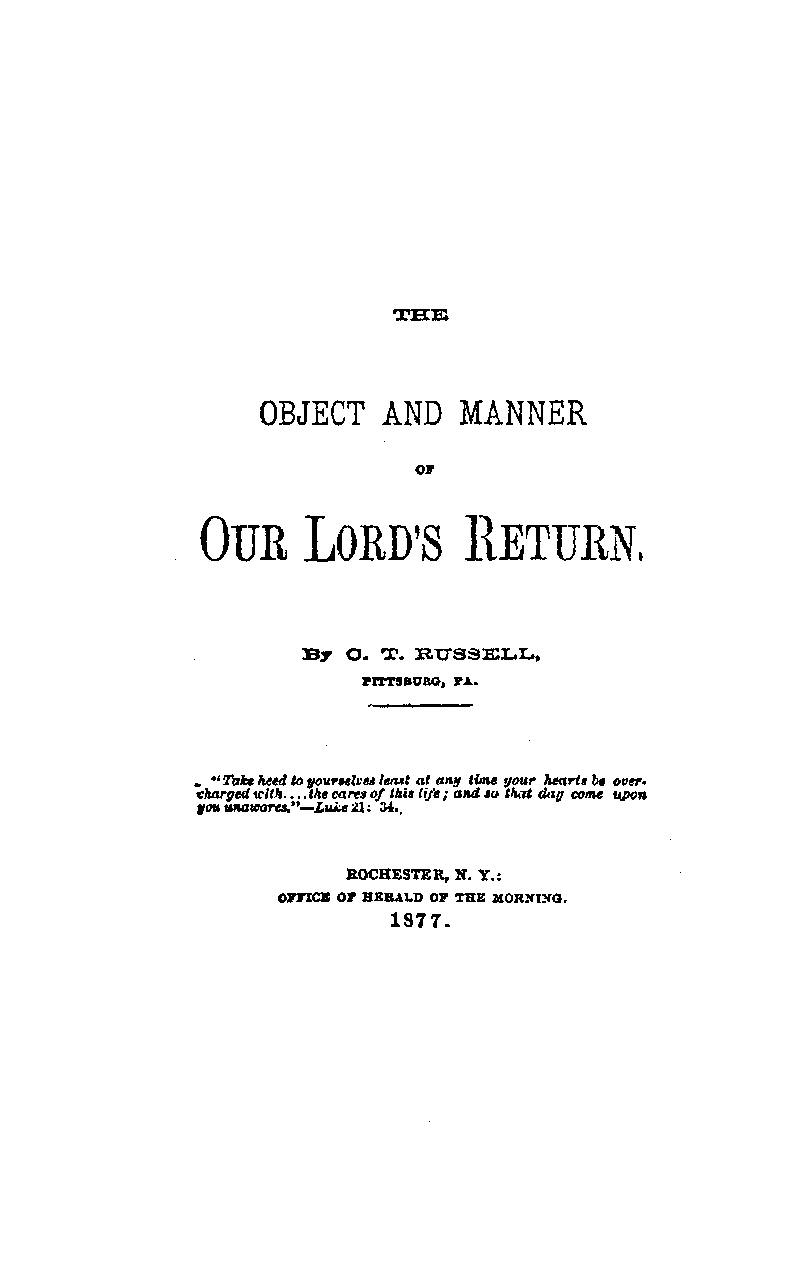
THE
OBJECT AND MANNER
or
Our Lord’s Return.
By O. T. RUSSELL,
FITTSBUBG, FA.
* '‘Take heed to yourselves leant at any time your hearts be overcharged with. ...the cam of this life ; and so that dag come upon you unawares."—Luke-Hi 34..
KOCH ESTER, N. Y.; oznos OF HERALD OF THE MORNING.
1877.
OUR LORD’S RETURN.
CHAPTER I.
THE OBJECT OF THE SECOND ADVENT.
That our Lord intended us as His disciples to understand, that for some purpose, in some manner, and at some time, He would come again, is, we presume, admitted and believed by all familiar with the scriptures. But the object of that coining is viewed from widely different standpoints, and seen in as various colors as there are glasses ; each observer honestly and sincerely desirous of seeing and understanding the subject correctly. We shall not attempt in these few pages to give all that can be presented upon this subject, but simply offer a sketch of what we understand the events and their order to be ;—giving as far as space will permit, the scriptural evidence favoring it. In doing so, we shall endeavor to exercise Christian courtesy, when referring to the views of brethren who differ with us.
The writer believes that in order to an understanding of this subject, it is necessary for us to have some clear conception of God’s plan for the salvation of the world of mankind. If we can obtain this, it will unquestionably give us information very valuable, in the consideration of our subject; for, In that plan, not only the first but also the second advent has an important place. Here a vital question arises, viz.:
HAS GOD A PLAN?
Or, did He in an idle moment frame this world, and biing us, His creatures, into existence simply to exercise His creative power ; entirely unmindful, or uncaring, what should be the result to us of that existence % Many who love the Lord with ali their hearts speak of Him and His work as though this were the case. They thiuk of the fall of Adam, by which “ Siu entered" the world and death by [or, as a result of] sin,” (Rom. 5 : 12) as an emergency entirely unexpected and unprovided for by the Creator.
Such naturally regard the salvation provided through our Lord Jesus Christ as an after-thought. God, having been thwarted by an agent of His own creation,—the Devil,—now sought to repair the mischief by providing a way by which a few of these creatures could be saved. Trhey regard the present and past contest between good "and evil, as a race between God and the Devil, in which, so far, the Devil has been the most successful. They hope and trust, however, that before the winding up of all things, the numbers of the saved will be greater than those of the lost: and so God, even without any plan, come off conqueror.
But, Christian friends, He who would rebuke a man for building a tower without first counting the cost, shall He build and people a world without counting the cost ? Nay, verily ; God has, and always has had, a plan—a purpose ; and all His purposes shall be accomplished. Ho works things after the counsel of His will.”
Not only is this true, but He has revealed His plan to us in “ the Scriptures, which are able to make us wise,” and given us His Holy Spirit to enlighten our understanding, “ that tee might knatc lhe things that arc freely given unto us of God.” (I Cor. 2 : 12.) Which things, neither the world nor carnally minded Christians can see (v. 14); they are revealed by the spirit in answer to dilligeat search. “If thou seekest after wisdom, and liftestup thy voice for understanding, yea: if thou searehest for her as men search for silver ; then shall thou find the knowledge of God.” When He, the Spirit of Truth is come, He shall guide you into all truth.
The Spirit does this as we have seen through the Word—the lamp. But God's word, the Bible, is a revelation not intended for one decade or century, simply ; but, to the conditions of His people, at all times and in every age. It is continually unfolding to us some new, fresh beauty, of which but a short time before we had not even dreamed. It is because of this continuous unfolding of truth, as it becomes “ meat in due season” to the hooseholdof faith, that under*auother figure the same word is compared to “ a lamp to our feet for, “ the path of the just shines more and more until the perfect day.” It shone some away back in Enoch's day, and has been increasing ever since; not, that light yesterday is darkness to-day ; but, there is more light to-day, by which we can still better appreciate that of yesterday.
Have we. as a church, all the light now ? Cer-
tainly not; nor will we have until the “ perfect day.’’ Whilst we reniemember,.then, that
“God moves in a mysterious way His wonders to perform
we should be ready and watching for the earliest glimpse of the next unfolding of llis revelation of Himself and His plan ; reraembeiing that
“ His purposes will ripen fast, • Unfolding every hour.”
We will now see what we can find of God’s plan revealed in His word, therefrom to judge of the object of our Lord’s return.
We lay down as a foundation, then,—whether the plan is so far unfolded that we can fully comprehend it, and see the connection which must exist between the past and present dealings of God and that plan, or not:—First, God has a purpose or plan. Second, That plan is based and founded upon love, for ‘;God is love.” (I John 4 : 8.)
We do not cast aside God’s justice, etc. ; but, whatever His plan it must comport with His character—Love—for, “ He cannot deny Himself.”
The Christian church is about equally divided upon the question of Election vs. Free Grace, or Calvinism vs. Arminianism ; a small number, proportionately, believing in Universalism or the final eternal salvation of all mankind. Doubtless, all familiar with Scripture know that each of these positions are supported by much scripture ; and yet, can they all be true ? Must there not he some comiecting link which will harmonize and reconcile them ? Surely this is the case, for God’s Word is not yea and nay. Let us examine the first two, Calvinism and Armin ian ism, separately ; the last, Universalism, is so flatly contradicted by much direct scripture, that we shall measurably pass it unnoticed. And what we have to offer on the others is not designed as a fling against any of the “ branches of the true vine but strongly expressed, to call special attention to the more uncomely features of those doctrines which their strongest advocates will concede are weak points.
Calvinism virtually says: God is all wise; He knew the end from the beginning; He had a plan which was to save a few, not from any merit in them, but of His sovereign choice He elected these to eternal life,—all others to eternal death. He could as easily save all men, but He docs not want to : He is able, but unwilling, to save any hyfc a few.
Armeniai'iLm virtually says . wxl loves all His creatures ; His tender mercies are over all His works. He is trying His utmost to save them all, but is not able :, only the very few, the “little flock.” Sin. slipped past Him, entered the world at the outset, and has gained such a foothold that only by the aid of His children can it be overcome, even in ages.
As before suggested, each of these, although apparently, antipodes, have some seriptual basis, and we believe, when properly arranged, are in harmony with each other.
We will now look at the Bible ; first nt a dark picture, then at a brighter one. Here we find that though little light was given as to man’s salvation and future happiness at the first unfolding of the
plan, even that little wag not given to the world at large—the masses—but to a few Patriarchs, among whom were Enoch, Noah, Abraham, Isaac, and Jacob. These were chosen,—elected,—not .alone from the world, but from among the other members of their families, as it is written: “Jacob have I loved, Esau have I hated.” [loved less.] Isaac alone of all of Abraham’s children was the child of promise. Of Abraham it is written, “Thee only have I chosen of all thy father’s house.” ’
At Jacob’s death, the principle of election changes,, but the fact remains. All of Jacob’s children are thereafter recognized as God’s representatives,—His church, or people. There on his death bed, the old patriarch blesses each of his sons and gives to Judah the sceptre,—symbol of nationality,—saying : “The Sceptre shall not depart from Judah, nor a lawgiver from between his feet, until Shiloh come.” TThis was fulfilled to the letter. That tribe represented the nation until Christ came. To this one nation God gave the Law, in which was shadowed forth the Gospel. This shadowy light, the Law, was given to no other nation orpeople'; it was exclusively to Israel, as we read : “You only, have I known of all the families of the earth.” We will therefore designate this the Jewish or Law age.
At the death of Christ another change takes place. The Law ends. lie made an end of the Law, ‘ nailing it to the cross,” and introduced a new dispensation,—the gospel of grace, under the law of the Spirit. This is not restricted to one nation, as was the law, but is free to all, to be “preached in all the World, for a witness” before this age ends. (Math 24 : 14). But although we are to know no difference in our presentation of it to all people, God has been guiding and directing its course. Under that direction, we of Europe and America, have been more favored than the inhabitants of other parts of the earth. Why did the light of truth and salvation, started by our Lord and llis apostles in Palestine, travel nothward and wesward through Europe and America, rather than southward and eastward through Africa and Asia ? Did it happen so ? oh no I Our Father is at the helm; He is guiding His truth.
True, now the bible is published in the language of every nation. It is now being u preached to every nation” : (not individual) but this we may say, has all been done during the present century'. Yet to-day, four out of five of the inhabitants of earth know not that Jesus died for them. Here is a sense in which God is even now electing. He elected to send the gospel to you and me anil our fathers, and He chose not to send it to yonder Hottentot and his fathers. But says one, God works by instrumentalities. He has been wanting His people to come to the work, and by giving of the money and talents which He so freely bestowed on us, we may, through missions, which He will bless, have the privilege of being coworkers with Him.
To much of this we can heartily assent. We believe that through us God is working; that He is pleased with our zeal in His service. But we cannot for one moment suppose that the eternal welfare of four-fifths of the human family is made to depend entirely upon the zeal and liberality of the other onefifth. No ! No I I The God of love, is not experimenting at the expense of the eternal happiness of the great mass of His creatures.
We see, then, that in some sense God has so far been electing the church. But why. He must have a purpose and object in so dointr. Tie has a plan, and doubtless it is far greater and grander than ever entered into the heart of man to conceive. What saith the scriptures ?
In the promise of God to Abraham: “In thee and in thyseed shall all the families of the earth be blessed,” God’s plan and purpose is stated in one sentence. Paul, in an inspired comment upon this promise, (Gal. 3), says, “ He saith not to seeds, as of many, but as of one, and to thy seed, which is Christ.” Is it Christ Jesus individually that is here referred to as the one seed ? No ; the apostle continues (vs. 29) if ye [the church] be Christ’s, then are ye Abraham’s seed, and heirs according to the promise, (as originally made to Abraham). We learn that God had us comprehended in IIis plan when speaking to Abraham. Not only Christ Jesus, the head of this seed, but they that are Christ’s—the little dock—as members of His body : and this one seed will not be complete until the last member of that body is perfected. This thought is maintained throughout the Epistles—Christ, “ the head of the bodv. the church.” (Col. I : 18. Eph. 1 : 23 ■ 4 : 12 : 5 :'25-32 I Cor. 12 : 12, 27. Rom. 12 : 5, etc.) The figure is carried yet further. We, His disciples, are spoken of as filling up the measure of Christ’s sufferings. (Col.
1 : 24. II Cor. 1:5. II Tim. 2:10.) And we have the promise, “ that if we suffer with Him, we shall also reign with Him.”
The promise, to which we are heirs, declares that when this seed is complete, all nation* shall he blessed in it. A promise made away back in Eden, that the seed of the woman should bruise the serpent’s head, crush evil and sin, is another to which we are joint-heirs. But did not Jesus do tins—bruise Satan— when he died ? No; the death of Christ and the subsequent persecution of the church are the “bruising of the heel.” Paul says, “ Satan is to be bruised shortly under the feet of the church,”--head and body, (Rom. 1G : 20). Again, the same thought is expressed under the figure of
THE BRIDE AND BRIDEGROOM.
The church is represented as a chaste Virgin, espoused to Christ (II Cor. 11 : 2). As such we are now betrothed, and have received the sea! of that engagement.—the first fruits of the Spirit. Not married, not the bride yet, but waiting and longing for that union with the Bridegroom. When He went away lie said, “ I will come again and receive you unto myself. He expressed it so in the parable of the “ Ten Virgins.” When “ the Bridegroom came, they that were ready went into the marriage.” There and then we shall enter upon the full realization of the u things which God hath in reservation for those that love Him.”
All, we presume, will agree with us, when we say, that no matter how much cnioynient we have prior to the resurrection, we certainly'wait until then for the full measure. The whole church or body is complete before the final rewards are given. lienee, when recounting the ancient worthies, the Apostle says : (Heb. 11 : 39, 40), “ They received not the promises that that they without usshould not be made perfect.” And, of Himself, when about to die, He said, UI have fought a good fight... .henceforth there is laid up for me a crown of righteousness, which the Lord, the righteous Judge, shall give me at that day; and not to me only, but unto all them, also, that love His appearing.” (II Tira. 4 : 8.). True, we now have and enjoy many blessings in Christ. Now we have the peace that the world can neither give nor take away. But all this is but a foretaste ; the weight of glory comes over there. We now, in a certain sensed have begun our othce, as Kings and Priests, conquering self and the lusts of the flesh, and “ offering up spiritual sacrifices unto God but it is only in the same sense that we are now spoken of as being risen with Christ, and seated with Him in heavenly places. By faith in Ris promises we anticipate' the glory and the rest that remains ; and although beset with trials and troubles in life, we have a "peace to which the world is a stranger.
When the Lord promises, saying, “ To him that overeometh, 1 will give to sit with me in my throne,” and k‘ to him that overeometh I will give power over the nations.” does He mean it ? Is he to sit on the throne of His glory ?” Will He take to Himself His great power and reign over the nations ? Surely, His word cannot fail; it will be as real a reign over the nations for us—the church—as for Him. God gave “ Christ to be the head over the bodyand 44 fie that hath freely given us Christ, will ’fie not with Him also freely give «s all things?” Yea, verily, brethren, we hare not realized “ our high-calling which is of God in Christ Jesus.” We are. called to son-ship of God, and not this alone, but to be joint-heirs with Christ Jesus our Lord. This is the little company whom God saw away back in Eden, through whom He-’ is shortly to bruise Satan and 44 ble.'S all the families of the earth.” It is this company to Peter refers, (Acts 15: 14) saying, *“ God did visit the Gentiles to take out of them a people for His name.” We are the Virgin, soon to receive the name of our Lord,44 a new name that no man knoweth save he that receiveth it”
It was for these Jesus prayed: (John 17) “ I pray not for the world” but for them thou hast given me, and “ not for these only but all them also which shall deKers on me through their word, u that they all may be one in me.” This oneness and unity the Lord did not expect in tills present time. He says He came to bring division. Consequently He is not disappointed nor thwarted in His plans. In the parable of wheat aud tares, He tells us that the enemy would sow tares among the wheat, and they look so much alike that we cannot separate them. “Let both grow together until the harvest,—the harvest is the end of the world” [aeon—a^e] then He will have them separated by angels.
Yet, as Jesus says “the Father heareth me always,” we may know that at some time they all will be one in Him. When ? At the resurrection, when we are united to our head, becoming the “one seed,” at the marriage when we are united to the Bridegroom and they twain become ox’E. But although this prayer was mainly for the church, yet Jesus loved the whole world. Yes, he died for the World, and they have a place in this prayer. But notice where. He prays for the church first, that they all may be made one in Him; then the object of the union is‘‘that the world may believe.’7 But the believing of. and prayer for, the World, is after the marriage of the chaste Virgin. For this marriage, ‘*we ourselves, that have the first-fruits of the spirit, groan within ourselves waiting for the adoption, to wit: the redemption of our body77; this cue body of which we each are members.
When we (the gospel church,) are redeemed, is God’s plan accomplished ? No. It is only begun. It is a grandif. a more lol ly plan. Not only do we groan for this consummation, but we have seen from our Lord’s prayer that the world lias an interest in it, and Paul positively assert*--,that uthe whole creation groaneth and travaileth in pain together.'7 What are they expecting ? Certainly not what v:e are looking for. They do not expect to form part of the body. No: “ the earnest expectation of the creature, waited for the manifestation of the sons of God.” (Bom. 8 : I'd.) Not Son of God. but sons. “Beloved, now are we the sous of God.:’
What interest has the world in our manifestation or shining forth ? Simply this,—Until we are manifested although we are the “light of the world/’ and it is blessed by this’light, which we are to let “so shine that men may glorify Our Father in heaven/’ yet how much more will it l*e blessed, when we “ shine forth as the sun in the Kingdom/’—when separated from the world as well as from the tares in the harvest. (Matt. 13 : 43.) If we now are a blessing to the world as light-bearers, poor and weak though that light often be, are we surprised that the hope of the world is this shining forth of the church ? Paul tells us why they wait and groan for our manifestation. “Because the creature itself also shall be delivered from the bondage of corruption into the glorious liberty of the sons of God.” That is, when the church hits been delivered from the present condition — subject to death—the bondage of corruption, then the world at large will have an opportunity in the same direction, —“ that the world may believe ” and as many as do so “ shall be delivered into the glorious liberty of the sons of God.” Sous, but not.joint-heirs. This will be the only distinction between them and us,—the gospel church.
God loves all his creatures, not because we love Him. but from pure benevolence. “God so loved the world” — while we were yet sinners. But He is a God of order. lie has a plan, and is carrying it out. During the past six thousand years, He has been getting ready,—preparing the instrumentality through which to bless the World. The time seems long to us mortals, but not so with Him who is from everlasting to everlasting.
This “ little dock ” who receive the Kingdom are butu the first-fruits unto God of IIis.creature3. (Jas. 1: 18. Rev. 14 : 4.) If there is a first-fruits there must of necessity, be more of a harvest, else the lan-Buage is senseless. Eph. 2 : 7, declares the object of od in our salvation to be, ‘‘That in the ages to come He might show the exceeding riches of His grace.”
But let us follow the church,—the first-fruits. We last saw her as the chaste virgin going into the marriage, when the bridegroom came. We next heartbe great voice of a multitude saying (Rev. 19 : 7.) “ Let us be glad and rejoice and give honor to God, for the marriage of the Lamb is come, and his wife hath made herself ready. We have heard of the marriage— listen I the ancel says to John (Rev. 21 : 9, 10). “Come hither, I will show thee the Bride, the Lamb’s wife?-7 We want to see her, let us follow. “And he showed me that great city, the Holy Jerusalem, descending out of heaven from God.” Are we to understand that this citv is a symbolic representation of the church ? Yes, just as in another symbol she is the “Temple of God.” But what of the precious stones of which it is built ? These are the same as the stones of the spiritual Temple ; i. e., living stones, —the same that Paul speaks of as “Precious stones” (1 Cor. 3.12), or the jewels of Mal. 3 : 17.
When this city “ shines'” the nations will walk in the light of it. Now they are blest by the feeble light of the church ; then they will walk in the perfect light which will shine from her. (Rev. 21: 24 ) There Hows a river—from under the throne—“a river of the water of life.” Not the ordinary kind of water. No, this is “water of life,” the kind the Lord promised to give us, and which Ue does give now to every one begotten. It shall be in you a well of water.” This kind of water would not flow in a natural river bed, but this same sort is here brought to our view' as flowing a broad, deep, mighty river. No longer the little well, no longer lontined’to the fewr, the “ little flock,” but‘; whosoever will” maypartake of it freely. There the Spirit and the Bride will say come, and he that heareth will say come. It will be free to all. But, notice when,* it is in the new heavens and new earth, (Kev. 21 : 1)—in the next dispensation. The church is not the Bride now, but a chaste Virgin. W hen she is married—united—she will be the Bride, and then it is that she says time to whosoever will
Oh, can we not pray from tt.e depths of ourhearts, come, Lord Jesus! come quickly I Shall w’e not, since we and all creation wait for it, rejoice at the sound of the Bridegroom’s voice, as He nears our dwelling? We do rejoice and lift up our heads, knowing that our redemption draweth nigh.
This is a glorious prospect for both the church and the world. But bow about those who died, not having heard the name of Jesus, who did not enjoy the privileges of light ? Must these all suffer the loss of eternal life and happiness with not even an opportunity to Jay hold on it ? Must they all go to heli, simply because they lived before Go“d’s plan had so far developed as to embrace them ? Or, shall we go to the other extreme and say, God will save all those who have never had light and truth ? If this be true, we have made a great mistake iu sending mis-slonaries with this light to the heathen. We know that when it is presented to them they do not all receive it and become Christians, and if in ignorance they would all be saved, we not only do them a positive injury but waste numbers of valuable lives and millions of money. And further, if God can consistently give these eternal life without a trial, or probation, why did He not give us all as good a lot, and save us all without our coming into the present probationary condition ; or why did He not kindly leave us all in the dark, and thus save all ?
Neither of these lines of human reasoning will stand the test. We must see what God’s plan-book, the Bible, has to say on the .subject. But first let us take a glance backward, and see about what proportion of our fellow creatures have a personal interest in the matter. We have seen that during the first 2100 years only a few Patriarchs were chosen. This brings us down to the time that the nation of Israel became God’s representatives, at the death of Jacob, the last patriarch. Of all others Paul declares,u-death reigned from Adam till Moses,”—or, until the Law, which was given to but one people ; and of these only a very few were saved; only those who could rise above the type and discern the antitype. The value of the Law in saving men may be gathered from St. Paul’s teachings. He ,says—“ that no man is justified by the Law is evident.” (Gal. 3 : It.) “By the deeds of the Law there shall no flesh be justified in His [God’s] sight.” (Rom. 3 : 20.) -For if righteousness come by the Law, then Christ is dead in .vain.” (Rom. 2 :*21.) “If the Law given could have given life, verily righteousness should have been by the Law.” (Kom. 3 : 21.) “For the Law made nothing perfect.” (Heb. 7 : 19.) “ Wherefore then serveth the Law ? It was added because of transgressions, till the Steed should come, to whom the promise was made.” (Gal. 3 : 19.) That is, the seed of Abraham not the fleshly descendants, for says Paul, “ the children of the flesh, these are not the children of God : but the children of the promise are counted for the seed.” (Rom. 9: 8.) Children of faith, Christ, and the church. (Gal. 3 : 29.)
Thus we learn that nearly all of the “ tittle dock” is being gathered during the gospel age. To-day, about one individual in five knows that Christ Jesus died for him. Until the present century, and during the dark ages, probably one in forty knew it. A fair calculation of the numbers who have never heard the Gospel, from Creation to the present time, would he about 120,000,000,000 souls.
Whether we can understand God’s dealings or not we may rest assured, “ the God of all the earth will do right.” But we are anxious to have the matter cleared up, if it can be, from God’s word. For, unquestionably, the facts already obtained from the Bible appear to clash directly with some of the plainest statements of Scripture. For instance, we read of Jesus, this is the true light that lighteth every fitan that cometh into the world.” How shall we understand such a statement ? Thousands of millions have not even heard of Him. Are we certain that hearing of Christ is essential ? May they not be saved by living up to the light of nature ? It is certain that they must hear of Christ before salvation, for, says Paul, “ How shall they believe on Him of whom they have not heard ?”
The conditions of salvation are “Believe in the Lord Jesus Christ and thou shalt be saved.” Again, “there is no other name given under heaven or among men, whereby we must be saved.” Must; if saved at all, it must oe in Him. If they could even do by nature man}' things contained in the Law, we have seen that “ the Law could not give life ;” “for by the deeds of the Law shall no man be justified.” Again we read, “ Jesus Christ, by the grace of God, tasted death for every man.” But if they never hear of it, and are never benefited by it, how can it be said to be “/or every man ?” Again, “ There is one God and one mediator between Gori and men, the man Cbrist Jesus : who gave Himself a ransom Jar all; to be testified in due time.”
Ah ! here we have it. God is a God of order. He has a “ due time” for everything He does, and when His “ due time” comes, it will be testified to all men that “ Christ died for the ungodly.” That true light shall yet lighten every man that ever came into the world. It certainly was not His plan to have it testified to them in the ages past, else it would have been done. But it will be testified in due time.
How we see a meaning in the statement, “ As in Adam all die, even so in Christ shall all be made alive.” I know that that these are texts used by Universalists, (but I am not a Universalist), but shall we not use them simply because they do ? No ; “all Scripture... .is profitable.” This is the time “ of restitution of all things,” mentioned by Peter, (Acts 3 : 21) of which he says “ God hath spoken by the mouth of all the holy prophets since the world began. This is not for the church, but for the world. The church gets something far better than a restitution. The whole human family get back in the second Adam all they lost in the first Adam. They did not lose eternal life or a spiritual existence in the first Adam, for he was a probationer for these himself, and as a stream cannot rise higher than the fountain we could not lose more through his disobedience than he possessed. There are two lives1—natural and eternal; and two deaths, temporal and eternal. He lost natural life and obtained temporal death. Consequently the restitution through Christ would only give to the world natural life and a natural body, at their restitution, such as Lazarus and Jairus’ daughter had when brought to life again. Of the church—the dead in Christ, at His coming—alone it is said, “ Sown a natural body, raised a spiritual body.” Ail others rise fleshly, natural bodies and liable to die again.
The Law contains no higher promise than that of natural life. “ That thy days may be long upon the land and no threatening more severe than temporal death. They “ that disobeyed were to be stoned or thrust through with a dart.” Eternal life or death are not mentioned in it. The Jews had an idea of a future life in Christ’s dav, but not from the law. The • 7
heathen had an idea also without any revelation.— simply a guess. For “ Christ brought life and immortality to light through the gospel.” (II Tim. 1: 10.) ’ If he brought it to light, it was not brought to light by Moses,
We fincl the matter clearly stated in Rom. 5:18, 19 ; “as by the offense of one [Adam] judgment came upon "all men to condemnation ; [death] even so, by the righteousness of one, the free gift came upon all men unto justification of life ; for as by one man’s [Adam’s] disobedience many were made sinners, so by the obedience of one [Christ] shall many be made righteous,” (i. e., justified to life as above).
They rise simply to have during the millennial age what ice have had during our lifetime, viz. : To hear of the love of God and death of Jesus for them, and to have an opportunity to accept of Him. They will not all receive Him, for we read of “a great company being cast into the lake of fire, the second death evenat the end of this millennial age (Rev. 20 : 9), when they have had a knowledge of the truth, which will then have been testified’ to every man.
Now we can understand I Tim. 9 :10. “ We trust in the living God, who is the Samur of all men, especially of those that belitce.” All men are to be saved from all they lost in Adam: while those that believe—the church—have an especial salvation—the eternal.
Not a second chance ; it cannot be another or a second change unless they have had one, and we have just found that so far the masses have had none; no! We advocate no second-chance for any man, but refer to Heb. 6 : 4, 6, and 10 : 26, 28—If we sin wilfully, turn our backs upon God’s salvation and the blood of the covenant, after we have received the knowledge of the truth, there remaineth no more a sacrifice for such. Christ died once for all, and it will be testified once, but He will die a second time for no one. “ He dieth no more.”
To the justice and mercy and love of this plan of God, when realized, we think the church and world can say “ Amen. True and righteous are thy judgments, Lord God Almighty.” It makes a harmony out of the various, heretofore conflicting texts of scripture ; we can see, now, how and why some were chosen or elected in Christ; how and when God is no respecter of persons, and the grace for all who will receive it with ample place for all the scripture supposed to teach universal eternal salvation, and with it all, begin to see a depth and scope to God’s plan we never before dreamed of. With Cowper we would say—
“ Judge not the Lord by feeble sense. But trust Him for His grace ;
Behind a frowning countenance He bides a smiling face.
w His purposes will ripen fast, Unfolding every hour;
The bud may have a bitter taste, But sweet will be the flower.”
When will this grand, glorious age of restitution begin ? Peter says, at the coming of the Lord ; u whom the heavens must receive until the times of restitution of all things which God hath spoken by the mouth of all His holy prophets since the world began.” (Acts 3: 21) We read of the restoration of Israel and other nations in Jeremiah, Isaiah, and the minor prophets : and also of the earth being restored to Edenic beauty, when the wilderness shall blossom as the rose, &e.; and the church, in general, believe in the restoration of a living remnant of Israel to their own land and to God’s favor, but as a rule they have never thought of the .prophecy embracing the dead as well as the living, and other nations as well as Israel. But these "things arc mentioned in the same Bible.
In Ezekiel 39 : 21-29, God tells how He has cast off Israel into captivity for their sins ; and “ there fell they all by the sword (v. 23) but lie promises to bring the whole house back into their own land. Then speaking of the gathering as accomplished, He says, “ I have gathered them into their own land, and left none of them any more there” (v. 2S). They fell by the sword, died, and He brought them all back again into their own land.
But Israel was a peculiarly favored people, says one. We remember Paul speaks of their restitution in Rom. 11: 25 to end. (Read carefully.) “ They are beloved for the father’s sakes therefore, they are all concluded in unbelief that God may have mercy upon all, and ihey are to “ obtain [this] mercy through your [the church’s] mercy.” Perhaps this restitution refers only to this people; not to all nations. David says : All nations which thou hast made shall come and worship before thee;” [Christ] Numbers of nations never yet worshipped, either from love or fear. The Sodomites were such a nation. Let us consider their case next Surely, they were a sample of the ungodly ; there was no special favor of God ever manifested toward them as a people, neither was there any remnant of them left, when God rained “ fire and brimstone from heaven and destroyed them all” And yet, of these Sodomites we read, (Exek. 16: 4S to 63) that Israel shall return to her former estate at the same time that Sodom and Samaria return to theft former estate (vs. 53 and 55). In verses 49 and 50 we are told what Sodom’s sin was ; and, says the Lord, u I took them away as I saw g<>od.” He saw good to take them away without their coming to a knowledge of Christ; it was not due time for that to be testified ; but it will be in the future. God proposes to bring them back to their former estate ; what they lost by sin and death entering the world through the first Adam is to be restored in the second, and they will have the same opportunity that be had, and better, in that the old serpent, the devil, Satan will be bound [or evil restrained] that he may deceive the nations no more until the thousand years are expired. But some one, not yet satisfied, says,perhaps God is speaking ironically, and means that he would as soon think of bringing Sodom and Samaria back as Israel. Friend, read caiefully vs. 60-63, and you will po longer think so; remember also that Sodom had been destroyed nearly a thousand years before this prophecy was made.
This helps us to understand—“ God is His own interpreter”—what Jesus meant when He said it would be more tolerable for Sodom in the day of judgment than for the Jews whom He addressee!; He declares that if the same mighty works had been done in Sodom, she would have’repented long ago. Well, Lord, why were such mighty works not done there, so that they had repented V It was not their due time; they were not on trial. In (their day of trial, when they are on probation for eternal life) their 4‘ day of judgment” (not a 24-hour day, but the millennial or judgment age) they will fare better thdn the Jews—have fewer stripes. “It will be more tolerable for Sodom in the day of judgment than for you.”
All must be judged or tried, and “ judgment must begin at the house of God”—the church. It did. Christ, the head, was tried in all points, yet without sin. We, the members of that house, are now on trial. We will not come into the judgment—or trial with the woild. “ We shall not come into condemnation, (judgment—Krisis) but are passed from death unto life because of faith we are covered by Christ’s righteousness; because of the blood of Christ, our Paschal Lamb, sprinkled on our hearts and having th it Lamb in us, we, the first born, are passed over.
But after the House, all the world will come into trial for life (judgment, Krisis). Those who accept of God’s conditions will be delivered from the bondage of corruption, into the glorious liberty of the sons of God, (Rom. S: 21) ; those who will not have the gift of God must die the second, the eternal death.
When the world is on trial we shall be the judges; for, “ know ye not that the saints shall judge the world ?” It is here that the parable or the sheep and goats is laid, when the son of man shall sit on the throne of His glory. It is during the millennial age that He does sit on the throne of His glory ; and the overcomers sit with Him in the throne. Then before Him are gathered all nations, and the sheep will be separated from the goats ; they do not stand in rows nor all at once any more than the church has while she has been on trial ; the separating being a gradual work dependent upon their acceptance or rejection of God’s grace and truth. The things of their past lives for which they must answer being inasmuch as ye have or have not done unto “ the least of these my brethren” (the church seated in the throne).
We conclude, then, that it was necessary that evil should enter the world, so that by contact with it and its results—misery and death—we might forever know good from evil. In no other way, perhaps, could God so fully make known to His creatures His various attributes—justice, mercy, love. etc.
In the age which ended with the flood, God measurably left mankind to themselves,without law or control. In the results — degeneracy and corruption, demonstrating to us, that unassisted our tendency is downward. During the Jewish age, the law was given—not to give life, u For the Law could not give life’’ but to show them and us how far short we come of perfection, even at our best; that so we might realize the necessity of salvation as a “ gift of God” which we could not merit by the works of the Law.
It was given “ because of transgression until the seed should come” (Gal. 3 : 19 and 29). It was simply a system of types, etc., “ a shadow of good things to come”—the gospel,—and served as “ a schoolmaster to [educate] bring us to Christ,” in whom alone we can receive eternal life. This brings us to the Gospel Age, when although the scope of the Law—in spirit, is broader, deeper and more comprehensive than the letter, yet we can be justified through faith ; “ For what the Law could not do, in that it was weak through the flesh, God sending His own son in the likeness of sinful flesh, and for sin, condemned sin in the flesh ; that the righteousness of the Law might be fulfilled in us who walk not after the flesh, but after the spirit” (Rom. 8 : 34.)
All these various parts of God’s great plan we find "working in harmony with each other, and with His own nature. In no other way could our minds recognize the justice of God in utterly destroying many nations before Israel—men, women and children— except that He “ slew great kings, for His mercy endureth forever.” “ He overthrew Pharaoh and his host, for His mercy endureth forever.” Tes, the fact that “ His mercy endureth forever” explains all this ; and it is twenty-six times repeated in this 136th Psalm. Now we can realize more fully than ever before, His wondrous love ; and as we kneel alone before Him we can feel that He is worthy of all homage and worship, for not only u God is Lore” and u His mercy endureth forever,” but when our substitute tasted death for all, “ lie is just to forgive.’? Our feelings are well expressed by St. Paul, when writing on the same subject (Rom. 11: 33)—44 O, the depth of the ruhcs both of the wisdom and knowledge of God ; how unsearchable are His judgments and His ways past finding out! For who hath known the mind of the Lora ?”
Truly the plan of God does show us the object of our Lord’s return. He comes to organize the one seed by which Satan is to be bruised—evil restrained and in which u ail the kindreds of the earth shall be blessed.”
He comes to glorify or set up His kingdom—the church—that as we have “ suffered with Him we may also reign with Him.” 4- That the saints of the Most High may take the kingdom under the whole heavens and possess it forever.” In taking possession, it “ consumes and breaks in pieces all these kingdoms [not the people but the governments] and it shall stand forever.” “Wait ye upon me, saith the Lord, for my determination is to gather the nations that I may assemble the kingdoms to pour upon them mine indignation, even all my tierce anger, for the whole earth shall be devoured with the fire of my jealousy. For then will I turn to the people a pure language that they may all call upon the name of the Lord to serve Him with one consent.” (Zeph. 3 ; 8). This chastisement of the world is not because God takes pleasure in human suffering, for 44 He doth not willingly afflict the children of men,” but for their good; and it is gratifying to learn that44 when the judgments of the Lord are abroad in the earth, the inhabitants of the world will learn righteousness.” When He hath made wars to cease unto the ends of the earth, bv the desolations which He hath made. (Ps. 40 : 8,” 10). When He has established His kingdom ; then “ peace shall flourish.” “ Nation shall not lift up sword against nation, neither shall they learn warany more.” Now “The devil is theprinceof this world.” Jesus said, “ My kingdom is not of this world,” but when “ He shall take unto Him His great power and reign.” when “ the kingdom is the Lord's and He is the Governor among the nations; [then. and not till then] all the ends of the world shall remember and turn unto the Lord, and all the kindreds of the nations shall worship Him.”
He comes now as “ the desire of all nations.” At the first advent there was no beauty in Him that they should desire Him.
lie comes to bring about the great restitution which was so beautifully represented and shadowed forth under the Law in “the year of Jubilee,” in which every man was restored to all His possessions, and to personal liberty. (Lev. 25 : 13.) The millennial reign is the great antitypieal jubilee, (the substance which cast the shadow in the Law) in which every man will have restored to him in the second Adam just what he lost in the first Adam, and have an opportunity to know God and to learn of that only name by which they can be saved—Jesus ; who tasted death for every man, to be testified in due time. Then the wilderness and the solitary place shall be glad, the desert shall rejoice and blossom as the rose, the glory of Lebanon shall be given unto it, they shall see the glory of the Lord and the excellency of our God. (Isaiah 35 : 1,2-)
Now we all suffer from the sin of Adam, and the errors of our ancestors, even the innocent babe of an hour old, but “ In thosd they shall say no more, the fathers have eaten a sour grape and the children’s teeth are set on edge ; but every one shall die for his own iniquity ; every man that eateth the sour grape, his teeth shall be set on edge.” “ The soul that sinneth, it shall die.” (Jer. 31: 29; 30 ; Ezek. 18 : 3.)
Shall we not, then, take up the strain which employed the apostles and prophets of old 1 Will the hope of the corning of the Bridegroom, which inspired with zeal the early church, uot now energize us to strive for the prize of our high calling which is of God, in Christ Jesus? Verily He that hath this hope in him puritieth himself. (1 John 3:3)
Lift up your heads, desponding Pilgrims, Give to the winds your needless fears ;
He, who bath died on Calvary's mountain,, Soon is to reign a thousand years.
Tell the whole world these blessed tldiugs. Speak of the time of rest that's Dear ;
Tell the oppressed of every nation, Jubilee lasts a thousand years.
What if the clouds do for a moment. Hide the blue sky where morn appears ;
8<»on the glad sun of promise given, Rises to shine a thousand years.
A thousand years earth’s coming glory, ’Tfs the glad day so long foretold ;
’Tis the bright morn of Zion's glory. Prophets foresaw In times of old.
CHAPTER II.
THE MANNER OF CHRIST’S SECOND COMING.
Having considered the object of our Lord’s return, the manner in which He will come becomes to all “ who love His appearing” one of great interest, and invites your attention. The reader will please bear in mint) that the subject is here treated abstractly, without the least reference to the time of the event, whether it be nigh, even at the door, or thousands of years future ; aud further, that the.^e pages were not written for the world, but for “ the household of faith” for those who accept the Bible as God’s word, and “ who by reason of use have their senses exercised.” (Heb. 5 : 14.) Experience has proven what {Scripture so plainly declares, viz. : that u the natural man receiveth not the things of the spirit of God he can understand the arguments but “ they are foolishness unto him. Neither can he know' them because they are spiritually discerned.” (I Cor. 2 : 14)
In order that we may have a good foundation, and as a basis for further investigation, we will first enquire, what is a spiritual hotly ?—w’hat powers are theirs, and by what laws are they governed? We are here met by the objections—we have no right to pry into the hidden things of God ; and, *4 Eye hath not seen, car heard, neither have entered into the
heart of man, the things which God hath prepared for those that love him?’ To both of these propositions we assent, but believe we cannot find out by studying God’s xvord—and our investigation will be confined to it—what He has not revealed. The above quotation of scripture, (I Cor. 2; 8) refers to the natural or carnal man, and by reading it, in connection with the three verses following it, the objection vanishes ; for, says the apostle, “ God hath revealed them unto us by His spirit,” which was given to us that “ we might know the things freely given unto us of Godand in the last clause of vs. 13, he gives us the rule by which we may know, viz. : “ Comparing spiritual things with spiritual.” We are very apt to invert this rule and compare spiritual things with natural, and thus get darkness instead of light Let us now use the apostle’s rule.
There is a spiritual body as well as a natural body; an heavenly as well as an earthly body ; a celestial as well as a’terrestrial. They are distinct and separate. (I Cor. 15 : 38-49.) We know what the fleshly-natural body is, for we now have such a one ; it is flesh, blood and bones ; for u that which is born of the flesh is flesh,” and as there are two kinds of bodies, we know that the spiritual is not composed of flesh .’blood and bones, whatever it is made of. It is a spiritual body, and “ that which is boru of the spirit is spirit.” But as to what material a spiritual body is made of, we know not, for it doth not yet appear what we shall be; but we shall be like Him? [Christ]
Angels are spiritual bodies. Christ was raised 3
from the dead a spiritual body ; this was His second birth. First, born of the flesh a fleshly body—for, “ as the children are partakers of flesh and blood, He also himself likewise took part of the same.” (Heb. 2: 14) He was “ Put to death in the flesh but quickened [made alive] bj' the Spirit.” He was raised a spiritual body. This resurrection was His second birth. He was the “ first born* from the dead,” “ the first-born among many brethren.” The church are those brethren and will have a second birth of the same kind as His* viz.: to spiritual bodies by the resurrection, when we shall arise in His likeness—being made “ Like unto Christ's glorious tody." But, this second birthf must be preceded by a begetting of the spirit—conversion—just as surely as a birth of the flesh is preceded by a begetting of the flesh. Begotten of the flesh—born of the flesh—in the likeness of the first Adam, the earthy ; begotten of the spirit—in the resurrection born of the spirit into the likeness of the heavenly, the second Adam. “ As we have borne the image of the earthly we shall also bear the image of the
•The first raised a spiritual body. Lazarus and others arose, natural, fleshly bodies and died again. The next to be raised spiritual bodies are “They that are Christ's at His eomlng.”
» fThe words translated begatten. begat and torn in our English Bibles, are all represented by the one word in the Greek, Genera ; consequently we must judge as to which is the proper word, by the connection in which we find it. “Now are we the Sons of God although not yet born, we are begotten sons ; so in the natural the embryo is a son before birth.
heavenly.” All who are begotten of the spirit are in a sort of embryo condition waiting for the birth. The head [Christ] has been born ; we are waiting for the adoption, to wit : the redemption of the body ; and, “ the whole creation groans and travails in pain,'’ waiting for the birth of the church of the first-born. We hope, then, by examining factwecordvd <»f angels, and of Christ after His resurrection to gain general information with regard to spiritual bodies ; thus “ comparing spiritual things with spiritual.”
First, angels can be, and frequently are, present, yet invisible ; for, the angel of the Lord encamp-eth round about them that are His and delivereth them and “ are they not all ministering spirits, sent forth to minister for them who shall be heirs of salvation?” (Heb. 1: 14.) Are you an heir of salvation? Then, doubtless, they have ministerd to you ; have they ministered visibly or invisibly? undoubtedly the latter. Elisha is surrounded by a host of Assyrians, his servant is fearful; Elisha prayed to the Lord and the young man’s eyes were opened and he saw the mountains round about Elisha full of chariots of fire and horsemen of fire [or like fire]. The Lord also when raised a spiritual body was present but unseen, for thirty-three days and forty nights (only appearing seven limes to His disciples).
Second, Angels can and have appeared as men. The Lord and two angels appeared to Abraham, who had a supper prepared for them, of which they ate. At first, Abraham supposed them to be “ three men,” and it was not until they were about to go that he discovered one of them to be the Lord, and the other two angels, who afterward went down to Sodom and delivered Lot (Gen. 18: 1.) An angel appeared to Gideon ns a man, but afterward made himself known. An angel appeared to Samson’s mother and father ; they thought him a man until He ascended up to heaven in the flame of the altar. (Judges 13: 20.) • The angel of the Lord appeared to Moses as a flame of fire : and, “ behold the bush burned, yet was it not consumed.” The angel of the Lord appeared to the children of Israel in the wilderness as a cloud bv day and a pillar of fire by night (Exodus 13 : 21 and 14: 19.) And doubtless many similar cases will recur to the mind of the reader. In some of these cases given, they appeared as men; but “ the Lord is not a manf” neither are angels men.
Third, spiritual bodies are glorious in their normal condition ; frequently spoken of as glorious and bright. The countenance of the angel who rolled away the stone from the sepulchre “ was as the lightning.” Daniel saw a glorious spiritual body wliose eyes were as lamps of fire, his countenance as the lightning, his armsand feet like in color to polished ■brass, his voice as the voice of a multitude; before him Daniel fell as a dead man. (Daniel 10 : 6.) John, on the isle of Patmos, saw Christ’s glorious body, (Rev. 1: 14) and describes the appearance in Almost the same language—His voice was as the sound of many waters, His eyes as lamps of fire, His feet like fine brass as it burns in a furnace, (so bright that you can scarcely look at it), John falls at His feet as dead ; but He said to Him fear not; I am He that was dead ; behold I am alive forevermore. Saul of Tarsus saw Christ’s glorious body. It shone above the brightness of the sun at noonday. Saul lost his sight and fell to the ground, &c.
We have thus far found spiritual bodies truly glorious ; yet. without a miracle, either the opening of our eyes to see them, or their appearing in the flesh, as men, they are invisible. This conclusion is further confirmed when we examine the more minute details connected with these manifestations. The Lord was seen of Saul alone, “ they that journeyed with him....seeing no man.” (Acts 9: 7.) The men that were with Daniel did not see the glorious being he describes, but a great fear “ fell on them and they ran and hid themselves.” Again, this same glorious being declares : (Daniel 10: 13) “ The prince of Persia withstood me one and twenty days.” “ Daniel, the man greatly beloved” of the Lord, falls as dead before this one whom Persia’s prince withstands one and twenty days I How is this ? Surely, He did not appear in glory to the prince ; no ; either He was invisibly present'with him, or else He appeared as a man.
But Christ is also a spiritual body since His resurrection. During the forty days of His presence before ascension, He appeared some seven or eight times to His desciples ; where was He the remainder of the time ? Present, but invisible. Notice also, that in each instance He is said to have appeared, or fie showed Himself, language never used of Him before His change from a natural to a spiritual body; now as angels He appeared. Not only so, but He appeared in different bodie’: as the gardener to Mary; “ after that. He appeared in another form, to two of them as they went into the country.” (Mark 16: 12.) Afterwards He appeared in a body, either the same or like the one crucified, having the marks of the spear and the nails. “ He came and stood in their midst, the doors being shut.” On these various occasions He appeared^ talked with them, then vanished out of their sight as the wind : they could not tell whence He came nor whither He went. “ So is every one that is born of the spirit.” When we are born of the spirit, (at the resurrection) we can do so also, AU spiritual beings exhibit this same power. But Jesus said : “handle me ; for a spirit [pnewma] hath not fash and bones, as ye see me have” and He ate with them. True : 1 believe it. So did the an-fels [mic'mia] (Ileb. 1: 7), appear as men in flesh. and ones ; they ate also ; their spiritual bodies did not eat, nor were they flesh and bones, but the body in which they appeared was flesh, and it ate. The disciples ditl not .>ee Chri-t’s glorious spiritual body; but as He appeared in a fleshly body. St. Paul teaches us distinctly that Chrht was raised from the dead a life-giving spirit, [pneuma. the same word used by our Lord.) (I Cor. 15 : 44, 45.) But where did He get the various bodies in which He appeared ? I cannot answer you ; but I believe, and you do also, other tiiiujs which we cannot understand. I cannot understand koto that grain of wheat grows. Yet I know it does. I know not how Christ turned the water into wine, or healed the sick, or raised the dead. Yet I believe that He did these things, Can you tel! me where He trot the clothes He wore after His resurrection? “ They parted His raiment anions them, and for His vesture they cast lots”—the old were gone, and the linen cloths lay in the sepulchre. Is it more difficult for spiritual beings, with their powers, to create a covering of flesh than a covering of cloth ? No ; the same power can and did do both
Thus we have found Christ’s spiritual body like those of angels ; glorious, yet invisible to mortals, with power to manifest the glory, or appear as a man or in any form He may choose.* In the resurrection we shall be like the angels ; and ‘‘ like unto Christ’s glorious body.” We shall be like Him ; for, [not ’til then] we shall see Him as He is,” for though we have known Christ after the Jlesh, yet now henceforth know we Him no more.” [after the flesh.] (II Cor. 5 : 16.) Such a spiritual being was Christ, at the time of His ascension, and with what we have learned of the powers of that spiritual body, we are now, we hope, prepared to enquire :
“ HOW WILL HE COME AGAIN ?”
Briefly stated, we believe the scriptures to teach, that, at His coming and for a time after He has come, He will remain invisible ; afterward manifesting or showing Himself in judgments and various forms, so that “ every eye shall see Him.”*
•This scripture does not necessarily teach that every eye will see Him at the same mmnent. A similar statement is made of the Resurrection. “ All that are in their graves hear the voice of the Son of Man and come forth.’’ Taken by Itself this seems to teach of the resurrection all al once. Yet wo
“ Every eye shall see Him” as He will appear ; but “ without holiness no man shall see the Lord ” as He is. ‘‘We shall see Him as He is, for we shall be like Him.”
SOME OF THE SCRIPTURE PROOF.
“ Behold, I come as a thief,r is the way He frequently spoke of His coming to His disciples. He comes ,:us a thief” for the church — the waiting virgins ; both “ they that sleep in Jesus”—the first resurrection—and “we, who are alive and remain,” “shall be caught up io meet the Lord in the air; so shall we ever be with the Lord.”
“ Forever with the Lord, Amen, so let it be ;
Life from the dead is in that word, *Tfs immortality.”
u In that day two shall be in the mill, two in the field, two in bed ; one be taken and the other left”— like Enoch, who “ was not, for the Lord took him.” The world will go on with its affairs, unconscious of the great changes of dispensation. But will they not miss the church ? So many? Nay, but so few of the church. It is only the overcomers that sit on the throne. It is but a “ little Jlock to whom it is the
learn that “ Blessed and holy are all they that have part in thefirnt resurrection.” So all shall be cognizant ot His presence though not all at the same moment. ** lie will l>e revealed in naming fire taking vengeance:” whether this refers to the “ tire of His jealousy—wrath—by which the whole earth Is to be devoured,” (Zeph. 1: IS & 3: 8) or an appearing In a visible flame as the angel appeared to Moses in the bush, is not clear. We Incline to the former.
Father’s pleasure to give the Kingdom.” These ere “ the Temple these “ the Bride “these follow the Lamb whithersoever He goeth ;” “ these are redeemed from among men, and are a first fruit unto God and the Lamb.” (Rev. 14: 6.) These have obeyed the Master's injunction : “ Take heed, least vour hearts be overcharged with the cares of this life, and so that day copie upon you unawares ; for as a snare shall it come upon all them [who are over-charged] that dwell upon the face of the whole earth.” (Luke 21 : 35.) These are “accounted, worthy to escape all these things (“the day of wrath on the world;” “ the time of trouble such as was not since there was a nation”)—They “ stand before the son of man.” But there are numbers of overcharged Christians who will not be counted worthy to escape (caught up to meet Him) ; servants, but not overcoming servants: not hypocrites, but “they shall have their portion with the hypocrites.” They did not build “ with gold, silver, precious stones,” and do not have the abundant enhance; but they built upon the rock and “ themselves shall be saved, as by fire.” Many will be purified of their dross in that fire. “ When the judgments of the Lord are abroad in the earth, the inhabitants of tire world will learn righteousness.”
…