Light After Darkness (1917)
Download: PDF — Light After Darkness (1917)
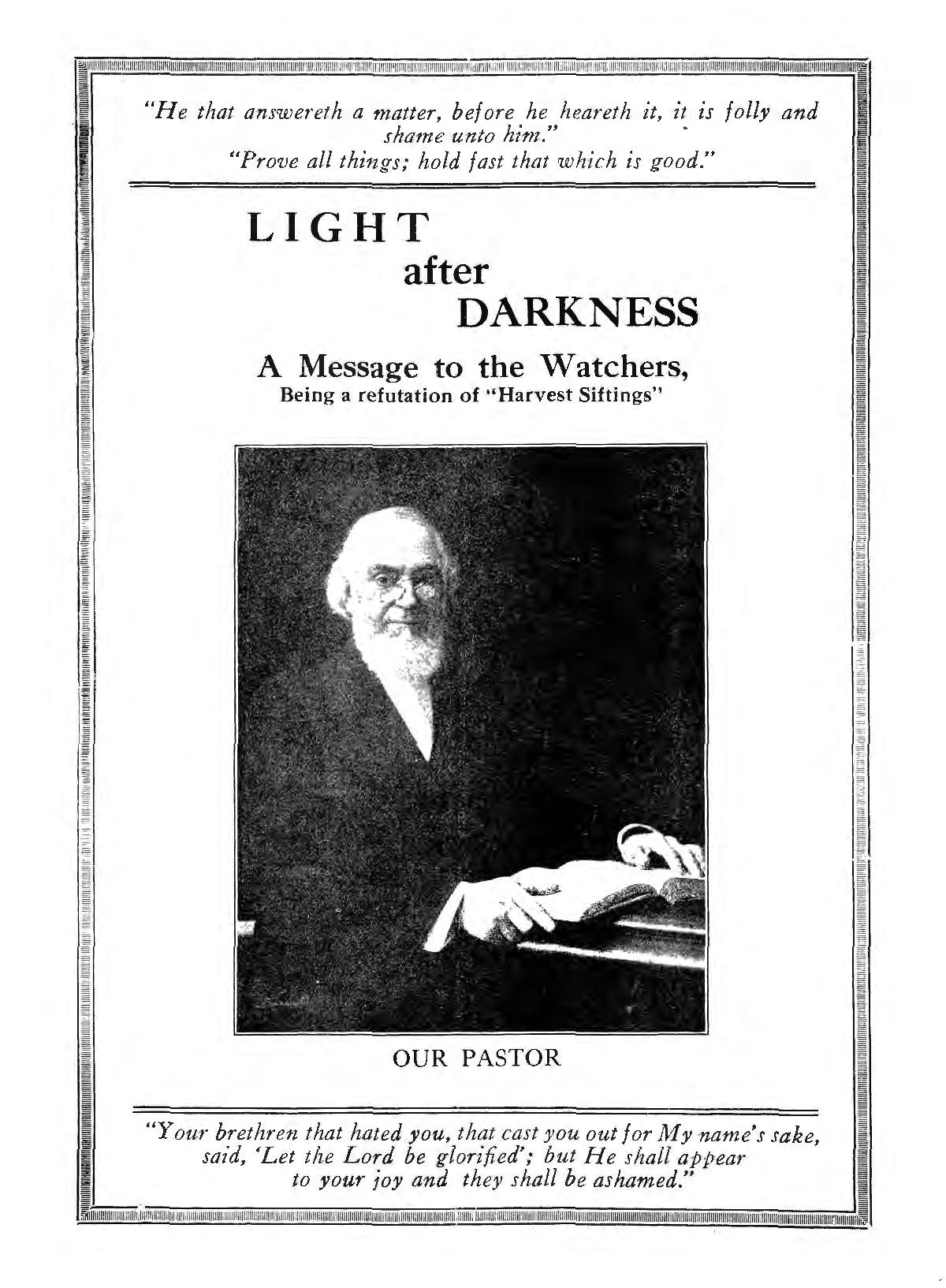
Being a refutation of “Harvest Siftings
OUR PASTOR
after
DARKNESS
Your brethren that hated you, that cast you out for My names sake, said, ‘Let the Lord be glorified’; but He shall appear to your joy and they shall be ashamed.”
He that answereth a matter, before he heareth it, it is folly and shame unto him.”
“Prove all things; hold fast that which is good.”
Our Present Counselor
E ARE LIVING in a time when, if it were possible, “the very elect” would be deceived, but God’s Word, our safe guide, assures us that this cannot be done, even though the Adversary should use some of his ablest instruments for that purpose. Jesus’ safety was found in what was written, and that constitutes our security also. We are not ignorant of the devices of our Adversary.
In New Testament days he used letters and words and spirits purporting to come from the right source and through the Lord’s channel in order to deceive the early Christians, but this was unavailing. He even caused some of his ablest ministers to write letters that were so nearly
like the writings found in the Holy Scriptures that some could not tell them apart, and consequently accepted them as inspired writings. This gave rise to the Apocryphal books, which may be found in the Catholic Bibles between the Old and New Testaments.
This should cause the Lord’s people to be especially on guard at this time, when we are so near the end of the way, entering into Gethsemane, previous to the binding of Satan.
One of these pseudo-writings may be found in a document recently published and mailed to the friends all over the world, entitled “Harvest Siftings,” which is an imitation and counterfeit of our dear Brother Russell’s Harvest Siftings, but a careful examination of the two writings bearing the same title will reveal the fact that they are entirely different. Brother Russell’s Siftings was a real thing; the latter is a deception. Brother Russell’s production was for the purpose of giving a plain, simple, straightforward, loving, Christian-like explanation of certain false charges which had been made by certain ones who had conspired against him. This latter document is altogether different. It is written for the purpose of condemning Brother Russell’s fellow-servants, and is the work of a Prosecuting Attorney rather than that of a Christian. In the one instance the Adversary attempted to disrupt the work of the Society by a conspiracy of brethren who were sifted out; in this instance he has proven a little more successful through the processes of usurpation, casting out faithful brethren, and then saying, “The Lord be glorified.”
This pseudo-“Siftings” is nothing but a legal document to prove what a wonderful President the Society has—a supposedly real hero who has saved the Society from being wrecked, whereas in reality it is a covered effort to overcome Brother Russell, as represented in his fellow-servants, to the extent of splitting the Church, and the usage of the Lord’s money contributed by His consecrated people. Brother Rutherford is using the Lord’s money in this way. He is using the Lord’s people, and he is using consecrated time and talents in the same direction.
If you will carefully scrutinize his so-called “Siftings,” you will readily observe that it has every ear-mark of the Lawyer, the Counselor, the Prosecuting Attorney. It is a lawyer’s business to accept his client’s case for money considerations, and to do everything in his power to prove his case. Lawyers argue on only one side of a case, and that is always their side—the selfish one. It is not a matter of strict justice (as it ought to be), but a matter of winning the case by arguments. To accomplish this purpose, such arguments only will be used that tend to establish their point. All other points will be suppressed, ignored, and omitted, and, at the same time, they will do everything they can to overcome the arguments on the other side, no matter how true they may be. Besides this, statements of witnesses are ofttimes colored to suit their case, and misrepresentations are frequently indulged in. In these, and in other ways, they either win the case, or come so near to it that their client seems satisfied, unless an appeal case can be worked up. You will find all these things used in this so-called “Siftings” to prove a point and to show what a wonderful champion the Society (Rutherford-Van Amburgh) has found in Our President.
He has set himself up as the Counselor of the Church, and this is the kind of counsel he is giving them. It might be well to notice in this connection that this word Counselor is one of the titles of the Lord Jesus, and is one of the principal works of the Advocate, and was never previously recognized as an office in the Church.
We are confident that the friends do not wish the money they have contributed for the spread of the Truth to be used to propagate falsehoods and to push the Primacy so as to split the Church. Neither do they wish the name, memory, contributions, sacrifices and prestige of our dear Brother Russell to be used in this manner. Therefore, we are inviting your careful and prayerful consideration of the facts stated in the writings herewith sent forth to the Lord’s people in His name, which, we believe, will be one of the means the Lord will use at this time to shield and protect His people—His sheep—from those that would otherwise devour and destroy.
“Grace and peace be multiplied unto you through the knowledge of God and of Jesus Our Lord.”—2 Peter 1:2.
“LET THERE BE LIGHT!”
"No weapon that is formed against thee shall prosper; and every tongue that shall rise against thee in judgment thou shalt condemn. This is the heritage of the servants of the Lord, and their righteousness is of me, saith the
Lord.”—Isaiah 53 :17.
J. F. Rutherford {
W. E. Van Amburgh f
I.
vs. R.
A. N. Pierson
F. Hoskins H. Hirsh
J. D. Wright A. I. Ritchie
ITTLE did we think when we looked upon the dead body of our great leader, Pastor Russell, less than nine months ago, that in so short a time it .would become our painful duty to sound an alarm to the Lord’s people everywhere, in the statement we are now- about to make. Little did we then think that those who would undertake to manage the affairs of the Society after Brother Russell’s death would attempt to pervert and change the time-honored
customs and usages left us by our dear Pastor, or that there would be introduced such flagrant and sweeping departures from the form of government as outlined in Brother Russell’s Will and in the Charter of the Watch
Tower Bible and Tract Society, written by his own hand.
For months past we have been hoping to avert the present issue, and now it is necessary that we relate to you the history of the unhappy circumstances which have led up to the present trouble. Even now, we would hesitate to speak of these things were it not for the fact that certain brethren, whose names we -must herein mention, have sent out broadcast lengthy statements which have distorted the facts and which are calculated to mislead the Lord’s people with regard to the true situation at headquarters. Accordingly, we have received- hundreds of letters requesting a true and complete explanation of the affairs and happenings here. Failure to correct the misleading statements and tell you the truth would surely mean a culpable neglect on our part to fulfil our solemiv and sacred duty to protect and safeguard the interests of the Lord’s flock.
The Watch Tower readers have received a paper styled “Harvest Siftings.” It bears the signature of the President of our Society, J. F. Rutherford. Several facts are apparent at once to the minds of all who have read this paper carefully, namely:
(1) That the author has attempted to assassinate the good reputation of some of his brethren, Directors of the Watch Tower Bible and Tract Society, who for many years under Brother Russell occupied positions of trust in the work of the Society.
(2) That the Author of ‘Harvest Siftings,” while knowing that St. Paul enjoins, “speak evil of no man,” has seemingly lifted all restraint from his tongue and pen and throughout his paper has carried on a campaign of slander and evil speaking.
(3) That while on page one of his “Siftings,” Brother Rutherford declares that God is his Judge, he seems unwilling that God shall judge his brethren, but proceeds himself to be their judge and to unmercifully condemn- them.
(4) That while on the first page of “Siftings,” our brother says he has no unkind feelings toward anyone, he proceeds to express, time after time, unkind sentiments toward these brethren.
(5) While in the concluding paragraphs of his paper, he exhorts that no bitterness be allowed to come in, he has repeatedly said many things therein to arouse bitter thoughts in the minds of the Lord’s people.
' (6) That throughout his statement our brother has attempted to link with Brother Johnson’s affairs in England the proceedings of the majority members of the Board of Directors, and that without there, being any relationship whatsoever and in face of repeated protests on our part.
(7) That on the first page of “Harvest Siftings,” top of second column, the author exhorts “that you do not form any distinct opinion until you have read all this statement”; the inference being that you should immediately form a distinc* opinion after reading his statement.
We have too much confidence in you, dear brethren, to think that after following the leading of the Lord under Brother Russell, many of you for years past, you could at this late hour be so misled as not to be able to discern between this and the spirit of the wise man of old: “He that answereth a matter before he heareth it, it is folly and shame unto him.” —Proverbs 18:13. See Vol. VI, pages 293, 294.
We would not publish this article merely in defense of our name. We have nothing that is not fully devoted to the Lord and the Truth; we suffer because of our faithful effort to serve these and you, and realizing this, we are not distressed. “We know whom we have believed and are persuaded that He is able to keep that which we have committed unto Him against that day.”
THE PURPOSE OF THIS PUBLICATION
The purpose of this explanation is not to retaliate, either, for, by the Lord’s Grace, we trust to follow the example of Jesus, “who when He was reviled, reviled not again.” Therefore, we will leave out personalities and bitter words in the presentation.
We believe that it will not be speaking evil to confine ourselves to some of the official acts of the President of the Society, for every voting shareholder has a right to information of this character. Our only purpose, dear, brethren, is to set matters before you in such a manner that you may see the facts and principles involved and be prepared to recognize the Lord’s leading and guidance through this fiery trial, .to the-intent that you may endure the same, without any real injury.
Herewith we set forth the salient points that you may be assisted in following the events up to the present sad crisis:
(1) That during the lifetime of Brother Russell, he exercised complete control and management of the Watch Tower Bible and Tract Society, and all of its affairs, for the reason that he created the Society with his own money and intellect under the special guidance of the Lord’s spirit, which he possessed in large measure.
(2) That as he looked forward to his death, it was not his thought that he would have a successor in this special office, but rather that the Board of seven Directors should “come to the front” and be his successor, and exercise complete management of the Society and its affairs.
(3) That the Charter of the Watch Tower Bible and Tract Society, written by Brother Russell, stated in plain terms the form of government by which the Society was to be governed. This, he declared, was intended to apply especially after his death.
(4) That at his death, Brother Russell left a will (see “Watch Tower,” December 1, 1916), in which he explains why he had control of the Society during his lifetime and the manner in which he desired the affairs to be continued after his death.
(5) That Brother Russell had not been dead more than a few days when his Will was declared to be illegal and, therefore, not binding, and that its provisions need not be observed by those who took charge, thus beginning the real murmuring against Brother Russell’s arrangements, which has" continued ever since.
(6) That Brother Rutherford, being well assured in advance that he would be elected President of the Society, drew up some by-laws before his election, which were taken to the shareholders’ meeting at Pittsburgh, January 6, and placed in the hands of a committee of three brethren, with the instruction that they suggest before the shareholders’ meeting that these by-laws be adopted by the Society for the government of its affairs.
(7) That these by-laws, prepared by Brother Rutherford, expressly stated that the President should be the executive and manager of the Society and that he should have full charge of all its affairs, both in foreign lands and in America.
(8) That the passage of these by-laws, under Brother Rutherford’s instructions, by the shareholders was contrary to the Charter of the Society, and, hence, not binding, since the Charter provides that “the Directors shall have full power to make by-laws.” (See charter, Sec. VII, elsewhere in this pamphlet.)
(9) That Brother Rutherford, knowing that these by-laws, recommended by the shareholders, were not legal, on returning from the election called a meeting of the Board of Directors, at which there were present Brothers Rutherford, Van Amburgh, Pierson, Ritchie and Wright. Brother Hoskins, being ill, was absent, and Brother Rockwell had just removed from Bethel. At this meeting of the Board, these by-laws, placing the control in the hands of Brother Rutherford, were adopted thus making them legal.
(10) That the Brethren present at this Board meeting who took part in the adoption of these by-laws, not being able to forecast the future, and not surmising that our brother would misuse the power, thought best at that time to take this action.
(11) That not many weeks had passed before there were misgivings in the minds of several of the Directors as to the wisdom of the action taken, and though they expressed no immediate protest, they recognized that they had placed altogether loo much confidence in Brother Rutherford in giving him such sweeping control, for they saw that he was interpreting the by-laws to mean that he alone was the controller of the Society to the exclusion of the Directors.
(12) That one of the seriously objectionable results of this power in the hands of the President was that he appointed a special representative, Brother A. H. Macmillan, who for two months previous to this time, since Brother Russell’s death, had shown himself unfit to represent the Society and its affairs in such an important position, and that to this special representative was delegated autocratic powers by the President, so that in the absence of the President, the word of his special representative was declared to be final on all matters, much to the sorrow and discomfort of many of the force.
(13) That instead of properly representing the Society and assisting the President in preserving inviolate its charter and Brother Russell’s will, Brother Macmillan did the very reverse. He apparently viewed Brother Russell’s Will as a mere trifle, not worthy of consideration, and time after time as he visited various parts of the country, he held up the Board of Directors to contempt and ridicule.
(14) That instead of the President exercising restraint over his special representative, he apparently sanctioned his unseemly conduct, as indicated in his statement in “Harvest Siftings,” page 11, where he says Brother Macmillan “has proven faithful and loyal.”
(15) That after three months or so had passed, it became clearly evident to the majority of the Directors that they had seriously blundered in placing the complete control in the hands of one man, contrary to the charter ('article VI of which reads: “The corporation shall be managed by a Board of Directors, consisting of seven members”), and that under this one-man rule the Directors were not allowed to direct, and could get little or no information regarding the affairs of the Society, for which the laws of the land held them responsible.
(16) That Brother Van Amburgh is the only Director who has fully supported the President in his methods and policies; whereas prior to Brother Russell’s death, Brother Van Amburgh frequently opposed Brother Russell in the business that he brought before the Board for consideration, thus taking hours of Brother Russell’s valuable time; and that since Brother Russell’s death, Brother Van Amburgh has given his undivided support to Brother Rutherford, and is permitted to exercise more authority than ever before; and has repeatedly refused members of the Board the privilege of getting information from the Society’s records.
(17) That prior to the time of Brother Johnson’s return from England, in the early part of April, things had not been running smoothly and to the satisfaction of the Board of Directors, and that Brother Johnson’s return had nothing whatever to do with the real issues.
(18) That when Brother Johnson returned to America he appealed to the Board of Directors for a hearing of the difficulties in England. Two hearings were allowed by the President, neither of which was an official Board meeting, and in neither of these was Brother Johnson given more than slight opportunity to state his case.
(19) That when Brother Johnson requested time and again that the President call a meeting of the Board to give him a fair opportunity to state his case, the President became angered and told Brother Johnson and the Board it was none of their business, that the management was all in his hands, and that he had closed up the matter of Brother Johnson’s affair and would not open it again.
(20) That when the members of the Board saw this attitude on the part of the President, which was but another exhibition of the same autocratic powers which he had many times exercised since his election, they concluded it wise to take counsel together and earnestly prayed over the matter, the result of which was that at the next Board meeting, one of our number offered a resolution to amend the by-laws which the Board had unwisely adopted early in the yean
(21) That the purpose of the Directors in wishing to amend the by-laws was not that the four members of the Board might take over the control of the Society, but that the Board might be restored to its proper position, according to Brother Russell’s will and charter.
(22) That when this resolution was offered to rescind the objectionable by-laws, the President was greatly angered and offered such strenuous opposition that the Board yielded to his suggestion to hold the matter over for about a month.
(23) That meantime the President took a trip West and completed the scheme by which he has attempted to declare illegal and put off the Board four of its properly constituted members, three of whom for many years past were recognized by Brother Russell as legally chosen Directors.
(24) That the President’s declaration that these members of the Board have had no legal standing as Directors for years past, would mean, if true, that Brother Russell has been transacting “illegal business” through an “illegal Board” for many years.
(25) Be it known, therefore, that Brother Rutherford in his “Siftings” has beclouded the real issues by claiming that the Directors have espoused the cause of Brother Johnson and want to send him back to England, when we had no desire or intention of doing anything of the kind; and be it further known that Brother Johnson is in no sense the cause of our differences here at headquarters.
(26) Be it known further that we had no thought whatsoever of interrupting the affairs of the Society by tying up its funds, as Brother Rutherford charges us, but merely to make them subject to the Board’s direction; and that no thought could be farther from our mind than that of wrecking the Society. God knows our hearts and our intentions. Instead, we have been for many years engaged with all our heart and strength in supporting the Lord’s work and in extending the influence of our Society and the Truth, which we all love so much. Our aim from first to last in this respect has been to fulfill the duties of our office, to which three of us were appointed under Brother Russell, and to faithfully fulfill the trust reposed in us; and to estop, if possible, a gross and wholesale departure from Brother Russell’s Will, his Charter, and the policies outlined by him to be followed after his death, to all of which the Directors solemnly bound themselves.
We do not cease to rejoice in the Lord and to give thanks for all the fresh evidences of our acceptance with Him which we have enjoyed during our recent trials. Our privileges are. it is true, somewhat curtailed; but be assured that we stand always ready to serve any of you.
“TRUTH CRUSHED TO EARTH SHALL RISE AGAIN”
[TH ALL of the mighty power of the Society at his back—the consecrated financial power and the moral power—the President of our Society has done his best to crush to the earth four brethren whose loyalty to the Lord, the Truth and the brethren no one ever before questioned. All of them have been in the service of the Truth for many years, and to none of them was the finger of scorn ever before pointed. They worked faithfully with their beloved Pastor until his death, and took
up their duties with the new President with renewed determination to support him as loyally as they had supported Brother Russell. This they continued to do until they saw that the Charter, Will, and all would be so completely subverted that there might be little left if they did not at once make protest.
It is probably sufficient to say that Brother Rutherford’s “Siftings” contains more than a hundred untruthful charges and misleading statements, all made, too, on Watch Tower paper, printed at considerable expense, and sent out from the Tabernacle, the home of the Truth.
BROTHER RUSSELL’S WISHES
The real issue, dear friends, is: Are we to remain faithful to Brother Russell’s memory, his methods and his plans for the work? In view of the fact that Brother Russell concluded to turn over to the Society all the Lord’s goods, as a “faithful and wise steward,” he first had an understanding with the Board of Directors, reference to which is made in his will, as follows:
“In view of the fact that in donating the journal 'Zion’s Watch Tower,' the 'Old Theology Quarterly' (now the ‘Bible Student’s Monthly), and the copyrights of the ‘Millennial Dawn Scripture Studies,’ Books and various other booklets, hymn-books, etc., to the Watch Tower Bible and Tract Society, I did so with the explicit understanding that I should have full control of all the Interests of these publications during my life, and that after my decease they should be conducted according to my wishes. I now herewith set forth the said wishes—my will respecting the same.”
The first part of this agreement was carried out during Brother Russell’s life time. And now, dear brethren, we come to the second part of it, as expressed in his Will, published in The Tower December 1, 1916. We do well to read it frequently to keep its various provisions fresh in mind. Another section reads:
“My object in these requirements is to safeguard the committee and the journal from any spirit of ambition or pride or headship, and that the Truth may be recognized and appreciated for its own worth, and that the Lord may more particularly be recognized as the Head of the Church and the Fountain of Truth.”
In these two quotations from the Will, it is evident that Brother Russell expected no successor in his peculiar office as “that wise and faithful servant” (Matthew 24:45-47). And as he wished to safeguard The Watch Tower so that there should be no opportunity for ambition, pride or headship, so it is equally true that Brother Russell never intended that anyone should succeed him in the full control of the Society’s interests throughout the wide world, and doubtless for the same reason that he wished to keep down headship. This thought is evidenced in many ways, and by his printed statement to this effect:
“In the event of my death, the Board of Directors will come forward !”
Also a quotation from the Charter, Section VI:
“The Corporation is to be managed by a Board of Directors consisting of seven members.”
Thus it will be seen that after Brother Russell’s death the Board of Directors became his successors in the control of the Society’s affairs, as the Editorial Committee of five became his successors as Editors of The Watch Tower.
ADVERSARY BUSY RAISING DUST CLOUDS
Some of the dear friends seem unable to grasp these truths. On the other hand some appear to grasp them as readily as they did “The Divine Plan.” We wonder if the Adversary has been busy raising dust-clouds to obscure these important truths, and to cover them up with false accusations of ambition against the majority members of the Board of Directors. Time after time in Brother Rutherford’s “Siftings” we have been accused of seeking honor, position, etc.; yet it should be evident to all that only Brother Rutherford's surmises are offered in support of these charges. Thus our earnest endeavors to do our duty and to stand in defense of our Society, and for the protection of its sacred interests, have been so misrepresented as to appear to be evil. Verily again our Adversary is putting “darkness for light and light for darkness.”—Isaiah 5:20.
We humbly believe, dear brothers and sisters in the Lord, that not one of us has any ambition, save to be faithful to the trust reposed in us by the Lord and by our beloved Pastor. We recall in this connection the words of our Lord and of the. Apostle Paul, as follows:
‘‘It is required in stewards that a man be found faithful; every man according to his several ability.”—I Cor. 4:2; Matthew 25'.15.”
We freely confess that none of us has any great ability; but it is our desire to use to His praise whatever little we have; and as stewards of the Society, we have sought only to be faithful.
BROTHER RUTHERFORD'S METHODS VS. BROTHER RUSSELL’S METHODS
The trouble really had its beginning before the election in Pittsburgh last January. Realizing that he would be elected President of the Society, and knowing that the Charter places the control of the Society’s interests in the hands of the Board of Directors, Brother Rutherford, before he started for the election at Pittsburgh, prepared some bylaws to be placed before the shareholders’ meeting. In this connection it would be well to quote a part of the Charter of the Society respecting the only body authorized to make by-laws. Section VII reads :
“The Corporation, by its Board of Directors [not the voting share-holders], a majority of whom shall constitute a quorum for the transaction of business, shall have full power and authority to make and enact by-laws, rules and ordinances, which shall be deemed and taken to be the law of said corporation, and do any and everything useful for the good government and support of the affairs of said corporation.”
Notwithstanding this provision in the Charter that the Board of Directors shall make the by-laws, at Brother Rutherford’s instance a committee on by-laws was appointed at the Convention in Pittsburgh. To this Committee Brother Rutherford’s by-laws were presented, and after deliberating upon them most of the afternoon, the Committee proceeded toward the platform to read them to the Convention. It was the hour set to reconvene the assemblage; but, thinking that the Committee had probably made changes during their long deliberations (against his plan to gain the control), Brother Rutherford held them up for an hour behind the platform while he endeavored to force them to change the by-laws back exactly as he had prepared them, threatening a fight before the Convention if this were not done. Little did the conventioners know of what was going on behind the curtain, and little did they realize why the Convention was delayed so long. There were several eye-witnesses of this controversy, besides the Committee, which was composed of Brother Margeson, of Boston, Chairman; Brother Bricker, of Pittsburgh, and Brother Ostrander, of Cleveland.
BROTHER RUTHERFORD’S BY-LAWS PASSED
The Committee held out courageously against Brother Rutherford, but fearing the threatened fight and consequent disturbance in the Convention if Brother Rutherford did not have his own way, they finally reported the by-laws as originally prepared by him. We rehearse these facts to show how the Brother managed to take the power from the Board of Directors, and to have it in his own hand. One of the bylaws, which was suggested at the shareholders’ meeting, reads ;
“The President of the Society shall always be the Executive Officer and General Manager of the Corporation, having in charge the management of its affairs and work, both in America and in foreign countries,*’
Another by-law, the one to which the Committee specially objected, authorized the President to appoint an Advisory Committee of three, of which the Secretary and Treasurer, Brother Van Amburgh, was to be a permanent member. These by-laws and such a Committee would naturally be thought by some to supplant the Directors in their advisory and executive capacity.
The President knowing that the shareholders could not legally make by-laws, since the Charter gives that right to the Directors, on returning to Brooklyn after the election, called a meeting of the Board at which he presented his by-laws for their adoption. Like the dear sheep who were in attendance at the shareholders’ meeting, unsuspicious and anxious to do anything to aid the new President, the Directors decided without protest to spread them upon the minutes of their meeting. It was this action that made the by-laws genuine and legal, an act which the Board hoped at the time would prove to be for the best interests of the work.
Thus it will be seen at a glance how Brother Rutherford planned to thwart Brother Russell’s expressed wishes in this respect and also the Charter, which places the control of the Society’s interests in the hands of seven brethren instead of one.
The Board has been accused of being ambitious. Suppose it has been ambitious in the matter of carrying out the provisions of Brother Russell’s Charter and Brother Russell’s will, what shall be said of Brother Rutherford’s efforts to take away the Directors’ control and usurp that control fully to himself? It seems an easy matter to raise dust to obscure the real issue, and this is what the Adversary apparently has been busy doing. We would not stop to mention these matters if they were personal. We could easily sacrifice all our personal rights and count them but loss and dross; but in a case like this it is different. The rights of Directors are not personal. The Directors represent the rights of the shareholders of the Society, and they cannot set aside a stewardship of this kind and at the same time be faithful. “It is required of stewards that a man be found faithful.” Besides, the civil law demands that Directors shall acquaint themselves with the interests of their corporations, and failure to do so is in the eyes of the law regarded as criminal negligence.
Being a lawyer, one would naturally expect that the President would do all in his power to have his fellowmembers of the Board cooperate in the administration of the affairs of the Society over which all had been given a stewardship. This would have been the course of wisdom and what would have been expected even of one not professing Christian principles.
PERSECUTION AND INTIMIDATION
T WAS NOT long till the Directors recog-j-x nized that a serious mistake had been made
J-S) in adopting by-laws that placed the entire
management in the President’s hands, con-ZwBa trary to the Charter. Although they endeav-
1 *73J ored to cooperate with him in the di-
rection of the affairs of the Society, they now became objects of persecution and in-vz timidation, chiefly by the President’s Rep-_ resentative, who had previously declared of some of them that “if they did not get out they would be kicked out.”
We realize, dear brethren, that many of these things will appear strange to you. It seems almost impossible that such a situation could exist among those of like precious faith, and especially in the Bethel and the Tabernacle. But such is the fact, and we must all meet the condition sooner or later and deal with it as we believe the Lord would have us do.
POLICEMAN CALLED TO EJECT DIRECTORS
No course has appeared too drastic for the President and his Representative in order to secure and maintain autocratic control of the Society. During Brother Rutherford’s absence in July, a rumor reached us that we would not be permitted to enter the Tabernacle office. Astonished, and doubtful that such treatment would be accorded a majority of the Trustees of the Society whose duties would naturally call them to the Tabernacle, we desired information as to whether such an order had been issued and by whom. White seeking this information in the office, we were ordered outside by Brother Macmillan. Believing we had a perfect right in the office, we remained five minutes, when we retired to the Chapel upstairs, where there was no one but ourselves. Presently there approached us Brother Macmillan with a policeman.
“Officer, put these men out!” said the President’s Representative.
“Move on, Gentlemen 1” said the policeman to the Directors.
“You have no right to put us out, Officer,” replied one of the Directors; “we are employed by this Society, and we are not disturbing anybody or anything.”
“Of course I have no right to put you out!” responded the policeman. “It is I who should go out instead”; and away he went.
The President himself has since this episode expressed his approval and endorsement of this act of violence on the part of Brother Macmillan.
RESOLUTION PRODUCES CRISIS
In view of all that had transpired in the months past, the Directors decided that some action should be taken to undo the mistake in placing such sweeping power in Brother Rutherford’s hands at the beginning of the year. The first step toward rectifying the matter was to repeal the by-laws, thus restoring to the Board its authority as provided in the Charter.
It was at this same time that Brother Johnson’s affair came up for consideration. When he returned from England he was given two hearings, in neither of which did he have a fair chance to present his case, and later, learning that there were complications that had not been brought out and adjusted, the Directors gave assurance to Brother Johnson that they were in favor of his having a full and fair hearing. It was at this time, when the Board insisted upon giving the Brother a further opportunity to explain his matters, that Brother Rutherford censured the Directors, telling them that the management was in his hands and that it was none of their business, that he, himself, had settled Brother Johnson’s affair. Thus the real issue, the management of the Society, came to the front and led to the resolution to repeal the by-laws.
At a meeting of the Board of Directors in June, before the policeman incident, a resolution was presented to rescind the by-laws. This was the last meeting ever held by the Directors over which Brother Rutherford presided. When the resolution came up the President raised such a storm of opposition that the' brethren yielded to his appeal to hold the resolution over until the next meeting, which was announced for July 20th. Although two or three requests were subsequently made for a meeting prior thereto, these were refused by the President until July 17.
BROTHER RUSSELL’S DIRECTORS PUT OUT-BROTHER RUTHERFORD'S PUT IN
The next few weeks were eventful. The President now realized the Directors were fully awake to their responsibilities. He was determined, however, that they should never acquire and use the power delegated to them in the Charter.
The President took a trip to Philadelphia to consult a lawyer. Then he started on his trip West. During his absence he heard of the disturbance at the Tabernacle re the policeman and telegraphed Brother McGee of Trenton that if he were advising us, to tell us to wait until his return, when all would be adjusted.
Little did we realize how the adjustment would be made. His design was that Upon the advice of his Philadelphia lawyer he would declare illegal the Board of Directors through whom Brother Russell had been doing illegal (?) business for so many years. On his homeward journey he visited Pittsburgh and appointed brethren to take our places, whom no doubt he felt certain would never attempt to rescind his by-laws, as this was his only cause for complaint against us.
At the noonday meal in the Bethel Dining Room on July 17, Brother Rutherford made the startling announcement to all gathered there that the Directors of the Society had never been legally elected, and that he had declared the offices of four of them vacant and appointed new ones in their places. All the old Directors were present and the Brethren he had appointed were also present.
Brother Russell’s Board Brother Rutherford’s New Board
Brother Rutherford
Brother Pierson, Cromwell, Conn.
Brother Van Amburgh
Brother Ritchie
Brother Wright
Brother Hirsh
Brother Hoskins
Brother Rutherford
Brother Pierson, Cromwell, Conn.
Brother Van Amburgh
Brother Fisher, Scranton, Pa.
Brother Spill, Pittsburgh, Pa.
Brother Bohnet, Pittsburgh, Pa.
Brother Macmillan.
Brother Pierson in his letter to Brother Ritchie has taken his stand with the majority members of the old Board, giving us a majority—five to two.
AN APPEAL TO THE VOTING SHAREHOLDERS
E BELIEVE that Brother Rutherford has made a very grave mistake in adopting such highhanded methods and we appeal to the consecrated judgment and good sense of the voting shareholders of the Society and to all “Watch Tower” readers everywhere!
We appeal not for any special and personal consideration for ourselves. We are in this controversy merely seeking to act as your representatives. We appeal to you in the interests of our Beloved Society and for your
own responsibility as shareholders to protect its welfare and to carry out the wishes and plans of the founder, our dear Pastor, and to arouse you to the fact that violence has been done to these.
This last step of Brother Rutherford was as contrary to Brother Russell’s judgment as expressed in the Charter of the Society as the former’s endeavor to secure entire control of the Society’s affairs. According to the Charter, which we print elsewhere in this pamphlet, no member of the Board of Directors can be removed from office except “by a two-thirds vote of the shareholders” at the annual election held in Pittsburgh the first Saturday in January. And yet the President has gone so far in the direction of grasping further power and control as to forcibly remove four of its members from office and expel them from Bethell
The question which we have been considering and which each of you must consider is: Is it safe to leave the management of the Society’s affairs in the hands of one who shows such disrespect and seeming contempt for Brother Russell’s wishes and the safeguards which he endeavored to throw around the management of the work after his death? Is it safe to have the control of the Society so placed that any and all of the workers who come into conflict with the highhanded and autocratic ideas of the President shall be summarily dismissed from Bethel and not permitted, no matter how efficient and desirous of serving, to continue in the work at headquarters ? Such is the present condition and it has resulted directly and indirectly in the removal of more than 25 brothers and sisters from the Bethel and Tabernacle within a few weeks.
In this connection is it not remarkable that Brother Rutherford should appoint as new Directors three brethren who live so far from Brooklyn—two at Pittsburgh and one at Scranton? It is worthy of note that Brother Pierson also is net a resident of Brooklyn; in fact lives several hours’ journey away. Thus a majority of the new Board is not in close touch with the work, nor able to intelligently supervise the Executive’s actions and conduct of the work, unless he sees fit to submit much more comprehensive statements of his activities and the finances of the Society than he has in the past.
BROTHER RUTHERFORD’S LEGAL CLAIMS NOT SUSTAINED
To justify his course in dismissing the four Directors, Brother Rutherford brought forward a Pennsylvania statute which requires that at least three Directors of a Corporation of that State must be residents of the Commonwealth. Upon this he also based his action in appointing the three br thren living in Pennsylvania.
However, a clause in the law reads that this statute is not to apply to Corporations already in existence. The Watch Tower Corporation was chartered several years prior thereto, hence the statute respecting the three Directors from Pennsylvania has no application to the Directors of our Society.
Whether Brother Rutherford overlooked this clause we are not in a position to know. Although he listened to Brother McGee discuss this and other points for an hour before the Philadelphia Church, where both sides of the case were presented, Brother Rutherford, although he followed in rebuttal, never once referred to this fact, nor to any other legal point raised by Brother McGee, who is Assistant to the Attorney General of the State of New Jersey.
In this connection we might add that several lawyers have volunteered opinions upon the merits of this case. Some live in Pennsylvania, New York and New Jersey, and without a single exception all have agreed that, even aside from the moral wrong, Brother Rutherford’s course is wholly unlawful.
DECLARES CHARTER MOST REMARKABLE DOCUMENT
Few of the friends of the Truth have not read in the Memorial Number of “The Watch Tower” the oration delivered on the occasion of our Pastor’s funeral in The Temple in New York. The oration was delivered by Brother Rutherford, and in order to show his estimate then of the Charter of the Society, we quote from it on page 374, first column, second paragraph, as follows:
“The work [that is the work of the Harvest] grew to great proportions; and, desiring that it might be conducted in a systematic manner and perpetuated after his death, he organized the Watch Tower Bible and Tract Society—a corporation, the charter of which was written by his own hand, and is admitted, by men who know, to be a most remarkable document. Through this channel he has promulgated the message of Messiah’s Kingdom to all the nations of the earth.”
Comment on this seems unnecessary. It speaks for itself. We leave it to sink into the hearts and minds of the Lord’s people everywhere and to make its own appropriate impression. Suffice it to say, however, that it must be apparent to all that there has developed a great change in Brother Rutherford’s mind between the time of his election and the time he wrote “Siftings”—a period of only seven months.
Showing further the sweeping change in his mind since last December, we quote the following from “The Watch Tower” of December 15th, 1916, page 390, written by Brother Rutherford himself, shortly after Brother Russell’s death, which gives an accurate and comprehensive account of the organization and the purpose of the Society:
ORGANIZATION OF THE WORK
"It is recognized that everything must be done decently and in order; that there must be a regular organization to carry on any work.
How, then, may the Harvest work be thus conducted since Brother Russell is no longer in our midst? Many of the friends throughout the country are asking this and other questions, and we take pleasure in answering:
“The Watch Tower Bible and Tract Society was organized in the year 1884 as a means of putting forth the Message of the Kingdom in an orderly and systematic manner. The Corporation is controlled and managed by its Board of Directors and Officers. The Board of Directors is composed of seven members. The Charter of the Corporation provides that the Board of Directors shall be self-perpetuating; that is to say, when a vacancy occurs by death or resignation the surviving members are empowered to fill such vacancy. Brother Russell was a member of the Board of Directors. Two days after his death the Board met and elected Brother A. N. Pierson as a member of the Board to fill the vacancy caused by Brother Russell’s change. The seven members of the Board as now constituted are A. I. Ritchie, W. E. Van Amburgh, H. C. Rockwell, J. D. Wright, I. F. Hoskins, A. N. Pierson, and J. F. Rutherford.”
BROTHER JOHNSON’S CASE NOT THE ISSUE
Doubtless some of our readers will ask: “Did not you four brethren form a league with Brother Johnson and want to send him back to England?” No, dear brethren, we had fio «uch thought. It is in connection with this very point that the highest tide of error and misrepresentation is reached in “Harvest Siftings.”
Throughout the paper the Directors are charged with having come under Brother Johnson’s influence, so that they have espoused his cause and made him their leader and that they were intending to send him back to England, etc.
From what we have said foregoing in these pages, we believe that all can see that the coupling of Brother Johnson’® affairs with the Board of Directors is an attempt to becloud the real issue and the real trouble, which existed before the return of Brother Johnson to America. Since self-exaltation began before there was any trouble about the English case, and since objections to the President’s course were made from January to March, it is manifest that Brother Johnson had nothing to do with our affair. It is absolutely untrue that Brother Johnson became in any sense a leader of the Directors. It is equally untrue that the brethren ever thought of returning him to the English Branch, even though two Committees appointed by the President, one in England and one in America, reported favorably on much of his work.
At no time did we ever contemplate deposing Brother Rutherford and making Brother Johnson President, as Brother Rutherford well knew. He and those with him also well know that we did not plot against him to oust him and seize control, to exalt ourselves and humiliate him. Since we frequently thus assured him, we cannot understand how he could believe and publish the contrary. All we wished to do was to co-operate with him for the good of the work; and we were well pleased that he act as President and presiding officer. But we -were not prepared to quietly allow him to set aside our Pastor’s Will and Charter and “lord it over God’s heritage” without a protest. That protest is the cause of all the trouble, even as St. Paul preaching the Truth at Ephesus was mobbed, and then charged with being a disturber of the peace.
VIOLENCE IN THE BETHEL
out today/
T the close of a conference near noon, Friday, July 27, Brother Rutherford tried to draw the Directors into an argument and partially succeeded. Then in a voice of wrath he demanded that if we had any ultimatum to deliver we should deliver it then. When told that we had none, he replied: “Then I have one to deliver to you,” and standing up, he delivered his decree: “My authority in this house has got to be obeyed and you will all get out of this house by Monday noon. Brother Johnson will get A few moments later there occurred in the
Bethel Dining Room a scene which we are loath to report; but we believe you should know the lengths to which these matters have gone in order that you may see the kind of fruitage that now appears.
At the noonday meal, Brother Rutherford reported to the Bethel Family that we would be compelled to leave the Bethel Home by Monday noon. The brethren then considered it their duty to make some statement to the Family. Brother Rutherford wished the Family to hear only his statement; but we persisted, and one of our number said that he wished to read a letter from Brother Pierson stating that he “would stand by the old Board.” Brother Rutherford refused to let the letter be read and shouted that Brother Johnson had been to see Brother Pierson and had misrepresented the matter to him. Upon Brother Johnson's firm denial of this, Brother Rutherford hastened to him and using physical force, which nearly pulled Brother Johnson off his feet, said in a fit of passion : “You will leave this house before night; if you do not go out, you will be put out.” Before night this threat was carried into effect. Brother Johnson’s personal effects were literally set outside the Bethel Home and brethren, as watchmen, were placed at various doors to prevent him from entering the house again.
Following is a copy of Brother Pierson’s letter:
BROTHER PIERSON TAKES STAND WITH OLD
BOARD
Cromwell, Conn., July 26, 1917.
Mr. A. I. Ritchie,
My Lear Brother Ritchie:
1 thank you for your favor of the 21st, received last Monday. Meanwhile I have been waiting on the Lord to know what to say in reply. After reading the letter, :he words of the Psalmist came to my mind, recurring many times since: “The meek will He guide in judgment; and the meek will He teach His way.” Consequently I have taken time to make this reply:
On entering the meeting room at the Bethel a week ago last Tuesday morning I was very much surprised to find that Brother Rutherford had appointed a new Board, and so expressed myself to those present. Presently we heard the reading of a letter from a Philadelphia law firm, in which were set forth the facts mentioned in the resolution read before the Bethel Family, viz., that the Board of Directors, as constituted, was not a legal one, therefore its members were not legally directors. Thereupon I expressed the thought that if these brethren were not legally members of the Board of Directors—which position some of them had held for many years in the eyes of the friends in general—then the fact remains that the Watch Tower Bible and Tract Society has never had a legal Board. To this Brother Rutherford assented. I further stated that if it was true that the Society’s business had been carried on for so many years in a manner not entirely in harmony with the requirements of law, it surely could be continued in the same way for a few more months, until another annual meeting. This was not a motion, but merely a criticism or suggestion, upon which no action was taken.
When the Committee which had drawn up the resolution pre-, sented it to me, I told them frankly that, while I had nothing whatever against the brethren chosen, I did object to the appointment of a new Board. After hearing the discussion by the different brethren, including Brother McGee’s summing up of the articles of the charter, I came to the conclusion that the statements concerning the legal standing of the members of the Board1 did not place the situation in its true light; for if four of the seven members of the Board were not legally Directors, then the other three, who had been elected as the Society’s officers by the shareholders, would have the same standing so far as membership in the Board of Directors is concerned. While the charter,, as published in the little blue-covered booklet we received, makes no provision for the selection of the members of the Board of Directors and specifies that “the members of the Board of Directors shall hold their respective offices for life, unless removed by a two-thirds’ vote of the shareholders.”
You ask why I signed the resolution that was so detrimental' to yourself and the other brethren. 1 felt that there was a measure of wrong on both sides. Some of you brethren had made statements at Philadelphia and other places which called for an explanation, and a letter of some kind was due the friends who asked for such an explanation. This resolution was drawn up by a Committee, whose original intention was to have it published, to which I objected. While I admire Brother Rutherford’s ability and his wisdom in settling many difficult questions for the Society, and while I fully believe that it is the Lord’s will that he should be our President, yet I cannot approve of some things he did in connection with this matter.
One of my principal weaknesses, as far as I know myself, is that it is very hard for me to say '‘No,” especially to brethren I love so much as I do all the members of the Board, including the brethren newly appointed; in fact, all who are truly the Lord's. When signing the resolution, I had strong hopes that reconciliation might be made between the two parties who differed, and that neither publication of the resolution nor any other explanation from either side might be necessary. Before I signed, however, a number of statements to which I objected .were stricken out. After being thus modified, it was further agreed that copies of this resolution should be sent only to Classes and brethren that had heard of the trouble and requested an explanation. I held out for some hours against -a thing I did not believe in, but since the brethren had changed it, eliminating some objectionable paragraphs, and agreeing to send it only to inquiring friends, I finally signed, as a compromise.
When our Secretary showed me a copy of the resolution which had been sent to the Class, I could not help but think that it had been sent far and wide to all Classes; and I felt that I had not taken the proper course -in signing even after it had been amended. Now that I have reason to believe a general circulation of this resolution has been made, I want to assure you that had I foreseen this I should never have signed the paper. I feel that this has done you four brethren a decided injury, because, in my opinion, none of you has any desire to do any harm to the Society or bring about a division, but that you simply differ with Brother Rutherford about the control of the Society; that it is your desire to stand by the charter and the principles of Brother Russell, which recognize the Board of Directors as having the power of control. I have now concluded to take a firmer stand for what I believe is the right, viz., that the appointment of the new members to take the place of the four who were not legally members according to the decision of the Philadelphia law firm was not the proper course, and will therefore stand by the old Board.
A copy of this letter goes to Brother Rutherford. With much Christian Love, as ever.
Your brother in Christ, A. N. PIERSON,
Vice President.
P. S.—You have my permission to make such use of this letter as you may deem wise.
A few days later, after repeated threats by the President to forcibly accomplish their ejection from the Home, the four Directors, though they considered the Bethel their home, and as having the same right there as Brother Rutherford and others, decided to submit to the injustice of Brother Rutherford’s orders, and have since gone forth from the Home. It ■was as a result of Brother Pierson’s negotiation and intercession that Brother Rutherford, after threatening to force our ejection, agreed with him to make an allowance to cover the expenses of the brethren leaving the Home. The sum was $300.00; but in no sense did it represent an adjustment of matters, but merely as making some provision for brethren who after long years of service, now without means, were about to be forced out into the world to start life anew.
To justify this drastic and violent action toward his brethren in thrusting them from the Home that had sheltered them during the long years that they labored harmoniously with Brother Russell, Brother Rutherford and his associates say that it was done because we were disturbing the Bethel Family and the work, and, therefore, done “for the good of the Cause.” We derive comfort from Isaiah’s prophecy, quoted in the Photo Drama: “Your brethren that hated you, that cast you out for my name’s sake, said, Let the Lord be glorified, but He shall appear to your joy, and they shall be ashamed.”
At no time has any of us said or done anything among the Bethel Family or any of the Classes to stir up trouble.
On Wednesday morning, Aug. 22, a copy of the following letter was received by Bros. Hoskins, Hirsh, Wright and Ritchie:
"Dear Bbotkbi:
"In view of the fact that you no longer have Sunday appointment* under the direction of the Peoples Pulpit Assn.; and further, in view of the fact that your clerical cards were secured, from the various railroads under the name of the Peoples Pulpit Association, tire would ask tut you return these cards to us in order that we might be protected from what the roads might consider as an injustice toward them. With Christian love,
"Yours in the service of the Redeemer,
“Paornas Putnr Assn.”
From this it is seen that they take away our opportunities of service, and then require us to turn over railroad permits, which do not belong to them. If the managers of the Peoples Pulpit Association are doing their duty they have nothing to fear from the Railroads, nor from us.
DIVISION AT BETHEL
It is proper in this connection to refer also to the support which Brother Rutherford claims from' the Bethel Family. The facts are that the President’s special representative and others, with the President’s official sanction, has for months been secretly carrying on a campaign amongst the Bethel Family and the traveling Pilgrim brethren, spreading false reports regarding the Board members, and prejudicing the minds of the Family against them. Some of the Pilgrim brethren, as they passed through Brooklyn, stopping for a day or two, had these evil things whispered in their ears, and then were sent forth to give them to the Classes. After this campaign had been carried on amongst the Family for some time they began to circulate petitions among the workers to support the President and his management, and to condemn the Directors, the understanding being that all who refused to sign would be dismissed from the service, with the result that many signed these petitions, some because they had been prejudiced, and others because of fearing they would be thrust out of Bethel. Hence the partial list of names of the Bethel Family which appeared in “Siftings.” Some who refused to sign these petitions were discharged and some others who signed the petitions have since been dismissed because they disapproved of “Siftings,” with its false charges.
THE PRESIDENT'S SPECIAL REPRESENTATIVE
The author of “Harvest Siftings” has something to say about Brother MacMillan’s appointment by Brother Russell last August as assistant to the President.. Several letters are quoted in support of the fact, and on page 22, bottom of the second column, Brother Rutherford states that “Brothers Hoskins, Hirsh, and Ritchie were displeased with Brother MacMillan’s appointment by Brother .Russell” and that they had been working against him from the first.
We believe it is enough to say that there has never been the slightest doubt in our-minds that Brother MacMillan received such an appointment by Brother Russell last August, nor have we disputed the fact at any time, nor was there the slightest objection in our minds to this appointment made by Brother Russell. To the contrary, it is a fact well known to Brother MacMillan that all three of the above-named brethren heartily co-operated with him at the time of his appointment by Brother Russell and for months afterwards. We would say, however, that it is one thing for Brother MacMillan to be Manager under Brother Russell and quite another matter for him to be Manager under Brother Rutherford.
As an example of the turn of mind on the part of Brother MacMillan, the brother approached Brother Hoskins at the time of Brother Russell’s funeral in Pittsburg, November 6, and only a few feet removed from the dead body of our Pastor, Brother MacMillan said:
…