Will there ever be a world without war (1992)
Download: PDF — Will there ever be a world without war (1992)
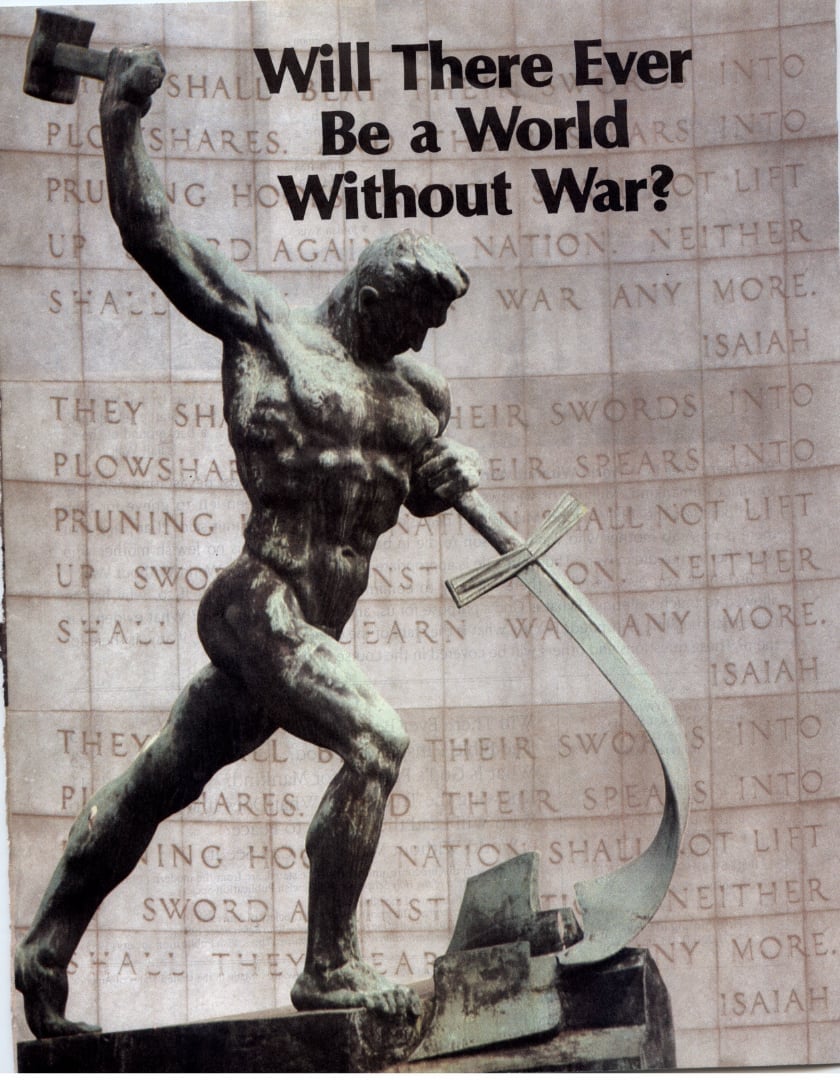
Will There Ever Be a World Without War?
Source: jw.org
Contents
Will There Ever Be a World Without War?
Title Page/Publishers’ Page
Contents
Introduction
Will There Ever Be a World Without War?
The Bible—Inspired by God?
What Is God’s Purpose for Mankind?
Knowing the True God—What Does It Mean?
Who Will Lead the Nations to Peace?
A World Without War—You Can See It
Bibliography
Will There Ever Be a World Without War?
Will There Ever Be a World Without War?
Title Page/Publishers’ Page
Title Page/Publishers’ Page
Will There Ever Be a World Without War?
This publication is not for sale. It is provided as part of a worldwide Bible educational work supported by voluntary donations.
To make a donation, please visit www.jw.org.
March 2018 Printing
English (wi-E)
© 1992
WATCH TOWER BIBLE AND TRACT SOCIETY OF PENNSYLVANIA
Contents
Contents
3 Will There Ever Be a World Without War?
3 The Bible—Inspired by God?
11 What Is God’s Purpose for Mankind?
19 Knowing the True God—What Does It Mean?
24 Who Will Lead the Nations to Peace?
31 A World Without War—You Can See It
Introduction
Introduction
Will There Ever Be a World Without War?—In our time we have seen the most devastating wars ever to afflict humankind. Millions of widows, widowers, and orphans have been left to grieve for their loved ones. At the 1991 Madrid Middle East peace conference, Yitzhak Shamir said: “I am sure that there is no Arab mother who wants her son to die in battle—just as there is no Jewish mother who wants her son to die in war.” Thus, our title is appropriate, Will There Ever Be a World Without War?
Also, have you ever asked: Is there any way to confirm the existence of God? If so, why has he allowed so much suffering? What is God’s purpose for us, and how can we know it? What evidence is there that the Bible is inspired? Exactly what is the state of the dead, and what hope, if any, is there for them? These questions and others will be covered in the course of this discussion.
All citations in this brochure, unless otherwise stated, are from the modern (1985) Tanakh, A New Translation of the Holy Scriptures, The Jewish Publication Society.
Symbols for translations of the Bible used:
JP - The Holy Scriptures, The Jewish Publication Society of America (1955)
NW - New World Translation of the Holy Scriptures—With References (1984)
Ta - Tanakh, A New Translation of the Holy Scriptures, The Jewish Publication Society (1985)
Mt. Hermon
The Sea of Galilee
Mt. Tabor
Earth could be a paradise—man has made it a battlefield
Will There Ever Be a World Without War?
Will There Ever Be a World Without War?
1, 2. What questions arise regarding the world’s future?
EVER since its establishment as a modern state in 1948, Israel has been in readiness against its neighbors. This confrontation, this running dispute, has left a trail of bereaved and mourning mothers, wives, children, and others—on both sides. Yet, one of mankind’s natural desires, especially at the family level, is to be able to live in peace.
2 However, war and strife are not just Middle Eastern problems. Powder kegs waiting to be ignited seem to be lying around all over the world. So the question is, Will peace, not just in the Middle East but world peace, ever be achieved? If so, how will it be accomplished? Will it be by means of mankind’s political, religious, and ethnic goodwill? Does that seem likely? Or will God, the earth’s Owner and Creator, have to intervene?
3-5. (a) What promise regarding peace is given in the Bible? (b) What questions need further investigation?
3 The Hebrew Scriptures give us heartening prophecies about a time when the nations “shall beat their swords into plowshares and their spears into pruning hooks: nation shall not take up sword against nation; they shall never again know war.”—Isaiah 2:4.
4 It was not only Isaiah who spoke of this world-encompassing peace. (Psalm 46:9-11 [46:8-10, NW]) A time of complete peace and harmony among men is really a major theme in the Bible. As Israeli statesman and author Abba Eban noted, the Hebrew Scriptures gave the ancient Israelites a unique future perspective and hope, as “Israel alone looked forward to a golden age in the future.”1 Yes, a marvelous future is near at hand for all mankind, an end to war, and much more. Isaiah also prophesied of Paradise conditions earth wide—an end to poverty, sickness, and even death.—Isaiah 11:9; 25:8; 33:24; 35:5, 6; 65:21.
5 Some may respond, ‘Those prophecies were written thousands of years ago, yet war still exists. How can the Bible be considered a reliable source of hope? What concrete proof exists that the Bible is truly the Word of God?’
The Bible—Inspired by God?
The Bible—Inspired by God?
1, 2. Why do many respect the Bible, and what claim do its writers make?
THE New Encyclopædia Britannica calls the Bible “probably the most influential collection of books in human history.” The Bible is held in high regard by many because of its antiquity—parts were written 3,500 years ago. Yet, its practical, up-to-date advice is one of the reasons that over three billion copies have been distributed and that it has been translated, in whole or in part, into almost two thousand languages, making it the world’s all-time best-seller.
2 Aside from these factors, all of which inspire respect for the Bible, there is yet another feature that has made it so influential and appealing throughout the ages—its claim to be the inspired revelation of Almighty God. Moses, who compiled the Torah (the first five books of the Bible) “wrote down” all that God told him to, which included the account of creation, the record of the Flood of Noah’s day, and the history of Abraham and of Moses’ own dealings with God. (Exodus 24:3, 4) King David said: “The spirit of the LORD has spoken through me, his message is on my tongue.” (2 Samuel 23:2) Other Bible writers made similar claims of divine guidance. All these writings together form God’s own explanation of history—its true meaning, interpretation, and final outcome. The many different writers of the Scriptures—kings, hired laborers, priests, and others—were all acting as secretaries in recording the thoughts of God, the Bible’s Author and the Guarantor of its promises.
3. What shows that belief in God and belief in science are not incompatible?
3 Since the Bible claims divine authorship, perhaps the foremost question for many relates to the very existence of its Author. Many reject God’s existence outright. Others, under the impression that all intelligent people have rejected the idea of God and belief in the Bible, ask: “Why don’t scientists believe in God?” Is this impression really true? An article in the magazine New Scientist said that the “view that commonly expects scientists to be nonbelievers . . . is a view that is wildly wrong.”2 The same article reports that random surveys among universities, research establishments, and industrial laboratories indicate that “as many as eight of every 10 scientists follow a religious faith or countenance principles that are ‘non-scientific.’” So it cannot accurately be said that faith is incompatible with science or scientists. (See the box “Evolution—A Fact?”)
EVOLUTION—A FACT?
THE Genesis account of creation states that all living things were created ‘after their kinds,’ or basic groups. (Genesis 1:12, 24, 25) In promoting their theory, many evolutionists have scoffed at the Bible account. But is there any proof that a new kind has ever appeared because of crossbreeding or mutations?e From the earliest records until now, dogs are still dogs, and cats continue to be cats. Even cockroaches, found among the earliest fossil insects, are virtually identical to modern ones.
Indeed, what evidence has been produced by the scientific community in well over a hundred years of intensive investigation since Darwin’s Origin of Species?f What conclusions have some experts reached?
THE FOSSIL RECORD: Fossil evidence is called by some ‘the final court of appeal’ because it is the only authentic history of life available to science. What does it show?
Professor of natural science John Moore reported on the results of an extensive study made by the Geological Society of London and the Palaeontological Association of England. “Some 120 scientists, all specialists, prepared 30 chapters in a monumental work of over 800 pages to present the fossil record for plants and animals . . . Each major form or kind of plant and animal is shown to have a separate and distinct history from all the other forms or kinds! Groups of both plants and animals appear suddenly in the fossil record. . . . There is not a trace of a common ancestor, much less a link with any reptile, the supposed progenitor.”—Should Evolution Be Taught?, 1970, pages 9, 14.
COULD MUTATIONS HAVE CAUSED EVOLUTION? Because of the harmful nature of mutations, The Encyclopedia Americana acknowledged: “The fact that most mutations are damaging to the organism seems hard to reconcile with the view that mutation is the source of raw materials for evolution. Indeed, mutants illustrated in biology textbooks are a collection of freaks and monstrosities and mutation seems to be a destructive rather than a constructive process.”—1977, Volume 10, page 742.
WHAT ABOUT THE APE-MEN? Science Digest stated: “The remarkable fact is that all the physical evidence we have for human evolution can still be placed, with room to spare, inside a single coffin! . . . Modern apes, for instance, seem to have sprung out of nowhere. They have no yesterday, no fossil record. And the true origin of modern humans—of upright, naked, toolmaking, big-brained beings—is, if we are to be honest with ourselves, an equally mysterious matter.”—May 1982, page 44.
A THEORY IN CRISIS: Notice the following comments by Michael Denton, a molecular biologist, as quoted from his book Evolution: A Theory in Crisis:
“There can be no question that Darwin had nothing like sufficient evidence to establish his theory of evolution. . . . His general theory, that all life on earth had originated and evolved by a gradual successive accumulation of fortuitous mutations, is still, as it was in Darwin’s time, a highly speculative hypothesis entirely without direct factual support and very far from that self-evident axiom some of its more aggressive advocates would have us believe. . . . One might have expected that a theory of such cardinal importance, a theory that literally changed the world, would have been something more than metaphysics, something more than a myth.”—1986 edition, pages 69, 77, 358.
A distinction should be made between what has been termed “microevolution,” or progressive developments, adaptations, and changes within a kind, and “macroevolution,” which teaches that one kind evolves into another. Those who teach evolution are usually referring to the latter concept.
For a detailed discussion, see The Origin of Life—Five Questions Worth Asking.
Is There Proof of Inspiration?
4. What scientific truths were mentioned thousands of years ago in the Bible?
4 When one reaches the conclusion that there is convincing evidence of a Creator’s existence, the question still remains whether he has inspired men to record his thoughts and purposes in the Bible. There are many reasons why we can be sure that this is the case, one of which is its scientific accuracy. (See the box “‘In the Beginning God Created’ . . .”) For example, over 3,000 years ago, Job said that God “hangeth the earth over nothing.” (Job 26:7, JP) About 2,700 years ago, the prophet Isaiah stated that God “sitteth above the circle of the earth.” (Isaiah 40:22, JP) Now, how could Job or Isaiah have known these basic scientific truths that the earth is suspended in space and is a sphere? They may be well-known today, but these statements were made at a time when such notions were unheard of. Is not divine revelation the most reasonable explanation?
“IN THE BEGINNING GOD CREATED” . . .
. . . “THE HEAVEN AND THE EARTH.” (Genesis 1:1, JP)—Most scientists today agree that the universe had a beginning. Astronomer Robert Jastrow wrote: “Now we see how the astronomical evidence leads to a biblical view of the origin of the world. The details differ, but the essential elements in the astronomical and biblical accounts of Genesis are the same: the chain of events leading to man commenced suddenly and sharply at a definite moment in time, in a flash of light and energy.”—God and the Astronomers, 1978, page 14.
. . . “LIVING CREATURES.” (Genesis 1:20)—Physicist H. S. Lipson, realizing the odds against a spontaneous origin of life, said: “The only acceptable explanation is creation. I know that this is anathema to physicists, as indeed it is to me, but we must not reject a theory that we do not like if the experimental evidence supports it.”—Physics Bulletin, Volume 31, 1980, page 138.
Even if the odds are against it, could not spontaneous generation have happened anyway? Physicist and astronomer Fred Hoyle says: “There is not a shred of objective evidence to support the hypothesis that life began in an organic soup here on the Earth.” He also states: “As biochemists discover more and more about the awesome complexity of life, it is apparent that the chances of it originating by accident are so minute that they can be completely ruled out. Life cannot have arisen by chance.” Hoyle adds: “Biologists indulge in unsubstantiated fantasies in order to deny what is so patently obvious, that the 200,000 amino acid chains, and hence life, did not appear by chance.” In effect, he asks, ‘Just how could the accidental coupling of chemicals in an organic ooze alone produce the 2,000 enzymes essential to life?’ He says the possibilities are one in 1040,000, or “about the same as the chance of throwing an uninterrupted sequence of 50,000 sixes with unbiased dice!” (The Intelligent Universe, F. Hoyle, 1983, pages 11-12, 17, 23) He adds, “If one is not prejudiced either by social beliefs or by a scientific training into the conviction that life originated [spontaneously] on the Earth, this simple calculation wipes the idea entirely out of court.”—Evolution From Space, Fred Hoyle and Chandra Wickramasinghe, 1981, page 24.
5, 6. What fulfillments of prophecy give evidence that the Bible writers were inspired by God?
5 Prophecy, in effect history written before it happens, is perhaps the main feature of the Bible that substantiates its claim of divine inspiration. For example, the prophet Isaiah foretold not only that Jerusalem would be destroyed by Babylon and that the entire Jewish nation would be taken captive but also that in time the Persian general Cyrus would conquer Babylon and liberate the Jews from captivity. (Isaiah 13:17-19; 44:27–45:1) Can you think of any means, other than divine inspiration, by which, 200 years in advance, Isaiah could have successfully predicted Cyrus’ birth, his name, and precisely what he would do? (See the box “God—‘The Revealer of Mysteries’ Through Prophecy.”)
GOD—‘THE REVEALER OF MYSTERIES’ THROUGH PROPHECY
WHEN speaking to an ancient king, the prophet Daniel said: “The mystery about which the king has inquired—wise men, exorcists, magicians, and diviners cannot tell to the king. But there is a God in heaven who reveals mysteries.” (Daniel 2:27, 28) Is there evidence that God really is a Revealer of mysteries through prophecy? The following are some examples.
The fall of Babylon: “Thus said the LORD to Cyrus, His anointed one—whose right hand He has grasped, treading down nations before him, ungirding the loins of kings, opening doors before him and letting no gate stay shut.”—Isaiah 45:1, prophesied c. 732 B.C.E. See also Jeremiah 50:35-38; 51:30-32, prophesied b. 625 B.C.E.
Fulfillment—539 B.C.E.: Historians Herodotus and Xenophon relate that Cyrus the Persian diverted the waters of the Euphrates, which ran through the center of Babylon, and sent his forces up the riverbed, catching the Babylonian guards unawares and taking the city in one night. Even with this strategy, Cyrus could not have entered the city had the gates on the banks of the Euphrates leading into the city not been carelessly left open. The ‘gates did not stay shut,’ just as the prophecy foretold.
The fate of Tyre: “Thus said the Lord GOD: I am going to deal with you, O Tyre! I will hurl many nations against you, as the sea hurls its waves. . . . And I will scrape her soil off her and leave her a naked rock. . . . And they shall cast into the water your stones and timber and soil.”—Ezekiel 26:3, 4, 12, prophesied c. 613 B.C.E.
Fulfillment—332 B.C.E.: Alexander the Great built a land bridge, or mole, from the mainland to the island portion of Tyre (half a mile (0.8 km) offshore) so that his soldiers could march across and attack the island city. The Encyclopedia Americana reports: “With the debris of the mainland portion of the city, which he had demolished, he built a huge mole in 332 to join the island to the mainland.” After a relatively short siege, the island city was destroyed, and Ezekiel’s prophecy was fulfilled in all its details. Even the ‘stones and woodwork and dust’ of old Tyre (the mainland part of the city) were ‘placed in the very midst of the water.’
The destruction of Jerusalem: “Then Isaiah said to Hezekiah, ‘Hear the word of the LORD of Hosts: A time is coming when everything in your palace, which your ancestors have stored up to this day, will be carried off to Babylon; nothing will be left behind.’”—Isaiah 39:5, 6, prophesied c. 732 B.C.E.; see also Isaiah 24:1-3; 47:6.
Jeremiah the prophet proclaimed: “I am going to . . . bring them [the Babylonians] against this land and its inhabitants . . . This whole land shall be a desolate ruin. And those nations shall serve the king of Babylon seventy years.”—Jeremiah 25:9, 11, prophesied b. 625 B.C.E.
Fulfillment—607 B.C.E. (586 B.C.E. according to most secular chronologies): Babylon destroyed Jerusalem after a year and a half siege. The city and temple were razed, and the Jews themselves were carried off to Babylon. (2 Chronicles 36:6, 7, 12, 13, 17-21) The entire nation remained in captivity for 70 years, as Jeremiah had foretold. Their miraculous release in 537 B.C.E. by Cyrus the Great, who conquered Babylon, fulfilled the prophecy of Isaiah, which had mentioned him by name. (Isaiah 44:24-28) The prophet Daniel, in captivity in Babylon, calculated the exact time of the release of his people, basing his conclusion on Jeremiah’s prophecy.—Daniel 9:1, 2.
6 Some of the most remarkable prophecies are recorded by Daniel, a prophet who lived in the sixth century B.C.E. Not only did he foretell the fall of Babylon to the Medes and the Persians but he also predicted events far beyond his time, into the distant future. For example, Daniel’s prophecy foretold the rise of Greece as a world empire under Alexander the Great (336-323 B.C.E.), the division of Alexander’s empire among his four generals after his untimely death, and the rise of the Roman Empire, with its fearful military might (first century B.C.E.). (Daniel 7:6; 8:21, 22) All these events are now indisputable historical facts.
7, 8. (a) What accusation have some made about Bible prophecies? (b) What proves that the accusation of fraud is not well-founded?
7 Because Bible prophecies have been so exact, critics have branded them as deceptions, that is, history written after the fact and disguised as prophecy. But how can one rationally assert that Jewish priests would dare to invent a prophecy? And why would they invent prophecies that contained the hardest diatribes imaginable against themselves? (Isaiah 56:10, 11; Jeremiah 8:10; Zephaniah 3:4) In addition, how could an entire literate nation, trained and educated with the Bible as its sacred text, be taken in by such a hoax?—Deuteronomy 6:4-9.
8 How could there have been any fraud connected with the disappearance of entire civilizations, such as Edom and Babylon, when these events took place many centuries after the completion of the Hebrew Scriptures? (Isaiah 13:20-22; Jeremiah 49:17, 18) Even if one maintains that these prophecies were not written in the time period of the prophets themselves, they were still recorded prior to the third century B.C.E., for by then they were already being translated into Greek in the Septuagint. Also, the Dead Sea Scrolls (which include portions of all the prophetic Bible books) are dated to the second and first centuries B.C.E. As noted, many prophecies were fulfilled only after these dates.
Is the Bible Full of Contradictions?
9-12. (a) Why do some say that the Bible contradicts itself? (b) How are some “contradictions” resolved?
9 But some object: ‘The Bible is full of contradictions and discrepancies.’ Very often, those who make this assertion have not personally investigated the matter but have just heard an alleged example or two from others. In reality most supposed discrepancies are easily resolved if it is remembered that the writers of the Bible frequently condensed their subject to a few words. An example of this is found in the account of creation. In comparing Genesis 1:1, 3 with Genesis 1:14-16, many have asked how it can be that God “made” the luminaries on the fourth creative day when light—evidently from these same luminaries—was reaching the earth on the first creative day. In this case the Hebrew writer eliminated the need for long explanations by a careful choice of words. Note that verses 14-16 speak of “making” in contrast to “creating” in Genesis 1:1, and “lights” in contrast to “light” in Genesis 1:3. This indicates that it was on the fourth creative day that the sun and moon, already in existence, became clearly visible through the earth’s dense atmosphere.a
10 Genealogical lists have also caused some confusion. For example, Ezra lists 23 names in his priestly genealogy at 1 Chronicles 5:29-40 (6:3-14) but lists only 16 names for the same period when giving his own genealogy at Ezra 7:1-5. This is, not a discrepancy, but a simple condensation. Additionally, according to a writer’s intention in recording an event, he highlighted, minimized, included, or omitted details that another Bible writer expressed differently in recording the same event. Such are not contradictions but, rather, are differing accounts reflecting the writers’ point of view and intended audience.b
11 Often, apparent inconsistencies can be resolved if we just look at the context. For example, “Where did Cain get his wife?” is a question often heard, highlighting the belief that this exposes a discrepancy in the Biblical account. The supposition is that Adam and Eve had only two sons, Cain and Abel. The difficulty is easily resolved if one reads on. Genesis 5:4 says: “After the birth of Seth, Adam lived 800 years and begot sons and daughters.” So Cain married one of his sisters or perhaps a niece, which would have been in full harmony with God’s original intention for the expansion of the human race.—Genesis 1:28.
12 There are obviously many details of human history not recorded as part of the Divine Record. But every necessary detail, both for those who first read it and for us today, has been included without making it cumbersome and impossible to read.
To Be Understood Only by Scholars?
13-15. (a) Why do some believe the Bible is too difficult for us to understand? (b) How do we know that God intended that his Word be understood?
13 Have you ever asked: “Why are there so many conflicting interpretations of the Bible?” After hearing religious authorities contradict one another, some sincere people become confused and discouraged. The conclusion that many reach is that the Bible is unclear and contradictory. As a result, many reject the Bible outright, believing that it is too difficult to read and understand. Others, when confronted with this vast array of religious interpretation, are reluctant to make a serious investigation of the Scriptures. Some say: “Learned men have studied for years in religious seminaries. How could I have any basis for questioning what they teach?” But is this how God views matters?
14 When God gave the Law to the nation of Israel, he did not indicate that he was giving them a system of worship that they could not understand, one that would have to be left in the hands of theological sages or “scholars.” Through Moses at Deuteronomy 30:11, 14, God declared: “Surely, this Instruction which I enjoin upon you this day is not too baffling for you, nor is it beyond reach. No, the thing is very close to you, in your mouth and in your heart, to observe it.” All the nation, not just the leaders, were told: “Take to heart these instructions with which I charge you this day. Impress them upon your children. Recite them when you stay at home and when you are away, when you lie down and when you get up.” (Deuteronomy 6:6, 7) God’s commandments, all committed to writing, were clear enough for the entire nation, both parents and children, to follow.c
15 As far back as Isaiah’s day, religious leaders incurred God’s condemnation by taking it upon themselves to add to and interpret God’s laws. The prophet Isaiah wrote: “That people has approached Me with its mouth and honored Me with its lips, but has kept its heart far from Me, and its worship of Me has been a commandment of men, learned by rote.” (Isaiah 29:13) Their worship had become a commandment of men, not of God. (Deuteronomy 4:2) It was these ‘commandments of men,’ their own interpretations and explanations, that were contradictory. God’s words were not. The same is true today.
Any Biblical Basis for the Oral Torah?
16, 17. (a) What do some believe regarding an oral law? (b) What does the Bible indicate regarding an oral law?
16 Some believe that Moses received an “Oral Torah” in addition to the “Written Torah.” According to this belief, God directed that certain commands not be written down but rather be passed on by word of mouth from generation to generation, thus being preserved only by oral tradition. (See the box “Does the Torah Have ‘Seventy Faces’?”) However, the Bible account clearly shows that Moses was never commanded to transmit an oral law. Exodus 24:3, 4 tells us: “Moses went and repeated to the people all the commands of the LORD and all the rules; and all the people answered with one voice, saying, ‘All the things that the LORD has commanded we will do!’” Moses then “wrote down all the commands of the LORD.” Further, at Exodus 34:27 we are told: “And the LORD said to Moses: Write down these commandments, for in accordance with these commandments I make a covenant with you and with Israel.” An unwritten oral law had no place in the covenant that God made with Israel. (See the box “Where Was the Oral Law . . .”) Nowhere in the Bible is there any mention of the existence of an oral law.d More important, its teachings contradict the Scriptures, adding to the misimpression that the Bible is self-contradictory. (See the box “Death and the Soul—What Are They?”) But it is man, and not God, who is responsible for this confusion.—Isaiah 29:13. (See the box “Showing Honor to the Divine Name.”)
DOES THE TORAH HAVE “SEVENTY FACES”?
IN Israel today it is not uncommon to hear people quote a well-known Jewish expression—“There are seventy faces to the Torah”—indicating that they believe that the Scriptures can be interpreted in many different, even contradictory, ways. This is viewed as true both of the written Law and of the so-called oral law. The Encyclopedia of Judaism comments: “The Oral Law is not a definitive code; it includes many diverse and even conflicting opinions. Concerning these the sages said, ‘All of them are the words of the living God.’” (Page 532) However, is it reasonable to believe that God would inspire conflicting and divisive opinions? How did the acceptance of such contradictions come about?
Throughout the period when the Hebrew Scriptures were committed to writing (c. 1513–c. 443 B.C.E.), God’s appointed representatives clarified matters of dispute, very often with God himself backing them up by a display of divine power or by fulfilling prophecies that he had given them to utter. (Exodus 28:30; Numbers 16:1–17:15 [16:1-50, NW]; 27:18-21; Deuteronomy 18:20-22) At that time if someone taught contradictory explanations and interpretations, he was viewed, not as a scholar, but as an apostate. God warned the entire nation: “Be careful to observe only that which I enjoin upon you: neither add to it nor take away from it.”—Deuteronomy 13:1 (12:32, NW).
However, in time a fundamental change occurred in the thinking of the nation of Israel. The Pharisees, who became prominent in Judaism during the first century C.E., espoused the teaching of the “Oral Torah,” which they had developed two centuries previously. They taught that in addition to giving the nation of Israel a written Law at Mount Sinai, God also transmitted to them at the same time an oral law. According to such belief, this inspired oral law interpreted and clarified details of the written Law, details that God had deliberately told Moses not to record. The oral law was not to be written down but was to be transmitted only by word of mouth, from master to disciple, from generation to generation. It therefore gave special authority to the Pharisees, who viewed themselves as guardians of this oral tradition.g
After the destruction of the second temple in 70 C.E., the Pharisaic view won out, and Judaism became a rabbi-dominated form of religion, something it had not been previously.h With new prominence given to rabbis rather than to priests or prophets, the oral law became the new centerpiece of Judaism. As The Encyclopedia of Judaism states: “The Oral Torah came to be regarded as more important than the Written Torah inasmuch as the explanation and understanding of the latter depended upon the former.”—1989, page 710.
As rabbis gained prestige and as traditions multiplied, the ban on writing down this oral law was lifted. In the late second and early third centuries C.E., Judah Ha-Nasi (135-219 C.E.) systematically recorded these rabbinic oral traditions in a work called the Mishnah. Additions made later were called the Tosefta. The rabbis in turn saw the need to give commentary on the Mishnah, and these interpretations of oral tradition became the foundation of a voluminous collection of books called the Gemara (compiled from the third to the fifth century C.E.). Together these works came to be known as the Talmud. Commentary on all these rabbinic opinions continues to our day. Since it is impossible to harmonize all these greatly differing views, is it any wonder that many prefer to see “seventy faces to the Torah”?
This teaching, initially promoted by the Pharisees, was rejected by many of their contemporaries within the Jewish nation. The Sadducees, many of whom were priests, as well as the first-century Essenes, rejected this Pharisaic concept. Today, the Karaites (since the eighth century C.E.), as well as the Reform and Conservative movements of Judaism, do not view such an oral law as divinely inspired. However, Orthodox Judaism today considers these traditions both inspired and obligatory.
The Encyclopaedia Judaica states: “The title rabbi is derived from the noun rav, which in Biblical Hebrew means ‘great’ and does not occur in the [Hebrew] Bible.”
WHERE WAS THE ORAL LAW . . .
. . . when Moses repeated all of God’s commands to the entire nation of Israel? The nation then agreed to carry out what he had repeated, and then Moses “wrote down all the commands of the LORD.”—Exodus 24:3, 4, Italics ours.
. . . when Joshua gathered the nation of Israel after entering the Promised Land and read to them once again all the words that they had agreed to carry out? “There was not a word of all that Moses had commanded that Joshua failed to read in the presence of the entire assembly of Israel.”—Joshua 8:35, Italics ours.
. . . when in the days of King Josiah the misplaced ‘book of the Law of Moses’ was found while the temple was being renovated? Upon hearing the contents read to him, Josiah rent his garments in grief, realizing that for generations the Law had not been carried out according to what was written. He then made arrangements to celebrate the Passover festival, which had not always been properly celebrated during the entire period of the kings and of the judges before them. Where was the ‘faithfully transmitted’ oral law during those hundreds of years? Had it existed, this information would never have been forgotten. Only an accurately preserved written record enabled the nation to return to doing God’s will properly.—2 Kings 22:8–23:25.
. . . when the prophet Jeremiah declared: “From the smallest to the greatest, they are all greedy for gain; priest and prophet alike, they all act falsely”? (Jeremiah 6:13) Throughout much of the nation of Israel’s history, this was the spiritual condition of the nation’s leaders, especially the priests, who were responsible to teach the Law. (Malachi 2:7, 8) Written records speak for themselves, but could men who were so unfaithful be depended on to preserve faithfully an oral tradition?
. . . during the more than a thousand years of recording the Hebrew Scriptures? From Moses to Malachi, there is no mention of the existence of such an oral law. Only hundreds of years later, during the period of the rabbis, when conflicting religious sects struggled for control and authority over the Jewish nation, do we find this concept mentioned. Do not those hundreds of years of silence on the subject and the testimony of inspired Scripture negate the claim that there ever was such an inspired oral law?
17 In contrast with the contradictory interpretations of men, the Bible itself is clear and trustworthy. God has provided us with ample proof within his Word that the peaceful world envisioned at Isaiah 2:2-4 is not just a dream but an impending reality. None other than God himself, the God of prophecy, the God of the Bible, will bring it about.
DEAD SEA SCROLLS
Dated to before the Common Era, reveal the accuracy of the transmission of the Bible text through the centuries. They also confirm that prophecies were recorded before their fulfillment
It should be noted that the six “days” of creation do not include the statement at Genesis 1:1, which refers to the creation of the heavenly bodies. Furthermore, the Hebrew word translated “day” allows for the thought that the events described at Genesis 1:3-31 took place during six ‘periods of time’ that could have been many thousands of years in length.—Compare Genesis 2:4.
For examples, see “Are There Contradictions in the Bible?”
Difficult questions for judicial cases were handled by a clearly outlined judicial arrangement. (Deuteronomy 17:8-11) In any other important matters that seemed obscure, to receive God’s answer, the nation was directed, not to an oral law, but rather to the Urim and Thummim in the hands of the priests.—Exodus 28:30; Leviticus 8:8; Numbers 27:18-21; Deuteronomy 33:8-10.
Some have read into the text at Deuteronomy 17:8-11 an implication of an inspired oral tradition. However, as mentioned in the footnote to paragraph 14, the text deals solely with the procedure of judgment in judicial cases. Notice that the issue was not whether different customs or traditions were passed down through many centuries or not. There were no doubt some traditions passed down as to how to carry out specifically certain aspects of the Law. But the fact that a tradition is long-standing does not prove inspiration. For example, note the tradition that developed regarding the bronze serpent.—Numbers 21:8, 9; 2 Kings 18:4.
A distinction should be made between what has been termed “microevolution,” or progressive developments, adaptations, and changes within a kind, and “macroevolution,” which teaches that one kind evolves into another. Those who teach evolution are usually referring to the latter concept.
For a detailed discussion, see The Origin of Life—Five Questions Worth Asking.
This teaching, initially promoted by the Pharisees, was rejected by many of their contemporaries within the Jewish nation. The Sadducees, many of whom were priests, as well as the first-century Essenes, rejected this Pharisaic concept. Today, the Karaites (since the eighth century C.E.), as well as the Reform and Conservative movements of Judaism, do not view such an oral law as divinely inspired. However, Orthodox Judaism today considers these traditions both inspired and obligatory.
The Encyclopaedia Judaica states: “The title rabbi is derived from the noun rav, which in Biblical Hebrew means ‘great’ and does not occur in the [Hebrew] Bible.”
What Is God’s Purpose for Mankind?
What Is God’s Purpose for Mankind?
1-4. (a) What was God’s original purpose for mankind? (b) Why did man prove to be disobedient? (See the box “Who Is Satan?”)
THE promise of a world without war as revealed at Isaiah 2:2-4 and Micah 4:1-4 not only provides us with a well-founded hope for the near future but also tells us something very important about our Creator. He is a God of purpose. The prophecy at Isaiah chapter 2 is actually part of a long series of prophecies that runs from the first pages of the Bible right through to the last, making clear to us how God will bring his original purpose to fruition.
2 When God created the first human couple, he told them clearly what his purpose was for them. At Genesis chapter 1, verse 28, we read: “God blessed them and God said to them, ‘Be fertile and increase, fill the earth and master it; and rule the fish of the sea, the birds of the sky, and all the living things that creep on earth.’” When we relate that command to what is stated in the next chapter of Genesis—“The LORD God took the man and placed him in the garden of Eden, to till it and tend it”—it becomes clear that God intended for the original couple, together with their offspring, to extend Paradise beyond the limits of the garden of Eden, eventually to encompass the entire earthly globe.a—Genesis 2:15.
3 How long would they enjoy their paradisaic home? The Scriptures imply that man was created to live forever on earth. Death for mankind would come about only if they disobeyed their Creator, as stated at Genesis chapter 2, verses 16 and 17: “The LORD God commanded the man, saying, ‘Of every tree of the garden you are free to eat; but as for the tree of knowledge of good and bad, you must not eat of it; for as soon as you eat of it, you shall die.’” Reasonably, therefore, continued obedience would have resulted in continued life, everlasting life, in these paradisaic conditions.—Psalm 37:29; Proverbs 2:21, 22.
4 However, an angel, later referred to as Satan (meaning “Adversary”), influenced that first couple to misuse their free will in choosing to disobey God. (Job 1:6-12; compare Deuteronomy 30:19, 20.) Creating the illusion that a serpent was speaking, this rebellious angel told Eve and, through her, Adam, that they would become wiser and their lives would become more complete by not submitting to God as the Ultimate Authority.b (Genesis 3:1-19) Because of their open rebellion, they were condemned to death. Did that mean that God’s purpose for mankind was frustrated or aborted? No, rather, it meant that another means would be needed to fulfill God’s original purpose of a paradise earth filled with obedient humans enjoying everlasting life. How would this come about?
WHO IS SATAN?
THE Bible speaks of Satan, not as “the evil inclination” within man, but rather as an invisible spirit creature, an angel. (Job 1:6) As one of the angels, or sons of God, he was created perfect, but later he caused himself to become the first rebel, or adversary, against God. (Deuteronomy 32:4; compare Ezekiel 28:12-17.) As part of his rebellion against God’s sovereignty, he accuses men of being unfaithful, acting only in self-interest. Note some of the scriptures that openly expose Satan’s subtle attempts to lead men into a course of disobedience and wrong conduct:
Job 1:6-12; 2:1-7
1 Chronicles 21:1
Zechariah 3:1, 2
A Promised Seed
5, 6. (a) What did God promise as a solution to the problems on earth caused by Satan’s rebellion? (b) What did God promise to Abraham?
5 In pronouncing judgment on those involved in rebellion against his authority, Jehovah God declared that he would raise up a “seed,” or “offspring,” that would undo the damage caused by the instigator of the rebellion. In symbolic terms, God spoke of the serpent, representing Satan, as being struck, or crushed, in the head by this Seed, thus putting an end to Satan’s existence and rebellion. Through the years this verse in Genesis has been interpreted in various and contradictory ways. But since the word “seed” is used in many prophecies, other related promises reveal what it means.—Genesis 3:15.
6 The term “seed” is often related to the outworking of God’s purpose for mankind as a whole. As recorded at Genesis 22:18, the faithful Hebrew Abraham was given this promise by God: “All the nations of the earth shall bless themselves by your descendants [seed, JP], because you have obeyed My command.” (Italics ours.) God showed special interest in Abraham as a man who searched for Him in truth. However, although God directly rewarded Abraham, this text clearly shows that God’s interest was not in Abraham alone, nor in his fleshly descendants exclusively. God was keeping close in mind his original purpose of a paradise earth for all mankind, “all the nations.” He was now revealing to Abraham that as a result of his faithfulness, he would have the privilege of producing the “seed” by which all the nations would bless themselves.
7, 8. How did this promised Seed become linked with the concepts of kingship and the Messiah?
7 Abraham was the father of many great nations. (Genesis 17:4, 5) But Jehovah God clearly revealed through which of these lines of descent the promised Seed would come, bringing blessings to all mankind. (Genesis 17:17, 21) Both Abraham’s son Isaac and grandson Jacob were mentioned as belonging to the line that would produce the “seed.” One of the nations that sprang from Abraham was the nation of Israel, comprising the 12 tribes who descended from the sons of Jacob, Abraham’s grandson. It was in this nation that the promised “seed” would finally appear.—Genesis 26:1, 4; 28:10, 13-15, JP.
8 Prophecy later revealed that a special seed, or ruler, would come specifically through the tribe of Judah. Genesis 49:10 states: “The rod shall not depart from Judah, nor a lawgiver from between his feet, until Shiloh come; and his be the obedience of peoples.”3 The Bible commentator Rashi states that the phrase “until Shiloh come” means “until the King Messiah will come, whose will be the kingdom.”4 Like Rashi, many Bible commentators have understood this prophecy to have Messianic meaning.
9. (a) What did God promise King David regarding the Seed? (b) How is the promise at Genesis 49:10 related to the one at Psalm 72:7, 8?
9 The first ruler from the line of Judah, King David, was promised by God: “Your house and . . . your throne shall be established forever.” (2 Samuel 7:16) God further promised: “I will set up thy seed after thee, . . . and I will establish his kingdom. He shall build Me a house, and I will establish his throne for ever.” (1 Chronicles 17:11, 12, JP) David’s son and successor, King Solomon, did indeed build Jehovah’s house, or temple, but he obviously did not rule forever. However, one of David’s seed would be the same “Shiloh,” or Messiah, prophesied at Genesis 49:10. (JP) Speaking prophetically about that one, King David wrote: “In his days let the righteous flourish, and abundance of peace, till the moon be no more. May he have dominion also from sea to sea, and from the River unto the ends of the earth.”—Psalm 72:7, 8, JP.
10. What was to be accomplished by the Seed promised in Genesis 3:15, and how does this agree with the promise given to Abraham?
10 If we follow the gradual revelation through prophecy, we come to understand that the blessings promised to Abraham—“in thy seed shall all the nations of the earth be blessed”—will in fact be fulfilled through this same Ruler from the line of David. (Genesis 22:18, JP) In this way the prophecies about the Seed become joined with the hope of the Jewish nation in the Messiah, during whose rule the earth will have total peace. In fact, he is the “seed” mentioned at Genesis 3:15 who would put an end to the original rebellion against God’s sovereignty and undo the damage that has resulted. (Psalm 2:5, 8, 9) Other questions and information about the promised Messiah are dealt with in the section “Who Will Lead the Nations to Peace?” But now let us consider God’s further dealings with Abraham’s descendants.
Purpose of the Law Covenant
11-13. How did the Law covenant benefit the nation, and was it meant to last forever?
11 The Israelites became a nation a few hundred years after Abraham’s time. God freed these descendants from captivity in Egypt, and under the leadership of Moses, another man of faith whom He had chosen, God concluded a special covenant, or agreement, with them. (Exodus 19:5, 6; Deuteronomy 5:2, 3) This Law covenant gave the nation clear direction as to how God desired to be worshiped. It organized them as a nation for such worship.
12 We might note that from the start this covenant was conditional. Before revealing to the nation of Israel the Ten Commandments and the entire covenant of which these were a part, God informed them: “Now then, if you will obey Me faithfully and keep My covenant, you shall be My treasured possession among all the peoples. Indeed, all the earth is Mine, but you shall be to Me a kingdom of priests and a holy nation.” (Exodus 19:5, 6) In order to continue to be used by God as a treasured possession, they would have to obey him faithfully. These were the terms of the covenant.
13 The promised reward for their faithfulness—that they would serve as a kingdom of priests—reveals that the Law covenant was not an end in itself but, rather, a transitional step toward qualifying a priesthood that would help other nations come to know the true God. From the start God’s purpose was that all mankind, and not just the people of one nation, should bless themselves.—Genesis 22:18.
14. What other benefits resulted from the Law covenant?
14 Since the Law covenant was not an end in itself, what was its purpose? It unequivocally exposed and denounced all false religious concepts that man had begun to develop independently since the time of the rebellion in the garden of Eden. (Deuteronomy 18:9-13) It also protected the nation of Israel from the disgusting practices and worship of the surrounding nations by minimizing all contact with those nations. (Deuteronomy 7:1-6) As long as Israel kept that Law, they would be preserved in a pure religious condition, in which they could eventually both identify and welcome the promised Seed, or Messiah.
Why did God require sacrifices as part of the Law covenant?
15, 16. What important spiritual lessons embodied in the Law covenant also point to its temporary nature?
15 The Law covenant also highlighted the need for atonement, incorporating a well-defined system of sacrifices that were an integral part of Jewish worship. (Leviticus 1:1-17; 3:1-17; 16:1-34; Numbers 15:22-29) From the time of the rebellion of Adam and Eve, mankind lost the perfection that would have enabled them to live everlastingly in perfect health. (Genesis 2:17) As a result of the first sin, Adam and Eve’s offspring (all born after the rebellion) inherited imperfection and the innate tendency to sin. (Genesis 8:21; Psalm 51:7 [51:5, NW]; Ecclesiastes 7:20) Imperfection led to sickness, aging, and death, as well as to the creating of a barrier between man and God. (1 Kings 8:46; compare Lamentations 3:44.) Some basis was needed to undo this damage as well as to overcome and bring about atonement for man’s imperfect state. Men of faith were always acutely aware of that need.—Job 1:4, 5; Psalm 32:1-5.
16 The Law covenant emphasized that God has legal standards that must be met. It also provided the basis for understanding how God’s standards of justice would be fully satisfied.c The provisions of sacrifice in the Law covenant could never restore God’s original purpose for mankind, since their effect was temporary, highlighting the condition of sin but not removing or preventing it. Therefore, the Law was a transitional step to help this organized nation of worshipers understand at the appropriate time how to identify the Seed and how that Seed would undo the damage caused by Adam’s sin. Where did the Torah indicate this?
Promise of a Prophet Like Moses
17, 18. What was meant by God’s promise at Deuteronomy 18:15, 18, 19 to raise up a prophet?
17 At Deuteronomy chapter 18, verse 15, Moses told the nation of Israel: “The LORD your God will raise up for you a prophet from among your own people, like myself; him you shall heed.” In the same chapter, at verses 18 and 19, Jehovah spoke to Moses, the one whom He had appointed as mediator between himself and His people, saying: “I will raise up a prophet for them from among their own people, like yourself: I will put My words in his mouth and he will speak to them all that I command him; and if anybody fails to heed the words he speaks in My name, I myself will call him to account.” How should this prophecy be understood?
18 The prophet mentioned here is clearly a specific and special individual. The context makes clear that this is not merely a general principle regarding God’s intention to continue to raise up prophets for the nation, as some have supposed. The Hebrew word for prophet (na·viʼʹ) is in the singular, comparing him to Moses, who was unique in the history of the nation. Additionally, the closing words in the same book of Deuteronomy state: “Never again did there arise in Israel a prophet like Moses—whom the LORD singled out, face to face.” (Deuteronomy 34:10-12) The one who recorded these words was very likely Joshua, the son of Nun, who himself was a great leader and prophet appointed by God. But from his own expression, there is no question that he did not see in himself a fulfillment of Moses’ words about a prophet like Moses. So, what did God mean when he promised to raise up a prophet like Moses? What was Moses like?
A New Covenant Prophesied
19. (a) How was Moses unique? (b) A prophet like Moses would have to serve as what else?
19 Moses was a great leader; he was a legislator, a prophet, a miracle worker, a teacher, and a judge. He was also a mediator, the only prophet who had mediated a covenant between God and man (in this case, the nation of Israel). A prophet truly like him would have to do something similar. Does this mean that God intended that the Law covenant be superseded by another covenant? Yes, it does. Through the prophet Jeremiah, God clearly stated his intention to conclude a new covenant. A new covenant would require a new mediator. Only someone like Moses could fit the requirements for such an assignment. If we examine what the new covenant entails, we can better understand the role of the mediator.
20, 21. (a) What is promised at Jeremiah 31:31-34? (b) What was the new covenant’s stated purpose? (c) As a result, what would become of the Law covenant?
20 It was about 900 years after Moses that Jeremiah conveyed to the nation of Israel God’s words: “See, a time is coming—declares the LORD—when I will make a new covenant with the House of Israel and the House of Judah. It will not be like the covenant I made with their fathers, when I took them by the hand to lead them out of the land of Egypt, a covenant which they broke, . . .—declares the LORD. But such is the covenant I will make with the House of Israel after these days . . . I will forgive their iniquities, and remember their sins no more.”d—Jeremiah 31:31-34.
21 If the prophet like Moses is to serve as a new mediator of a new covenant, then it also becomes clear that all the specific details of worship required under the Mosaic Law would be in force not permanently but rather only until the new covenant would be established. Certainly, when God would provide a basis for ‘forgiving their iniquities and remembering their sins no more,’ there would no longer be a need for the entire system of sacrifices provided by the temple arrangement, which brought about only temporary forgiveness. With the establishment of the new covenant, ceremonial aspects of the Law covenant, such as observing the Sabbath and holidays, would also no longer hold the same meaning. In his due time, God would certainly reveal what would be required of those in that promised new covenant arrangement.—Amos 3:7.
Blessings for All Nations
22, 23. (a) What was the purpose of the new covenant regarding the nations? (b) How do other prophecies show what God’s purpose was for all nations?
22 Understanding that the prophet like Moses and the Seed of Abraham are one and the same helps us to see another very important aspect of the new covenant; it would be the legal means by which people of all nations could worship the true God. Since Genesis 22:18 says it is by means of this “seed” (JP) that “all the nations of the earth shall bless themselves,” it is clear that at some juncture in human history, God would no longer be dealing exclusively with just one nation, the descendants of Abraham. After the nation of Israel had served in this vital role of providing this promised Seed and after the establishing of a new covenant, the worship of the true God would be opened up for people of all nations and races.
23 Certainly no one could reasonably dispute God’s fairness in allowing sincere people of every nation and race to worship him. This was God’s intention from the beginning, and there are many prophecies in the Bible that confirm the fact that people of all nations would bless themselves by the seed of Abraham. (Zechariah 8:20-23) One example can be found at Zephaniah chapter 3, verse 9, where God declares: “For then I will make the peoples pure of speech, so that they all invoke the LORD by name and serve Him with one accord.” The very prophecy from Isaiah chapter 2 mentioned at the beginning of this brochure highlights this unifying aspect of God’s worship, with people of many nations turning to serve him in truth, learning the ways of peace; it also highlights when this would occur: “It shall come to pass in the end of days.” (Isaiah 2:2, JP) What is meant by this expression, “the end of days”?
24. (a) What is meant by the expression “the end of days”? (b) What is described in Ezekiel chapters 38 and 39?
24 The Scriptures time and again speak of the day when God will bring all the nations into judgment. (Isaiah 34:2, 8; Jeremiah 25:31-35; Joel 4:2 [3:2, NW], Habakkuk 3:12; Zephaniah 1:18; 3:8) Since the rejection of God’s sovereignty in the garden of Eden, mankind’s failure to rule himself successfully has become more and more evident. Man’s governments have been an utter failure, causing untold suffering. If allowed to go on much longer in this age of nuclear weapons and worldwide environmental pollution, men could destroy themselves and their earthly home. Therefore, God, using his appointed Messiah, the Seed, will intervene. (Psalm 2:1-11; 110:1-6) The prophet Ezekiel foresaw the final battle of God against man’s governments. In chapters 38 and 39 of his book, he describes God’s war against “Gog of the land of Magog.” (Ezekiel 38:2) This is widely recognized as a prophecy of the last days. A careful study of the Scriptures reveals that “Gog” will be a coalition of nations making a vicious earth-wide assault on God’s people. That attack will be engineered and led behind the scenes by Satan the Devil. It is what triggers the complete wiping out of such Satanic forces by means of God’s awesome power.—Ezekiel 38:18-22.
25. What is prophesied to occur after the destruction of Satan’s forces?
25 Following the destruction of Satan’s forces, the original Edenic paradisaic conditions will be restored. But this time, under the new covenant arrangement, mankind will be obedient to God. (Isaiah 11:1-9; 35:1-10) Not only will sins be forgiven but mankind will be completely restored to perfection. (Isaiah 26:9) As a result they will be granted everlasting life. (Psalm 37:29; Isaiah 25:8) At that time even the dead, both those who died faithful to God and billions who never had a full opportunity to learn about him in truth, will be restored to life—resurrected! (Daniel 12:2, 12 [12:2, 13, NW, JP]; Isaiah 26:19) Does not such a wonderful hope draw us closer to the God who conceived such things?
26. What does the coming of the prophet like Moses require of us?
26 These are just some of the blessings for people of all nations who come to identify and listen to the voice of the prophet like Moses, the Seed who will rule on the throne of David “till the moon is no more,” meaning forever. (Psalm 72:7) Regarding this prophet like Moses, Deuteronomy 18:19 also says: “If anybody fails to heed the words he speaks in My name, I myself will call him to account.” Will you take the time, will you make the needed effort, to identify this Prophet like Moses, this Messiah, thereby learning all that God requires? Will you personally come to know the true God?
The account in the book of Genesis describing the garden of Eden is not a parable, but Eden was an actual locality that was quite extensive. The text points to a location north of the Mesopotamian plains, the source of the Euphrates and Tigris rivers. (Genesis 2:7-14) It was to serve as a model, according to which man could pattern and cultivate the rest of the earth.
For a deeper understanding of the implications of this rebellion, see the box “Why Does God Permit Wickedness?”
The legal precedent codified by Moses in referring to the mode of payment for infractions of the Law—“life for life, eye for eye, tooth for tooth”—reflects the guiding principle applied by God himself in solving the question of man’s salvation. (Deuteronomy 19:21) A perfect man, Adam, had been responsible for the condemnation of the human race, so another perfect man was needed to atone for this loss by surrendering his life. Thus his death would perfectly atone for Adam’s sin and its consequences for mankind. Only the coming of the promised “seed,” whose life would be offered as a legal ransom, could fully bring about such a release. (Genesis 3:15, JP) For a fuller discussion of this aspect of the Seed in God’s purpose, see the section “Who Will Lead the Nations to Peace?,” paragraphs 17 to 20.
…