Jehovahs Witnesses and education (1995)
Download: PDF — Jehovahs Witnesses and education (1995)
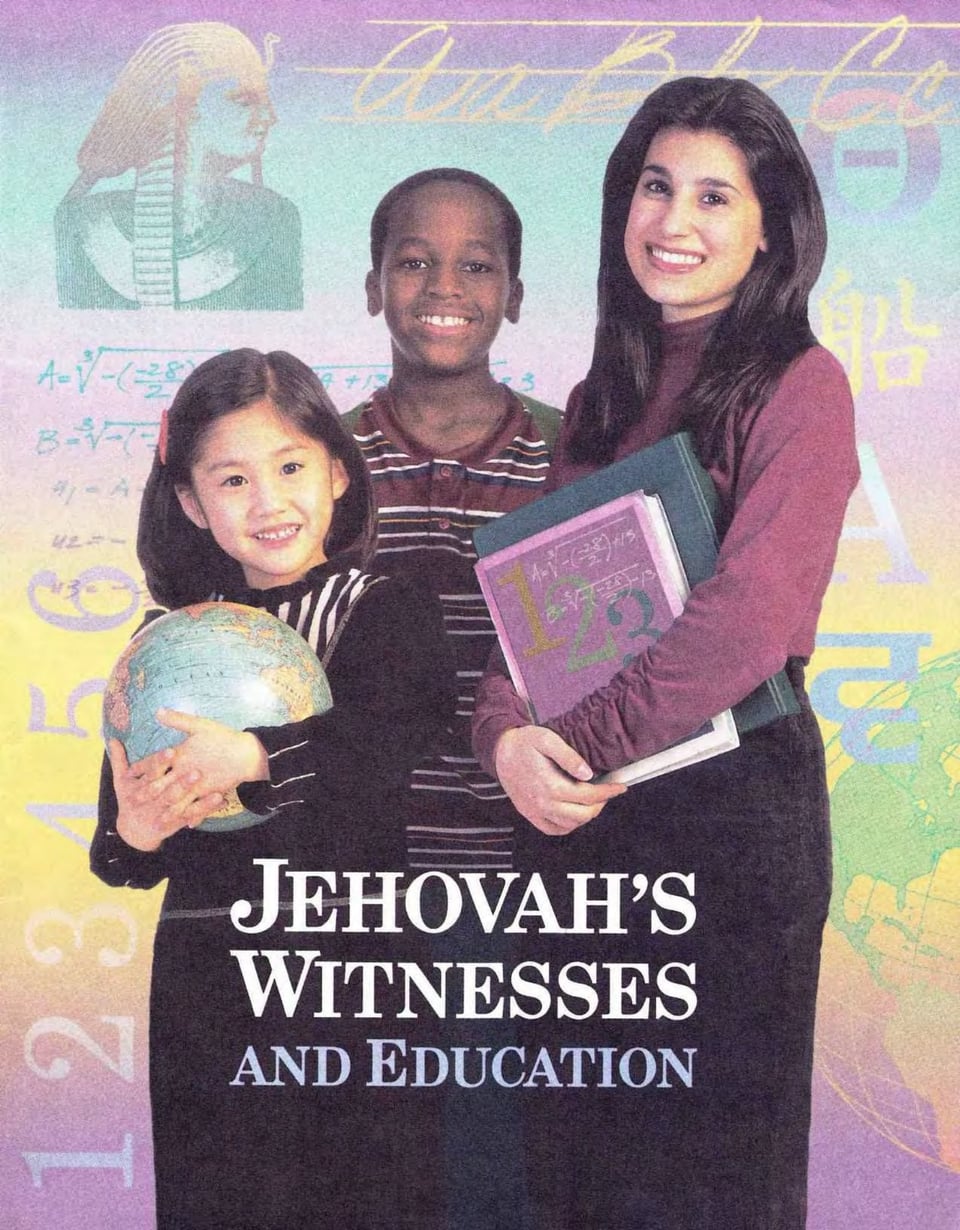
JEHOVAH'S WITNESSES AND EDUCATION The Purpose of This Brochure
DUTCH philosopher Spinoza wrote: "I have striven not to laugh at human actions, not to weep at them, nor to hate them, but to understand them." As an educator, you face the challenge of trying to understand the views, backgrounds, and convictions of the students in your care, including pupils who are children of Jehovah's Witnesses. At times, such students may take what seems to be an unconventional stand on certain issues. But when such actions clearly spring from a student's religious and moral convictions, they merit your attention. This brochure is produced by the Watch Tower Bible and Tract Society (the publishing agency of Jehovah's Witnesses) and is designed to help you better understand Witness students. We hope you will take the time to read it carefully.
Understanding the religious beliefs of another does not require that you accept or follow them, and to inform is not to proselytize. This brochure does not seek to impose the Witnesses' religious views on you or on your students. Our desire is simply to inform you about the principles and beliefs that some of your students are being taught by their parents so that you will find it easier both to understand Witness children and to work with them. Of course, what children are taught and what they do may not always harmonize, as each child is learning to develop his own conscience.
Like most parents, Jehovah's Witnesses want their children to make the most of their schooling. To that end, they teach their children to cooperate with their teachers. In return, Witness parents and their children appreciate it when educators treat them with understanding and respect.
Jehovah's Witnesses are Christians who are known worldwide. However, they are at times misunderstood. Our hope, therefore, is that this brochure will help you to understand better the Witness children you have in your care. In particular, we hope you will see why, in certain specific situations, they may claim the right to be different.
Contents
PAGE 4 How Jehovah's Witnesses View Education
PAGE 10 Educational Programs
PAGE14 The Challenge of Religious Diversity
PAGE 19
Moral Values
That Merit
Respect
PAGE 27 The Role of Parents
PAGE 31 Conclusion
© 1995 Watch Tower Bible and
Tract Society of Pennsylvania
All rights reserved
Publishers: Watchtower Bible and Tract Society of New York, Inc.
International Bible Students Association, Brooklyn New York, U.S.A.
First Printing in English: 5,000,000 Copies
Unless otherwise indicated, Scripture quotations are from the modern-language New World Translation of the Holy Scriptures—With References
Jehovah's Witnesses and Education English (ed-E)
Made in the United States of America How Jehovah's Witnesses View Education
Like all parents, Jehovah's Witnesses are concerned about their children's future. They therefore attach great importance to education. "Education should help people become useful members of society. It should also help them develop an appreciation of their cultural heritage and live more satisfying lives."
AS THIS quotation from The World Book Encyclopedia suggests, one of the main aims of schooling is to train children for day-to-day living, which includes enabling them to care for the needs of a family one day.
Jehovah's Witnesses believe this is a sacred responsibility. The Bible itself says: "Certainly if anyone does not provide for those who are his own, and especially for those who are members of his household, he has disowned the faith and is worse than a person without faith." (1 Timothy 5:8) The years spent at school prepare children for the responsibilities they will take on in life. Accordingly, Witnesses feel that education should be taken very seriously.
Witnesses endeavor to live by the Bible command: "Whatever you do, work at it with all your heart, as though you were working for the Lord and not for men." (Colossians 3: 23, Today's English Version) This principle applies to all aspects of daily life, including school. Witnesses thus encourage their youngsters to work hard and to take seriously the tasks assigned to them at school.
The Bible also teaches submission to the laws of the land in which one lives. So when schooling is obligatory up to a certain age, Jehovah's Witnesses comply with this law.—Romans 13:1-7.
While not minimizing the importance of training for day-to-day living, the Bible shows that this is neither the only nor the principal goal of education. A successful education should also foster in children the joy of living and help them to take their place in society as wellbalanced individuals. Thus, Jehovah's Witnesses feel that the choice of activities outside the classroom is very important. They believe that healthy relaxation, music, hobbies, physical exercise, visits to libraries and museums, and so forth, play an important part in a balanced education. In addition, they teach their children to respect older persons and to seek opportunities to do them a service.
What About Supplementary Education?
Because of new technology, the job market is constantly changing. As a result, many youngsters will have to work in areas or in trades in which they have had no specific training. That being the case, their
"Whatever you do, work at it with all your heart, as though you were working for the Lord."
—Colossians 3:23, Today's English Version "Education should help people become useful members of society.
It should also help them develop an appreciation of their cultural heritage and live more satisfying lives." The World Book Encyclopedia
Galleria degli Uffizi, Firenze
6 Jehovah's Witnesses and Education
work habits and personal training, in particular their ability to adapt to change, will be even more valuable to them. Accordingly, it is better that students become adults having, as Renaissance essayist Montaigne expressed it, 'a well-made head rather than a well-filled head.'
Unemployment, affecting both rich and poor lands, often threatens young people who are insufficiently qualified. Therefore, if the job market calls for training in addition to the minimum required by law, it is up to the parents to guide their children in making a decision about supplementary education, weighing both the potential benefits and the sacrifices that such additional studies would entail.
However, you will likely agree that success in life involves more than just material prosperity. In recent times men and women whose whole lives had become absorbed in their careers lost everything upon losing their jobs. Some parents have sacrificed their family life and the time that they could have spent with their children, missing out on helping them to grow up, because they were consumed by secular work.
Clearly, a balanced education should take into account that more than material prosperity is needed to make us truly happy. Jesus Christ stated: "It is written: 'Man does not
Healthy relaxation, music, hobbies, physical exercise, and visits to libraries and museums all play an important part in a balanced education
live on bread alone, but on every word that comes from the mouth of God.'" (Matthew 4:4, New International Version) As Christians, Jehovah's Witnesses appreciate the importance of developing moral and spiritual qualities as well as preparing themselves to care for their material needs.
Education in Bible Times
THE BIBLE teaches that education is of great importance. It depicts God as the "Grand Instructor" of his people, and throughout its pages it invites his servants to deepen their knowledge of him.—Isaiah 30:20.
In Bible times, only certain privileged classes were literate, such as the scribes in Mesopotamia and Egypt. In sharp contrast, everyone in ancient Israel was encouraged to learn to read and write. "The difference was no doubt due to the simpler alphabetic system of writing used by the Hebrews. . . The importance of alphabetic writing for the history of education must not be overlooked. It ushered in a break with the traditional scribal cultures of Egypt, Mesopotamia, and secondmillennium Canaan. To be literate was no longer the identifying and exclusive characteristic of a class of professional scribes and priests, versed in the abstruse cuneiform and hieroglyphic scripts."—Encyclopaedia Judaica.
Teaching Methods
In ancient Israel, children were taught from a very early age by both father and mother. (Deuteronomy 11: 18, 19; Proverbs 1:8; 31:26) In Dictionnaire de la Bible, Bible scholar E. Mangenot wrote: "As soon as he could speak, the child learned a few passages from the Law. His mother would repeat a
verse; when he knew it, she would give him another one. Later, the written text of the verses they could already recite from memory would be put into the children's hands. Thus, they were introduced to reading, and when they had grown older, they could continue their religious instruction by reading and meditating on the law of the Lord."
To help young and old to remember, various memory aids were used. These included alphabetic acrostics (succesive verses in a poem beginning with a different letter in alphabetical order), alliteration, and the use of numbers. Interestingly, the Gezer Calendar (Archaeological Museum of Istanbul), one
of the oldest examples of ancient Hebrew writing, is thought by some scholars to be a schoolboy's memory exercise.
The Curriculum
Parental education in Bible times included practical training. Girls were taught household skills. The closing chapter of the book of Proverbs shows that these were many and varied; they included handling real-estate transactions and operating a small business, as well as spinning, weaving, cooking, trading, and general household management. Boys were usually taught their father's secular occupation, whether
agriculture or some trade or craft. In Jewish religious circles, the following expression was common: "He who does not teach his son a useful trade is bringing him up to be a thief."
Thus, in Bible times, education was held in high esteem.
Educational Programs
Jehovah's Witnesses are known worldwide for their Bible educational work.
BECAUSE of the importance they attach to their Bible educational work, some may think that they are not interested in secular education. But that is not the case. To teach others, a teacher must first learn, and this requires proper training and instruction. So in addition to making good use of secular schooling, Jehovah's Witnesses have for many years benefited from various educational programs and schools operated by the Watch Tower Society.
These have helped Witnesses and others to improve themselves mentally, morally, and spiritually.
For example, in many countries the Witnesses have faced a special challenge—how to teach people who have had little or no opportunity to receive proper schooling and thus do not know how to read or write. To meet this need, the Watch Tower Society has organized literacy programs.
In Nigeria, for instance, literacy classes have been operated by Jehovah's Witnesses since 1949. By 1961, thousands of Nigerians had thereby learned to read, and available records show that between 1962 and 1994, a total of 25,599 additional adults were taught to read and write in these classes. A recent survey showed that over 90 percent of Jehovah's Witnesses in Nigeria were literate, compared with less than 50 percent of the rest of the population. In Mexico, the Watch Tower Society has operated literacy classes since 1946. During 1994, more than 6,500 persons were taught to read and write. Between 1946 and 1994, more than 127,000 were helped to become literate. Literacy classes have also been organized in many other countries, such
as Bolivia, Cameroon, Honduras, and Zambia.
Such literacy programs have often been given recognition by the educational authorities in the lands where they have been undertaken. In Mexico, for example, a civil servant wrote: "I am grateful for your co-operation, and in behalf of the state government I convey to you their most sincere congratulations for your noble progressive work for the benefit of the people in bringing the light of knowledge to the illiterate. . . I wish you success in your educational work."
The Theocratic Ministry School
Because they attach great importance to their Bible educational work, Jehovah's Witnesses endeavor to improve their ability to explain Bible teachings to others. To provide this type of help, in each of the more than 75,000 congregations worldwide, a meeting called the Theocratic Ministry School is held weekly. All who are enrolled, whether Witnesses or not, take turns giving before an audience a brief presentation on a preselected topic. Whatever their age, the students then receive counsel from an instructor with a view to training them in the skills of public reading and speaking. Even the youngest ones, as soon as they know how to read, can enroll and receive this training, which proves to be useful to them also in other areas, including their secular schooling.
Many educators have commented that Witness students tend to express themselves very well.
Additionally, each congregation of Jehovah's Witnesses is encouraged to have in its Kingdom Hall, or meeting place, a library containing Bible study aids, dictionaries, and other reference works. This library is available to all who attend meetings at the Kingdom Hall. Reading is warmly encouraged within their congregations, and each family is likewise encouraged to have a family
Students in the Theocratic Ministry School receive training in public reading and speaking
library with a wide range of publications to cover the needs of children and adults.
Other Schools
The Watch Tower Society also operates schools for training missionaries of both sexes, as well as schools for training men who have ministerial responsibilities in local congregations. These schools are added evidence that Jehovah's Witnesses attach great importance to education.
Reading is warmly encouraged within their congregations, and each family is likewise encouraged to have a family library with a wide range of publications
The Challenge of Religious Diversity
As an educator, you are confronted with a challenge that educators in previous centuries seldom faced—religious diversity.
THROUGHOUT the Middle Ages, citizens of the same country usually practiced the same religion. As recently as the end of the 19th century, Europe was familiar with only a few major religions: Catholicism and Protestantism in the west, Orthodoxy and Islam in the east, and Judaism. Diversity is, without doubt, much more common today in Europe and throughout the world. Unfamiliar religions have taken root, either adopted by some in the native population itself or introduced by immigrants and refugees.
Thus, today in countries such as Australia, Britain, France, Germany, and the United States, we find many Muslims, Buddhists, and Hindus. At the same time, Jehovah's Witnesses, as Christians, are actively ministering in over 230 lands;
they have become the second-largest religion in Italy and in Spain. In each of 13 countries, their active membership numbers over 100,000. See box, page 15.
The diversity of local religious practices may present challenges to the educator. For example, some important questions may be raised concerning popular celebrations: Should all observances be imposed upon every student—regardless of his or her religion? The majority may find nothing wrong with such celebrations. However, should not the viewpoint of families belonging to a minority group also be respected? And there is another factor to be considered: In countries where the law separates religion from the State and religious instruction is not to be included in the curriculum, would not some find it inconsistent to make such celebrations obligatory in school?
Birthdays
Misunderstandings may even arise with celebrations that appear to have few, if any, religious connections. This is true of birthdays, celebrated in many schools. Although Jehovah's Witnesses respect the right of others to celebrate birthdays, you are no doubt well aware that they choose not to share in such celebrations. But perhaps you are unaware of the reasons why they and their children have decided not to participate in these celebrations.
Le livre des religions (The Book of Religions), an encyclopedia widely distributed in France, calls this custom a ritual and lists it among "secular rites." Although considered to be a harmless secular custom today, birthday celebrations are actually rooted in paganism.
The Encyclopedia Americana (1991 edition) states: "The ancient world of Egypt, Greece, Rome, and Persia celebrated the birthdays of gods, kings, and nobles." Authors Ralph and Adelin Linton reveal the underlying reason for this. In their book The Lore of Birthdays, they write: "Mesopotamia and Egypt, the cradles of civilization, were also the first lands in which men remembered and honoured their birthdays.
Jehovah's Witnesses A Worldwide Religion
Country
Active Members
Argentina
105,650
Brazil
385,099
Britain
129,852
Canada
110,659
France
123,718
Germany
167,878
Italy
208,016
Japan
194,608
Mexico
404,593
Nigeria
180,813
Philippines
118,446
Poland
117,958
U.S. of America
936,264
The keeping of birthday records was important in ancient times principally because a birth date was essential for the casting of a horoscope." This direct connection with astrology is a cause of great concern to any who avoid astrology because of what the Bible says about it.—Isaiah 47: 13-15.
Not surprisingly then, we read in The World Book Encyclopedia: "The early Christians did not celebrate His [Christ's] birth because they considered the celebration of anyone's birth to be a pagan custom."—Volume 3, page 416.
With the foregoing in mind, Jehovah's Witnesses choose not to share in birthday festivities. To be sure, the birth of a child is a happy, glorious event. Naturally, all parents rejoice as their children grow and develop with each passing year. Jehovah's Witnesses also find great
joy in demonstrating their love for their family and friends by giving gifts and having good times together. However, in view of the origin of birthday celebrations, they prefer to do so at other times throughout the year.—Luke 15:22-25; Acts 20:35.
Christmas
Christmas is celebrated worldwide, even in many non-Christian countries. Since this holiday is accepted by the majority of the religions of Christendom, it may seem
Witnesses enjoy having good times together
rather surprising that Jehovah's Witnesses choose not to celebrate it.
Why is that so?
As many encyclopedias clearly state, Jesus' birthday was arbitrarily set as December 25 to coincide with a Roman pagan festival. Note the following declarations taken from different reference works:
"The date of Christ's birth is not known. The Gospels indicate neither the day nor the month."—New Catholic Encyclopedia, Volume II, page 656.
"Most of the Christmas customs now prevailing in Europe, or recorded from former times, are not genuine Christian customs, but heathen customs which have been absorbed or tolerated by the Church. . . The Saturnalia in Rome provided the model for most of the merry customs of the Christmas time."—Encyclopædia of Religion and Ethics (Edinburgh, 1910), edited by James Hastings, Volume III, pages 608-9.
"Christmas has been celebrated on December 25 in all Christian churches since the fourth century. At that time, this was the date of the pagan winter-solstice festival called the 'Birth (Latin, natale) of the Sun,' since the sun appeared to be reborn as the days once again became longer. In Rome, the Church adopted this extremely popular custom . . . by giving it a new
Culver Pictures
"The Saturnalia in Rome provided the model for most of the merry customs of the Christmas time."
—Encyclopædia of Religion and Ethics
meaning."—Encyclopædia Universalis, 1968, (French) Volume 19, page 1375.
"The development of the Christmas festival was influenced by the contrast with the pagan celebrations of the Sol Invictus (Mithra). On the other hand, December 25, being the day of the winter solstice, was identified with the light that broke forth into the world through Christ, and the symbolism of the Sol Invictus was thus transferred to Christ." Brockhaus Enzyklopdie, (German) Volume 20, page 125.
When learning the facts about Christmas, how have some reacted? The Encyclopedia Britannica observes: "In 1644 the English What the Children Say
"Even though I don't get presents on my birthday, my parents still buy me gifts on other occasions. I like it that way because I get surprised."—Gregory, age 11.
"The way most kids view Christmas is that it's just a time for lots of presents. But I get presents and go places all through the year. My family has taken me to other countries, like Fiji, New Zealand, and Brazil."—Caleb, age 10.
"I have fun with my friends, and we surprise each other with gifts from time to time."—Nicole, age 14.
"Many at school ask me how I can bear going without Christmas or other holidays. I'm not deprived of having fun. My family and I often do things together. We have wonderful friends that we enjoy going on vacation with. We go camping and skiing, and we often have gatherings at our home. I think if others knew how much fun we have, they would be surprised!"—Andriana, age 13.
"I never feel left out because I don't celebrate Christmas or other holidays. During the holidays, when we are off from school and Dad is off from work, we play games, go to movies, watch TV. We spend a lot of time doing things together as a family."—Brian, age 10.
puritans forbad any merriment or religious services by act of Parliament, on the ground that it [Christmas] was a heathen festival,
and ordered it to be kept as a fast. Charles II revived the feast, but the Scots adhered to the Puritan view." The early Christians did not celebrate Christmas, nor do Jehovah's Witnesses celebrate it today or take part in activities that are associated with Christmas.
The Bible, however, speaks favorably of giving gifts or inviting family and friends for a joyful meal on other occasions. It encourages parents to train their children to be sincerely generous, instead of giving gifts simply when socially expected to do so. (Matthew 6:2, 3) Children of Jehovah's Witnesses are taught to be tolerant and respectful, and this includes recognizing the right of others to celebrate Christmas. In turn, they appreciate it when their decision not to participate in Christmas celebrations is respected.
Other Celebrations
Jehovah's Witnesses take the same position on other religious or semireligious holidays that occur during the school year in various lands, such as June festivals in Brazil, Epiphany in France, Carnival in Germany, Setsubun in Japan, and Halloween in the United States. With regard to these or any other specific celebration not named here, Witness parents or their children would surely be happy to answer any questions you may have.
Moral Values That Merit Respect
Throughout history, brave men and women have taken a stand contrary to the popular thinking of their times. They have endured political, religious, and racial tyranny, often giving their lives for their cause.
THE EARLY Christians were particularly courageous. During the severe persecutions of the first three centuries, many of them were put to death by the pagan Romans for refusing
to worship the emperor. Sometimes an altar was set up in an arena. To gain their freedom, the Christians would merely have had to burn a pinch of incense in recognition
Jehovah's Witnesses try to instill true Christian values in their children
Respect, but Not Worship One morning in a school in Canada, an 11-year-old Witness girl named Terra noticed that the teacher took a fellow student out of the classroom for a few moments.
Shortly thereafter, the teacher quietly asked Terra to accompany him to the principal's office.
As she entered the office, Terra immediately saw that the Canadian flag was draped across the principal's desk. The teacher then instructed Terra to spit on the flag. He suggested that since Terra did not sing the national anthem or salute the flag, there was no reason why she should not spit on the flag when ordered to do so. Terra refused, explaining that although Jehovah's Witnesses do not worship the flag, they do respect it.
Back in the classroom, the teacher announced that he had just tested two students, instructing them to spit on the flag. Although the first student did participate in patriotic ceremonies, she nevertheless spit on the flag when ordered to do so. However, even though Terra did not sing the anthem or salute the flag, she refused to dishonor it in this way. The teacher pointed out that of the two, Terra was the one who showed proper respect.
of the divine nature of the emperor. Few, however, compromised. The majority preferred to die rather than renounce their faith.
In modern times, Christian Witnesses of Jehovah take a similar position in regard to political neutrality. For example, their firm stand in the face of Nazism is a matter of historical record. Before and during the second world war, approximately a quarter of the German Witnesses lost their lives, mainly in concentration camps, because they remained neutral and refused to say "Heil Hitler." Young children were forcibly separated from their Witness parents. In spite of the pressure, young ones remained firm and refused to be contaminated by the unscriptural teachings that others tried to force upon them.
The Flag Salute
Jehovah's Witnesses are not generally the target of such bitter persecution today. Nevertheless, misunderstandings sometimes arise as a result of young Witnesses' conscientious decision not to share in patriotic ceremonies, such as the flag salute.
Children of Jehovah's Witnesses are taught not to discourage others from saluting the flag; that is for each individual to decide. The position of the Witnesses themselves, however, is firm: They do not salute the flag of any nation. This is certainly not intended to indicate disrespect. They do respect the flag of "Give back to Caesar what belongs to Caesar—and to God what belongs to God"
—Matthew 22:21, Jerusalem Bible
whatever country they live in, and they show this respect by obedience to the country's laws.
They never engage in antigovernment activity of any kind. In fact, Witnesses believe that present human governments constitute an "arrangement of God" that he has permitted to exist. So they consider themselves to be under divine command to pay taxes and to respect such "superior authorities." (Romans 13:1-7) This is in line with Christ's famous statement: "Give back to Caesar what belongs to Caesar—and to God what belongs to God."—Matthew 22:21, Catholic Jerusalem Bible.
'But why, then,' some may ask, 'do Jehovah's Witnesses not honor the flag by saluting it?' It is because they view the flag salute as an act of worship, and worship belongs to God; they cannot conscientiously give worship to anyone or anything except God. (Matthew 4:10; Acts 5:29) Therefore, they appreciate it when educators respect this conviction and allow Witness children to abide by their beliefs.
Not surprisingly, Jehovah's Witnesses are not alone in believing that the flag salute is related to worship, as the following comments show:
"Early flags were almost purely of a religious character. . . . The aid of religion seems ever to have been sought to give sanctity to national
Three young Hebrew men refused to bow down before a statue raised up by Babylonian king Nebuchadnezzar
flags." (Italics ours.)—Encyclopedia Britannica.
"The flag, like the cross, is sacred. . . The rules and regulations relative to human attitude toward national standards use strong, expressive words, as, 'Service to the Flag,' . . . 'Reverence for the Flag,' 'Devotion to the Flag.'" (Italics ours.) The Encyclopedia Americana.
"Christians refused to . . . sacrifice to the [Roman] emperor's genius roughly equivalent today to refusing to salute the flag or repeat the oath of allegiance."Those About to Die (1958), by Daniel P. Mannix, page 135.
Again, Jehovah's Witnesses intend no disrespect for any government or its rulers by a refusal to salute the flag. It is just that they will not, in an act of worship, bow down to or salute an image representing the State. They view it as similar to the stand taken in Bible times by three young Hebrew men who refused to bow down before the statue raised up on the plain of Dura by Babylonian king Nebuchadnezzar.
Some Moral Principles That Jehovah's Witnesses Follow
With regard to moral values, Jehovah's Witnesses teach their children to keep separate from conduct, practices, or even attitudes that, although common in the world today, can bring harm to themselves or to others. (James 1:27) So they inform their children about the dangers of drugs and other practices, such as smoking and the abuse of alcohol. (Proverbs 20:1; 2 Corinthians 7:1) They believe in the importance of honesty and industriousness. (Ephesians 4:28) They teach their children to avoid foul language. (Ephesians 5:3, 4) They also teach them to live by the Bible principles on sexual morality and to have respect for authority and for the person and property of others. (1 Corinthians 6:9, 10; Titus 3:1, 2; Hebrews 13:4) They sincerely believe that living by those principles is in the best interests of their children.
(Daniel, chapter 3) So then, while others salute and pledge allegiance, children of Jehovah's Witnesses are taught to follow their Bible-trained consciences. Thus, they silently and respectfully refrain from participating. For similar reasons, Witness children choose not to participate when national anthems are sung or played.
The Parents' Right
Nowadays, most countries respect the parents' right to give their children religious instruction in harmony with their convictions. All religions support this right, as illustrated by the canon law still in force in the Catholic Church: "Having given life to their children, parents are under the very strict obligation to educate them, and have the right to do so; that is why it behooves parents primarily to provide their children with a Christian education according to Church doctrine."—Canon 226.
Jehovah's Witnesses ask nothing more. As caring parents, they try to instill true Christian values in their children and inculcate in them love for neighbor and respect for other people's property. They desire to follow the counsel the apostle Paul gave to the Christians in Ephesus: "Parents, do not treat your children in such a way as to make them angry. Instead, raise them with Christian discipline and instruction."—Ephesians 6:4, Today's English Version.
Religiously Divided Households
In some families, only one parent is a Witness of Jehovah. In such a situation, the Witness parent is encouraged to recognize the right of the non-Witness parent also to instruct the children according to his or her religious convictions. Children exposed to different religious views experience few, if any, ill effects.* In practice, all children have to decide what religion they will follow.
Naturally, not all youths choose to follow the religious principles of their parents, whether Jehovah's Witnesses or not.
Children's Right to Freedom of Conscience
You should also know that Jehovah's Witnesses attach much importance to the individual Christian conscience. (Romans, chapter 14) The Convention on the Rights of the Child, adopted by the General Assembly of the United Nations in 1989, recognized a child's right to "freedom of thought, conscience and religion" and the right "to express his or her opinion freely and to have that opinion taken into account in any matter or procedure affecting the child."
No two children are exactly alike. Therefore, you may reasonably expect some variations in the decisions
that young Witnesses or other students make when it comes to certain activities and assignments at school. We trust that you also subscribe to the principle of freedom of conscience.
Children are encouraged to take an interest in others
The Role of Parents
Without a doubt, raising children to be balanced adults in today's society is no easy task.
THE U.S. NATIONAL Institute of Mental Health published the results of a survey of parents who were considered successful-those whose children, aged over 21, "were all productive adults who were apparently adjusting well to our society." These parents were asked: 'Based on your personal experience, what is the best advice you could give to other
Educators play a key role in producing well-adjusted young adults
parents?' The most frequent responses were these: 'Love abundantly,' 'discipline constructively,' 'spend time together,' 'teach your children right from wrong,' 'develop mutual respect,' 'really listen to them,' 'offer guidance rather than a speech,' and 'be realistic.'
Parents, however, are not alone in working to produce well-adjusted young adults. Educators too play a key role in this. An experienced
school counselor observed: "The primary objective of formal education is to support parents in producing responsible young adults who are well-developed intellectually, physically, and emotionally."
So parents and educators share the same goal一to produce youths who will later become mature and balanced adults who enjoy life and are able to find their place in the society in which they live.
Coworkers, Not Competitors
Problems, however, arise when parents fail to cooperate with educators. Some parents, for example, are completely indifferent to their children's education; others try to compete with the teachers. Discussing this situation, a French journal said: "The teacher is no longer the only captain on board. Parents, obsessed with their children's success, dissect schoolbooks, judge and criticize teaching methods, and instantly react to their offspring's first bad mark." Such actions can encroach on the prerogatives of teachers.
School Problems Today
Jehovah's Witnesses feel that their children are better served when parents cooperate with educators, taking an active, helpful interest in their children's education. Such cooperation, they believe, is especially important because your job as an educator has become increasingly difficult.
Reflecting the society of which they are a part, schools are not sheltered from the problems of society in general. Social problems have intensified rapidly over the years. Describing conditions in one school in the United States, The New York Times reported: "Students sleep in class, they threaten each other in the graffiti-scarred hallways, they belittle the good students. . . . Almost all the students are coping with problems like caring for babies, dealing with incarcerated parents and surviving gang violence. On any given day, almost one-fifth are absent."
Jehovah's Witnesses feel that their children are better served when parents cooperate with educators, taking an active, helpful interest in their children's education
Especially alarming is the growing international problem of violence in schools.
Occasional fights involving pushing and shoving have been replaced by routine shootings and stabbings. Weapons have become more common, attacks more severe, with children resorting to violence more quickly and at a younger age.
Doubtless, not every country faces such grim conditions. However many educators worldwide confront the situation mentioned in the French weekly Le Point: "The teacher is no longer respected; he has no authority."
Such disrespect for authority poses a real danger to all children. So Jehovah's Witnesses try to instill in their children obedience and respect for authority, qualities that are often lacking in school life today.
Successful parents spend time with their children
Conclusion
A FULL consideration of the religious beliefs of Jehovah's Witnesses does not come within the scope of this brochure. Instead, we have endeavored to explain some of the principles the Witnesses believe in and to show clearly the type of family influences affecting your student if one or both parents are Witnesses.
Jehovah's Witnesses place great emphasis on their children's spiritual development. And they feel confident that this enhances their children's development in other areas. The beliefs they embrace and the principles they follow give their lives meaning and help them to deal with their everyday problems. In addition, those beliefs and principles should move them to try to be eager students and good citizens throughout life.
The Witnesses endeavor to be realistic about life, so they attach great importance to education. It is, therefore, their wish to work along with you to the best of their abilities. For their part, in their homes and in their places of worship around the world, they will continue to encourage their children to play their part in this fruitful collaboration.
For further information, please write Watch Tower, using the appropriate address below.
ALASKA 99507: 2552 East 48th Ave., Anchorage. AUSTRALIA: Box 280, Ingleburn, N.S.W. 2565. BAHAMAS: Box N-1247, Nassau, N.P. BARBADOS: Fontabelle Rd., Bridgetown. BELIZE: Box 257, Belize City. CANADA: Box 4100, Halton Hills (Georgetown), Ontario L7G 4Y4. ENGLAND: The Ridgeway, London NW7 1RP. FIJI: Box 23, Suva. GERMANY: Niederselters, Am Steinfels, D-6518 Selters. GHANA: Box 760, Accra. GUAM 96913: 143 Jehovah St., Barrigada. GUYANA: 50 Brickdam, Georgetown 16. HAWAII 96819: 2055 Kam IV Rd., Honolulu. HONG KONG: 4 Kent Road, Kowloon Tong. INDIA: Post Bag 10, Lonavla, Pune Dis., Mah. 410 401. IRELAND: 29A Jamestown Road, Finglas, Dublin 11. JAMAICA: Box 180, Kingston 10. JAPAN: 1271 Nakashinden, Ebina City, Kanagawa Pref. 243-04. KENYA: Box 47788, Nairobi. LEEWARD ISLANDS: Box 119, St. Johns, Antigua. LIBERIA: P.O. Box 10-0380, 1000 Monrovia 10. MALAYSIA: 28 Jalan Kampar, Off Jalan Landasan, 41300 Klang, Sel. NEW ZEALAND: P.O. Box 142, Manurewa. NIGERIA: P.M.B. 1090, Benin City, Edo State. PAKISTAN: 197-A Ahmad Block, New Garden Town, Lahore 54600. PANAMA: Apartado 6-2671, Zona 6A, El Dorado. PAPUA NEW GUINEA: Box 636, Boroko, N.C.D. PHILIPPINES, REPUBLIC OF: P.O. Box 2044, 1099 Manila [186 Roosevelt Ave., San Francisco del Monte, 1105 Quezon City]. SIERRA LEONE, WEST AFRICA: P. O. Box 136, Freetown. SOUTH AFRICA: Private Bag X2067, Krugersdorp, 1740. SWITZERLAND: P.O. Box 225, CH-3602 Thun [Ulmenweg 45, Thun]. TRINIDAD AND TOBAGO, REP. OF: Lower Rapsey Street & Laxmi Lane, Curepe. UNITED STATES OF AMERICA: 25 Columbia Heights, Brooklyn, NY 11201-2483. WESTERN SAMOA: P. O. Box 673, Apia. ZAMBIA: Box 33459, Lusaka 10101. ZIMBABWE: 35 Fife Avenue, Harare.
$
A = \sqrt {3} \cdot (\frac {- 2 9}{2}) + 1 5 = \sqrt {1 4} + 1 5 = \sqrt {3} \sqrt {2 7} = 3
$
$
E = \sqrt [ 3 ]{-(\frac {- 2 x}{2})} - 1 3 = \sqrt [ 3 ]{4 - 1 3} = \sqrt [ 3 ]{1} = 1
$
1995 FRONT COVER
2002 FRONT COVER