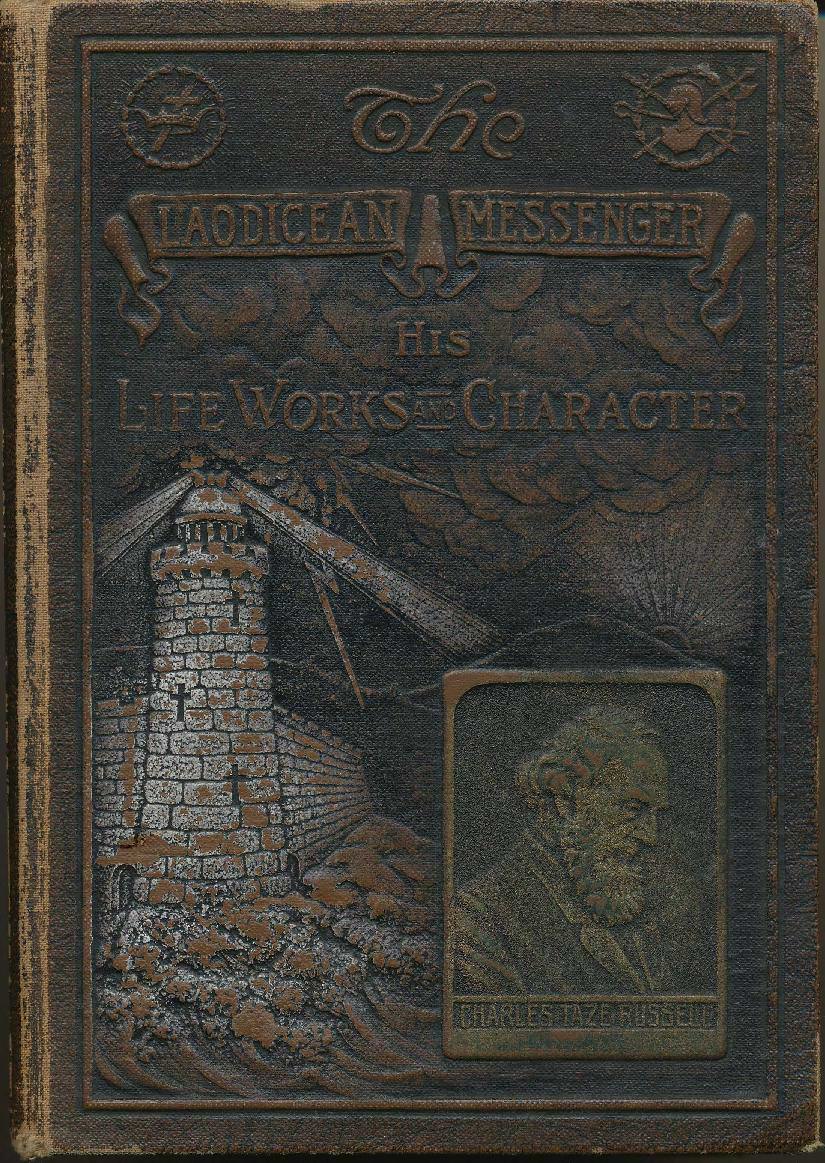
The Laodicean Messenger His Life Works And Character (1923)
Download: PDF — The Laodicean Messenger His Life Works And Character (1923)
A MEMORIAL
Christ in you, the hope of glory
Col. 1:27
VERY true child of God must have a
E
definite individual Christian character which is not dependent for its existence upon the spiritual life of any other Christian. He must from the Word of Truth, proclaimed, and exemplified by other Christians, draw those principles of life, which give him an established character, a spiritual individuality of his own. So positive and definite should be the spiritual individuality of every one, that, should even the beloved brother or sister whose spiritual life first nourished ours and brought us forward to completeness of character fall away, we would still live, being able to appropriate for ourselves the Spirit of Truth.”
—Daily Heavenly Manna,
September 17th.
THE
Laodicean Messenger
being the
MEMOIRS
of the
Life, Works and Character of That Faithful and Wise Servant of the Most High God
Copyrighted, 1923 By The
BIBLE EDUCATIONAL INSTITUTE Chicago, Ill.
Printed in the United States of America
Third Edition
DEDICATION
To the King of Kings and Lord of Lords
IN THE INTEREST OF
CONSECRATED SAINTS, WAITING FOR THE ADOPTION, This Work is Dedicated
To the sacred memory of a wise and faithful servant of the most high God; and it is with a sincere hope and fervent prayer that it will be a great aid to all in reviving a Christian zeal, which, though painful to say, is gradually losing in “its first love” and eagerness to serve the Lord and His children, our Brethren.
DEDICATION
He Stood Upon the Watch
P U B L I S H E R ’ S F O R E W O R D
On this 100th anniversary year of Pastor Charles Taze Russell’s death, a biography written by W. M. Wisdom is offered as a look back in time. This book was published in 1923. Beginning in 1912 the author served throughout the U.S. (though infrequently in the northwest and south central states) and from Ontario to Nova Scotia. In 1915 he was an elder in the New York Ecclesia. Some of his lessons appear in Bible Students’ Convention Reports from 1912-1916.
All biographies are written through the eyes of the author and not the living memories of the person himself. Some persons would prefer their histories were written differently or perhaps not at all. Characterizations are the preference of the writer. This author lived contemporaneously with Pastor Russell and had access to information, dates, places and events that may otherwise be lost to time and the memories of other generations. Praise and adulation may be considered as excessive or otherwise insufficient by some. Readers need to discern for themselves.
Rather than revising or writing a new history, this 1923 book is reproduced here and formatted with all the original text and features. All chapters begin on the same page numbers as the 1923 edition printed in Chicago. The text has been carefully compared and verified to the original. Due to type font differences, not all sentences or paragraphs begin and end at precisely the same location, yet they are close.
This work is commended for those sincerely searching those times and events which still mark another generation.
— 2016, Portland, Oregon
W HEN the news was flashed over the wire soon after Oct. 31st, 1916, “Pastor Russell is Dead,” the Truth Friends all over the world received the shock of their lives. Never did more unwelcome news reach loyal, loving Brethren; never, apparently, were there more heartaches; never more sorrow; never did more hot tears of grief flow from human eyes than when this sad news was received. The writer believes that this grief was genuine, sincere, that the sorrow was from the heart. The Funeral Services in the New York Temple, the gloominess of the Bethel Home, left their impress upon his heart and brain. Time can never efface that memory; the lesson learned has been enduring: “It is the Lord; let Him do what seemeth Him good.”
Since that date a cycle of seven years has been almost completed. With what sadness we note the change which a few short years have wrought in the attitude of so many of the dear Friends everywhere. The first glow of love is cooling to an alarming degree; devotion to the principals underlying the Divine Law are being ignored to a great extent, while a wave of unrighteousness is rapidly sweeping over the Church, threatening to drive the Bark of Faith on the Rock of Disaster.
For some time the writer has noted this growing tendency to lukewarmness, to indifference, to slackness amongst the Truth people; and while saddened by this knowledge, he saw no way by which he could aid in turning back the waves which he realized were rising higher and higher as time passed, though he sought in prayer with “tears and strong crying” the Lord’s guidance, this “seemed to tarry;” hence he “waited for it.”
Not from preference but from clearly marked Divine leadings in which his will was completely submerged into the will of The Head of The Church, he was finally impressed to undertake, under many disadvantages, the preparation and compilation of the matter for the Book now in your hands; and he might also add that, the Lord saw to it that he should have to face many discouraging experiences and surmount difficulties and overcome obstacles of which few knew and none could appreciate—but, “IT IS FINISHED.”
Both the Author and the Publisher would express regret that many imperfections have been revealed to their minds, yet for these they offer no excuses and would make no apologies—for no perfect thing could come out of an imperfect one; and if this Work does not offend some, then, according to Saint James, the Book would be Perfect, the Author Perfect, and the Publisher Perfect—all of which are most emphatically disclaimed. Nevertheless the Book does represent their best combined efforts.
Now, then, what was the motive that prompted to this enterprise? From the very beginning both the Author and the Publisher realized that some with a hypercritical cast of mind would impugn their motives; for there are always those who oppose everything wherein they are not the guiding spirits and have not the controlling hand; but here is the Book, look at it—yes, read it thoughtfully and see if you can find anything therein out of harmony with The Truth as we all received it through “that faithful and wise Servant.” If you can, then tell us frankly just wherein “we have come short.” Some, though not many, we are glad to say, have overlooked entirely the Scripture which saith, “He that answereth a matter before he heareth it, it is a folly and shame unto him.”
Again there are some who claim to recognize the subject of this Book as “that Servant,” while in reality they deny him, and make his writings in many respects of “none effect.” How many overlooked this sentiment, sound principle, as expressed by the one whose memory we cherish: “We should not think that we alone have the privilege of engaging in His Work; that we have patent rights on His work, and can hinder others from doing what they may be able to do and take pleasure in doing.” We have always respected this principle, and in the production of The Memoirs of the author of the statement quoted, we jointly feel that we have lived up to the Scriptural injunction of doing Good, “especially unto the (entire) Household of Faith.”
So our motive has been to do GOOD, as God has given us to understand what that means; therefore, we have no further explanation to make or apology to offer; merely pleading that we have earnestly and consistently striven to absorb the Truth and the spirit of the Truth which was so beautifully exemplified in the life of the subject of this book—our beloved Brother Russell, who labored so hard and earnestly to teach us how to walk as Christians should. God bless his Memory!
The Bible is THE BOOK of books in every sense; first, there is no other book like it in the world—for it is God’s Book or Message to the human family; second, it is a Book of books for the reason that it is made up of many books, or portions, by many writers—sixty-six divisions.
In a complete and connected sense, this Book, though containing the Great Author’s Wonderful Plan of the Ages, was sealed to human understanding until our Lord’s Parousia in 1874, when it was given Him to “loose the seals,” using a human instrument, “a chosen vessel,” for this purpose.
Charles Taze Russell was the one “chosen of God and faithful” to this end; so he, under the Lord’s guidance, gave us the “The Keys” to the Scriptures—and to all sincere Christians these “Keys” or Studies, have fulfilled the design of the author; for they have proved to be Helping Hands in the systematic study of the Bible. This Book—Memoirs—tells you something about how and under what difficulties “that Servant” attained the desired end—something of the discouragements he met and the obstacles he overcame.
To understand the Bible, then, it is necessary to have these “Helping Hands” to Bible Study; and to understand the author of these Studies in the Scriptures it is important to read and ponder well the revealments herein given pertaining to the Life, Works and Character of one of the greatest men the world has ever known.
The principle upon which the Memoirs was prepared and is issued is broad and comprehensive enough for all true Christians to stand upon; yet it is as narrow as the rules laid down for Christian conduct by our Lord and His Apostles.
To the true Christian we therefore need make no apology for the issuance of this Work; we have had from start to finish too many evidences of the Lord’s favor to doubt for a moment that He (not man) has guided in every step taken.
Manifestly, then, it is His wish that this Book of Memoirs of the Life, Works and Character of Charles Taze Russell should be placed in the hands of His Saints now and preserved for future generations.
May the blessings of the Lord go with the Book into the home of all who love the Lord and are striving to serve Him in sincerity and in truth.
The Author.
CONTENTS
CHAPTER PAGE
I. The Boy—The Man—The Bible Student
II. Autobiographical Notes
A condensed History of the Beginning and Progression of the Harvest Work.
III. Pastor Russell’s personality
His Wonder Speaking Eyes.
IV. Pastor Russell’s Characteristics
A Born Diplomat with a Penchant for Details.
V. Pastor Russell’s Ordination
His Education in Hebrew and in Greek.
VI. Pastor Russell’s Doctrines
Ransom and Restitution.
VII. Pastor Russell’s Teachings
As he Taught He lived.
VIII. His Office, Work and Service
IX. Volume and Character of His Work
To Him Duty Was Pleasure.
X. Bethel Service
Its Sanctifying Influence.
XI. World-Wide Witness
Great Newspaper Campaign
XII. Revisits Holy Land
Also the Pyramid of Gizeh.
XIII. Pastor Russell Addresses Hebrews
A Wonderful Meeting—Unusual Spectacle.
XIV. Foreign Missions Investigated
XV. The Photo-Drama of Creation
XVI. Ignorance Engenders Hate
XVII. Who, then, Is That Wise Servant?
CHAPTER PAGE
XVIII . Man of Ten Talents
A Wonder Unto Many
XIX. Knew Why Financiers Tremble
A Fabulous Sum Once Offered for His Counsel.
XX. His Exhortations
Pastoral Advice to the Church Everywhre.
XXI. Expressions from Those Who Knew
XXII. Pastor Russell a Great Man
Some Important Items.
XXIII. In Memoriam of a Scholar
XXIV. Pastor Russell’s Last Pilgrimage
XXV. Works While Dying
Realized Than His Hour Had Come.
XXVI. Pastor Russell Is Dead
Earthly Tabernacle Worn Out.
XXVII. Funeral Services of a King
Be Thou Faithful Unto Death.
XXVIII. “He Is Risen”
Jesus and the Two Walk to Emmaus.
XXIX. What He Willed
Last Will and Testament of Charles Taze Russell.
XXX. Excerpts from Memorial Addresses
Verse and Quotes
Subject Index
The Laodicean Messenger
CHAPTER I
THE BOY—THE MAN—THE BIBLE STUDENT
Pastor Russell, the greatest expounder of Biblical truths since the days of Saint Paul, the twelfth and greatest of the Apostles of the Lamb, and the staunchest defender of “the faith once delivered to the saints” since Luther, was born Charles Taze Russell, at Pittsburgh, Pennsylvania, February 16, 1852, of consecrated parents who were of Scotch-Irish descent. The circumstances connected with his birth, together with the environment of his early life, no doubt had much to do with his subsequent course and usefulness in the Lord’s cause, as in the case of Samuel, who was given to the Lord before he was born (I Samuel 1:11); and of Saint Paul, who tells us he was chosen from his birth (Galatians 1:15). In private Pastor Russell admitted his belief that he had been chosen for the great work he had accomplished, as “that Servant,” from before his birth.
Having come of such parentage and being reared under the influence of a Christian home, he necessarily developed, at an early age, a mind that incited him to “feel after God,” a desire to KNOW Him in the true sense, and so to worship Him accordingly. Being, therefore, of a naturally reverential trend of mind he early showed a tendency to worship a GOD of LOVE; for his own heart, warm and loving, rebelled at the thought of revering a “God who would torture throughout eternity” His helpless creatures when they were sinners by heredity.
Hence, as he grew older and became more mature of thought, he began to see how discordant are the teachings of all the creeds of “Christendom”: that these were not only in sharp conflict among themselves but in many fundamentals are wholly irreconcilable with reason, therefore in violent opposition to a proper concept of a just, wise and loving God; such indeed as the Scriptures show our Heavenly Father to be.
Therefore, what was young Russell to believe? How could he determine assuredly which of these conflicting teachings was right and which was wrong? These questions continually intruded themselves upon his inquiring mind; but where to find satisfactory answers was the perplexity with which he was confronted. He reasoned, however, that there must be solutions to such problems and he resolved upon finding them. His struggles, his defeats and his final success are told in the succeeding chapters.
“Once in all history we meet a being who never did an injury, and never resented one done to him, never uttered an untruth, never practiced a deception, and never lost an opportunity of doing good; generous in the midst of the selfish, upright in the midst of the sensual, and wise far above the wisest of earth’s sages and prophets, loving and gentle, yet immovable, resolute; and whose illimitable meekness and patience never once forsook him in a vexatious, ungrateful and cruel world.”
A PASTOR IN THE MAKING
The strong resemblance between the portraits of Pastor Russell at sixty and Charles Taze at four is unusual, and the character lines indicating determination rather suggest the explanation for his subsequent independent evangelistic work.
Up to the age of fifteen he believed as gospel truth all and only such doctrines as had been taught him. To learn to understand doctrines at that period was very difficult, as the clergy usually discouraged individual Bible research, and the asking of questions on doctrines was considered equivalent to doubting, and “to doubt was to be damned.” The dissipation of this superstitious reverence and fear only awaited such time as he could attempt to defend by the Scriptures his particular sectarian views, and subsequent events justify the thought that Providence had decreed that at just this juncture young Russell should attempt to reclaim an infidel.
By skillful questions, which were unanswerable by either minister or layman from their sectarian standpoints and by the maneuvering of many seemingly paradoxical Scriptures, the infidel completely routed young Russell, who within a few months became an admitted skeptic. Here, as in nearly every similar case, the Bible was discarded together with the doctrines of the creeds. Few indeed under such circumstances study the Scriptures to see whether they have been properly interpreted, and up to this time Charles Taze Russell was no exception.
As he desired to learn the truth concerning the hereafter, the next few years were devoted to the investigation of the claims of the leading oriental religions, all of which he found to be unworthy of credence, hence we see him arriving at manhood’s estate with a mind unsatisfied, a mind which, despite all efforts to the contrary, was still subject to its occasional bad hours on account of its “first impression” on the eternal torment theory.
At twenty-one Mr. Russell was possessed of much knowledge and voluminous data on religion as believed and practiced in all parts of the world. Apparently these were to become of no value to himself or others, because of large business responsibilities that were placed upon him at this time. Days grew into weeks, and weeks into months, and he found less and less time to devote to theological research, and the solace for heart and head so diligently sought for seemed as remote as ever. The question that here confronted him was, “Shall I try longer to find the truth on religion? Or, shall I smother the hope of finding it and strive for fame and fortune among the financial and commercial captains of the time?” The latter he was about to do, but fortunately he decided first to search the Scriptures from a skeptic’s standpoint, for its own answer on hell-fire and brimstone.
Amazed at the harmonious testimony, proving an unexpected but satisfactory answer, he undertook systematic Bible research and was brought to a complete confidence in the Bible as being inspired by an all-wise, powerful, just and loving Creator, worthy of adoration and worship. Thus a sure anchor for a fainting hope was found, and an honest, truthseeking heart was made glad.
An obituary writer had this to say of this grand man of God:
“In 1877 Pastor Russell called a meeting of all the ministers of Allegheny and Pittsburgh, showed them the Scriptures which indicated our Lord’s presence and urged them to investigate and proclaim the message. All the ministers of two cities were present and all of the ministers of the two cities refused to believe. In the same year he gave up his secular work to devote his entire time and fortune to the work indicated in the Scriptures as incident to the close of the Gospel Age and the change of Dispensations impending. As a means of determining whether his purposed course was in harmony with the Scriptures, and also as a means of demonstrating his own sincerity, he decided to test the Lord’s approval, as follows:
“(1) Devote his life to the cause; (2) invest his private fortune (about $350,000.00) in the promulgation of the work; (3) prohibit collection at all meetings; (4) depend on unsolicited contributions (which must be wholly voluntary) to continue the work after his own fortune was exhausted. Furthermore, in 1881 there were distributed free 1,400,000 copies of Food for Thinking Christians to the Protestant Churches in the United States, Canada and Great Britain, on three consecutive Sundays, by A. D. T. messenger boys.” This was said to have been at a cost of $40,000.00.
A MAN OF ENDURING FAME
A well known writer, a student of history and of the Bible, therefore a man who always has a clear, firm grasp of every subject that he handles, a few years ago wrote the following clear and comprehensive analysis of Charles Taze Russell, the same appearing in print:
“Many have long regarded Charles Taze Russell as their leader and friend, while others with open minds have come to be enlightened as to the claims of this man to enduring fame. Silently these ask, What monument has he reared to cause his memory to live in our admiration?
“Charles Taze Russell enjoyed the immeasurable advantages of good birth. His parents were Christian people of marked intelligence and refinement. His father was a successful retail merchant of Allegheny, Pennsylvania. His mother died when he was about eight years of age, leaving him to be thereafter the boon companion of his father. As such, he learned to keep the rooms in which the father and son lived, and developed the traits of neatness and precision so marked in after life.
“He began at a very early age to take great interest in his father’s store. At the age of fifteen, so great was his sagacity as a wholesale buyer of merchandise that his father often sent him alone on purchasing tours to Philadelphia. A young man of such commercial talents would not long be working for others. He soon started a store of his own; this rapidly increased to a chain of stores. He was one of the pioneers in the development of the marvelously successful idea of the chain-stores, an idea which has since enriched many men.
“It soon enriched him, and before he was well past the year of his majority, he was worth a quarter million dollars. His wealth increased by leaps and bounds. This was in the early seventies of the nineteenth century. Rockefeller was then unknown, nationally. The known millionaires of that day could have been counted on one’s fingers.
“Had he pursued the allurements of fortune with the same ability which he displayed at the start, with the same sagacity for management and leadership which he manifested at every turn of his life to the day of his death; had he stayed in the race for commercial supremacy, no one acquainted with the facts could reasonably doubt that he would have been the rival of John D. Rockefeller for the title as earth’s richest man. This was his legitimate prospect at the age of less than twenty-five.
“Jesus said to His disciples, ‘It is easier for a camel to go through the eye of a needle, than for a rich man to enter into the Kingdom of God.’ If this saying of the Son of God was true, it was true of Charles Taze Russell. This test came to him; and it was not an easy one, for it tested every fiber of his being. He had been a student of the Bible from his youth up; but he was not satisfied. Taught by the Calvinistic doctrine to believe in an austere God who showed partiality by electing a few to be saved, and dooming the remainder to eternal suffering, while he read in the Bible that God is full of loving kindness and tender mercy; hence he was confused and distressed. As a result at eighteen he became an infidel. Still he yearned to know God; but the creeds of Christendom only confused him.
“He once again turned his attention to the Bible, searching the Scriptures for himself, divesting his mind of all prejudice. God rewarded the earnest endeavors of this brilliant, independent mind by illuminating His Word to him. The young man began to see what all the theologians of the ages had failed to see—the harmony of the Word of God and the beauty of His Plan.
“At the age of twenty-four this young Bible Student became aware of the time features of the Scriptures. It was at this age that he began to see that the end of the Gospel Dispensation would be marked by a great world war. It was the unfolding of these features of the truth that swept his earthly goods onto the altar of burnt-offering and took him out into the campaign of preaching which ended only with his death.
“At the age of twenty he had independently discovered the truth that the Ransom Sacrifice of Jesus Christ on Calvary, as a substitute for Adam, and all his race, is the foundation stone of Christianity. In the same early year of his life he discovered the importance of the Restitution Doctrine. Thus he was enabled to proclaim these two great truths for a period of forty-four years. It was indeed remarkable that so young a man should see for himself truths so long unappreciated by the scholars of the centuries. These truths led logically to others, and made it possible for him to become recognized as the only theologian of the Gospel Age who had been able to demonstrate the harmony of the Bible with itself.”
“Unto the Angel of the Church of the Laodiceans write: These things, saith the Amen, the faithful and true Witness” —and the angel did as commanded, and long since “reported the matter.”
“Who then is a faithful and wise servant, whom his Lord hath made ruler over his household, to give them meat in due season.
“Blessed is that servant, whom his lord when he cometh shall find so doing.
“Verily I say unto you, That he shall make him ruler over all his goods.”—Matthew 24:45,46,47.
Close Your Eyes
“Close your eyes for a moment to the scenes of misery and woe, degradation and sorrow, that yet prevail on account of sin, and picture before your mental vision the glory of the perfect earth! Not a stain of sin mars the harmony and peace of a perfect society; not a bitter thought, not an unkind look or word; love welling up from every heart meets a kindred response in every other heart, and benevolence marks every act. There sickness shall be no more; not an ache, nor a pain, nor any evidence of decay—not even the fear of such things.
“Think of all the pictures of comparative health and beauty of human form and feature that you have ever seen, and know that perfect humanity will be of still surpassing loveliness. The inward purity and mental and moral perfection will stamp and glorify every radiant countenance. Such will earth’s society be; and weeping bereaved ones will have their tears all wiped away, when thus they realize the resurrection work complete.”—Pastor Russell.
CHAPTER II
AUTOBIOGRAPHICAL NOTES
A Condensed History of the Beginning and Progression of the Harvest Work
The following condensed though comprehensive history of the way in which the Lord opened up to the mind of young Russell the truth respecting His Plan, as emphatically shown in the Scriptures, together with some of the discouragements which beset him and the difficulties he had to overcome in his earnest endeavors to follow the Lord’s leadings, to the accomplishment of the Divine purpose, are best told in Pastor Russell’s own words:
“Many are the inquiries relative to the truths presented in the Scripture Studies and Watch Tower, as to whence they came and how they developed to their present symmetrical and beautiful proportions: Were they the results of visions? Did God in any supernatural way grant the solution of these hitherto mysteries of His plan? Are the writers more than ordinary beings? Do they claim any supernatural wisdom or power? Or how comes this revelation of God’s truth?
“No, dear Friends, I claim nothing of superiority, nor of supernatural power, dignity or authority; nor do I desire to exalt myself in the estimation of my brethren of the Household of Faith, except in the sense the Master urged, saying, ‘Let him who would be great among you be your servant.’ And my position among men of the world and of the nominal church is certainly far from exalted, being ‘everywhere evil spoken against.’ I am fully contented, however, to wait for exaltation until the Lord’s due time. In the Apostle’s words, I therefore answer, ‘Why look ye upon us, as though by our power we had done these things?’ We also are men of like passions with yourselves—of like infirmities and frailties, earnestly striving, by overcoming many besetments, discouragements, etc., to press along the line toward the mark of the prize of our high calling, and claiming only, as a faithful student of the Word of God, to be an index finger, as I have previously expressed it, to help you trace for yourselves, on the Sacred Page, the Wonderful Plan of God—no less wonderful to me, I assure you, than to you, dearly beloved sharers of my faith and joy.
“No, the truths I present, as God’s mouthpiece, were not revealed in visions or dreams, nor by God’s audible voice, nor all at once, but gradually, especially since 1870 and particularly since 1880. Neither is this clear unfolding of truth due to human ingenuity or acuteness of perception, but to the simple fact that God’s due time has come; and if I did not speak, and no other agent could be found the very stones would cry out.
“The following history is given, not merely because I have been urged to give a review of God’s leadings in the path of light, but especially because I believe it to be needful that the truth be modestly told, that misapprehensions and prejudicial misstatements may be disarmed, and that our readers may see how hitherto the Lord has helped and guided. In so far as the names and views of others who may be associated with this history are concerned, I shall endeavor to bring forward only such points as are necessary to an understanding of our position and of the Lord’s leadings. Nor can I name all the little points of Divine Favor in which faith was tested, prayers were answered, etc., remembering that our Master and the early Church left no such example of boasting faith, but rather admonished otherwise, saying, ‘Hast thou faith? have it to thyself!’ Some of the most precious experiences of faith and prayer are those which are too sacred for public display.
“I will not go back to tell how the light began to break through the clouds of prejudice and superstition which enveloped the world under Papacy’s rule in the Dark Ages. The Reformation movement, or rather movements, from then until now, have all done their share in bringing light out of darkness. Let me here confine myself to the consideration of the Harvest Truths as set forth in the Studies in the Scriptures and the Watch Tower.
How Young Russell Fell a Prey to Infidelity
“Let me begin the narrative at the year 1868, when the Editor, having been a consecrated child of God for some years, and a member of the Congregational Church and of the Young Men’s Christian Association, began to be shaken in faith regarding many long accepted doctrines. Brought up a Presbyterian, and indoctrinated from the catechism and being naturally of an inquiring mind, I fell a ready prey to the logic of infidelity as soon as I began to think for myself. And in my endeavor to be faithful I was trying to convert an infidel, and I did not convert him, but while trying to do so, I got enough new thoughts into my head to give me a lot of trouble, for finally I became an infidel, and was about a year in that condition. I still worshipped God, but did not recognize the Bible; not knowing whether Christ were my redeemer or not. Nevertheless I went continually to God in prayer and asked for guidance and finally, in God’s providence, I came to see the clear light on the Divine Word.
“But that which at first threatened to be the utter shipwreck of faith in God and the Bible, was, under God’s providence, overruled for good, and merely wrecked my confidence in human creeds and systems of misinterpretation of the Bible. Gradually I was led to see that though each of the creeds contained some elements of truth, they were, on the whole, misleading and contradictory of God’s Word. Among other things, I stumbled upon Adventism. Seemingly by accident, one evening I dropped into a dusty, dingy hall, where I had heard religious services were held, to see if the handful who met there had anything more sensible to offer than the creeds of the great churches. There, for the first time, I heard something of the views of Second Adventists, the preacher being Mr. Jonas Wendell, long since deceased. Thus I confess my indebtedness to Adventists, as well as to other denominations. Although his Scripture exposition was not entirely clear, and though it was very far from what we now rejoice in, it was sufficient, under God, to re-establish my wavering faith in the Divine inspiration of the Bible and to show that the records of the Apostles and Prophets are indissolubly linked together. What I heard sent me to my Bible to study with more zeal and care than ever before, and I shall ever thank the Lord for that leading, for though Adventism helped me to no single truth, it helped me greatly in the unlearning of errors and thus prepared me for the truth.
Plan Began to Unfold
“I soon began to see that we were living somewhere near the close of the Gospel Age and near the time when the Lord had declared that the wise, the watching ones of His children, should understand—come to a clear knowledge of His Plan. At this time, myself and a few other truth-seekers in Pittsburgh, Pennsylvania, formed a class for Bible study and from 1870 to 1875 was a time of constant growth in grace and love of God and His Word. We came to see something of the love of God how He had made provision for all mankind; how ail must be awakened from the tomb in order that God’s loving plan might be testified to them; and how all who exercise faith in Christ’s Redemption Work and render obedience in harmony with the knowledge of God’s will which they will then receive, shall, through Christ’s merit, be brought into full harmony with God, and be granted everlasting life. This we saw to be Restitution Work foretold in Acts 3:21.
“But though seeing that the Church was called to joint heirship with the Lord in the Millennial Kingdom, up to that time we had failed to see clearly the great distinction between the reward of the Church, now on trial, and the reward of the faithful of the world, after its trial, at the close of the Millennial Age: that the reward of the former is to be the glory of the Spirit Nature, the Divine; while that of the latter is to be perfection of the human nature, once enjoyed in Eden by their progenitor, Adam.
A Clear View of the Ransom
“However, we were then merely getting the general outline of God’s plan, and unlearning many long-cherished errors, the time for a clear discernment of the minutiae having not yet fully come. And here I should and do gratefully mention assistance rendered by Brothers George Stetson and George Storrs, the latter the Editor of the Bible Examiner, both now deceased. The study of the Word of God with these dear brethren led, step by step, into greener pastures and brighter hopes for the world, though it was not until 1872, when I gained a clearer view of our Lord’s Work, as our ransom price, that I found the strength and foundation of all hope of restitution to be in that doctrine. Up to that time, when I read the testimony that all in their graves should come forth etc., I yet doubted the full provision— whether it should be understood to include idiots or infants who had died without reaching any degree of understanding, beings to whom the present life and its experiences would seem to be of little or no advantage. But when in 1872 I came to examine the subject of restitution from the standpoint of the Ransom Price given by our Lord Jesus for Adam, and consequently for all lost in Adam, it settled the matter of restitution completely and gave me the fullest assurance that ALL must come forth from their graves and be brought to a clear knowledge of the truth and to a full opportunity to gain everlasting life in Christ.
“Thus passed the years 1869 to 1872. The years following, to 1876, were years of continued growth in grace and knowledge on the part of the handful of Bible Students with whom I met in Allegheny. We progressed from our first crude and indefinite ideas of restitution to a clearer understanding of the details; but God’s due time for revealing the clear light had not yet come.
“During this time, too, we came to recognize the difference between our Lord as ‘the man who gave Himself,’ and as the Lord who would come again, a Spirit Being. We saw that Spirit-beings can be present, and yet invisible to men. We greatly grieved at the error of Second Adventists, who were expecting Christ in the flesh, and teaching that the world and all in it, except Second Adventists, would be burned up in 1873 or 1874; their time settings and disappointments and crude ideas generally as to the object and manner of His coming, brought more or less reproach upon us and upon all who longed for and proclaimed His coming Kingdom.
Importance of Time Prophecies
“It was about January 1, 1876, that my attention was specially drawn to the subject of prophetic time, as it relates to these doctrines and hopes. It came about in this way: I received a paper called The Herald of the Morning, sent by its editor, Mr. N. H. Barbour. When I opened it I at once identified it with Adventism from the picture on its first cover, and examined it with curiosity to see what time they would next set for the burning up of the world. But judge my surprise and gratification when I learned from its contents that its editor was beginning to get his eyes open on the subjects which for some years had so greatly rejoiced our hearts in Allegheny—that the object of our Lord’s return is not to destroy, but to bless all the families of the earth; and that His coming would be thief-like and not in the flesh, but as a Spirit Being, invisible to men; and that the gathering of His Church and the separation of the wheat from the tares would progress in the end of this age without the world’s being aware of it.
“I rejoiced to find others coming to the same advanced position, but was astonished to find the statement very cautiously set forth that the editor believed the prophecies to indicate that the Lord was already present in the world (unseen and invisible) and that the Harvest Work of gathering the tares was already due; and that this view was warranted by the time prophecies, which but a few months before he supposed had failed.
“Here was a new thought; could it be that the Time Prophecies, which I had so long despised because of their misuse by Adventists, were really meant to indicate when the Lord would be invisibly present to set up His Kingdom—a thing which I saw could be known in no other way? It seemed, to say the least, a very reasonable thing that the Lord would inform His people on the subject—especially as He had promised that He would not leave them in darkness with the world and that although the day of the Lord would come upon all others as a thief in the night, it should not be so to the watching, earnest Saints.
“I recalled certain arguments used by my friend, Jonas Wendell and other Adventists to prove that 1873 would witness the burning of the world, etc.—the chronology of the world showing that 6,000 years from Adam ended with the beginning of 1873, and other arguments drawn from the Scriptures and supposed to coincide. Could it be that these time arguments, which I had passed by as unworthy of attention, really contained an important truth which they had misapplied?
“Anxious to learn from any quarter whatever God had to teach, I at once wrote to Mr. Barbour, informing him of my harmony on other points and desiring to know particulars why and upon what Scriptural evidences he held that Christ’s presence and the Harvesting of the Gospel Age dated from the Autumn of 1874.
“The answer showed that my surmise had been correct, namely, that the time prophecies—arguments—chronology, etc., were the same as used by Second Adventists in 1873, and explained how Mr. Barbour and Mr. J. H. Paton, of Michigan, a co-worker with him, had been regular Second Adventists up to that time; and that when the date 1874 had passed without the world being burned up, and without their seeing Christ in the flesh, they were for a time dumbfounded. They had examined the time prophecies, which seemingly passed unfulfilled, and had been unable to find any flaw, and had begun to wonder whether the time was right and their expectations wrong; whether the views of restitution and blessings to the world, which myself and others were teaching, might not be the things to look for. It seems that not long after their 1874 disappointment, a reader of the Herald of the Morning, who had a copy of the Diaglott, noticed something in it which he thought peculiar—that in Matthew 24:27,37,39, the word which in our Common Version is rendered coming is translated presence. This was the clue; and, following it, they had been led through prophetic time toward proper views regarding the object and manner of our Lord’s return. I, on the contrary, was led first to proper views of the object and manner of our Lord’s return, and then to an examination of the time, indicated in God’s Word. Thus God leads His children from different starting points of truth; but when the heart is earnest and trustful the result must be to draw all such together.
“But there were no books or other publications at that time setting forth the time prophecies as then understood; so I paid Mr. Barbour’s expenses to come to see me at Philadelphia, to show me fully and Scripturally, if he could, that the prophecies indicated 1874 as the date at which the Lord’s presence and the harvest began. This was in the summer of 1876. He came and the evidence satisfied me. Being a person of positive convictions and fully consecrated to the Lord, I at once saw that the special times in which we were living have an important bearing upon our work and duty as Christ’s disciples; that being in the time of the Harvest the Harvest Work should be done; and that present truth was the sickle by which the Lord would have us to do a gathering and reaping work everywhere among His children.
Beginning of the Harvest Work
“I inquired of Mr. Barbour as to what was being done by him and the Herald. He replied that nothing was being done; that the readers of the Herald, being disappointed Adventists, had nearly all lost interest and stopped their subscriptions; and that thus, with money exhausted, the Herald might be said to be practically suspended. I said to him that instead of feeling discouraged and giving up the work since with his newly found light on restitution (for when we first met he had much to learn from me on the fullness of restitution, based upon the sufficiency of the Ransom given for all, as I had much to learn from him concerning time), he should rather feel that now he had some good tidings to preach, such as he never had before, and that his zeal should be correspondingly increased. At the same time, the knowledge of the fact that we were already in the time of the Harvest gave to me an impetus to spread the truth such as I never had before. I, therefore, resolved upon a vigorous campaign for the truth.
“So I determined to curtail my business cares and give my time, as well as my means, to the great Harvest Work. Accordingly, I sent Mr. Barbour back to his home, with money and instructions to prepare in concise book-form the good tidings, so far as then understood, including the time features, while I closed out my Philadelphia business, preparatory to engaging in the work, as I afterwards did, traveling and preaching.
“This little book of 196 pages thus prepared was entitled ‘The Three Worlds’; and as I was enabled to give some time and thought to its preparation, it was issued by us both jointly, both names appearing on its title page, though it was mainly written by Mr. Barbour. While this was not the first book to teach a measure of restitution, nor the first to treat upon the time prophecies, it was, I believe, the first to combine the idea of restitution with time prophecy. From the sale of this book and from my purse, our traveling expenses, etc., were met. After a time I conceived of adding another harvest laborer to the force, so sent for Mr. Paton, who promptly responded and whose traveling expenses were met in the same manner.
“But noticing how quickly some people forget what they have heard, it soon became evident that while the meetings were useful in awakening interest, a monthly journal was needed to hold and develop that interest. It seemed, therefore, to be the Lord’s indication that one of our number should settle somewhere and begin again the regular issuing of the Herald of the Morning. I suggested that Mr. Barbour do this, as he had had experience as a typesetter and therefore could do it the most economically, while Mr. Paton and I would continue to travel and contribute to its columns, as we should find opportunity. To the objection that the type had been sold and that the few subscriptions which would come in would not, for a long time, make the journal self-sustaining, I replied that I would supply the money for purchasing the type, etc., and leave a few hundred dollars in the bank, subject to Mr. Barbour’s check, and that he should manage it as economically as possible, while Mr. Paton and I continued to travel. This, which seemed to be the Lord’s will in the matter, was therefore done.
New Adherents to Working Force
“It was after this, while on a tour of the New England States, that I met Mr. A. P. Adams, a young Methodist minister, who became deeply interested, accepting the message heartily during the week that I preached to his congregation. Subsequently, I introduced him to little gatherings of interested ones in neighboring towns, and assisted otherwise, as I could, rejoicing in another one who, with study, would soon be a co-laborer in the
Harvest field. About this time, too, I was much encouraged by the accession of Mr. A. D. Jones, then a clerk in my employ in Pittsburgh, who was a young man of activity and promise, one who soon developed into an active and appreciative co-laborer in the Harvest work. Mr. Jones ran well for a time, but ambition or something eventually made utter shipwreck of his faith, leaving us a painful illustration of the wisdom of the Apostle’s words, ‘My brethren, be not many of you teachers, knowing that we shall have the severer judgment.’
“Thus far all had gone smoothly and onward: we had been greatly blessed with the truth, but not specially tested in our love and fidelity to it. But the Spring of 1878, the parallel in time to our Lord’s crucifixion, and of His statement to Peter, ‘Satan hath desired to have you, that he might sift you as wheat,’ the sifting began which has Continued Ever Since; and which must, sooner or later, test every one who receives the light of present truth. For this fire shall try every man’s work, of what sort it is—whether he has built his faith flimsily of wood, hay and stubble, instead of valuable stones of God’s revealed truth; or whether he has built it upon the shifting sands of human theories, or upon the solid rock, the Ransom, the only foundation which God has provided.
“They who build upon that Rock shall be safe personally, even though they have built up an illogical faith, which the fire and shaking of this day of trial will overthrow and utterly consume, but they who build upon any other foundation, whether they use good or bad materials, are sure of complete wreckage.
“The object of this trial and sifting evidently is to select all whose heart-desires are unselfish, who are fully and unreservedly consecrated to the Lord, who are anxious to have the Lord’s will done, and whose confidence in His wisdom, His way and His word is so great that they refuse to be led away from the Lord’s Word, either by the sophistries of others, or by plans and ideas of their own. These, in the sifting time, will be strengthened and shall increase their joy in the Lord and their knowledge of His plans, even while their faith is being tested by the falling into error of thousands on every hand.
First Harvest Sifting Began
“The sifting began thus: Regarding Saint Paul’s statement, ‘We shall not all sleep, but we shall all be changed in a moment, in the twinkling of an eye,’ etc., we still held the idea which Adventists, and indeed all Christians hold, that at some time the living saints would be suddenly and miraculously caught away bodily, thenceforth to be forever with the Lord. And now our acquaintance with the time prophecies led us to expect this translation of the saints at the point of time in this age parallel to the Lord’s resurrection; for many of the parallelisms between the Jewish and the Christian Dispensations were already seen by us, and formed one of the features of the little book—The Three Worlds.
“We did not then see, as we do now, that the date, 1878, marked the date for the beginning of the establishment of the Kingdom of God, by the glorification of all who already slept in Christ (that is, the dead in Him), and the ‘change’ which Saint Paul mentions is to occur in the moment of death to all the class described, from that date onward through the Harvest period, until all the living members of the ‘body of Christ’ shall have been changed to glorious Spirit beings. When at that date (1878) nothing occurred, which we could see, a re-examination showed me that our mistake lay in expecting to see all the living saints changed at once, and without dying, an erroneous view shared in by the whole nominal Church, and one which we had not yet observed or discarded. Our present clear view was the result of the examination thus started.
“I soon saw that the Apostle’s words, ‘We shall not all sleep,’ that the word sleep was not synonymous with die, though generally so understood; but, on the contrary, the expression sleep, here used, represents unconsciousness; and that the Apostle wished us to understand, that from a certain time in the Lord’s presence, His saints, though they would die like other men, would not remain for any time unconscious, but in the moment of dying would be changed and would receive the Spirit bodies promised. Throughout this Gospel Age death of the Lord’s children has been followed by unconsciousness—‘sleep.’ This continued true of all who ‘fell asleep in Jesus’ up to the time when He took the office of King, which we have shown was in 1878 (Volume 2, Studies in the Scriptures, pages 218-219).
“Not only did the King at that time ‘awaken in His likeness’ all the members of His body, the Church, who slept, but for the same reason (the time for establishing His Kingdom having come) it is no longer necessary that the ‘feet,’ or last remaining members should go into ‘sleep’ or unconsciousness. On the contrary, each now, as he finishes his course, faithful unto death, will at once receive the Crown of Life, and being changed in a moment, in the twinkling of an eye, can not be said to sleep, or to be unconscious at all. Here then, 1878 is applicable, ‘Blessed are the dead who die in the Lord.’ So this re-examination showed further light upon the pathway and became a great cause for encouragement, as evidencing the Lord’s continued leading.
“But while I was thus helped to clearer views and brighter hopes, and while I diligently endeavored to help others, the Spring of 1878 proved far from a blessing to Mr. Barbour and to many under his influence. Rejecting the plain, simple solution presented above, Mr. Barbour seemed to feel that he must of necessity get up something new to divert attention from the failure of the living saints to be caught away en masse.
“But, alas! how dangerous it is for any man to feel too much responsibility and attempt to force new light. To our painful surprise, Mr. Barbour wrote an article for the Herald denying the doctrine of the Atonement; denying that the death of Christ was the ransom-price of Adam and his race, saying that the death of Christ was no more a settlement of the penalty of man’s sins than would the sticking of a pin through a fly and causing it suffering and death, be considered by an earthly parent as a just settlement for the misdemeanor in his child.
“I was astonished, supposing Mr. Barbour had a clearer understanding of the work of Christ, as our sin-offering, our willing Redeemer, who gladly co-operating in the Divine plan, gave Himself as the Ransom or corresponding price to meet the penalty on Adam in order that Adam and all his posterity might in due time go free from sin and death. A totally different thing indeed was the willing, intelligent, loving offering of our Redeemer, according to the plan devised and revealed by the infinite wisdom, from the miserable caricature of it offered in the above illustration. I had either given Mr. Barbour credit for clearer views than he had ever had, or else he was deliberately taking off and casting away the ‘wedding garment’ of Christ’s Righteousness; the latter was the only conclusion left, for he afterward stated that he had previously recognized the death of Christ as man’s ransom-price.
“Immediately I wrote an article for the Herald in contradiction of the error, showing the necessity that one die for all—the just for the unjust; that Christ fulfilled all this as it has been written; and that consequently God could be just and forgive and release the sinner from the penalty He had justly imposed. I also wrote to Mr. Paton, calling attention to the fundamental character of the doctrine assailed, and pointing out how the time and circumstances all correspond with the parable of the one who took off the wedding garment when just about to partake of the wedding supper. He replied that he had not seen the ransom feature in so strong a light before; that Mr. Barbour had a strong, dogmatic way of putting things, which had for the time overbalanced him. I urged that, seeing now the importance of the doctrine of the Ransom, he also write an article for the Herald, which, in no uncertain tone, would give also his witness for the precious blood of Christ. This he did. These articles appeared in the issues of the Herald from July to December, 1878.
“It now became clear to me that the Lord would no longer have me assist financially, or to be in any way identified with, anything which cast any influence in opposition to the fundamental principle of our holy Christian religion; and I, therefore, after a more careful though unavailing effort to reclaim the erring, withdrew entirely from the Herald of the Morning, and from further fellowship with Mr. Barbour. But a mere withdrawal I felt was not sufficient to show my continued loyalty to our Lord and Redeemer, whose cause had thus been violently assailed by one in a position to lead the sheep astray—and in that position, too, very largely by my individual assistance and encouragement when I believed him to be, in all sincerity, true to the Lord. I, therefore, understood it to be the Lord’s will that I should start another journal in which the standard of the cross should be lifted high, the doctrine of the Ransom defended, and the good tidings of great joy should be proclaimed as extensively as possible.
Zion’s Watch Tower, First Issue July, 1879
“Acting upon this leading of the Lord, I gave up traveling, and in July, 1879, the first number of Zion’s Watch Tower and Herald of Christ’s Presence made its appearance. From the first, it has been a special advocate of the ‘Ransom for all’ and by the grace of God, we hope this will ever be so.
“For a time we had a most painful experience: the readers of the Tower and of the Herald were the same, and from the time the former started and the supply of funds from this quarter for the Herald ceased, Mr. Barbour not only withdrew from the bank the money deposited by me and treated all he had in his possession as his own, but poured upon the Editor of The Tower the vilest of personal abuse in order to prevent The Tower and the doctrine of the Ransom from having due influence upon its readers. This, of course, caused a division, as such things always do. The personal abuse, being regarded by some as true, had its intended effect of biasing the judgments of many on the subject of the Ransom; and many turned from us.
“But the Lord continued His favor, which I esteem of more value than the favor of the whole world. It was at this time that Mr. Adams espoused the views of Mr. Barbour, and likewise forsook the doctrine of the Ransom. And true to our interpretation of the parable of the Wedding garment, as given at the time, Mr. Barbour and Mr. Adams, having cast off the wedding garment of Christ’s Righteousness, went out of the light into the outer darkness of the world on the subject once so clearly seen—namely, the time and manner of our Lord’s presence; and since then they have been expecting Christ in the flesh every Spring or Fall, and twisting the prophecies accordingly.
“During part of this ordeal, or we might truly call it, battle, we had the earnest co-operation of Mr. Paton, who, up to the Summer of 1881, was an appreciated co-laborer and defendant of the doctrine of coming blessings through Christ, based upon the ‘Ransom for all’ given at Calvary. The book, The Three Worlds, having been for some time out of print, it seemed as if either another edition of that, or else a new book covering the same features, should be gotten out. Mr. Paton agreed to get it ready for the press and Mr. Jones offered to pay all the expenses incident to its printing and binding and to give Mr. Paton as many copies of the book as he could sell, as remuneration for his time spent in preparing the matter, provided I would agree to advertise it liberally and gratuitously in The Tower—well knowing that there would be demand for it if I should recommend it, and that his outlay would be sure to return with a profit. I not only agreed to do this, but contributed to Mr. Paton’s personal expense in connection with the publishing, as well as paid part of the printer’s bill at his solicitation.
The Day Dawn
“In the end, I alone was at any financial loss in connection with the book called Day Dawn the writer and the publisher both being gainers financially, while I did all the introducing by repeated advertisements. We need to give these particulars because of certain one sided and only partial statements of facts and misrepresentations, which have recently been published and circulated in tract form by Mr. Paton, who is also now an advocate of that ‘other gospel’ of which the cross of Christ is not the center, and which denies that He ‘bought us with His own precious blood.’ Mr. Paton has since published another book, which though called by the same name, as the one we introduced, being on another and false foundation, I cannot recommend, but which I consider misleading sophistry, tending to undermine the whole structure of the Christian system, yet retaining a sufficiency of the truths which we once held in common to make it palatable and dangerous to all not rooted and grounded upon the Ransom-rock.
“The false foundation which it presents is the old heathen doctrine of evolution revamped, which not only denies the fall of man, but as a consequence, all necessity for a redeemer. It claims, on the contrary, that not by redemption and restitution to a lost estate, but by progressive evolution or development man has risen and is still to rise from the lower condition in which he was created until, by his own good works, he ultimately reaches the Divine Nature. It claims that our Lord Himself was a degraded and imperfect man, whose work on earth was to crucify a carnal nature, which, it claims, He possessed; and thus to show all men how to crucify their carnal or sinful propensities.
“And here, we remark, that the darkness and degradation which came upon the world in its fallen, cast-off condition, and which was only intensified by Papacy’s priest-craft during the Dark Ages, when contrasted with the light of intelligence, which God is now letting in on the world, have gradually led men to esteem present intelligence as merely a part of a process of evolution. This view, though quite incorrect, is, nevertheless, the occasion of the predicted great falling away from the faith of the Bible during the Harvest period. And few Christian people seem to be well enough grounded in the truth to be able to withstand this trial of the evil day, in which many will fall away, while only the few will stand. For this cause we use great plainness of speech.
“The little history of the way in which Mr. Paton came to turn from us and from the ransom, to oppose that which he once clearly saw and advocated, is important, as it became the occasion for another sifting or testing of the Watch Tower readers, by that time a greater number; because Mr. Paton had been a respected brother and co-worker with us, and because as a traveling representative of the Watch Tower and its doctrines, his expenses being met in part by subscriptions and renewals, as well as by money from me, he was personally known to a larger number of the readers than was the Editor of The Tower.
“In the year 1881, Mr. Barbour, still publishing the Herald and still endeavoring to overthrow the Doctrine of the Ransom, finding that on a preaching tour I had used a diagram of the Tabernacle to illustrate how Christ’s sacrifice was typified in the sacrifices of the typical Israel, wrote an article on the Atonement, in which he undertook to show that the sacrifices of the Day of Atonement typified almost anything else than what they do typify. I could readily see through the fallacy of his presentations, which made of the bullock a type of one thing in one verse and another thing in each verse in which it was mentioned; and so, too, with the goat. But I well knew that the people in general are not close reasoners and that, with the cares of life upon them, they are too apt to accept a seeming interpretation without a critical examination of the words of the Scripture and the context.
…