The Watchtower, April 15, 1918
Download: PDF — The Watchtower, April 15, 1918
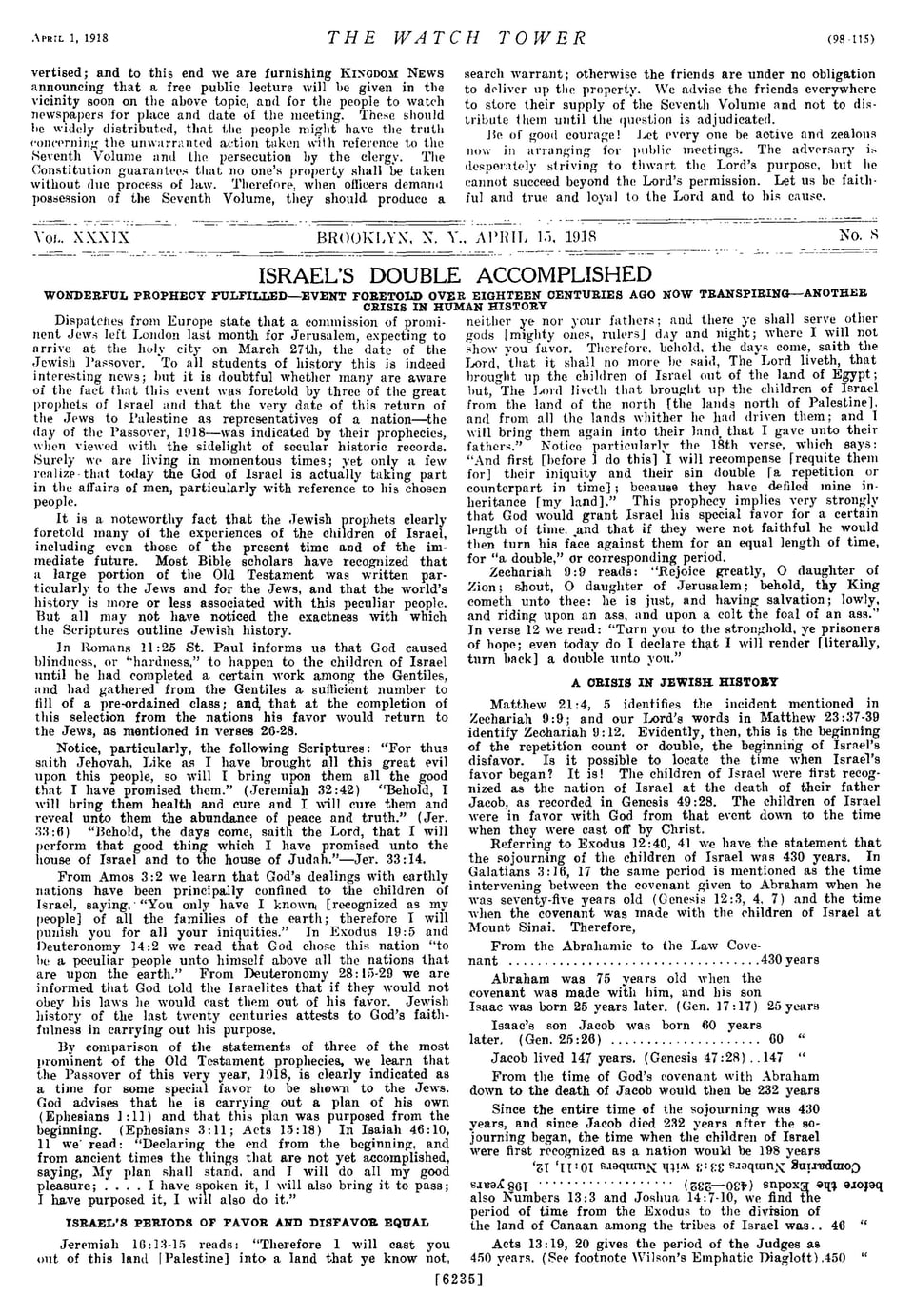
vertised; and to this end we are furnishing KINGDOM NEWS announcing that a free public lecture will be given in the vicinity soon on the above topic, and for the people to watch newspapers for place and date of the meeting. These should be widely distributed, that the people might have the truth concerning the unwarranted action taken with reference to the Seventh Volume and the persecution by the clergy. The Constitution guarantees that no one's property shall be taken without due process of law. Therefore, when officers demand possession of the Seventh Volume, they should produce a
search warrant; otherwise the friends are under no obligation to deliver up the property. We advise the friends everywhere to store their supply of the Seventh Volume and not to distribute them until the question is adjudicated.
Be of good courage! Let every one be active and zealous now in arranging for public meetings. The adversary is desperately striving to thwart the Lord's purpose, but he cannot succeed beyond the Lord's permission. Let us be faithful and true and loyal to the Lord and to his cause.
VOL. XXXIX
BROOKLYN, N. Y., APRIL 15, 1918
No. 8
ISRAEL'S DOUBLE ACCOMPLISHED
WONDERFUL PROPHECY FULFILLED-EVENT FORETOLD OVER EIGHTEEN CENTURIES AGO NOW TRANSPIRING-ANOTHER CRISIS IN HUMAN HISTORY
Dispatches from Europe state that a commission of prominent Jews left London last month for Jerusalem, expecting to arrive at the holy city on March 27th, the date of the Jewish Passover. To all students of history this is indeed interesting news; but it is doubtful whether many are aware of the fact that this event was foretold by three of the great prophets of Israel and that the very date of this return of the Jews to Palestine as representatives of a nation—the day of the Passover, 1918—was indicated by their prophecies, when viewed with the sidelight of secular historic records. Surely we are living in momentous times; yet only a few realize that today the God of Israel is actually taking part in the affairs of men, particularly with reference to his chosen people.
Jeremiah 16:13-15 reads: "Therefore I will cast you out of this land [Palestine] into a land that ye know not,
It is a noteworthy fact that the Jewish prophets clearly foretold many of the experiences of the children of Israel, including even those of the present time and of the immediate future. Most Bible scholars have recognized that a large portion of the Old Testament was written particularly to the Jews and for the Jews, and that the world's history is more or less associated with this peculiar people. But all may not have noticed the exactness with which the Scriptures outline Jewish history.
In Romans 11:25 St. Paul informs us that God caused blindness, or "hardness," to happen to the children of Israel until he had completed a certain work among the Gentiles, and had gathered from the Gentiles a sufficient number to fill of a pre-ordained class; and that at the completion of this selection from the nations his favor would return to the Jews, as mentioned in verses 26-28.
ISRAEL'S PERIODS OF FAVOR AND DISFAVOR EQUAL
Notice, particularly, the following Scriptures: "For thus saith Jehovah, Like as I have brought all this great evil upon this people, so will I bring upon them all the good that I have promised them." (Jeremiah 32:42) "Behold, I will bring them health and cure and I will cure them and reveal unto them the abundance of peace and truth." (Jer. 33:6) "Behold, the days come, saith the Lord, that I will perform that good thing which I have promised unto the house of Israel and to the house of Judah."—Jer. 33:14.
From Amos 3:2 we learn that God's dealings with earthly nations have been principally confined to the children of Israel, saying. "You only have I known [recognized as my people] of all the families of the earth; therefore I will punish you for all your iniquities." In Exodus 19:5 and Deuteronomy 14:2 we read that God chose this nation "to be a peculiar people unto himself above all the nations that are upon the earth." From Deuteronomy 28:15-29 we are informed that God told the Israelites that if they would not obey his laws he would cast them out of his favor. Jewish history of the last twenty centuries attests to God's faithfulness in carrying out his purpose.
By comparison of the statements of three of the most prominent of the Old Testament prophecies, we learn that the Passover of this very year, 1918, is clearly indicated as a time for some special favor to be shown to the Jews. God advises that he is carrying out a plan of his own (Ephesians 1:11) and that this plan was purposed from the beginning. (Ephesians 3:11; Acts 15:18) In Isaiah 46:10, 11 we read: "Declaring the end from the beginning, and from ancient times the things that are not yet accomplished, saying, My plan shall stand, and I will do all my good pleasure; . . . I have spoken it, I will also bring it to pass; I have purposed it, I will also do it."
neither ye nor your fathers; and there ye shall serve other gods [mighty ones, rulers] day and night; where I will not show you favor. Therefore, behold, the days come, saith the Lord, that it shall no more be said, The Lord liveth, that brought up the children of Israel out of the land of Egypt; but, The Lord liveth that brought up the children of Israel from the land of the north [the lands north of Palestine], and from all the lands whither he had driven them; and I will bring them again into their land that I gave unto their fathers." Notice particularly the 18th verse, which says: "And first [before I do this] I will recompense [requite them for] their iniquity and their sin double [a repetition or counterpart in time]; because they have defiled mine inheritance [my land]." This prophecy implies very strongly that God would grant Israel his special favor for a certain length of time, and that if they were not faithful he would then turn his face against them for an equal length of time, for "a double," or corresponding period.
A CRISIS IN JEWISH HISTORY
Matthew 21:4, 5 identifies the incident mentioned in Zechariah 9:9; and our Lord's words in Matthew 23:37-39 identify Zechariah 9:12. Evidently, then, this is the beginning of the repetition count or double, the beginning of Israel's disfavor. Is it possible to locate the time when Israel's favor began? It is! The children of Israel were first recognized as the nation of Israel at the death of their father Jacob, as recorded in Genesis 49:28. The children of Israel were in favor with God from that event down to the time when they were cast off by Christ.
Referring to Exodus 12:40, 41 we have the statement that the sojourning of the children of Israel was 430 years. In Galatians 3:16, 17 the same period is mentioned as the time intervening between the covenant given to Abraham when he was seventy-five years old (Genesis 12:3, 4, 7) and the time when the covenant was made with the children of Israel at Mount Sinai. Therefore,
From the Abrahamic to the Law Covenant 430 years
Abraham was 75 years old when the covenant was made with him, and his son Isaac was born 25 years later. (Gen.17:17) 25 yea
Isaac's son Jacob was born 60 years later. (Gen. 25:26) ... 60 "
Jacob lived 147 years. (Genesis 47:28) ..147 "
From the time of God's covenant with Abraham down to the death of Jacob would then be 232 years
Since the entire time of the sojourning was 430 years, and since Jacob died 232 years after the sojourning began, the time when the children of Israel were first recognized as a nation would be 198 years
Comparing Numbers 33:3 with Numbers 10:11, 12,
before the Exodus (430-232) 198 years also Numbers 13:3 and Joshua 14:7-10, we find the period of time from the Exodus to the division of the land of Canaan among the tribes of Israel was.. 46 "
Acts 13:19, 20 gives the period of the Judges as 450 years. (See footnote Wilson's Emphatic Diaglott).450 " The twenty-one kings of Israel, from Saul to Zedekiah reigned as follows:
Saul (Acts 13:21)
40 years
David (1 Chronicles 29:26, 27)
40 “
Solomon (2 Chronicles 9:30)
40 “
Rehoboam (2 Chronicles 12:13)
17 “
Abijah (2 Chronicles 13:1, 2)
3 “
Asa (2 Chronicles 16:13)
41 “
Jehosaphat (2 Chronicles 20:31)
25 “
Jehoram (2 Chronicles 21:1, 5)
8 “
Ahaziah (2 Chronicles 22:1, 2)
1 “
Athaliah (2 Chronicles 22:10-12)
6 “
Jehoash (2 Chronicles 24:1)
40 “
Amaziah (2 Chronicles 25:1)
29 “
Uzziah (2 Chronicles 26:3)
52 “
Jotham (2 Chronicles 27:1)
16 “
Ahaz (2 Chronicles 28:1)
16 “
Hezekiah (2 Chronicles 29:1)
29 “
Manasseh (2 Chronicles 33:1)
55 “
Amon (2 Chronicles 33:21)
2 “
Josiah (2 Chronicles 34:1)
31 “
Jehoiakim (2 Chronicles 36:5)
11 “
Zedekiah (2 Chronicles 36:11)
11 “
Period of the kings ...513 years
The period of desolation, 70 years (Jeremiah 25:11; 29:10; 2 Chronidles 36:22, 23)...70 "
Cyrus ascended the throne of Babylon, B. C. .536 "
From A. D. I to the crucifixion of Christ in the spring of 33 A. D.—32 full years... 32 "
Total length of Jewish favor from the time of Israel's first recognition as a nation to the time when Christ cast off that nation from divine favor.1845 "
In Isaiah 40:2 the statement is made: "Speak ye comfortably to Jerusalem, and cry unto her that her warfare [marginal reading, appointed time] is accomplished [completed, filled out], that her iniquity is pardoned; for she hath received of the Lord's hands double [a counterpart] for all her sins." This statement assures Israel that the time would come when her double, or time of disfavor, equivalent to former favor, would be accomplished, and that then he would turn his face towards her again.
If the foregoing be true, then just 1845 years after their rejection by Christ (Matthew 23:37-39) we should expect some historic event indicating that divine favor was beginning to return to the Jews. 1845 years from the spring of 33 A.D. would bring us to the spring of 1878. We should, therefore, expect to find some occurrence in the early part of the year 1878, as an indication of returning divine favor. What do we find?
In June, 1878, the Berlin Congress assembled, Lord Beaconsfield (a Jew) was the chairman and the central figure, the dominating mind that changed the treaty of San Stephano between the Russians and the Turks, and so amended it that the Turks were to have suzerainty over Palestine and that the Jews were to be permitted some measure of liberty. This was the first act on the part of any of the nations of Europe to recognize in any way the Jews as a nation.
A REMARKABLE PROPHECY LITERALLY FULFILLED
Note Zechariah 8:23: "In those days it shall come to pass that ten men shall take hold out of all [manner of] languages of the nations, even shall take hold of the skirt of him that is a Jew, saying, We will go with you; for we have heard that God is with you." It is a remarkable historic fact that this conference was attended by representatives from the following eleven nations: Great Britain, Russia, France, Italy, Turkey, Austria-Hungary, Germany, Greece, Roumania, Serbia and Montenegro. Thus there were ten representatives in attendance at that particular congress, in conference with the eleventh, a Jew. (See Berlin Conference, International Encyclopedia.)
But did God have anything to do with the raising of a Jew, Lord Beaconsfield, to the premiership of England, in order that he might fulfill this very prophecy, and in overruling that exactly ten other nations should be represented, and that the chairman should be the Jew? And did God have anything to do with the bringing about of that conference in the spring of 1878, exactly 1845 years after he had cast the Jews into disfavor? It is surely a remarkable coincidence, to say the least! The Lord's casting off of the Jewish people was in A. D. 33; but it was just 40 years afterward that the nation was completely destroyed, and it has not been recognized as a nation since that time until our day.
THE DESTRUCTION OF THE JEWISH POLITY
We quote as follows from Cornil's History of the People of Israel: "On the 15th of Nisan, i. e., of April, in the year 73 A. D., the first day of the Easter festival, the same day on which, according to tradition, the God of Israel had led His people out of Egyptian bondage into freedom, the last bulwark of Israel's liberty had fallen, and Israel was delivered into bondage."
We quote again from the Jewish Encyclopedia: "Masada attained great importance in the war with the Romans . . . With the fall of Masada the war came to an end, on the 15th of Nisan, 73." Again from Morrison's Jews Under Roman Rule: "The capture of Masada, a Jewish fortress on the southwestern shore of the Dead Sea, put a termination to one of the fiercest struggles recorded in history." (73 A. D.) Graetz's History of the Jews, Vol. 2, says: "Judea was not entirely subjugated; for three strong fortresses were still in arms: Herodium, Machaerus, and Masada . . . The heroes agreed to this proposal (of their leader Eleasar) even with enthusiasm, and on the first day of the great Feast of the Passover (A. D. 73), after slaying their own wives and children, they all perished on their own swords." We quote further from Ewald's History of Israel, Vol. 7 (which is entitled "The Apostolic Age," and which Prof. Ewald makes to end with the year A. D. 73.): "Eleasar accordingly persuaded all his people during that night to kill their wives and children and then themselves, but to burn all their treasures first. The next day the Romans found only 960 dead bodies, whilst but two women and five children hid themselves in caverns and were discovered. The Easter of the year 73, just seven years [note the great awakening of interest among the Jews by Pastor Russell in 1910 and 1911 through his message to them at the New York Hippodrome, Oct. 9, 1910, and the wide distribution of 'Die Stimme' in 1911, just seven years ago] from the beginning of the great movement and forty years after Christ's crucifixion, saw this end of the whole tragedy." Josephus also relates that Masada fell on the 15th of Nisan, April, A. D. 73.
THE COMPLETION OF THE DOUBLE
The above quotations from standard authors show fully that the Jewish nationality came to an end just forty years after their rejection of Christ and their being cast off as a nation.
As the first sign of their rejection was the declaration of our Lord just before his crucifixion and was just 1845 years prior to the year 1878, would not their recognition at the Berlin Congress imply the first indication of God's returning favor to them again as a nation? If we are right in these conclusions, then just 1845 years after the spring of A. D. 73 we should expect some national recognition of the Jews as a nation. Does it not seem peculiar at least that such a national recognition should occur this year exactly 1845 years to the month after their complete downfall? Does this not seem to imply to all reasoning students that divine providence is now taking a hand in the affairs of the nations? Would it be reasonable to account for all these exact correspondencies as merely coincidence—especially since we find them so accurately stated in his Word?
The Apostle Paul in the eleventh chapter of his letter to the Romans declares that the falling away of the Jews from divine favor meant the passing of that favor to the Gentiles. Recall the expression in Luke 21:24: "And they shall fall by the edge of the sword and shall be led away captive into all nations; and Jerusalem shall be trodden down of the Gentiles until the times of the Gentiles be fulfilled." Is it not reasonable to suppose that the returning of favor to the Jews means to some extent the withdrawing of that favor from the Gentiles?—Romans 11:15.
Ezekiel 36:19-36 tells of the wanderings of the Jews and of the restoration of their land to its pristine holiness: "I scattered them among the heathen and they were dispersed through the countries: according to their way and according to their doings I judged them. And when they entered unto the heathen whither they went they profaned my holy name when they said to them, These are the people of the Lord and are gone forth out of his land; but I had pity on mine holy name which the house of Israel had profaned among the heathen whither they went. Therefore say unto the house of Israel, saith the Lord God, I do not this for your sakes, O house of Israel, but for my holy name's sake which ye have profaned among the heathen, whither you went, for I will take you from among the heathen and gather you out of all countries and bring you into your own land, and ye shall dwell in the land that I gave to your fathers, and ye shall be my people and I will be your God and I will also save you from your uncleanness and I will call for the corn and will increase it and lay no famine upon you, and I will multiply the fruit of the tree and the increase of the field, and ye shall receive no more reproach of famine among the heathen.
And the desolate land shall be tilled, whereas it lay desolate in the sight of all that passed by and they shall say, This land that was desolate is become like the garden of Eden, and the waste and desolate and ruined cities are become fenced and inhabited. Then shall the heathen [Gentiles] that are left round about you know that I the Lord built the ruined places and planted that
Ezekiel 37:25: "And they shall dwell in the land that I have given unto Jacob, my servant, wherein your fathers have dwelt, and they shall dwell therein, even they and their children and their children's children forever, and my servant David shall be their prince forever."
that was desolate. I the Lord have spoken and I will do it."
Who shall say what great events may not soon follow the opening of this door for the Jews, and who can accurately appreciate all the blessing which is to come!—Jeremiah 3:17, 18.
"ABOUT MIDNIGHT"
"About midnight will I go out into the midst of Egypt."—Exodus 11:4.
The children of Israel, in bondage to Egypt, were typical of the Lord's people of this Gospel age long in bondage to "Christendom." Egypt symbolizes that condition of middlecourse, compromising worldliness which the word "Christendom" represents, and which is identified by our blessed Lord as "the great city, which spiritually is called Sodom [typical of carnal union of church and state] and Egypt, where [in its ancient form of pagan Rome] also our Lord was crucified" (Revelation 11:8) and where the crucifixion of the Lord's body members has steadily progressed. Historic precedent and Scriptural suggestions combine in warranting the expectation that this crucifixion, this crucial testing is about to reach its final climax in oppression and persecution by nominal church and clergy, acting underhandedly or openly through the civil powers and the mob.
Several divinely arranged plagues came upon Egypt, because of the unwillingness of Pharaoh, the king, to release the Hebrews from bondage. Spiritual Israel has long sought to be released from the world, the flesh and the devil, and especially from doctrines of devils, which constitute the strength of antitypical Egypt's oppression. Pharaoh, king of Egypt, typified Satan, prince of this world, order of things, or civilization. Several times Pharaoh had promised to let the Hebrews go, but each time "the Lord hardened Pharaoh's heart, so that he would not let the people go."—Exodus 10:20.
"And the Lord said unto Moses [Christ, Head and body], stretch out thine hand [instrumentality or applied power] toward heaven [the powers of spiritual control, the clergy and churches of Christendom] that there may be darkness [lack of knowledge, understanding, love] over the land of Egypt [Christendom], even darkness that may be felt. And Moses stretched forth his hand toward heaven [the churches who claim to represent heaven]; and there was a thick darkness in all the land of Egypt [all in the condition of worldliness, including worldly-minded clergymen] three days." The great world war among those nations that call themselves Christians has upset all theories about "Christ"-endom being Christian. During the first three years of the war from August, 1914, to August, 1917, there was no understanding by the world of the true, the Scriptural, significance of the war; all were in darkness, and remained so for three years, until enlightenment came to them through the Lord's divinely appointed channel, the WATCH TOWER BIBLE AND TRACT SOCIETY, in the shape of the message in Volume Seven of STUDIES IN THE SCRIPTURES.—Exodus 10:22.
"They saw not one another [comprehended not what they really were in God's sight] neither rose any from his place for three days." In proof of the antitypical correspondency we quote Rev. Joseph H. Odell, D. D., in the February, 1918, "Atlantic Monthly"; "The vastest of the world's tragedies came, and the church was not its interpreter. The majority of the clergy have not even sensed the unique strategy which the convulsed and confused world conditions have made possible. There are ministers everywhere who are still busy building their denominational fences and feverishly staking their sectarian claims." Neither worldly clergyman nor layman "rose from his place for three years"—from the old somnolent condition of dumb dogs (D.D.'s) and blind guides (B.G.'s). (Isaiah 56:10; Matthew 15:14) The utmost darkness, something keenly and anxiously felt, pervaded the houses—churches—of the worldly-minded. "But the children of Israel [the Lord's truly loyal and devoted people] had light in their dwellings [understood the significance of the world war and the things to come, in all their humble ecclesias.]"—Exodus 10:23.
OUR CONSECRATION MUST BE COMPLETE
"And Pharaoh called unto Moses and said, Go, ye, serve the Lord; only let your flocks and herds be stayed; let your little ones also go with you." (Exodus 10:24) In sacrificial rites the animals used typified the offerers of those animals;
and the offering of an animal by a person pictured that person's consecration. Ecclesiasticism (the product of Satan, antitype of Pharaoh) is willing enough for the Lord's people, old or young in Christ, to serve Jehovah, if only they will not offer themselves in complete consecration, in such a consecration as consumes their-very bodies on the altar of sacrifice.
"And Moses said, Thou must give us also sacrifices and burnt offerings, that we may sacrifice unto Jehovah, our God. Our cattle also shall go with us; there shall not an hoof be left behind; for thereof must we take to serve Jehovah our God; and we know not with what we must serve Jehovah, until we come thither."—Exodus 10:25, 26.
Those who start to serve the Lord cannot determine in advance just what or how much must be done; yet the sincere ones purpose to hold nothing back, but to make a complete consecration of themselves and all that they have.
"But Jehovah hardened Pharaoh's heart, and he would not let them go." (Exodus 10:27) No type can be taken to teach a doctrine; and we have no reason for supposing that Satan has intended to co-operate with God, but in the last analysis it must be admitted that he has done nothing which can successfully oppose the divine program. In this case it was really not God's purpose to have the people of Israel go until he had instituted the Passover type. Likewise, in recent years, it may be that Satan has been willing to make away with the Lord's people; but divine providence intervened, because the hour was not yet come. But whether this part of the account was intended to be pictorial or not we do not know. At all events the people did not go. Several times during the harvest, during the progress of what seemed plagues to Christendom, the Lord has permitted his people to think that they were about to go. Brother Russell expected the church to go beyond the vail in 1878, 1881, 1910 and 1914—just as with Elijah, who went with Elisha to four different places before he was actually taken. These seeming disappointments were divinely foreknown, "his appointments."
"And Pharaoh said unto him, Get thee from me, take heed to thyself, see my face no more; for in the day thou seest my face thou shalt die." (Exodus 10:28) Satan, speaking through ecclesiasticism is peeved at the claims of the Lord's people, and manifesting his displeasure, begins to utter threats.
"And Moses said, Thou has spoken well, I will see thy face again no more." (Exodus 10:29) The face is a sign of either favor or disfavor. The time has passed when the Lord will any longer show any favor toward ecclesiasticism, or when ecclesiasticism will show favor or intentional benefit to the Lord's people.
THE ANTITYPICAL TENTH PLAGUE
"And the Lord said unto Moses, Yet will I bring one plague more upon Pharaoh [ecclesiasticism] and upon Egypt [Christendom—it will be to them an unprecedented plague]: afterwards he will let you go hence [this suggests that the church now expecting to go to her Lord will not be disappointed this time; she shall surely be delivered after the divinely appointed last plague]: when he shall let you go, he shall surely thrust you out hence altogether." The final visitation of God's displeasure, amounting to the utmost expression of his wrath against Christendom, will so disturb the antitypical Egyptians that they may not confine themselves to words of chastisement against the Lord's people, but they may feel impelled to visit upon them tangible persecution, possibly culminating in imprisonment—through those civil powers which are deceived as to the true nature and character of the persecutors—and in bloody persecution and death. (Exodus 11:1) Here again we must not let the type teach us something which is not plainly stated elsewhere. This is no time to think "panicky" thoughts or to pose as martyrs unduly. But our Lord suffered such things, so did several of the apostles, so have many of the most noble and faithful of this age.
We, as servants, are not better than our Lord and we have no just claim for better treatment. The Lord's will be done.
"Speak now in the ears of the people, [proclaim the message of the seven STUDIES IN THE SCRIPTURES to all Christendom], and let every man borrow [ask] of his neighbor, and every woman of her neighbor [every truth ecclesia of the neighboring churches] jewels of silver and jewels of gold [the Lord's jewels in the great company and in the little flock]."—Exodus 11:2.
"And the Lord gave the people favor in the sight of the Egyptians. [In some respects, for their truly Christian character and lives the Lord's people are appreciated by the peoples of the world.] Moreover the man Moses [Christ, the Head] was very great [highly esteemed, theoretically] in the land of Egypt [throughout Christendom] in the sight of Pharaoh's servants [clergymen] and in the sight of the people" [the laity of Christendom].—Exodus 11:3.
"And Moses [Christ through the STUDIES IN THE SCRIPTURES] said [to ecclesiasticism], Thus saith the Lord, About midnight will I go out into the midst of Egypt." (Exodus 11:4) If the year in which the remaining church is expected to begin, in a more pronounced degree, to go beyond the vail is the year beginning October, 1917, then midnight of that day (reckoning the days from sundown to sundown) would be about January, 1918. God, through some special word of indignation and wrath, may be looked for as going throughout the heart and center of Christendom about that time.
"And all the firstborn [the firstborn of Egypt were set aside to the deity and typified the clergy-ministers of Christendom, set apart, in fact to the social service of Christendom] in Egypt, shall die [cease to be firstborns, or be divinely declared not to be what they claim and think themselves to be], from the firstborn [the leading ecclesiastic, the pope of Rome] of Pharaoh that sitteth upon his throne [Satan the god of priestcraft, is prince or ruler of this evil world], even unto the firstborn of the maidservant that is behind the mill [down to the lowliest minister of the smallest church grinding out its religious provender] and all the firstborn of beasts."—Exodus 11:5.
"And there shall be a great cry throughout all the land of Egypt, such as there was none like it, nor shall be like it any more." (Exodus 11:6) This suggests the final cry in Christendom. If this interpretation be correct, the next thing to look for is an unprecedented outcry on the part of Christendom's clergy and laity against the divine pronouncement which declares the end of Egypt's firstborn, the clergy, priestcraft, ecclesiasticism, churchianity.
"But against any of the children of Israel shall not a dog move his tongue against man or beast; that ye may know that Jehovah doth put a difference between the Egyptians and Israel." (Exodus 11:7) How manifestly is God's favor with his own people who are dwelling in peace of heart amid a world in arms, and how markedly is his disfavor upon the people of Christendom torn with the sword and threatened with revolution, famine and pestilence!
"And all these thy servants [the people of Christendom] shall come down unto me [Christ] and bow themselves down unto me [they will beseech the Lord's people to let their evil practices and institutions alone], saying, Get thee out, and all the people that sit at thy feet [Marginal reading. In this the day of the wrath of the Lamb, Christendom will want none of Christ or his members to trouble them any longer with their divinely authorized plagues]; and after that I will go out. [Not till things have taken some such a turn will the feet members of Christ pass over to 'be ever with the Lord']. And he went out from Pharaoh in a great anger." (Exodus 11:8) As the church turns her back forever in disfavor upon ecclesiasticism it is with a message containing all "the fierceness and wrath of Almighty God" (Revelation 19:15), in Volume Seven of STUDIES IN THE SCRIPTURES.
THE EFFECT OF THE PLAGUE UPON EGYPT
"And Jehovah said unto Moses, Pharaoh will not hearken unto you; [ecclesiasticism will not heed the awful warnings
of Ezekiel and Revelation, as shown forth in 'The Finished Mystery']; that my wonders may be multiplied in the land of Egypt." (Exodus 11:9) As a result of Christendom's failure to turn to God in a godly repentance, the words of God against her will be promptly and wonderfully fulfilled.
"And it came to pass that at midnight [about January of the year 1918, through the enormous circulation of 'The Finished Mystery' and the distribution of 10,000,000 'Fall of Babylon'] Jehovah [through his Word] smote all the firstborn in the land of Egypt [declared plainly and explicitly that the clergy, who insist on being first and foremost in everything, are really in his estimation dead, incapable of doing what they claim to do, because of iniquities which they committed in the dark ages and for which they are still unrepentant] from the firstborn of Pharaoh that sat on his throne unto the firstborn of the captive that was in the dungeon [literally, 'house of the pit,' church of eternal torment]; and all the firstborn of cattle."—Exodus 12:29.
"And Pharaoh rose up in the night, he, and all his servants, and all the Egyptians [if the suggestive interpretation set forth in these comments be right, then we may consistently look for an uprising of all worldly "Christians" because of and against the pronouncements of the wrath of God]; and there was a great cry in Egypt [such a cry has begun to rise from the clergy, who are seeking to enlist the civil powers in a campaign of persecution of the Lord's people]; for there was not a house where there was not one dead." Not a church where there was not a clergyman against whom this divine denunciation had gone forth.
"And he [ecclesiasticism] called for Moses and Aaron by night, [before the spring or summer of 1918] and said, Rise up ['rise to heights unknown,' to 'sit with Christ in the heavens'] and get you forth from among my people, both ye and the children of Israel; and go, serve Jehovah, as ye have said."—Exodus 12:31.
"And the Egyptians were urgent upon the people, that they might send them out of the land in haste [aroused nominal churchianity may be inclined to find quick means to expedite the passage of the Lord's people beyond the vail] for they said, We be all dead men." (Exodus 12:33) It was the atrociously false alarm, "If we don't kill them, they will kill us," that caused the weak king of France to sign the wicked order for the utter destruction of all Protestants on St. Bartholomew's Night.
"And take your flocks and your herds, as ye have said [the Lord's people are completely consecrated], and be gone [there will be nothing the antitypical Egyptians will wish so heartily as to see gone forever those in whom is the present word of God. The wish may be father to their thought to hasten the going of the spiritual Israelites]; and bless me also." (Exodus 12:32) When an antitypical Egyptian is in peril or fear, he seeks a blessing from somewhere.
"And the people took their dough before it was leavened [the Lord's people have the unadulterated truth, the divine Word, without any of the leaven, evil teachings, traditions and theories of the clergy], their dough [marginal reading] being bound up in their clothes upon their shoulders." (Exodus 12:34) The pure word of truth is bound up with the robe of Christ's righteousness and with the promises, with which the Lord's people are invested.
"And the children of Israel did according to the word of Moses [of Christ, as set forth in the Bible]; and they borrowed of the Egyptians jewels of silver and jewels of gold, and raiment; and Jehovah gave the people favor in the sight of the Egyptians, so that they lent unto them. And they spoiled the Egyptians." (Exodus 12:35, 36) When the Lord's people go forth from Christendom to be ever with their Lord, they will take with them every Christian having the Lord's spirit; not a single one of the Lord's jewels will be left in Christendom when the approaching exodus of the last members of the body of Christ is finished.
"It is a night [the dark night even now settling down] to be much observed unto Jehovah [it will be memorable forever] for bringing them out of the land of Egypt [out of the bondage of Christendom]; this is that night of Jehovah to be observed [remembered] of all the children of Israel in their generations."—Exodus 12:42.
COLPORTEUR AND PASTORAL WORK
The great amount of advertising the public press has given Pastor Russell's books recently, particularly "The Finished Mystery,"has doubtless created a demand for these books; and while it is not proper at this time to circulate "The
Finished Mystery," we advise the friends to colporteur for the other six volumes, especially the fourth, and to carry on the pastoral work, bearing the good tidings to as many as desire to hear.
JESUS FACES BETRAYAL AND DEATH
[With the exception of the first paragraph (printed below) this article was a reprint of that entitled, "Two Passover Memorials," published in issue of September 15, 1914, which please see.]
Nothing connected with the Gospel narrative appeals to human judgment more forcibly than does its simplicity. The fact that the weaknesses, failures and stumblings of the apostles themselves are faithfully narrated, without apologies or excuses or attempts to gloss over the defects, shows a sincerity, a truthfulness of intention, very rarely found in other writings. Nowhere is this characteristic more conspicuous than in today's lesson, which records the shameless perfidy of Judas and the weakness of the remaining eleven.
In our Lord's darkest hour these all forsook him and fled, seeking personal safety; and one of them subsequently denied knowing him. Had the writers of the Gospels interjected excuses and explanations for their course, they would have been excusable; but the narrative is really stronger as it stands, and we are perhaps inclined to furnish excuses for them which we might have been loath to receive had they offered similar ones for themselves.
JESUS ON THE CROSS
[The last twelve paragraphs of this article were reprinted from article-entitled, "Smitten of God—Afflicted," published in issue of November 15, 1914, which please see.]
JUNE 16.—MARK 15:22-39.
AN ILLEGAL ARREST—AN INIQUITOUS TRIAL—OUR LORD TAKEN BEFORE THE ROMAN GOVERNOR—CONDEMNED BY NEITHER PILATE NOR HEROD—THE ROMAN GOVERNOR'S ATTEMPTS TO FREE OUR LORD—LEADERS OF BELIGIOUS THOUGHT COMPEL PILATE TO ACT CONTRARY TO HIS DESIRES—WHY DEATH BY CRUCIFIXION WAS NECESSARY IN OUR LORD'S CASE.
"Truly this man was the Son of God."—Verse 39.
Following the institution of the Memorial Supper our Lord and his disciples sang a hymn, and then went out of the city to the Mount of Olives, a distance of perhaps a mile. Apparently several important lessons were given to the disciples en route to Gethsemane. These are recorded in John 15-17.
After they had arrived at the garden of Gethsemane, the Master left eight of the apostles near the entrance, and went a little further into its shades with Peter, James and John. All were to watch, to be on guard against something which was to occur, something of which Jesus knew, but which seemed most improbable to the apostles. It was midnight, and they were accustomed to retire early. The strain of the evening, and the weighty lessons which the Master had imparted, reacted in drowsiness; and they slept, instead of watching and praying. This was true even of the three nearest the Master.
Wishing to be alone in his communion with the heavenly Father, our Lord went a stone's throw farther into the shadows by himself. Time and again, in the agony which fell upon him, he came seeking human sympathy, only to find his dearest ones oblivious in sleep. Well had it been expressed by the prophet: "Of the people there was none with me." (Isaiah 63:3) He trod the winepress of grief alone.
For three and a half years he had devoted his life to the doing of the divine will. Had he done that will completely and absolutely, in a spirit that had been pleasing to the heavenly Father? More than this, could he, would he, pass through the experiences of the next few hours with proper courage, proper faith, proper obedience? Or would he fail, and lose his all in death?
STRENGTHENED FROM ON HIGH
Had the Master failed, there was no one to make good for him. He had no advocate. His failure meant, not only death everlasting for himself, but the loss of the great privilege of uplifting humanity from sin and death conditions through the Messianic kingdom. The Master's personal eternal life was in the balance that night in Gethsemane, as also were all his prospects of glory, honor, immortality and high exaltation at the right hand of the Father, far above angels, principalities and powers. No wonder the Master, realizing all this, was overwhelmed with the thought! No wonder he wished that if the divine plan could be otherwise worked out, he might be spared from the special tribulations and horribly misrepresenting experiences just before him!
Apparently the ignominy of being crucified as a male-factor and blasphemer, a terrible experience to one of his refinement and nobility of soul, was the thing which he prayed might pass away. He did not ask that he might not die; for he knew that for this very purpose he had come into the world, and that only by his death could the penalty resting upon the human family be removed. He had not thought of escaping death, but he hoped that the Father might have some way of eliminating the special ignominy of that hour. Yet even in his greatest distress the Master prayed: "Nevertheless, not my will, but thine, be done."
St. Paul assures us that the Master's Gethsemane experiences were linked with the fear of remaining in the death condition, fear of not being accounted of the Father as worthy of that glorious resurrection which he had been promised. (Hebrews 5:7) He was saved out of death, however; and more than this, he was given the assurance by the Father that he would be saved out of death. This is the explanation of the statement that an angel of God appeared to him in
the garden and strengthened him, gave him the Father's assurance that he had been faithful up to that moment, and that the divine blessing would be with him during the hour of trial just at hand. From that moment onward, all the fear and agony were gone. If the Father's blessing and smile went with him, he could endure all things come what might.
VIOLATION OF LAW AND OF JUST PRINCIPLES
Our Lord was arrested, neither by Pilate's nor Herod's instructions, nor by their soldiers. His arrest was made at the instance of the Jewish high priest and his associates, who had concluded that his life and ministry were inimical to their plans and projects and to what they considered to be the best interests of Judaism. The murder of Jesus was plotted in advance. But the murderers sought some excuse for their conduct, as all murderers do; and being politicians, they also sought an outward form or semblance of justice, having regard for the opinions of others of more tender conscience than theirs.
Under the charge of the priests were men who served as policemen in the Temple and its precincts. Armed with maces, swords and lanterns, these servants of the priests followed Judas, who knew beforehand that on this particular night Jesus did not intend to go to Bethany as usual, but had purposed to rendezvous with his disciples in the Gethsemane olive orchard.
After they had apprehended our Lord, the Temple police brought him directly to the house of Annas, a superannuated high priest, whose son-in-law Caiaphas officiated in his stead. Annas attempted an examination of Jesus, but met with little success, and so turned him over to Caiaphas, whose house was in the same courtyard. There, at probably three o'clock in the morning, the Sanhedrin had assembled.
The plot for Jesus' death was deeply laid. The hours between the time when Judas had left Jesus and the other apostles at the Passover supper and the hour of this trial were spent in gathering the members of the Sanhedrin from their various homes throughout the city. Conditions were considered desperate enough to justify all this arrangement for the murder of him who "spake as never man spake." This was because he taught the people, because his teachings were weakening the power of the Scribes and the Pharisees and of the traditions of the elders.—John 7:46; Matt. 26:55.
The theory of erroneous religious teachings is that ignorance and superstition are necessary to the preservation of sacerdotal power. Thus always has error hated the truth. Thus always has darkness hated the light. Jesus' condemnation was merely another triumph of darkness over light. Yet it was a triumph only in appearance; for the divine plan was thus being carried out. The great atonement for sin was thus being arranged for, the result of which will be the ultimate overthrow of Satan, sin and death, and the world-wide establishment of righteousness and truth forever.
THE CASE BROUGHT BEFORE PILATE
As quickly as possible the high priest and representatives of the Sanhedrin hurried Jesus to the Prætorium, asking Pilate to condemn him. The Roman governor inquired as to what charge they had against Jesus. They evasively answered that of course he was a wicked man, worthy of death, or they would not be there accusing him.
Pilate reminded them that under Roman usage they had great liberty in dealing with all disputes of a religious kind, that he was not posted in the tenets of Judaism, and that therefore they should deal with the case themselves.
The priests responded that they knew this, but that they had no power to inflict the death penalty. Thus they revealed the depth of their wickedness. They had deliberately plotted to have Pilate inflict the death sentence upon an innocent person.
Then they began to accuse Jesus, claiming that he was perverting the nation, turning it away from loyalty and obedience to the Roman government, that he was telling the people not to pay taxes to Caesar, and that he claimed to be the Jewish King. These were serious charges, and the Roman governor was in duty bound to consider them. We note that these were altogether different charges from those brought against Jesus at the trial before the Sanhedrin. Although the charges were false, our Lord made no defense. He knew that the time had come for him to die; and he would not attempt to turn aside that which he knew to be a part of the divine program for him.
OUR LORD ACCUSED OF TREASON
The wicked shrewdness of the Sanhedrin is very manifest, in preferring the charge of blasphemy for its effect upon the people, before whom they desired to appear very zealous for the divine law, while they brought an entirely different, but equally false, set of charges against him before Pilate, who cared nothing for their religious opinions. The accusation made before Pilate involved the charge of treason, a charge most likely to arouse the indignation and wrath of the Roman rulers. The Jewish religionists accused our Lord of seditious agitation, of prohibiting the payment of tribute money and of assuming the title of king of the Jews, and thus apparently of conspiring against the Roman government.
While the second charge was entirely false (Matthew 22:21), the other two had an appearance of truth; and to these were added numerous petty individual charges. But
to none of them did our Lord make reply, so that Pilate marvelled that he made no effort at self-defense in the midst of such danger.
Pilate's several efforts to release his innocent prisoner who, he discovered, had been delivered to him because of envy, were unavailing before the boisterous mob. These, instigated by their rulers, loudly clamored for our Lord's death, and that by the most ignominious and cruel method, crucifixion, so that his memory should ever be covered with infamy.
Then Pilate, who was influenced more by considerations of policy than by principle, delivered Jesus to be scourged. Yet at the same time he protested the innocence of his prisoner, and washed his hands in token of his own innocence in thus delivering up to them this just person. Not until he himself was pressed by the mob with the threat that he could be reported to Caesar as one hostile to the government and a traitor to his trust in encouraging sedition and conspiracy against the government did he relinquish his efforts to save Jesus.
OUR LORD'S LAST EARTHLY JOURNEY
The Master had been on a constant strain, without sleep, from the time he had sent his disciples to prepare the Passover. This period had included the trying experiences connected with the Passover and the institution of the Memorial Supper, the journey to Gethsemane, the agony and physical weakness there, the trial by the Sanhedrin, the trials before Pilate and Herod, the scourging, etc. All this must have been an enervating strain on him. Now, condemned to crucifixion by those for whom he had sacrificed his heavenly home and the glory which he had with the Father before the world came into existence, he was additionally required to carry his own cross. He did so until his weakness under its weight hindered, and a passing farmer was compelled to assist.
PERSECUTION CRYSTALLIZES CHRISTIAN CHARACTER
"All that will live godly in Christ Jesus shall suffer persecution."—2 Timothy 3:12.
When St. Paul wrote the words of this text he seemingly had in mind the very closing experiences of the church on earth. While it is true that the principle of persecution of those who live godly in Christ Jesus has applied throughout the entire age, yet in a marked degree was that to be expected in the end of the harvest period. We reach this conclusion because in the context the apostle says: "This know also, that in the last days perilous times shall come; for men shall be lovers of their own selves, boasters, proud, blasphemers, disobedient, . . . heady, high-minded, lovers of pleasure more than lovers of God; having a form of godliness, but denying the power thereof."
The best lexicographers define persecution as the act of doing injury to another; to beset with cruelty or malignity; to harass; especially to punish by loss, pain or death for adherence to a particular creed or mode of worship. Men with inflamed minds are apt to persecute any one who does not agree with them. Some have been persecuted by being put in prison; others by slander, libel, misrepresentation, which the Scriptures describe as bitter words shot out like arrows by the wicked. (Psalm 64:2-4) As civilization has advanced, methods of persecution have changed. In their turn, Lutherans, Baptists, Methodists, Presbyterians and others were persecuted; and in course of time have themselves become persecutors.
We are now living in a day when gross, vile persecution is not so popular as in olden times. The state of the public mind has much to do with determining the character of persecution inflicted, and which will be tolerated. At a time when the country is in stress, many take advantage of the situation to persecute those with whom they do not agree. They do this cunningly by misrepresentation. As an illustration, recently the clergy of the various denominations, Catholic and Protestant, have represented that members of the International Bible Students Association are engaged in the spreading of "Hun propaganda," and are in the employ of the German government. Nothing would have a greater tendency to inflame the public mind than such a charge. If the charge were true, it would be a heinous crime. Therefore, if the charge be false, it is a great crime to make such an accusation. These misrepresentations, carried by the clergy and their emissaries to petty public officials and by these officials reported to officials in higher station, often result in action which amounts to persecution. For instance, Dr. Case, of the Divinity School of Chicago University, recently published a statement referring to the work of the International Bible Students
Association, saying, "Two thousand dollars a week is being spent to spread their doctrine. Where the money comes from is unknown; but there is a strong suspicion that it emanates from German sources. In my belief, the fund would be a profitable field for government investigation." This, stimulated by similar charges from other nominal churchmen, evidently had something to do with Army Intelligence officers seizing the books of the Treasurer of the Society. The authorities doubtless thought that they would find some evidence to substantiate the charge that our Society is working in the interest of the German government. Of course, the books disclose nothing of the kind. All the money used by our Society is contributed by those who are interested in preaching the Gospel of Jesus Christ and his kingdom, and nothing else.
The wide publication by newspapers throughout the country of the fact that the Society's books have been seized had a tendency to excite suspicion in the minds of others. In many places, local officers have attempted to prohibit the holding of any kind of meetings, either public or private, for the preaching of the Gospel. Certain local officials have required every one to bring in their books and deliver them up. This, of course, is without legal authority, because the Constitution guarantees that no one shall be compelled to surrender his property except by due process of law. All of this persecution really emanates from a class of religionists who hold views antagonistic to the Scriptures and the Society's teachings.
Our information is that the Department of Justice has instructed the District Attorneys to prosecute any one who sells "The Finished Mystery" from and after the date the order was made (some time in March). There was nothing in the order authorizing local officers to interfere with Bible study, nor with public meetings which are held for the purpose of preaching the Gospel. It is in no wise a violation of law to meet together to study the Bible; and, acting under advice of legal counsel, we are advising all the Bible classes to meet in the usual manner and continue the Berean studies, including the study of Volume VII. We advise, however, that the objectionable pages (247 to 253, inclusive) be removed from all books, in order that there may be no semblance of violating the law. It is the duty of everyone to be law-abiding; but frequently men who think they are enforcing the law are themselves violating it. No Bible class should teach, instruct, or otherwise do any act or thing that will interfere with the Government's prosecution of the war.
Our business is to declare the message of the kingdom.
The Scriptures and the facts both lead us to the conclusion that the persecutions will increase. Those who make themselves the persecutors are to be pitied. In a measure we can sympathize with them, because once our eyes were blinded. We should have patience with these and speak to them kindly, trusting in the Lord to give us opportunity to open their eyes to the true situation.
In the text the Apostle declares that some form of persecution will attach to any one who lives a godly life. This infliction of injury may come directly upon an individual, or he may suffer indirectly by being associated with others who are persecuted. (Hebrews 10:32-34) Whatever injury is done to one of the Lord's little ones, all who are of that same class will likewise suffer. "Whether one member suffer, all the members suffer with it." (1 Corinthians 12:26) With consolation we remember the words of the Master: "If ye were of the world, the world would love his own; but because I have chosen you out of the world, therefore the world hateth you. . . . All these things will they do unto you for my name's sake, because they know not him that sent me." (John 15:19-21) In a general way, every person who is in opposition to the Lord's consecrated may be said to be of the world. All who have not the spirit of Christ are of the world. The clergy, manifesting the spirit of the world, are of the world; and history, from the beginning of the Christian era, shows that they have been the chief persecutors.
LIVING GODLY IN CHRIST JESUS
It is those who live godly in Christ Jesus that suffer persecution. To live godly means to live after the manner which God would approve; that is to say, to live in opposition to sin and in harmony with righteousness. It means to live according to the divine law, practising the golden rule. In the world there are two classes: one marching under the banner of Satan; the other, under the banner of the Lord. The first class is in darkness, not out of choice, but because they were born that way—all coming under the influence of the "prince of the power of the air." The other class have escaped from darkness only by reason of a full consecration to the Lord. Such have come into Christ.
In some respects the world has attained a very good standard. As a general rule the laws are very just; but because of the imperfection of man it is impossible to rightly construe and enforce the law. Every Christian realizes this and deeply sympathizes with those who are striving to enforce the law.
Our text applies to those who live godly in Christ Jesus, which means more than keeping the Ten Commandments. It means that such a one must be fully consecrated to the Lord, begotten of the holy Spirit being accepted by the Father in the Beloved One; and then that such a one should seek faithfully and consistently to carry out the vow of consecration even unto death. Such consecration vow requires the one making it to follow faithfully in the Master's footsteps. His commission is to make proclamation of God's message concerning the establishment of his kingdom. It is his present duty to announce that the kingdom is here. All who do this will be opposed by those who say, "The kingdom is not here; things are going on as they were from the beginning."
A true patriot is one who is willing to lay down his life in the interest of his fellow-men. The Christian who consecrates himself unto death is a real patriot, because he has agreed to be faithful to the Lord even unto death, in order that he might be associated with Christ Jesus in uplifting and blessing the human race. He, then, is the real friend of the people. Those who take a view opposite to his and who have not the mind of the Lord, readily become persecutors. Thus we see that those who are in Christ Jesus and who live godly have a difficult and narrow path to travel. Those who faithfully follow in the Master's footsteps bring upon themselves persecution. All who are loyal to God and
A good soldier is one who patiently endures the hardships incident to the performance of his duty. The good soldier of Christ Jesus must learn to endure patiently all hardships and persecutions that come to him. (2 Timothy 2:3) God in his perfect wisdom knows what is best for his children; hence the persecutions that come must be for the good of his children.
to his message of truth must thus suffer. They must expect persecution.
WHY PERSECUTION IS PERMITTED
The word "suffer" as used in the text means to experience. Therefore, he who will live godly in Christ Jesus is certain to experience persecutions as a part of his lot. The Lord Jesus and the apostles all suffered persecutions at the hands of those who did not understand them. Misunderstanding is generally the cause of persecution. Had the Jews known that Jesus was the great Messiah whom they were expecting, doubtless they never would have persecuted him. Did the world know the real purpose of Christians who are striving to follow in the Master's footsteps, doubtless the world would never persecute them. God's arrangement is such and the Scriptures everywhere tell us that those who belong to the royal priesthood will suffer persecution if they live godly, and that those amongst this class who do not experience such suffering may be sure they are not living according to God's will.
It is clearly God's will that in the end of the age his vengeance should be declared against the Babylonish systems. (Isaiah 61:1-3; Jeremiah 51:6) It is unpopular to take this course, but since it is the will of God, those in Christ must call attention to the manner of Babylon's deception. They must call attention to the fact that the Lord's kingdom is at hand, and that the great King is now present and will soon set up his kingdom. Any other course would be ungodly. Following the right course brings what the Apostle said it would—persecution.
The conditions imposed upon the church are designed by the Lord to be crucial tests of loyalty to him and the principles of righteousness. Trials, difficulties and persecutions are useful in demonstrating whether or not our covenant of consecration is really from the heart. Those who have merely made a covenant with the Lord by words, and not in truth and in fact, in due time will be sifted out. The faithful and loyal ones God has promised shall be made joint-heirs with Jesus Christ in his kingdom. It is for this reason that the church was called while evil still was permitted to reign in the earth and while the majority of mankind were under the blinding influence of the adversary. Now it seems that the calling is ended and the final crucial test of patient endurance is upon the church. The truly consecrated would have been disappointed had not the events developed as they have. This fiery experience is absolutely necessary, that the dross may be burned away and that the true character might be made manifest. The end is here. The great crucial test is upon God's people. Let every one, then, who has hope of being of the kingdom class know that he must suffer persecution; and in doing this, remember the Apostle's words: "If we suffer, we shall also reign with him. If we deny him, he also will deny us." All things of the world, all of its hopes and prospects, we have left behind us. We have burned every bridge connecting us with things earthly and the hope of earthly blessings. There is nothing to which we could turn back. All things are before us: life everlasting, with a perfect, glorious organism; joint-heirship with Christ Jesus in his kingdom; the loving smile and approval of Jehovah. There is no inducement to relax. There is every inducement to firmly press on, enduring hardness as good soldiers of Jesus Christ—patiently and cheerfully bearing whatsoever experiences the Father permits us to have, having in mind that soon we shall see him face to face and be forever with our Lord and King. Be patient, dear brethren. Look up and lift up your heads! The evidence is conclusive that our deliverance draweth nigh.
…