The Watchtower, June 15, 1919
Download: PDF — The Watchtower, June 15, 1919
PITTSBURGH, PA., JUNE 15, 1919
VOL. XL
No.12
GOD'S COVENANTS AND BLESSINGS
"Let them curse, but bless thou."—Psalm 109:28.
Clear understanding of every feature of God's plan, while desirable, is not necessarily essential to our blessing thereunder. Most of us believed in the precious blood of Christ and were justified freely thereby from all things when we did not at all understand the philosophy of the atonement—even as the majority of Christian people do not understand it now. While increasing knowledge did not bring increasing justification, it did bring increased appreciation, devotion and love, together with greater opportunities for harmony and co-operation with God's purposes, as those purposes were better understood.
Likewise a clear appreciation of God's covenants is important and valuable to the Christian. In the knowledge of these he possesses the key to the understanding of the entire plan of God. That which we believe the Lord has allowed us to see more distinctly than most Christians is manifestly our duty and privilege to lay before the household of faith.
The Apostle's statement that God "will have all men to be saved and to come to a knowledge of the truth," together with the inspired allusion to God's disposition quoted at the head of this column, shows us that the heavenly Father prefers to bless, rather than to curse. But for the maintenance of justice, the stabilizing attribute of God's character, he will curse, or remove the blessings already possessed or remove the opportunity for additional blessings, if favors already shown are unappreciated and unused.
Adam, God's perfect earthly image, was fairly engulfed in divine blessings. He was perfect socially, mentally, morally, and physically; more than this he had a perfect environment and perfect dominion. He was the climax of all Jehovah's wonderful creative work on earth and was included in the general statement of approval: "And God saw everything that he had made, and, behold it was very good." Thus "God blessed them" by making every arrangement for their well-being and happiness.
HOME TIES BROKEN
But man disobeyed God and so severed the bond of fellowship and communion between them, the tacit agreement between man and his Maker to render mutual love and appreciation. God's blessing or favor was withdrawn, and since only "in his favor is life" (Psalm 30:5), the curse or disfavor of Jehovah rested upon Adam. (Genesis 3:19) What now? Could nothing in the shape of divine blessing be looked forward to as the disobedient pair were driven from their home in Eden? Yes, there was a glimmer of hope given in the curse upon the serpent: "it [the seed of Eve] shall bruise thy head." (Genesis 3:15) It must have been humiliating to Adam, who should have been the head, to have his only ray of hope expressed in God's communication to the serpent, and that in a promise where his own name was not even mentioned; but the realization of that fact could not have been half as humiliating as the consciousness of the utter ingratitude with which he had treated the benign providences of his Maker.
Adam's failure to keep God's law had cut himself and his race off from divine favor and placed them under divine sentence; and nothing that man could do would restore that favor. The initiative toward reconciliation must come from God, if at all; and God's covenants are his statements of his proposition for a reconciliation, and indicate how, with whom, and by whom it shall be accomplished.
COVENANT, AN ARRANGEMENT OR CONTRACT
Before taking up a review of God's three most prominent covenants we will perhaps do well to bring clearly to mind the meanings of the important terms used, especially the words of Covenant and Mediator.
The word in the Greek which is translated covenant or testament is diatheekee and is derived from dia, thoroughly, and theh-o, to place. From this we get the thought of disposition, arrangement, bequest, testament, or covenant. Professor Young gives "arrangement, covenant"; Strong's Concordance gives "disposition, i.e., (specifically) a contract (especially a devisory will)." The English word covenant is probably well understood, but a few citations will not be out of place:
Covenant; an agreement entered into by two or more parties. A written agreement between parties under seal. Standard Dictionary.
Covenant; A written contract under seal; "covenant" is frequent in religious usage, as "contract" is in law and business. Fernald Synonyms.
Covenant; A covenant is usually a national and public transaction; a solemn engagement on the one hand and faith in that engagement on the other, enter into the nature of a covenant. Crabb's Synonyms.
Covenant; A mutual contract or agreement of two or more persons to do or to refrain from doing some act. In general (law), an agreement under a seal. In Biblical usage, the free promise of God, generally, though not always, expressly accompanied by the requirement of fulfillment of certain conditions on the part of man. Century Dictionary.
A contract or covenant may be unilateral, i. e. onesided, or bilateral, i. e. two-sided. A covenant may be conditional, or unconditional. Where a covenant is conditional each contracting party is bound to fulfill certain conditions, and a mediator is appointed to see that each keeps his covenant. Where a covenant is unconditional, no mediator is necessary.
Mediator; (Greek meseetees) middleman. Young's Concordance.
Mediator; a go-between, i. e. (simply) an internunciator, (by implication) a reconciler. Strong's Concordance.
The Greek word means simply a betweener, but is used in the Scriptures for one who interposes between parties at variance in order to reconcile them or to see that justice is done to both parties.
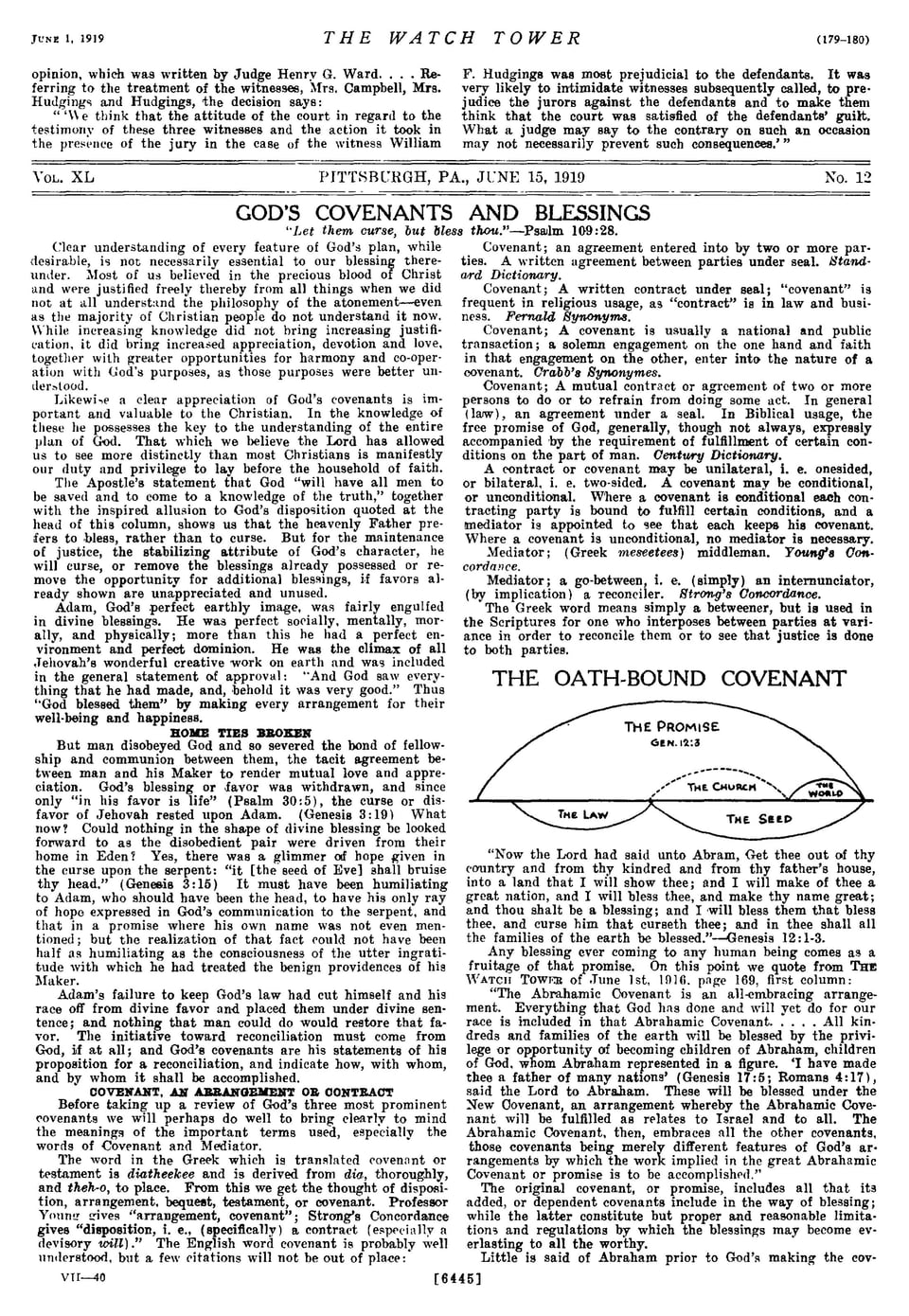
THE OATH-BOUND COVENANT
"Now the Lord had said unto Abram, Get thee out of thy country and from thy kindred and from thy father's house, into a land that I will show thee; and I will make of thee a great nation, and I will bless thee, and make thy name great; and thou shalt be a blessing; and I will bless them that bless thee, and curse him that curseth thee; and in thee shall all the families of the earth be blessed."—Genesis 12:1-3.
Any blessing ever coming to any human being comes as a fruitage of that promise. On this point we quote from THE WATCH TOWER of June 1st, 1916. page 169, first column:
"The Abrahamic Covenant is an all-embracing arrangement. Everything that God has done and will yet do for our race is included in that Abrahamic Covenant. . . . All kindreds and families of the earth will be blessed by the privilege or opportunity of becoming children of Abraham, children of God, whom Abraham represented in a figure. 'I have made thee a father of many nations' (Genesis 17:5; Romans 4:17), said the Lord to Abraham. These will be blessed under the New Covenant, an arrangement whereby the Abrahamic Covenant will be fulfilled as relates to Israel and to all. The Abrahamic Covenant, then, embraces all the other covenants, those covenants being merely different features of God's arrangements by which the work implied in the great Abrahamic Covenant or promise is to be accomplished."
The original covenant, or promise, includes all that its added, or dependent covenants include in the way of blessing; while the latter constitute but proper and reasonable limitations and regulations by which the blessings may become everlasting to all the worthy.
Little is said of Abraham prior to God's making the covenant with him, but we may suppose that he was a man of honest heart, who had already manifested a strong faith in God.
While Abraham was living in the land of the Chaldeans, God called him out from his relatives and friends, and directed him to go to the land of Canaan, where he would make him a great nation, promising further that, should he do so, in his seed all the families of the earth should be blessed. Abraham was called the friend of God, and God made this revelation to him. It was something to which faith could hold, but which could not be had from any other standpoint. This covenant was a definite declaration of God's benevolent intentions toward humanity in general, and of the fact that it had pleased him to select Abraham's posterity as the line through which he purposed to communicate the great and much needed blessing.
THIS PROMISE UNCONDITIONAL
There were no conditions to the promise, but there was a certain condition for Abraham to fulfil before that promise would be bound to Abraham's family and that condi
sition—that they should keep the Law and as a reward have life everlasting. Israel rejoiced in this manifestation of divine preference for them, more than for all the nations of the earth. And if honor from Almighty God has made some of the Jewish people at times to appear proud and arrogant, let us not forget that "to err is human—to forgive, divine." Perhaps if we had been in their stead, our imperfections would similarly display themselves.
But not a Jew kept the law perfectly. When they attempted to keep it they were disappointed. They failed; because the Law of God is the full measure of a perfect man's ability, and the Jews, like other men, being imperfect, found that they had undertaken an impossibility. Not a Jew, therefore, gained eternal life during the first year—not one. But God, foreknowing this, had made preparation for the atonement day every year, so that the people might continue to strive to attain eternal life under relatively favorable conditions. The morning of each new atonement day found the original Adamic sentence of death again upon them. Each
tion was that Abraham move into a land which God would show him. In a comparatively short time that single condition was fulfilled; thereafter all taught of God would know to look for the Messianic blessing through Abraham's seed. To make the promise more sure, if that were possible, God confirmed his word on the subject by his oath; thus giving two unshakable foundations for faith in the integrity of this wonderful promise. Seven times, in one form or another, was this promise reiterated to Abraham.—Hebrews 6:13-18; Genesis 22:16-18.
Abraham no doubt wondered at times how God intended to fulfill his covenant, seeing that the Canaanites continued to live in the land of Canaan while he was never more than a sojourner in it. God's promise concerning his "seed" seemed also to fail; and after many years when Isaac was born, he proved to be only a type, a living picture of the true "seed", through whom the promise of great prominence and world-wide influence and blessings was to be fulfilled.
Now God did not make his plan because of Abraham; but he merely made known his predetermined purpose to faithful Abraham, and chose his family as the one through which Messiah should be sent for the accomplishment of that plan. The plan itself, we are told, was predetermined from the
atonement day evening found that sentence typically satisfied and opportunity for another year guaranteed to them as a nation. But year after year, century after century, they failed, and discouragement took the place of hope.
But if God knew all the time that they could not keep the Law in such a way as to win life, the trophy of the law, why did he let them enter into the covenant at all? Before this question is answered it must be seen that the Jews were not disadvantaged in any way, even though they died because of their inability to keep the Law. When thus condemned to death by the terms of the Law which they thought was going to give them life (Romans 7:10), they were no more dead than the rest of mankind; they were merely in another ward of the great prison house of death.
The purpose of the Law, then, was educational, to teach the Jews and all mankind (1) the majesty and unchangeableness of divine justice, for prior to the giving of the Law there was no standard of righteousness in the world; (2) two other lessons closely associated; (a) that man needs better sacrifices than those of bulls and goats to take away sin; (b), that without the shedding of blood there is no means of justification in God's sight; (3) to show the Jews their own sinfulness and unworthiness to be the "seed" through which God would bless all mankind; (4) to assure Israel that the prom-
foundation of the world. (Ephesians 1:4) Abraham's obedience manifested his faith; and his continuance in Canaan marked the continuance of his faith.—Heb. 11:15.
THE LAW COVENANT
"The [Abrahamic] covenant, that was confirmed before of God in Christ, the Law [covenant], which was four hundred and thirty years after, cannot disannul, that it should make the promise of none effect. Wherefore then [serveth] the Law? It was added because of transgressions, till the seed should come to whom the promise was made."—Gal. 3:17-19.
Four hundred and thirty years after making the covenant with Abraham, God revealed another feature of his plan. When bringing Abraham's posterity out of Egyptian slavery to establish them in the promised land of Canaan, he brought them to Mount Sinai and there entered into a national covenant with them, known as the Law Covenant.
As a basis for this covenant or contract ten commandments were miraculously written upon two tables of stone, and subsequent elaborations given in the shape of many statutes, stipulating how the ten commandments were to be applied to their daily lives. God appointed Moses the mediator between himself and the people of Israel, to ratify the
ised seed would be a perfect man, able to keep all the requirements of the Law Covenant perfectly, as our Lord Jesus alone was able to do; (5) to prepare Israel, who had learned the lesson of their own shortcomings, to expect Messiah's birth out of the usual way, that his freedom from Adamic condemnation and weakness might be apparent; (6) to set forth in types and allegories some wonderful lessons illustrative of great divine principles of truth and righteousness—lessons which were beneficial to the Jewish nation, have been to the Gospel church and in time shall be to all the world; (7) to demonstrate to all the absolute necessity for the Redeemer and his mediatorial work for mankind (Acts 4:12); and forever to stop evolutionists, higher critics and all from saying: "We could have obtained life and perfection by our own efforts, if granted the opportunity."
The blessings they got were instructive in their nature (Romans 3:1, 2) but did not bring them everlasting life. Hence they were not in a position to become, as they had hoped, a national Messiah, a national seed of Abraham, for the blessing of all the nations.
For a time God gave them judges, then kings; but these were unable to accomplish the great things hoped for. But through the prophets the promise of a personal Messiah was made. One who should be of the lineage of David, a great
covenant and in his name to promise the people escape from death and from evil or blight, upon condition of their living up to the requirements of the Law; as it is written: "The man that doeth them shall live in them."—Galatians 3:12; Leviticus 18:5; 26:3-11, 14-44.
Hoping that the long deferred blessing of the original promise was now to be fulfilled, Israel readily assented to the terms of this Law Covenant and said: "All that the Lord hath spoken we will do." (Exodus 19:8; 24:3, 7) And no doubt they honestly intended full obedience, which they then considered to be a possible thing. Moses, fulfilling his part, ratified the covenant on behalf of God and the people, by sprinkling the blood of the sacrifice on the people and on the tables of the law, saying, "This is the blood of the covenant which God hath enjoined unto you", that is, the blood by which you and God are joined in covenant.—Hebrews 9:19, 20; Exodus 24:8.
Israel's experience of tribulation and bondage in Egypt was probably necessary to prepare them for God's great propo-
king, but far greater than the great, wise, and rich Solomon. Messiah would be David's son and yet David's Lord. (Psalm 110:1; Matthew 22:42-44) Here, as God had intended, Israel began to get the thought of a personal Messiah, a king of glory, who would use their nation as his instrumentality for the conquering of the world, when every knee should bow and every tongue confess to the glory of God.
JESUS, THE JUST ONE
Our Lord Jesus could and did fulfill the terms of the Law Covenant. All those commands and demands he summed up in the words, "Thou shalt love the Lord thy God with all thy heart, and with all thy soul, and with all thy strength, and with all thy mind, and thy neighbor as thyself." (Luke 10:27) Our Lord was able to love God supremely and his neighbor justly because of his absolute perfection, because his life was not derived from the polluted Adamic fountain but miraculously transferred from his previous, glorious spirit existence with the Father before the world was. Thus could it be said of him that he was "holy, harmless, undefiled and separate from sinners".
But while demonstrating by his obedience his right to all that the law offered, Jesus was proving himself obedient to a special sacrificial obligation which he had taken upon himself, in accordance with the divine will, for the joint purpose of redeeming mankind and of showing himself worthy for an unparalleled exaltation of nature to the divine plane itself, which God purposed as a reward for his obedience "unto death, even the death of the cross".
During these three and a half years of severe testing, Christ Jesus was demonstrating himself to be the sole heir of all the provisions of the Abrahamic Covenant, promised to Abraham's seed. Hence now in him, and in him only, "shall all the families of the earth be blessed". Thus, by fulfilling the conditions of the added Law Covenant Jesus made an end to that Law for every Jew who believed, nailing it to his cross, and was ready to begin the work of blessing, in God's due time. Romans 10:4; Colossians 2:14.
Thus the Abrahamic Covenant confirmed the idea that the seed must be of Abraham's descendents, while the Law itself just as surely proved that he would be "holy, harmless, undefiled, and separate from sinners".—Hebrews 7:26.
COVENANTS OF SACRIFICE
"Gather my saints together unto me; those that have made a covenant with me by sacrifice."—Psalm 50:5.
During the period of Israel's national favor, and even before that time, a few men and women exercising faith above and beyond the Law Covenant, were blessed by the underlying Abrahamic Covenant, though the Law itself made nothing perfect. They were blessed not in the sense of being given life, but in the sense of having divine favor or appreciation of their efforts to practice righteousness under conditions which tended to discouragement.
These ancient worthies the Apostle enumerates in Hebrews the eleventh chapter. They had the testimony that by their faith "they pleased God", although they did not by obedience to the Law Covenant secure the blessing which it proposed. These faithful ones will get through Christ what the Law Covenant could not give them; for because of inherited weaknesses they were unable to do perfectly. Those noble heroes of faith will be rewarded for their past sacrifices by a "better resurrection".—Hebrews 11:35.
That resurrection will be better, or advantageous, not only in point of time—for they will evidently be brought forth from the tomb with perfect organism at the beginning of Messiah's reign, rather than gradually throughout that reign—but it will be advantageous also in that they may be made "princes in all the earth" (Psalm 45:16); that is, they may be raised to positions of responsibility and prominence in dealing with the "residue of men" and, as earthly and visible representatives of the heavenly and invisible kingly class, may help the toiling but happy multitudes of mankind up the highway of holiness, then open.
As there were some in past ages whose faith could reach out and sense God's benign intentions regarding earth's affairs and could struggle against the general tendency toward depravity and selfishness in the world, so since the first advent of our Lord there have been those who, with greater light on God's purposes and with greater reward as a spur, have been willing, yes even anxious, to forego the pleasures and emoluments of the present evil world for the prospect of a resurrection not merely to human perfection, but to "glory, honor and immortality"—"the divine nature".—Romans 2:7; 1 Peter 1:4; 2 Peter 1:4.
SACRIFICE NOT COMPULSORY
No one is forced into this covenant of sacrifice. Our Master, the Head of the Christ, and the Exemplar in voluntary sacrifice, in opening the way for his church said on this point: "It any man will come after me, let him [1] deny himself, [2] take up his cross, and [3] follow me." Those who have heard and appreciated the Lord's offer to become his disciples have had faith in God's existence and in his disposition to reward those who diligently seek him. They approach Jehovah through Jesus, therefore under the original Abrahamic promise. The spirit and devotional attitude of those who thus come to God through Christ is perhaps nowhere better expressed than in a little poem which some footstep follower of the Lamb has left behind, called "My Sacrifice".
"Laid on thine altar, O my Lord divine,
Accept this gift today, for Jesus' sake.
I have no jewels to adorn thy shrine,
Nor any world-famed sacrifice to make;
But here I bring, within my trembling hand,
This will of mine—a thing that seemeth small;
And thou alone. O Lord, canst understand
How, when I yield thee this, I yield mine all
How, when I yield thee this, I yield mine all.
"Hidden therein thy searching gaze can see Struggles of passion, visions of delight, All that I have, or am, or fain would be Deep loves, fond hopes, and longings infinite. It hath been wet with tears, and dimmed with sighs, Clenched in my grasp till beauty hath it none. Now, from thy footstool, where it vanquished lies, The prayer ascendeth—'May thy will be done!'
"Take it, O Father, ere my courage fail; And merge it so in thine own will that I May never have a wish to take it back; When heart and courage fail, to thee I'd fly. So change. so purify, so like thine own Make thou my will, so graced with love divine, I may not know or feel it as mine own, But recognize my will as one with thine."
Of course Jehovah can accept no sacrifices unless they are perfect; and those coming to God since Jesus' day are no more perfect than were the Jews. God might appreciate them and call them friends because of their heart harmony with him (as he did to father Abraham) but he could not accept them as sacrificers unless made perfect. What, then, can be done? The sacrificer can do nothing toward making himself perfect, for he is under the sentence of Adamic death.—Psalm 49:7.
'ACCEPTED IN THE BELOVED'
But while believers cannot make themselves acceptable, the very one who invited them to become his disciples can make their sacrifices "holy and acceptable unto God". (Romans 12:1) Let us see how this works:
Our Lord Jesus was born under the Law Covenant and kept its provisions faithfully. By so doing he fulfilled the prophecy concerning him which said: "He will magnify the law, and make it honorable". (Isaiah 42:21) Previous to our Lord's full compliance with every requirement of the Law it might have been claimed that God's standards were so rigorous that no one could possibly live up to them, that they were simply dream visions of holiness. But when Jesus not only loved God with all his heart, mind, soul, and strength, and his neighbor as himself, but also did more, in that he sacrificed himself, "the just for the unjust," he demonstrated the fact that God had not given an impossible law; but that the fault lay with mankind, who had lost the original perfection with which the Father had endowed them.
The rights or prizes gained by our Lord Jesus through his perfect obedience to the law were earthly rights—human perfection, an Eden home, fellowship with God, and the dominion of earth. (Psalm 8:6-8) But the succinct wording of the Abrahamic promise embraces what is elsewhere more clearly stated, viz., that the seed of the promise was not merely to get the blessing but that it was also to dispense the blessing to the nations of earth.
Instead of keeping the earthly rights which his special birth and obedience to the Law made possible to him; and instead of using his powers and position as a perfect man to bring palliative blessings to mankind in the shape of instructions in health and morals, Jesus, in harmony with the Father's program, sacrificed these earthly rights at once as soon as he reached manhood's estate at thirty years of age. At Jordan he engaged to give up his earthly rights, interests, and privileges as the perfect seed of Abraham, and symbolized his complete consecration into a sacrificial death by water immersion.
NEW NATURE AS A REWARD
The Father accepted his consecration and forthwith gave him the begetting of the holy Spirit to a new nature. For the three and one half years of his earthly ministry our Lord persistently sacrificed his earthly life and every earthly interest, finishing the sacrifice at Calvary when he cried, "It is finished!" On the third day thereafter the Father raised him from the dead to a new life, again on the spirit plane of being, but far above angels, principalities, and powers.—Heb. 5:5.6.
So, then, as the glorified One in his resurrection, Messiah was a spirit being, "the express image of the Father's person," and, having ceased to experience his unforfeited human life at Calvary, he would henceforth have it to dispense, according to the Scriptures. Or, as he himself describes it, he had at the time of his resurrection the merit of his ransom sacrifice as an asset with which he could satisfy the claims of divine justice against any or all of Adam's race—he had the authority and technical ability to open the great prison house of death.—Revelation 1:18.
Forty years after our Lord's resurrection he ascended on high and appeared in the presence of God to appropriate the merit of his sacrifice on behalf of believers. (Hebrews 1:3; 9:24) Only when divine justice had accepted his righteousness, vicariously applied to the then believers, could those believers be accepted as joint sacrificers with Christ Jesus their Lord; and only then was it possible for them to be begotten of the same holy Spirit to a new nature, as the Apostle Peter explained on the day of Pentecost: "He hath shed forth this [manifestation of that] which ye now see and hear."—Acts 2:33.
Throughout the Gospel age the way has been open to that incorruptible inheritance; and those who have thus become Christ's are "Abraham's seed" and "heirs according to the promise". (Galatians 3:29) So, then, it is The Christ, the antitypical Isaac class, Jesus the Head and the church his body, which is the primary seed. This class, first drawn from the Jews and later from the Gentiles, is first blessed (as all peoples must be, according to the promise) (Galatians 3:8, 9) with life, reckoned or applied to them in response to their obedient faith, then, if faithful, they have another blessing in helping to dispense those life privileges, which Jesus alone earned, to the needy world, the rest of mankind. (Acts 15:15-17) And inasmuch as "it is more blessed to give than to receive" it may be truthfully said that the blessing of this seed class, the church, is a far more exceeding one than those who merely receive.
GRACE WITHOUT A MEDIATOR
All men are sinners, children of wrath under divine sentence of death; but there are other very important respects in which all men are not alike. Some hate the chains or sin wherein they are held and long for freedom and for reconciliation to God; while others love the sin and are estranged from God. God is not in their thoughts. Apparently this latter class is in the majority, for the Apostle John says: "We know that the whole world lieth in wickedness".—1 John 5:19.
Here we have the reason for the difference in God's dealings with the two classes. He takes note of those who are weary and heavy laden; and these, feeling after God if haply they might find him, he is pleased to "draw", during this Gospel age, through a knowledge of the truth, to Jesus that at his hand they may become justified and acceptable, if they will, as members of the body of Christ, and suffer with him now. Then they will reign with him bye and bye. The ungodly are not drawn or called in consecration with the high calling of the Gospel age, but are left to be dealt with by the Redeemer when he shall assume the office of Mediator between God and men—the world.
But is it not Scripturally declared of believers that they were enemies of God through wicked works? (Colossians 1:21) Yes, but nowhere does it say that they were enemies of God through wicked hearts, at the time of their coming to Christ. And this constitutes the difference. God, who reads the heart, deals with them from that standpoint and leads them to Christ (John 17:6), that the merit of his sacrifice may offset the demerits of their sin and their imperfect works.
These are drawn of the Father, as Jesus declares: "No man can come unto me [now] except the Father which hath sent me draw him," and whoever cometh unto me, drawn by the Father, I will in no wise reject. (John 6:44, 37) Some of the Lord's followers were drawn to him, of the Father before he had completed the sacrifice for sin on Calvary, and others have been drawn throughout the Gospel age; "even as many as the Lord our God shall call."—Acts 2:39.
If Abraham, who was but a friend of God, needed no mediator between himself and God, surely there is no need of such an official between those who occupy the tender and intimate relationship of father and son. (John 16:27; Hebrews 2:11; 1 John 1:3) But the church does have the kindly offices of an Advocate to represent her affairs at the court of divine justice and to make good for her unwitting and unwilling trespasses. —1 John 2:1; Romans 8:34; Hebrews 7:25.
SEED OF ABRAHAM TWOFOLD
In Romans 4:16 the Apostle shows that the original Abrahamic Covenant contains two parts.
"Only of late have Bible students discerned that Abraham is to have two seeds, exclusive of the Ishmaelites of the law or Hagar covenant. 'Thy seed shall be as the stars of heaven. and as the sands of the seashore.' The stars of heaven picture to us a glorified Christ and his church, the spiritual seed of Abraham, changed from human nature to divine nature, from earthly conditions to heavenly conditions. These are the heirs of Galatians 3:29, and are referred to by Saint Paul again when he says, 'As star differeth from star in glory, so is the resurrection of the dead'.—1 Corinthian 15:41, 42.
"But God's glorious plan will only begin its accomplishment in the glorification of the church. All the families of the earth, like the sands of the seashore, will be privileged to
come into relationship with God under Messiah's kingdom. All who will then knowingly and wilfully reject the divine arrangement will be cut off in the second death, but all who will then accept the terms of Messiah's kingdom and become obedient thereto will be gradually brought to perfection, and because of faith and obedience become identified with God and become the earthly or human seed of Abraham, blessed with human perfection and everlasting life in an earthly Eden."—Z' 13-p.43.
"During the Gospel age, Jehovah has been selecting the members of this spiritual seed, that they may lay down their human life and earthl interests in order to attain to the spirit nature. The selection of this seed has been the work of the Gospel age. Soon the seed will be all gathered; then the work of blessing the natural seed will begin, and through them the blessing will subsequently spread to all nations, as these will accept the divine favor."—Z' 13-p.21.
The natural seed will not be drawn by the Father, but the Lord Jesus will draw them to himself. "1, if I be raised on high, from the earth, will draw all to myself." (John 12:32, Diaglott) Even after the Son draws them unto himself, he must as the Mediator keep them unto himself until he shall have instructed them, disciplined them, made their knees to bow, and their tongues to confess. taught them the necessary lessons and brought them back to what was lost. Until this has been done the Father will have nothing to do with them, personally. Their acceptance by the Father will be at the close of the Millennial age, after the spiritual seed shall have completely "blessed" the natural seed, in fulfillment of the promise.
THE NEW LAW COVENANT
"Behold the days come, saith the Lord, that I will make a new covenant with the house of Israel, and with the house of Judah; not according to the covenant that I made with their fathers in the day that I took them by the hand to bring them out of the land of Egypt; which my covenant they brake, although I was an husband unto them, saith the Lord; but this shall be the covenant that I will make with the house of Israel; after those days, saith the Lord, I will put my law in their inward parts and write it in their hearts; and will be their God, and they shall be my people. And they shall teach no more every man his neighbor, and every man his brother saying, Know the Lord; for they shall all know me, from the least of them unto the greatest of them, saith the Lord; for I will forgive their iniquity, and I will remember their sins no more."—Jeremiah 31:31-34. See also Ezekiel 11:19; 36:26.
The New Covenant is the arrangement employed for the carrying out of the Abrahamic promise to mankind in general, estranged from him now not merely legally through the sentence of death, but also estranged in heart. The New Covenant is to be inaugurated with a view to effecting stupendous changes in human objects of affection, to painstaking establishment of the divine principles of wisdom, justice, love, and power in the human heart.
The prophecy of Jeremiah above quoted, combined with the statement of Moses respecting the greater Mediator than himself (Deuteronomy 18:15-18), helped the faith of all true Israelites to grasp more firmly the oathbound Abrahamic promise—"In thy seed shall all the families of the earth be blessed".
"The Mediator of the New Covenant will be the Christ. For more than eighteen hundred years, our Lord has been offering the great antitypical sacrifices of himself and his church. As soon as he will have finished making application of the blood, he will have made satisfaction for the sins of the world. This act will correspond to the sprinkling of the book of Moses. Divine Justice having accepted this arrangement, the Mediator will antitypically sprinkle the people; that is, he will show them how to come back into full accord with God.
"The New Covenant will begin to swallow up the old Law Covenant as soon as the Kingdom is established. The Scriptures indicate that the first to receive it will be the ancient wortnies. Raised from the dead to human perfection, they will form the nucleus of the new arrangement in the earth. Next in order will be those who have been known as Christians, but who have not been consecrated to death, and Jews who have been consecrated to the Law but who have been blinded. Gradually the light will come to all who love righteousness and hate iniquity. Sprinkled from all sympathy with evil, they will make their declaration of full loyalty to God. In due time this light will spread to all kindreds and tongues and nations.
CHANGE OF HEART IN THE MILLENNIUM
"The prophet Jeremiah speaking of the New Covenant (31:34) says, 'They shall know me, from the least of them unto the greatest of them, saith the Lord; for I will forgive their iniquity, and I will remember their sin no more'. The sins and iniquities of Israel will no longer be remembered against them. Christ will have appeared on their behalf and made satisfaction for their sins. They will then be as free from their original sin as the Gospel church are. The atonement of the Lord Jesus Christ is the sufficiency for all.—1 John 2:2.
"The prophet Ezekiel tells us that during the next age the hearts of mankind will be changed. He says, 'Thus saith the Lord God; . . . a new heart also will I give you, and a new spirit will I put within you; and I will take away the stony heart out of your flesh, and I will give you a heart of flesh'. (Ezekiel 36:22-27) This change of heart is entirely aside from the making of the New Covenant. It will take a thousand years to remove the stoniness out of the hearts of mankind and to make them stand without a Mediator. Those who receive everlasting life must attain this condition; for all of God's creatures who will live forever must keep his law perfectly.
"During the Millennium God will not recognize the people, because of their imperfections, their weaknesses; but all of their dealings will be through the Mediator, until they shall have been brought up to perfection. At the end of the thousand years, they will be delivered up to the Father, unblamable before him. (1 Corinthians 15:24) God will then receive them as sons, heirs of the earthly blessings which he has provided for mankind—the things given to Adam. The very moment when the merit of Christ is applied for the world is the same moment when they will be turned over to the Mediator. Then they will be in covenant relationship with God, but only through the Mediator, until they shall have reached human perfection and shall enter into this relationship directly with the Father."—Z' 13-p. 21.
THE WANDERER'S RETURN
It is this reuniting of the broken bond of love and fellowship between Jehovah and his creature man, which constitutes the last work of the Mediator. Throughout the thousand years of his reign Messiah holds this new relationship in escrow. He sees that mankind is made able to fulfill the law and instructs the people in all the advantages of loving God with their every power of mind and body, and on the other hand, he represents the interests of mankind and sees that Jehovah gives them the everlasting life and the lost dominion which they long for and need.
It is this last phase of the Mediator's work on behalf of mankind which is covertly referred to in the twenty-fifth chapter of Matthew in the words addressed to the then perfect members of the human race: "Come ye [now] blessed of my Father, inherit the kingdom prepared for you from the foundation of the world". (Matthew 25:34) What kingdom? it is asked. We answer: The kingdom of or dominion over the earth—such arrangement and direction of earth's affairs as will minister perfectly to the well-being and happiness of every human heart.
This is the same dominion which Adam possessed in the beginning. "the first dominion" (Micah 4:8; Psalm 8:6), the same dominion which was lost through disobedience, the same dominion which was usurped by Satan, the same dominion which was proven to belong only to our Lord. the same dominion or kingdom in which he promises his faithful followers a share (Luke 12:32; Revelation 3:21), the same kingdom for whose advent they have long prayed, the same kingdom which will be exercised for a thousand years for the blessing and uplifting of mankind, the same kingdom which shall increase upon the throne of David (Isaiah 9:7) until Christ shall have put all enemies under his feet (1 Corinthians 15:25; Psalm 110:1), the same kingdom which, when it shall have accomplished its temporary purpose of restoring man, shall be delivered up to God, even the Father (1 Corinthians 15:24), and the same kingdom or dominion which shall be handed back to the then capable members of the fleshly seed of Abraham, like the sands upon the seashore for number.
There will be a racial relationship between God and humanity during the reign of Messiah, but only through the Mediator. The individual relationship once enjoyed by Adam will not be entered into until the mediatorial government shall have ceased. The great Mediator is also Prophet, Priest and King. Having first freed them from the sentence of death by the application of his own blood to Adam's account, he instructs them in the ways of holiness; he gives to the zealous just enough love and rewards to spur them on to perfection; to the less zealous of mankind he gives just enough love and chastisements to encourage hesitating good intention; to the froward and incorrigible, after a hundred years trial, he gives merciful oblivion in eternal death (Isaiah 65:20); and to the finally loyal and obedient, a welcome back to the bosom of the Father, where there is fullness of joy and where there are pleasures forevermore.—Jeremiah 4:2.
THE COVENANTS IN TYPE AND PICTURE
"Abraham had three wives; Sarah, his original spouse; then later, Hagar, Sarah's maid, whom she urged upon him as a supposed assistance to God in the carrying out of the covenant. after a long delay and waiting; and third, after Sarah's death. Abraham took Keturah to wife, and by her had many children, whereas by the primary wife and by the maid, but one each. The Apostle's language justifies us in considering this matter allegorically or typically. The holy Spirit, through Saint Paul, tells us that Sarah represented the essence of the original covenant and that Hagar represented the Law Covenant. He explains that the Jewish people were in bondage under the Law Covenant and therefore the antitype of Ishmael, Hagar's son, and that these were cast out from divine favor, even as Hagar and her son were cast off from Abraham's family by divine instruction, and to make the type complete. The Apostle introduced this lesson to show us that the Covenant of Grace, under which the Gospel church is developed, has nothing whatever to do with the covenant of the Law; that the two were separate and distinct.
"Hagar's child might indeed appear to be the child of Sarah for a time, but it was not; even as Sarah's child, Isaac, was in no sense Hagar's son. The Apostle's argument is, 'So, then, brethren, we, as Isaac was, are the children of the promise'—the original covenant, and not children of the Law Covenant. Similarly, we fancy, the Apostle, if writing today to those who claim to be under the New Covenant, represented in the type of Keturah, would tell them plainly, 'You cannot be children of two covenants, children of two mothers'. If you are, children of the Keturan Covenant in any sense or degree, you cannot be the children of the Sarah Covenant; and if you are children of the Sarah Covenant, then in no sense or degree can you be the children of the Keturah Covenant or New Covenant—which is not yet in existence."—Z' 09p.105.
As Sarah was long barren, until after Hagar's son was born and became persecutor, so the Abrahamic Covenant, which was to produce the Messiah, was long barren. But that Sarah covenant has meantime produced the Lord Jesus and the various members of his body who have already passed into glory. "The seed of Abraham." "the seed of the promise," will be fully born shortly now, when the last member of the elect church, which is the body of Messiah, shall have stood the test and been received beyond the vail, completing the first resurrection, of "Christ, the first-fruits".
But the allegory continues: "And Sarah died;" and Abraham took another wife, Keturah (Genesis 25:1), who well pictures another covenant, the New Covenant. Abraham had many children by Keturah, even as the New Covenant will bear many children to God during the Millennium, but not one of them as a direct heir. As it is written: "Abraham gave all that he had unto Isaac". (Genesis 25:5) The children of Keturah, therefore, received their blessing through Isaac and well represent the restitution class of the Millennium who will be blessed by the antitypical Isaac, namely, the Christ.
Two matters should be borne in mind, first, Keturah did not become his wife, or covenant, until after Isaac married, and this typifies the union between Christ and the church in the end of this age; second, Abraham did not marry Keturah until Sarah was dead. In other words, this New Covenant does not become the wife, or covenant, until after the original covenant represented by Sarah, shall have brought forth the seed, the Messiah, through which the subjects of the New Covenant are to receive their blessing.
EPHOD AND SHEEPFOLD
The ephod worn by the high priests of Israel when performing certain functions of office was evidently intended to picture God's covenants.
"The 'Ephod' was made of cloth of purple, blue, scarlet, white and gold threads, skilfully and beautifully interwoven.
It was of two parts, one hanging in front and the other over the back. These two parts were fastened together by two gold clasps which rested on the shoulders. The ephod typified the two great covenants—the Abrahamic Covenant represented by the front part and the New Covenant represented by the back, both of which are thus shown to be dependent on our high priest. Both of these covenants are laid on him: if he fails to support them, fails to carry out their terms and conditions, they fall to the ground—fail. But, thank God, these covenants are united and firmly clasped on him by the gold clasp (divine power), as well as bound to him by the 'curious girdle'—a cord made of the same material as the ephod."—T. 30.
"The Breastplate of Judgment'—was placed on the front of the ephod. It was suspended by a gold chain from the clasps on the shoulder, and was fastened to the ephod by the lacer, through golden rings—this fastening being so concealed underneath that to the casual observer it might appear to be a part of the ephod. (Exodus 28:26-28) This breastplate beautifully represented the Law: it was not a part of the Abrahamic Covenant (ephod) but 'it was added' to it. (Galatians 3:19) As the Israelite regarded them (not seeing the hidden connection), the covenant to Abraham, and 'the Law, which was four hundred and thirty years after,' were all one."—T. 34.
It is interesting to note that the part representing the Abrahamic and Law Covenants were both in front of the high priest's body, as those covenants both antedated the "high priest after the order of Melchizedec". The head of the priest was plainly visible then, as Jesus, the Head, stands out prominently in earth's history. The body was practically covered from view, as the church, the "mystery" class, has been obscured to the eye of the casual observer. After both head and body of the high priest came the hinder part of the ephod, representing the New Covenant—not to be established until all the body of Christ is complete.
In the first five verses of the tenth chapter of the Gospel of John our Lord evidently refers to the Law Covenant under the figure of a sheepfold. The sheepfold is an arrangement instituted for the protection and welfare of the sheep, but they are in difficulty if they have no shepherd. So the Law itself was "holy, and the commandment holy, and just, and good". (Romans 7:12) But the trouble was with the imperfections of the sheep, which hindered them from enjoying the privileges of the fold, and with their shepherd, Moses, who himself was imperfect and could not give them life. After eighteen centuries our Lord came and found them "as sheep not having a shepherd". (Mark 6:34) He met all the requirements of the Law and thus showed that he was the rightful shepherd of the sheep; the warder, or divine justice, did not bar him from calling out such of the Jews as were true sheep at heart. He called these out and with them as a nucleus founded "this fold" of the Gospel age to which he is also the door, or only means of access. When this fold is complete he will deal with the "other sheep . . . which are not of this fold"—He will open up another fold for the residue of men, who will be obedient under the favorable circumstances of the Millennial age. The grand result will be that "there shall be one flock, and one shepherd", though many folds or final arrangements for the housing of God's perfect creatures on many planes of being. See John 10:16 Diaglott.
SUMMARY
Summing up, then, we find that covenants produce seed and are typified by women.
In the Law Covenant, (which was bilateral—two sided, and required the office of a mediator), Abraham represented Jehovah, while Hagar pictured the covenant which produced the natural seed of Israel, under bondage to that Law.
In the Abrahamic-Sarah covenant, (which was unilateral one sided, and required no mediator), Abraham typed Jehovah, the Father, while Sarah typified the covenant, or mother, that produced "the seed of promise". Sarah had but one son, Isaac, who was a type of the Christ. (Galatians 4:22-28) The Christ, "the seed of promise," is Jesus and his church (Galatians 3:16, 27-29), Jesus the Head, the church his body. The usual manner of birth of natural children is the head first. This illustrates the birth of "the seed of promise". Christ Jesus, the Head, was born at his resurrection to the divine nature, and he is the head of the body, the "first born". (Colossians 1:18) No child can have two mothers, but the head and body must be born from the same mother. It follows, then, that the church, the body of Christ, must be produced by the Abrahamic-Sarah covenant; hence the body members of the church could not possibly be under the New Covenant.
In the New Covenant, (which is bilateral and requires the office of a mediator), the mother is pictured by Keturah, who had many children, all of whom were born after the death of Sarah and after the marriage of Isaac and Rebecca. The New Covenant produces an earthly seed, to wit: all who will be restored to perfect human conditions during the reign of Messiah. None of the "seed of promise" could possibly be under the New Covenant, for the further reason that the New Covenant produces a seed, all of whom receive blessings under and through the ministrations of the "seed of promise", that is the Christ.
THE CHURCH: ITS LIFE AND WORK
JULY 6.—ACTS 2:37-47; 1 THESSALONIANS 5:11-15.
[This article was a reprint of that entitled, "The Early Church," published in the issue of January 1, 1902, which please see.]
PHILIP AND THE ETHIOPIAN
JULY 13.—MATTHEW 28:18-20; Acts 8:26-40.
[This article was a reprint of that entitled, "God's Providences Coöperate," published in the issue of March 1, 1902.]
CONVENTIONS AND
Those who had the privilege of attending one or both of the recent conventions held at Brooklyn and Boston have given hearty expressions concerning the enjoying and profit derived therefrom. The maximum attendance at Brooklyn was probably in the neighborhood of eighteen hundred and that at Boston about thirteen hundred. The spirit shown by the dear friends in attendance at both places was certainly commendable. All showed a willingness and earnestness to take up whatever phases of the Lord's work yet remain to be done, just as soon as his providences point out the way.
Brother Rutherford will be present at all of the General Conventions below announced, as also at Vancouver. Other speakers of ability, as well, will be in attendance and will doubtless minister to the refreshment and edification of all the hungry.
GENERAL CONVENTIONS
MORE CONVENTIONS
SEATTLE, WASH., July 36. This gathering of the friends will be very opportune, as it will include the great national holiday. No doubt there will be a large attendance from the
Sound classes. Address communications to E. G. Wylam, 1414 Seventh Ave.
SPOKANE, WASH., July 8-10. A mid-week convention has been arranged for at Spokane in order that the speakers assigned to the other gatherings could be present. This fact should not hinder a large attendance. Address communications to Isaac Hagen, E.2623 Seventh Ave.
PORTLAND, ORE., July 11-12. The friends at Portland have arranged for a three day convention on the above dates. Address all communications to C.W.Field,841 Halsey St.
DENVER, COLO., July 17-20. The delightful city of Denver has been selected for four days convention on the above dates. Address all communications to F. M. Robinson, Room 456 Railway Exchange Bldg.
REDUCED RATES FOR NORTHWESTERN CONVENTIONS
We have made application to the Regional Director of Railroads for special rates to the Seattle, Spokane, Portland, and Denver conventions. When buying your ticket to the convention pay full fare for a one-way ticket. Ask your agent for a certificate to the International Bible Students' Convention.
If two hundred fifty delegates attend each convention they will be able to secure a very low rate for the trip home from the convention.
LOCAL CONVENTIONS
ERIE, PA., July 3-6. The friends at Erie are arranging for a four day convention. They have secured a good auditorium and several pilgrims will be present, including one of the released brethren. For further particulars address Dr. E. C. Bruce, 626 E. 6th St.
ROCHESTER, N. Y., July 4-6. All sessions of this convention will be held in the R. B. I. Hall, 172 Clinton Avenue, South. For further information address Robert Dormer, Room 322 Central Bldg.
PHILADELPHIA, PA., July 4-6. Several Pilgrim brethren will serve at this local convention. Communications should be addressed to George G. Calhoun, 6019 North Tenth St.
KALAMAZOO, Mich., July 4-6. The Kalamazoo friends have made arrangements for a three day convention on the above dates. Several Pilgrims and one of the released brethren
St. Louis, Mo., July 4-6. The friends in the vicinity of St. Louis will be glad to know that there will be a local convention in that city on the above dates. There will be good speakers on the program, including one of the released brethren. Address all communications to J. H. Hoeveler, 5630 Pershing Ave.
will speak. Address all communications to Adrian Ridderhof, 555 Second St.
Los ANGELES, CALIF., July 4-6. The friends at Los Angeles have arranged for a local convention on the above dates. Several Pilgrims will serve in connection with the spiritual bill of fare. Address communications to F. P. Sherman, 21114 North Sichel St.
CHICAGO, ILL., July 4-6. The Lithuanian friends will hold a three-day convention with sessions at Archer Hall, 2988 Archer Ave., cor, McDermott Avenue, For further information write J.R.Muzikant, 2957 Lyman. St., Chicago, Ill. Phone Boulevard 5026.
LOUISVILLE, KY., June 28-29; LANSING, MICH., June 28-29; and ALBANY, N. Y., July 5-6.
LETTERS FROM AFIELD
LORD'S BLESSING ON COLPORTEUR WORK
DEAR BRETHREN:
Greetings in the name of our dear Redeemer. We have been having such good success here at Norfolk, Va., that we thought of writing to let you know of it. Since resuming the work which we were compelled to leave temporarily last summer, we have actually taken orders for and delivered over 1800 volumes in 8 weeks time. This makes an average of over 100 books a week for both Sister Zea and me. The first four weeks we sold single volumes, either the first or fourth, but the last four we sold sets of three. We have found many, many homes where the books are and many who love their contents, as was evidenced by the used condition of the volumes. The Father only knows how wonderful a witness has been given, in addition to gathering the wheat.
I have found it quite effective in gaining the people's attention when first approaching them to say I have been sent there. Many times this expression gains their attention whereas simply to produce the book and then tell them about it would only result in "I have no time" or some other expression like it. After telling them I have been sent to see them, I usually proceed like this: "I am sure you are reading the newspapers daily and are doubtless perplexed as you see the terrible condition the world is drifting into and as to the meaning of the trouble spreading over every land. It seems like present civilization is going into chaos, doesn't it? Would you care to know the meaning of this trouble and how it is to be settled?" Invariably this question brings an earnest "Yes, I would." Having gotten the person to this point which indicates interest I then take the book out and begin. I find it very good to refer to the Lord's Prayer,—"Thy kingdom come, thy will be done." Also I give a brief synopsis of the Plan.
Surely the dear friends who are unencumbered are missing wonderful blessings by not being in the Colporteur work. It is amazing how strong the Lord makes us as we daily go forth in his strength only to tell the poor groaning creation of the wonderful things the dear Lord has in store for them.
We were so richly blessed at the Brooklyn Convention we surely can go forth with renewed determination for we know that our deliverance draweth nigh.
Yours with much love, in which Sister Zea joins me,
JAMES G. ZEA.—Va.
P. S.—We are surely pleased with the books. Even the people remark about how nice they look and how well they are bound.
THE DANGER IS IN PRIDE
DEAR BRETHREN:
My heart has been made full of joy and love and praise through the precious things in the columns of the WATCH Tower very often, and there was no exception to this in the June 1st issue. The first article was so grand and the spirit of it par excellent.
I am living in hope that many or all of the Standfast Bible Students, as they call themselves, will see their mistake and be humble enough to return to co-operation with the Society. If they had not been so hasty in splitting off from the Society I believe they would have seen the trick of the adversary in
such a thought quite quickly. I am reminded of Proverbs 19:2: "He that hasteth with his steps, sinneth". I am more and more convinced that it is pride that leads off into factions. Pride, says the Standard Dictionary, is an unreasonable selfesteem, or conceit, of our own superiority. And a careful study of the subject from the Bible convinces me this definition is correct. How easy it is to become conceived with reference to our own spirituality and the correctness of our judgment regarding spiritual matters. While I did not think it proper to subscribe to help carry on the war in any way, why should I think that everyone who thinks it would be all right is my inferior spiritually? Maybe if I were as matured as some of the Lord's people I would see the matter differently. So the sane thing, for me to do, it seems to me, is to walk in the light as I see it; give reasons for what I believe to those who desire them; keep my own mind open for further light; and keep in mind the possibility that I might be wrong and others right.
Lots of friends would be profited by making a study of the meaning of pride both from the dictionary, the Bible, and experience. I feel quite sure that many would find themselves badly afflicted, who think they are almost ripe for the kingdom, who think they are of the Elijah class and others of the Elisha class.
You have my love, sympathy, prayers and appreciation. DANIEL TOOLE.-Pilgrim.
FREED FROM A DELUSION
DEAR BRETHREN IN THE ANOINTED:
I am writing to you in view of the fact that I have been associated with the "Standfast Bible Students" for the past six months and just recently severed my connection with them. Let me say that the course which I honestly and conscientiously pursued for six months I now by the Lord's grace am able to see is the most subtle delusion God has yet permitted to come upon his saints.
Our beloved Pastor, in commenting on 2 Thessalonians 2:11, says regarding those coming under these "delusions": "They claim to be conscientious, and so they are". Brethren. I feel sure the great majority of these brethren are honest and conscientious; nevertheless they are under a great delusion, which is daily leading them into greater darkness respecting our Pastor's teaching on the "sealing of the saints", the "shut door" of our Lord's parable, "the great company class", and the "image of the beast".
But the devil overstepped himself in my own individual case and others when recently there were passed resolutions at different classes, among them one to this effect: "We believe the need for public work is ended in view of the fact that the door is shut, the harvest ended, and the saints sealed", etc. Since uniting again with the I. B. S. A. the Lord has shown me the great darkness I was in.
…