The Watchtower, September 15, 1950
Download: PDF — The Watchtower, September 15, 1950
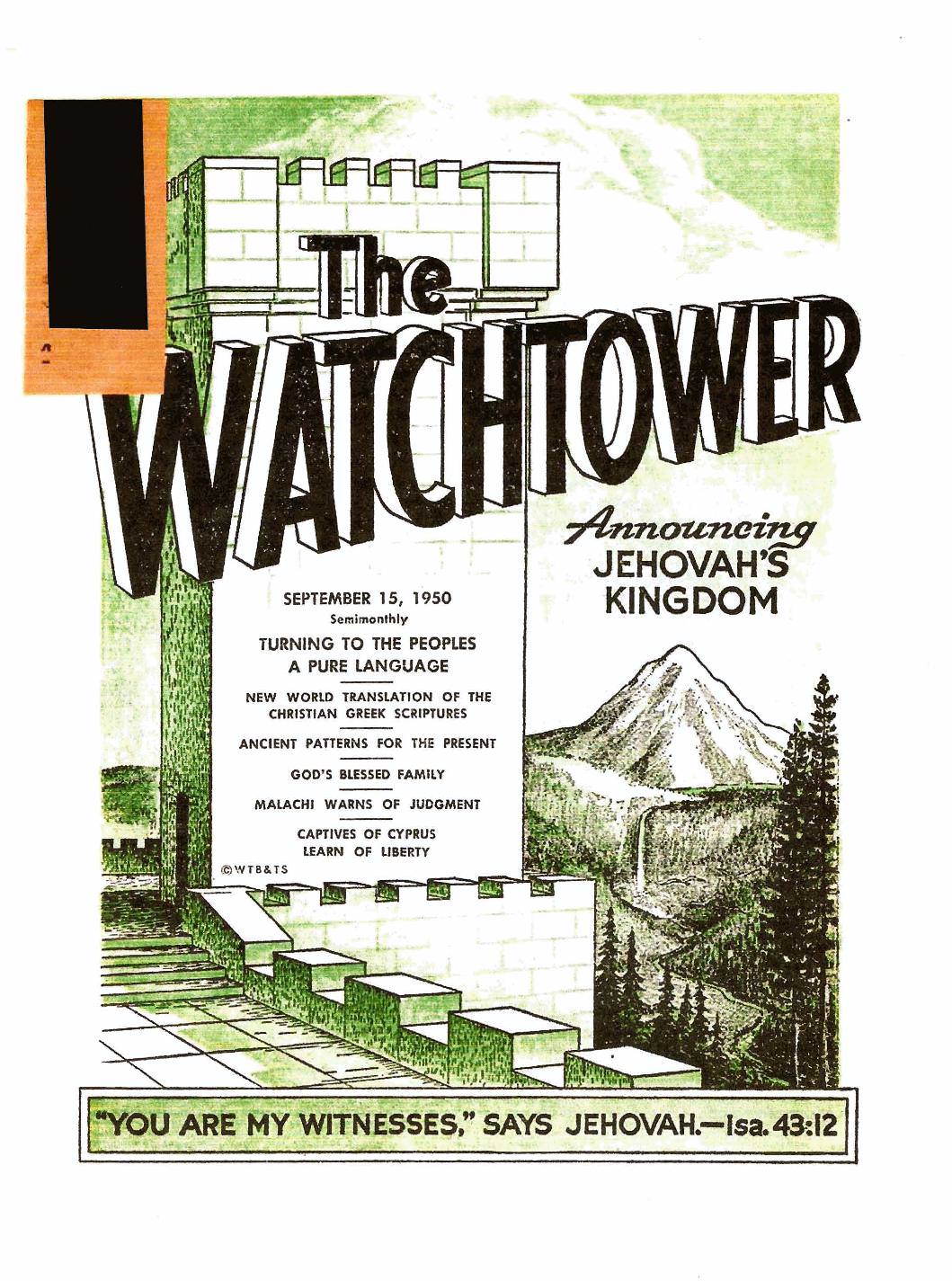
WATCHTOWER
SEPTEMBER 15,1950 Semimonthly
TURNING TO THE PEOPLES A PURE LANGUAGE
NEW WORLD TRANSLATION OF THE CHRISTIAN GREEK SCRIPTURES
ANCIENT PATTERNS FOR THE PRESENT
GOD'S BLESSED FAMILY
MALACHI WARNS OF JUDGMENT
CAPTIVES OF CYPRUS LEARN OF LIBERTY
Announcing JEHOVAH'S KINGDOM
© WTB&TS THE PURPOSE OF "THE WATCHTOWER"
Literal towers in Bible times were elevated vantage points from which watchmen could observe happenings, warn of danger, or announce good news. Our magazine figuratively occupies such a vantage point, for it is founded on the very pinnacle of wisdom, God's Word. That elevates it above racial, national and political propagandas and prejudices, frees it from selfish bias. It is not bound by any traditional creed, but its message advances as the light on God's purposes and works increases.—Habakkuk 2:1-3.
It sees things Scripturally. When it observes this generation afflicted with greed, delinquency, hypocrisy, atheism, war, famine, pestilence, perplexity and fear, and persecution of unpopular minorities, it does not parrot the old fable about history repeating itself. Informed by Bible prophecy, it sees in these things the sign of the world's time of the end. But with bright hope it also sees opening up for us just beyond these woes the portals of a new world.
Thus viewed, "The Watchtower" stands as a watchman atop a tower, alert to what is going on, awake to note signs of danger, faithful to point out the way of escape. It announces Jehovah's kingdom established by Christ's enthronement in heaven, feeds his kingdom joint-heirs with spiritual food, cheers men of good will with glorious prospects of eternal life in a paradise earth, comforts us with the resurrection promise for the dead.
It is not dogmatic, but has a confident ring in its voice, because it is based on God's Word. It does not privately interpret prophecy, but calls attention to physical facts, sets them alongside prophecy, and you see for yourself how well the two match, how accurately Jehovah interprets his own prophecy. In the interests of our salvation, it keeps sharp and faithful focus on Bible truth, and views religious news generally.
'Be watchful in these perilous times,' God admonishes. So keep on the watch by regularly reading "The Watchtower".
PUBLISHED BY THE WATCH TOWER BIBLE & TRACT SOCIETY
117 Adams Street
Brooklyn 1, N. Y., U. S. A.
N. H. KNORE, President
GRANT SUITER, Secretary
"They will all be taught by Jehovah."—John 6:45, NW; Isaiah 54:13
CONTENTS
Turning to the Peoples a Pure Language 307
New World Translation of the
Christian Greek Scriptures 312
Ancient Patterns for the Present 321
God's Blessed Family 325
Malachi Warns of Coming Judgment 329
Captives of Cyprus Learn of Liberty 332
Questions from Readers 335
Experiences in Announcing
Jehovah's Kingdom 336
Announcements 336
Announcements 336
Abbreviations used in "The Watchtower" for the following Bible versions
AS - American Standard Version LXX- The Septuagint Version
AT - An American Translation Mo - James Moffatt's version
Da - J. N. Darby's version NW - New World Translation
Dy - Catholic Douay version Ro - J. B. Rotherham's version
ED - The Emphatic Diaglott RS - Revised Standard Version
Le - Isaac Leeser's version Yg - Robert Young's version
Unless otherwise indicated, the Bible used is the King James Version
Printing this issue: 1,210,000
Five cents a copy
PUBLISHED IN THE FOLLOWING LANGUAGES Semimonthly Monthly
Semimonthly
Monthly
Afrikaans
Ilokano
Arabie
Portuguese
Cebu-Visayan
Italian
Chishona
Russian
Danish
Norwegian
Cinyanja
Slamese
English
Pangasinan
Greek
Slovak
Finnish
Spanish
Hungarian
Slovenian
French
Swedish
Ibo
Ukrainian
German
Tagalog
Malayalam
Yoruba
Hollandish
Visayan
Polish
Zulu
Watch Tower Society offices Yearly subscription rate
America, U. S., 117 Adams St., Brooklyn 1, N. Y $1
Australia, 11 Beresford Rd., Strathfield, N.S.W. 6s
British West Indies, 21 Taylor St., Port of Spain, Trinidad$ 1.25
Canada, 40 Irwin Ave., Toronto 5, Ontario $1
England, 34 Craven Terrace, London, W. 2 5s
Jamaica, 151 King St., Kingston 5s
New Zealand, G.P.O. Box 30, Wellington, C. 1 6s
South Africa. 623 Boston House, Cape Town 5s
Remittances should, be sent to office in your country in compliance with regulations to guarantee safe delivery of money. Remittances are accepted at Brooklyn from countries where no office is located, by international money order only. Subscription rates in different countries are here stated in local currency. Notice of expiration (with renewal blank) is sent at least two issues before subscription expires. Change of address when sent to our office may be expected effective within one month. Send your old as well as new address.
Entered as second-class matter at Brooklyn, N. Y., Act of March 3, 1879. Printed in U. S. A.
TURNING TO THE PEOPLES A PURE LANGUAGE
"For then will I turn to the peoples a pure language, that they may all call upon the name of Jehovah, to serve him with one consent."—Zeph. 3:9, AS, Da, Yg.
EHOVAH God's language is as pure as truth. It is the only pure language. Now is the time to be speaking it. Mastered by the peoples of whatever nationality, his language is a mighty unifying force amid a divided, war-menaced world. It does away with religious error and false worship and unites all persons who speak the language in a pure worship of the living and true God. In an era when the 2,796 listed languages and dialects of the world act as a great barrier to people's understanding of one another and when hundreds of religious sects confuse and prejudice mankind on the vital matter of worship, Jehovah God is turning to the many peoples of today a "pure language". This is in fulfillment of his ancient prophecy by one of his witnesses, Zephaniah: "For then I will turn the speech of the peoples into a purified speech; so that all of them may call upon the name of the LORD [Jehovah, AS], and serve him with one accord."—Zeph. 3:9, AT.
2 Many persons will ask: "Why should I learn this language in order to call upon the name of Jehovah and serve him?" The answer is, Because our rescue from destruction depends on our pure worship and
service of the Most High God. It is the prime requirement of our salvation. When we speak of destruction, we mean not merely a destruction of individual persons, but a destruction of nations, all the nations of this world. Are we meaning a world destruction? Yes! and this, not with the atomic and hydrogen bombs and chemical and germ warfare in mind, but with the execution of God's purpose in mind: "Therefore wait for me,' is the oracle of the LORD [Jehovah], 'against the day when I arise as a witness. For it is my decision to gather nations, to assemble kingdoms, that I may pour out my wrath upon them, all the heat of my anger. For in the fire of my zeal, all the earth shall be consumed.'" —Zeph. 3:8, AT, Ro, LXX.
3 That oracle of Jehovah, though uttered twenty-six centuries in the past, was especially spoken for our crucial day. Ancient Jerusalem, to whom it was first spoken directly, was just the prototype of modern Christendom, which professes to hold to the sacred Bible. Our day, since A.D. 1914 and its first world war, is the day of the gathering of the nations and the assembling of the kingdoms. Not by all the means of communication man has invented, however.
What is Jehovah turning to the peoples? With what effect?
Why now learn this language, call on God's name and serve him?
How has God now gathered nations and kingdoms? Why is it a timely mercy that he now turns a pure language to the peoples?
No; but by the great witness which Jehovah has risen up to give, and by which he has brought them all together under his attention and has stirred them up to combine in united opposition to his purpose. In the very nick of time he mercifully turns the pure language to the peoples. With it all people seeking life in a new world may sound forth his name and may unite in serving him before ever this earthly international organization is consumed by the fiery expression of his wrath at the battle of Armageddon. In none of Christendom's wars, from the days of Roman Emperor Constantine onward, has Jehovah God ever fought or aided either of the warring sides. But in the battle of Armageddon, which he has foretold, he will fight, outclassing all the fission and fusion bombs of Christendom, and he will win! Happily for those persons who have taken up his language and called upon his name and united in worshiping him, Jehovah will protect them during the heat of that world disaster. In safety he will bring them into the new world where only the pure language will be on every lip.—Rev. 16:13-16; Zeph. 2:1-3.
LANGUAGE TEXTBOOK
4 Today in more than a hundred nations, as far as we have record, this "pure language" is
being spoken. Regardless of their national or mother tongue hundreds of thousands are now speaking this "purified speech" in unity as one people; and the nations are hearing them talk it. Of course, the nations, with their national and religious traditions, do not like it. But they cannot prevent it any more than they can prevent Almighty Jehovah from turning the "pure language" to the peoples now
that his fixed time for it has come. By now you are asking "What is this language, and where is the textbook on it?" The answer to this is very evident. Since it is the Lord Jehovah that turns the pure language to the peoples, we must turn to his written Word, the Holy Bible, for that is what he wants us to talk.
5 The Bible is the textbook which teaches this language of the righteous new world. By that we
do not mean the Hebrew, A-ra-ma'ic and Greek in which the inspired Scriptures were originally written. Neither do we mean the mere written words of the Scriptures which a person may memorize and quote without knowing the right meaning of his quotation. We mean the pure message of God's written Word, which he as its Author alone can make clear by his spirit. That message reveals who He is, what his name is, what his unchangeable purposes are concerning his friends and his enemies, now and in the new world. It is the message of the New World government, his kingdom in the hands of his anointed King, Jesus Christ. People who declare Jehovah's purpose according to the revealed Scriptures and who announce his now established kingdom are speaking that pure language, declaring his name and serving him with one consent.
6 Jehovah God gave us the one original Bible. But despite this the hundreds of
religious sects of Christendom are not speaking the "pure language" or calling upon Jehovah's
name and peacefully serving him in heart harmony. All together, these religionists have no harmonious message based on the Bible.
Why? Because they place religious traditions, worldly philosophy and party loyalties above the pure, simple Word of God. They scorn the name of Jehovah
God, they split over political and national issues and even fight violent wars of bloodshed and costly destruction, Catholic against Catholic and Protestant against Protestant. Their methods, purposes and hopes are all of the old world, and their language is of the old world. There is a fundamental need of purifying the language of sincere persons who want to worship God in spirit and in truth and to call upon his holy name and serve him in oneness.
When we consider the preceding words of the prophet Zephaniah, we see how well they find their final fulfillment in religious Christendom and we can appreciate the need for a "purified speech". Referring to unfaithful Jerusalem of old and her modern counterpart in Christendom, Zephaniah says: "Woe to her that is rebellious and polluted! to the oppressing city! She obeyed not the voice; she received not correction; she trusted not in Jehovah; she drew not near to her God. Her princes in the midst of her are roaring lions; her judges are evening wolves; they leave nothing till the morrow. Her prophets are light and treacherous persons; her priests have profaned
the sanctuary, they have done violence to the law. . . . they rose early and corrupted all their doings."
(Zeph. 3:1-7, AS) Therefore Jehovah declared he would rise up against the hypocritical religionists as a witness and would deliver his testimony and execute his fiery judgment.
But in order that not all the people on earth may be consumed in the execution of his wrath against disobedience, hypocrisy and wickedness it is necessary for Jehovah to purify the speech or language of persons to be saved. When we hear him describe the religious leaders as they really are, the prophets or preachers as reckless, untrustworthy men and the priests as profaning really holy things and doing violence to God's law by wresting it out of its true meaning and application, we can see how the language of
the people has been corrupted in respect to the most sacred and vital thing, their knowledge, understanding and worship of God. Little wonder that Jehovah finds grounds for wrath and has purposed to destroy the entire system of things.
INFILTRATION OF IMPURITIES
9 This twentieth century represents the culmination of this corruptive process. During the nineteen centuries since the days of Christ's apostles there has been a great departure from "the faith that was once for all time delivered to the holy ones". (Jude 3, NW) The faithful apostles, and the Hebrew prophets before them, and, in fact, the typical history of the nation of Israel, foretold unitedly that there would be a great "falling away" from the original pure faith and its practice. About the middle of the first century the apostle Paul declared that the "mystery of this lawlessness" was already at work in his day, and he gave repeated warnings against what to expect. (2 Thess. 2:3, 7, NW) The prophecies of these things have proved to be inspired, for they have come true, as all the facts of history show.
10 Men who accepted or seized the responsibility of teaching and leading the Christian congregation disregarded the apostolic warnings. They fell for the very things warned against, the philosophy of this world, particularly the Platonic philosophy of the Grecian culture which made a great show of worldly wisdom; and also the religious traditions of men which contradict, nullify and displace the Bible teachings. They slyly worked these religious traditions and worldly philosophy into the Christian congregations and infected their religious belief. Just as the apostle Paul had forewarned in his farewell letter: "Wicked men and impostors will advance from bad to worse, misleading and being misled." (2 Tim. 3:13, NW) Only a small minority followed the instruction to "put up a hard fight for the faith" that was originally delivered by Jesus Christ and by his apostles and disciples who wrote under inspiration of God's spirit of truth.
11 Thus the perversion of Bible teaching reached up into the highest religious circles. It even made attempts upon the written text of the Holy Scriptures. The original writings of the Hebrew prophets and of the apostles and their associates were inspired, but till the fifteenth century A.D. their writings had to be copied by hand. Mistakes due to human imperfection crept into the making of these copies. As the original autographs of the inspired writers disappeared or were not at hand, it became impossible to compare the copies with the inspired originals so as to make perfect copies, to correct errors and to weed out all additions and interweavings of worldly philosophy and uninspired religious traditions. One such addition, which was worked into the original Greek text of the Scriptures to support the doctrine of
a trinity, was that at 1 John 5:7,8, namely, the words "in heaven, the Father, the Word, and the Holy Ghost: and these three are one. And there are three that bear witness in earth". This uninspired religious addition appeared first in a Latin translation of the fifth century. The Bible had threatened a punishment and had warned against thus adding to God's Word or taking away from it.—Deut. 4:2; Prov. 30:5,6; Rev. 22:18,19.
12 Generally, however, there was a reverential regard for the text of the Scriptures itself, and hence an endeavor to keep it as free as possible from corruption. The writings of Christ's disciples, with the exception of the gospel account by the apostle Matthew, were at first written in the common Greek spoken then throughout the regions of the Mediterranean sea. Of more than 4,000 Greek manuscript copies which are at hand today there are no two exactly alike. Yet by means of a careful study and comparison of these, especially with the most ancient manuscript copies and papyri fragments which have been discovered and brought to light in the last several centuries, it has been possible to construct a text of the Christian Greek Scriptures which closely resembles the original inspired writings of Christ's disciples. Such a text makes for truth.
CORRUPTION THROUGH TRANSLATION
13 But it was in the field of translating the original Scriptures into foreign languages that the Devil's greater opportunity lay for perverting or coloring the sacred teachings of God's Word. It was not the divine purpose that the good news of God's Word should be held down to those who could read the original Hebrew, A-ra-ma'ic and Greek of the Holy Bible. Jehovah is a God of salvation for all humankind of whatever race, color, nationality or language.
In fulfillment of sacred prophecy, Christ Jesus was a Jew and all his apostles were Jews. Yet salvation by the sacrifice of his Jewish flesh was not for Jews only, but for all those of mankind who should believe on him. (John 3:14-17) So Jesus gave full width to the vision of our Christian work when he said to his disciples before parting, "Go therefore and make disciples of people of all the nations, baptizing them in the name of the Father and of the Son and of the holy spirit, teaching them to observe all the things I have commanded you." (Matt. 28:19, 20, NW) This meant translating the message of salvation into as many languages and dialects as the people of all such nations spoke. If the message was not translated, they could not understand it and act upon it in faith and obedience.
14 The first translation of the message of salvation by Christ's disciples was inspired by God's spirit. This was on the first day of Pentecost at Jerusalem after Jesus had ascended to heaven, and he poured out the spirit upon his 120 disciples there. So they "started to speak with different tongues, just as the spirit was granting them to make utterance". The big crowd, representing fifteen or more lands, that assembled to witness this strange manifestation of God's spirit said: "We hear them speaking in our tongues about the magnificent things of God." (Acts 2:1-11, NW) There is historical testimony that the apostle Matthew first wrote his "book of the history of Jesus Christ" in the Hebrew for Jewish readers, but that later he made his own translation of this gospel account into the common Greek to reach a larger reading public. In that way he could transfer his inspiration to his translation into Greek, so that his written
translation was inspired. (Matt. 1:1, NW) But the other disciples wrote directly in the common Greek; so their writings needed translation into A-ra-ma'ic, Hebrew, Latin, etc.
15 Aside from Matthew's own translation into Greek, no written translation of the Scriptures down to this day is inspired. Moreover, being made from imperfect copies of the original Scriptures, the translation in a foreign language is often made more incapable of presenting perfectly the original thought or shade of meaning. So no recent translation of the Holy Scriptures should be venerated as inspired, not even the most popular Bible translation, the King James Version, nor the Latin Vulgate or Martin Luther's Version.
16 Up till the beginning of the year 1950 the Scriptures had been translated, in whole or in part, into 1,118 languages and dialects. New translations are being turned out on the average of about one a month. For the most part these are being made by religious clergymen and missionaries of Christendom's sects. Naturally the translations made by such religious men and women will be influenced, colored, worded and phrased according to the pagan philosophies and unscriptural traditions which their religious systems have inherited from the past. Their honesty, sincerity and religious zeal will fire them on to weaving these things into the translation as far as possible. And when they make their translation, not from the original Hebrew, A-rama'ic and Greek, but from a mere translation that already contains this particular religious coloration, it tends all the more to corrupt the translation. This hinders the users of the translation from speaking the pure language of God's message of salvation.
Was the first translation by Christians inspired? How so?
Why should no written translation since be venerated as some are?
How may translators be hindered from speaking the pure language?
17 Just as the Bible students of ancient Beroea, Greece, searched the Scriptures daily to see whether the things preached by even such a person as the apostle Paul were Scriptural and thus true, so the reader of a modern translation can safeguard himself against religious coloration of a translation. How? By cutting through religious tradition and digging down to the original sources by means of all the modern helps that he has for this purpose, such as ancient language dictionaries, Bible concordances, the latest grammars on ancient tongues, etc. He can detect error by comparing Scripture verse with Scripture verse to note any inconsistencies in translation and then searching back to the original text, if possible.
18 So a Bible translator needs more than mere religious fervor and honesty. He needs freedom from the religious traditions of influential, popular systems and from generally accepted pagan philosophies of this world. He needs to take the original
writings of the inspired writers for what they say, in an effort to find, not the proof of modern religious teaching, but the "faith that was once for all time delivered to the holy ones". Especially must he remember that the original Scriptures were inspired by God's active force or spirit. He should therefore pray for that same spirit, not to inspire him, but to help and guide him in translating. For that spirit is "the spirit of the truth", and God is more willing to give it to his spiritual children than an earthly father is to give good gifts to his natural children. (John 16:13, NW; Luke 11:13) The translator should not have in mind making a name for himself by having his name attached to the translation. He should be swallowed up in the desire to present the "pure language" of God's truth in order that readers of his translation may call upon the name of God, whose name is Jehovah, and may join with people who speak other tongues and dialects in serving this one true God with one consent. In that way the translator serves God's purpose and he works for his own salvation and that of those using the translation.
How can a reader safeguard himself against a colored translation?
So what does a translator need to serve God for salvation?
THE first written translation of the Holy Scriptures was from the Hebrew canon into the common Greek and came to be
known as the Greek Septuagint Version (LXX). * The disciples of Christ, who wrote in Greek, quoted from this version in their inspired writings. The Greek Septuagint began to be made in the beginning of the third century before Christ at Alexandria, Egypt, a large percentage of which was then Greekspeaking Jews. The Hebrews at
Jerusalem had developed a prejudice against written translations of the sacred canon of the Scriptures, thinking them too holy to suffer from misinterpretation
How was the first written translation of Scripture accomplished?
*The earlier "Samaritan Pentateuch" was mainly a transliteration of the Hebrew in Samaritan characters.
which was naturally to be expected in a foreign translation. However, despite such Hebrew prejudice, the translation was carried on during three centuries, evidently by Alexandrian, and not Palestinian, Jews and with the patronage of the Egyptian ruler, and from Hebrew rolls possibly imported from Palestine. Though one religious tradition maintains inspiration for the Septuagint, there is no inside or outside evidence to prove that claim. This translation formed what may be called the pre-Christian Greek Scriptures. It proved very valuable to the Greek-speaking Christians of the first-century congregation and to translators of the Hebrew Scriptures themselves. This Greek translation, and not the Hebrew Bible itself, was the Scripture collection that was used in the march of Christian missionary work westward through Europe.
2 By the end of the first century A.D. the official catalogue or canon of the inspired writings of Christ's disciples was finished. As they were written in Greek, they form what may rightly be called the Christian Greek Scriptures. They are on an equality with the Hebrew (A.ra.ma'ic) Scriptures as to inspiration, and they fill out those ancient writings, to compose the complete Bible. Thus the canon or official collection of inspired books of the Holy Bible was completed by the end of the first century A.D.* Written translation of the Holy Scriptures followed in due course along with the missionary effort of the early
Christians in obedience to Christ's command to make disciples out of all nations. The books of the Hebrew canon had already been collected at Jerusalem prior to its destruction A.D. 70, and now during the second century the collecting of the books of the inspired Christian Greek Scriptures took place, and translations proceeded. Translations in the Old Latin appeared. Portions of the Scriptures, such as the four gospel accounts and the letters of the apostle Paul, were brought together in codex form like books of our day, for convenient handling and use. The casing-in of books between lids in this style proved to be a marked specialty of the Christian congregation in the bookmaking industry, in that early second century.
3 Toward the end of the fourth century Eu.se'bi.us Jer.ome', commonly known as "Saint Jer.ome'", entered upon his work as a translator. In 383 he produced his new Latin version of the gospel accounts of Matthew, Mark, Luke and John, and in 405 he completed his entire translation of the Bible from the Hebrew and Greek into Latin. Despite widespread objection Jerome's' Latin Version won out and became the Bible of Western Christendom for the next thousand years. It became known as the Latin Vulgate or "common Latin edition". The first Bible to be run off a printing press by Jo'hann Gu'ten.berg at Mainz, Germany, was this Latin Vulgate.
4 But in time Latin died out as the lan-
*The bishop of Alexandria wrote a letter each year to the congregations under his supervision to inform them about the date of "Easter". In his 39th such Paschal letter, written A.D. 367, A.tha-na'si-us gave a list of the books of the "Old and New Testament". That portion of his letter, translated from the Greek, reads:
"The books of the New Testament there is no hesitation about saying again, for they are these: Four gospels according to Matthew, according to Mark, according to Luke and according to John; and next after these Acts of the Apostles and seven so-called general letters of the apostles as follows: One of James, two of Peter, then three of John and after these one of Jude. In addition to these there are fourteen letters of Paul
the apostle, written thus in order: The first one to the Romans, then two to the Corinthians, and next after these to the Galatians and thereafter to the Ephesians, then to the Philippians and to the Colossians and two to the Thessalonians and the one to the Hebrews; and then two to Timothy, but one to Titus. And one final one to Philemon; and again of John a Revelation."
This is the first example of the catalogue of the books of the Christian Greek Scriptures as we have them today. This published list, known as "The Canon of A.tha-na'si-us", preceded thus by 30 years the list published by the Council or Synod of Carthage, Africa, in 397 (A.D.).
When was the Bible canon completed? When and how were its books collected and published?
What was the first Bible printed? Who made that translation?
When Latin died out, what translations were needed? How was the need met?
guage of the common people, and popular languages of Latin extraction and also Teutonic languages developed. The need for Bible versions in the people's language became more insistent, and there were many handwritten or manuscript translations that were produced. Before printing was invented, about 1456, there were several German translations of the Bible or parts of it. The first Bible to be printed in a modern language was a German translation by an unknown author, and which was printed at Strassburg by Jo'hann Men'tel in 1466. But time fails to tell or even make mention of Bible production in all other languages.
UNSECTARIAN BIBLE SOCIETY
5 From the time of its organization the Watch Tower Bible & Tract Society has used the King James Version of 1611 as its basic version for Bible study. Our chief aim has been to make clear to the people the pure Bible teachings in the light of unfolding prophecy. We seek to advance with the brightening light of truth and to rid ourselves of all the bedarkening traditions of men and pagan philosophies of this world. When first formed in 1881 it was called the Watch Tower Tract Society, to indicate its purpose to spread the revealed truths of the Bible. (The Watchtower, April, 1881) In 1884 it became incorporated as Zion's Watch Tower Tract Society, but in 1896 it was called Watch Tower Bible & Tract Society. True to its name, it has engaged in distributing Bibles as well as publishing books, tracts, and other papers for disseminating Christian knowledge based on the rock-bottom teachings of God's Word. Its Bible education for the people has been unsectarian, and this type of education alone allows a Christian the freedom to cut through religious tradition and worldly philosophy and get back to the "faith that
was once for all time delivered to the holy ones". So from the time of publication of the magazine The Watchtower in 1879 the English publications of the Watch Tower Society have till now quoted, cited and referred to more than seventy different Bible translations in English and other languages. Thus the Society has recognized the value of them all and has made use of the good in them all as needed for setting forth God's true message and clearing away religious confusion.
6 In 1902 the Watch Tower Society came into possession of its first plates of a Scripture edition and could become a Bibleprinting society. These were the plates of an emphasized translation of the Christian Greek Scriptures known as "The Emphatic Diaglott". This had first been published by its author, Benjamin Wilson, a newspaper editor of Geneva, Illinois, in 1864, and who was never associated with the Watch Tower Bible & Tract Society. This emphatic translation had some notable features that made for a better understanding of the truth. However, it was not until December 21, 1926, that The Emphatic Diaglott was printed on our Society's own presses and cased in at a printing plant of its own.
This led eventually to the desire of the Society to print the complete Bible on its presses. World War II made the need for independent publication of the Bible itself even greater. In the throes of that global conflict the Society succeeded in purchasing plates of the complete King James Version of the Bible. On September 18, 1942, the New World Theocratic Assembly of Jehovah's witnesses opened up, with its key convention-assembly at Cleveland, Ohio. There the Society's president spoke on the subject "Presenting 'The Sword of the Spirit'" and as a climax he released this
From its beginning, to what has the Watch Tower Society been devoted? How and why has it made use of Bible translations?
When did the Society first become a Bible-printing Society? How?
How did the Society come to print the whole Bible and release it?
the first complete Bible printed on our presses. In its appendix it had many helpful features added for use in Bible study. In America 35,000 copies were disposed of immediately, since which beginning 700,000 copies of this Watch Tower edition have been distributed in many lands.
An excellent Bible translation of the twentieth century is the American Standard Version. Besides being a great improvement over the King James Version it has the remarkable and commendable feature of rendering God's name "Jehovah" at the 6,823 places where it occurs in the Hebrew Scriptures. After long negotiations and by a financial arrangement the Watch Tower Society was able in 1944 to purchase the use of the plates of the complete American Standard Version of the Bible for printing this version on its presses with a specially prepared Appendix of Bible-study helps. On August 10, 1944, at Buffalo, New York, the key city of 17 simultaneous assemblies of Jehovah's witnesses linked together by private telephone lines, the Society's president delighted his vast audience by releasing the Watch Tower edition of the American Standard Version. Already 252,000 copies have been produced, and it has proved an additional instrument in sounding abroad God's holy name and publishing the grand news of his kingdom of the new world of life and peace.
We acknowledge our debt to all the Bible versions which we have used in attaining to what truth of God's Word we enjoy today. We do not discourage the use of any of these Bible versions, but shall ourselves go on making suitable use of them. However, during all our years of
using these versions down to the latest of them, we have found them defective. In one or another vital respect they are inconsistent or unsatisfactory, infected with religious traditions or worldly philosophy and hence not in harmony with the sacred truths which Jehovah God has restored to his devoted people who call upon his name and seek to serve him with one accord. Especially has this been true in the case of the Christian Greek Scriptures, which throw light and place proper interpretation upon the ancient Hebrew Scriptures. More and more the need has been felt for a translation in modern speech, in harmony with revealed truth, and yet furnishing us the basis for gaining further truth by faithfully presenting the sense of the original writings; a translation just as understandable to modern readers as the original writings of Christ's disciples were understandable to the simple, plain, common, lowly readers of their day. Jesus reminded us that our heavenly Father knows the needs of his children before they ever ask him. How has he made provision for us in this need which we now keenly feel?
10 Particularly since 1946 the president of the Watch Tower Bible & Tract Society has been in quest of such a translation of the Christian Greek Scriptures. On September 3, 1949, at 8 a.m., at the Brooklyn headquarters (Bethel) the Society's president convened a joint meeting of the boards of directors of the Pennsylvania and New York corporations, only one director being absent. After the meeting was opened with prayer the president announced to these eight fellow directors the existence of a "New World Bible Translation Committee" and that it had completed a translation of the Christian Greek Scriptures. This it had turned over to the possession and control of the Watch Tower Bible &
Of what other Bible version did the Society next print and release an edition, and how?
After use of all the various translations what need was felt? Why?
How was another translation committee announced at a directors' meeting, and what had it done?
Tract Society, Pennsylvania corporation, just the preceding day. He read the committee's document by which it assigned the translation manuscript to the Society in recognition of the Society's unsectarian work of spreading the sacred Word of God and of promoting the knowledge and understanding of its teaching among the people of every nation, kindred, people and language, and in order that the translation might be a new means toward the expanding of its Christian educational activities throughout the world.
11 The president himself had read the manuscript of the entire translation, and on request he read to the meeting several entire chapters to let the directors see the nature of the translation. This reading was followed by favorable comments by all the directors present. One of the Pennsylvania corporation directors then moved the Society's acceptance of the gift. This was seconded. The motion was unanimously adopted by all the directors of the corporation, and thus the translation became legally the property of the Society's Pennsylvania corporation. But it had to be printed at the plant of the New York corporation here in Brooklyn, N. Y. On September 29, 1949, the president turned over the first of the manuscript to the Brooklyn factory
force to start working on it.
12 With all the other work to be turned out by the factory and with all the features that the committee produced to accompany the translation, an immense
On February 9,1950,the New World Bible Translation Committee submitted to us its important Foreword of the translation. It long appeared a problem whether the work could be accomplished on schedule for the outstanding event in the summer of 1950. But Wednesday afternoon,August 2,1950, when delivering his speech "Turning to the Peoples a Pure Language" at Yankee Stadium,New York city,the Society's president had the extreme pleasure of releasing to the international Theocracy's Increase Assembly of Jehovah's Witnesses the New World Translation of the Christian Greek Scriptures. The translation was received with the greatest of enthusiasm and appreciation by the vast throng of many thousands drawn from 72 lands of earth.Tens of thousands of copies were eagerly taken up by the conventioners that very afternoon and many thousands more by the close of the assembly on August 6.
DISTINCTIVE FEATURES
13 This new translation is a complete departure from the religious traditions of creed-bound Christendom. This is indicated even by its very name, as a translation of the "Christian Greek Scriptures", instead
amount of labor was involved to produce the completed publication. A group of 40 members of the Brooklyn headquarters (Bethel) family was organized to do extra proofreading and checking to insure accuracy of the publication's features.
of a traditionally so-called "New Testament".
It is unscriptural and misleading to call these 27 Christian books of the inspired Scriptures a "New Testament". The translation is not a revision of any previous work, but is a brand-new rendering from the original Greek text, using the standard text prepared by the two recognized British scholars, Westcott and Hort. But Greek texts by scholars of other lands have also been consulted by the translation committee, with a sincere endeavor to give a translation in agreement with the teachings of the Scriptures in the original Greek. A literal translation has been striven for as far as the modern English idiom has made this possible without awkwardness. All old-fashioned or out-of-date style of speaking has been eliminated, even as the original Scriptures were written in the people's natural way of talking to one another at the time. This makes for a better understanding and hence enjoyment of the translation.
14 One outstanding feature that is bound to stir up great controversy among modern translators and religious leaders of Christendom is the use of God's own given name in this English rendering of the Christian Greek Scriptures. The divine name is represented by a four-lettered Hebrew word, called a "tet.ra.gram'ma.ton" by the Latin translator Jerome'. The name occurs 6,823 times in the old Hebrew Scriptures, and, as far as the records show, this name has been read as "Jehovah" since the fourteenth century and has been popularized in that form in Christendom. Exactly how the name was pronounced is not now known. But, while recognizing the merits of the pronunciation "Yah.weh'", the translation committee has used the form "Jehovah" because of its familiarity and because it preserves the four original letters of the
Hebrew name. In God's own time when He reveals the correct pronunciation of his holy name, we will gladly make the accurate correction.
15 The committee does not claim to be the first to render the sacred name in an English translation of the Christian Greek Scriptures. Almost a hundred years ago the author of The Emphatic Diaglott published his translation of Matthew's gospel account and in it he used "Jehovah" 5 times, and the completed Diaglott (1864) contains the name 18 times from Matthew to Acts, but without any explanation for its use. But, to our knowledge, the New World Translation is the first to render the divine name consistently from Matthew to Revelation, 237 times all together in the main reading text, not to speak of 72 additional times where it occurs only in the marginal readings at the bottom of the page.
"But you can't do that!" said one critic to whom the manuscript of the translation was read for his comments. The committee, in its Foreword of twenty-nine pages, shows how it can be done on valid grounds; and it does so. English Bible translators have assumed that the divine name never occurred in the inspired writings of Christ's disciples. But Jerome', for one, informs us: "Matthew, who is also Levi, and who from a publican came to be an apostle, first of all the Evangelists, composed a Gospel of Christ in Ju-dae'a in the Hebrew language and characters, for the benefit of those of the circumcision who had believed. . . wherever the Evangelist makes use of the testimonies of the old Scriptures he does not follow the authority of the seventy translators [the Greek Septuagint], but of the Hebrew." (Catal. Script. Eccl.) Hence where Matthew quoted in Hebrew from the inspired Hebrew Scriptures, he must have faithfully quoted the divine name and thus have put it in his Gospel account.
The apostle Matthew was one of the men concerning whom Jesus said in prayer to God: "I have made your name manifest to the men you gave me out of the world. . . I have made your name known to them and will make it known." (John 17:6,26,NW) Matthew would therefore know the name from Jesus and would have no conscientious qualms about using it properly in his history of Jesus' life. If Matthew translated his own Gospel account from Hebrew into Greek, then he would follow the ancient practice of inserting the four Hebrew letters of God's name into his Greek text where it belonged, possibly 18 times as it occurs in the New World Translation.
17 Under inspiration Christ's disciples quoted copiously from the Greek Septuagint translation of the Hebrew Scriptures. In this translation the practice of old was to insert the Hebrew tetra gram'ma ton into the Greek text to correspond with where it occurred in the Hebrew Scriptures. Even in the fourth century Jerome tells us that in his day there were still copies of the Greek translation which contained the Hebrew tetra gram'ma ton where the divine name occurred in the text. What would the apostles writing in Greek do when they quoted from such a Greek translation of the Hebrew Scriptures? Jesus did not follow Jewish tradition and he taught his disciples not to do so. The tradition of the Jewish religious leaders who opposed Jesus to the death was to substitute the title "Lord" for the divine name, a name which they professed not to take in vain by not pronouncing it but which they did profane in practice. The inspired Christian writers were not bound by Jewish tradition to substitute the titles "God" and "Lord" for the divine name, and the holy spirit that inspired those writers was not under any fear that the divine name would be profaned by causing it to be written in Hebrew characters in the Christian Greek Scriptures. The disciples were free to follow the practice of inserting the Hebrew letters of the divine name in their Greek text. Their original autograph writings have disappeared.
18 Since the fourteenth century translations of the Christian Greek Scriptures have been made into the Hebrew tongue for the benefit of Jews. The committee in its Foreword lists 19 of such Hebrew translations, and all these together contain the divine name in 307 distinct instances. Where Jesus' disciples quoted from the Hebrew Scriptures in verses where the tetra-gram'ma·ton occurs, these Hebrew translations were simply obliged to enter the divine name exactly as it is in the inspired original Hebrew text, the same as the apostle Matthew was obliged to do. Thus all these Hebrew translations have entered the divine name Jehovah in the Christian writings from Matthew to Revelation; and all modern translators are powerless to object. The lower marginal references of the New World Translation show where it has backing from all these 19 Hebrew versions.
19 More than that, the divine name is found, not only in such Hebrew translations, but also in vernacular form in many translations made by missionaries during the past two centuries. The committee's Foreword lists 38 such translations of the Christian Greek Scriptures in which the name Jehovah occurs in twenty vernacular forms aside from the Hebrew and English translations. And as far as all these translations have the backing of the Hebrew Scriptures, they are correct in using the
How did the Greek Septuagint warrant the disciples' putting the divine name in their Greek writings? Why was tradition no deterrent?
What were recent Hebrew translators obliged to do about the name?
In what other recent translations does the divine name appear?
divine name Jehovah (Yah.weh') instead of the indefinite title "Lord", as is the practice of the King James Version.
20 This is not making the Divine Being a tribal God of the Jews in whom the people of the Gentile nations have no part. One modern Bible translator, who favors eliminating the name "Jehovah" or "Yahweh"' from translations of even the Hebrew Scriptures, is on record this year as saying: "Thus the tradition of the Jewish synagogue favors the practice of the King James Version, to which we are returning . . . There is an even stronger present reason. Neither Jews nor Christians worship merely a tribal deity, who has to have a proper name to distinguish him from other gods. We worship the one and only God of the universe." Now how do you relish having a man of such views for your Bible translator, even though he is a university professor? Under the seemingly broadminded idea of making the Supreme Person an international God he, like many others, would make him a nameless God.
21 But the Most High God has not chosen to remain nameless to the human family. He has given himself a name full of meaning to us. When asked by man what God's name is, he gave it, and said to his prophet Moses: "I am Jehovah." Through his prophet Isaiah he says: "I am Jehovah, this is My name." (Ex. 3:13-15; 6:2, 3 and Isa. 42:8, Yg) Jesus Christ is the Greater Prophet foreshadowed by both Moses and Isaiah, and his very name "Jesus" means "Jehovah is salvation". Jesus said: "I have come in the name of my Father." He taught his disciples to pray: "Our Father in the heavens, let your name be sanctified." (John 5:43 and Matt. 6:9, NW) No, this Jesus, who sent the spirit helper by means of which the Christian Greek Scriptures
were inspired, did not reduce his heavenly Father to a nameless God.
22 The divine name restored to the Christian Greek Scriptures gives the heavenly Father a personality that distinguishes him from his Son Jesus Christ. Instead of following the King James Version, for instance, at Acts 2:34, where that version reads, "The Lord said unto my Lord, Sit thou on my right hand," the New World Translation reads, in full harmony with the Hebrew Psalms: "Jehovah said to my Lord, 'Sit at my right hand'"; and at verse 21 it reads: "And then anyone that calls upon the name of Jehovah will be saved." Oh, how much this valid translation makes the Bible text clearer to our understanding and subject to correct explanation at once! What a revealing light it throws upon Christendom's traditional doctrine of the trinity! In like manner the New World Translation by its direct and consistent renderings exposes false religious traditions about the human soul, hell, earth's destiny, God's kingdom, and other doctrines of importance. But we must reserve it for articles in a later issue of this magazine to discuss the illuminating features of this translation of 1950.
SPREAD THE LANGUAGE
23 What shall we do now? Or what shall we say? The beginning of world sorrows in 1914 and all the fulfillments of Bible prophecy since then testify that we are certainly in the world's "time of the end". God's approval and blessing are not upon this doomed world in any of its political, commercial and religious efforts for perpetuating this old system of things; but, instead, his righteous wrath and indignation.
The gathering of the nations and the assembling of the kingdoms, with their United Nations and political blocs and pacts within the framework of that U.N. organization, are nearing the final stage. The time for the entire earthly system of things to be consumed in the fire of Jehovah's zeal is drawing close. But not without warning from the God of love and mercy. In this time of the end he has kept his promise and turned a "pure language" to the peoples who long for truth and righteousness. He has not left himself nameless, but has revealed his identity in order that the peoples may know to whom to turn through Jesus Christ. Through the Theocratic organization of his anointed witnesses he has been clearing up the Bible truth more and more and thus purifying their speech. So now they talk and live in harmony with the language of the approaching new world. And here, in this year of 1950, his providence brings forth this New World Translation of the Christian Greek Scriptures as a further purification of the speech of his people. He has graciously provided it as a further powerful means for turning to the peoples a "pure language".
24 Do not, then, let the prejudices, religious traditions and sectarian conceitedness of Christendom stumble you. Give this new English translation an openhearted welcome. It is issued to glorify or memorialize the names of no men. Therefore the men who compose the translation committee have indicated their desire to the Society's boards of directors to remain
anonymous, and specifically do not want their names to be published while they are in life or after death. The purpose of the translation is to exalt the name of the living, true God and spread the fragrant knowledge of his kingdom by Christ Jesus. Although published only in English, yet through publications of the Watch Tower Society which quote it and which are translated into upward of 90 languages, this translation will spread its spiritual help to millions of peoples of many tongues and nations. This translation, for its faithfulness, courage, and correctness, will commend itself to every honest searcher for the truth of the divine revelation.
25 Take this translation. Read it through, a thing that will be done with enjoyment. Study it, for it will help you to better your understanding of God's Word. Put it in the hands of others. Help others to study it and the Scripture publications based upon it. By this course you will be perfecting your mastery of the "pure language", the speech which talks understandingly of the new world in which God's kingdom by Jesus Christ will rule supreme and without a rival. By this course, too, you will be having a part as a coworker with God in turning to the peoples this "pure language". This will enable them all to "call upon the name of Jehovah" and to "serve him with one consent", gathered unitedly in support of his kingdom. This is the only way they will be shielded during the outburst of the fire of his wrath and indignation at Armageddon and be spared for joyous living in the endless new world.
(a) Whose name is this new translation issued to honor? (b) How will this English translation benefit people of many other tongues?
What should those having this translation do with it, and in what work will they thus have a larger part?
ANCIENT
MANY church-going people today regard three-fourths of the Bible, the Hebrew Scriptures which they call the "Old Testament", as a mere historical record of the dusty past. In this they greatly err. For many centuries God dealt with the Israelites in a special way and he caused their experiences, and the history of other ancient people before them, to be written down as patterns: "For whatever was written in former days was written for our instruction."—Rom. 15:4, RS.
A type is an image or representation of something that will come to pass at some future time. The antitype is the reality of the thing which the type represents. The type may properly be called a shadow; the antitype, the reality. Dramatic episodes and experiences serve as types, a study of which will give a person a reasonable facsimile or picture of the reality, and therefore they are called prophetic pictures. A type is also a pattern that serves as a guide in understanding the reality.
Having the proper view of this matter, Paul the apostle appreciated the importance of Israel's dramatic history. This is why in his letters he so often called up those past events and showed how they pictured, typified and cast a shadow of greater realities. For example, Paul says that the quenching of Israel's thirst by the water that issued out of the rock was merely a pattern or type of the "living
"Now these things," Paul
water" that issues forth out of the great Rock, Christ Jesus.—1 Cor. 10:1-4.
for the PRESENT
continues, "were our examples [figures, margin], to the intent we should not lust after evil things, as they [the ancient Israelites] also lusted. Neither be ye idolaters, as were some of them; as it is written [Ex. 32:6], The people sat down to eat and drink, and rose up to play. Neither let us commit fornication, as some of them committed, and fell in one day three and twenty thousand. Neither let us make trial of the Lord, as some of them made trial, and perished by the serpents. [Num. 21:5,6] Neither murmur ye, as some of them murmured, and perished by the destroyer. Now these things happened unto them by way of example ["by way of type," Rotherham]; and they were written for our admonition, upon whom the ends of the ages are come."—1 Cor. 10:6-11, AS.
TABERNACLE SHADOWS
Could it be that all those regulations, ordinances and commandments given Israel regarding their tabernacle services and sacrifices were pictorial of greater things to come? Most assuredly! And Paul makes this very clear by explaining the reality of many of those things. "For while the Law foreshadowed the blessings that were to come, it did not fully express them." (Heb. 10:1, AT) The priesthood under the old Law covenant was only a shadow or pattern of the greater and heavenly and spiritual things, as it is written: "the service they engage in is only a shadow and imitation of that in heaven."
(Heb. 8:5,6,AT) Yes, the ceremonial ordinances involving the keeping of holy days, new moons, sabbath days, meat and drink offerings, etc., the apostle tells us, were "all only the shadow of something that was to follow; the reality is found in Christ." Col. 2:16,17,AT.
Not leaving the subject, Paul again refers to those tabernacle sacrifices as only "a figure for the time present", and continues: "But Christ having come a high priest of the good things to come, through the greater and more perfect tabernacle, not made with hands, that is to say, not of this creation, nor yet through the blood of goats and calves, but through his own blood, entered in once for all into the holy place, having obtained eternal redemption. And according to the law, I may almost say, all things are cleansed with blood, and apart from shedding of blood there is no remission. It was necessary therefore that the copies of the things in the heavens should be cleansed with these; but the heavenly things themselves with better sacrifices than these. For Christ entered not into a holy place made with hands, like in pattern to the true; but into heaven itself, now to appear before the face of God for us."—Heb. 9:9, 11, 12, 22-24, AS, margin.
Now "Abraham had two sons, the one by a bondmaid, the other by a freewoman. But he who was of the bondwoman was born after the flesh; but he of the freewoman was by promise. Which things are an allegory: for these are the two covenants". (Gal. 4:22-24) What could be plainer than this statement, that these historical happenings were prophetic pictures, allegories, of things to follow?
OTHER POWERFUL EXAMPLES CITED
Other writers of the Greek Scriptures, the so-called "New Testament", also recognized in the Hebrew Scriptures patterns and profitable examples for Christians to follow. Sarah, in her meekness and obedience to her husband Abraham, is a good model for wives in the Christian congregation to imitate, the apostle Peter tells us. (1 Pet. 3:1-6) The disciple James calls up Abraham and Rahab as good patterns for those to follow who would prove their faith by their works. (Jas. 2:20-26) Or if it is a question of enduring affliction and persecution at the hands of the Devil and his agents, then one finds some of the finest examples in the accounts of the old Hebrew prophets. "Take, my brethren, the prophets, who have spoken in the name of the Lord, for an example of suffering affliction, and of patience." That righteous man Job, James says, is an outstanding example of patient endurance and steadfastness in integrity under stress.—Jas. 5:10, 11.
On the other hand, Jude in his short but powerful letter, in which he exhorts Christians to earnestly contend for the faith, says that they should be on guard against wicked men who would sneak in among the Lord's people. Jude then tells us that Cain in his wickedness is an example of such ones. Also Balaam's error pictured the mischief of this wicked class. And yet a third example is cited by Jude, when he shows that Korah in his rebellion was a picture of those that endeavor to pollute Christian congregations.—Num. 16:1-35; 22:7; 1 John 3:12; Jude 3,4,11.
John the Baptist and his work were further proof that the lives and work of the Hebrew prophets were pictorial of events to come to pass in the future. Malachi had foretold that one would come of whom Elijah the prophet was a picture, and while John the Baptist gave assurance that he was not Elijah, he freely admitted that he was doing the work pictured by the prophet.
(Mal. 4:5; John 1:21-23) Jesus also testified that, if we are ready to accept the idea, John the Baptist was the one foreshadowed by Elijah.—Matt. 11:13, 14; 17:12, AT; Mark 9:12, 13.
CHRIST, REALITY OF MANY TYPES
Many men of old, in their special service to God, pictured in a typical way Christ Jesus and his ministry. The anointed Jesus, then, became the reality of those prophetic pictures. As the root of Jesse, the Lion of the tribe of Judah in whom good-will people of all nations must hope, Christ is the Greater David. (Rom. 15:8, 12; Rev. 5:5; 22:16) Pointing to himself as the Greater Solomon, Christ declared: "Behold, a greater than Solomon is here." (Luke 11:31; 1 Ki. 10:1-9; 2 Chron. 9:1-8) The apostle Peter and Stephen, a servant in the early church, recognized Christ as the Greater Moses, of whom Moses was a type. Acts 3:20, 22; 7:37; Deut. 18:15.
When that generation asked for further proof that Jesus was Messiah, Christ cited the prophet Jonah as a fitting picture or type, in more ways than one, of himself, saying: "An evil and adulterous generation seeketh after a sign; and there shall no sign be given to it but the sign of Jonah the prophet: for as Jonah was three days and three nights in the belly of the seamonster; so shall the Son of man be three days and three nights in the heart of the earth." (Matt. 12:39, 40, AS, margin; Jonah 1:17) "Behold, a greater than Jonah is here," declared Jesus. "For even as Jonah became a sign unto the Ninevites, so shall also the Son of man be to this generation." Luke 11:30, 32, AS; Matt. 12:41; Jonah 3:1-10.
…