The Watchtower, December 1, 1950
Download: PDF — The Watchtower, December 1, 1950
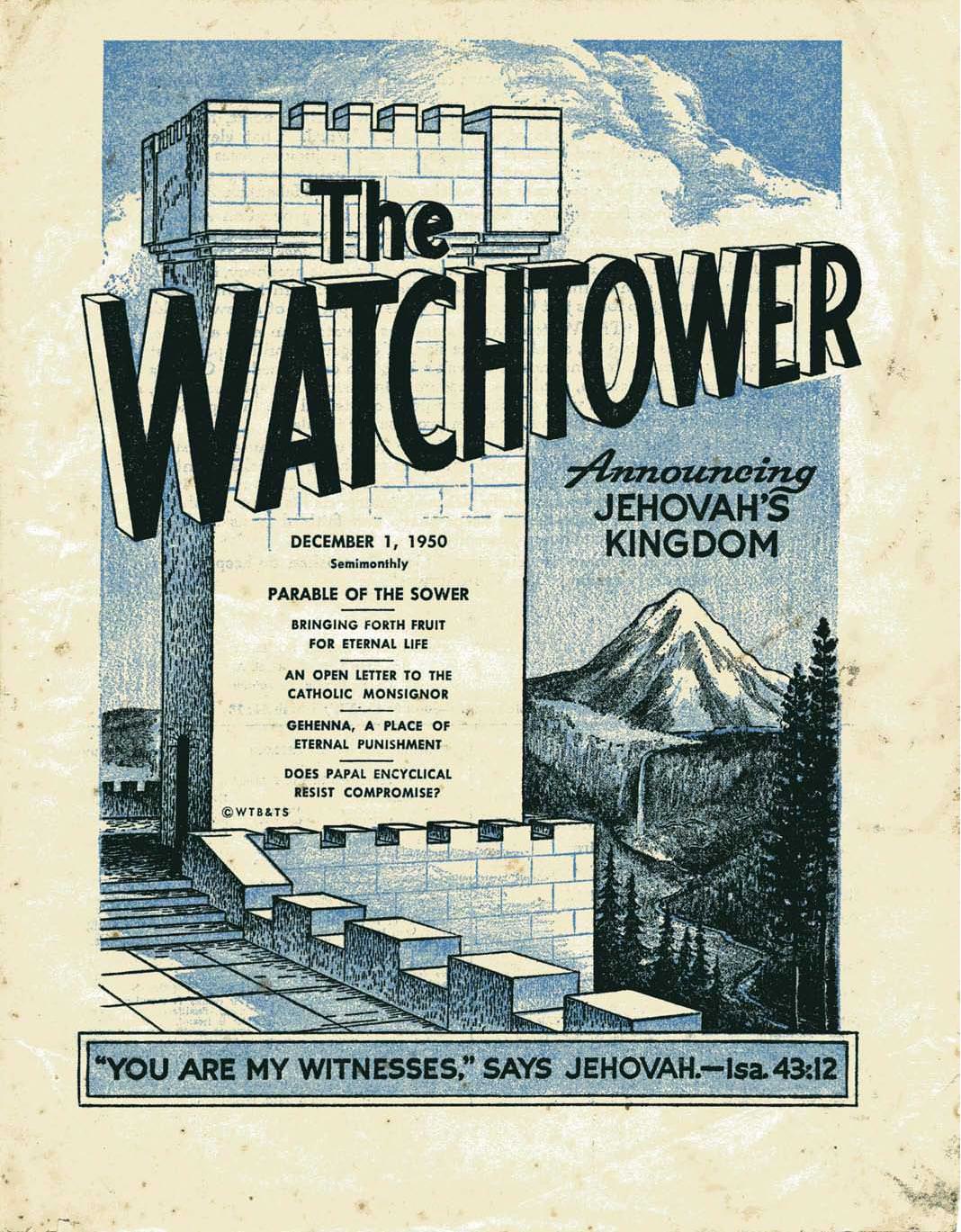
"YOU ARE MY WITNESSES," SAYS JEHOVAH.—Isa. 43:12
The WATCHTOWER
Announcing
JEHOVAH'S
KINGDOM
DECEMBER 1, 1950
Semimonthly
PARABLE OF THE SOWER
BRINGING FORTH FRUIT
FOR ETERNAL LIFE
AN OPEN LETTER TO THE
CATHOLIC MONSIGNOR
GEHENNA, A PLACE OF
ETERNAL PUNISHMENT
DOES PAPAL ENCYCLICAL
RESIST COMPROMISE?
©WTB&TS
"YOU ARE MY WITNESSES," SAYS JEHOVAH.—Isa. 43:12 THE PURPOSE OF "THE WATCHTOWER"
Literal towers in Bible times were elevated vantage points from which watchmen could observe happenings, warn of danger, or announce good news. Our magazine figuratively occupies such a vantage point, for it is founded on the very pinnacle of wisdom, God's Word. That elevates it above racial, national and political propagandas and prejudices, frees it from selfish bias. It is not bound by any traditional creed, but its message advances as the light on God's purposes and works increases.—Habakkuk 2:1-3.
It sees things Scripturally. When it observes this generation afflicted with greed, delinquency, hypocrisy, atheism, war, famine, pestilence, perplexity and fear, and persecution of unpopular minorities, it does not parrot the old fable about history repeating itself. Informed by Bible prophecy, it sees in these things the sign of the world's time of the end. But with bright hope it also sees opening up for us just beyond these woes the portals of a new world.
Thus viewed, "The Watchtower" stands as a watchman atop a tower, alert to what is going on, awake to note signs of danger, faithful to point out the way of escape. It announces Jehovah's kingdom established by Christ's enthronement in heaven, feeds his kingdom joint-heirs with spiritual food, cheers men of good will with glorious prospects of eternal life in a paradise earth, comforts us with the resurrection promise for the dead.
It is not dogmatic, but has a confident ring in its voice, because it is based on God's Word. It does not privately interpret prophecy, but calls attention to physical facts, sets them alongside prophecy, and you see for yourself how well the two match, how accurately Jehovah interprets his own prophecy. In the interests of our salvation, it keeps sharp and faithful focus on Bible truth, and views religious news generally.
'Be watchful in these perilous times,' God admonishes. So keep on the watch by regularly reading "The Watchtower".
g
PUBLISHED BY THE WATCH TOWER BIBLE & TRACT SOCIETY
117 Adams Street
Brooklyn 1, N. Y., U. S. A.
N. H. KNORR. President
GRANT SUITER, Secretary
"They will all be taught by Jehovah."—John 6:45, NW; Isaiah 54:13
CONTENTS
Does Papal Encyclical Resist Compromise? 467
An Open Letter to the Catholic Monsignor 469
Mobsters Break Up Assembly in Missouri 475
Simeon Realizes His Heart's Desire 476
Gehenna, a Place of Eternal Punishment 477
Bringing Forth Fruit for Eternal Life 480
Parable of the Sower 481
"Preach the Word" 494
Questions from Readers 495
Announcements 496
Abbreviations used in "The Watchtower" for the following Bible versions
AS - American Standard Version LXX - The Septuagint Version
AT - An American Translation Mo - James Moffatt's version
Da - J. N. Darby's version NW - New World Translation
Dy - Catholic Douay version Ro - J. B. Rotherham's version
ED - The Emphatic Diaglott RS - Revised Standard Version
Le - Isaac Leeser's version Yg - Robert Young's version
Unless otherwise indicated, the Bible used is the King James Version
Five cents a copy
Printing this issue: 1,230,000
PUBLISHED IN THE FOLLOWING LANGUAGES
<tr><th colspan="3">Semimonthly
Monthly
Afrikaans
Ilokano
Arabic
Malayalam
Twi
Cebu-Visayan
Italian
Chishona
Polish
Ukrainian
Danish
Norwegian
Cinyanja
Portuguese
Yoruba
English
Pangasinan
Clwemba
Russian
Zulu
Finnish
Spanish
Greek
Slamese
French
Swedish
Hungarian
Sikololo
German
Tagalog
Ibo
Slovak
Hollandish
Visayan
Kanarese
Slovenian
Watch Tower Society offices Yearly subscription rate
America, U.S., 117 Adams St., Brooklyn 1, N.Y. $1
Australia, 11 Beresford Rd., Strathfield, N.S.W. 6s
British West Indies, 21 Taylor St., Port of Spain, Trinidad $1.25
Canada, 40 Irwin Ave., Toronto 5, Ontario $1
England, 34 Craven Terrace, London, W. 2 5s
Jamalca, 151 King St., Kingston 5s
New Zealand, G.P.O. Box 30, Wellington, C. 1 6s
South Africa, 623 Boston House, Cape Town 5s
Remittances should be sent to office in your country in compliance with regulations to guarantee safe delivery of money. Remittances are accepted at Brooklyn from countries where no office is located, by international money order only. Subscription rates in different countries are here stated in local currency. Notice of expiration (with renewal blank) is sent at least two issues before subscription expires. Change of address when sent to our office may be expected effective within one month. Send your old as well as new address.
Entered as second-class matter at Brooklyn, N.Y., Act of March 3, 1879. Printed in U. S. A.
DOES PAPAL ENCYCLICAL RESIST COMPROMISE?
AUGUST 21 marked the release of the official English translation of Pope Pius XII's encyclical Humani Generis (Of Mankind). Its target was those Catholic churchmen who, in the interests of unity and of forming a solid religious front against atheism, would compromise on or set aside differences in dogma.
But was it the principle of compromise that the pope really objected to? In countries where she is powerful the Catholic Church declares that freedom of speech and freedom of religion are pernicious errors to be stamped out, but in democratic lands where the Church is a minority her spokesmen champion such freedoms. Is that not compromising her principles?
The Catholic Encyclopedia says, "Union with the Church is not merely one out of various means by which salvation may be obtained: it is the only means." Papal bulls and Church catechisms have said the same, and in this latest encyclical the pope lamented, "Some reduce to a meaningless formula the necessity of belonging to the true church in order to gain salvation." Yet when four Catholic teachers in Catholic schools in Boston protested that Jesuit Keleher, president of Boston College, taught heresy in saying there was salvation outside the Church, the teachers were fired. Their appeals to the Vatican were futile, for the Vatican knew that its doctrine of no salvation outside the Catholic
Church would not be popular in the United States democracy. Was not the Vatican compromising?
And is it not in an effort to compromise with science that the Catholic Church says that God may have made man's body by evolution, and then created a soul to go into that evolved body? The Catholic Encyclopedia states, "That God should have made use of natural, evolutionary, original causes in the production of man's body, is per se not improbable, and was propounded by St. Augustine." And again the pope in his recent encyclical echoes this view when he declares that studies in evolution must be limited to "inquiries into the origin of the human body as coming from pre-existent and living matter—for Catholic faith obliges us to hold that souls are immediately created by God".
In his encyclical the pope acknowledged "the word of God as contained in the sacred scripture as the foundation of all religious teaching"; yet this compromise with evolution cannot have foundation in the Scriptures. Why not? Because souls existed long before man was created. When making water animals God said, "Let the waters swarm with an abundance of living soul." Again, "God created the great sea-monsters, and every living soul that moveth." As to land animals, "God said, Let the land bring forth living soul after its kind, tame-beast and creeping thing and wild-beast."
(Gen. 1:20, 21, 24, Ro) Hence living souls were in existence before "God formed man of the dust of the ground, and breathed into his nostrils the breath of life; and man became a living soul". (Gen. 2:7) Numbers 31:28 shows that animals are souls. Ecclesiastes 3:18-20 shows the close similarity between men and beasts in death, and Ezekiel 18:4 proves that human souls die. No scripture even intimates that God implanted in man's body an immortal soul.
If the pope is concerned over compromise that contaminates the faith, why limit concern to modern trends? Why not cleanse the Catholic Church of the pagan teachings it embraced at the time of Emperor Constantine, in the fourth century? From that time forward the Church has opened its arms to such paganisms as trinity, purgatory, eternal torment, prayers for the dead, use of rosaries and images, cross worship, and many others. In defense of adopting such paganisms Cardinal Newman said the Church did "transmute the very instruments and appendages of demon-worship to an evangelical use" and added that they "are all of pagan origin, and sanctified by their adoption into the Church". (Essay on the Development of Christian Doctrine) Such hierarchy reasoning, however, collides head-on with 2 Corinthians 6:14-16: "Be ye not unequally yoked together with unbelievers: for what fellowship hath righteousness with unrighteousness? and what communion hath light with darkness? And what concord hath Christ with Belial? or what part hath he that believeth with an infidel? And what agreement hath the temple of God with idols?"
Actually, it is not so much compromise that the pope opposes. Catholic Church history reeks with many kinds of compromises. What the pope fears are the compromises of priests made independent
of the Church. He fears their drift from papal control, and that is why his encyclical repeatedly hammers home the assertion that the Church is the "teaching authority". But is the Catholic Church the "teaching authority", the "faithful and wise servant, whom his lord hath made ruler over his household, to give them meat in due season"? (Matt. 24:45) No organization that provides pagan doctrines as spiritual "meat in due season" could be, for 1 Corinthians 10:21 states: "Ye cannot be partakers of the Lord's table, and of the table of devils."
Nor can the Catholic Church pass as the teaching authority on the basis of her claim to be built on Peter. There is no proof that she is founded on him. He would not accept money for divine favors; the priests do. (Acts 8:20) He would not allow another man to kneel at his feet; the popes have men kiss theirs. (Acts 10:26) Moreover, the true church of Christ is not built on Peter, but on Christ. He is the one the Jews rejected as cornerstone for the spiritual temple, not Peter. He is the one Peter himself identified as the Chief Cornerstone, and added that other anointed Christians are living stones built up as a spiritual temple on Him. As for Peter, he claimed no infallibility, was corrected and taught by Paul, and was spoken of as only one of the twelve apostolic foundation stones.—Isa. 28:16; 1 Pet. 2:4-8; Gal. 2:11-14; 2 Pet. 3:15, 16; Rev. 21:14.
In view of all these conflicts between the Catholic Church and the Bible, we can understand this papal encyclical's lament concerning men now turning to the Bible: "It is a matter of regret that not a few of these, the more firmly they accept the word of God, so much the more do they diminish the value of human reason, and the more they exalt the authority of God and revealer, the more severely do they spurn the teaching office of the church."
Oct. 11, 1950.
To Matthew Smith,
Monsignor of the Roman Catholic
Church in America,
c/o The Register,
Catholic Press Soc., Inc.
Denver, Colo.
Before us is a copy of The Catholic Telegraph-Register, Section Two, dated Friday, August 18, 1950, containing an article signed by you. It occupies parts of three columns in the lower left-hand corner of page one and continues on page four for two full-column lengths, and is entitled: "Listening In," with the subheading, "Sect Rewrites Parts of Bible to Fit Beliefs." Also before us is a copy of the identical article by you appearing in The St. Louis Register of the same date, from which fact is to be gathered that your article was published quite generally in the 32 Diocesan editions of The Register published in as many cities. Your article therefore gained nation-wide publicity.
You open and close your article with a reference to the New World Translation of the Christian Greek Scriptures, released at Yankee Stadium, Wednesday, August 2,
the fourth day of the International Assembly of Jehovah's witnesses there. During the remaining four days of which Assembly 85,850 copies of this new translation were placed with the conventioners. We being the printers who have come into possession of the publication rights of this translation, we feel the obligation of making some answer to your article. It is hardly an exaggeration to say that the general public who read your adverse article is expecting a published reply from us, and we do not want either to disappoint these or to fail in our obligation to the Most High God and his recorded Word.
Your article appears to be based entirely on what the news reporters had to say about the speeches and releases offered at the Yankee Stadium Assembly, and not upon a personal examination of the literature that was released. For instance, your remark (17): "All this will be wholly different from the perpetual earthly happiness promised by the Witnesses. Their idea, if the newspapers are correctly quoting their leaders, is closer to a Mohammedan idea than to a Christian one."
Hearsay ("Listening In") is a very unreliable foundation on which to make such an assertion in the public press in criticism of a group of Christians, who, though a minority, have circulated their literature around the earth in more than 90 languages in excess of half a billion copies of bound books and booklets, besides hundreds of millions of free tracts and magazines.
Your article admits that in his public address of August 6 on "Can You Live Forever in Happiness on Earth?" the Watch Tower Society's president N. H. Knorr answered the question in the affirmative. Following his lecture 250,000 copies of his speech, in a 32-page booklet, were distributed free to all in attendance, numbers taking many copies each, so that what Mr. Knorr said was freely available in print.
You, with your Catholic means of obtaining information, could easily have procured a copy of this booklet. Those who heard or read this speech know that it has no resemblance to Mohammedanism but is based wholly upon the inspired Scriptures and the modern-day fulfillments of prophecy.
You say, "The idea of a perpetual reign of the saints on earth is repulsive to the majority of Christians," "Heaven will not be a glorified earth," and, "It is to be hoped, therefore, that Jehovah's Witnesses will not place all their faith in the absurdity of an earthly kingdom that will never die." (15,16,22) In none of their speeches or publications have Jehovah's witnesses taught that 'heaven will be a glorified earth'; but it is you, Monsignor, and your religious system that teach that people of your faith will take their earthly bodies to heaven.
Jehovah's witnesses, however, adhere strictly to the inspired Scriptures and believe what the apostle John says about those of the "little flock" of Christians who will go to the heavenly kingdom: "Dearly beloved, we are now the sons of God; and it hath not yet appeared what we shall be. We know, that, when he shall appear, we shall be like him: because we shall see him as he is." (1 John 3:2, Douay Version) We believe with the apostle John in a distinction between heaven and earth, and we accept his vision of the future in which he says: "And I saw a new heaven and a new earth. For the first heaven and the first earth was gone, and the sea is now no more." (Apocalypse 21:1, Douay) Certainly that new earth is to be populated with creatures of the earth, earthy, for Isaias 45:18 declares that the Lord God did not create the earth in vain: "he formed it to be inhabited."
It is useless for you to counter with the
argument that the apostle John saw only an apocalyptic vision. Not only the prophet Isaias speaks also of a new heavens and new earth (65:17; 66:22), but so does the apostle Peter. He describes the destruction of the present heavens and earth in which injustice dwells and then says: "But we look for new heavens and a new earth according to his promises, in which justice dwelleth."—2 Peter 3:13, Douay.
In harmony with the infallible Scriptures, Jehovah's witnesses teach that Christ's footstep followers who overcome this world will reign with him, not in the "new earth", but in the "new heavens"; and obedient mankind on the "new earth" will be blessed by the invisible, heavenly reign of Jesus Christ and his glorified followers, his bride. (Apocalypse 2:26-28; 3:21; 20:4-6) If this is "repulsive", it is repulsive to the majority of professed Christians who do not accept God's Word but who have been indoctrinated with religious traditions of men contrary to God's Word. (Matthew 15:1-9, Douay) Your hopes, therefore, that we will not place our faith "in the absurdity of an earthly kingdom that will never die" are ill-founded and are needless. We do not hope for such a thing, but preach "the kingdom of HEAVEN" as the rightful government for all the universe. Modern events fulfilling sacred prophecy prove that this heavenly kingdom is at hand and will remove the Devil's rule of earth; and because of this fact we can assure people of good will that they can live forever in happiness on earth under the heavenly kingdom of Christ and his glorified congregation. Then, in answer to the Lord's prayer, God's name will be hallowed and his will will forever be done on earth as it is done in heaven.
NO REWRITING OF PARTS OF THE BIBLE
Your article (2) states: "Newspaper accounts indicated that the 'translation' changed the texts to fit Witnesses' doctrines."
Then, to make it appear that Jehovah's witnesses are mutilating the Christian Greek Scriptures, you quote the New York Times' report as saying: "Rejecting the idea of the Holy Trinity, the Bible society translation replaces the phrase 'the Father, the Son and the Holy Ghost,' used frequently throughout the King James version with 'the spirit and the water and the blood' (1 John v. 7)."
First of all, the newspaper report errs in saying that the phrase "the Father, the Son and the Holy Ghost" is used frequently throughout the King James Version. It is not so used even in the Catholic Douay Version. The one place in the Scriptures where the phrase does occur, namely, at Matthew 28:19, the New World Translation renders the verse: "Go therefore and make disciples of people of all the nations, baptizing them in the name of the Father and of the Son and of the holy spirit." In a corresponding passage, namely, 2 Corinthians 13:14, this translation reads: "The undeserved kindness of the Lord Jesus Christ and the love of God and the sharing in the holy spirit be with all of you."
No parts of the Bible have been rewritten in this New World Translation to fit the beliefs of Jehovah's witnesses, as you blatantly assert. The Translation Committee did not construct its own Greek text of the Christian Scriptures. No; but on page 8 of the Foreword it notifies us that the Committee used the 1948 Macmillan Company edition of the Westcott and Hort text of 1881, besides S. C. E. Legg's editions of Matthew and Mark, and that it also took into consideration "other texts, including that prepared by D. Eberhard Nestle and that compiled by the Spanish Jesuit scholar José María Bover and that by the other Jesuit scholar A. Merk". Concerning the same Greek text mainly used by the Committee, E. J. Goodspeed says
in his Preface in "An American Translation" (1939) : "I have closely followed the Greek text of Westcott and Hort, now generally accepted. Every scholar knows its great superiority to the late and faulty Greek texts from which the early English translations from Tyndale to the Authorized Version were made."
So the New World Translation has rewritten no part of the Greek text, not even 1 John 5:7 which is cited in your article as a place where Jehovah's witnesses clash with the trinitarian doctrine. Does the New World Translation here replace the phrase "the Father, the Son and the Holy Ghost" with the phrase "the spirit and the water and the blood"? No! How could the latter phrase be used as a replacement when it is already there in the Greek text? But it is the former phrase that is not there.
The New World Translation of 1 John 5:7,8 reads: "For there are three witness bearers, the spirit and the water and the blood, and the three are in agreement [margin: are for the one thing]." This is a literal translation of the Greek text by the above-named Augustinus Merk, S.J., in his Novum Testamentum Graece et Latine; it is also a literal translation of the Greek text by the other Roman Catholic scholar, Joseph M. Bover, S.J., in his Novi Testamenti Biblia Graeca et Latina; as well as of Nestle's Novum Testamentum Graece and of the Westcott and Hort Greek text. So you see that even those Jesuit scholars do not include in their Greek texts the words, "in heaven, the Father, the Word, and the Holy Ghost. And these three are one. And there are three that give testimony on earth." (Douay) Those words are now recognized by all genuine scholars as spurious to the authentic Greek text. Your own precious Vatican Manuscript No. 1209 of the early 4th century does not contain the words, but brands them spurious.
The French Catholic Bible by Canon A. Crampon puts those words in brackets and says in the footnote: "The words put in brackets are not found in any Greek manuscript prior to the 15th century, nor in any manuscript of the Vulgate prior to the 8th." The Catholic German translation by P. Johann Perk of 1947 puts the words in parentheses and explains in a footnote. It is true that the Jesuit scholars Merk and Bover show the words in their parallel Latin text, but, please, note this: Bover and Cantera do not include the words in their Spanish translation of 1947. Also, the words do not appear in the Latin text of the Novum Testamentum Latine by J. Wordsworth and H. J. White of 1911, and which is rendered according to St. Jerome's edition. Their footnote says they print the Latin text without the disputed words, in harmony with the Latin manuscripts Amiatinus, Armachanus, Fuldensis, Sangermanensis, and the original Vallicellanus, these manuscripts being of the 6th to the 9th centuries. The footnote adds that the words appear in the Latin manuscripts Cavensis, the revised Vallicellanus, of the 9th century, and the Sixtine and Clementine editions of the Vulgate of the 16th century.
Please note other Roman Catholic translations that omit the words: The Spanish translation of 1948 by Nacar and Colunga; the French translation by Canon E. Osty, of 1949, and the French Catholic Bible of 1949 by the Monks of Maredsous; and the Westminster Version of the Sacred Scriptures by Rev. Cuthbert Lattey, S.J., of 1948. These read like the 1950 New World Translation.
Thus on the main text that is cited for charging Jehovah's witnesses with rewriting parts of the Bible to fit their beliefs you are proved false. The New World Translation stands vindicated, and it will
remain so against any future attacks from any quarter.
THE DIVINE NAME
The last four paragraphs of your article are grouped under the heading "Jehovah Not Correct as God's Name". Here you open by saying: "Something of the shallow scholarship in the sect in adopting the word Jehovah as part of its title is shown by the Catholic Biblical Encyclopedia's treatment of this word: . . .." And your closing paragraph says: "We fear that all the other scholarship of the Witnesses, including what they have done in their translation of the New Testament, is on the same basis as their use of the word Jehovah."
Thank you for this opportunity to present some facts to you and to the public. We do not say that "Jehovah" is the correct pronunciation of God's name. For that matter, neither is "Jesus" the correct pronunciation of Christ's name. But according to the Aramaic language which Christ and his apostles spoke, his name was pronounced "Yeshu'a" (the a representing a gutteral ending). But "Jesus" is only our colloquial way of pronouncing his name, and we do not find fault with you for using it instead of Yeshu'a. However, if you call it shallow scholarship for the Committee to use the word Jehovah in the New World Translation, then you will have to admit that it is due to the shallow scholarship of the Roman Catholic clergy of the thirteenth century, for in that century the word historically appears among them.
Your quotation from the Catholic Biblical Encyclopedia says Jehovah was the incorrect pronunciation given to the Hebrew tetragrammaton JHVH in the 14th century by Porchetus de Salvaticis (1303). But let us say: The origin of the word Jehovah used to be attributed to Petrus Galatinus, a Franciscan friar, the confessor of Pope Leo X, in his De Arcanis Catholicae Veritatis, published in 1518.
But the latest scholarship has proved he was not the one to introduce the pronunciation Jehovah, and neither was your aforementioned Porchetus de Salvaticis. As shown by Joseph Voisin, the learned editor of the Pugio Fidei (The Poniard of Faith) by Raymundus Martini, Jehovah had been used long before Galatinus. Even a generation before Porchetus de Salvaticis wrote his Victoria contra Judaeos (1303), the Spanish Dominican friar Raymundus Martini wrote his Pugio, about 1278, and used the name Jehovah. In fact, Porchetus took the contents of his Victoria largely from Martini's Pugio. And Scaliger proves that Galatinus took his De Arcanis bodily from Martini's Pugio. Galatinus did not introduce the pronunciation Jehovah, but merely defended it against those who pronounced the Hebrew tetragrammaton Jova.
In 1557 Jehovah became established in John Forster's New Hebrew Dictionary, and Marcus Marinus admitted Jehova in his Lexicon Arca Noae of 1593. Sebastian Muenster uses the name Jehova in his text of his Latin translation of the Hebrew Scriptures (1534), and in his notes on Exodus 3:15 and 6:3 he uses the name as though it were well known. Also in 1557, in bringing out Pagninus' Latin version of the Hebrew Scriptures, Robert Stephanus used Jehova uniformly for the Hebrew tetragrammaton. In a note on Psalm 2:1 he remarked that substituting Adonai for it was to be rejected as a Jewish superstition.
Cardinal Thomas de Vio Cajetanus in his Commentary on the Pentateuch, of 1531, regularly used Jehova. In his translation of Genesis 2:4 he has "Jehova Elohim"; and in his note on Exodus 6:3 he says: "Jehovah the God of your fathers appeared to me (Iehova Elohe patrum vestrorum visus est mihi)." To be consistent, you should call that "shallow scholarship" on the part of your cardinal, what?
But that such "shallow scholarship" is not limited to Roman Catholic clergy of the 13th to the 16th centuries, please be apprised that in an edition of the French Catholic Bible by Abbé A. Crampon of 1905 he used Jehovah in his text; this has since been amended to read "Yahweh" according to our copy of the 1939 edition. But note also the following.
You are also doubtless acquainted with the magazine The Grail, published in St. Meinrad, Indiana. Well, in the February, 1949, issue of this magazine appeared the article "Jona, God's Problem Prophet" by Philip Dan Stack. In it we read: "Now the word of Jehovah came unto Jona the son of Amittay [Footnote: 'All quotations from Sacred Scripture in this essay are from The Westminster Version of the Sacred Scripture, edited by The Rev. Cuthbert Lattey, S.J.; this accounts for the unusual spelling of certain proper names.'], saying, 'Arise, go to Nineveh, that great city, and denounce it; for their wickedness is come up before me.' (Jona 1:1-2) . . . A fine chance he, an insignificant prophet from Gath-hefer, would stand in forcing penance upon the fabulous Ninevites, who did not even know his own God's name." From page 54 to page 58 the name Jehovah is used 30 times, twice being spelled Jahve, and the version from which it is quoting is, mind you, the Westminster Version by a Jesuit Reverend! Was that not quite "shallow scholarship" to set before Catholic readers? Does it not make you blush to be confronted with such "shallow scholarship" on the part of Roman Catholic publications and authors in this twentieth century?
The pronunciation Jahweh, usually credited to John L. Ewald of the 18th century, goes back farther, to the 16th century. Ten years before Ewald was born (1747), Jahveh was found in Eichhorn's Simonis, the Lexicon in most general use in Germany.
F. H. Gesenius adopted the pronunciation Jahveh when Ewald was still defending Jehovah.
Why, then, does the New World Translation use the name Jehovah 237 times in its main text? Is it due to "shallow scholarship", as you insinuate? No. In the Foreword, from page 10 to page 25, the Translation Committee explains its basis for using this name so many times. In addition to the 19 Hebrew versions, it cites versions of the "New Testament" in 38 languages besides English and Hebrew where the translators use a vernacular form of the Hebrew tetragrammaton. But in its 2nd last paragraph the Translation Committee says: "While inclining to view the pronunciation 'Yah-weh' as the more correct way, we have retained the form 'Jehovah' because of people's familiarity with it since the 14th century. Moreover, it preserves, equally with other forms, the four letters of the tetragrammaton JHVH." And in its footnote a of page 36, on Matthew 1:20 where "Jehovah's angel" appears, it says: "Jehovah's, or, Yahweh's."
At the Yankee Stadium, when giving his speech introducing the New World Translation, the Society's president said: "But, while recognizing the merits of the pronunciation 'Yah.weh', the translation committee has used the form 'Jehovah' because of its familiarity and because it preserves the four original letters of the Hebrew name. In God's own time when He reveals the correct pronunciation of his holy name, we will gladly make the accurate correction."—See The Watchtower, September 15, 1950, page 317 \| 14.
The true scholarship behind the New World Translation will make itself known, not by the disclosure of the names of the translating committee, but by the faithfulness of the translation to the Greek text and by the reliable help it gives toward understanding God's written revelation to men. We are not troubled, therefore, by your thrust: "Albeit the identity of the translators is being withheld at their own request—they are not likely to make much impression on either Catholic or Protestant scholars. It is no wonder that the translators wish to remain unknown." (7)
Not praise from the scholarship of this fading world, but the true service of God and the education of the people in his Word, is what we are after. The honesty, courage and firm foundations of this translation will commend it to honest seeking hearts. Already the fact that the universally known Watch Tower Bible & Tract Society publishes this New World Translation has been more of a recommendation to lovers of God's Word than the mere scholarship of Christendom.
We are releasing this letter for publication in The Register, in fair play, as our answer to your article. Regardless of whether any of the affiliates of The Register publish this answer in whole or not, the Watchtower magazine will gladly publish it and thus it will reach its way to the public to whom it is due.
Sincerely,
WATCH TOWER BIBLE AND TRACT SOCIETY
Happy are you when people reproach you and persecute you and lyingly say every kind of wicked thing against you for my sake. Rejoice and leap for joy, since your reward is great in the heavens; for in that way they persecuted the prophets prior to you. Matt. 5:11, 12, NW. Mobsters Break Up Assembly in Missouri
EHOVAH'S witnesses arrange for a threeday circuit assembly of Christian people, September 1-3, in Kennett, Mo. This is a little town of six or seven thousand located in the southeastern corner of the state. The Blue Room above the Palace Cafe is obtained, preliminary preparations are completed, and the Friday evening session is peaceably held.
Early the next morning the witnesses are on the streets extending to the good citizens of the community knowledge and information which will enable them to chose the way of life that leads to God's glorious kingdom, the new world of righteousness long ago promised. In fact, the public lecture scheduled to be given the next afternoon, and to which the people are invited, is entitled "Choose Life that You May Live".
At first a few sneering voices are heard, then threats of violence are hurled, and finally, by late afternoon the whole atmosphere is filled with the nasty storm clouds of mob violence. A bully by the name of Coy Bannister goes from one barroom to the next tanking up on alcohol, and at the same time tries to get a mob organized. He is joined by a couple of other rogues, Paul Patton and "Buck" Estes, and the three form the nucleus of a mob that swells until it numbers 100 or 150. They mill around the streets, rip placards from the backs of helpless witnesses, pounce on lone witnesses, beating up those they are able to overpower.
Meantime, the mayor of the town, apparently an honest and upright man, does everything in his power to avoid bloodshed. But how helpless he is! There are only six men on his police force. He calls the governor of the state. He calls the state police. It is now late afternoon when he and the sheriff, the prosecuting attorney, the owner of the hall, and several others come to see the besieged witnesses at the hall and lay plans for their deliverance. It being impossible to hold any kind of public lecture the next day in this mob-infested town, it is agreed by all that evacuation must be made Saturday night. "While you're in session," the mayor says,
"we will make all arrangements for your removal."
Around six o'clock the evening program gets under way, while the limited police force guards the two entrances. Kingdom songs are sung, Jehovah's direction is asked and the entire meeting is put in his hands. Field experiences are related, and, needless to say, there are many interesting ones. The crowd outside cannot understand how the witnesses can remain so cool, and many of them will long remember the beautiful songs that are sung to Jehovah's praise. Even the state police, the mayor and other officials marvel at the coolness of these Christians in the face of so much opposition. During the meeting an attempt is made to cut the light wires, and at one time the mob charges the back door trying to force entrance. The state police stationed there draws his gun and holds them off.
It is now about 9 p.m., the meeting is over and the National Guard is prepared to evacuate the witnesses. Martial law is declared. The crowd outside, now numbering upward of 2,000, is ordered to the opposite side of the street. The iron door to the hall is opened and down come the witnesses. Steel-helmeted guardsmen with fixed bayonets now patrol the sidewalks maintaining law and order. Truly it is a strange sight, for one now sees among the guardsmen some of those who only a short time ago were among the mobsters. Ordered into uniforms they are now forced to act as protectors of the very Christian men and women they sought to destroy. It reminds one of how Jehovah turned the tables on wicked Haman.—Esther 6:4-13.
And as in that ancient case, so here in Kennett, many people are very much opposed to this violent outbreak of devilish mob spirit. The "sheep" are thus divided from the "goats". (Matt. 25:31-46) In conclusion this eyewitness account, as related by the circuit and district servants, tells how the broken-up assembly was moved a hundred miles away to Cape Girardeau for the final day's sessions. There, eleven were baptized and about 200 attended the public lecture.
Simeon Realizes His Heart's Desire
IN EDEN God foretold the coming of the One who would bruise the serpent's head. Later, to Abraham, God identified that One as he who was to bless all the families of the earth. Under inspiration Abraham's grandson, Jacob, when on his deathbed, foretold the coming of that One, Shiloh, to whom the people would gather. Moses prophesied of the coming of that One, and that he would be a prophet greater than Moses. David, king and poet, sang of the glories of His kingdom. Isaiah foretold that he would be born of a virgin, and Micah recorded that that One would be born in Bethlehem. Such are but a few of the many prophecies that pointed forward to the One who by common consent of the Jews was referred to as the Messiah, the Son of David.
These prophecies were now hundreds of years, yes, one of them even four thousand years old. The Israelites had seen a seventy year captivity in Babylon coupled with the complete desolation of their beloved homeland and since then they had experienced five hundred more years of subjection to Gentile rulers. Still no Messiah! still no Son of David! How the faithful, God-fearing Jews yearned and prayed for his coming—he that was to restore Israel, free it from the galling Gentile yoke; the One who was to bless all the families of the earth.
Among such righteous and reverent Jews who longed and prayed for the Messiah's coming was a faithful old servant of Jehovah by the name of Simeon who lived in Jerusalem. God had placed on him his holy spirit and rewarded him with the revelation that he would not see death until he had laid eyes on the one who was to be the Christ of Jehovah. Days, months, years were fleeing by, Simeon was aging, he had not much longer to live. When would he see this one?
Then one day, toward the end of 2 B.C., a young couple with a baby came to the temple from Bethlehem in Judea. The holy spirit revealed to him that this was the day he was waiting for and moved him to go to the temple, and there he would see the one of whom all the prophets had written. Hurrying there as quickly as his aged frame will permit him,
he sees Joseph, Mary and the child. With what joy Simeon takes the child Jesus in his arms! This was the One who would be the promised Messiah, the Son of David! Though himself too old to hope to see this One fulfill his earthly mission, yet even to see him as a babe, to realize that salvation for Israel was that near, that God had again remembered and visited his people, that all that had been written regarding him by the prophets was now at long last beginning to have fulfillment —what ecstasy all this must have brought to the aged Simeon! Now he was content to sleep in death until the latter end, until God would call him forth in the resurrection. Lifting his voice in praise to God we hear him say: "Now, Sovereign Lord, you are letting your slave go free in peace according to your declaration; because my eyes have seen your means of saving that you have made ready in the sight of all the peoples, a light for removing the veil from the nations and a glory of your people Israel."—Luke 2:27-33, NW.
See now how his face lights up as he blesses Joseph, the foster father, and Mary, the mother of Jesus! Then his face suddenly becomes serious, as, directing his remarks to Mary alone, he adds: "Look! this one is laid for the fall and the rising again of many in Israel and for a sign to be talked against (yes, a long sword will be run through the soul of you yourself), in order that the reasonings of many hearts may be uncovered." Luke 2:34, 35, NW.
Under the influence of the holy spirit Simcon here was applying a number of prophecies to Jesus. See Isaiah 52:10; 40:5; 42:6; 49:6; 8:14,18. The Christian Scriptures and the physical facts have since borne out that the Messiah, Christ Jesus, is indeed the light of the nations, the One to remove the veil of darkness from the faces of men and the One that brings them salvation.
We have good reason to believe that before long Simeon himself will share in the blessings that he foretold that Christ Jesus would bring to the peoples. (Rev. 11:17,18) With what joy he will enter on his privileges in the new world under Jehovah's king, the Son of David!
GEHENNA
Eternal Punishment
OUTSIDE of the small number of serious students of the Bible there are very few people who know what Gehenna really is. The vast majority of people are totally ignorant on a subject they should be very much concerned about. This is a pity, because, for the most part, they are not responsible for their ignorance. Hundreds of
years ago creed-bound men mistranslated into the many Bible versions certain Greek words. This is one reason for the general misunderstanding on the subject of what the eternal punishment of the wicked is. Another reason is the fact that the clergymen of Christendom, although many of them know the truth of the matter, have done very little to inform the people concerning Gehenna's true nature.
However, in his old age, when Solomon's heart was turned away from serving the
To the west and south, and immediately outside the ancient city of Jerusalem, was a valley first known in Hebrew as gey ben [b'ne] hinnom, "the valley of the son [or, sons] of Hinnom." Later it was just called gey hinnom, "valley of Hinnom," or in the Greek tongue, Gehenna. It was a rather deep and narrow gorge, with steep rocky slopes, situated not far from the great temple and palace of Solomon. One portion of this valley was later called Topheth, and it was here, some believe, that a music grove was located where Solomon's royal singers and musicians gathered to fill the valley with songs of praise to Jehovah. Josh. 15:8; 2 Ki. 23:10; Jer. 19:2, 6.
only true God, he built abominable altars in this ravine to the pagan gods and goddess of Molech, Baal, Chemosh and Ashtoreth. (1 Ki. 11:5-7) It is said that a monstrous idol of brass was here erected which was heated from within, and into whose red-hot arms the idol worshipers cast alive their sons and daughters. As a consequence, this valley that once resounded with Jehovah's praise was filled with the
screams of little children who were offered up as sacrifices to the fire-god Molech. 2 Chron. 28:3; 33:6.
In due time, faithful King Josiah stamped out this fiendishness, and in order that the practice might not spring up again he polluted the valley by defiling it with dead men's bones. (2 Ki. 23:10,14; 2 Chron. 34:4,5) From that time on Gehenna became the common cesspool for the city's sewage, a place where all of Jerusalem's garbage and filth were dumped. Here the bodies of dead animals and executed criminals were thrown. It was the city's incinerator, and to keep the fires burning sulphur or brimstone was added. The sides of the cliffs were jagged and some of the refuse thrown over clung to the rocks, and as putrefaction set in worms or maggots consumed the fleshy parts rather than the sulphurous fires below. To the Jewish mind Gehenna became a vivid symbol of destruction and an abomination, an abhorrence to the eye, and a stench to the nostrils.
What a fitting example and illustration Gehenna was for Jeremiah to use! When that prophet of God pointed to that defiled place as an example of what Jehovah purposed to do to that rebellious nation they got the point.
They knew that Almighty God purposed to destroy them as completely as anything thrown into the literal Gehenna was annihilated. "Thus will I do unto this place, saith Jehovah, and to the inhabitants thereof, even making this city as Topheth: and the houses of Jerusalem, and the houses of the kings of Judah, which are defiled, shall be as the place of Topheth." "Therefore, behold, the days come, saith Jehovah, that it shall no more be called Topheth, nor The valley of the son of Hinnom, but The valley of Slaughter."—Jer. 19:12, 13; 7:32, 33, AS.
And so it was when Jerusalem was finally destroyed A.D. 70. According to the Jewish historian, Josephus, between 2,000,- 000 and 3,000,000 inhabitants died of famine or disease or were killed by the Romans, and it appears that many of their dead bodies were thrown into Gehenna after that terrible struggle.
Now then, in view of what Gehenna was, literally and symbolically, what better illustration or symbol could the Great Prophet, Christ Jesus, use when telling Jews what was in store for the wilfully wicked? When he said certain ones were liable to wind up in Gehenna, his listeners two millenniums ago knew exactly what he was talking about. They knew that if the sulphurous fires did not consume their dead bodies, the ever-present maggots would. In either event, they knew full well that to be cast into Gehenna meant they were criminals unworthy of either a burial or a resurrection, only annihilation.
But some may ask: 'When or where did Jesus speak of Gehenna? In our Catholic Douay and Protestant King James Bibles we do not find the word Gehenna.' Quite true. This is the point made earlier, that those men who translated the Bible from the original Hebrew and Greek and from
the Latin Vulgate into English in the early seventeenth century were so mentally bound up and constrained by manmade creeds of "eternal torment" and "hell fire" they were not free to make even an honest translation. Consequently, at the twelve places in the Christian Greek Scriptures, commonly called the "New Testament", where the name Gehenna occurs, they translated it "hell", which English word they also used to translate the Hebrew word Sheol and the Greek words Hades and Tartaros.
All modern translators of any repute, both Catholic and Protestant, have been forced to make note of and apologize for the gross blunder in the following texts: Matthew 5:22, 29, 30; 10:28; 18:9; 23:15, 33; Mark 9:43, 45, 47; Luke 12:5; James 3:6. The English Revised, American Standard, Revised Standard, Catholic Confraternity, Spencer's (Catholic), Young's, Rotherham's, Weymouth's, Moffatt's, Emphatic Diaglott, the New World Translation, and many other modern versions, either correct the error in the text or make note of it in their footnotes.
NO TORMENT IN GEHENNA
'What is that? No eternal torment in the never-dying fires of Gehenna?' That is correct even though contrary to popular opinion. The general idea held by organized religionists is that Gehenna is just another name for the fantastic ecclesiastical firepool so fanatically taught by the clergy. Simply carrying over the Greek word Gehenna into English Bibles means nothing if the clergy continue to deceive the people into believing that Gehenna is a place of eternal torment. As the Encyclopedia Americana (1942 ed., v.14, p.81) observes: "Much confusion and misunderstanding has been caused through the early translators of the Bible persistently rendering the Hebrew Sheol and the Greek Hades and Gehenna by the word hell.
The simple transliteration of these words by the translators of the revised editions of the Bible has not sufficed to appreciably clear up this confusion and misconception."
There is a vast distinction between eternal torment and eternal destruction. Gehenna symbolizes the latter, a place of everlasting destruction. There was no thought of torment in the ancient Gehenna outside the walls of Jerusalem, for nothing alive was cast therein. To be tormented it would have to be alive! Hence, Gehenna cannot possibly symbolize torment or torture, either temporary or eternal.
On this point, it is well to consider what modern translators have to say. The footnote of Matthew 5:22, in the Catholic Confraternity translation of 1941, does not say that criminals were cast alive into Gehenna to be tortured in its fire and brimstone, but rather it was the place "where the bodies of criminals were burnt after execution of sentence". Commenting on this same text, the Roman Catholic Dr. F. A. Spencer, in his translation of 1937, says that when King Josiah desecrated the valley of Gehenna "the Jews thereafter used it as a dumping place for all kinds of refuse and the bodies of dead animals and criminals. To prevent infection, fires were kept always burning there; and the place became a type of the state of punishment of the lost". You see, there were fires in the literal Gehenna all right, but they were not used to torture even the worst criminals, criminals whose dead bodies were thrown there because they were considered unworthy of a resurrection.
After giving a brief history of the place, the appendix, page 891, of Benjamin Wilson's Emphatic Diaglott (1864), declares: "Gehenna, then, as occurring in the New Testament, symbolizes death and utter destruction, but in no place signifies a place
of eternal torment." To which can be added the following significant paragraph found in the appendix, page 767, of the New World Translation of the Christian Greek Scriptures (1950): "No living animals or human creatures were pitched into Gehenna to be burned alive or tormented. Hence the place could never symbolize an invisible region where human souls are tormented in literal fire and attacked by undying immortal worms for ever and ever. (Isa. 66:24) Because the dead criminals cast here were denied a decent burial in a memorial tomb, which symbolizes the hope of a resurrection, Gehenna was used by Jesus and his disciples to symbolize everlasting destruction, annihilation from God's universe, or 'second death', an eternal punishment. Hence to be sentenced to have one's dead body cast into Gehenna was considered the worst kind of punishment. From the literal Gehenna and from its significance the symbol of the 'lake burning with fire and sulphur' was drawn, at Revelation 19:20; 20:10, 14, 15; 21:8."
"Fire" is a symbol of utter destruction. Consequently, Revelation says in symbolic language that those who do not get life are hurled into the fiery lake which is the "second death". Likewise Jude 7 says that Sodom and Gomorrah are punished with "eternal fire". This is not literal fire, for those cities are now under water on the bottom of the Red sea. Jesus says in the parable that the "sheep" receive everlasting life, but the "goats" the opposite, "everlasting cutting-off" in destruction. (Matt. 25:46, NW; ED) The narration of the rich man and Lazarus at Luke 16:19-31 is just a parable, hence not literal. There is not one scripture that supports "eternal torment" or "everlasting torment" when correctly understood. What the Devil and his followers justly receive is everlasting cutting-off from life in annihilation.
Bringing Forth Fruit for Eternal Life
As for the one sown upon the right kind of soil, this is the one hearing the word and getting the sense of it, who really does bear fruit and produces, this one a hundredfold, that one sixty, the other thirty."—Matt. 13:23, NW.
EHOVAH takes pleasure in fruitfulness, especially where it results in everlasting life. Where there is fruit there is life, and what bears good fruit deserves to live. Every farmer feels joy and satisfaction in the productiveness of land under his cultivation. Not less true is this of the greatest farmer of them all, and he is Jehovah God. It was on the third day of creation that this great Cultivator of all the earth issued the fiat: "Let the earth put forth grass, herbs yielding seed, and fruit-trees bearing fruit after their kind, wherein is the seed thereof, upon the earth." You see, he had not created this earth to be a waste. Days later, before he made man and woman, "Jehovah God planted a garden eastward, in Eden; and there he put the man whom he had formed. And out of the ground made Jehovah God to grow every tree that is pleasant to the sight, and good for food; the tree of life also in the midst of the garden, and the tree of the knowledge of good and evil." (Gen. 1:11; 2:8,9,AS) To this perfect man the great Cultivator let out the earth for him and his future family to till it and look after it, extending the garden of Eden all around the globe to make it a paradise of pleasure. The great Cultivator will yet realize this paradise purpose of his, that obedient mankind may enjoy eternal life in a happy home. Their eating of the perfect fruits of this earthly paradise will sustain their lives forevermore.
2 The adversary of God and of man sowed the seeds of doubt and distrust in the heart of the woman in Eden. They took root in her and brought forth fruit in the form of disregard of her husband's headship and disobedience to God. Through the
woman the adversary sowed in her husband's heart the seeds of love of wife more than the love of Jehovah God, which was, in effect, a love more of himself than of God. Such seeds of selfishness rooted themselves in his heart and brought forth under his wife's cultivation fruit in the form of willful violation of Jehovah's law against eating the forbidden fruit. The fruiting thus brought forth by Adam and Eve met with God's disapproval, for it showed obedience to the will of the adversary, Satan the Devil, rather than God's will. And so it was a fruiting that led to death and destruction, and not to everlasting life in the paradise of pleasure. God sentenced the disobedient pair to death and drove them from the garden of Eden, out of reach of the "tree of life", that they might not "eat, and live for ever". (Gen. 3:1-24) When pronouncing sentence upon the adversary who, like a serpent, had schemed to lead mankind into disobedience, Jehovah God declared his purpose to set up a new government for the vindication of Him as the universe's Sovereign whom all mankind ought to obey. He declared his purpose to bring this government forth from the womb of his heavenly universal organization and to have it break up the works of the Serpent.—1 John 3:8, NW.
3 The heavenly universal organization loved God. Hence she had no love for the Serpent. So, too, the new government to which God's womanlike organization would give birth was certain to love God and hate the Serpent. God determined to test and prove the loyalty of this government by letting the Serpent wound the heel of its chief member, its King, the Seed of God's woman.
Then by this proved loyal government God purposed to destroy utterly the Serpent and all the wicked offspring which the Serpent would bring forth. In this way God purposed to bring back all the earth and its inhabitants under the universal sovereignty of God and to restore paradise and make it earth-wide. All this is included in his cryptic words to the Serpent, Satan the Devil: "I will put enmity between thee and the woman, and between thy seed and her seed; he shall bruise thy head, and thou shalt wound his heel." (Gen. 3:15, Le) Four thousand years later God's Son from heaven, Jesus Christ, suffered the heel wound and was raised from the dead and returned to heaven to become King. Then his apostle Paul wrote to the King's faithful followers: "For his part, the God who gives peace will crush Satan under your feet shortly." (Rom. 16:20, NW) The time is very short now till Satan and his seed are crushed and paradise is afterward restored on earth.
1 When suffering the wounding of his heel by dying on the torture take at Calvary Jesus Christ gave promise of the restoring of paradise to earth. The evildoer hanging alongside him had just said sympathetically: "Jesus, remember me when you get into your kingdom." Jesus showed
the resurrection hope which was set before this evildoer and all mankind in their graves by saying to him: "Truly I tell you today, You will be with me in Paradise." (Luke 23:42, 43, NW; Ro) This evildoer had not been a follower of Jesus Christ and so could hope only for paradise as the place for him to gain everlasting life. However, during the three and a half years of Jesus' teaching campaign among the Jews he had invited believers to become his footstep followers, forsaking this world. He held before them no earthly paradise hope, but a heavenly hope. He told them of his returning to heaven to receive the kingship in the government of a new world, and he invited them to prove themselves worthy to share with him in his heavenly kingdom. To this end he told them many parables or illustrations and explained the meaning of these to them. Among other requirements, they must be fruitful to the praise of God and his kingdom. Fruit of this kind results in eternal life for the fruitbearer, whereas the fruit that Eve and Adam brought forth in Eden resulted in death for us all. To illustrate this, Jesus, in the second year of his public lecture campaign, gave his parable of the sower of seed. Life seekers will be interested in studying it in the article that next follows.
Parable of the
THE parable of the sower is found in the gospel accounts of the disciples Matthew, Mark and Luke. Matthew's history of Jesus Christ introduces it this way: "On that day Jesus, having left the house, was sitting by the sea; and great crowds gathered to him, so
that he went aboard a boat and sat down, and all the crowd was standing on the beach. Then he told them many things by illustrations, saying: 'Look! a sower went out to sow; and as he was sowing, some seeds fell alongside the road, and the birds came and ate them up.
Others fell upon the rocky places where they did not have much soil, and at once they sprang up because of not having depth of soil. But when the sun rose they were scorched, and because of not having root they withered. Others, too, fell among the thorns, and the thorns came up and choked them. Still others fell upon soil that was right and they began to yield fruit, this one a hundredfold, that one sixty, the other thirty. Let him that has ears listen.' "Matt. 13:1-9, NW.
2 In Jesus' home country the sowing season commences in October. About the first of that month Jesus was born in Bethlehem and was baptized thirty years later in the Jordan river. The latter half of October the winter rains begin, but they are not so continuous as to prevent farmers from sowing seed for next year's crop. The sowing season continues during this rainy period until the end of February. Before the beginning of January the wheat was planted, and after the first of January the barley was planted. But the barley ripened first, by passovertime. The wheat was harvested after the feast of weeks, or Pentecost, some fifty days later. The sower of those days held the basketful of seed with his left hand. With his right he scattered the seed, "drawing it out" or scattering it along the furrows of his plowed land. (Ps. 126:5, 6; Amos 9:13, margin) The illustration of the sower was given by Jesus, not to illustrate the general Christian harvest at the world's "time of the end", but the fruitfulness of his faithful followers and the unfruitfulness of others who come in touch with the Kingdom news during the so-called "Christian era". The fruitful class gains life in the new world; the unfruitful class fails to do so. Why, we shall see.
The fulfillment of the parable had its beginning with Jesus Christ, who earned the title "the Son of man". As stated in his explanation of another parable, "the sower of the right kind of seed is the Son of man." (Matt. 13:37, NW) He is the one to whom the great Cultivator, Jehovah God, entrusts the seed to be sown. The seed is a message: "the sower sows the word." It is no message of human origin, but is one of heavenly origin and which men on earth were inspired to give. "The seed is the word of God." (Mark 4:14, 15 and Luke 8:11, NW) It is particularly the message of God's kingdom exercised through Christ. This message shows the opportunity for his followers to gain a place in the Kingdom with him by their complete faithfulness to God. This is indicated by Jesus' expression, "Where anyone hears the word of the kingdom."—Matt. 13:19, NW.
It is true that John the Baptist proclaimed, "Repent, for the kingdom of the heavens has drawn near," but his proclamation did not reveal the sacred secret that the followers of God's anointed King would have the opportunity to enter into the kingdom of the heavens with him to rule as kings. Jesus, and not John the Baptist, was the one who uncovered the secret: "Unless anyone is born again, he cannot see the kingdom of God. . . . Unless anyone is born from water and spirit, he cannot enter into the kingdom of God." (John 3:3,5,NW) So Jesus is primarily the sower, and God gave him the seed of the Word of the Kingdom to sow. But Jesus takes his faithful followers into the sowing work with him, and through him they receive the Word of the Kingdom to scatter. That is why the apostle says to them: "Now he that abundantly supplies seed to the sower and bread for eating will supply and multiply the seed for you to sow and will increase the products of your righteousness."
…