The Watchtower, January 15, 1951
Download: PDF — The Watchtower, January 15, 1951
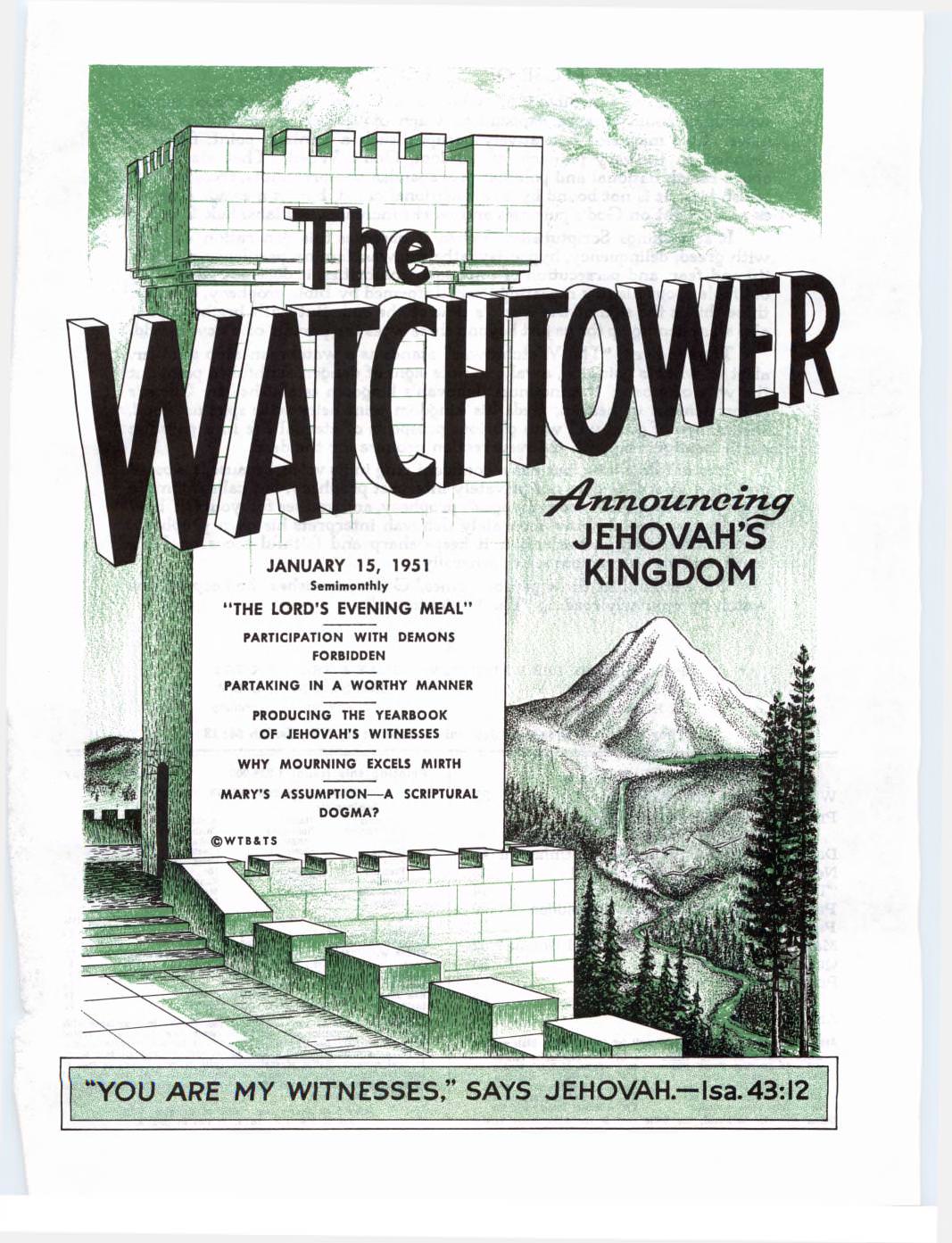
WATCHTOWER
JANUARY 15, 1951
Semimonthly
"THE LORD'S EVENING MEAL"
PARTICIPATION WITH DEMONS
FORBIDDEN
PARTAKING IN A WORTHY MANNER
PRODUCING THE YEARBOOK
OF JEHOVAH'S WITNESSES
WHY MOURNING EXCELS MIRTH
MARY'S ASSUMPTION—A SCRIPTURAL
DOGMA?
Announcing JEHOVAH'S KINGDOM
WTB&TS
"YOU ARE MY WITNESSES," SAYS JEHOVAH.—Isa. 43:12 THE PURPOSE OF "THE WATCHTOWER"
Literal towers in Bible times were elevated vantage points from which watchmen could observe happenings, warn of danger, or announce good news. Our magazine figuratively occupies such a vantage point, for it is founded on the very pinnacle of wisdom, God's Word. That elevates it above racial, national and political propagandas and prejudices, frees it from selfish bias. It is not bound by any traditional creed, but its message advances as the light on God's purposes and works increases.—Habakkuk 2:1-3.
It sees things Scripturally. When it observes this generation afflicted with greed, delinquency, hypocrisy, atheism, war, famine, pestilence, perplexity and fear, and persecution of unpopular minorities, it does not parrot the old fable about history repeating itself. Informed by Bible prophecy, it sees in these things the sign of the world's time of the end. But with bright hope it also sees opening up for us just beyond these woes the portals of a new world.
Thus viewed, "The Watchtower" stands as a watchman atop a tower, alert to what is going on, awake to note signs of danger, faithful to point out the way of escape. It announces Jehovah's kingdom established by Christ's enthronement in heaven, feeds his kingdom joint-heirs with spiritual food, cheers men of good will with glorious prospects of eternal life in a paradise earth, comforts us with the resurrection promise for the dead.
It is not dogmatic, but has a confident ring in its voice, because it is based on God's Word. It does not privately interpret prophecy, but calls attention to physical facts, sets them alongside prophecy, and you see for yourself how well the two match, how accurately Jehovah interprets his own prophecy. In the interests of our salvation, it keeps sharp and faithful focus on Bible truth, and views religious news generally.
'Be watchful in these perilous times,' God admonishes. So keep on the watch by regularly reading "The Watchtower".
PUBLISHED BY THE WATCH TOWER BIBLE & TRACT SOCIETY
117 Adams Street
Brooklyn 1, N. Y., U. S. A.
N. H. KNORR, President
GRANT SUITER, Secretary
"They will all be taught by Jehovah."—John 6:45, NW; Isaiah 54:13
CONTENTS
Why Mourning Excels Mirth 35
Producing the Yearbook of
Jehovah's Witnesses 36
Denial of Church Building Permit Unlawful 41
New Legal Booklet Well Named 43
"The Lord's Evening Meal" 44
Participation with Demons Forbidden 50
Partaking in a Worthy Manner 57
Mary's Assumption—A Scriptural Dogma? 62
Questions from Readers 63
Prison, Torture and Death for
Witnesses in Soviet Zone 63
Announcements 64
Abbreviations used in "The Watchtower" for the following Bible versions
AS - American Standard Version LXX- The Septuagint Version
AT - An American Translation Mo - James Moffatt's version
Da - J. N. Darby's version NW - New World Translation
Dy - Catholic Douay version Ro - J. B. Rotherham's version
ED - The Emphatic Diaglott RS - Revised Standard Version
Le - Isaac Leeser's version Yg - Robert Young's version
Unless otherwise indicated, the Bible used is the King James Version
Printing this issue: 1,235,000
Semimonthly
Monthly
Afrikaans
Italian
Arabic
Portuguese
Cebu-Visayan
Norwegian
Chishona
Russian
Danish
Pangasinan
Cinyanja
Siamese
English
Slovenian
Clwemba.
Sikololo
Finnish
Spanish
Greek
Slovak
French
Swedish
Ibo
Twl
German
Tagalog
Kanarese
Ukrainian
Hollandish
Visayan
Malayalam
Yoruba
Ilokano
Polish
Zulu
America, U.S., 117 Adams St., Brooklyn 1, N.Y. $1
Australia, 11 Beresford Rd., Strathfield, N.S.W. 8s
British West Indies, 21 Taylor St., Port of Spain, Trinidad$ 1.72
Canada, 40 Irwin Ave., Toronto 5, Ontario $1
England, 34 Craven Terrace, London, W. 2 7s
Jamaica, 151 King St., Kingston 7s
New Zealand, G.P.O. Box 30, Wellington, C. 1 7s
South Africa, 623 Boston House, Cape Town 7s
Remittances should be sent to office in your country in compliance with regulations to guarantee safe delivery of money. Remittances are accepted at Brooklyn from countries where no office is located, by international money order only. Subscription rates in different countries are here stated in local currency. Notice of expiration (with renewal blank) is sent at least two issues before subscription expires. Change of address when sent to our office may be expected effective within one month. Send your old as well as new address.
Entered as second-class matter at Brooklyn, N. Y., Act of March 3.1879. Printed in U.S.A.
WHY MOURNING EXCELS MIRTH
PIETY or wisdom is not measured by the length of the face. Neither is joy of heart announced by the continual cackle of mirth. Solomon commended mirth, but also said there is "a time to weep". (Eccl. 3:4; 8:15) Our times are perilous, the days wicked. The peoples are beset by woes, in the throes of delinquency, threatened by sobering dangers. Only frustration is the result of their attempt to escape these grim realities by a desperate pursuit of pleasure. Even millions claiming to be Christian prove to be "lovers of pleasures rather than lovers of God".—Eph. 5:16; 2 Tim. 3:1-5; 1 Pet. 5:8; Rev. 12:12, NW.
Sensible persons are saddened by such conditions, and seek knowledge of their cause. Foolish ones shrug them off as normal, try to laugh them off in a splurge of riotous living. Actually, the Bible foretells these conditions as a part of the sign that we live in the last days of this old world and may soon enter the first days of an everlasting new world of righteousness. Only the sober-minded will perceive this. Christ Jesus said: "Happy are you who weep now, because you will laugh." And again, "Woe, you who are laughing now, because you will mourn and weep."—Luke 6:21, 25, NW.
Continual revelry and hilarity now, in these crucial times of decision, without any sober consideration of the issues confronting humankind, will lead to future mourning and prevent entrance into Jehovah's new world where sorrow and sighing
will flee away forever. On the other hand, those who now mourn over these critical times and meditate upon them in the light of God's Word may discern that they indicate we now live in the last days, and their weeping eyes are opened to see the time when a new world will come, and in which God "will wipe out every tear from their eyes". (Luke 21:28; Rev. 21:4, NW) It is the contrite heart that God accepts, the mourning mind that he comforts, the sighing and crying one that he marks for salvation, and not the frivolous funster. "Wisdom builds the house of life: frivolity pulls it down."—Prov. 14:1, Mo; Ps. 51:17; Isa. 61:1, 2; Ezek. 9:3-6.
Some mirth now is valuable for relaxation and emotional change of pace, but it does not edify to eternal life. The course that excels now is to soberly face things, make our minds wise to the issues by serious study and meditation, rather than squander the best part of our mental energy in quest of hilarious laughter. Better to listen to wise rebuke and exhortation than to lose ourselves in pursuit of mirth. Hence God's Word advises: "Better is sorrow than laughter, for through a sad face the mind is improved. The mind of the wise is in the house of mourning, but the mind of fools is in the house of mirth. It is better that a man should hear the rebuke of the wise, than that he should hear the song of fools. For like nettles crackling under kettles is the cackle of a fool."—Eccl. 7:3-6, AT and Mo.
write-ups to the president's office. Then do the company organizations initiate the work on the yearbook? No, for the company servant reports to branches are compiled from the field service reports turned in by individual Kingdom publishers.
THE PART OF THE INDIVIDUAL PUBLISHER
Hence it is the individual publisher in the field service that is first in the produc-
YEARBOOKS of Jehovah's witnesses are one year and three months in the making. But how can that be, if one of these reports on the world-wide preaching activities of Jehovah's witnesses is released yearly? Surely the Watchtower So-
tion line for yearbooks of Jehovah's witnesses. It is the Kingdom publisher in the field that writes first, on the fleshly tablets of human hearts. "For you are shown to be a letter of Christ written by us as ministers, inscribed not with ink but with spirit of the living God, not on stone tablets, but on fleshly tablets, on hearts." (2 Cor. 3:3, NW) It is the Kingdom publisher in field service that marks foreheads and inscribes the good news on human minds. "He called to the man in linen, with the writer's ink-
ciety's president could not spend a year horn, and said to him, 'Go and three months writing and compiling through the city of Jerusa-
each one of these annual reports, and still prepare a new one for release each year. Clarification of this point lies in the answer to the question, Who produces the yearbooks of Jehovah's witnesses?
Is it the workers in the book bindery that put it in final form? or the pressmen that print it on the presses? or the platemakers? or linotype operators? or the typists that copy off the final manuscript that goes to proofreaders and typesetters? They play key roles in the yearbook production line, but they enter the picture in only the closing weeks of work on this publem and put a mark upon the foreheads of the men who bewail and bemoan all the detestable impieties that are being practised here.'" (Ezek. 9:3,4, Mo) Jehovah God uses the Kingdom publishers to do this work symbolized by writing, and it means a publicizing of his Word and a prosperous ingathering of additional ministers of the gospel. The increase is tangible results proving Jehovah's witnesses to be ministers, recommending them as such.
The extent of his preaching and the results of it the Kingdom publisher writes up
lication. Nor is it the Society's president that performs all of the work that has gone before, for he is dependent upon reports sent in from all of the Society's sixty-three branches, and the branch servants in turn rely upon reports from all of the 13,238 companies of Jehovah's witnesses throughout the earth as a basis for their
on a field service report slip. This, together with any additional remarks or accounts of experiences, goes to the company servant. He compiles the reports from all of the individual publishers in the company, and forwards the total results, along with any unusually interesting experiences, to the branch in charge of that territory. The
branch servant combines all of the company reports and full-time pioneer publisher reports coming to him in one detailed report to the president's office.
Only then can the president compile the earth-wide report for the yearbook. So the point summed up is this: the individual Kingdom publisher serves as a minister throughout the year, putting in time preaching, calling
takes about three months. Hence the individual publishers preach for a year and report their activity to provide raw material, then the president and office and factory workers labor for three additional months to complete the production of a yearbook. The translation of the yearbook into German and the production of it at the Society's branch factory at Berne, Switzer-
back on interested persons, conducting home Bible studies, training new ones in the work, having joyful experiences, enduring cruel persecutions, and all of this he faithfully reports. Thus the individual publishers furnish the raw materials that go into the composition of a yearbook. It is their course of conduct, their preaching, their endurance, their zeal, that determines and dictates the contents of a yearbook. In supplying raw materials for one yearbook they spend a year in Kingdom service.
PUTTING THE REPORT IN FINAL FORM
land, extends the time months longer for this foreign-language edition.
When the mass of individual publisher reports and experiences that start the yearbook production line rolling comes off as a finished product in the form of a beautiful bound book, it is returned to the Kingdom publishers in a palatable and digestible form. It is a thrilling report of a spiritual family of brothers and sisters, a family that is unified by God's spirit, undivided by the many nations and tongues from which its members come. The yearbook report shows what this family is doing toward
As these raw materials pass through the company servants and branch servants
they undergo refinement, so that by the time they reach the president's office only the best remains. But even so there is still an overabun-
dance of material. So the Society's president weighs the material, eliminates, condenses, summarizes, and compiles it into a coherent, unified whole. He introduces it with a Scriptural discussion that
preaching the gospel world-wide, proves its members will endure persecution unto death, highlights the prosperity and increases and blessings that God showers upon its spiritual brothers. It encourages each one of Jehovah's witnesses to praise God yet more and more, for it proves he is with them to prosper them in his service.
sets the theme, and appends to it a conclusion that rounds it out to completeness
EACH ONE COUNTS!
Each publisher reporting service during the year on which the book reports has contributed to that yearbook. It is the individual witness that is important. He may not think so, for example
To this is added a yeartext and daily texts with appropriate comments, to systematically supply portions of spiritual food for regular consumption.
This work at the Society's headquarters that puts the manuscript for the yearbook in its final form, and the work that follows at the publishing plant to produce the book,
when he looks
when he looks into the recently released 1951 Yearbook of Jehovah's Witnesses and sees that the average num-
ber of publishers reporting each month during the 1950 service year was 328,572, or that the peak number reporting was 373,430.
What is just one, when there are 373,430 in all? he may modestly reason. But what is 10? Ten ones. What is 1,000? A thousand ones. The 373,430 peak figure is only a mass of ones. If all the ones were dropped as unimportant, there would be no 373,430. The ones are the vital parts that make up the whole. It is the single grains of sand that make up the beautiful beaches, the individual drops of water that accumulate and form mighty oceans whose surfs boom like thunder. Similarly, it is the important and essential individual Kingdom publishers brought together as a multitude whose collective voice is "as a sound of many waters and as a sound of heavy thunders" as it roars out the proclamation: "Praise Jah, you people, because Jehovah our God, the Almighty, has begun to rule as king."—Rev. 19:6, NW.
If one publisher who reported during the 1950 service year had failed to report, the 1951 Yearbook would be different. The 373,430 would be 373,429. The total hours of service would be less. The figures for literature placement, and back-calls, and Bible studies would be less. Each publisher affects the yearbook, is in its reports, its figures, its charts. Each publisher contributes his bit toward making the yearbook a report of theocratic prosperity.
STIRRING STORIES, BUT NO FICTION
For example, if the individual witnesses in Hungary had not written on minds and hearts and had not reported on paper, we would not have read in the 1951 Yearbook about a thrilling 35 per cent increase in publishers in that land behind the "iron curtain". Arrests, court cases, prison terms do not halt the preaching, and even in death the thoughts are for witnessing. To illustrate, one brother was dying of cancer in a hospital located in a city where he was
a stranger. Toward the last he insisted that he be returned home, 240 miles distant, that he might die there. Why? Sentiment? No. In Hungary no public lectures are permitted, but funerals are. The brother reasoned that if his funeral were held in a city where he was unknown, few would come; but if it took place in his home town many would attend and a witness to the truth would be given. So he did return home, and died a few days later; but 500 persons were at his funeral and heard the comforting message of the Kingdom.
In Eastern Germany, where the communists have taken up where the Nazis left off trying to crush Jehovah's witnesses, God's servants continue to write the Kingdom message on minds and hearts and their numbers increase, despite night raids and confiscation of property and long prison terms inflicted upon them by the Soviet Red puppets. The police came to arrest one witness, and he received them in the striped zebra clothing he had worn in the Nazi concentration camp, saying, "Well, I'm all set for a 'democratic' concentration camp!" Terrified and enraged by so much boldness, the officers left him standing in his costume and went off without him.
In Japan this work of writing on minds and hearts is just getting started. Even so, progress was rapid in 1950. Publishers increased from 8 to 106, while 476 attended Memorial services, and on the following Sunday 3,706 attended the different public lectures. More than 4,800 home Bible studies were conducted, some missionaries each handling as many as 37 of these every week. Some studies have been held in schools, with as many as 75 in attendance. Gilead-trained missionaries arrived in Kobe in November 1949. There were no Japanese publishers there. Nine months later, in August 1950, an organized company of 60 publishers was operating. The missionaries working in the Kobe locality were told by a lawyer with whom they conduct studies that the Japanese people appreciate very much the way the Watchtower missionaries go to the homes of the people.
Most foreigners, including the orthodox church missionaries, set themselves on a pedestal and do not mix in with the Japanese people. The missionaries of these orthodox religions of Christendom appear with a fanfare of trumpets at Christmas time, and then lapse into suspended animation for the rest of the year. Jehovah's witnesses in Japan and elsewhere witness the year round, in season and out of season.
In French Equatorial Africa it is almost unnecessary to go from door to door in witnessing, for the people flock to the publishers to hear the message. Priests and pastors are jittery, and native witnesses confound white leaders of orthodox religions. One of the pastors of Oubangui arranged a meeting to discredit the witnesses, but each charge was ably refuted by publishers present. Finally in a rage the pastor leaped at a witness to make him close the Bible from which he was reading, and when he was met with more Scripture he screamed: "Get out! And those who like to follow the Witnesses go out too!" Thereupon the whole assembly, except the deacons, left with the witnesses.
The Society's literature is banned in Swaziland, Africa, but still the publishers preach. On one occasion the paramount chief, who had all of the Society's literature available, invited a pioneer witness to speak at the royal kraal. When he finished, four orthodox religious ministers present pulled their collars around to properly face front and declared: "We are no more religious ministers but are Jehovah's witnesses!" And in Nigeria attendance figures at public meetings are staggering, with entire towns turning out for the assemblies. At the Obiaruku assembly witnesses numbered 300; the public meeting, 4,626!
The 1951 Yearbook shows that increases in Northern Rhodesia are measured a little differently, not so much in number of publishers as in ability to read. Approximately 50 per cent of the publishers can now read, though in the "bush" the percentage is much smaller. Some companies report an almost 100 per cent increase in literates over the past year. The potential number of publishers is amazing. More than 40,000 attend meetings, which means one out of 40 of the total population. Many of these would take part in the work if permitted, but they are given more training before being used as representatives of the Society. In many parts of the country territory for witnessing is scarce, for one out of every 120 of the total population is a witness. One company has an attendance of more than 1,500 at its meetings and has only about 6 homes per publisher for territory. A circuit servant reported of one company: "Only a few villages left where there are one or two people left who do not attend the congregational meetings."
These and many other thrilling experiences in gospel-preaching are related in the 1951 Yearbook. But the point to remember is that they could not have been included in that book if the publishers in many lands had not been out preaching, writing on human minds and hearts, enduring faithfully through many trials and tribulations, and then making accurate report of such happenings. The yearbook is not fiction to be fitted to an author's whim, not a tale to be spiced by a vivid imagination. It is an accurate record, based on the factual reports made by individual Kingdom publishers world-wide.
A GOOD REPORT, AND A NEW GOAL
"Jehovah knows those who belong to him." (2 Tim. 2:19, NW) And the 1951 Yearbook proves that he is gathering them to his organization. It shows increase, that the average number of publishers busy each month rose from 127,478 in 1945 to 328,572 in 1950, that the publisher increase from 1949 to 1950 was 18 per cent.
During the 1950 service year, witnesses in 115 countries, islands, provinces and different territorial divisions of nations spent 54, 707,445 hours preaching, making many millions of return visits on interested persons, conducting hundreds of thousands of weekly Bible studies in the homes of the people, helping them to understand the 15,954,418 books and booklets in many languages that were placed during the year.
The faithful witnesses of Jehovah have compiled a good report by reason of their zeal in preaching. And why strive for a good report? Proverbs 15:30 answers: "A good report maketh the bones fat." But who wants fat bones? Well, it might be viewed in this light. Fat bones would be those having moisture and juicy marrow inside them. It is the healthy marrow in the bones that manufactures millions of red corpuscles every second, and it is there that white corpuscles also originate. Fat bones are necessary for good blood. And "the life of the flesh is in the blood". (Lev. 17:11) So a good report is a boon to the organism, making the bones fat for producing vigorous life.
Likewise in a figurative sense, a good report of Kingdom witnessing compiled by the organized body of Jehovah's people means health. It indicates that the organization is healthy and productive, alive and active. The great volume of works that produces the good report proves that the faith of Jehovah's people is alive, and is not a dead faith without works. So we thank God for a good report for the 1950 service year, and by his undeserved kindness seek an even better one for 1951. Ecclesiastes 3:1 shows that there is "a time to every purpose", and Isaiah chapter 60 proclaims that these days of Christ's presence are
the time for increase, for unprecedented ingathering, for zooming peaks of publishers. Hence it is with sound Scriptural grounds for hope of success that the 1951 Yearbook fires all publishers to aim for a 34 per cent increase in peak of publishers during 1951, to jump from 373,430 to 500,396! What a good report that would be to show all men the vigorous life that surges through the organized body of Jehovah's witnesses!
KEEP PLAYING YOUR PART AS A PUBLISHER!
So, with this glowing goal set before us, let all of Jehovah's servants work toward its realization. Let each one remember that by his present witnessing he is storing up raw materials for the 1952 Yearbook of Jehovah's Witnesses. How much will you provide during the 1951 service year? How much writing of truth will you do on human minds and fleshly hearts? How faithfully will you turn in written reports of such activity? Will you earnestly strive to assist at least one person of good will to become a Kingdom publisher during the year? In short, how much will you figure into the 1952 Yearbook? To what extent will you be in that report, in its tables, in its service charts?
When you write out field service reports now you are contributing to the 1952 Yearbook. To you your reports may seem like a mere trickle as they flow in during the year. But the trickle becomes a brook when it is joined by the reports from the other publishers in your company. And when those brooks from many companies meet at branch offices they become strongflowing creeks, and when 63 such figurative creeks from that many branch offices stream their reports into the president's office they merge there to form a river at flood stage. All because you, and you, and you, the individual publishers overspreading 115 lands, each kept a trickle of reports coming in during the service year.
So you keep writing your reports. Do not run out of ink, but mark with the pen of the man in linen. Do not get writer's cramp, but keep drawing on God's spirit to write on the fleshly tablets of human hearts. Let all of us be cowriters with our brethren
throughout the earth in now heaping up an abundance of raw materials for the 1952 Yearbook of Jehovah's Witnesses.
By Jehovah's undeserved kindness, when its production is complete may we read in it a report of a publisher peak of 500,396!
Denial of Church Building Permit Unlawful
HY discriminate against those who desire to assemble for divine worship? With lawlessness and delinquency rampant can you imagine city officials so unreasonable and arbitrary that they would forbid the construction of a church building? Is it possible that public officials could stoop so low? The denial of a permit to build a meeting place and place of worship is so obviously capricious that it offends any reasonable person.
From earliest times in America the church building has occupied a special status. It has been the desire of the people that the government should protect and extend favors as far as possible to congregations assembled for worship. All of the forty-eight states have provided in their constitutions for the exemption of churches from the payment of taxes. Churches bear burdens that would ordinarily fall directly upon the government. Christian preaching of the gospel enjoins upon the people an obligation to conduct themselves uprightly and to obey all proper law.
Jehovah's witnesses are not surprised nor discouraged when confronted by bigotry, arbitrary denials of fundamental rights or discrimination on the part of public officials. "From ancient times to the present day, the ingenuity of man has known no
limits in its ability to forge weapons of oppression for use against those who dare to express or practice unorthodox beliefs." Mr. Justice Murphy, dissenting, in Prince v. Massachusetts, 321 U.S.158,175-176.
In Tampa, Florida, it was necessary for a congregation to build a meeting place, since they were unable to lease suitable accommodations. A nonprofit corporation was organized, a lot obtained and a building permit procured. The day after the permit was granted the building inspector stopped work. He subsequently granted a new permit and then withdrew it, resorting to dilatory, delaying tactics. The board of representatives then, while the building inspector had the matter under reconsideration, hurriedly passed an ordinance designed to prohibit building of the church under the pretext of requiring off-street parking facilities for automobiles in the
vicinity of places of assembly in residential areas.
Not retreating from their purpose Jehovah's witnesses persisted in their plan to provide themselves with an appropriate place in which to meet.
It was necessary for them to reincorporate and resubmit their application, which complied with the law in all respects and provided adequate off-street parking. The inspector refused to accept or handle it, rejecting and denying the application. He attempted to justify the denial on the absurd ground that the erection of a small church in a residential area would result in traffic congestion and create a hazard. Jehovah's witnesses brought suit for a writ of mandamus to compel the issuance of a permit.
Denied relief in the trial court from this rankling abuse of power they appealed from the adverse decision to the Supreme Court of Florida, requesting the highest court in the state to correct this gross injustice. Their counsel by written briefs and oral argument exposed the unjust action of the officials and urged the court to reprimand them for their illegal conspiracy against the building of the church. Resorting to the extreme measure of prohibiting the construction of the church could have no reasonable relation whatever to the public welfare or safety. "It is better," said counsel, "that the worshipers be required to park their cars on some other private parking lot or leave their cars at home or even travel by taxi or bus than that the right to erect a church be completely denied on the ground that it creates a traffic hazard."
The Supreme Court of Florida on October 6,1950,unanimously upheld Jehovah's witnesses. Justice Terrell wrote the interesting opinion holding that they had substantially complied with the requirement of off-street parking space and reminding the officials that they had sunk down into the disgraceful depths of legal depravity flagrant abridgment of freedom of assembly, speech and worship-saying among other things:
"The contention that people congregating for religious purposes cause such congestion as to create a traffic hazard has very little in substance to support it. . . Which is the more important to preserve and foster, an attitude of respect or reverence for these institutions or throw it to the discard in order that the careless and unthinking may rip through the streets ad lib with no thought of the safety of man or beast? . . . Different species of democracy have existed for more than 2,000 years, but democracy as we know it has never existed among the unchurched. A people unschooled about the sovereignty of God, the ten commandments and the ethics of Jesus, could never have evolved the Bill of Rights, the Declaration of Independence and the Constitution. . . We therefore conclude that as to appellants the denial of their permit as requested was arbitrary and unreasonable, (1) because the provisions of the ordinance were substantially complied with, and (2) there is no showing that the ordinance had any relation to the public health, morals, safety or welfare."
Again, as in so many other cases, the victory on behalf of Jehovah's witnesses was widely acclaimed by others who will participate in the fruits of their diligent efforts to 'defend and legally establish the good news'. A prominent lawyer of Tampa expressed his appreciation to the Supreme Court of Florida as follows, in part:
"I want you to know that I certainly enjoyed reading the opinion written by you in the case of Jehovah's Witnesses, North Unit, Inc. v. The City of Tampa. . .
"In many instances the zoning authorities, both city and county, have acted extremely arbitrary and unreasonable. If it wasn't for the small means and lack of finances on the part of the aggrieved property owners, many of these cases would come to the Supreme Court. Thousands of people appreciated the fact that the Supreme Court of Florida has called a halt on these zoning boards, allowing the operation of a saloon in a community and denying a church being erected there."
Jehovah's witnesses are happy to be able to help in removing oppression by arbitrary officials, as stated by the grateful
attorney, in "the spirit of American democracy as we understand it". They also rejoice that they are able to proceed with the building of their Kingdom Hall where all are invited to worship God in spirit and in truth and take in knowledge which means their everlasting life.—John 17:3, NW.
New Legal Booklet Well Named
SPEAKING on "Defending and Legally Establishing the Good News" at the Theocracy's Increase Assembly in New York city, July 31, 1950, counsel for the Watchtower Society strongly emphasized preparedness for the world-wide persecution certain to come before Armageddon. He said: "I warn you to be ever ready for battle. . . Hate will rise to a fever pitch against us." He then released the new legal booklet Defending and Legally Establishing the Good News.
Just five weeks later the value of this new instrument, timely provided by Jehovah through his organization, was demonstrated in connection with the circuit assembly held at Decatur, Alabama, September 8-10. Disturbed by the activities of Communist agitators, city officials denied to Jehovah's witnesses the right to preach either publicly upon the streets or from door to door. To justify this denial a local ordinance was cited which forbade the selling or distribution of literature without a permit from the mayor. After many of such ministers had been accosted by the police and warned to discontinue their preaching, representatives of Jehovah's witnesses called on the mayor and the chief of police. The mayor said the work must stop. The chief stated, "I'm going to make arrests even if I have to call in all the officers to do so, including those off duty and asleep." Attempts to explain the validity of the preaching work and cite arguments from Defending and Legally Establishing the Good News availed nothing. Repeated efforts to locate the city attorney were unsuccessful. During Saturday afternoon the police arrested four of Jehovah's witnesses; two were preaching at the doors, one on the sidewalk was distributing invitations to the public
meeting next afternoon, and the fourth was merely walking along the street toward his territory. Charges were filed against all at headquarters and they were released on bond for hearing Monday morning. Late Saturday night, with the police threatening further arrests, the district servant deemed it necessary to make a report and seek counsel and instructions from the Society's Legal Office at Brooklyn. He was informed that he should follow closely the counsel in the legal booklet, and instruct the brothers to continue witnessing as usual. On Sunday the threatened arrests did not materialize.
Early Monday morning the defendants appeared for trial. The judge quickly informed them that the city attorney had requested an adjournment until four o'clock in the afternoon. Upon their return at that time they received the good news from the city attorney that he was ordering the charges dismissed. They were discharged and all their property was returned to them except one booklet, Defending and Legally Establishing the Good News. When asked for this the city attorney requested permission to keep it so that he might study it further, saying that he had a telephone conversation early Sunday morning with 'your New York counsel' who had persuaded him to read the law which it contained. He had obtained a copy from one of the brothers arrested and studied it, which convinced him that the law was invalid and that the charges should be dropped. Speaking highly of the counsel contained therein he concluded, "This would always be able to keep you out of further trouble of this nature. If I could have received it Saturday afternoon perhaps all the trouble could have been averted."
"The Lord's Evening Meal"
"To eat the Lord's evening meal. . . . For as often as you eat this loaf and drink this cup, you keep proclaiming the death of the Lord, until he arrives."—1 Cor. 11:20-26,NW.
EHOVAH God has provided a cup and a table for the people upon whom his great name is called. Favored and happy are all men and women who have the privilege of participating in the cup and at the table. These things he provides in order to unify his people as one body, with all members of it at peace with one another, helping and serving one another.
2 In the world artificial methods are being tried to attain unity within human society, and yet the steady tendency is toward selfish disunity, with finally 'every man's hand against his neighbor'. But Jehovah's unification work is succeeding. For nineteen centuries he has been calling, gathering and preparing the "little flock" of sheeplike men and women. (Luke 12:32) These faithfully follow the Shepherd Jesus Christ and so are to be united with him in the heavenly kingdom to reign with him for the blessing of all the families of the earth. In recent years, since the end of World War I in 1918, Jehovah has been using his Shepherd to gather other sheeplike ones, a "great crowd" of them, and they are called his "other sheep". (Rev. 7:9-17; John 10:16) There is now only a small remnant of the "little flock" on earth within the Shepherd's fold, but now he provides them with many companions by bringing together a great crowd of other sheep. Thus he brings about the condition which he describes as "one flock, one shepherd". The other sheep find in the Bible that their
destiny is not heavenly, but earthly. They are to inhabit forever the restored paradise on this earth and to be blessed with peace, prosperity, happiness and perfect human health by the heavenly kingdom of Jesus Christ and his little flock. So, in this condition of "one flock, one shepherd", the question arises at Memorial time, What are the privileges of the remnant and of the great crowd respecting Jehovah's cup and table? Difference of destiny should not create disunity among the sheep, and neither should difference of privilege do so. Happily it has been found not to do so. Why not?
The cup of Jehovah and the table of Jehovah are spoken of in connection with the Lord's evening meal. Likely you call it "the Lord's supper". (1 Cor. 11:20) This name designates the special meal which the Lord Jesus set up among his loyal followers on the night in which he was betrayed by Judas Iscariot. One of Jesus' followers, the apostle Paul, gives it this name in his letter to the Corinthians. Calling attention to their disorderliness about the matter, he writes: "Therefore, when you come together to one place, it is not possible to eat the Lord's evening meal. . . For I received from the Lord that which I also handed on to you, that the Lord Jesus in the night in which he was going to be handed over took a loaf and, after giving thanks, he broke it and said: 'This means my body which is in your behalf. Keep doing this in remembrance of me.' He did likewise respecting the cup also, after he
What has Jehovah provided to unify his people as one body?
What two classes are now brought together at Memorial, and so what question arises?
What name did Paul give to Memorial? How did he describe it?
had the evening meal, saying: 'This cup means the new covenant by virtue of my blood. Keep doing this, as often as you drink it, in remembrance of me.' For as often as you eat this loaf and drink this cup, you keep proclaiming the death of the Lord, until he arrives."—1 Cor. 11:20-26, NW; also Moffatt's translation.
4 The Lord Jesus died in the year 33 (A.D.). For nineteen centuries since then his obedient disciples have observed this supper, or evening meal, on the proper day of each year. The celebration of it annually until this year 1951 has meant its celebration more than 1,900 times, which makes it "often" indeed. Contrary to the claims of some religionists, Jesus personally has not had to suffer again that many times, that "often", because the apostle Paul says not. (Heb. 9:24-26; 10:10-14) In this twentieth century a faithful remnant of his "little flock" continues obediently to observe the Lord's evening meal, "proclaiming the death of the Lord." But now a "great
crowd" of other sheep in hundreds of thousands are associating with the remnant under the Shepherd Jesus Christ. Since the "little flock" is limited by the Scriptures to 144,000 members as a whole (Rev. 7:4-8; 14:1,3), and since the number of copies of The Watchtower printed is some 1,235,000 in 36 lanin the bread and wine with the remnant? Am I commanded to, and so must I? Is it my privilege also?
guages, the majority of our readers must be outside the "little flock" and be destined for the great crowd of other sheep. As we approach another Memorial season there is no question about what the small remnant must do, but the question all these other sheep now entertain is, Shall I participate 4. How often has it been celebrated? Who now have questions on it?
DECIDING ON PARTAKING
By examining the circumstances and features of the first celebration it will help us all in determining the Bible answer to these important questions. Let us take the account of a man who was present and participated and who saw and heard what was done. He is the apostle Matthew. The other writers of accounts, Mark, Luke and Paul, were not participators. Matthew 26: 17-30 reads:
"On the first day of the unleavened cakes the disciples came up to Jesus, saying: 'Where do you want us to prepare for you to eat the passover?' He said: 'Go into the city to so-and-so and say to him, The Teacher says: "My appointed time is near; I will celebrate the passover with my disciples at your home."' And the disciples did as Jesus ordered them, and they got
things ready for the passover. When,now,it had become evening he was reclining at the table with the twelve discito say to him: 'Master, it is not I, is it?' In reply he said: 'He that dips his hand with me in the bowl is the one that will betray me. True, the Son of man is going away, just as it is written concerning him, but woe to that man through whom the Son of man is betrayed! It would have been 5-7. What participator recorded the first Memorial? What does he say?
Matthew]. While they were eating he said: 'Truly I say to you, One of you will betray me.' Being very much grieved at this, they commenced each and every one better for him if that man had not been born.'
By way of reply, Judas, who was about to betray him, said: 'It is not I, is it, Rabbi?' He said to him: "That was for you to say.'"
7 After this exchange between Jesus and Judas, the account goes on to say: "As they continued eating, Jesus took a loaf and, after saying a blessing, he broke it and, giving it to the disciples, he said: 'Take, eat. This means my body.' Also he took a cup and, having given thanks, he gave it to them, saying: 'Drink out of it, all of you; for this means my "blood of the covenant" which is to be poured out in behalf of many for forgiveness of sins. But I tell you, I will by no means drink henceforth any of this product of the vine until that day when I drink it new with you in the kingdom of my Father.' Finally, after singing praises, they went out to the mount of Olives."—NW; see also Moffatt's translation.
Mark's account agrees with Matthew's above. Thus we have two writers as witnesses. The apostle John was at that first Memorial and he tells us more details about the identifying of the betrayer after Jesus said: "Truly I say to you, One of you will betray me." So John 13:22-30 adds: "The disciples began to look at one another, being at a loss as to which one he meant. There was reclining in front of Jesus' bosom one of his disciples, and Jesus loved him. Therefore Simon Peter nodded to this one and said to him: 'Tell who it is about whom he is speaking.' So the latter leaned back upon the breast of Jesus and said to him: 'Master, who is it?' Therefore Jesus answered: 'It is that one to whom I shall give the morsel that I dip.' And so, having dipped the morsel, he took and gave it to Judas, the son of Simon Iscariot. And after the morsel then Satan entered into
the latter. Jesus, therefore, said to him: 'What you are doing get done more quickly.' However, none of those reclining at the table knew for what purpose he said this to him. Some, in fact, were imagining, since Judas was holding the money-box, that Jesus was telling him: 'Buy what things we need for the feast,' or that he should give something to the poor. Therefore, after he received the morsel, he went out immediately. And it was night."—NW.
Thus by the agreement of these three witnesses we have it settled that Judas left the gathering before Jesus introduced the Memorial to the other apostles, the faithful eleven. The bread Jesus served at this Memorial was not dipped in the passover sauce before he gave it to them. Neither after setting up the Memorial did Jesus return to eating the passover and dipping morsels of bread. So Jesus served Judas with the sop and dismissed him before the new Memorial. Judas celebrated merely the passover with Jesus and his faithful apostles, just as the temple priests and captains did to whom Judas had bargained to betray Jesus. Judas was not debarred from the passover any more than they were; only all of them celebrated that passover with condemnation to themselves. Jesus let Judas be there for the passover with him that thus prophecy might have its full climax; as Jesus said: "But the result is that the scripture is fulfilled, 'He that used to feed on my bread has lifted up his heel against me.'" (John 13:18, NW) It follows that Jesus established the Memorial with the eleven loyal apostles, and by this he indicated who were to celebrate it henceforth.
10 No, those eleven men had not yet been begotten and anointed by God's spirit, "for as yet there was no spirit, because Jesus
What does John write on Jesus' identifying of his betrayer?
So did Judas celebrate Memorial? What shows whether he did?
Why, though not spirit-begotten, could the apostles partake?
had not yet been glorified." (John 7:39, NW) The spirit first came on the day of Pentecost ten days after Jesus had ascended to heavenly glory at his Father's right hand. But Jesus had said to those apostles: "In the re-creation, when the Son of man sits down upon his glorious throne, you who have followed me will also yourselves sit upon twelve thrones, judging the twelve tribes of Israel." (Matt. 19:28, NW) He had also called them members of his little flock, saying: "Have no fear, little flock, because your Father has approved of giving you the kingdom." (Luke 12:32, NW) To the apostles James and John he had also said: "The cup I am drinking you will drink, and with the baptism with which I am being baptized you will be baptized." (Mark 10:39, NW) And right after setting up the Memorial Jesus confirmed their being in line for the heavenly kingdom, when he said: "You are the ones that have stuck with me in my trials; and I make a covenant with you, just as my Father has made a covenant with me, for a kingdom, that you may eat and drink at my table in my kingdom, and sit on thrones to judge the twelve tribes of Israel." (Luke 22:28-30, NW) In his closing prayer Jesus prayed to his heavenly Father that they might be with him in his kingdom.—John 17:24.
11 Thus the fact that the eleven apostles were not yet begotten by the spirit cannot be used as an argument that believers who are not begotten of the spirit may partake of the Memorial emblems. Fifty-one days later the holy spirit was poured out upon the apostles and they were brought forth as spiritual sons of God. After that they did celebrate the Memorial as spiritual sons of God. But those who make up the great crowd of other sheep are not in line for the heavenly kingdom and will never be begotten by God's spirit and be resurrected
to spirit life. So they never become the spiritual Israelites to whom the apostle Peter wrote: "Coming to [Christ] as to a living stone, rejected, it is true, by men, but chosen, precious, with God, you yourselves also as living stones are being built up a spiritual house for the purpose of a holy priesthood, to offer up spiritual sacrifices acceptable to God through Jesus Christ. . . you are 'a chosen race, a royal priesthood, a holy nation, a people for special possession, that you should declare abroad the excellencies' of the one that called you out of darkness into his wonderful light."—1 Pet. 2:4-9, NW.
NOT AN ANTITYPE OF THE PASSOVER
12 Someone will say: "The remnant and the other sheep are now 'one flock, one shepherd'. The other sheep are devoted to God the same as the remnant. This devoting of oneself to God was symbolized by the Jewish rite of circumcision, was it not? And were not those strangers who sojourned with the Israelites allowed to partake of the passover, if they got circumcised? And so why should not the remnant and the other sheep or stranger class all partake together in common appreciation of Jesus' ransom sacrifice? Did not those circumcised strangers who partook of the passover make up the mixed multitude which marched out of Egypt with the Israelites, and do they not picture the 'great crowd' of other sheep of today? So why not all partake of Memorial?"—Ex. 12:48, 49, 38; Num. 11:4.
13 We answer, These things may be true, but participating in the Jewish passover is no argument for partaking of the Lord's evening meal. Why not? Because the passover is not a type of the Lord's evening meal.
So in what way will the other sheep not qualify as those apostles later did?
What argument is raised for the other sheep to partake of it?
13, 14. Why is this no real argument for them to partake?
14 In the passover the natural Jews and the circumcised strangers sojourning among them ate of a roast lamb with unleavened bread and bitter herbs. Previous to the supper, the blood of the passover lamb was sprinkled on the doorposts and intels of the Israelite homes and the celebrators retired indoors under the blood to keep the passover. (Ex. 12:1-27) But when setting up the Memorial Jesus took a loaf of unleavened bread, blessed it, broke it and distributed it, saying: "This means my body which is to be given in your behalf. Keep doing this in remembrance of me." Then he used wine to represent blood, but he did not tell his disciples to sprinkle the wine the way the lamb's blood had been sprinkled in Egypt. Instead, he handed them the wine in a cup and told them all to drink it, that is, drink symbolic blood, saying: "This cup means the new covenant by virtue of my blood, which is to be poured out in your behalf." (Luke 22:19, 20, NW) For the passover celebrators to drink the lamb's blood would have been to violate God's covenant with Noah concerning the sanctity of blood. Hence it would have called for the death of the drinkers. But Jesus told his disciples to drink the symbol of blood, the wine. So in a very important respect there is no correspondency between passover and Memorial, and the passover does not typify the Memorial. Celebrating passover does not picture celebrating the Christian Memorial.
15 For the first four celebrations of the Memorial (A.D. 33-36) those who participated were Jews, proselytes and circumcised Samaritans. They were not the average Israelites who were entitled to partake of the passover. They were the remnant of the Jews who accepted Jesus as the Messiah sent by God and who were baptized. Three and a half years after Jesus instituted the Memorial the apostle Peter was sent to the home of the Italian centurion Cornelius. From then on the uncircumcised non-Jews or Gentiles turned to Jehovah God and accepted Jesus as His Messiah and they were baptized in his name and admitted to the Memorial table and its emblems. Jehovah God the Father begot them as his spiritual sons and anointed them with his spirit to preach the kingdom of God. (Acts 10:1 to 11:18; Daniel 9:24-27) During the past nineteen centuries since then these spiritual children of God, these anointed "ambassadors for Christ", have been the only ones celebrating the true Memorial worthily.
EMBLEMATIC MEANING HELPS DECIDE
16 What do the emblems which Jesus used in setting up the Memorial mean? This has been a subject of tremendous controversy over centuries. The true Scriptural meaning itself helps in deciding who may rightly partake in harmony with the symbolism. The Memorial being instituted right after eating the passover, only unleavened bread was available to Jesus. Leaven or yeast represents sin; and bread without it is the only proper kind of emblem in the way of bread, to represent something sinless. So what does the loaf of bread mean, and also the wine? Using Moffatt's translation, we quote again Matthew's account for Jesus' words:
"As they were eating, he took a loaf and after the blessing he broke it; then he gave it to the disciples saying, 'Take and eat this, it means my body.' He also took a cup, and after thanking God he gave it to them saying, 'Drink of it, all of you; this means my blood, the new covenant-blood, shed for many, to win the remission of their sins. I tell you, after this I will never drink this produce of the vine, till the day
What Israelites first celebrated, and afterward what Gentiles?
16, 17. What does the meaning of the emblems help us decide? What were Jesus' words explaining their meaning?
I drink it new with you in the Realm of my Father.' "—Matt. 26:26-29, Mo.
18 By this we see that Jesus did not say that the bread and wine had been transubstantiated into his literal body and blood; no more than that the cup had been transformed into the new covenant when he said: "This cup means the new covenant ratified by my blood shed for your sake." (Luke 22:20, Mo) The bread and wine are merely emblems. They undergo no change by the words pronounced over them, but by such words they are explained to mean something else. What? Jesus said, "my body" and "my blood shed for your sake".
19 For commentary on these words we turn to Paul, where he says: "Therefore, my beloved ones, flee from idolatry. I speak as to men with discernment; judge for yourselves what I say. The cup of blessing which we bless, is it not a sharing in the blood of the Christ? The loaf which we break, is it not a sharing in the body of the Christ? Because there is one loaf, we, although many, are one body, for we are all partaking of that one loaf." (1 Cor. 10:14- 17, NW) For comparison we quote another version of these words, Moffatt's: "Shun idolatry, then, my beloved. I am speaking to sensible people; weigh my words for yourselves. The cup of blessing, which we bless, is that not participating in the blood of Christ? The bread we break, is that not participating in the body of Christ? (for, many as we are, we are one Bread, one Body, since we all partake of the one Bread)." With Moffatt's rendering the American Standard Version agrees; also Rotherham, Darby, Cuthbert Lattey, the New World Translation's margin, etc.*
20 From this inspired testimony it is evident that at the Memorial the Lord Jesus was referring to the "congregation, which is his body". It is, as Jesus said, "my body," because God "subjected all things under his feet, and made him head over all things to the congregation, which is his body, the fullness of him who fills up all things in all". (Eph. 1:22, 23, NW) In further explanation the apostle Paul writes in his same first letter to the Corinthians, saying: "For just as the body is one thing but has many members, and all the members of that body, although being many, are one body, so also is the Christ. For truly by one spirit we were all baptized into one body, whether Jews or Greeks, whether slaves or free, and we were all made to drink one spirit. But now God has set the members in the body, each one of them, just as he pleased. If they were all one member, where would the body be? . . . the head cannot say to the feet: 'I have no need of you.' . . . Now you are Christ's body, and members individually. And God has set the respective ones in the congregation."—1 Cor. 12:12, 13, 18, 19, 21, 27, 28, NW.
21 Hence when a Christian is really devoted to God and eats of the Memorial bread, he is thereby confessing that he is "sharing in the body of the Christ"; he is a member of it. Has he glorified or exalted himself publicly to membership in the spiritual body of Christ? No; but he has met God's requirements and he recognizes that "God has set" him in the body of Christ. This in itself rules out all the "other sheep" from partaking of the Memorial emblems, as they are not members of Christ's body. They cannot partake and say: "Because there is one loaf, we, although many, are one body," that is, "one body" with the members of Christ's body.
Spencer; Verkuyl, Anderson; Torres Amat, D'Almelda; the Portuguese Brazilian Bible; Elberfelder German; Centenary Version; Basic English; Westminster Version; the Latin Vulgate; and Douay Version.
Were the bread and wine transubstantiated? So how were they used?
To what was Jesus referring by his words "my body"? What scriptures bear this out?
What is Paul's commentary on their meaning at 1 Corinthians 10?
So what does partaking of the loaf mean? Whom does this debar?
22 The body of Christ was represented by the "one loaf", and the members of that spiritual body "are all partaking of that one loaf". For that reason there must be complete unity among them, for "we, although many, are one body". (1 Cor. 10:17, NW) Our unity must be not merely with one another, but particularly with the Head Jesus Christ. He is the Principal One. We must remember him. We must keep "holding fast to the head, to the one from whom all the body, being supplied and harmoniously joined together by means of its joints and ligaments, goes on growing with the growth which God gives". (Col. 2:19,
What must therefore exist between partakers of the loaf? How?
NW) It was because of arguing this vital matter of unity in his first letter to the Corinthians that the apostle suddenly made reference in the tenth chapter to the Lord's evening meal, or the Memorial. He held before them as a warning example the Israelites in the wilderness who fell away from Jehovah God to the worship of idols representing demons, so committing spiritual as well as physical fornication. He then warned his fellow Christians to "flee from idolatry". As an argument for them to do this he told them to consider what he had to say about the Lord's evening meal. The basic thought of that meal was oneness with Christ.
PARTICIPATION WITH DEMONS FORBIDDEN
THE apostle Paul followed up his explanation of the Lord's evening meal saying: "Because there is one loaf, we, although many, are one body, for we are all partaking of that one loaf. Look at that which
is Israel in a fleshly way: Are not those who eat the sacrifices sharers with [or, in] the altar? What, then, am I to say? That what is sacrificed to an idol is anything, or that an idol is anything? No; but I say that the things which the nations sacrifice they sacrifice to demons, and not to God, and I do not want you to become sharers with the demons [to participate in demons, Mo]. You cannot be drinking the cup of Jehovah and the cup of demons; you cannot be partaking of 'the table of Jehovah' and the table of demons. Or 'are we inciting Jehovah to jealousy'? We are not stronger than he is, are we?" 1 Cor. 10:17-22, NW.
2 In ancient Israel, when they offered peace-offerings and thankofferings, the offerers as well as the priests ate parts of the sacrifices. The sacrifice to God represented the person offering it, to illustrate that
With what argument against demonism does Paul follow up his explanation of the Lord's evening meal?
a life must go for his life; and by eating part of the sacrifice he was partaking of the sacrifice with the altar. He was sharing with the altar, 'participating in the altar.' (Mo) The altar got part of the sacrifice, for some parts of it, the fat, etc., were burned upon the altar; and the person offering the sacrifice through the priest got part of the sacrifice. It was offered to Jehovah God; and as the altar was His, the offerer and the Lord God had fellowship together. (Lev. 19:5,6; 22:29,30; Deut. 12:17,18; 27:5-7) So peaceful relations were either renewed or furthered between God and the offerer.
How did ancient Israelites share with God's altar?
…