The Watchtower, September 1, 1951
Download: PDF — The Watchtower, September 1, 1951
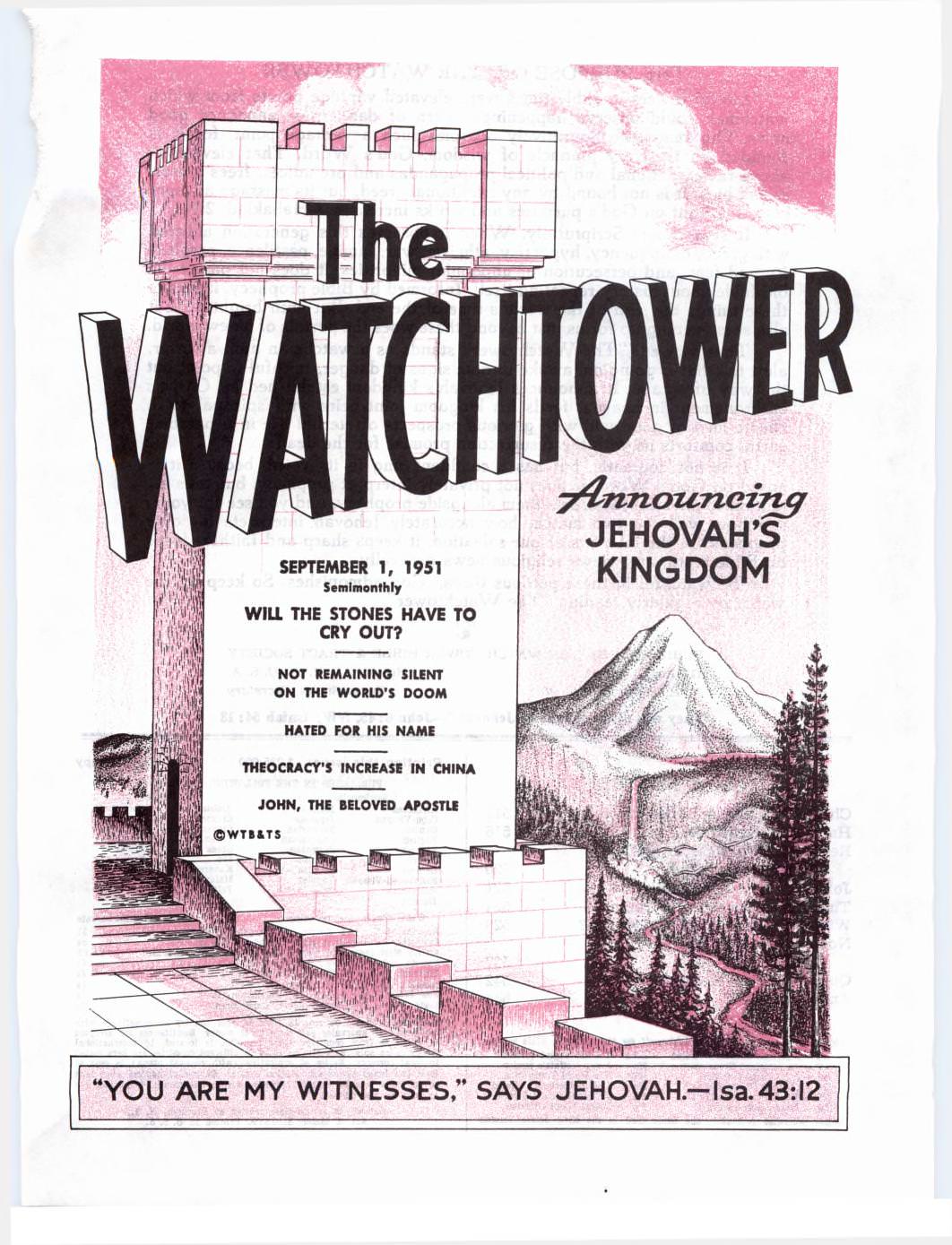
"YOU ARE MY WITNESSES," SAYS JEHOVAH.—Isa. 43:12
The WATCHTOWER
Announcing
JEHOVAH'S
KINGDOM
SEPTEMBER 1, 1951
Semimonthly
WILL THE STONES HAVE TO CRY OUT?
NOT REMAINING SILENT
ON THE WORLD'S DOOM
HATED FOR HIS NAME
THEOCRACY'S INCREASE IN CHINA
JOHN, THE BELOVED APOSTLE
©WTB&TS
"YOU ARE MY WITNESSES," SAYS JEHOVAH.—Isa. 43:12 THE PURPOSE OF "THE WATCHTOWER"
Literal towers in Bible times were elevated vantage points from which watchmen could observe happenings, warn of danger, or announce good news. Our magazine figuratively occupies such a vantage point, for it is founded on the very pinnacle of wisdom, God's Word. That elevates it above racial, national and political propagandas and prejudices, frees it from selfish bias. It is not bound by any traditional creed, but its message advances as the light on God's purposes and works increases.-Habakkuk 2:1-3.
It sees things Scripturally. When it observes this generation afflicted with greed, delinquency, hypocrisy, atheism, war, famine, pestilence, perplexity and fear, and persecution of unpopular minorities, it does not parrot the old fable about history repeating itself.Informed by Bible prophecy, it sees in these things the sign of the world's time of the end. But with bright hope it also sees opening up for us just beyond these woes the portals of a new world.
Thus viewed, "The Watchtower" stands as a watchman atop a tower, alert to what is going on, awake to note signs of danger, faithful to point out the way of escape. It announces Jehovah's kingdom established by Christ's enthronement in heaven, feeds his kingdom joint-heirs with spiritual food, cheers men of good will with glorious prospects of eternal life in a paradise earth, comforts us with the resurrection promise for the dead.
It is not dogmatic, but has a confident ring in its voice, because it is based on God's Word. It does not privately interpret prophecy, but calls attention to physical facts, sets them alongside prophecy, and you see for yourself how well the two match, how accurately Jehovah interprets his own prophecy. In the interests of our salvation, it keeps sharp and faithful focus on Bible truth, and views religious news generally.
'Be watchful in these perilous times,' God admonishes. So keep on the watch by regularly reading "The Watchtower".
PUBLISHED BY THE WATCH TOWER BIBLE & TRACT SOCIETY
117 Adams Street Brooklyn 1, N. Y., U. S. A.
N. H. KNORR, President GRANT SUITER, Secretary
"They will all be taught by Jehovah."—John 6:45, NW; Isaiah 54:13
CONTENTS
Cheap Talk versus True Principles 515
Hated for His Name 516
Remaining Fearless to the
Accomplished End 520
John, the Beloved Apostle 521
Theocracy's Increase in China 524
Will the Stones Have to Cry Out? 528
Not Remaining Silent on
the World's Doom 537
Questions from Readers 542
Announcements 544
Abbreviations used in "The Watchtower" for the following Bible versions
AB - American Standard Version LXX- The Septuagint Version
AT - An American Translation Mo - James Moffatt's version
Da - J. N. Darby's version NW - New World Translation
Dy - Catholic Douay version Ro - J. B. Rotherham's version
ED - The Emphatic Diaglott RS - Revised Standard Version
Le - Isaac Leeser's version Yg - Robert Young's version
Unless otherwise indicated, the Bible used is the King James Version
PUBLISHED IN THE FOLLOWING LANGUAGES Semimonthly Monthly
Five cents a copy
<tr><th>Afrikaans
Italian
Arabic
Portuguese
Cebu-Visayan
Japanese
Chishona
Russian
Danish
Norwegian
Cinyanja
Slamese
English
Pangasinan
Clwemba
Sikololo
Finnish
Slovenian
Greek
Slovak
French
Spanish
Ibo
Twl
German
Swedish
Kanarese
Ukrainian
Hiligaynon-Visayan
Tagalog
Malayalam
Yoruba
Hollandish
Zulu
Polish
Docano
Watch Tower Society offices Yearly subscription rate
America, U.S., 117 Adams St., Brooklyn 1, N.Y. $1
Australia, 11 Beresford Rd., Strathfield, N.S.W. 8s
Brillish West Indies, 21 Taylor St., Port of Spain, Trinidad$ 1.72
Canada, 40 Irwin Ave., Toronto 5, Ontario $1
England, 34 Craven Terrace, London, W. 2 7s
Jamaica, 151 King St., Kingston 7s
New Zealand, G.P.O. Box 30, Wellington, C. 1 7s
South Africa, 623 Boston House, Cape Town 7s
Remittances should be sent to office in your country in compliance with regulations to guarantee safe delivery of money. Remittances are accepted at Brooklyn from countries where no office is located, by international money order only. Subscription rates in different countries are here stated in local currency. Notice of expiration (with renewal blank) is sent at least two issues before subscription expires. Change of address when sent to our office may be expected effective within one month. Send your old as well as new address.
Entered as second-class matter at Brooklyn, N. Y., Act of March 3, 1879. Printed in U. S. A.
CHEAP TALK VERSUS TRUE PRINCIPLES
WHATEVER famines and shortages may afflict the world, there is no scarcity of words. "Talk is cheap," goes the saying, and it was never more true than now. Diplomats gather from four great powers and consume months trying to decide what to talk about at a more important meeting. In a few weeks' time the controversial MacArthur hearings run up a staggering transcript more than twice the length of the Bible.
Think of the pyramid of promises compiled in a single political campaign. Remember the cry of World War I, "Make the world safe for democracy!" and the chant of World War II, "Four Freedoms." Today democracy is more in jeopardy than ever, and totalitarian denial of free speech and worship as well as fear and want stalk the earth. Federations of nations rise and fall as men preach unity and treaties are torn to shreds. Talk of morality fills more time and space than ever, while immorality enjoys its greatest heyday. Plainly, along with the corroding riches the world has heaped up flowery sayings as security for the last days.—Jas. 5:1-5.
Christ Jesus taught: "Stop storing up for yourselves treasures upon the earth, . . . store up for yourselves treasures in heaven, . . . For where your treasure is, there your heart will be also." Those who spend their lives making, following and believing worldly political promises must certainly have placed their hopes upon
such system of things. Yet such ones usually profess to likewise serve God and repeat the "Lord's prayer" for his coming kingdom. Therefore they must be judged by God's Word, which they claim to follow. At once Jesus' warning comes to mind: "You cannot be slaves to God and to Riches."—Matt. 6:19-21, 24, NW.
So God's Word rejects the maneuver made popular by politicians, "playing both ends against the middle." One either is in harmony with God's purposes or is not. If he is, he will preach them as Jesus did and live up to the requirements of Christianity as Jesus did. Jehovah God will have it known that he accepts no blame for the political, religious, social and moral collapse of this old world.
Jehovah's Word, the Bible, is a masterpiece of epitome, wasting not a syllable as it unfolds to mankind the universal purposes of the Creator. Likewise, God's servants 'let their words be few' in making personal vows and promises, but speak out of their hearts' abundance in preaching world-wide God's kingdom promise. (Eccl. 5:1-6) What they read in God's Word they believe; hence they follow it in their lives and avoid immorality, empty speeches and deception from false promises.—Matt. 12:34; 1 Cor. 6:9, 10; 2 Tim. 2:16.
Worldly principles and promises, long in words but short in life span, wither and fade. "But the word spoken by Jehovah endures forever."—1 Pet. 1:25,NW. HATED FOR HIS NAME
JESUS CHRIST unquestionably brought the greatest message of peace, joy and human contentment ever introduced to the ears of men. However, he nowhere promised his followers favor with this world or even humane treatment from it. Plainly telling them what to expect, he pointed out: "Then people will deliver you up to tribulation and will kill you, and you will be hated by all the nations on account of my name."—Matt. 24:9, NW.
By the year (A.D.) 64 Christianity was prominent throughout much of the Roman Empire, including the capital city Rome itself. Their individual characteristics, form of worship and steadfast refusal to compromise thereon had made the Christians sure targets of hostility and ridicule. That year, the tenth in the reign of Emperor Nero, Rome was swept by a conflagration so great it is yet the object of poetry and legend. When the fire had subsided, the great slum areas of the proud capital lay in either part or total ruin. Nero's subsequent bounties for the homeless and energetic rebuilding program could not subdue the growing suspicion that he was the incendiary of his own capital. Looking for a handy scapegoat to divert attention, the harried emperor hastened to publicly pin the blame on the unpopular Christians. Thus began an era of ten major persecutions against Christians by various emperors of Rome over a period of nearly three hundred years.
Nero saw to it that the first of these terrible persecutions set the pace for the rest. At once he caused Christians to be rounded up, summarily condemned and put to death in the most barbaric manner conceivable. Some were thrown to the fierce beasts in the public arena, others were sewed in animal skins and left to the fury of wild dogs, many were crucified, and still others were garbed in combustible materials and ignited to become human torches lighting the gardens of Nero by night. It was in this persecution that the apostle Paul was martyred.
Brief respite followed the death of Nero, but by the latter years of the first century the second great persecution, under Emperor Domitian, flared up. It is said that in the year 95 alone some 40,000 suffered martyrdom. Like Nero, Domitian is found of demented traits. Earlier he had slain his own brother and a number of Roman senators. One of his decrees commanded the death of all of the lineage of David. In this ruler's persecution a number of prominent Christians suffered, including, according to Blanchard in his Book of Martyrs, the Timothy to whom Paul wrote two canonical letters. Also, it was in this period that John, last living of the twelve apostles, was exiled to the isle of Patmos, from where he recorded the inspired Bible book of Revelation about A.D. 96.
After Domitian the brief thirteen-month reign of Nerva provided a refreshing bridge into the third great period of trial by Roman fury.
In Emperor Trajan's reign hate kindled the fires anew.
A Christian widow, refusing to sacrifice to the emperor, was hung by the hair and then drowned in a river. Phocus, a Christian overseer, was thrown first into a hot limekiln, then into a scalding bath until he died. Another, Ignatius of Antioch, was scourged by fire, had his flesh torn by red-hot pincers and was finally ripped to pieces by wild beasts. Trajan's successor, Adrian, persisted in this till his death A.D.138, when he was succeeded by the relenting Antoninus Pius.
But again peace could be only temporary. Came the year 162 and the fourth wave of attrition, under the strong pagan Marcus Aurelius Antoninus. Under this ruler Christians, regardless of sex, were subjected to the most inhuman treatment to that date. Noted members of the Christian church like Polycarp and Justin went steadfastly into death. Added horrors like the red-hot torture chairs failed to destroy the Christian faith.
The fifth persecution was largely a local affair, breaking out spasmodically in various parts of the empire where existing laws against the Christians were irregularly enforced. The emperor, Severus, invoked no new mischief by law, evidently due to his affection for the Christian doctor who had cured him of a dangerous ailment.
A. D. 235 the sixth oppression fell upon the Christians during the reign of Emperor Maximinus. This time numberless Christian victims were slain without any trial whatsoever and their bodies were often piled in heaps without so much as a decent burial. It is said that this persecution stemmed from Maximinus' great hatred for his predecessor, Alexander,
who had sheltered the Christians. Under Decius, A.D. 249, the seventh persecution was inaugurated. This assault spread throughout the empire, spared neither age nor sex, and contrived to introduce torture unique to all that had gone before it.
CHRISTIANS ENDURE AND WIN
A young Christian man in Asia on receiving the demand to sacrifice to Venus, replies stoutly: "I am astonished you should sacrifice to an infamous woman, whose debaucheries your own historians record, and whose life consisted of such actions as your laws would punish. No, I shall offer the true God the acceptable sacrifice of praises and prayers." For this he is broken on the wheel, then beheaded. Julian, native of Cilicia, is bound in a bag with serpents and cast into the sea. Two former heathen priests, converted to Christianity, make many converts, suffer arrest during this persecution and, refusing to renounce their faith, are burned alive. The noted presbyter, Origen, is seized and imprisoned and only the death of Decius prevents his execution. War with the Goths diverts the attention of the successor, Gallus; but afterward, when plagues strike the empire, universal sacrifices to the gods of Rome are ordered. This causes more Christian slaughter, this time at the hands of local mobs and magistrates.
Still no rest! In April, 257, under Emperor Valerian, an eighth persecution opened. This wave added untold martyrs to the list as well as more fiendish tortures. This onslaught was leveled chiefly against the overseers and responsible ones in the Christian church, the design being to break up the ranks by destroying the leadership. Foremost among those victimized at this time was Cyprian, overseer of Carthage. Respected as well as he was known by the local Roman officials, he was not tortured to force a recantation, and the most painless death at their disposal, beheading, was provided him.
A.D. 274 Emperor Aurelian proclaimed a ninth persecution. It flared briefly, but quickly died with the slaying of the emperor at the hands of his own domestics.
Diocletian assumed the crown A.D.284. At first he seemed friendly to the Christians, but in the year 303 he gave in to persuasion and opened the tenth persecution, probably the most ferocious of all. Suffocation by smoke, forcible drinking of melted lead, mass drownings and burnings, breaking on the rack of men and women alike ran the empire with blood. In a single month 17,000 were slain. In the province of Egypt alone, 144,000 such professed Christians died by violence in the course of this persecution, in addition to another 700,000 who died as a result of fatigues encountered in banishment or under enforced public works.
Diocletian's abdication in 305 left the empire divided among six emperors. Constantine murdered his way to supremacy in the west and ceased the persecutions, with the aim of forming a fusion religion between Christian and pagan, thus strengthening the unity of his people.
What was typified by these ten persecutions by no means ended with them. The Devil's vicious assaults by violence against Christianity continued through the Dark Ages, the Reformation and right into the present days. Only the hand of the persecutor, not the basic reasons for persecuting, has changed. To find what those issues were and are, hear how those early Christian stalwarts gave firm answers to questions still asked by modernday "Caesars".
PAYING TO GOD AND TO CAESAR
When pressed by the Roman proconsul to deny Christianity or, finally, to at least "persuade the people" so that the government could release him without losing face, the aged overseer, Polycarp, replied:
"To you I felt myself bound to render an account, for our religion teaches us to treat the [civil powers] with becoming reverence, as far as is consistent with our salvation. But as for those without, I consider them undeserving of any defense from me." The mob then denounced him as "the enemy of our gods", betraying religious prejudice as their base motives.
In the year 200, two Christians before the proconsul Saturninus upheld their faith, to which the official stated: "We too are pious, and we swear by the genius of the emperor, our Lord, and we pray for his welfare, which you must also do." One answered: "I know of no genius of the ruler of this earth, but I serve my God in heaven, whom no man hath ever seen, nor can see. I have never stolen anything from any man; I pay scrupulously all the taxes and tributes which are due from me, for I acknowledge the emperor as my ruler, but I can worship only my Lord, the King of kings, the Lord of all nations."
The Christian stand of complete separateness from the world and its systems stood out in refusal of military service as in the case of the young Christian Maximilian, who protested that he had taken the badge of Christ and could not as well accept that of the world. Again, there is the instance of the centurion Marcellus, who, already a soldier, as a Christian refused to worship the idols and the state, thus publicly threw aside his insignia and suffered death.
It must be noted that even the harsh, totalitarian government of ancient Rome saw fit to cover its persecutions with false charges against the victims, as if it quailed at killing them openly for no other reason than "their religion". Summarizing the many excuses such as 'insulting the gods of Rome', 'renouncing the emperor,' 'noncompliance with military duty,' etc., the edict closing the tenth persecution in 311 declared by way of justification that the oppressions had been used to cause Christians to return to 'the old traditional religion of their fathers' and thus end the following of their 'own devices'.
OVERCOMERS FOR A NEW WORLD
Everything was done to paint the Christians in an unfavorable light. Though falsely charged with burning Rome in Nero's day, Tacitus informs us, they were then convicted more for the charge of 'hating the human race'. True, they were outspoken, openly proclaiming the coming destruction of the godless world system. Their materially-minded enemies called them 'gloomy and austere', and charged that they sought to bring about an immediate fulfillment of their prophecies through seditious overthrow of the authorities. The government was far more anxious that they should recant than that they should suffer, possibly because of the blight these innocent lives cast upon Roman history. Even when convicted, Christians still held the choice of life (by compromise) or death in their own hands. For every imaginable evil, be it earthquake, plague or flood, Christians were sure to receive the blame from the superstitious Romans who fancied these to be sure tokens of the anger of their gods over the very existence of the Christians. But for all of this, it is noteworthy that many pagans, even officers in the army, were converted to Christianity by the unwavering faith of the Christians while enduring the cruelest torture.
Fighting opposition, they kept going forward; their worship banned, they continued their assemblies, though often in the recesses of underground cemeteries, the catacombs. Just as true of pre-Christian witnesses of Jehovah God described
by Paul's letter to the Hebrews, so were these faithful ones ' . . . stoned . . . sawn asunder . . . slaughtered with the sword . . in want, in tribulation, under ill-treatment; and the world was not worthy of them. . . .'—Hebrews 11:37, 38, NW.
And is it the same today? The experiences of Jehovah's witnesses would seem to prove it so. In the same manner as with Christians of the first few centuries they have been falsely labeled as seditionists, Nazis, communists, capitalist American spies, and generally 'haters of everything', depending upon where they happen to be and whatever will make them the most readily unpopular. But the facts prove their accusers the haters and their acts simply a fulfillment of part of Jesus' great prophecy for these last days: "You will be hated by all the nations on account of my name."
Before and during World War II, these faithful Christian witnesses endured mobs, beatings and imprisonment in democratic lands; and unflinchingly faced the headsman's axe, gallows and torture chambers of Nazi concentration camps. Since the war they have been banned, scourged and killed in communist countries and have seen violence in supposedly "free" lands, such as Greece, mount to the point of pushing them before the firing squad. It cannot be different while we are under the same system of things that murdered Christ Jesus and vainly tried to drive his early followers from the face of the earth.
Still, this ill-treatment does not deter men of good will from assembling with the only truly joyful people on earth, who glory not in persecution but in the vindication of their God. True to their God and their own experience, they point seekers of peace and joy not to the old system of things. They proclaim Jehovah God's new world!
Remaining Fearless
to the Accomplished End
TROUBLES and calamities have come upon this generation like a torrential downpour, flooding and overwhelming earth's inhabitants with great fears. But the torturing memory of past troubles is not as great for them to bear as the fear of the future. Amid such world perplexity and distress, faithful Christians are faced with other fearful problems, for as "the children of light" they are intensely persecuted by the wicked elements of this dark, satanic world. Darkness hates the light. (John 3:19-21; 12:36) Nevertheless Jehovah counsels his people not to be discouraged or frightened.*
There is good reason why God's people are told to be fearless. They are sent to a stiff-necked, hardhearted and rebellious people, to Christendom and her allies, and to these they are commanded to declare God's message of warning, not diminishing a word of it. (Ezek. 2:1-8) The time is short, the final end of this system of things is near; consequently there is no time for hesitation, timidity or inactivity. For the Lord's people to draw back, soft-pedal, or fearfully quail before the enemy would eventually mean their destruction. "The fear of man bringeth a snare; but whoso putteth his trust in Jehovah shall be safe." Fear is an expression of selfishness, whereas "there is no fear in love, but perfect love throws fear outside".—Prov. 29:25, AS; 1 John 4:18, NW.
Fear prevents progress, brings stagnation, cripples activity, and enslaves the mind in a state of anxiety and worry. The truth, on the other hand, sets one free from such fears. It is therefore love for Jehovah God and love for his precious
Word of truth that will free the servants of God from the fears of this troubled atomic age. Hence, it is most important that you meet together for regular study of the Bible with the Lord's people. Your love for God is proved by your works of love. Consequently, have a share with Jehovah's witnesses in giving this final testimony to the people of all nations before the final war of Armageddon breaks.
And as you go forward and engage in proclaiming the glad news to others that the theocratic kingdom is man's only hope, do not go in your own strength or power. No one is so strong he can stand up by himself against the onslaughts of the demons. Stay close to the Lord and his organization. Look and pray to him for grace and strength. Remember what the prophet wrote: "The everlasting God, Jehovah, . . fainteth not, neither is weary; there is no searching of his understanding. He giveth power to the faint; and to him that hath no might he increaseth strength. . . they that wait for Jehovah shall renew their strength." Remember what the apostle says: "My God will fully supply all your need to the extent of his riches in glory by means of Christ Jesus." Remember what the Almighty himself says: "Fear thou not, for I am with thee; be not dismayed, for I am thy God; I will strengthen thee; yea, I will help thee." Therefore, "Jehovah of hosts, him shall ye sanctify; and let him be your fear, and let him be your dread."—Isa. 8:13; 40:28, 29, 31; 41:10, AS; Phil. 4:19, NW.
What an unspeakable reward will go to those remaining fearless to the end! Not only will they see the wicked completely destroyed, but they will also live on into the new world free of all fears and troubles.
This subject is discussed at great length in The Watchtower, March 15, 1950.
TO THE Christian familiar with his Bible, the names of the various apostles immediately bring associations with them.
Matthew, the tax collector; Thomas, the doubter; Peter, the apostle with the keys; Paul, the apostle to the Gentiles; Judas Iscariot, the betrayer. And the apostle John? The beloved apostle.
missionary tours! And then to be given the commission and power to carry on the same work! "As you go, preach, saying, 'The kingdom of the heavens has drawn near.' Cure sick people, raise up dead persons, make lepers clean, expel demons. You received free, give free." Compare such work with mending
John was among the first four, all fishermen, called by Jesus to be his disciples. At the time Jesus called him he and his brother James were busy repairing nets in a boat with their father Zebedee. (Matt. 4:21,22) When called by Jesus John did not ask, What will happen to my father's fishing business? How shall I provide for myself if I become Jesus' follower? Neither did he ask for time to first think it over. No, he immediately left his father and his fishing business and started on his career as a fisher of men.
What a new life thus opened up to John! What a privilege was his to be in such intimate association with the long-looked for Messiah; with the One who had been with Jehovah God since of old, before anything or anyone else was created; to be with the One who was the firstborn of all creatures, and by whom all other things came into existence! (Prov. 8:22-30; Col. 1:15; John 1:3, NW) What valuable training he, in common with the other disciples, received as daily he listened to Jesus' preaching and accompanied him on his
nets? Never!—Matt. 10:5- 15; Luke 8:1, NW.
John is generally considered as having been the youngest of the twelve, and not without good reason. Not only did he evidently
survive the rest, but in the Scriptural accounts, whenever he is mentioned with one, two or three others his name always comes last. John was one of the three disciples whom Jesus repeatedly preferred over the others, as at the raising of the daughter of Jairus, at the transfiguration scene, and in the garden of Gethsemane. (In later years Peter and John, along with James the brother of Jesus, were referred to by Paul as being like pillars in the church.)—Matt. 17:1; Mark 5:37; 14:33; Gal. 2:9.
Not only was John among the favored, preferred few, but Jesus put him in a class by himself by bestowing special affection upon him; so much so that John repeatedly refers to himself as the disciple Jesus loved. John occupied the bosom position of his Master at that last passover together and to him Jesus commended his mother the following afternoon. Why did Jesus thus prefer John?—John 13:23; 19:26; 20:2; 21:7, 20.
Jesus had come to the people bearing the name of Jehovah, but who instead of worshiping Him were steeped in tradition. They were merely going through the outward forms of worship, while their hearts were far removed from Jehovah. And their religious leaders had as little love for their fellow men as they had for Jehovah God.
What cared they that the dead were being raised, lepers were being cured, the lame were being healed and the poor were having the good news of God's kingdom declared to them? Their chief concern was their reputation among the people.—Matt. 6:1-8; 11:4-6; Mark 7:1-15.
Jesus exposed their folly and hypocrisy and showed them that the entire law can be summed up in just one word, love, and that God wanted mercy and not sacrifice. In fact, Jesus' entire ministry was a continuous expression of love, for his heavenly Father and for his fellow man, both by word and by action. From the writings of John it is apparent that he keenly appreciated this emphasis that Jesus placed on love. No wonder, therefore, that Jesus found in John a closer kinship, a more harmonious meeting of the mind and heart than he found in any of the others.-Matt. 9:13; 22:37-40.
Note the following examples bearing out the point above made: "For God loved the world so much that he gave his onlybegotten Son." "You also ought to wash the feet of one another." "By this all will know that you are my disciples, if you have love among yourselves." "If anyone loves me, he will observe my word, and my Father will love him, and we shall come to him and make our abode with him." "This is my commandment, that you love one another just as I have loved you. No one has love greater than this, that someone should surrender his soul in behalf of his friends." John 3:16; 13:14, 35; 14:23; 15:12, 13, NW.
And not only did John highlight Jesus' emphasis on love but he himself made love the theme of his epistles. "See what kind of love the Father has given us, so that we should be called children of God." And again: "Beloved ones, let us continue loving one another, because love is from God,
and everyone who loves has been born from God and gains the knowledge of God. He that does not love has not come to know God, because God is love."—1 John 3:1; 4:7,8,NW.
JOHN NO SENTIMENTALIST
Because of Jesus' love for John and John's emphasis on love in his writings some have concluded that John was a weak and sentimental person. Nothing could be farther from the truth. His coming with his brother and mother to Jesus with the request to receive the chief places in his kingdom would indicate that he was not at all backward and retiring. (Matt. 20:20-23; Mark 10:35-40) Boanerges, "sons of thunder," is what Jesus called him and his brother. When the Samaritans refused to receive their Master these two "sons of thunder" asked: "Master, do you want us to tell fire to come down from heaven and annihilate them?" Note also John's report regarding another incident: "Instructor, we saw a certain man expelling demons by the use of your name and we tried to prevent him, because he is not following with us." Yes, "we tried to prevent him." But Jesus set them straight. —Mark 3:17; Luke 9:49, 50, 54, 55, NW.
The love between Jesus and John was not based on mere sentimentality, but on their mutual love for righteousness; like the bond between David and Jonathan. And, like the psalmist, John hated all unrighteousness. (Ps. 139:21,22) His love of righteousness and hatred of unrighteousness caused him to record rebuke after rebuke not to be found in the other accounts of Jesus' ministry, outstanding of which are Jesus' words to the religious leaders of his day: "You are from your father the Devil and you wish to do the desires of your father." He alone records the taunting words of the natural brothers of Jesus, telling that they did not exercise faith in him.
Other accounts tell us that there was grumbling at the expense of the ointment used by Mary to anoint the feet of Jesus, but only John gives us the details. It was Judas who grumbled; and why? Because he carried the money box and was a thief. (John 8:44; 7:5; 12:6, NW) For other examples see John 2:4; 19:38, NW.
Another point of interest in John's Gospel and which throws light on his personality is the fact that he never refers to himself by the name "John". He is either one of the sons of Zebedee or the disciple whom Jesus loved, preferred or had affection for. And so, since the only John he mentions is John the Baptist, he simply refers to him as "John". This characteristic of John, incidentally, lends weight to the opinion of some that he himself is the unnamed companion of Andrew mentioned at the beginning of Jesus' ministry and also the unnamed disciple mentioned at the close of his ministry; the one who followed Jesus into the courtyard of the high priest and who gained entrance because he was acquainted with the high priest and who arranged for Peter to also gain entrance.—John 1:35-40; 18:15, 16.
To John we are indebted for much information regarding the ministry of Jesus. He alone records the counsel Jesus gave on the night of his betrayal as well as his prayer. He alone pinpoints the prime purpose of Jesus' coming into the world, to "bear witness to the truth". He alone records four passover feasts that Jesus attended, thus helping us to establish that Jesus' ministry took three and a half years. He alone quotes Jesus' direct references to his prehuman existence.—John 3:13; 8:58; chapters 13-17.
Jehovah God and Christ Jesus used the beloved apostle John to record the last inspired prophecy to be given to man, the
book of Revelation. What a preview of history, as much as three thousand years in advance, John there had! The birth of the Kingdom, the war in heaven, the great conflict at Armageddon, and the final destruction of the Devil and his hosts! What a cast of characters! What action! What drama! All of which, incidentally, John recorded before he wrote his three epistles and his Gospel account. As we read the things John was used to give us, we are reminded of Jesus' first miracle (recorded only by John) of changing water into wine, where the best wine was served last.
Self-styled higher critics in their efforts to discredit the Bible dispute John's authorship of Revelation and the Gospel bearing his name. However, their argument that John was too mild-tempered to write the book of Revelation is certainly without foundation in view of what we have already noted regarding his righteous indignation. And their claim that the Gospel of John was written either in the year 132 or 150 is likewise without foundation in fact. Papyrus fragments of John's Gospel written in the first half of the second century were recently found in Egypt. The time required for copies of John's Gospel to be translated and to reach from Ephesus to Egypt would clearly put its composition within the lifetime of John.
John the beloved apostle proved worthy of Jesus' love. For some seventy years he faithfully served Jehovah God and toward the end thereof he gave us Revelation, three epistles and the Gospel bearing his name. John's life, works and writings underscore the truth of Jesus' words: "He that has my commandments and observes them, that one is he who loves me. In turn, he that loves me will be loved by my Father, and I will love him and will plainly show myself to him." (John 14:21, NW) What greater happiness could one want?
Theocracy's Increase in China
This article continues the series reporting on the Aslatic travels of the Society's president, N. H. Knorr, and his secretary, M. G. Henschel
THE branch servant was at the Bangkok airport to meet us at noon, but when we got off the plane and came into the customs at 12:30 we saw no signs of him. We learned about ten minutes later when he found us in the customs room that he had been talking to a young Thai woman and she became very much interested in the truth. Brother Babinski was talking to her in the Thai language and after we cleared through customs he introduced her to us. She went by the title "Princess" because she is a first cousin to the present king. She is a writer and furnishes publications in Bangkok with historical and educational stories while also doing some supervisory work at the airport. She could understand and speak English quite fluently, but she prefers the Thai. We dropped her off at her publisher's place and then we went on to the branch office. There we met the brothers again and in the evening the regular service meeting was on, so I talked after the program and gave them a report on the good work our brothers are doing in Burma.
Brother Henschel and I left Thailand at 1:30, which was 3:30 Hong Kong time, not far from sunrise. This time when we said good-by we did not promise to see them shortly again, but it was our hope to some day return and to then anticipate seeing a much greater organization established in Thailand. It is very evident that
there are hundreds and maybe thousands of persons, even though Buddhists, who love life and will seek it. As the truth spreads, as Paul put it, they will hear, and if they hear they will believe, but they can never hear without preachers. So our Thailand publishers are determined, by the grace of our God in heaven, to preach so that many will hear and some will believe.
By 9:30 we would be at Hong Kong, Britain's precious jewel of the Far East. Weather was a question. About the month of April there is a change in the monsoon and the gray fog sits on the hills and waterways around Hong Kong. Before our arrival there had been a series of thirty dull days.
HONG KONG
This April 14 the clouds had lifted off the water, but it was still gray with blustery winds that fairly whistled around the foothills that border the airport. Five missionaries and as many company publishers had gathered there that day to welcome us from Bangkok. A friendly airways official gave information that the plane was overhead and would appear through the clouds any minute. We were up above wondering what we would see when we came down through the clouds. It was just four years before that we had flown past the granite-capped hills and looked down on a battle-scarred Hong Kong that had survived air raids and Japanese occupation. We remembered how the last time we were in Hong Kong there was an American brother who was employed temporarily in Hong Kong and who was doing some witnessing, but that was the extent of the work in Hong Kong then.
We had been there at Memorial time and a bit of unleavened bread had to be baked for the occasion by a Chinese woman. We had four assembled in the cold confines of a hotel room. But even then we had hope that something could be done for the people of good will in Hong Kong in a theocratic way. Two years later two missionaries took up residence and started the work of witnessing in a new land. Many people showed good will. Some showed exceeding kindness to the missionaries. Other graduates of Gilead were added, to the number of five. After long and tedious studying and argument a few Chinese natives began to get the gist of the Kingdom message and the second year of heavy plowing finished with an average of six company publishers. We wondered how things were going there and we were glad when our plane came down over the sea and beneath that 500-foot ceiling of clouds we could see the hillsides and the many buildings—Hong Kong! One brother who was connected with an airline met us near the plane and behind the barrier we could see others. We were happy to be with them.
When we could be with them we inquired about how the work was going. They told us that by Memorial time they had 15 company publishers in the field; that was the March report. They were rejoicing because 91 persons of good will and
publishers had packed out the Kingdom Hall and overflowed into two bedrooms next door where they could hear but not see what was going on. Ninety-one persons was the greatest attendance figure for
any meeting up to that time. Before that it had been 40. Now there was a visit from the Society's president and they were taking full advantage of it. For this special event 150 letters of invitation were mailed out, 1,000 posters were printed, as well as 20,000 handbills. What would be the harvest?
Two picture theaters had been offered free. A sound system was installed free in the Star Theatre which they chose. Persons of good will provided newspaper advertising. Willing servants distributed the leaflets. Everything seemed ready for a record witness. All of this advertising was done in Kowloon, on the mainland across from the island city of Hong Kong, for no regular witnessing had yet been done in Hong Kong proper. The publishers had been working diligently during the assembly which was opened on Friday and they were rejoicing in this first theocratic assembly ever held in Hong Kong. The missionaries had not attended an assembly for 2 1⁄2 years and now they were taking full advantage of the assembly blessings.
First we went to the missionary home and then over to the assembly hall on the main street of Kowloon, Nathan Road. This hall was given free for the occasion. The baptismal talk was just ending when we arrived and two Chinese youths had agreed to do Jehovah's will and others were seriously contemplating doing so. Off they went to the immersion and soon again it was time for the meetings. Brother Henschel and I enjoyed talking to this
audience, for they fairly drank in each word at this their first assembly. The interpreters spoke in Cantonese dialect so all attending could understand. There were 34 present.
PUBLIC MEETING
Sunday dawned warmer and brighter. What attendance could we expect at the Star Theatre? Placards were donned and remaining handbills in English and Chinese were put out. Fifteen minutes to go and a crowd hung around outside. When they saw the doors were open they rushed in. By 10:30 a.m. they poured in like water. The ground floor of the theater was filled, so the gallery had to be opened up. The start of the talk was held up a few minutes for all to get settled. There were 707 there to hear "Proclaim Liberty Throughout All the Land". Everyone was thrilled at such an attendance and they were glad that the visit had provided the stimulus to aim high. Attention was the best and at the end of the talk hundreds of booklets were given away free. More than twenty names were handed in for future contact. The talk had been ably translated into Cantonese, the local Chinese dialect. The number of publishers that had part in the advertising of the meeting had grown to 20, which meant a 100 per cent increase over last year's peak.
The afternoon and evening were joyful, for this rich blessing at the public meeting had almost overwhelmed the publishers. Brother Henschel spoke at the hall on Nathan Road and I had the privilege of going across the harbor to Hong Kong to visit a sister who was lying ill in a hospital. She was one of the most zealous publishers of the company and her sudden illness had been a great blow because she so much wanted to be at the convention. She had been busy writing out letters of invitation to her friends and she was delighted to learn that over seven hundred persons had been at the meeting that morning. Visiting the sick is a Christian privilege and here I saw how much good it can do for an afflicted one. The sister did not know how to express her thanks.
While Brother Henschel was talking a stranger entered the hall. He had a Bible in his hand and he sat and nodded when the prophecies were quoted. After the meeting he was approached by one of the publishers and he told how that morning he had been to church and when he returned home some ladies who attended the public lecture told him of their experience and the fine talk they had heard. They told him where other meetings were to be held and he came right on down. He had been a secretary of the Y.M.C.A. years ago in Swatow and then went into business in Shanghai. Then came the Communist rule of Shanghai and he had to get out. His wife, however, was not permitted to leave because she is a doctor and the Communists retain all professional people, if possible. His Bible was well worn and he said he was looking for a place where people were interested in the study of the Bible. He showed joy over what he heard and said he would return. Sure enough, that night when I spoke he was back again. So arrangements were made to regularly study the Bible with him and he will attend all the meetings. This shows how the truth can spread in a city of two million with only five missionaries.
Brother Carnie met a doctor's son while in the service and arrangements were made for a home Bible study. The study is held right in the surgery room. The interest of this young man is so great that he invites all kinds of people to attend: teachers, students and people of all religions. He opened up the way with the headmaster at school for the missionary to give a lecture in the Church of England. Then one of the Scripture teachers opened his home for a Bible study and some of the students attend.
Another experience was with the son of a Buddhist. The Buddhist joined a church but the son showed interest. One day the preacher came by and told the boy to burn the books, but he did not comply and it aroused greater interest in the Kingdom message.
He studied and brought in school friends. Now six of the boys come to the Kingdom Hall and two publish regularly.
One day while working in a Chinese section one of the missionaries came in contact with an English literary club. Much interest in the message was shown and now the missionary speaks every week to a class of about 25, using the book "The Truth Shall Make You Free".
Another time while going from house to house a woman invited the publisher in and said the daughter was keen on the Bible, but she did not know what to think about her son. He did not care about such things at all. Back-calls were made. The boy became ill and the publisher would call and talk to him. The boy took to the truth very quickly. Soon he was coming to the Watchtower study. Now he is a regular publisher putting in about 60 hours a month in the service. He put out most of the handbills for the public meeting at the time of the assembly. Meanwhile the mother has not progressed, though she shows good will. So the truth is becoming known in Hong Kong and Kowloon and already one of the religious organizations has published literature denouncing the faithful ministers of Jehovah for their teaching work.
Living is not easy in Hong Kong. Robberies are many and sometimes there are shooting frays between police and bandits on the streets. People are often afraid to open the door because so many have been dealt with violently. The crisis in China has brought all kinds of people into Hong Kong. The buildings are overcrowded and often many persons live in one room. To get a room requires payment of exorbitant fees of "key money". Educated and wealthy businessmen from the cities of
China may be found in Hong Kong. They fled and left behind their business and wealth, preferring to hold onto life and not be accused by communist agents and penalized. Their stories were only of troubles for the people of China, the stories that always go with Communism.
MESSAGE FROM SHANGHAI
We had a message from our brothers in Shanghai to confirm that things are not good for the people there. It is especially difficult for the foreigners to do anything. They are often insulted or they may have their face slapped and there is no recourse to the police. It is just a matter of bearing it. The missionaries there are sticking with the local Chinese publishers and they want to help them as much as they can to grow mature in the truth and keep going in the service. In 1947 there were 9 publishers in China, and the report for 1951 shows 46; so there has been an increase. One hundred five attended the Memorial in Shanghai this year. There are also a few publishers in other cities. We pray that the good work will continue in China and that the suffering people may have some opportunity to hear the truth.
Perhaps some day there will be a large organization of publishers in Hong Kong and they may have an opportunity to go into China and tell the people the truth. The progress made in Hong Kong is very encouraging and we hope it will continue. More missionaries could well be used there now, for great is the interest in Jehovah's new world. It is truly a privilege to know of Jehovah's blessed provision for those who love righteousness and that that new system of things is going into operation under the reigning King, Christ Jesus. That is the knowledge the people of China and all the world need and it is happifying to see that there are prospects for some of the Chinese people to share in the blessed new world of righteousness.
Will the Stones Have to Cry Out?
"If these remained silent, the stones would cry out."—Luke 19:40, NW.
THE supremacy of Jehovah God is made very evident through his manner of carrying out his purposes. It is Jehovah who said: "I have spoken, I will also bring it to pass; I have purposed, I will also do it." (Isa. 46:11, AS) With complete ease and certainty he goes about accomplishing all that he has said he will do, exactly at the time previously determined. One of Jehovah's expressed purposes is the complete overthrow and final destruction of Satan, the old Serpent, together with all of his offspring organization, visible and invisible. (Gen. 3:15; Isa. 14:24-27; 2 Pet. 2:9; Jude 6, 7; Rev. 20:2) The Most High has clearly let it be known how and at what period of time he will accomplish this. What leader of men and nations in this world would disclose his tactics and time of attack to an enemy? He would be considered foolish; he would be risking defeat. But that is because no leader on this earth can be sure of his superiority. Jehovah is different; his supremacy is a fact. No storm, flood or earthquake can delay Him, for He can control all such things. No actions the enemy, Satan, and his organization can take could have the slightest possibility of success against the force that Jehovah sends out. Whether the enemy chooses to attack or run and hide, nothing will prevent Jehovah's Executioner, Christ Jesus, from blotting them out. (Amos 9:1-4) Today their end is very near. 2 Although the doom of the wicked ones
was sealed by Jehovah at the time of the rebellion, until the set time for the execution of that judgment comes those whom Jehovah sentenced to annihilation are permitted to go about deceiving and taking captive many creatures who have no knowledge of the Most High and his purposes and so have done wrong. All the while Jehovah has been patient with those who have opposed him. In his undeserved loving-kindness he has allowed those who have been victimized by Satan's wicked organization to gain knowledge of the Almighty God's purposes and thus to have an opportunity to escape destruction with the Devil's world. (2 Pet. 3:9) In fact, before taking action to punish evildoers Jehovah has always given them due warning. Jesus expressed it this way: "The wisdom of God also said: 'I will send forth to them prophets and apostles.''" (Luke 11:49, NW) To this may be added the clear-cut words of God recorded in Jeremiah 35:14, 15 (AS): "I have spoken unto you, rising up early and speaking; and ye have not hearkened unto me. I have sent also unto you all my servants the prophets, rising up early and sending them, saying, Return ye now every man from his evil way, and amend your doings, and go not after other gods to serve them, and ye shall dwell in the land which I have given to you and to your fathers." How merciful God has been!
3 One act of mercy which God performed was the sending of the greatest prophet,
How is Jehovah's supremacy shown?
In what way has Jehovah shown mercy to those who have opposed him?
What special consideration was shown the natural descendants of Israel by sending Jesus to earth?
Jesus, to the earth. This left a record which the Devil's world has been unable to erase. For about three and a half years Jesus devoted all of his time and energy to the work of informing the people about Jehovah's kingdom and purposes related thereto. He went to the cities and the villages, to the seaside and to the mountains, and everywhere he told of the supremacy of his Father in heaven. He worked among the descendants of Israel, a people who should have known Jehovah and served Him but who had fallen away to impure worship. To these Israelites God had given many prophecies pointing out Jesus and the things he would do, but the majority did not want to accept the Son of God. Yet there were many who loved right-doing and who therefore heeded the admonition of Jesus, appreciating the fulfillment of the prophecies that had been written about his coming. These who changed from their evil course and followed the Son benefited greatly; they put themselves in position to gain everlasting life.—John 3:16, 17.
4 It was a time when the Most High put his covenant people Israel to their greatest test. What each one did would be a personal judgment of himself; he would either listen to God's message or reject it. Jesus said: "He that does not exercise faith has
been judged already, because he has not exercised faith in the name of the only-begotten Son of God. Now this is the basis for judgment, that the light has come into the world but men have loved the darkness rather than the light, for their works were wicked." (John 3:18, 19, NW) There was no doubt about it, either. Many were
given a final judgment of destruction on the basis of their wicked actions, as Jesus straightforwardly put it: "Serpents, offspring of vipers, how are you to flee from the judgment of Gehenna?" (Matt. 23:33, NW) These did not follow the message from God Jesus brought, so it became a final testimony to them.
5 On the other hand, some of those that believed the preaching of God's Son elected to follow the Teacher, and they took up the work of spreading far and wide the message he taught. Disciples of Jesus were sent out by him to preach it. (Matt. 10:5; Luke 10:1) Many accompanied Jesus as he toured and taught, enjoying a special privilege of being with Christ Jesus in human flesh.
According to God's prophetically expressed purpose, Jesus was not to continue his ministry in the earth indefinitely. For example, the prophet Daniel, in the latter portion of the 9th chapter, made a record of the exact time when the Messiah should be "cut off" in death, and this Jesus knew. Toward the close of his earthly ministry Jesus was traveling from the east in the direction of Jerusalem. He knew there were still some prophecies that had to be fulfilled concerning him, and the Record tells us: "And when he got near to Bethphage and Bethany at the mountain called Mount of Olives, he sent forth two of the disciples, saying: 'Go into the village that is within sight of you, and in it after you pass in you will find a colt tied, on which none of mankind ever sat. Loose it and
4,5. How was the activity of Jesus a test to God's covenant people, and what resulted to them?
6, 7. (a) Toward the close of his earthly ministry, what prophecles did Jesus fulfill before all the people? (b) Could anyone have prevented the fulfillment thereof?
bring it.' . . . So those who were sent forth departed and found it just as he said to them. . . . And they led it to Jesus, and they threw their outer garments upon the colt and set Jesus upon it. As he rode along they kept spreading their outer garments on the road. As soon as he got near the road down the Mount of Olives all the multitude of the disciples started to rejoice and praise God with a loud voice concerning all the powerful works they had seen, saying: 'Blessed is the One coming as the King in Jehovah's name! Peace in heaven, and glory in the heights above!" "—Luke 19:29-38, NW.
7 By this powerful public testimony all of the people in the land had to hear who Jehovah's King was. Matthew's account shows that he entered into Jerusalem itself; people were speaking of the occurrence everywhere. It had to be thus, for Jehovah's prophecy had been given: "Rejoice greatly, O daughter of Zion; shout, O daughter of Jerusalem: behold, thy king cometh unto thee; he is just, and having salvation; lowly, and riding upon an ass, even upon a colt the foal of an ass." (Zech. 9:9, AS; also see Ps. 118:22-26) This occasion should have made all the people of Judea rejoice as never before. Their King was in the midst of them! But had they joy? Most did not; some opposed such public praise to Jehovah: "However, some of the Pharisees from the crowd said to [Jesus]: 'Teacher, reprove your disciples.' But in reply he said: 'I tell you, If these remained silent, the stones would cry out.'" (Luke 19:39, 40, NW) And Jesus was right; the very stones would have cried out. It was Jehovah's will; who could change or prevent the making of that announcement? Still, these religious leaders, the Pharisees, opposed Jehovah's King and kingdom and wished only that their regime, on which they grew fat at the expense of the people in general, would continue. Jehovah had foretold that too.
WARNING OF DOOM
8 Jesus' ministry on earth was ending, but before he died all must know of his message and his works of love. Though a great crowd of his disciples hailed Jesus as King, the majority of Israelites rejected him and the message of salvation he had brought; they allowed Satan to keep them in darkness, especially through religious shepherds such as the Pharisees. If they would not believe such a powerful testimony as was then given but would cling to their selfish, evil living contrary to God's way, what could there be left for them? The fruits of their wrongdoing are seen in the prophecy Jesus spoke at that time: "And when he got to a nearby position, he viewed the city and wept over it, saying: 'If you, even you, had discerned in this day the things having to do with peace—but now they have been hid from your eyes. Because the days will come upon you when your enemies will build around you a fortification with pointed stakes and will encircle you and distress you from every side, and they will dash you and your children within you to the ground, and they will not leave a stone upon a stone in you, because you did not discern the time of your being inspected.'" (Luke 19:41-44, NW) As further evidence that the city was hopelessly wicked, Jesus' disciples who remained after his death to continue giving the message of life were mistreated, persecuted and killed. (Matt. 23:33-36) And before the generation then living expired in a natural way, the Roman armies came up against Jerusalem (A.D. 70) and completely destroyed it, in a time of great suffering and loss of life.
No, that was not the first time Jehovah had given a warning witness. In Noah's day ample warning and notice were given to the people before the Flood came. In Egypt Jehovah's witnesses, Moses and Aaron, told of the things God was going to bring upon the nation, which things he did bring; and finally the hosts of Egypt met destruction in the Red sea. Prior to the entry of God's nation into the Promised Land, the fame of Jehovah's mighty acts was spread far and wide and the inhabitants had a warning of what was to come. Jerusalem was destroyed in 607 B.C. after many previous public declarations by Jehovah's prophets.
10 Those who entered the ark in Noah's time were preserved alive into a new world on account of the fact that they heeded the Word of Jehovah, but they were few. (Gen. 9:18) Some non-Israelites believed in Jehovah and went with Israel out of Egypt, so they were saved alive to worship the Most High. In the Promised Land Rahab and the nation of Gibeonites took a stand for Jehovah's worship, and they saved their lives. (Josh. 6:25; 9:26) Those who fled Jerusalem upon authoritative advice of the prophets escaped being destroyed with Jerusalem, but they were a small minority. These are evidences that the warnings issued by Jehovah help those who put faith in what He says to save their lives; notice is not served in vain.
11 Once again time has run out on those evil ones who stand in the path of the accomplishment of Jehovah's purpose. The time is here for the new world to take over; Jehovah's King Christ Jesus has been enthroned and the earth must be cleansed of all unrighteousness and wickedness. And as in the past, Jehovah causes announcement of his purposes to be made
publicly as a warning to all the inhabitants of the land and for the good of those who wish to save their lives. Jesus said of this time: "And this good news of the kingdom will be preached in all the inhabited earth for the purpose of a witness to all the nations, and then the accomplished end will come." (Matt. 24:14, NW) Yes, today witnesses of Jehovah are on the earth telling out the good news and notifying all that shortly Jehovah will act through Christ to destroy the wicked from the face of the earth.
…