The Watchtower, April 15, 1952
Download: PDF — The Watchtower, April 15, 1952
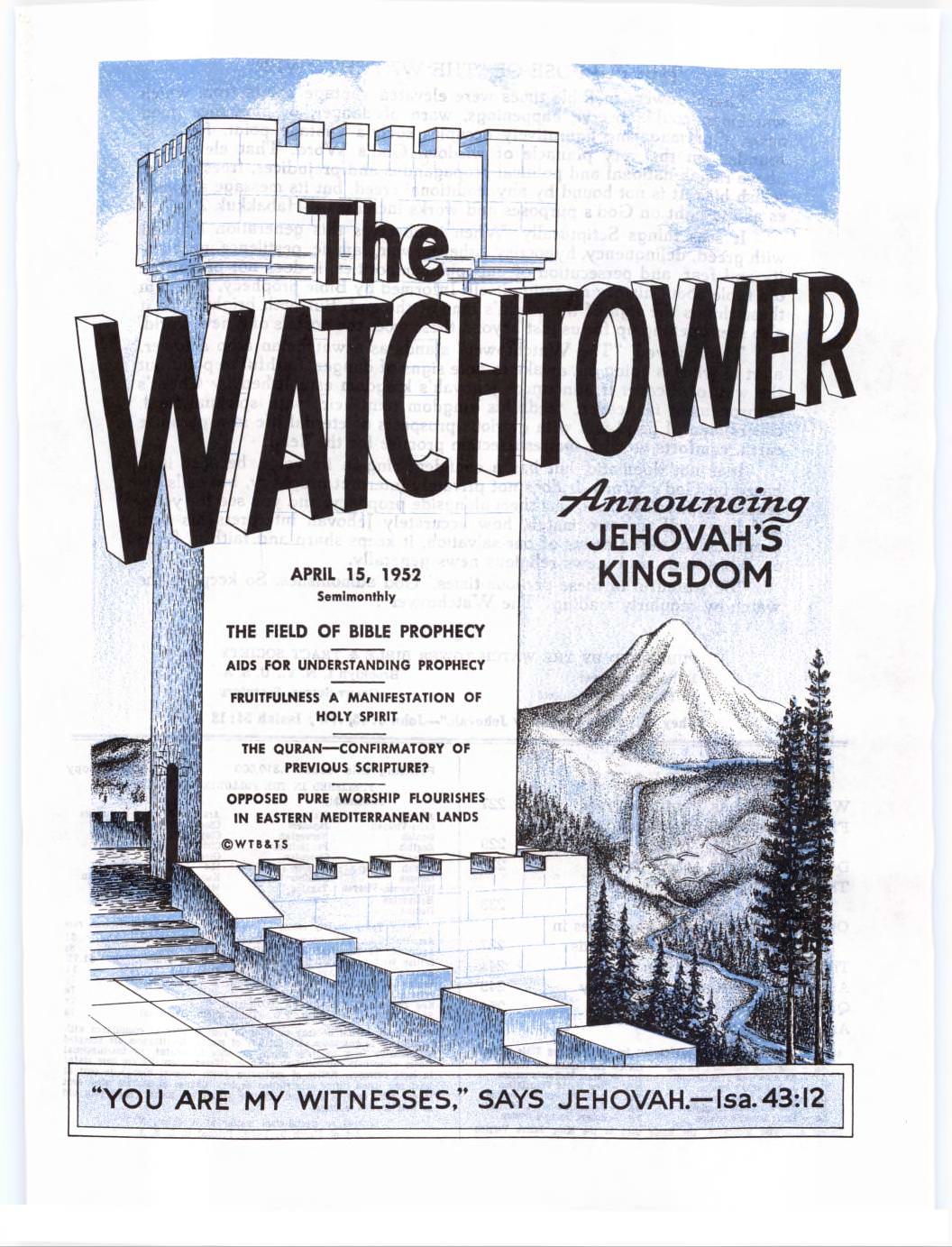
The WATCHTOWER
Announcing
JEHOVAH'S
KINGDOM
APRIL 15, 1952
Semimonthly
THE FIELD OF BIBLE PROPHECY
AIDS FOR UNDERSTANDING PROPHECY
FRUITFULNESS A MANIFESTATION OF
HOLY SPIRIT
THE QURAN—CONFIRMATORY OF
PREVIOUS SCRIPTURE?
OPPOSED PURE WORSHIP FLOURISHES
IN EASTERN MEDITERRANEAN LANDS
©WTB&TS
“YOU ARE MY WITNESSES,” SAYS JEHOVAH.—Isa. 43:12 THE PURPOSE OF "THE WATCHTOWER"
Literal towers in Bible times were elevated vantage points from which watchmen could observe happenings, warn of danger, or announce good news. Our magazine figuratively occupies such a vantage point, for it is founded on the very pinnacle of wisdom, God's Word. That elevates it above racial, national and political propagandas and prejudices, frees it from selfish bias. It is not bound by any traditional creed, but its message advances as the light on God's purposes and works increases.—Habakkuk 2:1-3.
It sees things Scripturally. When it observes this generation afflicted with greed, delinquency, hypocrisy, atheism, war, famine, pestilence, perplexity and fear, and persecution of unpopular minorities, it does not parrot the old fable about history repeating itself. Informed by Bible prophecy, it sees in these things the sign of the world's time of the end. But with bright hope it also sees opening up for us just beyond these woes the portals of a new world.
Thus viewed, "The Watchtower" stands as a watchman atop a tower, alert to what is going on, awake to note signs of danger, faithful to point out the way of escape. It announces Jehovah's kingdom established by Christ's enthronement in heaven, feeds his kingdom joint-heirs with spiritual food, cheers men of good will with glorious prospects of eternal life in a paradise earth, comforts us with the resurrection promise for the dead.
It is not dogmatic, but has a confident ring in its voice, because it is based on God's Word. It does not privately interpret prophecy, but calls attention to physical facts, sets them alongside prophecy, and you see for yourself how well the two match, how accurately Jehovah interprets his own prophecy. In the interests of our salvation, it keeps sharp and faithful focus on Bible truth, and views religious news generally.
'Be watchful in these perilous times,' God admonishes. So keep on the watch by regularly reading "The Watchtower".
২
PUBLISHED BY THE WATCH TOWER BIBLE & TRACT SOCIETY
117 Adams Street
Brooklyn 1, N. Y., U. S. A.
N. H. KNORR, President GRANT SUITER, Secretary
"They will all be taught by Jehovah."—John 6:45, NW; Isaiah 54:13
CONTENTS
Waterless Clouds, Fruitless Trees 227
Fruitfulness a Manifestation of
Holy Spirit 229
Devil Worshipers Accept Truth 232
The Quran—Confirmatory of
Previous Scripture? 233
Opposed Pure Worship Flourishes in
Eastern Mediterranean Lands 237
The Field of Bible Prophecy 241
Aids for Understanding Prophecy 249
Questions from Readers 254
Announcements 256
Abbreviations used in "The Watchtower" for the following Bible versions
AS - American Standard Version LXX - The Septuagint Version
AT - An American Translation Mo - James Moffatt's version
Da - J. N. Darby's version NW - New World Translation
Dy - Catholic Douay version Ro - J. B. Botherham's version
ED - The Emphatic Diaglott RS - Revised Standard Version
Le - Isaac Leeser's version Yg - Robert Young's version
Unless otherwise indicated, the Bible used is the King James Version
Printing this issue: 1,310,000 Five cents a copy
PUBLISHED IN THE FOLLOWING LANGUAGES
Semimonthly Monthly
Semimonthly
Monthly
Afrikaans
Italian
Arabic
Portuguese
Cebu-Visayan
Japanese
Cibemba
Russian
Danish
Norwegian
Cinyanja
Siamese
English
Pangasinan
Cishona
Silozi
Finnish
Slovenian
Greek
Slovak
French
Spanish
Ibo
Twl
German
Swedish
Kanareso
Ukrainian
Hiligaynon-Visayan
Tagalog
Malayalam
Yoruba
Hollandish
Zulu
Polish
Docano
Watch Tower Society offices Yearly subscription rate
America U.S., 117 Adams St., Brooklyn 1, N.Y. $1
Australia, 11 Beresford Rd., Strathfield, N.S.W. 8s
British West Indies, 21 Taylor St., Port of Spain, Trinidad $1.72
Canada, 40 Irwin Ave., Toronto 5, Ontario $1
England, 34 Craven Terrace, London, W. 2 7s
Jamalca, 151 King St., Kingston 7s
New Zealand, G.P.O. Box 30, Wellington, C. 1 7s
South Africa, Private Bag, P.O. Elandsfontein, Transvaal 7s
Remittances should be sent to office in your country in compliance with regulations to guarantee safe delivery of money. Remittances are accepted at Brooklyn from countries where no office is located, by international money order only. Subscription rates in different countries are here stated in local currency. Notice of expiration (with renewal blank) is sent at least two issues before subscription expires. Change of address when sent to our office may be expected effective within one month. Send your old as well as new address.
Entered as second-class matter at Brooklyn, N. Y., Act of March 3, 1879. Printed in U. S. A.
WATERLESS CLOUDS, FRUITLESS TREES
AFTER quoting Luke's Gospel where it tells of Christ's sending out some of his followers to do door-to-door preaching, the article in the Catholic magazine Information, January 1952, breezily asserts: "Those so commissioned, so charged were Catholic laymen." The same commission is upon Catholic laymen today, the writer contends. But, "it appears that it is others who are going about two by two" preaching. He has in mind such ones as Jehovah's witnesses, and bemoans their zeal in spreading a "mass of error" while lamenting Catholic failure to preach the "eternal and dynamic truth".
In a short item following this article a Jesuit priest seems upset about the same situation. After fretting over the zeal of Jehovah's witnesses and administering a subtle smear by associating them with Communists, he settles down to chiding an apathetic flock:
"The Church today must look to Catholic laymen and laywomen to reach the vast number of nonchurchgoers in the U.S. now estimated as numbering from seventy to one hundred million. Many of these people are out of all contact with Catholic teaching, and it seems they would actually be in a better position to learn about the Catholic truth if they were in Africa, or some other missionary region, where the voice of the missionaries or the catechists could reach them. Many millions in the U.S.A., who are not really members
of any religious denomination, are more aloof from Catholic teaching than if they were in a well-served mission land. Catholic lay people are intimately associated with these nonreligious people in business and social life. They know that these people have received little or no religious teaching. The Catholic laity has many opportunities to help them in a tactful way, to the better knowledge of the Church's teaching and her claims. They can offer to give them Catholic reading matter, take them to a sermon or instruction, or even a retreat, and introduce them to a Catholic Information Center. Nevertheless it would seem, in many cases, that even our Catholic lay folk who have attended Catholic schools, never think of their duty and responsibility to help others learn the Faith, and bring them to the one true Church founded by Jesus Christ."
But it is not fair to nag at the Catholic population in the foregoing ways. There are large numbers of them who love the Lord and would serve him if they were equipped. The Catholic Church organization is at fault. It has given its people no gospel, no good news to preach. Devout Catholics could tell others about repetitiously praying with beads, or kneeling before images, or enduring rituals in a dead language, or sprinkling water supposedly holy, or buying absolution or Purgatorial releases, or indulging in gambling at Church functions. No good news in such teaching.
Nothing inspiring in it. Maybe many Catholics tried it at first, only to find that their hearers confronted them with Bible texts exposing such follies. So they retired in a shell of silence.
How can one perform spiritual works when famished for spiritual food? How can clouds without water pour down refreshing rain? How can barren trees yield nourishing fruit? Throughout the big orthodox religious systems the prophesied condition prevails: "I will send a famine in the land, not a famine of bread, nor a thirst for water, but of hearing the words of the LORD." (Amos 8:11) The masses of people dependent upon these systems for spiritual sustenance have no water of truth, no fruits of the spirit; only religious traditions, formalisms, ceremonies, rituals, and wordy philosophies of self-styled wise men. So they are like "waterless clouds carried this way and that by winds; trees in autumn time, but fruitless".—Jude 12,NW.
Mark 11:12-14 tells of a fig tree that had leaves but no fruit, and when Jesus went to it to get fruit and found none he cursed it and it withered and died. Again, Luke 13:6-9 tells of a fig tree that had been unproductive for three years, and when the owner ordered it uprooted the caretaker requested that he be allowed to give it special attention for another year, to see whether it would respond and produce fruit, and if not then he would cut it down.
These illustrations were stated with the Jewish nation in mind. When Messiah Christ came he was hungry to see godly fruitage produced by the Jewish nation in covenant to do God's will. But he found none, and so eventually that nation withered and died so far as being Jehovah's chosen people. That nation was like the fig tree that had the appearance of being fruitful but was not. As shown by the illustration in Luke, this nation was given special and exclusive attention for years
before it was cast off and the gospel went to the Gentiles. Yet it never became fruitful in godly works, as a nation.
When Jude 12 speaks of the waterless clouds and fruitless trees, it adds concerning the trees, "having died twice, having been uprooted." How twice destroyed? First, these trees were as good as dead because they did not produce fruit. Not only were they taking up space but they were also costing money, because in Palestine at that time fruit trees were taxed. So to use the space to good advantage and to avoid paying tax on a worthless tree, it was uprooted. That would mark a second and final death for it, no stump being left out of which new shoots might grow. So the tree once as good as dead due to its fruitlessness becomes actually dead when uprooted, or twice dead. It illustrates the end of men and organizations who claim to serve God but who do not.
If we are to be pleasing to God we must bear Kingdom fruit. John 15:1-8 shows this clearly. Branches that bear no fruit are cut off entirely from the theocratic organization and die. Branches that do bear fruit are pruned so that they can bear more. Just as excess twigs and suckers are trimmed from a branch so that the sap and strength they once used can now go to fruit production, so all useless pursuits are pruned out of the Christian's life to gain freedom for gospel-preaching.
True Christians will so use their time and energy. They do not have to be chided into it. A proper understanding of the good news of Christ's kingdom thrills and inspires them to serve God. So let the Catholic Church reconsider the dry husks comprising its spiritual menu, and it will see why those who feed at its table are listless and apathetic, without spiritual zest and zeal. And let honest Catholics examine the Bible to see the source of strength for Jehovah's witnesses.
Fruitfulness
A Manifestation of Holy Spirit
LAST year when two seeds sprouted and grew in a Washington, D.C., greenhouse
it created a sensation in botanical circles. Millions of seeds sprout yearly, but these were special. They were lotus seeds from a Manchurian peat bog, and said by some to be 50,000 years old. When they germinated the importance of their age grew, and so other seeds from the same place were tested by the radiocarbon clock. This atomic clock showed they were around 1,000 years old.
For 1,000 years these seeds had lain idle, unproductive. Had they been properly planted shortly after their maturity by now the seeds descended from them would number many billions. But due to their idleness only the two original seeds existed last year. It is as Jesus said: "Most truly I say to you, Unless a kernel of wheat falls into the ground and dies, it remains just one kernel; but if it dies, it then bears much fruit."—John 12:24, NW.
So it is with the truths of God's Word, which truths are, in one of Jesus' illustrations, likened to seeds spread by a sower. (Luke 8:11) God's Word endures forever. (1 Pet. 1:25) But we cannot wait that long to sow the truths contained therein. We must not allow them to lie idle for 1,000 years, like the two lotus seeds. We are not sure of life tomorrow, much less 1,000 years hence. (Prov. 27:1) We must sow now, without delay, to produce Kingdom fruits. After sowing the seed of truth by such means as witnessing from door to door, we must return to water and cultivate by making calls back and conducting
home Bible studies, and then rely upon God to give the increase. (1 Cor. 3:6) Thus we build on
the foundation we laid in door-to-door sowing. Jesus did not build on another's foundation. He is our model. Paul did not build on another's foundation. We are told to imitate him. (Rom. 15:20; 1 Cor. 11:1; 1 Pet. 2:21) By engaging in all features of gospel-preaching we see the truth seeds we have sown sprout and grow and become rooted in the minds and hearts of others, who in turn become fruitful sowers of the seed elsewhere.
In Jesus' illustration the persons to whom we preach are likened to different types of soil; some not receiving the seed because of being too hard, or too rocky, or too thorny, but some being receptive to the seed and becoming productive. (Matt. 13:3-9, 18-23) When we leave the seed in the form of literature at the door, we cannot be sure just what type of soil pictures the obtainer. Even an experienced farmer cannot always accurately judge the soil merely by looking at it. Sometimes he must have it analyzed. Similarly, the minister cannot judge the results of placements at the door just by the appearance of the obtainer. Even the experienced publisher is often wrong. So we must call back to check on the seed, to see whether it has taken root, to see whether further care symbolized by watering and cultivating will stimulate its growth. We do not make the mistake Jesus warned against: "Stop judging from the outward appearance, but judge with righteous judgment." (John 7:24, NW) So we do not make snap judgments from the appearances of things at the time of literature placement, but to rightly judge whether the obtainer is symbolized by thorny ground, or rocky ground, or hard-packed ground alongside the road, or good soil we follow through with further calls.
This is in the interest of fruitfulness.
"FRUITAGE OF THE SPIRIT"
The increasing number of ministers that comes in the wake of this sowing is an evidence of the backing of Jehovah's spirit: "Not by might, nor by power, but by my spirit, saith Jehovah of hosts." (Zech. 4:6, AS) But increase of numbers alone is not sufficient; many false religions can point to numerical increases in their congregations. To judge the tree we must examine the fruit: "Every good tree produces fine fruit, but every rotten tree produces bad fruit; a good tree cannot bear bad fruit, neither can a rotten tree produce fine fruit. Every tree not producing fine fruit gets cut down and thrown into the fire. Really, then, by their fruits you will recognize those men."—Matt. 7:17-20, NW.
The fine fruit is of the spirit, the bad is works of the flesh: "Now the works of the flesh are manifest, and they are fornication, uncleanness, loose conduct, idolatry, practice of spiritism, hatreds, strife, jealousy, fits of anger, contentions, divisions, sects, envies, drunken bouts, revelries, and things like these. As to these things I am forewarning you, the same way as I did forewarn you, that those who practice such things will not inherit God's kingdom. On the other hand, the fruitege of the spirit is love, joy, peace, longsuffering, kindness, goodness, faith, mildness, self-control." Gal. 5:19-23, NW.
The big orthodox religious organizations of Christendom may be able to point to numerical strength, but can they show the fruitage of the spirit? The world generally is now in the throes of a moral breakdown,
laboring overtime in works of the flesh. Do the big religious organizations stand out as different from this materialistic world? Instead, are they not a part of it, submerged in its fleshly works? They are never cited as being outstandingly different from mankind in general—and certainly they would be if they were producing the fruitage of the spirit that is so rare in this delinquent world.
However, Jehovah's witnesses do stand out as different. Not only are they different because they preach from door to door, call back, conduct studies, train new ministers and show increases at a time when many religions lament waning interest and fading congregations; but they are also different because they produce the fruitage of the spirit. For example, worldlings come to our big assemblies and see there what they cannot do, what the United Nations cannot do, what no other human organization can do. They see persons of many different races, nationalities, languages and former religions all now united in peace and unity, having overcome the barriers that divide this world. Joy beams from all faces, and love and co-operation and kind consideration are manifested among the huge crowds, sometimes exceeding 100,000 persons. The visiting worldlings are amazed at the efficient organization of all the many activities, and readily admit it is absolutely unmatched by any worldly organization. Yet as they scratch their heads in puzzlement they acknowledge that we appear to be just ordinary, average people. Which, of course, is true.
When they ask for the explanation of this unity despite differences that split the world wide open, we tell them that God's spirit is the unifying force, that what they are seeing is the result of or the manifestation of holy spirit. We are joyful when they observe these things, for it is evidence that we are producing the fruits of the spirit, setting us apart as different from those absorbed in the works of the flesh.
But it puts these worldly observers in a critical position, a very responsible one, and a wrong decision could make them fit subjects for eternal destruction. How so? Because of the possibility of unforgivably sinning against the spirit.
SIN AGAINST HOLY SPIRIT
To clarify this, please get out your Bible and read Matthew 12:22-33. Jesus had just cured a demon-possessed man—a thing not possible through human power. The onlooking crowds knew this, and were ready to recognize Jesus as the son of David on the basis of the miracle. But the Pharisees rejected the miracle as a manifestation of God's spirit and countered that it was performed by Satan's power, thereby blaspheming and speaking injuriously against and sinning against the holy spirit. They knew that if they accepted this as God's spirit they must accept Jesus as Messiah. They must acknowledge themselves as false teachers, abandon their way of living and become followers of Jesus. This would remove them from their lofty position with its many selfish gains. They were unwilling to give up such things and so deliberately refused to accept this evident operation of Jehovah's miracle-working spirit.
Eventually they succeeded in putting Jesus to death, but just as he had said about the kernel of wheat having to die to become productive, his death only resulted in producing many more anointed ones who had gifts of the spirit by which they performed miraculous signs, such as the speaking in tongues, prophesying, gifts of knowledge, gifts of healing, and so forth. The performance of these miracles by the apostles and their associates was an open manifestation of the operation of God's holy spirit, and those who would not accept it were willfully resisting the spirit, sinning
and blaspheming against it and marking themselves for eternal destruction. Just as the religious clergy had once complained that the world was going after Jesus because of his miracles, they now lamented that his followers were by similar works turning the earth upside down, upsetting their religious order of things.John 12:17-19; Acts 17:6; 1 Cor. 12:1-11.
However, these miraculous manifestations of the spirit were to cease: "Love never fails. But whether there are gifts of prophesying, they will be done away with; whether there are tongues, they will cease; whether there is knowledge, it will be done away with. For we have partial knowledge and we prophesy partially; but when that which is complete arrives, that which is partial will be done away with. When I was a babe, I used to speak as a babe, to think as a babe, to reason as a babe; but now that I have become a man, I have done away with the traits of a babe."—1 Cor. 13:8-11, NW.
The purpose of these miraculous gifts upon the infant church was to get it started and established, to show God's transfer of his spirit from the Jewish Mosaic Law organization to the new Christian system of things. After it had grown out of its infancy and maturely stood on its own feet, these miraculous gifts would no longer be practiced. They would not be needed. That is why the miraculous gifts are not with the Christian organization today. Without such aids the mature church, fortified with advanced Scriptural knowledge and fulfillments of many prophecies, can preach a convincing message and make progress with those having hearing ears. It still has the holy spirit upon it, but that spirit is manifested in a different way, primarily by love and all the other associated fruits mentioned in Galatians 5:22, 23 and 1 Corinthians 13:4-7.
spirit that worldly observers note at our assemblies. They acknowledge we are just average people, yet see the organization is unlike any other human organization because of the fruitage of the spirit. But this manifest operation of holy spirit does not make them become a part of the unified organization they marvel at. Pharisaical selfishness prevents them from giving up their way of life, their enjoyment of works of the flesh, their part in the world and its organizations. They resist being moved in the right direction by this manifestation of holy spirit, and are skeptical that it is due to God's spirit. Like the Pharisees, they look for other causes and assign other reasons for the joy and peace and unity that so amazes them. So in effect are they not sinning against the manifest operation of the holy spirit, and is it not possible that they are thereby condemning themselves to eternal death?
But in it all our role is to always manifest our possession of Jehovah's spirit. It is not in our own strength that we unceasingly preach in all the earth, face up to persecution, endure mob violence, suffer imprisonment, maintain integrity to death, and yet continue to increase and overflow with the fruitage of the spirit. In private conduct and in public witnessing, as individuals and as an organization, we must always walk according to the spirit and not after the flesh. We must be "for signs and for wonders", be "a theatrical spectacle to the world"; and it is possible only if we make manifest God's spirit upon us. Isa. 8:18; 1 Cor. 4:9, NW.
So do not allow the seeds of truth to lie idle and unproductive for 1,000 years, like the two lotus seeds. Rather, sow and water to the end that God may give the increase and make manifest his spirit upon the theocratic organization. It will divide the people during this judgment period soon to be climactically ended by Armageddon.
DEVIL WORSHIPERS ACCEPT TRUTH
About a year ago a number of us were preaching the good news of God's kingdom from door to door in a certain village in the Calabar province of Nigeria. I was turned away from the first door with "I am not a Christian, I am for Ekpo". (Ekpo is a secret, devil-worshiping society.) After trying in vain to break through this shell I went to the next door, where I got the same response. Suddenly we heard a loud shout and almost immediately we were surrounded by about thirty young men, armed with machetes, who had jumped out of the bush. They were Ekpo members and tried to frighten us by menacing gestures. Seeing our complete lack of fear some went away, but others seized us and dragged us back to where we had left the other ministers. They mocked and jeered us as we went and expressed their determination that no further preaching would be done in the neighborhood. However, to their disappointment they found that preachers had already covered the rest of the village and had left literature with a number of the people. They then assembled in a compound belonging to an Apostolic Church member and took counsel on what to do next. But Bible questions were asked by this man, and we had the privilege of answering from the Bible in the presence of these devil worshipers. Today, more than a year later, the once-Apostolic Church member is going from house to house himself, as one of Jehovah's witnesses. More than eighty of the one-time mockers have turned up for the four public talks recently given in this same village. And now there are fourteen Christian ministers who are preaching regularly where a year ago there was only one. A new congregation has been formed. Truly "Jehovah knows those who belong to him".—From a circuit servant in Nigeria.
THE Quran is the holy book of Islam and by the 250 to 300 million Muslims throughout the world is regarded as inspired. It makes many references to persons and incidents mentioned in the Bible, such as Adam, Noah, Moses, Jesus and the Flood. Compiled in the middle of the seventh century A.D. by the associates of Muhammad who survived him, it claims to corroborate previously given divine revelation. "And we gave [Jesus] the Evangel with its guidance and light, confirmatory of the preceding Law; a guidance and warning to those who fear God . . . And to thee we have sent down the Book of the [Koran] with truth, confirmatory of previous Scriptures, and their safeguard."—Sura 5:50-52, Rodwell.
There can be no question about it. God is a God, not of confusion, but of reason and order. The revelations he gives to men must be consistent with each other if we are to prove God true but all men liars. (1 Cor. 14:33; Isa. 1:18; Rom. 3:4) And so we find it to be the case as regards the writings of the Hebrew Scriptures and the Christian Greek Scriptures. The 39 books of the Hebrew Scriptures are harmonious with each other though written by more than thirty different men over a period of many, many centuries. And the 27 books of the Christian Greek Scriptures are both harmonious with one another and confirmatory of the Hebrew Scriptures.
That is why Christ Jesus could tell the religious leaders in his day: "You are searching the Scriptures, because you think that by means of them you will have everlasting life; and these are the very ones that bear witness about me." (John 5:39,NW) And that is why the Beroeans were commended for carefully examining the Scriptures to
make sure that what Paul was telling them was indeed confirmatory of previous Scriptures; and why Paul counseled Timothy to be diligent in his studies of the Scriptures. Acts 17:11;2 Tim. 2:15;3:15-17.
By thus confirming and harmonizing with each other, both the Hebrew and the Christian Greek Scriptures support each other's claim to authenticity. We should therefore expect to find the Quran, since it also claims divine inspiration, to be harmonious with and confirmatory of previous revelation. But do we? Let us see.
The name of Jehovah, peculiar to the God of the Bible, is given the place of first importance throughout the Hebrew Scriptures. (See Exodus 6:3; 2 Samuel 7:23; Psalm 83:18, etc.) Christ Jesus and his followers also highlighted the importance of that name. (John 17:4,6; 18:37; Acts 15:14) And although that name is missing from most versions of the Christian Greek Scriptures, ancient manuscripts of the Greek Septuagint show that the early Christians used the name Jehovah.
But what about it in the Quran? Although the name of Jehovah appears 6,823 times in the Hebrew Scriptures alone, we fail to find a single reference to it in the Quran. Clearly the Quran is not confirmatory of previous Scriptures as regards the name of Jehovah. Its Allah is nameless.
Again, the Hebrew Scriptures teach that the penalty for sin is death: "For dust thou art, and unto dust shalt thou return." "For the living know that they shall die: but the dead know not any thing." "The soul that sinneth, it shall die." (Gen. 3:19; Eccl. 9:5, 10; Ezek. 18:4). The Christian Greek Scriptures confirm this by telling us that "the wages sin pays is death". (Rom. 6:23, NW) Such texts as seem to indicate otherwise are found to be illustrations given by Jesus in his parables or in the book of Revelation and are not to be taken literally, no more than the surrounding context is. See Luke 16:19-31; Revelation 20:14.
But the Quran, far from confirming the foregoing, strikingly disagrees with it, warning of hell-fire, eternal torment and punishment after death in 75 per cent of its suras, literally hundreds of times. "Those who reject our Signs, We shall soon cast into the Fire: as often as their skins are roasted through, we shall change them for fresh skins, that they may taste the Penalty." And those in hell will plead for destruction but will not get it. (Sura 2:206; 4:56; 25:13,14 Ali) Says a Muslim commentator (Ali): "Anything—total annihilation—would be better than the anguish they will suffer. But no annihilation will be granted them." Can such a god be properly described as "the Compassionate, the Merciful", as the Quran does in every sura's beginning (except the ninth)?
REGARDING CHRIST JESUS
The Hebrew Scriptures quote the true God as saying: "I said, Ye are gods, and all of you sons of the Most High. Nevertheless ye shall die like men." And again: "Thou art my son; this day have I begotten thee." And Isaiah foretold: "For unto us a child is born, unto us a son is given; and the government shall be upon his shoulder: and his name shall be called Wonderful, Counsellor, Mighty God, Everlasting Father,
Prince of Peace." (Ps. 82:6,7; 2:7; Isa. 9:6, AS) Clearly these scriptures indicate that Jehovah God has sons who are called gods, and that among these there is one who occupies a preferred position.
And the Christian Greek Scriptures time and again confirm the foregoing both by direct quotations and by identifying this particular Son of God as the Messiah, Christ Jesus. "This is my Son, the beloved, whom I have approved."—Matt. 3:17; 17:5; John 10:34; Heb. 1:5, NW.
But in this again the Quran fails to confirm previous Scripture, for, while acknowledging that Jesus was born of a virgin, it repeatedly insists that God does not have offspring: "Sole maker of the Heavens and of the Earth! how, when He hath no consort, should He have a son? He that created everything, and He knoweth everything!" "It beseemeth not God to beget a son. Glory be to Him! when he decreeth a thing; He only saith to it, Be, and it Is."—Sura 2:110; 6:101; 19:19-22,36, 91-93; 72:3; 112:3, Rodwell.
Evidently the difficulty here lies in making too literal a comparison of the Fatherhood of God with that of human creatures. A man cannot have a son without a spouse with whom he has sexual relationship; that is the only way in which he can bestow life upon another. But God is not so limited. The Bible speaks of Adam as being the son of God; yet it also tells us that he made Adam out of the dust of the ground.—Luke 3:38; Gen. 2:7.
God is a God of order and he has chosen to use an organization for the carrying out of his purposes in heaven just as he has used and does use organizations of men on earth to carry out his purposes. Time and again these organizations are referred to as God's spouse, which, of course, is in a figurative sense. By means of such an organization he brought forth spirit creatures, and since these received life from God they are properly spoken of as "sons of God".—Isa.
54:5; Rev. 12:1; Gen. 6:4; Job 38:7.
The Hebrew Scriptures also foretold that the Messiah would come, would suffer, would be nailed to the torture stake and would die for the sins of others. "The assembly of the wicked have inclosed me: they pierced my hands and my feet." "Surely he hath borne our griefs, and carried our sorrows; . . . But he was wounded for our transgressions, . . . he was cut off out of the land of the living for the transgression of my people."—Ps. 22:1-21; Isaiah chapter 53, AS.
And the Christian Scriptures confirm all this also, from beginning to end, telling not only that Jesus suffered but that he also died on the stake and that for the sins of man. "For I handed on to you, among the first things, that which I also accepted, that Christ died for our sins according to the Scriptures, and that he was buried, yes, that he has been raised up the third day according to the Scriptures."—Matt. 27:31-36; John 1:29; 1 Cor. 15:3,4; Gal. 3:13,NW.
But far from confirming previous Scripture in these matters the Quran states: "They said (in boast), 'We killed Christ Jesus' . . . But they killed him not, nor crucified him, but so it was made to appear to them . . . for of a surety they killed him not." (Sura 4:157, Ali) A footnote to the foregoing states (n.663): "The Orthodox Christian Churches make it a cardinal point of their doctrine that his life was taken on the Cross, that he died and was buried. . . This is necessary for theological doctrine of blood sacrifice and vicarious atonement for sins, which is rejected by Islam."
By rejecting the doctrine of the atonement for sin the Quran further denies its claim to be confirmatory of previous Scripture. From Genesis through Revelation
the Bible unequivocally states that the penalty for sin is death (as we have already seen) and that only a sacrifice can expunge the guilt. The need of a sacrifice for sins was emphasized in the many sin and trespass offerings and particularly by the offerings made on the day of atonement, all of which were a vital part of the Mosaic law arrangement. (Leviticus, chapters 4-7,16) All of these established the principle that "unless blood is poured out no forgiveness takes place", and they had their fulfillment in the sacrifice of Christ Jesus.—Hebrews, chapters 9,10,NW.
Then again, according to Genesis 7:13; 10:1 it is apparent that Noah and his sons, all of them, as well as their wives, were spared. This is confirmed by 2 Peter 2:5, which tells that Noah and seven others passed through the flood. But according to the Quran, one of Noah's sons was destroyed in the flood.—Sura 11:36-47, Ali.
And in considering the relative positions of angels and man the Christian Greek Scriptures confirm the Hebrew Scriptures that man was created a little lower than the angels; but according to the Quran, the angels are inferior to man.—Ps. 8:5; Heb. 2:7,9; Sura 2:30-34, Ali.
More instances could be given but the foregoing should suffice to show that the Quran does not live up to its claim to be confirmatory of preceding Scriptures.
THE BIBLE CORRUPTED?
In endeavoring to explain such discrepancies as have been noted in the foregoing, Muslim writers contend that the Quran does confirm previous Scriptures as they were originally given, but that it could not be expected to confirm the corrupted versions extant today. But since when? Surely, in view of the many ancient manuscripts at hand today it cannot be argued that the Scriptures were corrupted since Muhammad's day. If they were corrupted at all such must have been done before his time.
But this poses another problem: Why hold out the Quran as confirmatory of previous Scriptures when there were no particular Scriptures extant at the time by which this claim could be proved?
The fact is that not even the Quran teaches that the Hebrew and Christian Scriptures had been corrupted in Muhammad's day. It implies just the opposite, for it accuses Jews and Christians of being false to their Scriptures, either by misquoting them, 'displacing words' or by failing to quote them completely, 'throwing them behind their backs,' as it were.
"And some truly are there among them who torture the Scriptures with their tongues, in order that you may suppose it to be from Scripture, yet it is not from the Scripture." "O children of Israel, . . clothe not the truth with falsehood, and hide not the truth when ye know it." How could they be accused of torturing the Scriptures with their tongues, if what they had were not indeed the Scriptures? And how could they be accused of knowingly clothing the truth with falsehood and of hiding it, if their Scriptures were already corrupted?—See Sura 2:38, 39, 70-73; 3:63, 64, 72; 4:50, 135; 5:16, 47, 50-52, 70, 72; 10:94, Rodwell.
In view of all the foregoing it is not at all surprising to learn that Muslim commentators themselves fail to agree that the Hebrew and Christian Scriptures are corrupted. Arguing against such corruption is none other than Razi himself, one of their foremost Imams, or religious leaders. According to him: 'tampering with the Tourat [the Law, Pentateuch or Book of Moses] and the Evangel [the gospel of Christ Jesus] was impossible, as both were handed down in an unbroken and widespread succession.'
Yes, in spite of the contentions of Muslim scribes and modern "Christian" higher
critics to the contrary, the facts of history all argue against the Bible's having been corrupted. Wherever contemporary historians touch on incidents recorded in the Bible they corroborate them, such as the anti-Christian writers of the first and second centuries A.D.; even as countless archaeological discoveries and geological findings have done. According to one Albright, foremost American archaeologist, 'nothing has been discovered by archaeology to shake the faith of the Christian in the Bible in the slightest.'
In this connection note also the words of the noted scholar, Sir Frederic G. Kenyon, of England: "The interval then between the dates of original composition and the earliest extant evidence becomes so small as to be in fact negligible, and the last foundation for any doubt that the Scriptures have come down to us substantially as they were written has now been removed. Both the authenticity and the general integrity of the books of the New Testament may now be regarded as firmly established. General integrity, however, is one thing, and certainty as to details is another." The Bible and Archaeology (published 1940), pp. 288, 289.
And the evidence is piling up that the same is true regarding the Hebrew Scriptures. A striking case in point being the recently discovered Dead Sea scroll of Isaiah, which though some seven centuries older than any other copy of Isaiah, revealed no striking changes so as to indicate a corruption of text.
The facts are clear. The Christian Greek Scriptures do confirm the previous revelation, the Hebrew Scriptures; but the Quran, although claiming to do so, does not, confirming neither. And the blame for its not being "confirmatory of previous scripture" cannot be shifted to a supposed corruption of the Biblical text, but lies with the Quran itself.
Opposed Pure Worship Flourishes in
Eastern Mediterranean Lands
A report received from N. H. Knorr, president of the Watch Tower Bible and Tract Society, while on a lecture tour of southern Europe, the Middle East and Indla
WE SPENT a few days in Rome after the assembly. I was able to talk over many problems with the missionaries and circuit servants and check matters in the branch office of the Society, as well as to give instructions for the work that is still to be done in Italy. The visit at the Bethel home in Rome was very pleasant, and I was glad to see how nicely the home and surrounding gardens are kept.
Thursday, December 13, came much too soon. We rose at 4:15 a.m. and all of the members of the family and missionaries living at the home got up to say good-by. They all wanted to go to the airport with us, but there was no way at that hour in the morning to get to the airport. It would be so much more practical for all of them to go back to bed and get a little more rest for the coming day's work. So off we went in a taxi with the branch servant to the airlines office.
When we arrived at the airport at daybreak we were surprised to find two Dutch sisters there. They had come to the assembly from the Netherlands, but we did not expect to see them at the airport. They had come to say good-by to us. We wondered how they got out there, and they said they had come out the night before and stayed at the waiting room all night.
At 7:20 we were on our way to Athens,
Greece. As we flew along the western coast of Italy we saw the beaches made famous by World War II and the little harbors and villages of ancient origin. It was not long until we flew over Naples. There was Mount Vesuvius and near the base the ruins of Pompeii. Beyond were ranges of mountains whose peaks were covered with snow. It was clear and we could see hills and valleys below as we crossed the "toe" of boot-shaped Italy, not far from Catanzaro, and passed over the Ionian sea. It looked warm with the bright sun shining on the waters and scattered clouds. But once we approached Greece we could see a heavy blanket of snow covered all the land to the north and south of the Gulf of Corinth, and we knew it was cold down there.
ATHENS, GREECE
We arrived at the Athens airport at 11:50 Athens time, there to be met by many happy brothers and sisters who there began their showing of warm hospitality. A car awaited us and took us along the seaside drive toward the city of Athens. Across the bay we saw Piraieus and to our right the snow-covered hills beyond Athens. The ruins of the Parthenon shone in the bright sunlight there on the Acropolis in the center of the city area. We were told that snow was a rare occurrence, because snow seldom falls in Athens. The day before our arrival had been a bad one, but now the sun shone brightly and all felt glad.
The branch servant, Brother Idreos, gave us a schedule for activities from the time of our arrival until we were to leave.
Every minute was used profitably. We first checked in at our hotel and then went on to the Bethel home, where we had lunch with the family. It was a joy to be with them again. This time the quarters in the building were a little larger, because certain adjustments had been made during the years to get more space in the building. While the brothers have a nice apartment there, still it is not sufficiently large to accommodate all the family, and it is necessary for a number to find quarters outside.
The printing of the Greek Watchtower and books and booklets is managed by the branch in Athens for local use. That afternoon we visited the two locations where publication is done because it is impossible to find one place large enough to accommodate the whole printing department. All the publications are set up first in hand type and then the chases are carried to the printing factory. Some typesetting is done by a commercial firm on the linotype, but the greater amount of the work is done by hand-type composition. After the sheets are printed they are bundled and brought to the first location. We saw where the type is set, and there folding and stitching takes place. This adds a lot of extra work, but there is no way to change it unless a building can be obtained to house all the equipment or something is constructed by the Society. This presents a big problem.
We went back to the branch office to discuss the many questions that have arisen in Greece. The work in this country cannot be carried on as freely as in other democratic lands. The Greek authorities are powerfully influenced by the Greek Orthodox Church, which is the state church, and for years no permission has been given for public assembling of Jehovah's witnesses. It is impossible to obtain Kingdom Halls and there gather the brothers for pure worship. So all of the Christians who desire to serve God must do so with the possibility of being arrested and put into jail. Many small meetings are broken up from time to time by the police, the accusation being made that Jehovah's witnesses are proselyting others, which is contrary to the Constitution. But when it is found that all present are Jehovah's witnesses and have the same faith they are usually allowed to go free after spending a night in the prison. The brothers and sisters are not fearful of this inconvenience to their daily work or routine, because they know that worshiping God according to his commandments is more important than possibly losing a job.
INCREASE DESPITE PERSECUTIONS
The zeal and determination to carry forward the preaching of the gospel found in the Greek brothers are something to be admired. In 1947 when I made the previous visit to the branch office and talked to some of the company servants there were 1,891 publishers on the average. Despite the persecutions and opposition against the work, the "other sheep" are being gathered together and in the year 1951 there were 3,368 regularly preaching the good news in all parts of Greece. They reached a new peak of 4,163. It really takes courage on the part of these publishers to press on in the work. In 1947 there were only five pioneers and now there are 27. They have some books and magazines, but even these cannot be distributed to the publishers through the mails. They must be taken about the country by other means. Jehovah is blessing them in their efforts to overcome their problems.
The first evening we were there we attended the service meeting and theocratic ministry school of the Bethel family, all of which was in Greek, but interesting to observe, for it showed how even in small gatherings they carried on with demonstrations and gave very instructive information to those present concerning how to conduct themselves in the field.
After this meeting I spoke to the family for a while and then Brother Henschel made some remarks, all of which were greatly appreciated by them.
The next day found us discussing with the Society's legal counsel many of the legal issues and we prepared some material to present to the American Embassy to see what could be done in the way of claiming constitutional rights for Jehovah's witnesses in Greece. An arbitrary ruling has been set forth by one department of the Greek government saying that all publications of the Watch Tower Society and Jehovah's witnesses must be marked "Heresy of Jehovah's witnesses". At the present time they are marked in accordance with the law as "Publications of Jehovah's witnesses". The Protestant organizations can distribute their literature when it is stamped with merely the name of the organization or marked as "belief" or "dogma" of an organization. But for Jehovah's witnesses they insist on using the word "heresy". There is no law which requires the use of this word, but the post office will not accept our publications without it. This makes a great expense for the Society in the distribution of the publications, especially the subscriptions, so we will try to see what can be done. There is certainly no objection to stamping the publications with the words "Beliefs of Jehovah's witnesses" because we are proud of what we believe, which is based on God's Word of truth.
That afternoon the big event of the visit to Greece was to take place. An effort had been made by the branch servant to obtain permission for a special meeting of Jehovah's witnesses in a theater in the city and application was filed with the police. The branch servant was not able to get a satisfactory answer and when he went to
the police headquarters on the day of our arrival he was told that the "opinion" of the archbishop was being awaited and that he must be patient. So it was not possible to hold a regular convention.
MEETING WITH THE BROTHERS
The alternative was to visit many of the brothers throughout the district of Athens. The schedule was made whereby I would be taken from one home to another by taxi to talk to the brothers for approximately twenty minutes. There were groups of forty to more than a hundred that met at certain hours of the afternoon in different homes. Sometimes there were considerable distances to cover between homes. All this was scheduled from 1 o'clock until 7:15 at night. Brother Henschel followed me at every one of these homes and he too talked about twenty minutes through an interpreter. By this means all of the brothers possible were given attention, spiritual admonition and encouragement.
It was one of the most blessed experiences of our lives, and in this way we spoke to 905 of our Greek brothers for a period of more than six hours. It was a pleasure to see the joy on the faces of all these faithful servants of the Lord. It was not like speaking from a platform, with the audience some distance from you, but you were in the midst of a group of eager people with eyes sharp and ears hanging on every word that was spoken and everything done. We did not have time to shake hands or give special greetings to individuals. It was just moving into the home, usually not taking off the coat, and starting in talking. The publishers appreciated the love and greetings from the brothers world-wide and were delighted to receive information direct from headquarters and to be told how their zeal was helping their brothers in other lands and their brothers were shoulder to shoulder with them in this great fight for freedom and proclaiming the message of the Kingdom.
Words will never describe the joy they had nor ours.
Anything to happen in Greece after this experience would be mild as far as excitement and pleasure are concerned. These groups had all risked arrest by coming together, but they had no fear. They wanted to take in more life-giving knowledge. Their only complaint was it was too short. The day ended with a late evening meal at the Bethel home amidst a happy and contented family. The day had been a success and a great time of spiritual feasting for the publishers in Greece. It made the heart of Brother A. Karanassios, the former branch servant, glad as he lay in his sickbed. He had seen the work grow over the years in Greece and now in his old age he was nearing the finish of his earthly course with joy over the blessings and protection of Jehovah upon the good work.
PLANS FOR EXPANSION
Saturday's work started with the consideration of the morning Bible text with all the Bethel family at breakfast, and then more discussions on problems and visiting properties which might be purchased by the Society for the building of a home that would house the local printing plant and office and the whole Bethel family. This matter was given serious consideration and it is hoped that arrangements can be made by the Society to obtain property and build a structure that will facilitate the work in Greece.
At noon we called on the American Embassy and presented our problems to a friendly official. He assured us he would pass the information given him on to those in authority in the Greek government and see what could be done to bring some relief from the difficulties we face. It was interesting to talk with him and see how
he was well aware of the attitude of the Greek Orthodox Church officials toward our work and that of other non-Orthodox people in Greece. His explanation of their conception of freedom was informative.
Later in the afternoon discussions were had with the company servants from many cities in Greece, as well as islands of the Aegean sea, dealing with their problems, and later with the circuit servants who visit the companies throughout all of Greece. They asked many questions and problems were discussed pro and con. The meeting began at 1:30 p.m. and concluded at 5:45. There were 67 persons in attendance. A few of the full-time publishers asked about going to Gilead and it is hoped more publishers from Greece will soon have that privilege.
Sunday's coming meant our time for departure had arrived and our busy days in Athens were quickly gone. More of Jehovah's witnesses were to be visited and Istanbul was the next stop. So off to the airport we went. About 55 were there to see us off and we were happy with them over the fruitful visit we had together. Indeed they had had an assembly and they were determined to press on diligently in aiding the "other sheep" to take their stand before the final battle of Armageddon. There was no question in their minds that the new world ruled by Christ Jesus is the thing that is needed and they are going to preach the message even if it means the governments of this earth take their life. Some in Greece have lost their lives. Many have been in prisons and are now there. Many are persecuted. But the Lord's Word points out that when his people are scattered, then they will go forward everywhere preaching the gospel. Trying to scatter Jehovah's witnesses in Greece has resulted in a great witness and they will continue to promote clean, undefiled worship of the Most High God, Jehovah.
The Field of BIBLE PROPHECY
"No prophecy of Scripture springs from any private release."—2 Pet. 1:20, NW.
DIVINE prophecies! What are they? Why are they used? Where do they originate? Who are used to transmit them? By what means and in what manner are they transmitted? Are there any keys which unlock them? Do they have more than one fulfillment? How may they be proved to be true? When may they be understood? In what sense do Jehovah's witnesses prophesy today? To understand the vast field of Bible prophecy these and many other questions require answering.
2 At the outset, what are Bible prophecies? They are part of the host of divine revelations of Jehovah God recorded and preserved for us in the Hebrew and Greek Scriptures. A large part of the Bible is written in this form of sacred pronouncement. (Rom. 3:2, NW) Jesus indicated this when he said: "All the things written in the law of Moses and in the Prophets and Psalms about me must be fulfilled." (Luke 24:44, NW) Prophecy is the foretelling of something that is to occur in the future. It is the teaching or foretelling of future events beyond the power of natural man. Therefore prophecy that is true is a statement of facts and happenings made known ahead of time to take place in the future. Otherwise stated, prophecy is history written in advance.
3 Why has God used this form of sacred pronouncement? It appears that God has chosen to state ahead of time many of his majestic purposes and their details in the form of prophecy as an evidence of his foreknowledge and of his mastery of the situation produced by the rebellion in Eden. Further, he used this kind of sacred pronouncement in order to hide or conceal sacred secrets which would serve as spiritual food for his servants to feed from at their unfolding in future generations. Many of these secrets had a surface or limited application at the time they were transmitted, but they were so presented as to contain deeper hidden matters to come to light in later times. (Eph. 3:5; Matt.10:26,NW) The study of Bible prophecies and their fulfillments is necessary to arrive at an accurate knowledge of the truth concerning God and his incoming new world of righteousness. (Eph. 1:17, NW) It is necessary in order to build one's faith in God and Christ Jesus, the King. The true religion's being a revealed religion based on divine revelations, Christians as practicers of true worship do not follow the foolish course of many today who treat prophecy with contempt. Rather the true worshipers "make sure of all things" and "hold fast to what is right", and this includes divine
1, 2. What are some questions that pertain to the field of Bible prophecy? What are Bible prophecles?
Why has God chosen to use prophecy as a form of sacred pronouncement?
revelations in the form of prophecies. 1 Thess.5:20,21,NW.
4 Bible prophecies originate with Jehovah God. They do not spring from the genius of any man. "No prophecy of Scripture springs from any private release. For prophecy was at no time brought by man's will, but men spoke from God." (2 Pet. 1:20, 21, NW) Hence Jehovah God is the author of true prophecy. Jehovah is the great Author and Finisher of his works, and this is so indicated in Revelation 1:8 (NW), where it says: "I am the Alpha and the Omega,' says Jehovah God, 'the One who is and who was and who is coming, the Almighty.'" Only Jehovah God knows the end from the beginning and therefore can foreknow future events in accord with his purposes. (Isa. 46:9, 10, AS) Even Jesus Christ testified that the prophetic and other divine utterances through him were not of his own originality. (John 14:10, NW) Not only the giving of prophecy lies in Jehovah's hands but also the interpretation thereof, as clearly demonstrated by Joseph when, interpreting Pharaoh's dream, he said: "It is not in me: God will give Pharaoh an answer."—Gen. 41:15, 16, AS.
ORDERS OF PROPHETS
5 A prophet or a prophetess is one used to utter prophecy. In Hebrew the word for prophet is nahvi. God's spokesman Samuel states that in very early times prophets were sometimes known as seers. (1 Sam. 9:9) However, the Bible refers to all men used by God through whom prophecies have been transmitted regardless of time in history as "prophets". In Biblical times there were three orders of prophets: first, those spoken of as general prophets; second, the line of the prophets; and third, the prophets referred to in the Christian
Greek Scriptures. In the group spoken of as general prophets we find such men as Enoch, Noah, Abraham, Aaron, Moses and Jesus. All these were mighty spokesmen of Jehovah in their day, used to utter sacred pronouncements of world-shattering importance. Their prophecies have been recorded for us and are of great significance today.Jude 14; Heb. 11:7; Gen. 20:7; Ex. 7:1; Deut. 18:15; Luke 24:19; Acts 3:22.
The second order, the line of the prophets, begins with Samuel and runs all the way down to John the Baptist. (1 Sam. 3:20; Luke 1:76; Acts 3:24) These were special spokesmen of Jehovah who were sent to give counsel to the kings and to the nation. After Solomon's time when there were the two nations, Israel and Judah, each with its separate ruling house of kings, God provided for a line of prophets to serve each country. The line of prophets which served the northern kingdom of Israel began with Ahijah, and continued to include Jehu, the son of Hanani, Elijah, Micaiah, Elisha, Jonah, Hosea, Amos and the last one, Oded. (1 Ki. 11:29; 2 Chron. 28:9) All the other outstanding prophets of old, many of whom have Bible books named after them as writers, were spokesmen sent to the southern kingdom of Judah. Some of these were Gad, Nathan, Joel, Isaiah, Micah, Nahum, Zephaniah, Jeremiah, Habakkuk, Ezekiel, Obadiah, Daniel, Zechariah, Haggai and Malachi. Only two prophetesses are mentioned in this order, namely, Huldah, the wife of Shallum, and Anna of the tribe of Asher. (2 Chron. 34:22; Luke 2:36) There were also bands of prophets called " sons of the prophets" who were used of the Lord. Some of the prophets like Elijah, Elisha and John the Baptist had disciples following them who did work similar to theirs.—1 Ki. 20:35; 2 Ki. 4:38; Mark 2:18.
How do divine prophecles originate?
Who are used to utter prophecles, and what three orders of them are there?
Describe the line of the prophets.
All prophets of this second order were valiant witnesses of Jehovah. They held themselves available for consultation on private and public matters. They issued public rebukes to violators of the law covenant whether they were kings or the nation itself. They predicted future events. Some of them performed miracles by the power of God. They uncompromisingly took their stand on God's side of whatever issue was current in their time. They were ready to withstand the stream of public opinion and persecution rather than compromise in their devotion as prophets of Jehovah. Their loyalty and integrity amidst overwhelming odds was amazing, of which Paul writes: "As well as Samuel and the other prophets, who through faith defeated kingdoms in conflict, . . . stopped the mouths of lions, stayed the force of fire, escaped the edge of the sword, from a weak state were made powerful, became valiant in war, routed the armies of foreigners. Women received their dead by resurrection; but other men were tortured because they would not accept release by some ransom, in order that they might attain a better resurrection. Yes, others received their trial by mockings and scourgings, indeed, more than that, by bonds and prisons. They were stoned, they were tried, they were sawn asunder, they died by slaughter with the sword, they went about in sheep skins, in goat skins, while they were in want, in tribulation, under ill-treatment; and the world was not worthy of them. They wandered about in deserts and mountains and dens and caves of the earth." (Heb. 11:32- 38, NW) What a monumental record in behalf of true worship by those called as God's spokesmen! These proved prophets speak to us today in thunderous tones as the complete fulfillments of their prophecies unfold one after another in a mountain of judgment against this present generation.
…