The Watchtower, June 1, 1952
Download: PDF — The Watchtower, June 1, 1952
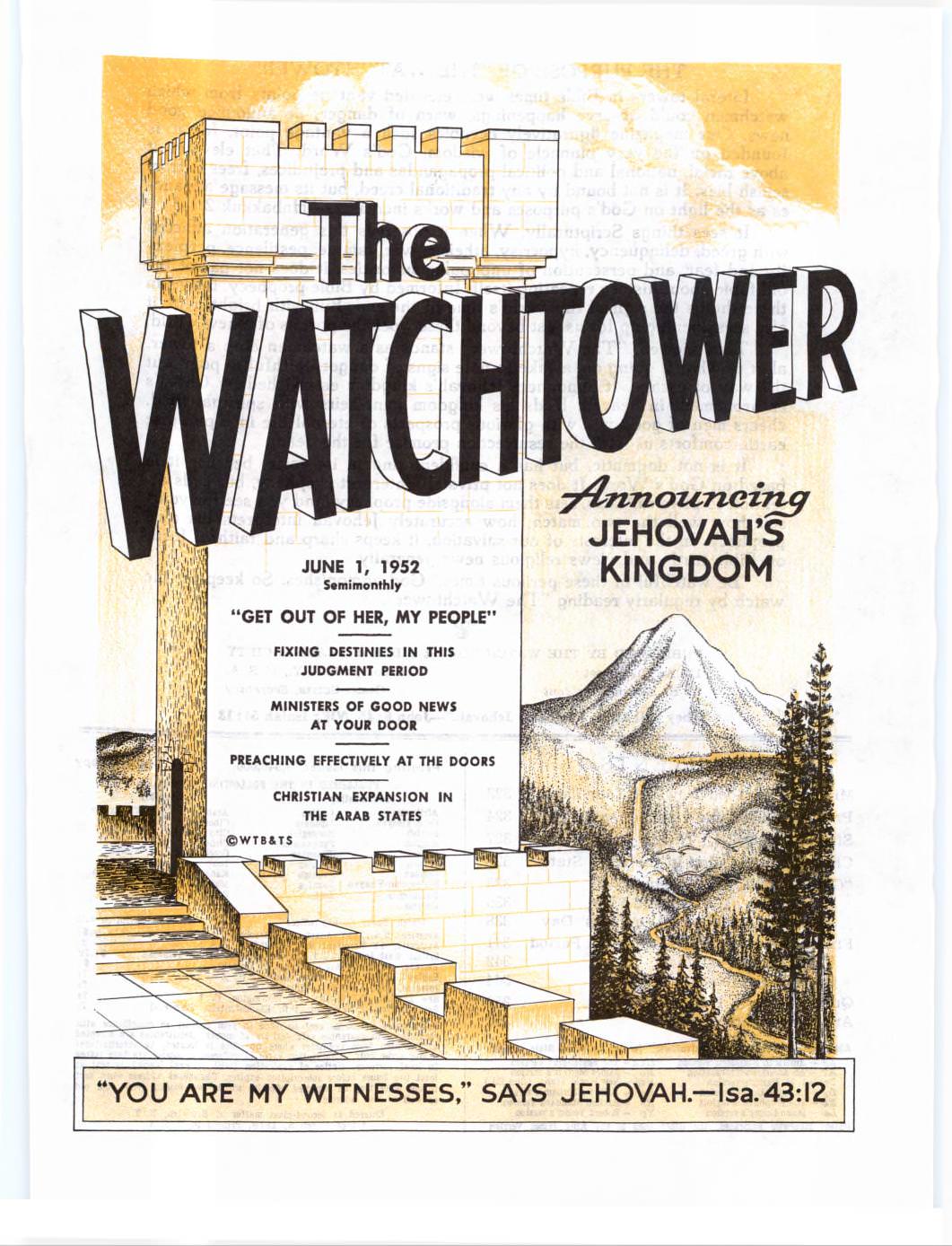
"YOU ARE MY WITNESSES," SAYS JEHOVAH.—Isa. 43:12
The WATCHTOWER
Announcing
JEHOVAH'S
KINGDOM
JUNE 1, 1952
Semimonthly
“GET OUT OF HER, MY PEOPLE”
FIXING DESTINIES IN THIS
JUDGMENT PERIOD
MINISTERS OF GOOD NEWS
AT YOUR DOOR
PREACHING EFFECTIVELY AT THE DOORS
CHRISTIAN EXPANSION IN
THE ARAB STATES
©WTB&TS
“YOU ARE MY WITNESSES,” SAYS JEHOVAH.—Isa. 43:12 THE PURPOSE OF "THE WATCHTOWER"
Literal towers in Bible times were elevated vantage points from which watchmen could observe happenings, warn of danger, or announce good news. Our magazine figuratively occupies such a vantage point, for it is founded on the very pinnacle of wisdom, God's Word. That elevates it above racial, national and political propagandas and prejudices, frees it from selfish bias. It is not bound by any traditional creed, but its message advances as the light on God's purposes and works increases.-Habakkuk 2:1-3.
It sees things Scripturally. When it observes this generation afflicted with greed, delinquency, hypocrisy, atheism, war, famine, pestilence, perplexity and fear, and persecution of unpopular minorities, it does not parrot the old fable about history repeating itself.Informed by Bible prophecy, it sees in these things the sign of the world's time of the end. But with bright hope it also sees opening up for us just beyond these woes the portals of a new world.
Thus viewed, "The Watchtower" stands as a watchman atop a tower, alert to what is going on, awake to note signs of danger, faithful to point out the way of escape. It announces Jehovah's kingdom established by Christ's enthronement in heaven, feeds his kingdom joint-heirs with spiritual food, cheers men of good will with glorious prospects of eternal life in a paradise earth, comforts us with the resurrection promise for the dead.
It is not dogmatic, but has a confident ring in its voice, because it is based on God's Word. It does not privately interpret prophecy, but calls attention to physical facts, sets them alongside prophecy, and you see for yourself how well the two match, how accurately Jehovah interprets his own prophecy. In the interests of our salvation, it keeps sharp and faithful focus on Bible truth, and views religious news generally.
'Be watchful in these perilous times,' God admonishes. So keep on the watch by regularly reading "The Watchtower".
PUBLISHED BY THE WATCH TOWER BIBLE & TRACT SOCIETY
117 Adams Street
Brooklyn 1, N. Y., U. S. A.
N. H. KNORR, President
GRANT SUITER, Secretary
"They will all be taught by Jehovah."—John 6:45, NW; Isaiah 54:13
CONTENTS
Ministers of Good News at Your Door 323
Preaching Effectively at the Doors 324
Strong Refuge 327
Christian Expansion in the Arab States 328
"Get Out of Her, My People" 333
Downpours of Water and Fire 335
Judgment upon Israel in Jesus' Day 338
Fixing Destinies in This Judgment Period 341
Family Responsibility 342
Community Responsibility 344
Questions from Readers 350
Announcements 352
Announcements
Abbreviations used in "The Watchtower" for the following Bible versions
AS - American Standard Version LXX- The Septuagint Version
AT - An American Translation Mo - James Moffatt's version
Da - J. N. Darby's version NW - New World Trans. (2nd Ed.)
Dy - Catholic Douay version Ro - J. B. Rotherham's version
ED - The Emphatic Diaglott RS - Revised Standard Version
Le - Isaac Leeser's version Yg - Robert Young's version
Unless otherwise indicated, the Bible used is the King James Version
Printing this issue: 1,345,000 Five cents a copy
PUBLISHED IN THE FOLLOWING LANGUAGES
Semimonthly Monthly
Semimonthly
Monthly
Afrikaans
Italian
Arabic
Portuguese
Cebu-Visayan
Japanese
Cibemba
Russian
Danish
Norwegian
Cinyanja
Siamese
English
Pangasinan
Clshona
Silozi
Finnish
Slovenian
Greek
Slovak
French
Spanish
Ibo
Twl
German
Swedish
Kanarese
Ukrainian
Hiligaynon-Visayan
Tagalog
Malayalam
Yoruba
Hollandish
Zulu
Polish
Iocano
America, U.S., 117 Adams St., Brooklyn 1, N.Y. $1
Australia, 11 Beresford Rd., Strathfield, N.S.W. 8s
British West Indies, 21 Taylor St., Port of Spain, Trinidad$ 1.72
Canada, 40 Irwin Ave., Toronto 5, Ontario $1
England, 34 Craven Terrace, London, W. 2 7s
Jamaica, 151 King St., Kingston 7s
New Zealand, G.P.O. Box 30, Wellington, C. 1 7s
South Africa, Private Bag, P.O. Elandsfontein, Transvaal 7s
Remittances should be sent to office in your country in compliance with regulations to guarantee safe delivery of money. Remittances are accepted at Brooklyn from countries where no office is located, by international money order only. Subscription rates in different countries are here stated in local currency. Notice of expiration (with renewal blank) is sent at least two issues before subscription expires. Change of address when sent to our office may be expected effective within one month. Send your old as well as new address.
Entered as second-class matter at Brooklyn, N. Y., Act of March 3, 1879. Printed in U. S. A.
MINISTERS OF GOOD NEWS AT YOUR DOOR
GOOD news at your front door! That is what Jesus Christ prophesied for these critical times. "Look! I am standing at the door and knocking. If anyone hears my voice and opens the door, I will come into his house and take the evening meal with him and he with me." True Christian ministers make a like approach to the people "because even Christ suffered for you, leaving you a model for you to follow his steps closely".-Rev. 3:20;1 Pet. 2:21,NW.
Who are the ministers of good news? Jesus predicted today's unparalleled woes and bad news, but simultaneously said: "This good news of the kingdom will be preached in all the inhabited earth for the purpose of a witness to all the nations, and then the accomplished end will come." (Matt. 24:14, NW) Necessarily, the witnesses of the birth of Jehovah's kingdom by Christ would be Jehovah's witnesses. Some will want us to leave it to Christendom's more than 250 sects to declare the message. But how can they, when they ridicule its timeliness, persecute its preachers, and teach unscriptural doctrines in its stead? And how many would hear it if it were left confined to the four walls of an orthodox sectarian cathedral or "church" building? In the United States, 1950 statistics, which were considered high, revealed that only fifty-seven per cent of the population was enrolled in church membership. This leaves some 65,000,000 persons unaccounted for, and when those that attend church only
very irregularly are included, it is safe to say that from seventy to one hundred million in this country alone are not adequately reached. Yet all the spiritually needy over the earth have pulpits ready and waiting for a minister to arrive, step in and preach to them. Unbelievable? No, these pulpits are their own front doorways!
Surprised moderns need not voice amazement at the appearance of God's ministers at their doors. Jehovah commissioned his pre-Christian prophets for such style of preaching. Faithful Isaiah was told to keep at it until the locale of his activity was desolated, "until cities be waste without inhabitant, and houses without man." A mighty message through Ezekiel resounded "by the walls and in the doors of the houses". With good authority, then, Jesus sent his early followers to the homes with a message that would divide the inhabitants, adding: "If the house is deserving, let the peace you wish it come upon it." And he personally took the lead, "from city to city and from village to village, preaching and declaring the good news of the kingdom of God."—Isa. 6:11; Ezek. 33:30, AS; Matt. 10:11-13; Luke 8:1, NW.
In his general witness work Jesus called at the homes of "all kinds of men", "to seek and to save what was lost." He invited himself to Zacchaeus' home and, after that chief tax collector had accepted his message, said: "This day salvation has come to this house." At a certain ruler's house he restored that one's daughter from death.
He sent orders to an army officer's abode to heal his slave. A "woman named Martha received him as guest into the house", where Jesus found her sister Mary to be very much interested, for she "sat down at the feet of the Master and kept listening to his word". Martha's anxiety over material things Jesus here said was in vain, proving that the spiritual provisions he served were always the motivating purpose of his calls.—Luke 19:5-10; Matt. 9:23-26; Luke 7:2-10; 10:38-42, NW.
So it would appear that house-to-house work was meant again when, following the outpouring of the holy spirit at the feast of Pentecost, A.D. 33, the disciples were described "continuing daily with one accord in the temple, and breaking bread from house to house". (Acts 2:46) Certainly we know that Jesus' followers expanded the private home ministry to marvelous limits after his death and resurrection. Despite
warning from the authorities to cease, "every day in the temple and from house to house they continued without letup teaching and declaring the good news about the Christ, Jesus." (Acts 5:42, NW) Paul tells how anxious he was to discharge his apostleship in a thorough manner. Note the means he used to ensure this: "I did not hold back from telling you any of the things that were profitable nor from teaching you publicly and from house to house." Acts 20:20, NW.
How natural in view of all this that, with the immense task of preaching the good news of the Kingdom throughout the earth in this complex modern world, Jehovah's organization should lean so heavily on the age-old Scriptural door-to-door ministry! Difficult as the task is even with this help, it would be impossible without it. Still there are problems to be overcome in doing this work effectively. Just how we will now consider.
Preaching Effectively at the Doors
WHAT brings the minister of good news to the door? To find the Right Shepherd's "other sheep", a unique and blessed pursuit. If for his public lectures God's minister prepares earnestly, should he not prepare equally well for the task of confronting each door in a manner much more intimate than is possible with any one of the listeners in a public hall? As the Right Shepherd's representative he should be a pleasing example, able to relay the Shepherd's voice without distortion.
The exemplary apostle Paul, in his effort to reach all and not stumble any by his
message, said: "For, though I am free from all persons, I
have made myself the slave to all, that I may gain the most persons. And so to the Jews I became as a Jew, that I might gain Jews; to those under law I became as under law, . . . I have become all things to people of all kinds, that I might by all means save some." (1 Cor. 9:19,20,22,NW) This does not mean to affect a false front of superficial worldly wisdom to impress the intellectual. The real sheep will be weary of such vain speculations anyway and will welcome God's wisdom as a refreshing change.
In it they will recognize the voice of, no, not you, but the "right shepherd". (John 10:14 NW) Furthermore, such persons are in need of far more than mere mental exercise. They need what false religion and worldly philosophy have not given them; they need love, sympathy, understanding. Given these, those disposed to be sheeplike will respond. They will see your sincerity and open their minds. The good news will have been successfully introduced.
Still, weightier matters of Bible truth and argument must follow. The Christian minister's appeal should consistently be to the mind rather than to the emotions of the householder. The most sincere of listeners will likely have some question or objection that must be removed before further progress can be made. If we can combine adequate and ready answers with sincerity and warmth of decorum, we will have fashioned a twofold weapon for effective use of "the sword of the spirit, that is, God's word". (Eph. 6:17, NW) True, many initial objections are stock phrases used to rid the doorway of pests and peddlers. Often these can be ignored, the weight of the Kingdom message speaking for itself and clearing up any question as to the minister's purpose in calling. But more often the seemingly minor plaints must be dealt with. In doing so be brief, escaping an argument over incidentals, not fumbling the opportunity to proceed into more constructive Scriptural teachings.
points it covers that are helpful in meeting various arguments.
A few of the commoner objections presented to the house-to-house minister follow. The answers given may not always be appropriate and they should not be memorized. They only illustrate possibilities. Far more effective will be the minister's own words with sincere conviction, and especially a good knowledge of the Bible literature he is presenting, keeping in mind
TURNING ASIDE OBJECTIONS TO THE MINISTRY
Householder: The Bible is all I need.
Publisher: Not quite. You also need God's spirit, for without that you could never understand the Bible. Many Bible writers could not understand what they had written because God's spirit that inspired the writing had not yet opened those prophecies for understanding. Today many prophecies are being fulfilled and the Bible is widely distributed, but God's spirit is still active; it will yet assist those who seek the mind of the Lord. You are wise in obtaining a Bible. Be equally wise in accepting a God-given help to understand it.
Householder: I have my own church.
Publisher: True, you have your own church, your neighbor on the right has his own church, and your neighbor on the left has her own church. It is also true that Christ Jesus has his own church. Is your church his church? Can you prove it by the Bible?
Or to this one might also say: Nor would I seek to force your conversion from yours to another sect. But surely your church can stand to have a better Bible student in its midst. Our literature is nonsectarian and will acquaint you with the Bible, not another sect.
Householder: You are against religion. Publisher: Hardly that, since by occupation I am a minister of religion. Of course, I do not subscribe to every religious doctrine. Neither do you. In Jesus' day only one group claimed Christianity; today more than 250 sects make this claim. Obviously some must be wrong in some way. We are simply engaged in reestablishing the beliefs of the one true religion. From what you say, I believe this would interest you.
Householder: I am a Catholic.
Publisher: Then we have a very important point in common. I know from experience that Catholics do not believe in sectarianism, and neither do Jehovah's witnesses. We both know that Christ founded only one true church, not hundreds. Our work seeks to educate Christians to the Scriptural idea of "one Lord, one faith, one baptism". I wonder if you would like to consider the Bible proof we have found.
Householder: I am a Jew.
Publisher: Splendid. I find consulting with Jewish persons to be an invaluable aid in the work I am doing. You see, like you we are opposed to all intolerance. And we feel the real hope for defeating that menace is the acceptance of the true worship of Jehovah God. The ancient Jewish nation was in a special covenant with Jehovah. Its prophets sounded God's messages and recorded them under divine inspiration. Today those prophecies are being explained and we feel that united belief in their common hope for all mankind will remedy all disunity and intolerance.
Householder: You are against the government.
Publisher: No, I am against only corrupt government, and, of course, I suppose you are too. But in our study of the causes for corruption in government we find the Scriptural reason for a general lack of integrity in human rule and the reason for its many failures. Please look into this publication for the cause and the solution.
Householder: I am too busy.
Publisher: Then do not allow me to consume your time just now.I know what it means to handle my own secular work,
household duties and still do this preaching, and I do not like to be bothered when occupied either. However, please accept this sample copy of one of our magazines. You undoubtedly acquire timesavers for your other important tasks, things you feel you must get done. Bible study is really our greatest necessity, since we claim to be Christians; and you will find our literature an invaluable timesaver in this. May I inquire what time might be suitable for me to call again when you would not be so busy?
Householder: I am not interested.
Publisher: I hope you will not think me presumptuous if I say you might be interested in a question nearly all your neighbors have asked me: "Why are there so many religions and which one is right?" This publication traces religious history back to the time when there was but one religion and it helps you identify the religion that God started for man.
Many easier methods of preaching the "good news of the kingdom" than from door to door can be found; but there is none other more essential, none so varied, nor any more joyous. True, it means meeting the scoffer face to face, but this yields the privilege of sharing in the great marking work foretold by Ezekiel. (Ezek. 9) On the other hand, when the sheeplike persons invite you into their homes for Bible study and they come to learn the truth and side with those whose hope is everlasting life in the new world, how they will thank you for coming and how glad they will be that they did not claim to be too self-sufficient, too busy, too sick, too tired, too much opposed or too little interested to hear and accept the only truly good news today!
STRONG REFUGE
"GOD is our refuge and strength, a very present help in trouble." Psalm 46, from which those words are taken, was written and preserved for just such a crisis as exists today in the lives of those who watch, pray and hope for the kingdom of God.—1 Cor. 10:11, NW.*
Those who look to human agencies for help are doomed to bitter disappointment. Why? Because the entire system of things under which such human agencies operate is dominated by Satan the Devil and his demons. These invisible forces have no love for their human dupes and devotees; in fact, they are responsible for all the woe and turmoil we find in the world today. (2 Cor. 4:4; Rev. 12:1-12) They will no more be able to furnish protection from God's wrath at Armageddon than they were able to do so at the Flood.
Religious leaders praying to God for peace and prosperity are likewise doomed to disappointment, for all such prayers are contrary to God's will. Why should God go contrary to his announced purposes and give selfish men peace and prosperity just so they can consume it on their selfish desires? So long as such men exist God will not bring peace to the earth.—Isa. 48:22; Jas. 4:2,3.
If we would receive God's protection and find him a refuge and strength, we must exercise faith in him. We must accept the trouble that his Word foretold would come upon the earth, and while it rages look to God for refuge and strength. We must serve his purpose while making known his purposes to others. "I, even I, am Jehovah; and besides me there is no saviour. I have declared, and I have saved, and I have showed; and there was no strange god among you: therefore ye are my witnesses,
saith Jehovah, and I am God."—Isa. 43:11,12,AS.
God's Word is filled with examples of how he proved himself a refuge and strength to his people in times past. Jehoshaphat found him such when Ammon, Moab and Mount Seir came up against Judah. Asa found God to be a safe refuge when an Ethiopian army, consisting of a million men and hundreds of chariots, came up against him. Hezekiah likewise found Jehovah a present help when Sennacherib and his hosts threatened to come against Jerusalem.—2 Chron. 20:1-30; 14:9-15; Isa. 37:14-38.
In recent years, particularly since 1918, Jehovah's witnesses have repeatedly found Jehovah to be a refuge and strength. If that were not true they would not be here today, and that in ever-increasing numbers. The most determined and fiendish persecution against them has failed, their persecutors going down while Jehovah's witnesses lived on to renew their strength and to resume their preaching work.—Isa. 40:28-31; Rev. 11:7-12.
Quite likely at Armageddon we shall see cataclysmic forces of destruction operated by God to overwhelm this old world and blot it out. (Ps. 46:2,3) We may naturally be frightened, as was Moses at Mount Sinai, but we shall not share the world's fear, because we will know that God is controlling the forces of destruction and that he is directing them, not at us, but against his enemies, our enemies.
Our Christian obligation now is to be fearless in Jehovah's service under the shadow of his mighty hand. So we can keep calm and go peacefully about our work as his ministers of good news knowing that he will never forsake his faithful people, but will help them, "and that right early." Ps. 46:5, AS.
For a detailed discussion of this subject please see The Watchtower of March 15, 1951.
While recently touring Near Eastern and Oriental areas with his secretary In the interests of expanding Christian missionary work, the Society's president, N. H. Knorr, sent this report from the Arab countries.
BEIRUT, Lebanon, on Christmas eve would remind most Americans of New Year's Eve. Brother Henschel and I found that out while trying to sleep there through the night of December 24,1951. The effort was largely wasted. Not long after the noise had subsided we had to get up in order to catch an early plane to Jerusalem. We had been in Beirut only long enough for a stopover visit with the local Kingdom publishers and some that had come over from Tripoli and points in between. However, we planned an early return to Beirut following an assembly in Ramallah, near Jerusalem.
Because of our traveling in a Lebanese plane our flight to Jerusalem followed a circuitous route. Lebanese and Syrian aircraft do not fly over the modern state of Israel where they would run the risk of being shot at. But we did not mind the extra half-hour this added to our flying time, for the trip afforded a highly interesting study in Biblical geography.
We gained altitude, swept southward over the land once called Tob and on past the territory that God gave to the children of Manasseh on the east side of the Jordan. On the southern tip of the sea of Galilee
we saw the waters going out through the Jordan river toward the Dead sea. The valley is fertile all the way down to the Salt sea, but becoming less and less so as one goes southward. It is easy to see why the ten cities spoken of in the Bible as Decapolis had their location to the east and just south of the sea of Galilee.
I had the opportunity to sit next to the captain in the cockpit, thus
gaining an extraordinary view of the territory. Along the northern portion of the Salt sea and to the east of it was the one time land of Reuben, and below that the lands of Moab and Mount Seir. A few miles to the north of the point where the Jordan flows into the Dead sea the captain pointed out the city of Jericho and the hills that continue to rise until the city of Jerusalem takes its lofty place in the hills of Judah. I could see distinctly the cities of Ramallah, Jerusalem, Bethlehem, and in the distant west Jaffa and Tel Aviv. Beyond that was the great Mediterranean.
ASSEMBLY IN RAMALLAH
We landed on a little strip in the hills between Jerusalem and Ramallah and soon made our way into Jerusalem, skirting along the Jordan side of an area near the city known as "No man's land" which separates the states of Israel and Jordan. Then we arranged for a car to take us to the home of the Society's local representative in Beit Jala near Bethlehem south of Jerusalem.
On the way we passed "The Field of the Shepherds", so called in memory of the shepherds who were watching their sheep on the night that Jesus was born in Bethlehem. It is a place not far from the city and they could easily have walked in to see the Lord on the night of his birth. But it could hardly have been on the night of December 24, because on the 25th when we were driving through the region it was prohibitively cold.
There were few shepherds to be seen and little green grass or stubble on which sheep might feed. More harmonious with such known facts is the evidence that Christ was born around the first of October, a point more in keeping, too, with his baptism by John the Baptist in the Jordan river, which took place when
Brother Henschel next gave good counsel on walking by the spirit and keeping oneself and the organization clean. I followed, basing my remarks on the apostle's strong admonition for all members of the congregation to be ministers, for which reason he had written Christians everywhere to heed the supreme importance of this office, a minister of the Most High. This concluded an enjoyable morning and we turned our
in the Jordan River, which took place when Jesus had just turned thirty years of age. In October, but certainly not in December, one might expect the temperature of the Jordan's waters to accommodate the baptismal program of John.
Learning in Beit Jala that Brother Kobrossi, whom we sought, had already proceeded to Ramallah for final assembly preparations, we followed at once. That afternoon we located him and discussed the problems affecting Jehovah's witnesses in Jordan. Strange to say, this land, so favored nineteen centuries ago with the
attention to the public meeting scheduled at 2 p.m. in the Town Hall.
been used to announce the subject, "Will Religion Meet the World Crisis?" Just two hours of activity in this regard now took place, and that only by the brothers' calling on persons of good will known to be interested in the Kingdom message. We were pleasantly surprised, therefore, on arriving at the Town Hall, to find it nearly filled. By the time the talk started listeners were standing in the hallway. Ninety-
birth of Christianity and the first announcement of the glad message, "The kingdom of the heavens is at hand!" is today in sore need of more preachers to advance the cause of pure worship. We told the brothers there of six missionaries on their way from America, two of whom will be assigned to Bethlehem and Beit Jala and four to Ramallah. It developed that five regular Bible studies conducted in the vicinity of Jerusalem have a total attendance of about ninety-five persons. Of this number only twenty-two were actually publishing the Kingdom mestwo in all were present, including the mayor of Ramallah, who afterward said he believed that more of this kind of information should be given to the people of his city. During the concluding session back at the private home, I urged the local publishers to aid the missionaries who would soon be with them to learn the Arabic language, and showed how in turn the missionaries would provide them all with much help in their witnessing work. Explanation of the Society's plans for local organization was eagerly absorbed by this group so inter-
sage.
The next morning forty-nine of us gathered in the front room of one of the brothers' homes for the opening session of our assembly. Brother Chimiklis, a graduate of Gilead, opened with a talk on "The Way of Success".
ested in becoming more proficient ministers of the Kingdom.
THE "HOLY CITY", MOSLEM VERSION
With a portion of the next day to ourselves we were anxious to visit the old walled city of Jerusalem and see the location where the temple had been planned by David and built by Solomon. Now considered sacred ground to the Moslems who control it, Christians can enter only between 7:30 and 11:30 a.m., and then by special permission. Central point of interest now is the mosque called The Dome of the Rock, inside which is the highest peak of Mount Moriah, rising about five feet above the floor. The top of the rock bears an expanse approximately thirty feet by twenty feet, around which is a wooden barricade and which is supposed to mark the spot where the Jews' altar of sacrifice had been located. It was on this very Mount Moriah that Abraham brought his son Isaac to offer him in sacrifice to Jehovah as commanded. The spot's interest to Moslems rests in the claim that Mohammed is here supposed to have last touched earth when he ascended to heaven. The part of the rock which allegedly shows his footprint has been cut off and put in a special boxlike shrine with an opening to allow devotees to touch it.
Not far from here is the "Golden Gate" in the walls of Jerusalem through which Jesus and his disciples entered the city when the Lord came down from near Bethany over the mount of Olives to make his triumphal entry into the city and be hailed as the son of David. It proved a very interesting landmark, since from there we could get the perspective of the temple site in relation to the mount of Olives, the valley of Kidron, Gethsemane and other places of Biblical significance. Leaving the temple area we passed the famed "Wailing Wall" of the Jews, said to be part of the foundation of Herod's temple. But there are no more Jews in the walled city to wail at this wall as we saw them doing in 1947. A guide told us that now the Orthodox Jews stand in their State of Israel facing this wall and continue their wailing. We were soon flying back to Lebanon, leaving in our wake this city of wailing, much more a symbol of sorrow than of hope to the diverse religions that have branded it "holy". In the near future the reign of Christ the King will bring the establishment of pure, undefiled worship everywhere on earth, making necessary no pilgrimages here or bloody crusades to wrest one piece of ground from the grasp of its possessors. It was good to know this troubled area was being served by devoted believers in Jehovah's service.
BAPTISM IN THE RAIN
We were on hand for the following day's opening of the convention scheduled for Beirut. Brothers were there from all parts of Lebanon and many from Syria. Conspicuous in the crowds were large numbers of young men and women. The attendance reached 260 by the time of Brother Henschel's talk on Friday evening, December 28. We had a taste of the unusual when the electric power failed in our section of the city about halfway through this address, but Brother Henschel continued without a break. A few candles were brought into action until the lights were restored. On Saturday morning a small outside pool was furnished with warm water to make immersion candidates more comfortable, and twenty symbolized the dedication of themselves to God and his service despite a heavy downpour. During these first two days extensive advertising of Sunday's public meeting was carried on while the attendance continued to grow in the Kingdom Hall, where the sessions were held. By Saturday night 400 were present.
On Sunday, December 30, all activity was transferred to the chapel of the American University, where the public meeting was set for three o'clock. "Will Religion Meet the World Crisis?" was the issue that our advertising had succeeded in making the question of the day in Beirut, and 793 persons came to hear the answer. Their applauses were loud and enthusiastic as one point of argument after another touched them off. At the close of the talk the listeners happily received a new booklet in Arabic, a matter of as much special joy as it was surprise to the brothers, for it meant having new information to use in the field service.
This convention was a gratifying experience in a land where interest in the Kingdom has soared rapidly. A little more than two years ago the Society sent two brothers to Beirut, where a small group of six persons was organized but badly in need of assistance. Now the company has over 100 publishers. Four more missionaries were sent there about a year ago and still another eight arrived three months ago. The latter group is assigned to Tripoli. In 1947, when I last visited Lebanon, there were 99 publishers on the average. In 1951 the average was 301, with a peak of 401, showing plainly the expansion in this land of one and one-half million people.
SYRIA AND ITS PROBLEM MOSLEMS
On Monday, December 31, we got an early start by car for a scheduled visit to Syria. A crisp ride through mountain snows was relieved by a descent into the long valley that boasts Lebanon's most fertile land. It is here that Baalbek is located, which, however, was not on our route. A city had been built there and in Nero's time temples were erected to Jupiter, Bacchus and Venus. Native stone was taken from a nearby quarry in huge slabs and a great center of devil religion was set
up. The ruins still stand to point silently back to the ancient worship of Baal with its base sexual orgies with which the practices there had been associated as well as the pagan worship of Rome. The valley produces fine wines which would lend themselves readily to the drunken ceremonies in honor of Bacchus.
The fertile plain was quickly traversed. Then through the Anti-Lebanon range, the border formalities of Lebanon and Syria, and down the winding road into the city of Damascus. We had a little time to see the city, the modern part of which is very progressive in appearance. Interest carried us to the street called "Straight", mentioned in the Bible, particularly to see the portion of the wall of the old city that contains the window where Paul was supposed to have been let down and made good his escape. (2 Cor. 11:32,33) There is no doubt that parts of the old wall are still there, but we doubted seriously that the window we saw and which is above the main entrance of a church was the window it pretended to be. It looked much too new to be the same window or, in that portion, the same wall as in Paul's day, because the city had been attacked and wrecked and conquered many times by invaders. Anyway, the window over the front door of the church provides good advertising for that particular church. The account in the Bible is authentic, but one wonders about the authenticity of that particular window.
We waited for the funeral procession of a Moslem priest to pass. Immediately before the coffin walked a man with a husky voice who wailed and cried for the ones that followed after. We were told that he was paid to do this. We noted no women in the procession.
That afternoon from two to four o'clock Brother Henschel and I spoke to forty-five of our brothers, fifteen of whom had come from Lebanon to encourage those in Syria.
The Syrian publishers were overjoyed to hear that the Society would soon try to send missionaries to Damascus to assist them.
The work in Syria faces excellent prospects. It was organized about three years ago with one full-time pioneer minister and nineteen company publishers. Now there are fifty-seven publishers, and a peak of eighty-two was reached last year. Moslem influence, much stronger in Syria than in Lebanon, presents a major problem. It is very difficult to talk to a Moslem about Christ's ransom sacrifice or his being the Messiah. The Moslems hold to a doctrine that sometime someone will come to show them the way and establish a world government on earth. To them Christ is only another prophet and Mohammed a greater prophet. They implicitly follow their Koran and remain adamant toward the Bible. On the other hand, about fifteen per cent of the population is composed of nominal "Christians" who have the Bible in common with Jehovah's witnesses and among these interest is growing, some already having become Kingdom publishers. When we finally had to say good-by to these very friendly brothers we motored away from the skyline dotted by Moslem minarets and returned once again to Beirut.
REJOICING AMID PROGRESS
We were back to begin the new year in Beirut, further discussing matters concerning the work in Jordan, Syria and Lebanon, all of which come under the jurisdiction of that office. At midmorning all of the missionaries stationed at Beirut joined us and we went by car to visit the new missionary home in Tripoli. We arrived in time for the midday meal, which was followed by discussing their problems with the Tripoli missionaries. Shortly some of them may be sent to Aleppo in Syria to
help in the expansion of the work there, and when they go they will be replaced in Lebanon by others recently graduated from the Watchtower Bible School of Gilead, if such proves to be the Lord's will. There are advantages in sending experienced missionaries to Syria, because these brothers will know more of the Arabic language and will be better able to get along in Syria, where much less English is spoken than in Lebanon.
That night a two-hour meeting was scheduled for the Tripoli company and persons of good will in the vicinity. Some came from other companies too, packing out the Kingdom Hall's main auditorium and adjoining overflow rooms with 302 persons. Between Brother Henschel and me, I had Brother Tuttle the branch servant and Brother Chimiklis talk. These brothers had been the first two missionaries in Lebanon and they spoke now in Arabic. Both did well and the audience was pleased with their efforts. It is hoped that in three months these brothers will be able to serve the companies as circuit servants without interpreters and also give their public talks in the Arabic language. They are going to try hard to do this, and I feel sure that with their efforts and the Lord's blessing they will succeed.
We drove back to Beirut that night because there was a lot to do the next day, finishing our work in the office and getting ready to leave for Karachi, our next stop. Our fellow workers in Lebanon are very enthusiastic and very happy over the progress that has been made in the preaching of the good news during the last few years. They appreciate that the Society has sent missionaries into their midst to help them. They in turn have helped the missionaries by furnishing teachers of the Arabic language from their midst, and all of the missionaries have been grateful for this. The work continues to be blessed by Jehovah.
"Get Out of Her, My People"
"Get out of her, my people, if you do not want to share with her in her sins, and if you do not want to receive part of her plagues. For her sins have massed together clear up to heaven, and God has called her acts of injustice to mind."—Rev. 18:4, 5, NW.
THERE is a basic rottenness in these last days that has polluted every field of this world's activity. Its politics is corrupt. Its commerce is oppressive. Its military is wasteful. Its religion is hypocritical. Its pleasures often lead to delinquency and immorality, and its sports to foul play and crookedness. The vast majority of the people go along with the world in its rottenness, seeing it, contributing to it, participating in it, indifferent to it, calloused to it, or cynically accepting it. For outward show many practicers of it make incensed speeches against it, but how many really rise up in wrath to stamp it out? The majority cling to this wicked old world, support it, fight for it, die for it, vote into power its corrupt rulers, and otherwise completely make themselves a part of it. They cast their lot in with this world. With it they sow to the lusts of the flesh. With it they will reap their share of its plagues. Not only is this logical and just; it is Scriptural as well.
2 In chapter 18 of Revelation the entire world organization or system of things controlled by Satan the Devil is spoken of as "Babylon the great". Babylon began her fall when her invisible part was hurled earthward by Christ after his enthronement A.D. 1914. (Rev. 12:1-12) At Armageddon the fall of the invisible demon hordes will be completed and will land them in the abyss, and the visible realm of Satan will suffer complete destruction. (Rev. 19:11-21; 20:1-3) But some will escape the fiery judgments that consume her. How? By a later resurrection in the millennial reign of Christ? Not according to the record: "Get out of her, my people, if you do not want to share with her in her sins, and if you do not want to receive part of her plagues. For her sins have massed together clear up to heaven, and God has called her acts of injustice to mind. That is why in one day her plagues will come, death and mourning and famine, and she will be completely burned with fire, because Jehovah God who judged her is strong."—Rev. 18:4,5,8,NW.
3 Her plagues are destruction, fiery and final. The Babylonish organization will never be resurrected or raised up from her destructive baptism of fire. If this is her plague, and if those who remain in her share it, how can we contend that those individuals undergoing fire baptism with her will rise in the resurrection of mankind? We cannot do so Scripturally. The plain statement is that the fate of individuals remaining within the organization is the same as that of the organization itself. If the individuals return, the organization
What conclusion is both logical and Scriptural?
How must we escape the plagues upon Babylon the great?
What are the plagues? So what logically follows?
will; but if the organization does not, neither will the individuals once within it. The way to salvation is flight now, before its fall: "Get out of her!" Israelite captives in ancient Babylon were instructed to flee that wicked system: "Away! away! go out thence; touch nothing unclean! Go out of the midst of her; keep yourselves pure, you who bear the vessels of the LORD!" "Go out of the midst of her, O my people! Save everyone his life from the fierce anger of the Lord." (Isa. 52:11; Jer. 51:45, AT) Revelation 18:4 shows the same instruction holds true at the time of greater Babylon's fall.
4 Most persons view things from the human standpoint, and for that reason attach too much importance to the salvation of creatures. That is only a secondary purpose for the release of Babylon's prisoners. Jehovah's view of matters is what counts, and it shows the primary reason for the release: "I do not this for your sake, O house of Israel, but for my holy name, which ye have profaned among the nations, whither ye went. And I will sanctify my great name, which hath been profaned among the nations, which ye have profaned in the midst of them; and the nations shall know that I am Jehovah, saith the Lord Jehovah, when I shall be sanctified in you before their eyes. For I will take you from among the nations, and gather you out of all the countries, and will bring you into your own land." (Ezek. 36:22-24, AS) On different occasions in the wilderness Jehovah was going to destroy Israel, but Moses pleaded with Jehovah and prevailed upon him to spare them. On what grounds? The salvation of creatures? No, but for the sake of Jehovah's great name. (Ex. 32:9-14; Num. 14:11-24; 16:44-50; Deut. 9:18, 26-29; Ezek. 20:9) How important to us is the salvation of grasshoppers? We are as
grasshoppers in God's sight. (Isa. 40:22) So we must make God's thoughts our thoughts, if we are to see in clear focus and true perspective Jehovah's destructive acts at the end of judgment periods. If we persist in tenaciously clinging to the self-centered human view that focuses on creature salvation and leaves Jehovah's vindication in the hazy, out-of-focus background, we may find the Scriptural teaching a hard saying unwelcome to our ears, and be offended and stumbled by it.—Isa. 55:8,9; John 6:60,66.
It is likely that for the majority of men who have lived on the earth the time of their judgment will be in the millennial reign of Christ, at the time of the resurrection of mankind and thereafter. However, long before this many persons will have had their time of judgment, as the Scriptures show that God has brought certain judgment periods upon human society at certain times, during which God held them accountable for their course of action. That they might be really accountable at such times, he caused testimony to be given that they might know the issue and make their decision, by which they would determine their destiny, independent of any inherited condemnation from Adam. One of such judgment periods was the flood of Noah's day, prior to which Noah preached righteousness. Another was the fiery end of Sodom and Gomorrah, which cities saw warning miracles by angels and heard testimony from Lot before the rain of fire fell. In Jesus' day it was a time of judgment and he warned certain Jewish cities of a fate like that upon Sodom and Gomorrah, and judged certain scribes and Pharisees fit for the eternal destruction of Gehenna. Our present day is also a time of judgment, and by the time Armageddon strikes all persons then living will have fixed their destiny.
In contrast with a human view, what is the correct view on release of Babylon's prisoners?
What judgment periods are here mentioned?
DOWNPOURS OF WATER AND FIRE
We can learn much about this present judgment period by considering past ones pictorial of our day. The first was the Noachian flood. Jesus declared it was a picture of the present judgment period: "Just as it occurred in the days of Noah, so it will be also in the days of the Son of man: they were eating, they were drinking, men were marrying, women were being given in marriage, until that day when Noah entered into the ark, and the flood arrived and destroyed them all." (Luke 17:26, 27, NW) Why were they destroyed? Because of their corruption: "The Lord saw that the wickedness of man on the earth was great, and that the whole bent of his thinking was never anything but evil." Hence Jehovah determined: "I will blot the men that I have created off the face of the ground, both men and animals, reptiles, and birds of the air; for I regret that I ever made them." Noah was to escape. Why? "Noah alone among his contemporaries was a pious and exceedingly good man; Noah walked with God." That the destruction of the others was a final judgment executed against them is shown by Jehovah's forceful words to Noah: "I have resolved on the extermination of all mortals; for the earth is full of wrong-doing through them; I am going to exterminate them from the earth. But with you I will make a covenant; you shall enter the ark, accompanied by your sons, your wife, and your sons' wives."—Gen. 6:5, 7, 9, 13, 18, AT.
7 Not only is this final destruction made sure by God's use of the expression "exterminate" and Jesus' use of "destroyed", but also 2 Peter 2:5-9 (NW) establishes it: "He did not hold back from punishing an
ancient world, but kept Noah, a preacher of righteousness, safe with seven others when he brought a deluge upon a world of ungodly people; and by reducing the cities Sodom and Gomorrah to ashes he condemned them, setting a pattern for ungodly persons of things to come, and he delivered righteous Lot, who was greatly distressed by the indulgence of the law-defying people in loose conduct—for that righteous man by what he saw and heard while dwelling among them from day to day was tormenting his righteous soul by reason of their lawless deeds—Jehovah knows how to deliver people of godly devotion out of trial, but to reserve unrighteous people for the day of judgment to be cut off." Peter cited these ancient examples of cutting-off to show the fate of false prophets and false teachers in the Christian congregation, who brought in destructive sects and disowned Christ, and who thereby were "bringing speedy destruction upon themselves". Who will contend that the destruction of such defilers of the Christian congregation is not final? The ancient destructions upon Noah's contemporaries and Sodom and Gomorrah must be just as final, else how could they illustrate the one Peter was discussing?—2 Pet. 2:1-4, NW.
After showing the flood typical of the present judgment period, Jesus proceeded to show Sodom and Gomorrah pictorial of it also: "Just as it occurred in the days of Lot: they were eating, they were drinking, they were buying, they were selling, they were planting, they were building. But on the day that Lot came out of Sodom it rained fire and sulphur from heaven and destroyed them all. The same way it will be on that day when the Son of man is to be revealed." (Luke 17:28-30, NW) Our previous consideration of 2 Peter 2:5-9 has shown that those destroyed by God at Sod-
Why consider the Noachian flood? What were the facts?
How does Peter show the destructions of the flood and at Sodom were final?
Why is Sodom's case vital, and what else shows its destruction final?
om and Gomorrah are eternally "cut off". Corroborating this is Jude 7, which states that these cities are "placed before us as a warning example by undergoing the judicial punishment of everlasting fire". (NW) "Everlasting fire" symbolizes the
same thing as Gehenna, namely, second death. The destruction upon Sodom and Gomorrah must be final, or Jude would not have used it to illustrate the fate of those defilers for whom "the blackness of darkness stands reserved forever". (Jude 13, NW) Jude 7 shows that those anthat thou art a comfort unto them. When thy sisters, Sodom and her daughters, shall return to their former estate, and Samaria and her daughters shall return to their former estate, then thou and thy daughters shall return to your former estate."
cient cities had their judgment day back there at the time of their destruction, since they are spoken of as having already undergone an execution of judgment, "the judicial punishment of everlasting fire." By no wresting of scripture can this be made to mean a future resurrection for slain of the Lord. No remnant was saved from those cities, Lot and his daughters being sojourners, not natives.—Rom. 9:29, NW.
If those slain by the Lord at Sodom have no resurrection, then those slain by him at Armageddon will have none, for the former pictures the latter. So in their endeavor to prove their contention that not all slain at Armageddon will remain dead, some seek to show that the Sodomites destroyed by fire will return in a resurrection. They quote Ezekiel 16:53-55: "When I shall bring again their captivity, the captivity of Sodom and her daughters, and the captivity of Samaria and her daughters, then will I bring again the captivity of thy captives in the midst of them: that thou mayest bear thine own shame, and mayest be confounded in all that thou hast done, in
10 The context shows that restoration after captivity, not resurrection in the millennium, is being discussed. In a miniature fulfillment came the restoration of Judah and Jerusalem after 70 years of desolation (607-537 B.C.), when Jews and Nethinim and other foreigners returned to inhabit
the land. The greater restoration started in Jesus' day and continues now. When Jesus came the Jews were in captivity to the Devil's organization, Babylon the great. Captives of Rome politically, captives of sin, captives of false religion. But when Jesus came, preached, died, was resurrected, appeared in heaven with his sacrificial merit, provided the basis for redemption, poured out the holy spirit upon a faithful Jewish remnant who sought redemption in his name, illuminated their minds to freedom-giving truths and released them from bondage to antitypical Babylon, then they were restored to the theocratic organization of Jehovah God. For three and a half years after Pentecost the freeing message was confined to the Jews, and a remnant was restored. All this was in fulfillment of Ezekiel 16:53-55, where it speaks of the restoration of Jerusalem and her daughters.
11 When persecution grew intense and believing Jewish Christians were scattered, they went everywhere preaching. The evangelist Philip went to Samaria, where
Why and how do some try to show Sodom's destruction not final?
What fulfills Ezekiel's prophecy about the restoration of Jerusalem and her daughters?
When were "Samarla and her daughters" restored?
Jesus had preached some time previous. Many of the Samaritans believed, more preachers were sent to them, and the holy spirit descended upon them. They were brought into God's congregation. There, as represented in that Samaritan remnant, Ezekiel 16:53-55 was fulfilled.—John 4:39- 42; Acts 8:1-25.
12 Then the gospel went to the Gentiles. The Jews thought of them as dogs. (Matt. 15:26, 27; Mark 7:27, 28) Dogs were unclean animals, viewed as sexually depraved, and linked in with sodomy: "There shall be no prostitute of the daughters of Israel, neither shall there be a sodomite of the sons of Israel. Thou shalt not bring the hire of a harlot, or the wages of a dog, into the house of Jehovah thy God for any vow: for even both these are an abomination unto Jehovah thy God." (Deut. 23:17, 18, AS) The female prostitute's gain is likened to the hire of a harlot, and the male sodomist's gain is likened to the wages of a dog. Instead of "dog" An American Translation uses "male prostitute" and
Moffatt's version uses "catamite", which means a boy kept for unnatural purposes. These sexual depravities were flagrant in Sodom, the base sin of sodomy taking its name from that city. So all this shows how the Jews associated Sodom and dogs and Gentiles.
13 To buttress this view of
matters note the following quotation from the introductory material of volume 7 of The Interpreter's Bible, published last year. The first paragraph under "Morality", beginning on page 80, reads: "The moral life of the pagan world was often referred to by
early Christian writers whose view of the morality of the time was a stereotyped one inherited from their Jewish predecessors. Both Jewish and Christian authors agreed that the Gentiles were morally degenerate. The Old Testament story of Sodom and Gomorrah, on which the Lord had rained down fire and brimstone, represents the Hebrew attitude toward pagan wickedness, whether of Egyptians, Canaanites, Philistines, Assyrians, Babylonians, or Romans." 14 The apostle Peter had this view of Gentiles as being sodomic and doglike, and that is why it was so hard for him to grasp God's purpose for him to take the gospel to the Gentiles. Yet when he did understand he obeyed, and God poured out his spirit on Gentile believers, receiving them into the same restored congregation along with believing Jews and Samaritans. (Acts 10:9-48) When the faithful Jewish remnant saw uncircumcised Gentiles, whom they had previously viewed as dogs and Sodomites, restored with them they
felt some shame. They had thought the Jews specially holy and that God would use only Jews to make up Messiah's bride. Now they learn they are not so important or holy, but that God makes worthy for the Kingdom not only Samari tans but also uncircumcised Gentiles. Thus fulfillment of
Ezekiel 16:53-55 was started off in early Christian times. Ezekiel did not mean literal Sodom, no more than did Isaiah when he called Israel Sodom, or did John when he wrote that Jesus died in Sodom. (Isa. 1:10; Rev. 11:8) Ezekiel used it symbolically for uncircumcised Gentiles, and when
What shows how the Jews linked Sodom and dogs and Gentiles?
What quotation supports this view?
So how did the restoration take in "Sodom and her daughters"?
discussing restoration of the theocratic organization, not resurrection.
JUDGMENT UPON ISRAEL IN JESUS' DAY
15 Another judgment period is brought into view when those championing resurrection for exterminated Sodomites quote Jesus' words on a certain occasion. He had reproached the unrepentant Jewish cities of Chorazin and Bethsaida, which had witnessed many of his powerful works, then said: "And you, Capernaum, will you perhaps be exalted to heaven? Down to Hades you will come; because if the powerful works that took place in you had taken place in Sodom, it would have remained until this very day. Consequently I say to you people, It will be more endurable for the land of Sodom on Judgment Day than for you." (Matt. 10:14, 15; 11:20-24; Luke 10:10-15, NW) From this some argue that there is a future judgment, in the millennial reign, for both Sodom and these Jewish cities.
16 If we take this expression to mean that, then it would contradict Jude's statement that Sodom had already undergone the "judicial punishment of everlasting fire". Actually, Jesus was using a form of speech construction common in Biblical times. He used a similar construction when he said: "It is easier, in fact, for a camel to get through the eye of a sewing needle than for a rich man to get into the kingdom of God." (Luke 18:25, NW) No sane person would believe a camel could squeeze through a needle's eye. Yet if this obviously impossible thing were said to be easier than something else, would that not powerfully emphasize the utter impossibility of the other thing? So Jesus forcefully made the point that rich ones loath to part with their wealth would not enter the kingdom.
Similarly, Sodom did not endure its judgment day, had failed completely, and the Jews knew its fate was sealed. Their opinion of Sodom was the lowest possible. So when Jesus told them that it would be more endurable for utterly depraved Sodom than for these Jewish cities they got the powerful point.
These Jewish cities had heard the warning and had seen powerful works; they had had their fair judgment trial and by their decision showed they were worthy of eternal destruction. (Matt. 10:5-15; Luke 10:8-12; John 12:37, NW) By witnessing miraculous cures performed by the power of the holy spirit and yet refusing to accept the message, the inhabitants of these cities were sinning against the holy spirit, which is the unforgivable sin meriting second death. They ranged themselves alongside the Pharisees who saw Jesus heal a demon-possessed man, but refused to accept this manifest operation of the holy spirit. Because of this Jesus told them they would never have forgiveness, neither in the present system of things nor in the next, the new world. Being judged adversely, unforgivable in both the old world and the new world, it would be useless to resurrect them in the millennium. Jesus pronounced judgment against them: "Serpents, offspring of vipers, how are you to flee from the judgment of Gehenna?" If the blind religious leaders were to land there, so were their blind Jewish followers. And when the false religious leaders converted some heathen they did not bring him into the true worship that would cleanse him of his past sins against God, but merely added to his past sins the religious sinfulness and hypocrisy which they taught him, doubling his burden of guilt. Thus the proselyte became twice as much a "subject for Gehenna" as the scribes and
Why do some argue for a future judgment for both Sodom and the Jews of Jesus' day?
What did Jesus mean when he said judgment would be more endurable for Sodom than certain Jewish cities?
Why would it be useless to resurrect the Jewish clergy, their Jewish followers, and their Gentile converts?
Pharisees.—Matt. 12:22-32; 15:14; 23:15, 33, NW.
18 Nor is the fact that the judgment day for natural Israel was nineteen centuries ago denied by Jesus' words: "Men of Nineveh will rise up in the judgment with this generation and will condemn it; because they repented at what Jonah preached, but, look! something more than Jonah is here. The queen of the south will be raised up in the judgment with this generation and will condemn it; because she came from the ends of the earth to hear the wisdom of Solomon, but, look! something more than Solomon is here." (Matt. 12:41, 42; Luke 11:31, 32, NW) This does not mean the Ninevites and the queen of the south will confront the Jews of Jesus' day in the millennium judgment period. Why that, just to condemn those Jews, and for something they did in their former existence? In the millennium persons will be judged on the basis of what they do then, not what they did in a previous existence. Yet these Jews are adversely judged and condemned because nineteen centuries ago, back in their lifetime, during their judgment period, they rejected one more than Jonah and more than Solomon, namely Messiah Christ. They have no second chance in a second judgment period, in the millennium.
19 What Jesus meant was that the Jews of his day were condemned by the example of the repentant Ninevites, which example was recorded in the Hebrew Scriptures and confronted those Jews during their then judgment period. In the same way the record of the queen of the south stood up to confront the unrepentant Jews. Such Gentiles heeded mere men such as Jonah and Solomon; the covenant nation of Jews would not heed even their Messiah. Before their judgment period was over, those
…