The Watchtower, July 15, 1952
Download: PDF — The Watchtower, July 15, 1952
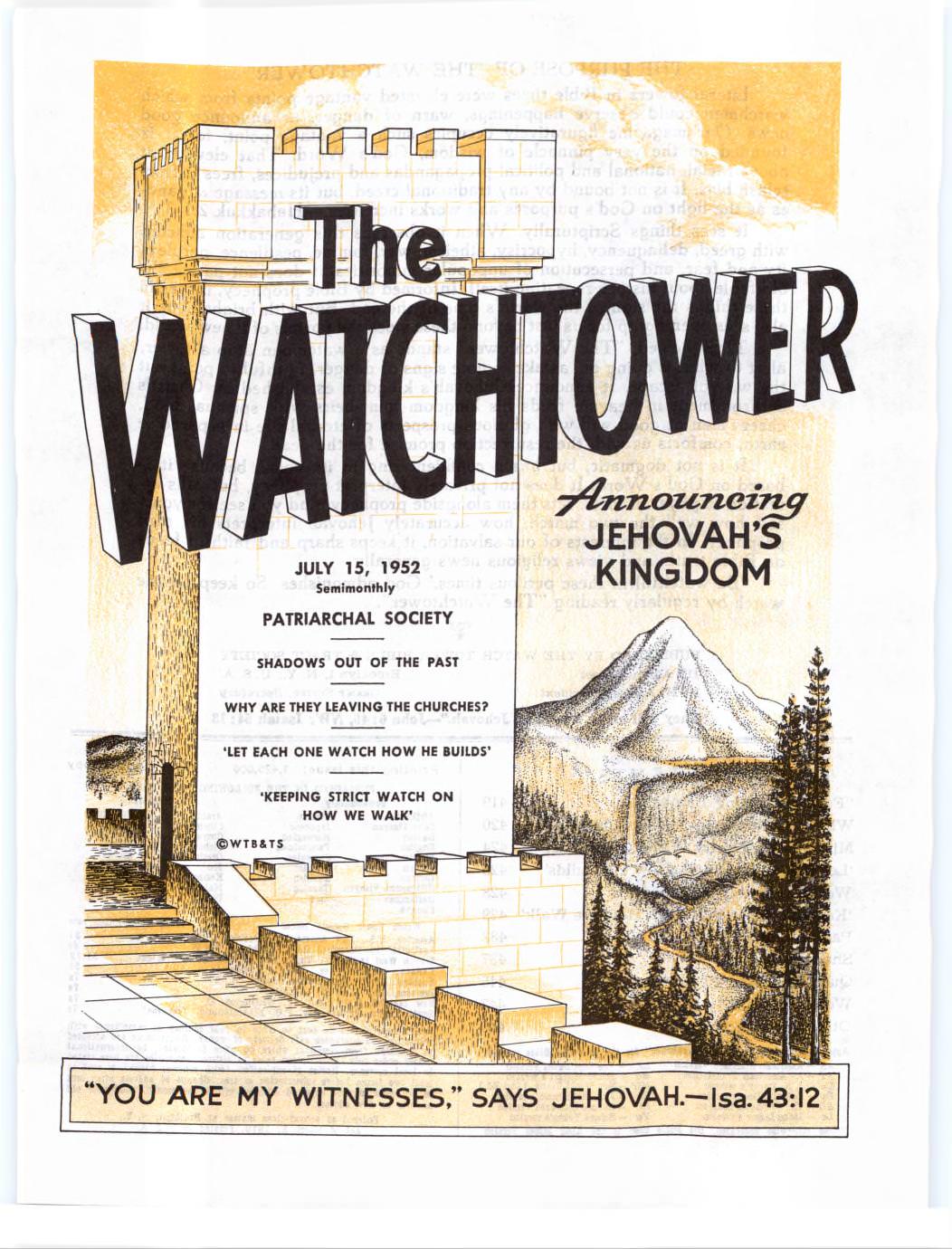
"YOU ARE MY WITNESSES," SAYS JEHOVAH.—Isa. 43:12
The WATCHTOWER
Announcing
JEHOVAH'S
KINGDOM
JULY 15, 1952
Semimonthly
PATRIARCHAL SOCIETY
SHADOWS OUT OF THE PAST
WHY ARE THEY LEAVING THE CHURCHES?
'LET EACH ONE WATCH HOW HE BUILDS'
'KEEPING STRICT WATCH ON
HOW WE WALK'
©WTB&TS
"YOU ARE MY WITNESSES," SAYS JEHOVAH.—Isa. 43:12 THE PURPOSE OF "THE WATCHTOWER"
Literal towers in Bible times were elevated vantage points from which watchmen could observe happenings, warn of danger, or announce good news. Our magazine figuratively occupies such a vantage point, for it is founded on the very pinnacle of wisdom, God's Word. That elevates it above racial, national and political propagandas and prejudices, frees it from selfish bias. It is not bound by any traditional creed, but its message advances as the light on God's purposes and works increases.—Habakkuk 2:1-3.
It sees things Scripturally. When it observes this generation afflicted with greed, delinquency, hypocrisy, atheism, war, famine, pestilence, perplexity and fear, and persecution of unpopular minorities, it does not parrot the old fable about history repeating itself. Informed by Bible prophecy, it sees in these things the sign of the world's time of the end. But with bright hope it also sees opening up for us just beyond these woes the portals of a new world.
Thus viewed, "The Watchtower" stands as a watchman atop a tower, alert to what is going on, awake to note signs of danger, faithful to point out the way of escape. It announces Jehovah's kingdom established by Christ's enthronement in heaven, feeds his kingdom joint-heirs with spiritual food, cheers men of good will with glorious prospects of eternal life in a paradise earth, comforts us with the resurrection promise for the dead.
It is not dogmatic, but has a confident ring in its voice, because it is based on God's Word. It does not privately interpret prophecy, but calls attention to physical facts, sets them alongside prophecy, and you see for yourself how well the two match, how accurately Jehovah interprets his own prophecy. In the interests of our salvation, it keeps sharp and faithful focus on Bible truth, and views religious news generally.
'Be watchful in these perilous times,' God admonishes. So keep on the watch by regularly reading "The Watchtower".
৩
PUBLISHED BY THE WATCH TOWER BIBLE & TRACT SOCIETY
117 Adams Street
Brooklyn 1, N. Y., U. S. A.
N. H. KNORR, President
GRANT SUITER, Secretary
"They will all be taught by Jehovah."—John 6:45, NW; Isaiah 54:13
CONTENTS
"Feed My Young Lambs" 419
Why Are They Leaving the Churches? 420
Missionary Activity in the Gold Coast 424
'Let Each One Watch How He Builds' 425
World Assembly 1953 428
'Keeping Strict Watch on How We Walk' 429
Patriarchal Society 432
Shadows Out of the Past 437
Questions from Readers 446
Works of Charity 447
Other Announcements 448
Abbreviations used in "The Watchtower" for the following Bible versions
AS - American Standard Version LXX- The Septuagint Version
AT - An American Translation Mo - James Moffatt's version
Da - J. N. Darby's version NW - New World Trans. (2nd Ed.)
Dy - Catholic Douay version Ro - J. B. Rotherham's version
ED - The Emphatic Diaglott RS - Revised Standard Version
Le - Isaac Leeser's version Yg - Robert Young's version
Unless otherwise indicated, the Bible used is the King James Version
Afrikaans
Italian
Arabic
Portuguese
Cebu-Visayan
Japanese
Cibemba
Russian
Danish
Norwegian
Cinyanja
Siamese
English
Pangasinan
Cishona
Silozi
Finnish
Slovenian
Greek
Slovak
French
Spanish
Ibo
Twl
German
Swedish
Kanarese
Ukrainian
Hilgaynon-Visayan
Tagalog
Malayalam
Yoruba
Hollandish
Zulu
Polish
Iocano
America, U.S., 117 Adams St., Brooklyn 1, N.Y. $1
Australia, 11 Beresford Rd., Strathfield, N.S.W. 8s
British West Indies, 21 Taylor St., Port of Spain, Trinidad $1.72
Canada, 40 Irwin Ave., Toronto 5, Ontario $1
England, 34 Craven Terrace, London, W. 2 7s
Jamaica, 151 King St., Kingston 7s
New Zealand, G.P.O. Box 30, Wellington, C. 1 7s
South Africa, Private Bag, P.O. Elandsfontein, Transvaal 7s
Remittances should be sent to office in your country in compliance with regulations to guarantee safe delivery of money. Remittances are accepted at Brooklyn from countries where no office is located, by international money order only. Subscription rates in different countries are here stated in local currency. Notice of expiration (with renewal blank) is sent at least two issues before subscription expires. Change of address when sent to our office may be expected effective within one month. Send your old as well as new address.
Entered as second-class matter at Brooklyn, N. Y., Act of March 3, 1879. Printed in U. S. A.
"FEED MY YOUNG LAMBS"
AFTER his resurrection Jesus appeared to certain of his apostles on the shore of the sea of Tiberias. At that time Jesus commanded Peter, "Feed my young lambs." And just before his ascension into heaven Jesus commanded Peter, and the other apostles with him, "Go therefore and make disciples of people of all the nations, baptizing them in the name of the Father and of the Son and of the holy spirit, teaching them to observe all the things I have commanded you."—John 21:15; Matt. 28:19, 20, NW.
One of the various ways in which Jehovah's witnesses today follow in the footsteps of Christ Jesus and imitate the example set by the apostles and obey the above commands is by calling back on the persons with whom they have left literature while going from house to house. That such activity does indeed result in feeding the young lambs of Christ Jesus is apparent from the following experience.
A witness for Jehovah was going from door to door in a certain town in Germany and came to a Catholic rest home. A young nun answered the door and, after listening very attentively to her testimony, accepted a copy of the Watchtower magazine and agreed to have the visitor call back in two weeks. However, a day or two later, the witness happened to meet the nun on the street in town. With considerable excitement the nun told of how the mother superior had found the copy of The Watchtower
and was very angry. She warned the witness not to return because the mother superior would be sure to throw her out.
But when two weeks had rolled around the witness reasoned with herself that it still was her responsibility before Jehovah as one of his witnesses to keep her promise and make that call. So she made the call, and who should answer the door but the mother superior herself, who asked: "Are you the woman that left that Watchtower here last week?" Expecting the worst the witness braced herself and calmly answered, "Yes, I am that woman." "Won't you step inside?" the mother superior then asked.
The witness followed her to an inner room where she found six other nuns seated. Then the mother superior said: "We have all read The Watchtower very carefully and have decided that we want you to teach us more about the Bible; will you?" A study was started then and there.
After the study had gone on for about a month or two a priest came to the rest home to recuperate from an illness. By this time the library of the rest home contained some books of Jehovah's witnesses and several copies of The Watchtower. Observing that the priest was interested in these publications he was asked to join the Bible studies, which he readily did. After some time he returned to his parish with the request that he be supplied with copies of The Watchtower. However, before long he wrote that it was no longer necessary to send these, as he had come in contact with Jehovah's witnesses in his own community.
Soon the priest shed his clerical garb and became a farmer and witness for Jehovah.
He wrote the nuns about this and extended to them the invitation to come and work for him on his farm. Two of them accepted the invitation, the rest preferring to remain at the rest home for the time being. When inquiry was made by her overseers whether the mother superior wanted replacements for the two that had left, she replied: "No, there really was not enough work for so many." She was not taking any chances on having their Bible study interfered with.
Shortly after this a Protestant pastor and his wife came to this rest home looking for accommodations. The mother superior tried to discourage them from staying and had almost succeeded when the pastor surprised her by inquiring if she happened to know of any Jehovah's witnesses in town. "Why yes," she answered, "in fact one of them comes here quite frequently." Curious and surprised, the pastor asked, "What? and do they work for you?" "No, not exactly," she replied, "this witness comes here to teach us about God's Word, the Bible."
At this pastor's face lit up and he said: "Well then, this is the right place after all for me and my wife. You see, we met some of Jehovah's witnesses in England, and so are very much interested in learning more about Jehovah and his Word, too." So they also joined in the study during the time of their stay at the rest home.
Yes, calling back on persons who have manifested interest in God's Word is one of the effective means Jehovah's witnesses are using to feed the young lambs of their Right Shepherd, Christ Jesus.
Why Are They Leaving the Churches?
"WHY are the old churches with fine buildings losing prospective members to the 'less respectable' sects?"
asks Presbyterian Life of January 20,1951. The writer, Alton Trueblood, goes on to say: "If tradition and wealth and an early start make any difference [the Catholics], the Presbyterians and Episcopalians should be doing very well, while those who worship at the other end of the street should
be relatively less successful. But the fact is reverse." He further observes:
"If we care about the Christian enterprise we must deal realistically with the fact that, in this particular comparison, the Christian organization enjoying the least social standing, having the shortest history, occupying the least fashionable district, and guided by the least trained ministry is going ahead of the others, not only in numbers, but also in zeal, in commitment, and in proportionate giving. This ought to bother us mightily." It should do more. Should it not call for an examination to see whether or not such so-called "fashionable" churches hold in common "the faith that was once for all time delivered to the holy ones"?
(Jude 3, NW) Should it not spur us to inquire whether there is any comparison between the early Christian church and this world's "respectable" religions?
Christianity was not born on a "respectable" corner in a magnificent cathedral amid softly playing organ music, but in a manger. Its seed did not take root in the hearts of the high, mighty, and so-called "reputable" religions of the day, but Christianity found a home in the hearts of the poor, despised, and lowly—men called "unlearned and ignorant" and of no reputation. (Acts 4:13) They were preachers, all of them. None were paid. "You received free, give free," is what they were taught. (Matt. 10:8, NW) Meetings were held in varied surroundings, indoors and outdoors. Their sermons were spontaneous, from the heart. So were their prayers. Each sermon was packed with truth and instruction regarding Christian conduct and ministry. 2 Tim. 4:3-5.
Christians especially were not to seek either wealth or fame, and were to show no preference to the possessors of such. (1 Tim. 6:9, 10; Jas. 2:1-4) They had neither political power nor intellectual prestige. They had the spirit of the Lord, which they would not sell or trade for all the fame and fortune in the world. They were not considered "reputable" in the eyes of the Stoics or Platonists, nor in the eyes of the "fashionable" Jewish religions of the day, the scribes, the Pharisees, or the Sadducees. Christianity, even though unpopular, was alive and progressive. It needed no revivals then, needs none now!
PRESENT SO-CALLED "CHRISTIAN" CHURCHES
Two things are certain. First, the so-called "reputable" and "Christian" churches of today do not match the pattern laid down by the early Christian church, but quite perfectly fit the pattern set by those "reputable" societies that vanished into oblivion. And, second, there is a famine for proper Bible instruction within these religious institutions. Millions of persons attend church regularly every Sunday and listen to their pastors, but after a ten- or fifteen-minute sermon and the religious ceremonies for the day the people leave with no good news to preach to the world. They have heard about a popular book, or about the political situation existing in the world, or perhaps a résumé of the economic crisis. Maybe the Bible was mentioned or a Scripture text was used, but the pastor soon wandered off into some easy-to-listen-to philosophy. But where is the energizing message to spur the congregation to Christian activity? Where is the one hope? Where is the accurate knowledge of God's Word? Of God? Of his Son? Where is the spiritual food to aid the congregation to grow to full maturity? Where is their interest in the kingdom that Jesus taught all Christians to pray for? Where is the energetic Christian organization built on love? It is quite obvious all this is sorely lacking.
S. Parkes Cadman, a minister at one church for thirty-five years, at the close of his ministry had this to say: "My church is slipping, and my men won't do anything about it. Do you know what is wrong with my church? My people like me, but they don't love God."* After thirty-five years the verdict ran, "They don't love God!" Dr. Frederick K. Stamm, who served as a clergyman since 1910, and for some time headed the country's largest Congregational Church, had this to say of the spiritual quality of one of the so-called "fashionable" and "respectable" churches where he served for many years: "I looked around for people with a dream, and found none.
Aside from the president of the Board, who died two months later, I found no man of spiritual stature who I felt would help to 'meet the mortal need' of that community . . . If it ever had a dream it had faded into oblivion. Its face was toward the past, not toward the future. I had expected to find men of tall spiritual stature. Instead I found pygmies, men who had never grown out of their infantilisms. . . It was the finest money-making institution I have ever seen that called itself a church. It was said in the board meeting, 'What we need in this church is someone who can leave us more money for our endowment.'"*
If these so-called "Christian" churches were being taught the Word of God and the truths presented in the Bible this morbid condition would not be present. All the members of the congregation would be fine specimens of tall spiritual stature filled with love for God and their neighbor. They would not be spiritual "midgets" still dependent on the milk of God's Word, and which milk is even denied them. Each would be a trained minister; for is not that the reason that teachers were given "with a view to the training of the holy ones for ministerial work"? Yes. To engage in the pure worship of God means one must be a preacher, a minister, a servant of the Most High God, Jehovah. (Jas. 1:22-25, NW) Christendom has miserably failed in this respect. Her false religious shepherds have fed themselves but not the sheep. Therefore, "Thus saith the Lord Jehovah, Behold, I am against the shepherds; and I will require my sheep at their hand, and cause them to cease from feeding the sheep; neither shall the shepherds feed themselves any more; and I will deliver my sheep from their mouth, that they may not be food for them."—Ezek. 34:10, AS.
SOWING ACCORDING TO THE SPIRIT
In contrast with the indifferent way taken by these "respectable" religions of Christendom, Jehovah's witnesses diligently work to make everyone who shows interest in the truth a competent minister of God's kingdom. They try to bring all immature ones to a mature knowledge of God's Word. They work in unity, manifesting the spirit of God. They have "one Lord, one faith, one baptism; one God and Father", and all the Lord's people are associated in one visible organization built up in love. This is the answer to the zeal and the unusual growth of the organization of Jehovah's witnesses. Jehovah's witnesses hope in the kingdom of God and proclaim it to the ends of the earth as a witness to all nations. Not only are they interested in doing this themselves, but they have interest in training others for ministerial work. They know this means the salvation of others.—1 Tim. 4:16.
In their work they copy Christ and the apostles very closely. This is admitted in religious circles. William Charles Walzer, whose article on "The Early Church" appeared in the July 1951 issue of Adult Student, said:
"The apostles preached with conviction and enthusiasm. An apostle's purpose was not primarily to stimulate thinking but to convince his fellow Jews that the crucified Lord was truly the long-awaited Messiah and to win them to the Christian fellowship. The preaching of the apostles was simple, intimate, and spontaneous. On the spur of the moment Peter used the healing of the lame man as the springboard for an intimate address to the bystanders. (Acts 3:12-26) Apostolic preaching was Scriptural. . . In this respect cultists like Jehovah's witnesses more nearly resemble the early Christians than do members of the more-regular denominations."
On this same point Alton Trueblood, in the article in Presbyterian Life, observes:
"In many localities the initiative has moved away from the places marked by cushioned pews, fine organs, and professional singers, to the poor little store-front churches. Small but vigorous bands of Jehovah's witnesses meet in their modest quarters called Kingdom Halls, and Alcoholics Anonymous meet wherever they can; but the lack of impressive surroundings seems to hinder them not at all. Neither are they hindered by the lack of trained leaders. Apparently the power of Christian society cannot be measured by the number of its members who are listed in Who's Who.
"There can be no doubt that these vigorous and unrespectable sects which now flourish so mightily in our land are, in many respects, far closer to original Christianity than are those of us who represent the conventional movements of Christendom. We call ours the older tradition, but in this we may be inaccurate. Perhaps they represent what is truly old in the Christian witness. The early Christians were undoubtedly despised and they frequently met at the wrong end of the street."
This is all so very true. Is this not why not only prospective church members but also members of long standing, monks, Catholic priests, nuns, and Protestant clergymen are coming forth completely abandoning their old traditional organizations and are joining in the proclamation of "this good news of the kingdom" with Jehovah's witnesses?—Matt. 24:14, NW.
The people of good will are fleeing the famine-stricken churches of Christendom. They can no longer be held in those false religious prison houses by soft pews, professional singers, organ music, or by a claim of respectability. The people are spiritually starved. They are hungry. They want to be fed. They do not want to die a
death of slow starvation. "Behold, the days come, saith the Lord Jehovah, that I will send a famine in the land, not a famine of bread, nor a thirst for water, but of hearing the words of Jehovah." (Amos 8:11, AS) So they are coming forth! They are coming "to the mountain of Jehovah" to be fed.-Mic.4:1,2,AS; Isa.58:11;65:13-16.
"We may as well face the fact," said Mr. Trueblood, "that in so far as our religion is represented exclusively or even chiefly by the attendance of well-dressed, uppermiddle-class people at an impressive church for one hour on Sunday morning, we are already in decay. In so far as this is a conventionalized ceremony, disassociated from the common life which most people now live, it will eventually lose the vitality it still has." The honest truth is that there is no life left in Christendom's churches. She is passé. What is the only hope for people of good will? "Get out of her," God answers, "if you do not want to share with her in her sins, and if you do not want to receive part of her plagues. For her sins have massed together clear up to heaven, and God has called her acts of injustice to mind."—Rev. 18:4, 5, NW.
Now is the time for the honest-hearted persons to respond to Jehovah's command to "get out of her" before he completely destroys her at the battle of Armageddon. Jehovah God is now inviting all peoples of all nations to dine at his table and live. "Ho, every one that thirsteth," says he, "come ye to the waters, and he that hath no money; come ye, buy, and eat; yea, come, buy wine and milk without money and without price. Wherefore do ye spend money for that which is not bread? and your labor for that which satisfieth not? hearken diligently unto me, and eat ye that which is good, and let your soul delight itself in fatness. Incline your ear, and come unto me; hear, and your soul shall live." Isa. 55:1-3, AS.
MISSIONARY ACTIVITY IN THE
IN OBEDIENCE to Jesus' command Jehovah's witnesses today are making "disciples
of people of all the nations". A letter at hand shows how this is being done in Gold Coast, Africa.
"Wednesday we walked two miles to Brauta, witnessing to the village of Amoanda on the way. To continue witnessing with us the sisters carry their babies on their backs and loads on their heads. The brothers have learned much in the past few years and now they will carry the baby and at times both the baby and the load so as to relieve the sisters; a thing most unusual among these native Africans. In the past I have been criticized for carrying my brief case while traveling through the bush; 'that's a woman's job,' they would say. Theocratic organization is making a striking difference in our brothers over here. The kindness and love they show is not generally found among the Africans in their dealings with their wives and families, and it is widely noticed. I gave a public talk at Brauta and 297 attended.
the formal greetings by shaking hands first with the lowest
"Friday, three of us—the linguist, a young native boy of eight or nine years (they never know just how old they are) and myself—went two miles farther to Objubi. After making known our presence and the purpose of our call we were escorted to the chief's palace to await the arrival of the elders and the chief in formal attire. There we sat in the lone palace courtyard, before a line of twelve stools, before each of which lay an animal skin, a special deerskin lying before the chief's stool. After they entered and took their seats, I began
in position and on up to the chief. After I had sat down, then they came and shook hands with me, beginning with the chief and on down to the lowest.
"Then the chief spoke to me through
a linguist who served as a logos, tribal custom forbidding his speaking directly to a person. He related what had taken place in his village before my arrival, etc. I briefly told him the purpose of my visit and he returned the greetings of his elders and subjects. Only then was I able to proceed with the witnessing and to present my request for him to ring the gong to call the villagers to my meeting and public talk. During my witnessing all was very quiet. Then I called for the young boy with the big vernacular Bible to read Job 32:9, a favorite text of his which he could read surprisingly well. The young boy, dressed in his native cloth, walked to the center of the courtyard, opened the Bible to the place and read to the chief: 'It is not the great that are wise, nor the aged that understand justice.' The boy's reading had a humbling effect on the chief.
"I proceeded with the witness and when I had concluded the chief said that my coming into the village was something never before done in the history of his people; no white man had ever entered, so humble and so friendly with the dark-skinned Africans. Forgetting about custom and tradition, the chief spoke to me in such a warm and friendly manner that it was apparent that they were happy to receive me, not as a representative of the white man but as an ambassador of Jehovah's kingdom. Neither the chief nor any of the elders could read. However, the schoolmaster could, and so I left him some literature in Twi for him to read to the chief.
Doubtless all the village came to hear the talk, as there were 475 in attendance.
"The next day we walked another two miles through the bush to Bereku. The brush was so thick that it was like walking through a tunnel; it being so dark I could not take any pictures. A native Methodist clergyman hearing one of the young witnesses read from the Bible sent for me. He asked how it was that so many of our peo-
swer. There were 232 that came to hear the public talk at Bereku.
"From there I traveled to Winneba, a village near a beach and of some 15,000 population, where, on Sunday, the largest crowd ever gathered to hear the public lecture. There, a young lad, after hearing a previous lecture, told his fisherman father: 'We made that boat with our own hands and now we are sacrificing to it. I
ple could read when he had been instructing boys a long time in the Methodist school and these could not read nearly as well as did our people. The young witness spoke for himself and gave a sufficient anlearned today that this is wrong and I'm not going to do it again.'"
Yes, Christian disciples are being made of men of all kinds, including the African natives of the Gold Coast.
'Let Each One Watch How He Builds'
THE Scriptures speak of Jehovah God as a builder or constructor. "Every house is constructed by someone, but he that constructed all things is God." They also speak of Christ Jesus as a builder. "On this rock-mass I will build my congregation, and the gates of Hades will not overpower it." Christ's followers are spoken of as being both God's building and his fellow workers: "For we are God's fellow workers. You people are God's field under cultivation, God's building."—Matt. 16:18;
what is laid, which is Jesus Christ. Now if anyone builds on the foundation gold, silver, precious stones, wood materials, hay, stubble, each one's work will become manifest, for the day will show it up, because it will be revealed by means of fire, and the fire itself will prove what sort of work each one's is. If anyone's work which he has built on it remains, he will receive a reward; if anyone's work is burned up, he will suffer loss, but he himself will be saved; yet, if so, it will be as through fire."
1 Cor 3:10.15 NW
As to the activity of Christians in building the apostle Paul continues: "According to the undeserved kindness of God which was given to me, as a wise director of works I laid a foundation, but someone else is building on it. But let each one keep watching how he is building on it. For no man can lay any other foundation than
To whom are these words addressed? Primarily "to the congregation of God that is in Corinth, to you who have been sanctified in union with Christ Jesus, called to be holy ones, together with all who everywhere are calling upon the name of our Lord, Jesus Christ". (1 Cor. 1:1,2,NW) These, "God's fellow workers," by accept-
ing Christ Jesus as their Savior and Redeemer and as their Exemplar have made him their foundation.
Now it is up to each one to "keep watching how he is building on it [him]".
They are to watch "how" they build, or the kind of building materials they are using; that is, what kind of hopes they build for themselves, what teachings they accept and preach, and what course of action they take. Clearly the gold, silver and precious stones would picture the right kind of hopes, teachings and activity, whereas the wood materials, hay and stubble would picture the wrong kind.
Christ Jesus gave many illustrations showing that at his return he would judge and reward his faithful followers. (Matthew chapter 25) Such Bible prophecies as Matthew chapter 24 and Revelation 11:15-18 show that he returned in 1914. However, the physical facts indicate that he did not begin to take an accounting with his followers until 1918; thus paralleling his work of cleansing the typical temple at Jerusalem and pronouncing judgment upon that nation three and a half years after his appearance as the Messiah.—Matt. 21:12,13; 23:1-39; 2 Cor.6:16; 1 Pet.4:17.
Prior to that time Jehovah had a work done of preparing the way before the Lord, even as he commissioned John the Baptist to prepare the way before Jesus' first advent. (Mal. 4:5,6; Matt.11:14; Luke 1:17) This preparatory work brought together a great number of Christians who professed to be dedicated to God, and to recognize Christ Jesus as their foundation.
However, coming from apostate religious systems these brought with them many beliefs and practices which were, in fact, just so much wood material, hay and stubble. Among such were the beliefs that it was necessary to develop a beautiful character to get to heaven and that that
was a Christian's chief duty; the notion that Christians must appear sanctimonious and pious, evincing more concern over what men thought than over what God thought; false teachings such as that the political powers of this wicked world were the "higher powers" of Romans 13:1 who must be obeyed even though they contradicted God's expressed commandments; that a pile of stone in Egypt constituted a witness to Jehovah (Isa. 19:19,20); that one imperfect man living in our day was repeatedly foretold in Bible prophecy; etc.
Among the Lord's people at that time were two classes. One of these was building with the durable materials by humbly, sincerely and unselfishly serving God to the best of their ability and understanding. These had, however, some of the wood, hay and stubble with them. And then there was the other class, who were self-centered, proud and insincere. These were serving God solely for what they got or hoped to get.—2 Thess. 2:10-12.
As with the illustration of the wheat and the weeds, these two classes were permitted to continue alongside each other until the harvesttime, or time for judgment, which was foretold as the time of the Lord's coming to his temple. "Behold, I send my messenger, and he shall prepare the way before me: and the Lord, whom ye seek, will suddenly come to his temple. . . But who can abide the day of his coming? and who shall stand when he appeareth? for he is like a refiner's fire, and like fullers' soap: and he will sit as a refiner and purifier of silver, and he will purify the sons of Levi, and refine them as gold and silver; and they shall offer unto Jehovah offerings in righteousness." (Matt. 13:36-43; Mal. 3:1-3, AS) Similar prophecies are to be found at Zechariah 3:1,2; 13:9.
What is this fire which will make manifest the kind of building that each one has done?
Catholic theologians use this text, 1 Corinthians 3:15, to support their teaching of purgatory. But how could that be? Are we to understand that the gold, silver, precious stones, wood material, hay and stubble are to be taken literally? No? Then why view the fire as being literal? Logically, if all those substances were used to represent something else, then the fire also would represent something and would not refer to literal fire. It would picture something that exposed and destroyed the false hopes, false teachings and unchristian activities of those who were or professed to be Christians, God's fellow workers, would it not?
And what was that? The facts show that the instrument that God used to destroy this worthless combustible material was and is the truth. Yes, the truth of God's Word is pictured not only as a sharp sword, as hail and as a hammer, but also as fire. "Is not my word like fire? saith Jehovah; and like a hammer that breaketh the rock in pieces?" (Isa. 28:17; Jer. 23:29, AS; Heb. 4:12) This fire appeared as lightning flashes from God's temple; bright shining truths which burned up the wood, hay and stubble. (Job 37:3; Rev. 11:19) The truth destroyed these things in the eyes of the faithful ones by exposing their unscripturalness, unreasonableness and folly.
Those whose hearts were honest were only too glad to get the increased light and to let go of the false teachings and wrong practices as soon as the fire brought them to their attention. They had no selfish affinity for such. They wanted their message to be as pure as Jehovah's words, as silver purified in a furnace seven times. (Ps. 12:6,7,AS; Isa.12:1) Their chief concern was to have Jehovah's approval and share in the vindication of his name.-Prov.27:11.
On the other hand, those who had accepted "present truth" because of some selfish reason or motive, refused to let go
of the wood, hay and stubble. It was these very things that had attracted them to the truth, and so they could not let go of them. They were too proud to admit that they had made mistakes; they were too selfcentered to let go of the flattering occupations of character development and creature worship; they were too fearful of what Satan's world could do to them to take an unequivocal and bold stand for God's kingdom. So they, together with their hay, wood and stubble, perished as far as Jehovah's organization was concerned. If they had let go of these things they might have been saved.—1 Cor. 3:15, NW.
The words of Paul which we have just considered not only are of prophetic interest to us, but announce a principle of Jehovah God which applies to all his creatures, not just to the remnant of the "body of Christ" which were on the earth at the time that the Lord came to his temple. Today there are a great number of professed Christians who are building with wood materials, hay and stubble; doing great works in Jesus' name, but to whom he is going to say: "I never knew you at all. Get away from me, you workers of lawlessness."—Matt. 7:23, NW.
These go to church on Sundays, occasionally or regularly, but have no conception of what the Bible teaches or what God requires of them. They hold to the trinity teaching even though Jesus said "the Father is greater than I am", and that he was "the beginning of the creation by God". (John 14:28; Rev. 3:14, NW) They believe and teach that man has an immortal soul, whereas the Bible plainly states that "the soul that sinneth, it shall die". (Ezek. 18:4) They further teach that sin's penalty is eternal torment, whereas God plainly told Adam that because of his disobedience he would return to the dust, and Paul states that the "wages sin pays is death".—Gen. 3:19; Rom. 6:23, NW. Further, they believe that hundreds of millions, either at death or via purgatory, will go to heaven; whereas the Scriptures plainly teach that only comparatively few, a little flock of 144,000, will do so.
(Matt. 7:13,14; Luke 12:32; Rev. 14:1) They mix in with the politics and commercial schemes of this world, even though Jesus told his followers not to lay up treasures on earth and that they were to be no part of this world. (Matt. 6:19; John 15:19) They put the laws of man above the laws of God, although Jesus plainly commanded: "Pay back, therefore, . . . God's things to God," and the apostles stated, "We must obey God as ruler rather than men." (Matt. 22:21; Acts 5:29, NW) They accept the evolution theory which makes void the Word of God, which Jesus plainly stated is the truth.—John 17:17.
Surely the false religious organizations of the world are building with combustible materials, which suffer damage now as the fire of truth strikes them, and which will be consumed entirely at the coming battle of Armageddon. Politicians and financiers also build with materials that cannot last beyond Armageddon.
In view of these facts let all men of good will bestir themselves. Let them investigate as to just what the Bible teaches, just what is the hope that God holds out for them, and just what his requirements are which must be met if they would realize that hope. Jehovah's witnesses everywhere consider it a privilege to help all such sincere ones to build with the durable materials and to follow the apostle's injunction: "Let each one keep watching how he is building."—1 Cor. 3:10, NW.
WORLD ASSEMBLY 1953
The Watch Tower Bible and Tract Society is pleased to announce that Jehovah's witnesses will hold a world assembly in the summer of 1953 at Yankee Stadium, New York city. All of Jehovah's witnesses everywhere will have this assembly in mind and will ask Jehovah to bless all the arrangements and things that are to be done there so that the assembly will redound to his honor and praise. God's servants in the earth should begin now to plan their vacation for the summer of 1953. The exact dates of the assembly will be announced in an early issue, but it can be said now that the convention will be held the latter part of July or early in August. All persons loving righteousness and desiring to worship the Most High Jehovah are welcome.
It is hoped that representatives from most of the Society's branches will be present. Missionaries from their far-flung fields of activity will be there to make reports. Witnesses in the United States and Canada and other nearby countries will come in strong numbers. By the Lord's undeserved loving-kindness this will be the greatest assembly ever held by Christian people promoting true worship.
All who live in countries overseas should communicate with their local branch office if they plan to attend the convention. The branch offices will be in position to advise what the best means of transportation available may be and will tell you what procedure to follow for obtaining visas or meeting other immigration requirements. It may be possible for many from other countries to arrange for group travel to New York.
Disturbing world conditions should not hinder persons from making plans to attend. Trust in the Lord. He knows when the battle of Armageddon will come and there is no need for us to be worried about the turmoil in the world. We know what it means and what it is leading to. Jehovah is with us. So do not let the troublous times in the world hold you back from planning to take in the blessings that Jehovah has in store for his people at this assembly. For many it will mean weeks or maybe months of traveling; for others just a few days. But, regardless, it means planning now, a year in advance, not only for you but for the Society. By Jehovah's undeserved kindness we hope to make it the best assembly yet.
'Keeping Strict Watch on How We Walk'
EHOVAH God, the Most High, is righteous, pure and holy. He is the Father of celestial lights and all his work is perfect. (Lev. 19:2; Deut. 32:4; Jas. 1:17, NW) His Son, Christ Jesus, so imitated his Father that he could say: "He that has seen me has seen the Father." (John 14:9, NW) And for this globe Jehovah has purposed a new heavens and a new earth of righteousness.—2 Pet. 3:13, NW.
Can we for a moment imagine that in that new world persons will be getting drunk? will practice immorality? will seek divorces on many pretexts? will have wild parties? will see how far they can go from the right way without actually falling? will see how near they can approach to fornication or adultery and still draw back? Of course not! People then will live clean, decent and upright lives.
There are some persons, however, who imagine that because of inborn sin such works of the flesh may now be passed over, lightly or heavily, but passed over nevertheless. In the new world, they reason, they will be different. But will Armageddon, which will mark the end of this old world, make such a change in such persons that they will no longer want to do then what they want to do now? Will that mighty act of Jehovah instantly and miraculously eradicate their selfish inclinations and automatically make everyone chaste?
Let us not deceive ourselves. Armageddon will destroy this wicked world just as surely as the flood destroyed the evil world in Noah's day, but it will not wipe out the fallen tendencies in our mortal bodies. It
is the ransom, not Armageddon, that cleanses us from sin. To get the benefit of the ransom we must co-operate with God's holy spirit by opposing sin.-Matt. 24:37- 39; Eph. 4:30; 1 John 1:7, NW.
Yes, in the new world we will still have to fight these fallen tendencies although it will doubtless be easier then than it is now. Progress in right doing will be rewarded with improvement in mental and physical well-being, making for still more improvement. Then there will be no Satan and his demons to tempt us; neither will there be a filthy, drunken, gluttonous, greedy and sex-mad old world to tempt God's servants. All that will perish at Armageddon. 1 John 2:16, 17; Rev. 20:3; 21:4, NW.
But let no one think that such a change in surroundings will entirely solve the problem, for even then some will be cut off in death at the end of 100 years because of selfishness. And it seems that at the end of the 1,000 years a considerable number will show themselves to be selfish and will be destroyed with Satan and his demons. Isa.65:20; Rev.20:7-10.
If we wait until the new world to clean up because circumstances will be more favorable then, most likely we will never enter it, for God will not spare any who are in sympathy with this present wicked system of things and its practices. If we would enjoy the blessings of the new world we must live according to its pure and righteous principles to the best of our ability now. We may not postpone the struggle. We must war against sin in our bodies now if we would have God's mercy; for his mercy is not for careless, willful and continual sinning, but only for single acts due to Adamic weakness.—Psalm 51.
Note how the apostle John contrasts the two kinds of sin. On the one hand he states: "My little children, I am writing you these things that you may not commit a sin. And yet, if anyone does commit a sin, we have a helper with the Father, Jesus Christ, a righteous one. And he is a propitiatory sacrifice for our sins, yet not for ours only but also for the whole world's." Here we see that there is a forgiveness for the committing of a sin. But on the other hand John states: "Everyone who practices sin is also practicing lawlessness, and so sin is lawlessness. Everyone remaining in union with him does not practice sin; no one that practices sin has either seen him or come to know him. Little children, let no one mislead you; . . . He who practices sin originates with the Devil, because the Devil has been sinning from when he began." Here we clearly see that there is no forgiveness for those who make a practice of sin.—1 John 2:1, 2; 3:4, 6-8, NW.
Some, seeking to find justification for their careless conduct, point to the mistakes that faithful men of old made, such as Noah, David and others. But these overlook the fact there is nothing to indicate that those servants of God repeatedly erred in these respects. Rather, they committed a sin, sincerely repented, accepted the Lord's chastisement, and were restored to God's favor. And these deflections were written down so that those coming after them who erred in like manner might take comfort and hope in God's mercy, but not to excuse sinning or to justify laxity. —Rom. 15:4.
Therefore let every Christian who hopes to gain life in the new world now heed the apostle's admonition: "So keep strict watch that how you walk is not as unwise but as wise persons, buying out the opportune time for yourselves, because the days are wicked." (Eph. 5:15,16,NW) Yes, and let anyone "that thinks he has a firm position beware that he does not fall". Ours is a wily and vicious foe, the adversary the Devil, who "walks about like a roaring lion, seeking to devour someone". We must therefore take our "stand against him, solid in the faith", confident that if we 'oppose the Devil then he will flee from us'. If we grow careless and let him trip us up we cannot blame the Devil. That excuse did not help Eve, neither will it help us. 1 Cor. 10:12; 1 Pet. 5:8,9; Jas. 4:7, NW. We must also steer clear of the world, for "what fellowship does light have with darkness"? The world follows the line of least resistance. "For the time that has passed by is sufficient for you to have worked out the will of the nations when you proceeded in deeds of loose conduct, . . . Because you do not continue running with them in this course to the same low sink of debauchery, they are puzzled and go on speaking abusively of you."—2 Cor. 6:14-18; 1 Pet. 4:3, 4, NW.
Both the Devil and his world appeal to our natural desires and our depraved tendencies, and if we are not alert these desires and tendencies will govern us instead of our governing them, and thus we become slaves of sin. (Romans chapter 6; 1 John 2:16, 17) Better is he that rules his spirit than he that takes a city. (Prov. 16:32) We have a warfare going on within us, so that what we wish to do we do not, and what we would not, that we practice. That is why we must continually exert our will power and browbeat our body; keep it down where it belongs, as an abject slave, otherwise it will make itself a willful and capricious master. (Rom. 7:15-23; 1 Cor. 9:27, NW) To help us to avoid injurious things God's Word gives many examples of what happened to those who walked carelessly.—1 Cor. 10:5-11, NW. If we would keep strict watch over our actions we must begin with the mind, the heart.
That is where the trouble starts, as Jesus well pointed out, and that is why the wise man counsels us to guard, above all else, our minds or hearts. (Prov. 4:23, Mo; Matt. 15:19) The best way to keep out the wrong things is to keep the mind filled with the right thoughts: "Finally, brothers, whatever things are true, whatever things are of serious concern, whatever things are righteous, whatever things are chaste, whatever things are lovable, whatever things are well spoken of, whatever virtue there is and whatever praiseworthy thing there is, continue considering these things."—Phil. 4:8, NW.
We profess to love God, do we not? If we do love him we will keep his commandments. (1 John 5:3) Carelessness will bring reproach upon his name. That is what Israel of old and certain ones in Paul's day were guilty of. (Ezek. 36:20-32; Rom. 2:24, NW) Being zealous for his name Jehovah has no alternative but to withhold his blessings from those that bring reproach upon it by a selfish course of action. When Achan and the sons of Eli grievously transgressed, the entire nation suffered defeats. (Josh. 7; 1 Sam. 2:22-25; 3:11-14) God's principles do not change. Wanting to have Jehovah's blessings will make us careful.
Loving our neighbor as ourselves will also make us careful regarding our conduct. How can we interest others, who are sighing and crying because of all the abominations they see in the land, in God's kingdom, if they also see such wickedness in us? (Ezek. 9:4) How can we conscientiously instruct others and we ourselves not be making a sincere effort to live up to God's requirements? "Do you, however, the one teaching someone else, not teach yourself? You, the one preaching 'Do not steal', do you steal?" (Rom. 2:21-23, NW) Let the apostate clergy take that course,
but not the genuine ministers of Jehovah God.—Ps. 50:16, 17, AS; Matt. 23:1-5, NW.
Love for our neighbor will also dictate that we do not encourage him in his wrongdoing. Evildoers may think they are smart, but as opportunity affords we should give them to understand that we do not think that they are. "Thou shalt not hate thy brother in thy heart: thou shalt surely rebuke thy neighbor, and not bear sin because of him." "He that rebuketh a man shall afterward find more favor than he that flattereth with the tongue." (Lev. 19:17; Prov. 28:23, AS) That is far better than gossiping about your neighbor's mistakes. Gossip helps neither the gossiper nor the one gossiped about nor the ones hearing the gossip; in fact, it hurts all three classes. So why indulge in it?
However, in keeping strict watch that how we walk is wise, let us not go to fanatical extremes. Let us not be like the oldfashioned religionists who frowned on all dancing, drinking, laughing, and who even considered it a sin to kiss one's mate or children on Sunday. There will be no "killjoys" in the new world; the new world will be a joyous world, but the joy will be in the right kind of things. They will be pure, wholesome joys, joys that will last. The joys that the Devil and his world now offer us are as bitter ashes. They leave one disappointed, discontented. Why lose peace of mind, suffer shame and perhaps miss out on eternal life for the sake of momentary thrills and transitory pleasures?
Godly devotion with self-sufficiency is a means of great gain. (1 Tim. 6:6, NW) God knows what is best, and when he counsels against certain actions let us not fly in the face of divine wisdom and spurn divine love by ignoring that counsel. Yes, for the sake of the honor of Jehovah's name, for the benefit of our fellow man and for our own welfare, let us 'keep strict watch that how we walk is as wise persons'.
Patriarchal Society
GOD-fear ing people earth-wide are aware of the
"Abraham, the family head, . . . By faith he resided temporarily in the land of the promise as in a foreign land, and dwelt in tents with Isaac and Jacob, the heirs with him of the very same promise."
—Heb. 7:4; 11:9, NW.
present disintegration of the corrupt old world society. Bible prophecies and the sign of the times prove conclusively that these old world systems of things will make their permanent exit in a low bow of total defeat in the immediate future. Fortunately for the generation of the righteous now on earth, Jehovah God in his great mercy and foresight has preserved a record of his divine revelations which contain a host of secrets pertaining to our present and future welfare. By the force of events many of these secrets are now being unlocked by the Great Interpreter himself. (Dan. 2:47) From these it is possible to obtain a clearing vision of the details which will operate in the new world order of things. Actually the new order of things is already taking shape and will be fully operating at Armageddon time to fill the vacuum left after the cataclysmic disappearance of the old order. For this reason God's witnesses on earth are now diligently studying the Holy Scriptures to fully examine the numerous shadows, principles, methods, procedures and systems employed by societies of God's servants in Biblical times. God's dealings with those ancient societies foreshadowed many developments in the new world order of things.—Rom. 15:4, NW.
2 Our present purpose is to make an examination of patriarchal society. To commence with we should know what the word society generally means. Society means an organization of persons associated together for various purposes with the individuals generally living together as members of a community. For 856 years after the flood the form of human society that Jehovah God had dealings with was that of a patriarchal society. However, the last 215 years of this patriarchal era found the Israelites in slavery as a patriarchal society subservient to Egypt. A patriarch was a family head. (Acts 7:8,9,NW) Therefore a patriarchal society was the organization of individuals related by blood, by marriage or by adoption who lived and worked together in a community under the leadership of a male family head. Such a patriarchal society formed a "family government".*
FAMILY HEAD NOAH
3 The first great patriarch or family head of the immediate post-flood society was Noah. From the Bible's account of Noah's activities and from later evidences of his leadership, we observe that Noah was a great organizer of society. For about 40 or 50 years before the flood, Noah organized his family of three sons and their
Why do Christians today find it timely to examine some of the shadows and systems of earlier societies?
Biblical Law, by H. B. Clark, pp. 53, 125.
What is meant by "patriarchal society"? When did such a form of Biblical society exist?
Describe Noah's organizing activity.
wives and his own wife for the building of the ark. This was a prodigious project necessitating the gathering and assembling together of much timber and other materials. All this required negotiations with neighboring peoples, payment in money for goods and services and making of contracts which brought into play rules of conduct and business. Likewise the marshaling together of the host of animals which later entered the ark required planning and orderly handling. Noah, the 599-year-old shrewd organizer, after caring for all preliminaries, went into the ark in 2370 B.C. with an organized society of which he was the head. For a year and ten days he maintained order and the well-being of this community in the ark while the flood waters held sway over the earth.-Gen.6:13-8:19.
4 Jehovah God had blessed and guided this preflood patriarchal society under
Noah's headship. Just as this society had gone into the ark fully organized so they came out fully organized under a family government. Having disembarked safely on dry land in 2369 B.C., Noah immediately led his family in making a giset in the sky as a sign of God's great covenant with surviving society under Noah's leadership. Hence Jehovah God as the great Superior took steps to give man a righteous start upon a cleansed earth. God gave righteous man a law around which to develop his post-flood government.-Gen. 8:20-9:17.
By reason of his having been in direct communication with God many times and having received revelations of the divine will, Noah as a keen lawyer and organizer was in the authoritative position to guide the expansion of human society after the flood. And that he zealously did during the 350 years he continued to live after the deluge. A man of great wisdom, foresight and of long experience in ways theocratic, Noah could be relied upon to set the proper lead in matters of post-flood government. When new problems arose he would be able
gantic burnt offering of praise to their deliverer Jehovah. Jehovah was pleased with this evidence of gratitude and proceeded to give Noah instructions for continuing human society. God promised man that never again would he curse the ground and that the earth would continue to enjoy its seasons. Also a divine command was given to fill every part of the earth with families of his descent. By direct revelation God began to give man divine law through the instrumentality of Noah. The rainbow was
to make clear right principles, establish proper precedents, initiate wholesome customs and give sound judgment in harmony with the mind of the Lord which he enjoyed as God's confidential servant and prophet. How fortunate human
society was after the flood to have had such a well-trained theocratic organizer as their counselor!-Gen. 9:28,29.
6 Did Noah seize the opportunity after the flood to become a king of a supergovernment to rule over all the rapidly increasing number of his descendants? No. Noah was a God-fearing man of faith in the promised Seed who was to be sent as King to establish a new world government over all mankind. (Gen. 3:15; Heb. 11:7)
What did God do for human society right after the flood?
How was Noah equipped to give a proper lead to human society after the flood?
What governmental pattern did Noah set for society after the flood?
Kingship was not Noah's assignment. Rather Noah proceeded to set a pattern of developing small units of family governments or patriarchal societies, which family groups would live independently of each other and migrate into all parts of the earth. The unit of this arrangement was not the individual but the family, a group of related individuals ruled by its family head, the patriarch. After the death of a family head, the oldest son would continue the headship of that unit and permit the other sons to move off, as did Esau and Jacob, in later history, to start separate societies. Later in time, the sons of a family head held together after their father's death under the leadership of an outstanding brother as did the twelve sons of Jacob and thus became a "house" or a clan of twelve families. In time each family of Israelites developed into a tribe, and finally these kindred tribes grew into a nation under the headship of Jehovah.-Gen. 46:2,3; 49:28; 50:24,25; Ex.19:4-6.
Under Noah's wise supervision the typical divine mandate of populating the earth proceeded to the point where eventually seventy nations were in operation all speaking one language but migrating as nomadic communities in all directions. Twenty-six of these nations sprang from Noah's son Shem, fourteen from his oldest son Japheth and thirty from his youngest son Ham. (Gen. 10:1-32) Noah also lived to witness the beginning of a cancerlike growth of rebellion against the great Sovereign Superior, Jehovah God. It all began with a young great-grandson of his by the name of Nimrod who was not honored as among the seventy family heads of the seventy nations. By defying God's rainbow covenant, by using war to put men in fear of himself, and as a tool of
Satan, Nimrod rebelled against the Noachian system of rule. Instead he set up the first kingdom government with Babylon as the center. This upstart tried to make himself greater than Noah by proclaiming himself as the first human king. He embarked on a religious tower-building project to keep many of the families from spreading to the four corners of the earth as God purposed. God expressed his wrath against this rebel movement by confusing the tongues of these tribes under Nimrod, thus forcing them to migrate abroad in accord with his original will. Having lived a long life as a counselor among many ancient nations, organizer Noah finally died, in 2020 B.C., at the ripe age of 950 years. Before his death he witnessed God's mandate carried out in spite of Satan's thwarting efforts by uniting man under governments opposed to Jehovah God. Gen.11:1-9.
INTERESTING FEATURES
We will now proceed to examine several interesting features of patriarchal society. At this point it should be understood that while many legal features found in the Bible are also found in the ancient nontheocratic legal systems such as the Babylonish Code of Hammurabi, the Hittite Code and the Assyrian Code, all three codes having been found in recent times by archaeologists, such are no evidences that these features were borrowed by the Hebrews from their pagan neighbors. Rather, expressly to the contrary. These are evidences that heathen nations have carried over many ancient laws and customs from the Noachian system of law and order, which pattern the faithful Hebrew patriarchs followed.—Ezek. 14:12-14, 20.
What did Noah live to see? How did Satan try to interfere with God's post-flood purposes, and what resulted?
8, 9. (a) From where did the Hebrew family heads get their customs and law? (b) How was it possible for the theocratic patriarchs to deal with their pagan neighbors according to a common legal procedure? (c) What argument is there for thinking that many of these customs were of a divinely sanctioned origin?
As the early tribes and nations came under greater control of Satan and his false theories of government, the Noachian structure of early law and order receded somewhat into the background. Nevertheless, since it was a fact that many of their basic laws were still of early Noachian origin, this made it possible for faithful theocratic patriarchs like Abraham, Isaac and Jacob to deal with their pagan neighbors according to common customs of legal procedure. It is also well to state at this point that, since many of the legal features practiced by the faithful theocratic patriarchs were later incorporated in the Law covenant dictated by God to Moses, it strongly indicates that they were of a divinely sanctioned origin. For surely God would not have incorporated laws and customs which originated with Satan's demon-empowered governments.2 Cor. 6:14-16, NW.
10 As already alluded to, the family rather than the individual was the unit in patriarchal society. Generally there was no holding of individual property aside from a few personal belongings. All property as to herds, household goods, equipment and lands was held in common by the family, since they were all related to one another by birth, marriage or adoption. This is confirmed in the statement made by Rachel and Leah to Jacob their husband and family head on the occasion when they separated with all their goods from their father Laban's tribal household to commence an independent patriarchal society. "Rachel and Leah replied [to Jacob their husband and head], 'What share or possession is left for us in our father's house? Does he [Laban their father] not treat us like aliens? He has sold us, and he goes on to spend all the price of our marriage! All the wealth that God has taken from our
…