The Watchtower, August 1, 1952
Download: PDF — The Watchtower, August 1, 1952
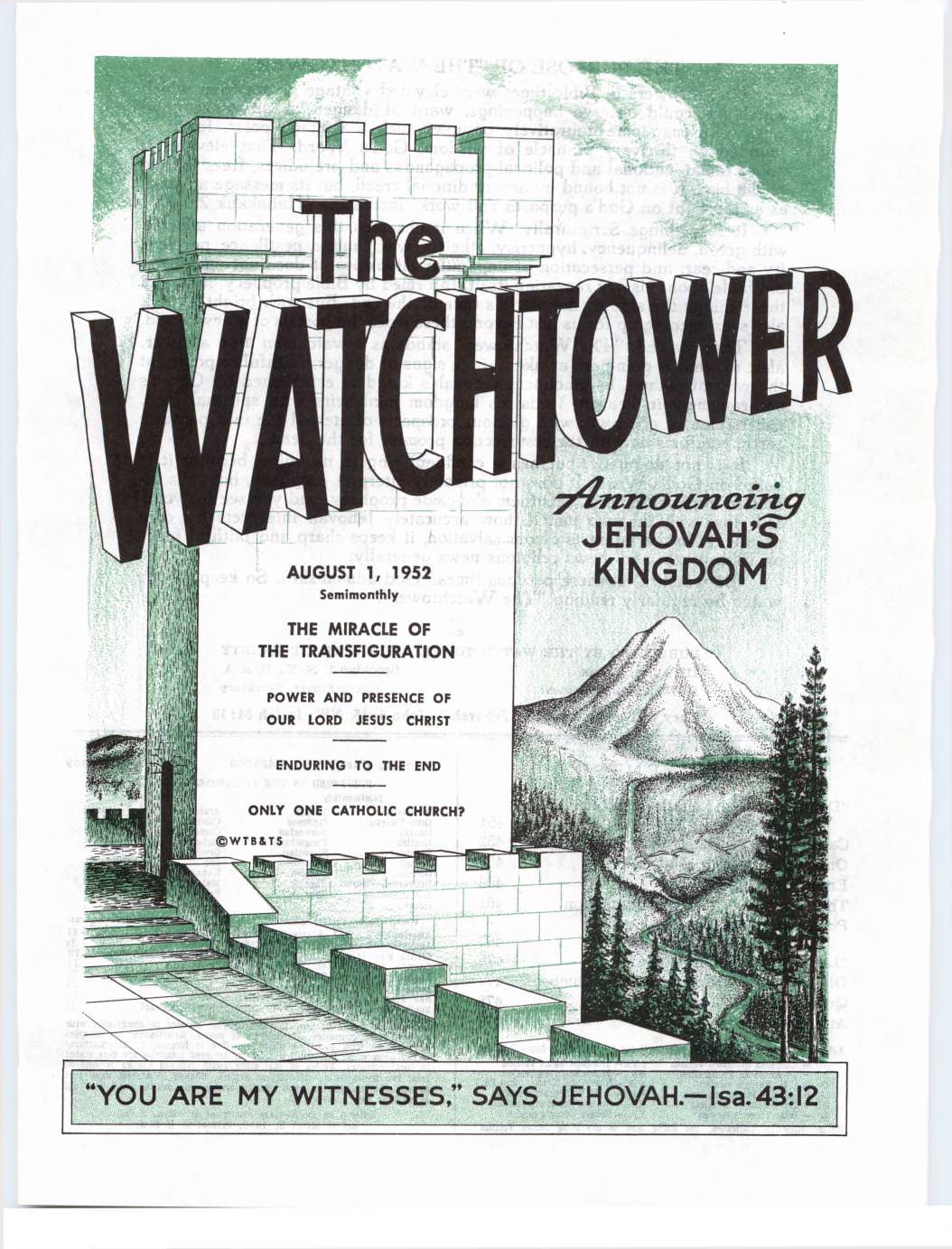
"YOU ARE MY WITNESSES," SAYS JEHOVAH.—Isa. 43:12
The WATCHTOWER
Announcing
JEHOVAH'S
KINGDOM
AUGUST 1, 1952
Semimonthly
THE MIRACLE OF
THE TRANSFIGURATION
POWER AND PRESENCE OF
OUR LORD JESUS CHRIST
ENDURING TO THE END
ONLY ONE CATHOLIC CHURCH?
©WTB&TS
“YOU ARE MY WITNESSES,” SAYS JEHOVAH.—Isa. 43:12 THE PURPOSE OF "THE WATCHTOWER"
Literal towers in Bible times were elevated vantage points from which watchmen could observe happenings, warn of danger, or announce good news. Our magazine figuratively occupies such a vantage point, for it is founded on the very pinnacle of wisdom, God's Word. That elevates it above racial, national and political propagandas and prejudices, frees it from selfish bias. It is not bound by any traditional creed, but its message advances as the light on God's purposes and works increases.-Habakkuk 2:1-3.
It sees things Scripturally. When it observes this generation afflicted with greed, delinquency, hypocrisy, atheism, war, famine, pestilence, perplexity and fear, and persecution of unpopular minorities, it does not parrot the old fable about history repeating itself. Informed by Bible prophecy, it sees in these things the sign of the world's time of the end. But with bright hope it also sees opening up for us just beyond these woes the portals of a new world.
Thus viewed, "The Watchtower" stands as a watchman atop a tower, alert to what is going on, awake to note signs of danger, faithful to point out the way of escape. It announces Jehovah's kingdom established by Christ's enthronement in heaven, feeds his kingdom joint-heirs with spiritual food, cheers men of good will with glorious prospects of eternal life in a paradise earth, comforts us with the resurrection promise for the dead.
It is not dogmatic, but has a confident ring in its voice, because it is based on God's Word. It does not privately interpret prophecy, but calls attention to physical facts, sets them alongside prophecy, and you see for yourself how well the two match, how accurately Jehovah interprets his own prophecy. In the interests of our salvation, it keeps sharp and faithful focus on Bible truth, and views religious news generally.
'Be watchful in these perilous times,' God admonishes. So keep on the watch by regularly reading "The Watchtower".
PUBLISHED BY THE WATCH TOWER BIBLE & TRACT SOCIETY
117 Adams Street Brooklyn 1, N. Y., U. S. A.
N. H. KNORR, President GRANT SUITER, Secretary
"They will all be taught by Jehovah."—John 6:45, NW; Isaiah 54:13
CONTENTS
"Defending and Legally Establishing the Good News" 451
Catholic Clerics Differ on Church Gambling 452
Only One Catholic Church? 453
Enduring to the End 456
The Miracle of the Transfiguration 461
Power and Presence of Our Lord Jesus Christ 467
"Let Your Kingdom Come!" 476
Distributing French Awake! in Quebec 477
Questions from Readers 478
Announcements 479
Abbreviations used in "The Watchtower" for the following Bible versions
AB - American Standard Version LXX- The Septuagint Version
AT - An American Translation Mo - James Moffatt's version
Da - J. N. Darby's version NW - New World Trans. (2nd Ed.)
Dy - Catholic Douay version Ro - J. B. Rotherham's version
ED - The Emphatic Diaglott RS - Revised Standard Version
Le - Isaac Leeser's version Yg - Robert Young's version
Unless otherwise indicated, the Bible used is the King James Version
<tr><th>Afrikaans
Italian
Arabic
Portuguese
Cebu-Visayan
Japanese
Clbemba
Russian
Danish
Norwegian
Cinyanja
Siamese
English
Pangasinan
Cishona
Silozi
Finnish
Slovenian
Greek
Slovak
French
Spanish
Ibo
Twl
German
Swedish
Kanarese
Ukrainian
Hiligaynon-Visayan
Tagalog
Malayalam
Yoruba
Hollandish
Zulu
Polish
Docano
Watch Tower Society offices Yearly subscription rate
America, U.S., 117 Adams St., Brooklyn 1, N.Y. $1
Australia, 11 Beresford Rd., Strathfield, N.S.W. 8s
British West Indies, 21 Taylor St., Port of Spain, Trinidad$ 1.72
Canada, 40 Irwin Ave., Toronto 5, Ontario $1
England, 34 Craven Terrace, London, W. 2 7s
Jamaica, 151 King St., Kingston 7s
New Zealand, G.P.O. Box 30, Wellington, C. 1 7s
South Africa, Private Bag, P.O. Elandsfontein, Transvaal 7s
Remittances should be sent to office in your country in compliance with regulations to guarantee safe delivery of money. Remittances are accepted at Brooklyn from countries where no office is located, by international money order only. Subscription rates in different countries are here stated in local currency. Notice of expiration (with renewal blank) is sent at least two issues before subscription expires. Change of address when sent to our office may be expected effective within one month. Send your old as well as new address.
Entered as second-class matter at Brooklyn, N. Y., Act of March 3, 1879. Printed in U. S. A.
"DEFENDING AND LEGALLY ESTABLISHING THE GOOD NEWS"
Report from Ancona, Italy
AS ELSEWHERE on earth, Jehovah's witnesses continue to expand in the eastern part of Central Italy, along the Adriatic seacoast, in a section known as Abruzzo. In fact, the witnesses of Jehovah have become better known in this area than any other non-Catholic organization and their popularity among persons of good will is steadily increasing to the extent of alarming the priests. The efforts of the priests to stir up the common people to violence against Jehovah's witnesses have failed; merely warning their parishioners not to accept literature has had no effect; and the excommunication scare does not work anymore. So now they try to get the police to stop our work on the grounds that a license is needed to preach from door to door.
This is what was tried at Ancona, a seaport city of about 100,000 inhabitants where a group of Jehovah's witnesses from Abruzzo went to work as full-time ministers. There, as in many other places in Italy, they soon found persons of good will and were able to start a small study group. Their quiet, peaceful Christian activity, however, did not go unnoticed, and on March 2, 1951, two of the ministers were stopped by the police and taken to police headquarters. Here they were questioned as to their work and all the literature they had with them was confiscated.
This action violated the law that requires that a written court order be issued before personal property can be confiscated. However, the Italian police have been trained under the old fascist school and they operate as though fascism still controlled Italy. In fact, the "Public Security Laws" which were framed during the fascist regime have not yet been substituted with new laws in harmony with Italy's new Constitution. Although judges have instructed that the laws should be applied in harmony with the spirit of the new Constitution, the police continue to apply old fascist laws and openly declare that the new Constitution means nothing to them. A few days later the police raided the home of these ministers in Ancona, seizing all the Bible literature they could find, 200 bound books and upward of 2,000 booklets; all of which was done without any court order. The charge was: distributing literature without a permit.
The Watchtower Society instructed the local ministers to proceed with their preaching activities, using only the Bible if necessary. No fine was paid and the unlawful seizure was contested. Wherever they found interested persons orders were taken for Bible literature.
When the day for the trial finally came Jehovah's witnesses were represented by a well-known lawyer, glad to defend them because of the principles involved.
The trial was held on January 11, 1952, and the praetor, who officiates as judge in such trials, handed down a decision in favor of the ministers of Jehovah. Among other things he said: "The fact is firmly established that the only reason for the activity of the accused [is] to teach their religion. . . . Such religious propaganda is, in our positive arrangement, fully permissible and explicitly authorized by the Constitution. . . the uncertainty and irregularity of the offerings show that if the accused received contributions, such did not, however, constitute the purpose and aim of their activity. . . . From the complaints for arrest the evidence is clear that none of the accused were found leaving, selling and distributing in any form whatsoever the books, booklets and magazines in 'public
places either open or exposed to the public.' [Which the Constitution does prohibit.] Due to the above-said condition, this fine does not apply . . . the accused are innocent of the violation of which they are charged because the facts do not indicate a violation. . . . the restitution to the accused of the books and booklets confiscated from them is hereby ordered."
This was indeed a great legal victory for Jehovah's witnesses and it not only gives them the legal right to preach the good news unhampered in Ancona, but adds weight to their legal position elsewhere in Italy. These court victories (four important decisions, including one by the Supreme Court) are building up a strong wall of defense against freedom-haters and religious bigots.—Phil. 1:7, NW.
CATHOLIC CLERICS DIFFER ON CHURCH GAMBLING
On August 18, 1951, the Milwaukee Journal announced that Cardinal Stritch had banned gambling in the Catholic churches of Chicago. This came as bad news to many Milwaukee citizens who have been known to trek to Chicago as many as 4,000 at a time on peak Sundays for the pastime. This has been necessary since 1943 when the law finally cracked down on gambling in Milwaukee churches. Games of chance had been illegal in Milwaukee since 1939, but continued in the churches after that partly because the district attorney refused to enforce the law on religious enterprises; and as the Journal noted, "partly because the Catholic church here refused to recognize the law." After 1943 a new district attorney changed all that and sent Milwaukee bingo lovers to Chicago.
A thread of hope was left open for the bingo enthusiasts through the Chicago Sun Times, which revealed, the Journal said, that the cardinal's "confidential communication is reported to say that special permission hereafter must be obtained from the chancery office before games of chance can be played". This seemingly leaves the way open for wide
exceptions to the cardinal's rule. Perhaps he is not thoroughly convinced of the evil of church bingo. The Journal recalls that "Cardinal Stritch, who was then archbishop of Milwaukee, said in August, 1943, that games of chance in churches were not immoral when conducted according to church regulations, the primary purpose being recreation and the unexpended surplus going to charitable or religious causes".
In contrast, it is of interest to note the words of another Catholic prelate, Msgr. Paul Emile Leger, archbishop of Montreal. Lo! what a contrast, when in February, 1951, he said on the same subject: "People who assemble in church basements, very often at the time the evening prayer should be recited, do not go there to praise God. On the other hand, these games of chance destroy the real spirit of charity because the money is given in the hope of being able to gain more and not for a supernatural reason and to help the poor and needy. It is humiliating to hear some of the comments on these practices, and still more humiliating to hear of the methods in use in some of these organizations."
ASK any good Catholic, "How many Catholic Churches are there?" And he will no doubt proudly and promptly reply, "There is but ONE Catholic Church." And then, perhaps, with a bit of pride for his own church, he will point at Protestantism, as did The New Mission, book of the Redemptorist fathers, sold in Toronto, Canada, and say: "Protestantism is split into countless wrangling sects. The few remnants of Christianity that hide the leprosy of heresy are wearing away, and the grinning skeleton of infidelity appears in all its blasphemous deformity!" But not the Catholic Church. She is one. As one Catholic zealot wrote: "For over 1900 years there has been only one Catholic denomination. The Catholic Church has as its visible head His Holiness, the Pope, whose proclamations on matters of faith and morals are infallible. The word 'catholic' means 'universal', and throughout the world there is ONE CATHOLIC CHURCH!'" Such wild assertions are often made because they are seldom challenged.
True, Protestantism is divided into more than 250 different ways; but what about Catholicism? Is there truly just one Catholic Church? If it be right and proper for Catholics to point out the "countless wrangling sects" in Protestantism, surely
it is just as proper to do the same with Catholicism. If Catholics find it expedient to warn one of the "grinning skeleton of infidelity" of Protestantism, it should be just as expedient for Catholics to be warned of the "blasphemous deformity" of Catholicism. "For with what judgment you are judging, you will be judged, and with the
measure that you are measuring out they will measure out to you. Why, then, do you look at the straw in your brother's eye, but do not consider the rafter in your own eye? Or how can you say to your brother: 'Allow me to extract the straw from your eye'; when, look! a rafter is in your own eye? Hypocrite! first extract the rafter from your own eye, and then you will see clearly how to extract the straw from your brother's eye."—Matt. 7:2-5, NW.
It is an easy thing for Catholics to see the strawlike divisions in Protestantism, but they appear totally blind to the rafterlike divisions in Catholicism. These raftersize divisions in the eye of Catholicism are indelibly recorded in history, "before whom we—even his holiness Pius IX—must prostrate ourselves and be silent and bow our heads. That dictator is history. This is not like a legend, which can be made as the potter makes his clay, but is like a diamond which cuts on the glass what cannot be cancelled," said Bishop Strossmayer. It is before this "dictator" that the frequent Catholic assertions about there being only one Catholic Church must stand or fall.
Does history show there to be but one Catholic Church? Did not the eleventh-century separation leave Catholicism divided between Roman Catholics and Eastern Orthodox sectors, and the Reformation leave Continental Europe and the British Isles divided between Roman Catholic,
See The Watchtower, March 15, 1952, pp. 177-181.
Lutheran, and Reformed Churches, with further divisions as denominationalism increased? Are there not Eastern Orthodox Catholics? Old Catholics? Liberal Catholics? Polish National Catholics? Or are we to assume that these religions existed side by side with the Roman Catholic Church down through the centuries? Is not Protestantism itself an offshoot of Catholicism? Roman Catholicism not only is divided into many directions as spokes in a wheel, but also is a center of a great magnetic force drawing in every kind of pagan knickknack into her fold by calling them "Christian". The Roman Church, instead of being a one way highway, is a highway of many lanes, divided and subdivided, named and renamed, intermingled with an endless chain of confusing traditions, relics, idolatries, and formalisms.
MORE THAN ONE CHURCH
History testifies that with the organization of the Papacy after A.D. 440 the great schism between the Latin and the Greek parts of the Roman world began to develop. Up to this time the church in the West, centered at Rome, and the church in the East, with headquarters in Byzantium, were one church. But there were certain basic differences which made for confusion. Racially, socially, linguistically, mentally, morally and philosophically there were deep gulfs between the two. The East was Greek in blood and in speech; the West was Latin. The conflict deepened between the East and West.
Ignatius in Constantinople refused to administer the sacrament to Caesar Bardas, knowing he was immoral. At the Council of St. Sophia, Photius bitterly condemned the Latin Church for adding the word "filioque" to the Nicene Creed. On this point the Handbook of Denominations, by F. S. Mead, says: "The Eastern Church held that the holy spirit proceeded directly from the Father; the Western Church held that it came from the Father and the Son—filioque. Political and ecclesiastical jealousies fanned the flame, the pope excommunicated the patriarch and the patriarch excommunicated the pope, and the result of the long friction was that there were two churches, Eastern and Western, instead of one." No longer one church but two. The New World, Chicago's official Catholic paper, has this to say regarding this break: "An orthodox Catholic is a member of either the Russian or Greek Orthodox church which broke away from the Church of Rome in the year 1054. They deny the supremacy of authority of Our Holy Father, the Pope, and likewise Papal infallibility. . . . According to Catholic teaching, they are considered to be in schism. Their clergymen have valid orders, and the administration of Sacraments in this Church are valid. They number about 45,000,000, and are the second largest Christian body in the world."
The Eastern Orthodox Churches reject the teaching of the surplus merits of the saints and the doctrine of indulgences. The use of carved images, except for the crucifix, is forbidden. Purgatory is denied. In the Roman Catholic Church all beneficed clergy must be celibate, whether they are in monastic order or not. In the Orthodox Church those who are engaged in parochial work must be married, though they are debarred from the higher offices. Another striking difference is found in the administration of the mass, for the Roman Catholic Church allows the laity to partake of the bread only, the wine being reserved for the clergy, while in the Orthodox Church both elements are received by the laity. Further, in the Orthodox Church the elements may be administered to infants immediately after baptism, while in the Roman Catholic it is postponed till adolescence, though not necessarily till after "confirmation".
Also Orthodox Church worship may be conducted in the vernacular; the Roman Catholic service is always read in Latin.—Handbook of Denominations; The Byzantine Patriarchate, by George Every.
In 1870, at the time the infallibility of the pope was proclaimed as a matter of faith, another split took place. A large body of Roman Catholics refused to accept the definition of papal infallibility and formed what is known today as the Old Catholic Church. These rallied around the archbishop of Utrecht in the Netherlands as their leader. They profess adherence to the first seven General Councils of the Church, and likewise believe in the Nicene Creed. But Roman Catholics mark them as a "Protestant and Modernist body". According to Roman Catholic authority, 'their orders and their administration of the Sacraments are valid.'
The relationship between church and state caused another division within the Church of Rome. These divided Roman Catholics contend that "all laws are either derived from the authority of the state, or, while granting a juridical authority to the Church, deny that the Church is in any way supreme or superior to the State, and maintain that the Church's authority is over consciences only, and that she has no external or social authority". (The New World, December 27, 1946) These call themselves Liberal Catholics.
And another division. On March 14, 1897, the Polish National Catholic Church was born in resentment against certain resolutions passed by the Roman Catholic Council at Baltimore in 1884. Mead writes: "These resolutions seemed to the dissenting Polish congregations to give the Roman hierarchy of the Roman Catholic Church an unwarranted religious, political, and social power, and to permit an unlawful encroachment upon ownership of
Church property and to pave the way for the political exploitation of the Polish people.'" While this is the only body of any considerable size to break away from the Roman Catholic Church in America, there are other groups among Slovaks, Lithuanians, Ruthenians and Hungarians which have also broken away; several of the Slovak and Lithuanian parishes have merged with the Polish National Catholic Church.
Recently a smell of schism in the Roman Catholic Church in Soviet territory has come to the attention of the pope from under the Iron Curtain, according to the London Catholic Tablet of September 6, 1947. Both the London Soviet News and the Moscow radio have announced the consecration of two new Catholic bishops in St. Jacob's cathedral in Riga, Latvia. One is the well-known Catholic theologian Peter Strud, rector of Riga Ecclesiastical seminary, and the other Professor Kazimir Dulbinsky, also of the same Roman Catholic seminary. It appears that this action was taken without Vatican authorization.
From this brief recount of Catholic history, we find her not one solid church-mass extending down through the centuries, but split into various sects and cults. Therefore, Jesus' words at Matthew 7:1-5 are most applicable to her. Further, history testifies against her as being divided in politics, divided over domestic and international issues, divided in claims of capital and labor, divided over fascism, divided over communism, divided over democracy, divided in war and divided in peace. And "every kingdom divided against itself comes to desolation, and every city or house divided against itself will not stand". Matt. 12:25, NW.
Now is the time to flee the divisive house of all false religion and hail the true church, the one built upon "the spiritual rock-mass" as mankind's only hope.—Rev. 18:4; 1 Cor. 10:4, NW. to the End
THE way that leads to life is not an easy one. It is not for those wishing to follow the lines of least resistance. Fairweather friends will not last long on it. It is a way being trod, not by the many, but by the few: "Go in through the narrow gate; because broad and spacious is the road leading off into destruction, and many are the ones going in through it; whereas narrow is the gate and cramped the road leading off into life, and few are the ones finding it."—Matt. 7:13, 14, NW.
To get on the road that leads to life we must dedicate ourselves to the service of Jehovah God and then continue therein in spite of all the opposition that the world and the Devil can bring against us. As Jesus stated: "He that has endured to the finish is the one that will be saved."—Matt. 24:13, NW.
Thereafter we have no more choice in the matter. Having put our hand to the plow we may not even look back with longing. (Luke 9:62) On the contrary, we must ever look forward and press forward, eagerly taking hold of every privilege of service that is extended to us, viewing it as an opportunity to show our love of God and our appreciation of what he has done for us. And as we accept these privileges of service, we must resolve to endure in them in spite of all the efforts of the Devil to turn us aside. There is danger in taking just a single backward step. One of such steps leads to another, and soon we are back in the world, on the broad road leading to destruction.
For wise and loving reasons Jehovah God has arranged that those in his service
must weather the test of endurance. For one thing, it takes time to demonstrate that our integrity is unbreakable, to prove that we meant what we said when we dedicated ourselves to God's service. If we grow faint and lose hope just because the time may stretch out longer than we once thought, with persecutions increasing, God will not count us worthy of everlasting life. That is why we are counseled: "For you have need of endurance, in order that, after you have done the will of God, you may receive the fulfillment of the promise." —Heb. 10:36, NW.
JEHOVAH'S EXAMPLE OF ENDURANCE
Jehovah God has helped us to endure to the present time and he can and will continue to do so until the end of the test of endurance if we will but make use of provisions contained in his Word, the Bible. Not only does it contain striking examples of endurance and pointed admonition as to what is needed if we would endure, but to spur us on to endure it also points out the fruits of endurance.
The greatest and foremost example of endurance recorded in God's Word, strange though the thought may seem to some, is that supplied by Jehovah God himself.
Jehovah was not compelled to give us this example of endurance, as though he could not help himself, but he chose to do so of his own free will.
Instead of complaining, as some do, Why has God permitted all this wickedness? it would be far more becoming to such human creatures to ask, Why has God endured, yes, put up with, if you please, all such wickedness for the past six thousand years? He, who of all persons in the universe has been most undeserving of misrepresentation and reproach, while his unlimited power could have put a full and sudden stop to all such rebellion any time he pleased.
Truly, imperfect humans can ill afford to complain. Did not our first parents forfeit the right of existence of all their offspring? and therefore has not God's manifestation of the endurance of wickedness resulted in mercy's being shown to all of us? For "God, although having the will to demonstrate his wrath and to make his power known, tolerated with much longsuffering vessels of wrath made fit for destruction, in order that he might make known the riches of his glory upon vessels of mercy". (Rom. 9:22, 23, NW) And particularly is it true regarding our day that God's patient endurance means salvation to many of his creatures.—2 Pet. 3:9, 15.
While God's endurance has thus resulted in mercy's being shown to many of fallen mankind, that has not been his chief or primary purpose for manifesting it. Satan the Devil, having succeeded in deflecting our first parents, falsely charged that God could not put on earth men and women that would remain faithful to him under pressure and temptation. Jehovah knew that that base charge was false, but to demonstrate that fact to others he had to give Satan the Devil free hand in endeavoring to prove his charge. However, when God has uncontradictably demonstrated the falsity of Satan's charge and after he has fully demonstrated his supremacy by bringing forth his promised kingdom in spite of all the efforts of Satan and his
hosts to prevent it, then God will give expression to the wrath he has restrained all this time. Then, at last, his endurance will end.
And what, eventually, will Jehovah God have to show for his having thus exercised endurance? He will have a royal family of divine creatures in heaven, consisting of 144,000 and head over them will be his firstborn Son, Christ Jesus; and a recovered and perfected human race on a paradise earth, all inheritors of everlasting life. Surely then it will be apparent to all that Jehovah's endurance of wickedness was fully justified.
OTHER EXAMPLES OF ENDURANCE
The next great example of endurance the Bible has for us is that of Jehovah's Son, Christ Jesus. And what an example he set for us! No wonder we are admonished, "Let us run with endurance the race that is set before us, as we look intently at the leader and perfecter of our faith, Jesus. For the joy that was set before him he endured a torture stake, despising shame, and has sat down at the right hand of the throne of God. Indeed, consider closely the one who has endured such contrary talk by sinners against their own interests, that you may not get tired and give out in your souls."—Heb. 12:1-3, NW.
Consider also the example of Abraham, concerning whom Paul tells us: "But we desire each one of you to show the same industriousness so as to have the full assurance of the hope down to the end, in order that you may not become sluggish, but be imitators of those who through faith and patience inherit the promises. For . . . after Abraham had shown patience, he obtained this promise."-Heb. 6:11-15, NW.
Abraham was 75 years old when God first called him. He was about 125 years old when God confirmed his promise to him with an oath because of Abraham's willingness to offer up his beloved son Isaac, at that time about 25 years of age.
And then Abraham traveled in that land as a stranger for another fifty years, to die at the age of 175 years. Have we endured in God's service for 100 years?—Gen. 22:1-18; Ps. 105:9-15; Heb. 11:8-19.
The disciple James also brings examples of endurance to our attention. "Brothers, take as a pattern of the suffering of evil and the exercising of patience the prophets, who spoke in the name of Jehovah. Look! we pronounce happy those who have endured. You have heard of the endurance of Job and have seen the outcome Jehovah gave, that Jehovah is very tender in affection and compassionate." (Jas. 5:10, 11, NW) Not just for historical purposes, but that some might also be helped in this twentieth century to uphold Jehovah's sovereignty was the record of those faithful ones given us. If we endure as they did we too can be counted "happy".
Nor would we overlook the example that the apostle Paul gave us. He did not seek an early release from the ministry because of hardships and trialsome experiences. He did not retire on a pension, but kept on even though an old man. (Philem. 9) He performed the duties of an apostle with "all endurance, and by signs and wonders and powerful works".—2 Cor. 12:12, NW.
No hardship was too great for Paul to endure for the sake of the ministry. "In no way are we giving any cause for stumbling, that our ministry might not be found fault with; but in every way we recommend ourselves as God's ministers, by the endurance of much, by tribulations, by cases of need, by difficulties, by beatings, by prisons, by disorders, by labors, by sleepless nights, by times without food, by purity, by knowledge, by longsuffering, by kindness, by holy spirit, by love free from hypocrisy, by truthful speech, by God's
power; through the weapons of righteousness for offense and defense, through glory and dishonor, through bad report and good report; as deceivers and yet truthful, as being unknown and yet being recognized, as dying and yet, look! we live, as disciplined and yet not delivered to death, as sorrowing but ever rejoicing, as poor but making many rich, as having nothing and yet possessing all things." (2 Cor. 6:3-10, NW) Have we endured as many things as Paul did?
OTHER AIDS TO ENDURANCE
At times of weariness we may ask, How shall we stand up and last in this test of endurance? How? By loving God with all our heart, mind, soul and strength, is how. If we have love we will show it by keeping his commandments. For "love is long-suffering and obliging. . . It bears all things, believes all things, hopes all things, endures all things. Love never fails". (1 Cor. 13:4, 7, 8; 1 John 5:3, NW) Unless it is out of love that we endure our endurance not only will be short-lived but will not count with God. But if it is out of love that we bear up under afflictions and burdens we shall be able to continue, and not only shall we continue, but it will have the effect of deepening our love for God.
Love of God will help us to avoid the snares that love of money will lead us into, which would make it impossible to endure. "For the love of money is a root of all sorts of injurious things, and by reaching out for this love some have been led astray from the faith and have stabbed themselves all over with many pains. On the other hand, you, O man of God, flee from these things. But pursue righteousness, godly devotion, faith, love, endurance, mildness of temper."—1 Tim. 6:10, 11, NW.
Further, knowledge of the truth and the holy spirit will give us strength to endure.
A person having knowledge of Jehovah God and of the great issue concerning his name and sovereignty is strong. There is a secret source of strength in our knowing for whom we are privileged to endure hardship and persecution. "Walk worthily of Jehovah to the end of fully pleasing him as you go on bearing fruit in every good work and increasing in the accurate knowledge of God, being made powerful with all power to the extent of his glorious might so as to endure fully and be longsuffering with joy." (Col. 1:10, 11, NW) And having God's holy spirit upon us to make up for our weaknesses we are made still stronger for keeping in God's service with the right attitude of mind.
Another aid to endurance is joy. "The joy of Jehovah is your strength." (Neh. 8:10, AS) Anything undergone for the sake of bringing honor to God's name and upholding his cause is reason for joy. That is why we read that the apostles, after they had been beaten, "went their way from before the Sanhedrin, rejoicing because they had been counted worthy to be dishonored in behalf of his name." Their rejoicing so counteracted the suffering and shame that without letup they continued to teach and to preach the good news. (Acts 5:40-42, NW) We can do likewise if we will not let our minds dwell on the physical sufferings and mental grief of the reproaches but rather on the reasons why we should be joyful.
Hope is another factor that will help us to endure. No doubt it is because of the strength that our hope gives us to endure that the Devil has his world heap so much ridicule upon it. This hope plays an important part toward our ultimate salvation, for it holds us true to our course of serving Jehovah and bears us up in the midst of afflictions. Having this hope helps us to endure and, conversely, enduring strengthens
our hope. (Rom. 15:4) "For we were saved in this hope; but hope that is seen is not hope, for when a man sees a thing, does he hope for it? But if we hope for what we do not see, we keep on waiting for it with endurance."—Rom. 8:24, 25, NW.
Because of this hope we shall be able to endure persecution. The world marvels at the way Jehovah's witnesses seem to "thrive on persecution". That is because it does not understand or appreciate what the apostle Paul calls to our attention at Romans 5:2-5 (NW): "Let us exult, based on hope of the glory of God. And not only that, but let us exult while in tribulations, since we know that tribulation produces endurance; endurance, in turn, an approved condition; the approved condition, in turn, hope, and the hope does not lead to disappointment; because the love of God has been poured out into our hearts through the holy spirit which was given us."
To endure also requires self-control. We must hold ourselves in line as good soldiers of Christ Jesus. Men striving for temporary rewards exercise self-control; how much more should we with the prize of eternal life as our goal. (1 Cor. 9:25) That self-control and endurance go hand in hand in acquiring that godly devotion which will assure us God's approval and eventual salvation is apparent from the apostle Peter's words: "For this very reason, by your contributing in response all painstaking effort, supply to your faith virtue, to your virtue knowledge, to your knowledge selfcontrol, to your self-control endurance, to your endurance godly devotion."—2 Pet. 1:5, 6, NW.
The parable of the sower emphasized another need or requisite for our enduring, that of faith and a right heart condition. The seed that fell on the rock ledge or stony ground withered when the heat struck it. So likewise, if our hearts are stony, that is, selfish and lacking in faith, we shall not be able to endure the heat of persecution.
That is why Paul warns us: "Beware, brothers, for fear there should ever develop in any one of you a wicked heart lacking faith by drawing away from the living God." (Heb. 3:12, NW) Then Paul goes on to show how our hearts can become hardened by the deceptive power of sin.
In direct contrast with that kind of heart is the "right soil" kind of heart which retains the truth and brings forth "fruit with endurance", some thirtyfold, some sixtyfold and some a hundredfold.—Luke 8:15; Mark 4:20, NW.
FRUITS OF ENDURANCE
Never should we think that bearing up under the test of endurance is a waste of time; for as we continue on and bear up under things that try us changes go on in us; and if we undergo these trials in the right frame of mind and heart, the change will be for the better, resulting in God's approval. It is therefore something to be glad about, not sad. "Consider it all joy, my brothers," writes James, "when you meet with various trials, knowing as you do that this tested quality of your faith works out endurance. But let endurance have its work complete, that you may be complete and sound in all respects, not lacking in anything."—Jas. 1:2-4, NW.
From those words of James it is apparent that the test of endurance will not be quickly over but that we shall have trial after trial, ever causing us to exercise the right qualities and awakening new ones in us, as we lean heavily on God for wisdom and guidance. But by thus continuing we shall gain a many-sided experience and a well-rounded-out understanding of how to take things and we are matured and perfected in obedience and trust toward God.
So doing we shall prove our dependability toward God and will come to be among those of whose integrity Jehovah can be sure for all eternity. If we appreciate that fact we will not shrink back from tests of endurance but will consistently enter them with all we have, confident that with God's backing we can come off victorious.
There is yet another vital reason for enduring—it serves for the salvation of others, both in that we preach the good news of salvation to others and ourselves set an example in steadfastness. As Paul expressed it: "On this account I go on enduring all things for the sake of the chosen ones, that they, too, may obtain the salvation that is in union with Christ Jesus." 1 Tim. 4:16; 2 Tim. 2:10, NW.
Seeing, then, that others stand to profit by our steadfast endurance in God's service, we are under added obligation to keep on, never quitting. If we become quitters we shall help neither ourselves nor anyone else to salvation. But by continuing on in the service of Jehovah as his ministers, regardless of what we have to face or bear, we keep ourselves in line for salvation as well as help others in the way of salvation, both by our preaching to them and by our example.—2 Thess. 1:4.
God's promise of everlasting life in his new world is sure. The many blessings of serving God at the present time are with us. The fact that the work of preaching the good news may stretch out farther than we once thought should not dampen our zeal and enthusiasm. So, until we see Jehovah's war chariots wheel into action against Satan's visible organization and make it lick the dust, may there be no quitting on our part, but rather faithful endurance at our posts of service—for the vindication of Jehovah's name, for the salvation of others, for our own salvation. Isa. 21:8,9.
TRANSFIGURATION
"No, it was not by turning aside to follow artfully contrived false stories that we acquainted you with the power and presence of our Lord Jesus Christ, but it was by having become eyewitnesses of his magnificence."-2 Pet. 1:16, NW.
EHOVAH'S magnificent glory may be perceived only in the measure that he deigns to reveal it. He can hide it or show it, and happy are those of his children who are favored and permitted to catch even a fleeting glimpse of the divine effulgence. Such a marvelous sight uplifts, strengthens and supplies one with what is required for enlightenment and faithfulness. It enables the servant of God to meet critical conditions and confirms his hope as he moves forward toward the new world and everlasting life. In generations past Jehovah revealed his magnificence in part to Moses, Peter, James and John, and to his beloved Son, our Lord Jesus. An earnest study of Jehovah's record makes it possible for us to believe their testimony and so learn for ourselves about the wondrous majesty and glory of the King Eternal as revealed through the life, death, resurrection and second presence of the Lord Jesus. Additionally we may now, by Jehovah's undeserved kindness, be encouraged and strengthened to perform the service assigned to us by seeing the glory of Jehovah through his now reigning Son, Christ Jesus. The ones in this happy condition give thanks and with a good conscience
seek to purify themselves, following holiness and rejoicing in hope.
2 Note carefully Peter's words in his second letter, chapter 1 (NW): "May undeserved kindness and peace be increased to you by an accurate knowledge of God and of Jesus our Lord, forasmuch as his divine power has given us freely all the things that concern life and godly devotion, through the accurate knowledge of the one who called us through glory and virtue." (Vss. 2,3) Then following a description of some qualities a Christian must possess, he says of them: "For if these things exist in you and overflow, they will prevent you from being either inactive or unfruitful regarding the accurate knowledge of our Lord Jesus Christ." (Vs. 8) They must never be forgotten, otherwise we shall fail and lose the entrance into the kingdom of our Lord Jesus Christ. One of the best ways to prevent such 'unfruitfulness' is to continually make mention of them.
3 Emphatically and with much conviction the apostle continues, in verse 15: "So I will do my utmost also at every time that, after my decease, you may be able to make mention of these things for yourselves." To clinch the matter and help his brothers he further states: "No, it was not by turning aside to follow artfully con-
What beneficial results come to those privileged to see something of the glory of Jehovah and Christ Jesus?
2, 3. Explain why Peter said he was not following "artfully contrived false stories".
trived false stories"—such stories as may have originated with heathen mythology or the apocryphal writings. No, Peter had not cleverly devised a story. There was no system of pernicious mysticism "artfully" or deceptively built up, no, nothing artificial in what he had to say, when this faithful slave had disclosed the power and presence of the Lord Jesus, but by being an eyewitness of his magnificence at receiving "honor and glory when words such as these were borne to him [Jesus] by the magnificent glory: 'This is my son, my beloved, on whom I have set my approval.' "' Yes," Peter says, "these words we heard borne from heaven while we were with him in the holy mountain." (Vss. 16-18) Peter here refers to the miracle of the transfiguration, and, seeing he uses the fact of it to prove his points, it is very necessary that we understand it. Let us profit from its consideration and application.
THE TRANSFIGURATION
4 What actually happened has been recorded for us at Matthew 17:1-9, Mark 9:1-10 and Luke 9:27-36. Quoting from Mark's account (NW): "Furthermore he went on to say to them: 'Truly I say to you, There are some of those standing here that will not taste death at all until first they see the kingdom of God already come in power.' Accordingly six days later Jesus took Peter and James and John along, and conducted them up into a lofty mountain to themselves alone. And he was transfigured before them, and his outer garments became glistening, far whiter than any clothes-cleaner on earth could whiten them. Also Elijah with Moses appeared to them, and they were conversing with Jesus. And responsively Peter said to Jesus: 'Rabbi, it is fine for us to be here, so let us erect three tents, one for you and one for Moses and one for Elijah.' In fact, he did not
know what response he should make, for they became quite frightened. And a cloud formed, covering them protectingly, and a voice came out of the cloud: 'This is my Son, the beloved; listen to him.' Suddenly, however, they looked around and saw no one with them any longer, except Jesus alone. As they were coming down out of the mountain, he expressly ordered them not to relate to anybody what they saw, until after the Son of man had risen from the dead. And they took the word to heart, but discussed among themselves what this rising from the dead meant."
It is of importance to observe that each writer precedes the event of this remarkable vision with the question of our Lord and consequent discussion with his disciples, "Who are men saying that I am?" They said to him: 'John the baptist, and others, Elijah, still others, One of the prophets.' And he put the question to them: 'You, though, who do you say I am?' In answer Peter said to him: 'You are the Christ.' Also he started teaching them that the Son of man must undergo many sufferings and be rejected by the older men of influence and the chief priests and the scribes and be killed, and rise three days later." (Mark 8:27-29, 31, NW) Clearly Jesus was here confirming that he was the Christ, that he would die and be resurrected and that they would see the Kingdom in power before tasting death. The disciples were prepared for what was to follow, for Jesus had been so outspoken that there was no mistaking his remarks.
6 Just what did Jesus say concerning seeing the kingdom of God? The answer will be clear by comparing the brief record made by the three different writers: "... not taste death at all until first they
In your own words explain the transfiguration.
Just before the transfiguration what questions had Jesus propounded to his disciples, and why?
How was the promise of Jesus fulfilled that some of his disciples would not see death until first they saw the Son of man in the Kingdom with power?
see the Son of man coming in his kingdom" (Matt. 16:28, NW); "... until first they see the kingdom of God already come in power" (Mark 9:1, NW); "... will not taste death at all until first they see the kingdom of God." (Luke 9:27, NW) The obvious meaning is that before they finished their earthly course they must first see the Son of man in his kingdom with power. The Lord Jesus had taken Peter, James and John with him into a lofty mountain to pray, and while praying the appearance of his face became different and his apparel glittered and glistened with unearthly brilliance. He was "transfigured" before them. Then the vision revealed Elijah and Moses conversing with him, they also appearing "with glory". Evidently at this time the three apostles were weighed down with sleep, and as they became fully awake they heard a conversation going on. What kind of discussion could it possibly be? Luke is the only writer who informs us: "These appeared with glory and began talking about his departure that he was destined to fulfill at Jerusalem."—Luke 9:31, NW.
7 It was impetuous Peter who then burst out with the suggestion that it would be good to set up three tents on that lofty mountain, one each for the Lord, for Moses and for Elijah. While yet he was speaking a cloud formed and began to cover the trio and "a voice out of the cloud, saying: 'This is my Son, the Beloved, whom I have approved; listen to him.' At hearing this the disciples fell upon their faces and became very much afraid. Then Jesus came near and, touching them, said: 'Get up and have no fear.' When they raised their eyes, they saw no one but Jesus himself only. And as they were descending from the mountain, Jesus commanded them, saying, 'Tell the vision to no one until the Son
of man is raised up from the dead.' " (Matt. 17:5-9, NW) This vision had surely made a great impression on Peter's mind, for thirty-one years later he wrote about it as he sought to bring home to the minds of his brothers that he had not been 'artfully contriving false stories' but had preached to them the truth.
Further considering the matter Peter uses this vision of the transfiguration with regard to the "power and presence" of the Lord Jesus Christ, himself having been an eyewitness to its magnificence. It was very evident that what the apostles saw conveyed to their minds factual proof of his power and presence. Peter clearly shows that the transfiguration was to him the fulfillment of Jesus' promise that some of his disciples would not taste death until they had first seen the Son of man in his kingly power. By this vision they had witnessed the presence and power of Jesus Christ in Kingdom glory, and coupled with this were the words borne to Jesus by the magnificent glory, 'This is my Son, my beloved, on whom I have set my approval.' The apostles saw the brilliance, the magnificence, and actually heard Jehovah's voice from heaven acknowledging Jesus as the beloved Son of God, thus identifying him as the approved one and commanding them to "listen to him".
9 The three disciples were overawed with the majesty of this glorious spectacle. Would not any child of Jehovah be the same today if he had the great honor and privilege of seeing such a marvelous sight? Then, in addition, to actually hear the voice of Jehovah from heaven! What would any of us do? Without doubt exactly the same, fall upon our faces in fear. Because we have not experienced such a wondrous
Describe how the apostles were impressed by the vision.
Did Peter accept the vision as a fulfillment of Jesus' promise? Explain how and why.
How would such a glorious vision affect us today, and is it to be expected that there would be a grander vision now?
sight it is extremely hard for us to comprehend all that is involved, though we do know these three men were in fear, clearly indicating the power, conviction and realization of the presence of Jehovah's word. It would never be forgotten by them. Today we do not expect to climb a literal high mountain and see such a vision. Yet we shall realize, as we consider that transfiguration scene, that God's children on earth today have a vision far grander in every way. If we get God's mind on these truths they will have the same effect on us, causing us today to fear in the presence of God's voice, and bringing home to us our littleness, our complete unworthiness of Jehovah's kindness and mercy.
10 For our own well-being and strengthening in these trying times it is undoubtedly the real desire of each one to get the utmost value from the vision here under consideration. To grasp its effectiveness, forcefulness and splendor Jehovah's written word given centuries before must be examined. In so doing we learn the Hebrew Scriptures had taught that Jehovah God would raise up a prophet like the majestic Moses, a lawgiver, teacher and representative of Jehovah, who would be King in Israel. "Jehovah thy God will raise up unto thee a prophet from the midst of thee, of thy brethren, like unto me; unto him ye shall hearken; . . . Jehovah said unto me, They have well said that which they have spoken. I will raise them up a prophet from among their brethren, like unto thee; and I will put my words in his mouth, and he shall speak unto them all that I shall command him. And it shall come to pass, that whosoever will not hearken unto my words which he shall speak in my name, I will require it of him."—Deut. 18:15, 17-19, AS.
11 The promise God gave was that 'one like unto Moses would be raised up', and there certainly was a great similarity in Moses and Christ, even from birth. An attempt was made to destroy them as babes. They received special teaching from Jehovah during their 40-day fasting period. They were raised up for the deliverance of Jehovah's people from the world of idolatry and false worship. They opposed the priests and representatives of Satan and exalted and worshiped the one true Almighty Jehovah, thus bringing the issue of supremacy to a victorious climax. They were both 'lambs' used for the arranging of covenants made to produce a special people, a kingdom of priests. Both built tabernacles where the glory of Jehovah dwelt with them in their priestly services. They were commanders and leaders, had nations though no settled countries, and were set apart for Jehovah's service. These are just a few of the things wherein Moses and Christ were alike. Truly Christ was 'one like unto Moses'.
12 Not only was Jehovah purposing to raise up one like Moses, a Greater-than-Moses, but he promised that a Greater Elijah would also come. "Remember ye the law of Moses my servant, which I commanded unto him in Horeb for all Israel, even statutes and ordinances. Behold, I will send you Elijah the prophet before the great and terrible day of Jehovah come. And he shall turn the heart of the fathers to the children, and the heart of the children to their fathers; lest I come and smite the earth with a curse." (Mal. 4:4-6, AS) Now we see that the prophecies teach two great Hebrew prophets were going to figure in future events. It would not necessarily mean that these two well-known prophets must actually appear in flesh to
What was the promise of the prophetic word at Deuteronomy 18:15-19?
Explain some of the features wherein Christ is 'like unto Moses'.
Why should Elijah figure in the Kingdom vision?
fulfill these prophecies. Both died in faith and now await their resurrection.
13 Jehovah said: "I will send you Elijah the prophet." The man Elijah had been faithful and had never doubted Jehovah and was honored for his works of faith. One of the great works Elijah performed was to bring Israel to true repentance, and therefore we should expect that the 'Elijah to come' would do a similar kind of work. In the days of Jesus John the Baptist had completed the work as a forerunner. Also this reconciler worked hard to turn the people into the way of righteousness and if possible bring about their conversion. He well knew that if they were unconverted when the day of wrath was ready to be poured out they would be utterly destroyed. John the Baptist was performing a kind of service similar to that of Elijah. He denounced the priests who were serving the Devil, rebuked the king, delivered a warning to Israel and served the great Jehovah fearlessly. Meantime the leaders of Israel were mistakenly looking more to the fact of Elijah's coming as a miraculous event to them, instead of realizing that the work he was to do was actually to precede the judgment of destruction, and therefore was their last hope. So far, then, we can see that two prophets were promised for the end of the days, and both were seen in this transfiguration scene.
14 Not only do we see Moses and Elijah in this scene with their apparel glistening, but remember Jesus the Christ of God was there. He is there as The Christ, the anointed of Jehovah, for the prophecies had clearly taught that a son of David was to come who would be the Lord's anointed, and his kingdom would rule forever. Says Jehovah, "I have made a covenant with my
chosen, I have sworn unto David my servant: thy seed will I establish for ever, and build up thy throne to all generations. His seed also will I make to endure for ever, and his throne as the days of heaven. Once have I sworn by my holiness: I will not lie unto David: His seed shall endure for ever, and his throne as the sun before me. It shall be established for ever as the moon, and as the faithful witness in the sky." (Ps. 89:3,4,29,35-37,AS) "Behold,the days come, saith Jehovah, that I will raise unto David a righteous Branch, and he shall reign as king and deal wisely, and shall execute justice and righteousness in the land."—Jer. 23:5, AS; see also Jer. 30:9; Ezek. 34:23, 24; 37:24.
15 David's son would be greater than David, would be David's "lord", for he would be Jehovah's anointed Son. The sonship, kingship and anointing are all linked together in Psalm 2:2, 6, 7. Isaiah likewise testifies concerning the relationship of the kingdom and David's son and heir, and the Messiah: "For unto us a child is born, unto us a son is given; and the government shall be upon his shoulder: and his name shall be called Wonderful, Counsellor, Mighty God, Everlasting Father, Prince of Peace. Of the increase of his government and of peace there shall be no end, upon the throne of David, and upon his kingdom, to establish it, and to uphold it with justice and with righteousness from henceforth even for ever." (Isa. 9:6, 7, AS) Israel at the first advent of our Lord was in expectation of the anointed of God, the one to be their king. The cornerstone of Zion was to be laid and Jehovah would accomplish this, for it is written: "This is the day which Jehovah hath made; . . . Blessed be he that cometh in the name of Jehovah." (Ps. 118:22-26, AS) "Tell the daughter of Zion, 'Look! your King is coming to you, mild-tempered, and mounted upon an ass, yes, upon a colt, the offspring of a beast of burden.'
. . . 'Save, we pray, the Son of David! Blessed is he that comes in Jehovah's name!" (Matt. 21:5,9,NW) This means that not only had Jehovah promised a greater than Moses and Elijah but also a greater than David, one who would be the Son of God. This is substantiated by the record to which we now turn our attention.
16 At the time of Mary's conception the angel said: "You have found favor with God; and, look! you will conceive in your womb and give birth to a son, and you are to call his name Jesus. This one will be great and will be called Son of the Most High, and Jehovah God will give him the throne of David his father, and he will be king over the house of Jacob forever, and there will be no end of his kingdom. . . Holy spirit will come upon you, and power of the Most High will overshadow you. For that reason also what is born will be called holy, God's Son." (Luke 1:30-35, NW) At the actual time of the birth of the son, Jehovah's angel was sent to announce it to the country shepherds. "And suddenly Jehovah's angel stood by them and Jehovah's glory gleamed around them, and they became very fearful. But the angel said to them: 'Have no fear, for, look! I am declaring to you good news of a great joy that all the people will have, because there was born to you today a Savior, who is Christ the Lord, in David's city.'" (Luke 2:9-11, NW) Then we have on record the testimony of Simeon: "He would not see death before he had seen the Christ of Jehovah. . . . 'This one is laid for the fall and the rising again of many in Israel and
for a sign to be talked against.'" (Luke 2:26,34,NW) True it was that he became a "stone of stumbling" and "rock of offence" to both houses of Israel.
To John the Baptist questions were asked by the Jews, through their priests and Levites: "Who are you?' . . . 'I am not the Christ.' . . . 'What, then? Are you Elijah?' . . . 'I am not.' 'Are you The Prophet?' . . . 'No!' . . . 'Why, then, do you baptize if you yourself are not the Christ or Elijah or The Prophet?' " (John 1:19-25, NW) Note in the foregoing how the same three servants are joined together. Nathanael put the matter concisely in one sentence: "Rabbi, you are the Son of God, you are King of Israel." (John 1:49, NW) Because Jesus was God's Son he was his heir to those things Jehovah promised. He certainly was more than David's son and heir. Jesus asked the Jews: "What do you think about the Christ? Whose son is he?" They said to him: 'David's.' He said to them: 'How, then, is it that David by inspiration calls him "Lord", saying: "Jehovah said to my Lord, 'Sit at my right hand until I put your enemies beneath your feet'" ? If, therefore, David calls him "Lord", how is he his son?" (Matt. 22:42-45, NW) "So the Word became flesh and resided among us, and we had a view of his glory, a glory such as belongs to an only-begotten son from a father." (John 1:14, NW) "I have seen it and have borne witness that this one is the Son of God." (John 1:34, NW) At the time of baptism he is acknowledged by Jehovah as his Son, "And a voice came out of heaven: 'You are my Son, the beloved; I have approved you.'" —Luke 3:22, NW.
18 Further corroboration is supplied by the writings of Paul to the Hebrews: "God, who long ago spoke on many occasions and in many ways to our forefathers by means
Give Scriptural support showing David's son to be God's own Son.
17-19. How do we know Christ is the heir of God?
of the prophets, has at the end of these days spoken to us by means of a Son, whom he appointed heir of all things." (Heb. 1:1,2,NW) Again we have the illustration Jesus gave: "I will send my son the beloved. Likely they will respect this one.' When the cultivators caught sight of him they went to reasoning with one another, saying: 'This is the heir; let us kill him, that the inheritance may become ours.'"
…