The Watchtower, October 1, 1952
Download: PDF — The Watchtower, October 1, 1952
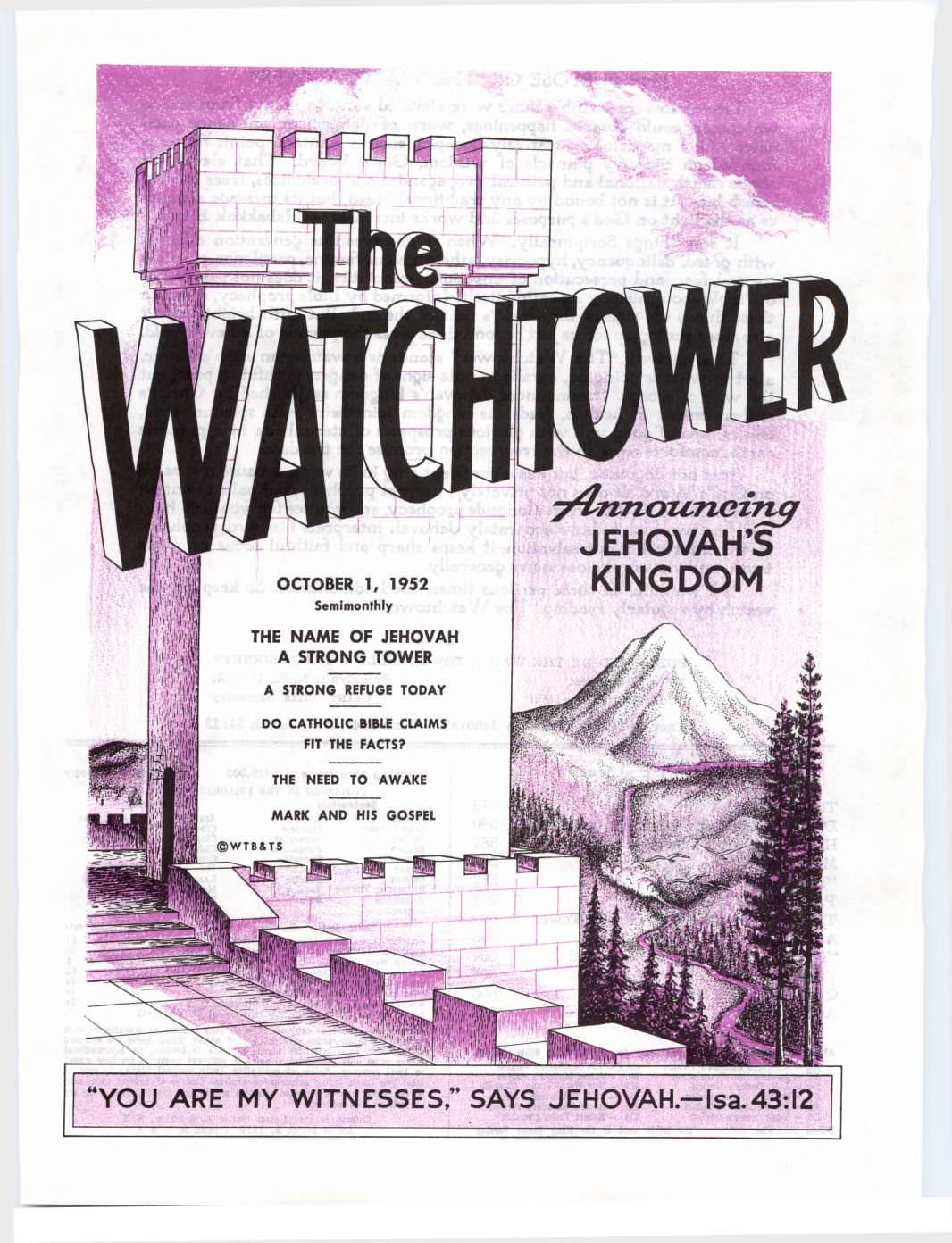
The WATCHTOWER
Announcing
JEHOVAH'S
KINGDOM
OCTOBER 1, 1952
Semimonthly
THE NAME OF JEHOVAH
A STRONG TOWER
A STRONG REFUGE TODAY
DO CATHOLIC BIBLE CLAIMS
FIT THE FACTS?
THE NEED TO AWAKE
MARK AND HIS GOSPEL
©WTB&TS
“YOU ARE MY WITNESSES,” SAYS JEHOVAH.—Isa. 43:12 THE PURPOSE OF "THE WATCHTOWER"
Literal towers in Bible times were elevated vantage points from which watchmen could observe happenings, warn of danger, or announce good news. Our magazine figuratively occupies such a vantage point, for it is founded on the very pinnacle of wisdom, God's Word. That elevates it above racial, national and political propagandas and prejudices, frees it from selfish bias. It is not bound by any traditional creed, but its message advances as the light on God's purposes and works increases.—Habakkuk 2:1-3.
It sees things Scripturally. When it observes this generation afflicted with greed, delinquency, hypocrisy, atheism, war, famine, pestilence, perplexity and fear, and persecution of unpopular minorities, it does not parrot the old fable about history repeating itself. Informed by Bible prophecy, it sees in these things the sign of the world's time of the end. But with bright hope it also sees opening up for us just beyond these woes the portals of a new world.
Thus viewed, "The Watchtower" stands as a watchman atop a tower, alert to what is going on, awake to note signs of danger, faithful to point out the way of escape. It announces Jehovah's kingdom established by Christ's enthronement in heaven, feeds his kingdom joint-heirs with spiritual food, cheers men of good will with glorious prospects of eternal life in a paradise earth, comforts us with the resurrection promise for the dead.
It is not dogmatic, but has a confident ring in its voice, because it is based on God's Word. It does not privately interpret prophecy, but calls attention to physical facts, sets them alongside prophecy, and you see for yourself how well the two match, how accurately Jehovah interprets his own prophecy. In the interests of our salvation, it keeps sharp and faithful focus on Bible truth, and views religious news generally.
'Be watchful in these perilous times,' God admonishes. So keep on the watch by regularly reading "The Watchtower".
২
PUBLISHED BY THE WATCH TOWER BIBLE & TRACT SOCIETY
117 Adams Street
Brooklyn 1, N. Y., U. S. A.
N. H. KNORR, President
"They will all be taught by Jehovah."—John 6:45, NW; Isaiah 54:13
CONTENTS
The Need to Awake 579
Do Catholic Bible Claims Fit the Facts? 580
Horse Blessing Undergoes Change 584
Mark and His Gospel 585
"The Son of the Man" 587
Princes' Just Rule 588
The Name of Jehovah a Strong Tower 589
A Strong Refuge Today 596
"Teacher of Trouble" Gets Fined 604
Truth Inspires Zeal in Youth 605
Questions from Readers 606
Announcements 608
Abbreviations used in "The Watchtower" for the following Bible versions
AB - American Standard Version LXX - The Septuagint Version
AT - An American Translation Mo - James Moffatt's version
Da - J. N. Darby's version NW - New World Trans. (2nd Ed.)
Dy - Catholic Douay version Ro - J. B. Rotherham's version
ED - The Emphatic Diaglott RS - Revised Standard Version
Le - Isaac Leeser's version Yg - Robert Young's version
Unless otherwise indicated, the Bible used is the King James Version
Printing this issue: 1,425,000 Five cents a copy
PUBLISHED IN THE FOLLOWING LANGUAGES
Semimonthly Monthly
Semimonthly
Monthly
Afrikaans
Italian
Arabic
Portuguese
Cebu-Visayan
Japanese
Cibemba
Russian
Danish
Norwegian
Cinyanja
Siamese
English
Pangasinan
Cisbona
Silosi
Finnish
Sloeian
Greek
Slovak
French
Spanish
Ibo
TwI
German
Swedish
Kanarese
Ukrainian
Hiligaynon-Visayan
Tagalog
Malayalam
Yoruba
Hollandish
Zulu
Polish
Docano
Watch Tower Society offices Yearly subscription rate
America U.S., 117 Adams St., Brooklyn 1, N.Y. $1
Australia, 11 Beresford Rd., Strathfield, N.S.W. 8s
British West Indies, 21 Taylor St., Port of Spain, Trinidad $1.72
Canada, 40 Irwin Ave., Toronto 5, Ontario $1
England, 34 Craven Terrace, London, W. 2 7s
Jamalea, 151 King St., Kingston 7s
New Zealand, G.P.O. Box 30, Wellington, C. 1 7s
South Africa, Private Bag, P.O. Elandsfontein, Transvaal 7s
Remittances should be sent to office in your country in compliance with regulations to guarantee safe delivery of money. Remittances are accepted at Brooklyn from countries where no office is located, by international money order only. Subscription rates in different countries are here stated in local currency. Notice of expiration (with renewal blank) is sent at least two issues before subscription expires. Change of address when sent to our office may be expected effective within one month. Send your old as well as new address.
Entered as second-class matter at Brooklyn, N. Y., Act of March 3, 1879. Printed in U. S. A.
THE NEED TO AWAKE
THIS good news of the kingdom will be preached in all the inhabited earth for the purpose of a witness to all the nations." (Matt. 24:14, NW) In obedience to that prophetic command of Christ Jesus some 450,000 Christian witnesses regularly go from house to house with Bibles and Bible literature, conduct Bible studies in the homes of the people, arrange for public Bible lectures and also stand on the busy streets offering the magazines The Watchtower and Awake! Often as they stand on the streets with these magazines passers-by will make such rejoinders as "I am awake"; "I'm not asleep!"
But persons making such rejoinders actually are asleep to the purposes of Jehovah God, to the fulfillment of Bible prophecies, to the urgency of heeding the Scriptural call to get out of Babylon. (Luke 21:28; Rev. 18:4, NW) Otherwise they also would be standing on the streets calling out to others to awake. However, although the rank and file of churchgoers are thus blithely oblivious to their need to awake, such fact has not escaped the notice of some of their clergymen. For example, the Dr. Culbert C. Rutenber, of Philadelphia, Pennsylvania.
The Chicago Daily Tribune, May 20, 1952, reported on the address which this theologian made to some 12,000 Baptist representatives of 7,000 Baptist churches in the United States at the opening session
of the 45th assembly of the American Baptist convention (held in Chicago, May 1923, 1952): "Dr. Rutenber said that the clergy and the laity are alike disturbed at the seeming irrelevance of the church in a world where the only dynamism appears to be the dynamism of anti-Christ, and that the church at large is waiting for a word from God—'a word of hope, a mighty word, a sure word'—but that actually Christians are asleep.
"God is more likely to speak that word,' Dr. Rutenber continued, 'if we give heed to the word He has already given us, which is, "Awake thou that sleepest, and Christ will give thee light."'
The learned doctor is right in concluding that Christendom is asleep. But is he himself fully awake? If he were would he not be able to give 'that word of hope, that mighty word, that sure word' to his listeners? That is what the Christian witnesses of Jehovah are doing. And far from the only "dynamism" in this world being godless and Christless communism, all acquainted with the facts know that the zeal and enthusiasm of Jehovah's witnesses far outstrip the "dynamism" of the Communists. In fact, one of the chief reasons why the Communists in Poland forced the work of Jehovah's witnesses underground was that the zeal, enthusiasm and success of Jehovah's witnesses so eclipsed the activities of the Communists.
Yes, Dr. Rutenber also needs to awake!
Do Catholic Bible Claims Fit the Facts?
OCTOBER 1952 marks the five hundredth anniversary of the production of the first printed book, Gutenberg's Bible. That month will see a drive of Protestant religious organizations of the United States to distribute one million of the new Revised Standard
Version Bible. On the other hand the Catholic Confraternity of Christian Doctrine, Washington, D.C., has designated September 28 to October 4,1952, as Catholic Bible week. This, the second Catholic Bible week of the year, the first having been held February 10 to 16 (which, incidentally, was the first time a Catholic Bible week was observed in the United States), has as its objective to "show how the Church which made the Bible—has valued it before, during and after Gutenberg".
Roman Catholic Bible claims, as listed in their Bible-week literature, can be summarized as follows: (1) The Catholic Church made the Bible. (2) The Catholic Church preserved the Bible. (3) The Catholic Church encourages the reading of the Bible.
THE BIBLE A CATHOLIC BOOK?
Does the claim that the Catholic Church made the Bible fit the facts? In answering that question let us first note that the Bible is God's Word. That being so, then ever since Moses completed the Pentateuch (the five books, Genesis, Exodus, Leviticus, Numbers and Deuteronomy) God's Word has been available to his servants. As other inspired servants wrote it grew and grew
so that by the time Malachi penned his prophecy God's Word, the Bible, had grown to 39 books. These 39 books constituted the sacred Scriptures that Jesus and his disciples used and which they encouraged others to study. John 5:39; Acts 17:11; 2 Tim. 2:15; 3:15-17.
With the writing of the accounts of Jesus' life by Matthew, Mark, Luke and John, the letters of Paul, Peter, James, Jude, and John and the Acts of the apostles and Revelation (or the Apocalypse), God's Word grew to 66 books. As these were written down and circulated among the early Christians they became recognized as part of the Bible. (2 Pet. 3:15, 16) The last of these writings, John's three letters and his Gospel, were completed about A.D. 98. Shortly thereafter began the compiling of these writings, and there is evidence to indicate that as early as A.D. 170 the canon or catalogue of the Bible we have today was recognized. Both Origen and Eusebius list these same books, and of ten early catalogues extant six likewise give the same list as is recognized today, three others omitting Revelation and one omitting both Hebrews and Revelation. In view of these facts, which show that the canon of the Bible was settled among the Christians in the second and early third centuries after Christ, can the Catholic Church claim to have made the Bible, simply because some 150 to 200 years later her Council of Carthage announced what writings she considered canonical?
If the Catholic Church made the Bible, is it not strange that she failed to include any word about the assumption of Mary, her immaculate conception and about the efficacy of praying to her; about the veneration of relics, images and saints; about the use of holy water; about the ceremony of the mass; about a pope's being the vicar of Christ; about monsignors, archbishops
for them we would have no Bible." Does this claim fit the facts? Let us see.
The facts are that not one of the oldest, most reliable and most valuable manuscripts of the Bible was found in territories under Catholic domination. Even her prized Vatican manuscript 1209 has been in her possession only since the fifteenth century. And this she hid away, making it available
and cardinals; about purgatory; about a celibate clergy; about not eating meat on Friday or during Lent; about making novenas; about infant baptism; etc.? Is not the fact that the Bible is silent on all these outstanding points of the Catholic religion strong circumstantial evidence that the Catholic Church did not make the Bible? that it is not a Catholic book?
Who made the Bible is very clear from its own pages. God is its author. "Thy word is a lamp to my feet." "The spirit of the Lord both spoken by me and his
to the public only when another great manuscript, the Sinaiticus, bid fair to eclipse it. So if the monks had done no copying at all during the Dark and Middle Ages we would still have the best manuscripts. They copied none of the good ones.
Bible copying may have been largely limited to the monks, but that was primarily due to the Catholic Church's keeping the Bible in a dead language. When Wycliffe translated the Bible into English his followers made many, many copies, and
word by my tongue." "Thy word is truth." "For the word of God is living and effectu-
al." "The holy men of God spoke, inspired by the Holy Ghost." —Douay Version at 2 Ki. 23:2; Ps. 118: 105; John 17:17; Heb. 4:12; 2 Pet. 1:21.
CATHOLIC CHURCH PRESERVE THE BIBLE? The Catholic
as for giving these monks any credit, they dared to take liberties with the inspired
text. That is why we
have in the King James and the Douay versions some spurious passages, such as 1 John 5:7, to mention one of the most flagrant examples.
Not only can no credit go to the Catholic Church for pre-
Church further states: "There can be no doubt that the
world must thank the Catholic Church for the Bible-if only for the 1,500 years which elapsed before the first Reformers appeared on the scene. Who spanned the gulf? We ask that the monks who copied for centuries, . . be given their due. But
serving the Bible but the facts of history show that she has
been the chief destroyer of the Bible. Copies of Wycliffe's Bible were hunted out by her from one end of England to the other and then destroyed. Tyndale had to print his "New Testament" on the continent of Europe, for he could not do so in Catholic England.
Although he published 18,000 of them and had them smuggled into England they were hunted down and destroyed so efficiently that only seventeen copies are known to survive today.
Endeavoring to justify such Bibleburning Our Sunday Visitor, February 10, 1952, states that such "was the burning of versions which were proved to be faulty, and therefore had no right to pass as 'the word of God' ". But was there such a great difference between the Catholic Bible and the translations of the Reformers as to justify the crusade which destroyed not only Bibles but also Bible translators, publishers and distributors? On this point note what the Catholic Encyclopedia has to say regarding the English Challoner-Douay Version:
"To call it any longer the Douay or Rheimish version is an abuse of terms. It has been altered and modified until scarcely any verse remains as it was originally published. . . In nearly every case Challoner's changes took the form of approximating to the Authorized Version." So in improving the Catholic version it became more like the Protestant King James version! Recent instances of this could be cited from both the new American Catholic versions of the book of the Psalms and Genesis and Msgr. Knox's version.
No, the claim that the Catholic Church burned Bibles because of their being faulty translations does not fit the facts. There must have been some other motives. What these were we will let the reader judge. Incidentally, note that such Bible-burnings are not a thing of the distant past. Many Bibles were publicly burned on May 27,1923, in Rome, in homage of the virgin Mary, and in the New York Times, March 6, 1952, appeared an article under the following headings: "Protestant Cleric Is Beaten in Spain. Youths Invade Chapel and Set Fire to Bibles, Pews and Hymnals."
ENCOURAGE BIBLE-READING?
According to Pope Leo XIII the Catholic Church "has never failed to take due measures to bring the Scriptures within the reach of her children". Again we ask, do the facts fit the claim that the Catholic Church has encouraged and does encourage Bible-reading? If so, how? and to what extent?
At the time when England was under Catholic domination, for anyone to be found guilty of reading the Bible in English meant the forfeiting of "land, cattle, life and goods from his heirs forever". Many were the followers of Wycliffe, the Lollards, who were imprisoned and even burned at the stake because of having thus read the Bible in their native tongue.
If the Catholic Church really had wanted to encourage Bible-reading would she have kept that sacred volume in the shroud of dead languages? Would Pope Gregory of the eleventh century have publicly thanked God that the Bible was in a dead language if he had wanted the people to read it? And why should it have been necessary for Thomas Stitny, "father of Bohemian prose," to complain about the efforts of the Catholic Church to keep the Bible from being translated into the Bohemian language if she was interested in having the common people read the Bible? Would Pope Pius VII on June 13, 1816, have stated, "Experience has proved that, owing to the rashness of men, more harm than benefit arises from the Sacred Scriptures when published in the language of the common people"? And would Pope Gregory XVI on May 8, 1844, in his encyclical Inter Praecipuas, have condemned "the publication, distribution, reading and keeping of the Scripture translated into the vernacular"?
The picture of a chained Bible is a familiar one. Catholic apologists tell us that it was chained merely to keep it from being stolen or knocked down on the floor and that such Bibles were "placed open on a table in the churches to be consulted".
But who would be consulting a Bible written in a dead language at a time when the great majority of the people could not even read their native tongue, not to say anything about the dead or classical languages?
The fact is that the only reason the Catholic Church finally did give the people the Bible in their native tongue, as she herself confesses, was to counteract Protestant versions. Says the Catholic Encyclopedia (Vol. 5, page 140, 1913 ed.) on this subject: "It [the Douay Bible] owed its existence to the religious controversies of the sixteenth century. Many Protestant versions had been issued and were used largely by the Reformers for polemical purposes. The rendering of some of the texts showed evident signs of controversial bias, and it became of the first importance for the English Catholics of the day to be furnished with a translation of their own, on the accuracy of which they could depend and to which they could appeal in the course of argument."
How reluctant the world's greatest religious organization which "made and preserved the Bible" was to do this may be gathered from the fact that she waited two hundred years after one of her excommunicated doctors of divinity (Wycliffe) had pioneered the task on his own initiative, to give to her people this much needed instrument! The above quotation also effectively silences the claims that the Catholic Church and not the Reformers pioneered the work of giving the people the Bible in their native tongues.
But surely today the Catholic Church encourages Bible-reading. Did not Pope Leo XIII grant 'an indulgence of 300 days to the faithful for every time they read at least a quarter hour the books of the Sacred Scripture'? True, but how much encouragement to read the Bible that represents non-Catholics do not know. But a Catholic knows that he can gain the like amount of indulgence, 300 days, for just repeating once "Mary, conceived without sin, pray for us who have recourse to Thee". And that takes only five seconds to repeat! Why spend 15 minutes reading the Bible to gain an indulgence that is yours for just five seconds of praying? Use that fifteen minutes in unscriptural repetitious praying and gain 54,000 days' indulgence! So it might be argued. But even if the Bible is read, how much benefit can be expected to be gotten from such reading done merely to gain some other benefit and that for a specified time? Where would the mind, one's thoughts, be?
Indicative of the way the Catholic Church really feels about the Bible is the following excerpt taken from current Catholic Bible tracts: "The Christian is not bound to read the Bible since it is the Church who proposes to us for our belief Divine Revelation as contained in Scriptures and Tradition."
CIRCUMSTANTIAL EVIDENCE
If Catholics are encouraged to read the Bible why is it necessary for Catholic publications to tell Catholics, "No, Catholics Are Not Forbidden to Read It" (showing a picture of the Bible) and to state that "some Catholics have the idea that Bible reading is strictly 'Protestant'"? What more damaging confession could the Catholic Church make as to her failure to encourage Bible reading than to admit that some of her children think that Bible reading is 'strictly Protestant'?
During World War II there was complaint in the Catholic press of Britain about the scandal of not being able to procure Catholic Bibles even though Catholic fiction and Protestant Bibles were plentiful. Replying to such complaints one Catholic publisher stated: "If there existed a demand sufficient to justify special effort, we may be sure that effort would be made.
It may be of interest to note that, though Catholics show this apathy regarding the Scriptures, in other quarters a new appreciation of the Bible is being manifested."
Further circumstantial evidence along this line appeared in the book Religious Beliefs of Youth, published in the United States in 1950. This book made a comprehensive analysis of the religious habits of United States youth, and among the statistics it published were those showing that 61.9 per cent of the Catholic youths had not read their Bibles during the past six months, to compare with only 31.2 per cent of the Protestant youths who had not read their Bibles within that time. Obviously, two-thirds of Catholic youth is not impressed by the offer of indulgences for reading the Bible if they do not read it even once in six months.
Nor are such observations as the following, taken from The Holy Bible, The Heritage of Catholic Family Life, likely to make Catholic youth want to do more Bible reading: "Can the six days of which Moses speaks be those long periods described by the geologists? Certainly they are not. Moses knew nothing of modern science; his picture of the universe is
quite naive, not further advanced, in fact, than that of the people among whom he lived three thousand years ago." Yes, poor Moses! He just did not know any better, according to this Catholic publication. How much faith in the inspiration of the Bible does such an appraisal of its account of creation indicate? And how much encouragement to read the Bible?
In view of the foregoing what conclusions must we reach? That the Catholic Church did not make the Bible, she has not preserved it, she does not genuinely encourage the reading of it. Her Bible efforts are merely window dressing and propaganda to meet competition. Just as she is content to let her people remain illiterate so long as the states do not try to educate them, so she is willing to let her people be without the Bible so long as there is no danger of their obtaining Bibles from other sources. And just as she has her greatest school systems where secular education is at its best, just so she publishes the Bible in the native tongue if there is a likelihood of her people's obtaining a Bible from other sources. Compare Spain with the United States. Her current Bible week is a case in point, for she admitted that it was planned to counteract the celebration by non-Catholics of the 500th anniversary of Gutenberg's Bible.
Horse Blessing Undergoes Change
Although there is no mention in the Bible of Paul's ever having his tent-making tools "blessed" so he could outshine competing tentmakers, or of Jesus' sprinkling Peter's fishing boat with "holy water", certain Roman Catholic officials make a regular custom of "blessing" farm animals and inanimate tools. The London Catholic Herald last November 16 explained that "the traditional Blessing of the Horses outside the Church of St. Leonard near Boerwang, Bavaria, has undergone a change" due to the shortage of horses. This opportunity was not taken to free the people from this church-fostered superstition and unnecessary ceremony, but now the Catholic Herald shows the priest walks between rows of tractors and "the blessing is still given—a blessing similar to that given at rallies of cars seen in a number of towns and cities in various parts of Europe".
MARK and His Gospel
EHOVAH God inspired Matthew, Mark, Luke and John to record the earthly ministry of his Son, Christ Jesus. Their records provide us with a fourfold strong foundation for our faith that Jesus was indeed the promised Messiah, the seed of Abraham and God's only-begotten Son. Additionally thereby we are equipped to effectively stop the mouths of the faithless and the scorners.
It appears that each of these four writers composed his account of Jesus' life as a man with some definite purpose in mind as well as according to what most impressed him. Thus Matthew wrote primarily for the benefit of the Jews and showed that Jesus was indeed their long-looked-for Messiah. Mark wrote particularly for the benefit of the Romans and so pictured Jesus as the miracle-working Son of God. Luke aimed for a comprehensive, logically coherent and chronologically accurate record; while John, writing some forty years after the others, made it a point to make his account supplemental, dealing primarily with matters they did not cover.
Who was Mark? Luke describes him as "John who was surnamed Mark". (Acts 12:12, NW) He was not one of the twelve apostles, nor does it seem that he was a constant companion of Jesus. He is thought to be the young man Mark himself tells about at Mark 14:51, 52 (NW): "But a certain young man wearing a fine linen garment over his naked body began to follow [Jesus] nearby, and they tried to seize him, but he left his linen garment behind and got away." It seems reasonable to conclude that this was Mark in view of the fact that Mark is the only writer who records this incident. And in leaving himself unidentified he would be following the example of others; Matthew doing the same at Matthew 9:10 and John, most likely also at John 18:15.
While Mark may thus have shown interest while Jesus was on earth, the fact that Peter refers to him as "my son" would seem to indicate that Mark became a Christian due to Peter's efforts. (1 Pet. 5:13) That he had some acquaintance with Jesus seems most reasonable in view of the fact that his mother's house was in Jerusalem and served as a meeting place for the early Christians. Thus it was to her house that Peter immediately went upon being miraculously released from prison, "where quite a few were gathered together and praying."—Acts 12:5-17, NW.
MARK'S RELATIONS WITH PAUL
Mark was associated with Paul and Barnabas, later with Barnabas alone, and also at one time with Peter, in Babylon. When Paul and Barnabas started out on their first missionary tour "they had John [Mark] also as an attendant". (Acts 13:5, NW) He was their assistant as they traveled from Antioch in Syria to Selucia, throughout the island of Cyprus and then
on to Perga in Pamphylia, in Asia Minor, at which place "John withdrew from them and returned to Jerusalem".—Acts 13:13, NW.
Just why Mark left Paul and Barnabas and returned to Jerusalem the record does not state; evidently Luke here charitably fails to state the reason. That it could hardly have been a good reason seems apparent from what took place later on, when Paul and Barnabas prepared to start out on their second tour, for Luke tells us: "For his part, Barnabas was determined to take along also John, who was called Mark. But Paul did not think it proper to be taking this one along with them, seeing that he had departed from them from Pamphylia and had not gone with them to the work." In fact, Paul felt so strongly about this that "there occurred a sharp burst of anger, so that they separated from each other, and Barnabas took Mark along and sailed away to Cyprus. Paul selected Silas and went off after he had been entrusted by the brothers to the undeserved kindness of Jehovah". Whether the fact that Mark was his cousin influenced Barnabas we will let the reader judge.—Acts 15:36-40, NW.
That Mark proved himself later on is apparent from Paul's changed attitude toward him. Paul includes Mark among his fellow workers and commands the Christians at Colosse to welcome Mark whenever he should come to them. Toward the close of his ministry Paul wrote Timothy: "Take Mark and bring him with you, for he is useful to me for ministering."—Col. 4:10; Philem.24;2 Tim.4:11,NW.
The candor and carefulness of Luke in giving us such details not only strengthens our faith in the authenticity of the account but also provides good admonition for Jehovah's servants today. Paul did not let Mark's deflection at Pamphylia embitter him against Mark. Rather, he followed the course of love which "does not keep account of the injury". (1 Cor. 13:5, NW) No doubt Paul was only too glad to have Mark's assistance after he had demonstrated his dependability. Mark likewise showed the right spirit; he neither got discouraged and quit nor did he nurse a grudge against Paul. Rather, he took to heart the rebuke implied by Paul's rejection of his services and profited thereby. So in the end we find Paul and Mark again working together to defend and legally establish the good news.
MARK'S ACCOUNT OF JESUS' LIFE
Most likely Mark wrote his account between the years A.D. 60 and 65, about twenty years after Matthew wrote his but some thirty-five years before John wrote his account. The overwhelming evidence points to his having written it in Rome.
Mark's account of Jesus' earthly ministry, much shorter than the other three, makes up for its brevity by a fast-moving tempo. Briefly he touches on the ministry of John the Baptist, Jesus' baptism and temptation in the wilderness, and by the fourteenth verse of the first chapter he has the reader plunging into Jesus' Galilean ministry, preaching the good news of the Kingdom, calling his disciples and performing miracles. After causing the high points of Jesus' activity to pass in swift review he gives us the details of Jesus' final public ministry, his arrest, trial, execution, burial and resurrection.
Of all the accounts of Jesus' life Mark's is the most graphic, the most vivid as well as the richest in interesting details. Clearly the one from whom Mark received his information was not only an eyewitness but also a very close observer. Who was this one? According to Papias, early second-century Christian, it was none other than the apostle Peter.
Peter's being a man of action, intense, impulsive, would help explain why the account of Jesus' life that he influenced emphasizes the miracles and actions of Jesus rather than his teachings. The main reason, however, for Mark's employing the style he did undoubtedly was his desire to appeal to the Romans. This is borne out also by his use of Latin expressions and his repeated explanations of Aramaic terms such as "Boanerges" and "corban". Mark 3:17:5:41:7:11.34:12:42.NW.
Higher critics in their efforts to discredit the fourfold testimony regarding Jesus' life have claimed that Mark merely abridged what Matthew and Luke wrote; some even claiming that there was but one original account and the others are variations of it. But, if Mark merely purposed to present a condensed version of Jesus' ministry, why is it that he adds so many details that the others failed to mention? For instance, in telling about Jesus' curing the man with the withered hand, Mark records not only that Jesus looked around
at the Pharisees watching what Jesus would do, but that he did so "with indignation, being thoroughly grieved at the insensibility of their hearts". (Mark 3:5, NW) And in reporting Jesus' cleansing of the literal temple in Jerusalem, Mark alone informs us that Jesus "would not let anyone carry a utensil through the temple". (Mark 11:16, NW) Mark's (or Peter's) own style is also apparent in a stronger wording of the rebukes Jesus administered to his own disciples. Compare Matthew 8:26 and 16:8 with Mark 4:40 and 8:17.
The Christian disciple Mark had many privileges of service. While, like Peter, he manifested weakness at one time, he recovered to become an effective and dependable servant of Jehovah God and assistant to the apostles Paul and Peter. His record of Jesus' ministry, together with its special characteristics, gives added testimony to the fact that Jesus Christ indeed lived and that he was none other than the Son of God.
"THE SON OF THE MAN"
"How petty are the books of the philosophers, with all their pomp, compared with the Gospels! Can it be that writings at once so sublime and so simple are the work of men? Can he whose life they tell be himself no more than a man? Is there anything in his character of the enthusiast or the ambitious sectary? What sweetness, what purity in his ways, what touching grace in his teachings! What a loftiness in his maxims! What profound wisdom in his words! What presence of mind, what delicacy and aptness in his replies! What an empire over his passions! Where is the man, where is the sage, who knows how to act, to suffer, and to die, without weakness, without display? My friends, men do not invent like this; and the facts respecting Socrates, which no one doubts, are not so well attested as about Jesus. Those Jews could never have struck this tone or thought of this morality. And the Gospel has characteristics of truthfulness, so grand, so striking, so perfectly inimitable, that their inventors would be even more wonderful than he whom they portray."—J.J.Rousseau,eighteenth-century French philosopher.
PRINCES' JUST RULE
BEHOLD, a king shall reign in righteousness, and princes shall rule in justice." (Isa. 32:1, AS) Is this prophecy having fulfillment now? If so, how?*
Jehovah God foresaw man's inability to establish a righteous government, and so at the very time of man's fall he gave an intimation of his purpose to provide a righteous rule by promising a seed that would crush the serpent's head. (Gen. 3:15) That seed, Christ Jesus, is the king referred to at Isaiah 32:1, and Bible prophecy shows that he has been ruling since 1914.—Rev. 11:15-18.
Who are the princes? In times past it was thought that Isaiah 32:1 referred to the time when earthly sons of Christ Jesus would rule as princes in the new world, as does Psalm 45:16. But this could not be so, for not only is nothing said in Isaiah 32:1 about the princes' being the sons of the king but the context shows that their rule is not under new world conditions, for "each of them will be like a hiding-place from the wind, and a shelter from the storm, like streams of water in a dry place, like the shade of a great rock in a wearisome land". (Isa. 32:2, AT) Such conditions will not obtain in the new world.
The Hebrew word here translated "princes" is sarim, which is rendered in many other ways also, such as captain, ruler, chief, etc., and is used to designate the first, chief or foremost in any company or group. We find the term used throughout Israel's history, before as well as after they had kings, and not only in a political sense. There were military, judicial and religious sarim or princes.
In view of the breadth of meaning of
this term we can see how the King, Christ Jesus, could have princes on earth now, not in the worldly governments, but in his theocratic organization. And while the King began reigning in 1914, it was not until 1919, when his people were released and restored, that we began to have these princes in our midst. (Isa.32:3,4) However, in view of the world's political and glamorous associations with the term "prince" it is not being used among the Lord's people. In the Scriptures the emphasis is on the heavy responsibility and hard work rather than on the title.
Particularly since 1938 have these princes been placed in positions of responsibility, for in that year the democratic rule was replaced by the theocratic appointment of servants through God's chosen instrument, the Society, so "that all of us may work together in peace, righteousness, harmony and complete unity". All obstructors were removed.—Isa. 1:24-26; 32:5-8.
As a result of this change and the pouring out of God's holy spirit, no more does the scepter of wickedness rest on the lot of the righteous. (Ps. 125:3) Instead, there is now within God's organization peace, quietness, righteousness and confidence, and we have seen a ninefold increase since 1938, from 47,000 to 435,000 ministers.
Let the "princes" now serve with justice, impartiality, in faithfulness and with heavenly wisdom. And let all ministers sow the truth beside all waters and plow and cultivate God's field to make it fruitful to his praise. Then, when Armageddon will have laid low the hosts of Satan, there will be a theocratic new world society standing all ready to be used by the King for his 1,000-year reign.—Isa. 32:15-20.
For details see The Watchtower, December 1, 1951.
"The name of Jehovah is a strong tower; the right-
JEHOVAH
a Strong Tower
"The name of Jehovah is a strong tower; the right-
eous runneth into it, and is safe."—Prov. 18:10, AS.
SECURITY, defense and peace are possible through an accurate knowledge of Jehovah's name. This is one of the great truths of the Scriptures, and is so important that our lives depend upon it. For thousands of years Jehovah's people have had confidence in his name, and it is necessary now for today's generation to realize it. David was one who took fullest advantage of the security provided by God's name, Jehovah, and one of the songs he composed expresses this truth in no uncertain man-
ferent, but we do need security. "For though we walk in the flesh, we do not wage warfare according to what we are in the flesh. For the weapons of our warfare are not fleshly, but powerful by God for overturning strongly entrenched things." Our defense is not in material things and our enemies are not primarily flesh and blood. "Finally, go on acquiring power in the Lord and in the mightiness of his strength. Put on the complete suit of armor from God that you may be able to stand
ner. He wrote: "Jehovah is my rock, and my fortress, and my deliverer, even mine; God, my rock, in him will I take refuge; my shield, and the horn of my salvation, my high tower, and my refuge; . . . I will call upon Jehovah, who is worthy to be praised." (2 Sam. 22:1-4, AS) In the verses following, in exulting gratitude, he expresses himself in many energetic figures of speech, which may sound extreme, but really only feebly express all that Jehovah has done and will do for those who put their trust in him.
2 In olden times a strong tower was built
firm against the machinations of the Devil; because we have a fight, not against blood and flesh, but against the governments, against the authorities, against the worldrulers of this darkness, against the wicked spirit forces in the heavenly places." (2 Cor. 10:3,4; Eph. 6:10-12, NW) While the faithful of old had stone towers of great security, yet their real trust was in the name of God, and just as they put their confidence in it, so we do today. How, then, can we 'run into it and be safe'? We must first know what the "name" means.
for defense and security. Today we do not require a strong tower of brick, stone or concrete, for our enemies do not fight us with bow and arrow, nor with shells or other explosives. Our fighting is vastly dif-
THE NAME
3 Jehovah is the self-given name of the Creator, denoting personality. There is only one Jehovah. Never do we read of 'the Jehovah of Israel' or the 'living Jehovah', for Jehovah lives. The name allows
Why must we have accurate knowledge of Jehovah's name, and how did King David speak of Jehovah?
Do we need a "strong tower" today, and why? What is necessary for us to know first?
Explain some of the meanings of the name. Do these definitions help us? How?
of no limitations. The most distinct attributes of the name are self-existence, unchangeableness, and eternity. He revealed himself to Moses. "And God said unto Moses, I AM THAT I AM: . . . Jehovah, the God of your fathers, . . . this is my name for ever, and this is my memorial unto all generations." (Ex. 3:14, 15, AS) The name "I AM" is from the same Hebrew root word as Jehovah. Other renderings of the full phrase are "I am because I am"; "I am who am"; "I will be that I will be." Every living creature, visible or invisible is or exists by reason of some provision made by Jehovah, but 'He is because he is'. In this sense no one else is. These definitions clearly show the idea of independent existence, uncontrolled will and action. He always is and is the same always, never ceases to be, cannot change, and is eternal.
4 Vastly different is the name from the names of the pagan gods, for they rest exclusively on reputed past records, not on the future; whereas the name Jehovah testifies to past deeds, present works, and future purposes. Our God Jehovah is just what he is and determines in himself, the manifestation of his works not being determined by anything outside of himself. He has absolute freedom and absolute independence and absolute immutability. His own words and deeds are essentially in agreement with himself. This implies invariable faithfulness. "Jehovah thy God, he is God, the faithful God, who keepeth covenant and lovingkindness with them that love him." (Deut. 7:9, AS) "For I, Jehovah, change not." (Mal. 3:6, AS; also Isa. 44:6) It cannot be said of Jehovah he has been or is to become, for he never began, and cannot begin to be. He always is an undeniable is. When creation commenced he was already there. Jehovah reveals himself by his deeds and commands, his name is a revelation, a memorial, a pledge. He is the becoming One: "I will become whatsoever I please."—Introduction of The Emphasised Bible, by Rotherham.
5 Jehovah said to Moses, "See now that I, even I, am he, and there is no god with me: I kill, and I make alive; I wound, and I heal; and there is none that can deliver out of my hand. For I lift up my hand to heaven, and say, As I live for ever." (Deut. 32:39, 40, AS) Of Abraham it is written, "And Abraham planted a tamarisk tree in Beer-sheba, and called there on the name of Jehovah, the Everlasting God." (Gen. 21:33, AS) This is one of the early texts in the Scriptures in which occurs an attribute of God, and immediately points to eternal duration. He who lives forever, running on, but never running out, of interminable, incessant, immeasurable duration. Forms and appearances of created things may change, but the counsels and purposes of Jehovah are permanent, never change, cannot be frustrated.
6 Jehovah is One. It is written: "Now I know that Jehovah is greater than all gods." "Behold, unto Jehovah thy God belongeth heaven and the heaven of heavens, the earth, with all that is therein." "Hear, O Israel: Jehovah our God is one Jehovah." (Ex. 18:11 and Deut. 10:14; 6:4, AS) He is the single, absolute, independent, everlasting One. Therefore the command is, "Thou shalt love Jehovah thy God with all thy heart, and with all thy soul, and with all thy might." (Deut. 6:5, AS) Jehovah is One, and all other gods are nothing. We can get to know the great Most High, Jehovah, only by reading and understanding his holy Word, and then we shall see how he declares his universalness and gloriousness in holiness. Nothing
How does the understanding of his name enable us to have confidence in Him?
Will Jehovah always exist, and how do we know this?
The fact that Jehovah is One reveals what? How does it affect us?
created is holy in itself, for natural purity or impurity does not coincide with holiness or unholiness. Holiness of the creature pertains to doing God's will, being the state in which the creature is bound to Jehovah by divine arrangement. Those, therefore, who come to know Jehovah and to be associated with the Holy One must immediately cleanse themselves, for all covenant regulations rest on the principle, "You must be holy, because I am holy." For this reason too Paul admonishes: "Therefore, since we have these promises, beloved ones, let us cleanse ourselves of every defilement of flesh and spirit, perfecting holiness in God's fear."—Lev. 11:44; 2 Cor. 7:1; 1 Pet. 1:16, NW.
He is the Rock: "I will proclaim the name of Jehovah: ascribe ye greatness unto our God. The Rock, his work is perfect; for all his ways are justice: a God of faithfulness and without iniquity, just and right is he." "Be thou to me a strong rock, a house of defence to save me. For thou art my rock and my fortress." "He only is my rock and my salvation: he is my high tower; I shall not be greatly moved." "They gather themselves together against the soul of the righteous, and condemn the innocent blood. But Jehovah hath been my high tower, and my God the rock of my refuge." He is the invisible basis of confidence, the perfection of unblamableness, because he is the truthful and righteous One. "Thy righteousness is like the mountains of God; thy judgments are a great deep: O Jehovah." Jehovah and his King, Christ Jesus, always do that which is right and suitable to what answers fully to his purposes and actions. Abraham said, "That be far from thee: shall not the Judge of all the earth do right?" Jehovah is the Great Rock of Eternity.—Deut. 32:3, 4;
Ps. 31:2, 3; 36:6; 62:2; 94:21, 22; Gen. 18:25, AS.
We also must know Jehovah by his title God, which means the creator of heaven and earth, of all things good, and the giver of life to the obedient. As the Almighty, his power is unlimited, and no one can stand against him. He reveals himself as the Most High, clearly showing he is above all, the great Supreme One, the Highest Power. Also as "LORD of hosts", he is seen to be in command of all the heavenly forces, and these will be used for the destruction of the wicked in the greatest war of all time. As Father he reveals himself as the Source of life, and the kind Provider for all who will live forever.
9 Moses asked Jehovah that he might see his glory, and in answer God said, "I will make all my goodness pass before thee, and will proclaim the name of Jehovah before thee." Then God did this, as recorded: "And Jehovah descended in the cloud, and stood with him there, and proclaimed the name of Jehovah. . . . Jehovah, Jehovah, a God merciful and gracious, slow to anger, and abundant in lovingkindness and truth; keeping lovingkindness for thousands, forgiving iniquity and transgression and sin; and that will by no means clear the guilty, visiting the iniquity of the fathers upon the children, and upon the children's children, upon the third and upon the fourth generation." (Ex. 33:19; Ex. 34:5-7, AS) Thus many wonderful significations are embraced with the name Jehovah: selfexisting, mighty, merciful, kind beyond discovering, long-suffering, strong, bountiful, true, preserver and pardoner, righteous, vindicator, and others. This is Jehovah, the one to whom we can go in every time of need, for all circumstances and conditions, and have in him complete confi-
What is involved in Jehovah's being "the Rock"? How does it strengthen us?
Explain the five titles here mentioned.
What did Jehovah do and say in answer to Moses' request to see his glory? Mention some of the attributes recorded. How does this help us?
dence and security, the Jehovah we must know, fear and worship.
HOW THE NAME PROVIDES SAFETY
10 The foregoing information has clearly shown Jehovah is able to perform all his purposes. Then accept this as a fact and make progress with assurance, having the same conviction as Paul, who said: "He
ple: "He has put his trust in God; let Him now rescue him if He wants him, for he said, 'I am God's Son.'" (John 19:10, 11; Matt. 26:52, 53; 27:43, NW) It had been prophesied that he would so trust. "Commit thyself unto Jehovah; let him deliver him: let him rescue him, seeing he delighteth in him." (Ps. 22:8, AS) Jesus Christ trusted, knowing his Father's name, and
who is calling you is faithful, and he will also do it." "But the Lord is faithful, and he will make you firm and keep you from the wicked one." "Let us hold fast the public declaration of our hope without wavering, for he is faithful that promised." (1 Thess. 5:24; 2 Thess. 3:3; Heb. 10:23, NW) He will never fail those who put their trust in him. "Blessed be Jehovah; for he hath showed me his marvellous lovingkindness in a strong city. Oh love Jehovah, all ye his saints: Jehovah preserveth the faithful, . . . Be strong, and let your heart take courage, all ye that hope in Jehovah."
note the wonderful result: It is according to the operation of the mightiness of his strength, with which he has operated in the case of the Christ when he raised him up from the dead and seated him at his right hand in the heavenly places, far above every government and authority and power and lordship and every name named, not only in this system of things, but also in that to come."—Eph. 1:19-21, NW.
11 How, then, does the protective quality of the name operate, seeing that the faithful servants of Jehovah have had to endure so much persecution and physical suf-
(Ps. 31:21, 23, 24, AS) Our Leader always trusted completely in Jehovah. He knew the Father's name, and of his great trial when he was before Pilate the following is recorded: "Pilate said to him: 'Are you not speaking to me? Do you not know I have authority to release you and I have authority to impale you?' Jesus answered him: 'You would have no authority at all against me unless it had been granted to you from above.'" Trust was also complete when he said to Peter in the garden of Gethsemane: "Return your sword to its place, for all those who take the sword
fering? Paul said: "We are pressed in every way, but not cramped beyond movement; we are perplexed, but not absolutely with no way out; we are persecuted, but not left in the lurch; we are thrown down, but not destroyed. Always we endure everywhere in our body the death-dealing treatment given to Jesus, that the life of Jesus may also be made manifest in our body." "In every way we recommend ourselves as God's ministers, by the endurance of much, by tribulations, by cases of need, by difficulties, by beatings, by prisons." (2 Cor. 4:8-10; 2 Cor. 6:4, 5, NW) But
will perish by the sword. Or do you think that I cannot appeal to my Father to supply me at this moment more than twelve legions of angels?" Even his tormentors and cruel murderers testified to his trust, for when he was hanging on the tree they spoke abusively many things, as for exam-
Paul was secure. He had an upright, faithful conduct toward Jehovah, and the Lord Jesus, and all men, and also he had a living faith in Jehovah's promises. He was faithful and dependable in the ministry entrusted to him, and had great love for the Lord
How do we know Paul and the Lord Jesus had confidence in the Father's name? Explain.
Does having trust in Jehovah's name mean we shall be free of persecution or physical hurt? What was Paul's testimony, and how was he secure?
and the brothers. He was patient under suffering and mild-mannered amidst injuries and provocation. He was maintaining a firm stand against the forces of the Devil's organization, invisible and visible.
12 Hence he well said, "I have fought the right fight, I have run the course to the finish, I have observed the faith. From this time on there is reserved for me the crown
13 Sometimes it is in accordance with God's will for his servants to be protected from physical hurt, and sometimes he permits it to come, but at all times, if we understand all the name stands for, it will be a "strong tower" and to it we may go for safety. If we trust, then the eventual results are always right. Moses knew the name of Jehovah, and went to it for defense. Hardly had the great multitudes of
righteous judge, will give me as a reward in that day." (2 Tim. 4:7,8,NW) He was meeting with God's approval, and felt completely safe. "For this very cause I am also suffering these things, but I am not ashamed. For I know the one whom I have believed, and I am confident he is able to guard what I have laid up in trust with him until that day." (2 Tim. 1:12, NW) Paul was not safe from fleshly hurt, but he trusted God, to whom he had committed all, "because we have rested our hope on a living
Israel miraculously escaped the armies of Pharaoh when the Amalekites attacked them without provocation. This was done in a most treacherous and dastardly manner, coming upon them at the rear of the camp, to smite the feeble and those faint and weary. (Deut. 25:17, 18) It was then decided by Moses to fight Amalek, and Joshua led the army while Moses, Aaron and Hur went to the top of a hill. There Moses, the great mediator, lifted up his hand with the rod, a clear indication he was depending up-
God, who is a Savior of kinds of men, especially faithful ones." (1 Tim. NW) "I continue mentioning you in my prayers, that the God of our Lord Jesus Christ, the Father of glory, may give you the spirit of wisdom and of revelation in
the accurate knowledge of him, the eyes of your heart having been enlightened, that you may know what is the hope to which
in Jehovah for victory. As long Moses held up his hands Israel prevailed, but when his hands dropped Amalek prevailed. Therefore proper assistance was given so his hands were held up, till the sun went down, and by then Joshua had gained the victory. Then "Je-
hovah said unto Moses, Write this for a memorial in a book, and rehearse it in the ears of Joshua: . . . Moses built an altar,
he called you, what the glorious riches are which he holds as an inheritance for the holy ones." (Eph. 1:16-18, NW) He knew that all who trusted and were faithful would be saved to inherit these great promises. Paul knew what the name stood for, and could exercise confidence in all his experiences.
and called the name of it Jehovah-nissi". That is, "Jehovah is my banner." (Ex. 17:14-16, AS, margin) It was Jehovah who had fought for Israel and the glory was due him. No pillar was here set up for Joshua, but an altar to Jehovah, for he had been Israel's defense and strong tower. Moses
Explain Paul's safety, and why was he confident?
What experience came upon Israel from Amalek which taught confidence in Jehovah's name?
knew the mercy and loving-kindness of the Eternal One.
14 There is the thrilling encounter of David with Goliath. The Philistines had defied Israel and their God, Jehovah, and caused their giant Goliath to parade the field for forty days, waiting for the fearful Israelites to take up his boastful challenge. David came on the scene, and immediately
vah" was his defense. The almighty God of purpose did not fail him.
15 Another servant who trusted in the name of Jehovah was Jehoshaphat. "His heart was lifted up in the ways of Jehovah." (2 Chron. 17:6, AS) He never moved out against the enemy without Jehovah's approval. On one occasion Ahab, king of Israel, requested Jehoshaphat to join him in battle against the Syrians which war-
saw this uncircumcised Philistine defying the armies of the living God. He accepted the challenge, and as they met for mortal combat, Goliath cursed David by his god and said: "Am I a dog, that thou comest to me with staves?" Here this great mass of flesh armed to the teeth bellowed threats at young David, enough to strike terror to the heart of any man. But David moved in to the fight courageously, fearlessly, in full confidence that he would be victorious. Never doubting nor hesitating, he answers this hulking bully in these words: "Thou comest to me with a sword, and with a
in battle against the Syrians, which warfare had been going on three years. Ahab's daughter had married Jehoshaphat's son, so there was a family connection, and in spirit the king of Judah joined Ahab, but said: "Inquire first, I pray thee, for the word of Jehovah." So Ahab brought about 400 of his own prophets and they told the king to go and fight, for a victory would be given. But Jehoshaphat was not satisfied. "Is there not here a prophet of Jehovah besides, that we may inquire of him?" Ahab replied, "There is yet one man by whom we may inquire of Jehovah: but I
spear, and with a javelin: but I come to thee in the name of Jehovah of hosts, the God of the armies of Israel, whom thou hast defied. This day will Jehovah deliver thee into my hand; and I will smite thee, and take thy head from off thee; . . for the battle is Jehovah's, and he will give you into our hand." (1 Sam. 17:43-47, AS) David placed all his confidence in the name of Jehovah, depending wholly upon it for success. To those watching it would seem David was throwing himself into the mouth of destruction, but David knew in whom he was trusting and that Jehovah
hate him; for he never prophesieth good concerning me, but always evil: . . Micaiah the son of Imla." Micaiah was brought in, probably from prison, to deliver his message, and he did it fearlessly in spite of the threats from the king's messengers. "As Jehovah liveth, what my God saith, that will I speak." It was favorable to Jehoshaphat but against Ahab. (2 Ki. 8:18; 2 Chron. 18:1-34, AS) Those who go forward trusting in Jehovah's name must know they are doing his will and not their own, as was the case with Jehoshaphat. He knew his name. He is all-wise and true
would be as good as his name. He trusted in the "strong tower" and was safe. There David stood (without sword or shield or armor-bearer) before the giant warrior and all the hosts of the Philistines, but he was safe and secure in the name of Jehovah. "I come to thee in the name of Jehoto his promise.
16 Later on Jehoshaphat is besieged by the combined forces of Moab, Ammon and Mount Seir, a tremendous multitude. What would the good king do? He immediately
Show how the battle between David and Goliath clearly demonstrates safety in the name.
What experience did Jehoshaphat have with Ahab which teaches the need for care on our part to learn first Jehovah's will?
How did Jehovah demonstrate his protection to Jehoshaphat and Judah against the armies of Moab, Ammon and Mount Seir?
flees to the "strong tower", Jehovah. "And Jehoshaphat feared, and set himself to seek unto Jehovah; and he proclaimed a fast throughout all Judah." (2 Chron. 20:1-4, AS) Note the prayer he offers exalting Jehovah, in its composition and expression one of the most remarkable ever recorded in Hebrew Scripture. Jehovah is acknowledged as supreme with irresistible power extending over every creature in heaven and in earth, the universal Sovereign. Being in covenant relationship with Him, they should go to Jehovah when in danger. He appeals to His justice and uses it to the full to point out that they were not permitted to invade their enemies and now these have attacked Judah, and finally says: "Neither know we what to do: but our eyes are upon thee." (2 Chron. 20:12, AS) They had no might of their own, therefore dependence was entirely on Jehovah. This king knew the name of Jehovah and that it was a strong tower, and in it he was safe. Jehovah destroyed the organized forces of Moab, Ammon and Mount Seir with one blow, by causing these wicked opposers of God's people to be instruments of destruction to one another. Jehoshaphat, a servant of God, ran into the name of Jehovah and was safe.
17 Then there was the time when the arrogant Assyrian monarch purposed to destroy Jerusalem. Hezekiah was king. The record states: "He wrought that which was good and right and faithful before Jehovah his God. And in every work that he began in the service of the house of God, and in the law, and in the commandments, to seek his God, he did it with all
his heart, and prospered. After these things, and this faithfulness, Sennacherib king of Assyria came, and entered into Judah, and encamped against the fortified cities, and thought to win them for himself." (2 Chron. 31:20,21; 32:1, AS) Hezekiah prepared the best he could to withstand this terrible enemy, but his trust was the name of Jehovah. He spoke to the captains, saying, "Be strong and of good courage, be not afraid nor dismayed for the king of Assyria, nor for all the multitude that is with him; for there is a greater with us than with him: with him is an arm of flesh; but with us is Jehovah our God to help us, and to fight our battles." (2 Chron. 32:7,8,AS) The believing, trusting confidence of Hezekiah had raised him above the enemy. The Assyrian defied Jehovah, saying: "Neither let Hezekiah make you trust in Jehovah, saying, Jehovah will surely deliver us."—2 Ki. 18:30, AS.
…