The Watchtower, November 1, 1952
Download: PDF — The Watchtower, November 1, 1952
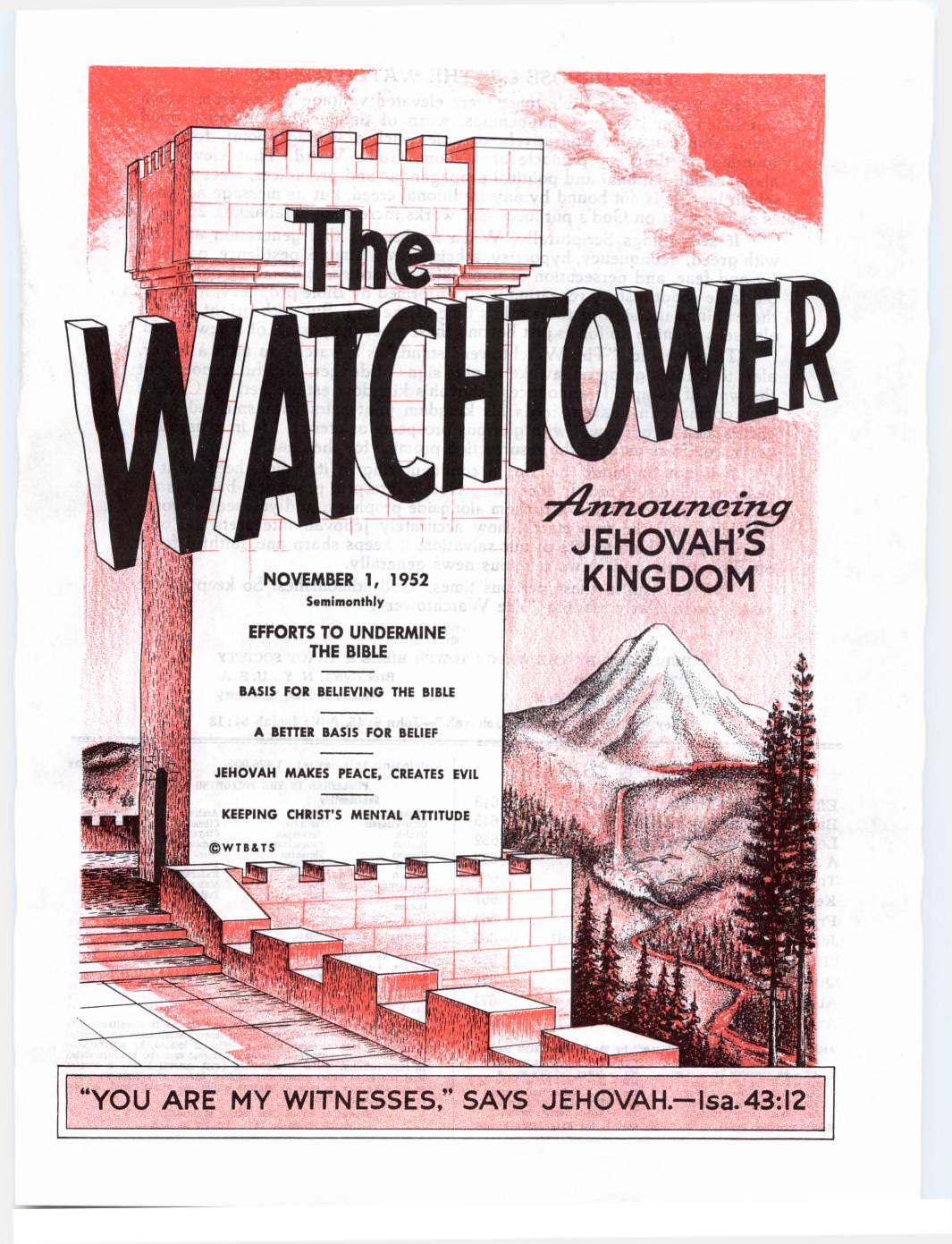
"YOU ARE MY WITNESSES," SAYS JEHOVAH.—Isa. 43:12
The WATCHTOWER
Announcing
JEHOVAH'S
KINGDOM
NOVEMBER 1, 1952
Semimonthly
EFFORTS TO UNDERMINE
THE BIBLE
BASIS FOR BELIEVING THE BIBLE
A BETTER BASIS FOR BELIEF
JEHOVAH MAKES PEACE, CREATES EVIL
KEEPING CHRIST'S MENTAL ATTITUDE
©WTB&TS
“YOU ARE MY WITNESSES,” SAYS JEHOVAH.—Isa. 43:12 THE PURPOSE OF "THE WATCHTOWER"
Literal towers in Bible times were elevated vantage points from which watchmen could observe happenings, warn of danger, or announce good news. Our magazine figuratively occupies such a vantage point, for it is founded on the very pinnacle of wisdom, God's Word. That elevates it above racial, national and political propagandas and prejudices, frees it from selfish bias. It is not bound by any traditional creed, but its message advances as the light on God's purposes and works increases.-Habakkuk 2:1-3.
It sees things Scripturally. When it observes this generation afflicted with greed, delinquency, hypocrisy, atheism, war, famine, pestilence, perplexity and fear, and persecution of unpopular minorities, it does not parrot the old fable about history repeating itself.Informed by Bible prophecy, it sees in these things the sign of the world's time of the end. But with bright hope it also sees opening up for us just beyond these woes the portals of a new world.
Thus viewed, "The Watchtower" stands as a watchman atop a tower, alert to what is going on, awake to note signs of danger, faithful to point out the way of escape. It announces Jehovah's kingdom established by Christ's enthronement in heaven, feeds his kingdom joint-heirs with spiritual food, cheers men of good will with glorious prospects of eternal life in a paradise earth, comforts us with the resurrection promise for the dead.
It is not dogmatic, but has a confident ring in its voice, because it is based on God's Word. It does not privately interpret prophecy, but calls attention to physical facts, sets them alongside prophecy, and you see for yourself how well the two match, how accurately Jehovah interprets his own prophecy. In the interests of our salvation, it keeps sharp and faithful focus on Bible truth, and views religious news generally.
'Be watchful in these perilous times,' God admonishes. So keep on the watch by regularly reading "The Watchtower".
ပြီး
PUBLISHED BY THE WATCH TOWER BIBLE & TRACT SOCIETY
117 Adams Street
Brooklyn 1, N. Y., U. S. A.
N. H. KNORR, President
GRANT SUITER, Secretary
"They will all be taught by Jehovah."—John 6:45, NW; Isaiah 54:13
CONTENTS
Efforts to Undermine the Bible
Basis for Believing the Bible
Legal Papers in Cookie Jar
A Better Basis for Belief
The Complete Cycle
Keeping Christ's Mental Attitude
Preaching in West Africa
Jehovah Makes Peace, Creates Evil
"Hold a Good Conscience"
Questions from Readers
Abandoned Bible Aid Yields Fruit
Announcements
AS — American Standard Version
LXX— The Septuagint Version
AT — An American Translation
Mo — James Moffatt's version
Da — J. N. Darby's version
NW — New World Trans. (2nd Ed.)
Dy — Catholic Douay version
Ro — J. B. Rotherham's version
ED — The Emphatic Diaglott
RS — Revised Standard Version
Le — Isaac Leeser's version
Yg — Robert Young's version
<tr><th>Afrikaans
Italian
Arabic
Portuguese
Cebu-Visayan
Japanese
Cibemba
Russian
Danish
Norwegian
Cinyanja
Siamese
English
Pangasinan
Cishona
Silozl
Flunish
Slovenian
Greek
Slovak
French
Spanish
Ibo
Twl
German
Swedish
Kanareso
Ukrainian
Hiligaynon-Visayan
Tagalog
Malayalam
Yoruba
Hollandish
Zulu
Polish
Watch Tower Society offices Yearly subscription rate
America, U.S., 117 Adams St., Brooklyn 1, N.Y. $1
Australia, 11 Beresford Rd., Strathfield, N.S.W. 8s
British West Indies, 21 Taylor St., Port of Spain, Trinidad$ 1.72
Canada, 40 Irwin Ave., Toronto 5, Ontario $1
England, 34 Craven Terrace, London, W. 2 7s
Jamaica, 151 King St., Kingston 7s
New Zealand, G.P.O. Box 30, Wellington, C. 1 7s
South Africa, Private Bag, P.O. Elandsfonteln, Transvaal 7s
Remittances should be sent to office in your country in compliance with regulations to guarantee safe delivery of money. Remittances are accepted at Brooklyn from countries where no office is located, by international money order only. Subscription rates in different countries are here stated in local currency. Notice of expiration (with renewal blank) is sent at least two issues before subscription expires. Change of address when sent to our office may be expected effective within one month. Send your old as well as new address.
Entered as second-class matter at Brooklyn, N. Y., Act of March 3, 1879. Printed in U. S. A.
EFFORTS TO UNDERMINE THE BIBLE
"Everyone that hears these sayings of mine and does them will be likened to a discreet man, who built his house upon the rock-mass. And the rain poured down and the floods came and the winds blew and lashed against that house, but it did not cave in, for it had been founded upon the rock-mass."-Matt. 7:24, 25, NW.
THE quickest way to destroy a building is to knock its foundation from under it. Gravity will do the rest. The quickest way to destroy Christian faith is to knock its foundation from under it. Doubts and skepticism will complete the ruin. The foundation of our faith is a book. That book is the Bible. Today there is an avalanche of knockers trying to sweep that foundation out from under Christianity. In times past Bible writers were killed, Bible believers were tortured, Bible translators were burned at the stake, and copies of the Bible were fed to the flames. Yet the book lives today. It is still under attack, but the assaults are more varied, more subtle. They converge upon the Bible from many quarters: from science, from atheism and, surprisingly enough, from those who pose as its friends, the clergy of Christendom.
2 Do you have faith in the Bible? Is your faith founded on fact? Do you both hear and heed the Bible's words, or is your faith shown to be dead by the absence of works in harmony with it? Many do not build a Christian life on a rock foundation, but base their religious life on the sands of superstition and tradition, on credulity and ceremony. Faiths based on
such false foundations will not survive stormy assaults, but the true faith that is founded on knowledge of and obedience to God's Word will stand like a house on a rock-mass. Neither will attacks by men that try it severely undermine it, nor will judgments from God that weigh it in the balances find it wanting. Both the faith that endures and the kind that collapses are embraced in Jesus' illustration: "Everyone that hears these sayings of mine and does them will be likened to a discreet man, who built his house upon the rockmass. And the rain poured down and the floods came and the winds blew and lashed against that house, but it did not cave in, for it had been founded upon the rockmass. Furthermore, everyone hearing these sayings of mine and not doing them will be likened to a foolish man, who built his house upon the sand. And the rain poured down and the floods came and the winds blew and struck against that house and it caved in, and its collapse was great." Matt. 7:24-27, NW.
3 Science has sought the collapse of the Bible, and it has made the creation account its chief target and evolutionary theories its flaming arrows. These burning missiles have reduced to ashes the unfounded faith of multitudes, but they have not penetrated the shield of true faith.
(Eph. 6:16) Why, even advancing scientific knowledge quenches evolution's fiery darts! Evolutionists at one time held strange ideas about spontaneous generation of life, but new knowledge forced them to abandon such theories. They claimed characteristics acquired from environment were passed on to offspring, but had to relinquish this attractive theory when modern genetics proved such were not inheritable. In arguing for the survival of the fittest, Darwin failed to explain the arrival of the fittest, which is the key problem. Hugo de Vries explained the arrival of small, inheritable changes in life forms by mutations, but now science is saddened to discover that these rare mutations are harmful instead of helpful, and could possibly account for a degeneration or deterioration, a devolution downward, but not an evolution upward. But if science allowed itself to be stripped of these past contentions its theory of evolution would be bankrupt, and such state of bankruptcy it will not honestly declare. So propagandizing evolutionists still offer these falsehoods as fodder for a gullible and uninformed public.
4 During June in New York city an International Symposium on Anthropology was held, and in reporting on one session the New York Times of June 12 headlined their conclusion, "Evolution of Body Is Declared at End." This matches the opinion of Lucien Cuénot, one of France's outstanding biologists, who, in discussing the evolutionary tree, said in his book L'adaptation, "The evolutionary sap no longer circulates." Incidentally, before he died last year Cuénot abandoned the evolution theory as untenable, to the great consternation of his scientific colleagues. It is very convenient for evolutionists to declare that evolution has ended. They do not have
to show it taking place now. They are not embarrassed by their inability to show it in operation now.
Another interesting point was disclosed by this meeting of anthropologists in New York city. The New York Times of June 10, under the headline "Age of Cave Man Is Cut 35,000 Years", reported their belief that "the ancestors of modern man in Europe are perhaps 35,000 years younger than has been previously believed", that "new study indicates that the cave man was extinct in Europe by the year 13,000 B.C." This slash in the cave man's age, from 50,000 years to 15,000 years, was forced by the newly developed radiocarbon clock. It was the advent of this clock that caused the Chicago Sun-Times of May 27, 1951, to report that evolutionists had cut the age of modern man from 1,000,000 years to 50,000 years. Science shaves the figure ever nearer to the Bible's 6,000-year age for man. That the present carbon clock figures may not be final was recognized by the symposium, for the Times reported: "Carbon dating techniques may be subject to revision later if differences in the natural rate of formation of the radioactive isotope can be detected or if anomalies in the rate of carbon utilization by growing materials are discovered, it was suggested."
ARCHAEOLOGY DENIES EVOLUTION
The science of archaeology contradicts instead of supports evolution. Note the following: "Strangely, in view of the consistent demands of the evolutionary school, we find no evidence of human evolution in the land of Egypt. More than this, the doctrine that man began with a brutish intellect and gradually developed his high and peculiar culture is refuted by the evidences from this country. In fact, the contrary is strikingly the case. Instead of proving a process of evolution, the history of man as found in the archaeology of Egypt is a consistent record of degeneration.
The eminent Sayce, one of the ablest archaeologists in the whole history of that great science, expressed his wonder and amazement at the high stage of culture met with in the very earliest records of the Egyptian people. Other authorities, such as Baikie, have written voluminously upon the subject. It had been hoped that when excavators finally reached undisturbed tombs of the first dynasty, they would find themselves in the dawn of Egyptian culture. . . Through the first tombs, we peer back into an older preceding culture that dazzles and amazes the human understanding. Instead of finding the dawn of a developing humanity, we see mankind already in the high noon of cultural accomplishments. . . Egypt, as elsewhere, shows us no dim, brutish beginning, but a startling emergence of this people in a high degree of culture. . . It must not be presumed that this condition is unique in Egypt, or peculiar to any one race or country. The same queer discrepancy between the fallacious theories of the philosophy of organic evolution and the facts of human history is observed wherever archeology
has been able to hold the torch of discovery over a given area."—Pages 41, 42, 49, 50, Dead Men Tell Tales, by H. Rimmer.
7 Notwithstanding the continuing vindication of the Bible by advancing knowledge, some of the clergy of Christendom oppose the Bible to side with science. On May 3 the Morning Call of Allentown, Pennsylvania, reported the "Reverend" Joseph B. Mohr as saying: "It is regrettable that the doctrine of the infallibility of the Bible has been interpreted by many to mean that the Scriptures in all their parts, even their pre-scientific parts, are of equal value to us today, and equally binding." What this cleric is trying to say in his roundabout, flanking attack on the Bible is that God's Word is not reliable, that if the men who wrote it had known science they would have written it differently, that if God who inspired it had known what today's scientists know he would have caused it to be written differently, that when we must choose between science and the Bible, we should choose science. This is only typical of so many clergy in Christendom today. They build on the shifting sands of science, not on the immovable rock of God's Word.
Basis for Believing the Bible
"Your word is truth."—John 17:17, NW.
THE clergy of Christendom fall into two general classes: the fundamentalists and the modernists, or higher critics. They hold different views on the Bible. The fundamentalist takes it all literally; the
higher critic takes it all apart. The fundamentalist contaminates it with paganism, by teaching such doctrines as trinity, eternal torment, purgatory, and other beliefs taught by pagans long before Christ. When apostate Christianity became catholic or universal from and after the fourth cen-
How does the fundamentalist tear down faith in the Bible?
tury it embraced pagan teachings, in order to appeal to pagans and convert them to a nominal Christianity. In a futile effort to avoid conflict with God's Word, the fundamentalist clergy twist certain texts to fit in with their paganisms, as Peter said: "The meaning of which the untaught and unsteady are twisting, as they do also the rest of the Scriptures, to their own destruction." (Matt. 15:6-9; 2 Pet. 3:16, NW) Though claiming to build on Bible truth, fundamentalists found their faith on pagan myth. Their misrepresentations of God and Christ cause many to turn away from the Bible. They thus lend themselves as tools for tearing down faith in God and his Word.
2 Paul warned against "the philosophy and empty deception according to the tradition of men", and said that after his going oppressive wolves would rise and waste the flock of God. Such ravenous wolves, Jesus cautioned, would come in sheep's covering. (Matt. 7:15; Acts 20:29; Col. 2:8, NW) They do now come out of clergy schools, masquerading behind a theological seminary sheepskin to appear as authoritative ministers of God. But whether they are fundamentalists or modernists, they devour rather than build up faith. The modern higher critic does this by saying that the Bible is only myth and legend, that it is not historically accurate, that much of it is fiction and deliberate forgery. As proof note this from the pen of one of such higher critics:
ployed literary devices, usual in their time, such as putting into direct discourse on the lips of their characters the points of view for which they were reported to have stood, or even writing an entire book in the name of a revered figure of a bygone day. Daniel and the Second Epistle of Peter are examples of this practice." This critic adds that it is immaterial that the "writing does not give an accurate account, according to modern historical perspective".*
3 "The authors and compilers of the biblical books often had a variety of traditions, legends and writings before them, and they edited these for their purpose, which was not primarily to convey historical information, but to declare God's message to their contemporaries through these memories of the nation's past. They em-
ARCHAEOLOGY SUPPORTS THE BIBLE
4 Just as in the case of the evolutionary scientists, the higher critics have been forced to retreat from former positions by the advance of knowledge, particularly knowledge unearthed by archaeologists. During the nineteenth century the highercritic scoffers were loud in their denunciation of the Bible's position that Moses wrote the first five books of the Bible, one of their arguments against it being that writing was unknown at the time of Moses. When they had to give ground on this point they did so grudgingly, and arbitrarily said that even if writing was known it was not widely used and Moses did not know the art. But further discoveries made the rout of the higher critics complete. Now it is acknowledged that writing was widespread in Abraham's time, that it was used by not only adults but children, whose textbooks have been found. Writing was known before the Noachian flood. Clay tablets with writing on them go back to the fourth millennium before Christ, reaching into the life span of Adam. In fact, archaeology indicates that Adam wrote, and along with others such as Noah, Shem, Isaac and
2, 3. What position does the higher critic take regarding the Bible?
Written by H. S. Coffin, former president of Union Theological Seminary in New York and former moderator of Presbyterian Church in U.S.A., published in Liberal Christianity (1942) and quoted in Joseph Free's Archaeology and Bible History, page 341.
What argument was once used against Moses' writership? and why is it no longer used by informed critics?
Jacob provided written documents from which Moses compiled the book of Genesis, down to chapter 37 verse 2.*
Adam was used to write the account of creation, and Noah and his three sons wrote of the global flood they survived in the ark. This contradicts the contention of higher critics that Moses merely purified the many different creation and flood stories widely circulated among the heathen. Archaeological discoveries indicate that by his very style Moses showed he was quoting the records of Adam on creation and Noah and his sons on the flood. The higher critic's claim here is similar to his position regarding monotheism and polytheism. He says polytheism was first, then the Hebrews by a purifying process developed monotheism. Archaeology disputes this. The Sumerians are about the most ancient people known to archaeology, and at the end of their culture they had a pantheon of 5,000 gods. But as their past is penetrated the number diminishes, for earlier they had only 750 gods. Farther penetration takes us back to the time when there was but one deity, the Sky-God, from whom the Sumerian pantheon of 5,000 gods descended. As monotheism was corrupted into polytheism, the true, original accounts were also corrupted to fit in with the variety of false gods. The Bible account of creation and of the flood was spread by word of mouth and new writings as peoples migrated, and variations and distortions flooded in. Tales are not purified by repetition, but undergo much change, some parts being exaggerated, others minimized or omitted, and still other parts twisted. The Bible contains the true, original accounts, and shows monotheism as being first. Polytheism and corrupted accounts followed.
Archaeology supports this position, the higher critics notwithstanding.
Scorn has been heaped upon the story of the tower of Babel. (Gen. 11:1-9) Yet in Mesopotamia archaeologists have discovered the remains of a number of temple towers, and one of these is believed by many Bible scholars to have been the tower of Babel. Under the picture of a restoration of this site we read: "A restoration of Babylon and the Tower of Babel. The tower . . . was begun in the third millennium B.C. but not completed until Nebuchadnezzar's reign."* George Smith, staff member of the British Museum, in his book Chaldean Account of Genesis, translates the writing found on an ancient fragment which tells of the destruction of one of the Babylonian temple towers, as follows: "The building of this temple offended the gods. In a night they threw down what had been built. They scattered them abroad, and made strange their speech. The progress they impeded." On this Joseph Free observes: "This account may be a later reflection of what actually occurred when God came down at the time of the building of the Tower of Babel and scattered the people abroad, confounding their language."—Archaeology and Bible History, page 46.
Another striking evidence of the historical accuracy of the Bible account is the case of forty-seven monarchs, aside from those of Israel and Judah. They are mentioned in the Bible, but their names were missing from secular history. "For this reason the learned leaders of 'higher criticism' relegated these forty-seven monarchs to the columns of mythology. They were grouped among 'the fables and folklore of the Old Testament' which this deluded school mistakenly taught was one of the
New Discoveries in Babylonia About Genesis, by P. J. Wiseman. The Watchtower, July 1, 1948.
† Pages 266, 267 of The Bible Comes Alive, by Sir Charles Marston, 1940 edition.
The Westminster Historical Atlas to the Bible, page 25.
What are the facts concerning the creation and flood accounts, and monotheism and polytheism?
How has archaeology brought some outside support to the Bible account of the tower of Babel?
How is Bible accuracy shown in the case of heathen kings?
basic weaknesses of the text. Then one after another these disputed monarchs began to rise from the dead in an archaeological resurrection. In some cases a burial mound was uncovered; in others, an annalistic tablet, a boundary marker, or a great building inscribed with the monarch's name. Now, all forty-seven of these presumably fabulous characters have been transferred from the columns of 'mythology' to the accepted records of established history."—Page 22 of
9 Leaving Egyptian scenes and skipping down to the time of Israel's entry into Canaan, we come to the miraculous fall of the walls of Jericho and that city's overthrow by the Hebrews under Joshua. When no archaeological confirmation of the Bible account was available the historicity of it was glibly disputed. This is no longer
Another vindication of the Bible's accuracy occurred when there arose a clash between Moses and the famous Greek historian, Herodotus, commonly called "the father of history". Herodotus lived in the fifth century before Christ, and he wrote that the Egyptians grew no grapes and drank no wine. More than a thousand years earlier Moses had written about a cupbearer whose duty was to supply wine for Pharaoh's table. (Gen. 40:9-13) The critics, in harmony with their policy, accepted Herodotus as their authority and rejected the Bible account as erroneous. But now archaeologists have found among the frescoes that decorate the tombs of Egyptian antiquity some that picture the Egyptians caring for the vines, gathering the grapes, pressing out the juice and storing it in stone or clay jars and skin bottles. Some of the juice was doubtless drunk in an unfermented state, but one of the murals depicted an Egyptian party, at the close of which slaves are shown assisting their inebriated masters home, and one of the revelers is shown dead-drunk under the table.*
possible. The Bible tells us that when the Israelites crossed the Jordan that river's waters stopped flowing, heaping up and backing up for some
time to allow the Israelites to cross the flood-stage Jordan dry-shod. (Josh. 3:14-17; 4:18) This stoppage of the waters of the Jordan was miraculous; but these waters have since been stopped by natural means. At flood stage they were stopped for sixteen hours when a landslide of the high west bank cut off the flow of waters, A.D. 1267. Centuries later, in 1927, a similar landslide at the same place dammed up the river for twenty-one hours. During that time persons crossed and recrossed the river freely on foot. Incidentally, these two blockages of the river occurred at the same place as did the stoppage of Jordan's waters in Joshua's time.*
10 As for Jericho itself, the Scriptural account shows that the walls were to fall down, but apparently not every section, for Rahab's house on the wall was to remain a place of safety for her and her family. The city was under a curse and not to be looted, but was to be burned. Joshua pronounced a curse upon anyone who rebuilt it. (Josh. 2:15; 6:5, 17, 18, 20, 22-24, 26) According to the Bible account, all these
Dead Men Tell Tales, pages 23, 24.
How was Moses vindicated as a historian when Herodotus clashed with him?
Pages 139, 140 of The Story of Jericho, by John Garstang and J. B. E. Garstang.
In the light of Israel's crossing of the Jordan, what recent happening is interesting?
How has archaeology confirmed the Bible account of the fall of Jericho?
conditions were met in the city's destruction. Does archaeology confirm it? Yes. Professor Garstang began excavations at Jericho in 1930. He found that the double walls surrounding the city had fallen down the slope, as if toppled by an earthquake or some such unseen hand. Houses had been built on rafters that bridged the tops of the two walls, and in one section part of the wall still stood, and could have been where Rahab's house had been preserved in the Biblical catastrophe. The excavators found evidence of intense fire. The city had been burned. This is not unusual in such cases, but this was no ordinary burning, because the layer of ashes was unusually thick and it appeared that all available fuel had been gathered to accomplish a thorough destruction. The city had not been looted, for provisions of dates, barley, oats, olives and other foodstuffs were found, charred by the flames. Also, the archaeologists estimated that there had not been any substantial rebuilding of the city until five hundred years later.* This would be about the time of King Ahab, when the Bible tells that it was rebuilt.—1 Ki. 16:33.34
REFUTING THE ATTACKS ON DANIEL
writing. One reason they do this is that they think Daniel's statements concerning the abomination that makes desolate were based on Antiochus Epiphanes' polluting of the temple at Jerusalem in 168 B.C. (Dan. 9:27; 11:31; 12:11) They deliberately put the writing of the prophecy after what they consider its fulfillment, since they do not believe in the power to prophesy. "Critics treated prediction as incredible, so they based their work on the assumption that prophecies were written after the events predicted had already occurred." But that Daniel's prophecy about "the disgusting thing that causes desolation" was not fulfilled in 168 B.C. is apparent, for when Jesus mentioned it two hundred years later its fulfillment was still future. The higher critics should date the book's composition after Jesus' time. More than that, to be consistent they should date the writing of the book after 1914, for that is when Christ's second presence began invisibly and he spoke of this abomination as being a part of the visible sign of his
11 In paragraph three we presented
the statement of a higher critic to the effect that the book of Daniel is a forgery. This is the opinion of higher critics generally. They say the book was not written by Daniel in the sixth century before Christ, as the Bible states, but was written about 165 B.C. by an unknown person who merely used Daniel's name to give stature to his
second presence! (Matt.24:15,NW) How unscholarly the higher critic's folly!
12 Another objection raised against the book of Daniel
is that certain stories in it are nothing but myths. They point to the account of the three Hebrews thrown into the fiery furnace, and say such things were not done. However, excavators at Babylon found what they thought at first to be a brick kiln, until they read the inscription on its base: "This is the place of burning where men who blasphemed the gods of
The Story of Jericho, pages 136, 141, 142, 146, 150. The Bible Comes Alive, pages 85-89.
The Bible Comes Alive, pages 7, 8.
(a) How do higher critics view the book of Daniel, and why? (b) How are they seen to be inconsistent?
What two occurrences once thought myths by higher critics are now supported by excavations?
Chaldea died by fire." Scoffers also ridicule the story of Daniel in the den of lions, saying that there is no evidence that such type of punishment was practiced. Mere failure to confirm something does not condemn it as false. However, in this case some confirmation was forthcoming, for excavators revealed a deep pit having this inscription: "The place of execution where men who angered the king died torn by wild beasts." We do not say this pit and this kiln are the ones the Bible mentions, but they show such things existed.
13 One point the critics worked overtime was Daniel's mention of Belshazzar as king of Babylon. Secular history indicated that Nabonidus was the last king of Babylon, and it knew nothing of any Belshazzar. So the higher critics claimed this as further proof that the book of Daniel was written centuries after Daniel's time, and that that explains how the writer made this terrible blunder of listing a mythical character as the last king of Babylon. They thought another slip was made when the writer spoke of Daniel's being raised to "third ruler in the kingdom", for one made prime minister was usually second in the kingdom. (Dan. 5:1, 29, 30) But now these criticisms are heard no more, for inscriptions by Nabonidus himself relate his prayers for his eldest son, Belshazzar. One Babylonian cuneiform text says concerning Nabonidus: "He entrusted a camp to his eldest, first-born son; the troops of the land he sent with him. He freed his hand; he entrusted the kingship to him." King Nabonidus was often away from the city of Babylon, and in his absence his son Belshazzar acted as king. Belshazzar made
Daniel third in power instead of second because he was second in power, first place being held by his father Nabonidus.
14 While Belshazzar was acting king, Babylon was taken by Darius and Cyrus. Darius said he slew the king when he took the city, but an inscription of Cyrus claims that he took the king captive.* There is no conflict. As the Bible shows, the night Darius entered the city King Belshazzar was slain. (Dan. 5:30, 31) But later Cyrus took King Nabonidus captive.
"Come now, and let us reason together" on some of the evidence that Daniel wrote the book in the sixth century B.C., and not some faker four centuries later. (Isa. 1:18) No secular history before Christ preserved any record of Belshazzar's existence. How would a forger of 165 B.C. know it, when everyone else, including the historians, were oblivious to it? The vaunted Herodotus did not even record it, and he wrote three centuries earlier. Or, how would a second-century B.C. impostor know Nebuchadnezzar was the one who had conducted the extensive building operations in Babylon? (Dan. 4:30) Secular history had not handed down that fact, and archaeologists have unearthed the evidence only in comparatively recent times. One higher critic lamely alibied: "We shall presumably never know." \ddagger But the writer of the book knew, for it was Daniel, and he lived during the reigns of both Nebuchadnezzar and Belshazzar! And did not Christ Jesus say Daniel wrote the book? (Matt. 24:15) So of what weight are the idle vaporings of the higher critics?
16 The Jewish historian Josephus indicates that the book existed before the time
Pages 138-141 of Diggers for Facts, by J. O. Kinnaman. Dead Men Tell Tales, pages 325-327.
† Page 54 of The Bible and Archaeology, by Sir Frederic Kenyon.
The Bible and Archaeology, pages 54, 55; Dead Men Tell Tales, pages 338, 339.
‡ Pages 189, 190 of Light from the Ancient Past, by Jack Finegan.
† Modern Science and Christian Faith, page 215.
13, 14. What points concerning Belshazzar and Nabonidus are now known, and which silence former charges?
‡ Archaeology and Bible History, pages 228, 229.
15, 16. What points of evidence are presented that prove Daniel wrote the book bearing his name, and did so when the Bible indicates he did?
of Artaxerxes (probably Artaxerxes III, who began reigning about 474 B.C.).* He claims some of the prophecies of Daniel were pointed out to Alexander the Great when he entered Jerusalem in 332 B.C. The book of Daniel is found in the original copies of the Septuagint, which was translated from Hebrew into Greek during the third and second centuries B.C. A fragment of the book of Daniel was found with the recently discovered Dead Sea Scroll of Isaiah, which the radiocarbon clock has allowed Biblical scholars to date in the second century B.C. \textcircled{1} So the book of Daniel existed during that second century, it had been copied, it was well known enough to be accepted into the Bible canon, it had been translated as a part of the famous original Septuagint, and was associated with the venerated scroll of Isaiah. It could not have been a recent writing by an impostor of that second century, known by everyone as a book that was a stupid hoax. Also, the first book of Maccabees, which is almost contemporary with the events of the second century related in it, not only presupposes the existence of the book of Daniel but actually betrays acquaintance with it. (Compare 1 Maccabees 2:59, 60 with Daniel 3:26, 27; 6:22.) This proves Daniel must have been written long before, and had become established as an authentic record. In all the above the evidence is overwhelming. Just as Daniel was delivered from the lions' den, so the book of Daniel has been delivered from the liars' den!
SOME TESTIMONIAL EVIDENCE FOR THE BIBLE
17 We have gone into some detail on the book of Daniel because it has been at the center of the higher critic's target, and in
turning back the fiery darts aimed at it we quench some of the higher critic's hottest missiles. His attacks on the other parts of the Bible can be similarly withstood. Actually, these hypercritical skeptics and doubters are camp followers of the agnostics and atheists. They appear to be first cousins of the former and second cousins of the latter. They certainly seem to speak the same language. But the speeches of all three classes are vain and empty, and archaeology has voided many of the arguments they aim at God's Word. Though not having space to present more archaeological details, we do offer as interesting testimonial evidence of the Bible's accuracy a few statements by archaeologists and other scholarly sources.
18 Here are two statements concerning the Hebrew Scriptures. "I do not think it will be long possible, even if it is now possible, for us to deny the remarkable accuracy of detail in the narratives of the Old Testament. Incidents hitherto regarded as legend, have been proved historical by recent discovery. . . . There is actual history at the back of all of the narratives." * "It is therefore legitimate to say that, in respect of that part of the Old Testament against which the disintegrating criticism of the last half of the nineteenth century was chiefly directed, the evidence of archaeology has been to re-establish its authority, and likewise to augment its value by rendering it more intelligible through a fuller knowledge of its background and setting. Archaeology has not yet said its last word; but the results already achieved confirm what faith would suggest, that the Bible can do nothing but gain from an increase of knowledge." \dagger
Josephus' Apion, Book I, Section 8.
Josephus' Antiquities, Book XI, Chapter VIII, Section 5.
‡ The Bible and Archaeology, page 223.
Accuracy of Old Testament in Light of Recent Palestinian Archaeology, by J. Garrow Duncan.
† The Bible and Archaeology, page 279.
\oplus Archaeology and Bible History, page 229.
Whom may we properly associate with the higher critic?
18-20. What interesting statements are made concerning (a) the Hebrew Scriptures? (b) the Bible as a whole? (c) higher criticism?
19 Following are some statements relating to the Bible as a whole. "No major contention of Scripture has been proved unhistorical." * "Archaeology contains irrefutable proofs of Biblical statements. Detailed accounts of almost innumerable discoveries dug up by pick and spade from ancient tombs and buried cities in Bible lands ably support the Scriptures." \dagger "This writer once thumbed through the book of Genesis and mentally noted that each of the fifty chapters are either illuminated or confirmed by some archaeological discovery—the same would be true for most of the remaining chapters of the Bible, both Old and New Testament." \ddagger Concerning the wealth of archaeological findings as they relate to the Bible, one archaeologist said: "In the bewildering mass of all this evidence which together would weigh so many tons that the figure, if computed, would appear fabulous, there is not one word, one testimony, or one fact that has contradicted or disproved a single line of the Holy Bible." \textcircled{8}
20 Three final quotations relate to higher criticism. "The asserted historical inaccuracies in Daniel are not statements which are disproved by history, but only statements which have seemed difficult to harmonize with the meager accounts of secular
historians. The asserted historical inaccuracies have, moreover, been steadily diminishing before the increasing knowledge of the times of Cyrus. . . The growth of our knowledge of this period shows how cautious one should be in doubting the historical accuracy of the Biblical records." "During the last ten years the science of Biblical archaeology has shown Bible criticism to be unsound in its premise and wrong in its conclusions." † "One of the most brilliant modern archaeologists, representing one of the greatest universities in the world, said in Iraq: 'I was brought up a "Higher Critic", and consequently disbelieved in the actual truth of the early narratives of the Bible. Since then I have deciphered thousands of tablets, and the more I learn, the more I believe the Bible to be true.' " ‡
21 All of this testimonial evidence for the Bible's truthfulness is a welcome confirmation of faith, but in view of much better testimonial evidence it is not required by true Christians. That better testimony we have in Jesus' prayerful expression to Jehovah: "Your word is truth." (John 17:17, NW) Archaeology is required by some to provide a basis for their belief in the Bible. But there is a better basis than that.
Archaeology and Israel, by W. F. Albright.
† Archaeology and the Bible, by George A. Barton.
Westminster Dictionary of the Bible, page 130.
‡ Archaeology and Bible History, page 340.
† Fresh Evidence About Old Testament, by Sir Charles Marston.
‡ New Discoveries in Babylonia About Genesis, page 140.
\oplus Dead Men Tell Tales, page 160.
What better testimonial evidence for the Bible is there?
Legal Papers in Cookie Jar
The ancient people of Israel may not have kept their housekeeping money in the teapot or in a clay piggy bank, but they did keep important legal documents and manuscripts in what looked like a cookie jar. One of these jars has been received at the Oriental Institute of the University of Chicago. It had been put together like a jigsaw puzzle from over 100 fragments found in the Dead Sea Scroll cave. Mention of the custom of putting legal documents in jars occurs in the Bible, Jeremiah 32:14, where the prophet charges Baruch, "Take these deeds, this deed of purchase which is sealed and this deed which is open and put them in an earthen vessel that they may continue many days." Description of the jar is reported to the American Schools of Oriental Research by Dr. Carl H. Kraeling.-Science News Letter, March 22, 1952.
A Better Basis for Belief
"The things that are coming announce to us, that we may know their issue. Tell us the things that are coming hereafter, that we may know that you are gods."—Isa. 41:22, 23, AT.
FAITH in the Bible does not hinge on what scientists say. When their advancing knowledge comes ever closer to conforming to the Bible, that does not make them become Christians. They still cling to their religion of evolution. Faith does not depend on the archaeologists for establishment either. Their discoveries merely confirm what the Bible has always said, but this confirmation does not convert them to Christianity. And when there is an apparent clash between the Bible and the interpretation they place upon a find, they lean toward their own undercause history to be written in advance. In other words, he can prophesy, can foretell the future. That is the acid test for disclosing godly qualities and powers. Jehovah God declares that this power of prophecy springs from him alone, and that because of his knowledge of the future his people need not dread any unforeseen events: "Who is like me? Let him come forward with his claim, let him set out his case before me. Who foretold the future long ago? Pray let us hear what is still to be! Fear nothing, dread not in the days to
2 But only Jehovah God can cause history to be written in adcause history to be written in advance. In other words, he can prophesy, can foretell the future. That is the acid test for disclosing godly qualities and powers. Jehovah God declares that this power of prophecy springs from him alone, and that because of his knowledge of the future his people need not dread any unforeseen events: "Who is like me? Let him come forward with his claim, let him set out his case before me. Who foretold the future long ago? Pray let us hear what is still to be! Fear nothing, dread not in the days to
standing and not the Bible. (Prov. 3:5) Science and archaeology are not essentials They may serve a purpose in bringing infidels and atheists to their senses and cause them to examine the Bible more seriously, but faith should not be dependent upon such studies of science and archaeology for its foundation. Our faith should not be dependent upon any discovered harmony between the Bible and such sciences as biology and geology. That harmony in itself does not make the Bible God's Word. Nor is it any confirmation of the Bible by archaeology that makes it God's Word. The more foot
come; have I not foretold it and announced it long ago? You are my witnesses whether there is any god, any Power, any, besides me." (Isa. 44:7,8,Mo) If any wish to vie with him as gods, they are invited to support their claims of godship by demonstrating their power to prophesy: "Let them approach and tell us what is to happen: tell us what the former things were, that we may lay them to heart; or the things that are coming announce to us, that we may know their issue. Tell us the things that are coming hereafter, that we may know that you are gods." (Isa. 41:22,23,AT) So it is
that makes it God's word. The mere fact that the Bible contains history that archaeology has now confirmed is not the vital point, for men can write true histories. Accurate histories can be written by both God and men.
not the ability to write what is scientifically sound that counts, nor is it the power to pen what is historically true that is essential, but it is the producing of that which is prophetically accurate that is vital in es-
What should our faith not be dependent upon?
What constitutes a test of inspiration and godly origin for writing?
tablishing it as inspired by God.
He is the sole source of prophetic power.
Peter showed that it was this power, and not scientific or archaeological studies, that confirmed God's Word. It was the fulfillment of prophecy that made him speak of the "word made more firm". On one occasion Jesus said to a group of his disciples: "Truly I say to you that there are some of those standing here that will not taste death at all until first they see the Son of man coming in his kingdom." This was a prophecy. It was soon fulfilled: "Six days later Jesus took Peter and James and John his brother along and brought them up into a lofty mountain by themselves. And he was transfigured before them, and his face shone as the sun, and his garments became brilliant as the light." Out from a bright protecting cloud God's voice came: "This is my Son, the Beloved, whom I have approved; listen to him." (Matt. 16:28; 17:1, 2, 5, NW) That this appearance in Kingdom glory was in fulfillment of Jesus' promise made six days earlier is made certain for us by Peter. When speaking of the power and presence of Christ he said that he and others knew of this glorious time of coming in Kingdom power, not on the basis of "artfully contrived false stories", but because of "having become eyewitnesses of his magnificence" "in the holy mountain".—2 Pet. 1:16-18, NW.
4 So Peter referred to fulfilled prophecy, and because of it he said "we have the prophetic word made more firm". The vision in fulfillment of Jesus' words made more firm other prophecies about the actual coming or presence in Kingdom power at the end of the times of the nations. (Luke 21:24) As more and more prophecies are fulfilled light increases and conviction strengthens, and we must be guided and enlightened by these things: "Consequently, we have the prophetic word made more firm, and you are doing well in paying attention to it as to a lamp shining in a dark place, until day dawns and a daystar rises, in your hearts. For you know this first, that no prophecy of Scripture springs from any private release. For prophecy was at no time brought by man's will, but men spoke from God as they were borne along by holy spirit." (2 Pet. 1:19-21, NW) Sound scientific findings and true historical narrations may spring from private release by man's will, but not prophecy and its fulfillment.
We know from experience that men cannot prophesy accurately. Just in our own generation men told us that the first world war was to make it safe for democracy. It did not. The League of Nations was to be the political expression of Christ's kingdom on earth. It was not. The second world war was to rid the earth of dictators. A bigger one now flourishes. The United Nations was to bring the nations together in peaceful co-operation. But they are split into eastern and western blocs, and the two factions fight their wordy battles in the United Nations and their bloody battles in Korea. No, men are not true prophets. They do a lot of predicting, but they do not do much fulfilling. But it is different with Jehovah God. He prophesies, and fulfillments follow. And logically, the more of his prophecies we find fulfilled, the more firmly do we hold in confidence to the yet unfulfilled words of God. So to strengthen still further our faith in the Bible let us ponder a few of the many fulfillments.
SOME STRIKING FULFILLMENTS OF PROPHECY 6 Some one hundred fifty years before
4. What did Peter rely on for confirmation of God's Word, and on what grounds do you so answer?
How are men as prophets? and how does God compare with them?
How was God's power to prophesy shown in the case of Tyre?
Nebuchadnezzar destroyed the land city of Tyre Isaiah foretold it, and several years before this event both Jeremiah and Ezekiel foretold it. But scores of years afterward Zechariah was still foretelling it. Why? Because about a half mile out in the water from the seacoast city of Tyre was an island on which was the water city of Tyre, and when Nebuchadnezzar overthrew the land city most of the inhabitants had evacuated with their possessions to the island city, and Nebuchadnezzar never did take it. But Alexander the Great did, 333- 332 B.C. To do it he built a mole or land bridge out into the water and to the island, and this mole he made out of the ruins and debris of the old land city of Tyre.* Thus were completely fulfilled Ezekiel's words, "Your walls shall be torn down, and your happy homes destroyed; your stones and timber and dust shall be sunk in the heart of the waters." (Isa. 23:1-13; Jer. 27:1-11; Ezek. 26:1-14; Zech. 9:2-4, AT) Complete fulfillment came, nearly two hundred years after Zechariah said it, nearly three hundred years after Jeremiah and Ezekiel said it, and more than four hundred years after Isaiah said it!
Before the fall of Nineveh the prophet Nahum predicted concerning it: "With an overflowing flood he will make an end of his adversaries; . . . The gates of the rivers are opened, and the palace melts away. And Nineveh is like a pool of water, . . To your foes the gates of your land will be opened wide; fire will devour your barriers." (Nah. 1:8; 2:6, 8; 3:13, AT) Nineveh was overthrown by the Chaldeans and Medes in 632 B.C. But note how. The swollen Tigris river made a breach in the city's wall and overflowed the city, opening the way for the easy entry of the enemy forces. One historical account states that the Assyrian king made a large funeral pyre in the palace, on which he and many of his servants and concubines died when the torch was put to it. The burning and sacking of the city was completed after the foe entered the burning and partly inundated city. Though now known through excavation, Nineveh's desolation was so complete that it later became like a myth. We read: "They were greatly aided by a sudden rise of the Tigris, which carried away a great part of the city wall and rendered the place indefensible. So complete was the desolation that in Greek and Roman times the departed Nineveh became like a myth. Yet all the while part of the city lay buried under mounds of apparent rubbish."* Through his prophet Nahum Jehovah foretold its fate and the manner of its fall.
Even more remarkable are the prophecies regarding Babylon. Years before Judah fell to Babylon Jeremiah foretold it, yet said a restoration would follow a seventy-year period of desolation. This would be made possible by the overthrow of the Babylonians, at which time they would put up no real fight: "The warriors of Babylon have ceased to fight, they stay in their strongholds; their strength is exhausted, they are turned into women." The once-mighty world power would become ruins: "Babylon shall become a heap of ruins, a haunt of jackals, a horror and a hissing, without an inhabitant." (Jer. 29:10; 51:30, 37, AT) That is all Babylon is today, a heap of deserted mounds.
9 Fully one hundred fifty years before the Jews were taken captive to Babylon Isaiah foretold it, and more than two hundred years in advance he foretold the restoration made possible by Babylon's over-
Archaeology and Bible History, pages 262-264; Rimmer's Internal Evidence of Inspiration, pages 202-204.
Westminster Dictionary of the Bible, pages 428. 429; see also the Prologue of Nebuchadnezzar, by G. R. Tabouis, and Internal Evidence of Inspiration, pages 204-206.
How was it shown in the case of Nineveh?
9. What prophecies did Jehovah cause to be made concerning Babylon?
throw, even giving the name of the conquering general. After stating that Jehovah "confirms the word of his servants, and fulfils the predictions of his messengers", that Cyrus would serve as his shepherd, that Jerusalem would be rebuilt, that the foundations of the temple would be laid, the divine record continues: "Thus says the LORD to his anointed, to Cyrus, whose right hand I have grasped, to bring down nations before him, and to ungird the loins of kings, to open doors before him, and that gates may not be closed: 'I will go before you, and will level the rugged heights; the doors of bronze will I break in pieces, and the bars of iron will I cut asunder.'"—Isa. 13:17-22; 14:1, 4, 8, 12-16; 39:6, 7; 44:24-28; 45:1, 2, AT.
10 In fulfillment of these prophecies, Cyrus took Babylon in 539 B.C. The city was in the midst of a drunken orgy, the gates had been left unbarred, there was no real resistance put up by the surprised soldiers. In his first regnal year Cyrus issued this proclamation, according to the Scripture record: "All the kingdoms of the earth hath Jehovah, the God of heaven, given me; and he hath charged me to build him a house in Jerusalem, which is in Judah. Whosoever there is among you of all his people, his God be with him, and let him go up to Jerusalem, which is in Judah, and build the house of Jehovah, the God of Israel, he is the God who is in Jerusalem." (2 Chron. 36:22, 23; Ezra 1:1-3, AS, margin; AT) Note that he attributes his victory to God. On his own cylinders he records his triumph over Babylon and gives the credit to divine aid, and on one of his bricks he says: "The great gods have delivered all the lands into my hand."*
11 To allow the Jews to return to Jerusalem to re-establish true worship of Jehovah
there was in accord with Cyrus' policy. Of course, Cyrus was polytheistic in worship and not monotheistic, so we cannot say he became a true worshiper of Jehovah himself. Jehovah used and maneuvered Cyrus for His purpose, as shown by Ezra 1:1 and Isaiah 44:28 and 45:1. He used Cyrus for his purpose in bringing about the Jewish restoration in 537 B.C., just as he had used another heathen king seventy years before to carry faithless Judah into captivity, calling that one "Nebuchadnezzar the king of Babylon, my servant". (Jer. 25:9) But Cyrus' policy was to restore images to their former shrines, for one of his cylinders reads: "I returned the gods to their shrines."* Cyrus recognized that Jehovah was the God of the Jews, and that his temple had been in Jerusalem, so his proclamation ordered the restoration of Jehovah's worship to be made there, "since he is the God who is in Jerusalem." (Ezra 1:3, AT) Regardless of Cyrus' policy, however, the point is that Jehovah foreknew and foretold these things centuries before they happened.
12 Jehovah's prophetic preview of the rise and fall of human governments continues. While Babylon was still the third world power and seemingly impregnable in that position, Daniel identified the fourth and fifth world powers to come, and showed how they would themselves fall in time. We read: "I raised my eyes, and looked, and lo! standing in front of the stream there was a ram with two horns, both of them high, though one was higher than the other, and the higher came up behind the other. I saw the ram butting westward, northward, and southward; none of the beasts could stand before him, nor could anyone rescue from his power; he did as
The Bible and Archaeology, pages 54, 141.
The Bible and Archaeology, page 141.
10, 11. How were these prophecies concerning Babylon's fall and Israel's release and restoration for true worship fulfilled?
What did Daniel foretell at chapter 8 verses 3-8 of his book?
he pleased, and accomplished great exploits. As I was considering the matter, lo! a he-goat from the west advanced over the whole face of the earth, without touching the earth; and the goat had a conspicuous horn between his eyes. When he came to the ram with the two horns, which I had seen standing in front of the stream, he ran at him in the impetus of his might. As I saw him come close to the ram, he was moved by fierce rage against him, and he smote the ram, and broke his two horns; and as the ram had no power to stand before him, he cast him down to the ground, and trampled upon him, there being none to rescue the ram from his power. Then the he-goat accomplished very great exploits; but when he had reached the height of his power, the great horn was broken, and in its place there came up four other horns, facing the four winds of the heavens."—Dan. 8:3-8, AT.
13 We are not left in doubt as to the correct interpretation of these things: "The ram which you saw, with the two horns, is
the king of Media and Persia. The hegoat is the king of Greece; and the great horn between his eyes is the first king. As the horn was broken, and four others arose in
its place, so four kingdoms shall arise from his nation, though not with a power like his." (Dan. 8:20-22, AT) Some years after Daniel was used to predict these momentous events the dual nation of Medo-Persia did overthrow Babylon to become the fourth world power. It is well symbolized by the two-horned ram, the higher horn coming up last, because the Median power came first, but the Persian power that followed surpassed it in strength. More than two centuries after Daniel recorded this prophecy Alexander the Great rose to power and cast down Medo-Persia, and upon his death in 323 B.C. the fifth world power of Greece was divided into four parts, each part ruled over by one of Alexander's four generals: Ptolemy in Egypt, Seleucus in Asia, Lysimachus in Asia Minor, and Cassander in Macedonia. Thus did four little horns follow the breakage of the big horn of the he-goat. How utterly impossible for man to make such amazing predictions, and how strikingly does it confirm the Bible as God's inspired Word!
FULFILLMENTS IN OUR DAY
14 Still more prophetic insight into the parade of human governments unfolds at Revelation 17:8, 10-14, NW: "The wild beast that you saw was, but is not, and yet is destined to ascend out of the abyss, and it is to go off into destruction. . . . And there are seven kings: five have fallen, one is, the other has not yet arrived, but when
he does arrive he must remain a short while. And the wild beast that was but is not, it is also itself an eighth king, but owes its existence to the seven, and it goes off into destruction. And the ten horns that you saw mean ten kings, who have not yet received a kingdom, but they do receive authority as kings one hour with the wild beast. These have one purpose, and so they give their power and authority to the wild beast. These will battle with the Lamb, but, because he is Lord of lords and King of kings, the Lamb will conquer them." At the time the apostle John was used to write
What is the correct interpretation of these things, and how did fulfillment come about?
What present developments show Revelation 17:8, 10-14 to be now in course of fulfillment?
this, five world powers had come and gone the sixth, the Roman empire, then existed and the seventh, the Anglo-American world power, was yet to come. It is here now, but so is an eighth, the international combine known as the United Nations, which owes its existence to the nations and receives its authority from them. It first existed as the League of Nations, then went into the abyss of inactivity and death, but now has ascended out as the present United Nations. It and all the nations will go into destruction when they war with the Lamb of God, Christ Jesus, at Armageddon. Then Christ's kingdom will hold undisputed sway over a new earth arrangement.
15 There are many other equally remarkable prophecies that have been fulfilled in vindication of the Bible as Jehovah's inspired Word. Space limits us to a brief consideration of only a few concerning the first presence of Jesus as Messiah and his second presence as enthroned King. More than five centuries in advance Daniel foretold the exact year of Messiah's appearance, and when that year came the Jews were expecting some development concerning Messiah. (Dan. 9:24-27; Luke 3:15) Daniel's prophecy also foretold that Jesus would be put to death three and one-half years later.* Other Hebrew Scripture prophecies predicted that he would be born in Bethlehem, of a virgin, be hated, rejected, betrayed by a follower for thirty pieces of silver, convicted by false witnesses, impaled with sinners, lots being cast for garments, be resurrected, and many other points. (Ps. 16:10; 22:16, 18; 35:11; 41:9; 69:4; Isa. 7:14; 53:3, 8, 12; Mic. 5:2; Zech. 11:12) In fact, one Bible scholar computed that "there are three hundred and thirty-two distinct prophecies in
the Old Testament which have been literally fulfilled in Christ". A mathematician figured out that the chance of one man's fulfilling all those things was one in eighty-four followed by ninety-seven zeros!* The possibility of its happening is so overwhelmingly remote that we must acknowledge Jehovah as the author of these prophecies.
16 As for the time of Christ's second presence, Daniel's prophecy is again the one that gives the chronology for it. (Dan. 4:16) It was figured out as pointing to A.D. 1914, and The Watchtower called notice to the significance of 1914 in the year 1879. The Christian Greek Scriptures foretell many physical evidences that would be observable at the time of Christ's second presence, so that persons on earth would know of his presence, Christ himself being a spirit creature and invisible to human eyes. (John 14:19) Predicted were world war, famine, pestilence, earthquakes, sectarian divisions, persecution of his followers, world-wide preaching of the good news of the established Kingdom, widespread delinquency and general breakdown of morals, and many other developments that we have seen since 1914. The generation experiencing the beginning of these things will survive to see their end at Armageddon. \dagger (Matt. 24:1-34; 2 Tim. 3:1-5, 13) Thereafter eternal life in endless blessings will begin for obedient persons in a new world.—2 Pet. 3:13.
…