The Watchtower, February 1, 1953
Download: PDF — The Watchtower, February 1, 1953
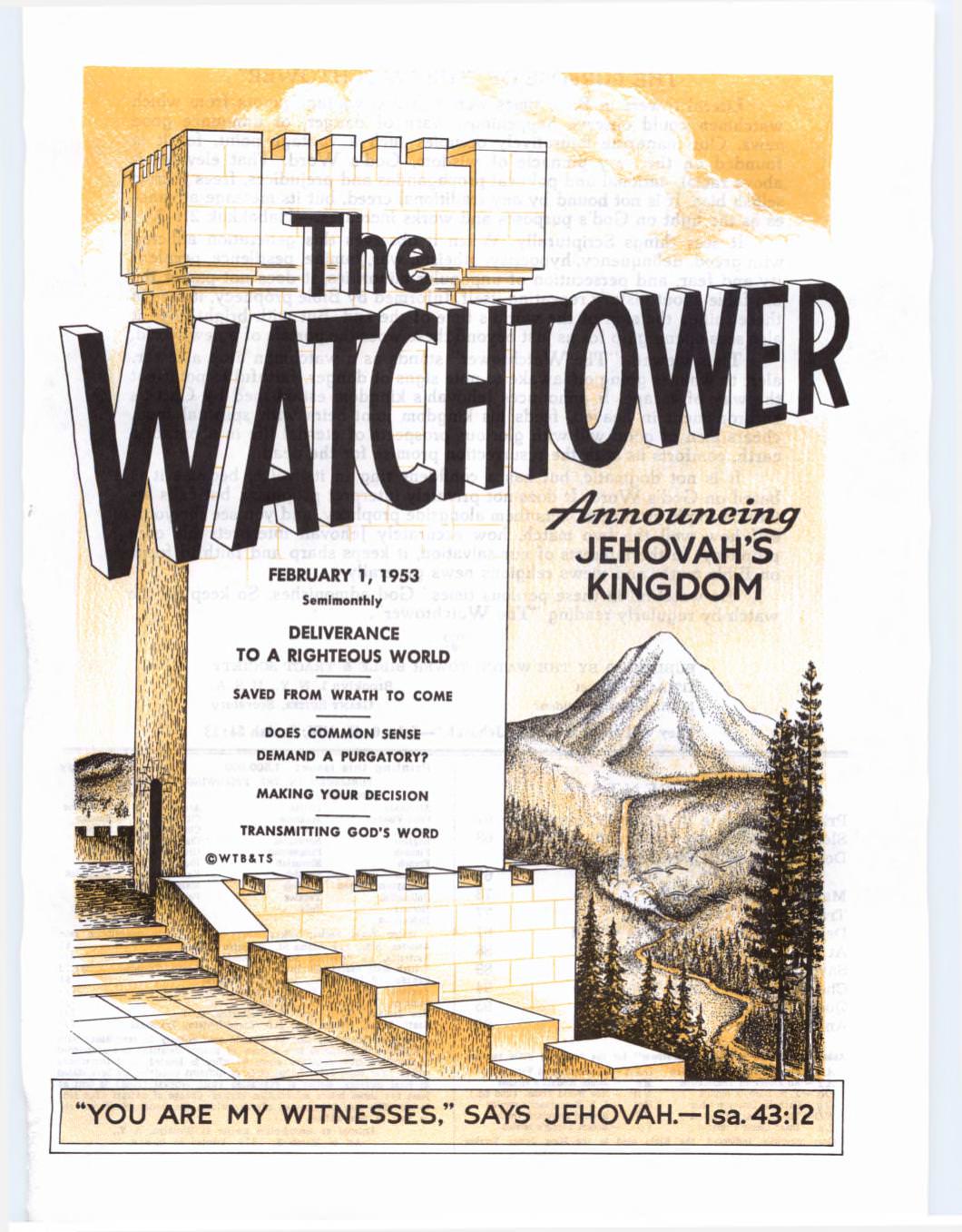
"YOU ARE MY WITNESSES," SAYS JEHOVAH.—Isa. 43:12
The WATCHTOWER
Announcing
JEHOVAH'S
KINGDOM
FEBRUARY 1, 1953
Semimonthly
DELIVERANCE
TO A RIGHTEOUS WORLD
SAVED FROM WRATH TO COME
DOES COMMON SENSE
DEMAND A PURGATORY?
MAKING YOUR DECISION
TRANSMITTING GOD'S WORD
©WTB&TS
“YOU ARE MY WITNESSES,” SAYS JEHOVAH.—Isa. 43:12 THE PURPOSE OF "THE WATCHTOWER"
Literal towers in Bible times were elevated vantage points from which watchmen could observe happenings, warn of danger, or announce good news. Our magazine figuratively occupies such a vantage point, for it is founded on the very pinnacle of wisdom, God's Word. That elevates it above racial, national and political propagandas and prejudices, frees it from selfish bias. It is not bound by any traditional creed, but its message advances as the light on God's purposes and works increases.—Habakkuk 2:1-3.
It sees things Scripturally. When it observes this generation afflicted with greed, delinquency, hypocrisy, atheism, war, famine, pestilence, perplexity and fear, and persecution of unpopular minorities, it does not parrot the old fable about history repeating itself. Informed by Bible prophecy, it sees in these things the sign of the world's time of the end. But with bright hope it also sees opening up for us just beyond these woes the portals of a new world.
Thus viewed, "The Watchtower" stands as a watchman atop a tower, alert to what is going on, awake to note signs of danger, faithful to point out the way of escape. It announces Jehovah's kingdom established by Christ's enthronement in heaven, feeds his kingdom joint-heirs with spiritual food, cheers men of good will with glorious prospects of eternal life in a paradise earth, comforts us with the resurrection promise for the dead.
It is not dogmatic, but has a confident ring in its voice, because it is based on God's Word. It does not privately interpret prophecy, but calls attention to physical facts, sets them alongside prophecy, and you see for yourself how well the two match, how accurately Jehovah interprets his own prophecy. In the interests of our salvation, it keeps sharp and faithful focus on Bible truth, and views religious news generally.
'Be watchful in these perilous times,' God admonishes. So keep on the watch by regularly reading "The Watchtower".
ပြီး
PUBLISHED BY THE WATCH TOWER BIBLE & TRACT SOCIETY
117 Adams Street
Brooklyn 1, N. Y., U. S. A.
N. H. KNORR, President
GRANT SUITER, Secretary
"They will all be taught by Jehovah."—John 6:45, NW; Isaiah 54:13
CONTENTS
Priestly Advocate of Error Discomfited
Sleeping Pills from the Pulpit
Does Common Sense Demand a Purgatory?
Making Your Decision
Transmitting God's Word
Deliverance to a Righteous World
At Least as Bad as Hitler
Saved from Wrath to Come
Choosing New World Life
Questions from Readers
Announcements
AS- American Standard Version
LXX- The Septuagint Version
AT-An American Translation
Mo-James Moffatt's version
Da-J. N. Darby's version
NW-New World Trans.(2nd Ed.)
Dy-Catholic Douay version
Ro-J. B.Rotherham's version
ED-The Emphatic Diaglott
RS-Revised Standard Version
Le-Isaac Leeser's version
Yg-Robert Young's version
Unless otherwise indicated,the Bible used is the King James Version
<tr><th colspan="2">Semimonthly
Monthly
Afrikaans
Italian
Arabic
Portuguese
Cebu-Visayan
Japanese
Cibemba
Russian
Danish
Korean
Cinyanja
Siamese
English
Norwegian
Cishona
Silozi
Finnish
Pangasinan
Greek
Slovak
French
Slovenian
Ibo
Twí
German
Spanish
Kanarese
Ukrainian
Hiligaynon-Visayan
Swedish
Malayalam
Yoruba
Hollandish
Tagalog
Polish
Ilocano
Zulu
Indonesian
PRIESTLY ADVOCATE OF ERROR DISCOMMITER
The WATCHTOWER
Announcing
JEHOVAH'S
KINGDOM
Vol. LXXIV February 1, 1953 Number 3
PRIESTLY ADVOCATE OF ERROR DISCOMFITED
RECENTLY a person of good will who had been studying the Bible with one of the Watch Tower missionaries sent to Uruguay arranged for a meeting between her priest and this missionary.
The priest was quick to open the little home interview by sarcastically asking the missionary, "Do you speak Greek?" When the missionary replied that he was not a Greek but an American and spoke only English and Spanish, the priest tried to end the discussion by saying that since
tory. Since the word does not even appear in the Bible, the best the priest could do was to refer to a citation in the apocryphal book of Maccabees, which actually supported the promise of a resurrection rather than any idea of suffering in purgatory. Next the missionary asked the priest for Scriptural support for the teaching of the trinity. Not being able to present any, he was next asked for support in the Bible for the doctrine of the immortal soul. Again not being able to answer in
the Bible was written in Greek he would only consent to a discussion of it if the missionary understood that language. However, the missionary pointed out that the Bible was also written partly in Hebrew and that under those conditions the priest would have to be able to speak Hebrew also to have a discussion.
The missionary further added, "The Catholic lady of the house here told me that you had personally encouraged her to read the Bible, but she did not mention anything about your insisting that she read it in Greek." Turning to the lady,
any way, the priest began to pace up and down the room like a caged lion, saying that he had not come to be made to appear as a dunce by having such silly questions put to him by a heretic.
However, the lady of the house managed to get the priest seated again, and this time the missionary said that since the priest did not want to answer questions, he would like to take the opportunity to point out to him texts from the Bible showing that the soul is actually mortal. The priest consented to listen to these Strangely enough, when the missionary
the missionary asked her, "Did the priest tell you to read the Bible in Greek?" Of course the lady replied, "Why, no, he gave me a Bible in Spanish." With that catch question thus disposed of, the discussion proceeded.
First the missionary asked the priest to show the group his support from the Bible for the church's teaching on purgaread from Joshua about animals' souls dying and from Ecclesiastes about human souls dying, the priest admitted that these texts were right even though they contradicted church doctrine. But he added that the trouble with the Protestants is that they do not know that the word "soul" is mistranslated in the Protestant as well as in the Catholic Bibles, and that while it is true that the soul dies, the spirit does not.
However, when he was confronted with the text in Ecclesiastes about all spirits returning to God, he saw that this thought put him in a dilemma, because it would mean that even the spirits of the most wicked would return to God, and so none would be left to go to purgatory or to hell, as he claimed.—Eccl. 12:7.
He tried to get out of this by explaining that the missionaries did not understand Greek, but that this word spirit was not spirit but another word, and he cited some strange-sounding word which he claimed was the Greek original. The missionary said it was a pity that he could not speak Greek himself, but that he had a copy of Strong's Exhaustive Concordance with him and they could look up the original Greek word in that. The word in the text in Ecclesiastes was in Hebrew, of course, and so they looked in vain for the word the priest used, checking both the Hebrew and Greek sections, only to finally discover it was the French word for God he was using to try to confuse them. The missionary then gave the priest a lesson in Hebrew and Greek from his concordance, showing him the correct Hebrew and Greek words for both spirit and soul and what they meant. By this time the priest was very much embarrassed and doubtless wished he had never said anything about understanding Greek, because it was clear to all that he had no knowledge of it.
The lady of the house then very emphatically and plainly told the priest that she was now convinced that Jehovah's witnesses know and teach more about the Bible than does the Catholic Church. And, speaking even more frankly, she declared that she had learned more in one hour of Bible study with Jehovah's witnesses than she had learned in six years of study with him. Tonight, she said, he had displayed his lack of knowledge by not being able to answer even one of the questions put to him. When he protested that he was unprepared, she pointed out that his seventeen years of study in a seminary should have been more than enough to prepare him. And thus the discomfiture of a priestly advocate of error resulted in one of the Lord Jesus' other sheep coming to a clearer knowledge and appreciation of the truth from God's Word.
Sleeping Pills from the Pulpit
Here's one for the record! We quote the entire report that appeared in the Fort Worth (Texas) Star Telegram: "Sydney, Australia, Aug. 27 (CDN)—If a sermon puts you to sleep it may be doing you more good than listening to it. That's the view of Rev. Gordon Powell. The Presbyterian minister believes that, in a sense, 'the more people sleep in church the better the sermon.' The clergyman declared from the pulpit of Sydney's St. Stephen's Church recently: 'People today are tired because the tension in their souls prevents them from getting proper benefit from ordinary sleep. In church they are reminded of the love and care of God and develop an inner sense of security that has a strong sleep-inducing effect.'"
Apparently he regards his sermons and his religion as merely a drug for the mentally distressed. Those of sound mind, however, recognize that only sluggards sleep at vital times, and that those who want life must sharpen their ears and gain solid facts so that their knowledge will not run out and the light of truth flicker away. But apparently this clergyman feels it matters little whether one listens to his sermon or not. Such sleep-inducers peddle false security, and themselves refuse to awaken to the lateness of the time. Insomnia sufferers, take note: One such pill is bad, an overdose is fatal!—Prov. 6:9-11; Mark 13:32-37.
Does Common Sense Demand a PURGATORY?
mands a purgatory." Those words are attributed to H. Page Dyer, a Protestant clergyman of Philadelphia, Pennsylvania, by Our Sunday Visitor, October 26, 1952. Thus, in support of purgatory, this Catholic weekly not only quotes the early church "fathers", Jewish authorities and the Bible but also non-Catholic clergymen and authors. Similar arguments are found in the Catholic Encyclopedia and The Faith of Our Fathers, by Gibbons.
Before examining the claim that common sense, the Word of God and tradition prove the existence of a purgatory, let us note what the teaching of purgatory really is. According to Cardinal Gibbons purgatory is "a middle state of temporary punishment, allotted for those who have died in venial sin, or who have not satisfied the justice of God for sins already forgiven. [The Catholic Church] also teaches us, that, although the souls consigned to this intermediate state, commonly called purgatory, cannot help themselves, they may be aided by the suffrages of the faithful on earth. The existence of purgatory naturally implies the correlative dogma—the utility of praying for the dead—for the souls consigned to this middle state have not reached the term of their journey. They are still exiles from heaven and fit subjects for Divine clemency".
This suffering, according to such Catholic authorities as Augustine, Thomas Aquinas and Gregory the Great, is "more severe than any a man can suffer in this
life". In fact, some even hold "that the least punishment of purgatory exceeds the greatest punishment of this life". Also that "purgatory is a real Sub-Hell. The sense pains of Purgatory equal those of Hell, which means the temperature is the same in both regions".—Our Sunday Visitor, November 26,1945.
COMMON SENSE VERSUS PURGATORY
Does common sense demand a purgatory? Does the purgatory teaching make sense? Let us see. In the first place note that, according to Catholic teaching, it is not the human body, but an intangible, nonmaterial entity known as the "soul" that goes to purgatory to experience its "sense pains". But how can that which is not temporal, since the soul at death is supposedly divested of all its temporal properties, suffer temporal punishment? Does common sense demand that?
And does common sense demand that we suffer, who knows how long, more severely than it is possible for man to suffer in his human organism, for sins that are recognized as only "venial sins"? Think of all the possible kinds of suffering, being burnt at the stake, slow death by cancer, the kinds inflicted on heretics during the reign of the inquisition and at the present time by Communist police authorities, and know that the least suffering in purgatory is still worse than that. Does that make sense?
And does common sense demand that the length of stay in purgatory largely depend upon the prayers, or suffrages, of the loved ones they left behind? If one has non-Catholic friends and relatives who do not believe in purgatory and therefore do not pray for him nor have masses said on his behalf, he of course will get no assistance from them, and so must he stay in purgatory until he has paid the last penny, as it were?—Matt. 5:26, Cath.
Confrat.
And why discriminate against youth? One may die in youth, while having his fling. Think of all the years he suffers and will have to suffer, more than he
gatory. Besides, just as man makes the punishment fit the crime so God in justice would do the same, and therefore common sense and justice alike demand a third, intermediate state, where length of suffering will be determined by the extent of one's sins.—Hab. 1:13; Luke 12:47; Rev. 21:27.
It is a well-known axiom that anything
could possibly suffer upon earth; while another, by living to a ripe old age, when the passions of youth have been spent, has then time to reflect, do penance and prepare himself for purgatory. Does common sense demand that?
Today a big majority of professed Christians, Catholics as well as Protestants, show by their actions that they are in fact 'lovers of pleasure rather than lovers of God'. Is God going to welcome in heaven millions of creatures who love pleasure more than they love him, and who will
can be proved if one starts out on a wrong premise. If man has an immortal soul that is separate and distinct from his body and which at death must live somewhere, and if apart from purgatory the only alternatives were heaven or hell, then it might be argued that common sense demands a purgatory.
GOD'S WORD VERSUS PURGATORY
But does the Bible teach that man has a soul separate and distinct from his body that lives on after he dies? Does it teach
choose him only when faced with the alternative of suffering? Does common sense demand that kind of Christianity? 2 Tim.3:1-7.
And is it common sense to hold that one of the most prominent teachings of the Christian religion is nowhere mentioned by name in the Bible? If so much depends upon prayers for the dead, why did neither Jesus nor any of his apostles and disciples as much as mention the subject once? What disservice to the poor souls in purgatory, what negligence, if the purgatory teaching is indeed true!
it teach that there is such a place as a burning hell of eternal torment? No!
Clearly the Bible says that at creation "man became a living soul". That the lower animals are souls. That "the soul that sinneth, the same shall die"; and that the King of kings and Lord of lords "only hath immortality".—See Genesis 2:7; Numbers 31:28; Ezechiel 18:4; 1 Timothy 6:16, Dy.
Further, according to God's Word, hell is not a place of torment but the common grave of mankind. That is why we find
Common sense demands a purgatory, we are told, because without it there are only two places for the immortal soul to go at death, heaven or a hell of eternal torment; and since nothing defiled can enter heaven and God is of purer eyes than to behold evil, the great majority would not be able to go to heaven and would therefore be doomed to a hell of torment, if there were no purin the Douay Version the Hebrew word sheol rendered not only 63 times "hell" but also once "pit" and once "death"; and why Msgr. Knox's version repeatedly reads "place of death" where the Douay reads "hell". In death man is like the lower animals, we are told at Ecclesiastes 3:19-21, and therefore, "Whatsoever thy hand is able to do, do it earnestly: for neither work, nor reason, nor wisdom, nor knowledge, shall be in hell, whither thou art hastening."—Eccl.
9:10, Dy.
So the argument that common sense demands a purgatory because so many immortal souls at death are neither fit for heaven nor deserving of eternal torment falls flat, since human creatures are souls but do not have souls that can exist apart from a body. Souls are mortal, can die, and sheol, the Bible hell, is the common grave of humanity. True, Jesus in his illustrations and in the Apocalypse links fire with hell in certain Bible translations, but why take the fire literally when we do not take the terms "sheep", "goats," "beast," etc., literally? Clearly such expressions are mere figures of speech. The Bible hope for the dead lies not in their being immortal but in the resurrection. John 5:28, 29; Acts 24:15, Cath. Confrat.
As for the need of purgatorial fires to cleanse us from sins, note the testimony of the apostle John: "But if we walk in the light as he also is in the light, we have fellowship with one another, and the blood of Jesus Christ, his Son, cleanses us from all sin." "If we acknowledge our sins, he is faithful and just to forgive us our sins and to cleanse us from all iniquity." Nor does such forgiveness apply only to our past sins, for John goes on to say: "If anyone sins, we have an advocate with the Father, Jesus Christ the just; and he is a propitiation for our sins, not for ours only but also for those of the whole world." 1 John 1:7,9; 2:1,2, Cath. Confrat.
SCRIPTURAL PROOF EXAMINED
In endeavoring to prove the existence of a purgatory many Bible texts are quoted. Let us consider the outstanding ones. Foremost is 2 Machabees 12:43-46 (Dy), which tells of one Judas Machabeus sending an offering "to Jerusalem for sacrifice to be offered for the sins of the dead, thinking well and religiously concerning the resurrection. (For if he had not hoped that they that were slain should rise again, it would have seemed superfluous and vain to pray for the dead.) And because he considered that they who had fallen asleep with godliness had great grace laid up for them. It is therefore a holy and wholesome thought to pray for the dead, that they may be loosed from sins".
As regards this proof, first note that neither this book nor any other book of the Apocrypha was accepted by the Palestinian Jews as part of God's Word, they were not quoted from by either Jesus or his apostles and disciples, and were not regarded as even accurate, let alone inspired, by none other than Jerome, the translator of the Latin Vulgate Bible. However, even if accepted as Scripture this text would not prove the purgatory teaching true for two reasons: First, the dead referred to were Jews who were slain because of their idolatry, and according to Roman Catholic teaching, idolatry is a mortal sin making one subject to eternal torment. Secondly, the quotation shows that it was because of the resurrection hope, not because the dead were alive, but because they were dead until the resurrection, that these prayers were to be offered. Souls in purgatory do not need a resurrection; they are supposed to be alive and at the end of their "spiritual evolution toward perfect holiness" taken to heaven.
It is further claimed that since the Bible gives examples of temporal punishment for sins a purgatory is implied; and for proof the examples of Moses, who was denied entry into the Promised Land, and David, whose first child by Bath-sheba died, are given. (Num. 20:12; 2 Ki. 12:13, 14, Dy; 2 Sam. 12:13, 14, non-Catholic versions) However, in the days of the Law arrangement not only were sins punished temporally but obedience was rewarded temporally.
(See Leviticus, chapter 26.) But neither temporal blessings for right-doing nor temporal punishment for wrongdoing is held out to Christians, but just the opposite at the hands of the ungodly. (Luke 6:20-26; 2 Tim. 3:12) Moses and David did not have recourse to the blood of Christ Jesus, nor is there any record that they suffered after death.
The Catholic Encyclopedia, endeavoring to prove the principle of purgatory, cites Matthew 3:8; Luke 13:3; 17:3, all of which speak of doing "penance" (Dy), and therefore allowing for the expiation of sins by meritorious works. However, the use of the word "penance" is ill-advised in these texts and so we find modern Catholic versions using the term "repentance" and "repent".—See Knox, Catholic Confraternity.
Purgatory is also held to be taught by Paul's words at 1 Corinthians 3:11-15, where he likens Christian works to gold, silver, wood, hay, etc., and then tells that the fire will try each man's work, and that if a man's "work burns he will lose his reward, but himself will be saved, yet so as through fire". (Cath. Confrat.) Are Christians building with literal gold, silver, wood and hay? Of course not! Then why consider the fire as literal? Besides, note that the work of each one, whether he be good or bad, will be tried, also that while the faulty work will be burned, or destroyed, the individual will be saved, yet "as through fire", not actually fire.
Still another text used to support purgatory is found at Matthew 12:32, where Jesus is recorded as saying: "For him who blasphemes against the Holy Spirit there is no forgiveness, either in this world or in the world to come." (Knox) Mark's and Luke's rendering of this phrase clearly indicate that what Jesus meant was that such sins would never be forgiven. (Mark 3:29; Luke 12:10) Besides, the
"world to come" refers, not to the state of the dead, which other parts of the Bible show to be a state of unconsciousness, but to a new system of things, as promised: "And meanwhile, we have new heavens and a new earth to look forward to, the dwelling-place of holiness; that is what he has promised."—2 Pet. 3:13, Knox.
THE TESTIMONY OF TRADITION
But someone will say, You ignore entirely the testimony of tradition. But, we reply, of what value is tradition if it contradicts God's Word? For a teaching to be true it must be according 'to the law and to the testimony', for 'God's word is truth'. Jesus condemned the religious leaders of his day because they sought to nullify God's commandments by their tradition, and Paul said: "For God is true, and every man is a liar," if he contradicts God's Word.—Isa. 8:20, Dy; Mark 7:9; John 17:17; Rom. 3:4, Cath. Confrat.
The mere fact that some early church "fathers" believed something akin to purgatory does not prove that Jesus and his apostles did, especially in the complete absence of any mention of it in the "New Testament". Did not Paul warn that there would be a falling away? (Acts 20:29,30 Cath. Confrat.) Peter spoke of some distorting the Scriptures in his day, and John singled out one that was ambitious.—2 Thess. 2:3-7; 2 Pet. 3:16; 3 John 9, Cath. Confrat.
And where did the church "fathers" get the idea of purgatory since it is not to be found in the Bible? From pagan sources. According to the Catholic Encyclopedia the pagans had a belief similar to purgatory. And Professor Hislop gives proof that the ancient Egyptians, the Greeks and the Romans believed in it, quoting Virgil, Plato and others.
Common sense does not demand a purgatory. Common sense rejects it!
MAKING YOUR DECISION
TIME and again well-meaning religious people speak of God as "trying to convert the world". To help God to do this, they interest
wide.—Matt. 24:14; 28:19, 20, NW.
That Jesus did not expect his disciples to convert the world is apparent from his own words as re-
themselves, among other things, in home and foreign missions. However, if we judge by the progress made during the past century it becomes apparent that their goal of converting the world will never be realized, for not only has the so-called "non-Christian" population doubled during that time, but even what claims to be Christian is farther away from really being Christian than it ever had been. Clearly there must be a mistake somewhere.
In the first place let us note that God does not tru to do anything. He commands
corded at Luke 18:8 (NW): "When the Son of man arrives, will he really find this faith on the earth?" Note also his prophecy: "Just as the days of Noah were, so the presence of the Son of man will be." Certainly the world was not converted to God in Noah's day in spite of the marvelous exhibition of faith that Noah gave in building the ark and in warning of the deluge.—Matt. 24:37; Heb. 11:7; 2 Pet. 2:5, NW.
The misconception as to God's trying to convert the world is based on a failure to appreciate that Jehovah's chief purpose is
and it is done. He said: "Light be. And light was." (Gen. 1:3, Ro) Whatever he purposes he accomplishes: "I have spoken, and I will bring it about; I have purposed, and I will do it." (Isa. 46:11, AT) Very obviously then, God's purpose does not include his servants' converting the world or that goal would not be getting farther and farther away from being realized.
But did not Jesus command his followers to make disciples of all nations and foretell that the good news of the Kingdom would be preached in all the world? True.
appreciate that Jehovah's chief purpose is to vindicate his supremacy and name and that the salvation of creatures is at best only secondary thereto. Jehovah delivered the Israelites from Egypt, he tells us, to make a name for himself; the same reason why he delivered them from Babylon and restored them to Palestine: "Thus saith the Lord Jehovah: I do not this for your sake, O house of Israel, but for my holy name."—2 Sam. 7:23; Ezek. 36:22, AS.
Jehovah God does not need puny man for the accomplishment of his purposes. It is beneath his dignity and station to
but note that he did not command the converting of all nations but to "make disciples of people of all the nations". Also, preach the good news of the Kingdom in all nations "for a witness", not for the purpose of converting all of them. The facts show that these commands are being fulfilled; disciples are being made of all nations and the witness is being given world-
It is beneath his dignity and station to either coax or coerce any of his creatures to worship him. He resorts neither to threats of torment after death nor to physical harm in this life; Islam, the Roman Catholic Hierarchy, and many others, to the contrary notwithstanding. He is a God of love and so appeals to love in his creatures. (Jer. 19:5; Rom. 2:4, NW) He be-
stows his blessings upon them and then advises them upon what conditions they can retain these and gain even more.
Then it is up to them to make a decision, to accept God's favors on his conditions or reject them and lose all.
MAKING THE DECISION IN TIMES PAST
Consider our first parents. They had life, the right thereto and many other blessings and prospects. To test their appreciation God made their enjoyment of these blessings dependent upon obedience to a simple command: merely not to eat of the fruit of a certain tree. If God had been interested only in the salvation of creatures, had he been a God who would "try to convert the world", he would not have permitted that temptation to come to Eve. But he did permit it. And when the deceiver in the guise of a serpent presented the temptation to Eve, she had to make a decision—either to obey God or to follow the suggestion of the deceiver. Because of lack of appreciation, lack of love and lack of faith, Eve made the wrong decision. And when she offered the fruit to Adam he also had to make a decision, to eat or not to eat. He likewise made the wrong choice, and so both of them eventually returned to the ground from which they were taken. The effects of that wrong decision have been felt by all mankind for about six thousand years now. (Gen. 3:19; Rom. 5:12) Ever since that time God has been putting it up to man to choose between the two ways, the right way and the wrong way. Matt. 7:13, 14.
Jehovah's relations with the children of Israel repeatedly showed this manner of dealing with his creatures. After having voluntarily gone on record at Mount Sinai as wanting to serve Jehovah, the Israelites time and again rebelled and so were laid low in the wilderness. (Ex. 19:5-8; 1 Cor.
10:5, NW) When God's time came for them to enter the Promised Land a new generation had risen, and so Moses put up to them this matter of making a decision: "I call heaven and earth to witness against you today that I have put life and death before you, the blessing and the curse; therefore choose life, that you as well as your descendants may live, by loving the LORD your God, by heeding his injunctions, and by holding fast to him; for that will mean life to you."—Deut. 30:19, 20, AT.
This matter of making a decision was particularly emphasized by Joshua some twenty years after the Israelites had entered the land of Canaan. Knowing he would soon die he called together all the tribes of Israel and squarely put it up to them as to whom they were going to serve. After recounting the way Jehovah had dealt with Abraham and his descendants down to their day, Joshua went on to say:
"Now therefore fear Jehovah, and serve him in sincerity and in truth; and put away the gods which your fathers served beyond the River, and in Egypt; and serve ye Jehovah. And if it seem evil unto you to serve Jehovah, choose you this day whom ye will serve; whether the gods which your fathers served that were beyond the River, or the gods of the Amorites, in whose land ye dwell: but as for me and my house, we will serve Jehovah." After hearing a record of Jehovah's dealings with them and their fathers and the expression of Joshua's own strong determination to serve Jehovah, the people replied: "Far be it from us that we should forsake Jehovah, to serve other gods; for Jehovah our God, he it is that brought us and our fathers up out of the land of Egypt, from the house of bondage, and that did those great signs in our sight, and preserved us in all the way wherein we went, and among all the peoples through the midst of whom we passed; and Jehovah drove out from before us all the peoples, .
. . therefore we also will serve Jehovah; for he is our God."
But Joshua tried them to see if they really meant it, saying: "Ye cannot serve Jehovah; for he is a holy God; he is a jealous God; he will not forgive your transgression nor your sins. If ye forsake Jehovah, and serve foreign gods, then he will turn and do you evil, and consume you, after that he hath done you good." But the people stood firm by their decision: "Nay; but we will serve Jehovah. And Joshua said unto the people, Ye are witnesses against yourselves that ye have chosen you Jehovah, to serve him. And they said, We are witnesses."—Josh. 24:14-22, AS.
When Christ Jesus was on trial before Pilate the Israelites again had to make a decision, between the Devil as represented by Caesar and Jehovah God as represented by his Son. They made the wrong decision on that occasion, shouting, "We have no king but Caesar." (John 19:15, NW) They suffered the fearful consequences of that wrong decision in their complete destruction at Caesar's hands A.D.70.
MAKING OUR DECISION TODAY
Bible prophecy shows that the second presence of Christ Jesus has taken place, that he has been placed upon his throne and that he is now ruling in the midst of his enemies. (Ps. 110:1-3; Matthew, chapter 24; Rev. 11:15-18) By means of the preaching of the good news of the Kingdom and making known the name of Jehovah the issue is again being squarely presented to the people and again they have to make their decision: either for Jehovah's kingdom by Christ Jesus or for the governments of this old world under the domination of Satan the Devil. (Matt. 4:8, 9; 2 Cor. 4:4, NW) "Be wise, O ye
kings: be instructed, ye judges of the earth. Serve Jehovah with fear, and rejoice with trembling. Kiss the son, lest he be angry, and ye perish in the way, . Blessed are all they that take refuge in him."—Ps. 2:10-12, AS.
The wise are willing to be instructed. They accept the evidence of reason: they see all about them a marvelous orderly universe which bears eloquent testimony that God indeed exists. (Rom. 1:20, NW) They examine the Bible and learn that its testimony is abundantly corroborated by the evidence of geology and archaeology. They note that the Bible is filled with prophecies, many of which have been fulfilled with remarkable accuracy. Only God could do that.—Isa. 41:22, 23.
From the Bible they learn that God's original purpose for man and the earth was to have a paradise filled with perfect human creatures living together in harmony and worshiping their Creator and that since Jehovah God is omnipotent that purpose will be realized. (Gen. 1:26-28; Isa. 55:11) Also that today is a day of judgment and that everyone is receiving a mark, either the mark of the beast or the mark that Jehovah's servants place on those who sigh and cry for the abominations they see committed in the land. Ezek. 9:4; Rev. 13:15-17; 14:9, 10.
You individually cannot escape being marked. You cannot avoid having to make a decision. "He that is not on my side is against me, and he that does not gather with me scatters." (Luke 11:23, NW) Which way will you decide? Will you choose to serve Jehovah God and set out on the right, wise, obedient, loving way, the way of appreciation and gratitude, which though cramped at present and having a narrow gate leads off to life, or will you take the line of least resistance, the selfish, easy broad way that leads off to destruction?
You have the facts; you can, you must reason on them and then reach a conclusion. And then what? Having chosen wisely you will need to back up your decision by a consistent course of action. "Faith, if it does not have works, is dead in itself." (Jas. 2:17, NW) What works? The works set out in God's Word and particularly as given by Jesus' words and example. That means to make a dedication of oneself to God even as Jesus did at the Jordan when he said: "Look! I am come (in the roll of the book it is written about me) to do your will, O God."—Heb. 10:7, NW.
And having dedicated yourself one of the very first things you will need to do is to give a public expression of that dedication by being baptized even as Jesus commanded his disciples: "Go therefore and make disciples of people of all the nations, baptizing them." (Matt. 28:19, NW) But you say that you were baptized as an infant? But were you? The word baptize comes from a similar Greek word which actually means to submerge or dip beneath the water, and so we find that both John the Baptist and Jesus' disciples completely immersed in water those who believed. —John 3:23.
Being immersed in water illustrates that we have died as regards the doing of our own wills and have been made alive as to the doing of God's will. Having dedicated ourselves to the doing of God's will it is most fitting that we make a public declaration of that fact, before witnesses. Infants could not do this for themselves. Also, by
being immersed we have a vivid reminder that we have dedicated ourselves, which will help us to live up to our vows.
God's will for Christians primarily consists of doing three distinct things. First of all, it means study of God's Word and of Bible aids that help us to understand it so as to become more and more acquainted with God and his purposes so that we can intelligently co-operate with them. (2 Cor. 6:1) Secondly, it means using our lips to bring honor to Jehovah God and comfort to men of good will, for, we being Christians, our purpose in life must be the same as was that of Christ Jesus, and he said regarding his own purpose: "For this purpose I have been born and for this purpose I have come into the world, that I should bear witness to the truth."—John 18:37; 2 Cor. 1:4; Heb. 13:15; 1 Pet. 2:9, NW.
And thirdly, we must make progress in the way of righteousness. We must be consistent; we must not only love Jehovah God, truth and righteousness, and our neighbor, but also hate that which is wicked and selfish. We must keep ourselves clean from the wicked world and its practices.—Isa. 52:11; Heb. 1:9; Jas. 1:27, NW.
Thus we see that God, far from trying to convert the world, gives his creatures the opportunity to choose and then take the consequences. Having made the right decision we must follow with a consistent course of action if we would share in God's purpose for earth and man.
So keep strict watch that how you walk is not as unwise but as wise persons buying out the opportune time for yourselves, because the days are wicked. Eph. 5:15, 16, NW.
Transmitting God's Word
THE word spoken by Jehovah endures forever." (1 Pet. 1:25, NW) Due to the fact that none of the original autograph copies of the Bible have come down to us, many critics of the Bible dispute this promise of Jehovah that his Word would endure. What are the facts? Are the various books of the Bible that we have today essentially the same as when first written down by God's inspired servants? Can we be assured of the Bible's authenticity? If so, by what means has his Word been transmitted to us?
In the first place let us note that there is an obvious honesty and candor about the Bible that stamps it as truth. Archaeologists tell us that the historical records they uncover seldom if ever contain anything that reflects unfavorably upon the rulers and nations whose history they record. How different the Bible on this very point! From Adam and Eve down to the disciples of Christ Jesus it frankly portrays the failings and sins of individuals and nations, be they friends or foes.
Next note the harmony of its more than thirty-five different writers. Though these were separated by many miles and lived centuries apart, came from many different walks of life and even spoke different languages, they all stress the same theme of the supremacy of Jehovah. Had the Bible been materially corrupted, would we find such honesty, candor and harmony within its covers?
Further, archaeology presents an everincreasing mountain of evidence supporting the authenticity of the Bible. Nothing has been uncovered to shake the faith of the Christian in the Bible in even the slightest degree. The same is true regarding the record geologists have found in the earth bearing on the creation and the Flood as recorded in the Bible. Could serious interpolations have crept into the Bible record, and yet it have such a flawless record of historical accuracy?
Still stronger evidence is found in the fulfillment of the countless prophecies of both the Hebrew and Christian Greek Scriptures, prophecies fulfilled at Jesus' first advent and in our day. And then we have the words of Jesus Christ, the greatest man that ever lived, who, all must admit, influenced mankind more for good than any other man that ever lived, and who said concerning God's Word, "Your word is truth." (John 17:17, NW) Are men able to accurately foretell events, and would Jesus Christ have given his stamp of approval on the Hebrew Scriptures as he had them if they had in fact not been as God gave them to the original writers?
Further, we know that through the years, in the first centuries of the Christian era and during the Dark and Middle Ages, God's Word suffered violence at the hands of its enemies. Copies of the Bible by the thousands, both hand-written and printed, were destroyed; Bible translators, Bible copyists and publishers, and those who merely read the Bible or taught it to others were hounded, imprisoned, tortured and even burned at the stake. Surely preservation of the Bible under such circumstances indicates divine protection; and would God have seen to it that it was preserved had it not in fact been his Word?
FROM MOSES TO MALACHI
While in view of the foregoing we have abundant basis for accepting the Bible as we have it today as being essentially as it was first recorded and therefore the Word of Almighty God Jehovah, it will nevertheless prove strengthening to our faith to learn by just what means that Word has reached us, us who are living in this latter half of the twentieth century of the common era, or some thirty-five centuries removed from Moses. And God has seen to it that, as attacks on the Bible increase, more and more evidence should come to light regarding its authenticity and the manner of transmitting it.
Since Moses is credited with writing the first five books of the Bible, known as the Pentateuch, "five books," and he appeared on the scene some 2,500 years after the creation of the first man, from where did Moses obtain his information? While he could have obtained his information by means of direct revelation, as did other inspired writers, the Bible does not indicate that this method was used in his case. Or he could have received his information by means of oral tradition, there being but five links between him and Adam, namely, Methuselah, Shem, Isaac, Levi and Amram; but here again there is nothing in the Bible to indicate that oral tradition served Moses in this matter.
Then how did Moses obtain his information? From written records? Yes, recent archaeological discoveries have furnished conclusive evidence that writing existed before the Flood, and which writing was done on clay tablets. Going right back to mankind's very beginning and indicating that Adam wrote or possessed written
records, is the statement found at Genesis 5:1: "This is the book of the generations of Adam." The term "generations" here used is highly significant. A similar expression is found at Genesis 2:4, "These are the generations of the heavens and of the earth when they were created." Obviously, inanimate and unintelligent heavens and earth do not beget or generate offspring, and so we find that modern translators render the Hebrew word toledo th, "history," "story" or "historical origins" instead of "generations" at Genesis 2:4. To be consistent they should have rendered it thus in all the eleven times this expression occurs from Genesis 2:4 to 37:2. The individuals to whom these records are credited as writers or possessors, in addition to Adam, are: Noah, sons of Noah, Shem, Terah, Ishmael, Isaac, Esau (twice) and Jacob.—See Genesis 6:9; 10:1; 11:10, 27; 25:12, 19; 36:1, 9; 37:2.
Further, this expression, contrary to the opinion of Bible scholars in general, refers to what has gone before and not to what follows after. This was the style of writing used in Moses' day and before, being a conclusion known as a "colophon", which fact has been amply proved by archaeological discoveries. This is further verified by the conclusions Moses used to the sections of the Pentateuch known as Leviticus and Numbers, the one for Leviticus reading: "These were the commands which the LORD gave Moses for the Israelites at Mount Sinai." (Lev. 27:34; Num. 36:13, AT) Clearly these expressions mark the conclusion of what has gone before and not the introduction of what is to follow. Beginning with Genesis 37:3 this expression is no longer found, indicating that from there on Moses himself composed the record, doubtless getting his information through his father Amram from Joseph's brother Levi.
After Moses died the holy spirit used other servants of God to continue the sacred record, such men as Joshua, Samuel, David, Solomon, and on down to Malachi. God commanded Moses to keep the book of the law in the ark of the covenant, which was in the second compartment of the tabernacle, and doubtless that is where subsequent inspired writings were also preserved. (Deut. 31:26; 2 Ki. 22:8) That these writings were preserved through the destruction of Jerusalem and the desolation of Palestine is apparent from Daniel's reference to them and from the use of them by Ezra in postexilic times.—Neh. 8:1-3; Dan. 9:2.
It is held that Ezra compiled the books of the Hebrew Scriptures and put them into final form, with perhaps the exception of Nehemiah and Malachi; Ezra, incidentally, being credited with writing the two books of Chronicles in addition to the book bearing his own name. In his day began the making of many copies of the Hebrew Scriptures, so that both the Jews who remained at Babylon and those who were scattered abroad in the provinces might have God's Word. Today some 1,700 manuscripts, or hand-written copies of the Hebrew Scriptures, are known to be in existence or extant.
Ezra, who pioneered Scripture copying, was a Levite scribe who had set his heart to know the law of God, to do it and to teach it to others. (Ezra 7:10) He evidently set a very good example, for we find that the scribes who carried on this work after him were most scrupulous in copying the Bible manuscripts. They viewed a mistake with holy terror and considered it a sin to write even a single word from memory. To make certain that nothing was omitted or added, they counted not only the words but the number of individual letters involved. Before and during the time of Christ such scribes were known as the Sopherim; and while these were so fantastically careful not to make any unwitting changes in the text, at times they did let their religious prejudices get the better of them to the extent of making a few changes, such as deliberately substituting "God" or "Lord" for "Jehovah".
After the Sopherim came the "lords of tradition", the Masoretes, who not only exercised the greatest care and fidelity in copying, making absolutely no changes, but also made good the harm done by the Sopherim by indicating where the latter had taken liberties with the text. These Masoretes produced what is known as the Masoretic text, on which our present-day copies of the Hebrew Scriptures are based. The oldest of these goes back to A.D.916, and is known as the Codex Babylonicus Petropolitanus.
How dependable, how accurate is this Masoretic text? A Bible manuscript, the Dead Sea scroll of Isaiah, discovered in 1947, provides the answer. From its style of writing Bible scholars have dated it as of the second century before Christ. The findings of science's radiocarbon clock allowed for the same date, it indicating that the linen cloth in which this manuscript was wrapped was 1,900 years old, with a margin of error of 200 years one way or the other. Here then was a copy of the book of Isaiah a thousand years older than the oldest dated Masoretic text known, and yet, aside from minor variations in spelling, it was found to be identical with the accepted Masoretic text.
Do we appreciate what that means? Our copies of Isaiah are the same as the oldest Masoretic texts, which go back about a thousand years. And now we have a manuscript that is a thousand years older than the oldest Masoretic text, and still no appreciable changes. So, two thousand years of transmitting God's Word and no appreciable changes, no corruptions, no interpolations, no impurities, no liberties taken.
Now, is it not reasonable to conclude that if such was the case from 100 B.C.to A.D. 1947 there were also no serious changes made in transmitting it during the some six hundred years prior to that time, thus bringing us back to the time when Isaiah wrote the book in the first place? And if that is found to be true regarding the book of Isaiah, is it not reasonable to conclude that the same is true of the other books of the Hebrew Scriptures? Surely it is.
THE CHRISTIAN GREEK SCRIPTURES
The facts regarding the transmitting of the Christian Greek Scriptures parallel those regarding the transmitting of the Hebrew Scriptures. The ones copying these, although not professionals, were to a good degree as careful as were the Hebrew scribes. True, a few errors did creep in, but here again we find that in the main these were negligible. How can we be sure of this? Because just as the recently discovered Dead Sea scroll of Isaiah confirms the accuracy of the Masoretic text of the Hebrew Scriptures, so the comparatively recent finds of papyrus manuscripts of the Christian Greek Scriptures, written as early as the second century of the Christian era, or within a hundred years after the originals were produced, establish beyond a doubt the accuracy of such vellum manuscripts as the Vatican No. 1209 and the Sinaiticus.
In view of these papyrus finds the outstanding English Bible scholar, the late Sir Frederic Kenyon, was able to say: "The interval then between the dates of original composition and the earliest extant evidence becomes so small as to be in fact negligible, and the last foundation for any doubt that the [Christian Greek]
Scriptures have come down to us substantially as they were written has now been removed."—The Bible and Archaeology, pages 288, 289.
In recent years spokesmen for the Roman Catholic Church have repeatedly published the claim that she is the one that preserved the Bible. Representative of such claims is the one that appeared in Our Sunday Visitor: "The Bible was the sole possession of Catholics for nearly twelve hundred years. Had it not been carefully preserved by the Catholic Church and had not thousands of manuscript Bibles been copied by hand, the world would not have it today." What about this claim?
The fact is that not one really old and valuable Bible manuscript was discovered in territories under Vatican domination, not even the Vatican No. 1209. The Catholic Church gained possession of it only in the fifteenth century. Who preserved it until that time? Not the Catholic Church! To the extent that she did preserve copies of the Bible, she did so by keeping them in a dead language so that the common people could not read them! Pope Gregory VII actually thanked God that such was the case. And while it may be true that there were limited editions of the Bible in other languages, the fact remains that until the reformers translated it the common people did not have access to the Bible in their own tongue.
No, not to any religious organization or any group of men, but to Almighty God himself must go the credit for preserving the Bible. And its being transmitted throughout the many centuries with such purity of text furnishes another link in the chain of authenticity proving that the Bible is indeed the Word of the Almighty God, Jehovah, and that it will endure forever.—Isa. 40:8.
DELIVERANCE to a Righteous World
"God is unto us a God of deliverances; and unto Jehovah the Lord belongeth escape from death."—Ps. 68:20, AS.
PERILOUS times, filled with anxiety and fear of the possible near end of civilization, prod men to seek alliances of strength. Not strange, this, for a great prophet of God predicted for the time of the end "anguish of nations, not knowing the way out . . . while men become faint out of fear and expectation of the things coming upon the inhabited earth". (Luke 21:25, 26, NW) A guarantee of survival and deliverance against any eventuality is what men today seek. Fear of death, possibly premature death in atomic warfare between nations, binds the people in its iron grip and makes them slaves to systems and arrangements they hope will guarantee survival.—Heb. 2:15, NW.
2 Fond hopes of welding the nations of the world into one happy family are rapidly fading into oblivion. The keystone arrangement for peaceably resolving differences has brought disappointment. The United Nations, which was to have provided a workable system for holding together the family of nations in unity and harmony, has thus far shown itself to be little more than a forum for debate and the sounding of national propagandas. (Isa. 8:9,10) Having no trust in a manifestly weak U.N., the big powers have resorted once again to a build-up of military strength to ensure their continuance in a hostile world, even as the first world
power of ancient Egypt assembled thousands of war horses and chariots to ensure its safety. Ignored is the Bible's pronouncement of woe to those who resort to such measures for deliverance: "Woe to them that ... rely on horses, and trust in chariots because they are many, and in horsemen because they are very strong."—Isa. 31:1, AS.
No effort is spared nor money withheld in the race to develop the most efficient means of wreaking "defensive" destruction. East and West maintain large military forces, each side hoping (1) to preclude disaster by discouraging enemy attack and (2) be in position to successfully meet and survive an attack should it come. Other smaller nations join in pacts and alliances with the big powers, endeavoring thereby to increase their own chances of survival. The great majority of peoples of the world, by choice or by compulsion, cast their lot with one side or the other. Everyone has the same idea in mind, namely, deliverance by means of alliance with the strongest possible force.
4 But this philosophy of survival is nothing new. It has been tried before by great powers, and the results have not been encouraging in the least. Secular history demonstrates that every world power from the time of ancient Egypt has depended on military strength to effect its deliverance in time of trouble, and yet such powers were not able to sustain themselves indefinitely.
Sooner or later in a time of great test they fell. The record of wars preserved in the Bible adds proof that military strength does not guarantee security and deliverance. Often great military powers, although apparently overwhelmingly strong and seemingly able to endure any test of arms, met defeat at the hands of those comparatively unarmed. Noteworthy, too, is the fact that such defeated nations in all their defensive measures chose to ignore Jehovah.—Isa. 60:12.
Egypt of the Pharaohs mustered all the war equipment of the realm, six hundred chariots strong, and pursued an unarmed people considered a threat to its existence. All six hundred chariots were destroyed, and drowned in the Red sea were the hardened troops that accompanied them. (Exodus 14) A mighty Philistine army of 30,000 chariots and 6,000 horsemen, seemingly invincible, moved against Israel. There was a demonstration of military strength comparable in that day to the strength of the great powers today. And that strength seemed the more overwhelming because there was not so much as a sword in all Israel at the time, nor even a smith in the land. Nevertheless the mighty Philistine hosts were scattered and their military forces were unable to deliver them.—1 Sam. 13:5,19,22; 14:22,23.
6 Jabin, king of Canaan, saw 900 of his best chariots wiped out by what were considered defenseless people. (Judg.4:13-17) Assyrian King Sennacherib witnessed the decimation of his mighty military power in one night, 185,000 of his best troops being found "dead bodies". (Isa. 37:35, 36, AS) Nowhere in the history of modern warfare has there been an equal to the
destruction of 100,000 Syrian footmen in one day.—1 Ki.20:29.
the lessons of history that security and deliverance are not synonymous with military strength. There is not one example of history where reliance upon the military has indefinitely preserved a nation. Nor has military strength been a certain deliverer in all great crises. The successive rise and fall of nations gives proof of that fact. Now the greatest crisis of all time is upon the world. Quite naturally men are anxious for a guarantee of deliverance. Will they now continue to rely on methods that have always proved inadequate? Moreover, though deliverance by military means was to be sure in any crisis, the survivors would still be faced with subsequent troubles and succeeding crises brought on by still other circumstances. The terrible aftermath of World War II illustrates this point well. Military might cannot deliver nations or peoples from the troubles and anxieties of this world. Something more than that is needed.
A candid view of history, ancient and modern, reveals the ineffectiveness of armies, alliances, pacts, agreements, weapons of destruction, etc., in really bringing about a genuine deliverance. It is not the part of wisdom to keep repeating mistakes of the past. Wise men listen to counsel and profit thereby. (Prov. 12:15; 9:9)
"They that seek Jehovah understand all things," because he is the great Counselor. (Prov. 28:5, AS) Jehovah's Word reveals him as a mighty Deliverer. He has promised for these last days a deliverance without precedent in human history—a deliverance of people from the oppressions and terrors of this old system of things to a righteous new world free for all time and resplendent with the vigor, freshness and confidence that come with genuine security.
This new world is specially prepared by Jehovah, for he says of himself, "For behold me! creating new heavens and a new earth, and the former shall not be mentioned, neither shall they come into mind." (Isa. 65:17, Ro, mar.) No conceivable arrangement of men today could possibly achieve such deliverance of humankind from its afflictions.
9 Christ Jesus appreciated the troubles of mankind and their need for a deliverer. But he did not instruct them to devise methods to effect their own deliverance. Rather he taught the people to pray to God for deliverance, and thus he pointed them to the correct source of deliverance. This meant that men were to rely upon Jehovah God to deliver, not upon Imperial Rome's legions, nor upon any succeeding power that might gain the ascendancy, subjugate Caesar's armies and dominate the world. Bear in mind that Jesus foreknew and foretold the turbulent times that have now come upon the world. He predicted that nation would rise against nation and kingdom against kingdom, precipitating distress of the most critical kind. Yet he did not advocate reliance upon any human scheme or organization for deliverance, but he instructed men to direct their prayers to Jehovah God for deliverance. That God's will might be done on earth, as in heaven, was to be their prayer. They were to thus look for deliverance in a manner and from a source much higher than things earthly.—Matt. 6:9-13; 24:1-14; 2 Tim. 3:1.
10 Jehovah is the great Deliverer; of this there is no doubt. But he does not provide deliverance indiscriminately. He delivers only those who are worthy of
deliverance, and abandons to destruction those not worth saving. "Jehovah knows how to deliver people of godly devotion out of trial, but to reserve unrighteous people for the day of judgment to be cut off." (2 Pet. 2:9, NW) He proclaims himself the only Deliverer and Savior of mankind, through his Son Jesus Christ. Peter testifies to this, saying: "Furthermore, there is no salvation in anyone else, for there is not another name under heaven that has been given among men by which we must get saved." (Acts 4:12, NW) Jehovah's Word is actually a great song of deliverance that fosters courage, strength and confidence in him. He never lets those who love him forget his power for deliverance, though they go through difficult times. He compasses them about with songs of deliverance, all of which show him as the One sure to deliver.—Ps. 32:7.
11 God's way of deliverance is so wonderfully different from the ways of the world as to be incomprehensible to men who lack faith. Just so, too, it is infinitely more effective than any worldly deliverance could ever hope to be. God does not need to rely on armed might nor upon clever military stratagems for power of deliverance. With complete confidence in his own ability, he says, "I will have mercy . . . and will save them by Jehovah their God, and will not save them by bow, nor by sword, nor by battle, by horses, nor by horsemen." (Hos. 1:7, AS) It would be a confession of weakness for him to take military measures in the ways of men. Why, his very name is a strong tower to which the righteous can run for safety. (Prov. 18:10) Jesus appreciated that God's deliverance of men did not depend on the sword. Therefore, "return your sword to its place, for all those who take the sword will perish by the sword," said Jesus to a well-meaning companion who wished to deliver him from the hands of his enemies.
…