The Watchtower, June 15, 1953
Download: PDF — The Watchtower, June 15, 1953
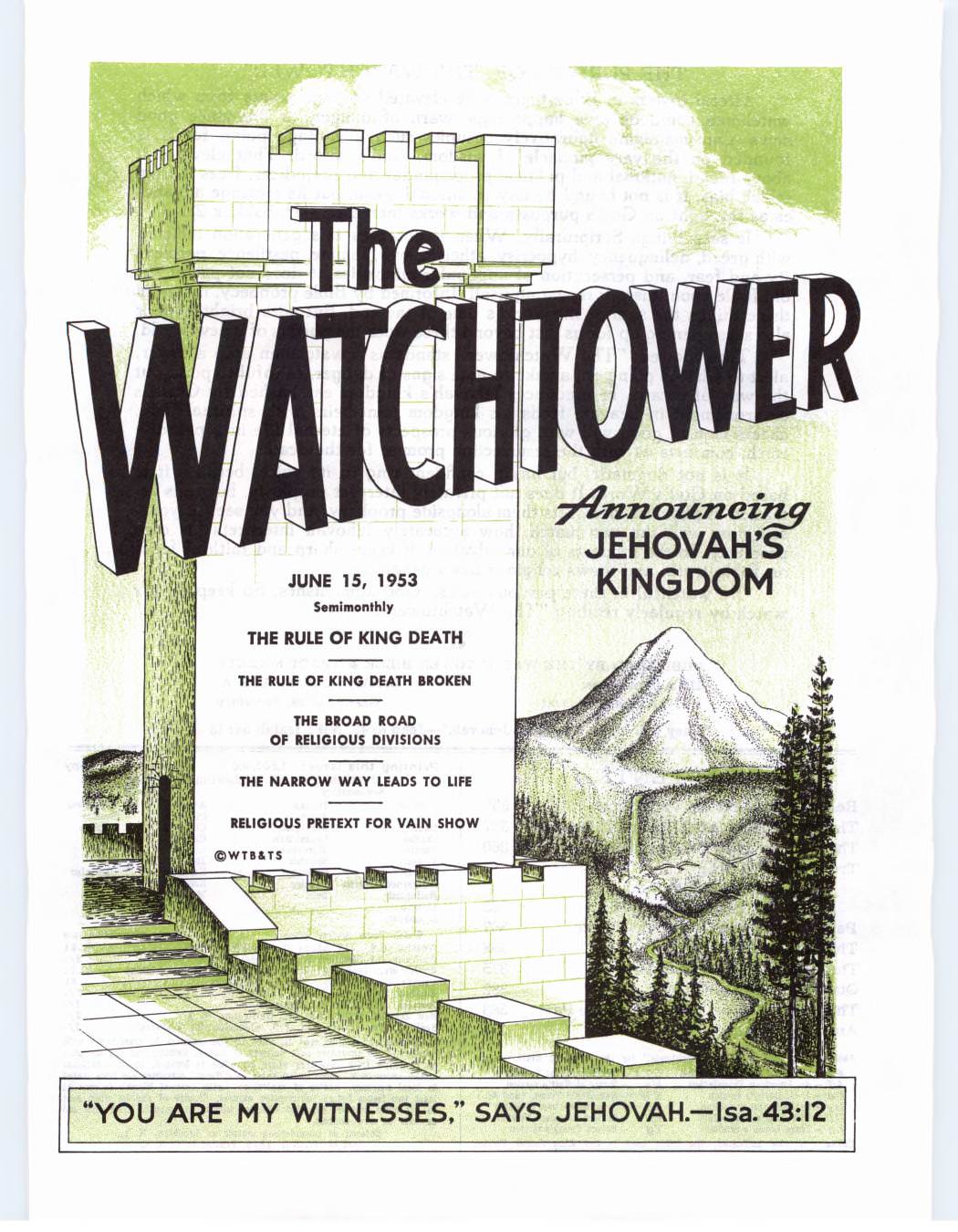
"YOU ARE MY WITNESSES," SAYS JEHOVAH.—Isa. 43:12
The WATCHTOWER
Announcing
JEHOVAH'S
KINGDOM
JUNE 15, 1953
Semimonthly
THE RULE OF KING DEATH
THE BROAD ROAD
OF RELIGIOUS DIVISIONS
THE NARROW WAY LEADS TO LIFE
RELIGIOUS PRETEXT FOR VAIN SHOW
©WTB&TS
“YOU ARE MY WITNESSES,” SAYS JEHOVAH.—Isa. 43:12 THE PURPOSE OF "THE WATCHTOWER"
Literal towers in Bible times were elevated vantage points from which watchmen could observe happenings, warn of danger, or announce good news. Our magazine figuratively occupies such a vantage point, for it is founded on the very pinnacle of wisdom, God's Word. That elevates it above racial, national and political propagandas and prejudices, frees it from selfish bias. It is not bound by any traditional creed, but its message advances as the light on God's purposes and works increases.—Habakkuk 2:1-3.
It sees things Scripturally. When it observes this generation afflicted with greed, delinquency, hypocrisy, atheism, war, famine, pestilence, perplexity and fear, and persecution of unpopular minorities, it does not parrot the old fable about history repeating itself.Informed by Bible prophecy, it sees in these things the sign of the world's time of the end. But with bright hope it also sees opening up for us just beyond these woes the portals of a new world.
Thus viewed, "The Watchtower" stands as a watchman atop a tower, alert to what is going on, awake to note signs of danger, faithful to point out the way of escape. It announces Jehovah's kingdom established by Christ's enthronement in heaven, feeds his kingdom joint-heirs with spiritual food, cheers men of good will with glorious prospects of eternal life in a paradise earth, comforts us with the resurrection promise for the dead.
It is not dogmatic, but has a confident ring in its voice, because it is based on God's Word. It does not privately interpret prophecy, but calls attention to physical facts, sets them alongside prophecy, and you see for yourself how well the two match, how accurately Jehovah interprets his own prophecy. In the interests of our salvation, it keeps sharp and faithful focus on Bible truth, and views religious news generally.
'Be watchful in these perilous times,' God admonishes. So keep on the watch by regularly reading "The Watchtower".
২
PUBLISHED BY THE WATCH TOWER BIBLE & TRACT SOCIETY
117 Adams Street Brooklyn 1, N. Y., U. S. A.
N. H. KNORE, President GRANT SUITER, Secretary
"They will all be taught by Jehovah."—John 6:45, NW; Isaiah 54:13
CONTENTS
CONTENTS
Religious Pretext for Vain Show 355
The Broad Road of Religious Divisions 357
The Narrow Way Leads to Life 360
True Worship Progresses in Northern Africa and on the Iberian Peninsula 365
Pastor Quits for Conscience' Sake 367
The Rule of King Death 368
The Rule of King Death Broken 375
Questions from Readers 382
The Bible—but Only the Desirable Parts 383
Announcements 384
Abbreviations used in "The Watchtower" for the following Bible versions
AS - American Standard Version LXX - The Septuagint Version
AT - An American Translation Mo - James Moffatt's version
Da - J. N. Darby's version NW - New World Trans. (2nd Ed.)
Dy - Catholic Douay version Ro - J. B. Rotherham's version
ED - The Emphatic Diaglott RS - Revised Standard Version
Le - Isaac Leeser's version Yg - Robert Young's version
Unless otherwise indicated, the Bible used is the King James Version
<tr><th colspan="4">Printing this issue: 1,500,000 Five cents a copy
PUBLISHED IN THE FOLLOWING LANGUAGES
Semimonthly
Monthly
Afrikaans
Italian
Arabic
Portuguese
Cebu-Visayan
Japanese
Climbba
Russian
Danish
Norwegian
Cinyanja
Siamese
English
Pangasinan
Cishona
Siloxi
Finnish
Slovenian
Greek
Slovak
French
Spanish
Ibo
Twl
German
Swedish
Kanarese
Ukrainian
Hiligaynon-Visayan
Tagalog
Korean
Yoruba
Hollandish
Zulu
Malayalam
Ilocano
Polish
Indonesian
RELIGIOUS PRETEXT FOR VAIN SHOW
PERHAPS no religious service is attended by more professed Christians than that held on Easter Sunday. Regarding the 1953 Easter the New York Times, April 6, reported: "Easter Services Jammed. Record Throngs in City Pay Glad Tribute to the Resurrection." It also told of mammoth crowds attending Easter sunrise services in various parts of the United States and that one of the largest crowds ever assembled in St. Peter's Square gathered there to hear an address by the pope.
Among the details given in the Times report were the following: At St. Patrick's cathedral the bright finery of 5,000 worshipers combined with the white and gold vestments of the priests and the choral alleluias to reflect the joy of the Easter celebration of the solemn pontifical mass. At the cathedral of St. John the Divine another 5,000 thronged the service at which five church banners and 62 organ trumpets were blessed, followed by a solemn liturgical procession of clergy and choir robed in white.
At St. Martin's Episcopal church a garden was set up in the chapel of the church. "It contained a representation of the Hill of Calvary with three crosses and the Holy Sepulchre. An azalea bush was planted beside the tomb and daffodils, tulips, narcissuses, blue daisies, lilies and snapdragons were included in the arrangement. The tomb was constructed from rocks from many countries." Some 6,000 persons
viewed this display in the five Easter services held in the church.
At Radio City an audience of some 6,500 witnessed a "dramatic enactment of the rising of the Easter sun", the stage simulating the interior of a Gothic cathedral with red and blue stained-glass windows, the altar being flanked by Easter lilies and guarded by figures of angels. Similar sunrise services were held in other theaters throughout the city, and at Paramus, New Jersey, nearly 9,000 attended the Easter sunrise service.
Nor were the spectacles limited to places of worship. Police estimated that 1,250,000 witnessed the Easter parade on Fifth Avenue, where not only the notable figures of society paraded in their finest and most correct, but where notoriety seekers held forth and publicity agents of milliners and clothing stores advertised their wares by means of models who posed as Easter worshipers. One white-haired old gentleman, attired like Benjamin Franklin in eighteenth-century knee breeches and buckled pumps, presented himself at one church after another.
One "woman wore a large round wide brimmed hat on which was mounted a cross, table and chairs for the Last Supper, chickens, a live bird in a cage and other bric-a-brac"; who, however, was admonished to keep on walking until she got outside of the Easter parade area. Another wore a large hat containing rows upon rows of pink roses, topped with a skirted rabbit, chickens and an American flag.
A number of other such millinery creations were also seen, calling to mind the fantastic headgear of the South African ricksha boys. In spite of all this we are solemnly assured that this was the most dignified Easter held in recent years!
Ostensibly one engages in a form of worship for the purpose of pleasing or appeasing a deity. Those professing to be Christians by the same token engage in their religious services for the purpose of gaining the favor of the God of the Bible. To gain his favor he tells us that our worship must be based on truth, must be sincere and uncontaminated by the world.John 4:24; Heb. 4:13; Jas. 1:27, NW.
But are the spectacles enacted in the churches and the finery displayed on Fifth Avenue for the purpose of winning Jehovah God's approval? Or is its purpose to attract the idly curious, win the approval of men and reap a large harvest of shekels for the coffers of the church? And what about the sincerity of such church attenders who limit church-going to once or twice a year, when a spectacle is being presented? Are not such drawing near to God with their lips while their hearts are far removed from him? Are they not displaying a form of godly devotion but proving false to its power?—Matt. 15:8; 2 Tim. 3:5, NW.
All such, however, is not surprising in view of the fact that "there is no indication of the observance of the Easter festival in the New Testament or in the writings of the apostolic Fathers". (Encyclopaedia Britannica) It was first at the Council of Nice, A.D. 325, that Easter was established as a festival, to fall on the first
Sunday after the full moon on or following March 21.
Easter and everything associated with it is of pagan origin, not Christian. The very term "Easter" is taken from the goddess of spring, Ostara, a variation of Ishtar or Astarte. Both eggs and rabbits are pagan symbols of fertility, while the wearing of new Easter hats was done by pagans to assure luck in love.
Even the thousands of Easter sermons are filled with paganism. The theme of immortality is stressed and much is made of the return of life in the spring as emblematic of human immortality. Thus clergymen confuse the Scriptural teaching of the resurrection from the dead with the Pythagorean and Platonic teaching of the immortality of the human soul, as if they were one and the same thing. Far from being the same they are not even compatible, for there could be no resurrection unless there was a death, a cessation of life; and if the immortality teaching is true then there is no such thing as death.
How could Christ Jesus have been immortal when he plainly told John that he was the Living One who had become dead but now was living forever and ever? (Rev. 1:5, 18; 2:8, NW) And note also Paul's argument on the resurrection at 1 Corinthians, chapter 15. If there is no resurrection then Christ is not risen but is still dead, and Christians are without hope. The resurrection hope and the immortality dogma cannot be reconciled.
Easter has no place in the true worship of Jehovah God. It is based on false teaching and serves as a religious pretext for vain show. And judging by the crowds his professed "people love to have it so".—Jer. 5:31.
The Broad Road of Religious
of Religious
HY so many religions? Within the United States alone there are twenty-three kinds of Baptists, twenty-one kinds of Methodists, twenty divisions among the Lutherans, thirteen brands of Mennonites, ten kinds of Presbyterians, and a whole handful of Churches of God. Thirty-nine religions admit such a lack of unity that they say doctrine is all up to the individual, apparently assuming he knows more than the scholars, or that his contradicting idea may be inspired by the spirit. One authority put it this way: "If one must speak of denominations and sects, of organizations here and there, of movements now and then, how can one speak of Christianity in the United States? Is not this religious chaos . . . all spots and jumps?"
Divisions
Yes, why such division? The Bible is just one book. Average editions contain 1,000 to 1,300 pages, and that is not exceedingly large. Webster's Dictionary contains 3,000; the Encyclopaedia Britannica, 24,000; the Harvard Classics, 22,000. Yet on the basis of the Bible's 1,000 pages rests the foundation of more than 230 of America's more than 250 religions, or one denomination for every five pages in that book. Now, since the Bible does not contradict itself on doctrine every five pages, why are there so many different religions claiming it as their guide? Are their scholars so ignorant they cannot read these 1,000 pages to agree, or are there other reasons?
Some reasons for this division have been petty, others practically ridiculous, few of them Christian. A main cause has been man's determination to make his religion
over to suit him, instead of making himself over to suit God. These attempted "improvements" were long ago foretold: "Men will rise and speak twisted things to draw away the disciples after themselves," and, "There will also be false teachers among you. These very ones will quietly bring in destructive sects and will disown even the owner that bought them [Christ]." (Acts 20:29, 30; 2 Pet. 2:1, NW) In evidence that this happened, The Kingdom of God in America says current religion "represents not so much the impact of the gospel upon the New World as the use and adaptation of the gospel by the new society for its own purposes". Unity of doctrine is gone, and that loss of unity represents a loss of true Christianity.
Religious boundaries have been frequently laid out along the political and economic map. William Warren Sweet in The Story of Religions in America points out that the most important and far-reaching of the schisms in American churches occurred over Negro slavery, and says: "It was not until church members had become wealthy cotton growers, that the churches ceased to denounce the institution. At the adoption of the Constitution all the churches were unanimous in their opposition to slavery; by the opening of the Civil War the churches had become a bulwark of American slavery." So, with religion not molding the people, but being molded by them; not influencing the world, but being influenced by it, it is little wonder that it has spread out in so many different and conflicting directions.
HISTORY OF DIVISIONS
The first settlers brought with them a great number of religions. There were Anglicans, Puritans, Pilgrims, Scotch Presbyterians, Calvinists, Lutherans, Quakers, Baptists, Methodists, and others. But the pioneer was a rugged individualist, independent and determined to go his own way in religion as well as in politics. He took this already confused stock of religions and severed and split them into myriads of smaller groups. "Denominations such as the Dunkers and Mennonites, which were of European origin, when transplanted to America divided and redivided as they moved westward into the undeveloped frontier," says Sweet, who describes this frontier religion as "warped though it often was, almost beyond recognition". The foundations for the new religions were, therefore, based not on sound doctrine but on this warped frontier viewpoint. While getting farther and farther from true worship, the number of sects grew and grew.
Further severing America's religion was the "Great Awakening" between 1734 and 1790. This was a surge of revivalism that spread from New England down through New Jersey and into the South. The new preachers or "New Lights", however, were not looked on with favor by the more conservative elements or "Old Lights" who frequently expelled the newer group. These, being vigorously evangelistic, just established their own congregations, some of which grew into new religions. The Unitarians split off from the Congregationalists in this manner. The Presbyterians split temporarily into "New Side" and "Old Side" bodies, and many "Separate" congregations that were formed became Baptist. Shubal Stearns, the founder of one of these, moved to North Carolina, where his evangelism produced the Separate Baptists, now a comparatively small group, whose immediate growth was called "almost unparalleled in Baptist history".
Slavery, already mentioned, was the third great reason for schisms. It split Methodism wide open in 1844. The great Baptist split was in 1845. The Presbyterian house divided right down the Mason-Dixon line between North and South. Entirely separate religious organizations were established to conform to politics, and when politics can divide the church it has certainly fallen a long way from the separateness from politics taught by Christ and the apostles! The Baptist and Presbyterian divisions remain to this day; the Methodist breach was healed only in 1939. Frank S. Mead in his Handbook of Denominations says this split "concerned neither doctrine nor polity; it was purely political and social". The real effort was not to follow God's Word, but to support the political views of the members, to 'adapt the gospel to their own purposes'.
Differently, the Episcopalians did not divide; they just went out and shot each other. Bishop Polk was a Southern general, and according to Mead's See These Banners Go, "Bishop McIlvaine of Ohio and fighting Bishop Polk of Louisiana prayed for each other by name in their chancels, every Sabbath day." They just "separated for the moment, as two travelers might separate to walk around a mud puddle in their road and join again when the obstacle was passed".
THE ROAD BROADENS
Not only did this sectional conflict also divide these same religions into white and colored, developing new denominations for Negroes, but national divisions severed other groups. Though the early Christian congregation was to make no division between Jew or Greek, slave or free, and James said class distinctions were a sin, the Eastern Orthodox churches within the United States are divided into Albanian, Bulgarian, Greek, Roumanian, Russian, Serbian, Syrian and Ukrainian groups.
The Lutherans are divided into Danish, Finnish, Norwegian and other sections. "The churches of America," says H. Richard Niebuhr, "no less than those of Europe, have often been more subject to the influence of provincial or class environment than to the persuasions of a common gospel."—1 Cor. 12:13; Jas. 2:1-9.
The fourth and fifth major causes of division were the phenomenal antimission movements that swept the frontier in the early nineteenth century, and the use of instrumental music. Antimissionism developed from the frontier objections to sending money back East to pay for the missionaries, and from the frontier preachers' jealousy over the eloquent, bettertrained new arrivals. The movement swept the whole of the frontier, particularly through Kentucky and Tennessee, and so struck the Baptists that at least three groups of "Hard-Shell" or "Antimission" Baptists still remain.
This, along with debate over that particularly noisy instrument, the organ, disrupted the Disciples of Christ so violently that a fourth of their members split off to form the "Churches of Christ". The anti-organ argument said: "No element of public worship is legitimate which is not explicitly authorized in the New Testament. Instrumental music is not so authorized. Therefore it is not legitimate." The extent to which this was carried was shown by Lard's Quarterly (1864), which said: "Let every preacher resolve never to enter a meetinghouse of our brethren in which an organ stands. Let no one who takes a letter from one church ever unite with another using an organ. Rather let him live out of a church than go into such a den.
Let all who oppose the organ withdraw from the church if one is brought in." (Italics his) Today a million people think God is vitally concerned over whether any musical accompaniment helps the singers stay on key. Of course, they have no objections to other modern innovations not mentioned in the Scriptures: the radio, songbooks, stained-glass windows, etc.; but they justify this by saying these are not elements of worship as they think a sounded note somehow is. However, instrumental music seems approved in the so-called "New Testament".—Rev. 5:8; 15:2.
The desire of particular men to lead their group was another major cause of religious divisions. Such jurisdictional divisions are well exemplified by the Mormons. When their founder, Joseph Smith, died, the largest group, the Church of Jesus Christ of Latter-day Saints, followed Brigham Young to Utah where they built Salt Lake City. A second group, the Reorganized Church of Jesus Christ of Latter Day Saints, was led by Joseph Smith's sons. A third formed the Church of Christ (Temple Lot); a fourth, the Church of Jesus Christ (Bickertonites), followed Sidney Rigdon; a fifth, the Church of Jesus Christ (Cutlerites), followed Alpheus Cutler, one of the original seven elders of Mormonism; and the sixth group, the Church of Jesus Christ (Strangites), followed James J. Strang, who claimed he had written credentials from Joseph Smith.
STILL MORE DIVISIONS
Others followed quirks of their own ideas to further confuse the picture. The "two seed" theory of the Two-Seed-in-the-Spirit Predestinarian Baptists (one of the antimission groups) is that back in Eden God put a good seed in man; Satan, the evil one. Babies, they think, are born with one seed or the other, so missionary work is useless; a man with the bad seed is helpless and one with the good will come to the church anyway.
At last report (eight years ago) their numbers had dropped to a mere 200. Their doctrine is based on a misinterpretation of Genesis 3:15 about the seed of the woman.
Then, as one writer commented: "In any large city unheard-of sects can be located frequently consisting of only one or two churches. A dissatisfied preacher finds it easy to lead off a group and start a new denomination of his own. . . . Most of the little groups have no history save a church quarrel, and few of them possess any distinctive doctrines or practices." It has been estimated that there may be as many as 3,000 of these independent groups.
Away back in 1890 a little book, Short History of the Church in the United States, truthfully said: "The multiplication of ecclesiastical organizations has been one of the characteristics of American religious life." Some like to call them the "many mansions" in the Father's house, perverting John 14:2, which refers to heavenly blessings. In most minds today a shamefully hazy blending occurs to where divergence of doctrine and difference of belief are passed over, put aside with the view that they are all different roads going to the same place. But they are not. While propounding their own theories they cannot be gathering with Christ. He called the tradition-following religious leaders of his day who did not hold to right doctrine while claiming divine authority for their acts hypocrites, blind guides, fools, serpents, viperous offspring doomed to destruction. (Matt. 12:30; 23:1-39) Those seeking life and truth must get off these broad paths, dust off their Bibles and learn from that thousand pages the difference between all this hodgepodge of selfcontradicting doctrines and the true inspired Word given by Jehovah God. But for a discussion of this and of its importance we must refer you to our following article, "The Narrow Way Leads to Life."
Beware of the dead-end streets!
SOME people think religion's purpose is just to make good men. Their view is: "If one is sincere in his religion, that is all that is expected of him." Others view religion as a drug for the mentally distressed or a help to those in trouble. They say: "All these religions fit some people's needs; if they are doing good, that is fine!" Still others who think just having the name "Christian" is sufficient say: "They are just different roads, all going to the same place." Hence, it is often proposed that these various roads be fused into a broad middle way, a uniting of all religions. The frame of mind behind such a view was shown by
Dr. Norman Vincent Peale in the June, 1948, American magazine, where he said doctrinal differences "are of little real significance to the average man today", and, "Not one modern Protestant out of 50 could tell you in what doctrinal respects Methodists differ from Baptists or Presbyterians from Congregationalists."
This slurring over of doctrines is encouraged by such clergymen as Peter Ainslee, former president of the national conference of the Disciples of Christ, who once said: "Let those bodies that hold to baptism by immersion still practice what they believe. . . . Let the creedal bodies still hold to their creeds. . . . But let them abandon denominationalizing as one of the things for which they stand." It would seem he was more concerned about having them stay in his organization than about their having true worship. However, true worship and right doctrine are of vital importance. The prophet warned: "My people are destroyed for lack of knowledge; because thou hast rejected knowledge, I will also reject thee."—Hos. 4:6.
That knowledge comes, not from the human ideas that have severed today's religions, but from God's Word. The psalmist said: "Thy word is a lamp unto my feet, and a light unto my path." All these religious roads are dead-end streets because they are not lit by that Word. Its light does not spread out to cover today's many conflicting doctrines, for Christ said: "Go in through the narrow gate; because broad and spacious is the road leading off into destruction, and many are the ones going in through it; whereas narrow is the gate and cramped the road leading off into life, and few are the ones finding it."—Ps. 119:105; Matt. 7:13, 14, NW.
Sincerity alone is not sufficient for one to get life. "What man thinks a right course, may end upon the road to death." "Man's ways are always right in his own eyes, but the Eternal has the verdict on his life." (Prov. 14:12; 21:2, Mo) Even being a "good man" is not sufficient. Jesus was asked: "Teacher, what good must I do in order to get everlasting life?" He replied:
"Observe the commandments continually." The questioner said he did that; he did not murder, steal, commit adultery, covet, bear false witness, and he honored his parents. He was a good man, but he asked: "What yet am I lacking?" The answer: Sell your belongings, give to the poor "and come be my follower".—Matt. 19:16-22, NW.
No one is following Christ if he teaches a different doctrine; he is following himself or some other man. Today's hundreds of brands of religion that are scattering with doctrines which differ drastically even among themselves should take Jesus' warning: "He that is not on my side is against me, and he that does not gather with me scatters." (Matt. 12:30, NW) They are following a broad and spacious road that will accommodate all these beliefs. Not all could be on his side.
If a traveler desiring to visit a neighboring country asked directions of 200 different persons and got 200 answers, all the way around the compass, north, south, east and west, what would he do? Take the advice of the person his grandparent took advice from, or from the one who wore the most peculiar garb, or had the most mellow voice, or to whom his sweetheart or marriage mate listened, or who had the most imposing or closest building in which to talk? Would he say that he does not talk about directions, as some people say they will not talk about religion? No. An intelligent traveler would get a roadmap to compare the different directions and see why they are so conflicting.
POOR GUIDES
Where true worship is concerned, the roadmap or guidebook is the Bible. Yet today's individual ignorance about that guidebook is astounding. Bishop Wells of the West Missouri diocese of the Episcopal church said: "The fact of the situation is that 90 per cent of our church members—not the leaders, but the average man and woman—do not really know what they believe and why.
They might be called religious illiterates. Many persons do not know the Bible." (Kansas City Star, January 31, 1951) But does this apply to just "the average man and woman", as he implies? Not according to a survey made by Dr. George Herbert Betts of Northwestern University and published in a little book entitled "The Beliefs of 700 Ministers". He wanted to determine: "All formal creeds aside, what do the ministers of our churches believe? Do they agree to a man on the beliefs within a single denomination? Do the denominations agree with each other on the great fundamental matters of Christian faith? Can we of the masses find in our spiritual leaders a certainty of belief on the crucial questions of religion such as warrants our trusting their insight?" To answer this he sent 56 basic doctrinal questions to 1,500 representative clergymen and theological students; 700 replied. Here are the percentages on certain representative questions:
Did they believe:
Not
Old Testament prophets inspired?
Yes
Sure
No
The trinity doctrine?
Record of creation?
Biblical miracles?
In an actual devil?
Jesus' virgin birth?
Heaven is a place?
Hell?
Christ said the way is narrow. They have certainly spread out. Some are bound to be teaching false doctrine, because Genesis is either true or false; the miracles either occurred or did not; either Jesus was born of a virgin or the Bible lies. There are not two answers to these questions, but only one. It is not that the Bible is impossible to understand, but that too many care too little about what it says, leaning to their own ideas, following men instead of God. By following their own theories they have turned from pure worship just as surely
as did Adam and Eve, who were led by Satan into a simple matter of disobedience. Likening these false doctrines to yeast, the apostle warns that just a little ferments the whole lump.*—1 Cor. 5:6, NW.
The early church had no such confusion. Christ set the apostles on a cramped path, the narrow road leading to life. Could you imagine Peter going to Galatia and saying Jesus was not the Messiah, while Paul in Ephesus said he was; Paul going to Corinth and saying to be baptized and another apostle saying not to; Timothy in Thessalonica telling the Christians to study the prophets faithfully while someone else goes to the Bereans and says about these very prophets that Christ quoted freely: "Why, that is the Old Testament, just mythology, fakes and forgeries, good literature but that is all"? Of course not! They knew that Jesus was the Messiah, baptism was proper, the prophets were true.
APOSTOLIC EXAMPLE
How was it the apostles had such unity? It was not just because their group was small, but was because they had right doctrine, held rigidly to the truth, refused to be contaminated by false worship, refused to unite with those teaching falsehoods. Today's religious leaders with their broad roads and plans for interfaith would have considered Jesus and the apostles narrow, for these early Christians would never
Denomination
Replies
Believe in Devil?
Believe Creation Acc't?
Not
Not
Yes
Sure
No
Yes
Sure
No
Baptist
68%
63%
Congregational
Episcopalian
Evangelical
Lutheran
Methodist
Presbyterian
13 others
77%
60%
have put up with such confusion as goes under the name "Christendom" today.
Whether today's clergymen know it or not, their lack of concern for true doctrine would have put them in the same class as the Jews who rejected truth, and to whom Jesus said: "You are from your father the Devil and you wish to do the desires of your father."—John 8:44, NW.
The apostles got this true doctrine through obedience to God's Word, through being disciplined by the truth; putting their own ideas aside and letting the truth rule them. Otherwise they would have claimed Jehovah as their father while doing the works of Satan, and would have fit right into the warning that "if you are without the discipline of which all have become partakers, you are really illegitimate children, and not sons". (Heb. 12:8, NW) Legitimate sons of God have unity because they have the solid Christian faith that is built on the solid rock of God's Word. It corrects former wrong ideas. "All Scripture is inspired of God and beneficial for teaching, for reproving, for setting things straight, for disciplining in righteousness, that the man of God may be fully competent, completely equipped for every good work." (2 Tim. 3:16, NW) Discipline is not always pleasant, but it is necessary for proper training, and when the true Christian lets God's Word correct him, teach him, reprove him and set him straight about the false doctrines of this old world's religions, he is glad to change his ideas to conform to that Word. He then comes to unity on doctrine with all others who really do accept the narrow path of truth.
SOURCE OF UNITY
There is no need for the ignorance that has prompted today's many religious divisions, save that the Scripture said that the wicked god of this system of things has blinded the minds of the unbelievers to
the truth. (2 Cor. 4:4) In dividing they have lost their dynamic power, have changed, modified, corrupted and perverted the truth. They have divided over petty differences and national rivalries, have made new doctrines at will, and have gotten doctrines and tried to find a few Scripture texts to prove them, rather than putting their ideas aside to study the 1,000 pages of the Bible and find out what true worship really is. Such study would soon show the difference between what is taught in today's religions and what the Bible actually says.
Take, for example, the doctrine of the trinity. It was taught by the pagan Plato, the pagan Egyptians, Babylonians, Zoroastrians, Hindus, Taoists and Buddhists, but was not taught by the apostles, as the January 1 issue of this magazine showed in detail. The doctrine of the immortal soul, according to the pagan Greek historian Herodotus, came from pagan Egypt. According to the Jewish Encyclopedia, the Jews got it from the pagans. On examining the Bible, however, you will find that it shows irrefutably that the soul can die, and therefore is not immortal. (Ezek. 18:4, 20; Acts 3:23) The related doctrine of hell-fire was also taught by the Buddhists, Egyptians, Babylonians, Persians, Phoenicians and Greeks, but not by the Bible, which says simply, "the dead know not any thing," and shows that hope for future life is in the resurrection as a reward for right doing, not in everlasting torment.—Eccl. 9:5, 10; Job 14:13; John 5:28, 29.
For unity on spelling the dictionary is accepted as an authority. In religion the Bible is that authority. It shows what true worship was before it was perverted by all these pagan doctrines. Having taken three sample doctrines, the trinity, immortality and hell, on which Dr. Betts' survey showed today's clergy are at disagreement, we find that by accepting the Bible's authority we can come to unity with all who likewise will accept God's Word.
But if such widely accepted doctrines are false, how did religion come to adopt them? Through the very practice of trying to make their interfaith projects a unity of organization instead of a unity of doctrine and broadening their organization to include all sorts of doctrines that were never a part of true Christianity. Frank S. Mead explains it simply in his book See These Banners Go: "What we call the Church is a snowball, rolling. It started on 'the coasts of Caesarea Philippi,' . . . it rolled westward gathering, absorbing, being colored by everything it touched, and coloring everything. It was Hellenized in Greece; Romanized in Rome; it gathered laws, philosophies, thinkers, tinkers, soldiers, saints and devils; it became in time a rolling leviathan of accumulated creeds and catechisms, convictions and conceptions, social custom and economic practice. In shape and size and structure it has changed mightily." In getting off onto this broad road that could encompass all kinds of worship, it has rejected its core of true Christianity, for Christ warned that the broad road followed by the multitude leads to destruction.
JOIN THE FEW
It is for a very logical reason, however, that many people believe that all these conflicting doctrines and forms of worship are acceptable to God. They cannot see how God could possibly doom all these people to hell just because they are in the wrong religion, and so they think God does
not mean what His Word says about the narrow way. By sheer force of numbers they think to high-pressure him into accepting almost all of them. The flaw in their argument is that the Bible does not say the wages sin pays is hell-fire, but that it is death, and that the gift God gives for righteousness is everlasting life. "For the wages sin pays is death, but the gift God gives is everlasting life by Christ Jesus our Lord." (Rom. 6:23, NW) God does not bless with future life the indifferent, lethargic ones who think He owes them something, but rather those who thankfully put forth a real effort to find the narrow way he has set out, and follow it. The others have not proved worthy of life, so will not receive a resurrection, will remain in permanent death. Only eight persons were worthy of surviving the flood; not ten righteous men could be found in Sodom; only a few hundred accepted Jesus in his day; the vast number of today's so-called Christians are that in name only. Christ was right when he said only a few would follow the narrow way that leads to the reward of life.—Gen. 6:1-7:7; 18:23-33; Matt. 23:37, 38; 1 Cor. 1:22, 23; Matt. 7:13, 14.
Study. Demand absolute proof for all doctrines—not just the "proof texts" all religions have, but the whole picture, all the Bible has to say on the subject. Prove what is right. Come out of this confused babble of doctrines on these broad streets ending in death. In harmony with God's inspired Word, the One Book that is the sole basis for true united worship, follow closely the narrow way that really does lead to life.
True Worship Progresses in Northern Africa AND on the Iberian Peninsula
Concluding the report on the African trip of the president of the Watch Tower Society, N. H. Knorr, and his secretary
IT WAS a happy group that I left behind in Ethiopia as I flew away to Cairo. En route we stopped for a few hours at Eritrea for engine repairs. By the time I got to Cairo, Brother Henschel, my secretary, had already left for his visit to Tripoli, Libya. During his stay in Cairo he had addressed 92 witnesses of Jehovah at their assembly and gave a public discourse at which 182 were present.
It was arranged for me to go to Alexandria to talk to the brothers there. At 6 p.m. the various congregations in Alexandria, French, Arabic and Greek, came together and I spoke to them through two interpreters, one speaking Greek and French and the other Arabic. Present were 257, a much bigger crowd than I had served five years before. The next morning we returned to Cairo by train. In the evening 116 brothers attended the central meeting and again the talk was given through three languages.
I flew to Algiers by way of Paris, where I had a twelve-hour stopover permitting me time to go over the problems of the Paris branch office with the one in charge, the branch servant, who then accompanied me to Algeria. The work of spreading the true worship in Algiers has just started. The Society recently sent some missionaries and other full-time ministers to this capital of Algeria to see what could be done, and they are doing well. The Arab section of the city, called La Casbah, is in
the ancient Arab town which was the original city
of Algiers. Now the city has spread out and this has become more or less the center of town.
The missionaries find it very interesting to witness to these Arab people. When they knock at the door of a Moslem home the woman checks to see who is there. If the man happens to be an Arab, the Moslem woman will cover her face with a veil before she speaks to him; but if it is a European she does not. No one seems to understand just why; but it is observed that even when an Arab woman is in a shop making a purchase, if she is speaking to a European she unveils her face, but should an Arab enter she immediately puts her veil upon her face.
This was the first time an assembly of Jehovah's witnesses had been arranged for the city of Algiers. The Watch Tower Society had written to all who were interested in its work and told them of the visit of the president and the meetings that were to be held. On Saturday morning a group of thirteen came together and went forth to engage in the field ministry. A small hall had been rented for the afternoon meeting, and much to our surprise 39 were in attendance. Very good interest was shown and many questions were asked at the conclusion of the meeting. On Sunday the public meeting was held at 9:30 a.m., at which thirty were present.
Right now there are ten part-time ministers assisting the eight full-time ministers in the work of making known the Kingdom message to the people of Algeria.
So for the few months that the brothers, the full-time ministers, have been there good work has been done, and if it keeps up at that rate it will not be long before a fine congregation of Jehovah's ministers will be organized.
From Algiers I flew to Madrid and there met Brother Henschel and the brothers who work in the Iberian field. Regarding Libya, to which Brother Henschel went after his visit to Cairo, he had the following to report:
LIBYA
"This land was formerly held by Italy, but now an attempt is being made by the British and the United Nations to help the Libyans to organize their own government. It is a major task because few Libyans have had experience in such matters. A king has been enthroned and Arabic has become the official language. The religion of Islam predominates.
"With the rise of this new nation to a place among the countries of the world, there has also arisen within it the proclamation of the Kingdom message. Begun in 1950, the seeds of truth planted are already bearing good fruit. The brothers in the Tripoli company show great enthusiasm for the work. During the past year as many as 19 different ministers have had a share in the preaching work in one month. The local congregation is Italian. While the work cannot be carried on as freely as in some other countries, missionary work being frowned on officially, the truth is nevertheless spreading. Some of those who attended the assembly in Tripoli live out on farms near the city. Among the experiences they told is the following regarding a sister and her priest:
"A new Catholic priest, upon coming to her parish, visited all his parishioners in it and made arrangements for having dinners
with them. He told her, then also one of his parishioners, that he would come on Thursdays. However, he came back on Wednesday and found the family eating beans. He was invited to join them in their meal if he cared for beans. This highly insulted him and he asked for meat and eggs, of which there was none in the house. Angrily he left the house and on the next Sunday in church he denounced the family for offering beans to the priest. That was the last time they attended church.
"During my visit meetings were held at the Kingdom Hall, the peak attendance being 27 at the public meeting. My departure from Libya was delayed at the airport, which meant that I would miss connections at Rome for Barcelona. The delay in Rome I spent with the brothers there, who were rejoicing in the fact that they recently had a new peak of 2,150 Kingdom proclaimers in Italy.
SPAIN
"On January 10, I arrived at Barcelona via Madrid and immediately began discussing local organizational problems with the brothers there. Special field service efforts were on and new ministers were taking part in the preaching work for the first time. That night I gave a talk to an audience of 50 in a private home.
"On the following day two more gatherings were held in private homes and it was a thrill to see 193 in attendance, which was almost double that of the previous year, when 100 were present. This was partly due to the presence of brothers from Barbastro and Palma de Marjorca. The field preaching activities and the series of meetings caused the brothers in Spain to exhibit a spirit among them that I had not seen before. Many home Bible studies are now being conducted and the prospects for future growth are excellent.
"Some of the brothers from Barcelona, desiring to continue their 'convention' joys, as well as to meet the president and brothers from other parts of Spain, accompanied me by plane to Madrid Tuesday morning. That afternoon we had a meeting in Madrid at the home of one of the witnesses, with 26 present. In the evening, at another home, 32 were present."
As Brother Henschel was speaking to those brothers I was arriving by plane from Algiers. Naturally I found many problems that needed attention. For some years the Iberian Peninsula has been a dark corner of Europe where true freedom of worship does not exist. Since World War II a little handful of Kingdom publishers have boldly continued with pure worship in Spain, where the cult of saints and virgins predominates.
Two separate meetings were held on the afternoon of the following day with a combined attendance of 46, I speaking to one group and Brother Henschel to the other. Later that evening, I made it very plain to fifty brothers and newly interested ones gathered in a private home that their advancement must be made manifest, and pointed out to them the various ways in which they could do this.
PORTUGAL—LAST STOP
From Spain we flew to Portugal and within a few hours of landing we were giving talks to a group of 43 brothers at the central meeting place of Jehovah's witnesses in Lisbon. That night we crossed the river to Almada and had a similar meeting with 53 attending. It was the beginning of a week of special ministerial activity and the brothers were in high spirits as they engaged in Kingdom service and worship. On Sunday all came together at Almada, and in spite of the rain the count was 73 brothers and persons of good will.
Early Tuesday morning we left Europe, winging our way homeward to New York. We watched the sun come up behind us and could see the light increase each minute until finally the sun broke forth in all its splendor from above the fluffy clouds. It is just that way with the light of truth now, for it is shining brighter each minute through the spiritual darkness of Satan's system of things on this earth. It had just been our privilege to see expansion on a large scale in Africa and southern Europe, with thousands more ministers of the good news letting their light shine than when we last were there. What an indescribable privilege it is to serve Jehovah!
Pastor Quits for Conscience' Sake
"The Rev. Edward H. Morgan, pastor for eight years of the First Presbyterian Church of Springfield, Delaware county, resigned yesterday from the Presbyterian Church of the U.S.A. . Mr. Morgan blamed the trend of modernism for his action, and declared he could no longer continue to compromise his beliefs, . . [saying] 'I am leaving the church because I can no longer serve the Lord with a clear conscience and without compromise as a minister of the Presbyterian Church in the U.S.A. . . Finding myself continually involved in what I believe to be at variance with God's word, I find the only course for me is to remove myself.'"—Philadelphia Inquirer, January 19.
If the pulpit were a service instead of a profession, such men would not find themselves economically bound to a system they could not honestly support; and if more of them had the strength to give up their life's work when they found it did not correspond with God's Word, even though, like Mr. Morgan, they had no idea what they would do in the immediate future, there would be fewer men at war with their consciences, and there might be more true servants of God in the land.
LOOK where you will across the length and breadth of this fair earth, on hilltops or in the valleys, wherever you see any signs of life you will also see memorials to death. In the vicinity of every city, town and village, along beautiful country road sides, your gaze will take in from perhaps a few to hundreds of memorial tablets, crosses or tombstones testifying to the fact that death rules as king. But besides these, there are thousands of unnumbered and unremembered dead who have no markers or statues identifying the place where they lie. That place may have been a battlefield, a desert, a snowfield or the seemingly endless stretches of the sea. Those who knew them are themselves no longer here to tell us. The grave is indeed one of the three things never satisfied. (Prov. 30:15, 16) But consider too the seemingly unlimited duration of this sovereign's rule. Our ancestors all acknowledged his kingship. Yes, we can go back to the very first man and woman and find that in their day the sway of this unwelcome royal government was acknowledged, and there it had its beginning.
2 However, it was not the Creator's purpose that death should sweep through the land and constantly add to his plunders. He finds no pleasure in death, but would rather have even the wicked turn from
"Nevertheless, death ruled as king from Adam down to Moses, even over those who had not sinned after the likeness of the transgression by Adam, who bears a resemblance to
him that was to come." —Rom. 5:14, NW.
his way and live. (Ezek. 18:32; 33:11) The tears, heartaches, broken homes produced by disease, plague, famine
and sword, need never have been but for one wicked conspirator and two accomplices. If the Creator's wise command had been obeyed and his earthly children had kept the love of Jehovah in their hearts, we would now have a world filled with happy, healthy, mature men and women. These would find complete happiness in instructing equally joyful children, and all without a trace of sin, sorrow, suffering, death and imperfection. How do we know this? The oldest and most reliable book in the world, the Holy Bible, reveals that such was the Creator's purpose. It states: "And God created man in his own image, in the image of God created he him; male and female created he them. And God blessed them: and God said unto them, Be fruitful, and multiply, and replenish the earth, and subdue it; and have dominion over the fish of the sea, and over the birds of the heavens, and over every living thing that moveth upon the earth." (Gen. 1:27, 28, AS) He purposes that the earth be permanently populated. "For thus saith Jehovah that created the heavens, the God that formed the earth and made it, that established it and created it not a waste, that formed it to be inhabited: I am Jehovah; and there is none else." (Isa. 45:18, AS) His purpose shall be accomplished. Isa. 66:1; 60:13; 11:9.
But who brought about the change from the perfectly ideal condition to the wretched chaos the world is in today, you may ask? The wicked conspirator who started it all, Satan the Devil, did not foresee the full and final consequences of his wrongful acts. He determined to gratify an illegitimate, selfish ambition and show others what he could accomplish. That ambition has consumed him like an intense greed and changed him from an originally perfect creature to one with no regard for the suffering and wretchedness produced by the gratification of his desire. There came a time when he decided that instead of loyally representing his Creator and using his exalted office to lead the earthly creatures under his charge to render obedience and due worship to Jehovah he would lead them to render such homage to himself. In self-conceit with corrupted wisdom his line of argument was that his personal beauty, the gift of his Creator, merited such recognition. Craving admiration and worship he vowed he would become like the Most High.—Ezek. 28:14-17.
4 To achieve his end Satan was now willing to become a slanderer, a deceiver, an opposer of Jehovah and a devourer, as identified by the names Devil, Serpent, Satan and Dragon. Using all the subtleness of his exalted position and communicating his message through the visible serpent, he assured the first woman that by following his suggestion she would have something far greater than what an untrustworthy God had given her. Whether she was shocked at the original suggestion of distrust of her heavenly Father, or not, is immaterial and the record does not state. That she yielded to the allurement of the prize and transgressed is important. James wrote: "But each one is tried by being
drawn out and enticed by his own desire. Then the desire, when it has become fertile, gives birth to sin; in turn, sin, when it has been accomplished, brings forth death." (Jas. 1:14, 15, NW) It is evident that Eve did not fully weigh the matter as to the reliability of the authority making the promise, nor did she consult Adam, her head, on the matter. In this she showed a lack of love. Spellbound with the prospect to be gained, she decided to grasp the forbidden and then assist her husband to it.
Having succeeded with Eve the cunning adversary now used her as his tool to break the integrity of Adam. She was bone of his bone and flesh of his flesh. When she invited Adam to eat, the full consequences of her disobedient act quite probably struck home to him. He was not deceived. How would his Creator take action? Would he immediately lose his only human companionship? Why had she forced this issue upon him? To yield to her meant disobedience to his God. It was a choice between love and duty to Jehovah and affection and attraction to his helpmate; choice between the Creator and the creature, between governing his life by principle, according to the godlike attributes with which he had been endowed, on the one hand, and passion, the strong pull of human emotion, on the other. Adam too lacked true love for his Creator and decided wrongly. Without gratitude and thankfulness to God, the first human pair became accomplices to the great conspirator. Satan had succeeded in bringing reproach on Jehovah, whose glory is above the earth and the heavens. The Devil supplanted the truth with falsehood and destroyed pure and right worship in the earth. Jesus testified of him: "That one was a manslayer when he began, and he did not stand fast in the truth, because truth is not in him.
When he speaks the lie, he speaks according to his own disposition, because he is a liar and the father of the lie."—John 8:44, NW.
Now consider for a moment the tactics employed by the Devil right from the start. By spreading his lying report, 'You shall not surely die,' he planted doubt, distrust and disbelief in the first human minds, and thereby dragged down the unmatchable, illustrious and praiseworthy name of Jehovah to the level of an exploiting racketeer. He charged God with being a deliberate deceiver, interested in keeping man as an underdog, and for that reason wholly untrustworthy. In all of this he manifested what he himself had become. Did the human children of their heavenly Father, surrounded by so many expressions of his love, kindness and care, resent such false accusations? Did either cry out, 'You snake in the grass, you can't call my Father that'? The record does not allow us to think so. The deceiver's work was so deftly done and their personal interests were so appealed to that they forgot and turned their backs on their best friend. With no grounds for doubting Jehovah in the least, they failed to show the faith required to please God. At the suggestion of a course offering them unrestrained liberty, license, they plunged ahead on their own, and began to make of themselves copies of their master. By their choosing the course of a transgressor death became their king. He has been a hard, unrelenting ruler, and, try as man will, he is unable to break death's power.
7 But you and I too must choose between loyalty to Jehovah on one hand and submission to the archenemy Satan the Devil
on the other. By our course of action we support one or the other of these two masters. This is so because we have freedom of will. To obey Jehovah means life, to yield to his enemy means eventual death. We must guard against yielding to temptation to please our flesh, and we must beware against being made tools of the adversary to ensnare others. The apostle Paul warned, "For if you live in accord with the flesh you are sure to die; but if you put the practices of the body to death by the spirit, you will live."—Rom. 8:13: Gal. 5:16, 17; Rom 8:5-8, NW.
Observe now man's declining years, the result of cutting himself off from God's undeserved kindness. Dwelling in the land where death cast its shadow neither Adam nor any of his offspring lived a full one-thousand-year day. Longevity gradually decreased with several sudden drops in the lives of men. After the first ten generations from Adam to Noah no one attained an age reaching into the nine-hundred-year age bracket. Shem, who followed Noah, lived to only six hundred years. The three succeeding generations attained an age within the four-hundred- to five-hundred-year bracket. Then followed another sudden drop, for within five generations man's life span was cut in half. The four generations that followed, reaching to Joseph, the son of Jacob, brought man's maximum life expectancy down near the hundred-year mark. (Genesis chapters 5, 7 and 11) Death was ruling as king from Adam to Moses and man's fading life spark was just like a mist appearing for a little while. The great conspirator had the ability to bring the plague of death through transgression but was without the power of life, for only in Jehovah's hand is the breath or life power of all mankind.—Jas. 4:14, NW; Job 12:10.
9 It is unsound to say that the years of the patriarchs were not as long as ours, possibly as short as our months, for God had specifically given man lights in the firmament to designate days and years. Though their annual periods were not calculated to the fraction of the day, there was no mistaking the seasons of the year, since Jehovah had said, "While the earth remaineth, seedtime and harvest, and cold and heat, and summer and winter, and day and night shall not cease."—Gen. 1:14; 8:22, AS.
MAN'S DEATH STATE
10 For six thousand years men have been dying, yet, strange as it may seem, the vast majority do not know what the condition of death really is. Those without the Bible believe either their personal theories or their particular sacred books. Even those with the Bible are greatly confused by the traditions of men. The general religious conception is that death is separation or alienation from God. Some have said it means the closing of heaven to the lost soul. Since it is assumed that the soul is immortal and must live on forever, and since a happy existence, or heaven, is denied it, it follows that it must spend its eternity in a state of misery. Pagan tradition, human philosophy, the world's literature and education have generally followed these conclusions.
11 For our own good, let us consult God's Word for the correct answer. Speaking of what takes place at the moment man dies, Psalm 145, verse four (Dy), reads, "His spirit shall go forth, and he shall return into his earth: in that day all their thoughts shall perish." (See Psalm 146:4, AS.) Certainly if one's thoughts perish,
then all knowledge and feeling perish as well. This is borne out by Ecclesiastes 9:5 (Dy), "For the living know that they shall die, but the dead know nothing more. Neither have they a reward any more: for the memory of them is forgotten." The prophet Job also describes the death state in the words, "There the wicked cease from troubling; and there the weary be at rest. There the prisoners rest together; they hear not the voice of the oppressor. The small and the great are there; and the servant is free from his master." (Job 3:17-19) "But man dieth, and wasteth away: yea, man giveth up the ghost, and where is he?" (Job 14:10) There is no activity in the death condition. "The dead praise not Jehovah, neither any that go down into silence." "Whatsoever thy hand findeth to do, do it with thy might; for there is no work, nor device, nor knowledge, nor wisdom, in Sheol, whither thou goest."—Ps. 115:17; Eccl. 9:10, AS.
12 From the evidence, then, we can see that death is the end of one's existence. It is physical death, and any attempt to make a distinction between it and a so-called spiritual death is unscriptural. Man dies physically, mentally and spiritually all at once. The dead person's mind cannot function, his eyes cannot see, his ears cannot hear, nor can his lips speak. Death for man is the same as it is for the lower animals. (Eccl. 3:19-21; Ps. 104:29; 145:20) Notice how plain God made this at the time when the first death sentence was pronounced. God concluded his judgment against Adam with the words, "For dust thou art, and unto dust shalt thou return." (Gen. 3:19) He was to go back to the state of nonexistence from which he came. There was no part of the divinity in man that had to be kept alive.
13 The record furthermore says nothing about Adam or his posterity as losing heaven. That had never been promised to either Adam or his posterity, and to have claimed a right to it would have been highly presumptuous. "The heavens are the heavens of Jehovah; but the earth hath he given to the children of men." (Ps. 115:16, AS) Mere creation did not entitle them to an unconditional, endless earthly life, much less to a spiritual or heavenly condition. Only the adversary promised that, namely, that they should be like gods, and he was unable to keep his promise that man should not die. God moreover enforced the death penalty by acting after his word: 'And now, lest he put forth his hand, and eat, and live forever.' Therefore Jehovah God sent him forth from the garden of Eden, and he placed the cherubim, and the flame of a sword, to keep the way of the tree of life. Gen. 3:22-24, AS.
…