The Watchtower, July 15, 1953
Download: PDF — The Watchtower, July 15, 1953
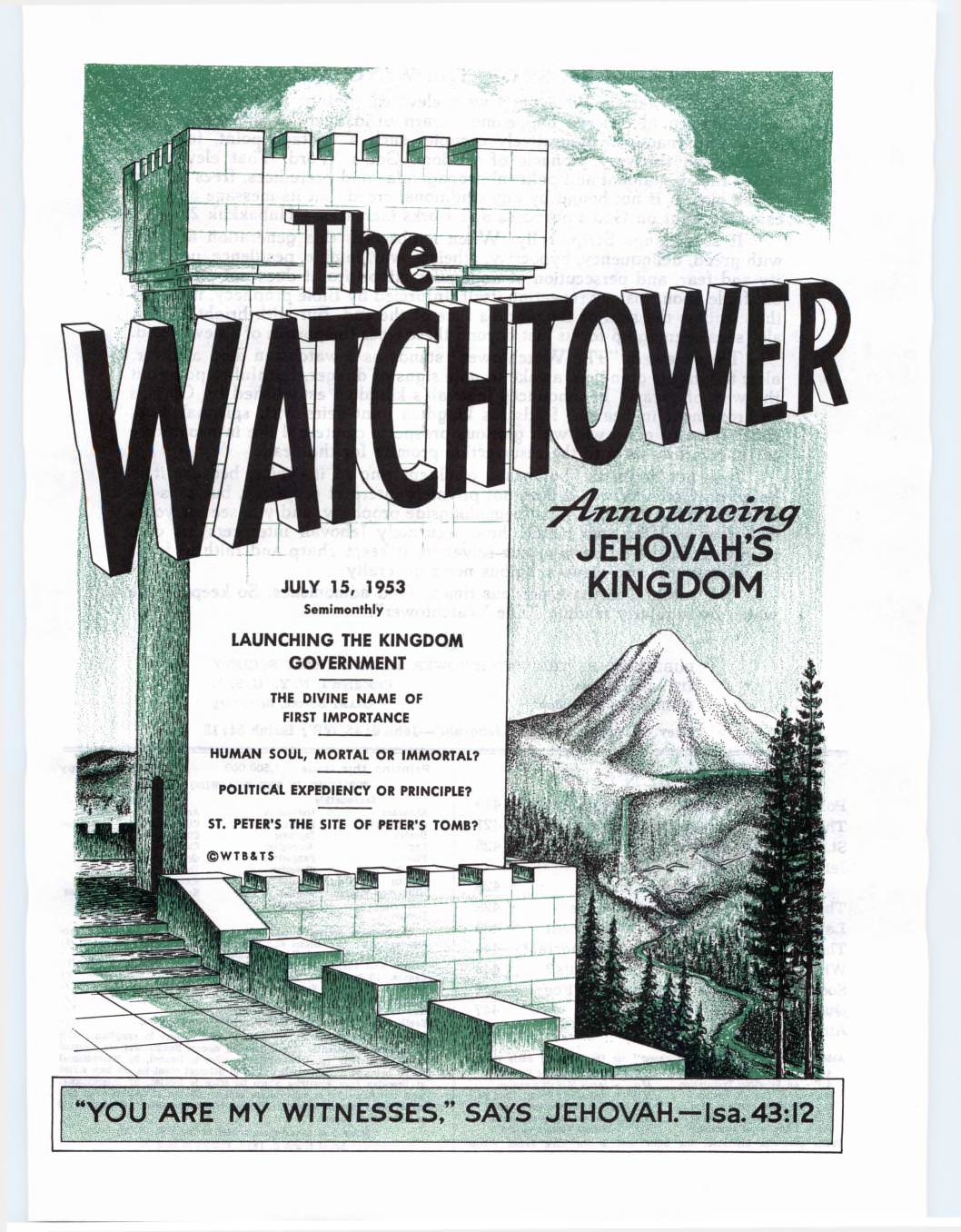
The WATCHTOWER
Announcing
JEHOVAH'S
KINGDOM
JULY 15, 1953
Semimonthly
LAUNCHING THE KINGDOM
GOVERNMENT
THE DIVINE NAME OF
FIRST IMPORTANCE
HUMAN SOUL, MORTAL OR IMMORTAL?
POLITICAL EXPEDIENCY OR PRINCIPLE?
ST. PETER'S THE SITE OF PETER'S TOMB?
©WTB&TS
“YOU ARE MY WITNESSES,” SAYS JEHOVAH.—Isa. 43:12 THE PURPOSE OF "THE WATCHTOWER"
Literal towers in Bible times were elevated vantage points from which watchmen could observe happenings, warn of danger, or announce good news. Our magazine figuratively occupies such a vantage point, for it is founded on the very pinnacle of wisdom, God's Word. That elevates it above racial, national and political propagandas and prejudices, frees it from selfish bias. It is not bound by any traditional creed, but its message advances as the light on God's purposes and works increases.-Habakkuk 2:1-3.
It sees things Scripturally. When it observes this generation afflicted with greed, delinquency, hypocrisy, atheism, war, famine, pestilence, perplexity and fear, and persecution of unpopular minorities, it does not parrot the old fable about history repeating itself. Informed by Bible prophecy, it sees in these things the sign of the world's time of the end. But with bright hope it also sees opening up for us just beyond these woes the portals of a new world.
Thus viewed, "The Watchtower" stands as a watchman atop a tower, alert to what is going on, awake to note signs of danger, faithful to point out the way of escape. It announces Jehovah's kingdom established by Christ's enthronement in heaven, feeds his kingdom joint-heirs with spiritual food, cheers men of good will with glorious prospects of eternal life in a paradise earth, comforts us with the resurrection promise for the dead.
It is not dogmatic, but has a confident ring in its voice, because it is based on God's Word. It does not privately interpret prophecy, but calls attention to physical facts, sets them alongside prophecy, and you see for yourself how well the two match, how accurately Jehovah interprets his own prophecy. In the interests of our salvation, it keeps sharp and faithful focus on Bible truth, and views religious news generally.
'Be watchful in these perilous times,' God admonishes. So keep on the watch by regularly reading "The Watchtower".
PUBLISHED BY THE WATCH TOWER BIBLE & TRACT SOCIETY
117 Adams Street
Brooklyn 1, N. Y., U. S. A.
N. H. KNORR, President
GRANT SUITER, Secretary
"They will all be taught by Jehovah."—John 6:45, NW; Isaiah 54:13
CONTENTS
Political Expediency or Principle? 419
The Divine Name of First Importance 421
St. Peter's the Site of Peter's Tomb? 425
Jehovah's Witnesses Neither Capitalists nor Communists 428
The Ceremony Is a Religious One 428
Launching the Kingdom Government 429
The Human Soul, Mortal or Immortal? 444
What Has Happened to the Parents? 446
Social Agencies as Delinquency's Foes 446
Questions from Readers 447
Announcements 448
Abbreviations used in "The Watchtower" for the following Bible versions
AS - American Standard Version LXX- The Septuagint Version
AT - An American Translation Mo - James Moffatt's version
Da - J. N. Darby's version NW - New World Trans. (2nd Ed.)
Dy - Catholic Douay version Ro - J. B. Rotherham's version
ED - The Emphatic Diaglott RS - Revised Standard Version
Le - Isaac Leeser's version Yg - Robert Young's version
Unless otherwise indicated, the Bible used is the King James Version
Printing this issue: 1,500,000 Five cents a copy PUBLISHED IN THE FOLLOWING LANGUAGES Semimonthly Monthly
<tr><th colspan="2">Semimonthly
Monthly
Afrikaans
Indonesian
Arabic
Polish
Cebu-Visayan
Italian
Cibemba
Portuguese
Danish
Japanese
Cinyanja
Russian
English
Norwegian
Cishona
Slamese
Finnish
Pangasinan
Greek
Silozi
French
Slovenian
Ibo
Slovak
German
Spanish
Kanarese
Twl
Hiligaynon-Visayan
Swedish
Korean
Ukrainian
Hollandish
Tagalog
Malayalam
Yoruba
Ilocano
Zulu
Watch Tower Society offices Yearly subscription rate
America, U.S., 117 Adams St., Brooklyn 1, N.Y. $1
Australia, 11 Beresford Rd., Strathfield, N.S.W. 8/-
British West Indies, 21 Taylor St., Port of Spain, Trinidad$ 1.72
Canada, 40 Irwin Ave., Toronto 5, Ontario $1
England, 34 Craven Terrace, London, W. 2 7/-
Jamaica, 151 King St., Kingston 7/-
New Zealand, G.P.O. Box 30, Wellington, C. 1 7/-
South Africa, Private Bag, P.O. Elandsfontein, Transvaal 7/-
Remittances should be sent to office in your country in compliance with regulations to guarantee safe delivery of money. Remittances are accepted at Brooklyn from countries where no office is located, by international money order only. Subscription rates in different countries are here stated at Brooklyn from countries where no office is located, by international least two issues before subscription expires. Change of address when sent to our office may be expected effective within one month. Send your old as well as new address.
Entered as second-class matter at Brooklyn, N. Y., Act of March 3, 1879. Printed in U. S. A.
POLITICAL EXPEDIENCY OR PRINCIPLE?
ALL intelligent creatures, as free moral agents, have the choice of being governed by principle or by passion. To be governed by principle means to act upon knowledge of the facts according to reason and conscience. To be governed by passion means to act because of outside influence, to let personal considerations dictate, such as wealth, fame, power, safety or gratification of the senses or instincts. Adam, our first parent, chose to be governed by passion, by outside influence as represented in his wife, Eve, instead of by principle as represented in God's will and law. The vast majority of his offspring have followed his example. Gen. 3:17; Matt. 7:13, 14.
Particularly strong is the temptation to be governed by outside influence and passion, instead of by a sense of duty and principle, felt by those in governing positions. By reason of their power they have many opportunities to use their positions for their own benefit rather than to dispense justice. Such misuse of political office often takes the form of political expediency. God's Word, the Bible, records more than one instance of where those in responsible positions acted from expediency instead of from principle. Aaron allowed himself to be influenced by the people to make the golden calf, and Saul was likewise influenced to disobey God's command regarding the rooting out of the
Amalekites.—Ex. 32:1-6, 21-24; 1 Sam. 15:13-23.
The most notorious example in all history, however, of a ruler's compromising what he knew to be right for the sake of political expediency is that given to us by Pontius Pilate. Pilate had taken up his duties as governor of Judea A.D. 26 and repeatedly clashed with the Jews, he being a stubborn ruler and they a fanatically religious, stubborn people. In his own stubbornness Pilate at times had the blood of the Jews shed needlessly, on one occasion even mixing their blood with that of their sacrifices.—Luke 13:1, 2.
In view of these events it can be appreciated that when the Jewish mob came to him that passover night A.D. 33 with Jesus, Pilate preferred not to have anything to do with the matter and told them to punish Jesus according to their law. But the mob wanted to put Jesus to death and so had to have Pilate's authorization. (John 18:31) After questioning Jesus and finding no fault in him Pilate was ready to release him, but that was not what the mob wanted. Hearing that Jesus was a Galilean he sent him to Herod Antipas, son of Herod the Great and tetrarch of Galilee, glad for the excuse to shift the responsibility.—Luke 23:1-7.
Herod was pleased to see Jesus, expecting to see a miracle performed, but, finding Jesus uncommunicative, returned him to Pilate. While this gesture resulted in Pilate and Herod's becoming friends "with each other on that very day, for before that they had continued at enmity between themselves", it still left Pilate with the responsibility of making a decision regarding Jesus.
There could have been no question in his mind regarding the innocence of Jesus, "for he was aware that out of envy they had handed him over." In fact, three times he said to the Jewish mob: "Why, what evil did this man do? I found nothing deserving of death in him; I will therefore punish him and release him."—Matt. 27:18; Luke 23:8-22, NW.
Pilate, who could show himself so stubborn in dealing with the Jews, showed himself peculiarly weak and lacking in firmness when principle was involved. The fickle populace, which just four days ago hailed Jesus as King, was now clamoring for his life as a result of the rabble-rousing of the religious leaders. (Luke 19:38, NW) Fear of another uprising no doubt played its part in causing Pilate to yield, even as Matthew's account indicates. (Matt. 27:24) But evidently still stronger was Pilate's love of his position and his regard for Caesar's favor upon which that position depended, a fact noted by the apostle John. So when the crowd taunted him with, "If you release this man, you are not a friend of Caesar. Every man making himself a king speaks against Caesar," Pilate weakened. He knew he was doing wrong by yielding; his very act of washing his hands in public revealed the presence of a guilty conscience. And so political expediency was responsible for the perpetration of the greatest crime in history, the foulest murder, the violent ending of the only perfect life that had ever been lived, that of none other than the
Son of Jehovah God.—Matt. 27:24; John 19:12-16, NW.
There have been many Pilates down through the centuries; rulers who have sacrificed innocent servants of Jehovah God because of political expediency, among which might be included those who have acted as 'swords of the church' of Rome during the Dark and Middle Ages. And there are many Pilates with us today; minor officials in such democratic lands as the United States, Canada, Switzerland and Italy who yield to religious pressure to persecute Jehovah's servants, necessitating appeals to the Supreme Courts, which courts in many instances have shown themselves to be above political expediency. On the other hand there are lands where the leading or major government officials have shown themselves to be Pilates in being willing to sacrifice the interests of Jehovah's servants in the interests of political expediency. Christians suffering under such conditions can take comfort in Jesus' words that Jehovah God, in his due time, will avenge all such injustices.—Luke 18:7, 8.
To follow principle costs something. It means loving the truth, even though it is unpopular. It means fearing God, not men. And it means hating unjust gain, not going after it. (Ex. 18:21; Prov. 29:25, AS) But it is the price that all must pay, especially those in positions of responsibility and authority, for being free moral agents; and not only so that we might have a clear conscience now but also that we might gain the approval of the Judge of all the earth, our Maker. The way of political expediency is the easy way that leads to death. The way of principle is the hard way, but with proper knowledge it leads to life.—Matt. 7:13, 14; John 17:3.
THE DIVINE NAME of FIRST IMPORTANCE
THE chief concern of most professed Christians as regards their religion is the "saving of their souls". They give little or no thought to the glorifying and vindicating of the name of their Creator, Jehovah. They have little concern whether or not men "may know that thou alone, whose name is Jehovah, art the Most High over all the earth". (Ps. 83:18, AS) All such reveal a woeful lack of understanding of their relationship to their Maker; a failure to appreciate how far superior He is to any of his creatures, and that he is the only true God.
But does not the Bible place emphasis on the salvation of creatures? Do we not read time and again about what we must believe and do if we would be saved? True, but God's Word also shows that the honoring of Jehovah's name and its vindication, which involves also the triumph of righteousness, is of far greater importance. Salvation of creatures is merely incidental thereto, or at best wholly dependent upon Jehovah's vindication.
WHY MERCY AND DELIVERANCE
A careful study of God's Word shows that it is because his name and supremacy are involved that he has extended mercy and provided deliverance to members of the human race. When Adam and Eve rebelled Jehovah could immediately have wiped them out, together with the adversary, and started anew. Why did he not do so? Because by causing Adam and Eve's
deflection the adversary had challenged Jehovah's supremacy, had challenged his ability to put men on earth that would maintain integrity, had challenged Jehovah's ability to carry out his purposes. That is why God mercifully permitted
our first parents to live so many years after they had sinned.—Gen. 2:17; Job, chapters 1 and 2; Prov. 27:11; Isa. 46:11.
In dealing with haughty Pharaoh Jehovah showed much patience. Why did he not destroy Pharaoh at once? For the same reason: "For by now I could have stretched out my hand and struck you and your people with pestilence, so that you would have been effaced from the earth; but this is why I have spared you: to show you my power, and to have my fame recounted throughout all the earth." (Ex. 9:15, 16, AT) And those words, by the way, have even more force as applied to the greater Pharaoh, Satan the Devil.
That is why Jehovah delivered the nation of Israel from Pharaoh's pursuing army; even though they "rebelled against the Most High at the Red sea. Yet he delivered them for his name's sake, in order to make known his might". Yes, not just because he remembered his covenant with Abraham, Isaac and Jacob and so had pity on their descendants, but that he might redeem them unto himself, "to make himself a name by doing great and terrible things for them."—Ex. 2:24, 25; 2 Sam. 7:23; Ps. 106:7, 8, AT.
In the same tenor are Jehovah's words to a backsliding Israel: "For my name's sake will I defer mine anger, and for my praise will I refrain for thee, that I cut thee not off." (Isa. 48:9, AS) By the prophet Ezekiel Jehovah repeatedly emphasizes this fact that he showed mercy to his people for his name's sake: "But I wrought for my name's sake, that it should not be profaned in the sight of the nations."
"And ye shall know that I am Jehovah, when I have dealt with you for my name's sake, not according to your evil ways, nor according to your corrupt doings, O ye house of Israel, saith the Lord Jehovah." "But I had regard for my holy name, which the house of Israel had profaned among the nations, whither they went. Therefore say unto the house of Israel, Thus saith the Lord Jehovah: I do not this for your sake, O house of Israel, but for my holy name, which ye have profaned among the nations, whither ye went." (Ezek. 20:9, 44; 36:21, 22, AS) No question as to which came first, the honor of his name or the salvation of his creatures, as far as Jehovah is concerned, is there?
Consider the instance of the three Hebrews who were thrown into the furnace. Higher critics have used this incident, among others, to discredit the authenticity of the book of Daniel, claiming that such a miracle was without real point and therefore most likely merely an invention. But thereby they only reveal their lack of understanding, for by this miracle the name of Jehovah was greatly magnified. Note the decree that Nebuchadnezzar, ruler of the world power of Babylon, made as a result of that remarkable deliverance of God's servants: "Every people, nation, and language, which speak anything amiss against the God of Shadrach, Meshach, and Abed-nego, shall be cut in pieces, and their houses shall be made a dung-hill; because there is no other god that is able to deliver after this sort." (Dan. 3:13-29, AS) Yes, the three Hebrews had assured the king that Jehovah could deliver them if it pleased him to do so; and it pleased Jehovah to do so, not just to spare their lives, but primarily to make Nebuchadnezzar know that the God of the Jews was indeed the supreme living God.
APPRECIATED BY MEN OF OLD
Novel as this thought, that the vindication of Jehovah's name is more important than the salvation of creatures, may be to most professed Christians, God's servants in times of old fully appreciated this fact. Consider Moses: When Jehovah expressed his determination to destroy the nation of Israel because of their rebellion at the time the ten spies gave a bad report, Moses pleaded for God's mercy on the basis of his name's being involved: "If thou shalt kill this people as one man, then the nations which have heard the fame of thee will speak, saying, Because Jehovah was not able to bring this people into the land which he sware unto them, therefore he hath slain them in the wilderness." On the basis of that argument Jehovah showed mercy even as he did on a previous occasion when the same issue arose—due to the Israelites' making the golden calf and worshiping it.—Ex. 32:7-29; Num. 14:11- 35, AS.
In view of the fact that Joshua was trained by Moses it need not surprise us that he also appreciated the importance of Jehovah's name. When the small army he sent to take Ai was defeated Joshua was grief-stricken; he could not understand it. In deep sorrow he appealed to Jehovah: "Oh, Lord, what shall I say, after that Israel hath turned their backs before their enemies! For the Canaanites and all the inhabitants of the land will hear of it, and will compass us round, and cut off our name from the earth." And was that the extent of Joshua's concern? Not at all. His chief concern was, "and what wilt thou do for thy great name?" Yes, that was the crux of the matter, 'Jehovah, what will happen to your name if your name-people are wiped out?'—Josh.
7:7-9, AS.
Jehovah was not oblivious to the fact that his name was involved, but because an Israelite had taken some booty from the city of Jericho, which had been wholly devoted to destruction by Jehovah, he permitted Israel to suffer a setback. After the offending Achan was duly punished, Israel again proved victorious, to the honor of Jehovah's name.Josh. 7:10 to 8:25 AS.
Samuel, the last of the judges, had the same appreciation as did Joshua, the first of them. When the Israelites feared they would be destroyed because they had rejected Jehovah as King and asked for a human king, Samuel assured them, "Jehovah will not forsake his people for his great name's sake, because it hath pleased Jehovah to make you a people unto himself." (1 Sam. 12:22, AS) Again Jehovah showed mercy because of his name.
APPRECIATED BY
DAVID, JEREMIAH, HEZEKIAH
David was outstanding for his appreciation of the importance of Jehovah's name. Seeing and hearing Goliath taunt the armies of Israel incensed David: "Who is this uncircumcised Philistine, that he should defy the armies of the living God?" Though a mere youth and armed with but a shepherd's staff, a sling and a few smooth stones, David faced Goliath in confidence, saying to him: "Thou comest to me with a sword, and with a spear, and with a javelin: but I come to thee in the name of Jehovah of hosts, the God of the armies of Israel, whom thou hast defied. This day will Jehovah deliver thee into my hand." Why was David so confident that Jehovah would give him the victory? Because it was Jehovah's purpose to have all the earth "know that there is a God in Israel", and that victory does not depend upon carnal
weapons but upon Jehovah.—1 Sam.17:26 45-47, AS.
Whatever the circumstances, David looked to God for help on the basis of His name. "He guideth me in the paths of righteousness for his name's sake." "For thy name's sake, O Jehovah, pardon mine iniquity, for it is great." "For thou art my rock and my fortress; and for thy name's sake thou wilt lead me and guide me." "For thy name's sake, O LORD [Jehovah], save my life! In the vindication of thyself bring me out of trouble!"—Ps. 23:3; 25:11, AS; 31:3; 143:11, AT.
Another sweet singer of Israel, Asaph, likewise appreciated this claim on Jehovah's mercy on the basis of his name: "Help us, O God of our salvation, for the glory of thy name; and deliver us, and forgive our sins, for thy name's sake. Wherefore should the nations say, Where is their God? Let the avenging of the blood of thy servants which is shed be known among the nations in our sight." (Ps. 79:9,10,AS) The prophet Jeremiah prayed a similar prayer: "Though our iniquities testify against us, work thou for thy name's sake, O Jehovah; for our backslidings are many; we have sinned against thee. Do not abhor us, for thy name's sake."—Jer. 14:7,21,AS.
King Hezekiah also showed that he appreciated that deliverance was for Jehovah's name's sake. When Sennacherib boasted that 'none of the gods of the nations have been able to deliver out of my hand, neither can your God Jehovah', Hezekiah prayed to Jehovah: "Of a truth, Jehovah, the kings of Assyria have laid waste all the countries, and their land, and have cast their gods into the fire: for they were no gods, but the work of men's hands, wood and stone; therefore they have destroyed them. Now therefore, O Jehovah our God, save us from his hand, that [we might be spared alive? No, but that] all the kingdoms of the earth may know that thou art Jehovah, even thou only."
And Hezekiah's prayer was answered, Jehovah's angel slaying 185,000 of the flower of Sennacherib's army, because Jehovah's name was involved. That name is indeed a strong tower.—Prov. 18:10; Isa. 36:13-20; 37:10-38, AS.
APPRECIATED BY CHRIST AND HIS APOSTLES
Christ Jesus also appreciated that the salvation of creatures was not the most important thing. As he himself stated, he came, first of all, "not to be ministered to, but to minister" and, secondarily, "to give his soul a ransom in exchange for many." (Matt. 20:28, NW) To minister and serve in what way? By bearing witness to his Father's truth and by glorifying his Father's name. That is why he said to Pilate: "For this purpose I have been born and for this purpose I have come into the world, that I should bear witness to the truth." And that is why he was able to pray on the night of his betrayal, even before he had given his life as a ransom in exchange for many: "I have glorified you on the earth, having finished the work you have given me to do." He glorified his Father's name in two distinct ways: first, by learning obedience by the things he suffered, thereby proving the Devil a liar when he boasted he could turn all men away from God; and also by 'making manifest his Father's name to the men his Father had given him'.—John 17:4, 6; 18:37; Heb. 5:8, NW.
And he impressed upon his immediate followers this same appreciation of the importance of bringing honor to his heavenly Father. In his sermon on the mount he commanded them to let their light shine
before mankind. Why? So that glory and praise might be given to his Father who is in the heavens. (Matt. 5:16, NW) He expressed the same thought but with a different illustration in the counsel he gave his apostles on the last evening he was with them: "My Father is glorified in this, that you keep bearing much fruit and prove yourselves my disciples."—John 15:8, NW.
The apostle Paul expresses himself similarly at Hebrews 13:15 (NW), saying: "Through him let us always offer to God a sacrifice of praise, that is, the fruit of lips which make public declaration to his name." Yes, letting our light shine, bearing fruit, offering sacrifices, all for the same purpose, that of bringing honor to Jehovah's name. No wonder Peter wrote: "You are 'a chosen race, a royal priesthood, a holy nation, a people for special possession, that you should declare abroad the excellencies' of the one that called you out of darkness into his wonderful light." 1 Pet. 2:9, NW.
Jehovah God and Christ Jesus both bear testimony to the chief importance of Jehovah's name as compared with the salvation of creatures, as do also many of Jehovah's servants from Moses to the apostle John. Those who are truly wise will therefore make Jehovah's name superior in their lives by doing all they can to make known that name, by bringing honor and praise to it and by endeavoring at all times to conduct themselves in harmony with the righteous principles that Jehovah's name stands for. Only by following this course can we appeal to Jehovah for mercy and deliverance "for his name's sake". Jehovah's name is superior. Our salvation is incidental and dependent upon its vindication.
St. Peter's
The Site of Peter's Tomb?
WAS Peter ever physically present in Rome? While there has been much tradition to that effect, some of it going back to the second century A.D., actual proof has been wanting. According to tradition Peter was martyred at the site of the ancient Circus of Nero, where it is claimed he was also buried. It is said that the site of his tomb was revered since the second century and that on it Constantine built the first St. Peter's basilica begun A.D. 323 but not completed until after his death.
In c.1503 the present basilica of St. Peter was begun, and completed after 127 years, in c.1630, at a cost of $48 million. Incidentally, the drive for funds for the building work, carried on in Germany by the sale of indulgences by the monk Tetzel, was one of the immediate causes of the German Reformation by Luther. According to Life, United States weekly picture magazine, its length is 710 feet, height, 452 feet, maximum width, 450 feet. All of which makes it the world's largest basilica.
To provide added space so as to be able to comply with the wishes of Pius XI to be buried alongside Pius X in the burial vaults
beneath St. Peter's, excavations were begun in 1939, and finding the area promising in archaeological interest digging was greatly extended. In 1946, the Illustrated London News, September 7, under the heading, "The Most Important Archaeological Discovery Made During the War: Roman Tombs Beneath St. Peter's, Rome," told of the finding of a complete Roman necropolis or cemetery beneath St. Peter's containing pagan and Christian tombs dating back from the middle of the second to the end of the third century A.D. A number of beautiful sculptured sarcophagi, bearing the names of those entombed, skeletons, jewelry, etc., were found.
According to this journal: "The present discoveries dispose of the tradition that the Basilica of Constantine was founded on the site of the Circus of Nero and Caligula in which, according to tradition, the martyrdom of St. Peter took place. It has come as a surprise that no trace has been found under St. Peter's of the Circus or of the Via Cornelia, both of which ancient topographers show as under the Vatican basilica." However, it seems that the Circus was not far away, since one inscription requested burial "in the Vatican near the Circus".
In its March 27,1950, issue, Life devoted some dozen pages to these discoveries under St. Peter's, and gave a report by a Monsignor Kaas (since deceased) who had charge of the work. After telling of the circumstances causing the work to be started and the difficulties, especially with water, so much so that a water diviner was resorted to but without any success, Kaas goes on to say that "any believer who has passed through the excavated necropolis" and who finds himself in "the immediate vicinity of the place assigned by Christian tradition to St. Peter's tomb, succumbs to the silent but eloquent logic of his surroundings".
But what about the non-Catholic? How valid are these findings for him? "Nonbelievers may not view this affirmation in the same light," says Kaas; but he argues that the evidence challenges "nonbelievers for proof to the contrary of archaeology's affirmation". To the same effect is the report published in the New York Times, December 20, 1951, which quoted the Vati-
dence, presented this week in the Pontifical Roman Academy of Archeology by Professor Margherita Guarducci, a specialist in ancient Roman epigraphs, may date back to the closing years of the third century or even to the period just after the year 250.
"The evidence—tracings on the wall of a pagan mausoleum under the basilica included an inscription" that "was an ap-
can's claim to "scientifically unquestionable" evidence. But the Cleveland Plain Dealer, December 21, 1951, under the heading, "Vatican Scientists Report Tombless Burial of St. Peter," stated: "Pilgrims who visit the Vatican grottos will be able to get within 10 feet of the place where Vatican authorities say St. Peter was buried, but they will not be able to see his tomb. For there is no tomb." So it seems that, rather than a tomb, what was discovered was a "grave made of rough masonry, like those for the poorest" and of which only one side wall remained -Times. December
peal to St. Peter to pray for the Christians buried near him". There was also a portrait, evidently intended to be that of Peter, with the word "Petrus".
Regarding other writings at the place, the New York Tribune, December 21, 1951, stated: "The scribblings—similar to the hundreds which can be found even today on various walls of the present basilica in the wake of American soldiers' visits during World War II—include evidence that the early visitors believed that St. Peter could be venerated at the spot."
Why should reports first tell of the spot
21, 1951.
The same issue of the Times states that "all around was palpable evidence that Christians paid veneration to this spot, since the second half of the first century". Other reports stated that veneration was paid as far back as the second half of the second century. All these dispatches, note, were of December, 1951. But along comes a dispatch about a year later, Times, November 24, 1952, under the heading: "St. Peter's Tomb May Be Source of New Finds. Evidence linking tradition of
as being venerated the second half of the second and even the first centuries, and then about a year later state that previous information indicated only the first part of the fourth century but now there is evidence that shows veneration in the second half of the third century? Does not all such betray a desire to make the evidence fit tradition instead of letting the evidence speak for itself? None of the inscriptions states that Peter was buried there. And granting that they prove that Peter was venerated at that spot they merely prove
St. Peter's burial to a generation closer to his own lifetime than recent excavations under St. Peter's Basilica have done may be forthcoming soon, Vatican officials said today.
"Archeologists recently discovered the first written evidence under the basilica that the spot was considered the burial spot of St. Peter at least as early as the first years of the fourth century. The evithat the tradition existed in the second half of the third century, not that the tradition itself is true.
THE SCRIPTURAL TESTIMONY
Since traditions regarding Peter's having been in Rome do not go back to his day, let us note what God's Word has to say on the subject, since it was written in Peter's time. Search as we may, not a hint do we find that Peter was ever in Rome, let alone that he was bishop there.
And not only are the Scriptures silent as regards his being there, giving no evidence either direct or circumstantial to that effect, but they give the strongest kind of circumstantial evidence that Peter was never in Rome.
Paul wrote a letter to the Romans and in it he sends greetings to twenty-six different individuals and yet does not mention Peter. Can we for a moment imagine that Paul would entirely ignore Peter if Peter was in Rome and Paul was writing to Peter's congregation, which is what the Christians of Rome would have been, had Peter been there and been their bishop? And not only bishop but also the vicar of Christ! Does it make sense to hold that Paul would have dared to purposely ignore Christ's successor?—Rom. 16:1-24.
Further, Paul's letter is full of corrective instruction. Why should it be necessary for Paul to instruct the Roman Christians in so many matters if Peter, the vicar of Christ, was present with them? Could we imagine Paul's trying to set straight the disciples of Jesus while Jesus was with them, as though Jesus had been neglecting to properly teach them? Is it reasonable to conclude that if the Roman Christians were under the tutelage of any vicar of Christ Paul would have found it necessary to write them?
Also note that time and again in his letters from Rome Paul mentions others that are there with him, some of whom also sent greetings along with Paul. Is it not strange, if Peter was also in Rome as the vicar of Christ and head of all the Christian congregations, that Paul did not arrange to have Peter also send along his greetings, benedictions, etc., to the various congregations to whom he wrote?
According to the New York Times, the identification of St. Peter's Basilica as the burial place of the apostle Peter "is regarded as destroying doubts that were cast during the period of the Reformation and thereafter on the historical data attesting to Peter's physical presence in Rome. The whole line of papal succession may be held to hinge upon this point". If that is true, is it not strange that so much definite information should be uncovered regarding pagan persons, their names, tombs, actual remains, inscriptions, etc., and yet God should allow the evidence of Peter's burial at the site of St. Peter's to be so dubious, equivocal and ambiguous as to make any deductions regarding it mere speculation?
If the "whole line of papal succession may be held to hinge" on whether Peter's remains lie buried beneath St. Peter's or not, then it must be admitted to be without foundation, for the recent diggings under the basilica have yielded nothing that would strengthen the position of the Roman Catholic Church in this respect.
So what conclusion must we reach? That on the one hand archaeology at best only supports the fact that there was a tradition that Peter could be revered on Vatican hill, not that the tradition of Peter's being in Rome is true, nor that he was buried there. And on the other hand, that the Scriptures furnish the strongest kind of circumstantial evidence that Peter was never in Rome. St. Peter's therefore is not the site of Peter's tomb.
Jehovah's Witnesses Neither Capitalists nor Communists
IT IS a well-known fact that after World War II the conditions in Finland have been such as to favor communism. Where the large manufacturing plants and false religion have long held rule in unrighteousness and dishonesty, there have sprung up powerful Communist strongholds. One of such "red camps" is situated in the city of Kemi, in northern Finland, about sixty miles from the polar or Arctic circle. In their midst is a very active company of Jehovah's witnesses, some 60 strong, with many full-time ministers.
A man and wife, serving as full-time ministers in such a Communist factory community, got into a difficult situation because a witness for Jehovah from Helsinki, who is technical manager for a large American oil company, paid them a visit in what the Communists call his "dollar smile", meaning his American car. From that moment the doors of the community were closed to our pioneer ministers; everybody being now convinced that Jehovah's witnesses were spies for American capitalists. People did not want their literature and those who had begun to study with them told them they did not need to come any more.
Then help came from an unexpected quarter. Six miles away from this community lived the city fire chief, who was also a Communist; in fact, their local leader and an idol next only to Stalin. This fire chief not only obtained the book "Let God Be True", but arranged to study the Bible in his home with the aid of a minister of Jehovah.
One autumn evening after the study had been held the minister was ready to leave on his bicycle when the fire chief noticed that it was raining hard and that the storm was increasing in violence. So he ordered an ambulance, put the bicycle in the back and then drove the minister to his home. As the ambulance appeared in front of the minister's home, the curious neighbors, in spite of storm and rain, came to see what was going on. Imagine their surprise when they saw their idolized Communist leader and the minister whom they had labeled an "American capitalistic agent" together lift the bicycle out of the ambulance!
This little scene opened the door for many opportunities to witness. As the witnesses went about their preaching work the next day they met faces friendly and curious. They went from one coffee table to the next writing up subscriptions, distributing literature, and, above all, talking about the Bible. The people learned that even as Jehovah's witnesses had nothing in common with communism they had nothing in common with capitalistic imperialism. As a result, in a short time five Communists left their organization and came out into the freedom of God's children, no longer Communists.
The Ceremony Is a Religious One
At the coronation Britain's queen received the Church's full blessing, and even more. The Sunday Chronicle of March 8 put it this way: "And now comes the most exalted moment. The Queen is to be raised to the mystic company of the Lord's Anointed, thus becoming Queen, not only by the will of Man, but in the sight of God. . . . That which is to come is a mystery, not to be seen by man; and few will hear the voice of the Archbishop as, dipping his fingers into the Spoon, he says: 'Be thy Hands anointed with Holy Oil, be thy breast anointed with Holy Oil, be thy Head anointed with Holy Oil as Kings, Priests and Prophets were anointed.' As the Dean returns the Sacred Oil to the Altar, the congregation again see their Queen, now to the eye of faith mystically transfigured. She is ready to receive in the investiture the emblems which may be held or worn only by the Lord's Anointed, the vestments resembling those of a Priest which are put upon her by the Dean." The further religious significance of this ceremony is shown in the "Sword of State", with which she is to, among other things, "protect the Holy Church of God," and "the crown of glory and righteousness" which she is to receive, "which to her many peoples bears a significance beyond all earthly authority and power." Participation in the pageantry is, therefore, a religious act as well as a political one.
Launching the Kingdom Government
"And a great sign was seen in heaven, a woman . . . And she gave birth to a son, a male, who is destined to shepherd all the nations with an iron rod. And her child was caught away to God and to his throne."
EHOVAH God declares in his Word, the Bible, that his purpose in creating the earth was to have it inhabited by
Rev. 12:1,5,NW.
perfect, faithful men and women. He says: "I have made the earth, and created man upon it: . . I am Jehovah; and there is none else." Further magnifying Jehovah and his purpose with regard to the earth, the faithful witness Isaiah emphasizes that he is "the God that formed the earth and made it, that established it and created it not a waste, that formed it to be inhabited". (Isa. 45:12, 18, AS) To this end he created a perfect man and woman and gave them a command to multiply and fill the earth with a righteous race of people.
2 However, before any children were born to this perfect pair they disobeyed their Maker and fell away to sin. Under the influence of the rebellious spirit creature who had been appointed as their guardian, Adam and Eve foolishly chose to forsake the governmental arrangement provided by Jehovah for their well-being. Violating the principles of faith and obedience to Jehovah's requirements, they chose the course that led them to sin, slavery and death. No longer could they hope to enjoy the delights of intimate association with their Creator and the wonderful blessings of the beautiful garden home that had been especially prepared for them. Instead, they became the unhappy subjects of a rebel government, facing a sentence of death for
unfaithfulness. Nor were they blessed with being able to pass on to their children the wonderful heritage of life
as Jehovah had originally purposed. Instead of a blessing from their Creator for themselves and their children, they came under a curse that included the earth on which they lived. The way of rebellion could give them none of the blessings or bright prospects for the future that had been held out for the human family by Jehovah God their Creator.
Did the treachery of that unfaithful trio move Jehovah to destroy them and abandon his purpose toward the earth? Did their lack of faith make the word and purpose of Jehovah null and void and of no effect? Certainly not! In fact, with full confidence as to the outcome, Jehovah deferred the execution of sentence against them to permit a full-scale proving of his universal supremacy. This made it possible for them to continue working in defiance of their Maker. The appointed spirit son who led the rebellion Jehovah later significantly named the Devil and Satan. Even then, at the dawn of man's history, Satan was looking far ahead and was determined to gain for himself the worship of all earth's billions, with a place in the heavens like the Most High himself. His centuries-old efforts to control the people of the earth by means of false worship, oppressive government and regimentation are now rapidly approaching their end.
Immediately after that infamous rebellion in Eden Jehovah openly prophesied that the time would come when he would crush all his opposers and finally carry out his original purpose to make the earth a beautiful home for faithful men and women. He has given us positive assurance through his written Word that his purpose is to launch a righteous world government that will provide prosperity, peace, happiness and everlasting life. 'Of the increase of that government and peace there will be no end,' we are told. (Isa. 9:6,7) What a wonderful prospect that is for troubled humankind today, especially for those who have faith in Jehovah's promise and look forward to it with confidence, worshiping him in spirit and in truth! That righteous kingdom government of God has not been formed or launched with haste. Jehovah has given the rebel Satan sufficient time to make good his boast that he could turn all men against their Creator. For nearly 6,000 years, yes, right down to our present generation, Jehovah has allowed Satan to remain to prove his defiant challenge. Satan has failed! Now his time is up! And as we briefly review the pages of history we shall observe the incessant attempts of Satan to establish his supremacy and control over the earth. We shall see that his campaign has been fruitless, and time after time loyal servants of Jehovah have remained faithful to His worship, resisting every temptation and pressure brought against them. Finally, we shall see how Jehovah brings his purpose to a climax in our time by the launching of his Kingdom government of righteousness and peace.
There never has been a time in the history of humanity when Satan has turned all men against Jehovah, although for a period of 1,656 years from the time of
Adam until the Flood only ten persons are mentioned in the Bible as remaining faithful to Jehovah. So, it appears that Satan had much his own way during that time. But what was the result of that long period of satanic control over mankind? Once again Jehovah spoke out in condemnation of the rebel system and all those who supported it. "And Jehovah saw that the wickedness of man was great in the earth, and that every imagination of the thoughts of his heart was only evil continually. And Jehovah said, I will destroy man whom I have created from the face of the ground; . . . But Noah found favor in the eyes of Jehovah." (Gen. 6:5, 7, 8, AS) To accomplish this destruction Jehovah brought a flood of water over all the earth, and only eight souls survived.
After the destructive fury of the flood had subsided, the eight survivors came forth to start life afresh upon a cleansed earth. Since this family of survivors was devoted to the worship of Jehovah one might reason that conditions would grow better. But Satan soon rallied the wicked forces of his organization, which had been badly upset by Jehovah's action, and spurred it on to greater activity. His goal has always been to influence, control and corrupt mankind. He seemed to give special attention to one of Noah's sons, Ham. Noah's other two sons, Japheth and Shem, continued faithful to Jehovah, but Ham and his offspring were caught in the influence of the wicked one and soon turned back from the worship of the Almighty God, Jehovah.
WORLD POWERS
7 As time passed, some of Ham's descendants journeyed toward Egypt. There they set up the first great world power.
As their monuments and inscriptions show, these men were laboring under the influence of Satan the Devil. They had entirely forsaken the pure worship of Jehovah and, instead, worshiped demon gods associated with the Devil in his efforts to dominate the world. The Egyptians raised an army of horsemen and chariots, built schools of learning and gave special attention to commerce. This nation is prominently mentioned in the Bible because of its efforts to destroy the offspring of Abraham that dwelt there for a time, and to whom Jehovah made precious promises in relation to the government he purposed to launch for his kingdom. Yes, the kingdom that was destined to bring blessings to all the families of the earth.
By a demonstration of his mighty power Jehovah humiliated the Egyptians and their false gods by delivering the children of Israel, as they were now called, and bringing them to the land promised to Abraham and his seed. With them then he launched a typical theocracy. That government, ruled by Jehovah, was administered through earthly representatives. It came to be known as the nation of Israel. Its people at once became the targets of Satan's attacks. Satan evidently thought this was the government Jehovah intended to launch to carry out his purpose to fill the earth with righteous human creatures; so he tried to destroy it and its people, but he failed, as did Egypt. The rulers of Egypt were cruel, wicked men and greatly oppressed the people. Their government, which became the first world power, was a complete and miserable failure. It was conquered by Assyria, the second world power, likewise under the influence of Satan.
might. After a successful campaign, Sennacherib, king of Assyria, invaded Palestine with a great army to destroy the nation of Israel and its theocratic government. He sent a boastful and insulting message to the king of Judah, Hezekiah, saying: 'Your God cannot save you from the might of Assyria and its gods.' (2 Ki. 18:33-35; 19:14-19, AS) Faithful Hezekiah went to the temple of Jehovah, spread this message before him and asked for help and guidance. Jehovah answered his prayer by sending an angel, who destroyed 185,000 Assyrian soldiers in one night. Sennacherib was greatly humiliated and hastened home to seek comfort from his gods. While he was worshiping the god Nisroch, two of his own sons killed him. (2 Ki. 19:35-37, AS) The Assyrian power did not create a government that brought peace and happiness to the people.
The government of the Assyrians featured military power. Their aim was to rule the world by the strength of military
10 The next world power discussed in the Bible is Babylon. Mighty Babylon, whose rulers were proud and wealthy, in its governmental setup specialized in religion, religion of the basest kind. Nebuchadnezzar, the king of Babylon at its inception, said in his heart: "I will exalt my throne above the stars of God; . . . I will make myself like the Most High." (Isa. 14:4, 13, 14, AS) His ambition was to overthrow the typical theocracy of Palestine and thus make himself the undisputed ruler of humankind. In this attempt he pictured Satan, who helped him carry out his ambitious plans. Satan turned the children of Israel away from the true, clean worship of Jehovah; and because of their deflection Jehovah permitted Nebuchadnezzar to destroy their land and take them off into slavery for seventy years.—Jer. 25:11, AS.
11 As the end of the period of captivity approached, the king of Babylon made no move to release the Israelites, thinking to hold them permanently as slaves, to the ultimate reproach of Jehovah.
But Jehovah promised he would release his people from slavery and restore them to Jerusalem at the end of the seventy years. Therefore he
stirred up the Medes and the Persians to attack and conquer mighty Babaway to its successor in the chain of world powers, Greece, the fifth.
13 Evidently the Greeks felt that culture and education were what man needed to ensure peace and happiness everywhere. They gave this world many philosophers who taught false doctrines that confused the people. Some of their doctrines still afflict humanity in their efforts to learn
ylon and permit the captive Israelites to return to their own land. This was done on time! The
religion of Babylon did not do her people or anyone else any good; rather it did much harm. To this very day the effects of their satanic doctrines are felt among men. They permeate the doctrines of Christendom and lead men into darkness and destruction. Proud Babylon's false religion was not a blessing, but resulted in a curse.
the way to life and peace. The culture and education of Greece did absolutely nothing to help mankind better its condition. Finally proving ineffective at world rule, Greece gave way in power to Rome.
14 Rome, too, was interested in and steeped with commerce, education and religion, but the dominant force of this sixth world power was politics.
world power was politics. We note in passing that many Christian congregations were established in the scattered provinces of Rome by Christ's
power was in the setting up of the MedoPersian empire. This outfit had, as its specialty, law, boasting that the laws of Persia never changed. Alas, with all their so-called 'perfect laws', the Medes and Persians did not have a government that could bring peace and happiness to the nation or the world. While it is true that Jehovah used Cyrus, the founder of the Medo-
Persian empire, and also later Ahasuerus
apostles. After the passing of the apostles, ambitious men, who outwardly accepted Christianity, began to twist the teachings of the Lord Jesus and his apostles. They did this in order to draw disciples after themselves. (Acts 20:29,30) As these men grew in power they were called 'bishops'. They disagreed on many important doctrines, and as a result religion became a divisive factor in the nation. Emperor Constantine took note of this existing condition and called the 'bishops' of the various factions
to render valuable service to his people Israel, still they worshiped demon gods and their rulers were fallen, selfish men who could not enact or administer righteous laws that would bring permanent relief to ailing mankind. Medo-Persia fell
to a conference at Nicaea for the purpose of creating a fusion religion. Constantine was a pagan politician and presided at this meeting. These men did not look to the Bible for some way to settle their differences on these doctrines; they thrived on
many words and silver-tongued oratory.
Among them was an invisible but very much interested delegate, Satan the Devil, the god of this world or system of things. (2 Cor. 4:4) At this council of Nicaea Satan's far-reaching scheme to turn men away from the Bible was set into motion. Three of his pet doctrines, the trinity, immortality of the soul and eternal torment, were endorsed. This wily devil knew that men believing these false doctrines would not and could not understand Jehovah's purpose to fill this earth with a righteous
purpose to fill this earth with a righteous race of people. How is this so?
15 Belief in the ungodly trinity would prevent one from understanding the Scriptural doctrine of the ransom. A perfect man was needed to redeem mankind from Adamic sin and death, and none of Adam's children could provide the price of the ransom. (Ps. 49:1, 2, 7) In order to redeem mankind it was necessary for Jesus to become a man and die. But for this to occur it would mean a dissolution of the trinity. As for the immortality of the soul: if the soul were immortal the precious doctrine of the resurrection would be utter nonsense, because one cannot resurrect a person who is not dead. The doctrine of eternal torment is a fiendish one, for it pictures Jehovah as a cruel monster, and not
a God of love, which he is. So Rome did much harm to Christians and brought relief to no one. As this wicked empire deteriorated
into decay, the next and seventh world power made its appearance in the form of the British Empire, later joined by America to form the Anglo-American world combine, a great Protestant, democratic power. 16 The special features of the preceding
six world powers, namely, commerce, military power, religion, established laws, culture, education and politics, were now all incorporated into this seventh power, and to all of this was added 'democracy'. Now Satan thought he really had a combination that would succeed in establishing peace and unity on earth. But this power has done little indeed to advance peace and happiness. Although claiming to be Christian, this combination has not relieved the
world of its sorrows. Why, look! in one generation man has engaged in two most destructive world conflagrations, wars that upset the economy of all nations, killed millions of the flower of youth and have sown such seeds of discontent that now in the offing is another world struggle. The nations of the world are now divided into two camps carrying on a cold war that soon may become hot. Thinking men fear that such a conflict will destroy civilization as we now know it. In all of this we see that Satan's methods of government have been tried and have been found wanting.
17 According to Bible chronology, the "appointed times of the nations", mentioned by Jesus at Luke 21:24 (NW), began 607 years before Christ and extended over a period of 2,520 years to A.D. 1914. In that very year the first world war erupted to the horror of the so-called "Christian nations" that claimed that they constituted 'God's kingdom on earth'. Sober-minded people then realized that the claims of Christendom were fraudulent, and they became perplexed. At that time Jehovah's witnesses preached that the kingdom of God was the only hope for mankind and that it was at hand and they urged all nations and peoples to accept it.
Did the nations do so? No! Instead they persecuted Jehovah's witnesses, sending many to jail and trying their utmost to stop the preaching work. They accepted the League of Nations instead of God's kingdom. Why, some of the clergy were so certain the League would bring peace and happiness to the world they called it 'the political expression of God's kingdom on earth'. But when World War II broke out that League went into the abyss, or state of inactivity; it could do nothing in the way of preserving peace. At the end of the war the politicians and clergymen attempted to revive the dormant League and called it "United Nations". This setup still lives, even though finding it difficult to so do, but still can do little to preserve peace in the world. The reason is that the men and nations that make up this union are selfish, fallen creatures who have forgotten Jehovah; they cannot bring order out of confusion.
18 Nations have failed to bring peace and happiness to the earth, because they have operated on the satanic theory that self-interest and competition would bring out the best in men. Instead of bringing out the good in men, this policy has made men cruel, dishonest and aggressive, developing the spirit that led to wars of conquest and thus brought much sorrow and suffering to all. In direct contradistinction, Jehovah's Kingdom government will operate on the basis of love and co-operation and will bring peace and happiness to the people.
19 The Bible record shows that governments created by men under the influence of Satan cannot bring the desired consequences. If the present system of things continues, the destiny of humanity can only be total annihilation. Were such to
be the case, how would God then carry out his declared purpose to fill the earth with the descendants of Adam and Eve? Well, would he create another human pair and begin again? To do so would prove Satan's side of the issue, that he could turn all men away from their Creator, something he has never succeeded in accomplishing. Jehovah God will show his supremacy over Satan by redeeming the children of Adam and, through them, carrying out his purpose toward this earth. This program requires a redeemer and a perfect government administered by righteous men. Arrangements toward this end have been made, and so the original purpose of Jehovah relative to this earth and man will be fulfilled to the complete satisfaction of Jehovah's infinite wisdom.
PREPARING THE KINGDOM GOVERNMENT
20 A great deal of painstaking labor is required to prepare a vessel for launching. So with the launching of a government. Soon after the "covering cherub" in Eden led the first human pair into the way of death Jehovah declared his purpose to launch a government that would rid the universe of that deceiver. At Genesis 3:15 it is written: "I will put enmity between thee and the woman, and between thy seed and her seed; it shall bruise thy head, and thou shalt bruise his heel." The faithful prophet Enoch foretold the destruction of the wicked. Jude refers to this in his epistle: "Yes, the seventh man in line from Adam, Enoch, prophesied also regarding them, when he said: 'Look! Jehovah came with his holy myriads, to execute judgment against all and to convict all the ungodly concerning all their ungodly deeds that they did in an ungodly way and concerning all the shocking things that ungodly sinners spoke against him.'
"Jude 14,15 NW.
21 In the days of Noah Jehovah caused a picture to be made of the launching of the Kingdom government. Conditions on earth at that time were so bad that Jehovah determined to wipe all living creatures off this globe by a flood of waters. Noah was instructed to build an ark to save his household and certain animals. He followed the instructions given to him by Jehovah, built the ark, a watertight seaworthy vessel with room for his family of eight, including himself, and the animals and space for ample supplies of food and water. Then when the mighty deluge burst forth the ark was launched, and for a year it rolled and tossed in the turbulent roar of water, carrying its burden safely through the inundation and storm, and landed safely on a cleansed earth when the waters subsided; and once again the true worship of Jehovah was renewed on earth.
22 Let us now follow through with the picture there made. Jehovah's Kingdom government, launched on troublous seas, will survive the terrific storm and flood of Armageddon and will protect all people of good will who take their stand for it and enter into God's "ark" of his new system of things. After Armageddon has completed its destructive work the Kingdom government will guide the people in the way of life and eternal happiness.
23 Reverting again to the picture, we learn that some years after the Flood, 427 years, to be exact, Jehovah revealed to his friend Abraham his purpose to bless all the families of the earth through the seed of Abraham. (Gen. 12:1-3) At that time the seed was not identified nor was the nature of the blessings disclosed. Jehovah
ratified the law covenant with the natural offspring of Abraham about 430 years later. (Gal. 3:17) Then he launched a typical theocratic government amid such a manifestation of divine power that Moses said, "I am terrified and trembling." Paul wrote that this was a demonstration or picture of what will take place when the real Kingdom government will be made manifest to mankind.—Heb. 12:18-28, NW. 24 It appears that the Israelites thought the Law covenant was the instrument Jehovah would use to fulfill his promise to bless all the families of the earth. In the days of King David a typical theocratic kingdom was set up in the house of David. Now look at what they had: a covenant, a king of Jehovah's choosing, a theocratic government; and they were the natural seed of Abraham. Still the promised blessings did not come through this arrangement. Why not? First, the laws on which the covenant was based were perfect, but the people were imperfect and for that reason alone they could not keep the law and thus gain the blessings God promised. Instead of bringing life to Israel, the Law covenant became their tutor or schoolmaster teaching them they were sinners and were in need of a redeemer to bring life to them. Furthermore, the royal theocracy instituted with the house of David was only a shadow or type of the real one that was to be set up with Christ the Greater David.
…