The Watchtower, September 1, 1953
Download: PDF — The Watchtower, September 1, 1953
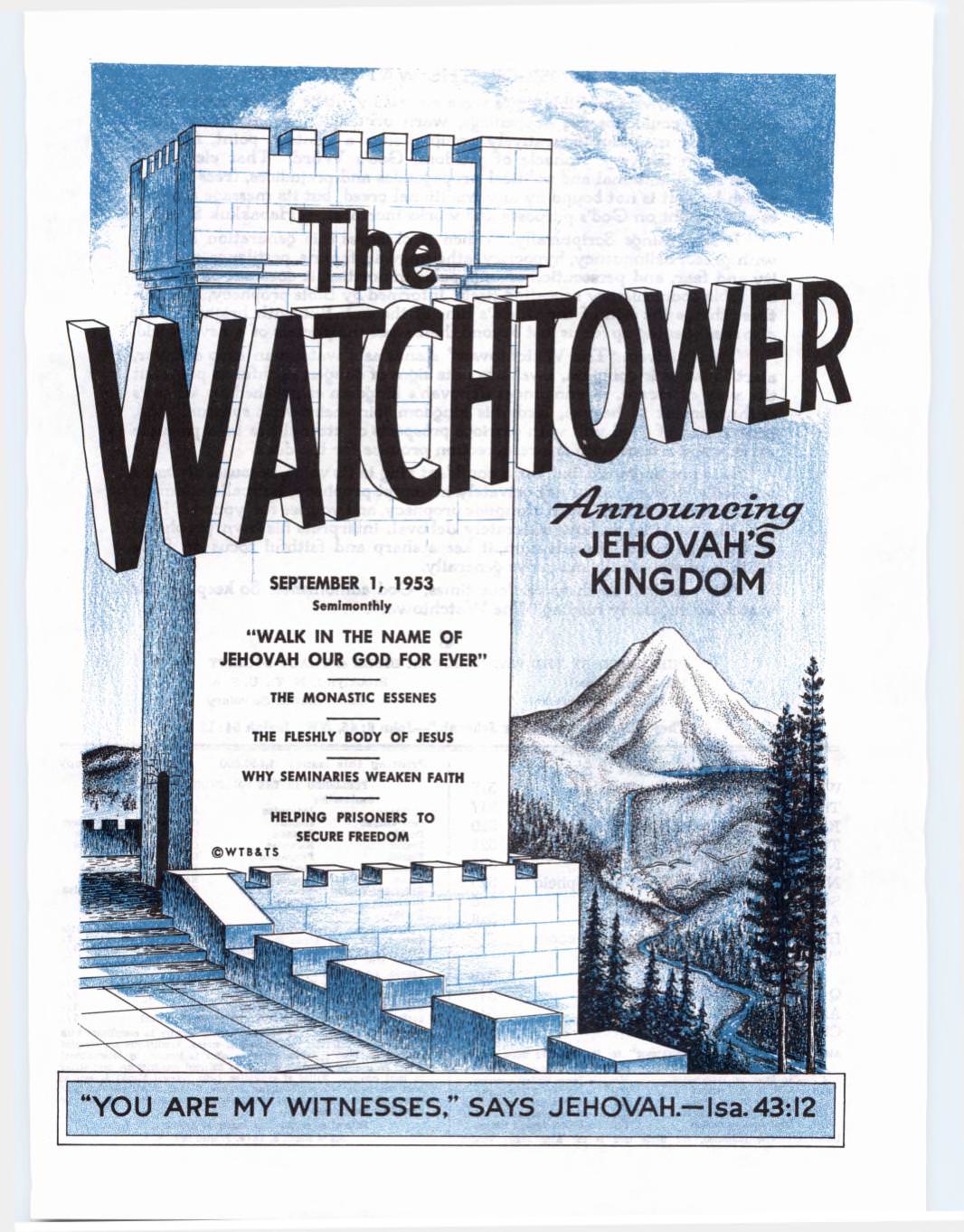
WATCHTOWER
SEPTEMBER 1, 1953 Semimonthly
"WALK IN THE NAME OF JEHOVAH OUR GOD FOR EVER"
THE MONASTIC ESSENES
THE FLESHLY BODY OF JESUS
WHY SEMINARIES WEAKEN FAITH
HELPING PRISONERS TO SECURE FREEDOM
Announcing JEHOVAH'S KINGDOM
"YOU ARE MY WITNESSES," SAYS JEHOVAH.—Isa. 43:12 THE PURPOSE OF "THE WATCHTOWER"
Literal towers in Bible times were elevated vantage points from which watchmen could observe happenings, warn of danger, or announce good news. Our magazine figuratively occupies such a vantage point, for it is founded on the very pinnacle of wisdom, God's Word. That elevates it above racial, national and political propagandas and prejudices, frees it from selfish bias. It is not bound by any traditional creed, but its message advances as the light on God's purposes and works increases.—Habakkuk 2:1-3.
It sees things Scripturally. When it observes this generation afflicted with greed, delinquency, hypocrisy, atheism, war, famine, pestilence, perplexity and fear, and persecution of unpopular minorities, it does not parrot the old fable about history repeating itself. Informed by Bible prophecy, it sees in these things the sign of the world's time of the end. But with bright hope it also sees opening up for us just beyond these woes the portals of a new world.
Thus viewed, "The Watchtower" stands as a watchman atop a tower, alert to what is going on, awake to note signs of danger, faithful to point out the way of escape. It announces Jehovah's kingdom established by Christ's enthronement in heaven, feeds his kingdom joint-heirs with spiritual food, cheers men of good will with glorious prospects of eternal life in a paradise earth, comforts us with the resurrection promise for the dead.
It is not dogmatic, but has a confident ring in its voice, because it is based on God's Word. It does not privately interpret prophecy, but calls attention to physical facts, sets them alongside prophecy, and you see for yourself how well the two match, how accurately Jehovah interprets his own prophecy. In the interests of our salvation, it keeps sharp and faithful focus on Bible truth, and views religious news generally.
'Be watchful in these perilous times,' God admonishes. So keep on the watch by regularly reading "The Watchtower".
g
PUBLISHED BY THE WATCH TOWER BIBLE & TRACT SOCIETY
117 Adams Street Brooklyn 1, N. Y., U. S. A.
N. H. KNORR, President
GRANT SUITER, Secretary
"They will all be taught by Jehovah."—John 6:45, NW; Isaiah 54:13
Why Seminaries Weaken Faith
The Fleshly Body of Jesus
Kingdom Hall Stoning Protested
The Monastic Essenes
No General Motors of Religion!
Nigerian Freedom of Worship Upheld
Standing on Street Corners
Appreciating The Watchtower
Helping Prisoners to Secure Freedom
“Walk in the Name of Jehovah Our God for Ever”
Questions from Readers
Announcements
Check Your Memory
Abbreviations used in “The Watchtower” for the following Bible versions
AS
American Standard Version
LXX The Septuagint Version
AT
An American Translation
Mo James Moffatt's version
Da
J. N. Darby's version
NW New World Translation
Dy
Catholic Douay version
Ro J. B. Rotherham's version
ED
The Emphatic Diaglott
RS Revised Standard Version
Le
Isaac Leeser's version
Yg Robert Young's version
Unless otherwise indicated, the Bible used is the King James Version
Semimonthly
Monthly
Afrikaans
Indonesian
Arabic
Polish
Cebu-Visayan
Italian
Climbba
Portuguese
Danish
Japanese
Cinyanja
Russian
English
Norwegian
Cishona
Siamese
Finnish
Pangasinan
Greek
Siloxi
French
Slovenian
Ibo
Slovak
German
Spanish
Kanarese
Twl
Hiligaynon-Visayan
Swedish
Korean
Ukrainian
Hollandish
Tagalog
Malayalam
Yoruba
Ilocano
Zulu
Watch Tower Society offices Yearly subscription rate
America, U.S., 117 Adams St., Brooklyn 1, N.Y. $1
Australia, 11 Beresford Rd., Strathfield, N.S.W. 8/-
British West Indies, 21 Taylor St., Port of Spain, Trinidad $1.72
Canada, 40 Irwin Ave., Toronto 5, Ontario $1
England, 34 Craven Terrace, London, W. 2 7/-
Jamalca, 151 King St., Kingston 7/-
New Zealand, G.P.O. Box 30, Wellington, C. 1 7/-
South Africa, Private Bag, P.O. Elandsfontein, Transvaal 7/-
Remittances should be sent to office in your country in compliance with regulations to guarantee safe delivery of money. Remittances are accepted at Brooklyn from countries where no office is located, by international money order only. Subscription rates in different countries are here stated in local currency. Notice of expiration (with renewal blank) is sent at least two issues before subscription expires. Change of address when sent to our office may be expected effective within one month. Send your old as well as new address.
Entered as second-class matter at Brooklyn, N. Y.,
Act of March 3, 1879. Printed in U. S. A.
WHY SEMINARIES WEAKEN FAITH
A FREQUENT visitor at the Brooklyn Heights Kingdom Hall on Thursday evenings during the winter of 1952-3 was a psychologist who signed himself as "Rev. , Ph.D." Why was he attending these meetings of Jehovah's witnesses? Because he was looking for the truth? Apparently not, for he was a Protestant who was convinced that his church was the true one because of its "apostolic succession of bishops, elders and deacons". Then why did he come? Because he recognized a powerful force at work among Jehovah's witnesses; he saw an earnestness, a sincerity, a confidence, a conviction, an enthusiasm on the part of all. They had something that neither his nor other religious organizations had and he wanted to get his finger on it, to get at the cause, so as to be able to make use of it in his religious organization.
In discussions with him it was apparent that he was far from satisfied with the spiritual state of Christendom. Particularly was he critical of the clergy who performed their duties in a routine, mechanical, lukewarm way. And regarding a postgraduate course he took at a prominent theological seminary, he said that it seemed as if the purpose of it was to destroy the faith of those attending it so that they could go out and destroy the faith of others.
While that may seem to be a very strong statement, yet this Kingdom Hall visitor is
not alone in recognizing that seminaries have a bad effect on those who attend them. For example, note the article, "Where Goes the 'Glow'?" that appeared in The Christian Century, April 29, 1953. Under the heading "Going in Hot, Coming out Cold", the writer, a Mr. Samuel M. Shoemaker, who describes himself as "one who is constantly putting the claims of the Christian ministry before young men in college", had the following to say:
"Why does it happen so often that a man who goes into a theological seminary warm or even hot in his conviction comes out cool or even cold? In some of the larger and more intellectual seminaries, a rather shocking proportion of men (more than a fourth, I am told) never go into the ministry at all. Is this all weeding out the unfit, shaking off the men who can't meet the intellectual demands? Or does a great deal represent a spiritual failure on the part of the seminary? Among those who find their way eventually into the ministry there will be a considerable group that seems more puzzled than radiant, more conscious of the problems that religion raises, than of the solutions it offers when genuinely practiced. .I am troubled about what the seminaries do to so many of them."
Illustrating his point, this writer told of an enthusiastic and outstanding undergraduate of one of the foremost universities who went to a highly reputable theological school, where he was "turned into about as regular-issue, lackluster, conventional a parson as you could find in a day's search.
. . . There used to be a shine to him. But there is no shine today, or little. Where did it go?"
What a commentary on the results of theological seminary training! If there is one place where a man should have his faith, his zeal, his enthusiasm, his "spiritual glow", his intensity and ardor for God's service increased, it certainly should be at an institution dedicated to the training of ministers. Yet here is proof that just the opposite takes place. Why?
Mr. Shoemaker, our critic of theological seminaries, would have us believe that the fault lies in a lack of personal dealing with the students on the part of the teachers, as well as a lack of ease and effectiveness on their part when they do deal personally with their students. He also would see a weakness in emphasizing head knowledge to the neglect of experimental religion. He points to the personal instruction that Jesus must have given to his little band of immediate followers during the some three years that he was with them.
True, the accounts of Christ's earthly ministry are filled with references to his giving personal instruction, and we may be sure that he gave his twelve apostles during the time they were with him far more instruction than is recorded; not to say anything of his personally instructing Nicodemus, the woman at the well, and others. But was that the reason why his teaching was so effective? Or was it because of his faith in the Hebrew Scriptures as God's inspired Word, his understanding and appreciation of them, and because of his ability to make them clear to others?
He was effective because of his strong faith and confidence. That is why "the crowds were astounded at his way of teaching; for he was teaching them as a person having authority, and not as their scribes".
He was effective because he understood God's Word and made it clear to his hearers, as can be seen from the statement made by the two with whom he spoke on his resurrection morning on the way to Emmaus: "Were not our hearts burning as he was speaking to us on the road, as he was fully opening up the Scriptures to us?" (Matt. 7:28, 29; Luke 24:32, NW) And what was true of Christ was true of his apostles and other early disciples, such as Stephen and Apollos.
When the modern theological student enters his seminary "hot" and comes out "cold", clearly something has happened to his faith. What? Can it be that it has weakened because his teachers were unable to satisfactorily answer his questions, such as: Why the mystery of the trinity? Since there is only one name under heaven assuring salvation, what is the destiny of the multitudes who never heard of it? Why a future judgment day if one goes to his eternal reward at death? Why are petty differences allowed to separate so-called Christian organizations?
And will a study of higher criticism which views with strong suspicion all Bible claims regarding its origin, preservation and authenticity—strengthen or weaken faith? And what about evolution? The Bible account of creation satisfies reason and inspires gratitude; but can the changing and conflicting theories and speculations of evolution do either? And how strengthening to faith are the courses in psychology with their maze of uncertainty and confusion?
In view of all the foregoing, is it any wonder that the theological students upon graduating have lost whatever 'glow of the spirit' they may have had when entering their seminary? What gives the ministers of Jehovah their spiritual glow is their appreciation that "the word of God is alive and exerts power".—Heb. 4:12, NW.
The Fleshly Body of Jesus
WHEN Jesus was on earth was he really fully a human creature? Was he altogether a man?
or was he an incarnation, part man and part spirit, divinity clothed upon with a fleshly body and appearing to be human, but yet partly spiritual, divine?
The Scriptures abound with evidence that Jesus was God's high priest and underwent temptations such as humans are susceptible to. (Matt. 4:1-11; Heb. 2:17, 18) Does it not seem unreasonable that Christ Jesus would practice deception or would appear to be something that he really was not? Would it not be deception for the Son of God in the flesh to claim to be suffering all the temptations and undergoing all the hardships to prove himself to be a worthy high priest for mankind and really not be a man, but be above the possibilities of human temptation and sin?
Jesus was on earth to prove his blameless integrity, to be the perfect answer to Satan's challenge that Jehovah God could not put men on the earth who would be faithful to him under the Devil's assaults. If he was not a man, would he not have failed to answer Satan's challenge? Jesus, God's only-begotten Son, the Word, became flesh. The apostle John says: "So the Word became flesh." (John 1:14, NW) Yes, he was no incarnation or materialization of a spirit person to a fleshly body parading as
a man during his 3 3 1⁄2-year residence on earth in the flesh. He was a perfect man, having a perfect human body of flesh and blood, a perfect human organism.
THE MIRACLE OF JESUS' HUMANITY
How, then, was it accomplished that this One, with a past of untold millions of years in the heavens became a human and was lowered
to this position to fulfill God's purposes? Jehovah God, by his almighty power, was able to take the personality of his only-begotten Son, his life pattern, with its tested qualities of integrity over millions of years of faithful service, its complete and whole-hearted devotion to Jehovah God, and put this personality within the reproductive powers of the tiny bundle of live energy that he inserted into the womb of the virgin Mary. Thus the child Jesus was born with all the marvelous qualities of integrity in him just as a child inherits qualities from his father. Also, according to God's laws governing inheritance Jesus received from his mother Mary certain features of body and certain of Mary's faithful and loving characteristics. But having a perfect Father as his life source, he did not inherit imperfection from his imperfect mother Mary. He was not another personality or a different person, but he was the only-begotten Son and was able to identify himself later as such. By process of natural growth Jesus matured: "And the young child continued growing and getting strong, being filled with wisdom, and God's favor continued upon him."
The fact that Jesus was not an incarnation or a materialization is proved by the cases where his body tired and was refreshed by rest and food. (Mark 4:38; 6:30-33; Luke 8:23; John 4:6) This shows that he understood what it meant to be tired, that he had merely a human body with its capacities and limitations as designed by God, yet being perfect and able to live forever just as Adam and Eve's bodies could have existed forever had they remained faithful.
When Jesus was baptized at the age of thirty he was a perfect man, the exact equivalent of Adam, who was perfect in Eden. Jehovah accepted Jesus' dedication and put upon him the obligation by which Jesus would sacrifice his perfect human life as a ransom for the sins of all mankind. Now God would not accept a sacrifice that had any blemish or fault in it, but only that which was perfect. (Ex. 12:5; Deut. 15:21; 1 Pet. 1:19; Matt. 3:17) Therefore we can see that the thirty-year-old Jesus, although he ate the food that was eaten by the people of his day, was not deteriorated in body by it, but remained perfect.
At the time that he was baptized by John in Jordan the heavens were opened to him, meaning that he received an understanding of things in the heavens. At this time, then, and during his forty-day temptation and training period in the wilderness, it was recalled to him that he had had prehuman existence with the Father. Now, merged with his personality was all the remembrance of his past life, and his personality was greatly enriched and strengthened by having these things recalled to him.
JESUS' FLESHLY BODY DISSOLVED
What happened to the perfect fleshly body of Jesus after his death? Was it preserved so that in time men will look upon it in worship? or does Jesus still have this fleshly body in the heavens, "spiritualized" so that it can be seen and worshiped? Neither. The Scriptures answer: It was disposed of by Jehovah God, dissolved into its constituent elements or atoms.
Jesus was the antitype foreshadowed by Moses, the great mediator and leader of the congregation of Israel. God himself disposed of Moses' body by burial, and "no man knoweth of his sepulchre". (Deut. 34:5, 6) Later, one of the Christian writers says that Michael had a dispute with the Devil over the body of Moses. (Jude 9) The Devil desired to get the body of Moses the great leader and to use it as an object of worship to draw the Israelites away from their true invisible Commander and Leader, Jehovah God. With stronger desire the Devil wanted to obtain the fleshly body of Jesus after his death to induce some to worship it and use it for indecent false religious purposes, thus reproaching Jehovah God. But Jehovah thwarted the Devil's purpose in both cases by disposing of the bodies of these two faithful men.
Moses' body returned to the dust by process of decay, as all human bodies do, but not so in Jesus' case, for it is written: "For thou wilt not leave my soul to Sheol; neither wilt thou suffer thy holy one to see corruption." (Ps. 16:10, AS; Acts 2:31) So God caused Jesus' body to disappear, but not corrupt, meaning that it was dissolved, disintegrated back into the elements from which all human bodies are made.—John 20:1-13.
JESUS RESURRECTED WITH SPIRIT ORGANISM
The resurrected Jesus was given a spirit body: "He being put to death in the flesh, but being made alive in the spirit." (1 Pet. 3:18, NW) "Whom not one of men has seen or can see." (1 Tim. 6:16, NW) Paul merely caught a glimpse of the glory of Jesus' spirit body and was blinded. (1 Cor. 15:8; Acts 9:17, 18) At the resurrection of his faithful followers in whom God has cultivated heavenly hopes they will be given, not fleshly, but glorious spirit bodies. We all know what a fleshly body is like. But John says: "Beloved ones, now we are children of God, but as yet it has not been made manifest what we shall be.
We do know that whenever he is made manifest we shall be like him, because we shall see him just as he is."—1 John 3:2, NW.
When Jesus was on earth he was said to be "lower than the angels". Man is lower than angels. Certainly one who is in the flesh is lower than one who is in the spirit. God often contrasts flesh and spirit. (Ps. 8:4,5; Heb. 2:9; Isa. 31:3) Could you believe that Jesus Christ, the majestic King of the new world, made higher than all other creation, would remain in a body of flesh? He would be inferior to a spirit and far too limited to accomplish the marvelous things required of such King, among them the destroying of the mighty spirit person Satan the Devil.
A human body requires earthly elements for its continued existence. It is made for the earth and must subsist upon the things produced from the earth. (1 Cor. 15:40, 47; Isa. 45:12, 18) God does not violate his own laws that he has established to govern natural things. Therefore he would not take a human body out of its proper habitation and transfer it to the heavens, the realm of spirit persons.
HIS POST-RESURRECTION APPEARANCES
What about the bodies in which Jesus appeared after his resurrection? He manifested himself on one occasion in a body that had wounds into which Thomas was able to place his hands to prove that Jesus was the same person, resurrected, whom Thomas had known as the Master. But if Jesus took his human body to heaven to keep these wounds forever, this would be contrary to God's laws governing fleshly bodies and their ability to repair themselves. Moreover, if Jesus sacrificed his human body for the life of the world and then took it back, retaining it for himself, he could not offer such merit before God in
behalf of others. The ransom would be taken back, leaving mankind still in their sins.
So these bodies that Jesus appeared in after his resurrection were materialized bodies. Similar instances occurred in ancient times, such as when the three men visited and ate with Abraham, and those appearing to Lot, in each case being angels who materialized in the form of men. Jesus' materialized bodies were signs, evidences to eyewitnesses proving he had been resurrected according to the promise of Jehovah God.-Gen. 18:1-22; 19:1-16; John 20:29-31.
The proofs that these were bodies materialized for the occasion are many. Mary, when she first saw Jesus after his resurrection, did not recognize him, thinking that he must be the gardener. On the road to Emmaus, he was recognized by his manners and actions, not by his facial features. (John 20:14-16; Luke 24:13-32; Mark 16:12) When he materialized a body with wound marks to convince the doubtful Thomas, Jesus appeared in a room with locked doors. (John 20:26-28) This shows that he could materialize and dematerialize a body instantaneously. Scientists claim the ability to make material substance out of pure energy. How easy for the power of the resurrected Jesus, then, to materialize a body!
Now about the scripture that says: "While they were speaking of these things he himself stood in their midst and said to them: 'May you have peace.' But they were terrified, and because they became frightened they were imagining they beheld a spirit. So he said to them: 'Why are you troubled, and why is it doubts come up in your hearts? See my hands and my feet, that it is I myself; feel me and see, because a spirit does not have flesh and bones just as you behold that I have.'" (Luke 24:36- 39, NW) Surely, some will contend, this shows that he was not a spirit, but a "spiritualized" fleshly body.
No, but these men thought that they saw a vision, or a manifestation to them such as the manifestation of the angel to Daniel, which caused him to fall down with fear.—Dan. 10:4-9.
Since flesh and blood cannot inherit God's kingdom, Jesus could not go to heaven with a fleshly body. "Ah," some will argue, "Jesus did not here say he was flesh and blood, but flesh and bones." But would it have been reasonable for Jesus to say, 'See, I am flesh and blood,' when no blood
was running from his body? But it was easily evident to the senses of sight and touch that he had flesh and bones.
So then, those who refuse to recognize the signs of Jesus' invisible presence because of looking for his coming in a body of flesh are mistaken. So also those who try to worship him today as the baby Jesus, in the face of the evidence that he grew to human manhood, died and was resurrected a mighty spirit person. It is not the baby Jesus that God commanded all to worship, nor the fleshly body, but Christ Jesus the glorified heavenly King of the new world.
Kingdom Hall Stoning Protested
CHRIST JESUS foretold that his followers would "be hated by all the nations on account of my name". (Matt. 24:9, NW) Among the ways in which this hatred manifests itself is by the stoning of the Kingdom Halls of Jehovah's witnesses. However, not all people who note such stonings approve of them. Men of good will, lovers of righteousness and of freedom of worship, often strongly protest such acts of bigotry and intolerance. For example, on April 23, 1953, the Kingdom Hall of Jehovah's witnesses in Easton, Pennsylvania, was stoned for the second time, and that while a congregational meeting was in progress. The Easton Express said editorially:
VANDALISM OR BIGOTRY
"It might have been just a release of unbridled young energy, which often results in what adults term 'vandalism', that caused the stoning of windows at Kingdom Hall, Easton, during a congregational meeting of Jehovah's witnesses Thursday night. But inasmuch as it was the second such occurrence, one might ponder the possibility of a deeper and more serious motive, despite the fact that youngsters apparently were involved. A juvenile who expresses prejudice against minority religions and races usually is reflecting prejudices transmitted by adults or environment. "To apprehend and punish the children involved in the Kingdom Hall stoning incidents would be of no avail, if religious minority prejudices are at the base of this action. It might be a signal of a broader social ill, with
the remedy lying in adult education. The Witnesses are a quiet minority sect, entitled to the same constitutional protections as any other faith; it is their right to worship in any manner they choose, as long as it does not infringe on the rights or impede the free movement of others. Parents who believe in the American way will impress this basic tenet of freedom on the minds of their children."
The stoning of the Easton Kingdom Hall caused one Jewish businessman to offer a reward of $100 for information leading to the arrest of the guilty persons. Reporting on both the incident and this offer the Easton Express stated:
"Flying glass sprayed the interior of the hall, the missiles endangering worshipers. There has been an indignant community reaction to the assault. Mr. Malkin said he is offering the reward solely 'in the interest of preservation of human rights and freedoms. Outrages of this type against minorities cannot be allowed to go unchallenged,' he declared. 'The future security of America is based on the maintenance of individual and minority freedoms. If this sort of thing can happen to the Jehovah's Witnesses, it could happen to any church or religious group. If those who perpetrated this outrage are caught and punished, it will be the best thing that ever happened to Easton.'"
It is apparent that Mr. Malkin is familiar with recent world history. How so? Because one of the very first groups to be suppressed by Adolf Hitler was Jehovah's witnesses.
The Monastic Essenes
AVE you ever heard of the Essenes? No? Well, that is not at all surprising. Although they lived in Palestine in Christ's time, they were so small and insignificant a sect that not once are they mentioned in the Scriptures. What we know about them has been handed down to us by Josephus, Philo and Pliny the Elder. The trustworthiness of these writers leaving something to be desired, it is not surprising to find that there are differences among scholars concerning these Essenes.
Particularly upon Josephus are we dependent for what is known regarding the Essenes, he having had firsthand knowledge of them. Although Josephus himself was a Pharisee, and although the Essenes numbered only some four thousand members, yet we find him devoting ten times as much space to the Essenes as he does to the Pharisees and Sadducees. Why should Josephus devote so much space to the Essenes when the Bible writers ignored them entirely? Because the Bible writers were simply concerned with giving an accurate record of the momentous events that occurred in their day, whereas Josephus, a Jew, living in a Rome saturated with the Greek culture, was chiefly concerned with making a good impression upon the Romans, and he found the Essenes particularly useful for this purpose, as they had taken on more of the Greek philosophy than had any other Jewish sect.
It is of interest to note that the Dead Sea Sectaries, writers of the Dead Sea scroll of Isaiah and other scrolls found near the Dead Sea in 1947, appear to have been Essenes; for among the scrolls found was a manual of their customs and activities, which bears a most striking resemblance
to what Josephus has to say about the Essenes. Where there is a distinct difference this can be explained on the grounds that Josephus colored his account so as to make the Essenes seem to
have more of the Grecian culture than was actually the case.
Why term the Essenes monastic? Because they had a "monastic organization", one "analogous to monastic institutions of a later date". They were a sect of mystic ascetics, severely curbing the flesh and giving the Scriptures a mystical or allegorical meaning. They seem to have developed gradually, their exact origin being unknown. First mention of them was made at the time of the Maccabees, about 150 years before Christ. Their religious views were colored by either Grecian or Persian philosophy, and so it is not to be wondered at that they believed in the immortality of the soul and in predestination.
Some, such as McClintock & Strong's Cyclopedia, hold that they actually were extreme Pharisees, those who practiced celibacy, for the most part, and who carried the Pharisaical teachings to their logical extreme, rather than by means of sophistry trimming their teachings to suit their convenience, as was the case with Pharisees in general. Among the points that the Essenes and Pharisees had in common were: the consideration of the social meal as a sacrament; bathing each time before they partook of it; bathing each time after easing nature; covering the lower part of the body with a small apron when bathing; four grades or classes of purity within the sect; considering an assembly for worship as sacred if ten persons, a complete number, were present; abstinence from oaths; refusal to move a vessel on the sabbath.
CUSTOMS OF THE ESSENES
There is much conflicting opinion as to why this sect of the Jews was called "Essenes". In fact, some twenty different explanations are given, most of which have to do with their peculiar customs, such as their being "silent ones", "seers," "pious ones," "physicians," "brothers," "retired or secluded ones."
The Essenes lived chiefly in rural communities and were presided over by a president who also acted as judge, and who was elected by all the members of the community. They engaged in various kinds of farming, raising grain, flocks, bees, etc., and made their own clothes; to procure anything from outsiders would have defiled them. They held everything in common and were opposed to slavery and war. They adopted the children of others, not having any of their own.
Rising early in the morning they began the day by prayer, facing the sun, a form of sun worship. No secular conversation could be engaged in until after the morning worship. Then they went about their duties. At the fifth hour, or about eleven o'clock, they bathed, put on white robes and assembled in their refectory or sacred dining hall for their meal, which consisted of very plain food. It was presided over by the priest and, aside from his giving thanks at the beginning and end of the repast, no one spoke. Then they put on their work clothes again and labored until the close of day.
In addition to farming and related activities, they concerned themselves with the healing arts, especially making use of roots
for medicine. They were also concerned with doing deeds of charity to others.Having turned all their funds in to the common treasury they would often be in need when traveling, and so each Essene community had a steward whose business it was to supply needy Essene strangers with food and clothing.
On the sabbath they assembled in their synagogues for worship, which consisted primarily of reading and discussion of the Scriptures. They were seated according to age, and laughter, spitting and speaking out of turn were severely punished. They observed the sabbath day, says Josephus, "stricter than any other of the Jews." Not only did they refuse to warm any food or lift any vessel on the sabbath but they even went so far as refusing to go to the stool or ease the calls of nature on that day!
The Essenes refused to anoint themselves, considering ointment or any oil as unclean, whereas actually, in view of the heat, it was almost imperative to make use of such to stay clean. They considered it a good thing to be sweaty; body odors evidently did not annoy them. Although dressed in white, they did not change their clothes or their shoes until these were completely worn out or in pieces.
One who wanted to become a member of the Essenes had first of all to turn over to the sect all his wealth, upon which he received a small spade, with which to dig a hole when he wanted to ease himself, a small apron for use when bathing and the white robe. (Deut. 23:13) During the first year he was compelled to live apart from the sect although adhering strictly to its rules. Then he was allowed to join the sect in their bathing but still not allowed to eat with them until two more years of probation. If he adhered strictly to all the rules of the sect for three years, then, upon taking "tremendous oaths", as Josephus calls them, tremendous both in what they required and the penalties involved, he was fully initiated into the sect.
These oaths, the only ones permitted to the Essenes, vowed honesty, purity, loyalty to the sect and secrecy regarding certain features of it. Among those that were to be kept secret were "the names of the angels", which included the secrets concerning the tetragrammaton (the four Hebrew letters making up God's name, the Anglicized form being "Jehovah") and other names of God and the angels. Violation of any of the rules was punished by cutting down one's food and, in the case of excommunication, denying it altogether. Since the Essenes considered all food unclean except that prepared by them, some offenders even starved to death because of such penalties. Upon repentance they were to be forgiven and restored to fellowship and food.
THE FILTHY RAGS OF SELF-RIGHTEOUSNESS
Josephus praises the Essenes highly for their piety and charity and records several instances in which they are purported to have accurately foretold certain events. He lauds them for the great affection they had for one another, for rejecting all pleasures as evil and for considering continence and conquest over the flesh a great virtue. "Holding righteous indignation in reserve, they are masters of their temper, champions of fidelity, very ministers of peace."
God's Word tells us that our own righteousness or good works are as filthy rags or a polluted garment. (Isa. 64:6) Basically, it was in just these filthy rags that the Essenes placed their whole confidence. The law of God as given by Moses did not convince them of their need of a sin-atoning sacrifice. They ignored its provisions for typical cleansing by trespass and sin offerings and the day of atonement sacrifices. When John the Baptist came they likewise ignored his message and provision for a representative cleansing by means of immersion in the Jordan; and when Christ Jesus came they ignored him as well as his sacrifice, which alone could bring man into a condition of being declared righteous by God.
Some claim to see a relationship between the Essenes and John the Baptist's abstemious course, dwelling in the wilderness, not drinking wine, and living in a celibate state; but in view of the foregoing it might be observed that there was as much similarity between John the Baptist and the Essenes as there is between a human living infant and a papier-maché doll. Others would have us believe that when Jesus spoke of some making themselves eunuchs for the sake of the kingdom of the heavens and when Paul spoke about the gift of singleness they had in mind the Essenes. (Matt. 19:11, 12; 1 Cor. 7:37) Such a conclusion is likewise due to a failure to appreciate the difference in purpose between the Scriptural course and that of the Essenes. The most important truths of the hope of mankind being in God's kingdom and in the Messiah the Essenes completely overlooked.
While there was one group among the Essenes that married, the great majority of them considered themselves too righteous to touch a woman, deprecating especially woman's vicissitudes, and to make it easier for them to hold to their unnatural course they persuaded themselves that women tempted them to lasciviousness and that none of them preserved their fidelity to one man.
To all reasonable minds, the efforts of the Essenes to be overmuch righteous must appear ridiculous. (Eccl. 7:16) What difference did it make to the Almighty God Jehovah whether or not they took a bath after each time they heeded a call of nature to ease themselves? or whether or not they eased themselves on the sabbath? or whether they expectorated to the right hand or to the left? or whether or not they wore their clothes and shoes until they were entirely in rags?
Did God recognize the fine distinctions of four classes or grades among them whereby one of a higher grade could not touch one of a lower class without becoming unclean? Did he also consider all the Essenes so much better than the rest of men that for them to touch a stranger would
quited—until I have requited on their bosom their own sins.' " Or as the common version expresses it: "Stand by thyself, come not near to me; for I am holier than thou." Josephus and others may praise the Essenes, but Jesus' words to the Pharisees can also be properly directed to them, especially since they may actually have been Pharisees: "You are those who declare
make them unclean? Would he rather have them starve to death than eat something prepared by non-Essenian hands, and therefore supposedly unclean?
Is not all such a striking example of what Jehovah condemned at Isaiah 65:5,6 (AT) : "Who say, 'Stand off; come not near me, lest I make you taboo!" These men are a smoke in my nostrils, a fire that burns continually. See! it stands written before me: 'I will not keep silent, until I have reyourselves righteous before men, but God knows your hearts; because what is lofty among men is a disgusting thing in God's sight."—Luke 16:15, NW.
Josephus had about a hundred times as much to say about the Essenes as about Christ and the Christians. Which, however, has history shown to be of greater moment in that first century A.D., the doings of the sect of the Essenes or what Christ and his followers accomplished?
NO GENERAL MOTORS OF RELIGION!
The most astounding insight into interfaith was given by Dr. Norman Vincent Peale of New York's Marble Collegiate Church in the American magazine, June, 1948. He used this example: "A generation ago a number of different companies which made many different kinds of motorcars were combined into one great corporation. This corporation did not scrap all the old models and produce only one kind of car. It has continued to turn out many different models, to meet the preferences of customers, but by merging companies it has vastly increased the efficiency of its operation and thus made more cars available to more people than
was ever possible before." That is his proposal in the way of interfaith; keep all sorts of ideas to satisfy the customers. Pure worship and right doctrine are relegated to a secondary position. Such interfaithers want to satisfy the people, not God; to please their salary-payers, to let the customers say what they expect of their religion, rather than letting it tell what God expects of them. They are more concerned about interfaith than true faith, and anyone who does not approve of their broad religious course they consider "narrow". They would not have liked Christ's separateness at all. In contradiction of their theory, he said: "Narrow is the gate and cramped the road leading off into life, and few are the ones finding it." The wise will follow his warning, investigate, study, know the reason for their faith, accept only what can be absolutely proved, and will hold narrowly to pure doctrine—the only course that really leads to life!—Matt. 7:13, 14, NW; 1 Thess. 5:21.
Nigerian Freedom of Worship Upheld
THE enemies of Jehovah's servants have ever brought false charges against them, as the Bible repeatedly shows. However, at times these false accusations have boomeranged, as in the case of Daniel. A modern example of the wicked digging a pit by means of false accusations and then falling into it themselves is here given as reported by the Society's branch office at Nigeria, Africa:
"Because of their refusal to take sides in a land dispute and particularly because of their preaching activities, the small congregation of Christian witnesses of Jehovah at Ode Irele, Nigeria, became the victims of a conspiracy. Two were arrested and thrown into the local jail after a kangaroo court had convicted them on seven false charges. An urgent appeal for help was sent to the British district officer, who summoned the chiefs and the imprisoned witnesses before him for investigation.
"The accusations were examined. First, the refusal to pay taxes. To the consternation of his accusers the witness for Jehovah reached into his pocket and brought out his tax receipts for the past ten years. The charge was indignantly struck out by the officer. The second charge was that the brothers refused to join in community road building. Witnesses were called who testified that the two brothers were always first in reporting for such duty, and so that charge was struck out. The third charge was that of preaching against the government. 'What have you to say to that?' the officer asked the brothers. One replied: 'You represent the government. If we were against the government, why would we appeal to you for help? We believe this government is one of the best at present and we are grateful for the freedom we enjoy under British rule; but we are bound to say that soon God's government will be here, and that will be better than any other.' In similar manner the remaining charges were dealt with and disposed of.
"Strongly rebuking the conspiring chiefs, the district officer demanded to know the real reason for this conspiracy. Then the truth came out. Many people were getting interested in the message that the Christian witnesses of Jehovah were bringing to them, and as a result church attendance and contributions were falling off. 'We do not want Jehovah's witnesses in our town,' the chiefs said. The district officer then explained to them that they were living under a democracy where freedom of worship was guaranteed. 'I give you permission to drive Jehovah's witnesses out of your town,' he said, 'on one condition. First you drive out the Catholics, then the Baptists, then the Methodists and all the others. Then, when you have done that, you have my permission to drive out Jehovah's witnesses last.' He furthermore forbade them to try any more cases involving Jehovah's witnesses in their native court, insisting that any charges against them be brought before him personally. In conclusion he stated, 'I will not entertain any more complaints against Jehovah's witnesses for the next six months.'
"Then things began to happen. Greatly crestfallen, the head chief returned to his new car to go back home, but he was unable to get it started. Mechanics were called but they were unable to help and the car remained stranded for three weeks. Back home the chiefs found that the prison wall where the brothers had been incarcerated had collapsed, and at the native court, where the conspiracy had been hatched, they found that the roof had fallen in. Now the brothers are planning to build a new Kingdom Hall, for since the trouble started the number of witnesses for Jehovah in Ode Irele has increased from sixteen to ninety-three."
Standing on Street Corners
UNDER that title the Episcopal Churchnews for March 15 carried the following editorial, which we quote by their kind permission:
"You find them everywhere, in the busiest part of the big cities. At General Convention in Boston they stood where the street-corner concentration of round collars was thickest, and patiently, politely, held out copies of The Watchtower. More than one cleric hastily succumbed to curiosity and made a purchase, which he stuck into his pocket for future reading.
"Meanwhile, the members of Jehovah's Witnesses make themselves unpopular by refusing to salute the flag and by going to jail rather than to war. Our tendency—reasonable and respectable people that we are—is to brush them off from our consciousness, to murmur 'those fringe people' and pour another cup of tea or the second cocktail.
"But suppose we have a look at a copy of The Watchtower and see how the world appears to the 'peculiar people' who are equally ready to stand on street corners or go to jail for their faith. We find first of all that a knowledge of English is not needed for the salvation which the Witnesses proclaim. The Watchtower can be had in thirty-eight other tongues, including Indonesian, Tagalog, Silozi, Twi, and Yoruba (we aren't making these names up). We wish we could say the same thing for Episcopal Churchnews.
"As one reads through The Watchtower, what word best describes the feeling running
through all its articles? Perhaps the word is 'urgency.' Jehovah's Witnesses believe that Christ returned in 1914 and is now reigning, though invisibly; that we are living at 5 minutes of twelve and the final culmination of history is visibly shaping up; that it is now or never—choose God and partake of the resurrection of the righteous; deny Him and your existence will be blacked out and annihilated.
"Jehovah's Witnesses are in a hurry. They believe the time is very short, and that the decision each must make is a plain Yes or a plain No; that Yes is the password into everlasting life, and No the invitation to extinction.
"They are more right than otherwise. As Episcopalians we do not try to work out God's timetable; we dare not predict the split second of Christ's return. But we have His promise that He will return. And for the individual, each second of this present life is as fraught with eternal consequences as the Witnesses say it is. We are choosing now, this day, this moment; our big decisions and little decisions are adding up to the final decision.
"When we begin to know this in our bones and our blood, perhaps something new will be seen on the face of the earth: Episcopalians (lay or clerical) standing at street corners, with tracts in their hands. And they will look across the street at the Watchtower salesman and wave a friendly greeting to him. However much they may differ, they are members of the Brotherhood of the Urgent."
Appreciating "The Watchtower"
How do you feel about The Watchtower? Like the reader who wrote as follows?
"The Watchtower is the most delicious morsel we've ever tasted. Each one gets tastier (if possible). No humdrum about our menu! It's so good we can hardly digest one until we look forward to another. Have you ever gone into an exclusive candy kitchen and wondered how to choose what you want when you saw so many, many lovely kinds?
I feel that way spiritually about The Watchtower. There is so much to study that I hardly know where to begin.
Then when I begin, I can't quit until I have to go and tell someone else about it, or discuss it with them. And so it goes. Never a dull moment!"
Helping Prisoners to Secure Freedom
IN CREATING man in his own image God included the faculty of a free will. (Gen. 1:26) Due to man's disobedience, however, he has brought himself into many forms of bondage. In their efforts to get rid of some of these bonds men have sacrificed much treasure and blood; such as in World War II, the goal of which was the four freedoms of speech, of religion, from fear and from want. But man, instead of getting more freedom, has since then been shackled by even heavier chains as an everincreasing portion of the world becomes enslaved to the totalitarian monstrosity and the rest of the world groans under the burdens of equipping itself to resist aggression. Why such failure? Because, as the apostle Peter tells us: "While they are promising them freedom, they themselves are existing as slaves of corruption." 2 Pet. 2:19, NW.*
However, it is not Jehovah's purpose to always have the world part free and part slave. No, he is a God of freedom and so has given us the assurance that not only his spiritual sons but "the creation itself also will be set free from enslavement to corruption and have the glorious freedom of the children of God".—Rom. 8:21, NW.
What kind of freedom does God hold out to us? Not absolute freedom, for by its very nature only One could have such a freedom, the One who is almighty and supreme, namely, Jehovah God. He alone has such freedom that none can question him as to his actions. (Isa. 45:11,12) All others can have only a relative freedom, freedom compatible with their obligations to Jehovah as their Sovereign and Benefactor. He created us for his purpose, and the use of the free will that he gave us must be limited by that purpose. And since we
are sharing this earth with others we may not exercise our free will to the extent of depriving others of what we want for ourselves.—Gal. 5:13-15, NW.
How is this freedom that God provides for us to be obtained? Fundamentally, its legal right is assured us by the ransom sacrifice of Christ Jesus, which assures us freedom from bondage to sin, Satan's organization and death. Complete freedom from this threefold bondage, however, lies in the future and will be fully realized in the new world only at the end of the thousand-year rule of God's kingdom.—Isa. 65:17, 21-23, 25; Rev. 20:5.
At present Jehovah holds out to us a measure of relative freedom. To realize this measure of freedom we must follow the advice and course set by Jesus: "If you remain in my word, you are really my disciples, and you will know the truth, and the truth will set you free." (John 8:31, 32, NW) What truth and understanding will give us this freedom? The truth regarding Jehovah's supremacy and his purposes will give us freedom from the fear of man, from false religion and from selfishness. More specifically, it is the acquiring of an accurate knowledge of our relationship to Jehovah and what the boundaries of his freedom for us are. Appreciating those boundaries and acting in accord with such appreciation will give us the greatest possible freedom.
Having gained this freedom ourselves, let us use it, not as an excuse for moral badness but to help others to secure freedom. How can we do this? By cherishing our Christian freedom, by demonstrating its priceless value before all men, and by proclaiming 'liberty throughout all the land', by saying to the prisoners "Go forth!"
"Walk in the Name of Jehovah Our God for Ever"
"For all the peoples walk every one in the name of his god; and we will walk in the name of Jehovah our God for ever and ever."—Mic. 4:5, AS and Da.
THE "latter days" or final days of this old world were foretold to be a time of most important decision. This decision will affect the eternal destiny of each individual. It will prove
With the following speech the president of the Watch Tower Bible and Tract Society released Volume I of the "New World Translation of the Hebrew Scriptures" to the New World Society Assembly of Jehovah's Witnesses at Yankee Stadium, New York city, N. Y., Wednesday afternoon, July 22, 1953.
whether he is worthy of eternal life in a righteous new world or not. How can a person know that his decision is the right one? He can know this unmistakably by his choice of the right God to worship. That is what makes the decision the most important one to make. The choice of the God who has promised and who can be depended upon to fulfill his promise to create a warless new world makes a person's decision the right one. That there would be many gods among whom to choose and that some would choose the God who offers lasting peace, security and prosperity, the inspired prophecy indicated when it said:
2 "But in the latter days it shall come to pass, that the mountain of Jehovah's house shall be established on the top of the mountains, and it shall be exalted above the hills; and peoples shall flow unto it. And many nations shall go and say, Come ye, and let us go up to the mountain of Jehovah, and to the house of the God of Jacob; and he will teach us of his ways, and we will walk in his paths. For out of Zion
shall go forth the law, and the word of Jehovah from Jerusalem; and he will judge between many peoples, and will decide concerning strong nations afar off: and they shall beat
their swords into plowshares, and their spears into pruning-hooks; nation shall not lift up sword against nation, neither shall they learn war any more. But they shall sit every man under his vine and under his fig-tree; and none shall make them afraid: for the mouth of Jehovah of hosts hath spoken it. For all the peoples walk every one in the name of his god; and we will walk in the name of Jehovah our God for ever and ever."-Mic.4:1-5, AS.
Both heavenly and human events since A.D. 1914 mark our days as the "latter days" or final days of this old world. (Matt. 24:3-39) Therefore, let everyone who reads Micah's prophecy and looks for its fulfillment now ask himself, Who of all the peoples is it that is walking in the name of Jehovah as God? Is it the recently established republic of Israel or is it the Jewish people as a whole through whose faithful ancestors we have received the sacred Hebrew Scriptures? The answer must be No; for during the past nineteen centuries the name of the living and true God has not come to be known to mankind through such natural Jews.
Who, then, by authentic records in law courts of the land, not excepting the United States Supreme Court, and by the reports in the newspapers, magazines, bulletins and books, both secular and religious, both friendly and hostile, yes, who by these records are indisputably shown to be the people that have chosen to walk in the name of Jehovah as their God for ever and ever? The honest, unbiased answer must be, Jehovah's witnesses. Moreover, the enormous amount of literature that these people have distributed and the hundreds of thousands of public lectures that they have given in these latter days give answer to the same effect. Even the enemies are obliged to admit that in such witnesses of Jehovah alone this prophecy of Micah finds its fulfillment today.
4 For this reason in the last two decades the name of the Most High God has come under a great deal of discussion, and their foes claim that the witnesses do not have the correct name, although this name has been appearing in Bible translations for hundreds of years. Recently an endeavor was made to remove all basis for the name by which these Christian witnesses are known. How? By taking the very name of the Most High God out of the Bible translation. This was the case in the Revised Standard Version of the Holy Bible, published in 1952 and the publication of which was commercially advertised as the "greatest Bible news in 341 years".
5 The Bible was written in Hebrew, Aramaic and common Greek originally; and in the Hebrew Scriptures the divine name is written as a Tetragrammaton or four Hebrew consonants, which correspond, in
Latin, with JHVH, and in English, with YHWH. For centuries the name has been pronounced "Jehovah", but within the last century Bible scholars have preferred the pronunciation "Yahweh" as more correct. The translators of the Revised Standard Version, being an American committee and succeeding to the committee that had produced the American Standard Version of 1901, had a most important decision to make regarding their translation, and that was with respect to the name of the Most High God. This was in view of paragraph 8 of the Preface of the American Standard Version, which reads:
I. The change first proposed in the Appendix [of the English Revised Version]—that which substitutes "Jehovah" for "LORD" and "God" (printed in small capitals)—is one which will be unwelcome to many, because of the frequency and familiarity of the terms displaced. But the American Revisers, after a careful consideration, were brought to the unanimous conviction that a Jewish superstition, which regarded the Divine Name as too sacred to be uttered, ought no longer to dominate in the English or any other version of the Old Testament, as it fortunately does not in the numerous versions made by modern missionaries. This Memorial Name, explained in Ex. iii. 14, 15, and emphasized as such over and over in the original text of the Old Testament, designates God as the personal God, as the covenant God, the God of revelation, the Deliverer, the Friend of his people;—not merely the abstractly "Eternal One" of many French translations, but the ever living Helper of those who are in trouble. This personal name, with its wealth of sacred associations, is now restored to the place in the sacred text to which it has an unquestionable claim.
6 With the much heralded and widely celebrated release of the Revised Standard Version on September 30,1952,the translation committee made known its decision to the world: the divine name had been denied its "unquestionable claim" to a place in the sacred text and had been ruled out completely.
In paragraph seventeen of the preface of this new 1952 version the committee explains its reason for this decision, and in what it says it makes complete fools out of the American Standard Version committee regarding the divine name. Paragraph seventeen reads:
A major departure from the practice of the American Standard Version is the rendering of the Divine Name, the "Tetragrammaton." The American Standard Version used the term "Jehovah"; the King James Version had employed this in four places, but everywhere else, except in three cases where it was employed as part of a proper name, used the English word LORD (or in certain cases God) printed in capitals. The present revision returns to the procedure of the King James Version, which follows the precedent of the ancient Greek and Latin translators and the long established practice in the reading of the Hebrew scriptures in the synagogue. While it is almost if not quite certain that the Name was originally pronounced "Yahweh," this pronunciation was not indicated when the Másorētes added vowel signs to the consonantal Hebrew text. . . For two reasons the Committee has returned to the more familiar usage of the King James Version: (1) the word "Jehovah" does not accurately represent any form of the Name ever used in Hebrew; and (2) the use of any proper name for the one and only God, as though there were other gods from whom he had to be distinguished, was discontinued in Judaism before the Christian era and is entirely inappropriate for the universal faith of the Christian Church.
7 You thousands of conventioners here at Yankee Stadium, who are baptized followers of the Lord Jesus Christ and who therefore represent a considerable portion of what is called "the Christian Church", does that Revised Standard Version's Preface speak for YOU? Do you agree that the "use of any proper name for the one and only God, as though there were other gods from whom he had to be distinguished, . . .
is entirely inappropriate for the universal faith of the Christian Church"?
How would the apostle Paul reply to that statement? He said: "Although there may be so-called gods in heaven or on earth—as indeed there are many 'gods' and many 'lords'—yet for us there is one God, the Father, from whom are all things and for whom we exist, and one Lord, Jesus Christ, through whom are all things and through whom we exist." (1 Cor. 8:5, 6, RS) The apostle Paul here stated that there are many creatures in heaven and on earth that are called either "gods" or "lords". So, amid all the rival claims to godship, was it necessary for Paul's God to be distinguished by a name to make him exclusive as the "one God"? We Christians confess that there is but the one God; yet his being the one God is disputed and denied by others, and there are a billion and a half people today who are worshiping countless other gods and to whom these gods are just as real as the one true God is to Bible Christians. It is therefore most appropriate for the Christian God to be distinguished by a name. Also, in the universe there are many that are called "lords", although there is only one real Lord for Christians, and hence, too, it is appropriate and necessary for Christians to identify who their Lord is by the name Jesus Christ.
THE BIG POINT OF CRITICISM
There have been quite a number of criticisms of the Revised Standard Version, some clergymen calling it "this modernist Bible", "this new Bible of modernism." But among the many critics of that version how many have shown appreciation for God's name and have criticized it for barring his name out and hiding it from readers?
We have at least one such criticism here as published in the New York newspaper Daily Compass, of October 28, 1952, and it comes from a Jewish editor. Here is part of what he writes on the Revised Standard Version: "The 32 Protestant scholars may have attempted to revise the Scriptures in the 'clearest, most accurate English of our time,' but in so doing, they actually obscured the original meanings. Moreover, by rendering some original Hebrew names, such as 'Jehovah' into English words that never convey the original meaning ('Jehovah' is a compound of three tenses 'I Was, I Am, I Will Be'), the translators have greatly transgressed and committed grievous sin. For by using the word 'Lord' for 'Jehovah' they only add confusion to the readers who will now not know when [the reference is to] Jehovah, the Creator of all, or to the accepted Christian Son who is so referred to throughout the evangelical works. 'Lord,' moreover, has several common meanings."
…