The Watchtower, September 15, 1953
Download: PDF — The Watchtower, September 15, 1953
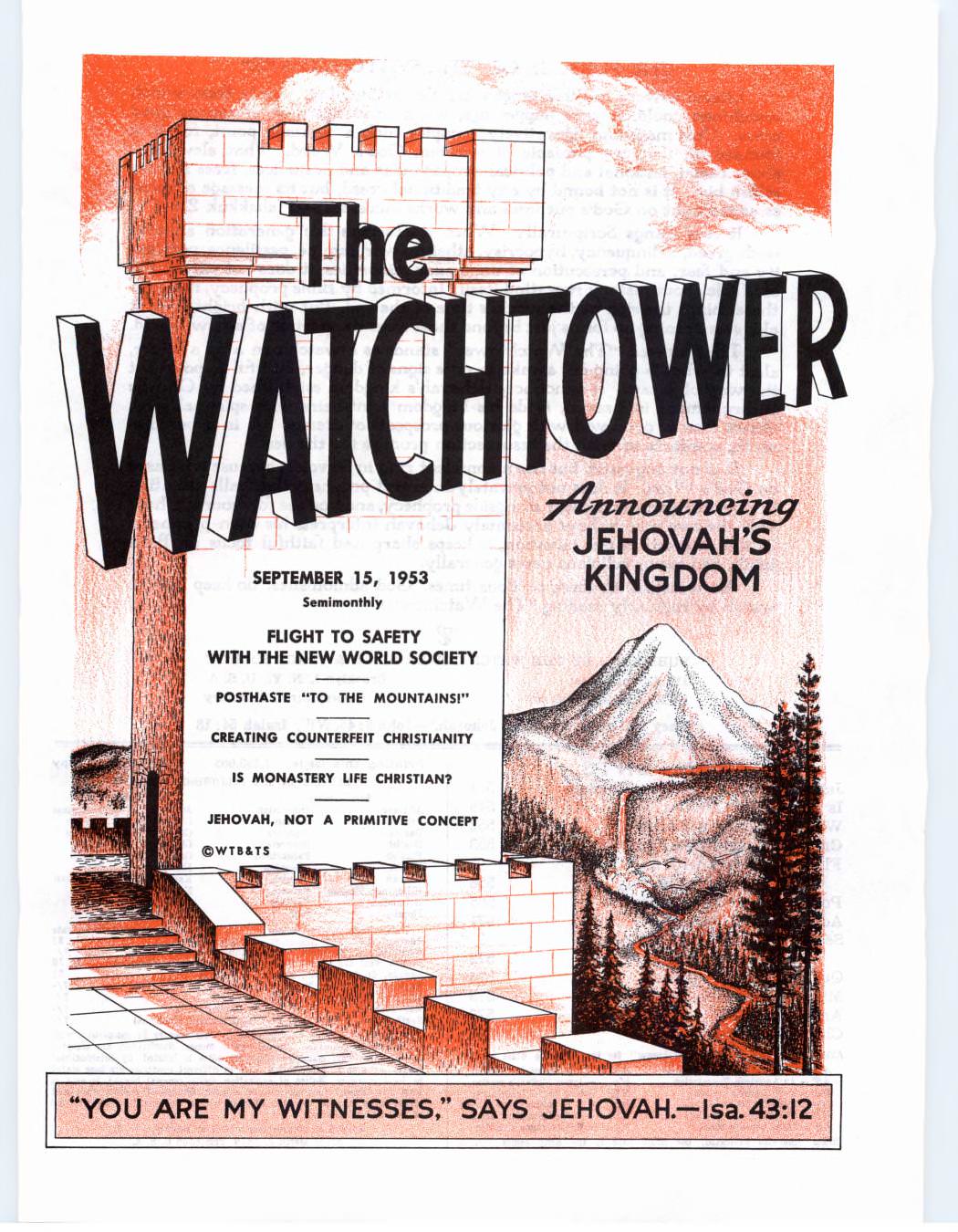
The WATCHTOWER
Announcing
JEHOVAH'S
KINGDOM
SEPTEMBER 15, 1953
Semimonthly
FLIGHT TO SAFETY
WITH THE NEW WORLD SOCIETY
POSTHASTE "TO THE MOUNTAINS!"
CREATING COUNTERFEIT CHRISTIANITY
IS MONASTERY LIFE CHRISTIAN?
JEHOVAH, NOT A PRIMITIVE CONCEPT
©WTB&TS
"YOU ARE MY WITNESSES," SAYS JEHOVAH.—Isa. 43:12 THE PURPOSE OF "THE WATCHTOWER"
Literal towers in Bible times were elevated vantage points from which watchmen could observe happenings, warn of danger, or announce good news. Our magazine figuratively occupies such a vantage point, for it is founded on the very pinnacle of wisdom, God's Word. That elevates it above racial, national and political propagandas and prejudices, frees it from selfish bias. It is not bound by any traditional creed, but its message advances as the light on God's purposes and works increases.—Habakkuk 2:1-3.
It sees things Scripturally. When it observes this generation afflicted with greed, delinquency, hypocrisy, atheism, war, famine, pestilence, perplexity and fear, and persecution of unpopular minorities, it does not parrot the old fable about history repeating itself. Informed by Bible prophecy, it sees in these things the sign of the world's time of the end. But with bright hope it also sees opening up for us just beyond these woes the portals of a new world.
Thus viewed, "The Watchtower" stands as a watchman atop a tower, alert to what is going on, awake to note signs of danger, faithful to point out the way of escape. It announces Jehovah's kingdom established by Christ's enthronement in heaven, feeds his kingdom joint-heirs with spiritual food, cheers men of good will with glorious prospects of eternal life in a paradise earth, comforts us with the resurrection promise for the dead.
It is not dogmatic, but has a confident ring in its voice, because it is based on God's Word. It does not privately interpret prophecy, but calls attention to physical facts, sets them alongside prophecy, and you see for yourself how well the two match, how accurately Jehovah interprets his own prophecy. In the interests of our salvation, it keeps sharp and faithful focus on Bible truth, and views religious news generally.
'Be watchful in these perilous times,' God admonishes. So keep on the watch by regularly reading "The Watchtower".
ပြီး
PUBLISHED BY THE WATCH TOWER BIBLE & TRACT SOCIETY
117 Adams Street
Brooklyn 1, N. Y., U. S. A.
N. H. KNORE, President
GRANT SUITER, Secretary
"They will all be taught by Jehovah."—John 6:45, NW; Isaiah 54:13
<tr><th>CONTENTS
Jehovah, Not a Primitive Concept
Is Monastery Life Christian?
Who Knows True Worship?
Creating Counterfeit Christianity
Flight to Safety with the New World Society
Posthaste “to the Mountains!”
Admissions of Failure
Seed Sown in Gold Coast Yields Ninetyfold
Questions from Readers
Misrepresentation Misfires
Announcements
Check Your Memory
Abbreviations used in “The Watchtower” for the following Bible versions
AS- American Standard Version
LXX- The Septuagint Version
AT-An American Translation
Mo-James Moffatt's version
Da-J. N. Darby's version
NW-New World Translation
Dy-Catholic Douay version
Ro-J. B. Rotherham's version
ED-The Emphatic Diaglott
RS-Revised Standard Version
Le-Isaac Leeser's version
Yg-Robert Young's version
Unless otherwise indicated, the Bible used is the King James Version
Semimonthly
Monthly
Afrikaans
Indonesian
Arabic
Portuguese
Cebu-Visayan
Italian
Climbba
Russian
Danish
Japanese
Cinyanja
Slamese
English
Norwegian
Cishona
Silozi
Finnish
Pangasinan
Greek
Slovak
French
Slovenian
Ibo
Twl
German
Spanish
Kanarese
Ukrainian
Hiligaynon-Visayan
Swedish
Korean
Urdu
Hollandish
Tagalog
Malayalam
Yoruba
Ilocano
Zulu
Polish
Watch Tower Society offices Yearly subscription rate
America, U.S., 117 Adams St., Brooklyn 1, N.Y. $1
Australia, 11 Beresford Rd., Strathfield, N.S.W. 8/-
British West Indies, 21 Taylor St., Port of Spain, Trinidad$ 1.72
Canada, 40 Irwin Ave., Toronto 5, Ontario $1
England, 34 Craven Terrace, London, W. 2 7/-
Jamaica, 151 King St., Kingston 7/-
New Zealand, G.P.O. Box 30, Wellington, C. 1 7/-
South Africa, Private Bag, P.O. Elandsfontein, Transvaal 7/-
Remittances should be sent to office in your country in compliance with regulations to guarantee safe delivery of money. Remittances are accepted at Brooklyn from countries where no office is located, by international money order only. Subscription rates in different countries are here stated in local currency. Notice of expiration (with renewal blank) is sent at least two issues before subscription expires. Change of address when sent to our office may be expected effective within one month. Send your old as well as new address.
Entered as second-class matter at Brooklyn, N. Y.,
Act of March 3,1879. Printed in U.S.A.
Number 18
JEHOVAH, NOT A PRIMITIVE CONCEPT
ACCORDING to one of America's foremost theologians, Harry Emerson Fosdick, the Bible reveals a gradual development of man's concept of God. Writing in the New Outlook, May 1953, he had, among other things, the following to say on this subject:
"The primary problem in Christian apologetics is . . . to achieve a concept of God which will require a minimum of argument because its intelligibility, reasonableness, and relevance to human need carry a self-authenticating authority. The problem is not new. It is old, dating from primitive man, from man as soon as he learned to think. Always the question was, in view of what we know now, how shall we think of God?
"The Bible itself is a major illustration. What a contrast between the ideas of God at its primitive beginnings and at its end! From the early battle cry, 'Yahweh is a man of war: Yahweh is his name,' to Jesus' beatitude, 'Blessed are the peacemakers, for they shall be called the children of God'—what a deepening of the concept of divine nature! What an expansion in man's apprehension of God!
"The writers of the Scriptures traveled an ascending road with widening vistas, and because any God of this universe is infinite, that process can never stop. It critically confronts us today."
Mr. Fosdick would thus have us believe that man of himself gradually ascended
from a concept of Yahweh or Jehovah as a God of war to a God who blesses the peacemakers; and that the Bible, far from being a divine revelation to man, is but the record of man's efforts to acquire an adequate concept of God. (Ex. 15:3, NW; Matt. 5:9) Whatever kind of apologetics that may be, it certainly is not Christian, for Christ Jesus never taught such things. He said, "Your word is truth."—John 17:17, NW.
A humble and honest examination of the Bible will reveal that Mr. Fosdick's comments are not in line with what Jehovah's Word says. It shows that while Jehovah's requirements of his creatures differ according to his purposes and the time in which they live, his four cardinal attributes are always the same, namely, justice, power, wisdom and love. Do we not read in the very first book of the Bible of Abraham's appeal to God's justice? "Shall not the Judge of all the earth do right?" And did not the Founder of Christianity and his apostles emphasize the fact that Jehovah is a just and righteous God?—Gen. 18:25; Luke 18:7; Rom. 9:14.
And did not the angelic messenger to Abraham reveal Jehovah as the Almighty when he asked, "Is anything too hard for Jehovah?" A concept identical with that Christ Jesus gave when he said: "With God all things are possible." (Gen. 18:14, AS; Matt. 19:26, NW) No change in concept of God as regards his justice and power during a period of two thousand years, is there?
Further, does not the Genesis account of creation testify to Jehovah's wisdom, and did not Moses repeatedly state that God was the source of wisdom and that he imparted it to his servants? (Genesis, chapters 1 and 2; Ex. 28:3; 36:1, 2) And did not Christ Jesus and his immediate followers testify to the same effect?—Luke 11:49; Rom. 11:33; Jas. 1:5.
And finally, as regards Jehovah's being a God of love, mercy and peace, here likewise we find no difference between the God of Moses and the God of Christ Jesus. Note how Jehovah revealed himself when Moses asked to see his glory: "Jehovah, Jehovah, a God merciful and gracious, slow to anger, and abundant in lovingkindness and truth; keeping lovingkindness for thousands, forgiving iniquity and transgression and sin."—Ex. 34:6, 7, AS.
But perhaps someone will say, What about the rest of that quotation that reads, "That will by no means clear the guilty, visiting the iniquity of the fathers upon the children, and upon the children's children, upon the third and upon the fourth generation." While those words seem to contradict what preceded them, a little reasoning will make it all clear. Is it not true that when a people or nation, such as Israel, rejected Jehovah's worship and went to pagan religion God permitted them to go into captivity and that the results were felt not only by themselves but also by their descendants even to the third and fourth generations? Is it not simply an inexorable law that by the very nature of things parents by their course of action bring upon their children either good or evil; it being simply a matter of 'what you sow you will reap'?
Christ Jesus taught exactly the same as Moses in this respect, a fact that modernist clergymen like to overlook. Note his warning to the religious leaders of his day as to what was in store for them: "You are bearing witness against yourselves that you are sons of those who murdered the prophets. Well, then, fill up the measure of your forefathers. Serpents, offspring of vipers, how are you to flee from the judgment of Gehenna? For this reason, here I am sending forth to you prophets and wise men and public instructors. Some of them you will kill and impale, and some of them you will scourge in your synagogues and persecute from city to city; that there may come upon you all the righteous blood spilled on earth from the blood of righteous Abel to the blood of Zechariah son of Barachiah, whom you murdered between the sanctuary and the altar. Truly I say to you, All these things will come upon this generation." (Matt. 23:31-36, NW) Those words were fulfilled with the complete destruction of Jerusalem A.D. 70. That destruction was just and was in keeping with Jehovah's being a God of war.
Yes, the Bible is the divine revelation and not merely a record of man's concepts of his God. From beginning to end it reveals Jehovah as a God of love, wisdom, justice and power. He first shows himself as a God of love, bestowing his blessings upon his creatures. But when these spurn God's gifts, rebel and turn to wickedness, then he has no alternative but to show himself as a God of war. Do the Hebrew Scriptures overlook Jehovah's loving, tender and compassionate qualities? "Jehovah appeared of old unto me, saying, Yes, I have loved thee with an everlasting love: therefore with lovingkindness have I drawn thee." (Jer. 31:3, AS) Do the Christian Greek Scriptures overlook Jehovah's justice and righteous indignation? "Vengeance is mine, I will repay, says Jehovah." "For our God is also a consuming fire." (Rom. 12:19; Heb. 12:29, NW) Jehovah is not a primitive concept of God.
IS Monastery Life CHRISTIAN?
MONASTERY life is held in high esteem by many persons. Not that many want to become monks themselves, but they place the monk on a pedestal and admire him because of his asceticism. Thus twenty-two students, both Protestant and Catholic, of an Ohio university felt that they were "a bit closer to heaven" for having spent a week end at the Trappist monastery at Gethsemane, Kentucky, early in 1951, "brushing against the garment of God," as one of them expressed it.—Cleveland Press, March 5, 1951.
What is the life of the Trappist monks that caused these young men to feel so edified because of having come in contact with it? What is the origin of monastic life? And does that life find support in the Bible, and particularly in the example given us by Christ Jesus?
The Trappists really are the "Order of Cistercians of the Strict Observance," which order was founded in the eleventh century. Because of its strict rules it is the pride and joy of many Catholics and has been popularized by a best-selling book written by one of its members. In the United States there are six Trappist monasteries, all together housing some 500 monks, the Trappists being but one of more than 400 Roman Catholic orders or congregations of "Religious" scattered throughout the country.
The theme or keynote of the Trappists is "strict observance" or austerity. Regarding the details we quote from Coronet, October 1951. First of all there is the requirement of silence. "Silence is the shroud
these men wear, to better concentrate on God." "The rule of silence is a
penance these monks impose upon themselves as mortification for their sins and the sins of the world." Except for religious services, and necessary communication with their superior or outsiders because of business relations, they do not speak. Among themselves they use only the sign language.
Austerity is also emphasized in the hours for prayer. Days begin at 2 a.m., with four hours of prayer, and, all together, seven hours each day are spent in religious devotions. Christianity to them is "a total obedience to Christ's command at Gethsemane to 'watch and pray.'" "To them there is no greater service to humanity than prayer," they recognizing "fervent prayer as the strongest weapon for their salvation."
Austerity is also shown in their menu. No meat, fish or eggs except in cases of illness, meals consisting mostly of vegetables, soups, beverages and plain bread. Austerity also shows itself in their sleeping quarters: each has an individual cell, furnished with crude furniture and a "simple" crucifix. The bed consists of boards with a mattress of straw. Each wears the same robe for work, worship, relaxation and sleep, at night removing only his shoes.
Communication with friends and relatives is kept at a minimum, and personal visits are not allowed. Most of the daylight hours are spent in farm work, although there is some time for relaxation and pursuing hobbies such as stamp collecting amateur astronomy, writing novels, etc.
As to why all this austerity, we are told that Trappist monks "devoutly believe that rigorous austerity brings out the best in human character and that by their austere life and self-sacrifice they bring mankind closer to God," these things being the "guideposts to salvation." Each Saturday
cism, a term used to describe the training of Greek gladiators and prize fighters, those practicing it did not at first separate themselves from their fellow men but mingled with them in their daily occupations while denying themselves wine, meat and agreeable foods, some of them also practicing celibacy.
As time went on these retired to the
evening two Trappists wash the feet of the rest, hoping thereby to purify themselves. In addition to the vows of poverty, chastity and obedience required of all Catholic orders, Trappists also vow to remain Trappists the rest of their lives and to perfect themselves.
ORIGIN OF MONASTERIES
Actually monasticism or monastery life is as ancient as pagan religion itself, written records purporting to go back 2,000 years before Christ telling of those who spent their nights in prayer and their days
deserts for contemplation, where they were visited by many as objects of reverence or for advice. They then became known as anchorites, that is, those who retire; as monks, meaning those who live alone, and hermits because they lived in deserts. The anchorites were the most excessive in their austerity, exposing themselves to the rigors of the weather without sufficient clothing, eating very sparingly of coarse foods, wearing heavy chains and iron rings; some even assuming painful positions over a period of years, such as one Simeon Stylites, of the sixth century, who spent both night
fasting. And "nearly 600 years B.C., the artificial caves of India were occupied by Buddhistical monks, and there is conclusive evidence that they served the Brahmins for a like purpose long before that." McClintock & Strong's Cyclopedia, Vol. VI, page 459.
Monasticism can therefore be classed among the many features of the Roman Catholic religion that Cardinal Newman lists in his work, An Essay on the Development of Christian Doctrine, as having their origin in paganism. In fact, he includes a
and day in an erect position atop a pillar, for some thirty years, it is claimed, and who fasted forty days at a stretch. Up until the twelfth century he had many imitators all of whom were known as "Pillar Saints."
As anchorites, hermits and monks increased, they formed communities, and then became known as cenobites, from the Greek terms meaning common or communal life. At first each monk was free to do as he pleased, but as time went on these communities evolved set rules, and in the fifth century poverty, chastity and obedi-
monastic custom, that of the tonsure, a circular haircut peculiar to some monks.
While among the Jews for the last two centuries before their destruction A.D. 70 there existed a monastic sect known as the Essenes, it appears that it was not these, but the pagan Egyptian monks that were the immediate predecessors of the so-called Christian monks, as they were first found in Egypt. Beginning as a form of ascetience were made the three prime requisites of monastery life. Each monastery, however, continued independent of others until about the eleventh century, when various "orders" began to be formed and monasteries joined one or another of these. The next two centuries saw the formation of the largest and most popular Roman Catholic orders, among which were the mendicants, those monks who went about begging.
History shows that monasticism has swung from one extreme to another; from asceticism to the worst kind of licentiousness; and from poverty to such riches that "the wealth of the monasteries was tempting and the great ones both in Church and State seized upon them." (Catholic Encyclopedia, Vol. X, p. 475) In fact, at one time fully half of Europe was owned by monasteries and other church institutions, and an abbey such as that of Mount Casino had a revenue of more than a million dollars annually. And while swearing vows of obedience its abbots became dukes and sovereign princes, and in Britain sat as peers in Parliament; they coined money like feudal barons and lived in great state and dignity, one of the abbots of St. Gall once entering Strasbourg with a thousand horsemen in his train.
NO BASIS IN THE SCRIPTURES
The entire philosophy of monasticism is foreign to the Scriptures. It finds its basis in gnosticism and pagan religions and is premised on such teachings as that of immortality of the soul, eternal torment and purgatory. Two outstanding fallacies of monasticism are that all that is connected with the flesh is evil and therefore the flesh must be abused as much as possible, and that by means of such abuse, personal works and prayer one can perfect himself and gain salvation for himself and others.
Monasticism is the very antithesis of Christianity. Jesus warned not to advertise one's prayers and fasting, not to let anyone but God know about these things. (Matt. 6:5-8,16-18) What is the entire monastic system of retiring to a monastery, wearing black robes, having one's hair cut a certain way, or cut off altogether, adhering to strict rules regarding silence, and abstinence from certain foods
and hours spent in prayer but so much of advertising of piety, which Christ condemned? Not self-inflicted punishment, but deeds of mercy to one's fellow man are what God commands.—Isa. 58:1-7, AS.
Nowhere, in either the Greek Scriptures or the Hebrew, do we find any basis for asceticism, as though denying ourselves the necessary comforts of life would bring favor with God. Note how plainly the apostle Paul condemns all such: "If you died together with Christ toward the elementary things of the world, why do you, as if living in the world, further subject yourselves to the decrees, 'Do not handle, nor taste, nor touch,' respecting things that are all destined to destruction by being used up, in accordance with the commands and teachings of men? Those very things are, indeed, possessed of an appearance of wisdom in a self-imposed form of worship and mock humility, a severe treatment of the body, but they are of no value in combating the satisfying of the flesh."—Col. 2:20-23, NW.
True, Christ Jesus suffered, his apostles and disciples suffered, even as did Jehovah's faithful servants from Abel to John the Baptist, but do we read that they courted suffering for its own sake? They were willing to suffer rather than compromise, but when they could avoid suffering without compromising they did so. Nowhere are we told that such self-imposed sufferings are the way to salvation. On the contrary, we are told that it is the blood of Christ, together with our faith in it, that cleanses us from all sins.—Rom. 5:1; 1 John 1:7.
Nor is there any justification for retreating from mankind. According to the Catholic Encyclopedia, for Christians to heed John's words, "Keep yourselves from idols," they had to separate from the world because the world was full of idolatry. But where do we read in the Bible that any of the early Christians did that?
Would there have been any persecution if they had followed that course? Of course not, and the fact that they were persecuted proves that they did not physically separate themselves from the world.
The trappists take a vow of silence, but where in the Scriptures are we told to refrain from using our tongues? On the contrary, we are told to comfort him that is weary with a word, to speak the truth to our neighbor. Every Christian is to make disciples of people of all nations. The early Christian congregation, when it was scattered because of persecution, did not keep silent, but went everywhere preaching the Word. Speech is a gift, God intends us to use it, but, of course, not abuse it or misuse it.
Christ Jesus did much praying, once spending a whole night in prayer, just before he chose his twelve apostles. (Luke 6:12-16) And on the night of his betrayal he did much praying and he counseled his apostles to "watch and pray." (Matt. 26:41) But did he mean thereby that we should
spend from four to seven hours daily in prayer? Hardly, when he warned against needless repetition in prayer. (Matt. 6:5-8) He was a busy man, he had much preaching to do. So did Paul and all the other early Christians. They also had to study God's Word so as to properly equip themselves for preaching.
We are commanded to love God. The best way we can do that is to praise him, not within the walls of a monastery but where others can hear of him so that they also can join in praising God. We are told to love ourselves and our neighbors as ourselves. We do not show love of ourselves by torturing our bodies, denying them necessary food and rest, and we cannot be loving our neighbor as ourselves if we separate ourselves from him. We show the very best kind of neighbor love when we preach to our neighbors about who Jehovah God is, what his purposes are and what his kingdom will accomplish. (Mark 12:28-34) That is the essence of Christianity, but it cannot be done in a monastery. Therefore monastery life is not Christian.
Who Knows True Worship?
In 1951 an Iowa court threw out a bequest to promote the dissemination of the Christian religion when it found that so many conflicting views made it impossible to define Christianity. More recently a British lawyer's will that specified that the recipient of his goods be "a member of the Church of England and an adherent of the doctrine of that church," was thrown out of a British court which held that there are too many possible interpretations of what it means to be a member of the Church of England for that requirement to have any meaning at all. It ruled that it was impossible to define what the doctrine of the Anglican church is, and hence the degree to which one is "an adherent" of that doctrine. Of course, the apostles and early Christians had no such problem. They knew what true worship was, and narrowly defined it. It was only with the additions, divisions and confusions of false teachers who peddled their own ideas instead of God's that such a condition developed. Even those claiming to follow Christ no longer know for sure which way he went! They could determine it by casting off these human ideas and returning to the One Book that reliably reports what he preached and did, but too many are too busy with trivial matters to take time to do this, so they continue to use the name "Christian" while going in all sorts of opposite ways.
Creating Counterfeit Christianity
EARLY Christians were not timid about telling others what they believed. Prominent church organizations today teem with those who profess Christianity but who shy away from speaking of their belief. Not long ago at St. Patrick's Cathedral in New York the "Reverend" E. B. Broderick chided church members who refused "to poke their heads out of their homemade spiritual bombshelters." He likened them to "timid disciples who keep us guessing by refusing to declare themselves." (New York Times, May 25, 1953) Protestants have their "timid disciples," too! Dr. D. Steward of the Central Presbyterian Church in Houston, Texas, declared: "It is a serious condition when members of Christian Churches do not know what they stand for." (Houston, Texas, Post, October 27, 1952) What has brought about a "Christianity" so devoid of the genuine qualities displayed by early Christians?
The stark truth is that a "Sunday religion" has evolved over the years. It masquerades as Christianity. Indeed, a form of worship that is divorced from the everyday affairs of life could not be genuine Christianity, for Christianity is a worship to be practiced every day. Confirming this Christ himself declared: "If anyone wants to come after me, let him disown himself and pick up his torture stake day after day and follow me continually." (Luke 9:23, NW) The apostles taught the good news in the temple and from house to house "every day." (Acts 5:42, NW) Since genuine Christianity is everyday worship,
a "Sunday religion" must be a "form of godly devotion" that is counterfeit, because the worshipers 'prove false to its power.' (2 Tim. 3:5, NW) Thus in spawning a "Sunday religion" there has been created a counterfeit Christianity. This is the dividing of the people into two classes: the clergy and the laity.
By the term "clergy" is meant the select group of men who are ordained by organized religion to preach its message and who usually wear distinctive garb and assume impressive titles. The laity are thus the common people as distinguished from the clergy. Under this system the laity sit in pews and pay the clergy to preach to them. Under this system the laity "accumulate teachers for themselves to have their ears tickled." (2 Tim. 4:3, NW) Is this division of "Christians" into people pleasing preachers and passive auditors Scriptural? The Catholic Encyclopedia, under the heading "Cleric," asserts: "Christ did not commit the preaching of the Gospel . . . to the faithful in general, but to certain carefully defined persons, as the Apostles." In view of this it was not at all strange that, when there was a request for "emancipation of the laity" at the World Congress of the Apostolate of the Laity, the pope bluntly rejected the idea, saying: "The expression 'emancipation of the laity' is hardly pleasing to us; it has rather an unpleasant sound."—New York Times, October 15, 1951.
Two facts become clear: First, the clergy contend that the clergy and laity division is of divine origin. Second, any other arrangement would, to put it mildly, be "unpleasant" for the clergy.
Let us now "make sure of all things" by turning to the Scriptures. If the clergy and laity division proves to be unscriptural, then it has been a big factor in creating counterfeit Christianity.
NO CLASS DISTINCTION
Early Christians were all brothers. No class distinction could rightfully exist. (Jas. 2:1-9) Christians were not to bow down worshipfully before another, as Peter told Cornelius. (Acts 10:25, 26) No Christians kissed Christ's hand or toe; instead, he washed their feet! "If I, although Master and Teacher, washed your feet, you also ought to wash the feet of one another." (John 13:14, NW) If bowing down and kissing toes and hands were Scriptural, then, according to Jesus' example, Christians would have to do this, not to a select few, but to all their brothers. Clearly, such procedure is not Scriptural, and Christ set no pattern for class distinction.
Early Christians were all laymen. They had no paid clergy. In fact, the Founder of Christianity was not a clergyman but a layman. When Christ taught in the synagogues, the people were so amazed they asked: "Where did this man get these things?" And then when their astonishment heightened, they asked: "This is the carpenter the son of Mary...is it not?..." So they began to stumble at him." (Mark 6:2, 3, NW) It was due to the very fact that Christ was not one of the clergy of his day that people stumbled over him, losing the opportunity for life!
That the apostles were not professional theologians, Luke tells us: "Now when they beheld the outspokenness of Peter and John, and perceived that they were men unlettered and ordinary, they got to wondering." (Acts 4:13, NW) The apostles were just ordinary people. For instance,
Peter, Andrew, James and John were fishermen; Matthew was a tax collector. (Mark 1:16, 19; Matt. 9:9) Though the apostle Paul had received religious instruction according to the Pharisees' way of worship, yet he had to abandon such religious instruction in order that he might practice the genuine worship of God! Jesus denounced the Pharisees' worship as counterfeit! (Acts 22:1-21; Matthew chapter 23) Paul the Christian was no paid clergyman, but a tentmaker and a teacher of the good news.—Acts 18:3; 1 Cor. 9:16.
ALL AUTHORIZED TO PREACH
Early Christians were all ministers. One historian states: "In the apostolic church preaching and teaching were not confined to a particular class, but every convert could proclaim the gospel to unbelievers, and every Christian who had the gift could pray and teach and exhort in the congregation." Further, the commission to preach comes from Almighty God, and, since God is not partial, all are authorized to preach. (Acts 10:34, 35, NW) Christ Jesus recognized this: "Jehovah's spirit is upon me, because he anointed me to declare good news to the poor, he sent me forth to preach a release to the captives." (Luke 4:18, NW) The truth would free the laity from the clergy. This truth all early Christians preached: "Just as you sent me forth into the world, I also sent them forth into the world." Thus true Christians were to speak, not sit.—John 17:18; Acts 1:8, NW. Contrary to the Catholic Encyclopedia, the "faithful in general" were to preach.
Contrary to the Catholic Encyclopedia, the "faithful in general" were to preach. The seventy sent out by Jesus were not clergymen. In their presence Jesus declared: "I publicly praise you, Father, Lord of heaven and earth, because you have carefully hidden these things from wise and intellectual ones, and have revealed them to babes. Yes, O Father, because to do thus came to be the way approved by you."
(Luke 10:21, NW) The way approved by God could not be a clergy-laity system.
With the outpouring of the holy spirit, Christianity prospered. It grew from 3,000 ministers to 5,000. (Acts 2:41; 4:4) To be sure, these "faithful in general" were not merely attenders at a religious service, but they were all ministers! "All [the 5,000] except the apostles were scattered [by a persecution] throughout the regions of Judea and Samaria. However, those who had been scattered went through the land declaring the good news of the word." (Acts 8:1, 4, NW) Furthermore, what was the purpose of Christ's giving "gifts in men"? Was it not to train others to be preachers? "He gave some as apostles, some as prophets, some as missionaries, some as shepherds and teachers, with a view to the training of the holy ones for ministerial work."—Eph. 4:8, 11, 12, NW.
When Paul wrote, "Preach the word, be at it urgently in favorable season, in troublesome season," was this admonition limited to Timothy? No! Explained the apostle: "The things you heard from me with the support of many witnesses, these things commit to faithful men who in turn will be adequately qualified to teach others." (2 Tim. 4:2; 2:2, NW) Indeed, the "faithful in general" were to "preach the word"!
FLATTERING TITLES UNSCRIPTURAL
If there is no clergy among true Christians, why do we read of deacons and bishops in the Bible? The answer: This is simply a case of mistranslation. The Greek word episkopos, translated "bishop," (1 Tim. 3:1) has the real meaning of "overseer." The title "deacon" (1 Tim. 3:12) is the result of another mistranslated Greek word, diakonos, the basic meaning of which is just "ministerial servant." To call one a "ministerial servant" is not tickling one's
fancy, nor is it the giving of a flattering title, which is condemned by God. (Job 32:22) The word "reverend" in the Bible nowhere applies to man; only to Jehovah. (Psalm 111:9) And Jesus specifically condemned the titles "Rabbi" and "Father." (Matt. 23:7, 9) Thus the giving of flattering titles, further dividing the clergy from the laity, is unscriptural and has fostered counterfeit Christianity.
Counterfeit Christians are spectators. Genuine Christians are a "theatrical spectacle to the world" because they preach, not watch. Paul invited all to imitate him as such. (1 Cor. 4:9, 16, NW) Therefore the genuine worship of Jehovah cannot be a "balcony religion," where worshipers watch and observe while someone else does the work. But every genuine Christian must boldly play his part as a preacher of the good news while the scene of this old world still remains, "for the scene of this world is changing" and will pass away at Armageddon.—1 Cor. 7:31; 1 John 2:17, NW.
This "change of scenes" means a new world is near. (2 Pet. 3:13) Who will live to see it? Only true Christians. Imitation Christians may flourish, yes, but only until Armageddon. Of the wheat (true Christians) and weeds (imitations) Jesus said: "Let both grow together until the harvest." "The harvest is a consummation of a system of things, and the reapers are angels." (Matt. 13:30, 39, NW) The crop of "weeds" that Christendom has raised under its unscriptural clergy and laity system will be cast into the fiery furnace of destruction at Armageddon. And hurled into the abyss of death will be that chief counterfeiter, that sham sovereign, Satan the Devil. (Rev. 20:1-3) A new scene comes before our eyes: a new world wherein death, pain and sorrow have vanished. (Rev. 21:1-5) Only the genuine Christians will live to enjoy this complete "change of scenes"'!
Flight to Safety with the
New World Society
"When you see Jerusalem surrounded by encamped armies, then understand that the desolating of her has drawn near. Then let those in Judea begin fleeing to the mountains, and let those in the midst of her [Jerusalem] withdraw." Luke 21:20, 21, NW.
THE founding and building of the new and lasting things go forward successfully while the condemning and destroying of the old things proceed. When
The speech below (in two parts) was delivered by the president of the Watch Tower Society to 134,333 attending the New World Society Assembly of Jehovah's Witnesses at Yankee Stadium, New York city, on the afternoon of its seventh day, Saturday, July 25, 1953, and was featured by the release of the Society's new book entitled "New Heavens and a New Earth".
the demolishing of the old things is completed shortly, there will be no chaotic beginning for the new, there will be no need for men to start at the level of the early caveman, but the way will be fully cleared for the developing of the new to the grandeur of a paradise. It is a time of increasing peril. It is also a time of great opportunity. The peril steadily increases for those who hang on to the old in defiance of its being condemned. Mankind's only safety lies in speedy flight to the new, and that without delay. It is with the new that the great opportunity lies for men to survive the end of the old and enjoy a future of enduring happiness, peace and love. The new things are not those that vainglorious men of this world conceitedly promise to build. The new things are those of the Almighty One who sits on the throne of the universe. For nineteen centuries his words have stood recorded: "Look! I am making all things new." (Rev. 21:5, NW) Today he is backing up his words with deeds. The new things are being made. Happy are those people who see them being constructed and who flee to them.
Safety and preservation will never fail them there with God's New World society.
2 Men have a strong tendency to hold on to certain things long held
sacred and to trust in them as though they were a charm against harm. It is felt that they are from God and that he will spare them and therefore it guarantees one's safety to take refuge in such sacred things. But things to which men impute sacredness may not be sacred to God, even if they have great age or antiquity. To rely on such means to deceive oneself with a false hope. It is necessary to determine whether they are in agreement with God's promised new things. If not, they will not be carried over and incorporated with the new. For the truth of this in our time we have a historic example. In fact, this example was a prophecy of what would take place in our time. No temple of religion was invested with greater sacredness or guarded with greater jealousy and fanaticism than Herod's temple in Jerusalem nineteen centuries ago. It and previous temples on the same spot had a combined existence of almost a thousand years; and yet after a guided tour of inspection of Herod's temple Jesus Christ said: "The days will come in which not a stone upon a stone will be left here and not be thrown down."—Luke 21:5, 6, NW. That temple was the most gorgeous building in the holy city of Jerusalem.
In it the priests who were descendants of the chosen family of Aaron busied themselves with the sacred services. It was called "the house." Yet, notwithstanding all its sacred associations, Jesus said just before this: "Jerusalem, Jerusalem, the killer of the prophets and stoner of those sent forth to her,—how often I wanted to gather your children together, the way a hen gathers her chicks together under her wings! But you people did not want it. Look! your house is abandoned to you." (Matt. 23:37, 38, NW) Jesus knew not only that it had become a house of merchandise and a cave of robbers but also that it was served by priests who were plotting his death. It had merely an outward show of sacredness but was entirely empty of holiness within. Jesus therefore declared it abandoned by Jehovah God and refused to patch it onto the new system of things that he was bringing in. Thirty-seven years later it met the fate he predicted. Not a stone of it was left resting on another. However, the new temple of Jehovah God, a spiritual temple of "living stones," continued standing. Within it a righteous new system of things functioned that was to result in the pure worship of the true God all over the earth and the everlasting blessing of all the families of mankind.—1 Pet. 2:5; Eph. 2:20-22.
4 The new system of things did not wait for the destruction of Jerusalem and its temple before beginning. With the death, resurrection and ascension of Jesus to heaven to appear in the presence of Jehovah God with the blood merit of his human sacrifice, the new system of things began in reality. Having the sacrifice that was really acceptable to God for ransoming
mankind from sin and its penalty death, Jesus served as the new High Priest of God. The earthly high priest of the old Jewish system of things lost his office before God, for he had been made a high priest by the Law covenant that Moses had mediated between God and Israel at Mount Sinai. But now Jesus had become a Prophet and Mediator greater than Moses and he mediated a new covenant between Jehovah God and the spiritual Israelites, the Christian congregation that was built upon him as the Rock. Thus that old Law covenant that God had made with the natural Israelites at Sinai was abolished and its priesthood, its sacrifices, its festivals and its obligations with it. (Heb. 3:1; 9:11-15; Col. 2:13, 14; Deut. 5:2, 3; 29:1) From then on Jesus Christ served as God's anointed High Priest at God's spiritual temple, its Holy of Holies being even heaven itself before the very presence of God himself.
5 Jesus' manifesting of himself as the new and everlasting High Priest meant that the consummation of the old system of things had come. As it is written concerning him: "Now he has manifested himself once for all time at the consummation of the systems of things to put sin away through the sacrifice of himself." (Heb. 9:26, NW) It was in full harmony with this fact that the abandoned temple of Herod at Jerusalem was destroyed by the legions of Rome under General Titus in the year 70 (A.D.). This was when the reputedly holy city of Jerusalem itself was destroyed.
6 Today in this year 1953 we must not overlook one important point: For thirty four years after God's new covenant was made and the Christian congregation began to be built on Jesus Christ the Rock at Pentecost of 33 (A.D.) the city of Jerusalem served as the headquarters city of the Christian congregation. The governing body of the congregation was located there and was made up of the twelve apostles and other older disciples, such as James the brother of Jesus.
They used the temple courts as a convenient place to meet crowds of people and preach to them. It was in this temple that Paul the apostle was mobbed about the year 56, and it was in Jerusalem that the disciple James and other faithful Christians with him were killed by fanatical Jewish stoners in 62. But when the year 67 came, the Christian governing body and all other disciples of Jesus fled from Jerusalem and from all the province of Judea. Why did not the Christians stay on and keep preaching the good news about Jesus Christ in the old holy city and the rest of Judea? Was it cowardice before persecution? Was it unfaithfulness toward their commission to preach the good news? None of that! It was the wise preservation of their lives, that they might continue preaching elsewhere. It was obedience to the prophetic command of Jesus Christ when he foretold the destruction of the abandoned temple and said to his disciples:
"You will be delivered up even by parents and brothers and relatives and friends, and they will put some of you to death, and you will be objects of hatred by all persons because of my name. And yet not a hair of your heads will by any means perish. By endurance on your part you will acquire your souls. Furthermore, when you see Jerusalem surrounded by encamped armies, then understand that the desolating of her has drawn near. Then let those in Judea begin fleeing to the mountains, and let those in the midst of her withdraw, and let those in the nearby regions not enter into her [into Jerusalem], because these are days for meting out justice that all the things written may be fulfilled. Woe
to the pregnant women and the ones suckling a baby in those days! For there will be great necessity upon the land and wrath on this people, and they will fall by the edge of the sword and be led captive into all the nations, and Jerusalem will be trampled on by the nations, until the appointed times of the nations are fulfilled."—Luke 21:16-24, NW.
THE CUE TO FLEE
In November of the year 66 (A.D.) the governing body in Jerusalem and all the other disciples there and in the province of Judea were given their cue to flee from the entire province to the mountains, as commanded by Jesus. That was when the Roman armies under Gaius Cestius Gallus, the governor of Syria, arrived before the city which was in revolt against Rome. After five days of fighting that put the full capture of the city within his grasp he withdrew his forces for no accountable reason, to be pursued by the Jews, with loss of thousands of his troops. The Christians took this as the cue given many years before by Jesus. So they fled from Jerusalem. They did not stop in any part of the province of Judea; Jesus' command was for those in Judea to flee from it to the mountains. Hence they and their children (born or yet unborn) crossed the Jordan River into the mountainous region of Gilead and settled principally at Pella, one of the cities of the Decapolis. There they kept up their Christian activities and carried on their preaching. There they were safe when the Romans came back in the early part of A.D. 70 and terrible desolation came upon Jerusalem in fulfillment of Jesus' tearful words addressed to her: "If you, even you, had discerned in this day the things having to do with peace—but now they have been hid from your eyes. Because the days will come upon you when your enemies will build around you a fortification with pointed stakes and will encircle you and distress you from every side; and they will dash you and your children within you to the ground, and they will not leave a stone upon a stone in you, because you did not discern the time of your being inspected."
Luke 19:41-44 NW
The life of the holy city and its temple did not prove to be charmed. Those who stuck with those things of the corrupted old system fought a lost cause and perished in the desolation of Jerusalem and all the province of Judea. But the Christians in the mountains of Gilead survived and preached on. The old system that then perished is gone forever; the priesthood of Aaron's family and the worship of Jehovah God in a material, man-made temple at Jerusalem will never be reinstated. The new Christian system of things under the new covenant with Jesus as Mediator and High Priest endures down to this day.
10 All this is not without tremendous significance to us in these strange, unusual days. We are staring in the face something similar, only far worse. We feel the urge to ask after the causes of things, and we do so wisely, that we may know whether a certain course of action is advisable for us. When we see that the present-day city of Jerusalem in Palestine does not carry on the tradition of the ancient temple city, but that Christendom is in fact the modernday counterpart of the holy city of the days of Jesus and his apostles, then we are impelled to ask, What led to the frightful siege and destruction of Jerusalem in 70 (A.D.)? Knowing that, we can then determine whether for a like reason destruction on a vaster scale is hanging threateningly over Christendom, the twentiethcentury counterpart of the doomed Jerusalem.
11 Jesus gave the key to the answer when he said to his disciples in this same prophecy, as reported by the apostle Matthew: "And this good news of the kingdom will be preached in all the inhabited earth for the purpose of a witness to all the nations, and then the accomplished end will come. Therefore, when you catch sight of the disgusting thing that causes desolation, as spoken of through Daniel the prophet, standing in a holy place, (let the reader use discernment,) then let those in Judea begin fleeing to the mountains. Let the man on the housetop not come down to take the goods out of his house; and let the man in the field not return to the house to pick up his outer garment. Woe to the pregnant women and those suckling a baby in those days! Keep praying that your flight may not occur in wintertime nor on the sabbath day; for then there will be great tribulation such as has not occurred since the world's beginning until now, no, nor will occur again. In fact, unless those days were cut short, no flesh would be saved; but on account of the chosen ones those days will be cut short."—Matt. 24:14-22, NW.
12 The "disgusting thing that causes desolation" at the sight of which standing in the holy place the Christians were to flee to the mountains—this was the cause of the appalling destruction that overtook Jerusalem and her realm in Judea. That "disgusting thing" was the league or alliance that the religious rulers of Jerusalem made with the Roman empire in order to procure the death of Jesus Christ, God's anointed King. That imperial world power of Rome was symbolized in divine prophecy as a disgusting thing, as a ferocious wild beast that would war upon Jehovah's holy ones or saints on the earth.
It proceeded first against Jehovah's chief Holy One, his Son Jesus Christ, to do away with him
as a rival to its world domination.—Acts 3:14; 4:27-30, NW.
13 The religious rulers of Jerusalem were the ones that thrust God's Holy One before the attention of the Roman world power, seeking revenge because Jesus exposed their false practices and their violations of God's commands. Before the Roman governor Pontius Pilate they accused Jesus of being seditious against Caesar, forbidding the paying of tax to Caesar and stirring up the people against him. When Governor
Pilate tried to resist the religious pressure and to let Jesus go, the Jews shouted: "If you release this man, you are not a friend of Caesar. Every man making himself a king speaks against Caesar." When Governor Pilate, in an appeal to the Jews' national patriotism, presented Jesus as their king and tried to shame them by asking, "Shall I impale your king?" then, of all people, it was the Jewish chief priests that answered: "We have no king but Caesar." John 19:12-16, NW.
heard and acted upon their defiant cry at that time concerning Jesus' blood: "His blood come upon us and upon our children"! No wonder he abandoned their house as a
14 Do you feel disgust at that? Then how much more would God in heaven feel hot indignation at this betrayal of his Anointed King Jesus Christ to the Roman imperial world power and the linking up of those who claimed to be his people with the cruel, anti-Jehovah world power of Rome? It was a religio-political conspiracy against Jehovah's Messianic kingdom. No wonder he
polluted temple! No wonder he considered them part and parcel of a disgusting thing, an abominable arrangement against his kingdom by his Holy One Jesus Christ! (Matt. 27:25; 23:38 NW) They professed friendship for God's enemy, Caesar, thus making themselves God's enemies. Now let them eat the bitter fruitage of that traitorous friendship; let them gall under the unequal yoke of such a nefarious anti-kingdom conspiracy until they should be driven to violent revolt against their
political partners. God foreknew that the hypocritical religio-political alliance was bound to break up in due time and that the political part of the disgusting thing would move with its armies against the religious part of the disgusting alliance, to bring Jesus' blood upon the guilty religionists and their children, giving Jerusalem a blood bath from the veins of 1,100,000 of her children!
15 The revolt of the Jews against their friend Caesar came in 66 (A.D.) for the outrages done them by his political governors. That same year the armies of the political part of the disgusting thing turned against them and made a preliminary assault against their holy city Jerusalem. That was the sight of the disgusting thing with its armies surrounding the holy city of Jerusalem that the Christians were to look for as notification that it was high time for them to flee to the mountains outside Judea for safety.
Not knowing how soon the armies of the disgusting thing would come back and complete the desolation of Judea and Jerusalem, the Christian governing body and other obedient Christians moved out without having to do it on any inconvenient Jewish sabbath day or in wintertime. In the seventh century before Christ the Babylonish armies had come back to desolate Jerusalem the first time. In 70 (A.D) the Roman armies came back. During the spring and summer of that year the siege and complete destruction followed. By prompt, obedient action the Christians had escaped sharing in that horrible desolation.—Jer. 37:6-10.
MODERN COUNTERPART
16 Jesus, when prophesying of that "disgusting thing that causes desolation," said that Daniel the prophet had foretold it too. Daniel prophesied of its appearance as taking place at the time appointed, the "time of the end." (Matt. 24:15, NW; Dan. 11:29-35) Jesus predicted things to occur in the time of the end of this world, and such things have come in one continuous series since A.D. 1914—world war, famines, pestilences, earthquakes, world-wide persecution of true Christians, the preaching of the good news of God's kingdom as established, false prophets and Christs, and, yes, the "disgusting thing that causes desolation"—all these things in combination marking this as the critical "time of the end." What makes it the "time of the end" for the nations of this world is that God's "appointed times of the nations" came to the end of their 2,520 years' length in 1914 and there the long-prayed-for kingdom of God was born in the heavens and his holy, anointed King Jesus Christ was installed upon the throne and given the right to rule the entire earth and break to pieces all
nations that opposed his rightful rulership. Matt. 24:3-25; Rev. 12:1-5; Ps. 2:7-9.
17 As this period since 1914 is confirmed as the "time of the end," where then are the disgusting thing and its armies of desolation that Daniel and Jesus foretold? Look! there it is in the religio-political conspiracy of today against the established kingdom of Jehovah God and its holy, anointed King Jesus Christ. Identify it for yourself by its fulfillment of the prophecy of Psalm 2:1-6 (AS): "Why do the nations rage, and the peoples meditate a vain thing? The kings of the earth set themselves, and the rulers take counsel together, against Jehovah, and against his anointed, saying, Let us break their bonds asunder, and cast away their cords from us. He that sitteth in the heavens will laugh: the Lord will have them in derision. Then will he speak unto them in his wrath, and vex them in his sore displeasure [saying]: Yet I have set my king upon my holy hill of Zion." (Acts 4:24-30) The world alliance known as the United Nations is the chief and most powerful expression of this religio-political conspiracy against the Messianic kingdom of God. We say "religio-political," because the religions of this world are in on this world conspiracy against the Kingdom, especially the religions of Christendom.
18 For decades before A.D. 1914 Jehovah's witnesses had been preaching the full establishment of God's kingdom by Christ at the end of the "appointed times of the nations" in that year. To confirm their preaching as correct, World War I for global domination by the nations of this earth broke out suddenly in 1914, to be followed by the mournful train of events down to this day. Had the religious clergy of Christendom examined the prophecies that Jehovah's witnesses called to their attention, had they faced the facts of modern history and seen their import and shown loyalty to God's will, they would have hailed his kingdom and would have recommended it as the only government entitled to world domination.
To the contrary of this, they took sides with the political factors in total warfare for the domination of the earthly realm of God's anointed King Jesus Christ. They led in persecuting Jehovah's witnesses who stood loyal to God's enthroned Ruler and they moved the sword-brandishing arm of the political state against Jehovah's witnesses to try to exterminate them from the earth. They gave no reverential thought to Jesus' words: "Inasmuch as ye have done it unto one of the least of these my brethren, ye have done it unto me." (Matt. 25:40) For fear of alienating the affections of their political friends the clergy preferred to hold to the warring kingdoms of this world and to accuse Jesus Christ of sedition against Caesar by accusing his true followers of this.
19 When at the close of World War I in 1918 the united political program for the postwar world was proposed, the clergy of Christendom were at once for it. What was that? To have Christ as King? No, not that, but a League of Nations, to provide strength for the old-world system to continue through unity. The clergy of Christendom were first to follow the lead of the politicians and to advocate the League of Nations. In January of 1919, before the peace conference convened at Paris, France, the Federal Council of Churches of Christ in America urged the establishing of the League of Nations and said it was not merely a peace expedient, but, to
quote their pamphlet, "it is rather the political expression of the kingdom of God on earth." They added: "The heroic dead will have died in vain unless out of victory shall come a new heaven and a new earth wherein dwelleth righteousness.—2 Pet. 3:13." In other words, the postwar world under the League was to be the new heavens and new earth that God has promised, the League of Nations as the "political expression" of God's kingdom to be the new heavens, making unnecessary Christ's real kingdom that forms the new heavens of God's new world.
20 As for the pope of Rome, although failing to get a seat in the League of Nations, he offered the benefit of his ecclesiastical offices to it. On January 10, 1920, the League began functioning with the support and blessing of the clergy of Christendom. At the same time the voice of Jehovah's witnesses began to be heard with an unusual tone of boldness and conviction, proclaiming God's kingdom under Christ as the only hope of distressed humanity.
21 Now which of these two postwar movements really promoted God's kingdom? Which of them aroused the disgust of the Most High God? Jehovah's witnesses or the clergy-blessed League of Nations? Well, Jehovah's witnesses are still here as represented in this New World Society Assembly at Yankee Stadium, New York city, but where is that political new heavens, the League of Nations? Where was it during World War II? Down in the bottomless pit of helpless inactivity. To take away its reproach, they have revived it and given it a new front and a new name called United Nations. Students of Bible prophecy know this was just as foretold.—Rev. 17:9-11.
22 The League of Nations and the religious clergy of Christendom got along notably well together, and there was no open break. But in October of 1933, eight months after Hitler came to power, Nazi Germany quit the Disarmament Conference and the League of Nations, and the disintegration of the League began, Japan having withdrawn from it on March 27 that year. It was first after this that Communist Russia was admitted, on September 18, 1934, or years after protests had been raised against it for its flagrant persecutions of religion within its borders. In 1935 Fascist Italy flouted the League of Nations and launched off onto its aggressions. The League applied sanctions against it and Mussolini's Italy quit that body on December 11, 1937. In 1939 the League of Nations was given its kick over into the bottomless pit of ineffectiveness by Hitler Germany's aggression against Poland, this precipitating World War II. We now ask, Up till that year of the League's descent into the abyss had the armies of the "disgusting thing that causes desolation" been seen surrounding the modern counterpart of Jerusalem? No; not to any noticeable extent.
23 Now mark this point: When the League of Nations was kicked into the abyss and when for six years this disgusting thing was in this bottomless pit, the disgusting thing was not and it was not visibly standing in the holy place as a sign for true Christians to move out of Christendom and flee to the "mountains" of safety. But early in 1945 there was a stirring in the bottomless pit and the thing that was disgusting to Jehovah God and his King began making preparations at the
…