The Watchtower, October 15, 1953
Download: PDF — The Watchtower, October 15, 1953
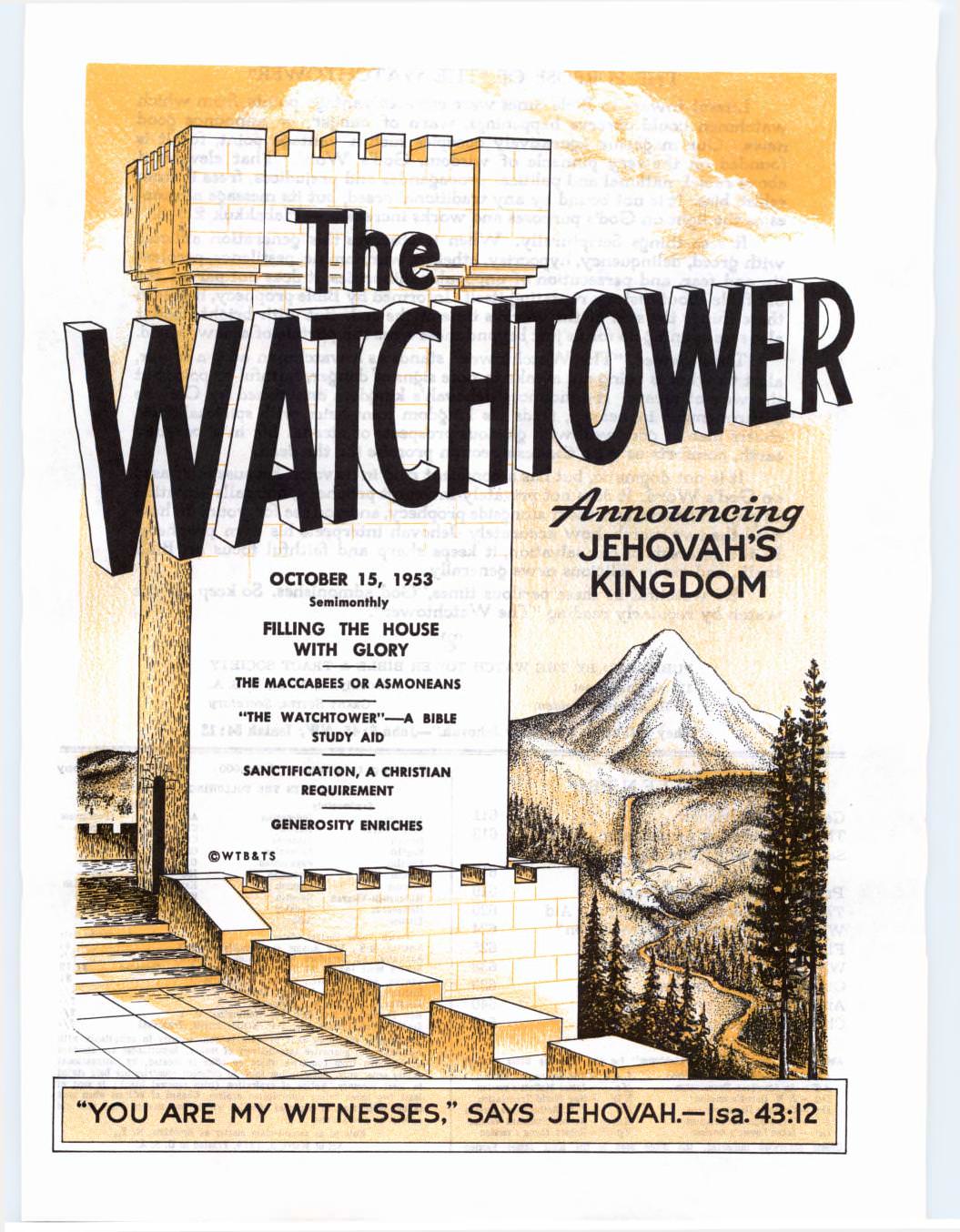
The WATCHTOWER
Announcing
JEHOVAH'S
KINGDOM
OCTOBER 15, 1953
Semimonthly
FILLING THE HOUSE
WITH GLORY
THE MACCABEES OR ASMONEANS
"THE WATCHTOWER"—A BIBLE
STUDY AID
SANCTIFICATION, A CHRISTIAN
REQUIREMENT
GENEROSITY ENRICHES
©WTB&TS
"YOU ARE MY WITNESSES," SAYS JEHOVAH.—Isa. 43:12 THE PURPOSE OF "THE WATCHTOWER"
Literal towers in Bible times were elevated vantage points from which watchmen could observe happenings, warn of danger, or announce good news. Our magazine figuratively occupies such a vantage point, for it is founded on the very pinnacle of wisdom, God's Word. That elevates it above racial, national and political propagandas and prejudices, frees it from selfish bias. It is not bound by any traditional creed, but its message advances as the light on God's purposes and works increases.—Habakkuk 2:1-3.
It sees things Scripturally. When it observes this generation afflicted with greed, delinquency, hypocrisy, atheism, war, famine, pestilence, perplexity and fear, and persecution of unpopular minorities, it does not parrot the old fable about history repeating itself. Informed by Bible prophecy, it sees in these things the sign of the world's time of the end. But with bright hope it also sees opening up for us just beyond these woes the portals of a new world.
Thus viewed, "The Watchtower" stands as a watchman atop a tower, alert to what is going on, awake to note signs of danger, faithful to point out the way of escape. It announces Jehovah's kingdom established by Christ's enthronement in heaven, feeds his kingdom joint-heirs with spiritual food, cheers men of good will with glorious prospects of eternal life in a paradise earth, comforts us with the resurrection promise for the dead.
It is not dogmatic, but has a confident ring in its voice, because it is based on God's Word. It does not privately interpret prophecy, but calls attention to physical facts, sets them alongside prophecy, and you see for yourself how well the two match, how accurately Jehovah interprets his own prophecy. In the interests of our salvation, it keeps sharp and faithful focus on Bible truth, and views religious news generally.
'Be watchful in these perilous times,' God admonishes. So keep on the watch by regularly reading "The Watchtower".
ဒီ
PUBLISHED BY THE WATCH TOWER BIBLE & TRACT SOCIETY
117 Adams Street Brooklyn 1, N. Y., U. S. A.
N. H. KNORR, President
GRANT SUITER, Secretary
"They will all be taught by Jehovah."—John 6:45, NW; Isaiah 54:13
CONTENTS
Generosity Enriches
The Maccabees or Asmonéans
Sanctification, a Christian Requirement
Principle Ignored 800 Years
The Watchtower-a Bible Study Aid
Which Side Are the Churches On?
Filling the House with Glory
Which Papers Do You Read?
Questions from Readers
Announcements
Check Your Memory
AS - American Standard Version
LXX - The Septuagint Version
AT - An American Translation
Mo - James Moffatt's version
Da - J. N. Darby's version
NW - New World Translation
Dy - Catholic Douay version
Ro - J. B. Rotherham's version
ED - The Emphatic Diaglott
RS - Revised Standard Version
Le - Isaac Leeser's version
Yg - Robert Young's version
<tr><th colspan="2">Semimonthly
Monthly
Afrikaans
Indonesian
Arabic
Portuguese
Cebu-Visayan
Italian
Clibemba
Russian
Danish
Japanese
Clinyanja
Slamese
English
Norwegian
Cishona
Siloxl
Finnish
Pangasinan
Greek
Slovak
French
Slovenian
Ibo
Twl
German
Spanish
Kanarese
Ukrainian
Hiligaynon-Visayan
Swedish
Korean
Urdu
Hollandish
Tagalog
Malayalam
Yoruba
Ilocano
Zulu
Polish
GENEROSITY ENRICHES
IN Brooklyn, New York, the last Saturday afternoon in June was extremely hot and humid. But that did not keep Christian ministers of Jehovah from calling at the homes of the people, looking for rooming accommodations for their fellow ministers who were coming from 96 different lands to attend the New World Society Assembly of Jehovah's Witnesses, which was to be held at the Yankee Stadium in just three weeks. Evidently the weather had driven most of the Brooklynites to the beach or the country, for in the majority of the places no one answered the doorbell.
At one apartment a woman was speaking on the phone as the minister rang her bell. The door being open, she called out, asking what was wanted. The minister began to explain the purpose of his call but was cut short with "Nothing doing here!" Then, continuing her phone call, she explained to the person at the other end of the line: "That was the Watchtower. Imagine the nerve of those people, coming around looking for rooms!"
However, about an hour earlier in the afternoon a woman had invited the minister in. "I'm living alone," she said. "My son just left for Korea. I'll be glad to let you have his room." As the minister explained the need of rooms the woman stated: "You say they are ministers? I'll let them have my own bedroom also. I can go on my vacation while they are here and
they can have the use of the whole apartment. I'll wait until they arrive and turn the key over to them. . . Climbing stairs on such a hot afternoon! Could I offer you a glass of cold ginger ale?" Which of these two women was the happier, the wiser?
Of course most persons would say that the one who showed generosity was the wiser, the happier of the two, but by their actions many of such would belie their words. The tendency of the times is to get all one possibly can and to give as little as possible. The clock watcher at the office or factory certainly is not generous with his time, energy and brains. The housewife who rushes through her duties so that she can spend most of her days gossiping or at the movies likewise does not believe in being generous. Neither is the Christian minister who contents himself with merely the average of his congregation's activities in the matter of time or financial support.
Selfishness is folly. He who is stingy and miserly in his relations with others will receive like currency in return. Not only that, but his whole outlook on life is cramped, skimpy, shallow and small. He gives because he has to, and so does not enjoy giving; the less he gives the less he wants to give and the more it hurts him to give. And, above all, such a one shortchanges himself as regards the favor of Jehovah and the blessings he has in store for his generous servants.
How strikingly different from all such niggardliness is the example set by Jehovah God! Generously he purposed for man to live forever and enjoy endless and inexhaustible blessings upon earth. And not only in his material blessings but also in his spiritual gifts is Jehovah generous: "If anyone of you is lacking in wisdom, let him keep on asking God, for he gives generously to all and without reproaching, and it will be given him."—Jas. 1:5, NW.
Solomon appreciated the wisdom of generosity. "There is that scattereth, and increaseth yet more; and there is that withholdeth more than is meet, but it tendeth only to want. The liberal soul shall be made fat; and he that watereth shall be watered also himself." And again, "Cast thy bread upon the waters; for thou shalt find it after many days. Give a portion to seven, yea, even unto eight; for thou knowest not what evil shall be upon the earth."—Prov. 11:24, 25; Eccl. 11:1, 2, AS.
Christ Jesus stressed the wisdom of generosity also. "Practice giving, and people will give to you. They will pour into your laps a fine measure, pressed down, shaken together and overflowing. For with the measure that you are measuring out they will measure out to you in return." Also, "If someone under authority impresses you into service for a mile, go with him two miles. Give to the one asking you, and do not turn away from one that wants to borrow from you without interest."—Luke 6:38; Matt. 5:41, 42, NW.
Paul also makes this point, particularly in his second letter to the Corinthians: "Our heart has widened out. . . I speak as to children—you, too, widen out." "He that sows sparingly will also reap sparingly, and he that sows bountifully will also reap bountifully."-2 Cor. 6:11, 13; 9:6, NW.
But let us not make the mistake of thinking that the wisdom of generosity applies
only in a material way. Christian ministers may often be like the apostles Peter and John who had neither silver nor gold to give to the cripple lying at the temple door, but who were able to give something far more valuable, physical health. Surely our gifts of the truth, the hope and comfort of God's kingdom resulting in spiritual health, are far more valuable than any gold and silver we or any others may be able to give. And to the extent that we are generous with our time and energy in bringing comfort to others, to that extent we shall be "watered," refreshed, and become "fat," prosperous, spiritually. Our example of generosity will most likely awaken generous sentiments in men of good will.
Still another respect in which we can show generosity and be enriched by it is by showing mercy. We can be generous in our judgment of others, those with whom we live as members of a family, those with whom we rub elbows at our places of employment, and our associates in the Christian congregation. We all are imperfect, we all make mistakes.
Then again we may hear unfavorable reports regarding one. The wise course is to be generous, charitable, forgiving as regards the failings of others. As far as possible give them the benefit of the doubt; reason that there must have been extenuating circumstances. That kind of thinking makes for our own peace of mind and puts us in position to be able to help erring ones. Better to err on the side of being too generous and forgiving than on the side of being too severe and unyielding. Showing mercy we shall receive mercy.
Truly, to show generosity is the wise course: it enriches both the one to whom it is extended and the one showing it, whether it be expressed in material or spiritual gifts or in the showing of mercy to others. Generosity enriches.
The MACCABEES or ASMONÉANS
GOD'S Word the Bible is silent regarding Jewish history between the time of Nehemiah and John the Baptist. This was not due to some oversight, but doubtless because the spirit of prophecy was not at work among them. (2 Pet. 1:21, NW) It was during the latter part of this period, particularly between the years 168 B.C. and 40 B.C., that the Maccabees took the lead in Jewish affairs in Palestine.
For more than a century after Nehemiah's time the Jews had comparative quiet. They prospered, multiplied and strengthened themselves, for the Persian rulers as well as their successor, Alexander the Great, were very favorably disposed toward them. At Alexander's death, in 323 B.C., his kingdom was divided among his four generals, Ptolemy Soter being given Egypt and Seleucus being given Syria, including Palestine. During the next twenty years Palestine became a pawn in the hands of these two generals as it was taken and lost, taken and lost, by one or the other.
Then, during the rule of Ptolemy Soter's son, Philadelphia, the Jews enjoyed great prosperity. It was he who made Alexandria the center of learning in the ancient world and caused the Septuagint, the Greek translation of the Hebrew Scriptures, to be started, in 280 B.C., for the benefit of some 80,000 Jews residing in Alexandria, most of whom had been brought to Alexandria by his father.
Several other Ptolemies succeeded Philadelphia in their turn, not, however, without a gradual weakening of their rule, so that, in 199 B.C., the Syrian ruler Antiochus the Great (III) was able to retake
Palestine. After him came his son, Antiochus Epiphanes (175-164), a religious fanatic, who, because of his lack of success in his wars against the old enemy Egypt, embarked on a religious crusade to force the people under him to convert to the religion of the Greeks. According to the historian Lord, "this monarch was one of the most cruel, rapacious and tyrannical princes" ever to achieve infamy on the pages of history.
He succeeded in converting the Samarians by force and then proceeded in the same manner with the Jews, appointing a high priest willing to suppress everything Jewish and popularize everything Greek. In 170 B.C., he came to Jerusalem and looted the temple. Two years later he returned, desecrating the temple by sacrificing a sow on its altar and dedicating it to Zeus Olympus. Copies of the law were burned, and possession of them was made punishable with death. An image was set up in the temple and harlots were brought into it. Circumcision was a capital crime and Jews were forced to eat swine's flesh. The walls of Jerusalem were razed, and in the city a garrison of Greeks and apostate Jews was planted to enforce this policy of unification by the Grecian religion and "culture."
Because of these events some of the Jews fled Jerusalem to Modin (location of which is uncertain), among whom was one Mattathias, a Levite priest who had five grown sons. Influential and rich, the king's officer endeavored to bribe Mattathias to get him to co-operate in the Grecian proselytizing campaign. However, Mattathias not only contemptuously rejected the offer but publicly announced he would adhere strictly to the law of Moses. It seems that at the very time he made this declaration an apostate Jew came forward to sacrifice upon a heathen altar. This so enraged old Mattathias that he not only slew the Jew upon the altar but also killed the king's commissioner, and then tore down the pagan altar.
As a result of this he had to flee to the mountains, taking with him not only his five grown sons but also a large following who responded to his call: "Let everyone zealous for the Law follow me!" Soldiers were sent after these, and, attacking on a sabbath, when the Jews refused to fight, they slew a thousand of his followers. Because the Jews repeatedly suffered great losses due to their refusal to fight on the sabbath, Mattathias decreed that from then on they would fight if attacked on the sabbath.
Although very old, Mattathias was able to raise a large army and succeeded in driving the persecuting soldiers out of the country, pulling down heathen altars and re-establishing Jewish ceremonies. After but two years of this activity he died at the age of 145, according to Josephus. Shortly before his death he called together his five sons, John (Johannes), Simon, Judas "Maccabeus," Eleazar and Jonathan, and urged them to keep up the struggle
against the policies of Antiochus to Grecize the Jews.
JUDAS MACCABEUS
In accordance with the recommendation of Mattathias, Judas Maccabeus took the lead in the warfare against the Syrian overlords, and his name soon became associated with all his brothers and their descendants, so that they all were called Maccabees, regarding the derivation of which name there are many theories. Actually, however, the proper name for the family is Asmonéan or Hasmonéan, from the great-grandfather of Mattathias, Chasmon, who, it appears, was a descendant of the priestly family Jehoiarib.—1 Chron. 24:7.
Judas Maccabeus and his soldiers went through the cities of Judah and destroyed pagan worshipers, Gentile and apostate Jew alike, and tore down their altars. Apollonius, military governor of Samaria, marched forth against Judas with a much superior force, only to be slain and have his army scattered. Hearing of this, Seron, commander-in-chief of the Syrian forces in Palestine, and a higher-ranking general with a larger force, set out against Judas. He likewise suffered defeat with a great loss of men. As a result the name of Judas Maccabeus became a terror to the nations round about.
King Antiochus Epiphanes, furious at the setbacks these Syrian armies received at the hands of Judas, had his deputy or lieutenant, Lysias, prosecute the war against the Jews while he embarked on other campaigns. Lysias put three experienced generals at the head of forces numbering 40,000 footmen, 7,000 horsemen and a number of elephants. Judas and his band of 3,000 outmaneuvered the generals and routed their armies, slaying some 3,000 and taking immense spoil. The following year Lysias himself set out against Judas at the head of 60,000 chosen footmen and 5,000 cavalry.
Judas with but 10,000 dispersed these also.
This victory, occurring in the year 165 B.C., opened to Judas the way to Jerusalem. Entering it, he cleansed and rededicated the temple just exactly three years to the day after it had been so vilely polluted by Antiochus and his armies. This day, the twenty-fifth of Chislev, the ninth month, was thereafter celebrated by the feast of dedication and is referred to at John 10:22.
Then the surrounding nations, the Idumeans, descendants of Esau, with various Bedouin tribes, sought to accomplish what the Syrian armies had failed to do; but Judas, dividing his forces of 13,000 men into three sections, kept 2,000 in Jerusalem and divided the rest in two armies, and, marching in different directions, defeated all these enemies. By this time, 164 B.C., Antiochus was stricken with elephantiasis, and, noting that death was near, appointed his friend Philip regent until his son Eupator should come of age. Lysias, who had served as deputy or lieutenant, challenged this appointment of Philip and as a result of the wars between these two the Jews had a brief respite.
There was, however, still a sore spot to the Jews, the garrison of Syrian and apostate Jewish soldiers on Mount Zion, and so Judas proceeded to attack these, who in turn sent word to Eupator, or more likely to Lysias, the regent, who sent an overwhelming army of 100,000 soldiers, 20,000 cavalry and 32 elephants. In this battle, which was undecisive, Eleazar, one of the sons of Mattathias was crushed by an elephant, the first of the five Maccabees to fall. Lysias, hearing that his rival Philip had taken Antioch, hurriedly made peace with Judas and returned to Antioch to oust
Philip. Shortly thereafter Demetrius, son of Seleucus, returned to the palace of his ancestors and slew both Lysias and the young king and reigned in their stead.
Judas defeated an army that Demetrius sent under Bacchides; and another under Nicanor, which general Judas himself slew. After this Judas made a treaty with the Romans. Again Demetrius sent Bacchides, one of his ablest generals, against Judas, this time with an army of 22,000. Due to bloody wars, propaganda and fear, the forces under Judas dwindled to a mere 800, but this did not prevent him from engaging the thousands under Bacchides in battle. Hemmed between two forces, the Jewish army was decimated and Judas slain.
JONATHAN AND SIMON
The patriotic party among the Jews offered to Jonathan, the youngest of the sons of Mattathias, the lead and he accepted. However, he was not the military leader Judas had been, and his warfare was mostly defensive or in the form of raids. The Syrian overlords, however, were glad to make peace with him because of the strife and confusion at home. Opposing factions each in turn sought the favor of the Jews and at times Jewish armies fought to help put down Syrian rebellion. In 144 B.C. Jonathan was nominated high priest by the Syrian king, and a year later a Syrian conspirator, Tryphon, lured Jonathan with a few soldiers into a trap and slew them, although at the time Jonathan had an army of 40,000 under him.
During the early part of Jonathan's rule of eighteen years his brother John was slain. So now, with his death, there remained but Simon. In the first or second year of Simon's leadership the Jews gained independence for themselves in Palestine, even getting rid of that hated Syrian garrison on Mount Zion that had so long harassed the worshipers at the temple.
So noteworthy was this lifting of the Syrian yoke by Simon considered that the Jews began dating their documents from "the first year of Simon, high priest, commander and leader of the Jews."
Under Simon the Jews prospered, and the treaty with Rome was renewed; although they must afterward have regretted it, as it furnished the excuse for Rome to gain mastery over Palestine eventually. While free from Gentile aggression, the Jews quarreled among themselves, and so it was that after but eight years of leadership Simon's end came; he, together with two of his sons, was murdered by one Ptolemy, a son-in-law who aspired to the high priest's office. Simon's son, John Hyrcanus, took his place. He subdued Samaria and Galilee, extending the limits of his kingdom almost to its borders under King David.
After almost thirty years, John Hyrcanus was succeeded by his son Aristobulus, a wicked prince who assassinated his brother and starved his mother to death in a dungeon. After him came Alexander Jannaeus, whose turbulent reign lasted 27 years, to 78 B.C., and who was succeeded by his wife Alexandra, who ruled for nine years. Her son Hyrcanus II succeeded her; but, having to contend with the intrigues of his brother, Aristobulus, he put himself under the protection of the Romans. As the historian Lord expresses it: the Romans "came as arbiters, they remained as masters." Supporting Hyrcanus' cause was an Idumean prince, Antipater, "wealthy, active and seditious," who wormed himself into favor with the Romans and soon enjoyed the actual power while Hyrcanus held the sovereignty. Antipater's son Herod proceeded to Rome and by intrigues secured for himself the kingship of Judea. After a three-year war he subdued the
Asmonéan prince Antigonus, and put him to death, as well as the other two remaining princes of that line and all the members of the Sánhedrin save two. While the Asmonéan line thus ended as far as its ruling princes were concerned, its policies continued through the Sadducees down to the desolation of Jerusalem A.D.70.
During the time the Asmonean princes held sway in Judea, "dangers then were as much from within as from without; and party jealousies brought the divine cause to the greatest peril." "Enforced idolatry, a temporizing priesthood, and a faithless multitude" describes the Jews at that time. It was the time when tradition became more important than the written Word; when the apocryphal books were written, including the so-called Psalms of Solomon. The last of the high priest's line had fled to Egypt, and the office had become a political commodity.
While certain historians grow eloquent in telling of the wars of the Maccabees and would place the Maccabees on a par with the valiant warriors mentioned in the Hebrew Scriptures and in the eleventh chapter of Hebrews, yet the fact remains that the wars of the Maccabees were not fought at Jehovah's direction, his name was not the paramount issue, divine power was not exercised on their behalf. On the contrary, these were political, patriotic wars, even though the Jews' religion was involved, and in that respect are to be likened rather to the wars fought by the Swiss, the Dutch and the Americans for freedom.
The record of the Maccabees graphically underscores the warning Jehovah gave the Jews as to what they could expect if they turned away from serving him, as well as the rule expressed by Christ Jesus, "All those who take the sword will perish by the sword."—Leviticus, chapter 26; Matt. 26:52,NW. SANCTIFICATION a CHRISTIAN REQUIREMENT
WHAT constitutes a Christian? Strictly speaking, a Christian is a holy one, a sanctified one, a "saint." He is one whom Jehovah God has sanctified and who has sanctified himself and who is leading a life of sanctification. As the apostle Paul expressed it, "This is what God wills, the sanctifying of you."—1 Thess. 4:3, NW.
What is God's part and what is the part of the Christian in sanctification? On what is it based? What is its purpose? Its goal? The noun "sanctification" comes from the Latin sanctificatio, and the verb "to sanctify" from sanctificare, meaning "to make holy." In the Hebrew Scriptures these terms translate various forms of the word qadash, which, according to its connections, has the root meanings of "to be bright, new, clean" and "to separate, to divide off, to cut away." In simplest terms "to sanctify" means to separate or set apart for the service and use of Jehovah God. Thus McClintock and Strong's Cyclopaedia defines sanctification as "separation from ordinary use to a sacred purpose."
In the Hebrew Scriptures both persons and things were sanctified. By his deliverance of the entire nation of Israel Jehovah set them apart for his own holy purpose, and so he speaks of sanctifying the entire nation. (Ex. 31:13) And because of his sparing the first-born at the passover Jehovah claimed them as his in a special sense, and so instructed Moses: "Sanctify unto
Later on Jehovah took the tribe of Levi in the place of the first-born and it became a sanctified tribe: "The Levites shall be mine; because all the firstborn are mine; for on the day that I smote all the firstborn in the land of Egypt I hallowed [sanctified: qadash] unto
me all the first-born."—Ex. 13:2, AS.
me all the firstborn in Israel." (Num. 3:12, 13) By means of a special ceremony Aaron and his sons were both consecrated, that is, authorized, commissioned, appointed, had their hands filled with certain prerogatives, and sanctified, set apart from ordinary to special sacred service, as priests.—Ex. 28:41; 29:33.
Jehovah set aside or sanctified the seventh day of creation from ordinary to special use, which the rest of the Scriptures show to be to vindicate his name. (Gen. 2:1-3) At the time of the giving of the law Mount Sinai was declared to be set apart, holy or sanctified. Neither man nor beast was permitted to come near it. (Ex. 19:23) Pagans would have termed it taboo. The word qadash was also used to denote the cleansing and purifying from certain defilements or the preparing of oneself for special occasions. (Josh. 3:5; 2 Sam. 11:4) All such sanctifications, however, were typical or representative, foreshadowing the real sanctification that was to come with Christ Jesus.
CHRISTIAN SANCTIFICATION
In the Christian Greek Scriptures the words sanctify and sanctification translate Greek words whose root is hagios, an adjective meaning "holy," which in turn is comprised of two roots or smaller words meaning "not of the earth"; and hence, "dedicated to God above." In each instance in the King James "New Testament" the Greek word for "saint" is hágios.
The same is also true of the word "Holy" in the expression "Holy Ghost." Christians are therefore holy ones, set apart for God's service.
It is Jehovah God who makes holy or sets apart the Christian, even as Christ testified regarding himself: "Do you say to me whom the Father sanctified and dispatched into the world, 'You blaspheme,' because I said, I am God's Son?" (John 10:36, NW) In the case of Christ's followers God does this by Christ Jesus: "Both he who is sanctifying and those who are being sanctified all stem from one."—Heb. 2:11, NW.
These sanctified ones or "saints" are not limited to a miracle-working few, but include all the spiritual body of Christ. Thus Paul repeatedly addresses his letters to the sanctified ones, called to be "saints" or holy ones.—See Romans 1:7; 1 Corinthians 1:2; Ephesians 1:1; Philippians 1:1; Colossians 1:2.
On what basis does Jehovah God sanctify these? On the basis of Christ's ransom sacrifice: "We have been sanctified through the offering of the body of Jesus Christ once for all time." "Hence Jesus also, that he might sanctify the people with his own blood, suffered." (Heb. 10:10,29; 13:12, NW) God's Word of truth also plays a vital role in the work of setting these apart for God's service. That is why Christ prayed: "Sanctify them by means of the truth; your word is truth." (John 17:17, NW) Additionally God's active force or power at work is needed, and so we read that Christians are "sanctified with holy spirit."—Rom. 15:16, NW.
Jehovah God and Christ Jesus do their part of sanctifying the Christian by means of Christ's blood, the truth of God's Word and the holy spirit. But there will be no resultant sanctification unless the Christian also does his part. He must first of all exercise faith, for we are told that Christians are "sanctified by their faith in" Christ; by their "faith in the truth."—Acts 26:18; 2 Thess. 2:13, NW.
Further, the Christian must also separate himself from the unclean world; not by entering a monastery or convent, but by not spotting himself with this world's greedy commerce, its corrupt politics, its false religions. (Jas. 1:27; 1 John 2:15-17, NW) And he must also keep himself morally clean, as Paul emphasized in his letters to the Thessalonians and to Timothy: "For this is what God wills, the sanctifying of you, that you abstain from fornication; that each one of you should know how to get possession of his own vessel in sanctification and honor, not in covetous sexual appetite." "Be a vessel for an honorable purpose, sanctified, useful to his owner, prepared for every good work. So, flee from the desires incidental to youth, but pursue righteousness, faith, love, peace, along with those who call upon the Lord out of a clean heart."—1 Thess. 4:3-5; 2 Tim. 2:21, 22, NW.
The foregoing words of Paul also give us the purpose of sanctification, namely, to be an instrument useful to God, prepared to do his work. Yes, while keeping clean along such lines is the requirement of all, it is especially incumbent upon Christians to cleanse themselves, for they have the privilege and responsibility of bearing the vessels of Jehovah, the truths of God's Word and the privileges of service that go with the understanding of them.—Isa. 52:11.
Sanctification primarily concerns those Christians who have a heavenly hope, those who, because of their faith and dedication to do God's will in the "acceptable season," have been declared righteous by Jehovah God and given a heavenly hope. (Rom. 5:1; 2 Cor. 6:2, NW) They are referred to as a "little flock"; as "the bride, the Lamb's wife"; as of "Abraham's seed," which is to bless all the families of the earth.
(Gen. 22:17,18; Luke 12:32; Gal. 3:29; Rev. 21:9,NW) They are called a little flock, for their number is limited to 144,000, as Revelation 7:4-8 and 14:1,3 clearly show. It is only to these that Paul's words are directed: "Pursue peace with all
and eat the fruit of them; men will be at peace with one another and with the lower animals; and gradually death and all its concomitants of sickness, sorrow and pain will be done away with.—Isa. 65:17-25; Rev. 21:4.
In the days of Israel's typical theocracy, God had one law for the homeborn and the stranger in a great number of things. The
people, and the sanctification without which no man will see the Lord."—Heb. 12:14,NW.
However, the Bible also shows that there are "other sheep," a "great crowd" of dedicated Christians who have an earthly hope. (John 10:16; Rev. 7:9-17) An earthly hope? Yes, for God's Word assures us that the earth abides forever and was created to be inhabited; that it is the place of God's feet and that he will make it glorious. (Eccl. 1:4; Isa. 45:18; 60:13; 66:1) In that glorious new earth men will build houses and inhabit them plant vineyards
same is true today, in a number of respects God has one law for his spiritual Israel and the "strangers," the Christians who have dedicated themselves to Jehovah God but who have an earthly hope. Though not strictly considered as sanctified ones or "saints," these nevertheless are benefited by Christ's ransom sacrifice at the present time, have the truth of God's Word and receive of his active force or holy spirit. They also must exercise faith, keep themselves separate from the world and morally clean as they serve as God's instruments to make his truths known to others
PRINCIPLE IGNORED 800 YEARS
The Biblical principle condemning the honoring of a man because of wealth and position is stated by James: "For if there shall come into your assembly a man having a golden ring, in fine apparel; and there shall come in also a poor man in mean attire: and you have respect to him that is clothed with the fine apparel and shall say to him: Sit thou here well; but say to the poor man: Stand thou there, or: Sit under my footstool: do you not judge within yourselves, and are become judges of unjust thoughts. Hearken.
sively. . . Membership in the order, for all except the lowest category, has been restricted to men of noble blood." In April "the Vatican, after making a long study of the Knights and their modern works decided that . . . the higher degrees of Knights need no longer be of noble birth."
Was this so they would conform at last to the Christian principle stated at Galatians 3:28 that there would be neither Jew nor Greek, bond nor free, male nor female divi-
my dearest brethren: Hath not God chosen the poor in this world, rich in faith and heirs of the kingdom which God hath promised to them that love him?"—Jas. 2:2-5, Catholic Douay Version.
The Knights of Malta do not believe that. Time magazine reported, April 20: "The Knights of Malta . . . after their emergence during the 12th century as a crusading order of warrior-clerics . . . built up strong dynasties in Palestine, Rhodes and Malta successions severing the Christian congregation? Oh, no! That was not mentioned at all. Money was involved. Rich Americans and prominent men elsewhere who had no claim to royalty had been excluded from the higher orders of the Knights. Time explained that a Vatican official had said: "Had it continued to exclude blood other than blue blood, [the order] would have been bound to extinction." If it holds to this principle God will extinguish it anyway, its financial situation notwithstanding.
Bible Study Aid
WHY do we need The Watchtower? Because The Watchtower helps us to understand the Bible. And why should we want to understand the Bible? Because the Bible is the infallible guide furnished us by a loving and wise Creator.
God's Word is a lamp to our feet and a light to our path. (Ps. 119:105) Without it we would walk in darkness. (Isa. 8:20, 21; Matt. 15:1-14) It is as a lamp shining in a dark place to which we do well to take heed until the day dawns and the daystar rises. (2 Pet. 1:19-21, NW) As Paul the apostle expresses it: "All Scripture is inspired of God and beneficial for teaching, for reproving, for setting things straight, for disciplining in righteousness, that the man of God may be fully competent, completely equipped for every good work." 2 Tim. 3:16, 17, NW.
God's Word means not only light for us but also life. "This means everlasting life, their taking in knowledge of you, the only true God, and of the one whom you sent forth, Jesus Christ," said Jesus in his prayer on the night of his betrayal. He told his disciples, "The sayings that I have spoken to you are spirit and are life," which sayings have been recorded in the Bible. He well knew that "man must live, not on bread alone, but on every utterance
coming forth through Jehovah's mouth." (Deut. 8:3; Matt. 4:4; John 6:63; 17:3, NW) Even to Adam that truth was brought home, for although he had sufficient of the necessities to sustain life, yet eventually, after he had lived for 930 years, he died because of ignoring God's Word.—Gen. 3:17- 19; 5:5.
God's Word means life and light to us, however, only if we exercise faith. (Matt. 9:29) "Without faith it is impossible to win his good pleasure, for he that approaches God must believe that he is and that he becomes the rewarder of those earnestly seeking him."—Heb. 11:6, NW.
Since today, more than ever before, attacks are being made upon the Bible's authenticity, its principles and its wisdom, it becomes increasingly important that through study of the Bible we become equipped with a large shield of faith to ward off all such attacks, attacks made not only by its avowed enemies, but also by its professed friends. And with more than 250 different sects claiming to be Christian in the United States alone, we must study our Bibles if we would be able to give a satisfactory answer to everyone that demands of us a reason for the hope that is in us. (1 Pet. 3:15, NW) As the wise man expressed it: "The heart of the righteous studieth to answer."—Prov. 15:28, AS.
Further, as moral conditions go from bad to worse it becomes ever more difficult to hold on to the righteous principles of God, which should govern our daily lives. To continually strengthen our resolves to do what is right, to have God's love for righteousness and his hatred for wickedness, we must keep on thinking God's thoughts, keep on renewing our minds and making over our personalities by means of the truth.—Matt. 16:23; Rom. 12:2; Phil. 4:8; Col. 3:9, 10, NW.
HELP NEEDED
No question about it, if we would gain life we must study the Bible. But does that in itself mean that we need The Watchtower? Cannot we individually go to the Bible and gain all the knowledge and understanding necessary? Can we? At Acts, chapter 8, we read of an official of Queen Candace, an Ethiopian eunuch, who went directly to his Bible, but when he was asked by the disciple Philip, "Do you really know what you are reading aloud?" what was his answer? "Really how could I ever do so, unless someone guided me?" He realized his need of help. And Philip, having been guided by others in the first place, was equipped to give this Ethiopian eunuch the guidance he needed.—Acts 8:27-38, NW.
Note also the two on the way to Emmaus on the morning of Jesus' resurrection. They must have been familiar with God's Word or Jesus would not have chided them for being 'slow in heart to believe all that the prophets had spoken,' but they did not understand. It took Jesus' explanation of what they were already familiar with to cause them to see how the Scriptures foretold the Messiah's sufferings and death. No wonder they afterward exclaimed: "Were not our hearts burning as he was speaking to us on the road, as he was fully opening up the Scriptures to us?"—Luke 24:13-32, NW.
conception of Christianity until Paul enlightened them.—Acts, chapter 10; 18:25, 26; 19:1-7,NW.
Cornelius undoubtedly was acquainted with God's Word, but only with Peter's help did he recognize Christ Jesus as the Messiah. Apollos, although "aglow with the spirit," needed help to understand "the way of God more correctly." And the disciples at Ephesus had a very inadequate
WHY "THE WATCHTOWER"?
Since it is apparent that we do need help to understand the Bible, why, of all the religious literature published, should we look to The Watchtower for this help? First of all, because it adheres strictly to the Bible; it lets "God be found true, though every man be found a liar." (Rom. 3:4, NW) It is not restricted by any creeds or traditions of men, but stands solely and solidly on the Scriptures. It does not bow down to, nor does it claim to speak for, a magisterium that assumes an authority above that of God's Word. Even as Jesus did, it continually supports its statements and explanations with "It is written." (Matt. 4:4, 7, 10; 11:10; 21:13; 26:24, 31, NW) And even as Jehovah invites his earthly creatures, so The Watchtower invites all its readers: "Come now, and let us reason together." Isa. 1:18, AS.
It does not support any of the political ideologies of the various blocs of the nations, but gives its allegiance solely to the kingdom of God. It does not preach brotherly love in times of peace and fratricide when nationalistic passions are aroused in time of war. It keeps itself unspotted from the world even as Jesus did.—John 18:36; Jas. 1:27.
The Watchtower, not being bound by any creed, is able to progress with the increasing light. It appreciates that "the path of the righteous is as the light of dawn, going on and brightening, unto meridian day." (Prov. 4:18, Ro) When clearer light shines on the Scriptures as a result of fulfillment of prophecy or greater research, it is not too proud to give to its readers the benefit of the improved understanding of God's will and purposes.
To help us to understand the Bible, The Watchtower uses the topical method. By this method all the information on a certain subject contained in all the sixty-six books of the Bible is brought together and compiled in a logical and orderly manner. This is necessary because the Bible, being largely historical, is written in a running style, and therefore, with few exceptions, does not treat comprehensively any one teaching at one place. This is also true because many of the false teachings that now confuse professed Christians were unknown among the servants of Jehovah in times past; the truth was taken for granted. In rounding out this topical method of study The Watchtower takes note of the meaning of the words in the original Hebrew, Aramaic and Greek languages, and it also takes into consideration the context of the texts it cites to prove a point.
By making use of such a topical arrangement The Watchtower is not skipping around, trying to find a text to prove a pet theory or preconceived opinion, but is letting the Bible as a whole indicate God's mind on a subject. Incidentally, this method is not new with The Watchtower, but is, in effect, the method used by Jesus in his sermon on the mount, the method Peter used on the day of Pentecost, and the method Paul used time and again in his letters. For examples please see: Matthew 5:21-38; Acts 2:14-28; Romans 15:7-13; Hebrews 1:5-14.
STUDY "THE WATCHTOWER"
There seems to be a tendency on the part of some of the readers of The Watchtower to peruse merely the main article of each issue, including perhaps the questions from readers. This is a mistake. The Watchtower deals with Bible teaching or doctrine, Bible prophecy, Christian conduct, Bible history and current missionary activity.
Only by giving careful consideration to all its contents, including its so-called secondary articles, can we hope to get a roundedout Scriptural education and keep up to date with the advancing light.
Each issue of The Watchtower may be likened to a well-balanced and wellprepared meal. Nutritionists tell us that the body needs proteins, starches, minerals and vitamins, and a rounded-out meal will provide all these. It would be a mistake to ignore any one of these. In the same way we should not ignore any of the courses of our spiritual meal. And just as we would not think of rushing through a natural meal but would take time to enjoy it, so we should also not rush through our spiritual meals.
Nor is mere reading of The Watchtower enough. Much of it, particularly the main or study articles with questions, present complex and weighty truths, often entirely new and different from anything that has been published previously, which cannot be fully understood and appreciated by just one reading. Such intellectual or spiritual fare requires thorough mastication, that is, concentration, meditation and reflection. To make such truths and arguments our own we must be convinced of their Scripturalness, their reasonableness, their factualness. That requires going over the material several times, not just once.
Besides, we want to remember as much as possible, for our purpose in acquiring these truths is not just for our own enjoyment but to give us something that we can pass on to others. And only if we have a point clearly in mind shall we be able to explain it to others; another reason for our studying The Watchtower thoroughly.
Further, The Watchtower contains much admonition and instruction regarding Christian conduct and activity. To gain the full impact of such we must go over it again and again.
Unless we are moved to action we are like the foolish man that built his house upon the sand. Then ours would be a dead faith.-Matt. 7:26, 27; Jas. 2:14-26, NW.
HOW TO STUDY "THE WATCHTOWER"
As Christians, study of the Bible, with the help of Bible aids, is not discretionary but mandatory, for the apostle Paul's instructions to Timothy apply to each one of us: "Do your utmost to present yourself approved to God, a workman with nothing to be ashamed of, handling the word of the truth aright." (2 Tim. 2:15, NW) If we want life we must gain God's approval, and if we want God's approval we must handle the Word of God aright, and to do that we must study. How can we best study the Bible with the aid of The Watchtower?
First of all, we recognize that it takes time to study, so we must buy out time for regular and unhurried study. If we have a very full schedule we might find fifteen or thirty minutes daily the first thing in the morning, or right after breakfast or at some other convenient time of day. (Eph. 5:16) Otherwise it would be well to budget at least one evening a week for our own private study. Nor should we overlook the fact that the busy and alert minister will take advantage of opportunities to study when traveling, even as he is alert to opportunities for incidental preaching.
To properly study The Watchtower we must approach it with the right heart attitude. While we are commanded, "Make sure of all things; hold fast to what is right," let us not overlook the fact that we are also admonished, "Do not treat prophesyings with contempt." (1 Thess. 5:20, 21, NW) Having found, time and again, that The Watchtower adheres faithfully to God's Word, we have no grounds for approaching a study of it with suspicion, but rather we should approach it with a sincere desire to understand what God has provided for us through its pages, ever ready to "accept with mildness the implanting of the word which is able to save [our] souls."—Jas. 1:21, NW.
The Beroeans set us a good example in this. True, they made certain that what Paul told them was based on the Scriptures; but did that mean that they listened to Paul with a skeptical, critical or antagonistic spirit? Not at all. Rather, we are told that they "received the word with the greatest readiness of mind."—Acts 17:11, NW.
Having the right heart attitude toward the material we are to study, we should next make sure that we dismiss all matters not germane to our study. We cannot expect to receive much benefit from our study if we have our minds on something else; some pleasant or unpleasant experience we just had or which we expect to meet up with after our study. Having set aside time for the study of The Watchtower, let us give it our undivided attention; as Paul expresses it, "pay more than the usual attention to the things" we are studying. Otherwise they will not impress themselves deeply enough on our subconscious minds so that we can recall them at will.—Heb. 2:1, NW.
Note the title and the caption text, if there is one, also the relationship between the two. As you read note not only what is presented, but how. Reflect, note how the argument is being developed. Something new? or differently expressed than before? Look up the texts cited but not quoted; note their application. Do you appreciate what light they throw on the theme under discussion? You may want to underscore main points, or the exact answers to the questions, if the article has questions. Can you express the answer in your own words? If supporting ideas, texts or facts come to mind, why not jot them down in the margin for use at the congregational study?
In an article of any length there usually are subheadings, denoting a change in thought or another aspect of the main theme. Note how the succeeding paragraphs relate to it. After you have studied an article or that part scheduled for the coming congregational study, reflect. What were the main points, the new points, the points particularly helpful to me? Go over the study questions again; as you read them does the answer to each one immediately come to mind? Remember, one of the best aids to study is review.
Studying The Watchtower with another has much to recommend itself. Studying with another lightens the labor of concentration, increases the joy, makes for better understanding, as well as improved ability to express oneself in the congregational study of The Watchtower. Something for members of a family to consider.
Congregational study of The Watchtower? Yes, each week, at some fourteen thousand Kingdom Halls of Jehovah's witnesses an hour is set aside, usually on Sunday afternoon or evening, for the study of the Bible with the help of The Watchtower. It is not enough to study privately or with other members of our family. We gain more from each lesson if we hear what others have to say in answer to its questions; they may have a different, more correct or more complete understanding of it than we do. And not only can we receive help at such a study but we can also give help to others. They need what we can give, we need what they can give. No individual member of the Christian congregation can say to another, "I have no need of you."—1 Cor. 12:19-22, NW.
A knowledge and understanding of the Bible means light and life. To gain that knowledge and understanding we need help. The Watchtower is the pre-eminent Bible study aid. Let us show our appreciation of it by carefully reading it from cover to cover, by thoroughly studying its main articles in private or with our families, and then by regularly coming together for congregational study where we not only gain further help but are able to help our fellow Christian ministers.
WHICH SIDE ARE THE CHURCHES ON?
Under the heading "Do Lottery, Liquor Belong in Church?" the Paris, Texas, News carried the case of a woman who said nervously: "My husband is a very attractive man, but he has been addicted to gambling. I have tried everything in my power to make him give up this evil habit, but it seems to have him enslaved as much as if he were a dope addict. Just when I thought I was making some progress, my husband comes home with a handful of tickets being sold by my church, and waves them in my face. My church is having a lottery, and is giving away 500 in cash prizes. The first prize amounts to 200, and the smallest is 10. The tickets sold for 10 cents apiece, but this price was listed in the corner as 'Donation—10 cents'. I suppose that was just a means of evading the laws against gambling. My husband tells me that I have a lot of nerve to preach to him about the evils of gambling when my own church is running a lottery. He asks me to explain the difference between his patronizing a bookie, where he bets 2 on a race horse, and buying a handful of chances on a church lottery at a dime a ticket. Is sin only that type of behavior on which the church obtains no financial returns? My husband is now ridiculing my religion and calling us hypocrites."
Y. N. И. У.
THE house to be filled with glory was a temple dedicated to Jehovah of hosts. He
"And I will fill this house with glory, saith Jehovah of hosts." Hag. 2:7, Da.
promised to fill it with glory.
His promise to do so came as the crowning point of a prophecy of the greatest import to all the nations. "For thus saith Jehovah of hosts: Yet once, it is a little while, and I will shake the heavens, and the earth, and the sea, and the dry land; and I will shake all nations, and the desire of all nations shall come; and I will fill this house with glory, saith Jehovah of hosts."—Hag. 2:6,7, Da.
2 Pronounced more than twenty-four centuries ago, this prophfathers at Mount Sinai through Moses. (Lev. 26:27-35;1 Ki.9:6-9) Now a remnant of the chastised Israelites had had their God Jehovah open the way for them to leave their captivity in Babylon and return to their homeland. For what purpose? Primarily for the purpose of rebuilding Jehovah's house on the old temple location, that his true worship might be revived and carried on there. Because of enemy opposition and misguided interference from the
Persian government the
then a modest temple the building of which was less than a month in progress. It was being built upon the site of the former temple of King Solomon there on Mount Moriah in Jerusalem. Following the destruction of Solomon's temple by the Babylonians in 607 B.C., that sacred location had lain desolate for seventy years, the whole city had lain desolate, the entire realm of the kingdom of Judah had
Sunday morning, July 26, 1953 the final day of the New World Society Assembly of Jehovah's Witnesses at Yankee Stadium, New York city, N.Y., the following speech was delivered by the vice-president of the Watch Tower Bible and Tract Society before an audience of 131,419 conventioners.
restored remnant of Israelites had lost sight of the primary purpose of their being restored to their homeland. They ceased working on the temple and let it lie, hardly begun, to the reproach of their God Jehovah.—Luke 14:29,30.
For thus choosing to obey man as ruler rather than God they did not prosper for the sixteen years that Jehovah's house lay neglected. Then, to stir up the Jewish governor Zerubbabel and the Levite high
lain desolate without man and his domesticated beasts. It was a divine judgment against the nation because of their longcontinued violation of the covenant that Jehovah God had made with their forepriest Joshua and all the restored remnant, Jehovah God gripped his prophet Haggai with his holy spirit and had Haggai encourage them to renew the temple work in fulfillment of their solemn obligation to God. With faith in God the remnant took up the temple work once more. About a month later, when things had begun to take shape, Haggai was inspired by God's spirit to utter the electrifying prophecy just quoted.—Hag.
1:1 to 2:9.
4 Haggai's prophecy was never really fulfilled upon the temple that Governor Zerubbabel finished building four years later, nor upon Herod's temple that succeeded it, even though Jesus Christ did visit that temple and teach in its courts. The temple priesthood and other Jewish religious leaders did not permit that temple to be filled with any glory through Jesus Christ and his apostles. In 70 (A.D.) it was put to the torch by the Romans and destroyed. It will never be rebuilt for Haggai's prophecy to be fulfilled in it. But in 1919, less than six months after the end of World War I, Jehovah God did something that corresponded with his restoring of the Jewish remnant from Babylon back in 537 B.C. He delivered a remnant of his anointed witnesses from the power of a greater Babylon, the Devil's world organization that had laid violent hands upon Jehovah's witnesses during World War I and had taken them captive against their wills. God's purpose in delivering them was the same as that in the case of the Jewish remnant in the days of the prophet Haggai—temple work. As long as the restored remnant of anointed witnesses of Jehovah would concentrate on this temple work, they were bound to prosper spiritually.
5 What was this temple work to be? Not the erecting of a literal temple of earthly materials either at Jerusalem or at 124 Columbia Heights, Brooklyn, New York, or anywhere else. There is no need for such a literal temple today. Such a temple would be so inadequate as God's house. "Thus saith Jehovah: The heavens are my
throne, and the earth is my footstool: what is the house that ye will build unto me? and what is the place of my rest?" (Isa. 66:1, Da) The heavenly throne of Jehovah was symbolized by the propitiatory cover upon the ark of the covenant that stood inside the Most Holy of the temple of Jerusalem. The propitiatory cover was surmounted by two golden cherubs that faced the center of the cover with outstretched wings. Here Jehovah was symbolized as throning amid the cherubs, and his glory light, called the Shekinah, lit up the otherwise unlighted Most Holy of the temple. From there Jehovah communicated with his people Israel. But those were only symbolisms. God's true throne is the heavens. There is where he reigns as universal sovereign; and the earth, where once his material temple stood on Mount Moriah, is to him like a footstool by which he steps up and mounts his high-seated throne.
No man-made temple, no matter of what grand proportions, can house or hold in the Most High God. Solomon was awed by the realization of this. When he dedicated the gorgeous temple he had built and when the glory of Jehovah filled the house with a miraculous cloud, Solomon said in prayer to him: "But will God indeed dwell on the earth [in a material temple]? Behold, the heavens, and the heaven of heavens, cannot contain thee; how much less this house which I have built!" Solomon's temple could not possibly be the place of Jehovah's real throne. Nonetheless, God had respect to that temple because of what it symbolized and what it foreshadowed for the future, and he kept a watchful eye upon it and put his incomparable name upon it. He said to Solomon: "I have sanctified this house which you have built in which to put my name forever; and my eyes and my heart shall be there for all time."
(1 Ki. 8:27-30, Da; 9:3, 7, AT) Because Jehovah was present there in a representative way, it was proper for Israelites and also strangers of good will to turn to the temple when praying, just as if literally facing him when making a request of him. Solomon prayed: "And as to the stranger also, who is not of thy people Israel, but cometh out of a far country for thy name's sake . . . when he shall come and pray toward this house, hear thou in the heavens thy dwelling-place, and do according to all that the stranger calleth to thee for; in order that all peoples of the earth may know thy name, and that they may fear thee as do thy people Israel; and that they may know that this house which I have built is called by thy name."—1 Ki. 8:30-43, Da.
The day of such symbolisms is now gone, and no temple of Jehovah will ever be built again on Mount Moriah and there will be no need to remove the Mohammedan "Dome of the Rock" just to build a temple there such as is pictured in Ezekiel's vision. (Ezek. 40:1 to 46:24) How contrary, then, to the Holy Scriptures for any religion to build basilicas, cathedrals and churches to house what they call "the host," which the priest claims to transmute into God! Neither by such "host" nor by any other representation does the Most High God dwell now in any temple made with man's hands. The Christian martyr Stephen made that plain to the Jewish Sanhedrin of Jerusalem while Herod's temple still stood, saying: " [King] Solomon built a house for him. Nevertheless, the Most High does not dwell in houses made with hands; just as the prophet says: 'The heaven is my throne, and the earth is my footstool. What kind of house will you build for me? Jehovah says. Or what is
the place for my resting? My hand made all these things, did it not?' Years later the apostle Paul repeated this truth to the pagan Athenians, saying: "The God that made the world and all the things in it, being, as this One is, Lord of heaven and earth, does not dwell in handmade temples, neither is he attended to by human hands as if he needed anything, because he himself gives to all persons life and breath and all things." (Acts 7:47-50; 17:24,25,NW) Those who profess to be Christians and who have been induced by one argument or another into contributing to the building of costly, overdecorated religious buildings ought to know this truth already, but do not.
8 Let such pause to consider God's inquiry: "What manner of house will ye build unto me? and what place shall be my rest? For all these things hath my hand made, and so all these things came to be, saith Jehovah." (Isa. 66:1, 2, AS) Whatever kind of house man may erect must be of materials God already made. That is the kind or manner of house that anybody could build in a material way. Such a place for God to rest symbolically is no longer acceptable to him. He himself is building a real temple out of altogether new material that human architects cannot use. It is made up of 144,000 and One stones, not quarried, fashioned and laid in place by man, but "living stones," each one of which is a "new creation," each one a living, intelligent new creature of God, while Jesus Christ his Son is the "foundation cornerstone." It is a "spiritual house for the purpose of a holy priesthood, to offer up spiritual sacrifices acceptable to God through Jesus Christ." (1 Pet. 2:4-6 and 2 Cor. 5:17 and Eph. 2:20-22, NW) This is the real temple that was foreshadowed by that which Solomon built and that which Governor Zerubbabel rebuilt.
This is the temple on which Jehovah God has his eyes and where his heart is. Upon it he has put his holy name.
…