The Watchtower, January 15, 1954
Download: PDF — The Watchtower, January 15, 1954
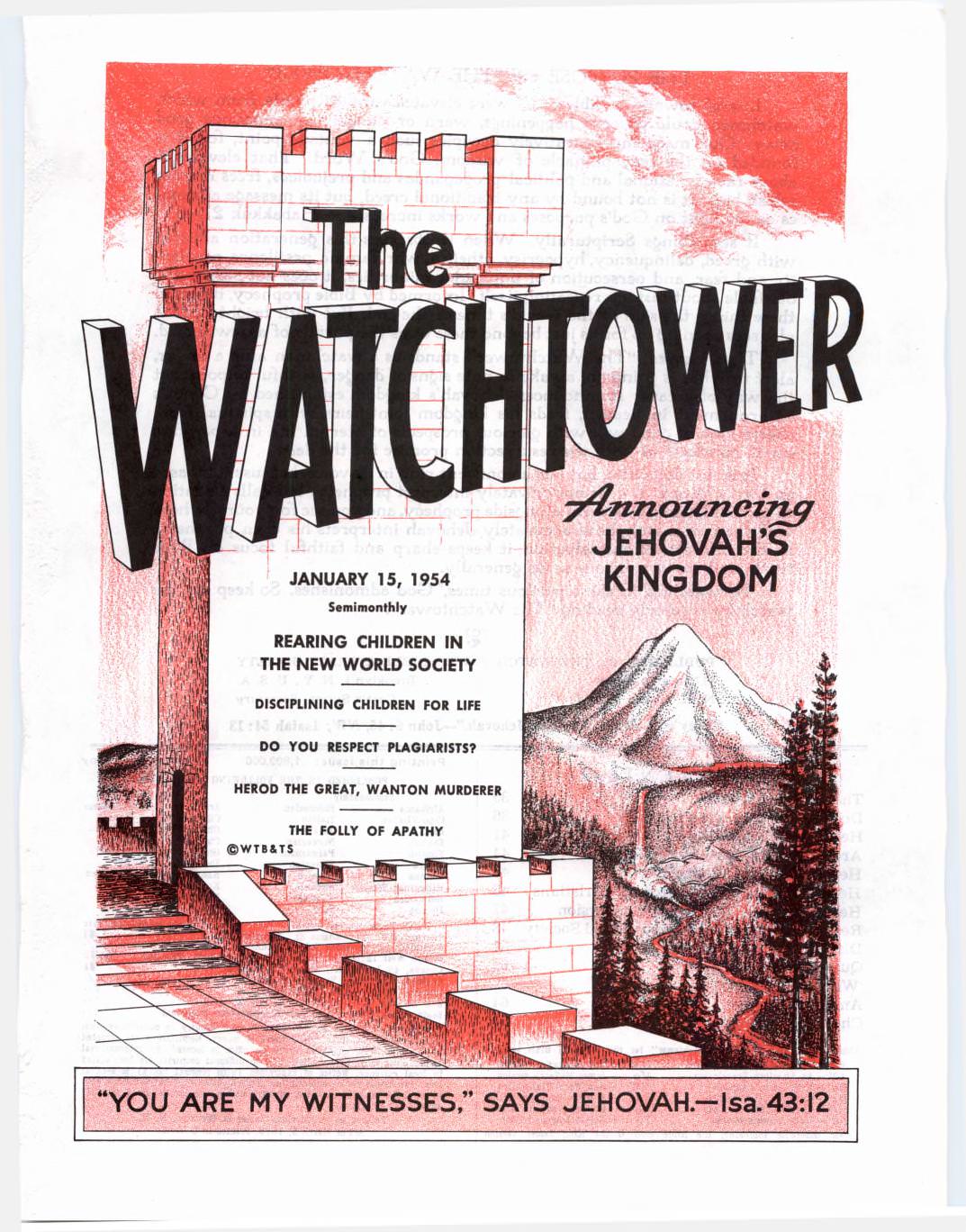
"YOU ARE MY WITNESSES," SAYS JEHOVAH.—Isa. 43:12
The WATCHTOWER
Announcing
JEHOVAH'S
KINGDOM
JANUARY 15, 1954
Semimonthly
REARING CHILDREN IN
THE NEW WORLD SOCIETY
DISCIPLINING CHILDREN FOR LIFE
DO YOU RESPECT PLAGIARISTS?
HEROD THE GREAT, WANTON MURDERER
THE FOLLY OF APATHY
©WTB&TS
“YOU ARE MY WITNESSES,” SAYS JEHOVAH.—Isa. 43:12 THE PURPOSE OF "THE WATCHTOWER"
Literal towers in Bible times were elevated vantage points from which watchmen could observe happenings, warn of danger, or announce good news. Our magazine figuratively occupies such a vantage point, for it is founded on the very pinnacle of wisdom, God's Word. That elevates it above racial, national and political propagandas and prejudices, frees it from selfish bias. It is not bound by any traditional creed, but its message advances as the light on God's purposes and works increases.—Habakkuk 2:1-3.
It sees things Scripturally. When it observes this generation afflicted with greed, delinquency, hypocrisy, atheism, war, famine, pestilence, perplexity and fear, and persecution of unpopular minorities, it does not parrot the old fable about history repeating itself. Informed by Bible prophecy, it sees in these things the sign of the world's time of the end. But with bright hope it also sees opening up for us just beyond these woes the portals of a new world.
Thus viewed, "The Watchtower" stands as a watchman atop a tower, alert to what is going on, awake to note signs of danger, faithful to point out the way of escape. It announces Jehovah's kingdom established by Christ's enthronement in heaven, feeds his kingdom joint-heirs with spiritual food, cheers men of good will with glorious prospects of eternal life in a paradise earth, comforts us with the resurrection promise for the dead.
It is not dogmatic, but has a confident ring in its voice, because it is based on God's Word. It does not privately interpret prophecy, but calls attention to physical facts, sets them alongside prophecy, and you see for yourself how well the two match, how accurately Jehovah interprets his own prophecy. In the interests of our salvation, it keeps sharp and faithful focus on Bible truth, and views religious news generally.
'Be watchful in these perilous times,' God admonishes. So keep on the watch by regularly reading "The Watchtower".
২
PUBLISHED BY THE WATCH TOWER BIBLE & TRACT SOCIETY
117 Adams Street
Brooklyn 1, N. Y., U. S. A.
N. H. KNORR, President
GRANT SUITER, Secretary
"They will all be taught by Jehovah."—John 6:45, NW; Isaiah 54:13
CONTENTS
The Folly of Apathy 35
Do You Respect Plagiarists? 36
Herod the Great, Wanton Murderer 41
Archelaus, the Ruthless Ethnarch 44
Herod Antipas, "That Fox" 45
Herod Agrippa, Persecutor of Christians 46
Herod Agrippa II Resists Conversion 47
Rearing Children in the New World Society 48
Disciplining Children for Life 54
Questions from Readers 62
'Words Fitly Spoken' 63
Announcements 64
Check Your Memory 64
AS- American Standard Version
LXX- The Septuagint Version
AT-An American Translation
Mo-James Moffatt's version
Da-J. N. Darby's version
NW-New World Translation
Dy-Catholic Douay version
Ro-J. B. Rotherham's version
ED-The Emphatic Diaglott
RS-Revised Standard Version
Le-Isaac Leeser's version
Yg-Robert Young's version
Unless otherwise indicated, the Bible used is the King James Version
Semimonthly
Monthly
Afrikaans
Indonesian
Arabic
Portuguese
Cebu-Visayan
Italian
Cibemba
Russian
Danish
Japanese
Cinyanja
Slamese
English
Norwegian
Cishona
Silozi
Finnish
Pangasiman
Greek
Slovak
French
Slovenian
Ibo
Twl
German
Spanish
Kanarese
Ukrainian
Hiligaynon-Visayan
Swedish
Korean
Urdu
Hollandish
Tagalog
Malayalam
Yoruba
Ilocano
Zulu
Polish
Watch Tower Society offices Yearly subscription rate
America, U.S., 117 Adams St., Brooklyn 1, N.Y. $1
Australia, 11 Beresford Rd., Strathfield, N.S.W. 8/-
British West Indies, 21 Taylor St., Port of Spain, Trinidad$ 1.72
Canada, 40 Irwin Ave., Toronto 5, Ontario $1
England, 34 Craven Terrace, London, W. 2 7/-
Jamaica, 151 King St., Kingston 7/-
New Zealand, G.P.O. Box 30, Wellington, C. 1 7/-
South Africa, Private Bag, P.O. Elandsfontein, Transvaal 7/-
Remittances should be sent to office in your country in compliance with regulations to guarantee safe delivery of money. Remittances are accepted at Brooklyn from countries where no office is located, by international money order only. Subscription rates in different countries are here stated in local currency. Notice of expiration (with renewal blank) is sent at least two issues before subscription expires. Change of address when sent to our office may be expected effective within one month. Send your old as well as new address.
Entered as second-class matter at Brooklyn, N. Y., Act of March 3, 1879. Printed in U. S. A.
THE FOLLY OF APATHY
THIS is the day of indifference, unconcern and apathy. Talk to a person about the dry rot of corruption in high places, and he manifests indifference. Tell him about the staggering and evermounting national debt that is undermining the nation's economic stability, and he remains unconcerned. Warn him of the creeping fascism that is gnawing at the very vitals of his most precious freedoms, and he shows apathy. And knock at his door with a message from God's Word, and he may not even exert himself to ascertain whether the one calling is peddling shoe strings or is a Christian minister bringing the good news of God's kingdom.
And modern man feels quite pleased with his apathy. Why be concerned with corruption, with a day of reckoning or with what the morrow may bring? Things are going well with me today! Like his counterpart of twenty-five centuries ago he says: "Jehovah seeth us not; Jehovah hath forsaken the land." "Jehovah will not do good, neither will he do evil." (Ezek. 8:12; Zeph. 1:12, AS) Or he may take the smug attitude that "the old-time religion is good enough for me," never concerning himself with whether his forebears used good judgment in picking their religion or not.
Actually his actions show him to be the fool that "hath said in his heart, There
is no God." (Ps. 14:1) Deep down in that heart he is dissatisfied with his philosophy of life, but instead of looking for something better, he selfishly indulges himself in physical pleasures and sooner or later is made to know the truth that "whatever a man is sowing, this he will also reap." Gal. 6:7, NW.
Instead of manifesting apathy, now more than ever before is the time for us to be alert, watchful, interested and concerned, for there is a God in heaven and his Word is truth. And that Word shows that we are living in a transition period from an old system of things to a new heavens and earth. (2 Pet. 3:4,13) Now, therefore, is the time to heed Jesus' warning: "Pay attention to yourselves that your hearts never become weighed down with overeating and heavy drinking," and to obey the command: "Seek ye Jehovah, . . . seek righteousness, seek meekness." —Luke 21:34; Zeph. 2:3, AS.
Those who make the hope of God's kingdom their concern will receive even now peace of mind and joy of heart. And that hope is truly a prize for which to live, work and fight, for it will take an everlasting life to realize fully its blessings of peace and prosperity, health and life. Those manifesting apathy toward that hope today will never know such blessings. Truly such apathy is folly.
Do You Respect Plagiarists?
A New York preacher and a Texas editor repeatedly take articles from "The Watchtower" and "Awake!" and publish them as their own in their religious paper
WHAT do you think of a man that lifts articles from one magazine and has them published in another magazine? What do you think when he attaches his name as author of the stolen articles? What do you think of him when he continues to do it after he has been caught and has promised to quit? And does the fact that he claims to be a minister of religion shock you still more?
Again, what do you think of the magazine that uses the plagiarized articles? What do you think of the judgment of such a magazine when it denounces as false another magazine, then turns around and prints as truth the articles plagiarized from it? What do you think of the editor that tells the injured magazine its word is worthless when it brings the plagiarism to his notice? What do you think of him when he ignores the proof sent to him? What do you think when his magazine continues to use the stolen articles? And does not the fact that this magazine poses as Christian make the plagiarism even more reprehensible?
Can you have confidence in such a writer? or in the magazine that uses his plagiarized copy? or in the editor that directs it? Consider the facts, then form your opinion.
The "writer" is Antonio Ochoa of New York city and is a minister of the Churches of Christ. The magazines from which he copies his articles are The Watchtower and the Awake! published by the Watchtower Society, who are publishers for Jehovah's witnesses. The magazine that uses the plagiarized articles is the Churches of
Christ paper Gospel Broadcast, published in Dallas, Texas. The editor and publisher of it is Eugene S. Smith.
The Watchtower Society learned of this unethical practice when a member of the Churches of Christ presented one of Jehovah's witnesses with a copy of the Gospel Broadcast. "We were somewhat shocked," wrote the witness, "to find that this magazine, namely the Gospel Broadcast, is copying the articles from The Watchtower and is printing them as though their minister was the originator of them." Churches of Christ members were very much more shocked when Jehovah's witnesses at their doors would tell them that parts of their Gospel Broadcast were only reprints of parts of The Watchtower and Awake! How odd, since their religious leaders tell them these magazines are false, for their paper to use articles from these magazines and credit one of their ministers as the author!
A HASTY REPLY
When we wrote Editor Smith asking if it was his policy to republish articles without giving credit to the original publications he snapped back: "Since
ization in the past, it means absolutely nothing."
Would not a reliable editor have investigated such a serious charge before answering? Above all, should not an editor claiming to be Christian be guided by the Bible principle, "He that answereth a matter before he heareth it, it is folly and shame unto him"? Hasty replies that question the veracity of others are not characteristic of men possessing understanding: "He that is slow to wrath is of great understanding: but he that is hasty of spirit exalteth folly."—Prov. 18:13; 14:29.
Smith's quick retort may have sprung from the high esteem in which he holds Ochoa, for the man in charge of the Gospel Broadcast's publishing plant is reported to have lauded Ochoa as a great scholar, not knowing apparently that the scholarly articles had been lifted from the publications of Jehovah's witnesses. But whatever Smith's reasons for his slurring reply to our letter about the plagiarized material, we responded to it by sending marked copies of nine different issues of The Watchtower and one of Awake! that had been plagiarized in fourteen issues of the Gospel Broadcast in just nine months; and a
number of other examples could have been cited.* Our letter accompanying the proof of plagiarism stated:
"In your letter of May 23 [1953] to us you said you had only our word on this matter and concluded that our word meant absolutely nothing. The foregoing gives you proof that it does mean something. Now we would like to know if you have any apology or reconsideration to make concerning this discourteous dismissal of our first letter bringing this matter to your attention. Do you think your appropriating of another organization's labor and writing without giving credit is ethical or Christian? While you may not have known your contributor was lifting the articles from The Watchtower, yet you must know that publishers cannot shift responsibility in such matters to contributors. The publisher bears responsibility for what he prints."
This registered letter requested the courtesy of an answer. None was received. It seems that this editor that called our word worthless was knocked speechless when he realized he had thrown a verbal boomerang. It must have been a sickening sensation when he checked and saw paragraph after paragraph in Ochoa's articles that were lifted bodily from earlier issues of The Watchtower and Awake!
A BROKEN PROMISE
What did the Churches of Christ minister, Antonio Ochoa, have to say when confronted with his plagiarist activities? Writing on May 18, 1953, he said: "In
<tr><th>Gospel Broadcast date
Title of articles
Date of Watchtower copied from
July 17, 1952
Are Popes Fallible or Infallible?
March 15, 1952
July 24
Are Popes Fallible or Infallible?
March 15, 1952
September 4
Constantine's Cross
August 1, 1951
October 16
True Religion versus False Religion
February 1, 1952
January 8, 1953
Is God Responsible for All Evils?
April 1, 1952
January 22
Choosing Now to Live Then: How?
March 15, 1952
January 29
Choosing Now to Live Then: How?
March 15, 1952
February 5
Early Christians Unspotted from the World
March 1, 1951
February 19
Is Christmas Christian or Pagan?
December 15, 1952
March 12
Do You Have Hearing Ears?
May 15, 1952
April 9
God's People and the Bible
December 15 and November 1, 1952
April 16
God's People and the Bible
November 1, 1952
April 23
God's People and the Bible
November 1, 1952
June 4
Is the Holy Mass a Scriptural Sacrifice?
March 1, 1953
June 11
Is the Holy Mass a Scriptural Sacrifice?
March 1, 1953
respect to your letter of May 16, I have to admit that it is true that I have quoted certain articles from your magazine and I haven't said the origin of such research because of the strong prejudice among the people who read those articles, against Jehovah's witnesses.
I thank you very much for your letter and the advice you give me, and I promised that never I will do that any more as that is your will. Although I have to tell you that I never have received money for the things I write, my only purpose is to do something good and open the eyes of the people who don't have perhaps the opportunity to see the truth more perfectly because of the prejudices and the environment where they live."
What Ochoa is saying is that the people of his own religious faith are so prejudiced that they would not consider Bible truth if they knew it came from Jehovah's witnesses. Because of these prejudices he says they "don't have perhaps the opportunity to see the truth more perfectly." This is an admission that their own church does not provide them with clear truth and that to "open the eyes of the people" he brings into their view the clear truth presented in The Watchtower and Awake! But "because of the strong prejudice" against Jehovah's witnesses, he says he must let them think the needed truth is from his pen to get them to take it in. Apparently he puts Editor Smith in the same prejudiced class in need of truth, and gets him to accept it for publication by concealing its real source.
But what of Ochoa's promise to steal no more? Instead of falsely branding our word worthless Smith could truly say of Ochoa's word, "It means absolutely nothing." Four months after Ochoa's promise to quit plagiarism the Gospel Broadcast of September 17 published almost in its entirety an article from the February 8, 1953,
Awake! and their issue of September 24 carried an article copied paragraph for paragraph from the June 8 Awake! But Ochoa still feels that the Gospel Broadcast readers are too prejudiced to take truth straight from the original source; so he took full credit. The October 8 Gospel Broadcast again carried reprints from The Watchtower with typist Ochoa posing as the author. As he had frequently done before, he even used our title, "The Greater Happiness of Giving," in copying from our August 1 issue. Mixed in with our material, which highlighted the happiness of giving spiritual food, was Ochoa's thanks for money sent to him. He enjoys receiving money, but spiritually gives only what he has taken from others. Perhaps the spiritual pantry of his own church is bare. Editor Smith must think it is, else why knowingly continue an accomplice to literary piracy?
As this is being finally written, the latest plagiarism is in the November 19 Gospel Broadcast. It has word for word the four-page article of the February 1, 1953, Watchtower entitled "Transmitting God's Word." That is, word for word except where Ochoa failed to copy carefully and left out three lines, resulting in sentences that made no sense. Ochoa did not catch his copyist errors, nor did Smith, nor did proofreaders. Similar carelessness occurred in the February 5, 1953, Gospel Broadcast, which took an article from The Watchtower but made some cuts to fit the available space. This article was documented, with reference numbers in the article and at the end these numbers and the sources of proof were listed. When they cut the article some reference numbers were cut, but at the end of the article these omitted numbers appeared with their sources, just as in The Watchtower's complete article. They are very careless plagiarists, as well as unprincipled.
Jesus said: "By your words you will be vindicated, and by your words you will be condemned." (Matt. 12:37, NW) So hear their words. In the Gospel Broadcast of last May 14 their writer James Lovell said: "The world does not take our word or recognize our goodness above that of any other religious body and HAS NO VALID REASON TO DO SO. It is high time those of us who call ourselves Christians returned to God." We agree, and suggest as a beginning the ending of plagiarizing and the questioning of our word when they do not think very highly of their own. "First extract the rafter from your own eye, and then you will see clearly how to extract the straw from your brother's eye." (Matt. 7:5, NW) In the November 25, 1948, Gospel Broadcast Lovell noted the growth of Jehovah's witnesses despite persecution and said: "Our love for and faith in Christ are not enough to bring any sort of persecution in any nation." After mentioning the tremendous circulation of Jehovah's witnesses' literature, he said: "Much of the stuff we print is trash which our own members will not buy or read, much less being able to sell it to others." Saying Watch Tower publishing was done "by members who work for 10 a month 'expense money,'" he contrasted: "We have a few loyal, consecrated servants who give themselves to the Cause for 50 a sermon 'expense money,' but, like a Catholic, there is an extra 'expectation' for preaching a funeral or performing a wedding!"
In the May 28 Gospel Broadcast of last year Lovell lamented the twenty or more divisions of the Churches of Christ in America, saying: "Every faction among us is headed up by an editor who either seeks personal power or who sells books. . Our attitude as much as says forget what Christ taught or wants as long as we can build a business or father a faction." No
soldier of Christ needlessly "involves himself in the commercial businesses of life." Paul warns: "Keep your eye on those who create divisions." Also, "Does the Christ exist divided?" A church "divided against itself will not stand." A divided church may assume the name of Christ's church, but it is what they do more than what they say that counts: "Not everyone saying to me, 'Master, Master,' will enter into the kingdom of the heavens, but the one doing the will of my Father who is in the heavens will." (2 Tim. 2:4; Rom. 16:17; 1 Cor. 1:13; Matt. 12:25; 7:21, NW) And it is not Jehovah God's will for Christians to shun persecution, or print trash, or charge $50 for sermons, or build a business, or father a faction!
"THAT STEAL MY WORDS"
Nor is it Jehovah's will for Christians to be plagiarists. False prophets in Israel would mingle with their lies the true words of Jehovah delivered by faithful prophets. Jehovah's judgment was: "Behold, I am against the prophets, saith Jehovah, that steal my words every one from his neighbor." The unscrupulous falsifiers mixed in true expressions to give their religious lies a deceptive ring of truth.Jer.23:30,AS.
Again, in ancient Israel dishonest merchants would add water to the wine to make it go farther, and Jehovah used this to illustrate moral and spiritual corruption, saying: "Thy silver is become dross, thy wine mixed with water." (Isa. 1:22) Tasty wine that gives joy of heart should not be adulterated with water; nor should God's Word be adulterated by mixing in false creeds or modern philosophies. Yet this is done, to make the Bible acceptable to a wider class of persons, to spread its watered-down message farther and bring in greater financial returns. Paul condemned this, saying: "We are not peddlers of the word of God." He used the word "peddlers" to indicate dishonest merchants, such as those alluded to at Isaiah 1:22.
His expression can also be rendered: "We are not those who commercialize or make gain of the word of God," or, "We are not adulterators of the word of God." A little later in his writings he said: "We do not behave improperly, but we have renounced the underhanded things of which to be ashamed, not walking in craftiness neither adulterating the word of God, but by making the truth manifest recommending ourselves to every human conscience in the sight of God."—2 Cor. 2:17, NW, margin; 4:1, 2, NW.
We cannot comprehend how one who claims to be a Christian minister can deliberately and regularly plagiarize and yet have a clear "conscience in the sight of God." Does it not rather seem that men who can do this have been "marked in their conscience as with a branding iron," rendering it seared and insensitive to any guilt prickings? Is that why Ochoa and Smith have not "renounced the underhanded things of which to be ashamed," but continue "walking in craftiness," one pretending to write and the other publishing what is not theirs? Their continuing careers in plagiarism call to mind the words: "Were they ashamed when they had committed abomination? nay, they were not at all ashamed, neither could they blush."—1 Tim. 4:2, NW; Jer. 6:15.
Amos 8:11 (AS) states: "Behold, the days come, saith the Lord Jehovah, that I will send a famine in the land, not a famine of bread, nor a thirst for water, but of hearing the words of Jehovah." This spiritual famine is now on in the churches of Christendom, whether they be the fundamentalist groups whose creeds are based on pagan teachings such as trinity and purgatory and eternal torment, or the modernist cults that embrace worldly
philosophies and unprovable evolution theories. This famine explains the moral collapse and spiritual anemia rampant in Christendom at the present time. On the other hand, why are Jehovah's witnesses so zealous in preaching and so enduring under persecution, as Churches of Christ Lovell noted? Because they are spiritually well fed. Can a man do heavy physical labor on starvation rations? Neither can a man zealously preach and faithfully endure as a Christian when deprived of wholesome spiritual food.
WHY OBJECT?
No honest person would condone plagiarism. It is against the law. But our purpose in objecting to it is for an additional reason. Jesus warned his disciples: "Be on the alert and watch out for the yeast of the Pharisees and Sadducees." By "yeast" was meant false religious teachings. Paul showed what the result would be of mixing such yeast with the truth, when he announced the principle: "A little yeast ferments the whole lump." By mixing the false with the true the entire presentation is spoiled. It is like spoiling good wine with water. As Paul further said: "What fellowship does light have with darkness?" (Matt. 16:6, 11, 12; Gal. 5:9; 2 Cor. 6:14, NW) Since we believe the teachings of the Churches of Christ are erroneous we do not approve of our articles based on Bible truth being wrapped up in the same package with theirs, being made a part of the lump in which their yeast ferments. Also, some sincere readers of the Gospel Broadcast may see in the articles plagiarized from our magazines the message of truth; they would naturally look to that religious group as the source of such truths and put trust in it. This would leave them exposed to the falsehoods taught by that group.
Viewing it from the standpoint of the Churches of Christ: if they think we are wrong and they are right, why would they want to contaminate their message with what they consider our error?
The Scriptural principle outlined in the preceding paragraph operates, regardless of which is right and which is wrong. Maybe Ochoa and Smith are not sure they are right. Surely they would not reprint as their own The Watchtower and Awake! if they thought those magazines in error. And if the writers for and the editor of the Gospel Broadcast are so unstable, how can the readers feel confident in the paper's guidance? Readers can hereafter wonder when they see its articles: Are they by Churches of Christ ministers as it says, or are they reprints from the Watchtower or Awake! magazines? How can readers hereafter rely on that paper or its writers or its editor?
Christ Jesus said: "Be on the watch for the false prophets that come to you in sheep's covering, but inside they are ravenous wolves. By their fruits you will recognize them. Never do people gather grapes from thorns or figs from thistles, do they? Likewise every good tree produces fine fruit, but every rotten tree produces bad fruit; a good tree cannot bear bad fruit, neither can a rotten tree produce fine fruit. Every tree not producing fine fruit gets cut down and thrown into the fire. Really, then, by their fruits you will recognize those men." (Matt. 7:15-20, NW) So the conclusion of the matter is an easy application of this rule given by Christ. Do you think plagiarism is fine fruit from a good tree? Or do you think it is bad fruit from a rotten tree? You answer for yourself.
HEROD THE GREAT, Wanton Murderer
WHAT the Bible records regarding the various Herods is very brief. In going
The Herods and their immediate predecessors ruled in Palestine during the greater part of both the first century before Christ and the first century after Christ. They were Idumeans, or Edomites, whose people the Maccabean princes of the Jews had subjugated in the second century B.C. Early in the first century B.C., an Idumean, one Antipas, was appointed by the
to secular or profane history for additional information it is both interesting and strengthening to faith to note how truly representative of the individual Herods those fragmentary Scriptural references really are.
then ruling Jewish prince to be governor of Idumea. Upon his death he was succeeded by his son Antipater. This Antipater succeeded in causing strife between the members of the Jewish royal family from which he benefited, so that Julius Caesar made him governor of Judea as well as a Roman citizen.
At the time Antipater was appointed governor of Judea he gave the governorship of Galilee to his son Herod and that of Jerusalem to another son, Phasael.
According to Josephus, when Herod was made governor in 47 B.C. he was very young, only fifteen years of age. (Antiq. 14:9,2) Some historians insist that a copyist's error crept in here and that the record should read twenty-five years, so as to correspond with other dates given by Josephus.
Herod distinguished himself by ridding his territory of robber bands, whom he summarily executed without due process of law, much to the consternation of the Sanhedrin, whose authority he openly flouted. In 43 B.C. he succeeded his father, who had been poisoned by a Jewish general, but only after first putting down a revolt. He also had his father's assassin slain without legal formalities.
In 40 B.C. Herod had to flee for his life because of a successful revolt by the Jewish Asmonéan prince Antigonus. His brother failed to make a getaway and was forced to commit suicide. Herod eventually reached Rome, where he succeeded in obtaining the crown from the triumvirs Antony and Octavian. Returning, Herod gradually was able to gather to himself a Roman army of sufficient size to take Jerusalem and to establish himself as king of Judea in 37 B.C. Upon taking the city Herod executed forty-five of the leading partisans of Antigonus and later also Antigonus himself. All the Sanhedrin save two were likewise slain at Herod's command. Envious of the popularity of one of his brothers-in-law, a mere youth whom he had appointed high priest, Herod had him drowned and then feigned great sorrow at his death.
Herod had ten wives in all, of whom Mariamne, of the Jewish royal family, was the most beautiful. He was so jealous of her that on two occasions when he left for distant parts he gave secret orders that should he fail to return she was to be slain. Each time the one to whom he gave this order betrayed it to his wife. This involved each in the charge of adultery and as a result Herod had all three executed.
to Antony and to Octavian and gained favors from them.
Cunning and craftiness must be added to Herod's base traits. Adroitly he switched his allegiance to Julius Caesar, to Cassius,
King Herod was also an ambitious builder. He caused to be constructed theaters, amphitheaters, hippodromes, citadels, fortresses, monuments and even cities, which he named after himself, his relatives or the emperors. He built an artificial harbor city, Caesarea, which rivaled the seaport Tyre; he rebuilt Samaria, and carried on vast building projects in many other lands, in Tyre, in Sidon and in cities as far removed as Athens and Antioch.
He built many temples throughout his land in honor of Caesar Augustus, and a magnificent temple at Rhodes to the pagan deity Apollo. On Mount Zion he built a palace for himself as well as the famed "Herod's temple" for the Jews, which took forty-six years to fully complete. (John 2:20) At the time it was said concerning it: "He who has not seen Herod's temple has not seen anything beautiful."
But wicked Herod, in spite of his achievements, had no peace. The slaying of his beautiful wife Mariamne filled him with remorse. While currying the favor of the Jews by the construction of such a magnificent temple, he estranged himself from them by his idolatries, his foreign-building projects and by his appointment of Greek counselors. To many of the Jews he seemed to be no better than that Syrian ruler Antiochus Epiphanes, who tried to force the Greek religion and culture upon the Jews and against whom the Maccabees (Asmonéans) rebelled in the first place. Repeatedly the Jews made conspiracies to take his life and as a result one of his fortresses was continually filled with seditious Jews who, after a brief detention, were executed. Toward the closing years of his reign he had two of his own sons executed on suspicion of sedition and, while on his deathbed, a third son.
Licentious living—Herod was wanton in this respect also—brought upon him loathsome diseases from which he suffered greatly, his palace resounding with his cries.
He consulted physicians, took baths, but all to no avail. Sensing that the Jews would rejoice at the news of his death, he determined to have mourning at his death such as no king had ever had before. To this end he ordered all the principal men of Jewry brought to Jericho, where he was staying at the time, and incarcerated in the hippodrome, and then gave secret instructions that upon his death, before the news was to be given out, all these men were to be slain. These latter instructions, however, were not carried out.
MATTHEW'S ACCOUNT LEGENDARY?
According to the Jewish Encyclopedia, Vol. 6, page 360, Herod's connection "with the alleged massacre of the Innocents as related in the New Testament is now generally admitted by independent Christian thinkers to be legendary." Evidently such 'thinkers' base their conclusions on the fact that this incident was not recorded by Josephus or other historians of the time.
However, for truly Christian thinkers that is no proof at all. They stand by God's Word as true though it makes all men liars. (John 17:17; Rom. 3:4, NW) To deny the authenticity of Matthew, chapter two, would be to deny also the authenticity of Jeremiah 31:15, which prophetically foretold the incident, as well as remove the basis for the fulfillment of the prophecy at Hosea 11:1, regarding Jehovah's calling his Son out of Egypt. (Matt. 2:15) Numerous reasons might be given why Josephus and others failed to mention this event, intentionally or unintentionally; and, besides, the number of times that archaeology has verified the Bible on points on which secular historians were silent estops any doubting of Matthew's
account simply because it was not mentioned by others!
Some question Matthew's account because the date of Herod's death is generally given as 4 B.C., at the age of seventy years, whereas Bible chronology indicates that Jesus was born 2 B.C. (Compare Luke 3:1, 23 with Daniel's prophecy of "seventy weeks" at Daniel 9:24-27, and which weeks of years began in 455 B.C.) However, note the following:
According to Josephus' Antiquities, Book 14, chapter 16, (11,4) Herod took possession of Jerusalem in the summer of 37 B.C., and actually began to rule more than three years after he had been appointed to be king of Judea by the Roman senate. It is from this year, then, rather than from the earlier date, that Herod's 37-year reign mentioned by Josephus in Book 17, chapter 8 (1), should be counted. On the basis of this calculation Herod's death would fall in 1 B.C. or A.D.1, which would easily allow for Jesus' birth to fall in 2 B.C. during Herod's reign, and for the visit of the magi to Herod thereafter and then the slaughter of the young boys in Bethlehem.
Among the proofs given for Herod's death as occurring 4 B.C. is that he ordered the burning alive of two Jewish seditionists shortly before his death and that on the night they were executed there was an eclipse of the moon, and it is calculated that there was such an eclipse March 13, 4 B.C. But a lunar eclipse is not a sufficient date by which to locate the year of a certain event, because in any year there usually are two eclipse seasons and in many years two eclipses of the moon may be seen in a certain part of the earth. In fact, while only one partial eclipse is recorded for 4 B.C., three are given for 1 B.C., and they complete ones. So, on the basis of the eclipse, 1 B.C. would have a stronger claim than 4 B.C.
In this regard it is interesting to note that authorities differ greatly as to how old Herod was when he became governor in 47 B.C.; also that according to Appleton's Cyclopedia, when it comes to dates, Josephus "is altogether too careless to be taken into account." Thus the date of Herod's death furnishes no obstacle to accepting the account of the slaughter of young boys mentioned by Matthew. And certainly in view of what we have seen about Herod's disposition, his many murders and his scheme to slay all the principal men of Jewry so that there would be great mourning at his death, yes, everything we know about him is in keeping with that event.
ARCHELAUS, The Ruthless Ethnarch
WITH Archelaus, son and successor of King Herod, the proverb held true, "like father, like son," for he is described as "cruel and tyrannical, sensual in the extreme, a hypocrite and a plotter." His policies resulted in his being banished by the Roman emperor, thus bearing out
whose people were seething with discontent because of the burdens placed upon them by his muchmarried and construction-minded father. (1 Kings 12) And like Re-
hoboam, Archelaus handled the matter unwisely. Failing to sense the temper of the people, he soon had such a disturbance on his hands that before it was quelled the bodies of some three thousand Jews defiled the temple pavements. And after Archelaus left for Rome matters went from bad to worse. An armed uprising
the Scriptural principle that "he that is cruel troubleth his own flesh."—Prov. 11:17, AS.
Just a few days before he died King Herod made a final will in which he designated Archelaus instead of Antipas as heir to his throne and willed him half of his dominion, two other sons being given each one fourth. But due to opposition the best that Archelaus could secure from the Roman emperor Augustus was the title of ethnarch, a title considerably inferior to that of king although more honored than that of tetrarch or territorial prince
spread throughout the land, which was put down at the cost of the lives of thousands of Roman soldiers and of so many Jews that their tradition records it as one of the worst massacres in their history.
On his return Archelaus continued his unwise policies. His oppressive measures caused him to be summoned to Rome to answer charges made against him by the Jews and the Samaritans, who suffered even more at his hands. Caesar Augustus, after giving him a hearing, had him banished.
In view of these facts we can readily
However, he did receive, with the exception of a few important cities, the territory his father had willed him, namely Judea, Samaria and Idumea.
The rule of Archelaus was marked with turbulence even before he left for Rome to get the terms of his father's will validated by the emperor. Like Rehoboam, Solomon's son, he had inherited a land
understand why Joseph, the foster father of Jesus, 'upon hearing that Archelaus was ruling in Judea became afraid to depart for there but instead, upon being given divine warning in a dream, withdrew into the territory of Galilee [over which the tetrarch Herod Antipas ruled] and settled in a city named Nazareth.'—Matt. 2:22, 23, NW.
HEROD ANTIPAS, "That Fox"
KING Herod the Great on his deathbed made
a new will, as already noted, in which he left half of his dominion to his son Archelaus, and one fourth each to his sons Philip and Herod Antipas. The fourth, or "tetrarchy" of Herod Antipas, consisted of Galilee and Perea, where Jesus did much of his preaching. While both Philip and Herod Antipas were "tetrarchs," 'rulers over one fourth' of a province, the term was also applied to any minor district ruler or territorial prince. (Luke 3:1, NW, footnote) In this connection let it be noted that although Herod Antipas is referred to at Mark 6:14 as "King Herod," he was not a king in the same sense that Herod the Great was.
Herod Antipas seems to have been a weakling whose desire to please men and his wife caused him to compromise and eventually led to his undoing. In some respects he might be likened to King Ahab, and his wife certainly was another Jezebel, for she hated John the Baptist every bit as much as Jezebel hated John's prototype, Elijah.—Matt. 17:10-13.
Herod Antipas, disappointed by his father's deathbed change in his will, went to Rome in the hope of gaining more honor and territory; and not only once, but time and again. But all in vain. During one of his visits at Rome he was invited to stay at the home of one of his half brothers, Philip (not to be confused with another half brother Philip the tetrarch * ), who had married his own niece Herodias. She was ambitious to be a queen and proceeded to play upon his emotions so successfully that Herod took her with him when he returned to Galilee, necessitating his divorcing his first wife, the daughter of the Arabian King
Aretas, who returned to her father's palace.
This adulterous union, which scandalized the Jews, did not go unnoticed by John the Baptist, and so during his year of preaching he repeatedly told Antipas: "It is not lawful for you to be having the wife of your brother." Guilty Herodias wanted him killed for this, but Antipas would go no farther than having John imprisoned, for he "stood in fear of John, knowing him to be a righteous and holy man; and he was keeping him safe. And after hearing him he was at a great loss what to do, yet he continued to hear him gladly."—Mark 6:17-20, NW.
Yes, Antipas continued to hear John gladly until at a birthday party he unwittingly committed himself to John's execution; but only because saving his face was more important to him than the life of a righteous man. So "in view of the oaths and those reclining at his table" he gave orders to have John beheaded to comply with the request made by his stepdaughter Salome at the instance of her mother Herodias.—Mark 6:21-28, NW.
When Antipas heard of Jesus' miracles he concluded that John had been raised from the dead, and so was anxious to see him. (Matt. 14:1, 2; Luke 9:7-9, NW) When certain Pharisees tried to frighten Jesus by telling him that Antipas was seeking to kill him Jesus gave them a stinging answer to transmit to Antipas, "that fox."—Luke 13:31, 32.
Herod Antipas finally did get to see Jesus when Pilate tried to shift the responsibility of giving Jesus justice by sending Jesus to him. His curiosity, however, was not satisfied, for Jesus did not perform any miracles; in fact, Jesus did not even answer his questions.
Disappointed, and noting the vehement denunciations the Jewish clergy were making against Jesus, Antipas joined his soldiers in poking fun at Jesus, after which he returned his prisoner to Pilate, the superior authority as far as Rome was concerned. Up till this time Pilate and Herod Antipas had been enemies, apparently due to certain accusations Antipas had leveled against Pilate out of envy, but now they became fast friends.—Luke 23:7-12, NW.
Again Antipas had allowed his desire to please men result in the sacrifice of a servant of Jehovah, and this time none other than the Son of God.
As the years went by Antipas wearied of his efforts to gain the royal title and more territory, but not Herodias. Noting a new emperor at Rome, Caligula, she gave her husband no peace until he agreed to try it again. But instead of gaining more, he lost everything. Reports insinuating that Antipas was plotting sedition reached the emperor the same time that Antipas and Herodias did. Unable to satisfactorily refute the charges, Antipas was banished and his wealth and territory were given to others. Herodias voluntarily chose to go with her husband; but this must have given him small comfort in view of the fact that she had been instrumental in his fall. He had listened to her once too often.
HEROD AGRIPPA Persecutor of Christians
IN THE record of King Herod Agrippa I we find emphasized the fact that Jehovah is a God "exacting exclusive devotion" and so is displeased not only with those who worship creatures but with creatures who accept worship from others.—Ex. 20:5, NW.
This Agrippa's father was one of the sons of Herod the Great, whom he slew on suspicion of sedition in the closing years of his life. Brought up in Rome, Agrippa's lot fluctuated radically between prosperity and adversity for years. Thinking himself alone, he once openly expressed the wish that his friend Caligula were emperor. Emperor Tiberius, hearing of this, had Agrippa put in prison, where for months his life was in constant jeopardy. With the death of Tiberius, Caligula came to the throne, and not only released Agrippa but also made him a king over certain minor territories in Palestine.
When Caligula banished Herod Antipas on suspicion of sedition, he gave Agrippa that one's territories of Galilee and Perea. Later, when Claudius succeeded Caligula, Claudius rewarded Agrippa for certain valuable services Agrippa had rendered to him by adding Judea and Samaria to his dominion so that now Herod Agrippa I became king of all Palestine, even as his grandfather Herod the Great had been.
Like his grandfather and most of his uncles, Agrippa I indulged his fondness for building, but different from them he professed great devotion to Judaism, religiously taking part in the ceremonies and festivals and did what he could to lighten the Roman yoke that rested upon the Jews. His sincerity in this might be questioned, since we are told that he "made many considerable concessions to heathen customs and manners"; and especially as he pressed his persecution of Christians simply because he noted that it pleased the Jews, as Luke tells us.—Acts 12:1-19, NW.
Some time after he had slain James the brother of John, and after the angel had delivered Peter from his clutches, A.D.
44, Agrippa I appeared at a feast in honor of Claudius Caesar. According to Josephus he was clothed in silver garments, which, shining in splendor in the morning sun, caused the people to shout upon hearing his voice the words recorded in the Bible: "A god's voice, and not a man's." In that
instant "the angel of Jehovah struck him, because he did not give the glory to God; and he became eaten up with worms and expired." (Acts 12:20-23, NW) Early in his reign, while yet in his prime, King Herod Agrippa I was 'soon taken away by his Maker for having become a party to giving flattering titles.'—Job 32:21, 22.
HEROD AGRIPPA II Resists Conversion
ACCORDING to historians the last of the Herods was Herod Agrippa II, son of Herod Agrippa I. While not professing his father's devotion to the law of Moses, it is apparent from his treatment of the apostle Paul that he had far more of its spirit as summed up in the "Golden Rule": "All things, therefore, that you want men to do to you, you also must likewise do to them."—Matt. 7:12, NW.
Due to the fact that Agrippa II was only seventeen years old when his father died so suddenly, the Roman emperor was persuaded by his counselors not to give the youth his father's rule over all Palestine. Instead, the emperor gave the youth only the rulership over the small principality of Chalcis on the western slope of the AntiLebanon range, together with the superintendence of the temple at Jerusalem and the right to appoint the high priest. However, as the years went by his territory was increased.
In the Bible he comes to our attention because of the witness the apostle Paul gave to him at the time Agrippa II and his sister Bernice paid a courtesy call on Governor Festus. Paul, who at the time was a prisoner of Festus (a charge Festus inherited from his predecessor Felix), expressed himself as happy to be able to
make his defense before one so familiar with Jewish customs.
Resisting Paul's eloquent testimony Agrippa said to Paul: "In a short time you would persuade me
to become a Christian." Paul, continuing his entreaty, replied: "I could wish to God that whether in a short time or in a long time not only you but also all those who hear me today would become men such as I also am, with the exception of these bonds." His father would have handed him over to the Jews for punishment, but Agrippa II said: "This man could have been released if he had not appealed to Caesar." Acts 26:1-32, NW.
It was during the life of Agrippa II that the Jews' rebellion against Rome finally led to their national suicide. Josephus records a well-reasoned and earnest appeal that Agrippa II made, endeavoring to turn the Jews from their rebellious course. He pleaded with them to consider how small they were and how great was the might of Rome. But his words fell on deaf ears. Failing to dissuade them, Agrippa II at last left the Jews and attached himself to the conquering armies of Rome and shared the fruits of their victories, while the Jews experienced the fulfillment of Jesus' words regarding their national destruction. Luke 19:41-44; 21:20-22, NW.
Thirty years after that destruction, or about the year 100, Herod Agrippa II died without any offspring, thus marking the end of the line of the Herods.
Rearing Children IN THE New World Society
"These words that I am commanding you today must prove to be on your heart; and you must inculcate them in your son and speak of them when you sit in your house and when you walk on the road and when you lie down and when you get up."—Deut. 6:6, 7, NW.
EHOVAH says it is not in man that walks to direct his steps. Men say man can direct his steps. So they refuse divine direction, accept human direction, walk into one mess after another, and prove God true. Jehovah says there is a way that seems right to a man, but the end is the way of death. Men have long taken the way that seemed right to them, and it has led to war, famine, sickness and death. The way that seems right to man seems wrong to God. The way man walks is not the way God directs.—Prov. 14:12; Jer. 10:23.
2 If the way that seems right to a man ends in death, how can the way that seems right to a child end elsewhere? If it is not in man that walks to direct his steps, how can it be in the child that toddles to direct its steps? Yet modern man, who directs his steps from mess to mess and whose way winds up in the ditch of destruction, says the modern child should direct its own steps, should choose its own way. This method is called "self-regulation," and one of its more fanatic advocates writes: "Obviously self-regulation must not be accompanied by parental frowns or angry words. The baby must be approved of all the way and all the time. . . . The child's chief aim in life is to be loved, and every
spank, every moral lecture, every frown means to the child that he is not loved. . To impose fear on a child is the unpardonable sin, and I hasten to say that fear does not necessarily mean spanking or storming, for the most mealy-mouthed mother can instill fear in her children by a disapproving look." They argue that discipline inhibits the child, frustrates it, stunts its personality.
Well, here are some personalities that should have been stunted. A 15-year-old boy stabs to death a 10-year-old girl. Why? He answers, "I suddenly felt an overpowering impulse to kill." A 16-year-old killed a man with a hammer. His reason, "I felt a sudden desire to kill someone—it didn't matter who." Another 16-year-old shot and killed three sisters and their brother, explaining, "I kinda wondered what it would feel like to kill somebody." A 15-year-old boy told police he knifed to death his best friend at a revival tent meeting because, "He hit me with a songbook." A 16-year-old boy killed his friend for tickling his feet while he slept. Because his mother would not let him use the family car to go to a basketball game, a teenager took a shotgun, killed his mother, his 11-year-old brother, his 6-year-old sister, took the car, and went to the game. Two brothers with a rifle downed a man from a distance, then as they advanced toward the injured man took turns firing shots into his body, with a final one at point-blank range going into his brain.
Still another teen-ager went on a wild week end of murder. His victims screamed. He cannot stand screaming. He shrugged off five killings as "too bad."
4 Last July the front-page headlines of a New York newspaper read: "Girl Gang War with Knives Nipped in Bud." The report said: "A girl gang fight with ice picks, switchblade knives and butcher knives was averted, although battle lines had already formed, when cops responded to a call." The battle had been agreed upon as a result of a quarrel over boys. Gang wars between teen-agers are unbelievable, but they are true. Rival gangs meet by appointment, battle with guns, knives, clubs and even home-made gasoline explosives known as "Molotov cocktails." In one case rival gangs fought, a boy was lashed to the front bumper of a car, the driverless car sent down a hill, the crash at the bottom killed him. Again, two teen-age gangs met, a fight started, five shots rang out, five kids fell down, three wounded and two dead.
Men can harness the atom, but they cannot harness their children. Child psychologists oppose it, favoring progressive methods shorn of restraints. But with child psychologists to direct, why does delinquency increase? If the theories of training they have planted are so good, why are the fruits harvested so bad? We have only nibbled at the record of juvenile delinquency, but that small taste told us the fruit is rotten. Recently a leading New York newspaper ran a series on teen-age crime and gang wars, and, after noting the rise of progressive methods of child training that all but discard discipline, said:
"Many of those fighting teen-age crime are convinced this lack of discipline is to blame for many children refusing to accept normal standards of behavior." J. Edgar Hoover has investigated the causes of juvenile delinquency and claims ninety per cent of it is traceable to lack of parental discipline. A Brooklyn court judge contributes this caustic comment: "I think we need the woodshed for some young folks. But that is not considered fashionable now. Now we are told you must not strike a child; you may be stunting a genius."
But is there springing up around us a bumper crop of unstunted geniuses? Rather are we not reaping a record harvest of juvenile delinquents? Good trees produce fine fruit, not rotten harvests. Maybe the theories planted by child psychologists are not good trees, but rotten. Rotten trees should be chopped down. Modern methods should be uprooted and in their place should be planted proper parental discipline. Not parental discipline in ways that seem right to men, since it is in neither parent nor child to direct steps or choose right ways unassisted. Look to Jehovah God! He will direct both parent and child in right ways. He directs the parent through His Word; he directs the child through its divinely instructed parent. So trust in Jehovah, lean not on self. Acknowledge him in this matter, and he will direct your path.—Prov. 3:5, 6; Matt. 7:16-20.
To parents Jehovah says: "These words that I am commanding you today must prove to be on your heart, and you must inculcate them in your son and speak of them when you sit in your house and when you walk on the road and when you lie down and when you get up." (Deut. 6:6, 7, NW) The parents were obligated to instruct, the children to listen and learn.
No limitations as to time or place were put on this instruction. Whenever appropriate, wherever convenient, whatever suitable situation presented itself, instruction should be given. But in addition the parents should set aside specific times for home study with their children. It might be a discussion of the text at breakfast, or a study during the day or evening in one of the Society's bound books, or of a Bible chapter, or of a secondary article in The Watchtower, or one of the themes in "Make Sure of All Things", or a review of points presented at a congregational meeting.
The children certainly should attend these meetings and sit quietly. Note that the attendance of children is a divine command: "Call the people together, the men and the women and the little ones and your temporary resident who is within your gates, in order that they may listen and in order that they may learn, as they must fear Jehovah your God and take care to carry out all the words of this law." (Deut. 31:12, NW) The little ones were not to be segregated from parents, not to be shunted off into some Sunday school to have special instruction, but were to remain in the one congregation "in order that they may listen and in order that they may learn." And to what were they to listen? To the Law specially written and simplified for consumption by children? No, they gave ear to such complicated things as Leviticus! They listened and learned, and when they failed to understand they questioned their parents later. Today little ones are not to be sidetracked into a sound-proof room to romp, nor is it wise to supply them with trinkets to toy with and drop during meetings. Remember Jehovah's purpose for ordering their presence is "in order that they may listen and in order that they may learn." If little ones
in Israel could listen to Leviticus and learn youngsters today can listen to much lighter material and learn. This way may not seem right to men, but it is right to God.
IMPORTANCE OF PARENTAL EXAMPLE
9 Instruction by speaking and reading can accomplish much, but instruction by example accomplishes more. Parents are examples to their children, whether they want to be or not. Children are specially susceptible to examples, having a natural tendency to imitate. Jesus showed this when he said: "With whom shall I compare this generation? It is like young children sitting in the market-places who cry out to their playmates, saying: 'We played the flute for you, but you did not dance; we wailed, but you did not beat yourselves in grief.'" (Matt. 11:16, 17, NW) Jesus' generation was unco-operative and impossible to satisfy, like the playmates that would not respond with dancing when other children played the flute or with grief when their fellows wailed. But the point is that the children in their games were imitating adults. Adults held weddings accompanied by music and dancing; they also conducted funerals with much wailing and grief. In their games the children were imitating these adult activities.
10 Be sure your activities as parents are worthy of imitation. Do you regularly study at home the Bible and Bible helps? Do you attend area book studies, congregational Watchtower studies and service meetings and ministry school sessions? Do you sit quietly and listen, and offer comments when the opportunity is presented? Do you engage in field service regularly, taking your children along? Do they observe you in door-to-door work, back-call work and home Bible study work, hearing you make effective presentations?
If they do, do not be surprised to see them playing door-to-door service with their playmates or conducting a study with a doll or giving a student talk to an imaginary audience. Some parents have even encouraged their children in such games, with good results.
11 Anyway, in view of this imitative trait in children, to train your children to live in the new world the first requirement is to train yourself to live in it. You act the way you want your children to act, be the way you want your children to be. They will tend to imitate you. Not only is this true relative to theocratic activities, but it is specially true with respect to personal conduct. If your moral standard is high, if your principles are good, if you are kind and courteous and considerate to all, then your children will gravitate in those directions. If you are quiet, respectful, honest, merciful, faithful and loving, those qualities will tend to rub off on your children.
12 It is of little value to tell your child what you did when you were a boy or girl its age. It did not see you then; it sees you now. It is not so much what you did then, as what you do now; not what you did as a child, but what you do as an adult. Do you have two sets of principles, one to preach and the other to practice, one for yourself and the other for your child? Of course, adults may do things children should not, yet the basic principles that govern are usually the same. Do you whisper during meetings, yet scold your child when it causes disturbance? Do you wander around during sessions at large assemblies, yet discipline your child if it does the same at the local congregation? After telling your child not to talk about others, do you gossip? Do you tell it not
to lie, then lie yourself? Do you break your promises to it, but expect it to keep its promises to you? Do you demand more of it than you do of yourself?
13 Never forget that your actions speak louder than your tongue, that your example says more than your words. Sometimes if you practice your principles you do not even have to preach them. Some things may seem trivial, but if they violate a principle you are trying to instill in your child they do harm. The child may think you are inconsistent and unreliable, and feel it too can ignore principles. Your training and precepts must be consistent or the child will not know where it stands with you, will not be sure that when you say a thing you will do it, that when you promise you will perform, that when you threaten you will fulfill. If you say but do not do, you will be like the hypocritical Pharisees of whom Jesus said: "They say but do not perform." (Matt. 23:3, NW) What they said was all right; what they did was all wrong. A child spots insincerity and hypocrisy and dislikes it; but he will also copy it for selfish advantage. So, parents, if you do not want little Pharisees do not be big Pharisees.
…