The Watchtower, March 1, 1954
Download: PDF — The Watchtower, March 1, 1954
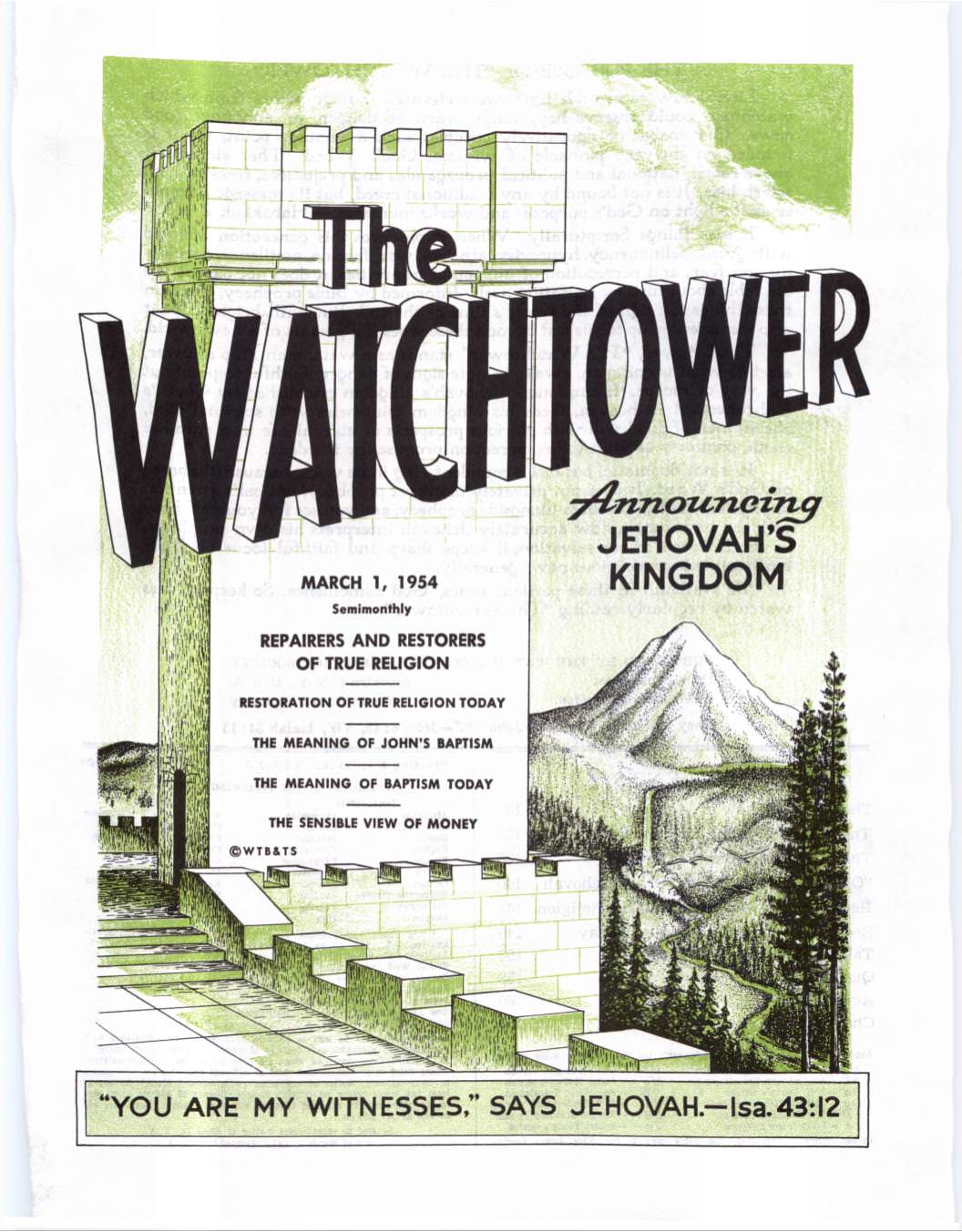
"YOU ARE MY WITNESSES," SAYS JEHOVAH.—Isa. 43:12
The WATCHTOWER
Announcing
JEHOVAH'S
KINGDOM
MARCH 1, 1954
Semimonthly
REPAIRERS AND RESTORERS
OF TRUE RELIGION
RESTORATION OF TRUE RELIGION TODAY
THE MEANING OF JOHN'S BAPTISM
THE SENSIBLE VIEW OF MONEY
©WTB&TS
“YOU ARE MY WITNESSES,” SAYS JEHOVAH.—Isa. 43:12 THE PURPOSE OF "THE WATCHTOWER"
Literal towers in Bible times were elevated vantage points from which watchmen could observe happenings, warn of danger, or announce good news. Our magazine figuratively occupies such a vantage point, for it is founded on the very pinnacle of wisdom, God's Word. That elevates it above racial, national and political propagandas and prejudices, frees it from selfish bias. It is not bound by any traditional creed, but its message advances as the light on God's purposes and works increases.—Habakkuk 2:1-3.
It sees things Scripturally. When it observes this generation afflicted with greed, delinquency, hypocrisy, atheism, war, famine, pestilence, perplexity and fear, and persecution of unpopular minorities, it does not parrot the old fable about history repeating itself. Informed by Bible prophecy, it sees in these things the sign of the world's time of the end. But with bright hope it also sees opening up for us just beyond these woes the portals of a new world.
Thus viewed, "The Watchtower" stands as a watchman atop a tower, alert to what is going on, awake to note signs of danger, faithful to point out the way of escape. It announces Jehovah's kingdom established by Christ's enthronement in heaven, feeds his kingdom joint-heirs with spiritual food, cheers men of good will with glorious prospects of eternal life in a paradise earth, comforts us with the resurrection promise for the dead.
It is not dogmatic, but has a confident ring in its voice, because it is based on God's Word. It does not privately interpret prophecy, but calls attention to physical facts, sets them alongside prophecy, and you see for yourself how well the two match, how accurately Jehovah interprets his own prophecy. In the interests of our salvation, it keeps sharp and faithful focus on Bible truth, and views religious news generally.
'Be watchful in these perilous times,' God admonishes. So keep on the watch by regularly reading "The Watchtower".
PUBLISHED BY THE WATCH TOWER BIBLE & TRACT SOCIETY
117 Adams Street
Brooklyn 1, N. Y., U. S. A.
N. H. KNORR, President GRANT SUITER, Secretary
"They will all be taught by Jehovah."—John 6:45, NW; Isaiah 54:13
CONTENTS
The Sensible View of Money
The Meaning of John's Baptism
The Meaning of Baptism Today
“Old Men and Children” Praise Jehovah
Repairers and Restorers of True Religion
Restoration of True Religion Today
Taking Teaching from Jehovah
Questions from Readers
Announcements
Check Your Memory
AS
American Standard Version
LXX
The Septuagint Version
AT
An American Translation
Mo
James Moffatt's version
Da
J. N. Darby's version
NW
New World Translation
Dy
Catholic Dquay version
Ro
J. B. Rotherham's version
ED
The Emphatic Diaglott
RS
Revised Standard Version
Le
Isaac Leeser's version
Yg
Robert Young's version
Unless otherwise indicated, the Bible used is the King James Version
Five cents a copy
Printing this issue: 1,800,000
<tr><th colspan="2">Semimonthly
Monthly
Afrikaans
Indonesian
Arabic
Portuguese
Cebu-Visayan
Italian
Climbba
Russian
Danish
Japanese
Cinyanja
Slamese
English
Norwegian
Cishona
Silozi
Finnish
Pangasinan
Greek
Slovak
French
Slovenian
Ibo
Twi
German
Spanish
Kanarese
Ukrainian
Hiligaynon-Visayan
Swedish
Korean
Urdu
Hollandish
Tagalog
Malayalam
Yoruba
Ilocano
Zulu
Polish
Entered as second-class matter at Brooklyn, N. Y., Act of March 3, 1879. Printed in U. S. A.
THE SENSIBLE VIEW OF MONEY
HOW often we hear someone call money "the root of all evil." This gives the wrong impression, conceals a treacherous snare and obscures a sign of the last days. Why? Because money is not the root of all evil. There is nothing evil intrinsic in the circulating medium called "money." What the root of all evil really is can be found in the words of Christ's apostle: "Those who are determined to be rich fall into temptation and a snare and many senseless and hurtful desires which plunge men into destruction and ruin. For the love of money is a root of all sorts of injurious things, and by reaching out for this love some have been led astray from the faith and have stabbed themselves all over with many pains." (1 Tim. 6:9, 10, NW) Here, then, is this evil-inspiring root the love of money! What happens to those who fall victim to the love of money?
The love of money is a snare whether money be obtained honestly or dishonestly. We might compare this snare to a trap or pit dug in the ground that is filled with sharp stakes, the whole snare slightly covered over. So when a man, or any animal, steps upon it, he tumbles in. Such a snare is that into which "those who are determined to be rich" must necessarily fall. The way to avoid tumbling into a snare like this is to have a sober-minded view of money by heeding the advice given in God's written Word, the Bible. That book gives graphic evidence that the love of
money is a root of all sorts of injurious things.
Take, for example, the case of Achan. Just before Jericho fell the Israelites were warned not to take to themselves any of the spoils; all gold and silver was to go into the treasure of Jehovah's house. But when Achan found some silver and a gold bar, his love of money gave him other ideas. He took the money and hid it in his tent. Israel suffered a defeat before the city of Ai because of Achan's disobedience. When his sin was discovered, Achan, together with all his family, was stoned to death. Achan's love of money led to disobedience, and his disobedience to death. Joshua, chapters six and seven.
Another who allowed his love of money to lead to disloyalty, and disloyalty to disaster, was Elisha's servant Gehazi. Elisha, through Jehovah's power, had just cured Naaman of leprosy. When offered gifts, the prophet refused to accept them. But Gehazi, running after Naaman and falsely using the name of Elisha, asked for silver and garments. Gehazi's disloyalty, however, was detected. Said Elisha: "Was I not present in spirit when the man turned from his chariot to meet you?' . . . 'Is it a time to accept money? . . . The leprosy of Naaman shall fasten upon you and upon your descendants forever.'" (2 Ki. 5:26, 27, AT) The desire for selfish gain turned Gehazi into a liar and a deceiver and 'stabbed him all over with many pains.'
The name "Judas" has become a synonym for traitor. But what started Judas on this traitorous course? Greed. He loved money. He loved money so much that he turned into a thief long before he betrayed Jesus. When Mary of Bethany anointed Jesus with expensive perfumed oil, Judas denounced it as extravagance, for he wanted the oil to be sold for money. Why? "Not because he was concerned about the poor, but because he was a thief and had the money-box and used to carry off the monies put in it." Whatever were Judas' reasons for betraying Jesus, the love of money was predominant. To the chief priests he asked: "What will you give me to betray him to you?" They agreed on thirty silver pieces. The rest is well known. Judas, after the betrayal, cast down the silver and hanged himself. What did this love of money do to Judas? It turned him into a thief, a betrayer and, in a sense, a murderer; for he well knew that the priests wanted Jesus killed. Not money itself, but the love for money, led Judas 'astray from the faith' and plunged him into such destruction that Jesus said: "It would have been better for that man if he had not been born."—John 12:6; Matt. 26:15; Mark 14:21, NW.
Many are the reasons why money is loved. Often it is the desire for power and prestige. Simon of Samaria loved money in this sense, for he lusted for power so that he might exploit others and exalt himself. When he saw Peter and John imparting the gift of holy spirit, he asked: "Give me also this authority, that anyone upon whom I lay my hands may receive holy spirit.' But Peter said to him: 'May your silver perish with you, because you thought through money to get possession of the free gift of God.'" (Acts 8:18-20, NW) Today "simony" is the practice of buying or selling church positions.
Indeed, today the love of money has pervaded organized religion. Christendom's churches commercialize the Word of God, placing emphasis, not on Bible truths, but on collections, bazaars, bingo and on other methods to raise money. No one needs to be told of the love of money that actuates commerce. And the love for selfish gain, power and prestige in politics is all known only too well. Even marriage has been corrupted by the universal love of money. It was the same in Jesus' day. Of ancient Rome Lord's Beacon Lights of History says: "Money was the first object in all matrimonial alliances." So it is with many today.
The Scriptures give us warning of the ever-present danger of loving money. But is not money essential? Yes, but the true Christian realizes that, beyond a certain amount needed to provide the needs of life, money has no power to bestow happiness or life. Real happiness and real life come from laying up treasure in heaven by showing love for God and not love for money. Jehovah, the true God, is rich, for all the gold and the silver of the earth are his. Still the Christian can use the money of this unrighteous world to make friends with God. For Jesus advised: "Make friends for yourselves by means of the unrighteous riches, so that, when such fail, they may receive you into the everlasting dwelling-places." (Luke 16:9, NW) Jehovah and Christ are these true Friends who can preserve life when money utterly fails. Only those who have used their life, time and material wealth to honor Jehovah and Christ will have true Friends at Armageddon.
Part of the sign of the last days is the abundance of "lovers of money." (2 Tim. 3:2, NW) This, together with all the other features of the last-days sign now flash before our eyes. How vital, then, that we be sober-minded regarding the use of money, that we avoid the snare that could plunge us into destruction at Armageddon.
Millions of people will die rich at Armageddon. No profit this! So make money your servant. Use it to honor God and to show love for neighbors by bringing them the good news of God's kingdom. Jehovah and Christ
will then be your everlasting Friends. They will not forget your loving service. For the King Christ will welcome you to the "everlasting dwelling-places" of the new world: "Come, you who have my Father's blessing, inherit the kingdom prepared for you from the world's foundation."—Matt. 25:34, NW.
The Meaning of
BIGGEST Mass Baptism of Modern Times." Thus read the headlines of the Associated Press dispatch that reported on the immersion of 4,640 witnesses of Jehovah at the Riverside Cascade
Pool on July 22,1953, in connection with their international New World Society Assembly held at Yankee Stadium, New York city.
Reporting on a similar baptism, held two years before at London's Lido Beach as part of the international Clean Worship Assembly, under the heading "Galilee Comes to the Lido," the London Daily Herald told of 1,123 witnesses' being immersed. Among other things its reporter was impressed by the "frightening earnestness" of the witnesses who had come to the Lido to be baptized, and, after commenting on the baptism of the men, went on to say: "Then came the women. Some women were old, many middle-aged and many young. And some of the swim-suits were as attractive as their wearers. But don't doubt the sincerity of these people, disagree with them as you may. One crippled man with a walking stick was helped down and immersed. There was a grey-haired great-grandmother of 76, [and] an
86-year-older—a thin little wispy-haired woman."
They manifested a "frightening earnestness," says the reporter for the London Daily Herald; and "don't doubt the sincerity of these people." Yes, Jehovah's witnesses take baptism seriously. Can it be that they take it too seriously? The reporter for another London newspaper, the Sunday Chronicle, seemed to think so, for he just could not understand why Jehovah's witnesses insisted on total immersion, and spoke of it as a "trivial detail of a ceremony" that had become "an idée fixe in a multitude of fanatical minds."
True, most religious organizations practice baptism of infants and that by sprinkling. Thus the New York Herald Tribune, on November 8,1953, published a picture of a chaplain at the Bellevue Hospital, baptizing an incubator baby through the portholes of its incubator.
What is the truth about baptism? What do the Scriptures have to say about it? Is total immersion a mere "trivial detail"?
Who may or should be baptized and when and how?
In view of the fact that many religions teach that John the Baptist set the formal pattern for baptism of Christians, let us first consider why John preached and what his baptism meant.
JOHN'S COMMISSION
The angel Gabriel, who appeared to the priest Zechariah as he was performing his priestly duties and informed him that he and his wife Elizabeth, although childless until now, would have a son in their old age, gave specific instructions as to the rearing of this son, whose name was to be John, and foretold the work he would do: "He must drink no wine and strong drink at all, and he will be filled with holy spirit right from his mother's womb, and many of the sons of Israel will he turn back to Jehovah their God. Also he will go before him with Elijah's spirit and power, to turn back the hearts of fathers to children and the disobedient ones to the practical wisdom of righteous ones, to get ready for Jehovah a prepared people."—Luke 1:15- 17, NW.
In due time the promised son was born and "the young child went on growing and getting strong in spirit, and he continued in the deserts until" the spring of A.D.29, when he began his public ministry with the electrifying announcement, "Repent, for the kingdom of the heavens has drawn near."—Luke 1:80; Matt.3:2,NW.
Why was it necessary for John the Baptist to serve as a messenger to prepare the way before Jehovah's coming in the person of Jesus Christ? Did not the nation of Israel have the law of Moses, the very purpose of which was to serve as a tutor to lead them to Christ, by protecting them from pagan worship, by impressing upon them their need of a ransomer to take
away their sins, and by making prophetic patterns of the work their Messiah was to do?—Gal. 3:24; Deut. 7:16; Heb. 10:1.
True indeed, but the Israelites had not been faithfully adhering to that law or Jehovah would not have let them go into captivity to Babylon. And even that chastisement had only a temporary salutary effect upon them as a people, for after the deaths of Ezra, Nehemiah and Malachi, and particularly with the rise of Greece to the position of the fifth world power, their worship became a formalistic, nationalistic Judaism that, while holding to the external features of the Law, became contaminated with pagan Grecian philosophy and more and more steeped in oral traditions that made God's Word of no effect.
The religious leaders became very selfrighteous, exalted themselves instead of Jehovah's name and Word and viewed with contempt the common people, most lowly of whom were the tax collectors and harlots. A preparatory work was certainly sadly needed if they were to be ready to recognize and accept their Messiah when he arrived!
In preaching the much-needed message of repentance John the Baptist spared no one. Not only did he instruct the tax collectors not to overcharge or extort, a common practice in those days, and tell the military not to harass or falsely accuse anybody and to be content with their provisions, etc., but he even publicly, and repeatedly at that, rebuked the king, Herod Antipas, for his adulterous marriage to Herodias, telling him: "It is not lawful for you to be having the wife of your brother." And especially did he lash out against the religious leaders of his day, in language similar to that which Jesus was later to use against them: "You offspring of vipers, who has shown you how to flee from the coming wrath? Therefore produce fruits that befit repentance.
And do not start saying within yourselves, 'As a father we have Abraham.' . . . Indeed, the ax is already in position at the root of the trees; every tree, therefore, not producing fine fruit is to be cut down and thrown into the fire."—Mark. 6:18; Luke 3:7-14, NW.
SIGNIFICANCE OF JOHN'S BAPTISM
With his preaching John also baptized. Why? Did it in either a literal or figurative way take away the sins of the Israelites who were baptized? This is the thought of Christendom in general, as most religions teach that baptism is for the purpose of washing away the sin inherited from Adam. The Scriptures, however, do not support any such conclusion.
In the first place let it be noted that John was sent only to the nation of Israel, to prepare them for their Messiah. (Acts 13:24) Further note that John's baptism was separate and distinct from that which was performed in the name of Jesus, or Paul would not have rebaptized certain disciples at Ephesus in the name of Christ Jesus but would have been content with their having been baptized with John's baptism. (Acts 19:1-6) The purpose of John's preaching being to bring about a change of heart, a repentance so as to prepare the Israelites for their Messiah, those who did thus repent and confess their sins were baptized by John in public acknowledgment of that fact. The repentance brought about the "remission of sins," the baptism itself was because of their repentance, or conditioned on it, a token or a picture of it, the repentance.
Particularly do the modern versions of the Christian Greek Scriptures make this clear. According to them John the Baptist stated, as recorded by Matthew at 3:11, "I, on the one hand, baptize you with water because of your repentance." (NW) "I am baptizing you in water in token of your repentance." (AT) "I am baptizing you in water to picture your repentance." (C.B.Williams) According to modern versions Luke tells, at 3:3, that John the Baptist came or went all over "preaching baptism of those repenting for forgiveness of sins" (NW); "preaching a baptism conditioned on repentance" (Williams); "announcing a baptism whereby men repented, to have their sins forgiven."—Knox.
The same meaning is apparent from the way these render Paul's words to the Ephesians regarding John's baptism as recorded at Acts 19:4: "John baptized with the baptism of those repenting [mar., baptism of repentance]." (NW) "John's baptism was a baptism in token of repentance." (AT) "John baptized with a baptism that was an expression of repentance." (Williams) Clearly the foregoing indicate that it was the sinner's act of repentance, not God's act of forgiveness, that was pictured by the baptism.
That this was the understanding of the early Christians appears from a footnote in Williams' translation in explanation of rendering Acts 2:38 as follows: "You must repent—and, as an expression of it, let everyone of you be baptized in the name of Jesus Christ—that you may have your sins forgiven." The footnote states that the explanatory phrase, "as an expression of it," is "implied from context and usage in the early church."
Since John baptized with the "baptism of repentance," he could not understand why Jesus came to him to be baptized: "I am the one needing to be baptized by you, and are you coming to me?" Jesus did not take time to explain, but simply said: "Let it be, this time, for in that way it is suitable for us to carry out all that is righteous."—Matt. 3:13-15, NW. Why did Jesus insist on being baptized although having no sins to repent of?
What meaning do the Scriptures attach to his
baptism? For answers to these and similar questions regarding baptism we refer the reader to the following article.
The Meaning of Baptism Today
WE HAVE noted that John's baptism was only for Jews. We have also seen that it was part of his preparatory work to make ready the Jews for their Messiah. Further we have seen that it was a picture, not of what God did in forgiving their sins, but of what they themselves did in that they repented, and that it was separate and distinct from the baptism performed in the name of Christ Jesus.
What is the meaning of baptism today? Since it is performed in obedience to Jesus' command, it is reasonable to conclude that it would also be in imitation of the example he set. That being so, the meaning of his baptism would also be the meaning of baptism for his followers today. And what was that meaning? It was a symbol or picture, performed publicly, showing that he had dedicated himself to the doing of his Father's will as that will was revealed to him in his Father's Word.
This is apparent from Psalm 40:7,8 which Paul at Hebrews 10:5,7 applies to Jesus Christ: "Hence when he comes into the world he says: 'You did not desire sacrifice and offering, but you prepared a body for me." Then I said, "Look! I am come (in the roll of the book it is written about me) to do your will, O God.'"
Paul applies this prophecy to the time when Jesus came into the world. When was
that? At the time of his birth in a manger in Bethlehem? Hardly, for as an infant he could not express any determination to do Jehovah's will. Then was it at the age of twelve? Well, all we know about Jesus' activities from the time he was twelve years old until he became thirty is that he learned the carpenter trade. Clearly, doing God's will involved more than merely being a carpenter. Jesus came to earth to bear witness to the truth, to maintain integrity under pressure and so vindicate his Father's name, and to give his life a ransom for many. (John 18:37; Heb. 5:8; Matt. 20:28) That being so, would Jesus say, 'Look! I am come to do your will,' and then wait eighteen years before commencing to do that will?
In keeping with God's law for the Levitical temple service, Jesus, at the age of thirty, shortly after he had been baptized, commenced to preach. (Num. 4:2,3; Luke 3:23) So we cannot conclude other than that he came into the world to do God's will at the time of his baptism and therefore it was a symbol or picture of his dedication. At the same time it was a public confession of that fact. The baptism he commanded as part of the work of making disciples of all nations would therefore likewise picture dedication to do God's will.
—Matt. 28:19, 20.
THE PROPER SYMBOL
How should baptism be performed? By aspersion (sprinkling) or effusion (pouring) or by immersion? The form most frequently used throughout Christendom is that of sprinkling. Those using this form generally agree that immersion was used in apostolic times but defend sprinkling on the grounds of convenience.
To refer to sprinkling as a baptism is to use a misnomer, for the original Greek word baptisma means a dipping under water, an immersion. Thus we read in Greek literature that the cork, floating on the top of the water, was not baptized, but the net, being submerged, was; also that the bulrushes by the sea were baptized only when the high tide covered them.
It is not surprising, therefore, to note that extremely literal translations of the Bible, such as those by Rotherham and Wilson, use the various inflections of "to dip" or "to immerse." Because baptism means an immersion, Paul likens the passing of the nation of Israel through the Red Sea, with water on each side of them and with the cloud above them, to a baptism. And so Peter speaks of following Noah into the ark before the flood came as a baptism. Incidentally, on each of these occasions two baptisms took place: a baptism to salvation for Jehovah's servants, and a baptism to destruction for Jehovah's enemies, namely, Pharaoh and his hosts by the Red Sea, and the wicked world of Noah's day by the Deluge.—1 Cor. 10:1-3; 1 Pet. 3:20, NW.
A further Scriptural illustration showing the correct meaning of baptism relates to the Syrian general Naaman, who was a leper. Concerning his baptism we read, according to the Septuagint version: "So Naaman went down and dipped himself
seven times in Jordan, according to the word of Elisaie, and his flesh returned to him as the flesh of a little child and he was cleansed" of his leprosy. (2 Ki. 5:14) The Greek word here rendered "dipped himself" is the past tense of baptizein, and means "baptized himself." The only other reference to baptizein in the Septuagint, as far as the canonical books are concerned, is at Isaiah 21:4, where we read that "transgression overwhelms me" (where a footnote indicates that a literal rendering would be "transgression baptizes me"), although the root word baptein occurs many times.
The argument is advanced that sprinkling is merely a matter of convenience. But would it not also have been convenient for John and Jesus to resort to sprinkling? Certainly; but they did not let that enter into their consideration. Rather, they went out of their way, and caused the multitudes that wanted to hear them to go out of their way, so that they would be where there was sufficient water, even as we read at John 3:23 (NW) that they were "baptizing in Aenon near Salim, because there was a great quantity of water there."
The case for immersion is made conclusive when we recollect that baptism is not a symbol of the washing away of sins but of the dedication of oneself to do God's will. Fittingly immersion pictures what has taken place, the being dipped under the water illustrating one's burial or death to one's own will, and the being raised up again illustrating one's being made alive to do the will of Jehovah God. Yes, the example of the apostolic Christian congregation, the meaning of the words themselves, the manner in which these words are used by Scripture writers and the fitness of the symbol all combine to prove immersion to be the proper form of baptism.
What about infant baptism or pedo- baptism? In view of the foregoing it should not surprise us that not once do we read of any infants' being baptized, much less a command to that effect.
What negligence on the part of Jesus and his apostles not to warn parents of the eternal misery that would await their children if they died before being baptized, as some teach, if such were actually the case! The very silence of the Scriptures in this respect is strong circumstantial evidence that infants were neither baptized nor considered as fit subjects for baptism. Baptism was for those who repented and accepted the truth heartily. Infants can do neither.—Acts 2:41, NW.
BAPTISM TODAY
Repeatedly the Scriptures speak of those who were baptized in apostolic times as receiving the holy spirit; Cornelius and his household received the holy spirit even before baptism. (Acts 2:38;19:5,6;10:44- 48) God's will for those who then dedicated themselves to him was that they should become spiritual sons, and these were said to be "baptized into Christ's body."—Gal. 3:27; 1 John 3:2, NW.
However, this baptism was limited to comparatively few, only a "little flock" of 144,000. These have the hope of sharing heavenly glory with Christ as his bride or body and reigning with him a thousand years. (Luke 12:32; Rev. 7:2-4; 14:1, 3; 20:5, 6; 21:2, NW) For all such baptism is also a picture of being immersed into Christ's spiritual body, and that they are to be buried with him in the likeness of his death. (Rom. 6:4; Col. 2:12; 2 Tim. 2:11, NW) Bible prophecy and its fulfillment indicate that this number has been about completed and that only a "remnant" of these yet remain on the earth. This remnant have for some time been faithfully fulfilling their commission to bear witness to Jehovah's name and to comfort those that mourn with the good news of the
Kingdom. Isa. 43:10-12; 61:1-3; Matt. 24:14.
As a result of this preaching work a class of Christians has manifested itself whom Jesus termed "other sheep" and whom the apostle John described as a "great crowd, which no man was able to number, out of all nations and tribes and peoples and tongues." These John saw "standing before the throne and before the Lamb," as distinguished from the "little flock" who will share the throne with Christ Jesus.—John 10:16; Rev. 7:9; 3:21, NW.
Manifesting faith in Jehovah God and recognizing Christ Jesus as their Savior and Ransomer, these also dedicate themselves to the doing of God's will so that they also may gain his approval and everlasting life, not in the heavens, but right here on earth; for the Bible shows that this earth will abide forever and that one day it will become a glorious place with God's will being done on it even as it is in heaven. Eccl. 1:4; Isa. 60:13; Matt. 6:9, 10.
In accordance with Jesus' instructions recorded at Matthew 28:19, 20 (NW) these are baptized in the name of the Father, meaning that they recognize the office and authority of Jehovah God as their Father and appreciate their relationship to him. They are also baptized in the name of the Son in that they recognize the office and authority of Christ Jesus as God's Son, what he did for them, and their obligation to obey him and follow his example. And they are baptized in the name of the holy spirit in that they are cognizant of the function and purpose of God's holy spirit or active force, without which they could not fulfill their dedication vows.
AN ORDINATION CEREMONY?
The Associated Press dispatches reporting on the 1953 mass baptism of Jehovah's witnesses in connection with their international assembly stated that Jehovah's witnesses considered their baptism as an ordination ceremony and that each baptized witness was an ordained minister.
Upon what grounds do they base their position?
In the first place, it, the baptism, being performed at God's command, is recognized by him as authoritative. It represents their agreement to follow in the footsteps of Christ Jesus, who certainly was the minister of Jehovah God. This ordination is further recognized as authoritative by the instrument God is using at the present time to give an effective and harmonious witness to his name and kingdom, namely, the Watch Tower Society. And on November 30,1953,the Supreme Court of the United States ruled that this baptism of immersion by Jehovah's witnesses is a valid ceremony of ordination within the meaning of the law for Jehovah's witnesses. Incidentally, the 1954 Yearbook of Jehovah's Witnesses shows that 50,665 ministers were thus ordained during 1953.
But is it not necessary to go to a theological seminary to be qualified as a minister? If it were, then neither Jesus nor his apostles, with the exception of Paul, could have been recognized as ministers. In fact, some asked regarding. Jesus: "How does this man have a knowledge of letters, when he has not studied at the schools?" And the educated class at the time wondered at the boldness of Peter and John, for they noticed that Peter and John were unlettered and ordinary men. But that did not keep them from preaching the good news. And not only they, but all the early Christians preached. (John 7:15; Acts 4:13; 8:4, NW) One can become adequately equipped to preach by studying at home evenings and week ends, and by attending the various Bible classes arranged for under the direction of the Watch Tower Society.
It follows, then, that a diploma from a theological seminary is likewise not a ministerial prerequisite. The very best proof that one could have that he is a minister is the same to which Paul pointed as his letters of recommendation, namely, individuals who, due to one's efforts, have dedicated themselves to Jehovah God. 2 Cor. 3:1-3, NW.
Once having dedicated ourselves to God and symbolized it by water baptism, we may never let that fact slip out of our consciousness, for it is better not to have vowed than to vow and then not to pay our vows. (Eccl. 5:5) Jesus was ever conscious of having agreed to do God's will and he spoke of God's will as a cup he was drinking and a baptism with which he was being baptized and had yet to be baptized with. (Matt. 20:22, 23; Luke 12:50, NW) Only by keeping integrity to God and by associating with God's people, the New World society, may we hope to survive the destruction of this wicked world in the coming battle of Armageddon and enter into the new world of righteousness even as Noah and his family entered a new world after the flood.-Matt. 24:37-39; 2 Pet. 3:7, 13; Rev. 16:14, 16.
To sum up: we have seen that John's baptism was a picture of repentance; that Christian baptism in water is a picture of dedication to do God's will; that only complete immersion is water baptism, that only it fittingly pictures dedication and that it serves both as a public confession of one's dedication and as an ordination ceremony; that neither a theological seminary training nor a diploma is a prerequisite to being a minister of Jehovah God, and that by keeping integrity we can hope to survive the destruction of this wicked system of things to enter into the new world of righteousness as members of the New World society.
"Old Men and Children" Praise Jehovah
MANY centuries ago the psalmist commanded: "Both young men and virgins; old men and children: let them praise the name of Jehovah." (Ps. 148:12, 13, AS) That this command is being obeyed in our day, and that in all parts of the earth, was apparent from the reports given at the New World Society Assembly of Jehovah's Witnesses held in July, 1953, at Yankee Stadium, New York city. Among such reports were the following:
In a certain village in France three young girls, aged 11, 15 and 17, learn the truth from Jehovah's witnesses and attend the meetings. Their parents try to discourage them by destroying the Society's Bible-study aids, so the girls continue their studies in the cow shed. Soon Lucienne, the youngest, starts talking to her friends about God's kingdom, and so when the village priest teaches them the catechism these children reply, "But Monsieur le curé, Lucienne says that isn't written in the Bible." This happens week after week until the priest, one day in exasperation, warns all his parishioners against little Lucienne. But Lucienne keeps on talking and finally the priest goes to her mother and says: "Madam, you should stop your children from talking to others! If they insist on learning the Bible, let them keep it to themselves. I am warning you!" But what does mother reply? "Have you ever been able to stop a girl from talking?" Of course, nothing could stop them from bubbling over with the good things they had learned, and at the next assembly of Jehovah's witnesses all three girls were baptized.
Among those who recently have begun to praise Jehovah in Guatemala is an eighty-six-year-old former Protestant clergyman. He is a regular and punctual attendant at the congregational meetings although it means traveling several miles on horseback. As he goes about telling others about Jehovah's goodness he never fails to observe: "Imagine! All these years I thought I was going to heaven and now I find out that I am going to live on earth!" He is happy at the prospect.
And among the children praising Jehovah in Guatemala is a twelve-year-old boy. His mother had obtained the Watchtower Bible study aid "This Means Everlasting Life"; and
from the beginning this boy evinced real interest and begged others to read the book to him, as he was blind. In spite of his handicap he engages regularly in the field ministry, placing Bible literature with his neighbors and making return visits.
In a lonely, faraway place at the highest point of the Apennine Mountains in Central Italy, an eighty-four-year-old lone witness for Jehovah began to preach the good news of the Kingdom. With a cane in each hand to support his frail, bent body, and a pack of Bible literature on his back, he visits the people scattered along the rugged mountain trails. Beginning before six o'clock in the morning, he returns before noon to escape the hot sun. Many a fall he has experienced while climbing the perilous trails. So effective has been his work that the Catholic Church sent in two young missionary monks to counteract his work. They followed him through the mountain trails seeking to frighten the people from listening to his message and urging those who had obtained literature to bring it to town to have it burned. Despite this opposition, in six months a congregation was formed. A year later thirty persons were baptized; all as the result of this eighty-four-year-old witness' overcoming tremendous obstacles.
In Nicaragua a five-year-old girl accompanies her mother in the field ministry and goes from door to door by herself giving the witness and placing magazines with the householders. Once when visiting her superstitious aged grandmother she explained to her who Jehovah is and why the images she had, which could not see, hear or speak, were worthless.
In Finland, a girl of nine years became active in the field ministry and not only attended the congregational meetings regularly but prepared her lesson in advance and gave good answers to the questions propounded. Expressing her desire to symbolize her dedication to Jehovah by water immersion, her mother remarked that they were not fully prepared to take such a step. The little girl replied: "Of course, you cannot come, mother, because you don't understand; but, let me go; I know the truth." So she went and was immersed.
Repairers and Restorers of True Religion
"And they that shall be of thee shall build the old waste places; thou shalt raise up the foundations of many generations; and thou shalt be called The repairer of the breach, The restorer of paths to dwell in."
—Isa. 58:12, AS.
TRUE religion is the genuine worship of Jehovah. False religion embraces everything against the worship of Jehovah. The word "religion" in its simplest and most common form means "a form or system of worship." Therefore the word itself does not mean "truth." We speak of pagan religion as well as Christian religion, so that any form or system of worship, regardless of the motive or object, is properly called a religion. Regardless of the existence of many thousands of different religions there is only one true religion, and it is the worship of the Most High God, whose name is Jehovah. This true religion has now been restored to the people.
2 True religion is eternal, and can never be destroyed. Throughout the many centuries enemies have tried to throw it down and destroy it, but their works of evil have proved futile. There have been times when true religion has been almost completely hidden from view. It has been slandered and men have made it a treasonable offense to practice it. Indeed, during the nearly 6,000 years of man's existence on this earth there have been many occasions when true religion hardly survived the terrific onslaughts made against it. But though sometimes almost in ruin, yet Jehovah has always raised up faithful men to
champion its cause and fight for its existence, regardless of personal loss and even the danger of death. These men repaired the breaches and restored the paths, so that people might again worship Jehovah God in spirit and in truth.In just such a critical time we are living today.
Pure religion existed in Eden before Adam's disobedience, because at that time there was the worship of but one God, Jehovah. Great blessings attended man while in that pure state, he being assigned very pleasurable services in connection with the lower creation, over which it was God's purpose to grant him dominion. There were peace and quietness and nothing to mar the serenity of that garden of delight. Man needed no mediator with God, for Jehovah spoke to man in the end of the day, probably in the evening time. But this state of paradise did not last long, for Adam forsook true religion and embraced the false. A willful act of disobedience lost these blessings, and the happy, blissful relationship he enjoyed could be repaired and bestowed on his offspring only by one possessing the power and authority to do so. Mankind lost these wonderful blessings and life itself, and so far have they traveled from true religion that multitudes do not even know what it is. Such ignorant ones conclude that their idol-worshiping religion is the right one, entirely disregarding the terrible fruitage it has produced and how far it has destroyed any resemblance between Creator and creatures.
Man's being made in the "image of God" involves pure worship of Jehovah. He must operate on the same principles and rules of action as his Creator. When man ceases worshiping Jehovah, then immediately his recognition of responsibility toward God departs. He loses understanding and goes headlong into foolishness and spiritual insanity, for thereafter he goes in search of wood, stone or metal, fashions it into an image, paints on it a face, and then bows before it. Some creatures satisfy themselves by worshiping other creations, animate or inanimate. False religion breeds ignorance, fear, superstition, hatred, fanaticism and insanity. True religion produces goodness, joy, peace, love and life. The hope and salvation of mankind lie in the restoration of true religion.
The creator of false religion is Satan, for he deliberately caused the rebellion of man in Eden to make a breach between God and man, and in this he was successful. Then Satan began to organize mankind into his way of worship. He has always done his utmost to prevent humankind from obtaining knowledge of Jehovah. To accomplish this he caused men to commence worshiping the creation of God, instead of the Creator, and so over the centuries men have made religion of everything, from the sun to creeping things on the earth. Earth-wide confusion has resulted. Paul writes: "If, now, the good news we declare is in fact veiled, it is veiled among those who are perishing, among whom the god of this system of things has blinded the minds of the unbelievers, that the illumination of the glorious good news about the Christ, who is the image of God, might not shine through." (2 Cor. 4:3, 4, NW) The time will come when Satan will not be able to deceive mankind with false religion, for it is foretold of Jesus: "And he seized the dragon, the original serpent, who is the Devil and Satan, and bound him for a thousand years. And he hurled him into the abyss and shut it and sealed it over him, that he might not mislead the nations any more until the thousand years were ended." —Rev. 20:2, 3, NW.
The corrupt conditions resulting to mankind when true religion is lost are forcefully demonstrated by the terrible state into which the people of Noah's day fell: "So God saw the earth and, look! it was ruined, because all flesh had ruined its way on the earth. After that God said to Noah: 'The end of all flesh has come before me, because the earth is full of violence as a result of them, and here I am bringing them to ruin together with the earth.'" (Gen. 6:12, 13, NW) Again 2,000 years later conditions were the same, for Paul states: "Because, although they knew God, they did not glorify him as God nor did they thank him, but they became empty-headed in their reasonings . . . Although asserting they were wise, they became foolish and turned the glory of the incorruptible God into something like the image of corruptible man and of birds and four-footed creatures and creeping things. . . . And just as they did not approve of holding God in accurate knowledge, God gave them up to a disapproved mental state, to do the things not fitting, filled as they were with all unrighteousness, wickedness, covetousness, injuriousness, being full of envy, murder, strife, deceit, malicious disposition, being whisperers, backbiters, haters of God." (Rom. 1:21-31, NW) Paul also declared that the same evil conditions would exist in the last days of this evil system of things.—2 Tim.
3:1-7.
These above-quoted scriptures clearly describe the desolation, the fallen-down condition and the low estate of humanity. It is absolutely necessary now for a mighty reparation and restoration work to be brought about so that some of the world's dying population may be redeemed and saved from complete disaster. Such a world-wide reconstruction work has been in progress, and today hundreds of thousands of humans have thereby gained great benefits. Not that such persons have found a new religion, but rather they have been guided into the old paths again, having been led back to the religion of the apostles and of the faithful men of old like Noah, Abraham and others. The good resulting to those who have been restored to the faithful service of Jehovah has been immeasurable. They have come to learn that Jehovah is the Most High God, and the love of God kindled in their hearts and lives has produced obedience to the doing of his will. True religion has developed in these sincere and honest-hearted ones reverence, honor, gratitude, hope and godly fear. It has bound them securely to the Almighty, moving them to willingly surrender all to Jehovah.
It involves the personal relationship, for it involves the decision of the creature to subject himself to the Creator. Such an act is virtuous, for it means that one is continually prompted to render to God the worship and reverence that are his by right. Then it is that those who are true worshipers find loving communion with the Creator and come to know and honor him as their own Supreme Lord, love him
as a Father, finding in his family and in his sacred service complete rest, happiness and peace. So all-embracing are the blessings of true religion that they cannot be limited, for hope is born and the prospects of entering into everlasting life become part of one's life, and more so as one learns to believe and trust in the promises of Jehovah and Christ Jesus our Lord.
9 Hope produced by true religion transforms the life. It nullifies the disappointments, trials and sufferings of the present existence under this evil system of things, whereas the absence of hope numbs the mind and heart. Hope of life for all time can be given to us only from Jehovah God through His Son. "This means everlasting life, their taking in knowledge of you, the only true God, and of the one whom you sent forth, Jesus Christ." (John 17:3, NW) "Let us enjoy peace with God through our Lord Jesus Christ, through whom also we have gained our approach by faith into this undeserved kindness in which we now stand, and let us exult, based on hope of the glory of God. And not only that, but let us exult while in tribulations, since we know that tribulation produces endurance; endurance, in turn, an approved condition; the approved condition, in turn, hope, and the hope does not lead to disappointment; because the love of God has been poured out into our hearts through the holy spirit which was given us." (Rom. 5:1-5, NW) This is the true religion.
10 Some may ask, How can you be sure it is the true religion? The answer is that everything pertaining to it must speak to the honor and praise of Jehovah. It must enlarge the heart and the mind toward Him. There must be a desire and a hope created to see his name exalted above every other name in the universe. Yes, to see his name JEHOVAH shining brilliantly, gleaming gloriously, prominently displaying its grandeur and majesty to the gaze of all creation.
These are some of the marks of true religion. It is not formalism, not ritual, not a social function. No, it is not something to try to show oneself respectable, but a living, all-consuming zeal to worship Jehovah with spirit and truth. There must be a holding to the Creator and it must bind us in bonds that cannot be broken. Paul was a true worshiper, and he said, "For I am convinced that neither death nor life nor angels nor governments nor things here nor things to come nor powers nor height nor depth nor any other creation will be able to separate us from God's love that is in Christ Jesus our Lord."—Rom. 8:38, 39, NW.
11 The substitution by Satan of false religion for true worship has brought great reproach upon Jehovah's name. In Eden, Satan called into question the veracity of God's word, his workmanship and the honor of his name, yes, and even his good purposes toward the human pair. It is recorded: "Now the serpent proved to be the most cautious of all the wild beasts of the field that Jehovah God had made. So it began to say to the woman: 'Is it really so that God said you must not eat from every tree of the garden?' At this the woman said to the serpent: 'Of the fruit of the trees of the garden we may eat. But as for eating of the fruit of the tree that is in the middle of the garden, God has said, "You must not eat from it, no, you must not touch it for fear you may die." At this the serpent said to the woman: 'You positively will not die. For God knows that in the very day of your eating from it your eyes are bound to be opened and you
are bound to be like God, knowing good and bad.'" (Gen. 3:1-5, NW) These few words disclose much. Satan questioned the propriety of Jehovah's commands. The enormity of this crime can be understood only when we consider the nearly 6,000 years of sinning, wickedness, sickness, sorrow, suffering and death inflicted on the human race. How despicably selfish and rebellious to the extreme to even cast a doubt upon the word of the Creator! Those sinister words "Is it really so that God said"'—partly interrogative and partly simulated astonishment—were designed to arouse suspicion and distrust of the Creator. Yes, the depths of Satan's wickedness are hereby revealed. His rebellion against divine law and order is demonstrated by his defaming the name of the Most High. Here it was that Jehovah's name was first profaned and defamed. Satan's plan of action was to cut the binding tie between the human pair and Jehovah, to make a breach that would be impossible to repair and restore to its original soundness.
12 It was in the third century of human history, during the lifetime of Enosh, son of Seth, that man began to openly profane the name of Jehovah. It is written: "At that time a start was made of calling on the name of Jehovah." (Gen. 4:26, NW) Men were not repentant and seeking in humility to serve Jehovah. Hebrew scholars have contended that this text should read "began profanely," or "then profanation began." It is a fact that the same Hebrew verb is translated "profane" in the King James Version at Leviticus 21:6, but there the verb is in a different conjugation, formation or species. This time, however, was the time for external idolatry. In this connection note these pertinent comments: "In the days of Enos the sons of Adam erred with great error, and the counsel of the wise men of that age became brutish, and Enos himself was (one) of them that erred; and their error was this: they said, Forasmuch as God hath created these stars and spheres to govern the world, and set them on high, and imparted honour unto them, and they are ministers that minister before him; it is meet that men should laud, and glorify, and give them honour.
. . they began to build temples unto the stars, and to offer sacrifice unto them . . . that they might in their evil opinion obtain favour of the Creator; and this was the root of idolatry, &c. . . So, in process of time, the glorious and fearful name (of God) was forgotten out of the mouth of all living, and out of their knowledge, and they acknowledged him not." (Quoted
from Treatise on Idolatry, by Maimonides) This shows the Jewish viewpoint on Genesis 4:26 as to the subtle scheme of Satan.
13 Nimrod the rebellious one despised the worshipers of Jehovah, for without doubt Noah and Shem had preached to mankind the commandments of Jehovah including the prohibition against the wanton shedding of blood. Nimrod defied Jehovah, and made himself a ruler over the people. "He displayed himself a mighty hunter in opposition to Jehovah. That is why there is a saying, 'Just like Nimrod a mighty hunter in opposition to Jehovah.'" (Gen. 10:9, NW) The Jerusalem Targum says: "He was a mighty hunter [or, mighty in prey] and in sin before God for he was a hunter of the children of men in their languages, and he said unto them, 'Depart
from the religion of Shem and cleave to the institutes of Nimrod.'" His purpose was to destroy true religion. The beginning of his kingdom was Babel. (Gen. 10:10) When the great tower and city of Babel were being built it displeased Jehovah. The record states: "After that Jehovah said: 'Look! They are one people and there is one language for them all, and this is what they start to do. . . .' Accordingly Jehovah scattered them from there over all the surface of the earth, and they gradually left off building the city." (Gen. 11:5-8, NW) This city and tower were built to blot out the name of Jehovah, and in defiance make a name for themselves.
14 In the days of Moses, Pharaoh defied Jehovah, exalting himself before the world
as the greater. Jehovah destroyed the power of this mighty world ruler, threw down his idols, and established himself as the Most High. To Pharaoh God's warning was: "But, in fact, for this cause I have kept you in existence, for the sake of showing you my power and in order to have my name declared in all the earth." (Ex.
9:16, NW) Throughout the life of Moses and his successor Joshua it became necessary to squarely place before the people the choice of adhering to true religion or falling away from divine favor by adopting false religion. The people of Israel were time and again saved from destruction. On one occasion Moses pleaded with Jehovah to save them for His own name's sake; God heard, and that breach was healed. "Therefore he said that he would destroy them, had not Moses his chosen stood before him in the breach, to turn away his wrath, lest he should destroy them."—Ps. 106:23, AS.
15 Another serious breach was healed in Elijah's day. This was due to Jehovah's abhorrence of King Ahab's apostasy to pagan religion. Jezebel, his queen, was the queen-daughter of an ex-priest of Astarte and Baal from Sidon in the Phoenician country, where lived the descendants of Canaan. Ahab should not have married this infidel hater of pure religion. She organized her own priesthood, of whom it is recorded that 450 were provided for at her table, which, of course, meant at the country's expense. Some years before Samuel had abolished the false religion, but Jezebel reimported it. The time had arrived for decision to be made by the people of Israel as to whom they were going to serve, Jehovah or Baal.
16 True religion at this time was in a broken-down condition. However, Elijah was used by Jehovah to build up that which was broken down and restore true religion, for he exalted the name of Jehovah. King Ahab accused Elijah of troubling Israel, but the prophet's fearless reply was: "I have not troubled Israel; but thou, and thy father's house, in that ye have forsaken the commandments of Jehovah, and thou hast followed the Baalim." Elijah commanded Israel to gather to Mount Carmel, and also the 450 false priests of Baal. Then Elijah said: "How long go ye limping between the two sides? if Jehovah be God, follow him; but if Baal, then follow him." Now followed the contest, as described at 1 Kings 18:17-40 (AS). Note the helplessness and hopelessness of the Baal as the fanatics cried out and performed disgusting acts of licentiousness according to their pagan rites, hoping to appease their god. Read
the account and try to imagine all the excitement, the mad frenzy. Then, as no answer came, their religious rites growing more senseless and shameless (for the worship of Baal was one of great obscenity), these insane devil worshipers began to knife themselves, and blood flowed freely. All day long this went on until they were exhausted. What an exhibition of demonic religion to those standing by who should have been worshiping Jehovah in holy array!
17 Now observe Elijah. Calmly, reverently, without undue display of emotionalism, he offers prayer, with dignity and solemnity, in contrast with the lewd madness of the false prophets: "O Jehovah, the God of Abraham, of Isaac, and of Israel, let it be known this day that thou art God in Israel, and that I am thy servant, and that I have done all these things at thy word. Hear me, O Jehovah, hear me, that this people may know that thou, Jehovah, art God, and that thou hast turned their heart back again." How clearly such a prayer can be understood, and how it reveals the deep love Elijah had for Jehovah and for Israel, for he was pouring out his heart to Jehovah in this prayer! He had strong faith, and he did not want the curse of Jehovah to fall upon these people. So he prayed that this people's heart would be turned back to the safe old paths and that they would forsake the selfish, passion-arousing, devastating false religion of Baal.
18 Elijah honored and exalted Jehovah, refusing to use Baal's altar, but rather himself repaired the altar of Jehovah that had fallen to the ground through disuse and disdain. Taking the twelve stones, he rebuilt the altar. In advance Elijah had announced what would come to pass, and his faith was complete.
He was championing the name of Jehovah and restoring true religion to Israel, repairing that which was broken down of the true worship. Probably his prayer took only a few minutes, but immediately afterward the answer came from Jehovah. Beholding this instantaneous fire from heaven consuming the sacrifice, the onlookers could no longer be in doubt as to who was God. "And when all the people saw it, they fell on their faces: and they said, Jehovah, he is God; Jehovah, he is God. And Elijah said unto them, Take the prophets of Baal; let not one of them escape. And they took them; and Elijah brought them down to the brook Kishon, and slew them there." 1 Ki. 18:39, 40, AS.
19 It was a day of triumph for Elijah, as he was used to repair the breach and restore true religion, and to exalt the name of Jehovah. He had risked his life in protest against all this profanity, this Goddishonoring and bestial false religion, but Elijah was jealous for Jehovah. Jehovah himself is a jealous God, and therefore could brook no rival. Elijah's conception of the Most High God was so lofty that it absolutely precluded all other gods and objects of worship. This contest on Carmel is one of the finest ever recorded. However, that decision did not end the contest forever, because the invisible Satan soon got busy again breaking down the work Elijah had built up and taking from Israel the true religion. Later there came a breach lasting for seventy years, during which time Jerusalem and the cities of Judah lay in ruins. Jeremiah had warned Israel over and over again concerning her false religion, and one of his messages was: "O foolish people, and without understanding; that have eyes, and see not; that have ears, and hear not: Fear ye not me? saith Jehovah: will ye not tremble at my presence? . . . But this people hath a revolting and a rebellious heart; they are revolted and gone. Neither say they in their heart, Let us now fear Jehovah our God, that giveth rain. . . A wonderful and horrible thing is come to pass in the land: the prophets prophesy falsely, and the priests bear rule by their means; and my people love to have it so: and what will ye do in the end thereof?"—Jer. 5:21-31, AS.
20 Jehovah said: "Every one [of them] is given to covetousness; and from the prophet even unto the priest every one dealeth falsely. They have healed also the hurt of my people slightly, saying, Peace, peace; when there is no peace." Jehovah's wrath was bound to come and no pacifying by false prophets could stop it. These false religionists were acting treasonably before Jehovah by counteracting and countermanding the commands of Jehovah the Most High, the true king of Israel. They were seeking to undermine the loyal obedience of the faithful ambassador of Jehovah. "Thus saith Jehovah, Stand ye in the ways and see, and ask for the old paths, where is the good way; and walk therein, and ye shall find rest for your souls: but they said, We will not walk therein." And again: "Let mine eyes run down with tears night and day, and let them not cease; for the virgin daughter of my people is broken with a great breach, with a very grievous wound." This breach was so wide that it took God's people into captivity for over seventy years. They had to learn that there was only one way of worshiping and that was the right way. "Shall a man make unto himself gods, which yet are no gods? Therefore, behold, I will cause them to know, this once will I cause them to know my hand and my might; and they shall know that my name is Jehovah."—Jer. 6:13-19; 14:17; 16:20, 21, AS.
…