The Watchtower, March 15, 1954
Download: PDF — The Watchtower, March 15, 1954
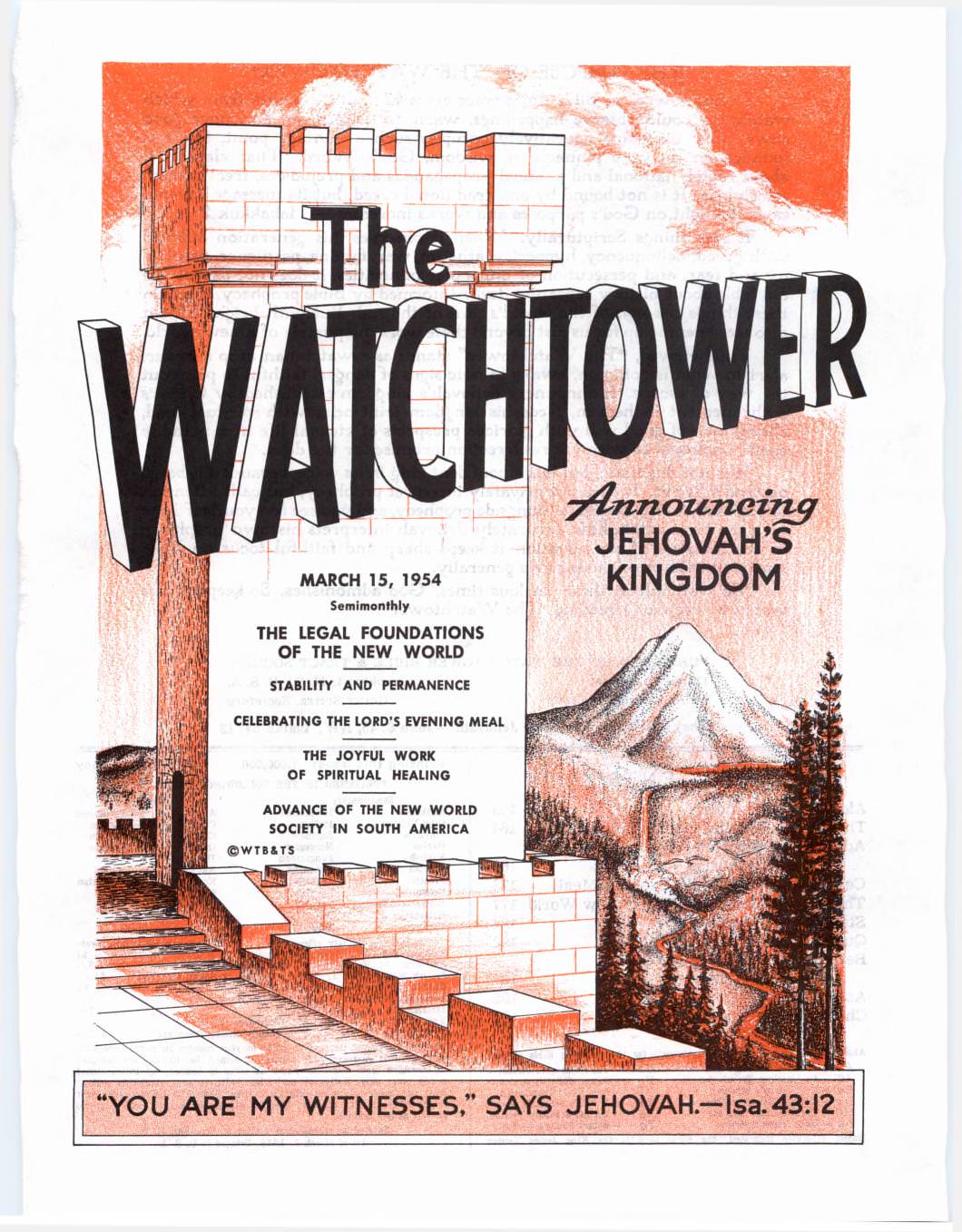
"YOU ARE MY WITNESSES," SAYS JEHOVAH.—Isa. 43:12
The WATCHTOWER
Announcing
JEHOVAH'S
KINGDOM
MARCH 15, 1954
Semimonthly
THE LEGAL FOUNDATIONS
OF THE NEW WORLD
STABILITY AND PERMANENCE
CELEBRATING THE LORD'S EVENING MEAL
THE JOYFUL WORK
OF SPIRITUAL HEALING
ADVANCE OF THE NEW WORLD
SOCIETY IN SOUTH AMERICA
©WTB&TS
"YOU ARE MY WITNESSES," SAYS JEHOVAH.—Isa. 43:12 THE PURPOSE OF "THE WATCHTOWER"
Literal towers in Bible times were elevated vantage points from which watchmen could observe happenings, warn of danger, or announce good news. Our magazine figuratively occupies such a vantage point, for it is founded on the very pinnacle of wisdom, God's Word. That elevates it above racial, national and political propagandas and prejudices, frees it from selfish bias. It is not bound by any traditional creed, but its message advances as the light on God's purposes and works increases.—Habakkuk 2:1-3.
It sees things Scripturally. When it observes this generation afflicted with greed, delinquency, hypocrisy, atheism, war, famine, pestilence, perplexity and fear, and persecution of unpopular minorities, it does not parrot the old fable about history repeating itself. Informed by Bible prophecy, it sees in these things the sign of the world's time of the end. But with bright hope it also sees opening up for us just beyond these woes the portals of a new world.
Thus viewed, "The Watchtower" stands as a watchman atop a tower, alert to what is going on, awake to note signs of danger, faithful to point out the way of escape. It announces Jehovah's kingdom established by Christ's enthronement in heaven, feeds his kingdom joint-heirs with spiritual food, cheers men of good will with glorious prospects of eternal life in a paradise earth, comforts us with the resurrection promise for the dead.
It is not dogmatic, but has a confident ring in its voice, because it is based on God's Word. It does not privately interpret prophecy, but calls attention to physical facts, sets them alongside prophecy, and you see for yourself how well the two match, how accurately Jehovah interprets his own prophecy. In the interests of our salvation, it keeps sharp and faithful focus on Bible truth, and views religious news generally.
'Be watchful in these perilous times,' God admonishes. So keep on the watch by regularly reading "The Watchtower".
PUBLISHED BY THE WATCH TOWER BIBLE & TRACT SOCIETY
117 Adams Street Brooklyn 1, N. Y., U. S. A.
N. H. KNORR, President
"They will all be taught by Jehovah."—John 6:45, NW; Isaiah 54:13
CONTENTS
Aid to Understanding 163
The Joyful Work of Spiritual Healing 164
Advance of the New World Society in South America 168
Celebrating the Lord's Evening Meal 173
The Legal Foundations of the New World 177
Stability and Permanence 184
Questions from Readers 190
Better Immoral than One of Jehovah's Witnesses? 191
Announcements 192
Check Your Memory 192
Abbreviations used in "The Watchtower" for the following Bible versions
AS - American Standard Version LXX - The Septuagint Version
AT - An American Translation Mo - James Moffatt's version
Da - J. N. Darby's version NW - New World Translation
Dy - Catholic Douay version Ro - J. B. Rotherham's version
ED - The Emphatic Diaglott RS - Revised Standard Version
Le - Isaac Leeser's version Yg - Robert Young's version
Unless otherwise indicated, the Bible used is the King James Version
Semlmonthly
Monthly
Afrikaans
Indonesian
Arabic
Portuguese
Cebu-Visayan
Italian
Cibemba
Russian
Cinyanja
Japanese
Cishona
Sesotho
Danish
Norwegian
Greek
Siamese
English
Pangasinan
Ibo
Silozi
Finnish
Slovenian
Kanarese
Slovak
French
Spanish
Korean
Ukrainian
German
Swedish
Malayalam
Urdu
Hiligaynon-Visayan
Tagalog
Polish
Yoruba
Hollandish
Twi
Ilocano
Zulu
Watch Tower Society offices Yearly subscription rate
America, U.S., 117 Adams St., Brooklyn 1, N.Y. $1
Australia, 11 Beresford Rd., Strathfield, N.S.W. 8/-
British West Indies, 21 Taylor St., Port of Spain, Trinidad$ 1.72
Canada, 40 Irwin Ave., Toronto 5, Ontario $1
England, 34 Craven Terrace, London, W. 2 7/-
Jamalca, 151 King St., Kingston 7/-
New Zealand, G.P.O. Box 30, Wellington, C. 1 7/-
South Africa, Private Bag, P.O. Elandsfontein, Transvaal 7/-
Remittances should be sent to office in your country in compliance with regulations to guarantee safe delivery of money. Remittances are accepted at Brooklyn from countries where no office is located, by international money order only. Notice of expiration (with renewal blank) is sent at least two issues before subscription expires. Change of address when sent to our office may be expected effective within one month. Send your old as well as new address.
Entered as second-class matter at Brooklyn, N. Y. Act of March 3, 1879. Printed in U. S. A.
AID TO UNDERSTANDING
THE Bible enjoys a distribution that runs into thousands of millions. Millions of persons never bother to read it, but other millions do. Some read it just as a matter of religious formalism, making no earnest effort to understand it and holding no serious intent of putting its principles into everyday practice. But there are many sincere persons that read it with an honest desire to understand it and make their lives conform to its precepts. Yet their diligent efforts do not bring clear understanding and hence they fall short of the conformity they desire. What is lacking?
When Jehovah God delivered Israel from Egypt and made it his covenant nation he gave it his law, which he inspired Moses to write, along with some prophecy and history dating from the time of creation. With these first books of the Bible, guiding instruction in their application was provided in the form of a priesthood. Faithful priests constituted a teaching organization to assure clear understanding of Jehovah's law. As centuries passed Jehovah raised up prophets, whose words of warning and prediction further clarified Jehovah's purposes, and which were recorded and made a part of the Bible. When Jesus came to earth he preached and prophesied, and thereby brought in a period of great enlightenment concerning the completed canon of the Hebrew Scriptures. More than that, he became the mediator of a new
covenant, and declared new truths and precepts, which were publicized and enlarged upon by his disciples and eventually put in writing as the Greek Scriptures, to complete the Bible canon of sixty-six books as we have it today.
However, the priests in Israel said many things in explanation of the written Scriptures that were not recorded, and the same is true with respect to the prophets and Jesus and his disciples. Jehovah uses a visible organization, entrusts the Biblical truths to it, and expects it to abide by and clarify these truths to others. Many religious organizations today claim to be this visible organization of God, but by their fruits they show they are not. All along there have been such false pretenders, who have been exposed by faithful priests and prophets before the time of Christ, by Jesus when he came and by his apostles afterward, and by his footstep followers even to our day.
Today the facts of the past few decades show Jehovah has been and is using the Watch Tower Society and Jehovah's witnesses as a teaching organization, anointed witnesses who make up the promised "faithful and discreet slave" appointed to give spiritual "food at the proper time." (Matt. 24:45, NW) They cause to be published material that makes the Bible clear for our day. The publications may be likened to a telescope, the Bible to the stars.
Without a telescope many stars can be seen, but the view of the heavens is very incomplete. A powerful telescope brings the whole heavens more nearly into view. With the Bible alone many points can be seen, but with the aid of the Watch Tower publications a much more complete picture of
Jehovah's purposes comes into view. The Bible remains the basic essential. What good would be a telescope without the stars? What value Bible helps without the Bible? So both are needed, and together the Bible will be read with far greater understanding.
MANY men in this old world concentrate on ways to destroy life. Some men seek to save life. Doctors do this. What a thrill must be theirs to enter a room where a child nears death and they are able to diagnose the case, prescribe the remedy, administer it, and watch the flush of life return to the pale cheeks! What satisfaction must be the doctor's that completes a delicate operation that saves a man's life! More rewarding than any monetary fee must be the joy and thrill of knowing that he has extended a human life for ten or twenty years.
Much greater must have been the joys of Jesus when he was on earth. He alludes to himself as a physician, and part of his record in physical healing reads: "The blind are seeing again, and the lame are walking about, the lepers are being cleansed and the deaf are hearing, and the dead are being raised up, and the poor are having the good news declared to them." Again, "Then great crowds approached him, having along with them people that were lame, crippled, blind, dumb, and many otherwise, and they fairly threw them at his feet, and he cured them; so that the crowd felt amazement as they saw the dumb speaking
and the lame walking and the blind seeing, and they glorified the God of Israel." Matt. 11:5; 15:30, 31; Mark 2:17, NW.
On one occasion Jesus cured ten lepers. Men cannot cure leprosy as Jesus did and without leaving its crippling effects. Jesus gave sight to a man born blind. Today's doctors can make glasses but not eyes. They can provide hearing aids, but cannot restore the sense of hearing as Jesus did. They can remove an arm or a leg, but it is possible that Jesus could replace such a lost body member. The Greek word translated "crippled" at Matthew 15:30 is rendered "maimed" at Mark 9:43, where it refers to an amputated hand; so it is not beyond possibility that some of the crippled Jesus healed were amputees. Jesus' cures never ended in failure. The mistakes of present doctors often send patients to the grave, whereas Jesus brought persons back from the grave. What great joy it must have been to Jesus to go around the countryside, see a blind man and restore his sight, or see a deaf man and restore his hearing, or see one dumb and bid him speak, or tell the dead to rise to life again!
—Luke 17:12-14; John 9:1, 7; Mark 5:41, 42; John 11:43, 44.
What if we could do that? What if we could go out on the street and see a blind man guided by a seeing-eye dog and tell him to see and his sight would be restored? What if we could tell a paralytic to get off his bed and walk and he would do so? or bid a girl on crutches throw them aside and walk without them? or replace the artificial leg of an amputee with one of flesh and blood? Above all, what if we could attend a funeral and, instead of helplessly grieving with the others, tell the deceased to rise from the coffin and walk out and that amazing miracle would take place? Would not the deep satisfaction coming from such accomplishments be so rewarding in itself that we would not think of financial gain? Our joy would be so overflowing we would not stop short of complete exhaustion. As long as any blind or lame or deaf or dumb remained in the earth we would want to be busy in the work of healing.
"WORKS GREATER THAN THESE"
Jesus performed these miracles of physical healing, yet he said his disciples would do greater works: "Most truly I say to you, He that exercises faith in me, that one also will do the works that I do, and he will do works greater than these, because I am going my way to the Father." (John 14:12, NW) His followers today cannot perform the miracles of physical healing. What can they do that rivals or surpasses such mighty works? With the truths of Jehovah's Word they can be instrumental in spiritual healing. Jesus did this spiritual healing by declaring the truths of Jehovah, and it is associated with his physical cures, at Matthew 11:5. He viewed it as more important than physical healing, and used the latter mainly to get the people to give attention to the message he preached, to
get the early Christian body established and matured for declaring the good news. It was the truths for spiritual healing rather than physical cures that he wanted publicized.—1 Cor. 13:8-11; Mark 5:43; Matt.24:14.
But since Christ Jesus, in addition to performing amazing physical cures, did the work of spiritual healing, how can it be said that his followers do greater works? Suppose a doctor discovers a drug that cures a disease or develops an operational technique that makes possible a delicate, lifesaving operation. After applying his discovery for three or four years and in that time curing forty or fifty persons, this doctor dies. But he has taught others, and after his death hundreds and thousands of doctors copy his methods and for many years and in many lands cure thousands upon thousands of persons. Because their works accumulate over a long period of time and spread over large areas, are they not greater in time and extent than those of the original doctor? The doctor inaugurating the cures is the vital figure, but the ones that follow accumulate a far larger number of cures. So it is with Jesus and his followers. He inaugurates the work and is the leader and perfecter of the way, the model in whose steps his disciples must follow. But his exclusive performance of the work was confined to Palestine and lasted only three and a half years, whereas his followers do it earth-wide and for many years. It is in this sense that their works are greater.
Not with the physical ailing of an individual in mind, but with the spiritual sickness of the nation of Israel in view, Jehovah's prophet said: "Where will you still be smitten, that you continue in your defection? The whole head is ailing, and the whole heart sick; from the sole of the foot to the head there is no health in it—nought but blows and bruises and bleeding wounds, that have not been pressed nor bound up nor softened with oil."
But following a period of captivity in Babylon a restoration and spiritual healing was to come: "None who dwells there will say, 'I am sick,' for all her citizens will have had their sins forgiven." "Behold, I will bring them complete recovery and healing, and will reveal to them abundance of peace and security." Associating sins and their forgiveness with the sickness shows it was primarily spiritual. In figurative speech this spiritual healing is portrayed as physical: "Then shall the eyes of the blind be opened, and the ears of the deaf shall be unstopped; then shall the lame man leap like a hart, and the tongue of the dumb shall sing." The fulfillment of this prophecy following the return from Babylon must have been in a spiritual sense, since the physically blind and deaf and lame and dumb were not miraculously cured. Isa. 1:5,6;33:24; Jer. 33:6; Isa. 35:5,6 AT.
When Jehovah restored his people to the Promised Land, ending their captivity in Babylon, they were cleansed of their former sins and were able to re-establish true worship at the rebuilt temple at Jerusalem. In a spiritual sense the inhabitants of the land could not say they were sick, and in a spiritual sense Jehovah did bring in health and cure. Eyes once blind to Jehovah's leading and ears once deaf to his commands now opened to see and hear and obey. Those who formerly made a lame response now leaped to do Jehovah's service, and tongues formerly silent now readily sang out the praises of Jehovah God.
Centuries later Jesus performed a similar work of spiritual healing, and in this present day Jehovah's witnesses are used to effect spiritual cures—an opening of eyes blind to Jehovah's purposes, an unstopping of ears deaf to his commands, a training of silent tongues to speak truth and sing praises, an energizing of lame ones to the point of going from door to door to preach, and even a bringing to life and spiritual activity of those dead in trespasses and sins. (Eph. 2:1) It takes words of truth from the Bible to end spiritual sickness and provide spiritual health, and once we have it we must "keep holding the pattern of healthful words." If anyone does not accept these healthful words of truth and teaches false doctrine he is mentally diseased, spiritually sick: "If any man teaches other doctrine and does not assent to healthful words, those of our Lord Jesus Christ, nor to the teaching that accords with godly devotion, he is puffed up with pride, not understanding anything, but being mentally diseased over questionings and debates about words." Jehovah's truths mean spiritual health and life: "My son, attend to my words; incline thine ear unto my sayings. For they are life unto those that find them, and health to all their flesh." The wisdom from above constitutes a tree of life.—2 Tim. 1:13; 1 Tim. 6:3, 4, NW; Prov. 4:20, 22; 3:13-18.
Materialistic persons today fail to appreciate spiritual healing, though they would welcome physical cures. A physical cure might extend their life ten or twenty years, but spiritual healing would open the way for life, not just for ten or twenty years, or ten or twenty million years, but for eternity. Yet they refuse to be healed of their spiritual illness, oblivious to the fact that they are spiritually blind, deaf, dumb, lame, unclean and even dead. Often they deliberately make themselves so, closing eyes and ears to the truth, refusing to discuss the Bible. (Zech. 7:11-14; Acts 7:57; Rev. 3:17-19) Though they pass the most rigid eye examination, if they cannot see in the present world happenings the sign of the establishment of Jehovah's kingdom in heaven they are blind to the most momentous event of our times.
Though their sharp ears can hear a pin drop at the busiest intersection of the biggest city, if they cannot responsively hear Jehovah's commands they are deaf to the most important voice in the universe. Though their tongues pour out a continuous flood of words, if they cannot speak Jehovah's message they are dumb to the most vital speech. Bodies may have energy to work all day and dance all night, but if they are motionless and inactive in Jehovah's service they are dead in trespasses and sins, not alive to Jehovah at all.—1 Tim. 5:6.
CHRISTIAN OBLIGATIONS
What would we think of a doctor that turned his back on a critically sick man, letting him die because the doctor did not want to be bothered? Since the spiritual healing is far more vital, is it not more reprehensible for true Christians to ignore the needs of the spiritually sick multitudes? A ministration of truth might wash clean the spiritually leprous ones and make happy the eyes once blind and the ears once deaf: "Happy are your eyes because they behold, and your ears because they hear." (Matt. 13:16; Eph. 5:26, 27, NW) But if Christians withhold healthful words and let those now dead in trespasses and sins die physically at Armageddon, their responsibility compares with the doctor's that turns his back on the dying. Jehovah holds them accountable.—Ezek. 33:8.
In emergencies doctors should be available any hour of the day or night. In physical healing Jesus did not refuse assistance, but took on the infirmities of the people, spent himself in the cause, felt force go from him when he healed others. (Matt. 8:17; Isa. 53:4; Mark 5:30) Christians today should not spare themselves but should spend their energies in the work of spiritual healing, feeling the same compassion for the afflicted ones that Jesus felt, as stated at Matthew 9:36 (NW): "On seeing the crowds he felt tender affection for them, because they were skinned and knocked about like sheep without a shepherd." The injuries that here roused Jesus' pity were spiritual, caused by the lack of a faithful shepherd to look after their spiritual interests. Followers of Christ should feel tender affection for persons today who are spiritually sick because Christendom's unfaithful shepherds have failed to feed and protect them spiritually, and the healthful words of truth should be made available to them.
Doctors spend long years studying and training for their profession, and when they practice it they use what is termed a good bedside manner, having the mental attitude of their patient in mind. Jehovah's witnesses must study diligently, learn the truth, learn how to present it effectively, and use a doorside manner that shows tact and understanding of the householder's mental state. Just as the doctor must diagnose his patient's illness and determine the needed remedy, so Jehovah's witnesses must discover the particular spiritual ailment of the householder and present the truths that will clear up that difficulty. Many will not permit this administration of healing truth, even denying that they are spiritually sick. They may not permit us to help them, just as some, like Christian Scientists, will not permit a doctor to aid them medically because they deny they are physically sick. Still, Christians know the multitudes are spiritually ailing and they must diligently offer the healing truths, letting any refusal come from the sick multitudes and not from themselves.
So reflect for a moment. If you could heal the physically blind, deaf, dumb, lame, leprous, and even raise the dead, would you not be doing it tirelessly, thrilled beyond description with the sheer joy of such miraculous accomplishments?
Knowing the spiritual healing is more vital, its benefits more lasting, its urgency more pressing, will we spend ourselves in it as much as or more than we would if we could go out and tell a blind man to see, or a deaf one to hear, or a dumb one to speak, or a lame one to walk or a leprous one to be clean, or even a dead one to come to life again? The spiritual healing is not so spectacular in fleshly appearance and awesomeness, and hence not so glamorous to
the imagination. But it is permanent, not temporary, and in time brings with it perfect and everlasting physical health. Share in it with zeal. Joy in the cures observed Appreciate its urgency, its vitalness. "Ponder over these things, be absorbed in them, that your advancement may be manifest to all persons. Pay constant attention to yourself and to your teaching. Stay by these things, for by doing this you will save both yourself and those who listen to you."—1 Tim. 4:15, 16, NW.
Advance of the New World Society in SOUTH AMERICA
BACK in the year 1942 there were only eight lands in South America where Jehovah's witnesses were preaching the good news of the Kingdom, and their total number came to 807. In 1943 the Watchtower Bible School of Gilead was opened for the purpose of training ordained ministers to carry forward the missionary work in foreign lands.
By the end of the 1953 service year 301 specially trained Gilead students were scattered throughout South America, with the prospect of more entering, and there was a total of 13,174 representatives of the New World society proclaiming the good news in all parts of this great continent high in the Andes, in the valley of the Amazon and far to the south in the pampas of Argentina.
At Yankee Stadium in the summer of 1953 it was announced that the president of the Watch Tower Bible and Tract Society, N. H. Knorr, and one of the directors, M. G. Henschel, hoped to tour South
America and visit all the branch offices and missionaries. The schedule was prepared so that the visit could begin in the latter part of November, 1953.
The first scheduled stop for the two visitors was to be at Caracas, Venezuela. All of Jehovah's witnesses in the interior of the country were invited to come to the national assembly to be
held there and to participate in the largest theocratic feast ever prepared for Venezuela.
During the week prior to the assembly the witnesses of Jehovah in Venezuela kept coming from the east and the west, all enthusiastic about worshiping Jehovah at a central point. Distribution of handbills proceeded among persons of good will. Radio and newspaper notices were given during the week, and all the conventioners were anxious to see how this convention would compare with the one of three years before when the president of the Society spoke to 146 at a public lecture.
At the main entrance of the meeting place pictures of the 1953 convention at Yankee Stadium were put up, as this Venezuelan assembly was a kind of continuation of that grand gathering. The new Spanish Songbook that had been released at Yankee Stadium was released on the opening day of this assembly and all were anxious to learn the new songs. New Spanish tracts were put on display in the hall.
The convention opened on Friday, November 13, with 324 brothers joyously gathered, equipped for field service. The afternoon was set aside for a baptismal service for all those who desired to symbolize their dedication of their lives to Jehovah. A very fine pool had been rented for this purpose. Because of its being a religious gathering, the owner of the pool reduced the rental price from one thousand bolivars to a hundred; but upon watching the immersion of 81 persons of all ages he was so impressed that he refused to accept any money at all and said it was an honor to have accommodated such Christian people.
By Friday evening 468 were in attendance, taking in the information presented in a well-arranged program. At that time Brothers Knorr and Henschel were due to leave Idlewild airport, New York, but because of engine trouble they did not get under way until 11:20 the next forenoon. While this made it impossible for them to arrive in time for any of the Saturday sessions, the program in Caracas went right ahead with substitutions being made for them. The principal talks of the Yankee Stadium assembly were translated into Spanish and given and films in color of the assembly were shown.
After the Saturday evening program was over our travelers from the Brooklyn headquarters arrived at the branch office. Their trip from New York to Maiquetia airport had passed without incident.
The Sunday sessions got off to a good start with Brother Henschel giving the talk he was scheduled to deliver the night before. The audience was delightfully surprised to hear him give his entire talk, "Lies Lead to Loss of Life," in Spanish. He clearly pointed out that Jehovah's witnesses must be speakers of the truth publicly, in their homes and in the congregations.
What would be the response to the invitations to the afternoon's public lecture, "After Armageddon—God's New World"? At three o'clock Brother Knorr began speaking through an interpreter and the people continued to come in. The main hall was filled and many were seated in the adjoining patio with a total of 942, the largest gathering by far for any theocratic assembly in Venezuela.
After the serving of food there were more singing and other talks by the two visiting brothers, for which 733 remained. The Society's branch servant for Venezuela presented to the assembly the Resolution that had been presented and accepted by the Yankee Stadium assembly on July 20, and the brothers in Venezuela were pleased to accept it also. Brother Knorr concluded the convention by stressing the need of sticking to the organization, keeping it clean and following through faithfully on one's dedication to Jehovah God. The joyous expressions of these humble, zealous and happy brothers showed their appreciation for this grand assembly.
There are now many well-established congregations and thirty-one missionaries scattered throughout Venezuela, with a number of local brothers engaging in the full-time ministry. Arrangements were made for further increases and expansion of the Kingdom witness. It was a joy to meet with the missionaries and to talk over their problems with them; and the days that followed the assembly were well used, Tuesday being spent with the group at Valencia, Wednesday with the group at Barquisimeto and Thursday with the group at Maracaibo.
At each place a meeting was held for the good-will interest, each of which was very well attended.
COLOMBIA
By midday of November 20 our travelers were flying over the Gulf of Venezuela, to the north of Maracaibo, on their way to Barranquilla, where the convention for Colombia began with Brother Knorr speaking at the local Kingdom Hall.
On the following day certain programs were devoted to the full-time ministry and it was good to see and hear how a number of the brothers have arranged their affairs to get into that field of service. The Society has only six missionaries in Colombia; so it is up to the local full-time ministers to do the preaching of the message in all parts of the country. One sells plantains in the open market every morning and preaches afternoons and evenings; another takes in washing; another drives a taxi half a day; others operate their carpenter and shoe shops part time. One eleven-year-old girl has answered the call to full-time service and is doing well. The Society is giving financial support to a number of special full-time ministers so that these can go into other territories and build up new congregations. With forty full-time ministers pushing ahead in Colombia the work there has seen an increase of 31 per cent in the past year.
The first two months of the present service year, September and October, have already seen a twenty per cent increase, for a total of 439 ministers, and the average hours are excellent. Probably the reason for this is that the Barranquilla congregation, where there are only two missionaries, who, however, are extremely zealous and spend much time with the newly interested people in educating them in door-to-door witnessing, has set such a good example. In just a few short years three congregations have been established there and these have produced practically all of the full-time ministers in the country. One sister sixty-one years old in the general full-time ministry averages 135 hours a month.
The convention at Barranquilla followed the same pattern of other conventions of Jehovah's witnesses, and here also they were happy to accept the Resolution of the New World society.
In the Sunday morning's discussion of baptism the matter of proper living was injected into the talk. The Catholic religion has never stressed high morals in South America. Legal marriage is difficult for the poor because the Catholic Church demands such high prices, and, as a result, fornication, adultery and immorality are rampant. Divorce is impossible, even on the grounds of adultery; hence many complications present themselves in such Catholic-dominated lands when persons begin to learn the principles of God's Word through the preaching of Jehovah's witnesses. So when the baptismal talk was finished a number of brothers inquired as to whether they could be baptized or not, and they were advised they could not until they had straightened out their lives and lived with only one wife or married the woman they were living with. These seekers for life were happy to straighten out their affairs, and so put off baptism until the next opportunity. Fifty symbolized their dedication to do Jehovah's will.
The president of the Society delivered the public lecture, "It Is Time to Consider God's Way." The Kingdom Hall was packed, the driveway was full, the crowd overflowing into the large patio in the rear, for a total of 655, a new record in attendance for Barranquilla.
Of these, some 500 remained to hear the concluding remarks by Brother Knorr, at which time a report was given regarding the fine increases accomplished by the witnesses in Colombia. The witnesses there are determined to bless Jehovah's name every day and praise him forever and ever.
The Society's branch office for Colombia is located at Barranquilla; so a day was devoted to handling the problems and planning for the future expansion of the work in Colombia. Colombia is a large territory and millions of people have yet to receive the witness concerning God's kingdom.
AT BOGOTA
Engine trouble caused a delay in getting away by plane to Bogotá. After a brief stop at Cartagena, in a driving rain, our two travelers were off to the mountains. Higher and higher the plane rose, until finally it crossed the ridge that brought into view the beautiful plateau on which rests the capital city of Colombia.
The missionary home in Bogotá is located conveniently in the city. Extensive preparations had been made for the evening talk "After Armageddon—God's New World," but due to action by the authorities the public lecture had to be held as a private meeting and in the local Kingdom Hall. Here in the interior of the country the people seem quite fanatical about their religion and much opposition has been manifested toward non-Catholics.
By 6:30 p.m. about 100 people were seated in the Kingdom Hall, with loudspeakers tying in the garage and dining room. The total attendance of 162 extremely pleased the missionaries. As an added pleasant surprise colored slides of the New World Society Assembly of Jehovah's Witnesses at Yankee Stadium were shown and commentary was given along with them. While those inside the hall were pleased
with the truths being presented and happy over the prospects of the new world of righteousness, there were some on the outside that displayed different feelings, showing their displeasure that such a meeting should be held by trying to create a disturbance.
The next morning the missionary home was found to be marked up with expressions such as "Down with Jehovah!" "May Jehovah's Witnesses Die!" and "Long Live the Virgin!" and crosses were marked all over the building. The brass plate bearing the name Salón del Reino (Kingdom Hall) was all scratched up. It was quite a washing job, cleaning all the doors and making the outside of the home look presentable again. When the religious education has been so corrupted that people do not know who Jehovah is, they will do such things. Catholic translators and scholars, whether Spanish or of some other tongue, know that the name of the Sovereign of the universe is given in the Bible. In Spanish we call him Jehova.
After cleaning the walls, the missionaries had a discussion of their problems with the visiting brothers. In this city of Bogotá, with some 600,000 population, they are wondering why, after eight years of work, they have an average of only thirty Christian ministers of Jehovah. Is it the people? Is it the fear of the government? Is it a lack of a sense of responsibility? It is difficult to comprehend how some individuals think, but the conclusion was reached that we must continue to teach and try to bring to maturity those who are seeking righteousness. The fact that ninety-one persons of good will attended a meeting that evening was considered encouraging.
ECUADOR
Morning soon came and it was time for the president and his secretary to move on to Quito, Ecuador, where a convention was to open that day, November 26.
It was a cloudy day and it was not long before the plane, in which the Society's representatives were riding, began to circle high above the clouds. According to the schedule the plane should have been over Quito. This capital city of Ecuador is hidden in a valley, surrounded by high mountains, and the pilot decided it was too risky to try to land on the small airport. After circling for some time the plane headed off in a westerly direction and an hour and fifteen minutes later landed safely at Guayaquil. Our travelers were hustled off to a hotel and advised that the plane would take off for Quito the next morning. This unexpected stop resulted in an enjoyable visit with the local missionaries who, having received word from Quito that our travelers were landing in Guayaquil, called at their hotel.
The next morning Knorr and Henschel were on their way over the large peaks of the Andes and then up through the beautiful green valley in which Quito, the city of red roofs, is located. A dozen peaks rise some 16,000 feet and the city itself lies 9,243 feet above sea level. The highest volcano in the world, Cotopaxi, is just a few miles south of Quito. A smiling crowd of conventioners was at the airport to welcome the travelers, glad that they had finally arrived safely.
There was still another day for the convention and it was turned over to the visitors. The morning sessions were at the Kingdom Hall and those in the afternoon at the Club Checoeslovaco-Ecuatoriano, where 113 were present. Two zealous sisters came from Ambato, where they are devoting fifty hours monthly to the witness work and conducting sixteen weekly Bible studies between them.
The congregation in Quito is doing steady work. Ten missionaries together with sixty local ministers are busy preaching.
Leaving Quito, our travelers, Knorr and Henschel, arrived in Guayaquil Saturday afternoon where, in the spacious Salon del Reino, they found an enthusiastic assembly in progress since the previous day. The attendance had climbed to 189 and then increased to 252 for Brother Knorr's final talk on Sunday evening.
Five years ago when the first missionaries arrived in Guayaquil they found no witnesses at all. Now there are eighty sharing in the work. They find the people eager to take the literature and to study.
Travel between cities in Ecuador is difficult because of lack of roads, but nevertheless fifty brothers did come to Guayaquil from Manta, Riobamba de Cuenca, by truck. A number of these were baptized.
Following the assembly Brothers Knorr and Henschel spent two days discussing local problems with the missionaries. More missionaries will be sent into the country to help expand the work.
In all three countries there is much evidence of stepped-up activity on the part of the Roman Catholic Hierarchy. Priests are being brought in from other countries, particularly Spain, and a struggle is on to hold the power over the people.
Jehovah has his New World society in operation and its representatives are in all parts of the earth. They are not trying to gain control of the people by intrigue but are preaching the truth from the Bible and pointing the people to their only hope, the reign of Christ and the new world. Year by year their numbers increase because sheeplike ones are being found and taught, while at the same time all grow to maturity. The fight may become intense before the issue is settled, but Jehovah leaves no doubt as to the outcome. He will remove wickedness from the earth and preserve the righteous for life eternal. In South America increasing numbers look forward to this new world, and they will not be disappointed.
Celebrating the Lord's Evening Meal
ONLY one red-letter date appears on the 1954 calendar of Jehovah's witnesses, and that is April 17. On that date, as the
sun sinks behind the horizon in the west, every last one of Jehovah's witnesses that can possibly do so will assemble with other witnesses at the local congregational meeting place. This year upward of a half million witnesses together with several hundred thousand persons of good will are expected to assemble thus.
Why should all the witnesses of Jehovah come together on April 17? Because it is also Nisan 14. Nisan 14? Yes, according to the calendar that Jehovah God gave to the nation of Israel the first month of the year was Nisan or Abib and it began with the new moon nearest the spring equinox or the first day of spring.—Ex. 12:1, 2.
What is so notable about Nisan 14, you ask? That day became outstanding in the year 1513 B.C., when Jehovah made a name for himself by breaking the Egyptian yoke over his people and setting them free. On that night the Israelites ate a "supper" consisting of roast lamb or kid, unleavened bread and bitter herbs; and it was termed the "passover supper" because God's angel of death spared or 'passed over' their first-born while destroying all the first-born of Egypt; that is, spared them provided they had carried out all the instructions including the splashing of some of the blood of the lamb on the doorposts and on the upper part of the doorway belonging to the houses in which they ate the supper, and remained inside.—Ex. 12:3-13, NW.
So that they would never forget that memorable day when Jehovah vindicated his supremacy, humbled Pharaoh's pride
and set his people free from the bitter Egyptian bondage, God commanded that this passover supper be celebrated annually on Nisan 14, and later hat it was to be celebrated in the
city on which he had placed his name, Jerusalem. Thus, some fifteen centuries later, on Nisan 14, A.D. 33, we find thirteen Israelites in an upper chamber in the city of Jerusalem celebrating the passover. Who were these thirteen? Christ Jesus and his twelve apostles.
However, it is not to celebrate the Jewish passover that Jehovah's witnesses come together this year on Nisan 14, but rather to celebrate the signal events that were to occur on that Nisan 14 of A.D.33, events that would far surpass in importance even those that occurred 1545 years before in Egypt. Yes, Nisan 14, A.D.33, saw Jehovah's name vindicated in that on that day Christ Jesus gave proof that a perfect man could keep integrity in spite of all that the Devil could bring upon him, and on that day the ransom sacrifice was provided which was to lead to the eventual deliverance of all lovers of righteousness from the bondage of the Greater Pharaoh, Satan the Devil, and from antitypical Egypt, his organization. All on that day? Yes, because according to God's calendar the day began at sunset and continued until the next sunset.
MEANING OF THE EMBLEMS
Just as Moses instituted an anniversary celebration of the deliverance of the Israelites from Egypt on the very night that they were delivered, so Christ Jesus instituted an anniversary celebration of the deliverance he was to provide on that very night of Nisan 14, A.D.
And while the various religious organizations of Christendom celebrate the "Lord's supper" semiyearly quarterly, monthly, weekly, and even almost daily, yet in view of the fact that the passover, which commemorated the deliverance from Egypt, was celebrated only once a year and that on Nisan 14, it is reasonable to conclude, in the absence of any instructions to the contrary, that the Lord's evening meal also should be celebrated only once a year, on Nisan 14, to commemorate the deliverance provided by the death of the antitypical passover Lamb, Christ Jesus.
It was after the passover supper and after Jesus had dismissed Judas that he "took a loaf and, after saying a blessing, he broke it and, giving it to the disciples, he said: 'Take, eat. This means my body.'" (Matt. 26:26; John 13:21-30, NW) To which body was Jesus referring here? To his fleshly body? Hardly, for concerning it we read that not a bone was broken, whereas Jesus broke the loaf. (John 19:36) Rather, he was referring to his spiritual body, the Christian congregation, which in the Scriptures is termed a body or Christ's body more than forty-five times. That this is the correct conclusion is apparent from Paul's words: "The loaf which we break, is it not a sharing in the body of the Christ? Because there is one loaf, we, although many, are one body, for we are all partaking of that one loaf." Clearly the loaf pictures not Jesus' fleshly body but his body members, the Christian congregation.—1 Cor. 10:16, 17, NW.
By partaking of this loaf one says in effect, 'I profess to be a member of the body of Christ.' Since in the Scriptures yeast or ferment is a picture of sin and all passover bread had to be without yeast, this would picture the fact that those who are part of the spiritual body of Christ
will do their best to keep themselves free from sin and malice. Further this yeastless bread was also termed the "bread of affliction" because it was heavy, "sad" as it were, and reminded the Israelites of their sufferings in Egypt and of the great haste in which they left Egypt, so great that they did not have time to properly prepare their bread. It therefore also fittingly pictures the suffering that Christ's body members must endure.—1 Cor. 5:6-8; Deut. 16:3; 1 Pet. 2:21, NW.
After giving the disciples the loaf to eat, Jesus also "took a cup and, having given thanks, he gave it to them, saying: 'Drink out of it, all of you; for this means my "blood of the covenant" which is to be poured out in behalf of many for forgiveness of sins.'" (Matt. 26:27, 28, NW) Since drinking the cup means sharing with Christ, does that indicate that Christ's followers have a part in providing forgiveness of sins by their sacrifice? No, for the Scriptures show that only Christ could provide a ransom. (Ps. 49:6-9; John 1:29) But his followers can share in drinking the same cup that Jesus drank in the sense that this cup also pictures God's will for his servants, even as Jesus prayed on the night of his betrayal: "Father, if it is possible, let this cup pass away from me. Yet, not as I will, but as you will."—Matt. 26:39, NW. See also Matthew 20:22.
The Scriptures tell us that the soul or life is in the blood. (Lev. 17:14) Blood poured out would therefore picture death. So those who drink of the cup at the Lord's evening meal confess thereby that they expect to die with Christ that they may share in his resurrection. (Phil. 3:7-11) With the arrival of God's kingdom, drinking of the fruit of the vine is also a symbol of sharing in Christ's joy.-Matt. 26:29; 25:21, 23, NW. NOT TRANSUBSTANTIATION
Perhaps by now some good Roman Catholic who has been reading the foregoing will say, 'But you have changed the Bible! According to my Bible Jesus said regarding the loaf and the wine: "This is my body," and "This is my blood."' (Knox) True, many translations do so render Jesus' words. But there are also others that render them similarly to the way the New World Translation does. Thus Moffatt uses the word "means" for "is"; C. B. Williams uses "represents" instead of "is"; whereas Weymouth in his footnote (Third Edition) states: "Or 'signifies,' 'represents,' 'symbolizes my body.' In many places in both the O.T. and the N.T. the verb 'is' or 'are,' expressed or (as here) understood, may be thus rendered." Among the examples Weymouth gives is that of the illustration of the sower where Jesus repeatedly states that one thing "is" another, although meaning that one thing "represents" another. See also Matthew 13:36-39.
Yes, Jesus' speech was full of metaphors, symbols; and not only Jesus' but also his apostles'. Note Paul's words regarding the rock in the wilderness from which water gushed forth for the benefit of the Israelites: "All drank the same prophetic drink, watered by the same prophetic rock which bore them company, the rock that was Christ." (1 Cor. 10:3, 4, Knox) Was that rock actually Christ? No, but it foreshadowed, it pictured Christ. The same with Jesus' words on the night of his instituting the memorial of his death.
Had Jesus meant that the bread or loaf was his actual body and that it would or was to be repeatedly sacrificed as is claimed by the Roman Catholic Church in the sacrifice of the mass, would he not have stated, "Do this in sacrifice of me"? or, "Thus sacrifice me"? But instead he said, "Do this for a commemoration of me." (Luke 22:19, Knox) Obviously he
meant that this observance was to be in commemoration of his sacrifice, not a repetition of it.
And if the wine at that time was actually Jesus' blood, why should he refer to his blood as yet "to be shed" for sins? (Luke 22:20, Knox) Further, Jesus stated that he would not "drink of this fruit of the vine again" until he drank it new with his apostles in his Father's kingdom. (Matt. 26:29, Knox) Why refer to it as "this fruit of the vine" if it actually was his blood?
Nor was there any need for Jesus to perform such a miracle, let alone prove that he did so. Whenever Jesus performed miracles it was to help those in need and to bring honor to his Father, but there was absolutely nothing to be gained from Jesus' miraculously changing that bread and wine to flesh and blood. Besides, when Jesus changed water to wine at the wedding feast at Cana, the wine was real wine, but there is no evidence that the apostles ate real flesh and blood.—John 2:1-11.
Those who claim that the loaf and the wine actually become the flesh and blood of Christ at the mass are inconsistent in that they speak of the 'unbloody sacrifice of the mass.' How could it actually be Jesus' blood and yet an unbloody sacrifice? And if an unbloody sacrifice, then it cannot take away sins, for Paul plainly states: "Unless blood is shed, there can be no remission of sins."—Heb. 9:22, Knox.
We are told that the holy mass is the highest form of worship. Is it not strange that in all the twenty-two letters written to the early Christians the Lord's supper should be mentioned only once (1 Cor. 11:23-33)? If it is imperative to the forgiving of sins, is it not also strange that John in discussing forgiveness of sins did not once refer to the mass? (1 John 1:8-10; 2:1, 2, 12, NW) And what about the need of a priest to have the mass said? Is there a single word in the Christian Greek Scriptures about a class of priests who alone were eligible to sacrifice the body of Christ in the mass?
We read of Christ Jesus as the high priest, and of all Christians as being a 'holy and royal priesthood,' but nowhere about certain Christians' being a special class of priests. (Heb. 8:1; 1 Pet. 2:5,9, Knox) And is it reasonable that Christ Jesus the high priest should be offered or sacrificed by imperfect human 'underpriests'? Look at it whichever way we will, to insist that the memorial of his death that Christ Jesus instituted was anything more than just that does not make sense.
PARTAKERS AND OBSERVERS
The 1954 Yearbook of Jehovah's Witnesses tells that in French Equatorial Africa 573 persons attended the Memorial service and not a one partook of the emblems. Why? In fact, throughout all the world 742,565 attended the various celebrations of the Lord's evening meal and only 19,183, or approximately one out of forty, partook. Why? Because while all who repent, convert, exercise faith in Jehovah God and Christ Jesus and then dedicate their lives to the doing of God's will, and who then live up to their vows of dedication, may properly be termed Christians, yet only those who additionally thereto have had a heavenly hope awakened in them because of God's begetting them with his holy spirit as sons of God and then anointing them with that same spirit to be members of the body of Christ can properly partake. Only these can share in
Christ's death and also in his resurrection. Of these Paul wrote: "The spirit itself bears witness with our spirit that we are God's children. If, then, we are children, we are also heirs: heirs indeed of God, but joint heirs with Christ, provided we suffer together that we may also be glorified together."—Rom. 8:16, 17; 2 Tim. 2:11, 12 NW.
Yes, of the 742,565 persons that attended the Memorial celebration in 1953, only 19,183 professed to be spiritual sons of God. And what about the rest? They recognized themselves as the "sheep" who show kindness to Christ's brothers, as the "other sheep" who are no part of the "little flock," and as the great crowd, seen in vision by John, that were standing before the throne in contrast with the 144,000 sealed servants of God who will share the throne with Christ Jesus.-Matt. 25:31- 46; John 10:16; Luke 12:32; Rev. 7:9; 3:21, NW.
Then why do these attend the Memorial service? Because of Jesus' command and because of their interest in their spiritual brothers. Besides, at the Lord's evening meal Jehovah is magnified in the recounting of what he has done for us through his Son in providing deliverance, and the faithful example of Christ Jesus is highlighted, which example all dedicated Christians, whether with heavenly or earthly hopes, must follow. It is a lesson in appreciation of what Jehovah God and Christ Jesus have done for us and what is required of us. That is why on April 17 Jehovah's witnesses throughout the world come together after sundown at their local Kingdom Halls.
LEGAL FOUNDATIONS OF THE NEW WORLD
"God, when he purposed to
demonstrate more abundantly...the unchangeableness of his counsel, stepped in with an oath."—Heb. 6:17, NW.
WHAT was the compelling reason for Paul, "an apostle to the nations," that is, non-Jewish people (Rom. 11:13, NW), to pen a letter to the Hebrew Christian congregation of Palestine? Not that Paul was in any sense stepping out of bounds in writing to his own countrymen. Time and again he expressed his great love and concern for them, and he knew they were included in that commission spoken by the Lord Jesus to Ananias: "This man is a chosen vessel to me to bear my name to the nations as well as to kings and the sons of Israel." (Acts 9:15, NW) But, to quote his words to the Galatians, Paul appreciated that "I had entrusted to me the good news for those who are uncircumcised, just as Peter [in contrast] had it for those who are circumcised." (Gal. 2:7, NW) There must, therefore, have been a special reason for Paul's writing that very interesting and informative letter to the Hebrews, though he himself says it was "in few words."—Heb. 13:22, NW.
2 We believe that compelling reason that arose in Paul's mind in his day has arisen again in our day. Make no mistake! Do not conclude from the title chosen for this article that it will be a legal discussion of certain abstract truths, studied only in an objective manner. Instead, like Paul, we put this matter before our readers because "we desire each one of you to show the
same industriousness so as to have the full assurance of the hope down to the end, in order that you may not become sluggish, but be imitators of those who through faith and patience inherit the promises."—Heb. 6:11, 12, NW.
3 In support of this, the apostle then proceeds to unfold an argument which forms the main basis for our study. He reminds us of God's promise made to Abraham, and which was given under oath. A similar procedure is adopted by men in order to provide a legal guarantee, thus bringing an end to any possible dispute. The only difference is that, whereas "men swear by the one greater," God "swore by himself," "since he could not swear by anyone greater." So in this way God gave overwhelming proof of the unchangeableness of his expressed purpose, by adding his oath to his promise, thus making his word doubly trustworthy and true. To what end? That we "may have strong encouragement," thus providing a powerful antidote to any inclination to become sluggish.—Heb. 6:13-18, NW.
4 We believe, then, that in our study of this part of God's Word there is good material for providing real, practical help to the many thousands of our newly interested readers, as well as affording profitable study for all of Jehovah's witnesses and, above all, for their encouragement to press on in God's sacred service.
Since the legal aspect is involved, we wish to profit by the method frequently adopted by lawyers when scrutinizing, say, the wording of an act of parliament, or some governmental decree. They will first localize the particular portion that has a bearing on the case in question, then they will proceed to closely examine that part, phrase by phrase, word by word. Pursuing this method, we propose asking ourselves the following three questions: (1) What is the new world? (2) What are its foundations? and (3) How are the foundations made legal?
There are four different Greek words translated "world" in the King James Version, but the one we are specially interested in at the moment is the Greek word kosmos, which is uniformly translated "world" in the New World Translation. This word carries the thought of an orderly arrangement, or order of things, and does not refer to the literal earth in any one instance. The expression, "the new world," logically implies the existence of an old world. Additionally, there is the presumption that the new world replaces the former one, which becomes obsolete and vanishes away. This argument is sound and has Scriptural precedent when Paul takes up the discussion of the new covenant. See Hebrews 8:13, NW.
7 At 2 Peter, chapter three, the apostle shows very clearly that in the Bible usage of the word "world" it is made up of a symbolic heavens and earth. The heavens symbolize the invisible ruling part of the arrangement, whereas the earth symbolizes the visible part, that which we see about us. The apostle speaks of a heavens and an earth that came to an end at the time of the Flood, though neither the literal heavens nor the literal earth ceased to exist then. He then says that "the heavens and the earth that are now are stored up for fire and are being reserved to the day of judgment and of destruction of the ungodly men." After giving further detail as to how the present world order will completely vanish away, Peter finally tells of the new world, when he writes: "But there are new heavens and a new earth that we are awaiting according to his promise, and in these righteousness is to dwell." (2 Pet. 3:7,13,NW) This beautifully and closely ties in with the promise and grand description of a new heavens and a new earth as foretold in Isaiah's prophecy, and enlarged on in glowing terms in the last book of the Bible. (Isa.65:17-25,AS; Rev.21:1-4,NW) But what are the foundations of this new world?
The new world is not without rulership. This rulership is exercised by means of a kingdom. The word "kingdom" means a state or dominion the head of which is a king. The new world is ruled over by the King Christ Jesus, who operates through a single kingdom embracing both heaven and earth. This is in contrast with the old world, which, while it has but the one invisible over-all ruler, Satan the Devil, who is "the god of this system of things," yet on earth, in the visible part of his domain, we find many kings and kingdoms existing at the same time down to this day. (2 Cor. 4:4, NW) This is one of the major causes for greed, jealousy, suspicion, strife and war. Christendom in general teaches that God's kingdom will eventually come about by a gradual conversion of the present world and its peoples, a process of evolution, so to speak, until the time comes when all are ready to accept Christ as King.
But this is wholly unscriptural, as well as becoming increasingly remote, judging by the general trend of world conditions, and we here mention one or two leading scriptures that throw light on this
sults, we refer you to the scripture at Revelation 11:15-18, NW.
10 From the scriptures already mentioned we would be quite justified in saying that it is evident that the foundations of the new world inhere in Christ Jesus as the promised "Prince of Peace," upon whose shoulder the government of the new world rests. (Isa. 9:6, 7, AS) But we have
9 In his night-visions, Daniel saw "one like unto a son of man," who, at the hands of the "ancient of days [Jehovah]," was given "dominion, and glory, and a kingdom" that would never pass away or be destroyed. (Dan. 7:13, 14, AS) Referring to this same time, and showing what happens when God's anointed King takes up his power, the same prophecy records: "And in the days of those kings shall the God of heaven set up a kingdom which shall never be destroyed, nor shall the sovereignty thereof be left to another peoa more direct word than that. Israel of old was not without rulership, and God used that people to make a prophetic pattern of things better and greater to come.In fact, that is the basis of Paul's arguments throughout his letter to the Hebrews, where he speaks of God's law to Israel as "a shadow of the good things to come." (Heb. 10:1, NW) Well, the rulership of that typical theocracy was exercised through a kingdom that had as its center the capital city of Jerusalem, the governing part of which was called Zion, where the throne was situated. Concerning Zion.
ple; but it [God's kingdom] shall break in pieces and consume all these kingdoms [of the present world], and it [God's kingdom] shall stand for ever." (Dan. 2:44, AS; see also Psalm 2:7-9.) That Jesus himself appreciated the true position to be exactly in harmony with the foregoing is shown by his emphatic statement when Pilate questioned him concerning his kingship. Said Jesus: "My kingdom is no part of this world." (John 18:36, NW) And this certainly cannot be construed to mean that Christ's kingdom would be solely a heaven-
…