The Watchtower, January 1, 1955
Download: PDF — The Watchtower, January 1, 1955
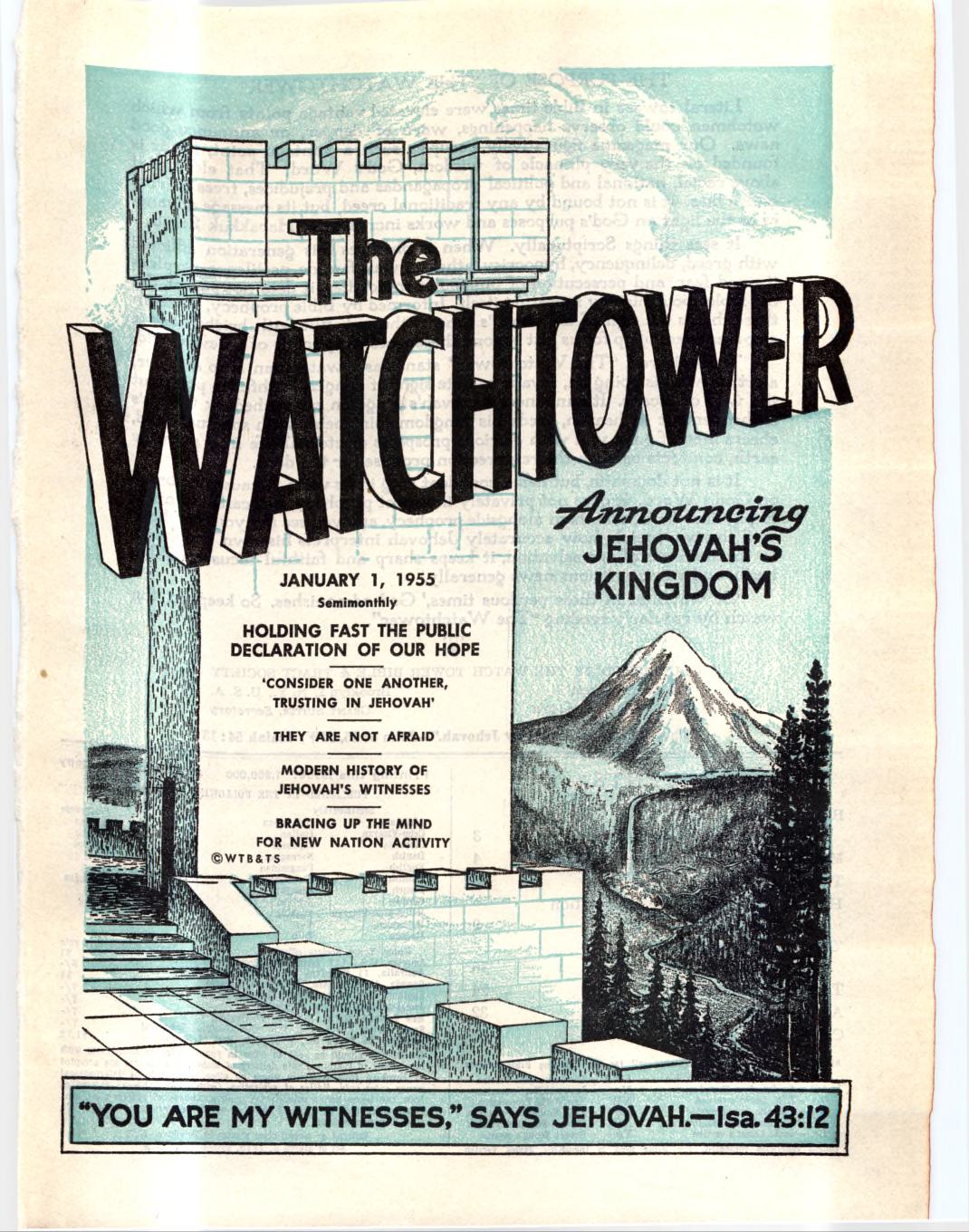
WATCHTOWER
JANUARY 1, 1955 Semimonthly
'CONSIDER ONE ANOTHER, TRUSTING IN JEHOVAH'
HOLDING FAST THE PUBLIC DECLARATION OF OUR HOPE
THEY ARE NOT AFRAID
MODERN HISTORY OF JEHOVAH'S WITNESSES
BRACING UP THE MIND FOR NEW NATION ACTIVITY CWTB&TS
Announcing JEHOVAH'S KINGDOM
"YOU ARE MY WITNESSES," SAYS JEHOVAH.—Isa. 43:12 THE PURPOSE OF "THE WATCHTOWER"
Literal towers in Bible times were elevated vantage points from which watchmen could observe happenings, warn of danger, or announce good news. Our magazine figuratively occupies such a vantage point, for it is founded on the very pinnacle of wisdom, God's Word. That elevates it above racial, national and political propagandas and prejudices, frees it from selfish bias. It is not bound by any traditional creed, but its message advances as the light on God's purposes and works increases.—Habakkuk 2:1-3.
It sees things Scripturally. When it observes this generation afflicted with greed, delinquency, hypocrisy, atheism, war, famine, pestilence, perplexity and fear, and persecution of unpopular minorities, it does not parrot the old fable about history repeating itself. Informed by Bible prophecy, it sees in these things the sign of the world's time of the end. But with bright hope it also sees opening up for us just beyond these woes the portals of a new world.
Thus viewed, "The Watchtower" stands as a watchman atop a tower, alert to what is going on, awake to note signs of danger, faithful to point out the way of escape. It announces Jehovah's kingdom established by Christ's enthronement in heaven, feeds his kingdom joint-heirs with spiritual food, cheers men of good will with glorious prospects of eternal life in a paradise earth, comforts us with the resurrection promise for the dead.
It is not dogmatic, but has a confident ring in its voice, because it is based on God's Word. It does not privately interpret prophecy, but calls attention to physical facts, sets them alongside prophecy, and you see for yourself how well the two match, how accurately Jehovah interprets his own prophecy. In the interests of our salvation, it keeps sharp and faithful focus on Bible truth, and views religious news generally.
'Be watchful in these perilous times,' God admonishes. So keep on the watch by regularly reading "The Watchtower".
PUBLISHED BY THE WATCH TOWER BIBLE & TRACT SOCIETY
117 Adams Street
Brooklyn 1, N. Y., U. S. A.
N. H. KNORR, President
GRANT SUITER, Secretary
"They will all be taught by Jehovah."—John 6:45, NW; Isaiah 54:13
CONTENTS
Bracing Up the Mind for New Nation Activity
Modern History of Jehovah's Witnesses
The True Riches
Holding Fast the Public Declaration of Our Hope
'Consider One Another, Trusting in Jehovah'
They Are Not Afraid
Announcements
Check Your Memory
AS- American Standard Version
LXX- The Septuagint Version
AT-An American Translation
Mo-James Moffatt's version
Da-J. N. Darby's version
NW- New World Translation
Dy-Catholic Douay version
Ro-J. B. Rotherham's version
ED-The Emphatic Diaglott
RS-Revised Standard Version
Le-Isaac Leeser's version
Yg-Robert Young's version
Unless otherwise indicated, the Bible used is the King James Version
<tr><th colspan="2">Semimonthly
Monthly
Afrikaans
Indonesian
Arabic
Portuguese
Cebu-Visayan
Italian
Cibemba
Russian
Cinyanja
Japanese
Cishona
Sesotho
Danish
Norwegian
Greek
Slamese
English
Pangasinan
Ibo
Silozi
Finnish
Slovenian
Kanarese
Slovak
French
Spanish
Korean
Ukrainian
German
Swedish
Malayalam
Urdu
Hiligaynon-Visayan
Tagalog
Polish
Yoruba
Hollandish
Twi
Ilocano
Zulu
BRACING UP THE MIND FOR NEW NATION ACTIVITY
THE new nation is not modern Israel in Palestine nor any other nation formed by imperfect men who are a part of this old world or old system of things. The new nation is the nation foretold by Isaiah as being "brought forth at once." (Isa. 66:7,8, AS) It is the nation that is happy, because its God is Jehovah. (Ps. 33:12, Ro) It is made up of the remnant of the members of Christ's body, and the glorified enthroned Jesus Christ is their reigning King; but now there associate with this spiritual nation a growing flock of the other sheep of the King-Shepherd. John 10:16, NW; Ezek. 34:23, 24.
And what is the activity of this new nation and its good-will companions? It is that of bearing witness to the great King of eternity, Jehovah God, and preaching "this good news of the kingdom" "in all the inhabited earth for the purpose of a witness to all the nations."—Matt. 24:14, NW.
And why should it be necessary to brace up our minds for such activity? As Christians we need to brace ourselves, because the whole world is going in the opposite direction and is arrayed against us even as it was arrayed against our Master when he was on earth. It was foretold regarding him: "I have set my face like a flint"; and as the time drew near for his being offered up "he firmly set his face to travel to Jerusalem." Because of this determined bracing of himself he was able to say, by way of encouragement to his apostles on the night of his betrayal: "In the world you will have tribulation, but cheer up! I have conquered the world." (Isa. 50:7, RS; Luke 9:51; John 16:33, NW) And that world includes not only the visible enemies of the new nation but primarily its invisible enemies, Satan and his demons.—Eph. 6:10-12.
Because of this opposition to New Nation activity Peter admonishes us: "Brace up your minds for activity, keep completely balanced and set your hope upon the undeserved kindness that is to be brought to you at the revelation of Jesus Christ. 1 Pet. 1:13-15, NW.
It is with the girdle of truth that we must brace up our minds for the strenuous activity that must be carried on by those who belong to the new nation. It means "keep on watching and praying." It means diligently studying God's Word, not contenting ourselves with a mere superficial reading of it and the spiritual food Jehovah provides at the present time. It means being alert to one's opportunities of service and to the snares that lie in one's path. It means being forward-looking, of a positive frame of mind, strong in faith, firm in hope, having our minds filled with thoughts that are 'righteous, chaste, true, praiseworthy and virtuous.'—Phil. 4:8.
MODERN HISTORY of Jehovah's Witnesses
EARLY VOICES (1870-1878)
Part 1
SO, THEN, because we have so great a cloud of witnesses surrounding us, let us also put off every weight and the sin that easily entangles us, and let us run with endurance the race that is set before us, as we look intently at the leader and perfecter of our faith, Jesus." (Heb. 12:1, 2, NW) The writer of that advice was not referring to eyewitnesses of his own running the race as a Christian but was referring to witnesses whom he describes, many of them by name, in his preceding chapter, men and women all the way back to Abel who lived before Jesus finished his earthly ministry and who "had witness borne to them through their faith" that they pleased Jehovah God. (Heb. 11:1-40, NW) They were witnesses of Jehovah the same as Jesus was on earth. (Rev. 1:5; 3:14) In the Bible we have an authentic history of those ancient witnesses, written by some of these witnesses of Jehovah themselves, and all together those writers mention God's name Jehovah 6,823 or more times.
In the Christian Greek Scriptures, from Matthew to Revelation, we have a history of the Christian witnesses of Jehovah during Jesus and his apostles' days, written by inspired disciples of his. Since then over eighteen centuries have passed, and in recent years Jehovah's Christian witnesses have again come to the fore, becoming a subject of much inquiry and controversy. Many have wondered how Jehovah's witnesses came into existence. Multitudes have
gone to accusers and attackers, thinking to get unprejudiced, undistorted information about the modern witnesses of the Most High God. That authentic information may be made available to all for general enlightenment and for the correcting of many who have been misled by antagonistic would-be informers we begin here a series of articles on a "Modern History of Jehovah's Witnesses."
EARLY HAPPENINGS (1870-1878)
Gradually 'called out of darkness into God's wonderful light!" That briefly describes the modern history of Jehovah's witnesses as they advanced out of the darkness of Babylonish religious thinking toward increased restorations of new Bible truths. (1 Pet. 2:9, NW) The long night of spiritual darkness out of which these Christian witnesses came had existed from the early part of the second century following the death of Christ's apostles right up to the latter half of the nineteenth century. Early Christianity with its brilliance of right doctrine and cleanness of theocratic organization began to be eclipsed after the year 100 by a creeping spiritual darkness of Babylonish religious teachings, Grecian and Roman pagan philosophies and rank apostasy. Satan the Devil, ever active to defeat the true worship of Jehovah God, had produced apostate, false shepherds, "wolves in sheep's clothing," eventually to bring about desolation to the once spiritually flourishing Christian congregation.
In spite of the Protestant Reformation of the sixteenth century, which really effected no restoration of true worship, the pall of darkness continued over the minds of misled Christians until the time came for Jehovah to send forth his Liberator, the Greater Cyrus, Jesus Christ, to deliver the true Christian witnesses from their Babylonish bondage.
While their complete release from Babylonish captivity did not come until A.D. 1919, prior thereto for a period of nearly fifty years the witnesses experienced a gradual awakening to prepare them for their hour of liberation as a New World people. This proved to be similar to the case of the natural Jews in captivity to ancient Babylon, where Daniel and many others of Jehovah's faithful witnesses were aroused to wakefulness years before, to be ready for the restoration of true worship in Jerusalem when it came at last in 537 B.C. So, too, with Jehovah's witnesses in these modern times, a stir to spiritual wakefulness became apparent from the 1870's forward.
As to the old-world background and setting for the re-entry of Jehovah's witnesses on the world scene, the period from 1870 to 1900 proved to be destiny-shaping years for this "atomic-age" twentieth century. Forces political, religious and commercial began to maneuver for position to control the incoming new scientific era. Men and organizations were filled with forebodings as to the weird fast-moving days of the future, which some even visioned correctly as being cataclysmic. At the Vatican Council of 1869-70 the Roman Catholic cult sought to
strengthen its organization for the immediate future by declaring its autocratic head, the pope, infallible. The leading Protestant religious organizations became spiritually unprogressive in their ways. Their clergy sought to consolidate their power over the laity. This clerical assumption of greater authority over their flocks meant a backward step from freedom of Christian thought and worship on the part of the masses of professed Christians. Infidelity, higher criticism, evolution, spiritism, atheism and communism began to invade and decimate the great world religious organizations. Many of the evangelical churches began to "modernize" their false religious doctrines, not according to restored Bible truths, but according to theories of higher criticism and evolution. The paganized modernist form of theology inundated the churches.
Politically great forces were stirring. The United States of America was just recovering from its Civil War (1861-1865) to regain its strength rapidly for phenomenal expansion into a great world power. Germany had won the Franco-Prussian war of
1870, to be further built up into a powerful European colossus. Britain was passing through golden years of her Victorian era, sparring for future bids of world control. Industrially, the United States, Britain, France and large portions of Europe were undergoing a revolution in consequence of the invention of the steam engine. The industrial revolution was augmented, as the years progressed, by the discovery of electricity, invention of the telephone, the motorcar and the dozens of other "miracles" of this new atomic-destined civilization.
Commercialism likewise rose to new heights as a consequence of the industrialization of leading nations and the creation of new "gold mine" business enterprises. Labor unionism also came to the fore to become an antagonist of advancing capitalism. All this meant a wave of materialism, moneymaking and pleasure-seeking. The invisible demonic powers of this old world produced glittering snares of new enticements to blind the peoples to the incoming higher and finer values of restored Christian truth.
Amid these rumblings of industrial, commercial, social and religious changes early voices of small religious groups were heard in their efforts to read the signs of the times and predict the imminent second coming of Jesus, Jehovah's Christ. Various adventist groups were busy in the United States and Europe, proclaiming a visible return of Christ for 1873 or 1874, even though the American founder of their movement, William Miller, had acknowledged his error and disappointment as to the former set dates of 1843 and 1844. Earlier, the German Lutheran theologian Bengel (1687-1751) had fixed upon 1836 as the marked date for the beginning of the millennium of Revelation 20:6. In Scotland and England others, commonly known as "Irvingites," raised their voices to announce 1835, 1838, 1864 and finally 1866 for Christ's return. Christian writers such as Elliott and Cumming looked for the end in 1866, Brewer and Decker predicted 1867 and Seiss favored 1870. In Russia, Claas Epp, a leader of the Mennonite Brethren (Bruedergemeinde), and his associate fixed upon the date of 1889 for a great cosmic happening. a But all these widely proclaimed predictions came to complete disappointment because they were not based on accurate Biblical knowledge of Jehovah's prophecies. Christ's return was destined to be, not a physical manifestation as they had assumed, but rather, as the Scriptures now clearly indicate, an invisible presence of glory and power to provoke the greatest crisis ever experienced by man on earth.
Still other voices were heard, but these began to proclaim an impending invisible return of the Messiah. One of these groups was led by George Storrs of Brooklyn, New York. He and his associates after 1870 published a magazine entitled The Bible Examiner, setting forth their views that Christ's return would be an invisible one. Another group headed by H. B. Rice of Oakland, California, published a magazine called The Last Trump, heralding an invisible return as occurring in the 1870's. A third group comes to our attention, this time of disappointed Second Adventists who forsook that movement because of the failure of the Lord to return in 1873 as the Adventists had further predicted. This group was led by N. H. Barbour. They radiated their activities from Rochester, New York, performing a preaching service by sending out speakers to whatever churches would open their doors to them. They also published a monthly, The Herald of the Morning. One of this group came into possession of B. Wilson's Diaglott translation of the "New Testament," noticing in it that, at Matthew 24:27, 37, 39, the word the King James Version rendered coming is translated presence. This was the clue that led this group to advocate an invisible presence of Christ, claiming it began in the fall of 1874. b
Yet a fourth voice of proclaimers of an invisible presence of Christ comes to view, a group of sincere students of the Bible at Pittsburgh, Pennsylvania, U. S. A., with its chairman, C.
T. Russell. Charles Taze Russell was born in Old Allegheny (now part of Pittsburgh) February 16, 1852; he was one of three children of Joseph L. and Eliza Birney Russell. Both parents were Presbyterians of Scottish-Irish lineage. Russell's father operated a clothing store business. His mother died when he was only nine years old. While still a boy, he used to write Bible texts with chalk on the sidewalks, and although brought up a Presbyterian, he joined the neighborhood Congregational church, because it was more liberal. At fifteen years of age Russell was in partnership with his father in a growing chain of men's clothing stores. But while things went well for young Russell in business, he was troubled in mind. The doctrines of predestination and eternal punishment gave him particular difficulty, and by the time he was seventeen he had become an avowed skeptic, discarding the Bible and the creeds of the churches.
During the next few months Russell continued to reflect over the subject of religion, unable to accept it, and yet unwilling to let it go. Finally one day in 1870 he dropped into a dusty, dingy little basement hall near his Federal Street storefrom 1870 to 1875 to make a systematic study of the Bible. Note the following description of the change-over of thinking that was the fruitage of these five years of joint Bible study.
"to see if the handful who met there had anything more sensible to offer than the creeds of the great churches. There, for the first time, I heard something of the views of Second Adventists, the preacher being Mr. Jones Wendell . . Though his Scripture-exposition was not entirely clear, and though it was very far from what we now rejoice in, it was sufficient, under God, to re-establish my wavering faith in the divine inspiration of the Bible, and to show that the records of the apostles and prophets are indissolubly linked." d
Shortly after this Russell and about five others began to meet together regularly
"[We] soon began to see that we were living somewhere near the close of the Gospel age, and near the time when the Lord had declared that the wise, watching ones of his children should come to a clear knowledge of his plan. . . We came to see something of the love of God, how it had made provision for all mankind, how all must be awakened from the tomb in order that God's loving plan might be testified to them, and how all who exercise faith in Christ's redemptive work and render obedience in harmony with the knowledge of God's will they will then receive, might then (through Christ's merit) be brought back into full harmony with God, and be granted everlasting life. . . We came to recognize the difference between our Lord as 'the man who gave himself,' and as the Lord who would come again, a spirit being. We saw that spirit-beings can be present, and yet invisible to men. . . We felt greatly grieved at the error of Second Adventists who were expecting Christ in the flesh, and teaching that the world and all in it except Second Adventists would be burned up in 1873 or 1874, whose time settings and disappointments and crude ideas generally of the object and manner of his coming brought more or less reproach upon us and upon all who longed for and proclaimed his coming Kingdom. These wrong views so generally held of both the object and manner of the Lord's return led me to write a pamphlet—The Object and Manner of Our Lord's Return, of which some 50,000 copies were published."e
In January, 1876, Charles Russell for the first time received a copy of the monthly magazine The Herald of the Morning as published by the Rochester group headed by Nelson H. Barbour. A meeting was soon arranged between Russell and Barbour, since it was discovered that their views were the same concerning Christ's second coming as being invisible. As a result the Pittsburgh Bible group of nearly thirty decided to affiliate with the Rochester group slightly larger in number.
Russell became a joint editor along with Barbour for The Herald of the Morning. The Pittsburgh group on Russell's initiative agreed to finance a small printing place in Rochester for the joint printing undertakings. It was also decided to publish a bound book containing their joint views, the work being completed by 1877. The 194-page publication was entitled "Three Worlds or Plan of Redemption," by Barbour and Russell as joint authors. During this time Russell at the age of twenty-five began to sell out his business interests and went full time into the preaching work, going from city to city to talk to various gatherings of the public, on the streets and, Sundays, in Protestant churches, where he could arrange such with the clergy.
This book set forth their belief that Christ's second presence began invisibly in the fall of 1874 and thereby commenced a forty-year harvest period. Then, remarkably accurately, they set forth the year 1914 as the end of the Gentile times.—Luke 21:24.
"Hence, it was in B.C. 606, that God's kingdom ended, the diadem was removed, and all the earth given up to the Gentiles. 2520 years from B.C. 606 will end in A.D. 1914, or forty years from 1874; and this forty years upon which we have now entered is to be such 'a time of trouble as never was since there was a nation.' And during this forty years, the kingdom of God is to be set up (but not in the flesh, 'the natural first and afterwards the spiritual'), the Jews are to be restored, the Gentile kingdoms broken in pieces like a potter's vessel,' and the kingdoms of this world become the kingdoms of our Lord and his Christ, and the judgment age
introduced."—Three Worlds or Plan of Redemption, pp. 83, 189.f
After two years of affiliation a testing occurred that brought about a parting of the ways. In 1878 Barbour began to fall victim to higher criticism. He published an article in the Herald-
"denying that the death of Christ was the ransom-price...saying that Christ's death was no more a settlement of the penalty of man's sins than would the sticking of a pin through the body of a fly and causing it suffering and death be considered by an earthly parent as a just settlement for misdemeanor in his child."g
This plain denial of basic Bible doctrine amazed the Pittsburgh group and Russell. Months of argument ensued in publishing articles in the Herald pro and con on the ransom issue. Finally the Pittsburgh Bible group withdrew association from the Barbour group to undertake a separate Bible publishing work. Many of the Rochester group sided in with Russell and his associates on the ransom issue and they too came over to the Pittsburgh association. This parting proved fatal to the Rochester group, for within a few years the Herald ceased to be published and nothing more has been heard from this early voice sounding the "second coming" call. In our next article we shall see who of these many early voices finally received the go-ahead signal from Jehovah to represent him as His witnesses for future ministerial work.
THE TRUE RICHES
Paul said he was "as poor, yet making many rich; as having nothing, and yet possessing all things." (2 Cor. 6:10) How was this possible? How could a man who was poor possess all things, and make many rich? He could do this because, though his worldly possessions were limited, he had the greatest of riches—the riches that this world frequently ignores. What were they? A knowledge of the truth and the blessings of Jehovah God. Which riches do you value?
Holding Fast PUBLIC DECLARATION OF OUR HOPE
"Let us hold fast the public declaration of our hope without wavering, for he is faithful that promised. And let us consider one another to incite to love and right works, not forsaking the gathering of ourselves together, as some have the custom, but encouraging one another, and all the more so as you behold the day drawing near." Heb. 10:23-25,NW.
EHOVAH is the Giver of life. He also gives knowledge to man as to how he can attain life. Jehovah's witnesses have the hope of eternal life and are grateful for the knowledge they have of how life can be theirs unendingly through Jehovah's undeserved kindness. They want to live, for with life they can worship the Sovereign Ruler of the universe. (Ps. 118: 17) The majority of human creatures do not want to die and return to the dust, for in the grave where man goes there is no knowledge or wisdom, nor can the dead do any work. "For the living know that they shall die: but the dead know not anything, neither have they any more a reward; for the memory of them is forgotten." (Eccl. 9:5, 10, AS) Life, living in God's new world, is the hope held out for man. Jehovah's witnesses have hope in that new system of things, and this faith and hope are based on their knowledge of Jehovah's Word.
2 Jehovah's words have power. "For the word of God is alive and exerts power and is sharper than any two-edged sword."
(Heb. 4:12, NW) With this truth in mind we should want to know what Jehovah says at any time, if it is within our finding out. We should certainly want to study his sayings. When God says something we should listen, because what he says has a tremendous effect on animate and inanimate things. "By faith we understand that the systems of things were put in order by God's word, so that what is beheld came to be out of things that do not appear." (Heb. 11:3, NW) David, a man who was after God's own heart, appreciated the power of Jehovah's word, for he stated: "By the word of Jehovah were the heavens made, and all the host of them by the breath of his mouth." (Ps. 33:6, AS) Man cannot conceive the power in the Creator's words. It is written that "power belongeth unto God" and "the Almighty . . . is excellent in power." (Ps. 62:11; Job 37:23, AS) With all the power in heaven and earth as Sovereign Ruler, he can certainly make his Word to stand and never return to him unfulfilled. Hence he himself says: "So shall my word be that goeth forth out of my mouth: it shall not return unto me void, but it shall accomplish that which I please, and it shall prosper in the thing whereto I sent it."
(Isa. 55:11) Words so powerful we should study.
3 When Jesus walked this earth he spoke the words of his Father in the heavens. He had faith in Jehovah's words. His course of life was based on his Father's promises. It was Jesus himself who said: "The sayings that I have spoken to you are spirit and are life. But there are some of you that do not believe." (John 6:63, 64; 8:26- 28, NW) It is a fact that the majority of humans who lay claim to being Christian set themselves up as judges of God's words and they individually decide whether certain texts of the Bible are true and can be accepted or whether they should be discarded. Their wisdom they set above that of Jehovah God himself. They class themselves with those who do not believe. Marginal reading of John 6:63 (NW) makes Jesus' expression even stronger: "The sayings that I have spoken to you mean spirit and mean life."
4 This is no time to push aside the Word of God and say: "I'll look into that some other time. I have yet many years to live; so I'll do it later when convenient." Man reasons that there is so much of importance in this world to care for that he does not have time for the 'old' Bible. He wants to keep up to date. He thinks that accumulating riches will make him enjoy life in his later years. But he may never enjoy his savings and he can easily lose out on living eternally. At one time Jesus illustrated this: "The land of a certain rich man produced well. Consequently, he began reasoning within himself, saying: 'What shall I do, now that I have nowhere to gather my crops?' So he said: 'I will do this: I will tear down my storehouses and build bigger ones, and there I will
gather all my grain and all my good things, and I will say to my soul: "Soul, you have many good things laid up for many years; take your ease, eat, drink, enjoy yourself." But God said to him: 'Unreasonable one, this night they are demanding your soul from you. Who, then, is to have the things you stored up?' So it goes with the man that lays up treasure for himself but is not rich toward God."—Luke 12:16-21, NW.
To be rich toward God, to hold fast your hope, you must study the precious Word of God and continuously make public declaration of it. Anyone having the hope of life in the new world must boldly and thoughtfully tell out this good news, making it known to everyone who will listen. "This good news of the kingdom will be preached in all the inhabited earth for the purpose of a witness," said Jesus, because words so preached would be words of life. (Matt. 24:14, NW) Faith in the true God on the part of any individual comes by hearing the words of God. "However, how will they call upon him in whom they have not put faith? How, in turn, will they put faith in him of whom they have not heard? How, in turn, will they hear without someone to preach?" (Rom. 10:14, NW) One who knows the words of eternal life must teach them so that others can hear and so that those who do hear can have faith. Then these in turn will study God's Word like the teacher. "Preach the word" is the admonition of that faithful follower of Christ Jesus who knew that faith is built on accurate knowledge. (2 Tim. 4:2) To live in the new world one must be filled with the knowledge of God. If you could not be filled with the knowledge of God, then you would have to say that God is not a good teacher. True Christians realize, however, that they will "all be taught by Jehovah."
(John 6:45, NW; Isa. 54:13, AS) Learning from such a wonderful Teacher you will not want to keep the knowledge to yourself, "for with the heart one exercises faith for righteousness, but with the mouth one makes public declaration for salvation."—Rom. 10:10, NW.
Our concern, then, is with ourselves, making ourselves a group of good preachers. Paul urged: "Pay constant attention to yourself and to your teaching." (1 Tim. 4:16, NW) Wisely, then, each of us determines to study God's Word, the Bible, thus paying attention to ourselves and assuring ourselves of everlasting life. At the same time, by studying the Bible diligently we are able to pay constant attention to our teaching; we can be sure that which we tell others is the truth. As Christians we must follow Jehovah's instruction. "Take fast hold of instruction; let her not go: keep her; for she is thy life. Enter not into the path of the wicked, and walk not in the way of evil men. Avoid it, pass not by it; turn from it, and pass on." (Prov. 4:13-15, AS) How much more clearly can it be stated? Here it says instruction is our life! Better, then, that we pay attention to instruction, learning how to live.
'A TIME SUCH AS NEVER WAS'
7 Ours is a very wicked day, the worst in all history. On every side of us we see hatred, strife, war. Nearly every man's hand seems to be against his neighbor. The world is filled with selfishness, fear. Such are products of a mad, hateful world whose god is Satan the Devil. Yes, God's Word says that Satan is the god of this system of things. On this vital subject Jehovah's witnesses are trying to enlighten the people's minds. At the same time we hold out to peoples of all nations the hope that Jehovah holds out: His kingdom, the only
hope for mankind. This old world's inhabitants need instruction so that they can turn from the wicked course that will lead to death. "If, now, the good news we declare is in fact veiled, it is veiled among those who are perishing, among whom the god of this system of things has blinded the minds of the unbelievers, that the illumination of the glorious good news about the Christ, who is the image of God, might not shine through." (2 Cor. 4:3, 4, NW) Today as never before the light is shining through in the message that Jehovah's witnesses regularly take to willing listeners in all nations of the world. Hundreds of thousands are listening. More and more are taking in knowledge and instruction and thus starting on the road to life everlasting. This is the time for the great witness to be given as Jesus foretold: "And this good news of the kingdom will be preached in all the inhabited earth for the purpose of a witness to all the nations, and then the accomplished end will come." (Matt. 24:14, NW) Will you share in this great work of "announcing Jehovah's kingdom"? You can, and you will want to if you make it your business to heed instruction from God's Word and hold fast to that instruction.
Now is the time when those desiring to live in Jehovah's new world must stick together. Privately studying your Bible is necessary, but jointly studying with those of like precious faith is even more necessary. Since the words of God, as set forth in the Bible, are so powerful that by holding on to their instruction life can be gained, what should a believer in God's Word do? He should first study, then talk about that which he studies. To gain knowledge one must work. To retain that knowledge he must use it. You will want others to know what you know, therefore you will talk.
As Jehovah's chief witness Christ Jesus preached the good news and brought salvation to mankind. But now he is not with us in the flesh as he was nineteen hundred years ago when he led the apostles and set them the proper example. "We are therefore ambassadors substituting for Christ, as though God were making entreaty through us. As substitutes for Christ we beg: 'Become reconciled to God.'" (2 Cor. 5:20, NW) Those words Paul addressed to the congregation at Corinth. Today Jehovah's witnesses everywhere are a united congregation of Jehovah God. Unitedly, jointly they have a work to do, that is, to preach to all the world, to show all lovers of righteousness the way to life. Every one of Jehovah's witnesses must keep alive to the truth as expressed in His Word, because it is necessary for every individual in his theocratic organization to think as Jehovah thinks. He being their Teacher and his Word being their textbook, they will think alike, work alike and worship alike. Hence their sticking together in Jehovah's theocratic organization means for them their everlasting life. Were any individual in this New World society to try to go alone, he soon would see that he never could succeed or realize his hope in life. That individual never would get into the new world. So individually each one of us must stay in Jehovah's New World society and at the same time be active as a part of it.
Clearly now Jehovah God through Christ Jesus is gathering together all who are of good will and who love righteousness. (Zeph. 2:1-3) This he is doing before his battle at Armageddon. Those who now lay hold on instruction will flee from this old world and get into the new system of things. With so many of the "other sheep" being gathered into the New World society it is essential that Jehovah's witnesses must get to know one another, especially
within each of their congregations. They must learn of the benefits of that congregation and what it will do for them. Jehovah's witnesses soon learn that it is essential for them to go to every meeting arranged for them for their education and instruction. To get life they must constantly seek knowledge and learn more of Jehovah and his purposes. They must fully appreciate they cannot get along without his written Word. Also, they will learn that they cannot get along without Jehovah's organization. Their sticking together, their jointly studying God's Word, makes Jehovah's witnesses very vigorous. It sets them apart distinctly from all others in this world. They truly are Bible students; they constantly practice the teachings of God's Word.—John 13:17.
10 "Let us hold fast the public declaration of our hope without wavering, for he is faithful that promised. And let us consider one another to incite to love and right works, not forsaking the gathering of ourselves together, as some have the custom, but encouraging one another, and all the more so as you behold the day drawing near." (Heb. 10:23-25, NW) This sound counsel has been talked about many times. Probably all in your congregation have used this scripture, either at service meetings or at the theocratic ministry school, pointing out how necessary it is for every one of Jehovah's servants to assemble with his brothers, now more than ever because we are living at the end of this old system of things. Let us here examine this text to see what vital force there is in it and how it must affect us in our daily lives.
"PUBLIC DECLARATION OF OUR HOPE"
11 This scripture that says "Let us hold fast the public declaration of our hope" does not mean merely doing this by going from house to house witnessing day by day throughout our lives.
Many other scriptures definitely prove we must go from home to home preaching the good news of the Kingdom. That is a point beyond dispute. But what important fact is brought to our mind in this text under consideration? Does its statement—"Let us hold fast the public declaration of our hope without wavering"—apply to our house-to-house witnessing? Have in mind the context. What is Paul talking about here when addressing the Hebrews? He tells them to make a public declaration, but where? The context shows it must be in the congregation of Jehovah's people. There is a definite reason, too, for making this declaration and coming together in the congregation to do it. It must be a declaration that will incite to love, to help others in right works and to encourage one another in the Christian ministry. By doing these things all will be helped to remain united, to stay in the organization. Our congregation meetings themselves provide positive assistance to others. Yes, it is our public declaration of our hope in the congregation that does much for others of the congregation.
12 The New World society consists of many congregations scattered all over the earth. Many are in English-speaking communities. Others are among Germans, French, Japanese; in fact, assemblies are held in more than a hundred tongues in all parts of the world. But regardless of what language is spoken Jehovah's witnesses must come together in congregation meetings. Every dedicated member of the New World society must regularly assemble with others and get the benefit of his brothers' knowledge as well as give to his
brothers the benefit of his knowledge. Before one makes his public declaration in the congregation of God's people it is essential for him to engage in private study. But that is not all. After the private study you must meet with the congregation and make a public declaration of what you have learned. If one tries to go alone without the organization, it will be only a matter of time until he will be in want; and if he stays away from the congregation too long, he will die of starvation for spiritual food. A Christian witness of Jehovah cannot get out of line for New World living and survive for the new world. After one has made his day-by-day and week-by-week private study he should make his 'advancement manifest to all persons' by expressing before the congregation what he believes so that the other members of the congregation may thereby be incited to love and right works and encouraged to greater activity.—1 Tim. 4:15, NW.
13 Daily reading and study of the Bible are needful. Bible study aids also should be read, such as the Watchtower magazine and books distributed by the Watch Tower Bible and Tract Society; for every reasonable observer knows there are no other publications like these. All these printed products will help the truth seeker to get a broader understanding of the Word and purposes of Jehovah so that he will be able better to express his hope at the congregation meetings. By filling the mind with divine instruction and truth it will help the witness of Jehovah to prepare his talks for the theocratic ministry school that he attends; it will aid him in sharing in the service meeting and Watchtower study meeting, and it will help him in preparing short sermons to use from house to house. God's Word says we are to make a "public declaration of our hope." Ask yourself: 'How many times have I expressed myself in the Watchtower study meeting during the last six months, or the last year?'
It is very important that in these studies each one speak up as he has opportunity, because upon each one rests a twofold obligation. First, you have opportunity to make public declaration of your hope; and, second, the expression affects those who are listening and should incite them to love and the right kind of works. This you can do when you do not forsake assembling with your brothers in the congregation.
14 Another point: "Keep testing whether you are in the faith, keep proving what you yourselves are. Or do you not recognize that Jesus Christ is in union with you? Unless you are disapproved. I truly hope you will come to know we are not disapproved." (2 Cor. 13:5, 6, NW) Under that wholesome counsel by Paul it is very necessary for each one of us to look after himself. It is not just a matter of saying, 'I am one of Jehovah's witnesses,' or one's coming to a meeting and there sitting quietly. It really is a matter of inspecting yourself, testing or proving yourself by answering questions in public, voluntarily or when called upon. How can anyone say he is one of Jehovah's witnesses if he does not attend and participate in the meetings of true worshipers of Jehovah? (John 4:23) How can he say, even to himself, that he believes the truth of God's Word if he never expresses that truth to his brothers? One might be born a Catholic and be baptized into that religious cult when he is but a few days old and be called a Catholic for the rest of his life. Or he may be born of Protestant parents or Moslem parents or Jewish parents, and the name of his parents' religion will go with him the rest of his life unless he personally decides to progress. But as for Jehovah's witnesses,
each must make a decision for himself. It is not for any parent to decide for his child to make a dedication to Jehovah God through Jesus Christ. Each must personally prove that he is one of Jehovah's witnesses through public expression of his faith and hope in Jehovah's new world before the congregation of Jehovah's people. It is your active belief that will incite others to greater activity; therefore the knowledge you have gained should be expressed aloud before the congregation for the benefit of all.—1 John 4:17, NW.
15 Needful it is, then, to keep testing ourselves, keep on proving what we ourselves are, as to our faith. We can make mistakes, we can get out of line with Jehovah's principles of truth and righteousness, we can drift, think on wrong things; and, not having read and studied the Word of God enough, we can get to forming our own philosophies on life. Individuals may even go so far as to express what they think God himself should be like and what he should be doing. But one knows that he cannot become acquainted with another unless he talks to him or reads about or otherwise communicates with him. No one can come to know God unless he listens to him through his written Word. In private study you can take in much information about God, but by attending congregation meetings your advance study, having equipped you, enables you to express your belief and hope, to benefit others. It is very unprofitable for a Christian witness of Jehovah to forsake regularly assembling with other dedicated Christians. Think of the harm he does to himself and also to others. He is not incited to love and right works, for he does not hear his fellow workers comment and he is not there to give comment to help them.
"WE MAY HAVE FREENESS OF SPEECH"
16 Jehovah's visible organization has arranged for weekly Watchtower studies in every congregation throughout the world. It is advisable to attend these. Other meetings, too, such as the theocratic ministry school and the service meeting, yield a rich blessing and help one to hold on to instructions. Whenever you attend these meetings do not sit back and feel that it is so much better for any other person to express himself. In your simple, pleasant manner and with, probably, hesitant speech, even you can incite others to love and right works. You can encourage others by your right expression. Were you ever in a Watchtower study where a brother or sister you have been working with for months spoke up for the first time? It gave you a little thrill to hear this one speak, did it not? After the meeting you very likely complimented that one. To you it was a joy and a real pleasure to hear that person speak. It encouraged you to do greater works, as Paul said; and so, by making public declaration of your hope, you will be inciting and also be incited yourself to love and right works. Why not, then, give the other persons that same sense of joy, that same pleasure you had, by letting them regularly hear you speak in the Watchtower study? Without question they will appreciate your comment. You may be older in the truth and so they will be happy to hear what you have to say. Or you may be new in the truth and then they will rejoice to see your progress in understanding.
17 To express ourselves is both practical and necessary, for to a great extent we really do not know what we do believe until
we start talking or start writing, that is to say, communicating. If we never express ourselves, then our thoughts never come into a form to benefit others or even ourselves. Some excuse themselves by saying that if they speak they may give an incorrect or misleading answer. Do you keep quiet because you might make a mistake? Even your making that mistake is to your benefit. How so? Because then someone else will give the correct answer and, additionally, the chairman will express himself and point out the right answer and finally the paragraph will be read to complete the answer to the question. For a moment you may be a little ashamed, but you did express to the congregation what you believe. You found out you were wrong and so by studying along with other members of the congregation and by expressing yourself you discovered your error. By keeping quiet you may never have known of your error. So now you have the opportunity of changing your thinking. You want the right ideas in your head, and now you have changed some wrong thought and have substituted the correct one. No worshiper of Jehovah wants to go from house to house talking about Jehovah's purposes and telling householders the wrong things. So, then, your brothers helped you to correct the error you made in your public declaration in their hearing. Do not let the error you think you might express hold you back from speaking. Your mistake may sharpen the correct answer in the minds of others. If one did all his own thinking and never consulted anyone else or expressed himself to others, he never would be able to test himself. That underscores the value of "freeness of speech"; and that is why we have the admonition, "Keep testing whether you are in the faith, keep proving what you yourselves are."
18 We must advance, increase, grow up in Jehovah's organization; we cannot stand still. Through the Watchtower magazine and all companion publications, as well as through the congregation, circuit and district servants, the Watch Tower Society constantly stresses that we must study. Serious study is hard work. But it does yield happy results. It takes effort to search the Scriptures, but you know that the knowledge gained spells out life. Taking in knowledge of Jehovah God and of his Son, said Jesus, means everlasting life.
(John 17:3) One who wants life must listen to the Giver of life, Jehovah, for it is written: "Most truly I say to you, He that hears my word and believes him that sent me has everlasting life, and he does not come into judgment but has passed over from death to life." (John 5:24, NW) Everlasting life is due, then, to hearing the Word and believing Jehovah God, for it was God who sent Christ Jesus; and by having this faith we are able to pass over from death to life. By assembling ourselves together for making public declaration of our hope we continue learning and growing, advancing to maturity.
'Consider One Another, Crusting in Jehovah'
PAUL, writing to the Hebrews, wanted them to know more about Christ Jesus. He wrote: "Concerning him we have much to say and hard to be explained, since you have become dull in your hearing. For, indeed, although you ought to be teachers in view of the time, you again need someone to teach you from the beginning the first principles of the sacred pronouncements of God, and you have become such as need milk, not solid food. For everyone that partakes of milk is unacquainted with the word of righteousness, for he is a babe. But solid food belongs to mature people, to those who through use have their perceptive powers trained to
distinguish both right and wrong." (Heb. 5:11-14, NW) A vigorous Christian himself Paul wanted these Hebrews to advance and use their perceptive powers. In view of the time they were in the truth they should have been teachers, but they did not want to express themselves for enriching others. They preferred to take life easy and just feed on the milk of the Word and just remember the simple things they learned when they first came into Jehovah's organization without becoming acquainted with the whole Word of God and taking the solid food that belongs to mature people. Any dedicated Christian witness of Jehovah should want to grow up and make advancement in the New World society. When one gains knowledge of Jehovah's marvelous purposes it should
fill him with vigor and give him vitality. Energized, he should want to help others to gain the same valuable information he has.
Therefore he should show an aptness to teach, giving out accurate knowledge so that others, too, can lay hold on instruction.
When he really grows to love his brothers he will want to make a public declaration in the congregation to incite them to love and right works.
2 A great change must take place in one's thinking when he becomes a Christian.
and the brotherhood of man and world brotherhood; but those who have been carefully taught according to this old world's untheocratic theories prefer segregation, class
distinction, the caste system. How necessary it is, then, for a
There must be a making over of the mind. To quit the old way of thinking is necessary. A new form of instruction must be put on. That is why Paul wrote: "Quit being fashioned after this system of things, but be transformed by making your mind over, that you may prove to yourselves the good and acceptable and complete will of God." (Rom. 12:2, NW) Every one of us has been born in the wicked, delinquent, fearful old world and we have been trained in the old world's way to think selfishly, as human leaders want their followers or subjects to think. From childhood we have
reasonable person to make his mind over, to quit thinking like the old world and, instead, take instruction from Almighty God! God's Book, the Bible, teaches us to love as he loves. Love casts out fear. "He that does not love has not come to know God, because God is love." "There is no fear in love, but perfect love throws fear outside, because fear exercises a restraint. Indeed.
been taught to hate other nations, peoples and races and to fear them and suspect them, thus building up barriers between certain persons and ourselves. This wrong thought was very sharply expressed in one of the popular stage successes ("South Pacific"). In that play, a young army man, distressed because he had fallen in love with a young girl of another race and nationality, sings about 'your being taught to hate and fear; that you have got to be taught from year to year, having it drummed into your dear little ear-carefully taught to be afraid of people whose
he that is under fear has not been made perfect in love. As for us, we love, because he first loved us." (1 John 4:8, 18, 19, NW) When one lives by the accurate knowledge he receives from Jehovah's Word, how different his life becomes! But with these new ideas, these newly found truths from God's Word, Jehovah's witnesses must go forward to teach others so that all who eventually choose to become part of the New World society will think as Jehovah thinks and grow to maturity.
HOW VALUABLE IS THE BIBLE?
eyes are ugly made and whose skin is a different shade; carefully taught before it's too late, before you're six or seven or eight, to hate all the people your relatives hate.' And that is true of the old world. Talk aplenty there is about brotherly love
Every one of us can become alive to the wonderful joys and blessings that Jehovah's witnesses have if we take the time to receive instruction, associate with Jehovah's witnesses, express ourselves and advance to maturity in the congregation of God. Sometimes it is said that Jehovah's witnesses have their own Bible, but when one reads the pages of The Watchtower he sees that many translations are constantly cited and quoted from.
Jehovah's witnesses urge that every person read his own copy of the Holy Bible daily. It matters not which version of the Bible is read, whether the Catholic Douay, or the Protestant King James or American Standard, or any other Bible version in German, French, Spanish, Hebrew or Tagalog. No matter which rendering of the Holy Scriptures you read you can learn the truth. None, generally speaking, are so far off from the original meaning expressed in the Hebrew and Greek texts as to sidetrack the reader and send him into error. However, there are good and better translations. Such are available for selection; and when you can get a better one to read and study, it will be to your advantage. It will aid you to gain a clearer understanding, probably a quicker understanding, of the marvelous purposes of Jehovah. His Book, the Bible, is one you should be reading every day throughout the entire year, and year after year. It is an inexhaustible fountain of refreshing water, truth. It never becomes dry. It is always deliciously fresh, tasty. Do not be choosy in your reading, but starting with Genesis proceed through to the last book, Revelation. You will find the rarest gems of truth, marvelous instruction, sound counsel; for all this is the written word of the Supreme Sovereign, the living God JEHOVAH. For us, dwellers upon this little earth of his vast universe, he provided that Book so that we might be properly instructed and trained as true followers of his Christ.—Eph. 4:31, 32; 1 John 1:7.
4 Centuries ago when Pilgrim fathers came to America's shores the Bible was their principal book. Often now we hear or read of those bygone days when persons used their Bible daily in nearly every
home. It affected the upbringing of their children, it broadened their knowledge and understanding, it helped to keep them close to the living God. They did not measure its contents with a yardstick supplied by self-serving, hostile critics or prejudiced scoffers. Indeed, the Giver's Book, the Bible, is the one volume that has solid food for thought, excellent instruction on living and on proper behavior of oneself. Today the Bible is far more valuable to us than it was to those of the past days; for all things written aforetime were written for our instruction now in these days of great trial. (Rom. 15:4; 1 Cor. 10:11) The Bible is for our comfort, and in reading the Scriptures we are able to have hope.—1 Pet. 1:3; 2 Pet. 1:19-21.
Do you appreciate that when you hear or read the Bible you are actually listening to, giving attention to, Jehovah God, as he communicates his thoughts to you? He is not going to talk to you in a dream. He will not send you a special messenger, an angel, to give you private instruction. Through his written Word he now is communicating to us. "All Scripture is inspired of God and beneficial for teaching, for reproving, for setting things straight, for disciplining in righteousness, that the man of God may be fully competent, completely equipped for every good work." (2 Tim. 3:16, 17, NW) It is useless to look around for advice and instruction from any other source.
WHY REGULARLY STUDY AND PREACH GOD'S TRUTH?
No one can be just satisfied with a mere general knowledge of God's truth. (Psalm 117) In one's Christian activity he must leave the elementary things and advance to maturity. That is why Paul said: "For this reason, now that we have left the elementary doctrine about the Christ, let us press on to maturity, not laying a foundation again, namely, repentance from dead works, and faith toward God, the teaching on baptisms and the laying on of the hands, the resurrection of the dead and everlasting judgment.
And this we will do, if God indeed permits." (Heb. 6:1-3, NW) Once we have taken the forward step of being one of God's slaves, it is not a matter of becoming just a 'Sunday Christian.' It must be an everyday affair. The dedicated Christian witness of Jehovah must demonstrate that he is truly an industrious minister and cannot be interested in merely gaining knowledge for himself but he must see the responsibility of maintaining his own integrity through aiding others by sensibly preaching the good news to them. (1 Pet. 3:15) Every additional responsibility should be welcomed by all in the New World society. One should not be satisfied with the idea that he will 'let well enough alone,' but, rather, will be progressive and eagerly desire to advance. "For God is not unrighteous so as to forget your work and the love you showed for his name, in that you have ministered to the holy ones and continue ministering. But we desire each one of you to show the same industriousness so as to have the full assurance of the hope down to the end, in order that you may not become sluggish, but be imitators of those who through faith and patience inherit the promises." (Heb. 6:10-12, NW) No matter how long we have been walking in the truth, we must continue to preach God's Word, the Bible, and study the things he has provided for us to study through his organization for his purposes. Otherwise, if we do not keep pace with the organization, sluggishness will overtake us. (1 John 2:6) The Word of God makes us alive, gives us vigor, and we have zeal peculiar to Jehovah's house. A good Christian witness will always be an industrious person. He will be found regularly at the meetings, at the service centers, and
taking the lead in gratefully expressing the truth to others.
Do you ever feel spiritually weak? Examine yourself. Very likely you have not been going to meetings regularly. You lack association with your brothers. When one begins missing meetings one is withdrawing from Jehovah's organization, and that is when one begins to become weak. He ceases to express himself or make a public declaration of his hope. In these last days of the Devil's organization this is no time to take chances. All must be strong in powers of understanding, and the only way we can remain strong is to study Jehovah's Word and meet with Jehovah's people. "Brothers, do not become young children in powers of understanding, but be babes as to evil; yet become full-grown in powers of understanding." (1 Cor. 14:20, NW) The godly advice is that as far as the wicked things of this old system are concerned be like children, innocent toward such things and knowing only very partly or incompletely about the evil things, so as to avoid such. Do not associate in such company. But, on the other hand, when it comes to powers of understanding, do not be children; be full grown, mature.
One who holds on to the instruction from Jehovah will be a spiritually-minded person. He will think correctly, divinely, like God. Spiritual-mindedness is opposed to carnal-mindedness. To be carnally-minded means to be thinking of the things of this world, to be carrying on the wicked practices of the Devil's organization. To be spiritually-minded is to be the opposite of carnally-minded. Life and our gaining it are the important things to have in mind. Jesus had these things in mind when he was upon earth and he told his apostles: "Stop being anxious about your souls as to what you will eat or what you will drink, or about your bodies as to what you will wear.
…