The Watchtower, February 1, 1955
Download: PDF — The Watchtower, February 1, 1955
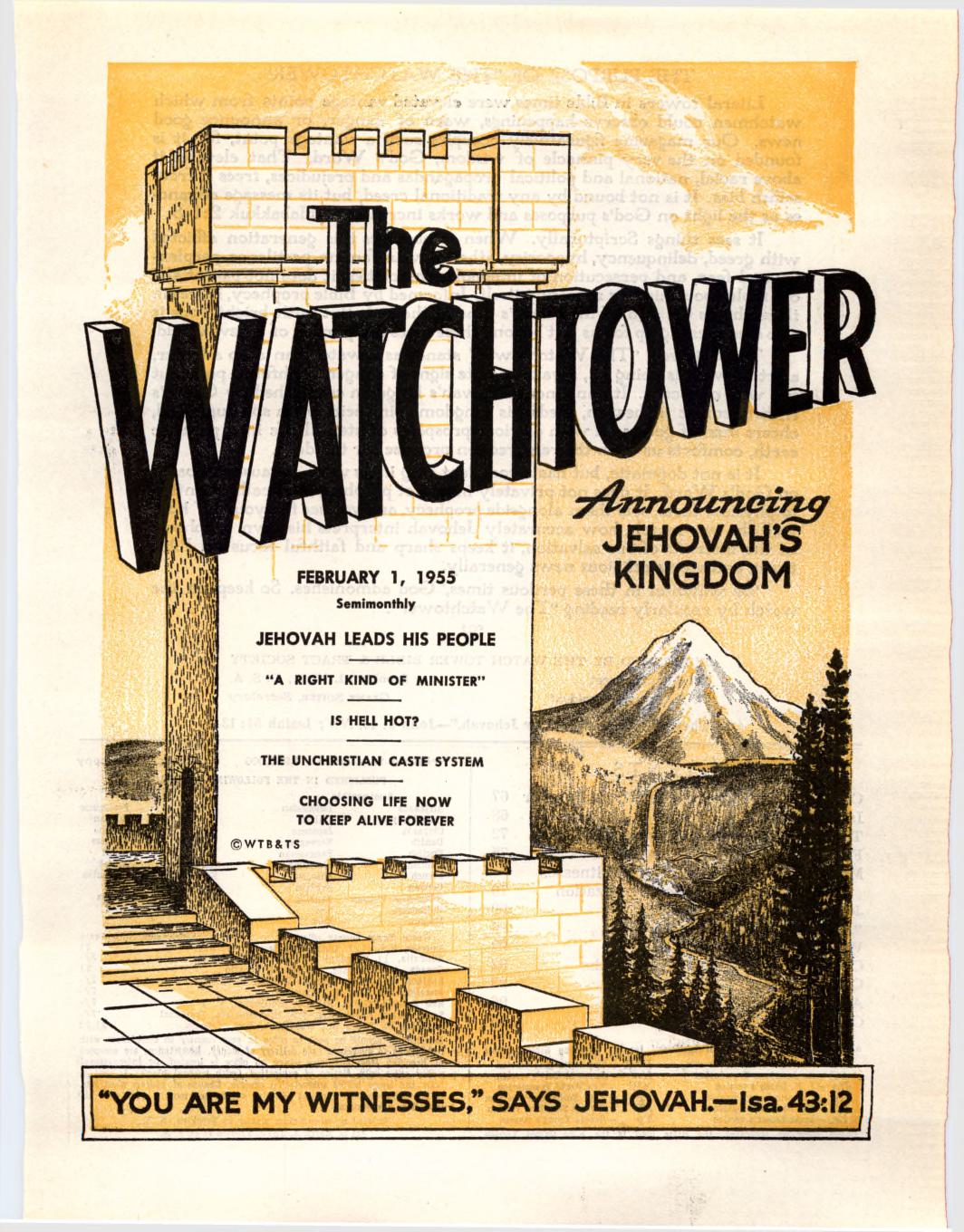
"YOU ARE MY WITNESSES," SAYS JEHOVAH.—Isa. 43:12
The WATCHTOWER
Announcing
JEHOVAH'S
KINGDOM
FEBRUARY 1, 1955
Semimonthly
JEHOVAH LEADS HIS PEOPLE
"A RIGHT KIND OF MINISTER"
IS HELL HOT?
THE UNCHRISTIAN CASTE SYSTEM
CHOOSING LIFE NOW
TO KEEP ALIVE FOREVER
©WTB&TS
"YOU ARE MY WITNESSES," SAYS JEHOVAH.—Isa. 43:12 THE PURPOSE OF "THE WATCHTOWER"
Literal towers in Bible times were elevated vantage points from which watchmen could observe happenings, warn of danger, or announce good news. Our magazine figuratively occupies such a vantage point, for it is founded on the very pinnacle of wisdom, God's Word. That elevates it above racial, national and political propagandas and prejudices, frees it from selfish bias. It is not bound by any traditional creed, but its message advances as the light on God's purposes and works increases.—Habakkuk 2:1-3.
It sees things Scripturally. When it observes this generation afflicted with greed, delinquency, hypocrisy, atheism, war, famine, pestilence, perplexity and fear, and persecution of unpopular minorities, it does not parrot the old fable about history repeating itself. Informed by Bible prophecy, it sees in these things the sign of the world's time of the end. But with bright hope it also sees opening up for us just beyond these woes the portals of a new world.
Thus viewed, "The Watchtower" stands as a watchman atop a tower, alert to what is going on, awake to note signs of danger, faithful to point out the way of escape. It announces Jehovah's kingdom established by Christ's enthronement in heaven, feeds his kingdom joint-heirs with spiritual food, cheers men of good will with glorious prospects of eternal life in a paradise earth, comforts us with the resurrection promise for the dead.
It is not dogmatic, but has a confident ring in its voice, because it is based on God's Word. It does not privately interpret prophecy, but calls attention to physical facts, sets them alongside prophecy, and you see for yourself how well the two match, how accurately Jehovah interprets his own prophecy. In the interests of our salvation, it keeps sharp and faithful focus on Bible truth, and views religious news generally.
'Be watchful in these perilous times,' God admonishes. So keep on the watch by regularly reading "The Watchtower".
e3
PUBLISHED BY THE WATCH TOWER BIBLE & TRACT SOCIETY
117 Adams Street Brooklyn 1, N. Y., U. S. A.
N. H. KNORR, President
GRANT SUITER, Secretary
"They will all be taught by Jehovah."—John 6:45, NW; Isaiah 54:13
CONTENTS
Choosing Life Now to Keep Alive Forever
Is Hell Hot?
The Unchristian Caste System
Filthy Speech
Modern History of Jehovah's Witnesses
Part 3: Expanding the Organization
Jehovah Leads His People
“A Right Kind of Minister”
Which Do You Believe?
Changes Sign After Three Months
Questions from Readers
Announcements
Check Your Memory
AS - American Standard Version
LXX - The Septuagint Version
AT - An American Translation
Mo - James Moffatt's version
Da - J. N. Darby's version
NW - New World Translation
Dy - Catholic Douay version
Ro - J. B. Rotherham's version
ED - The Emphatic Diaglott
RS - Revised Standard Version
Le - Isaac Leeser's version
Yg - Robert Young's version
Printing this issue: 1,950,000 Five cents a copy
PUBLISHED IN THE FOLLOWING LANGUAGES
Semimonthly Monthly
Semimonthly
Monthly
Afrikaans
Indonesian
Arabic
Portuguese
Cebu-Visayan
Italian
Cibemba
Russian
Cinyanja
Japanese
Cishona
Sesotho
Danish
Norwegian
Greek
Slamese
English
Pangasinan
Ibo
Silozi
Finnish
Slovenian
Kanarese
Slovak
French
Spanish
Korean
Ukrainian
German
Swedish
Malayalam
Urdu
Hilfgaynon-Visayan
Tagalog
Polish
Yoruba
Hollandish
Twl
Ilocano
Zulu
Watch Tower Society offices Yearly subscription rate
America, U.S., 117 Adams St., Brooklyn 1, N.Y. $1
Australia, 11 Beresford Rd., Strathfield, N.S.W. 8/-
Canada, 40 Irwin Ave., Toronto 5, Ontario $1
England, 34 Craven Terrace, London, W. 2 7/-
Jamalca, 151 King St., Kingston 7/-
New Zealand, G.P.O. Box 30, Wellington, C. 1 7/-
South Africa, Private Bag, P.O. Elandsfontein, Transvaal 7/-
Trinidad, 21 Taylor St., Woodbrook, Port of Spain $1.72
Remittances should be sent to office in your country in compliance with regulations to guarantee safe delivery of money. Remittances are accepted at Brooklyn from countries where no office is located, by international money order only. Notice of expiration (with renewal blank) is sent at least two issues before subscription expires. Change of address when sent to our office may be expected effective within one month. Send your old as well as new address.
Act of March 3, 1879. Printed in U. S. A.
CHOOSING LIFE NOW TO KEEP ALIVE FOREVER
KEEP alive forever? Is that possible? Yes, it is, because God, the Creator of the universe, is loving, wise and almighty. He created the earth in the first place so that man might live on it forever, for only if he disobeyed was man to die. Since we are assured that "the earth remains for ever," that God created the earth to be inhabited and that his purposes never fail, we must conclude that some day persons on earth will live forever.—Eccl. 1:4, RS.
So that he might realize his purpose even though man disobeyed, God provided his Son as a ransom and purposed a kingdom by means of which the benefits of that ransom can come to humankind. According to Revelation 11:15-18 God's kingdom began at the time that the nations became angry, which history shows to have been 1914. We are therefore living in the days of the establishment of God's kingdom through which Christ will rule until he has destroyed even the enemy death.
Because of these facts Jehovah God is now saying to those living on earth: "I have put life and death before you, the blessing and the malediction, and you must choose life in order that you may keep alive, you and your offspring, by loving Jehovah your God, by listening to his voice and by sticking to him."—Deut. 30:19, 20, NW.*
How do we choose life now? Merely by doing what we think is right, by being sincere? If sincerity were all that is required, then there was no need to give us the Bible, for many, many who have never heard of God and his Word are very sincere. But we are plainly told that it takes 'the truth to set us free,' and that to gain everlasting life we must keep on 'taking in knowledge of the only true God and of Christ Jesus.'—John 8:32; 17:3, NW.
So to choose life to keep alive forever we must take time and effort to study God's Word, to become acquainted with him, his attributes, his purposes and his will for us. This should not seem burdensome. We take time and effort to provide for the needed material things to sustain life a few short years, how much more willing should we be to obtain spiritual things that will sustain our lives forever?
However, for this knowledge to give us everlasting life we must act upon it, thereby being like the "discreet man, who built his house upon the rock-mass." And that requires more than merely not harming our neighbor, it means heeding Jesus' counsel to the rich young ruler, it means putting God first in our lives and following the example Jesus set for us. By continuing in that course we are choosing life now to keep alive forever in God's new world where his will will be done on earth as in heaven.—Matt. 7:24; 19:16-22, NW.
Pagan religions are noted for teaching red-hot hells. The ancient Egyptians, Babylonians, Phoenicians, Persians, Grecians and Hindus taught flaming hells. The Buddhists teach a hell wherein people cook and sizzle in blazing kettles. Is the Bible hell as hot as the pagans paint theirs? Here is the answer.
PEOPLE often forget they have brains when it comes to a topic such as hell. Oh, many persons will ponder on financial or other matters, but when hell is the subject they seem to prefer that someone else do the thinking. They may even push all hope of reasoning aside and declare, as one hell-fire believer did, that if he did not think the Bible taught a literal, red-hot, soul-scorching hell he would throw his Bible into the ash can. That is an extreme case. But it reflects a modern-day tendency to try to make God conform to man's ideas of how things should be run. These opinionated persons go to the Bible, not to weigh all the evidence, but to pluck out a few texts that seem to support their view of things; and so new religions start. True Christians, however, will "let God be found true, though every man be found a liar." (Rom. 3:4, NW) That is what we propose to do, appealing, at the same time, to common sense, as we let the Bible answer the question: Is hell hot?
From the frequency of the expression "hot as hell" it is apparent that many people view hell as being red-hot. This view has been fostered by the clergy teaching that hell is a fiery place of eternal torment for human souls. Tons of leaflets teaching a blazing hell have been printed and distributed. If you have read any of these you may have noticed that almost all point to the same four or five "proof" scriptures, such as Jesus' story of the rich man in hell, the undying worms and unquenchable fire of Mark 9:44, the "everlasting punishment" of Matthew 25:46 and the "lake of fire" five times mentioned in the book of Revelation. We want to examine these texts. But first, to have a thorough look at the subject, let us go to the Hebrew Scriptures.
Turning to the book of Genesis, we read about the creation of the earth, seas, fish animals and even the sun and the moon. Yet nowhere do we read about God's creating a special underworld compartment for the broiling torment of man. It seems strange that, if he made one, God did not have recorded in the Bible the creation of such an important place as a burning hell. Yet suppose he did make one. Would not Jehovah's love and justice have moved him to warn Adam of the full penalty of sin? Jehovah told Adam the consequence of sin was death. Are we really to think that, after Adam sinned, Jehovah changed his mind about the death sentence and decided to give Adam the torture treatment? The Bible answers: "I, Jehovah, change not." Mal. 3:6, AS.
But does not "hell" appear in the Hebrew Scriptures? Yes. So let us do the logical thing and pry into the background of that word "hell." Webster's unabridged dictionary tells us that hell corresponds to the Hebrew Sheol and the Greek Hades. It also says that hell comes from the English word helan, meaning "to conceal."
So we have found that the early meaning of the word "hell" carried no thought of any kind of heat. It merely meant "concealed." We have found, too, that the original Hebrew word, usually translated "hell" in English Bibles, is Sheol. Now what does Sheol mean? It simply means "a hollow place." So the original Hebrew word perfectly corresponds with the original or early meaning of the English word "hell."
Now that the clergy have put fire into the word "hell," the vital question is, Did the inspired Hebrew Bible writers say that conscious life and red-hot activity exist in Sheol or hell? No, quite the opposite! Instead of blazing fire it is described as a "land of darkness." (Job 10:21) Instead of a place of soul-chilling shrieks it is described as a place of "silence." (Ps. 115: 17) The Catholic Douay Bible, at Ecclesiastes 9:5, 10, says: "The living know that they shall die, but the dead know nothing more. Neither have they a reward any more: for the memory of them is forgotten. Whatsoever thy hand is able to do, do it earnestly: for neither work, nor reason, nor wisdom, nor knowledge, shall be in hell [Sheol, AS], whither thou art hastening." So, since the "dead know nothing more," or as the King James Version says, "the dead know not any thing," it would be impossible for them to know conscious torment. And since there is no work in hell, how can there be activity, red-hot or otherwise?
JACOB, JONAH, JOB AND JESUS
Now let us examine what Jacob said concerning hell. After hearing that his son had seemingly been killed by a beast, Jacob said: "I will go down to my son into hell [Sheol, AS], mourning." (Gen. 37:35, Dy) Did Jacob visualize his son in a steaming, scorching fire? And did Jacob expect
to go to such a place? Clearly, Jacob did not view hell as being red-hot.
After the prophet Jonah had been swallowed by a big fish, Jonah prayed: "I cried out of the belly of hell [Sheol, AS]: and thou hast heard my voice." (Jonas 2:3, Dy) Was it red-hot where Jonah was? No, it must have been damp and dark, although warm at fish-body temperature. Jonah spoke the way he did because he understood hell or Sheol to be the grave. For, had not Jehovah delivered him, the fish's belly would certainly have become Jonah's grave. If hell were eternal, Jonah would not have gotten out.
Job was a faithful servant of God. Trying to break Job's integrity, the Devil placed Job in a miserable state of affairs. So the suffering Job prayed to God: "Who will grant me this, that thou mayst protect me in hell [Sheol, AS], and hide me till thy wrath pass, and appoint me a time when thou wilt remember me?" (Job 14: 13, Dy) Since Job was already being tormented by the Devil, would he pray to be "protected" in, of all places, a Devil-managed compartment of red-hot coals? Hardly! Job would not pray to go from the frying pan into the fire! Job understood hell to be the common grave of mankind where he would rest until the resurrection.
The prophet Amos records Jehovah's words to those who would try to escape the Almighty's wrath: "Though they go
down even to hell, thence shall my hand bring them out."
(Amos 9:2, Dy) Would the wicked, trying with all their might to flee from the wrath of God, dig into a place that would bring them only red-hot torture?
It has been said that only the children of the Devil go to hell. But if that is true, why did Job pray that he might rest in hell? And if hell were a place just for the wicked, why would God send his Son to hell? For Jesus went to hell and was there three days. At Psalm 16:10 it was prophetically written of Jesus: "For thou wilt not leave my soul in hell; neither wilt thou suffer thine Holy One to see corruption." Centuries later the apostle Peter showed, at Acts 2:31, that Psalm 16:10 had its fulfillment in Jesus, that he did indeed go to hell but that God raised him up out of that condition. So hell could not be eternal.
TORTURE WITH FIRE REPUGNANT TO GOD
How does Almighty God look upon the idea of roasting men and women in fire? Well, man is made in the image of God. Yet we would not torture a man or a woman, even for one day! Why, the man who would torture a cat is, we say, a fiend. This is natural, since man does not love fiends; he detests them. Fiendishness repels. It is repugnant to God. For when the Israelites religiously burned their children in fire, Jehovah said: "They have built the high places of Topheth, which is in the valley of the son of Hinnom, to burn their sons and their daughters in the fire; which I commanded not, neither came it into my mind." (Jer. 7:31, AS) Fiendishness does not even enter the mind of the Creator. And no wonder, for "God is love."—1 John 4:8.
Thus far we have learned four things: (1) God detests fiendishness, (2) the good as well as the bad go to hell, (3) hell is not eternal, and (4) the Hebrews viewed
hell or Sheol, not as a place of red-hot fire, but as the cold, silent grave.
Turning now to the Christian Greek Scriptures, we find that the word translated "hell" and that corresponds to Sheol is the Greek Hades. Does the literal meaning of Hades carry the thought of glowing fire? No, it simply means "the unseen state." As with Sheol, there are no live people in Hades. "Death and Hades [hell, AV; Dy] gave up those dead in them." (Rev. 20:13, NW) Since at the resurrection Hades gives up its contents of "dead" people, it is not eternal.
THE RICH MAN AND LAZARUS
Still does not the account of the rich man in hell put flames in Hades? Jesus said: "The rich man died and was buried. And in Hades he lifted up his eyes, he existing in torments, and he saw Abraham afar off and Lazarus in the bosom position with him. So he called and said: 'Father Abraham, have mercy on me and send Lazarus to dip the tip of his finger in water and cool my tongue, because I am in anguish in this blazing fire.'" (Luke 16:22- 24, NW) Bible dictionaries list Jesus' story as a parable. But hell-fire teachers say, No, that it is not a parable. So let us read the account, taking it literally as the hellfire teachers say we must.
Taking it literally, we have a rich man going to a place of torment for no apparent reason other than the fact that he was rich. Are all rich people bad? Are all rich people going to a red-hot hell? The poor man goes into Abraham's bosom. Are people going here just because they lack money? Is there enough room for all the poor people in the world to recline on Abraham's bosom? Obviously, Bible scholars admit, Abraham's bosom has to be interpreted figuratively. So since the fate of the poor man is symbolic, then, if the story is to be consistent, the fate of the rich man also must be symbolic.
Further, if the "blazing fire" were literal, would the rich man ask for just one drop of water? Could even a bucket of water, much less a drop, get near a blazing hell? Taken literally, the account is worse than absurd: it outrages reason! Jesus spoke a parable, a story with symbolic meaning.
The parable showed how the Jewish clergy, pictured by the rich man, were selfrighteous. They wore the fine linen and had good things. Lazarus pictured the remnant of Jewish people of faith despised by the clergy and who were spiritually hungry. The death of the two men pictured a change in the two classes. Jesus tormented the clergy by exposing their greed and their false teachings and their hypocrisy. This, as it were, "burned up" the clergy. The heat was on. So they had to get rid of Jesus, which they did by murdering him. So the clergy came out of a luxurious condition into one of torment. But the remnant of faith had a change for the better. Jesus' preaching brought them spiritual food, an opportunity to come into favorable relationship with the Greater Abraham, Jehovah God. The parable has its major fulfillment today. For details see the book What Has Religion Done for Mankind? pages 246-256.
But does not the Bible speak of "hellfire"? Yes, but the word "hell-fire" is not a translation of the Greek Hades. "Hell-fire" is translated from the Greek Gehenna. Gehenna occurs twelve times in the Bible. But the average reader does not know this, since Bible translators have rendered Gehenna as "hell" or "hell-fire." This has caused a lot of confusion. Says the Encyclopedia Americana (1942 ed., v. 14, p. 81): "Much confusion and misunderstanding has been caused through the early translators of the Bible persistently rendering the Hebrew Sheol and the Greek Hades and Gehenna by the word
hell. The simple transliteration of these words by the translators of the revised editions of the Bible has not sufficed to appreciably clear up this confusion and misconception."
Jesus referred to Gehenna at Mark 9:47, 48 (NW): "It is finer for you to enter one-eyed into the kingdom of God, than with two eyes to be pitched into Gehenna [hell fire, AV], where their maggot does not die and the fire is not put out." Now Gehenna was a place for dumping refuse, outside the walls of Jerusalem. Its fires were kept burning to prevent pestilence. Sulphur or brimstone was added to help the burning. Bodies of executed criminals, thought to be unworthy of a resurrection, were sometimes thrown into Gehenna. But live persons were never cast there. When bodies or garbage fell upon the edges of Gehenna, the exposed matter would putrefy and breed worms. The worms finally destroyed the matter. So there were always worms and always fire to destroy matter. Jesus used Gehenna as a symbol, not for everlasting torment, but for everlasting destruction.
The "lake of fire" is also a symbolic term for everlasting destruction: "Death and Hades [hell, AV] were hurled into the lake of fire. This means the second death, the lake of fire." (Rev. 20:14, NW) So the "lake of fire" means "the second death," a destruction that lasts forever and ever, with no hope of a resurrection.
Note that hell or Hades is eternally destroyed. For hell, says Revelation 20:14 must be hurled into the "lake of fire." If hell is the lake of fire, as many say, how can it be cast into itself?
As to the "everlasting punishment" of Matthew 25:46, the original Greek word does not carry the idea of torment but of a cutting off from life. Thus the New World Translation renders it correctly as "everlasting cutting-off."
But what of Revelation 20:10 about the Devil's being "tormented day and night for ever and ever"? In Jesus' time jailers were called "tormenters." So when the Scripture says he will be "tormented day and night for ever and ever" in the "lake of fire," it means that the Devil will be restrained in a never-ending detention of destruction. Indeed, it will be "for ever and ever."
The Bible has answered our question. It has shown that Hades, Sheol or hell is the common grave of mankind. At the resurrection hell gives up its dead. Jehovah destroys hell, for it is cast into the "lake of fire." Gehenna represents the state of destruction that lasts forever and ever. There is no hope of a resurrection for those in Gehenna. So the fiery hells are only pagan hells. The Bible hell (Sheol-Hades) is not hot, but is the dark, silent grave.
TO MANY persons the term "caste" at once calls to mind the land of India, where the caste system has been a curse for so many centuries. However, this subject of caste is not merely of theoretical or academic interest to those residing outside India. On the contrary, when considered in all its ramifications, it will prove to be most pertinent to all who would be guided by God's Word, the Bible.
The English word "caste" comes from the Portuguese word
casta, meaning "race," and, by implication, unmixed or pure race. According to Webster's Dictionary it is "a more or less separate order or class of persons in society who chiefly hold intercourse among themselves, the separation being based on such things as difference of wealth, hereditary rank or privileges, profession, occupation, etc." It really is a false principle of social divisions into selfishly exclusive groups of persons (cliques), according to supposed social rank of persons having the same status or possessing common characteristics. Manifestations of the caste system would therefore include racial discrimination, the clergy-laity distinction, any clannishness because of "blood," wealth, learning, etc.,
as well as any favoritism shown because of having in common an admiration for certain human leaders, or sectarianism, or because of belonging to certain age groups.
The caste system appears to have had its origin at the time the ruling and priestly classes were organized at Babel following the Deluge, when dynasties were developed as a subversion of the patriarchal family divisions authorized by Jehovah God and also illustrated in the family of Noah and the descendants of Jacob. In India the caste system goes back to more than a thousand years before Christ, instituted, it appears, by the light-skinned Aryan invaders to keep themselves as a superior class. This is borne out by the Indian word for "caste," varna, which means "color."
The caste system is unjust, incompatible with Christ's rule to 'do to others as we want them to do to us.' It is a failure to "love your neighbor as yourself." It deprives persons of their dues in fields political, economic, religious and social. Additionally, it shackles its victims with an inferiority complex.-Matt. 7:12; Mark 12: 31, NW.
The caste system works harm not only to those it oppresses but also to those advantaged by it, for it exalts them; it breeds pride and prejudice, and "pride goeth before destruction, and a haughty spirit before a fall." Since God is said to dwell with the lowly and contrite ones, he must be far removed from the haughty and proud, for such are prone to say, "Can anything good come out of Nazareth?"—Prov. 16: 18, AS; John 1:46, NW; Isa. 57:15.
NO CASTE SYSTEM AMONG ISRAELITES
God's Word allows for no caste distinctions because of race, nationality or color, for, as the apostle Paul told the Athenians on Mars Hill, all can trace their origin to the one father, Adam. God "made out of one man every nation of men, to dwell upon the entire surface of the earth." And as Elihu pointed out to Job, God "shows no partiality to princes, nor regards the rich more than the poor, for they are all the work of his hands."—Acts 17:26, NW; Job 34:19, RS.
Instead of any caste distinction it is righteousness that counts with Jehovah, a point Peter so well made at the time the holy spirit was bestowed upon Cornelius: "God is not partial, but in every nation the man that fears him and works righteousness is acceptable to him." And such was true not only after the appointed "seventy weeks" of special favor to the Israelites came to an end but also long before
then. In fact, twice the entire nation of Israel came near to being destroyed by Jehovah because of their rebellious course, first because of their idolatry in making the golden calf while Moses was in the mount, and second, because of their rebellion at hearing the unfavorable report of ten of the spies.—Acts 10:34, 35, NW.
Yes, time and again the natural descendants of Abraham were allowed to go into captivity and suffer death by pestilence, etc., because of their unfaithfulness. On the other hand, Gentiles who exercised faith were blessed by Jehovah. For a few examples, note the mixed multitude that followed the Israelites out of Egypt, Rahab, the Gibeonites, Ruth, the widow of Zarephath, the leper Naaman. Because Jesus called some of these unflattering facts to the attention of the Jews in his day they endeavored to kill him.—Luke 4:25-30.
While the Israelites were shown special favors, such was not because of their being a superior caste but because of the faith of their forefathers, because of Jehovah's love for them, and for the sake of his name. They were commanded to treat the nonIsraelites in their midst justly and lovingly: "The temporary resident who resides for a while with you should become to you like a native of yours, and you must love him as yourself." "There should prove to be one law and one judicial decision for you and for the temporary resident who is residing for a while with you."—Lev. 19:34; Num. 15:16, NW.
The fact that the Israelites were not permitted to intermarry with the pagans round about them was not because of caste but to keep Jehovah's worship pure, for which reason also they were commissioned to act as executioners of the grossly immoral pagan worshipers of Canaan. Nor did they have any caste system based on tribal distinctions. While Judah was the royal tribe and Levi the priestly one, Jehovah repeatedly chose his judges and prophets from other tribes.
Intermarriage was permitted so long as it did not cause confusion as regards tribal boundaries.
NO CASTE SYSTEM AMONG CHRISTIANS
Neither is there any Scriptural basis for a caste system among Christians. Christ's words allow for no clergy caste among them: "Do not you be called 'Rabbi', for one is your teacher, whereas all you are brothers. Moreover, do not call anyone your father on earth, for One is your Father, the heavenly One. Neither be called 'leaders', for your Leader is one, the Christ. But the greatest among you must be your minister."—Matt. 23:8-11, NW.
Nor do the Scriptures allow for any sectarian cliques in the Christian congregation because of personal preference for certain human "shepherds." Speaking out against such divisive creature worship, Paul wrote: "Now I exhort you, brothers, . . that you should all speak in agreement, and that there should not be divisions among you, but that you may be fitly united in the same mind and in the same line of thought. What I mean is this, that each one of you says: 'I belong to Paul,' 'But I belong to Apollos,' 'But I to Cephas,' 'But I to Christ.' Does the Christ exist divided? Paul was not impaled for you, was he? Or were you baptized in the name of Paul?"—1 Cor. 1:10, 12-15, NW.
Nor is there to be any favoritism or clannishness because of nationality, social standing, heredity or sex. That is why Paul, in his letters to Timothy and Titus, condemned concern over genealogies and why he wrote to the Galatians that in the Christian congregation "there is neither Jew nor Greek, there is neither slave nor freeman, there is neither male nor female; for you are all one in union with Christ Jesus."—Gal. 3:28, NW.
Lest any think themselves better because of material wealth and so develop a caste whose company they would favor, the apostle Paul counseled: "Give orders to those who are rich in the present system of things not to be arrogant, and to rest their hope, not on uncertain riches, but on God." (1 Tim. 6:17, NW) The disciple James, Jesus' half-brother, severely criticized those in his day who showed favoritism to the rich, as if they were a special caste, saying: "My brothers, you are not holding the faith of our Lord Jesus Christ, our glory, with acts of favoritism, are you? For, if a man with gold rings on his fingers and in splendid clothing enters into your assembly, but a poor man in filthy clothing also enters, yet you look with favor upon the one wearing the splendid clothing and say: 'You take this seat here in an honorable place,' and you say to the poor one: 'You keep standing,' or 'Take that seat there beside my footstool,' you have class distinctions among yourselves and you have become judges rendering corrupt decisions, is that not so? If, now, you practice carrying out the kingly law according to the Scriptures, 'You must love your neighbor as yourself,' you are doing quite well. But if you continue showing favoritism, you are working a sin, for you are reproved by the law as transgressors." Jas. 2:1-4, 8, 9, NW.
THE PRACTICAL APPLICATION
While all these points seem so logical and self-evident when we reason on them in the light of the Scriptures, putting them into practice is not so simple, because of the inherited selfish bent of our minds. We must therefore be alert and put forth special efforts if we would be free from all traces of caste, such as practicing favoritism or clannishness because of certain common characteristics. We should "lean over backwards," as it were, to avoid any suspicion of caste.
If we seem to be in a favored position because of the color of our skin, or because of education, Christian maturity, youth, position of responsibility in the Christian congregation, we should make it a point to associate with those less favored in any of these respects, for the sake of building up Christian unity; doing so, not condescendingly, but as equals, appreciating that Jehovah can use them to impart a blessing to us even as he can use us to impart a blessing to them.
On the other hand, we must not, because of being less favored in certain respects, belittle ourselves and acquire an inferiority complex, imagining that more favored brothers do not want to associate with us. Remember, no one who is faithfully carrying out the righteous requirements of Jehovah need ever feel inferior or out of place in the midst of God's people. Nor should we "play up" to those more advantaged in any respect because of the favors they may be able to bestow, either of a material or of a spiritual nature.
And while not practicing caste distinctions ourselves we must not think it our duty to change the world in this respect. We can no more do that than we can convert the world to Christianity. Some have criticized the apostle Paul for not condemning slavery in his day but counseling slaves to be obedient and content with their lot, but such overlook that it is not the commission of Christians to reform this old world. At best we can only set an example. What Paul had to offer to the slaves in his day
was of far greater value than the political and economic freedom agitated by social reformers. He brought them the truth of God's Word and kingdom, which made them free from bondage to Satan, to Satan's system of things, to sin, to false religion and to death, giving them the hope of everlasting life; even as Jesus told his followers: "If you remain in my word, you are really my disciples, and you will know the truth, and the truth will set you free." John 8:31, 32, NW.
The same is true today. It is not for Christians to strive to put an end to the injustices of the caste system or to chafe at certain conditions among God's people that are due to the laws of Caesar and over which Christians have no control. All eat of the same spiritual food, have the same privileges of service and the same hope; and these are the things that matter.
So, briefly reviewing, we have seen that there is no Scriptural basis for any caste system, for any favoritism, class distinctions, sectarianism, cliques or special groups existing among Christians. If we love Jehovah with all our heart, mind, soul and strength and our neighbor as ourselves, we shall exalt neither ourselves nor others. And by living according to the Christian principle of love not only shall we bring happiness to our brothers as well as ourselves but we shall also be giving a witness to those on the outside, even as Jesus stated: "By this all will know that you are my disciples, if you have love among yourselves."—John 13:35, NW.
Filthy Speech
In today's world one is continually exposed to dirty minds and filthy speech. Some people cannot listen to conversation without thinking of a dirty story; cannot open their mouths without using vile language. Yet, one cannot revel in smut without getting dirty; so Paul's instruction at Ephesians 5:3,4 is worth keeping in mind continually: "Let fornication and uncleanness of every kind or greediness not even be mentioned among you, just as it befits holy people, neither shameful conduct nor foolish talking nor obscene jesting, things which are not becoming, but rather the giving of thanks." Do you follow this instruction?
MODERN HISTORY of Jehovah's Witnesses
EXPANDING THE ORGANIZATION Part 3
BECAUSE of continuing expansion of its work, legal incorporation of the Society established in 1881 became necessary. After proper application, finally on December 13, 1884, Judge F. H. Collier of the Court of Common Pleas for Allegheny County, Pennsylvania, granted a legal charter that was duly recorded December 15, 1884, thus giving the Society legal life.a Its original corporate name, Zion's Watch Tower Tract Society, was changed in 1896, by court-sanctioned amendment, to its present name, Watch Tower Bible and Tract Society. The Society's general purpose is stated in its charter's Article II:
"The purpose for which the corporation is formed is, the dissemination of Bible truths in various languages by means of the publication of tracts, pamphlets, papers and other religious documents, and by the use of all other lawful means which its Board of Directors, duly constituted, shall deem expedient for the furtherance of the purpose stated."
The charter provided for a board of seven directors, three to serve as officers. The original officers were President, C. T. Russell; Vice-President, William I. Mann; Secretary and Treasurer, (Mrs. C. T.) Maria F. Russell.b
While the Society had been circulating a bound book entitled "Day Dawn," written by an early associate, J. H. Paton, it was decided for Russell to become writer of a new book to be called "Millennial Dawn,"
which after many difficulties appeared in 1886 as Volume 1 of a promised series. Later this became known, instead, as Volume 1 of "Studies in the Scriptures" as well as "The Divine Plan of the Ages." More than six million copies were distributed over a forty-year period. It covered more clearly subjects previously explained in Food for Thinking Christians and in Tabernacle Teachings (later called "Tabernacle Shadows"). Its sixteen chapters (352 pages) included "Our Lord's Return," "Ransom and Restitution," "Plan of the Ages," and "The Kingdom of God." Chapter 15, "The Day of Jehovah," amazingly foreshowed the great preaching work now being done.
"The Day of Jehovah' is the name of that period of time in which God's kingdom, under Christ, is to be gradually 'set up' . . . while the kingdoms of this world are passing away and Satan's power and influence over men are being bound. It is everywhere described as a dark day of intense trouble and distress and perplexity upon mankind. . . . That some of the saints will still be in the flesh during at least a part of this burning time seems possible. Their position in it, however, will differ from that of others, not so much in that they will be miraculously preserved (though it is distinctly promised that their bread and water shall be sure), but in the fact that, being instructed from God's Word, they will not feel the same anxiety and hopeless dread that will overspread the world. The troubles of this 'Day of Jehovah' will give opportunity for preaching the good tidings of coming good, such as is seldom afforded, and blessed are they who will follow the footsteps of the Master, and be the good Samaritans binding up the wounds and pouring in the oil and wine of comfort and cheer."
d
By end of the '80's they had outgrown the quarters at 151 Robinson Street (earlier designated as 44, and then 40, Federal Street), Allegheny, Pennsylvania. e They decided to build, and in 1889 they moved into their own large, handsome four-story brick structure costing 34,000, located at 58 and 60 (later renumbered as 610-614) Arch Street, Allegheny (North Side, Pittsburgh), containing quarters for a small "Bible House family," printing works, shipping rooms, an assembly place for about 200, an office, an editorial department and a store front. They named it "Bible House." ^f Years later, the Society's board of directors accepted the donation of title to this plant, the board valuing the building's net equity and all of its equipment at 164,033.65. g
By 1890 there were about 400 active associates of the Society. The only report available shows the placement of 841,095 tracts, 395,000 extra copies of the Watch Tower magazine, and 85,000 Millennial Dawn bound books between 1886 and 1891.h
Incidentally, at Pittsburgh in 1954 the
Society completed a building at 4100 Bigelow Boulevard that now serves both as the legally registered office of the Pennsylvania
corporation (Watch Tower Bible and Tract Society) and as a Kingdom Hall. 1
STANDING IN DEFENSE OF TRUTH (1890-1908)
After the Watch Tower Society of Jehovah's witnesses had surprisingly survived its childhood struggle of early beginnings, the old-time apostate religious organizations began to blink their eyes, 'for look! this "voice of millennialism" did not die out in its birth throes like all the others. Why the audacity of them—these "Russellites," "Bible Students" or whatever you call them—they are standing as a stripling youth of an organization full of cheek to challenge and expose us "oldsters," we the ordained, recognized clergy of Christendom! Their voice is become more than just a whisper; for now bold words they speak in many places to the effect that the teachings we give the people are out of harmony with the Bible and that our position as spokesmen for Christ is presumptuous. This has gone far enough; the Watch Tower Society must be crushed now before it grows too big to handle.'
With such sentiments, Protestant elements of Christendom, as a 'roaring maned lion,' set out to attack and to destroy the
young Samson-like Watch Tower Society. But standing in defense of truth, the modern "Samson" witnesses had the spirit of Jehovah become operative upon them to bring, instead, this attacking "lion" to silence.—Judg. 14:5,6 NW; RS.
Quietly and surely by means of the Watch Tower magazine, the Society's many new Bible tracts and Bible study bound books' circulating in ever-widening fields, the gathering out of Jehovah's genuine anointed ones from the apostate religious organizations proceeded apace.
As such became associated in new, growing congregations, responsibility gradually was put upon them to do some preaching by distributing the printed message; first to perform this in a limited way among friends and, later, publicly with increased boldness. Their faith and their works of preaching kept increasing in proportion to their forsaking Babylonish religious thinking to embrace solid Bible truth. By this time they came to know that there is no "trinity"; that man does not possess an "immortal soul" but that he is a soul and is mortal; that the wages of sin is death, not "eternal torment in hell-fire"; that baptism by immersion is proper; that all who are dedicated to the living God and begotten of him by his holy spirit must be "faithful unto death" as followers of his Son, Christ Jesus, in order to enter the kingdom of heaven, and that during Jesus Christ's thousand-year or millennial rule the earth will be brought to a state of Edenic paradise, being made fit as perfect man's everlasting home. Such was the message that was beginning to be circulated in millions of printed pieces, bringing annoying alarm to Christendom's clergy.
Through the years five other powerfully written bound volumes of the series called "Studies in the Scriptures" were produced by C. T. Russell, each playing its part in gathering more of the anointed Christians into association with the Watch Tower Society. Volume 2, The Time is at Hand, was released in 1889; Volume 3, Thy Kingdom Come, in 1891; Volume 4, The Battle of Armageddon (originally called "The Day of Vengeance"), in 1897; Volume 5, At-onement Between God and Man, in 1899; and finally Volume 6, The New Creation, in 1904. A seventh volume the author had
promised but did not survive to write it.
Particularly from the early 1880's the Society's publications had been circulating in Europe where small groups of Bible students were being gathered together. So in 1891 Russell as the Society's president made his first trip abroad to stimulate and expand the interest in countries outside the United States and Canada. Two months were set aside for this missionary tour. From New York city Russell's party sailed for Belfast, Ireland. From there, after a meeting with friends, they went on to visit other groups and historic places in Scotland, Glasgow and Edinburgh; then to Copenhagen, Denmark; Germany's Berlin and Leipzig; Vienna, Austria; Kischenev in Russia; Constantinople, Turkey; Athens, Greece; Jerusalem in Palestine; Egypt's Cairo and the pyramids; Rome, Italy; Berne, Switzerland; Paris, France; Brussels, Belgium; Amsterdam, Holland; and then to London and Liverpool, at each of which Russell spoke to 150 before returning to New York. Of this tour he reports:
At London a publications depot was set up following Russell's visit; and then in 1900 the Society's first branch office was established there at 131 Gipsy Lane, Forest Gate, East London. k
Also after this foreign trip arrangements were made to begin publishing various books and pamphlets in German, French, Swedish, Dano-Norwegian, Polish, Greek, and later in Italian. Of interest, too, it is that with its issue of January 1, 1892, the Watch Tower began (and for many years until 1927, 1 regularly continued) to publish in each issue the "International Sunday School Lessons" whereby a short commentary study was made of the Protestantdenominational chosen "golden text" for each Sunday's scheduled lesson.
"Suggestive thoughts designed to assist those of our readers who attend Bible classes, where these lessons are used; that they may be enabled to lead others into the fulness of the Gospel."m
Now it became apparent that there was a need to hold conventions in various parts of the country other than at Pittsburgh with the annual Memorial celebration, as had been the practice of several years. So in 1893 a convention was arranged for Chicago, August 20-24, where the Columbian Exposition (world's fair) was being held that summer. Those traveling to Chicago for that assembly thus were enabled to obtain special rail fare rates.
"The number in attendance was about 360 . . . Following [the morning prayer meeting each day] came a discourse of about an hour and a half, then an adjournment for dinner, after which the afternoon, from 2 until 5, was devoted to the public answering of questions. The last day was devoted to the interest of the colporteur work; and on the day after the close of the Convention, some of the experienced colporteurs [now called pioneers] remained with some of the less successful and the beginners, and held a school of colporteuring—giving instructions, pointing out good and bad methods, manners and expressions . . . [About 50 colporteurs attended.] The Calvary Baptist Church of Chicago very kindly granted us the use of their baptistry; and, in all, seventy symbolized their baptism into Christ's death by immersion into water. The proportion of brethren and sisters was about equal, and their ages ranged from 17 to 70 years."n
Many letters kept coming to the Society's head office showing the heart reaction of those being called to associate as Jehovah's anointed preachers of good news. Following is an interesting one of 1894, typical of many letters still being received by the Society to this day from persons of good will toward Jehovah:
"Gentlemen: Enclosed herewith please find exchange on New York for the sum of $6.00 for which please send me Zion's Watch Tower [magazine] one year and copies of Millennial Dawn. By way of explanation for ordering this amount of books, I desire to say that, about two months ago, two young ladies [Watch Tower pioneers] came into my [law] office selling those books. I was very busy when they presented their card; and, seeing that they were ladies selling books, I bought the three volumes, thinking that by so doing I was helping them out. I have since concluded that these ladies brought to me 'glad tidings of great joy.' I took the books home, and thought little of them, until a few weeks ago, when I had some spare time, I began reading the first volume, and it was so very interesting that I could not stop. The result is, my dear wife and myself have read these books with the keenest interest, and we consider it a God-send and a great blessing that we have had the opportunity of coming in contact with them. They are indeed a 'helping hand' to the study of the Bible. The great truths revealed in the study of this series have simply reversed our earthly aspirations; and realizing to some extent, at least, the great opportunity for doing something for Christ, we intend to take advantage of this opportunity in distributing these books, first, among our nearest relatives and friends, and then among the poor who desire to read them and are unable to purchase; and for that reason we desire these extra copies. Yours, etc."
This letter was signed by lawyer J. F. Rutherford, who twelve years later dedicated himself to God and entered the fulltime service at the Pittsburgh headquarters or "Bible House" as the Society's legal adviser, only still later, in 1917, to become the Society's second president upon the death of Russell.
Jehovah Leads His People
IN ANCIENT times Jehovah proved himself to be a mighty, yet gracious
"You in your loving-kindness have led the people whom you have recovered; you in your strength will certainly conhow to be true followers, faithfully following the lead set for us. At the same time
leader of his people. On one memorable
duct them to your holy abiding place." Ex. 15:13, NW.
occasion he led them out of bondage in Egypt to their promised inheritance, and on another great occasion he led them out from captivity in Babylon back to their homeland. Today, at long last, Jehovah again leads his people out from the present wicked system of things into the kingdom of his beloved Son. Jehovah himself caused much detail to be recorded of those previous examples of his leadership, from which we can and should learn a great
however, many of Jehovah's servants are
called upon to act as leaders in varying degrees and positions, and none of us want to "accept the undeserved kindness of God and miss its purpose."—Rom. 15:4; 2 Cor. 6:1, NW.
2 Before coming to the question of our individual position and responsibility, and in order that we may approach it with a proper understanding and with the right spirit, let us first look at our position as a whole. We will note some of the outstand-
deal, "for all the things that were written aforetime were written for our instruction." Yes, we can look forward to gaining a closer insight and keener appreciation of the various qualities manifested by our great God when acting in this capacity. But, besides this, we have another objective. It is important and timely for us today to consider the responsibility resting upon us who are favored to be among those who are being led by Jehovah. Broadly speaking, that responsibility falls under two headings. First we all have to learn
ing things brought to our attention respecting Jehovah's leadership of his people in times past, and then see how those things throw light on the manner and purpose of his present leadings and the part we have to play therein. We will begin with
that grand example, already mentioned, of Israel's journeyings from the time they left Egypt.
HOW JEHOVAH LED ISRAEL
3 We are not left to
two headings. First, we all have to learn ___
2. (a) What striking examples of Jehovah's leadership do the Scriptures disclose? (b) For what two reasons is it timely to consider these?
What was at the back of all Jehovah's dealings with Israel?
corded history of the Israelites from the time they left Egypt and their forty year trek through the wilderness and draw our own conclusions as to how Jehovah led them.
He himself caused Moses to write the words of a song at just about the end of Israel's journeyings, drawing our attention to the very things in which we are interested. First, Jehovah's purpose back of all his dealings with Israel is clearly stated at the commencement of the song: "For I shall declare the name of Jehovah.
The honor and vindication of Jehovah's holy name is the primary consideration, as David also confirmed, saying: "Who then is like thy people, like Israel, a nation alone in the earth? whom God went to redeem for himself [out of Egypt] as a people so to make himself a name." Isaiah, too, stressed the same thing when he wrote:
"So didst thou lead thy people, to make thyself a majestic name!"—Deut. 32:3, NW; 2 Sam. 7:23; Isa. 63:14, Ro.
Now let us take note of the excellent qualities shown by Jehovah as the great Leader of his people. There are quite a few, but on examination they can be seen to line themselves up in striking, but balanced, contrast. On the one hand, with fighting strength and in fiery anger as "a manly person of war," he proved himself powerful in ability to shatter the enemy. On the other hand, in loving-kindness toward the people whom he had reclaimed from Pharaoh's grasp, he manifested fatherly strength and ability to protect and conduct Israel gently, yet surely, all the way to their ultimate "holy abiding place." Jehovah certainly proved himself a Leader of infinite tenacity and tenderness. As Moses reminded Israel at the commencement
of what he told them on the plains of Moab: "You saw how Jehovah your God carried you just as a man carries his son, in all the way that you traveled until your coming to this place." Then again in Moses' closing song we have that lovely and stirishing on the note of Jehovah's right to all the honor and credit, in these words: "He came to find him [Israel] in a wilderness land, and in an empty, howling desert. He began to encircle him, to take care of him, to safeguard him as the pupil of his eye. Just as an eagle stirs up its nest, hovers over its fledglings, spreads out its wings, takes them, carries them on its pinions, Jehovah alone kept leading him, and there was no foreign god along with him."—Ex. 15:1-3, 6, 13; Deut. 1:31; 32: 10-12, NW.
5 From the foregoing quotations alone one might conclude that Israel must surely have greatly appreciated, like a responsive child, all that Jehovah did for that people. But was such the case? Sad to relate, it was quite the reverse. From Mount Sinai onward, and as Moses testified when addressing them on the plains of Moab, the children of Israel, especially the generation that left Egypt, proved to be "a generation crooked and twisted."
They "acted ruinously" and "turned aside in a hurry from the way I [Jehovah] have commanded them to go. . . . I have looked at this people and here it is a stiff-necked people." Yet though that generation died off in the wilderness, with very few exceptions, as Jehovah foretold and determined, yet by no means did he relinquish his original purpose. Instead, through his angel, he kept on leading Israel just the same and successfully brought the sons of that original generation into the Promised Land and gave them possession of it. Ex. 32:7-9, 34; Deut. 1:34-40; 32:5, NW.
6 This highlights two further qualities in Jehovah's leadership of his people. It reveals his abundant mercy, balanced by his righteous judgments brought upon those who, though they had seen his glory and many miraculous signs, yet did not listen to his voice and treated him without respect.—Ex. 34:6, 7; Num. 14:22, 23.
Much more could be said, of course, under this heading. But, keeping to our main theme respecting the manner and purpose of Jehovah's leadings, let us see what can be learned from the Scriptures as they deal with the return of God's people from their captivity in Babylon.
See now how our field of study widens out. The record already considered is primarily historical, though it is true it provides the basis for many prophetic patterns. In contrast the record concerning the return of the Jews from Babylon is mainly prophetic, for the most important things involved therein were recorded long before the event took place. In fact, it was
about two hundred years previously that Isaiah in particular was inspired to write those numerous glowing passages telling of the return from exile. What is more wonderful still is the fact that those prophecies were really written for a later day, our own day, when Jehovah leads his people from modern Babylon up to his New World organization, Zion.
Many times those prophecies have been discussed in these columns, with collateral Scriptural evidence in support, showing how they had, first, a literal fulfillment in 537 B.C. and the years following. Then they had, in many instances, a miniature fulfillment at the time of the first advent, centering round the person of Christ Jesus. But, beyond question, their major fulfillment, along with prophecy in general, is focused on these days of the second advent, in the stupendous events now taking place under the direction of the reigning King, Christ Jesus. Accepting this basis, we shall confine our attention to the particular expressions and aspects of these prophecies that relate to our main theme.
10 To begin with, we are introduced to the One appointed by God to serve as his representative: "Behold, my servant, whom I uphold; my chosen, in whom my soul delighteth: I have put my Spirit upon him; he will bring forth justice to the Gentiles." Immediately it is foretold that this One will manifest the same qualities of tireless, faithful leadership, as did Jehovah himself: "He will not fail nor be discouraged, till he have set justice in the earth; and the isles shall wait for his law." Then the prophecy broadens out and tells of the grand commission to be accomplished by this servant, whose very appointment is a guarantee that he will lead, not only a remnant of faithful Jews, but also a great crowd of Gentiles from darkness and bondage into glorious light and freedom: "I, Jehovah, have called thee in righteousness, and [as the prime Leader] will hold thy hand, and will keep thee, and give thee for a covenant of the people, for a light of the Gentiles; to open the blind eyes, to bring out the prisoners from the dungeon, and them that sit in darkness out of the prison-house."
Then comes a reiteration of the fact that the credit and glory for all these things belong to Jehovah, who tolerates no rival: "I am Jehovah, that is my name; and my glory will I not give to another, neither my praise unto graven images."—Isa. 42:1, 4, 6-8, AS.
11 But who is this honored servant? You will note from the foregoing that the first thing mentioned is that Jehovah puts his spirit, his invisible active force, upon this One, authorizing and empowering him to carry out his commission. This points us to the vital link in the chain of evidence, namely, the prophecy recorded at Isaiah 61:1-3 (which please read), where more information is given as to the result and outworking of the spirit's operation on this anointed servant, including the leading forth into liberty of those found in prisonlike bondage. In turn this latter scripture was quoted by Jesus, when addressing his own townfolk in the synagogue at Nazareth, as being fulfilled in himself that very day. (Luke 4:17-21) As many of our readers well know, this is by no means the only link identifying the "servant" frequently mentioned by Isaiah. Quotations from Isaiah, chapter 53, for example, telling of the sufferings and shame heaped upon Jehovah's servant, are applied to Christ Jesus in quite a few instances in the Christian Greek Scriptures.
12 Turning now to Isaiah, chapter 55, we find some interesting and important information. Appealing to those who come to realize their need of those spiritual provisions that Jehovah alone can provide, Jehovah says: "Incline your ear, and come unto me; hear, and your soul shall live: and I will make an everlasting covenant with you, even the sure mercies of David. Behold, I have given him for a witness to the peoples, a leader and commander to the peoples." (Isa. 55:3, 4, AS) Here we have the explicit statement that this One, Jehovah's servant, will act as leader with full authority to issue directions and commands. These are imperative commands. "Indeed, any soul that does not listen to that Prophet will be completely destroyed from among the people." He is Jehovah's "faithful and true witness," and he is the one who gives expression to the urgent command in these days of Babylon's impending destruction: "Get out of her, my people, if you do not want to share with her in her sins, and if you do not want to receive part of her plagues." As Jehovah's representative, "called Faithful and True," he then proceeds to lead the heavenly armies against the nations of this world opposed to his rule, "and out of his mouth there protrudes a sharp long sword," giving those orders that bring about the final execution of the enemy forces. How like the fighting strength and ability manifested by Jehovah in the overthrow of Pharaoh and his forces!—Acts 3:19-23; Rev. 3:14; 18:4; 19:11-16, NW.
13 At this point we wish to draw your attention to yet another passage from Isaiah's prophecy closely linking the features already considered and giving strong confirmation thereto. Remember that Christ Jesus is the One who, as David's Son and rightful heir, inherits "the sure mercies of David," summed up in the unbreakable covenant for the Kingdom promised to David's seed, as beautifully expressed at Psalm 89:33-37.
Fittingly, therefore, this One as the Greater David is described in the opening verses of Isaiah, chapter 11, as "a shoot out of the stock of Jesse [David's father], and a branch out of his roots." (See Revelation 22:16 for proof of identification.) Now read for yourself the description that follows at Isaiah 11:15 (AS), showing the marvelous and balanced qualifications for leadership bestowed on this One by Jehovah's spirit, making him a wise, strong and understanding leader, showing fatherly strength and ability on behalf of "the meek of the earth," and wholly dependable, because "righteousness shall be the girdle of his waist, and faithfulness the girdle of his loins." Note, too, the link with Revelation 19:15 in that "he shall smite the earth with the rod of his mouth; and with the breath of his lips shall he slay the wicked."
…