The Watchtower, July 1, 1955
Download: PDF — The Watchtower, July 1, 1955
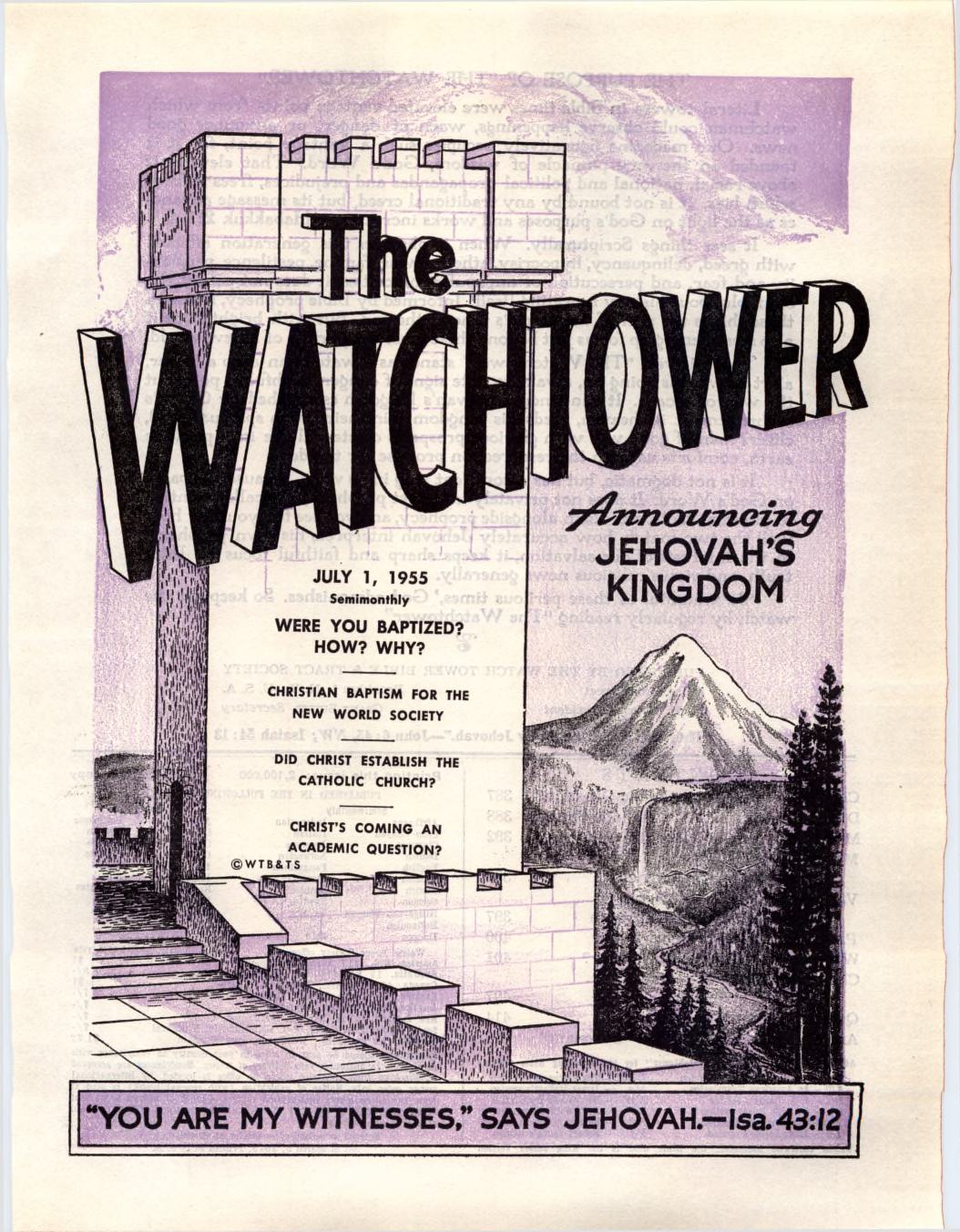
WATCHTOWER Announcing
JULY 1, 1955 Semimonthly WERE YOU BAPTIZED? HOW? WHY?
CHRISTIAN BAPTISM FOR THE NEW WORLD SOCIETY
Announcing JEHOVAH'S KINGDOM
DID CHRIST ESTABLISH THE CATHOLIC CHURCH?
CHRIST'S COMING AN ACADEMIC QUESTION? TB&TS
"YOU ARE MY WITNESSES," SAYS JEHOVAH.—Isa. 43:12 THE PURPOSE OF "THE WATCHTOWER"
Literal towers in Bible times were elevated vantage points from which watchmen could observe happenings, warn of danger, or announce good news. Our magazine figuratively occupies such a vantage point, for it is founded on the very pinnacle of wisdom, God's Word. That elevates it above racial, national and political propagandas and prejudices, frees it from selfish bias. It is not bound by any traditional creed, but its message advances as the light on God's purposes and works increases.—Habakkuk 2:1-3.
It sees things Scripturally. When it observes this generation afflicted with greed, delinquency, hypocrisy, atheism, war, famine, pestilence, perplexity and fear, and persecution of unpopular minorities, it does not parrot the old fable about history repeating itself. Informed by Bible prophecy, it sees in these things the sign of the world's time of the end. But with bright hope it also sees opening up for us just beyond these woes the portals of a new world.
Thus viewed, "The Watchtower" stands as a watchman atop a tower, alert to what is going on, awake to note signs of danger, faithful to point out the way of escape. It announces Jehovah's kingdom established by Christ's enthronement in heaven, feeds his kingdom joint-heirs with spiritual food, cheers men of good will with glorious prospects of eternal life in a paradise earth, comforts us with the resurrection promise for the dead.
It is not dogmatic, but has a confident ring in its voice, because it is based on God's Word. It does not privately interpret prophecy, but calls attention to physical facts, sets them alongside prophecy, and you see for yourself how well the two match, how accurately Jehovah interprets his own prophecy. In the interests of our salvation, it keeps sharp and faithful focus on Bible truth, and views religious news generally.
'Be watchful in these perilous times,' God admonishes. So keep on the watch by regularly reading "The Watchtower".
PUBLISHED BY THE WATCH TOWER BIBLE & TRACT SOCIETY
117 Adams Street
Brooklyn 1, N. Y., U. S. A.
N. H. KNORR, President
GRANT SUITER, Secretary
"They will all be taught by Jehovah."—John 6:45, NW; Isaiah 54:13
<tr><th>CONTENTS
Christ's Coming an Academic Question?
Did Christ Establish the Catholic Church?
Modern History of Jehovah's Witnesses
Modern Gideons in French Equatorial Africa
Visiting Jehovah's Witnesses in Mexico and Central America
Practicing True Love Every Day
Were You Baptized? How? Why?
Christian Baptism for the New World Society
Questions from Readers
Archaeology and the Word "Covenant"
AS - American Standard Version
LXX - The Septuagint Version
AT - An American Translation
Mo - James Moffatt's version
Da - J. N. Darby's version
NW - New World Translation
Dy - Catholic Douay version
Ro - J. B. Rotherham's version
ED - The Emphatic Diaglott
RS - Revised Standard Version
Le - Isaac Leeser's version
Yg - Robert Young's version
Semimonthly
Monthly
Afrikaana
Indonesian
Arabic
Portuguese
Cebu-Visayan
Italian
Cibemba
Russian
Cinyanja
Japanese
Cishona
Sesotho
Danish
Norwegian
Greek
Slamese
English
Pangasinan
Ibo
Silozi
Finnish
Slovenian
Kanarese
Slovak
French
Spanish
Korean
Ukrainian
German
Swedish
Malayalam
Urdu
Hiligaynon-Visayan
Tagalog
Polish
Yoruba
Hollandish
Twi
Ilocano
Zulu
Watch Tower Society offices Yearly subscription rate
America, U.S., 117 Adams St., Brooklyn 1, N.Y. $1
Australia, 11 Beresford Rd., Strathfield, N.S.W. 8/-
Canada, 40 Irwin Ave., Toronto 5, Ontario$ 1
England, 34 Craven Terrace, London, W. 2 7/-
Jamaica, 151 King St., Kingston 7/-
New Zealand, G.P.O. Box 30, Wellington, C. 1 7/-
South Africa, Private Bag, P.O. Elandsfontein, Transvaal 7/-
Trinidad, 21 Taylor St., Woodbrook, Port of Spain $1.72
Remittances should be sent to office in your country in compliance with regulations to guarantee safe delivery of money. Remittances are accepted at Brooklyn from countries where no office is located, by international money order only. Notice of expiration (with renewal blank) is sent at least two issues before subscription expires. Change of address when sent to our office may be expected effective within one month. Send your old as well as new address.
Christ's Coming an Academic Question?
ACCORDING to Jesuit Joseph Christie, one of London's best-known Roman Catholic preachers, "the question about our Lord coming back is interesting but academic. He has never been away. In any Catholic church you can find him, and his authentic voice goes down the ages through His teaching church." But is that the way Jesus' apostles and early disciples, those who had personally known him, felt about it? Did they feel that the question of his coming back was merely academic, that is, without any real practical value or application? Surely the church of which they were to be a part had Christ's presence and he taught through them, but did that mean that for them the question of Christ's coming again was purely an academic one?
If the question of Christ's coming again were purely an academic one, why did the apostles evince such an interest in his return? Why did they associate it with the consummation of this system of things? And why should Jesus have taken the pains to give them the long answer as he did as recorded at Matthew 24, 25, Mark 13 and Luke 21 if he could have dismissed the subject as glibly as did Jesuit Joseph Christie?
He who views the question of Christ's return as merely an academic one overlooks entirely the fact that Christ Jesus returns for the purpose of doing a judgment work, to reward his followers, to punish the wicked and, above all, to establish his kingdom. Those events are not merely of academic interest. And that they are associated with Christ's return or second presence the Scriptures clearly show. Thus Paul associated Christ's manifestation at the time of his second presence with his kingdom, and so did the prophet Daniel. 2 Tim.4:1; Dan.7:13, 14.
Jesus associated his return with the rewarding of his followers. Said he: "If I go my way and prepare a place for you, I am coming again and will receive you home to myself, that where I am you also may be." And again: "Look! I am coming quickly, and the reward I give is with me, to render to each one as his work is." Paul understood it this way, for he wrote: "I have fought the right fight, I have run the course to the finish, I have observed the faith. From this time on there is reserved for me the crown of righteousness, which the Lord, the righteous judge, will give me as a reward in that day, yet not only to me, but to all those who have loved his manifestation."—John 14:3; Rev. 22:12; 2 Tim. 4:7, 8, NW.
And Christ's second presence is also a time of separating the sheep from the goats: "When the Son of man arrives in his glory and all the angels with him, then he will sit down on his glorious throne. And all the nations will be gathered before him, and he will separate people one from another, just as a shepherd separates the sheep from the goats."
Jesus' illustrations of the pounds or minas and the talents drive home the same point, that when Christ returns there will be a judgment work.—Matt. 25:31, 32, 14-30; Luke 19:11- 27, NW.
Further, the Scriptures also show that Christ upon his return will destroy the wicked. Thus Paul, in comforting the Thessalonian Christians who were suffering much persecution said: "This takes into account that it is righteous on God's part to repay tribulation to those who make tribulation for you, but, to you who suffer tribulation, relief along with us at the revelation of the Lord Jesus from heaven with his powerful angels in a flaming fire, as he brings due punishment upon those who do
not know God and those who do not obey the good news about our Lord Jesus." "Then, indeed, the lawless one will be revealed, whom the Lord Jesus will annihilate by the spirit of his mouth and bring to nothing by the manifestation of his presence."—2 Thess. 1:6-8; 2:8, NW.
In view of all that the Scriptures show Christ will accomplish at his return, the establishment of his kingdom, the rewarding of his followers, the separating of the sheep and goats and the destruction of the wicked, the question of his coming back is certainly not just an academic one. Those who so hold show that they either do not believe the Scriptures or are blind to their import—in either case being blind guides who can but lead their blind followers to the ditch of destruction.—Matt. 15:14.
Did CHRIST Establish the CATHOLIC CHURCH?
The Catholic Church claims to go back to the time of Christ and the apostles. Do the facts of history and God's Word the Bible support that claim? If not, what are the facts regarding the origin and development of the Catholic Church?
ACCORDING to the Religious Information Bureau of the Knights of Columbus, the Roman Catholic Church, and only it, was established by Christ Jesus himself. In view of the fact that the apostle Paul instructs us to "make sure of all things; hold fast to what is right"; and that we should "let God be found true, though every man be found a liar," let us
examine those claims by the light thrown on this subject by the Christian Greek Scriptures. This should be wholly satisfactory to all holding that the Roman Catholic Church is the true church, since it also claims that "they were members of the Catholic Church who, under God's inspiration, wrote the New Testament in its entirety."—1 Thess. 5:21; Rom. 3:4, NW. If Christ Jesus and his apostles did indeed establish the Roman Catholic Church, then why is it that we look in vain, from Matthew through the Apocalypse or Revelation, for any mention whatsoever of the "Holy Father," or a pope, a college of cardinals, archbishops, metropolitans, patriarchs, monsignors, right reverends, priests, abbots, monks and nuns?
The Scriptural
ever, therefore, wants to be a friend of the world is constituting himself an enemy of God." But the Catholic Church has for fifteen hundred years mixed in politics; a classic example being the shrewd, cunning and crafty Cardinal Richelieu, his example being so notorious that Roman Catholic-minded Hollywood did not dare portray him as a cardinal for fear of the wrath of
record does tell us of Christians being organized back there, but if the structure of the Catholic Church is in line with that of the early Christians, how is it that we find absolutely no mention of it, not even a hint regarding such an elaborate system? On the contrary, Jesus said: "Whoever wants to be first among you must be your slave"; and, "One is your teacher, whereas all you are brothers. Moreover, do not call anyone your father on earth, for One is your Father, the heavenly One."—Matt. 20:27; 23:8,9,NW.
Further, if Christ established the Roman
the Catholic Church. Could we imagine a Peter, a John, playing the role of a Cardinal Richelieu?—John 18:36; James 4:4 NW.
Then again, ever since her inception at the time of Constantine, the Catholic Church has used force to spread her teachings. Especially notorious in this regard was Charlemagne, the first emperor to be crowned by the pope. Consider also the lives of millions lost in the futile crusades, the wanton massacring of entire cities by the crusaders, men, women and children,
Further, if Christ established the Roman Catholic Church, why is it that we look in vain in the Holy Bible for such expressions most current among her, such as trinity, purgatory, mass, immortal soul, lent, novenas, indulgences, penances, holy water, veneration of Mary, the Immaculate Conception, the Assumption of Mary, etc.?
On the other hand, we read much in the Bible regarding subjects seldom mentioned by the Catholic clergy, such as regards sin's wages being death, the hope of a resurrection, a new heavens and a new earth, and, above all, the importance of
even as did Roman Catholic generals during the religious wars of Europe, and as was done in Paris on St. Bartholomew's night, 1572. Consider also the diabolical tortures inflicted by the dreaded Inquisition, which are without parallel in human history. Catholic apologists, such as Gibbons in his Faith of Our Fathers, would excuse these acts by pointing to intolerance practiced by Protestant sects. But that does not prove that Christ established the Catholic Church, but merely that he also did not establish such Protestant sects!
Jehovah's name.—See Romans 6:23; John 5:28, 29; Revelation 20:5, 6; 2 Peter 3:13; Psalm 83:18; John 17:4, 6; Acts 15:14.
Christ did not mix in politics. He told Pilate that his kingdom was no part of the world or else his followers would have fought to prevent his being delivered up. And said the disciple James: "Adulteresses, do you not know that the friendship with the world is enmity with God? Who-
In February, 1934, the public press headlined, "Italian Police Chisel Name Off U.S.-Financed Church," indicating that the Catholic Church still practices intolerance. Yes, for it was Roman Catholic police, in Roman Catholic Italy (more than 99 per cent Roman Catholic, according to the Catholic Almanac), who chiseled the name of a Protestant church off its walls at the orders of Roman Catholic officials, orders that were based on a concordat signed by the Vatican and Mussolini.
Could we imagine Jesus or his apostles causing such a thing to be done? On the contrary, they showed that Christians used spiritual weapons, their sword is God's Word, and that vengeance belongs to Jehovah and he would repay.—2 Cor. 10:4; Rom. 12:19.
IF NOT CHRIST, THEN WHO?
If Christ Jesus did not establish the Catholic Church, who did, and when and how? The apostle Paul foretold that after his death wolfish men would enter the Christian congregation and that these would "speak twisted things to draw away the disciples after themselves."—Acts 20:29, 30, NW.
In writing the Thessalonian Christians not to expect the return of Christ in their day Paul warned that it would not come before there was an apostasy, that this apostasy or mystery of lawlessness was already at work in his day and that it would blossom out after he and others who acted as a restraint to it were out of the way. (2 Thess. 2:5,7,9) If such conditions began to manifest themselves while the apostles were alive, what could be expected after the apostles passed from the scene? What could? In answer to that question note what the historian Lord in his Old Roman World has to say about the gradual development of this apostasy:
"In the First Century not many wise or noble were called. . . In the Second Century . . . It was a disgrace to be a Christian in the eye of fashion or power." However, it was during this century that "bishops became influential, not in society, but among Christians." This calls to mind what the apostle John had to say about one Diotrophes, "who likes to have the first place among them," and who did not receive with respect anything John and the others with him had to say.—3 John 9.
"The Third Century," continues Lord in his Old Roman World, "saw the church more powerful as an institution," although "it was not until the Fourth Century—when imperial persecution had stopped; when the emperor Constantine was converted [only ostensibly, since he was not 'baptized' until he lay on his deathbed]; when the Church was allied with the State, . . . that men of rank entered the Church. When Christianity became the religion of the court and of the fashionable classes, it was used to support the very evils against which it originally protested. The Church was not only impregnated with the errors of Pagan philosophy, but it adopted many of the ceremonies of oriental worship."
Thus we see that when apostate Christianity fused itself with pagan philosophy and religion, and in the interests of worldly fame, wealth and political power it joined hands with the state, that marked the beginning of the Catholic Church as she has been known for the past sixteen centuries. Although claiming to be espoused to Christ she has had worldly paramours from the time of Constantine down to Franco, whom she allows to have a voice in the appointing of her bishops in Spain.
While the birth of the Catholic Church may be pinpointed at A.D. 325, when Constantine decided the debate on the trinity held at Nicea in favor of Athanasius and against Arius, it was not until after the year A.D. 440 that the bishop of the Roman see, Leo I, became in fact the first pope. He was the first Roman bishop able to hold undisputed sway over the other three sees into which the Christian world at that time was divided, namely, the Constantinopolitan, the Antiochian and the Alexandrian.
Upon becoming bishop of Rome, Leo I presumptuously stated: "I will revive government once more upon this earth; not by bringing back the Caesars, but by declaring a new theocracy, by making myself the vicegerent of Christ, by virtue of the promise made to Peter, whose successor I am, in order to restore law, punish crime, head off heresy, encourage genius, conserve peace, heal dissensions, protect learning; appealing to love, but ruling by fear.
Who but the Church can do this? A theocracy will create a new civilization. Not a diadem, but a tiara will I wear, a symbol of universal sovereignty, before which barbarism shall flee away."—Beacon Lights of History, Vol. III, pages 244, 245.
That some even in Paul's day had an ambition similar to that of Leo I is apparent from Paul's words to the Corinthians: "You men already have your fill, do you? You are rich already, are you? You have begun ruling as kings without us, have you? And I wish indeed that you had begun ruling as kings, that we also might rule with you as kings." (1 Cor. 4:8, NW) The ambition of Leo I was fully realized by Leo III, when, on December 25, A.D. 800, he crowned Charlemagne emperor of the Holy Roman Empire of the Germanic nations. Here, then, we have the gradual development of the Roman Catholic Church.
jealous over you with a godly jealousy, for I personally promised you in marriage to one husband that I might present you as a chaste virgin to the Christ. But I am afraid that somehow, as the serpent seduced Eve by its craftiness, your minds might be corrupted away from the sincerity and the chastity that are due the Christ. For, as it is, if someone comes and preaches a Jesus other than the one we preached, or you receive a spirit other than what you received, or good news other than what you accepted, you easily put up with him."—2 Cor. 11:2-4, NW.
Regarding the early Christian congregation Paul expressed this concern: "I am
Here we have it. Just as the "covering cherub" allowed his ambition to change him from an obedient spirit creature to Satan the Devil; just as the choice and pure vine of Israel allowed herself to deteriorate into a degenerate and wild vine; so, too, many of the Christian congregation, which began as a pure and chaste virgin, allowed themselves to be overreached by Satan the Devil and his world, to become unfaithful to their Lord Jesus Christ and to bring forth all manner of bad fruit, at which time they became known as the Catholic Church. So, instead of Christ, it really is Satan the Devil that is the one who established the Catholic Church.-Jer. 2:21; Ezek. 28:14-16.
"But We Can't Do That!"
In a small town in the Eastern zone of Germany two witnesses of Jehovah came to the home of an elderly clergyman. He invited the two witnesses in. A lively discussion was had on Bible teachings. Toward the end of the discussion the record of Jehovah's witnesses in the face of persecution was called to his attention and he was asked, 'In the face of these facts, would it not pay to investigate conscientiously and without prejudice?'
The clergyman admitted this and then explained that he had been giving the matter some thought because only a few days ago a man visited him who had just been released from a Communist prison, and who had told him: "Believe me or not, Mr. — but if we hadn't had those Jehovah's witnesses with us in prison we would have become desperate, we wouldn't have been able to hold out!" To which the clergyman added: "I know that God has actually raised up a people in the witnesses of Jehovah, who stand for his Name." Then in a resigned tone he added, "But we can't do that." Why can Jehovah's witnesses and why cannot such clergymen? Why?
MODERN HISTORY of Jehovah's Witnesses
CHAMPIONS OF FREEDOM OF SPEECH AND OF WORSHIP
REACHING Jehovah's kingdom message through hundreds of broadcasting stations in North and South America, Europe, Africa and Australia flourished during the decade beginning with 1927. Very effectively used first were the specially enlarged NBC commercial network for the international convention at Toronto, Ontario, in 1927 and, in 1928, the much larger first special Watchtower network for that year's international convention at Detroit, Michigan. So the Society decided to operate and for many months did operate a weekly "Watchtower network" of thirty stations for serving a multitude of listeners in Canada and the United States, broadcasting a one-hour program emanating from the studios of Watchtower station WBBR at New York city (Staten Island). Every Sunday the "Watchtower hour" included a lecture by Judge Rutherford together with introductory and concluding music by the WBBR orchestra of Bethel brothers. This weekly chain-broadcast service began November 18, 1928, and continued throughout 1929 and 1930.a
In 1931 the Society began a weekly broadcast through 250 radio stations by means of electrical transcription recordings of a series of 15-minute lectures by Judge Rutherford. b In 1932 the radio service was expanded to 340 stations broadcasting the weekly Bible lectures exposing apostate religion. By 1933 the international broadcast voice of the Society was being heard through 408 radio stations located in six continents—Argentina, Australia, Canada, China, Cuba, France, South Africa, Estonia, Uruguay, Alaska, Hawaii, Philippines and the United States. In that year alone there were transmitted 23,783 separate Bible talks. c
For Roman Catholics their pope, Pius XI, had declared 1933 as a "holy year," to usher in an era of Catholic action designed to bring peace to the nations.
Simultaneously, in the spring of 1933, American Catholics under leadership of their cardinals, bishops and priests began a concerted nationwide campaign to 'drive Rutherford off the air.' By this time on the radio Rutherford's was the best-known and most frequently heard voice in America. If the clergy were vexed by the Watch Tower Society representatives' passing
out millions of tracts in front of their church doors in the early 1900's, now they were plagued a thousand times more by the unanswere Bible preaching over the radio waves.
Through the effective Watchtower broadcasts the ranks of the witnesses kept rapidly growing. This avenue of communication cost the Society millions of dollars, all voluntarily contributed by the brothers during years of the great American depression (1929-1935). As we now see, in retrospect, 1933 turned out to be the year when the Vatican hierarchy and Jehovah's witnesses came to grips on the issue of freedom of speech. Catholic spokesmen vigorously used pressure and threats of boycott against radio stations to force them to refuse to hire their facilities to the witnesses. d
On April 23,1933, Judge Rutherford personally first broadcast over a special Watchtower chain of fifty-five powerful stations his now world-famous hour lecture "Effect of Holy Year on Peace and Prosperity." Two months later, on June 25, 1933, the same lecture in transcription was broadcast by 158 stations, for which five million printed invitations were circulated to build up a vast audience for this rebroadcast. e The reaction to the original April 23 broadcast was immediate, bitter, fiery. Certain radio managers fell victims of vigorous Catholic intimidation, refusing to carry any further Watchtower programs.
A few weeks later Catholic strong-arm tactics were further revealed at a public meeting in Plainfield, New Jersey, addressed by the Watch Tower Society's president on the subject "Intolerance," the official report of which follows:
"The persecution of Jehovah's witnesses at Plainfield, N.J., provided the occasion for a public address' being made from a theater building on Sunday, July 30, [1933] which address was broadcast by several radio stations. The speaker on this occasion was literally surrounded by firearms in the hands of sixty or more policemen who had come to the meeting uninvited and who were not either needed or wanted, but doubtless had been sent there at the instance of the Catholic hierarchy, looking for an occasion to prevent the meeting and possibly to destroy the speaker."f
This Plainfield, New Jersey, outrage against freedom of speech and freedom of worship was going too far. In the battle of the air waves, in late 1933 and early 1934 Jehovah's witnesses continued pressing the fight in the public interest by circulating a nationwide petition addressed to the United States Congress in Washington, vigorously protesting against Catholic intimidation and threats to free speech over the radio. To this petition 2,416,141 signatures were obtained and it was presented to Congress at Washington on January 24, 1934. Congressman McFadden, supported by others, had introduced a bill in Congress to prevent such discrimination, boycott and other threatening methods to hinder the broadcasting of programs in the public interest. The Society through its spokesmen submitted a volume of evidence in support of the petition. The net result was that Congress enacted a law placing all electrical communications under one new administrative agency, the Federal Communications Commission. This commission promptly held public hearings to enable it to make suggestions to the next session of Congress for the enactment of further laws as to broadcasting, as necessary. g On October 4, 1934, the Watch Tower Society's president appeared personally before this new federal agency at Washington and presented facts of the activities of the Roman Catholic Hierarchy in wrongfully interfering with the broadcasting service of Jehovah's witnesses.
In spite of these public protests against wrongful interferences, the Society's Bible broadcasts for 1934 amounted to 20,743 lectures, or a drop of 3,040 from the peak year of 1933, thus giving proof of the baneful effect of continued Catholic intimidation tactics. h
The decline in possible radio broadcasts continued, for in 1935 the total amounted to 18,287, or a decrease of 2,536 lectures over the previous year's decline. Jehovah's witnesses continued to press the fight for freedom of speech and worship by circulating another nationwide petition addressed to Congress, to which 2,284,128 signatures were obtained. This petition was presented to Congress in January, 1935, but was ignored. 1 There was then convened a national convention of Jehovah's witnesses in Washington, D.C., which met from May 30 to June 3, 1935. Twenty thousand persons gathered for this assembly to hear Judge Rutherford's outstanding lecture on Sunday, June 2, entitled "Government," delivered at Washington Auditorium and simultaneously broadcast internationally. On June 3, 1935, the Society's president filed a brief before the Federal Communications Commission, pressing for further action in defense of free speech. 2
Incidentally, this Washington convention proved to be outstanding for the new flash of truth as to the "great multitude" of Revelation 7:9, proving that its members are not a secondary spiritual class destined to go to heaven but that they are an earthly group identical with the "sheep" of Matthew 25:31-46, made known in 1923, and the "Jonadab" class revealed in 1932 with the release of Vindication, Volume 3. k
Outwardly it seemed that the witnesses were losing the battle for freedom of speech. In September, 1936, still a third national petition was gathered, this time the greatest in registering protest to the Washington government at its inaction against the continued unfair practices to suppress the witnesses. In support of this final protest 1 2,630,001 signatures were filed November 2, 1936, in Washington. This protest likewise went unheeded. m But the witnesses were not outwitted. Already in 1933 they took steps to develop an alternative public sound-service campaign in case they eventually should be driven off the radio. In that year the Society began the manufacturing of portable electrical transcription machines that could reproduce the 331⁄2-rpm radio-broadcasting recordings at public and private gatherings. In 1933, 4,646 such transcription meetings were held, with a total attendance of 240,434 persons. n Sound cars also were built to cruise along the streets and in public places to sound forth literally the Kingdom message from recorded discs. \circ As the years of the 1930's passed, this sound service grew to substantial proportions and proved to bring more tangible results than the radio, in that a visible audience was contacted and instructed.
Results of the non-radio sound service were so promising that, in 1934, the Society began to produce another service instrument, a portable phonograph, and to manufacture a series of 4 1⁄2 -minute 78-rpm discs containing effective Bible lectures. p At first this portable phonograph was used largely in the back-call service, but finally it came to be very widely used in the initial-call house-to-house service, being played on the doorsteps of the homes. Here indeed was a new preaching medium. It figured in a big way at the 1937 Columbus (Ohio) convention attended by 25,000 on Sunday, September 18, to hear Judge Rutherford deliver his important lecture "Safety," which at the same time was broadcast by 135 radio stations.
At this convention the historic decision was announced, that the Society was voluntarily withdrawing from all commercial radio broadcasting contracts after October 31, 1937. q Instead, all of Jehovah's witnesses would concentrate their time and funds on the more effective house-to-house work,
using the portable phonograph with a wide range of more than ninety Bible lectures that would enable millions to hear and learn Bible truth. The phonograph work took on new force, as is demonstrated by the report for 1938 showing that there were 430,000 discs with lectures in sixteen languages in use on 19,600 sound machines. In 1937 there were reported 10,368,569 listeners, and for 1938, 13,070,426. r Truly a literal mighty shout was being raised among all earth's inhabitants!
9 1938 Yearbook, pp. 38, 47.
(To be continued)
r 1939 Yearbook, pp. 59, 63, 64, 68.
"The New Sects in New Zealand"
UNDER that heading Anglican Dean Chandler wrote in the Christchurch Star-Sun about what he called the new "vigorous sects." Probably most readers could guess what group he particularly had in mind. "I received a letter," he said, "from a reader who is much perplexed because one of her family has left her church and become a member of one of the 'fancy religions' bearing an American label. My correspondent is now being besieged by zealots who belong to this new sect and who display a knowledge of the Bible which far surpasses her own."
Where had her teachers fallen short? Other statements in the article would give a clue: "Perhaps our most serious neglect is that of pastoral visitation, for as it is necessary for a shepherd to go around his flock continually, so it is necessary to find opportunity to discuss with our people vital problems that harass their minds and to rescue them from some of the heretical entanglements in which they are likely to be caught. Having said this, I am painfully conscious of my own neglect in this respect."
Another point: "I am more than ever convinced that the printed word has got to supplement the spoken word to an ever increasing degree. If we wish our people to be strong in faith we have got to encourage them to read and study far more than they do at present. Only by that means can they be armed against the assault of those who would drag them
from their moorings and leave them unanchored and tossing about on a sea of doubt and uncertainty." Thus he admits that the church sermons have not gotten sufficient knowledge into their heads.
"By the way," he says, "returning to the cult which I have singled out for special mention, it is interesting to note that it is a religion of the printed word, which word its devotees are required to sell, whereas Christianity, like Judaism from which it sprung, is intimately associated with buildings." But the kind of first-century Christianity that Jesus and the apostles had was not associated with buildings, but with the people—in their homes, on the streets and in the market places.
He refers to the "danger of overemphasising the Old Testament to the detriment of the New," while showing that too many of his people do not know a great deal about either. The solution? "Get back to the Bible." Yet he complains about others helping the people to do that when he has fallen short. One New Zealand reader said: "These parsons complain at the progress of Jehovah's witnesses and at the same time admit their own negligence in pastoral work. . . . Perhaps they are afraid to teach their people too much of their creeds because of the unanswerable questions the people would pose." Those who stick to the Bible do not face this problem. Just ask Jehovah's witnesses some Bible questions and find out for yourself!
Modern Gideons in French Equatorial Africa
IDEON of old is primarily remembered for being used by Jehovah to bring deliverance to the Israelites from the oppressive yoke of the Midianites with his little band of three hundred warriors, each armed with only a trumpet, a pitcher in which was a light, and a war cry, "Jehovah's sword and Gideon's!" But before he was used to bring that deliverance he served as a witness for Jehovah's true worship by tearing down his father's altar for Baal worship and by cutting down the sacred pole alongside it in obedience to instructions given to him by Jehovah's angel.
His work of destroying false worship foreshadowed a like work being done today in all parts of the earth by Jehovah's witnesses. A literal case in point is contained in the following from Jehovah's witnesses in French Equatorial Africa:
"The work here continues to increase. New fields open up and the persons of good will interested in the Kingdom message start to worship Jehovah in spirit and in truth. Every day the witnesses associated with the Bangui congregation are finding new 'other sheep' of the Lord who join themselves to the New World society.
"During the preaching from house to house, one of Jehovah's witnesses told about the hope of the new world after Armageddon to a married couple known to 'invoke and worship demons.' Moved by the powerful and happy message, the couple asked the witness to return and tell them more about it. He called back and gave them a further witness on the theme: Be reconciled with the Creator your God, before it is too late. Casting knowing glances at each other, the couple then asked the witness to unburden them of their fetish gods. The witness complied, it taking three trips to carry all their idols to the river in which he threw them.
"A neighbor noting what was going on scratched the witness on the back and said to him in a whisper: 'I want you to take our fetishes also, but my wife would be opposed. But come anyhow.' The witness followed the neighbor into his house. The neighbor then said to his wife: 'This man would like to get permission to throw away our fetishes; what do you think about that?' His wife replied, 'I have no objection.' So the man and the witness filled a big basket with the fetishes and brought it to the river, where a large crowd was watching and who even assisted in throwing the fetishes into the river, thinking thereby to help bring woe upon the witness and the man, in that the fetishes would avenge themselves upon these. Today we have a regular Bible study with these once worshipers of fetish gods and they have dedicated their lives to Jehovah and also symbolized this by water immersion.
"In another section an old woman of sixty years, also a fetish worshiper, had been invoking the demons since her early childhood. A few months before she died her son-in-law, one of Jehovah's witnesses, talked with her about the good news of Jehovah's kingdom and she manifested a keen interest in the message. Though gravely ill she called the witness, who conducted a congregation Bible study in the neighborhood and told him that she had one of the most dreaded and formidable fetishes and that she was afraid to destroy it because of fear that it would bring harm to her children. She therefore said to the witness: 'Please destroy this fetish in the name of your God Jehovah.' The witness exhorted her and then, after the prayer, he and a group of other witnesses with pickaxes uprooted the fetish plant and the altar of the demon god, to the consternation of the neighbors all around, as they considered this fetish to be the most dangerous one in the whole country."
Yes, today men of good will in French Equatorial Africa can say to the fetish worshipers as Joash, the father of Gideon, said to the Baal worshipers in his day: "If he is God, let him make a legal defense for himself." (Judg. 6:31, NW) Such iconoclastic activity on the part of the witnesses of Jehovah in French Equatorial Africa resulted in an increase of 183 per cent in the number of worshipers of Jehovah during 1953 over 1952.
Visiting JEHOVAH'S WITNESSES
LAST winter the president of the Watch Tower Bible and Tract Society visited branch offices and missionary homes in Spanish-speaking countries south of Texas. Mr. Knorr left New York on November 17, pausing at Dallas. There Jehovah's witnesses from many states had gathered at the Fair Park auditorium that evening to hear him. The 2,850 in attendance were thrilled to learn that one of the 1955 international assemblies of Jehovah's witnesses would be held July 13-17 in the Dallas Cotton Bowl. This announcement came as a climax to his 90-minute talk based on Hebrews 10:23-25. Ever since, preparations have been under way for readying certain fairgrounds' buildings, along with the Cotton Bowl, to handle the crowds expected to attend this "Triumphant Kingdom" assembly of Jehovah's Witnesses. Its program is to be carried on simultaneously in English and Spanish. For the Spanish programs a special pavilion has been arranged, and many of the countries that Mr. Knorr visited on this tour will be sending representatives to Dallas for this important gathering.
On Thursday evening (November 18) Mr. Knorr arrived by plane at Mexico's flourishing industrial city, Monterrey (400,000 inhabitants). Here Jehovah's witnesses of northern Mexico assembled in the first of four district meetings in the nation. "Bienvenidos" (Welcome), in large neon-lighted letters, graced the ball park used. Certainly all in attendance at this fine assembly felt welcome as they listened to the series of talks covering a wide range of subjects. In Mexico no public advertising can be done, so only those invited or Society members may attend.
One of the principal talks was "God's Love to the Rescue in Man's Crisis." Attendance, 3,350. Many Mexicans present had come mile after mile on foot just to be with their brothers. No hardship was too much. The assembly was their goal. They came for the enriching blessing of Jehovah. Love for Him and for their brothers fired all, glad to be relieved from Catholic oppression. Mexicans threw the Catholic power out of their country once and then gave the stolen land back to the people. The history of the Catholic Church in Mexico is worth reading, including its torture of the Indians, the taking of their gold, silver and land. Deprived, too, of education by that ruthless, self-serving power, now they thirst for the truth and for righteousness, conscious of their spiritual need.
Immediately after this three-day assembly the branch servant of La Torre Del Vigia along with the Society's president flew by plane to Mexico City for a second district assembly. This began Monday morning. Jehovah's witnesses came from Vera Cruz on the east, Acapulco on the west, and as far south as the state of Chiapas on the Guatemalan border. Some attended even from California, Texas, Oklahoma and other points in the United States. Sessions were held in the Arena Coliseo, ample for the crowd of 4,006. The arena's caretaker was surprised to see the orderliness of the crowd.
It was something never before seen in this boxing and wrestling arena. A heavy screen of wire is stretched between the lower sections and the balcony to prevent broken bottles and other missiles from reaching the ring when such objects are hurled by dissatisfied spectators. Obeying God's Word makes, not trouble-breeders, but peaceful people, and this spirit certainly was manifest at this convention.
In addition to the regular assembly sessions, a special meeting was held with circuit and district servants of Mexico. Here was a problem that needed handling, due to lack of single, mature ministers to perform circuit and district duties. So more circuits were set in Mexico and mature congregation servants chosen and appointed as circuit servants, each being assigned to visit and serve a given number of established congregations. Now every group of Jehovah's witnesses in Mexico is being served at least twice yearly by a competent servant. Sometimes full-time circuit servants and their wives travel as far as they can in automobiles, then ride a horse or a burro two or three days to reach small congregations in mountain or desert areas. It takes devoted ministers to do such work persons healthy and strong to carry on. The work is growing much faster in Mexico during the 1955 service year. In fact, by January, 1955, publishers numbered 11,563, to compare with the previous January's 10,613.
A real joy it was to see the splendid progress of the witnesses of Jehovah in Mexico, as they boldly carry the good news of the Kingdom into every nook and corner of that land. Two more assemblies arranged for other districts of Mexico the president of the Society had to forego attending, to reach his next stop.
GUATEMALA
Waiting at the airport to meet the president were 250 persons. But he never got to meet them at the airport. Approaching Guatemala City from Mexico City, the plane made a landing at Tapachula in southern Mexico. On refueling and again taking off, one of the large plane's engines caught fire. A warning bell rang! Brakes screamed, as fumes of burned rubber spread. The pilot stopped the huge craft before it got to the end of the runway. No harm, but excitement aplenty for a few moments! Then for eight hours the grounded passengers waited either at the airport or went into the city. But none could dodge the sun's intense heat. Choosing the shade of a banana tree, N. H. Knorr there read and did some writing. Not until 8:30 p.m. another plane, flown in from Mexico City, took away all the passengers, landing an hour later at Guatemala City.
By that time the evening meeting of Jehovah's witnesses was over. They had expected the president to speak to them, but the plane accident deprived him of the pleasure of being with them. For the Guatemala visit a very heavy schedule had been arranged. On Tuesday morning (November 30) the branch servant and the traveler were up and on their way at 5:30, flying past the beautiful peaks that surround Guatemala City, on their way to Mazatenango. Over beautiful lakes they sped; also alongside smoking mountains which could erupt at any time-over attractive cultivated farm land and grove after grove of banana trees.
At Mazatenango only four publishers of the Kingdom awaited them. These had been enthusiastically advertising a public lecture. In the afternoon Jehovah's witnesses and people of good will from nearby congregations converged on the Kingdom Hall, literally packing it out. Yes, 140 had jammed into that missionary home, and those that could not get in stood out on a balcony.
Rapt attention they gave as the service talk was being delivered simultaneously by Brother Knorr and his Spanish interpreter.
Here, the week before, when Roman Catholics were celebrating their dogma of the "immaculate conception of Mary," Jehovah's witnesses were advertising the public lecture, "God's Love to the Rescue in Man's Crisis." Priests, it was reported, had notified their congregations that if anyone went to hear that lecture it would be a mortal sin and would put their souls in danger of everlasting hell-fire. Not all thus warned were afraid of these false teachings, because 347 persons came to the town's theater to hear the talk at 5:00 p.m. Since then, eight others have associated themselves with the congregation at Kingdom Hall.
The next stop was Quezaltenango. The trip was made over long, winding, narrow roads, through banana and coffee plantations, up and over mountains with blind curves and hairpin turns—and on every turn a gorgeous display of the ever-varying creation of Jehovah; from great walls of jagged rock and peaks towering into the clouds, to delicate orchids along the roadside. Here, too, as far as humans are concerned, you are in another world, for you go through village after village whose Indian inhabitants—dressed in their odd costumes, colorful shirts and trousers, women in festive dress of yellow, bright red and blue design of their style—pause to look momentarily, all busy, carrying loads on their heads or on their burros.
The station-wagon-load of travelers finally reached their destination, going through its narrow cobblestone streets, stopping briefly at a colorful market, and then on to the afternoon meeting. Forty
of Jehovah's witnesses of the local congregation attended. Here it was cool, especially in the shade, for now the gathering was high in the mountains, to compare with the previous afternoon when the travelers were on the coastal plain of the Pacific. That evening at the city hall (engaged for the public lecture at eight o'clock) 355 persons were in attendance.
Now to return to Guatemala City. By car it would take over five hours, with 12,000-foot peaks to be crossed. The driving was through the clouds and, of course, to any car driver that means fog. Then down out of the clouds to Lake Atitlan and on to Guatemala City. There was plenty of work to be done at the branch office before the meeting that night, but in the meantime the witnesses for Jehovah had carried on intensive advertising, doing magazine work with The Watchtower (La Atalaya), distributing handbills, putting on information marches and going about the city with sound cars, thoroughly advertising the eight o'clock session at the theater. Their efforts were well repaid when 1,260 attended. In the three days 1,962 persons were able to hear the public talk delivered by the president of the Society. The work in this Central American country is going on excellently. In October there were 451 publishers; in November (the month of the visit), 463; and in the first month of 1955, a new all-time peak of 505 witnesses.
Guatemala, the entire country, still is struggling to recover from its recent civil war. Recovery is slow; many are despondent because of postwar hardships. But meantime, more and more happy voices are joining the swelling chorus, hailing Jehovah's new world and its enthroned King and announcing the good news of his kingdom.
(To be continued) Practicing True Love Every Day
TO PRACTICE true love every day we must first of all take in knowledge of Jehovah God.* Why so? Because "God is love." That means that he is the perfect expression of unselfishness. Love is the motive that caused him to create us in the beginning and it was love that caused him to surrender the dearest treasure of his heart for us: "God loved the world so much that he gave his only-begotten Son." As for what love really is, it is easier to tell how it works than to define it.—1 John 4:8; John 3:16, NW.
God gave Adam and Eve the gift or capacity of love in the first place, but, due to selfishness, they stunted it and so since then "the inclination of the heart of man is bad from his youth up." To help us to practice true love every day God has given us his book that teaches love and is pervaded with it. In view of all that God has done for us it certainly is fitting that he should command us to love him and also to love our neighbor. In practicing love, however, we must be careful that our love is genuine, sincere, not hypocritical: "Let your love be without hypocrisy." Hypocrisy makes us nothing, not something. Gen. 8:21; Rom. 12:9, NW.
We practice true love when we "sustain with words him that is weary." Yes, "a word in due season, how good is it!" We also practice true love when we make "public declaration of our hope," when we gather to "consider one another to incite to love and right works." And when we preach the good news of the Kingdom from house to house, on the streets, in the homes and whenever an opportunity presents itself. There are times when practicing true love means heeding the counsel: "Better is open rebuke than love that is hidden." But,
of course, with kindness and tact, not bluntly or caustically.—Isa. 50:4; Prov. 15:23, AS; Heb. 10:23-25, NW; Prov. 27:5, AS.
True love, however, does not limit itself to mere words but loves "in deed and truth." For, just as "faith, if it does not have works, is dead in itself," so also love without works is dead. "Whoever has this world's means for supporting life and beholds his brother having need and yet shuts the door of his tender compassions upon him, in what way does the love of God remain in him?"—Jas. 2:17; 1 John 3:17, 18, NW.
Further, practicing true love every day means assisting those who are ministering to our material needs so that they can have more time for Kingdom interests. It means putting up with the weaknesses of our brothers, patiently bearing with them and aiding them to attain maturity. It means not only attending congregation meetings but being punctual, at the same time by friendly greetings making others feel welcome and loved. It also means being alert to train others each time we go forth to preach. And we practice true love when we refuse to "keep account of the injury," and when we can say regarding reproofs: "Let the righteous smite me, it shall be a kindness; and let him reprove me, it shall be as oil upon the head."—1 Cor. 13:5, NW; Ps. 141:5, AS.
Armageddon will not miraculously change unloving dispositions, but will wipe them out. Only true love and those who practice it will survive that battle. By practicing true love every day we shall find New World associations to be as refreshing as the dew of Mount Hermon that nightly revived Palestine's parched vegetation during its long dry season.—Ps. 133:1-3.
EHOVAH'S Word, the Bible, contains an abundance of counsel on baptism. It shows baptism, immersion, to be an initial step of obedience required by the Scriptures of each one who makes a dedication to Jehovah. Why? What is its significance? What purpose does it serve? Our readers are situated in all parts of the earth and many of them have experienced some form of water "baptism" with a religious significance, and have an understanding of the meaning of the ceremony practiced in different places by different religions. Before we discuss the Scriptural meaning of baptism for Christians, it may be well for us to consider what Christian baptism is not.
2 Generally speaking, in most religions of the world, both in ancient times and at this day, water baptism is considered to be a sacrament. One of the great religious wrongs done to men is this false teaching of religion that water immersion is a sacrament. It is not a sacrament as it is set out in the Scriptures. The teaching that baptism is a sacrament is in effect the teaching that the ceremony or art itself has merit and imparts grace and benefit to the one being baptized. When a person is actually baptized he is immersed in water, and the sacramental claim is made that the act of being immersed or wet by water results in amazing things for the individual thus baptized.
HOW? WHY?
3 The following information is taken from The Catholic Encyclopedia, Volume II,
"Look! a body of water; what prevents me from getting baptized?"—Acts 8:36, NW.
and is here quoted to show what is claimed for the baptism ceremony. "The Decree for the Armenians" in the bull "Exultate Deo" of Pope Eugene IV: "Holy Baptism holds the first place among the sacraments, because it is the door of the spiritual life; for by it we are made members of Christ and incorporated with the Church... The effect of this sacrament is the remission of all sins, original and actual; likewise of all punishment which is due from sin." From "Etymology": "In ecclesiastical usage, however, when the terms Baptize, Baptism are employed without a qualifying word, they are intended to signify the sacramental washing by which the soul is cleansed from sin at the same time that water is poured upon the body."
4 This water immersion with the claimed result of forgiveness of original sin thereby means that the immersed one will receive life in heaven because, according to Catholic claim, "original sin deprived the human race of an unearned right to heaven." Viewing baptism as a sacrament obscures many truths of God's Word. We cannot here enter into a detailed discussion of all the Scriptural doctrines involved in a consideration of the false claims made for baptism as a sacrament. However, if you have been studying God's Word and this periodical for a time you know that remission of sins does not come to one because he gets wet with water, neither original nor subsequent sin, but that only Jehovah's provision through Christ Jesus' sacrifice of his perfect human life frees mankind from sin and death.
(John 1:29; 2 Cor. 5:21; Heb. 9:24-26; 1 John 2:1,2) Neither could a dipping in water save the individuals of the corrupt old world from punishment that is due for willful sin. (John 15:19; Gal. 1:3,4; Rev. 18:3-8) For the same reasons immersion in water does not constitute an individual a member of the church or body of Christ, the congregation.
Commenting further on the matter of water baptism, The Catholic Encyclopedia states: "How natural and expressive the symbolism of exterior washing to indicate interior purification was recognized to be, is plain from the practice also of the heathen systems of religion. The use of lustral water is found among the Babylonians, Assyrians, Egyptians, Greeks, Romans, Hindus and other." It is a fact that among the heathen, pagan religions washing and baptizing in water is also viewed as a sacrament that imparts much merit. NonCatholic authorities agree with this Catholic authority that such is the case and thus two authorities unite in proving the non-Christian claim or theory that water baptism is a sacrament to be of demon or Devil origin.
To quote from The Two Babylons by Hislop: "This doctrine of Baptismal Regeneration also is essentially Babylonian. Some may perhaps stumble at the idea of regeneration at all having been known in the Pagan world; but if they only go to India, they will find at this day, the bigoted Hindoos, who have never opened their ears to Christian instruction, as familiar with the term and the idea as ourselves. . .
We find different ancient authors bearing direct testimony both to the fact of this [Babylonian] baptism and the intention of it. . . they who were thus baptised were, as Tertullian assures us, promised the consequence, 'REGENERATION, and the pardon of all their perjuries.' Our own Pagan ancestors, the worshippers of Odin, are known to have practised baptismal rites, which, taken in connection with their avowed object in practising them, show that, originally, at least, they must have believed that the natural guilt and corruption of their new-born children could be washed away by sprinkling them with water, or by plunging them, as soon as born, into lakes or rivers. Yea, on the other side of the Atlantic, in Mexico, the same doctrine of baptismal regeneration was found in full vigour among the natives, when Cortez and his warriors landed on their shores. . . The reader has seen already how faithfully Rome has copied Pagan exorcism in connection with baptism. All the other peculiarities attending the Romish baptism, such as the use of salt, spittle, chrism, or anointing with oil, and marking the forehead with the sign of the cross, are equally Pagan."
In today's baptismal ceremonies of Christendom the devices of godparents, breathing on face of the candidate to exorcise evil spirits, making the sign of the cross, imposition of hands, putting blessed salt in the mouth of the candidate, touching the ears and nostrils with spittle of the priest, anointing with oil, the threefold ablution, white veil, lighted candles, these and other appendages of demon practice or devil worship, comprising the unchristian practice of the so-called sacrament of baptism have been adopted into the religions of Christendom, Roman Catholic and others as well to varying extents and different degrees. So, we do wish to point out at this juncture that Christian immersion in water has nothing to do with pagan sacraments.
In itself it does not bring forgiveness of sins or passage to heaven or adoption into the body of Christ. In order to determine what Christian baptism actually signifies, we turn, not to tradition and not to paganism, but to the holy Word of God, the Bible.-Matt. 15:1-9; Mark 7:1-8.
The Scripturally enjoined baptism of Christians signifies their dedication to Jehovah God; it gives evidence that they have made a dedication. In itself the immersion is not the dedication. It is a symbol of the dedication or stands for it and tells observers that the individual immersed has made a dedication. If we can see this truth that water baptism does stand for the dedication previously made by each individual, then other questions are plainly answered for us. The dedication must have been made prior to the immersion; otherwise there would be nothing for the immersion to symbolize. The immersion stands as a vivid reminder of the dedication. Christian water baptism is an outward symbol, as a testimony before witnesses, of the baptized one's complete, unreserved and unconditional dedication and agreement to do the will of Jehovah God, the Universal Sovereign, through Christ Jesus his King. It means his past course of life is buried (as by the immersion in water) and he comes up from the water to do only God's will and walk in newness of life thereafter.
9 In fact, baptism is an elementary Christian doctrine. So much so that it is classified with repentance and faith in God as being essentially an elementary necessity. "For this reason, now that we have left the elementary doctrine about the Christ, let us press on to maturity, not laying a foundation again, namely, repentance from dead works, and faith toward God, the teaching on baptisms." (Heb. 6:1,2,NW) That baptism is an immersion is shown in the facts concerning Israel, because that chosen nation is declared to have been baptized into Moses. "Our forefathers . . . all got baptized into Moses [how?] by means of the cloud and of the sea." (1 Cor. 10:1, 2,NW) This was the people who afterward "answered unanimously and said: 'All that Jehovah has spoken we are willing to do.'" (Ex. 19:8,NW) The law under which the dedicated nation of Israel served terminated with Christ Jesus. (Rom. 10:4) He was immersed at the age of thirty in symbol of his dedication to his heavenly Father, Jehovah.
10 The significance of the immersion of Jesus shows the significance of immersion of his associates and followers and the purpose of Christian baptism today. Jesus made a solemn decision to serve God, and came to John at the river Jordan at the age of thirty, requesting John to baptize him. Jesus had no sins to be forgiven, because he was "guileless, undefiled, separated from the sinners." (Heb. 7:26, NW) And "he committed no sin, nor was deceit found in his mouth." (1 Pet. 2:22, NW) Nevertheless, "Jesus also was baptized and, as he was praying, the heaven was opened up." Luke 3:21, NW.
…