The Watchtower, October 1, 1955
Download: PDF — The Watchtower, October 1, 1955
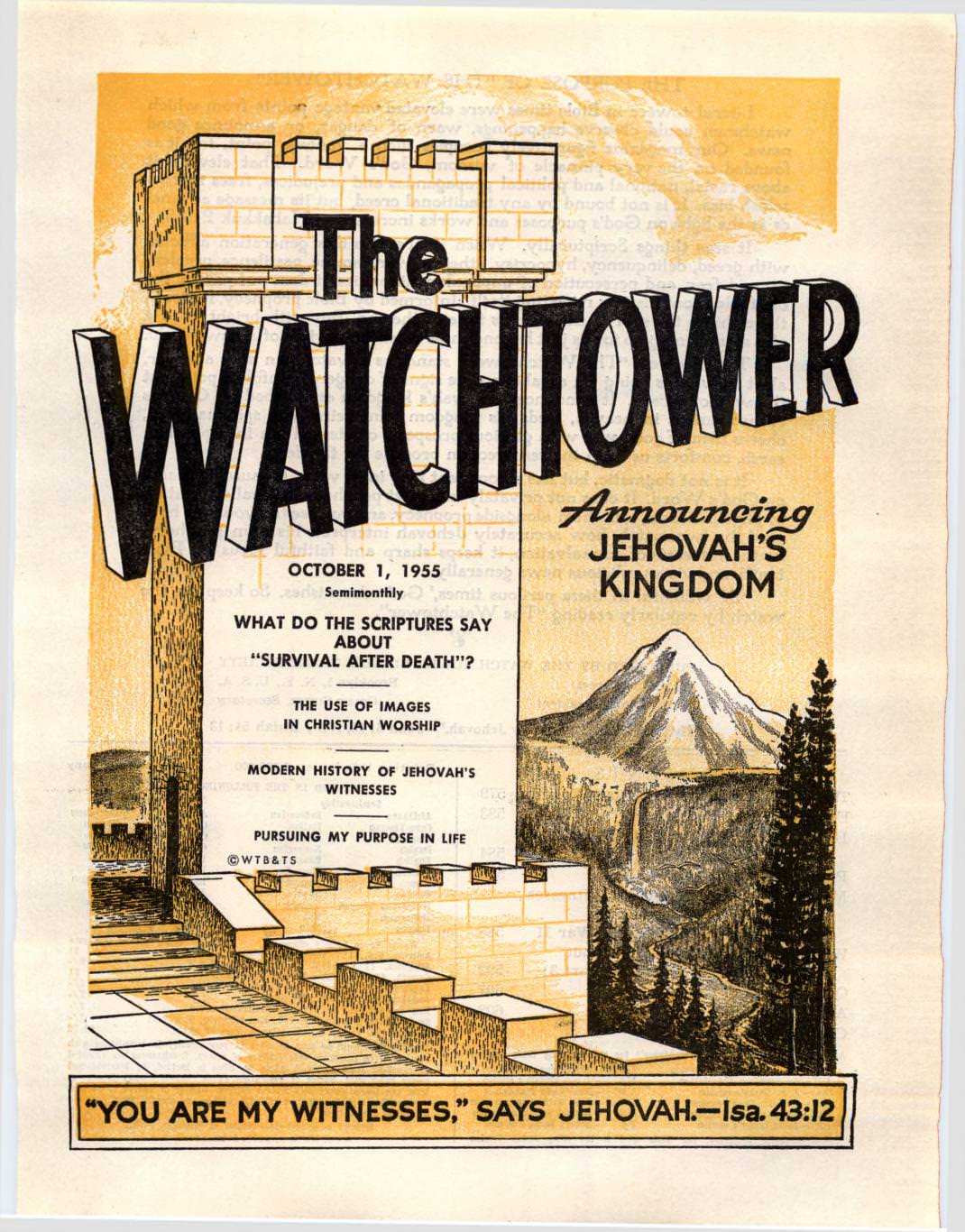
WATCHTOWER
OCTOBER 1,1955 Semimonthly
WHAT DO THE SCRIPTURES SAY ABOUT "SURVIVAL AFTER DEATH"?
THE USE OF IMAGES IN CHRISTIAN WORSHIP
MODERN HISTORY OF JEHOVAH'S WITNESSES
Announcing JEHOVAH'S KINGDOM
PURSUING MY PURPOSE IN LIFE
©WTB&TS
"YOU ARE MY WITNESSES," SAYS JEHOVAH.—Isa. 43:12 THE PURPOSE OF "THE WATCHTOWER"
Literal towers in Bible times were elevated vantage points from which watchmen could observe happenings, warn of danger, or announce good news. Our magazine figuratively occupies such a vantage point, for it is founded on the very pinnacle of wisdom, God's Word. That elevates it above racial, national and political propagandas and prejudices, frees it from selfish bias. It is not bound by any traditional creed, but its message advances as the light on God's purposes and works increases.—Habakkuk 2:1-3.
It sees things Scripturally. When it observes this generation afflicted with greed, delinquency, hypocrisy, atheism, war, famine, pestilence, perplexity and fear, and persecution of unpopular minorities, it does not parrot the old fable about history repeating itself. Informed by Bible prophecy, it sees in these things the sign of the world's time of the end. But with bright hope it also sees opening up for us just beyond these woes the portals of a new world.
Thus viewed, "The Watchtower" stands as a watchman atop a tower, alert to what is going on, awake to note signs of danger, faithful to point out the way of escape. It announces Jehovah's kingdom established by Christ's enthronement in heaven, feeds his kingdom joint-heirs with spiritual food, cheers men of good will with glorious prospects of eternal life in a paradise earth, comforts us with the resurrection promise for the dead.
It is not dogmatic, but has a confident ring in its voice, because it is based on God's Word. It does not privately interpret prophecy, but calls attention to physical facts, sets them alongside prophecy, and you see for yourself how well the two match, how accurately Jehovah interprets his own prophecy. In the interests of our salvation, it keeps sharp and faithful focus on Bible truth, and views religious news generally.
'Be watchful in these perilous times,' God admonishes. So keep on the watch by regularly reading "The Watchtower".
PUBLISHED BY THE WATCH TOWER BIBLE & TRACT SOCIETY
117 Adams Street
Brooklyn 1, N. Y., U. S. A.
N. H. KNORR, President
GRANT SUITER, Secretary
"They will all be taught by Jehovah."—John 6:45, NW; Isaiah 54:13
CONTENTS
The Use of Images in Christian Worship 579
Exploitation of Hypnotism 583
Holding Fast the Public Declaration
of Our Hope 584
Pursuing My Purpose in Life 585
Modern History of Jehovah's Witnesses
Part 19: Christian Neutrals
in America During World War II 588
What Do the Scriptures Say About
"Survival After Death"? (Part 3) 592
Questions from Readers 607
Announcements 608
Check Your Memory 608
<tr><th>Abbreviations used in "The Watchtower" for the following Bible versions
Bible version
Bible version
AS - American Standard Version
LXX - The Septuagint Version
AT - An American Translation
Mo - James Moffatt's version
Da - J. N. Darby's version
NW - New World Translation
Dy - Catholic Douay version
Ro - J. B. Rotherham's version
ED - The Emphatic Diaglott
RS - Revised Standard Version
Le - Isaac Leeser's version
Yg - Robert Young's version
Five cents a copy
Semimonthly
Monthly
Afrikaans
Indonesian
Arabic
Portuguese
Cebu-Visayan
Italian
Cibemba
Russian
Cinyanja
Japanese
Cishona
Sesotho
Danish
Norwegian
Greek
Siamese
English
Pangasinan
Ibo
Silozi
Finnish
Slovenian
Kanarese
Slovak
French
Spanish
Korean
Ukrainian
German
Swedish
Malayalam
Urdu
Hiligaynon-Visayan
Tagalog
Polish
Yoruba
Hollandish
Twi
Ilocano
Zulu
Watch Tower Society offices Yearly subscription rate
America, U.S., 117 Adams St., Brooklyn 1, N.Y. $1
Australia, 11 Boresford Rd., Strathfield, N.S.W. 8/-
Canada, 40 Irwin Ave., Toronto 5, Ontario $1
England, 34 Craven Terrace, London, W. 2 7/-
Jamalca, 151 King St., Kingston 7/-
New Zealand, G.P.O. Box 30, Wellington, C. 1 7/-
South Africa, Private Bag, P.O. Elandsfontein, Transvaal 7/-
Trinidad, 21 Taylor St., Woodbrook, Port of Spain $1.72
Remittances should be sent to office in your country in compliance with regulations to guarantee safe delivery of money. Remittances are accepted at Brooklyn from countries where no office is located, by international money order only. Notice of expiration (with renewal blank) is sent at least two issues before subscription expires. Change of address when sent to our office may be expected effective within one month. Send your old as well as new address.
Entered as second-class matter at Brooklyn, N. Y., Act of March 3, 1879. Printed in U. S. A.
THE USE OF IMAGES IN CHRISTIAN WORSHIP
What arguments now used by professing Christians to defend image worship were rejected by Christians of the first three centuries? Why is it abominable to bow down, burn incense and otherwise worship before an image?
THE devotees of Hinduism, particularly among the lower castes, treat their images as if they were living creatures "with all of the needs, weaknesses and passions common to humans. The worshipers give food to the images, bathe them, put dresses, jewelry and wreaths of flowers on them, tuck them in bed at night. In at least one temple the goddess is even brought into the god's bedroom at dusk to spend the night with him. In another temple the image catches a cold when he is bathed and then has to convalesce for several weeks." In a very similar manner the unlearned Roman Catholic people of Mexico, Central America and South America daily dress and bathe, place food and drink offerings before images of the "virgin" and the "saints." Before these images they bow, pray, burn incense and confess sins.
The Roman Catholic Church, of course, denies the charge of worshiping images,
or idolatry. SchaffHerzog's Encyclopedia of Religious Knowledge states: "The Roman Catholic Church has a peculiar talent for denying in principle what she admits in practice. She does not forbid people to read the Bible, but
she prevents them from doing it. She does not deny that it is the merit of Christ which makes man's works meritorious, but she inculcates that it is his own works which save a man. She does not teach image-worship, but she allows it." The Catholic Church, in neither openly admitting nor officially condemning this open idolatry, leaves an opening for all possible degrees of idolatry in her own ranks. She carefully refrains from doctrinal definitions on the subject as would fully convict her of idolatry. She studiously draws a distinction between the adoration and the worship of "saints," but the distinction is so fine that neither the Catholic masses nor their clergy understand or observe it.
Catholic theologians divide worship into three grades: "Latria being the name of the highest sort; that which is something less is styled hyperdulia, while the lowest order of all is called dulia."
They instruct that latria worship belongs to God, but dulia worship can be given to images. But these theologians give no Scriptural support for such distinction. Such degrees of worship rest strictly within the imaginations of men and have no authority whatsoever from the Word of God.
To prove this point, at Matthew 6:24 (NW) Jesus declares: "No one can be a slave to two masters." Here, in the original Greek the word translated "slave" is the very same from which the Catholic Church draws her "dulia," her inferior worship. But Christ plainly states that no one can be a slave to two masters; that this "dulia" worship is the exclusive right of God. And at 1 Thessalonians 1:9 (NW): "How you turned to God from your idols to be slaves to a living and true God." Here again in the original Greek the word "slaves" is but the translation of that word in which the Roman Catholic Church finds her inferior worship "dulia." But Paul unmistakably shows that this worship, service as slaves, was not to idols, but "to a living and true God." Through his prophet Isaiah, Jehovah says: "I am Jehovah, that is my name; and my glory will I not give to another, neither my praise unto graven images." These scriptures prove beyond all controversy that those who give the worship of "dulia" to pictures and images, and not to Jehovah God, are guilty of idolatry.—Isa. 42:8, AS.
But Catholics will say: "We do not worship the image, but the one whom the image represents." They claim that such worship is relative, different from the worship directed to God. Let it be noted, however, that God commanded the Israelites not only not to serve or worship any images but also not to make any for the purpose of worship nor to bow down to
them: "You must not make worthless gods for yourselves, and you must not set up a carved image or a sacred pillar for yourselves, and you must not put a stone as a showpiece in your land in order to bow down toward it, for I am Jehovah your God." God's form is not known to men, so there is no need to try to represent it. And it befouls the dignity of the great Creator to liken him to earthly creation. —Lev. 26:1, NW.
Note how emphatically Moses pressed this point home to the Israelites: "And you must take good care of your souls, because you did not see any form on the day of Jehovah's speaking to you in Horeb out of the middle of the fire, that you may not act ruinously and do not make for yourselves a carved image, the form of any symbol, the representation of male or female, the representation of any beast that is in the earth, the representation of any winged bird that flies in the heavens, the representation of anything creeping on the ground, the representation of any fish that is in the waters under the earth; and that you may not raise your eyes to the heavens and indeed see the sun and the moon and the stars, all the army of the heavens, and certainly get seduced and bow down to them and serve them, which Jehovah your God has apportioned to all the peoples under the whole heavens. . . Watch out for yourselves that you may not forget the covenant of Jehovah your God that he concluded with you and that you do not make for yourselves a carved image, the form of anything about which Jehovah your God has commanded you. For Jehovah your God is a consuming fire, a God exacting exclusive devotion."—Deut. 4:15-24, NW.
As for the claim made that only "relative" worship is given to the image, it is not true. Du Bois, one of the early Roman Catholic missionaries in India, declared: "The common people indubitably worship the image itself."
Thomas Aquinas, one of the very first authorities in the church of Rome, taught that an image may receive the same worship as what is represented by it; Christ's image may receive the same worship as Christ himself. According to Robert Bellarmine, another high dignitary of the church, the "images of Christ and the saints are to be adored not only in a figurative manner, but quite positively, so that the prayers are directly addressed to them, and not merely as the representatives of the original." Bonaventura affirms that "since all veneration shown to the image of Christ is shown to Christ himself, then the image of Christ is also entitled to be prayed to."
So, more than relative worship is accorded images. This is proved by the way devotees treat them. The newspaper L'Europeo of April 5,1947,showed pictures of devout Roman Catholics in Naples crawling prostrate on their stomachs before the images of Madonnas and licking the ground with their tongues on their way to the statues.In May,1952,the image of the "Virgin of Charity" was paraded through Havana and thousands of persons thought themselves blessed if they even caught a glimpse of the fifteen-inch image.In the several villages of Navarre prayers for rain were offered to St.Peter,and by way
of enforcing them the villagers carried the image of the "saint" in procession to the river, where they would three times demand the image to reconsider their prayers; then, if a downpour did not occur, they would toss the "saint" into the water for refusing to heed their demands.
A special dispatch to the Providence Sunday Journal, December 24,1950,told of angry villagers of Mascali abandoning the statue of
their patron saint, St. Leonard, to burn in the onrushing lava, because it had failed to stop the flow of the volcano. The Catholic Herald, London, December 19, 1950, published a picture showing the inhabitants of Milo carrying a statue of "Our Lady" right to the edge of the advancing avalanche of lava during a recent eruption of Mt. Etna. Similarly, in 1944 Italian peasants placed their images in the path of the flowing lava from Mount Vesuvius in a vain attempt to stop it. These are only a few of many instances showing that worshipers regard these images as more than representations and that considerably more than relative honor is accorded to them.
LAW AS SAFEGUARD
To safeguard the Israelites from such idolatry, Almighty God gave them the Decalogue, or Ten Commandments. And the first two of the Ten Commandments warn against foreign gods and idolatry: "You must never have any other gods against my face. You must not make for yourself a carved image or a form like anything that is in the heavens above or that is on the earth underneath or that is in the waters under the earth. You must not bow down to them nor be induced to serve them, because I Jehovah your God
am a God exacting exclusive devotion."—Ex. 20:2-5, NW.
Catholic theologians are so well convinced that the second commandment condemns image worship that they resort to dishonesty when they list the Ten Commandments in many of their catechisms. "I defy any man," says Dr. Berg, "to show me the second commandment in any one of the manuals of the Romish Church, before the Reformation."
If you have the revised edition of the Baltimore Catechism, look for the second commandment. You will note that it says: "The second commandment of God is: Thou shalt not take the name of the Lord thy God in vain." This is not true. That is the third commandment. The second they do not show, because it states the prohibition against image worship. It is dishonest to leave out the second and split the tenth under the pretense of teaching the complete law of God. The very underhanded method in which this is done is in itself evidence of the unscripturalness of this practice.
Dr. Dens, a Roman Catholic scholar, in his Theology, endeavors to justify the use of images by stating that the second commandment did not forbid the making of images, because "likenesses and images of cherubim were made by Moses at the command of God; also, by the command of God Moses erected a brazen serpent." Why, then, do Catholic authorities fear revealing the truth regarding the second commandment? Dr. Dens himself fails to tell all, as he should have told in all honesty, that these cherubim that Moses made at God's command were never seen by the people, save by the high priest once a year; that no man ever bowed, burned incense or worshiped before them. Dr. Dens does not add that when the people fell to worshiping the brazen serpent the faithful king Hezekiah broke the image in pieces, that he ordered the absolute destruction of all the other images in the land of Israel. And for this he received favorable mention by God. —Num. 4:5; 2 Ki. 18:4.
When the Israelites worshiped the golden calf at Sinai, they did so only as "a help to devotion," "relatively," so to speak. For Aaron said: "There is a festival to Jehovah tomorrow." Nevertheless, God was angry with them and punished them
severely for their idolatry. Time and again Israel fell away to idol worship, these pagan "helps to devotion," and just as often God punished them for it. For setting up calf worship in Israel, Jeroboam received the infamous title of one "who made Israel to sin." Yet, the Israelites sacrificed nominally to Jehovah just as they did in Jerusalem, but they bowed before the calves and kissed them. The bowing to and kissing of molten images as "relative" worship was abominable in the sight of God. Ex. 32:5, NW.
Today, images and statues are kissed to an extent that Jeroboam's calves never enjoyed. The great toe of the brass statue of Peter in the church of Rome is virtually worn away by this process. The worshiper first bows before the statue until his forehead touches the toe, then kisses it, then bows again. Are such worshipers lifting their hearts to God? Lactantius' answer was: "You worship them; for, if you believe them to be in heaven, why do you not raise your eyes up to heaven? Why do you look at the wood and stone, and not up, where you believe the originals to be?" The distinguishing mark of faithfulness in Elijah's day was that men did not bow the knee to Baal or kiss his image. The distinguishing mark of faithful men from Adam's day to ours is that they did not worship any other God than Jehovah, nor did they bow to graven images.—1 Ki. 19:18.
With the coming of Jesus Christ and the new system of things, the prohibition against image worship has not changed. Paul admonished Christians to "flee from idolatry." John appealed: "Little children, guard yourselves from idols." The Encyclopedia Britannica, Vol. XII, page 750 (1907 edition), declares: "The early Christians were absolutely unanimous in utterly condemning all heathen image-worship and the various customs, many of them obviously immoral, with which it was associated; it is needless to multiply citations from the fathers in proof of so undisputed a fact."
"In point of fact it was a common accusation brought against Christians by their enemies that they had 'no altars, no temples, no known images'; and that 'they set up no image or form of any god,' and this charge was never denied."—1 Cor. 10:14; 8:4-6; 1 John 5:21, NW.
Why should anyone kneel before an image of Christ Jesus or any saint, when he can bow the knee directly to God? God is looking for those who would, to worship him "with spirit and truth." When John fell down before an angel, he was told not to do that—"Worship God." When the devout Cornelius did obeisance to Peter, Peter lifted him up, saying: "Rise; I myself am also a man." The true worshiper bows worshipfully to God alone. To him he directs his prayers through Jesus Christ.
Image making and image worship are antiGod. "Cursed is the man who makes a carved image or a molten statue, a thing detestable to Jehovah." "What profiteth the graven image, that the maker thereof hath graven it; the molten image, even the teacher of lies, that he that fashioneth its form trusteth therein, to make dumb idols? Woe unto him that saith to the wood, Awake; to the dumb stone, Arise! Shall this teach? Behold, it is overlaid with gold and silver, and there is no breath at all in the midst of it. But Jehovah is in his holy temple: let all the earth keep silence before him." That fact alone, the fact that God is in his holy temple, should cause men to awake to their responsibility before him, put away their graven images and worship him, the only true and living God. He will not tolerate his praise to go to images.—Rev. 19:10; Acts 10:24-26; Deut. 27:15, NW; Hab. 2:18-20, AS.
Exploitation of Hypnotism
MANY who dabble in hypnotism consider it a harmless toy. And there are a number among those who take hypnotism seriously, teaching or using it in their profession, that insist that hypnotism cannot be used for criminal purposes. However, in one of the latest works on the subject the author, A. Salter, states: "I find myself in agreement with Rowland, Wells, and Brennan that appropriate procedures, which need not necessarily be subtle, can make hypnotized persons perform antisocial acts, even to the extent of criminally harming themselves or others." What Is Hypnosis?
Pertinent in this connection is the item that appeared in the New York Daily News, June 5,1955, headed "Grand Jury to Probe Hypnotic Rape Rap." It told how "Jesse Overton, Jr., 25, a scholarly-looking TV repairman was held for grand jury action today, charged with having used occult powers to hypnotize and rape the pregnant 17-year-old wife of a friend. Bail was set at $300. The
alleged victim, mother of a 4-month-old baby, told police she remembered nothing of the purported rape until the day after it happened. She recalled the incident, she said, only after her husband, who had learned how from Overton, hypnotized her and broke her 'mental block.'" Overton admitted to the police having had relations but claimed that it was not the first intimacy. The girl denied this.
Truly hypnotism does represent a menace when it can be used by a man to ravish a woman and she never know about it, and it is a twofold snare in that it places an innocent person in a position to be thus harmed and it places the temptation in the path of the one possessing such power. Fitting here are the words of the disciple James: "This is not the wisdom that comes down from above, but is the earthly, animal, demonic. But the wisdom from above is first of all chaste, then peaceable, reasonable, ready to obey, full of mercy and good fruits, not making partial distinctions, not hypocritical." Jas. 3:15, 17, NW. Holding Fast the Public Declaration of Our Hope
DO WE keenly appreciate our hope of everlasting life in God's righteous new world? If so, then we shall make that hope known to others. We shall do so not only for the benefit of men of good will looking for God but also for the benefit of our brothers in the Christian congregation.
Referring to this matter of making expression of our hope to our fellow Christians Paul wrote: "Let us hold fast the public declaration of our hope without wavering, for he is faithful that promised. And let us consider one another to incite to love and right works, not forsaking the gathering of ourselves together, as some have the custom, but encouraging one another, and all the more so as you behold the day drawing near." Certainly in view of the day in which we are living this counsel was never more fitting.—Heb. 10:23-25, NW.*
To the extent that we appreciate the needs of our brothers as well as our own, to that extent we shall be eager to make public declaration of our hope. Note how Paul makes this point in his letter to the Christians at Rome: "For I am longing to see you, that I may impart some spiritual gift to you in order for you to be made firm; or, rather, that there may be an interchange of encouragement among you, by each one through the other's faith, both yours and mine."—Rom. 1:11, 12, NW.
Love for Jehovah and our brothers will help us to hold fast to the public declaration of our hope by overcoming the timidity that makes us tongue-tied. Are you a mature minister? Do you have an accurate knowledge and a good understanding of Jehovah's purposes? Then think of the help you can give to others by making public declaration. Are you inexperienced and a rather new member of the New World society? Then think of the joy others receive as they note your progress, particularly such as may have had a part in your theocratic training.
By such efforts you cause your advancement to "be manifest to all persons." Not that we want to show off or show ourselves to be better than others; not at all, for there is no room for the spirit of competition among Jehovah's servants. But rather that thereby we show we have made advancement, that we are better than we previously were.—1 Tim. 4:15, NW.
What if we do happen to express an erroneous thought? By having that fact brought to our attention we shall be set straight and so be benefited. We may feel a little embarrassment at the time, but is it not better for us to get straightened out at the cost of a little wounded pride, perhaps, than to go on preaching error to others in the field? Besides, it is likely that others had the same mistaken idea, and so by our being corrected they also were helped.
And finally, as Jehovah's dedicated watchmen, we are sent by him to warn men of good will to flee to God's kingdom and to warn the wicked of their impending doom. To carry out that commission properly we must be at unity in understanding, work and worship, even as Isaiah foretold: "Thy watchmen! they lift up the voice, together do they sing; for they shall see eye to eye, when Jehovah returneth to Zion." And the only way we can achieve that unity is by heeding the commands given at Hebrews 10:23-25, and particularly the one of making "public declaration of our hope."—Isa. 52:8, AS.
As told by Robert W. Kirk
BACK in the fall of 1938, while working in a factory, to a friend I said: "Don't you ever go to church?" He, being in the truth, gave me a short witness, inviting me to his home. There I first learned the truth. My mother also accepted the truth, and about three years later we gave up our lovely apartment and sold the furniture so I could become a pioneer. After we bought a house trailer I joined the pioneer ranks. How happy I was to be a pioneer! To my friends I used to proudly announce: "I'm a pioneer now!" Soon I resolved that I would put forth every endeavor to remain a pioneer, because, even though I had given up a good job and steady income, it was worth it! Now I really had begun to pursue my purpose in living. My joy at being able to serve Jehovah full time was wonderful!
In 1944, at a convention in Pittsburgh, I heard it announced that anyone having certain qualifications and wishing to go to Gilead School should see Brother Knorr. Then I filled in the preliminary application. Imagine my surprise when I received a complete application form and later an invitation for the next class! The invitation said that I may not return home; so I sold my car and other things that I thought would be unsuitable to take to a foreign country. Admittedly this was not easy, parting with many things that I had
prized; and also realizing that shortly I would have to leave behind, too, family and friends. But Matthew 19:29 came to my mind. It helped me make the right decision: "And every one that hath forsaken houses, or brethren, or sisters, or father, or mother, or wife, or children, or lands, for my name's sake, shall receive an hundredfold, and shall inherit everlasting life."
Much can be said about Gilead life: The wonderful fellowship, not only among fellow students, but also with the instructors and other brothers on Kingdom Farm; above all, the privilege of taking in daily and being instructed in the "strong meat" of God's Word for several months! They changed me quite a bit, knocked off some rough edges, and polished me up, thus making me fit for missionary service.
After graduating in July, 1945, I was sent to southern Illinois as a "servant to the brethren," to serve both white and colored congregations. This branch of the work also was very joyful and stimulating. However, it was not all easygoing. It was difficult witnessing there, as a result of persecution and mob action that had begun some years before. Once while I alone was doing street work in a small town an elderly man said to me: "I'm coming back in ten minutes and if you are still here, you'll wish you weren't." I stood my ground. He came back as promised, accompanied by a big man who looked as if he was cut out to be a boxer. They grabbed me and marched me around to the police station. In a short time a mob formed and it seemed everyone was crying for blood. The police saw there was trouble ahead; so they took me inside the station and out the back door. As I drove away the mob followed me and escorted me right out of town. I went to the next town and went from house to house for an hour, placing twelve bound books. Never before had I done so well in so short a time. Again, near Lawrenceville, Illinois, a clergyman and the chief of police formed a mob of children to stone a group of us who were working from house to house.
After such experiences you feel much stronger inside, much more sure that this is the truth.
At East St. Louis, Illinois, in 1946, while serving the colored congregation, I received a letter from Brooklyn asking if I would accept an assignment in Burma. Burma? Several questions ran through my mind: Where exactly is Burma? What are the people like? Are there any publishers there? And other questions. Of course, I knew I would accept the assignment no matter what the answers were to these questions. I was sent to Brooklyn Bethel for two months' further training; then ten days at home. I boarded the train in Cleveland in December (1946) and, after a few days, continued westward from San Francisco. As I saw America's shore grow dimer and dimmer, mixed emotions were mine. Naturally there was a feeling of sadness, but at the same time I was happy that at last I was on my way to the Far East where missionaries were so badly needed, there being not yet one Gileadite in that part of the world.
On the ship there were not many listening ears, as it happened to be loaded with false shepherds--about 800 of them--belonging to many different religious organizations, all headed for various parts of the Orient. So I had plenty of time to think. Recalling some things I had heard about Burma, I tried then, on the vast Pacific, to get used to the idea of living in a hut, sitting on a mat and having to use sign language till I could pick up Burmese. But I was in for a surprise. I was soon to realize that in Burma the modern goes side by side with the primitive; also, that in Burma there are not only Burmese but a variety of people of all colors and languages with different standards of living,
culture, religion and habits, especially in the larger towns. I was met by publishers dressed in Western clothes, speaking English fluently. I was driven in a jeep over paved streets, not to a hut as I had expected, but to a large wooden house that was to be my future home. The brothers (then only eighteen of them in the whole country) gave me a warm welcome and I was happy to be with them.
However, although things were much more advanced than I had expected, they still were very far behind what I had left in the United States of America. Burma had been hard hit by the second world war. There was only a small supply of electricity, government concerns having priority. Few homes had electric light. At night most streets were dark. Thieves abounded; it was unsafe to be out after darkness began. Transportation was limited to a few old army trucks converted into buses. A rickety old bus was used by us for the ride out to Kingdom Hall. The oil lamps of the bus we then took out and pumped up to get ready for the meeting. Today, 1955, things are, of course, much better than in those early years after the Japanese pulled out of Burma.
As the country's only pioneer, every morning I went out alone in service, except on week ends when the congregation publishers joined me. Sometimes I momentarily thought how pleasant it would be to go home again, but instantly the amount of work to be done and the joys of service chased away such thoughts as I newly faced forward to continue pursuing my purpose in life. Three cartons of literature I had brought from the United States, as the brothers in Burma had not yet received the latest publications. In three weeks my literature was gone. The people were very friendly, inviting me in at almost every home, many offering tea and other refreshment. At quite a few homes I could use English, but was amazed at the variety of people one met when going from door to door.
Apart from the Burmese and other indigenous peoples of Burma, like the Karens, there were so many foreigners Chinese, Tamilians, Telegus, Bengalis, and many, many other Indian races. A few sentences in Burmese I learned for use at homes of the non-English speaking. Most of those I visited were Buddhists, Hindus, etc., who did not even believe in the Bible; so in many homes proving the Bible true had to be my first step.
It was some time before I really began to settle down. Many strange sights and customs I had to get used to—including such normal (for Burma) human practices as people bathing at a water tap at the roadside; others openly changing their sarongs, right out in broad daylight, or squatting on their haunches at the bus station while waiting for the bus to come; the big water buffalo and oxen pulling huge logs. Also, at first I wondered what those red marks were along all the streets and sidewalks. They looked like blood, and I just could not figure it out. Later I learned that this was caused by a red fluid the people spit out as they chew beetle and nut. Even now, after eight years, I am continually amused as I see persons carrying things on their heads, such as a bunch of bananas or an umbrella.
But as I steadfastly pursued my purpose in life, the satisfaction derived from helping new ones in service and watching a congregation grow more than makes up for any newnesses or inconveniences that a 'new boy' has to put up with even in Burma. The love one feels for the "other sheep" and the knowledge that they need your help to grow to maturity definitely help you toward settling down sooner than anything else. In 1948, for example, a letter came to us from a group of people in a village 125 miles away. For eight years
they had been trying to contact Jehovah's people. One of them, having obtained a bound book, became convinced he had found the truth. He witnessed to others in the village. Several left the Catholic church, formed a little congregation on their own and were meeting regularly for Bible study. To that distant village a brother and I went and there found twelve publishers waiting to be baptized and organized theocratically. They were surprised and glad to learn of the vastness of Jehovah's organization and of such places as Bethel and Gilead. Meeting them and helping them out in field service was a wonderful experience.
A Tamil man, with whom I began a study a few years ago, also was formerly a Catholic. He had left that church, even before he contacted Jehovah's people, merely by reading through a copy of the Greek Scriptures in his own language. Hungry for the truth, he eagerly absorbed everything that was explained to him at the studies. Although he has a large family to take care of, he is now one of our most zealous publishers, putting in forty to sixty hours a month and conducting about seven Bible studies. What a joy it has been to see him progress in the truth!
The New World Society Assembly at Yankee Stadium I was privileged to attend in 1953, and then to visit my home. Even though that convention was such a wonderful one, and it was so good again to see the folks at home, I can assure you that my thoughts were here in Burma with this small group of publishers that I have learned to love so much. After a few days in America I was ready, in fact, longing, to get back to my assignment. I feel there is so much work here to do and so few workers to do it.
While all missionaries here are loaded down with responsibilities, we do take time occasionally to sit down and review some of our past experiences.
It gives one a wonderful sense of proportion to compare his life before becoming a missionary and after becoming one. There are only four of us here, but all agree that we would not want to return home permanently. Speaking for myself, I can say that leaving what I called home and going into a foreign assignment about which I knew very little has given me much greater strength in Jehovah. The work has been more satisfying. I have been able to give much more than I would have been able to give in my home territory. Now when I see a Burmese publisher stand at a door giving a three- to eight-minute sermon with the Bible in his hand—a person who only a short time ago was attending a church—it makes me appreciate the undeserved kindness of Jehovah and the privilege I have of sharing in His work here in Burma. I consider it a favor from Jehovah to be here! I am happy to be here, happy to be now on active duty here as branch servant. Yes, while pursuing my purpose in life the hardships are greater, there are many more obstacles, but, when these are overcome, they definitely add to spiritual strength, for Jehovah's use and honor.
MODERN HISTORY of Jehovah's Witnesses
Part 19 CHRISTIAN NEUTRALS IN AMERICA DURING WORLD WAR II
WHILE the interesting things already related were happening to Jehovah's witnesses in other parts of the earth during World War II, what happened to the witnesses in the United States during this period? They too conducted themselves as neutrals amidst a sea of mankind that had become hysterical during days of war. This meant that the American witnesses withstood one of the hottest periods of persecution of Christians in the annals of modern history. From 1933, when figures of arrests began to be kept by the Watch Tower Society, up to 1951 where the aftermath of persecution due to military service requirements still continued, there is record of 18,886 individual arrests.a This is
an almost unbelievable figure for a country claiming to be democratic and a champion of freedom.
Additionally at least 1,500 mobbings occurred, involving the witnesses from one end of the United States to the other. As previously pointed out, on June 3, 1940, the Supreme Court of the United States ruled against the Society in the Gobitis flagsalute case. This touched off a terrific public reaction against the witnesses. It took great Christian fortitude and faith on the part of all of Jehovah's people, male and female, children and grown-ups, to endure this period of trial and at the same time to continue their public preaching from house to house and on the streets. Sheer faith in Jehovah defeated persecution in the long run, even as it had done in Germany and other countries.
Three years later (1943), when the flagsalute case was brought before the United States Supreme Court for the second time, the following official description of the public's reaction to the court's 1940 decision was set out in the Society's brief given to each of the nine high justices.
"Immediately following delivery of the Gobitis [adverse] opinion on June 3, 1940, a nation-wide campaign of newspaper publicity and idle gossip was launched by enemies of Jehovah's witnesses, falsely accusing them of being 'against the flag and government,' solely because they refuse to salute any flag, including the American flag, for conscience' sake. That opinion was like a lighted match applied to a field of dried grass. Prejudice created by unfavorable newspaper publicity flamed into open violence. Widespread mob attacks resulted immediately against Jehovah's witnesses. For more than two years, in thousands of communities throughout this land, certain religious elements or 'would-be' patriotic elements have led men controlled neither by law nor reason to assault thousands of Jehovah's witnesses, men, women and children; destroyed their property; drove them from their homes; burned their houses, places of worship, furniture, books and money; tied groups of them together and forced castor oil in large quantity down their throats; herded them like beasts along hot, dusty roads and railroad rights-of-way in many places; dragged them along the main streets of the city by a rope around their necks and strung up; and committed numerous other deeds of violence and wickedness against them without a cause, and continue so to do to this day without interference from the law. Public
officials, influenced by wellknown religionists, broke into homes of private citizens, Jehovah's witnesses, kidnaped and carried them from one state to another, and broke up their private Bible-study assemblies. Thousands of children have been expelled from school and great numbers prosecuted as delinquents, many convicted
and ordered to be taken from parents. Hundreds of parents have been threatened with prosecution for the alleged crime of contributing to delinquency and truancy of their children and many convicted—all because they have taught them the Bible and the children have humbly obeyed God's commands." b
On June 16,1940,the United States solicitor general, Francis Biddle, in a radio broadcast over a coast-to-coast network made the following statement in an effort to quiet the spirit of mob violence then rampant.
"... Jehovah's witnesses have been repeatedly set upon and beaten. They had committed no crime; but the mob adjudged they had, and meted out mob punishment. The Attorney General has ordered an immediate investigation of these outrages. The people must be alert and watchful, and above all cool and sane. Since mob violence will make the government's task infinitely more difficult, it will not be tolerated. We shall not defeat the Nazi evil by emulating its methods."c
Note the following nontheocratic report of this period of wartime persecution.
"Not since the persecution of the Mormons years ago has any religious minority been so bitterly and generally attacked as the members of Jehovah's Witnesses—particularly in the spring and summer of 1940. While this was the peak of the attacks upon them, hostility and discrimination have been rife for several years. Documents filed with the Department of Justice by attorneys for Jehovah's Witnesses and the American Civil Liberties Union showed over three hundred thirty-five instances of mob violence in forty-four states during 1940, involving one thousand four hundred eighty-eight men, women, and children. The cause of this extraordinary outbreak was the 'patriotic' fear aroused
by the success of the Nazi armies in Europe and the panic which seized the country at the imagined invasion of the United States. From California to Maine this emotion expressed itself in searching out 'Fifth Columnists' and 'Trojan Horses'—phrases which sprang into almost immediate popularity to characterize those thought to be opposed to national defense.
Jehovah's Witnesses were the object of immediate and widespread attack, chiefly because of their position, on flag saluting, well advertised by their widespread distribution of the May 29,1940, issue of the magazine Consolation giving details of the hearing before the U.S. Supreme Court of the Gobitis flag salute case. Following the decision of June 3, 1940, in which school boards were upheld in their right to expel children of this sect who refused to salute the flag, this propaganda was taken by some as seditious."d
For relief, for refuge, the doors of the United States Supreme Court were clamored at. Finally the unusual happened. The Supreme Court reversed itself on June 14, 1943, in the case of West Virginia State Board of Education v. Barnette, holding that Jehovah's witnesses need not salute the flag. From the court's historic opinion we quote:
"To sustain the compulsory flag salute we are required to say that a Bill of Rights which guards the individual's right to speak his own mind, left it open to public authorities to compel him to utter what is not in his mind. . . If there is any fixed star in our constitutional constellation, it is that no official, high or petty, can prescribe what shall be orthodox in politics, nationalism, religion, or other matters of opinion or force citizens to confess by word or act their faith therein. . . We think the action of the local authorities in compelling the flag salute and pledge transcends constitutional limitations on their power and invades the sphere of intellect and spirit which it is the purpose of the First Amendment to our Constitution to reserve from all official control. The decision of this Court in Minersville School District v. Gobitis [is] overruled."e
What rejoicing this victory brought to Jehovah's people! Now their children could return to public schools for their education and no longer would it be necessary to operate the temporary Kingdom Schools.
For the first time in eight long years could the children of the witnesses take their rightful places in the schoolrooms of the nation. This without their being required to make what to them is an idolatrous salute.
Sedition was another false charge. In Mississippi, in June, 1942, R.E.Taylor and two others of Jehovah's witnesses were arrested and falsely indicted for encouraging disloyalty to the government of the United States and that of the state of Mississippi, and for orally disseminating teachings and distributing literature calculated to encourage disloyalty to the government of the United States. These were convicted for sedition and each sentenced to imprisonment for the duration of the war but not to exceed ten years. This raised the serious stigma of sedition. One year later this came to the Supreme Court of the United States, where the Court held on June 14, 1943, in another "Flag Day" decision, 9 to 0, in favor of the witnesses' not being seditious. In its opinion the Court said:
"The statute as construed in these cases makes it a criminal offense to communicate to others views and opinions respecting governmental policies, and prophecies concerning the future of our own and other nations. As applied to the appellants it punishes them although what they communicated is not claimed or shown to have been done with an evil or sinister purpose, to have advocated or incited subversive action against the nation or state, or to have threatened any clear and present danger to our institutions or our government. What these appellants communicated were their beliefs and opinions concerning domestic measures and trends in national and world affairs. Under our decisions criminal sanctions cannot be imposed for such communications."
Here was another victory, a unanimous decision, that the witnesses could not, by any stretch of the imagination, be branded and legally punished by their religious opposers as being subversive. This favorable decision was a large contribution toward raising the bulwark of defense as to freedom of worship and freedom of speech, and that in the midst of global war.
After many battles in the lower courts, where license-tax laws designed for peddlers were made to apply to ministers of religion (that is, Jehovah's witnesses in the distribution of their literature), the United States Supreme Court on June 8, 1942, had ruled against the Society in Jones v. City of Opelika (Alabama). This opinion was aimed for dealing a body blow against the house-to-house work of the witnesses. It was, in fact, an outright suppression of freedom of worship, speech and press—in total disregard of guarantees in the federal Constitution. Undisturbed, the witnesses kept on with their preaching work, refusing to apply for licenses. There was thus forced an issue from a slightly different angle, to be brought again before the United States Supreme Court. This came in the case of Murdock v. Pennsylvania, where the high court remarkably reversed itself in favor of the witnesses on May 3, 1943. Note the following classical legal principles announced that day in the court's opinion.
"The hand distribution of religious tracts is an age-old form of missionary evangelism-as old as the history of printing presses. . . It is more than preaching; it is more than distribution of religious literature. It is a combination of both. Its purpose is as evangelical as the revival meeting. This form of religious activity occupies the same high estate under the First Amendment as do worship in the churches and preaching from the pulpits. It has the same claim to protection as the more orthodox and conventional exercises of religion. It also has the same claim as the others to the guarantees of freedom of speech and freedom of the press. .But the mere fact that the religious literature is 'sold' by itinerant preachers rather than 'donated' does not transform evangelism into a commercial enterprise. If it did, then the passing of the collection plate in church would make the church service a commercial project. A state may not impose a charge for the enjoyment of a right granted by the federal constitution. The power to impose a license tax on the exercise of these freedoms is indeed as potent as the power of censorship which this Court has repeatedly struck down. The judgment in Jones v. Opelika has this day been vacated. Freed from that controlling precedent, we can restore to their high, constitutional position the liberties of itinerant evangelists who disseminate their religious beliefs and the tenets of their faith through distribution of literature."h
Grand, gemlike words these! Another signal victory to raise higher the growing bulwark against the invasion of freedom of worship. Before the witnesses there now lay a clear legal field for their house-to-house ministry. Their apostolic way of preaching had been written into the law of the land. 1
(To be continued)
h Murdock v. Pennsylvania (1943), 319 U.S. 105.
1 Douglas v. Jeannette (May 3, 1943), 319 U.S. 157, 181.
Preaching by Means of Truck Signs
In Italy two Christian ministers who are also natural brothers are engaged in a trucking business that requires them to make long trips from one end of the Italian peninsula to the other. Alert to their opportunities to preach they painted on one side of their truck in large gold-colored letters the text at Matthew 24:14 regarding this good news of the Kingdom being preached in all the inhabited earth, and on the other side of the truck the words: "If you want to avoid being deceived and want to know the truth of Jehovah God's purposes, turn to Jehovah's witnesses." On a recent trip from southern to northern Italy they were stopped by four different highway police patrols who had become curious because of these signs. They had opportunity to preach. They enjoy many such experiences.
What do the SCRIPTURES say
bout "SURVIVAL after DEATH"? PART3
about
In two parts (previously published) of this three-part serial, readers saw how in our day Christendom's clergy, as well as certain of her high civic and military strong men, have resorted to occultism just as such human leaders regularly did in ancient times for gaining advance information, guidance and comfort. Although today's foremost scientists have carefully investigated, with aid of special instruments, they admit being still baffled by and unable to measure occult or spiritistic phenomena. Spiritualism, the rapidly spreading modern religion, keeps on insisting that unseen spirit persons, who now talk and otherwise communicate with willing humans, really are 'immortal souls' of men, women and children who once lived on earth and have died. Flatly contradicting that claim of spiritualists, the Bible uniformly and consistently teaches that the human soul dies. Destructibility of the human soul is repeatedly declared in the Bible's record of powerful sermons by Jesus Christ, Peter and Paul, as well as in writings by Moses and other ancient Hebrew witnesses of Jesus' Father, the living God, JEHOVAH. Also, the Bible's detailed account of the behavior of unholy, rebellious persons, both human and angelic (who thousands of years ago lived on earth), now throws a tremendous flood of light on today's deeply deceptive activity of some of those same still-living and now-invisible angelic persons who keep on actually talking with and otherwise trying to influence living humans to believe in "survival after death." Perils of such corrupting intercourse with rebel angels, and how to defend oneself against their deadly encroachments, are freely and fully discussed in this concluding article.
LEADING such an improper, unspiritual life in materialized flesh over an extended period of time, with one or more wives each, those self-debasing "sons of God" who absented themselves from their God-appointed realm certainly were not keeping their original position but were making their dwelling place with sinful women outside the paradise of Eden. By taking this selfish, lustful, untheocratic course these spirit "sons of God" turned themselves into demons and put themselves on the side of Satan and they too deserve God's pronouncement of sentence against them the same as did Satan the Devil. It is unquestionably to these self-demonized
angels that the disciple Jude refers in the following argument in his letter: "Jehovah, although he saved a people out of the land of Egypt, afterwards destroyed those not showing faith. And the angels that did not keep their original position but forsook their own proper dwelling-place he has reserved with eternal bonds under dense darkness for the judgment of the great day. So, too, Sod'om and Go-mor'rah and the cities about them, after they in the same manner as the foregoing ones had committed fornication excessively and gone out after flesh for unnatural use, are placed before us as a warning example by undergoing the judicial punishment of everlasting fire."—Jude 5-7, NW.
2 The original position of those "sons of God" was up in heaven in the spirit realm, where they were before the foundations of the earth were laid to provide a home, not for heavenly angels, but for mankind and lower animals.
Their proper dwelling place was in the loftier invisible realm of the heavens in companionship with the other spirit angels of God and with direct access to God's face rather than down here on earth in fleshly companionship with sinful women as wives and as mothers of unnatural children. Adam followed Eve into sin and rebellion against God; these "sons of God" followed the "daughters of men" into sin and demonic rebellion against God. They are the angels whom Jude meant, for Jude compared Sodom and Gomorrah to them, in that these cities committed fornication excessively and went out after flesh for unnatural use, trying even to commit sodomy with the two angels that had materialized as men in order to visit Lot at his home in Sodom. (Gen. 19:1-11) The Israelites, too, committed fornication idolatrously with the flesh of heathen women outside their holy nation. (Num. 25:1-9; 31:15,16) The sin of the "sons of God" was similar.
For their sinful disobedience these "sons of God" who forsook God's heavenly service have been sentenced to death with Satan the Devil, as his "seed" or offspring. Jude's letter shows this, for he locates his reference to these fallen angels in between his mention of those Israelites who were once saved from Egypt but who were afterward destroyed for not showing faith in Jehovah and the cities of Sodom and Gomorrah that underwent the judicial punishment of everlasting fire for their filthy immorality. (Gen. 19:12-29) Jesus Christ, in his prophecy on the "time of the end" of
this world, classed the anti-Christian goats in with these fallen angels, saying: "Be on your way from me, you who have been cursed, into the everlasting fire prepared for the Devil and his angels." (Matt. 25:41, NW) However, the sentence of everlasting destruction was not executed upon those disobedient angels even at the time of the flood. Their unnatural offspring, the Nephilim, were indeed destroyed at the flood, for they were merely human and were not admitted into the ark that Noah built for saving his family and specimens of the lower animals. The wives of the "sons of God," the mothers of the Nephilim, were drowned in the flood for they, too, were human and the "sons of God" could not take them with them when they dematerialized to escape the flood and return to the spirit realm.
4 What punishment, then, was inflicted upon those disobedient "sons of God" in this meantime before their coming destruction? Jude says that God "has reserved [them] with eternal bonds under dense darkness for the judgment of the great day." The apostle Peter also describes their immediate punishment, saying: "God did not hold back from punishing the angels that sinned, but, by throwing them into Tar'ta.rus, delivered them to pits of dense darkness to be reserved for judgment; and he did not hold back from punishing an ancient world, but kept Noah, a preacher of righteousness, safe with seven others when he brought a deluge upon a world of ungodly people, and by reducing the cities Sod'om and Go.mor'rah to ashes he condemned them, setting a pattern for ungodly persons of things to come, and he delivered righteous Lot, who was greatly distressed by the indulgence of the law-defying people in loose conduct." (2 Pet. 2:4-7, NW) Particularly from the Flood and to the judgment of the great day of Jehovah when he establishes his kingdom by Jesus Christ, the "angels that sinned" have been penalized with having to dwell in Tartarus, unable to return to their lofty "original position."
Tartarus (generally mistranslated "hell") is not the same as Gehenna and Ha'des (likewise mistranslated "hell"). Whereas Gehenna pictures God's arrangement for destroying wicked human souls forever and Ha'des is the common grave of mankind from which there will be a resurrection of the dead, Tartarus is where the "angels that sinned" are confined.
The Biblical Tartarus is not the Tartarus of the heathen mythologies, namely, the lowest of the lower regions, as far below Ha'des as the earth is below heaven. There the lesser gods, Cronus and the other spirit Titans, were imprisoned by the victorious god Zeus or Jupiter. It was a place of darkness and it enveloped all the lower regions the same as the heavens enveloped all that was higher than the earth. Comparable with the mythological meaning, Tartarus pictures a condition of deepest abasement and dense darkness, not for human souls, but for wicked spirits, rebels against God. In harmony with this, the Syriac version of 2 Peter 2:4 uses the expression "the lowest places" instead of Tartarus. These rebel spirits, including Satan the Devil, have been abased as if cast down to a literal Tartarus, by being cast out of God's service and sentenced to destruction, to being crushed at the head like so many serpents by the Seed of God's woman, the glorified Jesus Christ.
That did not mean they were at once excluded from heaven, kept away from contact with the faithful, holy angels. The book about Job, who lived over seven hundred years after the Flood, pictures how Satan had access into heaven, to enter the meeting of the "sons of God" and to challenge Jehovah to let him put Job's integrity to the test. (Job 1:6 to 2:10) And Revelation 12:1-7 reveals that when Jehovah's kingdom by Jesus Christ was born in the heavens in 1914 (A.D.), Satan and his angels had been tolerated up in heaven till then. Moreover, Satan and his demons constitute the symbolic heavens of this world, the heavens that have dominated earthly human society and that are to be destroyed as by fire at the battle of Armageddon. (2 Pet. 3:10-12) Hence, in the Bible, Tartarus means an abased condition, deprived of privileges of service within God's universal organization rather than a position or place.
In this abased state or condition Satan and the other angels that sinned are held under dense darkness or are in pits of dense darkness, held there by eternal bonds. The dense darkness is a spiritual one, rather than a literal one, with no light of truth and revelation and favor from God. "Light is sown for the righteous," not for demonized spirits. (Ps. 97:11) That is why the messages of the spirits through mediums give no explanation of the Bible and throw no light on Bible prophecies. So, being in pits of dense darkness does not mean that their operations in connection with humankind are restricted to séances in the dark with spirit mediums. They can perform through human agents also in the daylight.
Their being "reserved with eternal bonds" evidently means also that they are no more permitted to materialize in the flesh as before the Flood. This power of materialization was exercised by God's faithful angels, including Jesus Christ, for thousands of years after the Flood, down into the day of Christ's faithful apostles, according to God's will and to serve his holy purposes.
But the sinner angels were not allowed to use this power longer, for they would misuse it. The materializations that are reported by spiritualists as taking place at mediumistic séances are not materializations such as the "sons of God" performed before the Flood. Their materializations were instantaneous and out in the open daylight without a medium and in independent bodies. The spiritualist materializations today are merely the taking of the protoplasm or material of the medium's body and extruding it from such body as "ectoplasm" and then shaping it into human appearances. At the end of the apparition the ectoplasm, rather than being dissolved, uncreated and dematerialized, returns to the medium's body and the medium becomes normal and conscious again. Since the disobedient spirits can no longer materialize, they are obliged to operate through mediums. They also try to obsess human victims or take possession of them, fully controlling them. Such were the demon-possessed whom Jesus and his apostles encountered in their day, and many a demon Jesus and his apostles expelled to free their victims. (Matt. 4:24; 10:1, 8; 12:28, NW; Luke 9:1; 10:17; Acts 16:16-18) This they did by the spirit of God to uphold the truth and universal sovereignty of Jehovah God, and not by the power of the Devil the way the spirit mediums and religious exorcists do in order to bolster up the doctrines, beliefs and practices of false religious cults and systems. Operating through mediums at séances or table tippings or spirit knockings or other spiritualistic manifestations, these demons pretend to be "departed souls" of the human dead and thus keep up the lie that the dead are not dead but more alive and know more than ever before.
…