Hell-Fire—Bible Truth or Pagan Scare? (1951)
Download: PDF — Hell-Fire—Bible Truth or Pagan Scare? (1951)
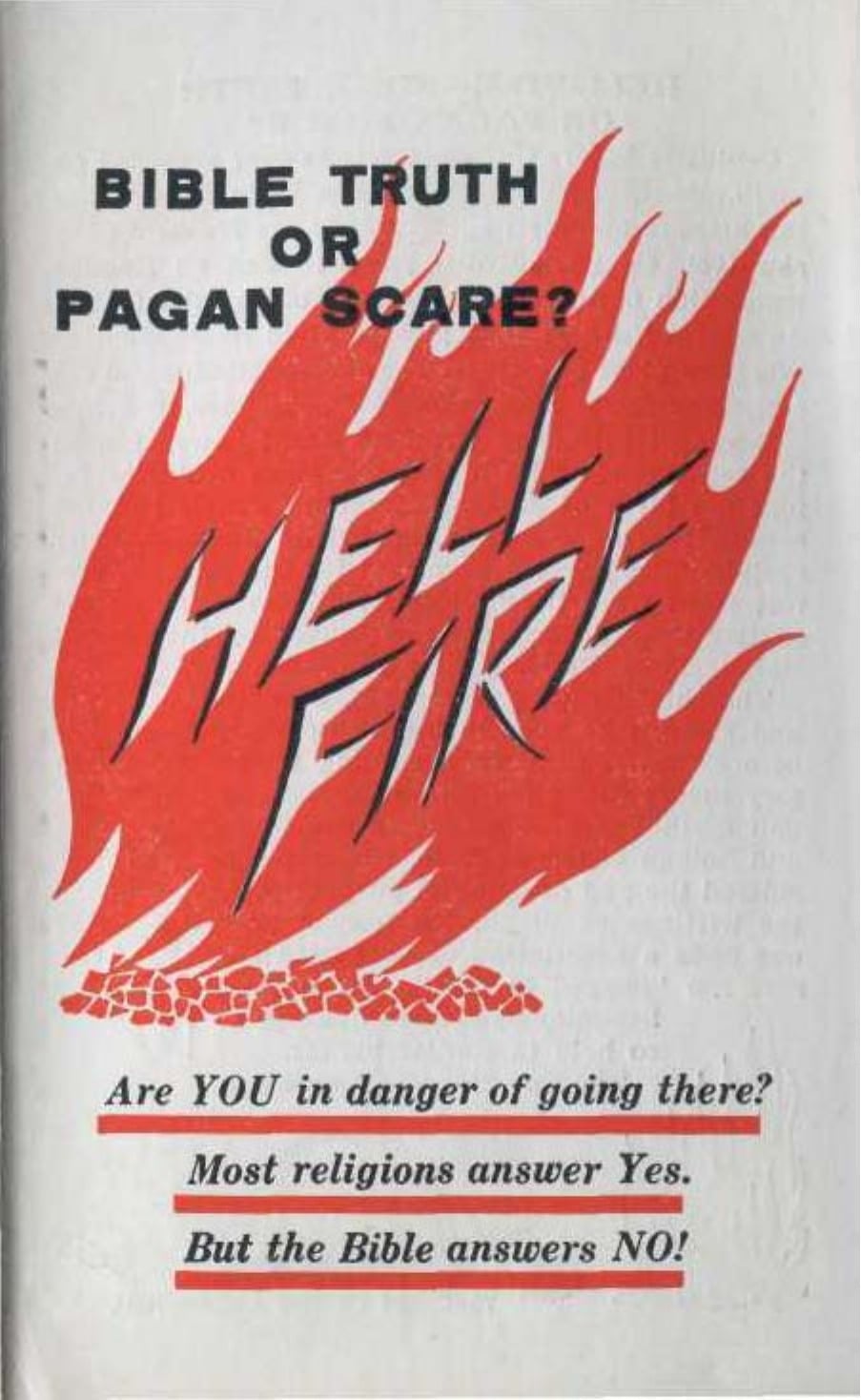
Are YOU in danger of going there?
Most religions answer Yes.
But the Bible answers NO!
BIBLE TRUTH OR PAGAN SCARE?
Are YOU in danger of going there?
Most religions answer Yes.
But the Bible answers NO!
HELL-FIRE—BIBLE TRUTH OR PAGAN SCARE?
Centuries before Christianity was ever preached on earth, Buddhist priests in remote India were teaching hell-fire and eternal torture. In the Harvard Classics (vol. 45, pp. 701-704) you will find an English translation of the sacred writings of Buddha (called Anguttara-Nikaya) that gives a vivid description of this fiery place of torture. The ancient Hindus and the early Chaldeans also believed the hell-fire doctrine.
Egyptian priests of the first world power taught the torment-after-death theory sixteen centuries before the birth of Jesus. According to their papyrus scrolls, now deposited in the British Museum, daily spell-binding prayers were said for the dead, to protect them from the "underworld" devils. One finds similar torture doctrines also taught by the ancient
Babylonians, Persians and Phoenicians.
The chief Greek philosophers, Socrates and Plato, who lived in the fifth century before Christ, fixed up a sizzling purgatory theory along the lines of earlier pagan mythologies. Also among the Greek and Roman gods was Pluto, who was considered the god of hell and purgatory. In the writings of Virgil, the Roman poet, one finds a description of how dead sinners are "purged in fires". The ancient
Scandinavians and Japanese also held to similar beliefs.
The Encyclopedia Americana,
TEACHERS OF THE PAGAN HELL 2 therefore, says: "While there are many and significant variations of details, the main features of hell as conceived by Hindu, Persian, Egyptian, Grecian, Hebrew and Christian theologians are essentially the same."
(1942 Edition, vol. 14, p.82) You see, Christendom got her after-death torture ideas from the hells of the heathen and the purgatories of the pagans!
What Does the Bible Say?
Yes, the word "hell" is in the common English version of the Bible, but the expression "hell-fire" is not translated from the same original Greek words, which makes a vast difference (gehenna is used, not hades). The Bible speaks of "everlasting punishment" but not of "eternal torture", and here too is a great difference of meaning. Look it up for yourself in Webster's New International Dictionary, 2nd Edition, page 1158, and you will see that the word "hell" comes from an old Anglo-Saxon verb, meaning "to conceal", and hence the dictionary defines "hell" as: "the place of the dead, or of souls after death; THE GRAVE:—corresponding to the Hebrew Sheol, and the Greek Hades." Rather than eternal fire, the grave is a cold, dark place where dead people are concealed.
Admitting that dead bodies are placed in graves, some people will contend that the wicked have souls that go to a place of fiery torment. If true, then man has an immortal, nondestructible something, called a soul, that is separate and distinct from his body. But the Bible does not say that at all. It does not say in Genesis 2:7, or any other place, that God gave man a soul. Rather, it says that God made man a soul. Man therefore is a soul; he does not have a soul separate and distinct from his body. Now the Bible is very definite and positive in saying that the soul can die. It is not immortal. Twice in Ezekiel (18:4, 20) it says, "the soul that sinneth, it shall die." Adam was made a soul; Adam sinned; Adam died. We are souls; we sin; we die. Why, even a perfect soul dies.
Jesus the Perfect One "poured out his soul unto death".—Isalah 53:12.
No Suffering After Death
If persons suffer after death, they must be alive, but the Bible says that when a man dies "his breath goeth forth, he returneth to his earth; in that very day his thoughts perish". Hence, "the dead know not anything," and "there is no work, nor device, nor
knowledge, nor wisdom, in Sheol, whither thou goest". "In death there is no remembrance of thee: in Sheol who shall give thee thanks?"—Psalm 6:5; 146:4; Ecclesiastes 9:5, 10.
No one would be so foolish as to think that beasts of the field have immortal souls that go to hell or purgatory when they die. The Bible shows that they, like men, are living souls that just cease to live, just perish, at the time of death. This is sinful man's destiny too, as it is written: "For that which befalleth the sons of men befalleth beasts; even one thing
befalleth them: as the one dieth, so dieth the other; yea, they have all one breath; and man hath no preeminence above the beasts: for all is vanity. All go unto one place; all are of the dust, and all turn to dust again."—Ecclesiastes 3:19, 20; see also Genesis 1:30, margin; Numbers 31:28.
To be consistent, those believing that hell is a place of fiery torture must also believe that the perfect man Jesus went to such a place when he died, for it was prophesied concern-
TEACHER OF THE BIBLE HELL
ing him: "Thou [Jehovah God] wilt not leave my soul in hell [sheol]." (Psalm 16:10, Author-
TEACHER OF THE BIBLE HELL
ized Version; 15:10, Douay) The apostle Peter quoted this Psalm as fulfilled in Christ, saying, "thou wilt not leave my soul in hell [hades]."
(Acts 2:27, Authorized and Douay translations) However, there is no confusion of understanding on these texts when one forsakes the pagan doctrines of hell-fire and immortality of the soul, and in their place accepts the simple truth of the Bible that hell is the grave and men are mortal souls.
Everlasting Punishment for Wicked
Human courts of justice impose the death penalty, not torture, for the worst of crimes. God's justice is no less than man's. He is no flend or sadist. He too decrees the death penalty, not torture, for the incorrigibly wicked, "everlasting cutting-off" from life, with no possibility of a resurrection. (Matthew 25:46) A fitting symbol, therefore, of such eternal destruction was the garbage dump in the
VALLEY OF HINNOM (GEHENNA)
deep valley outside Jerusalem, called Gehenna. In no sense was that place a symbol of torture, for no living animal or criminal was put in there; only material destined for complete annihilation. Consequently, when God tells the wicked they are in danger of going to Gehenna instead of sheol or hades (the common grave), it is the strongest warning that such are doomed to complete, everlasting and total destruction, a cutting off from all hope of a resurrection.
In Bible times jailers were called "tormenters". Hence, when the Scriptures say that the Devil and his crowd will be tormented "day and night for ever and ever", it means they will be bound and restrained in the perpetual captivity of death.
(Matthew 18:34; Revelation 14:10, 11; 20:10) Such symbolic language does not mean conscious suffering at all, for the "lake of fire", into which they are hurled, is defined in the same chapter thus: "This means the second death, the lake of fire." The faithless and filthy, the murderers, fornicators, idolaters and all liars have the same destiny, and "their portion will be in the lake that burns with fire and sulphur. This means the second death".—Revelation 20:14, 15; 21:8.
And so by laying aside preconceived ideas and traditions of men and letting God's Word be our teacher, we are able to learn the truth about this very important subject.
Unless otherwise marked, scriptures quoted herein are from the "American Standard Version" or the "New World Translation of the Christian Greek Scriptures".
"The Truth Will Set You Free"
"What a joy and comfort to know the truth!" That is what you too will shout when you read the book "Let God Be True". It will not only uproot from your mind false traditions, it will also plant in their place God's glorious Word of truth! The book answers a host of questions, such as: Who is Jehovah? Is there a Devil? Who are Jehovah's witnesses? Is there a trinity? When will Christ's new world kingdom take over complete rule of the earth? Hundreds of other questions, including those about hell, are answered in this wonderful book. Yours for a contribution of only 50c.
Send complete name and address with your contribution to
WATCHTOWER
117 ADAMS ST. BROOKLYN 1, N.Y.
15:10. Douay The apostle Peter quoted this Psalm as fulfilled in Christ, saying, "them wilt not leave my soul in hell [bades]." (Ats 2:27, Authorized and Douay translations). However, there is no confusion of understanding on these texts when one forsakes the pagan doctrine to believe that God exists in their place accepts the simple truth of the Bible that hell is the grave and men are mortal souls.
Everlasting Punishment for Wicked
Human courts of justice impose the death penalty, not torture, for the worst crimes. He is not less than man's. He is no friend or sadist. He too decrees the death penalty, not torture, for the innocent. He cuts-off 'from life', with no possibility of a resurrection. (Matthew 25:46) A fitting symbol, therefore, of the grave garbage dump in the
deep valley outside Jerusalem, called Gehnena. In no sense was that place a symbol of torture, for no living animal or criminal was put in there; only material destined for complete annihilation. Consequently, when God told the wicked they are in danger of going to Gehnena instead, he warned them not to be so under worst warning that such are doomed to complete, everlasting and total destruction, a cutting off from all hope of a resurrection.
In Bible times jailers were called 'tormenters'. Hence, when the Scriptures say that the Devil and his crowd will be tormented 'day and night for ever and ever', it means they will be bound and restrained in the perpetual captivity of death. (Matthew 18:34; Revelation 14:10, 11:20) Such symbolic language does not mean conscious suffering at all, for the "lake of fire", into which they are hurried, is not a physical place. It is a second life, the lake of fire." The faithless and filthy, the murders, formicators, idolaters, and all lilies, have the same deity, and "their portion will be consumed by fire." The second life means the second death." — Revelation 14:15, 21:8
And so by laying aside preconceived ideas and traditions of men and letting God's Word be our teacher, we are able to learn the truth about this very important subject.
Unless otherwise marked, scripter quotes are from the "American" edition of The Bible, translated by Translation of the Christian Greatest Scriptures.
"The Truth Will Set You Free"
"What a joy and comfort to know the truth!" That is what you too will about when you read the Bible, not only uproot from your mind false traditions, it will also plant in their place God's glorious Word of truth! The book answers a question that has been asked by many: Is there a Devil? Who are Jehovah's witnesses? Is there a trinity? When will Christ's new world kingdom take over complete rule of the earth? Numbers of other questions, including the question of whether God will fulfill book. Yours for a contribution of 50c.
Send complete name and address with your contribution to
WATCHTOWER
117 ADAMS ST. BROOKLYN 1, N.Y.
T2
Are YOU in danger of going there?
Most religions answer Yes.
But the Bible answers NO!
HELL-FIRE—BIBLE TRUTH OR PAGAN SCARE?
Centuries before Christianity was ever preached on earth, Buddhist priests in remote India were teaching hell-fire and eternal torture. In the Harward Classics (vol. 58, pp. 701-704) you will find an English translation of the sacred writings of Buddhas (called Anguvaratha-Xiñao) which gives a vivid description of life under the sun with all the trimmings. The ancient Hindus and the early Chaldeans also believed the hell-fire decturing.
Egyptian priests of the first world power taught the torment-after-death theory sixteen centuries before Christ. They believed that spirits, now deposed in the British Museum, daily spell-binding prayers were said for the dead, to protect them from the "underdown" deaths. One finds shouty torture doctrines also taught by the ancient Egyptians.
The chief Greek philosophers, Socrates and Plato, who lived in the fifth century before Christ, fixed up a sizing purgatory theory along the lines of earlier pagan mythologies. Also among the Greek and Roman gods was Pluto, who was considered the god of hell. The Roman poet, one finds a description of how dead sinners are "murged in fire". The
ancient Scandinavians and Japanese also held to similar flendish beliefs.
The Encyclopedia Americana
Therefore, says: "While there are many and significant variations of details, the main features of hell conceived by Hindu, Persian, Egyptian, Grecian, Hebrew and Christian theologies are essentially the hells of the past. The ancient god got her after-death lecture ideas from the hells of the heathen and the purpurates of the pagans!"
What Does the Bible Say?
Yes, the word "hell" is in the common English version of the Bible, but it is the expression "hell-dire" is not translated from the same original Greek words, which are often used to mean "death." The Bible speaks of "overwashing punishment" but not of "eternal torture," and here too is a great difference of meaning. Look it up for yourself in Webster's New International Dictionary, 2nd Edition, page 118. It says that the Hebrew Shoe, or the Old-Saxon Axon-vein, meaning "to conceal," and hence the dictionary defines "hell" as "the place of the dead, or of souls after death; THE GRAVE—corresponding to the Hebrew Shek, and the Greek —corresponding to the Hebrew Shoe, and the Greek —cold, dark place where dead people are concealed."
Admitting that dead bodies are placed in graves, some people will contend that the wicked have souls that go to a place of fiery torment. If true, then man is not immune to such torment. The Bible says a soul, that is separate and distinct from his body. But the Bible does not say that at all. It does not say in Genesis 2,7; or any other place, that God gave man a soul. Rather, it says that God made man a separate soul, that is separate and distinct from his body. Now the Bible is very definite and positive in saying that the soul can die. It is not immortal. Twice in Excelsi (18:4, 20) it says, "the soul that sinneth, it shall die." Adam was the first person to sinneth, so he dies; we sin; we die. What even a perfect soul dies.
Jesus the Perfect One "poured out his soul unto death"—Tasiah 53:12.
No Suffering After Death
If persons suffer after death, they must be alive, but the Bible says that when a man dies, "his breath goeth forth, he returns to his sertir; in that very day his thoughts perseil." He, "the dead know not anything," and "there is no work, nor devile, nor knowledge, nor wisdom, in Stoel, who thou gaze on him, and whose remembrance of Stoel in Stoel shall give thus death"—Rahm 65: 146: 146: Execlipses 95, 10.
No one would be so foolish as to think that beats of the field have immortal souls that go to hell or purgatory when they die. The Bible shows that they, like all men, are mortal souls. They perish, at the time of death. This is sinful man's destiny too, as it is written: "For that which bealthit the sons of men behalts heath; even one thing that bealthit them, and no other, yet they have all one breath; and man has no preeminence above the beasts; for all is veny. All go unto one place; all are of the dest, and all turn to them." Numbers 31:28; see also Genesis 13:90; Numbers 31:28.