Is there a creator who care about us (1998)
Download: PDF — Is there a creator who care about us (1998)
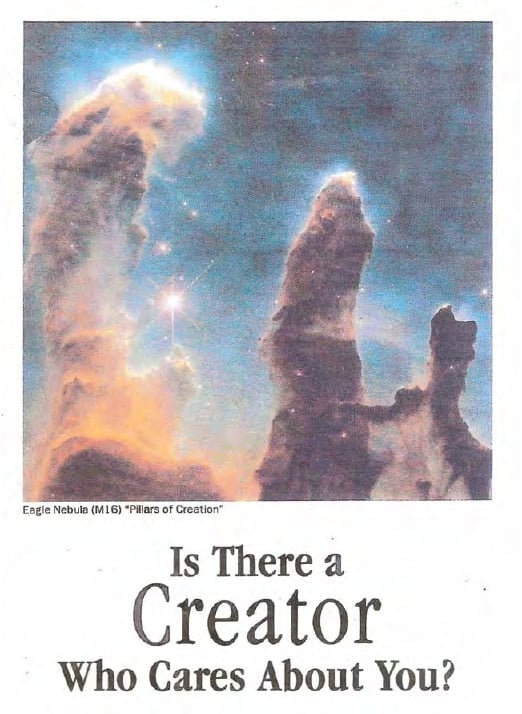
Is There a Creator Who Cares About You?
Source: jw.org
Contents
Title Page/Publishers’ Page
Contents
What Can Add Meaning to Your Life?
How Did Our Universe Get Here?—The Controversy
“Architectural Units of the Universe”
What Is the Origin of Life?
Teamwork for Life
From “the RNA World” or Another World?
How Unique You Are!
The Handiwork—What Is Behind It?
An Ancient Creation Record—Can You Trust It?
What Can You Learn About the Creator From a Book?
The Creator Reveals Himself—To Our Benefit!
A Great Teacher Shows Us the Creator More Clearly
If the Creator Cares, Why So Much Suffering?
Add Meaning to Your Life Permanently
Back Cover
Title Page/Publishers’ Page
Title Page/Publishers’ Page
Is There a Creator Who Cares About You?
2006 Printing
This publication is provided as part of a worldwide Bible educational work supported by voluntary donations.
Unless otherwise indicated, Scripture quotations are from the modern-language New World Translation of the Holy Scriptures—With References
Photo Credits:
Cover: J. Hester and P. Scowen (AZ State Univ.), NASA;
page 6: Tompkins Collection/Courtesy of Museum of Fine Arts, Boston;
pages 12, 13, and 78: Courtesy of Anglo-Australian Observatory, photographs by David Malin;
pages 14, 37, and 41: UPI/Corbis-Bettmann;
page 22: NASA photo;
page 76: Acropolis, Athens;
page 86: L. Ferrarese (Johns Hopkins University) and NASA;
page 89: U.S. National Archives photo;
pages 91 and 117: Culver Pictures;
page 107: WHO photo by Edouard Boubat;
page 110: Scroll: Courtesy of the Shrine of the Book, Israel Museum, Jerusalem;
page 115: Courtesy of The British Museum;
pages 123, 129, and 136: Pictorial Archive (Near Eastern History) Est.;
page 130: Garo Nalbandian;
page 163: Courtesy: Garden Tomb;
page 171: From the book Liberty’s Victorious Conflict;
page 179: Rowboat: Garo Nalbandian
[Picture on cover]
Eagle Nebula (M16) “Pillars of Creation”
Contents
Contents
PAGE CHAPTER
5 1 What Can Add Meaning to Your Life?
10 2 How Did Our Universe Get Here?—The Controversy
28 3 What Is the Origin of Life?
49 4 How Unique You Are!
73 5 The Handiwork—What Is Behind It?
85 6 An Ancient Creation Record—Can You Trust It?
103 7 What Can You Learn About the Creator From a Book?
120 8 The Creator Reveals Himself—To Our Benefit!
144 9 A Great Teacher Shows Us the Creator More Clearly
165 10 If the Creator Cares, Why So Much Suffering?
184 11 Add Meaning to Your Life Permanently
What Can Add Meaning to Your Life?
Chapter One
What Can Add Meaning to Your Life?
HAVE you dreamed of enjoying a better life, whether in your home area or in a tropical paradise? At one time or another, most of us have.
In 1891, French artist Paul Gauguin went to find such a life in French Polynesia. But reality soon set in. His dissolute past brought disease and suffering to himself and others. As he felt death approaching, he painted what has been described as a “final affirmation of artistic force.” The book Paul Gauguin 1848-1903—The Primitive Sophisticate says: “The spectrum of human activity encompassed by the painting spans all of life, from birth to death . . . He was interpreting life as a great mystery.”
Gauguin named that painting “Where Do We Come From? What Are We? Where Are We Going?”a
Those questions may sound familiar. Many thinking people ask them. After noting man’s scientific and technical advances, an editor of The Wall Street Journal wrote: “In the contemplation of man himself, of his dilemmas, of his place in this universe, we are little further along than when time began. We are still left with questions of who we are and why we are and where we are going.”
True, some people are preoccupied with caring for their family, earning a living, traveling, or other personal interests because they know of no other meaning to life. Albert Einstein once said: “The man who regards his life as meaningless is not merely unhappy but hardly fit for life.” In line with such thinking, some seek to put meaning in their life by pursuing the arts, scientific research, or humanitarian efforts to curb suffering. Do you know some like that?
It is understandable that basic questions about the meaning of life arise. How many parents after seeing a child die from malaria or another disease ask, Why such suffering? Is there meaning to it? Similar questions puzzle many young men and women who observe poverty, disease, and injustice. Brutal wars often lead people to wonder whether there can be meaning to life.
Even if you have not experienced such miseries, you might agree with Professor Freeman Dyson, who said: “I stand in good company when I ask again the questions [that the Biblical character] Job asked. Why do we suffer? Why is the world so unjust? What is the purpose of pain and tragedy?” You too might want the answers.
Finding satisfying answers would surely make a difference. A professor who endured the horrors of Auschwitz concentration camp observed: “There is nothing in the world . . . that would so effectively help one to survive even the worst conditions as the knowledge that there is a meaning in one’s life.” He felt that even one’s mental health is linked to this search for meaning.
Over the centuries, many have sought answers through religion. After Gautama (Buddha) was exposed to the sight of a sick man, an old man, and a dead man, he sought enlightenment, or meaning, in religion but without belief in a personal God. Others have turned to their church.
What, though, about people today? Many focus on science, dismissing religion and “God” as irrelevant. “The more science progresses,” comments Religion and Atheism, “the less room there seems to be for God. God has become a Displaced Person.”
Doing Without a Creator—Why?
Actually, the trend to dismiss religion or God has roots in philosophies of men who stressed pure reason. Charles Darwin felt that “natural selection” explains the living world better than does the existence of a Creator. Sigmund Freud taught that God was an illusion. And the view that ‘God is dead’ extends from the time of Friedrich Nietzsche down to our day. Oriental philosophies are similar. Teachers of Buddhism hold that there is no need to know about God. As to Shinto, Professor Tetsuo Yamaori stated that “gods are nothing but humans.”
While skepticism about the existence of a Creator abounds, is it justified? Likely you know examples of ‘scientific facts’ that prevailed in the past but that in time were proved totally wrong. Views such as ‘The earth is flat’ and ‘The whole universe revolves around our globe’ prevailed for centuries, but we now know better.
What about later scientific ideas? For example, the 18th century philosopher David Hume—not accepting that there is a Creator—could offer no explanation for the complex biological design on earth. Darwin’s theory proposed how life-forms developed, but it did not explain how life began or what meaning it has for us.
Consequently, many scientists as well as laymen sense that something is lacking. Scientific theories may try to explain how? but the key questions center on why? Even people raised amid belief in a Creator are affected. One young European history student said: “For me, God is dead. If he really did exist, there wouldn’t be such a mess in the world: Innocent people are starving; animal species are going extinct . . . The idea of a Creator is nonsense.” Given the conditions on earth, many cannot understand why a Creator—given that one exists—does not change things for the better.
Yet, we must admit that the reason many reject the existence of a Creator is that they do not want to believe. “Even if God were to tell me personally that I had to change my life,” a European industrialist told an employee: “I still would not do it. I want to live my life the way I like it.” Clearly, some feel that admitting the authority of a Creator would conflict with their freedom or with the life-style they prefer. They may proclaim, ‘I only believe what I see, and I can’t see any invisible Creator.’
Apart from why individuals have ‘done without a Creator,’ questions about life and its meaning persist. After man began exploring outer space, theologian Karl Barth was asked about this technological triumph. He said: “It solves none of the problems that keep me awake at night.” Today man is flying in space and speeding along in cyberspace. Still, thinking people see the need to have a purpose, something that gives meaning to their life.
We invite all who have an open mind to consider this subject. The book Belief in God and Intellectual Honesty notes that one who possesses “intellectual honesty” is characterized by a “readiness to scrutinize what one believes to be true” and “to pay sufficient attention to other evidence available.”
In the subject at hand, such “evidence available” can help us to see whether there is a Creator behind life and the universe. And if a Creator exists, what might that One be like? Would a Creator have a personality that relates to our lives? Our considering this can shed light on how our lives can become more meaningful and rewarding.
[Footnote]
D’où venons-nous? Que sommes-nous? Où allons-nous?
[Full-page picture on page 4]
[Picture on page 6]
Gauguin’s painting raised questions about the meaning of life
How Did Our Universe Get Here?—The Controversy
Chapter Two
How Did Our Universe Get Here?—The Controversy
ASTRONAUTS thrill to photograph the earth as it looms large through the window of a spacecraft. “That’s the best part of flying in space,” said one. But our earth seems very small when compared with the solar system. The sun could hold a million earths inside, with room to spare! However, could such facts about the universe have any bearing on your life and its meaning?
Let us take a brief mental trip into space to see our earth and sun in perspective. Our sun is just one of an awesome number of stars in a spiral arm of the Milky Way galaxy,a which itself is just a tiny part of the universe. With the naked eye, it is possible to see a few smudges of light that actually are other galaxies, such as the beautiful and larger Andromeda. The Milky Way, Andromeda, and some 20 other galaxies are bound gravitationally into a cluster, all of these being only a small neighborhood in a vast supercluster. The universe contains countless superclusters, and the picture does not end there.
The clusters are not evenly distributed in space. On a grand scale, they look like thin sheets and filaments around vast bubblelike voids. Some features are so long and wide that they resemble great walls. This may surprise many who think that our universe created itself in a chance cosmic explosion. “The more clearly we can see the universe in all its glorious detail,” concludes a senior writer for Scientific American, “the more difficult it will be for us to explain with a simple theory how it came to be that way.”
Evidence Pointing to a Beginning
All the individual stars you see are in the Milky Way galaxy. Until the 1920’s, that seemed to be the only galaxy. You probably know, though, that observations with larger telescopes have since proved otherwise. Our universe contains at least 50,000,000,000 galaxies. We do not mean 50 billion stars—but at least 50 billion galaxies, each with billions of stars like our sun. Yet it was not the staggering quantity of huge galaxies that shook scientific beliefs in the 1920’s. It was that they are all in motion.
Astronomers discovered a remarkable fact: When galactic light was passed through a prism, the light waves were seen to be stretched, indicating motion away from us at great speed. The more distant a galaxy, the faster it appeared to be receding. That points to an expanding universe!b
Even if we are neither professional astronomers nor amateurs, we can see that an expanding universe would have profound implications about our past—and perhaps our personal future too. Something must have started the process—a force powerful enough to overcome the immense gravity of the entire universe. You have good reason to ask, ‘What could be the source of such dynamic energy?’
Although most scientists trace the universe back to a very small, dense beginning (a singularity), we cannot avoid this key issue: “If at some point in the past, the Universe was once close to a singular state of infinitely small size and infinite density, we have to ask what was there before and what was outside the Universe. . . . We have to face the problem of a Beginning.”—Sir Bernard Lovell.
This implies more than just a source of vast energy. Foresight and intelligence are also needed because the rate of expansion seems very finely tuned. “If the Universe had expanded one million millionth part faster,” said Lovell, “then all the material in the Universe would have dispersed by now. . . . And if it had been a million millionth part slower, then gravitational forces would have caused the Universe to collapse within the first thousand million years or so of its existence. Again, there would have been no long-lived stars and no life.”
Attempts to Explain the Beginning
Can experts now explain the origin of the universe? Many scientists, uncomfortable with the idea that the universe was created by a higher intelligence, speculate that by some mechanism it created itself out of nothing. Does that sound reasonable to you? Such speculations usually involve some variation of a theory (inflationary universe model)c conceived in 1979 by physicist Alan Guth. Yet, more recently, Dr. Guth admitted that his theory “does not explain how the universe arose from nothing.” Dr. Andrei Linde was more explicit in a Scientific American article: “Explaining this initial singularity—where and when it all began—still remains the most intractable problem of modern cosmology.”
If experts cannot really explain either the origin or the early development of our universe, should we not look elsewhere for an explanation? Indeed, you have valid reasons to consider some evidence that many have overlooked but that may give you real insight on this issue. The evidence includes the precise measurements of four fundamental forces that are responsible for all properties and changes affecting matter. At the mere mention of fundamental forces, some may hesitate, thinking, ‘That’s solely for physicists.’ Not so. The basic facts are worth considering because they affect us.
Fine-Tuning
The four fundamental forces come into play both in the vastness of the cosmos and in the infinite smallness of atomic structures. Yes, everything we see around us is involved.
Elements vital for our life (particularly carbon, oxygen, and iron) could not exist were it not for the fine-tuning of the four forces evident in the universe. We already mentioned one force, gravity. Another is the electromagnetic force. If it were significantly weaker, electrons would not be held around the nucleus of an atom. ‘Would that be serious?’ some might wonder. Yes, because atoms could not combine to form molecules. Conversely, if this force were much stronger, electrons would be trapped on the nucleus of an atom. There could be no chemical reactions between atoms—meaning no life. Even from this standpoint, it is clear that our existence and life depend on the fine-tuning of the electromagnetic force.
And consider the cosmic scale: A slight difference in the electromagnetic force would affect the sun and thus alter the light reaching the earth, making photosynthesis in plants difficult or impossible. It could also rob water of its unique properties, which are vital for life. So again, the precise tuning of the electromagnetic force determines whether we live or not.
Equally vital is the intensity of the electromagnetic force in relation to the other three. For example, some physicists figure this force to be 10,000,- 000,000,000,000,000,000,000,000,000,000,000,000 (1040) times that of gravity. It might seem a small change to that number to add one more zero (1041). Yet that would mean that gravity is proportionally weaker, and Dr. Reinhard Breuer comments on the resulting situation: “With lower gravity the stars would be smaller, and the pressure of gravity in their interiors would not drive the temperature high enough for nuclear fusion reactions to get under way: the sun would be unable to shine.” You can imagine what that would mean for us!
What if gravity were stronger proportionately, so that the number had only 39 zeros (1039)? “With just this tiny adjustment,” continues Breuer, “a star like the sun would find its life expectancy sharply reduced.” And other scientists consider the fine-tuning to be even more precise.
Indeed, two remarkable qualities of our sun and other stars are long-term efficiency and stability. Consider a simple illustration. We know that to run efficiently, an automobile engine needs a critical ratio between fuel and air; engineers design complex mechanical and computer systems to optimize performance. If that is so with a mere engine, what of the efficiently “burning” stars such as our sun? The key forces involved are precisely tuned, optimized for life. Did that precision just happen? The ancient man Job was asked: “Did you proclaim the rules that govern the heavens, or determine the laws of nature on earth?” (Job 38:33, The New English Bible) No human did. So from where does the precision come?
The Two Nuclear Forces
The structure of the universe involves much more than fine-tuning just gravity and the electromagnetic force. Two other physical forces also relate to our life.
These two forces operate in the nucleus of an atom, and they give ample evidence of forethought. Consider the strong nuclear force, which glues protons and neutrons together in the nucleus of the atom. Because of this bonding, various elements can form—light ones (such as helium and oxygen) and heavy ones (such as gold and lead). It seems that if this binding force were a mere 2-percent weaker, only hydrogen would exist. Conversely, if this force were slightly stronger, only heavier elements, but no hydrogen, could be found. Would our lives be affected? Well, if the universe lacked hydrogen, our sun would not have the fuel it needs to radiate life-giving energy. And, of course, we would have no water or food, since hydrogen is an essential ingredient of both.
The fourth force in this discussion, called the weak nuclear force, controls radioactive decay. It also affects thermonuclear activity in our sun. ‘Is this force fine-tuned?’ you might ask. Mathematician and physicist Freeman Dyson explains: “The weak [force] is millions of times weaker than the nuclear force. It is just weak enough so that the hydrogen in the sun burns at a slow and steady rate. If the weak [force] were much stronger or much weaker, any forms of life dependent on sunlike stars would again be in difficulties.” Yes, this precise rate of burning keeps our earth warm—but not incinerated—and keeps us alive.
Furthermore, scientists believe that the weak force plays a role in supernova explosions, which they give as the mechanism for producing and distributing most elements. “If those nuclear forces were in any way slightly different from the way they actually are, the stars would be incapable of making the elements of which you and I are composed,” explains physicist John Polkinghorne.
More could be said, but you likely understand the point. There is an amazing degree of fine-tuning in these four fundamental forces. “All around us, we seem to see evidence that nature got it just right,” wrote Professor Paul Davies. Yes, the precise tuning of the fundamental forces has made possible the existence and operation of our sun, our delightful planet with its life-sustaining water, our atmosphere so vital for life, and a vast array of precious chemical elements on earth. But ask yourself, ‘Why such precise tuning, and from where?’
Earth’s Ideal Features
Our existence requires precision in other respects as well. Consider the earth’s measurements and its position relative to the rest of our solar system. The Bible book of Job contains these humbling questions: “Where did you happen to be when I founded the earth? . . . Who set its measurements, in case you know?” (Job 38:4, 5) As never before, those questions beg for answers. Why? Because of the amazing things that have been discovered about our earth—including its size and its position in our solar system.
No planet like earth has been found elsewhere in the universe. True, some scientists point to indirect evidence that certain stars have orbiting them objects that are hundreds of times larger than the earth. Our earth, though, is just the right size for our existence. In what sense? If earth were slightly larger, its gravity would be stronger and hydrogen, a light gas, would collect, being unable to escape the earth’s gravity. Thus, the atmosphere would be inhospitable to life. On the other hand, if our earth were slightly smaller, life-sustaining oxygen would escape and surface water would evaporate. In either case, we could not live.
The earth is also at an ideal distance from the sun, a factor vital for life to thrive. Astronomer John Barrow and mathematician Frank Tipler studied “the ratio of the Earth’s radius and distance from the Sun.” They concluded that human life would not exist “were this ratio slightly different from what it is observed to be.” Professor David L. Block notes: “Calculations show that had the earth been situated only 5 per cent closer to the sun, a runaway greenhouse effect [overheating of the earth] would have occurred about 4 000 million years ago. If, on the other hand, the earth were placed only 1 per cent further from the sun, runaway glaciation [huge sheets of ice covering much of the globe] would have occurred some 2 000 million years ago.”—Our Universe: Accident or Design?
To the above precision, you can add the fact that the earth rotates on its axis once a day, the right speed to produce moderate temperatures. Venus takes 243 days to rotate. Just think if the earth took as long! We could not survive the extreme temperatures resulting from such long days and nights.
Another vital detail is our earth’s path around the sun. Comets have a wide elliptic path. Thankfully, this is not so with the earth. Its orbit is almost circular. Again, this prevents us from experiencing death-dealing extremes of temperature.
Nor should we ignore the location of our solar system. Were it nearer the center of the Milky Way galaxy, the gravitational effect of neighboring stars would distort the orbit of the earth. In contrast, were it situated at the very edge of our galaxy, the night sky would be all but devoid of stars. Starlight is not essential to life, but does it not add great beauty to our night sky? And based on current concepts of the universe, scientists have calculated that at the edges of the Milky Way, there would not have been enough of the needed chemical elements to form a solar system like ours.d
Law and Order
From personal experience, you likely know that all things tend toward disorder. As any homeowner has observed, when left to themselves, things tend to break down or disintegrate. Scientists refer to this tendency as “the second law of thermodynamics.” We can see this law at work daily. If left alone, a new automobile or bicycle will become scrap. Abandon a building and it will become a ruin. What about the universe? The law applies there too. So you might think that the order throughout the universe should give way to complete disorder.
However, this does not seem to be happening to the universe, as Professor of Mathematics Roger Penrose discovered when he studied the state of disorderliness (or, entropy) of the observable universe. A logical way to interpret such findings is to conclude that the universe started off in an ordered state and is still highly organized. Astrophysicist Alan Lightman noted that scientists “find it mysterious that the universe was created in such a highly ordered condition.” He added that “any successful theory of cosmology should ultimately explain this entropy problem”—why the universe has not become chaotic.
In fact, our existence is contrary to this recognized law. So why is it that we are alive here on earth? As previously noted, that is a basic question that we should want answered.
[Footnotes]
The Milky Way galaxy is some 600 quadrillion miles [about a quintillion km] in diameter—yes, 600,000,000,000,000,000 miles [1,000,000,000,000,000,000 km]! It takes light 100,000 years to cross it, and this one galaxy contains over 100 billion stars!
In 1995, scientists noticed the strange behavior of the most distant star (SN 1995K) ever observed as it exploded in its galaxy. Like supernovas in nearby galaxies, this star became very bright and then slowly faded but over a longer period than ever before detected. New Scientist magazine plotted this on a graph and explained: “The shape of the light curve . . . is stretched in time by exactly the amount expected if the galaxy was receding from us at nearly half the speed of light.” The conclusion? This is “the best evidence yet that the Universe really is expanding.”
The inflation theory speculates as to what happened a fraction of a second after the beginning of the universe. Advocates of inflation hold that the universe was initially submicroscopic and then inflated faster than the speed of light, a claim that cannot be tested in a laboratory. Inflation remains a debated theory.
Scientists have found that the elements reveal amazing order and harmony. Interesting evidence is presented in the Appendix “Architectural Units of the Universe,” page 26.
[Box on page 15]
Trying to Number the Stars
It is estimated that the Milky Way galaxy has more than 100,000,000,000 (100 billion) stars. Picture an encyclopedia devoting one page to each of these stars—our sun and the rest of our solar system would be limited to one page. How many volumes would the set need to have in order to cover the stars in the Milky Way?
With volumes of reasonable thickness, it is said that the encyclopedia would not fit in the New York Public Library, with its 256 miles [412 km] of shelf space!
How long would it take you to examine those pages? “To flip through it, at the rate of a page per second, would require over ten thousand years,” explains Coming of Age in the Milky Way. Yet the stars making up our galaxy are but a small fraction of the stars in the estimated 50,000,000,000 (50 billion) galaxies in the universe. If the encyclopedia contained a page for each of these stars, it would not fit on all the library shelves on earth. “The more we know about the universe,” notes the book, “the more we come to see how little we know.”
[Box on page 16]
Jastrow—On the Beginning
Robert Jastrow, Professor of Astronomy and Geology at Columbia University, wrote: “Few astronomers could have anticipated that this event—the sudden birth of the Universe—would become a proven scientific fact, but observations of the heavens through telescopes have forced them to that conclusion.”
He then commented on the implications: “The astronomical proof of a Beginning places scientists in an awkward position, for they believe that every effect has a natural cause . . . The British astronomer E. A. Milne wrote, ‘We can make no propositions about the state of affairs [in the beginning]; in the Divine act of creation God is unobserved and unwitnessed.’”—The Enchanted Loom—Mind in the Universe.
[Box on page 17]
Four Fundamental Physical Forces
1. Gravity—a very weak force on the level of atoms. It affects large objects—planets, stars, galaxies.
2. Electromagnetism—the key attracting force between protons and electrons, allowing molecules to form. Lightning is one evidence of its power.
3. Strong nuclear force—the force that glues protons and neutrons together in the nucleus of an atom.
4. Weak nuclear force—the force that governs the decay of radioactive elements and the efficient thermonuclear activity of the sun.
[Box on page 20]
“Combination of Coincidences”
“Make the weak force slightly stronger and no helium would have been produced; make it slightly weaker and nearly all the hydrogen would have been converted into helium.”
“The window of opportunity for a universe in which there is some helium and there are also exploding supernovas is very narrow. Our existence depends on this combination of coincidences, and on the even more dramatic coincidence of nuclear energy levels predicted by [astronomer Fred] Hoyle. Unlike all previous generations, we know how we come to be here. But, like all previous generations, we still do not know why.”—New Scientist.
[Box on page 22]
“The special conditions on earth resulting from its ideal size, element composition, and nearly circular orbit at a perfect distance from a long-lived star, the sun, made possible the accumulation of water on the earth’s surface.” (Integrated Principles of Zoology, 7th edition) Life on earth could not have appeared without water.
[Box on page 24]
Believe Only What You See?
Many rational people accept the existence of things they cannot see. In January 1997, Discover magazine reported that astronomers detected what they concluded were about a dozen planets orbiting distant stars.
“So far the new planets are known only from the way their gravity perturbs the motion of the parent stars.” Yes, for the astronomers, the visible effects of gravity constituted a basis for believing in the existence of unseen heavenly bodies.
Related evidence—not direct observation—was an adequate basis for scientists to accept what was yet invisible. Many who believe in a Creator conclude that they have a similar basis for accepting what they cannot see.
[Box on page 25]
Sir Fred Hoyle explains in The Nature of the Universe: “To avoid the issue of creation it would be necessary for all the material of the Universe to be infinitely old, and this it cannot be. . . . Hydrogen is being steadily converted into helium and the other elements . . . How comes it then that the Universe consists almost entirely of hydrogen? If matter were infinitely old this would be quite impossible. So we see that the Universe being what it is, the creation issue simply cannot be dodged.”
[Picture on page 12, 13]
Our sun (box) is insignificant in the Milky Way galaxy, as illustrated here with spiral galaxy NGC 5236
The Milky Way contains over 100 billion stars, and it is only one of over 50 billion galaxies in the known universe
[Pictures on page 14]
Astronomer Edwin Hubble (1889-1953) realized that a red shift in light from distant galaxies showed that our universe is expanding and thus had a beginning
[Pictures on page 19]
Fine-tuning of forces that control our sun results in conditions just right for our life on earth
“Architectural Units of the Universe”
Appendix
“Architectural Units of the Universe”
That is how a modern encyclopedia of science describes the chemical elements. There is amazing variety among the elements of our earth; some of them are rare; others are abundant. Elements such as gold may attract the human eye. Others are gases that we do not even see, such as nitrogen and oxygen. Each element is made of a certain kind of atom. How the atoms are constructed and relate to one another bespeaks economy and awesome organization in chartlike order.
About 300 years ago, only 12 elements were known—antimony, arsenic, bismuth, carbon, copper, gold, iron, lead, mercury, silver, sulfur, and tin. As more were discovered, scientists noticed that the elements reflected a distinct order. Because there were gaps in the order, scientists such as Mendeleyev, Ramsay, Moseley, and Bohr theorized the existence of unknown elements and their characteristics. Those elements were subsequently discovered just as predicted. Why could those scientists predict that there were forms of matter that were unknown at the time?
Well, the elements follow a natural numerical order based on the structure of their atoms. This is a proven law. Thus, school textbooks can set out a periodic table of elements in rows and columns—hydrogen, helium, and so on.
The McGraw-Hill Encyclopedia of Science & Technology observes: “Few systemizations in the history of science can rival the periodic concept as a broad revelation of the order of the physical world. . . . Whatever new elements may be discovered in the future, it is certain they will find a place in the periodic system, conforming to its order and exhibiting the proper familial characteristics.”
When the elements are arranged in the rows and columns of the periodic table, a remarkable relationship is seen between elements that share a column. For example, in the last column are located helium (No. 2), neon (No. 10), argon (No. 18), krypton (No. 36), xenon (No. 54), and radon (No. 86). These are gases that glow brightly when an electric discharge passes through them, and they are used in some light bulbs. Also, they do not react easily with various elements, as do some other gases.
Yes, the universe—even down to its atomic particles—reveals astonishing harmony and order. What is responsible for such order, harmony, and variety among the building blocks of the universe?
[Chart on page 27]
Periodic Table of the Elements
(For fully formatted text, see publication)
Do the order and harmony of elements in the periodic table reflect mere chance or intelligent design?
METALS
NONMETALS
RARE GASES
TRANSITION ELEMENTS
Lanthanide series
Actinide series
I
II
III
IV
V
VI
VII
VIII
Name of element Symbol Atomic number
hydrogen H 1
helium He 2
lithium Li 3
beryllium Be 4
boron B 5
carbon C 6
nitrogen N 7
oxygen O 8
fluorine F 9
neon Ne 10
sodium Na 11
magnesium Mg 12
aluminum Al 13
silicon Si 14
phosphorus P 15
sulfur S 16
chlorine Cl 17
argon Ar 18
potassium K 19
calcium Ca 20
scandium Sc 21
titanium Ti 22
vanadium V 23
chromium Cr 24
manganese Mn 25
iron Fe 26
cobalt Co 27
nickel Ni 28
copper Cu 29
zinc Zn 30
gallium Ga 31
germanium Ge 32
arsenic As 33
selenium Se 34
bromine Br 35
krypton Kr 36
rubidium Rb 37
strontium Sr 38
yttrium Y 39
zirconium Zr 40
niobium Nb 41
molybdenum Mo 42
technetium Tc 43
ruthenium Ru 44
rhodium Rh 45
palladium Pd 46
silver Ag 47
cadmium Cd 48
indium In 49
tin Sn 50
antimony Sb 51
tellurium Te 52
iodine I 53
xenon Xe 54
cesium Cs 55
barium Ba 56
lanthanum La 57
cerium Ce 58
praseodymium Pr 59
neodymium Nd 60
promethium Pm 61
samarium Sm 62
europium Eu 63
gadolinium Gd 64
terbium Tb 65
dysprosium Dy 66
holmium Ho 67
erbium Er 68
thulium Tm 69
ytterbium Yb 70
lutetium Lu 71
hafnium Hf 72
tantalum Ta 73
tungsten W 74
rhenium Re 75
osmium Os 76
iridium Ir 77
platinum Pt 78
gold Au 79
mercury Hg 80
thallium Tl 81
lead Pb 82
bismuth Bi 83
polonium Po 84
astatine At 85
radon Rn 86
francium Fr 87
radium Ra 88
actinium Ac 89
thorium Th 90
protactinium Pa 91
uranium U 92
neptunium Np 93
plutonium Pu 94
americium Am 95
curium Cm 96
berkelium Bk 97
californium Cf 98
einsteinium Es 99
fermium Fm 100
mendelevium Md 101
nobelium No 102
lawrencium Lr 103
What Is the Origin of Life?
Chapter Three
What Is the Origin of Life?
OUR earth teems with life. From the snowy Arctic to the Amazon rain forest, from the Sahara Desert to the Everglades swamp, from the dark ocean floor to bright mountain peaks—life abounds. And it is loaded with the potential to amaze us.
It comes in types, sizes, and quantities that stagger the imagination. A million species of insects hum and wiggle on our planet. In the waters around us swim over 20,000 species of fish—some the size of a grain of rice, others as long as a truck. At least 350,000 plant species—some weird, most wonderful—embellish the land. And over 9,000 species of birds fly overhead. These creatures, including man, form the panorama and symphony that we refer to as life.
But more amazing than the delightful variety around us is the profound unity linking them. Biochemists, who peek beneath the skin of earth’s creatures, explain that all living things—be they amoebas or humans—depend on an awesome interaction: the teamwork between nucleic acids (DNA and RNA) and protein molecules. The intricate processes involving these components occur in virtually all our body cells, as it does in the cells of hummingbirds, lions, and whales. This uniform interaction produces a beautiful mosaic of life. How did this orchestration of life come about? In fact, what is the origin of life?
Likely you accept that at one time the earth had no life on it. Scientific opinion agrees, and so do many religious books. Still, you may realize that those two sources—science and religion—differ in explaining how life began on earth.
Millions of people of all educational levels believe that an intelligent Creator, the original Designer, produced life on earth. In contrast, many scientists say that life arose from nonliving matter, one chemical step after another, merely by chance. Is it one, or is it the other?
We should not think that this issue is rather remote from us and from our finding a more meaningful life. As already noted, one of the very fundamental questions humans have sought to answer is, Where did we as living humans come from?
Most science courses focus on the adaptation and survival of life-forms instead of on the more central question of the very origin of life. You may have noted that attempts to explain where life came from are usually presented in generalizations such as: ‘Over millions of years, molecules in collision somehow produced life.’ Yet, is that really satisfying? It would mean that in the presence of energy from the sun, lightning, or volcanoes, some lifeless matter moved, became organized, and eventually started living—all of this without directed assistance. What a huge leap that would have been! From nonliving matter to living! Could it have occurred that way?
Back in the Middle Ages, accepting such a concept might not have seemed a problem because spontaneous generation—the notion that life could arise spontaneously from nonliving matter—was a prevailing belief. Finally, in the 17th century, Italian physician Francesco Redi proved that maggots appeared in rotten meat only after flies had laid eggs on it. No maggots developed on meat that flies could not reach. If animals as big as flies did not just appear on their own, what about the microbes that kept appearing in food—covered or not? Although later experiments indicated that microbes did not arise spontaneously, the issue remained controversial. Then came the work of Louis Pasteur.
Many people recall Pasteur’s work in solving problems related to fermentation and to infectious disease. He also performed experiments to determine whether tiny life-forms could arise by themselves. As you may have read, Pasteur demonstrated that even minute bacteria did not form in sterilized water protected from contamination. In 1864 he announced: “Never will the doctrine of spontaneous generation recover from the mortal blow struck by this simple experiment.” That statement remains true. No experiment has ever produced life from nonliving matter.
How then could life come to be on earth? Modern efforts to answer that question might be dated to the 1920’s, to the work of Russian biochemist Alexander I. Oparin. He and other scientists since then have offered something like the script of a three-act drama that depicts what is claimed to have occurred on the stage of planet Earth. The first act portrays earth’s elements, or raw materials, being transformed into groups of molecules. Then comes the jump to large molecules. And the last act of this drama presents the leap to the first living cell. But did it really happen that way?
Fundamental to that drama is explaining that earth’s early atmosphere was much different from what it is today. One theory assumes that free oxygen was virtually absent and that the elements nitrogen, hydrogen, and carbon formed ammonia and methane. The concept is that when lightning and ultraviolet light struck an atmosphere of these gases and water vapor, sugars and amino acids developed. Bear in mind, though, that this is theory.
According to this theoretical drama, such molecular forms washed into the oceans or other bodies of water. Over time, sugars, acids, and other compounds concentrated into a broth of “prebiotic soup” where amino acids, for instance, joined to become proteins. Extending this theoretical progression, other compounds called nucleotides formed chains and became a nucleic acid, such as DNA. All of this supposedly set the stage for the final act of the molecular drama.
One might depict this last act, which is undocumented, as a love story. Protein molecules and DNA molecules happen to meet, recognize each other, and embrace. Then, just before the curtain rings down, the first living cell is born. If you were following this drama, you might wonder, ‘Is this real life or fiction? Could life on earth really have originated in this way?’
Genesis in the Laboratory?
In the early 1950’s, scientists set out to test Alexander Oparin’s theory. It was an established fact that life comes only from life, yet scientists theorized that if conditions differed in the past, life might have come slowly from nonlife. Could that be demonstrated? Scientist Stanley L. Miller, working in the laboratory of Harold Urey, took hydrogen, ammonia, methane, and water vapor (assuming that this had been the primitive atmosphere), sealed these in a flask with boiling water at the bottom (to represent an ocean), and zapped electric sparks (like lightning) through the vapors. Within a week, there were traces of reddish goo, which Miller analyzed and found to be rich in amino acids—the essence of proteins. You may well have heard of this experiment because for years it has been cited in science textbooks and school courses as if it explains how life on earth began. But does it?
Actually, the value of Miller’s experiment is seriously questioned today. (See “Classic but Questionable,” pages 36-7.) Nevertheless, its apparent success led to other tests that even produced components found in nucleic acids (DNA or RNA). Specialists in the field (sometimes called origin-of-life scientists) felt optimistic, for they had seemingly replicated the first act of the molecular drama. And it seemed as though laboratory versions of the remaining two acts would follow. One chemistry professor claimed: “The explanation of the origin of a primitive living system by evolutionary mechanisms is well within sight.” And a science writer observed: “Pundits speculated that scientists, like Mary Shelley’s Dr. Frankenstein, would shortly conjure up living organisms in their laboratories and thereby demonstrate in detail how genesis unfolded.” The mystery of the spontaneous origin of life, many thought, was solved.—See “Right Hand, Left Hand,” page 38.
Moods Change—Riddles Remain
In the years since, however, that optimism has evaporated. Decades have passed, and life’s secrets remain elusive. Some 40 years after his experiment, Professor Miller told Scientific American: “The problem of the origin of life has turned out to be much more difficult than I, and most other people, envisioned.” Other scientists share this change of mood. For example, back in 1969, Professor of Biology Dean H. Kenyon coauthored Biochemical Predestination. But more recently he concluded that it is “fundamentally implausible that unassisted matter and energy organized themselves into living systems.”
Indeed, laboratory work bears out Kenyon’s assessment that there is “a fundamental flaw in all current theories of the chemical origins of life.” After Miller and others had synthesized amino acids, scientists set out to make proteins and DNA, both of which are necessary for life on earth. After thousands of experiments with so-called prebiotic conditions, what was the outcome? The Mystery of Life’s Origin: Reassessing Current Theories notes: “There is an impressive contrast between the considerable success in synthesizing amino acids and the consistent failure to synthesize protein and DNA.” The latter efforts are characterized by “uniform failure.”
Realistically, the mystery encompasses more than how the first protein and nucleic acid (DNA or RNA) molecules came into existence. It includes how they work together. “It is only the partnership of the two molecules that makes contemporary life on Earth possible,” says The New Encyclopædia Britannica. Yet the encyclopedia notes that how that partnership could come about remains “a critical and unsolved problem in the origin of life.” True, indeed.
Appendix A, “Teamwork for Life” (pages 45-7), reviews some basic details of the intriguing teamwork between protein and nucleic acids in our cells. Even such a glimpse into the realm of our body cells elicits admiration for the work of scientists in this field. They have shed light on extraordinarily complex processes that few of us even think about but that operate every moment of our lives. From another standpoint, however, the staggering complexity and precision required returns us to the question, How did all of this come about?
You may know that origin-of-life scientists have not ceased trying to formulate a plausible scenario for the drama about the first appearance of life. Nevertheless, their new scripts are not proving to be convincing. (See Appendix B, “From ‘the RNA World’ or Another World?” page 48.) For example, Klaus Dose of the Institute for Biochemistry in Mainz, Germany, observed: “At present all discussions on principal theories and experiments in the field either end in stalemate or in a confession of ignorance.”
Even at the 1996 International Conference on the Origin of Life, no solutions were forthcoming. Instead, the journal Science reported that the nearly 300 scientists who convened had “grappled with the riddle of how [DNA and RNA] molecules first appeared and how they evolved into self-reproducing cells.”
Intelligence and advanced education were required to study and even begin to explain what occurs at the molecular level in our cells. Is it reasonable to believe that complicated steps occurred first in a “prebiotic soup,” undirected, spontaneously, and by chance? Or was more involved?
Why the Riddles?
A person today can look back over nearly half a century of speculation and thousands of attempts to prove that life originated on its own. If one does that, it would be hard to disagree with Nobel laureate Francis Crick. Speaking about origin-of-life theories, Crick observed that there is “too much speculation running after too few facts.” It is thus understandable that some scientists who examine the facts conclude that life is much too complex to pop up even in an organized laboratory, let alone in an uncontrolled environment.
If advanced science cannot prove that life could arise by itself, why do some scientists continue to hold to such theories? A few decades ago, Professor J. D. Bernal offered some insight in the book The Origin of Life: “By applying the strict canons of scientific method to this subject [the spontaneous generation of life], it is possible to demonstrate effectively at several places in the story, how life could not have arisen; the improbabilities are too great, the chances of the emergence of life too small.” He added: “Regrettably from this point of view, life is here on Earth in all its multiplicity of forms and activities and the arguments have to be bent round to support its existence.” And the picture has not improved.
Consider the underlying import of such reasoning. It is as much as saying: ‘Scientifically it is correct to state that life cannot have begun by itself. But spontaneously arising life is the only possibility that we will consider. So it is necessary to bend the arguments to support the hypothesis that life arose spontaneously.’ Are you comfortable with such logic? Does not such reasoning call for a lot of ‘bending’ of the facts?
There are, however, knowledgeable, respected scientists who do not see a need to bend facts to fit a prevailing philosophy on the origin of life. Rather, they permit the facts to point to a reasonable conclusion. What facts and what conclusion?
Information and Intelligence
Interviewed in a documentary film, Professor Maciej Giertych, a noted geneticist from the Institute of Dendrology of the Polish Academy of Sciences, answered:
“We have become aware of the massive information contained in the genes. There is no known way to science how that information can arise spontaneously. It requires an intelligence; it cannot arise from chance events. Just mixing letters does not produce words.” He added: “For example, the very complex DNA, RNA, protein replicating system in the cell must have been perfect from the very start. If not, life systems could not exist. The only logical explanation is that this vast quantity of information came from an intelligence.”
The more you learn about the wonders of life, the more logical it is to agree with that conclusion: The origin of life requires an intelligent source. What source?
As noted earlier, millions of educated individuals conclude that life on earth must have been produced by a higher intelligence, a designer. Yes, after examining the matter fairly, they have accepted that even in our scientific age, it is reasonable to agree with the Biblical poet who long ago said about God: “For with you is the source of life.”—Psalm 36:9.
Whether you have yet reached a firm conclusion about that or not, let us turn our attention to some wonders that involve you personally. Doing so is most satisfying and may shed considerable light on this matter that touches our lives.
[Box on page 30]
How Much Chance for Chance?
“Chance, and chance alone, did it all, from the primeval soup to man,” said Nobel laureate Christian de Duve, speaking about the origin of life. Is chance, though, a rational explanation for the cause of life?
What is chance? Some think in terms of a mathematical probability, such as the chance involved in flipping a coin. However, that is not how many scientists use “chance” regarding the origin of life. The vague word “chance” is used as a substitute for a more precise word such as “cause,” especially when the cause is not known.
“To personify ‘chance’ as if we were talking about a causal agent,” notes biophysicist Donald M. MacKay, “is to make an illegitimate switch from a scientific to a quasi-religious mythological concept.” Similarly, Robert C. Sproul points out: “By calling the unknown cause ‘chance’ for so long, people begin to forget that a substitution was made. . . . The assumption that ‘chance equals an unknown cause’ has come to mean for many that ‘chance equals cause.’”
Nobel laureate Jacques L. Monod, for one, used this chance-equals-cause line of reasoning. “Pure chance, absolutely free but blind, [is] at the very root of the stupendous edifice of evolution,” he wrote. “Man knows at last that he is alone in the universe’s unfeeling immensity, out of which he emerged only by chance.” Note he says: ‘BY chance.’ Monod does what many others do—he elevates chance to a creative principle. Chance is offered as the means by which life came to be on earth.
In fact, dictionaries show that “chance” is “the assumed impersonal purposeless determiner of unaccountable happenings.” Thus, if one speaks about life coming about by chance, he is saying that it came about by a causal power that is not known. Could it be that some are virtually spelling “Chance” with a capital letter—in effect saying, Creator?
[Box on page 35]
“[The smallest bacterium] is so much more like people than Stanley Miller’s mixtures of chemicals, because it already has these system properties. So to go from a bacterium to people is less of a step than to go from a mixture of amino acids to that bacterium.”—Professor of Biology Lynn Margulis
[Box/Picture on page 36, 37]
Classic but Questionable
Stanley Miller’s experiment in 1953 is often cited as evidence that spontaneous generation could have happened in the past. The validity of his explanation, however, rests on the presumption that the earth’s primordial atmosphere was “reducing.” That means it contained only the smallest amount of free (chemically uncombined) oxygen. Why?
The Mystery of Life’s Origin: Reassessing Current Theories points out that if much free oxygen was present, ‘none of the amino acids could even be formed, and if by some chance they were, they would decompose quickly.’a How solid was Miller’s presumption about the so-called primitive atmosphere?
In a classic paper published two years after his experiment, Miller wrote: “These ideas are of course speculation, for we do not know that the Earth had a reducing atmosphere when it was formed. . . . No direct evidence has yet been found.”—Journal of the American Chemical Society, May 12, 1955.
Was evidence ever found? Some 25 years later, science writer Robert C. Cowen reported: “Scientists are having to rethink some of their assumptions. . . . Little evidence has emerged to support the notion of a hydrogen-rich, highly reducing atmosphere, but some evidence speaks against it.”—Technology Review, April 1981.
And since then? In 1991, John Horgan wrote in Scientific American: “Over the past decade or so, doubts have grown about Urey and Miller’s assumptions regarding the atmosphere. Laboratory experiments and computerized reconstructions of the atmosphere . . . suggest that ultraviolet radiation from the sun, which today is blocked by atmospheric ozone, would have destroyed hydrogen-based molecules in the atmosphere. . . . Such an atmosphere [carbon dioxide and nitrogen] would not have been conducive to the synthesis of amino acids and other precursors of life.”
Why, then, do many still hold that earth’s early atmosphere was reducing, containing little oxygen? In Molecular Evolution and the Origin of Life, Sidney W. Fox and Klaus Dose answer: The atmosphere must have lacked oxygen because, for one thing, “laboratory experiments show that chemical evolution . . . would be largely inhibited by oxygen” and because compounds such as amino acids “are not stable over geological times in the presence of oxygen.”
Is this not circular reasoning? The early atmosphere was a reducing one, it is said, because spontaneous generation of life could otherwise not have taken place. But there actually is no assurance that it was reducing.
There is another telling detail: If the gas mixture represents the atmosphere, the electric spark mimics lightning, and boiling water stands in for the sea, what or who does the scientist arranging and carrying out of the experiment represent?
[Footnote]
Oxygen is highly reactive. For example, it combines with iron and forms rust or with hydrogen and forms water. If there was much free oxygen in an atmosphere when amino acids were assembling, it would quickly combine with and dismantle the organic molecules as they formed.
[Box on page 38]
Right Hand, Left Hand
We know that there are right-handed and left-handed gloves. This is also true of amino acid molecules. Of some 100 known amino acids, only 20 are used in proteins, and all are left-handed ones. When scientists make amino acids in laboratories, in imitation of what they feel possibly occurred in a prebiotic soup, they find an equal number of right-handed and left-handed molecules. “This kind of 50-50 distribution,” reports The New York Times, is “not characteristic of life, which depends on left-handed amino acids alone.” Why living organisms are made up of only left-handed amino acids is “a great mystery.” Even amino acids found in meteorites “showed excesses of left-handed forms.” Dr. Jeffrey L. Bada, who studies problems involving the origin of life, said that “some influence outside the earth might have played some role in determining the handedness of biological amino acids.”
[Box on page 40]
“These experiments . . . claim abiotic synthesis for what has in fact been produced and designed by highly intelligent and very much biotic man in an attempt to confirm ideas to which he was largely committed.” —Origin and Development of Living Systems.
[Box/Picture on page 41]
“A Deliberate Intellectual Act”
British astronomer Sir Fred Hoyle has spent decades studying the universe and life in it, even espousing that life on earth arrived from outer space. Lecturing at the California Institute of Technology, he discussed the order of amino acids in proteins.
“The big problem in biology,” Hoyle said, “isn’t so much the rather crude fact that a protein consists of a chain of amino acids linked together in a certain way, but that the explicit ordering of the amino acids endows the chain with remarkable properties . . . If amino acids were linked at random, there would be a vast number of arrangements that would be useless in serving the purposes of a living cell. When you consider that a typical enzyme has a chain of perhaps 200 links and that there are 20 possibilities for each link, it’s easy to see that the number of useless arrangements is enormous, more than the number of atoms in all the galaxies visible in the largest telescopes. This is for one enzyme, and there are upwards of 2000 of them, mainly serving very different purposes. So how did the situation get to where we find it to be?”
Hoyle added: “Rather than accept the fantastically small probability of life having arisen through the blind forces of nature, it seemed better to suppose that the origin of life was a deliberate intellectual act.”
[Box on page 44]
Professor Michael J. Behe stated: “To a person who does not feel obliged to restrict his search to unintelligent causes, the straightforward conclusion is that many biochemical systems were designed. They were designed not by the laws of nature, not by chance and necessity; rather, they were planned. . . . Life on earth at its most fundamental level, in its most critical components, is the product of intelligent activity.”
[Diagram/Picture on page 42]
(For fully formatted text, see publication)
Even a glimpse into the complex world and intricate functions in each body cell leads to the question, How did all of this come about?
• Cell membrane
Controls what enters and leaves the cell
• Nucleus
The cell’s control center
• Chromosomes
Contain the DNA, the genetic master plan
• Ribosomes
Place where proteins are made
• Nucleolus
Site where ribosomes are assembled
• Mitochondrion
Production center for the molecules that supply energy for the cell
[Picture on page 33]
Many scientists now acknowledge that the complex molecules basic to life could not have been spontaneously generated in some prebiotic soup
Teamwork for Life
Appendix A
Teamwork for Life
Life could not exist on earth without the teamwork of protein and nucleic acid molecules (DNA or RNA) within a living cell. Let us briefly review some of the details of that intriguing molecular teamwork, for they are the reason why many find it hard to believe that living cells appeared by accident.
Peering into the human body, down to and even inside our microscopic cells, we find that we consist primarily of protein molecules. Most of these are made up of ribbonlike strips of amino acids that are bent and twisted into various shapes. Some fold into a ball, whereas others are shaped like accordion pleats.
Certain proteins work with fatlike molecules to form cell membranes. Others help carry oxygen from the lungs to the rest of our body. Some proteins act as enzymes (catalysts) to digest our food by splitting the proteins in the food into amino acids. Those are just a few of the thousands of tasks that proteins perform. You would be right in saying that proteins are the skilled workers of life; without them life would not exist. Proteins, in turn, would not exist were it not for their link with DNA. But what is DNA? What is it like? How is it linked with proteins? Brilliant scientists have won Nobel prizes for uncovering the answers. We, though, do not have to be advanced biologists to grasp the basics.
The Master Molecule
Cells are largely made of proteins, so new proteins are constantly needed to maintain cells, to make new cells, and to facilitate chemical reactions within cells. The instructions needed for producing proteins are contained in the DNA (deoxyribonucleic acid) molecules. To understand better how protein is produced, take a closer look at DNA.
DNA molecules reside in the cell nucleus. In addition to carrying instructions necessary for the production of proteins, DNA stores and transmits genetic information from one generation of cells to the next. The shape of DNA molecules resembles a twisted rope ladder (termed a “double helix”). Each of the two strands in the DNA ladder consists of a vast number of smaller parts called nucleotides, which exist in one of four types: adenine (A), guanine (G), cytosine (C), and thymine (T). With this DNA “alphabet,” a pair of letters—either A with T or G with C—form one rung in the double-helix ladder. The ladder contains thousands of genes, the basic units of heredity.
…