The Kingdom Interlinear Translation of the Greek Scriptures (1969)
Download: PDF — The Kingdom Interlinear Translation of the Greek Scriptures (1969)
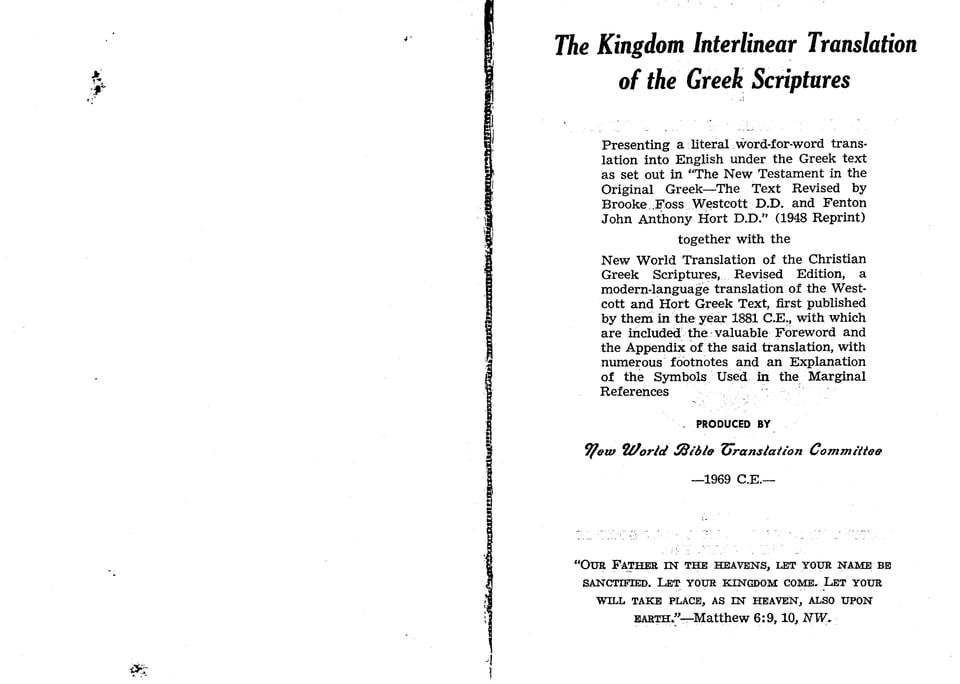
The Kingdom Interlinear Translation of the Greek Scriptures
Presenting a literal word-for-word translation into English under the Greek text as set out in "The New Testament in the Original Greek—The Text Revised by Brooke Eoss Westcott D.D. and Fenton John Anthony Hort D.D." (1948 Reprint)
together with the
New World Translation of the Christian Greek Scriptures, Revised Edition, a modern-language translation of the Westcott and Hort Greek Text, first published by them in the year 1881 C.E., with which are included the valuable Foreword and the Appendix of the said translation, with numerous footnotes and an Explanation of the Symbols Used in the Marginal References
PRODUCED BY
New World Bible Translation Committee
1969 C.E.
"Our Father in the heavens, let your name be sanctified. Let your kingdom come. Let your will take place, as in heaven, also upon earth."—Matthew 6:9, 10, NW. by
WATCH TOWER BIBLE & TRACT SOCIETY OF PENNSYLVANIA
First Edition: 500,000 copies
PUBLISHERS WATCHTOWER BIBLE AND TRACT SOCIETY OF NEW YORK, INC. INTERNATIONAL BIBLE STUDENTS ASSOCIATION Brooklyn, New York, U.S.A.
BY WAY OF EXPLANATION
The inspired Greek Scriptures, completed near the end of the first century of our Common Era, are an indispensable part of the Sacred Scriptures inspired by the Creator of heaven and earth. In fact, the original Greek Scriptures give us the key to the proper understanding of the first and larger part of the Holy Bible, that is, the inspired Hebrew Scriptures commonly called The Old Testament. Comparatively few persons in this latter half of the twentieth century C.E. have studied the original language of the inspired Greek Scriptures so as to be able to pry directly into the basic thoughts of the original written text. The inspired Greek Scriptures were written, not in the ancient classical Greek nor in the modern Greek which dates from the fall of Constantinople in 1453 C.E., but in the common or koiné Greek of the first century of our Common Era, the international language of that time. Hence the koiné Greek of the divinely inspired Scriptures is a special study in itself.
Sincere searchers for eternal, life-giving truth desire an accurate understanding of the faith-inspiring Greek Scriptures, an understand that will not be confused by sectarian, denominational religious teachings but that is fortified by the knowledge of what the original language says and means. To aid such seekers of truth and life is the purpose behind the publishing of The Kingdom Interlinear Translation of the Greek Scriptures. Its literal interlinear English translation is specially designed to open up to the student of the Sacred Scriptures what the original koiné Greek basically or literally says, without any sectarian religious coloration.
In the broad left-hand column of the pages of the main material will be found the original koiné Greek text as revised (in 1881 C.E.) by the renowned Greek scholars B. F. Westcott and F. J. A. Hort, and in between the lines of the Greek text will be found the word-for-word English translation. In the slim right-hand column of the page will be found the twentieth-century language translation entitled "New World Translation of the Christian Greek Scriptures," in its latest revision. The word-for-word interlinear translation and the New World Translation are arranged parallel on the page, so that comparisons can be made between the two readings and the accuracy of any modern translation can be determined.
PARENTHESES: In the English interlinear readings parentheses occur. These denote that the English word or words enclosed are implied in the meaning of the Greek word above, according to its gender, number, antecedents or relation to context.
BRACKETS: In the English readings (interlinear and main) brackets occur. These denote that the word or words enclosed have been inserted by the translator to make some application that is shown by the Greek word or to show something that is understood along with the Greek word because of its grammatical form. For example, the Greek definite article for "the" may be used just by itself to denote a person. But this article may be in the feminine gender and according to the context it applies to a woman. Accordingly, for the enlightenment of the reader who is not familiar with Greek the word "woman" is inserted enclosed in brackets in the English reading.
DOUBLE BRACKETS: In the Greek text and also in the English renderings double brackets are to be found. These enclose matter that the producers of the Westcott and Hort Greek text consider to be interpolations. Such interpolations may be things omitted by certain recognized Greek manuscripts or may be important matter "apparently derived from extraneous sources," as, for instance, the alternate conclusions to Mark's Gospel. See above-mentioned "New Testament," page 583, under "Noteworthy Rejected Readings printed within double brackets."
ARTICLE: The koiné Greek has a definite article, in three genders, masculine, feminine and neuter, and each of these genders of the article is declined in its five cases and in its singular and plural numbers. The Greek has no indefinite article. Consequently no indefinite article, "a" or "an," is to be found in the English interlinear reading. The indefinite article has to be inserted by the translator into the main English reading in the right-hand column where such indefinite article is appropriate or warranted by the Greek text. For example, the Greek words for "holy spirit" occur in numbers of instances with no definite article and are rendered accordingly into English.
OMITTED VERSES: Verses found in the Authorized or King James Version Bible of 1611 C.E. but not found in the Westcott and Hort Greek text are omitted and are indicated by the verse number followed by a long dash.
FOOTNOTES: The footnotes use symbols that are significant and these are explained in the section (pages 26-31) entitled "Explanation of the Symbols Used in the Marginal References." Footnotes also refer to the Foreword and the Appendix as found in the New World Translation of the Christian Greek Scriptures, 1950 edition, and so such Foreword and Appendix have been included in this volume.
In the firm conviction that this volume will be of great help to readers in the understanding of the original inspired Greek Scriptures we take pleasure in offering this Bible aid to the public.
THE PUBLISHERS
FOREWORD
From the time of that Roman Catholic clergyman, John Wycliffe, of the fourteenth century, until the middle of this twentieth century many English translations have been made of the inspired writings of Christ's disciples. All these have had their own commendable features. They have considerably met the needs of the day for a rendering of God's Word in the common language of the people. Much good has been accomplished by them and will yet be. But honesty compels us to remark that, while each of them has its points of merit, they have fallen victim to the power of human traditionalism in varying degrees. Consequently, religious traditions, hoary with age, have been taken for granted and gone unchallenged and uninvestigated. These have been interwoven into the translations to color the thought. In support of a preferred religious view, an inconsistency and unreasonableness have been insinuated into the teachings of the inspired writings.
a Called "Christian" to distinguish them from the pre-Christian Greek Septuagint translation of the inspired Hebrew Scriptures.
The Son of God taught that the traditions of creed-bound men made the commandments and teachings of God of no power and effect. The endeavor of the New World Bible Translation Committee has been to avoid this snare of religious traditionalism. This very effort accounts for distinguishing this differently as a translation of the "Christian Greek Scriptures." It is a traditional mistake to divide God's written Word into two sections and call the second section, from Matthew to Revelation (or Apocalypse), "The New Testament." At 2 Corinthians 3:14 the popular King James Bible version tells of the "reading of the old testament," but there the apostle was not referring to the ancient Hebrew Scriptures in their entirety from Genesis to Malachi. Nor was he meaning that the inspired Christian writings constituted a "new testament." The apostle was merely speaking of the book written by Moses in which the old Law covenant with Israel is fully set forth; for which reason he says, in the next verse, "when Moses is read." The sacred Scriptures, from Genesis to Revelation (Apocalypse), are one Book, inspired by the one Supreme Author. They cannot be divided into two parts, one of which may be ignored. The Hebrew Scriptures and the Christian Greek Scriptures are essential to each other. The latter supplement the former and are an integral part with the former to make the one complete Book of divine truth. Till now we have been able to translate only the Christian Greek Scriptures.
The apostle Peter wrote: "But there are new heavens and a new earth that we are awaiting according to his promise, and in these righteousness is to dwell." (2 Peter 3:13) The signs now multiply to prove that this generation is at the portals of the new world here promised. There no uninspired human traditions which bedarken and nullify the divine Word will be permitted, for that will be a righteous world. It befits the significant time of transition from the old world to the righteous new world that translations of the Scriptures today should as far as possible eliminate the misleading influence of religious traditions which have their roots in paganism, that thus the pure truth of God's Word may shine forth in all its harmonious brilliance and with its convincing power.
No uninspired translator or committee of translators can claim any direct command from the Most High God to engage in translating the divine Word into another language. But translation of it is necessary, and that into many languages, if Christ's command for this momentous day is to be fulfilled:
"This good news of the kingdom will be preached in all the inhabited earth for the purpose of a witness to all the nations, and then the accomplished end will come." So, to do the work of translating is an opportunity and a privilege. In presenting this translation of the Christian Greek Scriptures our confidence has been in the help of the great Author of The Book. Our primary desire has been to seek, not the approval of men, but that of God, by rendering the truth of his inspired Word as purely and as consistently as our consecrated powers make possible. There is no benefit in self-deception. More than that, those who provide a translation for the spiritual instruction of others come under a special responsibility as teachers before the divine Judge. Hence our appreciation of the need of carefulness.
Archaic language we have disposed of altogether, even in prayers and addresses to God.
This means we have every where dropped using the now sanctimonious formal pronouns thou, thy, thine, thee and ye, with their corresponding verb inflections. The original Bible was written in the living language of the people of the day, Hebrew, Aramaic and Greek; and so the Bible characters addressed God and prayed to him in the same everyday language that they employed in speaking to their fellow creatures on earth. The translation of the Scriptures into a modern language should be rendered in the same style, in the speech forms current among the people. We offer no paraphrase of the Scriptures. Our endeavor all through has been to give as literal a translation as possible, where the modern English idiom allows and where a literal rendition does not for any clumsiness hide the thought. That way we can best meet the desire of those who are scrupulous for getting, as nearly as possible, word for word, the exact statement of the original. We realize that sometimes the use of so small a thing as the definite or indefinite article or the omission of such may alter the correct sense of the original passage.
Watch has been kept against taking liberties with texts for the mere sake of brevity or shortcuts and against substitution of a modern parallel, where the rendering of the original idea makes good sense. To each major word we have assigned one meaning and have held to that meaning as far as the context permitted. This, we know, has imposed a restriction upon our diction, but it makes for good cross-reference work and for a more reliable comparison of related texts or verses. At the same time, in order to bring out the richness and variety of the language of the inspired writers, we have avoided the rendering of two or more Greek words by the same English word, for this hides the distinction in shade of meaning between the several words thus rendered. Attention has been given to the tenses of verbs to bring out the intended description of the action, position or state. As the reader becomes familiar with our translation he will discern more and more the harmony and interagreement of our renderings in all these respects.
The chapter and verse numbering follows that of the King James Version, thus making possible easy comparison. But, instead of making each verse a separate paragraph in itself, we have grouped verses into paragraphs for the proper development of a complete thought in all its context. Mindful of the Hebrew background of the Christian Greek Scriptures, we have followed mainly the Hebrew spelling of the names of
persons and places, rather than that of the Greek text which imitates the Greek Septuagint Version (LXX) of the Hebrew Scriptures.
THE DIVINE NAME: One of the remarkable facts, not only about the extant manuscripts of the original Greek text, but of many versions, ancient and modern, is the absence of the divine name. In the ancient Hebrew Scriptures that name was represented by the four letters יהוה, generally called the "Tetragrammaton" and represented by the English letters JHVH (or YHWH). In the Hebrew Scriptures the name, represented by this Tetragrammaton, occurs 6,823 times. The exact pronunciation of the name is not known today, but the most popular way of rendering it is "Jehovah." The abbreviation for this name is "Jah" (or "Yah"), and it occurs in many of the names found in the Christian Greek Scriptures. Also in the exclamation Alleluia! or, Hallelujah! found four times, at Revelation 19:1, 3, 4, 6, and meaning "Praise Jah!"
As the Christian Greek Scriptures were an inspired addition and supplement to the sacred Hebrew Scriptures, this sudden disappearance from the Greek text seems inconsistent, especially when James said to the apostles and older disciples at Jerusalem about the middle of the first century: "Symeon has related thoroughly how God for the first time turned his attention to the nations to take out of them a people for his name." (Acts 15:14) Then in support James made a quotation from the Hebrew Scriptures where the divine name occurs twice. If Christians are to be a people for God's name, why should his name, represented by the Tetragrammaton, be abolished from the Christian Greek Scriptures? The usual traditional explanation for this no longer holds. It was long thought that the basis for such failure of the divine name in our extant manuscripts was the absence of the name in the Greek Septuagint Version (LXX), the first translation of the Hebrew Scriptures which began to be made in the third century B.C. This thought was based upon the copies of LXX as found in the great manuscripts of the fourth and fifth centuries A.D.: the Vatican No. 1209, the Sinaitic, the Alexandrine, and the Ambrosianus. In these the distinctive name of God was rendered by the Greek words Kύριος (ky'ri·os) with or without the definite article and Θεός (the·os'). This namelessness was viewed as an aid to teaching monotheism.
This popular theory has now been flatly disproved by the recently found remains of a papyrus roll of LXX. This contains the second half of the book of Deuteronomy.
Not one of these fragments shows an example of Kúqiος or Θεός used instead of the divine name, but in each instance the Tetragrammaton is written in Aramaic characters. By permission of its owners we have reproduced photographs of fragments of the papyrus roll that our readers may examine these occurrences of the Tetragrammaton in such an early copy of LXX.a Authorities fix the date for this papyrus at the 2d or 1st century B.C. This means about a century or two after the LXX was begun. It proves that the original LXX did contain the divine name wherever it occurred in the Hebrew original. Considering it a sacrilege to use some substitute as ky'rios or the os', the scribes inserted the Tetragrammaton (התרגמה) at its proper place in the Greek version text.
Did Jesus Christ and his disciples who wrote the Christian Greek Scriptures have copies at hand of the Greek Septuagint with the divine name appearing therein in the form of the Tetragrammaton? Yes! The Tetragrammaton persisted in copies of LXX for centuries after Christ and his apostles. About A.D. 128 Aquila's Greek version had the Tetragrammaton in archaic Hebrew letters. About A.D. 245 Origen produced his famous Hexapla, this being a six-column reproduction of the inspired ancient Scriptures, (1) in their original Hebrew and Aramaic, accompanied by (2) a transliteration into Greek, and the Greek versions by (3) Aquila, (4) Symmachus, (5) the Seventy (LXX), and (6) Theodotion. In the second column of the Hexapla, in the transliteration into Greek, the Tetragrammaton was written in Hebrew characters, whereas in columns 3, 4, and 5 the Greek versions of Aquila, Symmachus and LXX
all represented the Tetragrammaton by the similar Greek characters. a Origen, in a statement on Psalm 2:2, said that "in the most faithful manuscripts THE NAME is written in Hebrew characters, that is, not in modern, but in archaic Hebrew." b
A papyrus fragment of that same 3d century A.D., namely, P. Oxyrhynchus vii. 1007, is a fragment of Genesis of the LXX, and it abbreviates the Tetragrammaton by its first letter doubled, a doubled Yod (ZZ), the initial letter being written in the shape of a z with a horizontal stroke through the middle, the stroke being carried unbroken through both such Yod's.c
In the succeeding century Jerome says that ignorant readers of the LXX imagined the Tetragrammaton to be a Greek word and actually pronounced it "Pipi." In his Prologus Galeatus prefacing the books of Samuel and Malachi he says: "We find the four-lettered name of God (i.e., ישוב) in certain Greek volumes even to this day expressed in the ancient letters." And in his 25th letter to Marcella, written at Rome, A.D. 384, he treats of the ten names of God and says: "The ninth [name of God] is a tetragrammaton, which they considered ἀνεχφώ-νητον [an·ek·pho'nē·ton], that is, unspeakable, which is written with these letters, Iod, He, Vau, He. Which certain ignorant ones, because of the similarity of the characters, when they would find them in Greek books, were accustomed to pronounce Pi Pi."d
Thus down to the time of Jerome, the translator who produced the Latin Vulgate, there were Greek manuscripts of the ancient Hebrew Scriptures which still contained the divine name in its four Hebrew characters. e
One thing is now certain. Whether Jesus and his disciples read the Scriptures in their Hebrew (Aramaic) original or in tained.
Furthermore, the Hebrew itself is preserved to this day in the library at Caesarea which the martyr Pamphilus so diligently collected. I also was allowed by the Nazarenes who use this volume in the Syrian city of Beroea to copy it. In which it is to be remarked that, wherever the Evangelist makes use of the testimonies of the old Scripture, he does not follow the authority of the seventy translators, but of the Hebrew."—Catal. Script. Eccl.
Matthew made more than a hundred quotations from the inspired Hebrew Scriptures. So where these quotations in-
thew 7:29 tells us: "He was teaching them as a person having authority, and not as their scribes." In the hearing of his faithful apostles Jesus prayed to Jehovah God, saying: "I have made your name manifest to the men you gave me out of the world. . . . I have made your name known to them and will make it known." (John 17:6, 26) The Jewish Talmud accuses Jesus of having performed his miracles by the pronouncing of the divine name; which is an indirect admission on the part of his enemies that he did use the name.
The question now before us is: Did Jesus' inspired disciples use the divine name in their writings? That is, Did God's name appear in the original writings of the Christian Greek
But all the writers of the Christian Greek Scriptures quoted
Scriptures? We have basis for answering Yes. In recent years some have claimed that Matthew's gospel account was at first written in Hebrew rather than in its kindred language, the Aramaic. It is contended that Matthew and the early Christians produced this account to become the last book of the canon of the Hebrew Scriptures as, till then, the canon of the Christian Greek Scriptures had not been contemplated. There is evidence that various recensions of the Hebrew and Aramaic versions of Matthew's account persisted for centuries among the early Jewish Christian communities of Palestine and Syria. Early writers, such as Pa'pi-as, Hegesippus, Jus'tin Martyr, Ta'tian, Sym'ma·chus, I·re·nae'us, Pantaenus, Clem'ent of Alexandria, Or'i·gen, Pam'phi·lus, Eu·se'bi·us, Ep·i·pha'-
from the Hebrew Scriptures or from the LXX at verses where the Name appears, and they could follow the style then true of copies of the LXX by using the Tetragrammaton in their Greek writings.
The evidence is, therefore, that the original text of the Christian Greek Scriptures has been tampered with, the same as the text of the LXX has been. And, at least from the 3d century A.D. onward, the divine name in Tetragrammaton form has been eliminated from the text by copyists who did not understand or appreciate the divine name or who developed an aversion to it, possibly under the influence of anti-Semitism. In place of it they substituted the words ky'ri·os (usually
nius and Je-rome', give evidence that they either possessed or had access to Hebrew and Aramaic writings of Matthew. Jerome, of the 4th and 5th centuries A.D., had this to say:
"Matthew, who is also Levi, and who from a publican came to be an Apostle, first of all the Evangelists, composed a Gospel of Christ in Judaea in the Hebrew language and characters, for the benefit of those of the circumcision who had believed. Who translated it into Greek is not sufficiently ascertranslated "the Lord") and the os', meaning "God."
RESTORING THE NAME: What is the modern translator to do? Is he justified, yes, authorized, to enter the divine name into a translation of the Christian Greek Scriptures? Every Greek reader must confess that in the LXX the Greek words ky'ri-os and the os' have been used to crowd out the distinctive name of the Supreme Deity. Every comprehensive Greek English dictionary states that these two Greek words have FOREWORD
been used as equivalents of the divine name. a Hence the modern translator is warranted in using the divine name as an equivalent of those two Greek words, that is, at places where Matthew, etc., quote verses, passages and expressions from the Hebrew Scriptures or from the LXX where the divine name occurs.
From the 14th century A.D. forward, translations of parts or of all the Christian Greek Scriptures have been made into the ancient classical Hebrew. The Shem Tob version of Matthew into Hebrew was made about A.D. 1385. When coming
FOREWORD
Greek Scriptures. To avoid overstepping the bounds of a translator into the field of exegesis, we have tried to be most cautious about rendering the divine name, always carefully considering the Hebrew Scriptures. We have looked for some agreement with us by the Hebrew versions we consulted to confirm our own rendering. Thus, out of the 237 times that we have rendered the divine name in the body of our version, there are only two instances where we have no support or agreement from any of the Hebrew versions. But in these two instances, namely, Ephesians 6:8 and Colossians 3:13, we
upon quotations from the Hebrew Scriptures where the Name appeared, the translators into Hebrew had no other recourse than to render ky'ri-os or the os' back into its original Tetragrammaton form. Thus in that early Shem Tob version of Matthew the Tetragrammaton occurs 16 times. All together, the appearances of the sacred Tetragrammaton in the 19 Hebrew versions to which we have had access total up to 307 distinct occurrences. These have thus restored the divine name to the inspired Christian Scriptures.
How is a modern translator to know or determine when to render the Greek words Kύριος and Θεός into the divine name in his version? By determining where the inspired Christian writers have quoted from the Hebrew Scriptures. Then he
feel strongly supported by the context and by related texts in rendering the divine name. The notes in our lower margin show the support we have for our renderings from the Hebrew versions and other authorities.
Not in all cases where the divine name is shown in the lower margin have we rendered it in the main body of our version. Thus there are 72 instances where the divine name is shown in the margin alone, but not incorporated into the text, the warrant not being strong enough.
On pages 26 to 31 we give the list of the Hebrew versions as well as other publications to which we have resorted for support of our renderings, not only of the divine name but also of other valuable features. Because the letter I corre-
must refer back to the original to locate whether the divine name appears there. This way he can determine the identity to give to ky'ri-os and the os' and he can then clothe them with personality.
Realizing that this is the time and place for it, we have followed this course in rendering our version of the Christian
A Greek-English Lexicon of the New Testament, by J. H. Thayer, 1887 edition, page 365, says under Kúqiως: "c. this title is given a. to God, the ruler of the universe (so the Sept. for יהוּד, יהוּד, יהוּד and יהוּד [a·do·nai', e·lo'ah, e·lo·him', Je·ho'vah and Jah])." On page 287 it says, under θεός: "Sept. for יהוּד, יהוּד and יהוּד [el, e·lo·him' and Je·ho'vah]." Says A Greek-English Lexicon, by Liddell and Scott, 1948 edition, on
also of other valuable features. Because the letter J corresponds with the first letter of the Tetragrammaton, we have designated them all under the letter J, but have added a superior number after in order to differentiate them. See pages 20, 21 for a photographic reproduction of the title page and of a sample page of one such Hebrew version by a Roman Catholic translator in 1668, a whom we have listed as J 9.
Doubtless for many of our readers a support for our rendering of the divine name comes from an unexpected source. We do not claim ours to be the first version to introduce it into the English translation of the Christian Greek Scriptures. Our list on page 22 shows that an American version of 1864 pre-
An Intermediate Greek-English Lexicon, 1888, based on Liddell and Scott 7th edition, page 458, said: "II. δ Kύριος, the LORD,=Hebrew JEHOVAH, LXX."
"A Greek and English Lexicon to the New Testament, by J. Parkhurst, revised edition of 1845, says, on page 347, under KY'PIOΣ: "III. In LXX it answers to the several names or titles of God, ישוב, ישוב, ישוב, ישוב, but far most frequently to ישוב: . . . In the New Testament, like Kúqios, when used as a name of God, though it sometimes answers to ישוב, yet it most usually corresponds to ישוב Jehovah, and in this sense is applied."
a The title page, reproduced on the next page (20), is in Hebrew and Latin and reads: "The Four Evangels from the New Law which have been translated from the Latin Tongue into the Hebrew Tongue at the hand of John Baptist Jonah [followed by the equivalent of this in Latin] and he dedicated them as an offering to the holy high priest Clement IX [Latin: dedicated to our most holy lord, Clement IX, Pontifex Maximus]. Printed here at Rome on the Press belonging to the Sacred Congregation for the Propagation of the Faith, in the year 1668 of the coming of our Messiah [at Rome, on the press of the S. C. Prop. Fidei, in the year 1668]." Around the picture the Latin text says: "Going into all the world, preach the good news to every creature." (See page 21.)
EVANGELIVM
Portes logebantur at inucem.
Transfamus ofque bothlebem,
of videamus hoc verbum, quod
iodum eft, quod Dominus often
dit nobis. 16. Et venerunt fe-
finantes: inuenerunt Mar-
iam. Joseph, infantem,
poftum in praetio. 17. Video
EVANGELIA NOVI TESTAMENTI
Ex Latino in Hebraicum fermonem verfa
AB IOANNE BAPTISTA NA;
האלגוריתם בינוני בינוני בינוני בינוני
האלגוריתם בינוני בינוני בינוני
SANCTISS. D. N.
Above we have reproduced page 194 of this Jonah version, setting forth the gospel according to Luke, chapter 2, verses 15-25, in Hebrew and Latin in parallel columns. In the Hebrew column we find the Tetragrammaton (טפרמטon) on lines 21, 22 opposite verse 23; and on lines 23, 25 opposite verse 24.
Parts of the Holy Bible have already been translated into more than 1,100 languages and dialects.
From the 18th century forward the non-Hebrew translators have in many cases found no proper equivalent in the languages into which they were translating the Christian Greek Scriptures, and hence they have used the divine name in suitable native spelling. That our readers may appreciate something of the extent to which the divine name is published in missionary versions of the Christian Greek Scriptures, we print on the preceding page a chart. It shows 20 vernacular forms of "Jehovah" used in 38 versions, and the languages in which each form is used respectively. On pages 24, 25 we are pleased to reproduce photographically parts of pages of several such versions of the Christian Greek Scriptures using the divine name in the text.
ceded us, but only on a limited scale; it rendered the name "Jehovah" 18 times from Matthew to Acts. We have listed this as J21 , and our footnotes show where its renderings occur and agree with ours. But we may be the first to render the name consistently throughout the 237 times in the main body of our text. However, many English readers will be surprised to learn that further support of our rendering of the Name comes from many non-Hebrew missionary sources.*
VERSIONS OF THE CHRISTIAN GREEK SCRIPTURES IN 38 LANGUAGES OTHER THAN ENGLISH OR HEBREW USING A VERNACULAR FORM OF THE TETRAGRAMMATON (See collection of American Bible Society, New York)
CHART
There can be no real objection for these translations to do so provided they reproduce the divine name at places where the Hebrew Scriptures show the background and validity for it. For corresponding reasons no reasonable mind can find Scrip tural objection to our doing so in this English version. Rather, as our readers familiarize themselves with this version, they will rejoice over the added clearness it imparts to many scrip tures not distinctly discerned before.
While inclining to view the pronunciation "Yahweh" as the more correct way, we have retained the form "Jehovah" because of people's familiarity with it since the 14th century. Moreover, it preserves, equally with other forms, the four letters of the Tetragrammaton JHVH.
New World Bible Translation Committee. February 9, 1950, New York, N.Y.
No.1 shows part of page 66 of the 1902 version of the Gabun language, setting forth Matthew 22:37 to 23:5. Note the appearances of the name Jehovah in verses 37 and 44, in contrast with Jesus (Jisu).
No.2 shows part of the page of the 1939 version in the Malagasy language, setting forth Matthew 4:6 to 5:8. The name Jehovah will be seen at Matthew 4:7,10, in contrast with Jesus (Jesosy).
No. 3 shows page 1194 of the 1816 version in the Hawaiian language, setting forth Mark 12:7-32. The name Jehovah appears at verses 11, 29, 30 in contrast with Jesu (Iesu).
EXPLANATION OF THE SYMBOLS USED IN THE MARGINAL REFERENCES
\ (Aleph)
Sinaitic MS. An uncial Greek manuscript of the 4th century, in codex form. Originally it evidently contained the whole Bible, including all the Christian Greek Scriptures. It is at present possessed by the British Museum, London, England.
A
Alexandrine MS. An uncial Greek manuscript of the 5th century, in codex form. When complete, it contained the whole Bible, including the Christian Greek Scriptures, all now but Matthew 1:1 to 25:6; John 6:50 to 8:52; 2 Corinthians 4:13 to 12:6. It is at present possessed by the British Museum, London, England.
Arm
Armenian Version. It is of the 5th century, or even as early as the beginning of the 4th century. However, the manuscripts are, for the Gospels, of the 9th and 10th centuries, and, for the other books, of the 13th century or later. This version was made from Syriac and Greek codices. Copies are found in Moscow (Russia), Armenia, Istanbul (Turkey), and Venice (Italy).
B
Vatican MS. No. 1209. An uncial Greek manuscript of the 4th century and considered earlier than \aleph. It is in codex form and contained originally the whole of the Greek Bible,
but in the Christian Greek Scriptures it now lacks Hebrews 9:14 to 13:25; 1 and 2 Timothy, Titus, and the Revelation (Apocalypse). It is catalogued as in the Vatican Library at Rome, Italy, from A.D. 1481, at least.
C
Codex Ephraemi rescriptus. This uncial Greek manuscript is a palimpsest, of the 5th century, and contains parts of the Gospels, Acts, the Epistles and the Revelation. It originally contained the whole Greek Bible, but in the 12th century the original writing was effaced, and what remains of the volume was used to receive a Greek version of some treatises by the ecclesiastic Ephraem of Syria. It is now possessed by the National Library at Paris, France.
D
Codex Bezae. Under this symbol we include the Cambridge MS. (Cantabrigensis) (D) and the Clermont MS. (Claromontanus) ( D_{2} ). Both MSS. are of the 6th century. The Codex Cantabrigensis, now possessed by the University of Cambridge, England, contains nearly all the Gospels, parts of the Acts, with a Latin translation; and a Latin translation of 3 John 11-15. The Codex Claromontanus, from the monastery of Clermont, but now in the National Library at Paris, France, contains the letters of the apostle Paul, all but a few verses,
with a Latin translation. Both manuscripts were originally acquired by Theodore Beza, the 16th-century Biblical scholar.
It
J
Reference works used principally with regard to the divine name "Jehovah" (ההוב). The 21 different reference works are distinguished by a superior number after the letter, from J1 to J21 , for the list of which see below pages 28-30.
LXX
The Seventy or the Greek Septua-gint Version of the inspired Hebrew Scriptures. This Greek version was
begun in the 3d century B.C. (about 280), when the Pentateuch, or five books of Moses, was translated, and continued until the 1st century B.C. Copies of the LXX are found in the above-mentioned codices X, B and A.
P
Papyrus fragments of the Chester Beatty collections Nos. 1, 2 and 3, and designated P45,P46 and P47. P45 (Chester Beatty 1) includes fragments assigned to the 3d century A.D. and is now located at London, England. The fragments are of the Gospels principally.
P46 (Chester Beatty 2) includes fragments assigned to the 3d and 4th centuries and which are of Romans, 1 and 2 Corinthians, Galatians, Ephesians, Philippians, Colossians, 1 Thessalonians and Hebrews. Some of these fragments are located at London, England, and some at Ann Arbor, Michigan, U.S.A.
P47 (Chester Beatty 3) includes fragments assigned to the 3d century and which are of the Revelation, chapters 9 to 17. These are now located at London, England.
Sy
Syriac Peshitta Version. Parts of it may be of Jewish origin, but it was made for Syriac Christians. It is basically a translation directly of the Hebrew Scriptures, although made with some consideration of the Greek Septuagint. Its most valuable manuscript for the translation of the entire Hebrew Bible is the 6th- or 7th-century codex in the Ambrosian Library, Milan, Italy. An earlier manuscript has a date corresponding with A.D. 464.
Syriac Versions. The Syriac (or Christian Aramaic) is related to the Hebrew language.
Sy c = the Curetonian Syriac. A manuscript in this old Syriac was discovered and published by Dr. W. Cureton. It contains parts of the four Gospels and is an Old Syriac version older than Sy p .
Syh = the Philoxenian Harkleian version, this being a 7th-century revision which Thomas of Harkel made of the 6th-century version of Philoxenus, of Mabug, Eastern Syria. This earlier version had been prepared for Philoxenus by one Polycarp. The revision which Thomas of Harkel made of this was to bring it from its free style into precise accord with the Greek text.
S yh 1 = the Jerusalem (Hierosolymitanum) version. From its resemblance to the Palestinian Targum it was called the Palestinian or Jerusalem Syriac. It includes a Gospel Lectionary (or book of readings from the Gospels) and other scriptures of the same version. It is related to the Old Syriac but is now assigned to the 6th century.
Vg
Vulgata Latina or Latin Vulgate. The Vulgate originally was a revision of the Old Latin text and was made by Eusebius Jerome, with reference to the original Hebrew and Greek of the Holy Scriptures. Begun A.D. 383, it was finished by him in 405.
We have consulted particularly the edition prepared in 1911 by J. Wordsworth and H. J. White, Novum Testamentum Latine secundum editionem Sancti Hieronymi ad Codicum Manuscriptorum Fidem. The footnotes of this give variant readings of the Sixtine edition and Clementine edition.
V gc=t h e C l e m e n t i n e r e c e n s i o n i s u e d i n t hree e d i t i o n s 1 5 9 2, 1 5 9 3 a n d
1598 by Pope Clement VIII. It differs from the Sixtine recension in about 3,000 places.
Vg s = the Sixtine recension issued by Pope Sixtus V in 1590, but which was recalled and suppressed 2 years later by Pope Clement VIII for the inaccuracy of its printing.
J1
Matthew in Hebrew. A version published by Jean du Tillet, Bishop of Brieux, France, from an ancient manuscript of Matthew in Hebrew found in Rome. This version was edited by J. Mercerus in Paris, 1555. See An Old Hebrew Text of Matthew's Gospel by Hugh J. Schonfield, Edinburgh, 1927, a copy of which is found at the New York Public Library.
J2
Matthew in Hebrew. About 1385 a Jew named Shem Tob ben Shaprut of Tudela in Castile, Spain, wrote a polemical work against Christianity entitled Eben Bohan in which he incorporates Matthew in Hebrew as a separate chapter. (Cursive manuscripts of Shem Tob's Eben Bohan are found at the Jewish Theological Seminary of America, New York city.)
J3
Matthew and Hebrews in Hebrew. Sebastian Münster revised and completed an imperfect manuscript copy of Shem Tob's Matthew. This he published and printed in Basel, Switzerland, in 1537. Later, in 1557, Münster published his Hebrew version of the Epistle to the Hebrews. (A copy is found at the New York Public Library.)
Matthew in Hebrew. A revision of Munster's Matthew made and published by Johannes Quinquarboreus, Paris, France, 1551. (A copy is found at the New York Public Library.)
J5
Liturgical Gospels in Hebrew. In 1574 Frederick Petri, a converted Jew, published a Hebrew version of the Liturgical Gospels, which he translated from the Greek. This was later carefully revised for republication in 1581 by C. Plantin at Antwerp, Belgium. (A copy is found at the New York Public Library.)
J 6
Liturgical Gospels in Hebrew. In 1576 J. Claius published his translation of the Liturgical Gospels into Hebrew. (A copy is found at the New York Public Library.)
J7
Greek Scriptures in Hebrew. In 1599 Elias Hutter of Nuremburg, Germany, published his translation of all the Christian Greek Scriptures into Hebrew. This was the first complete Hebrew version of all the canonical Christian Greek Scriptures, forming a part of Hutter's Polyglott New Testament of 1599. (A copy is found at the New York Public Library.)
J8
Greek Scriptures in Hebrew. In 1661, at London, England, William Robertson, a teacher of Hebrew at Cambridge University, published his careful revision of Hutter's version of the Christian Greek Scriptures in Hebrew. (A copy is found at the New York Public Library.)
Gospels in Hebrew. In 1639 John Baptist Jonah, a Jew who joined the Roman Catholic Church, completed his translation of the four Gospels into Hebrew from the Latin Vulgate. Jonah was a professor of Hebrew in the Roman Academy, Rome. His Hebrew translation was finally published in Rome in 1668 by the Sacred Congregation of Propaganda (S.C. Prop. Fidei). It contained a page of dedication to Pope Clement IX. See page 20 for illustration. (A copy is found at the Union Theological Seminary, New York city.)
J10
Gospels in Hebrew. In 1800 in London, England, Dr. Richard Caddick published his revision of the Hutter-Robertson version of the Gospels. (A copy is found at the New York Public Library.)
J11
Greek Scriptures in Hebrew. Soon after the foundation of the London Jewish Society, its secretary, T. Fry, assisted by G. B. Collyer and other scholars, made a fresh translation of the Christian Greek Scriptures into Hebrew. The version was published in London, England, in 1817. (A copy is found at the New York Public Library.)
J12
Greek Scriptures in Hebrew. In London, England, in 1831, W. Greenfield published his Hebrew version of the Christian Greek Scriptures. (A copy of the edition of 1851 is found in the library of the American Bible Society, New York city.) J113
Greek Scriptures in Hebrew. In 1838 the London Jewish Society published another Hebrew version as translated by A. McCaul, J. C. Reichardt, S. Hoga and M. S. Alexander. (A copy of the edition of 1872 is found in the library of the American Bible Society, New York city.)
J14
Greek Scriptures in Hebrew. In London, England, in 1846, John Christian Reichardt's version of the Christian Greek Scriptures was published. (A copy of the edition of 1853 is found in the library of the American Bible Society, New York city.)
J15
Luke, Acts, Romans and Hebrews in Hebrew. By 1855 in Berlin, Germany, Joachim Heinrich Raphael Biesenthal had published his translations of the above four books into Hebrew. (A copy is found at the New York Public Library.)
J16
Greek Scriptures in Hebrew. In 1866 the London Jewish Society published yet a third Hebrew version of the Christian Greek Scriptures under its auspices as jointly translated by John Christian Reichardt and Joachim Heinrich Raphael Biesenthal. (A copy is found at the New York Public Library.)
J17
Greek Scriptures in Hebrew. In Leipzig, Germany, in 1877, Franz Delitzsch completed his first translation of the Christian Greek Scriptures into Hebrew. By 1892, two
years after his death, there had been published ten editions containing his further revisions of the text. The editions we consulted were printed in Germany in 1892 and in 1937 for the British and Foreign Bible Society, London, England.
J18
Greek Scriptures in Hebrew. In London, England, in 1885, a new Hebrew translation of the Christian Greek Scriptures was published. This new translation was commenced by Isaac Salkinson and completed after his death by Christian David Ginsburg. Our oldest copy is of the third edition published in 1891. This has been compared with the small edition published by the Trinitarian Bible Society, London, England, in 1939, and also with the Hebrew-English New Testament published in 1941 by the same Society.
J19
John in Hebrew. In 1930 the British Jews Society of Haifa, Palestine (now in the Republic of Israel), published a Hebrew translation of the gospel of John as arranged by T. C. Horton. (A copy is found at the library of the American Bible Society, New York city.)
J20
A Concordance to the Greek Testament, by W. F. Moulton and A. S. Geden, published by T. & T. Clark in 1897 at Edinburgh, Scotland. Principally in the Scripture references under Θ E O′ Σ and KY'PIO Σ it intersperses parts of the Hebrew text containing the Tetragramma-ton (תרגמרמות) to which the Greek text refers or from which it makes a quotation.
J21
"The Emphatic Diaglott containing the Original Greek Text of what is commonly styled the New Testament (according to the Recension of Dr. J. J. Griesbach) with an Interlinear Word for Word English Translation. A New Emphatic Version" by Benjamin Wilson, a newspaper editor at Geneva, Ill. The issuing of it part by part extended over a period of seven years, ending in 1863. When afterward bound together, the whole bore the date 1864. The first edition to be issued at once in complete form (which was really
the 2d edition) was published by Fowler & Wells, New York city, in 1865. In 1902 the copyright and plates of The Emphatic Diaglott were bought from the Fowler & Wells Company and were presented by the buyer as a gift to the Watch Tower Bible & Tract Society, who are the present owners and publishers of this emphatic translation of the Christian Greek Scriptures. The name "Diaglott" is understood to mean "interlinear." It appears to be the first American translation to introduce the name "Jehovah" into the English text of the Christian Greek Scriptures.
PLURAL NUMBER of "YOU" and VERBS
"You" printed in all capital letters denotes the plural number of this pronoun. Also where the plural number of a verb is not certainly ap- parent to the reader it is indicated by printing the VERB in all capitals.
NAMES AND ORDER OF THE BOOKS of the Christian Greek Scriptures
<tr><th>Book
Page
Book
Page
MATTHEW
1 TIMOTHY
MARK
2 TIMOTHY
LUKE
TITUS
JOHN
PHILEMON
ACTS
HEBREWS
ROMANS
JAMES
1 CORINTHIANS
1 PETER
2 CORINTHIANS
2 PETER
GALATIANS
1 JOHN
EPHESIANS
2 JOHN
PHILIPPIANS
3 JOHN
COLOSSIANS
JUDE
1 THESSALONIANS
REVELATION
2 THESSALONIANS
Alphabetical Index and Marginal Abbreviations of the Books of the Christian Greek Scriptures
Book
Abbreviation Page
Book
Abbreviation Page
ACTS
Ac
MARK
Mr
COLOSSIANS
Col
MATTHEW
Mt
CORINTHIANS,1
1Co
PETER,1
1Pe
CORINTHIANS,2
2Co
PETER,2
2Pe
EPHESIANS
Eph
PHILEMON
Phm
GALATIANS
Ga
PHILIPPIANS
Php
HEBREWS
Heb
REVELATION
Re
JAMES
Jas
ROMANS
Ro
JOHN
Joh
THESSALONIANS,1
1Th
JOHN,1
1Jo
THESSALONIANS,2
2Th
JOHN,2
2Jo
TIMOTHY,1
1Ti
JOHN,3
3Jo
TIMOTHY,2
2Ti
JUDE
Jude
TITUS
Tit
LUKE
Lu
KATA MAΘΘAION ACCORDING TO MATTHEW
Βίβλος γενέσεως 'ιησού Χριστού υίοὺ Book of origin of Jesus Christ son Δαυείδ υίοὺ 'Αβραάμ. of David son of Abraham.
'Αβραάμ ἐγέννησεν τὸν 'ισαák, 'ισακ Abraham generated the Isaac, Isaac δè ἐγέννησεν τὸν 'ιακώβ, 'ιακώβ but generated the Jacob, Jacob but ἐγέννησεν τὸν 'Ioúδαν καὶ τοὺς αδελφους generated the Judah and the brothers αὐτοὺ, 3 'Ioúδας δè ἐγέννησεν τὸν of him, Judah but generated the Φαρές και τὸν Zαρὰ ἐκ τῆς Θάμαρ, Φαρές Perez and the Zerah out of the Tamar, Perez δè ἐγέννησεν τὸν 'Εσρώμ, 'Εσρώμ δè ἐγέννησεν but generated the Hezron, Hezron but generated τὸν 'Αράμ, 4 'Aράμ δè ἐγέννησεν τὸν the Ram, Ram but generated the 'Αμιναδάβ, 'Αμιναδάβ δè ἐγέννησεν τὸν Amminadab, Amminadab but generated the Ναασσών, Ναασσών δè ἐγέννησεν τὸν Σαλμών, Nahshon, Nahshon but generated the Salmon, 5 Σαλμών δè ἐγέννησεν τὸν Boëς ἐκ τῆς Salmon but generated the Boaz out of the 'Ραχάβ, Boëς δè ἐγέννησεν τὸν 'Ιωβήδ ἐk τῆς Rahab, Boaz but generated the Obed out of the 'Ρουθ, 'Ιωβήδ δè ἐγέννησεν τὸν 'Ιεσσαί, Ruth, Obed but generated the Jesse, 6 'Ιεσσαί δè ἐγέννησεν τὸν Δαυειδ τὸν Jesse but generated the David the βασιλέα. king.
Δαυειδ δè ἐγέννησεν τὸν Σολομών εὐκ David but generated the Solomon out of τῆς τοὺ Ούριου, 7 Σολομών δè ἐγέννησεν the [wife] of Uriah, Solomon but generated τὸν 'Poβoaμ, 'Poβoaμ δè ἐγέννησεν τὸν the Rehoboam, Rehoboam but generated the 'Aβιά, 'Aβιά δè ἐγέννησεν τὸν 'Aσάφ, Abijah, Abijah but generated the Asa, 8 'Aσάφ δè ἐγέννησεν τὸν 'Ιωσαφάτ, Asa but generated the Jehoshaphat,
1 The book of the history a of Jesus Christ, son of David, son of Abraham:
2 Abraham became father to Isaac; Isaac became father to Jacob; Jacob became father to Judah and his brothers; 3 Judah became father to Pe'rez and to Ze'rah by Ta'mar; Pe'rez became father to Hez'ron; Hez'ron became father to Ram; 4 Ram became father to Am·min'a·dab; Am·min'a·dab became father to Nah'shon; Nah'shon became father to Sal'mon; 5 Sal'mon became father to Bo'az by Ra'hab; Bo'az became father to O'bed by Ruth; O'bed became father to Jes'se; 6 Jes'se became father to David the king.
David became father to Sol'o·mon by the wife of Uri'ah; 7 Sol'o·mon became father to Re·ho·bo'am; Re·ho·bo'am became father to A·bi'jah; A·bi'jah became father to A'sa; 8 A'sa became father to Je·hosh'a-phat; Je·hosh'a·phat
1a Or, "line of descent; origin." See Appendix under Matthew 1:1.
'|ωσαφὰτ δὲ ἐγέννησεν τὸν '|ωράμ, '|ωρὰμ
Jehoshaphat but generated the Jehoram, Jehoram
δὲ ἐγέννησεν τὸν 'Oζείαν, 9 'Oζείας δὲ
but generated the Uzziah, Uzziah but
ἐγέννησεν τὸν '|ωαθάμ, '|ωαθὰμ δὲ ἐγέννησεν
generated the Jotham, Jotham but generated
τὸν "Αχας, "Αχας δὲ ἐγέννησεν τὸν 'Eζεκίαν,
the Ahaz, Ahaz but generated the Hezekiah,
10 'Eζεκίας δὲ ἐγέννησεν τὸν Μανασσή,
Hezekiah but generated the Manasseh,
Μανασσής δὲ ἐγέννησεν τὸν 'Αμώς, 'Αμώς δὲ
Manasseh but generated the Amon, Amon but
ἐγέννησεν τὸν '|ωσείαν, 11 '|ωσείας δὲ
generated the Josiah, Josiah but
ἐγέννησεν τὸν '|εχονίαν καὶ τοὺς ἀδελφούς
generated the Jechoniah and the brothers
αὐτοῦ ἐπὶ τῆς μετοικεσίας Βαβυλώνος.
of him upon the deportation of Babylon.
12 Μετὰ δὲ τὴν μετοικεσίαν Βαβυλώνος
After but the deportation of Babylon
'ιεχονίας ἐγέννησεν τὸν Σαλαθίήλ, Σαλαθίήλ
Jechoniah generated the Shealtiel, Shealtiel
δὲ ἐγέννησεν τὸν Zοροβάβελ, 13 Zοροβάβελ
but generated the Zerubbabel, Zerubbabel
δὲ ἐγέννησεν τὸν 'Αβιούδ, 'Αβιούδ δὲ ἐγέννησεν
but generated the Abiud, Abiud but generated
τὸν 'Ελιακείμ, 'Ελιακείμ δὲ ἐγέννησεν τὸν
the Eliakim, Eliakim but generated the
'Aζώρ, 14 'Aζώρ δὲ ἐγέννησεν τὸν Σαδώκ,
Azor, Azor but generated the Zadok,
Σαδώκ δὲ ἐγέννησεν τὸν 'Αχείμ, 'Αχείμ δὲ
Zadok but generated the Achim, Achim but
ἐγέννησεν τὸν 'Ελιούδ, 15 'Ελιούδ δὲ ἐγέννησεν
generated the Eliud, Eliud but generated
τὸν 'Ελεάζαρ, 'Ελεάζαρ δὲ ἐγέννησεν τὸν
the Eleazar, Eleazar but generated the
Μαθθάν, Μαθθάν δὲ ἐγέννησεν τὸν 'ιακώβ,
Matthan, Matthan but generated the Jacob,
16 'ιακώβ δὲ ἐγέννησεν τὸν 'ιωσήφ τὸν
Jacob but generated the Joseph the
ἀνδρα Μαρίας, ἐξ ης ἐγεννήθη
husband of Mary, out of whom was generated
'ιησούς οὐ λεγόμενος Χριστός.
Jesus the (one) being said Christ.
17 Πασαι οὐν αὐ γενεαί ἀπὸ
All therefore the generations from
'Aβραὶμ ἐως Δαυειδ γενεαί δεκατέσσαρες,
Abraham until David generations fourteen,
και ἀπὸ Δαυειδ ἐως τὸς μετοικεσίας
and from David until the deportation
became father to Jeho'ram; Jeho'ram became father to Uz·zi'ah; 9 Uz·zi'ah became father to Jo'-tham; Jo'tham became father to A'haz; A'haz became father to Hez-e·ki'ah; 10 Hez·e·ki'ah became father to Ma-nas'seh; Ma·nas'seh became father to A'mon; A'mon became father to Jo·si'ah; 11 Jo·si'ah became father to Jec·o·ni'ah and to his brothers at the time of the deportation to Babylon.
12 After the deportation to Babylon Jeco·ni'ah became father to She·al'ti·el; Sheal'ti·el became father to Ze·rub'ba·bel; 13 Ze·rub'ba·bel became father to A·bi'ud; A·bi'ud became father to E·li'a·kim; E·li'a-kim became father to A'zor; 14 A'zor became father to Za'dok; Za'dok became father to A'chim; A'chim became father to E·li'ud; 15 E·li'ud became father to El·e·a'zar; El·e·a'zar became father to Mat'than; Mat'than became father to Jacob; 16 Jacob became father to Joseph the husband of Mary, of whom Jesus was born, who is called Christ.
17 All the generations, then, from Abraham until David were fourteen generations, and from David until the deportation to
Βαβυλώνος γενεαί δεκατέσσαρες, και of Babylon generations fourteen, and
ὀπὸ τῆς μέτοικεσίας Βαβυλώνος ἐως τοὺ from the deportation of Babylon until the χριστοὺ γενεαί δεκατέσσαρες. Christ generations fourteen.
18 Τοὺ δὲ 'ιησοῦ Χριστοὺ ή γένεσις οὖτως Of the but Jesus Christ the origin thus ην. Μνηστευθείσης τῆς was. Having been promised in marriage of the μητρὸς αὐτοὺ Μαρίας τῶ 'ιωσήφ, πρὸν mother of him Mary to the Joseph, before η or to come together them she was found in γαστρὸ ἐχουσα ἐκ πνεύματος ἀγίου. belly having out of spirit holy.
19 'ιωσήφ δὲ δὲ ἀνήρ αὐτῆς, δίκαιος Joseph but the husband of her, righteous υν και μή θέλων αὐτῆν being and not willing her δειγματισαι, ἐβουλήθη λάθρα to make a public spectacle of, intended secretly ἀπολύσαι αὐτῆν. 20 Ταὺτα δὲ αὐτοὺ to release her. These (things) but of him ἐνθυμηθέντος ιδού αγγελος Κυρίου κατ' having thought look! angel of Lord according to οναρ ἐφάνη αὐτῆ λέγων 'ιωσήφ υίους dream appeared to him saying Joseph son Δαυείδ, μή φοβηθής παραλαβείν of David, not you should be afraid to take along Μαρίαν τῆν γυναίκá σου, τὸ γὰρ εν Mary the wife of you, the (thing) for in αὐτῆ γεννηθέν ἐκ πνεύματός ἐστιν ἀγίου her generated out of spirit is holy;
21 τέξεται δὲ υίον και καλέσεις she will give birth to but son and you will call τὸ ονμα αὐτοὺ 'ιησοῦν, αὐτῆς γὰρ σώσει the name of him Jesus, he for will save τὸ λαὺν αὐτοὺ ἀπὶ τῶν ἀμαρτιών αὐτῆν. the people of him from the sins of them.
22 Τοὺτο δὲ δλον γέγονεν ἐνα This but whole has happened in order that πληρωθή τὸ ρηθέν ἐπὶ Κυρίου might be fulfilled the (thing) spoken by Lord διὰ τοὺ προφήτου λέγοντος 23 'ιδὴ through the prophet saying Look!
Babylon fourteen generations, and from the deportation to Babylon until the Christ fourteen generations.
18 But the birth of Jesus Christ was in this way. During the time his mother Mary was promised in marriage to Joseph, she was found to be pregnant by holy spirit before they were united. 19 However, Joseph her husband, because he was righteous and did not want to make her a public spectacle, intended to divorce her secretly. 20 But after he had thought these things over, look! Jehovah'sa angel appeared to him in a dream, saying: "Joseph, son of David, do not be afraid to take Mary your wife home, for that which has been begotten in her is by holy spirit. 21 She will give birth to a son, and you must call his name Jesus,b for he will save his people from their sins." 22 All this actually came about for that to be fulfilled which was spoken by Jehovahc through his prophet, saying: 23 "Look! The virgin
20 a Jeho'vah's, or, Yah'weh's), J 3,7-14,16-18; Kuvqiou (Lord's), B. See Foreword, pages 10 (under "The Divine Name") to 25. See Appendix under Matthew 1:20. 21 b Jesh'u·a; meaning "Jehovah is salvation"), J 1-14,16-18; 'Iησοῦς (Jesus), B. 22 c Jehovah (Yahweh), J 1-3,7-9, 11-14,16-18; the Lord, B.
η
παρθενος
εν
γαστρί
εζει
και
The virgin
in
belly
will have
and
τέξεται
υίόν,
καὶ
καλέσουσιν
τό
will give birth to son,
and
they will call
the
ὔνομα αύτοι
'Εμμανούήλ·
οἰ
έστιν
name of him
Immanuel;
which
is
μεθερμηνευόμενον
Μεθ'
ήμών
ό
Θεός.
being translated
With us
the
God.
'Εγερθείς
δè
ό
'Ιωσήφ
άπò
Having been awakened but the Joseph from
τοὺ
ἐπνου
έποίησεν
ώς
προσέταξεν
αὐτώ
the sleep
did
as
directed
to him
ό
ἀγγελος
Kuρίou
καὶ
παρέλαβεν
τήν
the angel
of Lord
and
he took along
the
γυναίκα
αὐτοι·
καὶ
οὐκ
έγίνωσκεν
woman
of him;
and
not
he was knowing
αὐτὺν
ἐως
οὐ
έτεκεν
υίόν·
καὶ
her
until
when
she gave birth to
son;
and
έκάλεσεν
τὸ ὔνομα
αὐτοι·
' Ιησούν.
he called
the name
of him
Jesus.
Τοὺ
δè
' Ιησοού
γεννηθέντος
έν
Of the but Jesus having been generated in
Βηθλεεμ
τὸς
' Ιουδαίας
έν
ήμέρας
Bethlehem
of the
Judea
in
days
'Ηρώδου
τοὺ
βασιλέως,
ίδοù
μάγοι
άπò
of Herod
the
king,
look!
magi
from
ὀνατολών
παρεγévοντο
εἴς
eastern parts
came to be alongside
into
'Ⅰεροσόλυμα
λέγουντες
Ποὺ
έστιν
ό
Jerusalem
saying Where is the (one)
τεχθείς
βασιλεύς
τών
' Ιουδαίων;
εἴδομεν
γὰρ
born
king
of the
Jews?
We saw
for
αὐτοι
τὸν
ὀστερα
έν
τή
ὀνατολή
of him
the star
in the
east
and
we came
προσκυνήσαι
αὐτώ.
'Ακούσας
δè
ό
to do obeisance
to him.
Having heard but the
βασιλεύς
' Ηρώδης
έταράχθη
καὶ
πασα
King
Herod
was agitated
and
all
'Ⅰεροσόλυμα
μετ’
αὐτοι,
καὶ
Jerusalem
with him,
συναγαγών
πάντας
having led together
all
καὶ γραμματείς
τοὺ
λαοù
έπuvθάνετο
and scribes
of the people
he was inquiring
παρ’
αὐτών
ποὺ
ό
χριστὸς
γεννάνται.
beside them
where the
Christ
is generated.
οί
δè
εἴπαν
αὐτώ
'Ev
The (ones)
but said to him In Bethlehem
will become pregnant and will give birth to a son, and they will call his name Imman'u·el," which means, when translated, "With Us Is God."
24 a Jehovah, J 2-4,7-14,10-18 ; the Lord, \aleph B. 4 b 'O Xqiστοός (the Christ), \aleph B; מְחֵישֶׁ (the Messiah; meaning "the Anointed One" ), J 1-14,16-18.
24 Then Joseph woke up from his sleep and did as the angel of Jehovah a had directed him, and he took his wife home. 25 But he had no intercourse with her until she gave birth to a son; and he called his name Jesus.
After Jesus had been born in Beth'-le·hem of Ju·de'a in the days of Herod the king, look! astrologers from eastern parts came to Jerusalem, 2 saying: "Where is the one born king of the Jews? For we saw his star when [we were] in the east, and we have come to do him obeisance." 3 At hearing this King Herod was agitated, and all Jerusalem along with him; 4 and on gathering together all the chief priests and scribes of the people he began to inquire of them where the Christ<sup>b</sup> was to be born. 5 They said to him: "In Beth'le·hem
τῆς 'louδαίας' οὐτως γὰρ γέγραπται of the Judea; thus for it has been written
διά τού προφήτου 6 Και σú, Bηθλεεμ through the prophet And you, Bethlehem
γή 'lούδα, οὓδαμώς ἐλαχίστη εἰ land of Judah, by no means least are
έν τοίς ηγεμόσιν 'lούδα' ἐκ σοû in the governors of Judah; out of you
γὰρ έξελευσεται ήγούμενος, δστις for will come forth governing one, who
ποιμανεί τόν λαόν μου τόν 'lσραήλ. will shepherd the people of me the Israel.
7 Τότε ‘Hρώδης λάθρα καλέ σας τούς Then Herod secretly having called the μάγους ἡκρίβωσεν παρ’ αὐτῶν τόν magi carefully ascertained beside them the χρόνον τού φαίνουμένου άστέρος, 8 και time of the appearing star, and πέμψας αὐτούς εἴς Βηθλεεμ εἴπεν having sent them into Bethlehem he said Πορειθέντες έξετάσατε ἀκριβώς περί Having gone on way search you carefully about τού παιδίου ἐπάν δè εἵρητε the young child; whenever but you might find ἀπαγγείλατέ μοι, δπως κάγω ἐλθών report back to me, so that also I having come προσκυνήσω αὐτῶν. 9 οἱ δè might do obeisance to it. The (ones) but ἀκούσαντες τού βασιλέως ἐπορεύθησαν, καì having heard of the king went their way, and ιδοù δὲ αστήρ οἱ εν τή ανάτολή look! the star which they saw in the east προηγεν αὐτούς, εἴδον ἐλθών ἐστάθηκε went ahead of them, until having come it stood έπάνω οἱ ην τό παιδίου. 10 ιδόντες above where was the young child. Having seen δè τόν ἀστέρα έχάρηση χαρὺ μεγάλην but the star they rejoiced joy great σφόδρα. 11 καὶ ἐλθόντες εἴς τὸν οἱ κίαν very much. And having come into the house εἴδον τό παιδίου μετὰ Μαρίας τής they saw the young child with Mary the μητρὸς αὐτού, καὶ πεσόντες mother of it, and having fallen down προσεκύνησαν αὐτῶν, καὶ ἀνοίζαвτες they did obeisance to it, and having opened τούς θησαυρούς αὐτῶν προσήγεγκαν αὐτῶν the treasures of them they presented to it δώρα, χρυσόν καὶ λίβανον καὶ σμύρναv. gifts, gold and frankincense and myrrh.
of Ju·de'a; for this is how it has been written through the prophet, 6 'And you, O Beth'le·hem of the land of Judah, are by no means the most insignificant [city] among the governors of Judah; for out of you will come forth a governing one, who will shepherd my people, Israel.'"
7 Then Herod secretly summoned the astrologers and carefully ascertained from them the time of the star's appearing; 8 and, when sending them to Beth'le·hem, he said: "Go make a careful search for the young child, and when you have found it report back to me, that I too may go and do it obeisance." 9 When they had heard the king, they went their way; and, look! the star they had seen when [they were] in the east went ahead of them, until it came to a stop above where the young child was. 10 On seeing the star they rejoiced very much indeed. 11 And when they went into the house they saw the young child with Mary its mother, and, falling down, they did obei-sance to it. They also opened their treasures and presented it with gifts, gold and frank-incense and myrrh.
12 καὶ χρηματισθέντες
…