Manual of Theocratic News Service Information (1956)
Download: PDF — Manual of Theocratic News Service Information (1956)
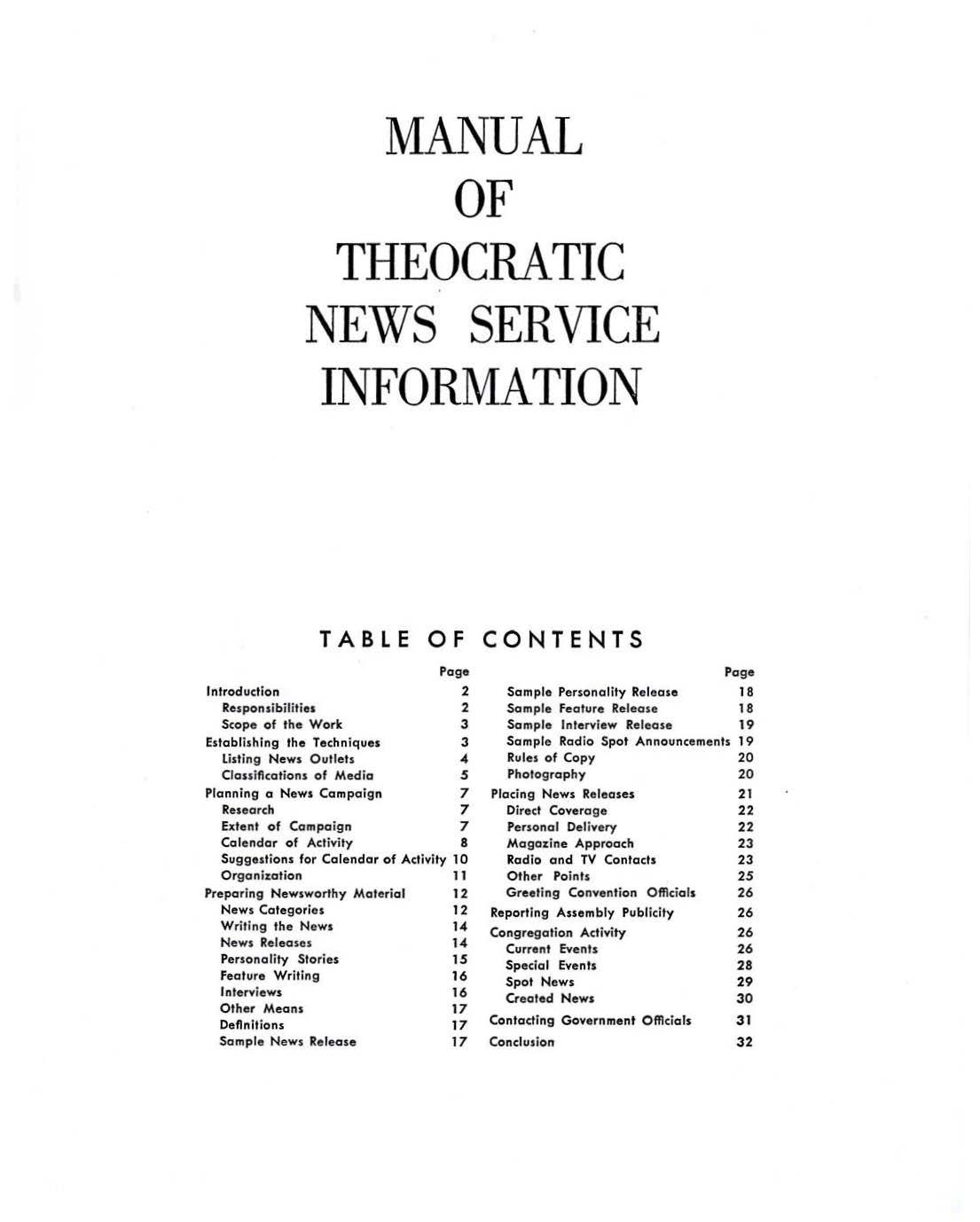
MANUAL OF THEOCRATIC NEWS SERVICE INFORMATION
TABLE
Page
OF CONTENTS
Page
Introduction
Responsibilities
Scope of the Work
Establishing the Techniques
Listing News Outlets
Classifications of Media
Planning a News Campaign
Research
Extent of Campaign
Calendar of Activity
Suggestions for Calendar of Activity 10
Organization
Preparing Newsworthy Material
News Categories
Writing the News
News Releases
Personality Stories
Feature Writing
Interviews
Other Means
Definitions
Sample News Release
Sample Personality Release
Sample Feature Release
Sample Interview Release
Sample Radio Spot Announcements 19
Rules of Copy
Photography
Placing News Releases
Direct Coverage
Personal Delivery
Magazine Approach
Radio and TV Contacts
Other Points
Greeting Convention Officials
Reporting Assembly Publicity
Congregation Activity
Current Events
Special Events
Spot News
Created News
Contacting Government Officials
Conclusion
INTRODUCTION
Good or bad, welcome or unwelcome, as long as the present system of things lasts, there will always be publicity. Since that is so the sensible attitude is not to allow it to be haphazard but to do everything possible to guide it Jehovah’s witnesses are growing in strength of numbers. Their growing prestige in the eyes of persons of good will and liberal-minded people is viewed by religionists and others with jealousy and hatred. Such opposers will not be idle. They will do all within their power to guide public notice of the New World society into undesirable channels and misrepresent facts to create unfavorable publicity. Resisting such efforts by a dignified counteroffensive is the theocratic answer to this situation. For this reason it is becoming increasingly important for Jehovah’s witnesses to have in the organization brothers who are qualified and trained to see that we are properly viewed by the public through the eyes and ears of the great variety of news media available.
Jehovah’s witnesses have the greatest publicity organization on earth. Each Kingdom publisher, in the fullest sense of the term, is doing public relations work. Our contact with the people at the door is by far the most effective means possible of creating good will for the organization. For that reason each Kingdom publisher can build or destroy good will. In addition, advertising the organizational activity from the objective standpoint is beneficial, and responsibility for this primarily falls upon certain appointed ones in the organization. The rules that are followed should be the same as those for the individual Kingdom publisher, namely, those based soundly upon Scriptural principles. Never should these Scriptural principles be departed from in such publicity work. Those charged with this additional responsibility are not stunt men or professional publicity agents. They are ministers whose service in this particular instance is that of supplying information to those interested in disseminating news.
Public interest in Jehovah’s witnesses is growing and expanding with the organization. Those who are responsible for the dissemination of the news are similarly affected. If their facilities are used to inform the public accurately and intelligently about Jehovah’s witnesses, then much good can be accomplished. This can best be done if Jehovah’s witnesses themselves co-operate in gathering the news and see to it that the proper facts are brought to the attention of these newsmen. Therefore, those who are charged with the responsibility of representing the organization in this capacity must not only have the necessary qualifications to do their job theocratically, but also have the necessary training in some of the techniques of reporting and news engineering, in order to make their efforts acceptable.
Jehovah's witnesses are not objectively interested in publicity or public relations. However, we are interested in advertising the Kingdom in any way whereby it can be effectively presented to the people, as long as it is in keeping with Scriptural principles. People read newspapers and listen to the radio. If through these channels they can read or hear something about the Kingdom, then they will be edified. For that reason, our service should not be a desire just to get Jehovah’s witnesses’ name in the paper. Many people are already aware of our existence. Neither is it altogether profitable publicity just to describe a convention that is being held, although both of these things in themselves do good in keeping the name of Jehovah before the people. A commendable amount of publicity has been gained already. Now it should be our desire to improve the quality and effectiveness of this feature of service by expanding our objectives.
Our effort should be to include in our press releases information about the Kingdom, about our beliefs and about those high principles by which Jehovah’s witnesses are governed that will enable all persons to recognize the New World society for what it really is—a people living according to New World standards. To accomplish this requires a working knowledge of the techniques of publicity and of the rapidly expanding field of professional public relations; otherwise such material would be unacceptable. For that reason this folder is being prepared.
RESPONSIBILITIES. Like all servants in the organization, the public relations servant must be qualified from the Scriptural standpoint. He will need a basic knowledge of the truth and of the Society’s policy in all major matters, but he must also have other qualifications to fit him for this work. He should be a brother who is mature in actions and in judgment He must be able to think quickly and accurately. He must be one who is devoted to truth and who will instinctively refuse to disseminate information of which he is not absolutely sure. He must be able to obtain factual information and know his authority for such statements. He must be one who uses good taste. He should be natural in all of his contacts. He should never put on airs. Not only is this true because those in the business of getting news are trained to spot a faker but it is not befitting a Christian minister. He should be tactful but not apologetic, direct but not forward, persistent but not obnoxious.
The public relations servant should know or be able to learn what constitutes news. He must be able to interpret news properly, write it effectively and then place it where it will do the most good for the largest possible audience. This takes experience and conscientious effort, but any brother having the necessary basic qualifications can learn to do it. The purpose of this folder is to offer information and suggestions that will be of assistance to anyone working in this theocratic field.
SCOPE OF THE WORK. For the most orderly and effective coverage of theocratic news it would seem best to limit the scope of the work of any public relations servant to the particular field in which he is assigned.
The congregation, in normal activity, creates much news, which is best known or controlled by the congregation servant. For that reason he will be responsible for its proper dissemination. Where news media cover a wider territory than that of his congregation, then he should establish a definite workable arrangement to co-operate with those congregation servants or circuit public relations servants involved. This can be done by dealing directly with these brothers or through the city servant, the circuit servant or the district servant. Sometimes, as in the case of district or national assemblies or special campaigns, several congregations or circuits may wish to place joint releases with the larger metropolitan papers and radio and TV stations. This should be done through the city servant or a combined effort of the circuit servants, depending on the circumstances.
The circuit servant and circuit public relations servant can be of much assistance to congregation servants. While they cannot be expected to write all the congregations’ releases for them, their usually wider experience may enable them to make helpful suggestions. Furthermore, the public relations servant will no doubt be using many of these brothers as contact men with the various news outlets in their territory. He will, therefore, have a direct interest in what is being done locally and how the news media are responding and will encourage the local brothers to discharge their responsibilities. His primary interest, though, will be in news that concerns activity of the circuit. In large metropolitan areas where there are several circuits, public relations servants or circuit servants should meet and make an assignment of all available news media, allocating to each circuit those media that are most likely to be interested In the news of the congregations in that circuit. These same news outlets assigned each circuit will then be the ones approached by the congregations in that circuit with their own local news releases. In this way a closely knit, workable organization can be maintained In all territories, without confusion or overlapping.
The district servant should become acquainted with the arrangements made throughout his district and offer suggestions as needed. He should especially be interested to see that satisfactory allocation of news media is made in metropolitan areas. In his report to the Society’s service desk following a circuit assembly, he should discuss any weaknesses that exist in the circuit public relations organization, as well as in the local congregation’s publicity activity. Problems encountered should be reported also. The district servant, too, will have in mind the over-all public relations organization of his district, endeavoring to assist its development to a point where all circuits in the district could immediately be welded into one unit for news dissemination of a district assembly.
The branches throughout the world will know from local conditions to what extent publicity work should be done in their respective countries. Where it seems inadvisable on any large scale, policy will be established after communication with the president of the Society. The suggestions outlined in this folder may be followed to whatever extent local conditions will allow. Particular problems involved should be reported to the president’s office for counsel.
ESTABLISHING THE TECHNIQUES
The techniques of public relations work are not difficult once they are properly analyzed and understood, and since newsmen themselves follow these rules the public relations servant should understand how to apply them so that his work will be acceptable.
(1)
(2)
(3)
(6)
ADJACESTVILLE ■TIMES' (W) 323 Main St. 7-6543
Quote:
John L. ReprosentatIvo*
KH: 126 Center St.
Contact: Br. Carrynees
The suggestions outlined in this folder are necessarily quite extensive. They are designed to cover as many and as varied circumstances as possible. It is not expected that all congregations or all circuits will be able to employ all the techniques outlined herein. These are merely suggestions arranged to give new ideas and to stimulate thought. But it is believed that following the general outline and adapting even just one or two suggestions to local conditions will enlarge the witness already being given. Therefore, all brothers assigned to this special field of theocratic activity will do well to study all the material presented here and then endeavor to develop to the best of their ability every possible resource in their respective territories.
Since the most colorful and varied single news event on the theocratic calendar is the assembly, the bulk of this information folder will relate to circuit assemblies. However, much of this material will be of immediate interest to the congregation servant too. He should have in his own files a record of news outlets that his congregation services. These should be available to the circuit public relations servant so that the circuit files can be kept up to date. The congregation servant will also be interested in those portions of this information folder dealing with what constitutes news, how to write it and place it effectively. Those specific events that are news in the congregation will, in most instances, be treated separately.
The simple formula for publicity can be stated in three steps: planning, preparing and placing newsworthy material. However, before any of these steps can be taken, the various news outlets available must be considered.
LISTING NEWS OUTLETS. As a preliminary step in carrying out any effective campaign, a list should be compiled of all news outlets. The following method, devised by combining a number of suggestions, has been tried with success. Any other satisfactory arrangement, however, can be used. Use a card, 3" x 5”, for each news medium. (See Illustration I, above.)
NH 21
•Adjacontvilla 68
Nearbytown 37
Pubs: 105
(4)
(5)
Illustration 1
In the upper left hand corner (1) list the publication’s name, address and telephone number. A few spaces down (2) insert the name of the congregation servant to be quoted and below it (3) the address of his Kingdom Hall. In the upper right-hand corner (4) place your code number for this publication and below (5) list the congregations in the area covered by the publication, number of Kingdom publishers in each and the total for all. [This simplifies the typing of blank-form releases. All that the typist needs is a stack of cards for those publications in outlying areas and a story so written that only names and locations need to be filled in. The name of the publication should be typed at the top of the release and each release becomes an individual story.] Listed in the lower left-hand corner of the card (6) for convenient reference should be the name of the brother or sister who acts as contact man for this particular news outlet.
On the back of the card (See Illustration H, p. 5.) (7) list the publication's publisher’s name, the editor’s name and names of any associate editors and reporters contacted. List also (8) the date and frequency of publication (if not a daily), (9) deadline date or time, (10) circulation and classification (for example: news, architecture, grocer's association, employee’s house organ). [Note: Some might prefer to place items (8), (9) and (10) in the lower right hand corner of the front of the card, if space allows. This makes for quicker reference.] Other notes that might be included on this card: (11) attitude of the publication, whether mats or pictures are acceptable and best size. In addition, (12) dates of submitted releases for a news campaign and results in
Mr. I.M. Journalist. Ed.
Miss Iva Nosefurnews, Rei. Ed.
(11)
Friendly
Hats
(no pix)
(12)
NR-1
4/12
in*
HR-4
4/28
in
PR-3
5/11
in.
PR-6
5/18
in.
HR-18
5/25
in.
FR-3
6/1
in.
Out: Thurs (W) Deadline:
Hon 10 an
Nees: 10,000
(7)
Illustration II
column inches might be recorded. For wire and photo services, radio and TV stations and other mass media, similar cards can be prepared with data that applies. On cards tor radio and TV stations programs might be listed that would be suitable for our purpose.
In order to prepare such lists the following can be done: 1. Compare and co-ordinate all current available lists. 2. List all publications in the classified section of the telephone directory. 3. Consult a directory, which is available in most larger public libraries. For example: Ayers; Editor and Publisher; Printers’ Ink; Standard Rate and Data; Photo Market; Broadcasting; Broadcast Advertising; Variety Radio Directory and various writers’ publications. 4. An investigation should be made of publications of various trade associations. 5. Locate those brothers working in large plants or shops that publish their own factory newspaper. These are known as house organs. 6. Monitor all radio and TV stations for those programs that present possibilities. Sometimes a brother or sister who is a shut-in will gladly assist. 7. Verify all addresses and phone numbers and keep lists up to date. 8. All publications should be carefully checked to make certain that they are the type that we would want carrying news about our Kingdom message. This is important. There are a few filthy scandal sheets, some labor organization papers and other leftist or rabid-type publications that we should do well to avoid in our news reporting. It is better if people do not associate us and our Kingdom work with papers of this kind.
The media of publicity and the personnel who man these media are in a constant state
(8) (9)
(10)
of flux and the circuit public relations servant must be alert in order to keep abreast with these rapid changes. Before he begins a new publicity effort he must bring his records up to date. He should never be behind the times in his contacts. Editors notice these things and can assume that the news release is belated also.
CLASSIFICATIONS OF MEDIA. Some circuit public relations servants find it advantageous to group their media according to certain classifications. In this way news releases slanted to a particular type of audience can be readily submitted to all news media covering that field. A code number designates each class, and they are generally filed according to these groupings. As a further division of these various groups, the territory covered by the circuit campaign is divided into areas designated by numbers. For example, numbers 1 to 9 could be assigned to one area, 10 to 19 to another, 20 to 29 to still another and so on. If only a few publications lie within the first area all of these publications could be numbered "1” and one contact man could cover them. If there are too many news outlets within this radius for one person to contact readily, then a second grouping could be made within this same area and designated number "2,” and so on. The same procedure could be followed in other areas, allowing at least nine subdivisions in each. This arrangement provides several advantages. It allows for expansion in news outlets without revising the entire numbering system. Furthermore, if divisions are so made that contact men are available for every half-dozen or so news outlets (even though not all are used regularly) it can allow the circuit public relations servant to reach every news outlet in his assigned territory with a special news release within a day’s time if necessary. Sometimes this can be important and should be the goal of the circuit news service organization. The letters designating the classification of the publication, plus the number that is assigned to the publication, complete the code number of the publication. For example, there might be one metropolitan daily, three hometown-type papers, two foreign weeklies and one radio station all in one area and contacted by one brother. If this area is number 21, the daily would have the code number NM 21, all the home-town-type papers would be NH 21, the foreign weeklies would both be NS 21 and the radio station RA 21. Thus, although each classification of news outlet is filed separately, the numbers show readily in which area they are located and who the contact man is that is responsible for all of them. This system fulfills two needs: First, ready access to any particular type of news media throughout the territory that reaches the same kind of audience. Second, assembling all news releases to be delivered to the same contact man.
Such a system might seem complicated at first and might be unnecessary in circuits covering widely scattered areas, but for extensive news coverage, especially in congested areas and for large assemblies, some such system is a necessity.
Following are the major classifications of news media with suggested code letters for each:
(NM) Metropolitan daily and Sunday newspapers. The larger the paper the more complex its organizational structure. News that interests such papers for their general sections must be of interest to the many people making up their large readership. That is why small circuit assemblies can go by unnoticed by some of the largest of these. Sometimes this can be overcome by directing items of particular Interest to one or more of their many departments. Such bits of news, well chosen, can be particularly slanted to the correspondingly smaller audience interested in this special field. Most larger papers in the United States and Canada will Include the following: Publisher, Business Manager, Managing Editor, City Editor, Editorial Writers, Religious Editor, Columnists, Woman’s Page Editor, Society Editor, Feature Editor, Foreign Editor, State Editor, Financial Editor, Business Editor, Food Editor, as well as radio and book review sections and others. Even the smaller dailies should be put in this class if they carry news of interest beyond the scope of their own circulation.
(NH) Home town press. These are the smaller outlying newspapers or suburban papers, many of them weeklies. They cover a limited area and deal primarily with local news rather than national or international news. Dailies that handle only local news should be put in this class.
(NS) Special newspapers. These include the foreign-language, racial, commercial and financial papers. In this class are the labor publications and others, some of which are quite reputable. It is primarily with this classification, however, that care must be exercised. Papers with questionable reputations should not be cultivated. Then there are those that have a controlled circulation within a very limited group. Though they reach only a few people, sometimes an effective witness can be given to persons not otherwise easily approached. Religious newspapers are in the special classification as well.
(FS) Feature syndicates. These are feature associations with offices in large cities servicing regional, national or international fields. They are not so interested in date-line material as they are in articles emphasizing a fact, a state of being, a condition or an analysis. These organizations handle feature stories, syndicated columns, etc. Only the largest circuits might find a place here for their stories. Stories for extensive circulation should be cleared through the Society’s branch headquarters.
(WS) Wire services. These news syndicates report news to a subscriber list as a regular service. They cover regional, national and international date-line news. They are interested in happenings that will interest their clientele on any or all of these levels. AP, UP and INS are the major news services in the U.S.A.
(PS) Photo services. These operate as news syndicates except that pictures tell their stories. Outstanding in the U.S.A, are AP Photo Service, Wide World Photos, International News Photos and Acme Newspictures, Inc.
(MG) Magazines, general. These are the large magazines of national circulation and general interest.
(MS) Magazines, special. These are designed for certain classes and include the racial publications, small local news magazines, farm and trade journals, juvenile publications, house organs or plant magazines, business report magazines, city or county news magazines, sometimes town yearbooks issued by chambers of commerce, etc. Some of these can be used effectively if the material is properly slanted to their special audiences.
(MP) Magazines, picture. These national publications are generally interested only in our largest assemblies.
(RA) Radio and (TV) Television are well known as news outlets.
(MM) Mass media. These media include newsreel services and similar large-scale outlets designed to reach masses of the people. Obviously, news to them is only that which interests the majority of the people on a wholesale scale.
It should be remembered, too, that there are many other types of publicity media that we use regularly and these should not be overlooked in advertising the Kingdom message. All advertising matter comes under this classification. Placards for store windows, bumper signs, car top signs, special letters to people of good will, etc., are all effective parts of our publicity program. However, these are generally controlled by another convention department. Still, it would be well for the circuit public relations servant to co-ordinate his activity with those responsible for these other advertising media.
PLANNING A NEWS CAMPAIGN
RESEARCH. Effective dissemination of news cannot be accomplished unless careful planning is a part of the program. Begin planning the program by developing all research material possible in connection with the event. First, study the publicity results of the last assembly. Study the clippings book. This provides a history that is necessary for the present campaign. Note the editors that gave favorable coverage. Note the particular slant of material that they used. Notice the particular interests that each publication had in the assembly. Then look for variations of those ideas that were particularly acceptable. Do not use the same personality except, of course, the district or circuit servant, etc. But a similar human interest story can be used if it was effective. Avoid those ideas that resulted unfavorably or that were not used.
Second, list all persons that will attend that may be newsworthy: district and circuit servants, the congregation servant in his local community, brothers in business or otherwise prominent in the locality, all on the program or serving as department heads, friends who may be attending from distant communities, missionaries home on a visit, several generations of witnesses in one family, a mother and daughter as full-time ministers (especially if the mother is also a homemaker), etc.
Third, develop background material. Learn all the statistics about the circuit and its congregations; the number of its ministers; its growth and so on. Assemble statistics on all departments of the assembly. AU this material will suggest further ideas for stories. Be prepared to answer controversial questions if necessary, although it is better, if possible, to turn such questions into interviews with a convention “official.” In this way authoritative quotes can be given. The convention public relations servant should remain in the background and yet he should know the answers himself. Direct quotations could be noted in all the Society’s publications as well, so that authoritative information can be given at any time even if one of the convention servants is not available. Answers must be accurate and in absolute harmony with the Society’s policy.
The circuit public relations servant should at all times work closely with the circuit servant. All data should be assembled and kept up to date throughout the entire campaign. This can be done, if necessary, by someone specifically assigned to that work who could serve as a staff reporter. Necessary equipment should be on hand to provide newsmen with background material if necessary: Yearbooks, convention reports, news clippings books, reports on legal cases, or any other material that might be deemed necessary. This would include those issues of The Watchtower containing the history of the Society or Qualified to Be Ministers.
EXTENT OF CAMPAIGN. The second step in planning the campaign is to determine its extent. It should not be just a matter of getting space either with or without pictures. Effective publicity requires a well-ordered effort through knowledge of the activity of the organization and the possibilities of all available media. For this reason it should de determined in advance just what is to be accomplished by this particular news service program. This can best be done by determining a theme that is to be followed throughout the entire campaign. This can be based on the district servant’s public talk or the theme of the circuit assembly itself.
Second, define the objectives and the classifications of media necessary to accomplish them. We are interested in getting people to go to the assembly. We are interested in giving the public an accurate picture of Jehovah's witnesses, their beliefs and activities, in line with the special theme selected. We are interested in raising the prestige of the organization. These things are all definite objectives of the circuit publicity campaign. The media that you select from all those available should be those best calculated to accomplish your objectives.
We have another important objective, though perhaps an indirect one. Our aim is to deliver to all those people who control news and influence public opinion such a systematic and thorough coverage of new-world news that they will become the best-informed people in the world on Jehovah’s witnesses, so that, regardless of how much or how little news is actually published or broadcast, these responsible people will be left with a lasting understanding of Jehovah’s kingdom and the New World society. Such an accomplishment may result in the tone of the news about Jehovah’s witnesses being favorable for some time to come.
Third, determine the geographical extent of the assembly and then determine the particular news outlets that will cover this event. Unless the circuit has been changed, this will ordinarily be the same as for the previous campaign. In the event of changes, the circuit public relations servant should obtain for his files a list of all news media within the territory of those congregations transferred to the circuit.
CALENDAR OF ACTIVITY. The third step in planning the campaign is preparing a schedule or "calendar of activity.” The effectiveness of the entire program can hinge on the thought and attention to detail that have gone into planning this schedule of activity. First, accumulate ideas. Think about the program; list all the news possibilities you can think of. Discuss them with the circuit servant and other mature brothers working with you on contacts. Adjust, revise and trim this assorted collection until only usable material remains. Now begin assembling the pieces. Adjust them to your list of media. Develop a chronological advance list of events, having in mind how you can break up your material, how fast you can develop your sequence stories and where they can be released.
Next, prepare four lists as follows: 1. A list of events. These are all the various activities that will take place during the assembly and that will be used as publicity hooks for news stories. 2. List all the stories surrounding each event and itemize the logical news outlets to handle each one of these stories. That means that for one particular event perhaps several different stories could be written and these could be used in different ways with the various news outlets. 3. Prepare a list of points based on the selected theme that could be demonstrated by various activities of the organization, either in the congregation or the circuit. This allows for building the campaign to a climax and accentuating certain basic principles in our activity of which we want the public to become aware. 4. List all picture possibilities around each event and around each story. This should be done whether you will have your own photographer or not In this way, when news photographers come to the assembly grounds they can be guided to those spots that will provide them with the best picture stories possible and those in line with your own themed campaign. Besides, picture possibilities will suggest ideas for television presentation.
When all four lists have been carefully compiled, then combine these lists and determine the dates of release for each story. (See Illustration III, p. 10.) This master list provides a calendar of activity and the circuit public relations servant is now ready to begin mapping his strategy for preparing and placing his news stories.
A suggested list of events that might be used for a circuit assembly follows. Around most of these events several stories can be developed. Some could be written as straight news releases, some as feature stories, some as personality stories, some as interviews. Some might be just brief items for a columnist, a woman’s page editor, etc. Use them where they will fit and do not overlook any possibilities. 1. Announcement of assembly and assembly city. 2. Circuit servant’s visit to the city to locate a site and inspect the grounds. 3. Contract signed for the convention building (if it is deemed advisable to publicize far in advance. Extreme care should be exercised in advance publicity in places of entrenched opposition, for the hall may be canceled. The circuit servant should be consulted on such matters.). 4. Congregations discuss travel plans. 5. Rooming work (if carried on). 6. Participants on program appointed. 7. Department heads of the service organization appointed. 8. Meeting of department heads to finalize plans. 9. Craftsmen named to participate. 10. Suppliers of produce for cafeteria selected. 11. Installation program begun. 12. Arrival (circuit servant, district servant, personalities, delegates). 13. Opening day. 14. Baptism. 15. Cafeteria operation. 16. Departments’ activity and volunteers. 17. Field service activity. 18. Saturday night meeting. 19. Sunday public talk. 20. Delegates return home.
Following is a list of some story possibilities. Many of these could be adapted to feature articles, a number could be designed for radio or television presentation. Some could be developed to surround certain of the events listed above. More story ideas will present themselves to the alert public relations servant because of varying local conditions. He should constantly expand and develop this list to provide the greatest possible color and variety for his news stories. 1. A great variety of human interest stories surrounding different personalities. 2. The Kingdom Hall, its purpose and place in the worship of Jehovah’s witnesses. 3. The congregation and its activity, weekly meetings, etc. 4. Practical ministerial activity: house to house, home Bible studies, etc. 5. Special training program in field ministry for new ministers. 6. Circuit assembly provides three-day training program. 7. Auditorium transformed into a Kingdom Hall; staging; sound; etc. 8. The circuit assembly program and its features: talks, panel discussions, interviews, staged dramatizations (demonstrations). 9. Analysis of circuit progress discussed at assembly, including local report; weaknesses pointed out and remedies offered. 10. Plans laid for progress during next six months. Application of plans in each local congregation. 11. Individual delegates’ reactions, how benefited. 12. Expansion of the organization through Gilead missionary training (see Yearbook). 13. Transportation from convening cities arranged for interested persons. 14. Transportation arranged for local residents to assembly site. 15. The full-time service. 16. A day with a family of Jehovah’s witnesses. 17. Convention history—1919 to date. 18. The “flight for freedom." 19. How one develops from first contact to point of dedication as a minister. (For an outline with picture possibilities see 1953 Convention Report, pages 91 to 93.) 20. Baptism, its effect on one’s life course (a full dedication story).
A list of points emphasizing the assembly theme might be drawn up as follows. One or two of these can be woven into each story. The same points may be used in more than one story. The points listed here are from the theme "Be Rich in Right Works." Similar points could be drawn from a different theme for another assembly. 1. Jehovah’s witnesses maintain that if a religion is worth believing it is worth practicing. (Jas. 1: 22) 2. Growing tide of materialism a challenge to Christian thinking and Christian works. (Matt. 6: 19-21) 3. Bulwark against communism is development of true Christian thinking through right works. Jehovah’s witnesses world-wide emphasize by preaching activity. 4. No "blue Mondays” for those with a full schedule of Christian activity. Stimulating and refreshing. 5. Christian’s primary work is to preach. (Matt. 24: 14) Jehovah’s witnesses are a preaching fellowship. 6. Jehovah’s witnesses’ organization designed to cultivate and train in works of Christian preaching. Uniform activity worldwide, a unifying force. 7. Watch Tower Society, directive agency, provides regular instruction in performing right works: traveling representatives, Bible textbooks, assemblies, etc. 8. Local congregation provides regular training program in practical Christian works: house to house, back-call, home Bible studies, etc. 9. Skilled workmen require advanced training, so the Christian worker needs a firm foundation in Bible education. Training at assembly designed to improve quality of preaching activity. (2 Tim. 3: 16, 17) 10. Work of circuit to be analyzed at assembly, including local congregation report; weaknesses determined and remedies offered; plans laid for expanded work at local and circuit levels.
Picture possibilities are almost limitless. Good ideas can be used repeatedly with variations in personality or staging. The following list is only to suggest ideas. Local circumstances must be considered. 1. Personalities: convention officials arriving, discussing plans, inspecting grounds, greeting each other, speaking, etc. People at sessions, babies in arms, young children singing, twins listen intently, old people take notes, babies asleep while parents listen, etc. Delegates from distant parts, etc. People in various places and poses around grounds reading the Bible. 2. Rooming: interviewing householder; close-up of office workers; line-up at rooming counter; etc. 3. Installation: smiling sisters arrange flowers; children help clean grounds; brothers install sound; smiling sister cleans chairs, etc. 4. Program: platform shots of speakers, demonstrations, round-table discussions, etc.; crowd shots; overflow-meeting shots; etc. 5. Baptism: people being immersed; young folks, elderly people, etc. Line-up of candidates. Over-all shots of immersion location. 6. Cafeteria: preparing food: sisters peel potatoes, prepare meat, mix salads, cook food, etc. Food serving lines: smiling sisters serving food, children getting trays, line-up at counter. Eating tables: children eating, also mother and baby or little girl, line-up at tables with happy, neat-looking group in foreground, over-all shots of eating facilities. (Avoid such shots as cleanup departments, which are usually messy.) 7. Departments: orchestra; neat sister behind book counter, territory assignment, etc. People buying Bibles, volunteering for service, etc. 8. Field: attractive sister putting window sign in store window; group preparing for service; sisters putting on placards or lined up with placards on; young person distributing handbills on busy street; etc.
SUGGESTIONS FOR CALENDAR OF ACTIVITY. (See Illustration IH, below.)
(A) In this column the date or time the article must be submitted should be given. Date-line news or radio and TV programs should be scheduled according to the event. Feature stories and others not highlighting actual events can be scheduled when the news flow is light. This column determines the day-by-day schedule of work, and by watching it closely the public relations servant can keep abreast of his campaign, regardless of the chronological sequence of events.
(B) Each type of release should be numbered in consecutive order, e.g., NR-1, NR-2; PR-1, PR-2; etc. The code letters determine the kind and the number identifies the individual release. Copies of the releases are then filed in numerical order according to classification.
(C) The number of the event as contained in your list of events is entered here. If other events develop after the calendar has been compiled, they can be added to the end of the list. Although the calendar is designed to list events in chronological order as nearly as possible this is not essential, since corresponding releases will not follow in the same order. Some will necessarily precede others because of their nature and the media with which they are placed.
(D) The story development best suited to the event and media for which it is intended should be determined from the list of story possibilities and the number entered in this column. Several stories may be written on the same event and all do not necessarily need to follow the same development.
(E) A suitable point on the theme can be chosen from the list of theme points and the number entered here. These can vary with the event or with the story.
Example: It may be decided to write all four different types of releases about event number one and place them with different news media. Although the same story possibility and theme point might be used for each release the following variation could lend color and variety to the stories: for the news release, story 6 and theme points 1 and 2 could be used; for the personality release, story 1 and theme point 4; for the feature release, story 5 and theme point 5; for the interview, story 4 and theme point 6. See the sample releases where these combinations were used.
(F) Picture possibilities that suggest themselves according to the events and stories listed could be entered in this column by number. Often more ideas will occur as the calendar develops. These can be added to your list of possibilities.
Symbols:
Release
NR-News
PR - Personality
FR - Feature
IR -Interview
Illustration in
SUGGESTIONS FOR CALENDAR OF ACTIVITY
Media: (Average circuit assembly) (General RA - Radio
News:) TV -Television
ND - Newspapers, daily (Local NH - Newspapers, home town
News:) NS - Newspapers, special
MS -Magazines, special
(Only major assemblies) MG - Magazines, general MP - Magazines, picture FS -Featuresyndicates WS - Wire services PS - Photo services MM-Mass media
Deadline
Release No.
Event
Story
Theme
Picture Possib.
Media
Assigned
Delivered
(A)
(B)
(C)
(D)
(E)
(F)
<G)
(H)
(X)
(G) The media determine to a great extent what type of release should be written and what its development should be. These news outlets carry your story to your audience and the audience must be considered in writing the same as in speaking. Media for each release are entered in this column by code number, e.g., ND 21-23, 40, 51, etc. If all daily newspapers are to be serviced with a particular release, this could be indicated by simply writing: ND all. However, if a certain few papers are to be given a different or special release, then the notation could read: ND all except . . . —and the numbers of the exceptions listed. These news outlets would then be listed individually, opposite the listing of the release they are to receive.
(H) This column might not be needed if the public relations servant writes his own releases. However, if someone else is designated to write a particular story, then the date or time and the initials of the one assigned should be entered here. This is a safety check to make certain no story is left unassigned.
(I) The date the release is actually delivered is entered here. This date, with the code number of the release, should be entered on all media record cards. This simplifies checking the response in the papers. If the response in column inches is also indicated on the record cards, it can easily be determined which releases were most effective. Study of these cards and releases submitted is helpful in planning a new campaign.
ORGANIZATION. Now that the calendar of activity is planned, the circuit public relations servant is in position to know what size organization will be necessary to put this program into operation effectively. Production of newsworthy material now becomes a matter of routine and the basic campaign will develop almost by itself. This allows for attention to the many interesting side lights or unexpected happenings that can enrich the already full schedule of effective publicity arranged for. Therefore, it is important that the basic organization be planned well in advance of the circuit assembly.
Those persons who are to contact media should be arranged for through the local congregation servants if possible. Allowing the local contact men to deliver releases has proved to be the best arrangement, because the local brothers are acquainted with all the news media in their area and have no doubt made contacts with them in regard to their own local news events. If they have not, then the circuit public relations servant should take someone with him to follow through in his absence and to assist in wider coverage of territory. Such local contacts also simplify the important task of checking the papers for stories printed. Collecting these clippings could also be detailed to the local contact man.
The circuit public relations servant should make it his business to get acquainted with the personnel of every news medium in his territory. This is particularly true of those news outlets that have proved most difficult or that have been unresponsive in the past.
It may be that the circuit public relations servant will require further assistance in the writing of script and releases, in typing, in proofreading, checking grammar, punctuation and spelling. Releases must be neat and accurate. Educated sisters often do very well at these details. They should be used if no brothers are available or qualified. Sisters can also be used in making contacts if necessary. Assistance might be needed also in preparing the clippings books for the district and circuit servants, as well as the circuit news servant’s own book. Clippings should be mounted neatly, with an effort made to show the results of the work in the most effective way. Editors are often impressed by the results obtained in news media in other localities and many times will respond by giving more coverage themselves.
A definite organizational procedure should be adopted and followed consistently, even though several jobs may be handled by one person. The following is suggested: Write the release. Proofread and correct for grammar, punctuation and spelling (assigning someone qualified to assist in this if necessary. It is important.). Type final copy and proofread. File carbons in permanent file. Deliver releases to contact men. Have contact men deliver releases to news outlets. Have contact men obtain printed stories and submit them to the department. Clip stories and e,nter in clippings books.
If the public relations servant is not preparing the releases personally, he should read and approve all releases that are written before they are sent out. This gives him complete control of all news that is submitted to the press.
Avoid last-minute problems. Work out the calendar of activity with the circuit servant and circuit assembly servant. Endeavor to anticipate every eventuality and make some provision to handle it. Plan foreign releases sufficiently in advance to permit translation before submitting to editors. Brothers can do this, and editors of the foreign press will appreciate the thoughtfulness. During the assembly itself have a definite schedule for every day’s activity. Every morning it will be found advantageous to have a meeting with those in the department for a briefing session. Matters to be discussed would be application of the theme to the day’s activity, consideration of the day’s schedule and special activities for the day. Problems that have arisen could be considered also. Make certain that speech copy is available, if at all possible. Make certain that all who are on the information staff or who talk to reporters know the first names of all speakers; that they know the speakers’ positions in the organization and where they are from. Such regular briefing sessions are particularly helpful to a large convention staff and may not be necessary for the smaller circuit assembly, but if there are any assistants at all to the circuit public relations servant, it will be good for him to discuss these matters with them some time during the assembly.
PREPARING NEWSWORTHY MATERIAL.
NEWS CATEGORIES: In order to prepare news stories properly it is essential that the public relations servant knows what constitutes news. News is something that Interests many people today. It must be something of interest to more than just a few and it must be current. Briefly, we shall discuss four different categories of news. Since much news of certain categories is on the congregation level a more detailed outline will be considered later under congregation activity. (Page 26)
1. Current events. These are events occurring with some regularity in the normal course of congregational activity; therefore, they are handled by the congregation. These would include appointments of servants to the congregation; Memorial, anniversaries of organizational activities, weekly meetings of the congregation, etc. For a more detailed discussion see the section on congregation activity.
2. Special events. These are all special happenings beyond strictly congregational routine, such as dedication, special talks, circuit servant’s visit, assemblies, marriages, etc. Most of these are also covered by the local congregation, but if, as in the case of the circuit assembly, the happening involves the entire circuit, then it is handled by the circuit public relations servant. See congregation activity for further information.
3. Spot news. This type of news is spontaneous in nature and involves happenings beyond our control, such as court trials, blood transfusion cases and other such occurrences incidental to our scheduled activities. These are usually handled by the congregation. At assemblies, however, occasionally spot news does occur, such as accidents, heat prostration cases, heart attacks, etc. Widespread notice of such happenings does not advance our program so we shall not voluntarily reveal such incidents. However, such news does not always remain hidden. Never try to interfere with a newsman’s getting such a story after he already has wind of it. Newsmen have a nose for news and will be even more determined to ferret it out. Interference might only antagonize and prejudice the reporter and arouse his suspicions that all is not as it should be. To a reporter such happenings mean news. However, this type of spot news should be played down or minimized. All the facts should be obtained by the public relations servant, but he must use good judgment and carefully weigh in his mind how a minimum of these facts can be properly presented. Generally, newsmen are cooperative, especially if cordial relations exist with the press, and many times the straight facts of the story alone will kill it as not newsworthy. Be honest and straightforward at all times with the press, but do not tell all you know. And remember, editors print news. They want it and they have ways of getting it. We have nothing to hide, so give them some facts and the truth will stand on its own.
4. Created news. At this point it should be made clear that producing news means more than just interpreting or shaping news that has occurred. It often means creating news. In our activity this does not mean resorting to “gimmicks” or stunts. It merely means employing recognized public relations techniques in reporting to make'an event newsworthy that might not otherwise fall within any of the categories already considered. Many happenings at our circuit assemblies are very important to us, but as viewed dispassionately by an editor are just not news. Yet we wish these things publicized. How can it be done? This involves the technique of “creating” news and tests the ingenuity and effectiveness of the circuit public relations servant to the limit. Our consideration of this category of news will offer suggestions that have been tried with success.
The first method of creating news is a technique of writing called “tie-ins.” It means simply hitching your story on to something that is already in the news. Generally there is a "story of the day” that is current. Sometimes many such themes are available. Since they generally reflect world conditions little difficulty should be encountered in employing them. For example, at the present time any story should be considered newsworthy if it mentions "resisting Communist infiltration” or "fighting the growing tide of materialism” or if it "fortifies men in the war of nerves.” Even such catch phrases as "for the good of the community” and “in the public interest” have been known to capture an editor's approval. You might be helped in analyzing the problem by tacking to the words “who,” or “what,” or “why,” the expression, “in relation to.” Who are Jehovah’s witnesses in relation to some news that is current? What are they in relation to it? How are they in relation to it? Keep your eyes open to the news, to what is happening and our relationship to it, how we can be tied in with it and set up in favorable contrast against it so as to make the news different. Then show the activity of Jehovah’s witnesses in this favorable respect.
By way of further illustration, if the circuit has reached a new peak or if there is noticeable increase of activity, this is news in itself. But if the brothers are simply being trained in certain features of the work, editors might not be interested unless the account is written in such terms that it becomes of interest to many people. For example, “In an effort to equip themselves for an expanded service to the community, Jehovah’s witnesses received instruction last night in effective means of carrying the Bible into the homes of the thousands of people who are without adequate Bible instruction. This report from the headquarters of their three-day training program being held at Blank Auditorium quoted Mr. District Supervisor as saying, etc.” Phrasing of this nature is not misrepresenting facts, which should never be resorted to. Actually, in the case of our work it is really reporting matters in their fullest sense. Kingdom preaching is in the highest public interest.
The second means of creating news is the use of names. Names play an important part in writing news stories. People are interested in people they know or even in those they may become acquainted with through the press. Editors are too—especially if these “name” people are doing something worthwhile. For this reason it is good in the local news media to build up the name or position of someone as the local spokesman for Jehovah’s witnesses. For example, “Mr. District Supervisor stated ‘so and so,’ according to Mr. Local Representative.” In this way, although the district servant made the statement, at the same time the local congregation servant comes info the picture. This has a twofold advantage. In the first place it is a local man who is doing something. Then, secondly, if the district servant is changed and a new one appointed, the name of the local congregation servant still appears in the press and the value of building the name of someone as an authority has not been lost. A point worth noting: newspapers like full given names, not just initials with the surname.
Other local brothers who might be prominent also make news, especially those who are in business or who are otherwise known in the community. Sometimes, if they are willing, these brothers can also be used in this way and can make statements regarding conditions in their particular field as they relate to the Kingdom message. None of the brothers so used should feel important because of this prominence they may receive through the press. None would be so used if it were not for their knowledge of the truth, and certainly no one can take personal credit for that.
A third means is interviews. These are very effective in creating news. Although this method has been used extensively by the brothers in times past, many have been merely objective discussions of our activity. We could not expect to use public news media to preach, but interviews can employ all of the other techniques in creating news to include much that will acquaint the public with our aims, purposes, opinions and accomplishments. Interviews need not be limited to radio and television. They can be used effectively in newspaper writing as well. This is true particularly in regard to the public talk. Through an interview with the district servant the theme of the talk can be given in advance, stimulating interest in the subject and at the same time providing a certain amount of educational material to edify the public.
In any statement or quotation that is made the effort should be, wherever possible, to acquaint the public better with our views on world conditions, the doctrines that we preach and the importance and significance of these matters to them. That is what our specialized form of public relations work should be designed primarily to accomplish. This must be done with recognition of those requirements that editors have for material of this sort, otherwise it will not be successful. We are as "playing in their league” and if we follow their rules they will "play ball.” Remember, statements of opinion must be in quotes and we do want to express our opinions in our stories.
WRITING THE NEWS. One of the most difficult tasks for the newly appointed circuit public relations servant seems to be that of writing good copy. Yet it is essential, because good copy will stand on its own feet. It is not always possible to reach the editor with the release, and even if you do, he will not publish anything he thinks is not newsworthy. If copy requires considerable rewriting, many times editors will not use it because of lack of time or inclination. Therefore, the circuit public relations servants should become thoroughly acquainted with the various kinds of writing necessary to plan a full and complete news program properly for the circuit assembly. In their broadest forms these could be divided into four types of writing: straight news writing, personality stories, interviews and feature writing. We shall consider each in turn.
News happens. If there is no action, there is no news; and if there is action, then there is something performing it. So that brings us down to the fact that news writing must be on nouns and verbs. The nouns name things and the verbs tell what they do. The manuscript is judged by this formula. A newspaper editor says to himself, “My readers are interested in people who do things.” We must show them that the witnesses are people that will be interesting to their readers, and we must show them that the witnesses are people who do things and that the things they do will be interesting. When you submit an article, it must give a clear picture of just who Jehovah’s witnesses are, but it must give this clear picture by their actions, not by a great deal of description. They must find out who they are by what they do.
News media are mainly divided into two departments: the nouns and verbs department, and the adjectives and adverbs department. Nouns identify people and verbs tell what they are doing. This is news writing. But adjectives glorify nouns and adverbs glorify verbs. This is not news writing, it is advertising. Those are the two departments, news and advertising. Advertising is not free. You pay for it. In other words, the newspaper pays for the nouns and verbs; but the writer pays for the adjectives and adverbs. So avoid adjectives, unless there Is no doubt in the public mind that the description applies.
NEWS RELEASES. News stories have leads. A brief statement appears, another one, and another one, each in a separate paragraph, each stating a different point; then, as the article continues, the same points reappear, only in longer paragraphs with details. That is a good style to follow for newspapers. Make the opening few paragraphs cover the high points, the gist, to arouse curiosity and to answer briefly the questions who, what, when, where, why and how. That is the lead of the story. The balance of the story develops these points further, still following this inverted pyramid style so that the story can be cut at any point and still be complete.
Learn to think in terms of short sentences. Learn to write short sentences that capture as much of the facts as possible, so that one short sentence contains as much news as a paragraph. If necessary write a paragraph and condense it to one sentence. Then leave the one sentence standing as one paragraph. Do not jam it together with another sentence that tells a different part of the news.
…