The Bible Examiner — Vol. 3, No. 10 (1848)
Download: PDF — The Bible Examiner — Vol. 3, No. 10 (1848)
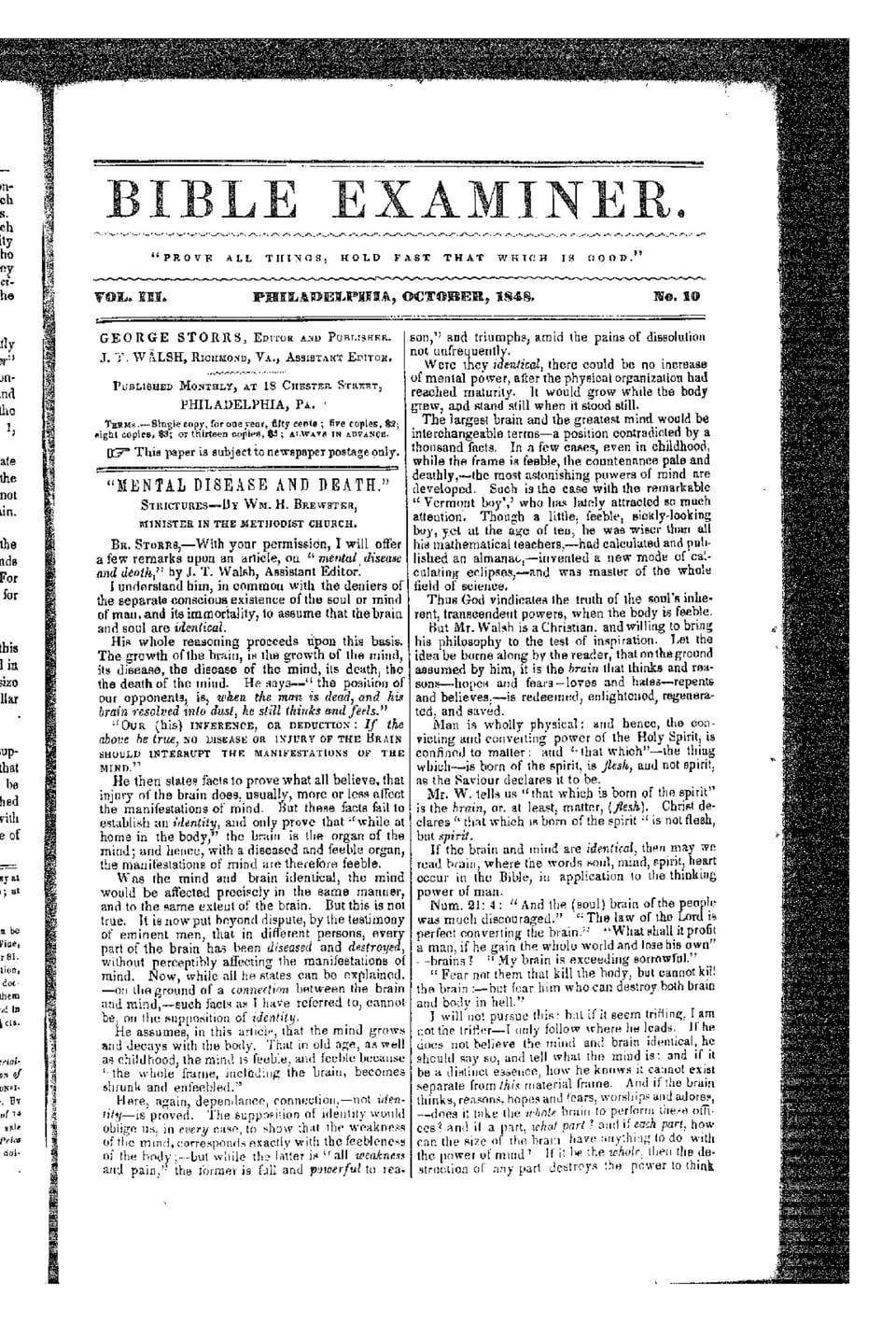
"PROVE ALL THINGS, HOLD FAST THAT WHICH IS GOOD."
VOL. XII. PHILADELPHIA, OCTOBER, 1848. No. 10
BIBLE EXAMINER.
"PROVE ALL THINGS, HOLD FAST THAT WHICH IS GOOD."
VOL. III. PHILADELPHIA, OCTOBER, 1848. No. 10
GEORGESTORRS, EDITOR AND PUBLISHER. J.T.WALSH, RICHMOND, VA., ASSISTANT EDITOR.
PUBLISHED MONTHLY, AT 18 CHESTER STREET PHILADELPHIA, PA.
THRAMA.—Single copy, for one year, fifty cents; five copies, $2;
eight copies,3; or thirteen copies,4; ALWAYS IN ADVANCE.
This paper is subject to newspaper postage only.
"MENTAL DISEASE AND DEATH."
STRICTURES—OY Wm. H. BREWSTER,
MINISTER IN THE METHODIST CHURCH.
Br. Storrs,—With your permission, I will offer a few remarks upon an article, on "mental disease and death," by J. T. Walsh, Assistant Editor.
I understand him, in common with the deniers of the separate conscious existence of the soul or mind of man, and its immortality, to assume that the brain and soul are identical.
His whole reasoning proceeds upon this basis. The growth of the brain, is the growth of the mind,
son," and triumphs, amid the pains of dissolution not unfrequently.
Were they identical, there could be no increase of mental power, after the physical organization had reached maturity. It would grow while the body grew, and stand still when it stood still.
The largest brain and the greatest mind would be interchangeable terms—a position contradicted by a thousand facts. In a few cases, even in childhood, while the frame is feeble, the countenance pale and deathly,—the most astonishing powers of mind are developed. Such is the case with the remarkable "Vermont boy," who has lately attracted so much attention. Though a little, feeble, sickly-looking boy, yet at the age of ten, he was wiser than all his mathematical teachers,—had calculated and published an almanac,—invented a new mode of calculating eclipses,—and was master of the whole field of science.
Thus God vindicates the truth of the soul's inherent, transcendent powers, when the body is feeble.
But Mr. Walsh is a Christian, and willing to bring his philosophy to the test of inspiration. Let the idea be borne along by the reader, that on the ground
its disease, the disease of the mind, its death, the death of the mind. He says—"the position of our opponents, is, when the man is dead, and his brain resolved into dust, he still thinks and feels."
"OUR (his) INFERENCE, OR DEDUCTION: If the above be true, NO DISEASE OR INJURY OF THE BRAIN SHOULD INTERRUPT THE MANIFESTATIONS OF THE MIND."
He then states facts to prove what all believe, that injury of the brain does, usually, more or less affect the manifestations of mind. But these facts fail to establish an identity, and only prove that "while at home in the body," the brain is the organ of the mind; and hence, with a diseased and feeble organ, the manifestations of mind are therefore feeble.
Was the mind and brain identical, the mind would be affected precisely in the same manner, and to the same extent of the brain. But this is not true. It is now put beyond dispute, by the testimony of eminent men, that in different persons, every part of the brain has been diseased and destroyed without perceptibly affecting the manifestations of mind. Now, while all he states can be explained. on the ground of a connection between the brain
assumed by him, it is the brain that thinks and reasons—hopes and fears—loves and hates—repents and believes, is redeemed, enlightened, regenerated, and saved.
Man is wholly physical; and hence, the convicting and converting power of the Holy Spirit, is confined to matter; and "that which"—the thing which—is born of the spirit, is flesh, and not spirit, as the Saviour declares it to be.
Mr. W. tells us "that which is born of the spirit" is the brain, or, at least, matter, (flesh). Christ declares "that which is born of the spirit " is not flesh, but spirit.
If the brain and mind are identical, then may we read brain, where the words soul, mind, spirit, heart occur in the Bible, in application to the thinking power of man.
Num. 21:4: "And the (soul) brain of the people was much discouraged." "The law of the Lord is perfect converting the brain." "What shall it profit a man, if he gain the whole world and lose his own" brains? "My brain is exceeding sorrowful."
"Fear not them that kill the body, but cannot kill the brain;—but fear him who can destroy both brain
and mind,—such facts as I have referred to, cannot be, on the supposition of identity.
He assumes, in this article, that the mind grows and decays with the body. That in old age, as well as childhood, the mind is feeble, and feeble because "the whole frame, including the brain, becomes shrunk and enfeebled."
Here, again, dependence, connection,—not identity—is proved. The supposition of identity would oblige us, in every case, to show that the weakness of the mind, corresponds exactly with the feebleness of the body;—but while the latter is "all weakness and pain," the former is fall and powerful to rea-
and body in hell."
I will not pursue this; but if it seem trifling, I am not the trifler—I only follow where he leads. If he does not believe the mind and brain identical, he should say so, and tell what the mind is; and if it be a distinct essence, how he knows it cannot exist separate from this material frame. And if the brain thinks, reasons, hopes and fears, worships and adores, does it take the whole brain to perform these offices? and if a part, what part? and if each part, how can the size of the brain have anything to do with the power of mind? If it be the whole, then the destruction of any part destroys the power to think which is not true.
If it be a particular part, then the destruction of the other parts should not affect the manifestations of mind, while the destruction of that part destroys the mind.
If this power belong to every part of the brain, considered separately, then every part of the brain must be destroyed, in order to destroy the power of thought, and there would be as many minds as there are parts or particles of the brain, when divided and sub-divided to the utmost susceptibility of division.
But if the brain and mind are not identical, but distinct entities, then the destruction of the brain does not involve, of necessity, the destruction of the conscious, thinking power, and for ought that he has shown, after death, "and the brain is resolved into dust." The man thinks and feels. If the brain does not think or will, any more than the heart, its destruction does not, of itself, destroy the power to think, any more than the destruction of the heart.
I have pursued this, perhaps, too far already, but there is something so repugnant to my feelings, opposed to my reason, and my interpretation of God's word, in the doctrine set forth, that I cannot look upon its propagation without deep feeling.
There live, alas! of heaven directed mien,
Of cultured soul and sapient eye serene,
Who hail three, man, pilgrim of a day,
Spouse of the worm, brother of the clay,
Frail as the leaf, in autumn's yellow bower,
Dust before the wind, or dew upon the flower.
For this bath science searched on weaty wing?
By land and sea, each mute and living thing!
Launched with Iberia's pilot from the steep!
To world's unknown, and isles beyond the deep?
O! star-eyed science! hast thou wandered there
To wait us home the message of despair?
Such are my involuntary exclamations on reading such articles as that I am reviewing.
Louell. Blase.
REPLY TO WILLIAM H. BREWSTER.
However well the gentleman may understand himself, it is evident that he neither understands me nor the subject before me. Of course Mr. Brewster will allow me the same liberty with his article that he has taken with mine. He will, therefore, excuse me, if, while I am respectful and kind to him, I should be a little severe with his arguments.
st. He says: "I understand him," (myself) "in common with the demers of the separate conscious existence of the soul or mind of man, and its immortality, to assume that the brain and soul are identical." Now, whatever others may "assume" on this subject, I "assume" nothing. I neither believe nor teach, that the "brain and soul are identical." Consequently, my "whole reasoning" does not proceed upon this basis." And he will search in vain for any such intimation. If Mr. Brewster will turn to those numbers of the Bible Examiner, in which my articles on the "Philosophy of Man" are published, he will see the various applications of the term "soul," as used in the Scriptures. He will there see, that I do not predicate mind of the soul, in the ordinary acceptance of the word; although the term soul is used in many places in the Scriptures to embrace, or include, the mind. Man is defined by the Scriptures to be "a living soul;" and the primary meaning of the term soul, is life: it would, therefore, be unscriptural, unphilosophical
and absurd to say that the "brain and" life "are identical;" although it be not possible for life to survive the dissolution of the brain.
"The growth of the brain, is the growth of the mind; it's disease the disease of the mind; its death the death of the mind." Yes; the healthy "growth of the brain, is the growth," or increased development, "of the mind," but not the soul! For an idiot, without mind, has as much soul or life, as the most intellectual. But the "disease of the brain, is the disease of the mind." Yes; is it not so? Can there be disease of one without implicating the other? And is there any manifestation of mind after the brain is dead? Mr. Brewster says there is! "It is now put beyond dispute, by the testimony of eminent men, that in different persons every part of the brain has been DISEASED and DESTROYED, without perceptibly affecting the manifestations of mind."
Now, while the above statement, in Mr. Brewster's opinion, may have been "put beyond dispute by eminent men," I am compelled, by facts and principles within my knowledge, to deny its truth, and to class it with hundreds and thousands of other "false facts," published to the world by medical charlatans to sustain an antiquated theory, and save their sinking orthodoxy! The proposition bears upon its face the strongest improbability. What! EVERY PART of the brain diseased, without PERCEPTIBLY affecting the manifestations of the mind?" "EVERY PART DISEASED!" All involved in disease down to the medulla oblongata, "in every part," "without perceptibly affecting the mind!" Astounding! But this is not all. "Every part" is not only represented as "diseased," but actually "DESTROYED without perceptibly affecting the manifestations of the mind." Friend Brewster may rely upon it, he has been imposed on by "false facts," facts which are nothing more than loose statements, made by men without regard to proper observation, and in utter violation of the laws of physiology. Such a state of the brain, as that represented by Mr. Brewster, is absolutely incompatible with life! No man could live after his brain was "destroyed in every part."
If Mr. Brewster's "facts" be "true facts," how will he be able to reconcile them with the position, that there is any "connection between the brain and the mind?" His "facts" not only upset my theory, but his own also! Like Samson, while he slays the Philistines, he, himself, perishes in the general wreck! But there is a "connection between the brain and the mind," even in the estimation of Mr. Brewster. What is that "connection?" My position is, that the brain develops mind; and that, consequently, "when the man is dead, and his brain resolved into dust," he ceases "to think and feel." My friend, however, thinks differently.
When I stated in a former article the relations between the body and the mind, in infancy, manhood, old age, disease and death, I only submitted a proposition which every physiologist in the world, of any note, is prepared to admit. Nor has any fact stated by Mr. Brewster, upon this point, disproved it. The body may "be all weakness and pain," to use a strong expression; and still the person may be able to "reason," but he who affirms that such a man, in such a case, is "full powerful to reason," and triumphs amid the pains of dissolution, has certainly observed to no purpose. It may be, that there are a thousand degrees of mental vigor; and
it is possible, that a dying man, when death has not yet invaded his brain, may be able to manifest some degree of intellect; but to suppose that because he can do this, that, therefore, his brain is not the organ of his mind, would be to make sad havoc of all logic.
As it respects the intellectual boy, of whom Mr. Brewster speaks, I will remark, that the nervous temperament—that temperament which embraces the brain and nervous system generally—gives rise to precociousness of intellect. It imparts to such children a sprightliness, a vivacity of mind, incompatible with long life; and, also, positively incompatible with the possession of a deep, profound, and philosophic mind. But, let my friend remember, that this very precociousness of mind, in connection with an undue development of the brain and nerves, is but another proof of the inseparable connection which obtains between the brain and the mind; and that this undue development, or predominance of the nervous system, is, in fact, the cause of that precocity. But, even if it were otherwise, such cases are rare; and they would only be exceptions to the rule.
After stating the case of the boy, to which I have just referred, Mr. B. remarks: Thus God vindicates the truth of the soul's inherent, transcendent powers, when the body is feeble." My friend forgot that this juvenile intellectual giant, who "was master of the whole field of science," had a predominance of the nervous temperament, which gave rise to his brilliant mind; and that his "soul" was not the "inherent" power in the case.
But, if this "feeble little fellow" is really "master of the whole field of science," all I have to say, is, that he surpasses all his predecessors. He has left Newton, Solomon, and my worthy friend himself, far behind, toiling after him in vain!
Mr. B. is continually arguing on the assumption, that I maintain the "identity" of the brain and mind. This I have previously denied. And now, let me enquire, does he consider the soul and the mind "identical?" "His whole reasoning proceeds upon this basis," as he said of me.
Let us examine this view of the subject. "The soul that sins shall die;" but the mind and the soul are "identical;" therefore, the mind shall die! What becomes of its immortality in this case? In the same manner I can prove the mind and soul to be distinct; Thus:
The mind can become deranged :
But derangement is nowhere affirmed of the soul :
Engo : The mind and soul are not the same. "The life of the flesh is in the blood." Jesus "poured out his soul," or life, "unto death. He did not "pour out" his mind. "His soul," or life, "was made an offering for sin." But it is nowhere asserted that his mind "was made an offering."
The brain and the mind stand in the relation of cause and effect. They are not "identical," but the one develops the other. Consequently, the following remark of Mr. Brewster is out of place: "Let the idea be borne along by the reader, that on the ground assumed by him," (myself) "it is the brain that thinks, and reasons, hopes and fears, loves and hates, repents and believos, is redeemed, enlightened, regenerated, and saved." I am really at a loss to know, how any person could so pervert what I have written! Be it known, then, to Mr. B. that, when a man thinks, he thinks by means of his
brain : that, when a man reasons, he reasons by means of the same instrument; and so of his hope, fear, love, hate, repentance and faith. All these mental and moral acts are performed by means of the brain. And there are appropriate organs in the brain for the manifestation of all these functions. It is THE MAN who is " redeemed, enlightened, regenerated, and saved," by motives, arguments, facts and principles addressed to him through his brain; or, if you please, through those mental and moral powers which are developed by that instrument.
But let me apply my friend's principle of reasoning to his own position, and then see how the case stands:
But some men, such as idiots, monomaniacs, &c., cannot reason :
It is the immortal soul that "thinks and reasons, hopes and fears, loves and hates, repents and believes, is redeemed, enlightened, regenerated and saved:
Ergo : They have no immortality, and cannot be the subjects of " redemption, enlightenment, regeneration, and salvation.
Again : It is the immortal soul that " thinks," &c.
But the beasts " think:"
Enoo: The beasts are immortal.
Again: "Whatsoever thy hand findeth to do, do it with thy might; for there is no wisdom, nor knowledge, nor work, nor device in sheol whither thou goest." "Also, their love and their hatred," as well as "their thoughts have perished:"
But these attributes are affirmed of the " soul." Therefore, the soul is not conscious in the intermediate state.
"Man is wholly physical," while, at the same time, he possesses effective, moral and mental faculties, which put him in relation with the universe, physically, morally and mentally. And it is his organization which makes him superior to "the beasts that perish;" and not the possession of an "immortal soul."
Mr. Brewster speaks of the "new birth" as though it were a physical production. "The Holy Spirit" operates on men as MEN, and not merely on what he pleases to call "an immortal soul." The spirit operates through the gospel, and moves to action by its motives and arguments, addressed to the reason and moral sentiments of men. It is not "an immortal soul" that is "born again," but the MAN, THE WHOLE MAN. Jesus said--"Except a MAN be born again, he cannot see the kingdom of God."
But, let us look at this from another point. Jesus says: "That which is born of spirit is spirit," not "soul." Now, man has a body, soul, spirit and a mind; will Mr. B. inform me which of these is the "immortal" part? Which of these is the subject of the "new birth?" Thus Mr. B.'s reduction ad absurdam recoils upon his own head.
I affirm, on the contrary, that it is the MAN, composed of soul, body, spirit and mind; composed of flesh, blood, bones, nerves, and brain, who is the subject of a moral or spiritual birth, in contradistinction to his first birth, which was purely animal.
Again, Mr. B. says - "If the brain and mind are 'identical,' then may we, &c., &c." "If!" This "if" is well put in, for we maintain no such absurd position. And it is a pity Mr. B did not take its kindly admonition; for it would have saved him tho trouble of writing at least half his letter!
But let me try him by his own rule, and see how "immortal soul" will stand the ordeal. "And the (immortal) soul of the people was much discouraged." "Immortal souls discouraged!" Now, it is evident that the text means nothing, but that the people became dispirited—dispending. And was not this freling produced by impressions made on them through the brain? I cannot conceive of an "immortal soul" discouraged! Discourage "immortality!" The law of the Lord is perfect, converting the (immortal) soul." Do "immortal souls" require conversion? "What shall it profit a man if he shall gain the whole world, and lose his own (immortal) soul?" And, seriously, "what would it profit a man, if he should gain the whole world, and lose his" brains? This would not profit him! But what did the Lord mean? He asked the question—"What would it profit a man, if he should gain the whole world and lose his life." "My" (immortal) "soul is exceeding sorrowful." Is sorrow an attribute of immortality?
"Fear not them that kill the body, but cannot kill the immortal soul—but fear him who can destroy both (immortal) soul and body in hell." Now, in the last text but one, quoted by Mr. B., he did not quote it all. Jesus said—"My soul is exceedingly sorrowful, even unto death." Now, if a soul can be "sorrowful even unto death," I should suppose it could be "killed." And, accordingly, we find the very "soul" that was "sorrowful even to death," actually put to death on the cross! Yes, that "soul was poured out unto death"—it was "made an offering for sin." Again: Does immortality go to "hell?" Can immortality be "destroyed?" I had thought that immortality was indestructible—deathless!
The Lord taught his apostles and disciples not to fear those who only had the power of "killing" in the present life; but whose power extended not to the life in come; but to fear him who not only had the power of life and death here, but who also, had the power to destroy both life and body in hell"—to put an end to your existence.
Mr. B. says—"If this seems trifling, I am not the trifler, I only follow where he leads." The gentleman is mistaken; he has not "followed" me, but an ignis fatus of his own creation; and, consequently, he has fallen into a dilemma from which he will find it difficult to escape. And if he has not trifled, he has at least the appearance of it. But I trust better things of him in future.
Mr. B. says: If he (I) do not believe the mind and brain identical, so (I) should say so, and tell what the mind is? Well, I have said so, I do not believe the mind and brain identical. The mind is an effect, an aggregate of powers, or functions, developed by the brain. These powers are perceptive and affective. They embrace the five external senses. In a more general sense, the mind is used to express not only the mental powers, but, also, the moral. All these functions have their corresponding organs in the brain; and when those organs are diseased their functions are deranged; and when they are destroyed, the mind is no more. A man think without a brain! When he can hear, see, feel, and smell, without the appropriate apparatus belonging to these functions, then, but not before, will he think, reason, and perceive without a brain! A portion of the brain may be diseased, involving the function of that part only, as in monomania. But if the whole
brain be involved, the man will be completely deranged.
My friend is not a mental philosopher. Let him be wide awake, or the Philistines may surprise him. We have not said the hundreth part of what we have to say, but this may suffice for the present. If Mr. B. should desire to continue the discussion, I shall be happy to aid him in the matter, in all canonr and truth. Wishing him all happiness, I subscribe myself,
His friend, respectfully, J. T. WALSIT.
DR. THOMAS' POSITION DEFENDED.
In our last we published so much of Br. Magruder's article as related to ourself, with his introduction. We now give that part of it which is a defence of Dr. Thomas' position in reply to Br. Grew, the latter having consented to accept Br. M. as "an ally" to Dr. T.
Mr. Grew's article in the August No., and the editorial endorsement of some of the positions he assumes, deserves a courteous and candid notice from those who think that Dr. Thomas is right in the main ground he takes in the argument. The Doctor is now in England. The period of his return is uncertain. His reply will be necessarily delayed. Mr. Grew and the Editor are both in the field against him. It is but fair to permit an ally, in his absence, to enter the list in behalf of the truth he advocates. I propose, therefore, briefly and as clearly as I can, to offer some scripture testimony on the question at issue, by way of
REPLY TO MR. GREW.
Dr. Thomas maintains that "repentance, immersion and holiness, are indivisibly essential to salvation in the Kingdom of God." To this Mr. Grew objects "as unscriptural and absurd," and adds—"Now, I say, it is absolutely necessary in order to stand complete in all the will of God, but not to salvation." When Mr. G. says the proposition of Dr. T. is absurd, he means to point his objection at "immersion" as an essential to salvation. He answers, that "without holiness no man shall see the Lord;" and that "except ye repent, ye shall all likewise perish." Now, how stands the Bible testimony as to the essentiality of immersion to salvation? Let us premise, however, that there is no dispute here as to the mode or action of baptism. On that point the disputants agree that immersion is the baptism of the Bible. Now, is immersion essential to salvation? What say the Scriptures? Let Mr. Grew turn to 1 Peter 3: 20, and read: "When once the long-suffering of God waited in the days of Noah while the ark was a preparing wherein few, that is, eight souls, were saved by water—the like figure whereunto even baptism (i. e. immersion) doth also now save us."
Mr. Grew asserts, baptism is not essential to salvation. The Bible declares " baptism doth also now save us " Which is right?
Again Does Mr Grew believe that faith is an essential of salvation? Yes, undoubtedly, for it is written, "He that believeth and is baptized shall be saved." But why make faith any more than baptism an essential from this text? What God hath joined together, let no man put asunder.
Again. "Ye are all the children of God by faith in Christ Jesus;" but it is immediately added, as descriptive of the mode of our having become children, "for as many of you as have been baptized into Christ, have put on Christ," Gal. 3:27.
It is easy to multiply quotations to the same effect, almost indefinitely. See Acts 2:38; Rom. 6:4, 5; Acts 8:12; Titus 3:5; &c. &c.
Mr. Grew says, "as Dr. T. excludes from salvation all the unimmersed, I hold him to adduce one passage which necessarily implies their exclusion from the kingdom of God." I answer by citing the words of Jesus in Luke 7:29, 30. Speaking of John the Baptist, he says, "All the people that heard him, and the Publicans, justified God, being baptized with the baptism of John. But the Phariseos and the lawyers rejected the counsel of God against themselves, being not baptized of him." Does not this passage "necessarily imply their exclusion from the kingdom of God?" Let truth and candour dictate the reply.
Mr. Grew says "Men are born of the spirit previous to their being qualified for baptism." This is true, if he means by "born of the spirit," belief—that faith is a qualification for baptism; but if he means, as he probably does, that men become Christians before they are qualified for baptism, he cannot object to being asked to prove what he affirms—for it is denied. If it be so, then baptism is not an ordinance for sinners, but for saints. Why, then, did Peter say on Pentecost, to those who already believed—"were pricked in their heart"—"Repent and be baptized—for the remission of sins." They were Christians when addressed by Peter, says Mr. Grew. But hold! Christians, and yet their sins unremitted? They were told to be baptized in order to get the remission of sins! If Christians, they were "saved," 1 Cor. 15:2; and yet Peter says, "baptism doth also now save us." Still, they were unbaptized. If saved without baptism, as Mr. G. says, then Peter is not to be believed! The Corinthians "hearing, believed and were baptized." It was thus they became "saved if they kept in memory" the things they had heard. 1 Cor. 15:2.
I pass over Mr. Grew's criticism on the phrase "being born of water," in John 3:5; for while indulging his strictures on Dr. T.'s construction, he does not favour us with his own. In his zeal to repudiate a literal application of the passage to baptism, he brings himself to the conclusion that a "man may be metaphorically born of water," and thus, it seems to me, stultifies the whole passage.
I should be glad to pursue the subject in detail, and give the scriptural testimony at large, to show that "baptism is one of the conditions of salvation"—"remission of sins"—regeneration and adoption into the family of God—all of which, indeed, are synonyms, and express that "newness of life," the rising to which, (after the burial of baptism of 6th chap. of Romans,) constitutes a leading feature in the "form of doctrine" which we are commanded to obey from the heart, in order to obtain the glory, honour and immortality which is promised to the patient in well-doing.
BR. GREW'S RESPONSE TO THE FOREGOING.
Br. Storrs:—As the manifestation of truth is our object, I cheerfully accept of Mr. Magruder as "an ally" of his absent friend.
Mr. M. has not attempted to refute my argument founded on Rom. 14:1, which imperatively requires the reception into the Christian church of the weak (i.e. erroneous) who are "in the faith" of Jesus Christ. It is admitted that we must be in this faith previous to immersion, which is admitting that immersion is not essential thereto, for if it were essential, we could not be in the faith until we were immersed. The sentiment that baptism is essential to salvation, is therefore refuted by a numerous class of bible passages which connect salvation with faith. Luke 7:48, 50; John 1:12; 3:14, 15, 16, 18, 36; 5:24; 11:25, 26; Acts 10:43; Rom. 5:1; &c. &c. It may be said that these passages no more prove that we can be saved by faith without baptism, than they prove that we can be saved by faith without repentance or holiness. The truth or fallacy of this affirmation depends on the question, whether or not faith is as necessarily connected with immersion in water, as it is with repentance or holiness? Most certainly it is not. No man has the faith essential to acceptable baptism without repentance. Faith indeed is itself reformation of principle. "How can ye believe that receive honour one of another and seek not the honour which cometh from God only?" But faith can and does exist without baptism. See Luke 7:50; 23:42, 43. Mr. M. offers 1 Peter 3:20 to 22, as proof of his position. The question is not, "which is right," Mr. Grew or Peter? The question is, is Mr. M.'s construction of the passage (part only of which he has quoted) correct? It appears to me that the inspired apostle put in the parenthesis ("not the putting away of the filth of the flesh, but the answer of a good conscience toward God") to preclude the very conclusion that Mr. M. adopts! The parenthesis shows that he uses the word "baptism" metonymically, in respect to salvation, and that the act of immersion in water will not save us. In conformity with this view of the subject, he told Simon, who had been baptized, that, so far from being saved, he had "no part or lot in this matter." Acts 7:21. He was not saved with it. The thief was saved without it.
Mr. M. quotes Mark 16: 16, and asks, "Why make faith any more than baptism an essential from this text? I reply, because my blessed Saviour has done so by saying, "he that believeth not, shall be condemned;" but he does not say this of him who is not baptized, either in this passage or in any other. "What God hath" "put asunder," "let not man" join together. Faith and baptism are joined together in the passage as duties, but not as equally important and essential. In this respect Christ makes a difference.
Gal. 3: 26, 27 is also quoted. "Ye are all the children of God by faith in Christ Jesus," but, Mr. M. observes, it is immediately added, as descriptive of the mode of our having become children, "for as many of you as have been baptized into Christ have put on Christ." This appears to be contradictory. If faith is the "mode" by which we become children, as the apostle declares, then we are children before we are baptized, and baptism is no more a mode of our becoming children than any other act of obedience. The parasite, "have put in Christ" refers to the general obedience of those who have been truly baptized into Him, which challenge proves that they are children.
I have asked for one passage which necessarily implies the exclusion of the unimmersed from the Kingdom of God. Mr. M. gives me Luke 7:29,30, and asks. "Does not this passage necessarily imply their exclusion from the kingdom of God?" I reply, certainly it implies the exclusion of those Pharisees who rejected the counsel of God by John,
QUERIES ON BAPTISM.
In some of the late numbers of the "Bible Examiner," the subject of baptism has been introduced; and some of the correspondents have taken a very strange position, viz: that there can be no salvation without immersion. With your permission I will give the readers of the Examiner a few interrogatories, which may lead some minds to further thought on the subject, while no doubt, others may reject the whole on vignetery and fanciful. It is
BIBLE EXAMINER.
most will admit is set up when Christ judges the quick and dead at his appearing and kingdom? Ques. 8. Is thore not a strong probability that Peter and the other Apostles, in the early part of their ministry, were as much mistaken and influenced by Jewish prejudice, when they applied water baptism after the subjects had been baptised with the Holy Ghost, as when they circumcised the uncircumcised?
Ques. 9. If there is no salvation without immerwhich is able to destroy both soul and body in hell." We will approach this text calmly, remembering that "no scripture is of any private, or self-interpretation." That is: no scripture is to be interpreted without making a harmony of all the scriptures relating to the same subject. Now, as this text does not affirm that the righteous are conscious when dead, it can only be inferred from the language. If other scriptures do positively affirm that the righteous, even, are without knowledge when dead, then we
to bring forth fruits meet for repentance. This however, is far from implying that those who repent and believe will be rejected without immsion. The phrase, "being not baptized or him," does not, with the connection, necessarily imply anything more than their not being baptized of him with pernence, as he required, (for many of them were willing to be baptized, Matt. 3:7) proved their rejection of the counsel on God.
I am asked to prove "that men become Christians before they are qualified for baptism." Mr. M. admits that we believe before, and, with the apostle, that we are the children of God by faith," and if children, then heirs; heirs of God and joint heirs with Christ," &c. Will Mr. M. abandon his position, or will he affirm that we may be the children of God by faith in Christ, and joint heirs with Christ to eternal glory, and yet not be Christians? I affirm that when the Eunuch said, I believe that Jesus Christ is the Son of God, believing this with all his heart, as Philip required, he was a Christian before he was baptized. It is objected, If it be so, then baptism is not an ordinance for sinners but for saints." I reply baptism is not an
assumed, without at this time attempting the proof, that John's baptism was under the Law, and was a type or "shadow of good things to come," and that the substance or antitype, was not, and could not, in the nature of the case, be identically the same thing as the type; or as Paul says, "not the very image of the things." As an example, the Lamb in the type was the sacrifice, which pointed to Christ as the antitypical sacrifice.
Ques. 1. Was not the probable mode by which John administered baptism to the multitudes who flocked to him from the whole country, according to the Law described by Paul, Heb. 9:19, using a bunch of hysop or other bitter herbs, as the multitudes from Galilee and beyond Jordan flocked down to or into the water, John did at Jordan the same as Moses did at the brazen laver, when the tribes passed on before him, "sprinkled all the people?"
Ques. 2. Was not that also the typical baptism which Christ's disciples administered, John 3: 22-24,and 4:1,2,from the fact that then,John was not cast into prison, before which the time was not fulfilled for the gospel of the kingdom to
would it be benvolent in Paul to thank God that he had baptised but two or three; and would it not be in opposition to the command of Christ, as most understand his words to be to his disciples "Go teach all nations, baptising them." &c., when Paul says, "for Christ sent me not to baptise, but to preach the Gospel?"
Ques. 10. After Christ's resurrection he directed his disciples to teach all nations, baptising them in the name of the Father, and of the Son, and of the Holy Ghost. Was this baptism to be performed with water after the manner of the types, or was it done by the Apostles when they preached the word, and then laid their hands on their hearer's heads, and they received the Holy Ghost, and thus through them as instruments baptised with fire and the Holy Ghost?
Paul, in Acts 19:4, contrasts John's baptism with the baptism of the Holy Ghost. In the fifth verse it is declared, that the twelve men were baptised, and in the sixth verse the manner in which it was done is declared to be by laying on of Paul's hands. The enquiry is now made, is there any other baptism left for the Christian dispensation, but the baptism of the fire and of the Holy Ghostmust seek such an interpretation of Matt. 10:28 as will harmonize. David deprecates death in this strain—"Return, O Lord, deliver my soul; ob save me for thy mercies' sake: for in death there is no remembrance of thee: in the grave who shall give the thanks?" Psa. 6:5. Again, the Psalmist, mourning over his afflictions, declares that his "life draweth nigh unto the grave;" and then adds—"Wilt thou show wonders to the dead? Shall thy loving kindness be declared in the grave? or thy faithfulness in destruction? Shall thy wonders be known in the dark? and thy righteousness in the land of forgetfulness?" These texts show clearly what view the Psalmist had of the state of the righteous dead. They do not have any "remembrance" of God—they are in a "land of forgetfulness." Peter tells us, respecting "David," that he is not ascended into the heavens." Acts 2:34. David himself declares, "I shall be satisfied when I awake with thy likeness:" not when he sinks into the "land of forgetfulness," where there is "no remembrance of God," but when he "awakes"—then he shall be satisfied: not before. Psa. 17:15. He tells us, Psa. 16:11, "In God's presence is fulness of joy." Then he did not go into that presence at
ordinance for sinners until they repent and believe, and thus become the children of God. If the children of God are not "saints," I should be glad to be informed who are. Mr. M. quotes Acts 2: 38, and exclaims, "Bold! Christians, and yet their sins unremitted." Nay, verily, I protest against a construction of the phrase, "baptized—for the remission of sins" that subverts scriptural facts and innumerable passages of divine truth, which connect pardon with repentance and faith. It is a fact, Jesus Christ being judge, that the believing woman in Simer's house was "forgiven" and "saved" before she was baptized. Luke 7: 47, 50. So was the man sick of the palsy. Luke 5: 20. That Christian baptism was instituted previous to these cases, and at the commencement of our Lord's ministry (if not before, by John,) is evident from John 4: 1, 2. "Though Jesus himself baptized not, but his disciples," yet, as they baptized by his authority and direction, it is written verse 1, that "Jesus—baptized." Surely it will not be denied that Christ's baptism is Christian baptism. Baptism is but the symbol of remission. Thus understanding it, the declarations of scripture, relative to the
be preached, beginning first at Galilee?
Ques. 3. When John says, "I indeed baptise you with water unto repentance, but He that cometh after me shall baptise (Greek Baptizo will it do to read it here immersed) you with the Holy Ghost and with fire," are we to understand that the subjects were to be baptized or immersed in a literal fire?
Ques. 4. Will any one say that John's words were not fulfilled when Peter began to speak the words of eternal life to Cornelius and those that were with him, when the Holy Ghost fell on them as it did on the Apostles at the beginning? See Peter's sermon, or the word preached to them. Acts 10: 34, 44.—("My word is a FIRE.") and then his comment, chapter 11: 15, 16. Was not this the baptism of fire and the Holy Ghost?
Ques. 5. Does not the mode in the antitype correspond with the mode in the type, when Moses and John sprinkled all the people? and would the truth be conveyed, and would it be proper to say, that Cornelius, and they which were with him were immersed in the Holy Ghost, rather than the Holy Ghost fell on them?
called elsewhere Christian "washing of regeneration;"—washing of water by the word"—&c. &c?
Peter says the eight souls saved by water in the days of Noah, was a figure of baptism which doth also now save us by (or, because of, Greek dm,) the resurrection of Jesus Christ. This baptism was not the putting away of the filth of the flesh, but the answer of a good conscience toward God. Let every Bible reader answer whether it was water baptism, or the baptism by the Holy Ghost, that saved us; for Peter speaks of but one in the singular number! Which of the two baptisms washed away Paul's sins referred to in Acts 22: 16? Was it the one when he was filled with the Holy Ghost by the laying on of the hands of Ananias upon the head of brother Saul; or was it water baptism after he received his sight? Does not Ananias say that he was sent by Jesus to do the first, and says nothing about being sent by Jesus to wash away the Sins of Paul by immersion, as your brother Magruder supposes in the last Examiner?
AUREN, N. Y., Sept. 2d, 1848.
C. B. Hotchkiss.
--death; because, if he had he would not have to wait till he awaked in the likeness of God to be satisfied: unless we suppose that the dead saints have fulness of joy and yet are not satisfied!! It were easy to increase the testimony as to the fact that the righteous dead are unconscious, as well as the wicked.
Now we may return to Matt. 10:28. Let us paraphrase this text. "Fear not them that kill the body, [or take away your present life or consciousness] but are not able to kill the soul: [are not able to reach you to harm you afterwards] but rather fear him which is able [after the resurrection] to destroy both soul and body in hell"—"gehenne." That the construction we put upon this text is not forced, is evident from the fact, that our Lord speaks of what God is able to do after the resurrection. He does not say, fear him who, after man has killed the body, is able to destroy the soul in hell—but both soul and body." Showing that our Lord speaks of the resurrection state and not the intermediate. Man can take away our temporal life, but he cannot reach our eternal life: God can deprive us of both by destroying both body and soul in gehenne. We repeat it—In order for God to destroy the body with the
subject, perfectly harmonize. I would remind my friend of the importance of examining all the passages relating to a particular subject to ascertain the truth. Acts 18. 8; "hearing, believed and were baptized" proves the latter to be a duty, but I think it is essential to eternal salvation.
In conclusion, I present to the serious consideration of my intelligent friend another insuperable objection to his view. It excludes from the kingdoms of God some who, on the whole, are more holy than some who are admitted.
HILARY GREW.
QUER. 6. If Christ, or his people through or by Christ, were not to come after John and baptise with literal fire, then upon the same principles of interpretation; may not the words of Christ to Nicodemus be something different from literal water, when he says, "except a man be born of water and of the spirit he cannot enter into the Kingdom of God!"
Ques. 7. If there is any doubt in answering the last question, can the objector show that the time when this being reborn takes place is not at the time when they enter the Kingdom of God, which
THE DEAD UNCONSCIOUS;
OR OBJECTIONS ANSWERED — No. I.
Truth is what we desire, and it cannot be purchased at too great a price. Truth makes us free and truth sanctifies us. Whatever else we have, if we have not truth, we shall "suffer loss;" even though we may "be saved," it will be "so as by fire."
The first text to which attention is called, is Matt. 10:28. And fear not them which kill the body, but are not able to kill the soul; but rather fear him
soul, after man has killed the body, there must be a resurrection first; and hence it is clear our Lord is not, in this text, making any statement that the soul is conscious when the body is dead; but assures them there is a power, beyond that of man, that can make a final and total end of their life or being. This interpretation harmonizes with the other inspired testimony "in the Psalms," quoted above. The testimony of Luke 12:4,5, confirms the interpretation we have here given. Be not afraid of them that kill the body [take away your present life] and AFTER THAT have no more that they can do.
But—fear him, which, after he has killed [taken away your present life] has power to cast into hell"—gchennaan. But, as remarked above, to cast into gchennaan, hell, the resurrection must first take place. But let us give still another view of Matt. 10:28. The same word—"Psuche," translated "soul" in this verse is used in the same discourse at the 29th verse, and is there translated "life." Let the 29th verse now be read thus, understanding it as addressed to the righteous; "Fear not them which kill the body [take away temporal life] but are not able to kill [or destroy] the psuche—life [because your life is old with Christ in God; so that if men take away your temporal life, after that they can do no more. Luke 12:4; for "when Christ who is our life shall appear, then shall we also appear with him in glory"] but rather fear him who is able to destroy [after the resurrection] both life and body in gchennaan." "Our life" is in Christ; men cannot reach that; but "God" can "take away" our "part out of the Book of Life; therefore fear him and not man.
BIBLE EXAMINER.
PHILADELPHIA, OCT. 1848.
ARE THE WICKED IMMORTAL?
"The soul that sinneth it shall die."—Bible.
BIBLE EXAMINER. THREE OFFERS. I. Any person sending us 1, current money, free of expense, shall have the Bible Examiner for 1849, and seven copies of the "Six Sermons," 18mo.; or 20 copies quarto. This offer is made to accommodate single subscribers in sending money; but we will do the same on any amount, for each dollar any one will send us. Please state distinctly which form of the sermons you will have, and how they shall be sent. The 18mo. shall have added, to each copy, the article on the "Richman and Lazarus," 12 pages, from the August number of the Examiner. Our price for the "Six Sermons, 18mo., in all cases, is 15 cents single copy, or1 for ten copies when not ordered in connection with the above offer. Our friends can see how much to their advantage it will be, in ordering the Sermons, to send us one or more subscribers at the same time.
K. Any person, or company of persons, who will send us five dollars, current money, at one time, free of expense, shall receive five copies of the Bible Examiner for 1849, and forty copies of the Six Sermons. 18mo. (pamphlet;) for ten dollars, ten copies of the Examiner, and ninety of the Sermons: for twenty dollars, twenty copies of the Examiner, and two hundred of the Sermons. The two above offers extend only to the first of January next.
Any person or company of persons, sending us 5. current money, free of expence before the 21st of December next, shall have 15 copies of Bible Examination for 1849: for10 they shall have 3 copies audited for $20 - 75 copies. We make these
offers now to see how many subscribers we shall have to begin the next year.
BR. HENRY HEYES—Is respectfully informed, that I do not "consider" that I have "completed in the main" or "whole," the "things concerning the kingdom of God." But, for the sake of variety, I had "intermitted" the articles on that subject. At some future time, opportunity permitting, I intend to finish those articles. Every thing in the Bible is "important;" and I am persuaded that the time is not far distant when every thing recorded on its pages will be so considered; and that the distinction between "essentials," and "non-essentials," will be forgotten. J. I. W.
To CORRESPONDENTS.—The articles by Homo and Br. Magruder, were both too late for the present number; other matter was set up and could not be laid over; and besides, we think there is as much in the Examiner on the subject of baptism, this month, as is desirable in one number. They shall have their place, one or both, in our next. Nearly all our extracts from letters are crowded out this month, besides much other valuable matter.
--putting forth wrong voluntary acts." Job says: "I have guided the widow from my mother's wennb." That was not a "wrong act." See Job 31: 15-18. If this be true, our brother's logic is false in the premises; hence, his conclusion fails.
POLLUTION AND VOLITION.—A correspondent of one of our exchange papers says: "It appears to me that man's moral pollution depends, or rests, upon his voluntary acts, and, consequently, that mankind are not morally polluted, sinful, or guilty, previous to moral action."
The Editor of that paper, one of the most logical ministers in the country, "replies as follows:
"All men, from Adam to the present time, have, without exception, commenced their responsible career, by putting forth wrong voluntary acts.
"Evil volition, as an effect, can result only from an evil cause,—there must, therefore, be something evil in, or associated with, the man, prior to his volitions, which is the cause of his doing evil voluntarily."
Ergo: There must have been "something evil in" Adam, "or associated with" him "prior to his volitions, which" was "the cause of his doing evil voluntarily."
Can the logician point out the fallacy, if there be any, in our deduction from his premises? We believe he cannot without denying his first proposition. Adam did, so far as there is any evidence to the contrary, "commence" his "responsible career, by putting forth wrong voluntary acts." Our logical brother seems to admit that fact; though, we suppose, he did not intend it; but, can he prove the contrary? But, if he can, he has another point equally as difficult to prove, viz.: that "all men, without exception, commenced their responsible career, by
--the second death the destruction of the soul and body through eternity."
CLERICAL MUSREPRESENTATIONS.
LETTER FROM DR. LEE.
Meltonsville, N. C., August, 1848.
Ba. Sroars:—In the fluctuations of opinions, and imaginations purely human and heathen; amid the revolutions of doctrines and speculations, one bright, true light continues still to enlighten, benefit, and dazzle mankind. It is a glorious light. It will ever retain its transforming influences, while gratitude and admiration shall swell the voice of praise; while freedom shall prompt to deliberations, or equity hold her balance upon earth. If there is one place where this light should shine more effulgently than in any other, it is the Pulpit. But when the Pulpit becomes the vehicle of gross, palpable prejudice and ignorance—of unintelligible jargon and unfathomable mysticism—of furious fanaticism and rabid falschool—it is an instrument most destructive of the peace, the interest, and the happiness of mankind. And has it ever been thus prostituted to purposes so vile and execrable? the gratification of unmixed malice, unbounded prejudice, and unmitigated hatred?
I told you in a former letter that a certain class of would-be-preachers were rabid in their denunciations, &c. I said the truth. Their madness has reached its crisis. It is no longer difficult, from the diagnostic symptoms, to prognosticate its termination—the lake of fire—unless they repent.
One of these giants in prejudice, presumption and soul misrepresentation, asserted, on the third Sabbath in this month, that he saw a letter by I. F. Lee, in the Bible Examiner, wherein he (I. F. Lee) denied "the dissolution of the soul and body," &c. I rose, denied the assertion, and assured the congregation that Dwight Hays had asserted a palpable falsehood, and that he who would deliberately utter so foul a calumny, could hardly be credited, even when he told the truth. I procured the pamphlets immediately, and then observed, that if any doubted my word, I would read the extracts after dismission. Other equally unfounded assertions he made, manifesting as clear a case of mania a stultitia as that of the fool, who said in his heart there is no God. Will you have the kindness, my dear Brother, to inform your readers, whether or not I have ever made such an assertion in any letter addressed to you, either published or unpublished. Have I ever either affirmed or denied the dissolution of the soul and body. I hope you will ever prove a true witness. Out then with the truth. I now call upon you to testify the truth, the whole truth, and nothing but the truth, in this case, for the sake of truth, and the edification of such friends as the caluminator. Dwight Hays, may have. The readers of the Bible Examiner, in this county and elsewhere, should know that I. F. Lee is not deranged, but understands too well the import of words to deny the dissolution of the soul and body. I believe with Adam Clark, that "the first death is the destruction of the body through time—
In hope of eternal life at the appearing and kingdom of Jesus Christ, I am truly yours,
I. F. LEE.
REMARKS BY THE EDITOR OF THE EXAMINER.
Dr. Lee has never written us anything of the character attributed to him by his clerical [we suppose] accuser. Clerical opponents, who misrepresent us, are the most unprincipled of all opponents: because they either do learn better, or they stand in a position where they ought to know better than to misrepresent what we have done, or than to attribute words to us which we never uttered: they are, however, the last men who have the Christian principle frankly to acknowledge that they were even mistaken. We have been the victim of this unprincipled conduct, more than once, from some of that class of men. The principle upon which they act is, "The end sanctifies the means," or, "Let us do evil that good may come." One of this class accused us publicly, some year ago,—in a paper of which he is editor and publisher,—of having expressed a sentiment which we never uttered; and he further charged us with saying that the statement was true, "when" we "knew" it was not; that is, he charged us with telling a wilful falsehood; and, when he was shown that we never made such a statement as he attributed to us, he entirely neglected to correct his mistake, but has left his readers under the impression to this day, that we were guilty of the charge. That same clerical leader, through his paper, lately made the following scurrilous attack upon Dr. Lees, of Leeds, England;—manifestly, having reference to that gentleman's letter in the last Examiner.
"An English writer says, that when he came to believe there was no 'fire-heil and its endless torments,' it was to him 'a mighty relief.' No doubt it was!—
"No rogue e'er felt the halter draw With good opinion of the law."
Thus this clerical gentleman, and his amanuensis attempt to stab Dr. Lees, of England, in the dark, and make the impression that he is a "rogue" that deserves a "fire-bell and eternal torments." Yet, this same clerical character can get his sect in their "Conferences," to pass resolutions approbating all he does, and expressing unbounded confidence in him; and some of those who voted for those resolutions, profess that they do not believe in "endless torments;" so their leader now judges them, publicly, to be "rogues" who have no "good opinion of the law" of God. We think, at this time, the readers of that paper might study to profit the parable of Jotham, Judges 9.: 7-15.
The words taken from the "English writer" are a garbled extract. Dr. Lees had been describing the careful and thorough manner in which he had investigated the subject of immortality, and its connections; his mind having been previously perplexed on the question. He says:—
"I compared the English version with the originals, always having my Hebrew and Greek Concordances before me, for the sake of readier reference to parallel Text and Context. The issue you will have anticipated. It opened out another volume of priestly hauds and forgeries, to be added to an already crowded catalogue. I rose up from my perusal, perfectly satisfied that the doctrines of the Fire Hell and its Eternal Torments, of the self-subsisting Soul and its Immortal faith, were senseless fictions, totally discountenanced by the SCRIPTURES, at any rate.
This was to me a mighty relief—and I felt for the first time, fully competent to defend Christianity, both from the fangs of Infidelity, and the corruptions of Priestcraft. I had now the highest assurance of the Truth -- Creation and Scripture were in harmony."
It will thus be seen that the "mighty relief" Dr. Lee experienced, was from the difficulty of "defending Christianity," while he admitted the "immortality and endless torment" failure. That once proved to be a falsehood is a "mighty relief" to any man who undertakes to defend a pure Christianity. In conclusion, we would say to Dr. Lee, of North Carolina, that Priests have always been the greatest enemies to any truth that endangers their fine creeds and disciplines. With few, and rare exceptions, they are the fast to engage in the investigation of any subject that may render them unpopular. "How can ye believe who receive honor one of another?" Many of them will misrepresent whatever we do or say; and the people have had such blind confidence in them, that they repent any such slander as if it were true. We must bear these things as parently as we can, tho' we may refute their slanders.
PROPHECY OP ZECHERIAH.
One of our exchange papers says: "Perhaps none of the prophecies have occasioned so much embarrassment in the student's mind, as that of Zecheriah, particularly the 14th chapter."
We know it is very unbarrassing to all those that attempt to establish a theory that is at war with that chapter—such as that there is no probation to any body after the second advent of our Lord, and that all not then converted will immediately be destroyed from the earth. Mr. Miller, and those who still adhere to his theory, have tried, and are trying in vain to harmonise not only Zech. 14th, but a multitude of other prophecies to their scheme.
The paper referred to, wishes to overcome the embarrassment by ascertaining that Zecheriah is a very "allegorical" writer, though his "similes and figures are so connected with unloubbed matter of fact, as to be distinctly apprehended," and it says, "the clear and distinct must govern and explain the figurative." Very well; and what then? Why, says the editor of the aforesaid paper, "We venture to affirm that Zech. 14 presents no scenery beyond the coming of Christ and the judgment." In reply, we venture to affirm that it does "present scenes beyond the second coming of Christ"—the judgment is another matter. But we shall see how that paper makes out its theory. It says, "This prophecy was uttered before the second building of Jerusalem and the temple." We deny that Zech. 14th was written before the building of the second temple. The difference in the chronology between Zech. 1st and 14th is twenty years. Zech. 1st is placed in the second year of Darius, and the temple was finished in the sixth year of the same king; see Ezra 6. 15, so that Zech. 14th was fourteen years after the temple was finished. The aforesaid paper says: After preaching the rebuiling of Jerusalem, together with the deliverance of Israel, the prophet's eye descries in the distance the first Advent of Christ, and presents here under the symbol of a branch." Yes, brother, and the "prophet's eye" reached a long way beyond that, in the time when, "Saint the Lord of
Hosts, I will remove the iniquity of that land in one day:" an event which has never yet taken place, but which the "prophet's eye" saw, though the eyes of the enemies of the return of Jacob's posterity cannot see.
The writer next says: "In Zech. 4, Christ is evidently presented between the two dispensations—between the Jewish and Gospel church—the two houses of Israel proper under the name of Zerubbabel;" and adds, "Before him (or the church, if you please so understand it,) is a mountain, that shall become a PLAIN." We do not "please so understand it," and consider it an unwarrantable assumption; nor is there any evidence in that chapter that "Christ is presented between the two dispensations;" that, in our "opinion," is all pure fancy; nor is that all of this writer's fancy; the most marvellous is still to come: he says—"This mountain can be none other than the kingdom of Israel; that theocracy must be demolished, or the gospel can never be advanced." If he will carefully examine the history with the prophecy, he will see, we think, that his theory, and the theory of Mr. Miller on Zech. 4 is all pure fancy. Zerubbabel was the Governor sent to Jerusalem by Cyrus to rebuild the temple; and is the same person called Sheshbazzar in Ezra 1: 8, 11, which compare with Ezra 2: 2 and 3: 2, 8; and with Haggai 1: 1, 14. Zerubbabel commenced building the tempel, under the decree of Cyrus, soon after his arrival at Jerusalem. Please read the whole of Ezra 3. After the work had gone forward a while, the "adversaries of Judah and Benjamin" set themselves to work to weaken the hands of Zerubbabel, and to prevent the accomplishment of the work; and in this they were, for some years, too successful; and after a time the work was "made to cease," for a while: see Ezra 4, throughout. But in the second year of Darins the work was again put forward: see Ezra 4: 24, and 5: 1, 2; Haggai, throughout; and Zech. 1: 1, 7, 12, 16. By the hindrances [mountain, brother,] that Zerubbabel had experienced, it seems he felt great discouragement; and now when he was directed to commence the work anew, the Lord was pleased to encourage his heart by a message from the prophet Zecheriah, chapter 4, in which the prophet had first represented to his mind the completion of the temple by the candlestick of gold with its bowl, pipes, &c., which was an indication of the opening of the temple service, and hence showed that it was completed. Then, when the prophet had seen this, he was directed to speak to Zerubbabel, the Governor, to encourage his mind, and assured him that the work should be accomplished by the special intervention of the Lord himself, so that what was to Zerubbabel a "great mountain" should "become a plain;" and "the word of the Lord came unto" Zecherian saying, "The hands of Zerubbabel have laid the foundations of this house; [see Ezra 3: 8-13] his [Zerubbabel's] hands shall also finish it," &c. This is God's own interpretation. To make Zerubbabel "the church," and the mountain "the kingdom of Israel" is an interpretation with a vengeance.
…