The Bible Examiner — Vol. 4, No. 5 (1849)
Download: PDF — The Bible Examiner — Vol. 4, No. 5 (1849)
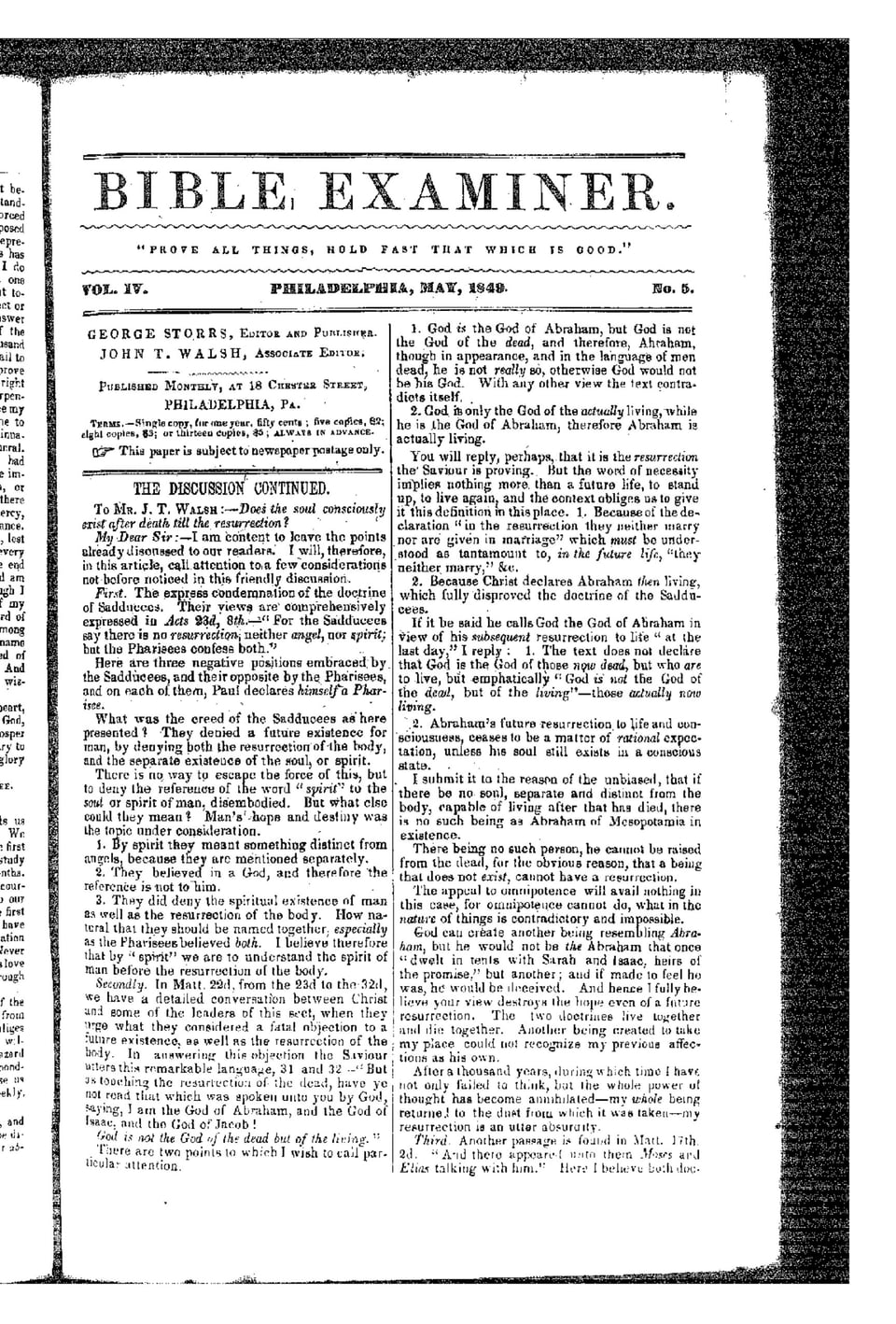
BIBLE EXAMINER.
"PROVE ALL THINGS, HOLD FAST THAT WHICH IS GOOD."
VOL. IV.
PHILADELPHIA, MAY, 1848.
No. 5.
GEORGE STORRS, EDITOR AND PUBLISHER JOHN T. WALSH, ASSOCIATE EDITOR;
PUBLISHED MONTHLY, AT 18 CHESTER STREET PHILADELPHIA, PA.
Terms. — Single copy, for one year, fifty cents; five copies, $9;
eight copies,3; or thirteen copies,6; ALWAYS IN ADVANCE.
This paper is subject to newspaper postage only.
THE DISCUSSION CONTINUED.
To MR. J. T. WALSH: Does the soul consciously exist after death till the resurrection?
My Dear Sir:-I am content to leave the points already discussed to our readers. I will, therefore, in this article, call attention to a few considerations not before noticed in this friendly discussion.
First. The express condemnation of the doctrine of Sadducees. Their views are comprehensively expressed in Acts 23d, 8th.—"For the Sadducees say there is no resurrection; neither angel, nor spirit; but the Pharisees confess both."
Here are three negative positions embraced by the Sadducees, and their opposite by the Pharisees, and on each of them, Paul declares himself a Pharisee.
What was the creed of the Sadducees as here presented? They denied a future existence for man, by denying both the resurrection of the body, and the separate existence of the soul, or spirit.
There is no way to escape the force of this, but to deny the reference of the word "spirit" to the soul or spirit of man, disembodied. But what else could they mean? Man's hope and destiny was the topic under consideration.
By spirit they meant something distinct from angels, because they are mentioned separately.
They believed in a God, and therefore the reference is not to him.
They did deny the spiritual existence of man as well as the resurrection of the body. How natural that they should be named together, especially as the Pharisees believed both. I believe therefore that by "spirit" we are to understand the spirit of man before the resurrection of the body.
Secondly. In Matt. 22d, from the 23d to the 32d, we have a detailed conversation between Christ and some of the leaders of this sect, when they urge what they considered a fatal objection to a future existence, as well as the resurrection of the body. In answering this objection the Saviour utter this remarkable language, 31 and 32 But as touching the resurrection of the dead, have ye not read that which was spoken unto you by God, saying, I am the God of Abraham, and the God of Isaac, and the God of Jacob!
God is not the God of the dead but of the living."
There are two points to which I wish to call particular attention.
God is the God of Abraham, but God is not the God of the dead, and therefore, Ahrham, though in appearance, and in the language of men dead, he is not really so, otherwise God would not be his God. With any other view the text contradicts itself.
God is only the God of the actually living, while he is the God of Abraham, therefore Abraham is actually living.
You will reply, perhaps, that it is the resurrection the Saviour is proving. But the word of necessity implies nothing more than a future life, to stand up, to live again, and the context obliges us to give it this definition in this place. 1. Because of the declaration "in the resurrection they neither marry nor are given in marriage" which must be understood as tantamount to, in the future life, "they neither marry," &c.
Because Christ declares Abraham then living, which fully disproved the doctrine of the Sadducees.
If it be said he calls God the God of Abraham in view of his subsequent resurrection to life "at the last day," I reply: 1. The text does not declare that God is the God of those now dead, but who are to live, but emphatically "God is not the God of the dead, but of the living"—those actually now living.
Abraham's future resurrection to life and consciousness, ceases to be a matter of rational expectation, unless his soul still exists in a conscious state.
I submit it to the reason of the unbiased, that if there be no soul, separate and distinct from the body, capable of living after that has died, there is no such being as Abraham of Mesopotamia in existence.
There being no such person, he cannot be raised from the dead, for the obvious reason, that a being that does not exist, cannot have a resurrection.
The appeal to omnipotence will avail nothing in this case, for omnipotence cannot do, what in the nature of things is contradictory and impossible.
God can create another being resembling Abraham, but he would not be the Abraham that once "dwelt in tents with Sarah and Isaac, heirs of the promise," but another; and if made to feel he was, he would be deceived. And hence I fully believe your view destroys the hope even of a future resurrection. The two doctrines live together and die together. Another being created to take my place could not recognize my previous affections as his own.
After a thousand years, during which time I have not only failed to think, but the whole power of thought has become annihilated—my whole being returned to the dust from which it was taken—my resurrection is an utter absurdity.
Third. Another passage is found in Matt. 17th. 2d. "And thero appeared unto them Moses and Elias talking with him." Here I believe both doctrines are illustrated and confirmed to the disciples.
Here was Elijah in a resurrection body confirming that doctrine. Here was Moses, who died and was buried 1400 years before, a proof of the other doctrine contended for.
But had not both bodies? I cannot say, though both were made known to the disciples, what was their appearance. God sometimes assumes a body and makes his angels to appear as men, spirits or flaming fire. Could he not clothe, for the time, the soul of Moses in a body, as it pleased him?
There is no proof that he was raised from the dead, i.e. that his body was raised, and if you deny my declaration, you must base that denial on sheer assumption.
My dear sir, on this side of the question I have now done. I am most respectfully and truly your friend and brother, W. H. BREWATER.
Dear Sir,—In your article you base an argument.
REPLY TO MR. BREWSTER.
1st. On "the express condemnation of the doctrine of the Sadducees."
Truly, in Acts 23d, 8th, it is said "For the Sadducees say there is no resurrection, neither angel nor spirit." What is the force of this passage? The Sadducees, by denying a "resurrection," as a necessary consequence, denied the existence of "angels and spirits;" thus predicating the existence of them upon their resurrection. There seems to be a hint here, that "angels" have attained to their present condition by a previous prohation and resurrection from the dead. This idea receives support from the Mosaic account of Man's fall, &c. According to this view, the existence of "spirits" should be predicated on the resurrection of men. The saints, when raised, are termed the "spirits of just men made perfect." But this merely by the way.
"The Pharisees confess both." "Both" what? The term "both," refers to two only. But you say "here are three negative positions embraced by the Sadducees, and their opposite by the Pharisees, and on each of them, Paul declares himself a Pharisee."
Now the term "both," referring to two things only, must be applied to "angels and spirits," whose existence is predicated upon a resurrection, or else, if you apply it to "angels and spirits," you must leave out of the question the "resurrection," altogether! And, accordingly, we do find just such an idea among some of the Pharisaic Jews, who affirmed, "that the resurrection was passed," the soul having gone to heaven at death, "and overthrow the faith of some."
But, waiving all this, did Paul affirm "himself a Pharisee" in the three particulars above noticed? He has not left us to infer his meaning, for in the 6th verse he tells us in what sense he is a Pharisee. He says—"I am a Pharisee—concerning the hope and resurrection of the dead, I am called in question." So there is no evidence that he was a Pharisee, believing in all the paganism of disembodied spirits, and "ghosts of frightful men."
After asking what was "the creed of the Sadducees," you reply, "they denied a future existence for man, by denying both the resurrection of the body, and the separate existence of the soul, or spirit." Now, if you had finished the sentence
at the term "body," you would have expressed the truth in the case, for the Sadducees truly "denied a future existence for man, by denying the resurrection of the body"—upon which that "existence" depends! But denying this, the other followed as a necessary conclusion.
Your second argument is founded on Mat. xxii. 23-32.
Now, be it remembered, the Saddness affirmed there was no resurrection; (see 23d verse.) and consequently no future life for man. Death, with them, was an "eternal sleep;" and for the purpose of puzzling the Lord, they asked him—whose the woman shall be in the resurrection, for the seven had her? They did not ask whose wife she shall be in the intermediate state, or the state between death and the resurrection; but whose wife she shall be in the resurrection? The Lord replied, "ye do err, not knowing the Scriptures, nor the power of God. For in the resurrection, (not in the state of the dead,) they neither marry, nor are given in marriage, but are as the angels of God in heaven;" thus predicating the angelic nature upon the resurrection. He continues, "but as concerning the resurrection of the dead, (not their separate existence,) have you not read that which was spoken to you by God, saying, I am the God of Abraham, and the God of Isaac, and the God of Jacob? God is not the God of the dead, (who live no more, as you suppose) but of the living;" that is, of those who shall live again by a resurrection, which you Sadducees deny. Such is the obvious meaning of the passage. You say "God is not the God of the dead"—that is, of those who are "really dead;" then by what logic will you make him the God of those who are half dead? Again you say, "God is only the God of the actually living;" but why prefix "really" and "actually" before "dead" and "living?" Do not the words express the ideas? Men are either dead or alive; and therefore the case stands thus:
God is not the God of the dead ;
Therefore God is not the God of Abraham.
But Abraham is dead ;
Are you willing to endorse this? Perhaps not; let us try again:
This is not the true position ; let us try another. 2. Living men are not the subjects of a resurrection ;
But Abraham, Isane and Jacob are living; Therefore they will not be raised from the dead.
God is not the God of the dead, who live no more;
But Abraham, Isaac and Jacob will live again; Therefore God is the God of Abraham, &c.
This expresses the truth on the subject, and both of us can endorse it with all the heart!
I have no objection to your definition of the term resurrection—"to stand up, or live again." It is a re-living, or living again, and necessarily implies the previous death of the subject. No death, no resurrection; no resurrection, no future life.
You speak of "Abraham's resurrection to life and consciousness" as "ceasing to be a matter of rational expectation, unless his soul still exists in a conscious state." Really, I should like for you to help me to an understanding—a "rational" understanding of this sentence! In the first place, you endow Abraham with "life and consciousness"
while dead, and then, strange to tell; raise him to "life and consciousness"! He will then have a double life and double consciousness! May we not say, that, if Abraham's soul exists in a state of "life and consciousness," his resurrection to "life and consciousness" "ceases to be a matter of rational expectation"? It would, indeed, be an absurd "expectation."
You then "submit it to the reason of the unbiassed, that if there be no soul, separate from the body, there is no such being as Abraham in existence." Further on you say, "There being no such person he cannot be raised from the dead, for the obvious reason that a being that does not exist, cannot have a resurrection."
Here you have precipitated yourself against the sharp rocks of skpticism, and cannot save yourself without "suffering loss."
If Abraham's soul is not living, you say he does not exist; and, consequently, he cannot be raised from the dead. This is your argument. Of course, then, the body of Abraham, to say nothing of his soul, has no existence; and this, according to your view, can never be raised: so that you are driven to the dreadful alternative of denying the resurrection of the body in toto! Then, if there be any resurrection, it must be affirmed of the spirit; but this, according to your view, is alive, and therefore cannot be the subject of a resurrection to life. So your view leads to a denial of the resurrection altogether. Here, then, we have this Pago-Christianized Theology to the life. The spirit or soul survives the body—this returns to dust, and ceases to exist—therefore it can never be raised—therefore the grave will never yield up its prey, but have the "victory"—therefore we can never sing, "O! grave where is thy victory"—therefore the sea will never give up its dead—therefore death is an "eternal sleep!" From such theology good Lord deliver us! But this is the legitimate tendency of the popular doctrine. It leads the mind back to Infidelity and Paganism. I am sorry, truly so, to find friend Brewster advocating such views.
Again, you say, "the appeal to omnipotence will avail nothing, for omnipotence cannot do, what, in the nature of things, is contradictory and impossible." My good sir, you are in company with those Athenians who mocked when they heard Paul on the "resurrection of the dead," and with those to whom he said—"Why should it be thought incredible that God should raise the dead?" Is there anything in the "nature" of the resurrection "contradictory and impossible"? I am almost constrained to say—"You do err, not knowing the scriptures, not the power of God;" for if the body has no existence, and cannot be raised, Paul erred when he said—"Our vile bodies shall be fashioned like his most glorious body." And, "if the spirit of Him who raised up Christ from the dead dwell in you, He that raised up Christ from the dead, shall also quicken your mortal bodies by his spirit that dwelleth in you."
But how can a body be "fashioned" when it has "no existence?" Or how can "mortal bodies" be made alive if they have no "existence?" This, according to your view, is "contradictory and impossible." The resurrection is, in a qualified sense, a new creation; but it is the reorganization of the former body. If this be not so, how is it, that we must all appear before the judgment seat of
Christ, that every one may receive in body, the things he has done, whether good or bad?" And how are they who "sleep in the dust of the earth to awake?" How is the "earth to cast out her dead?" as the Prophet says.
May I not adopt your language, and, with all the emphasis I can give it, declare that, IF YOUR VIEW be correct, THE "RESURRECTION IS AN ABSURDITY?"
3d. Your third proof is Mat. 17: 2, on which I shall be brief. Aud.
1st. We may remark, that the whole transaction is a "vision," and does not necessarily involve the personal presence of Moses and Elijah. But,
2d. Granting they were there personally, what does it prove? Of Moses it is said that he died, and the Lord buried him. The man Moses died, and the man Moses was buried; and if he personally appeared on the Mount of Transfiguration, he must have been raised from the dead.
Of Elijah it is said he went up to heaven in a chariot of fire, and no difficulty is presented in his case; but how you invest him with a "resurrection body," I cannot conceive. Elijah was not the subject of a "resurrection," but a translation. All he left when he went up was his mantle, which he left as a legacy to Elisha. It is said that the "Devil disputed about the body of Moses," but we have no evidence that Elijah left his body as a legacy to his Satanic Majesty, and received another as he went up.
You say, "there is no proof that Moses was raised from the dead." The very fact of his appearing on the mount, is "proof" to my mind.
You say, "God sometimes assumes a body," &c. Where is the proof of this? The bodies of "angels" are not "assumed." They "appear as men;" because this is their form. Man was made in their image. I regard it, therefore, as a "sheer assumption" on your part to deny the resurrection of Moses. If he personally appeared on the Mount, he was certainly raised, and his presence there would be the proof.
In conclusion you say, "On this side of the question I have now done."
O! that I could hope soon to have you on this side of the question, contending for incorruptibility, immortality and eternal life in Christ, by a resurrection from the dead!
Shall I not hear from you on the passages previously quoted? I have much additional testimony in store, and should like to have an opportunity of presenting it; if not in hope of changing your views, at least for the benefit of our readers. May the Lord bless us both, lead us into all truth, and give us an abundant entrance into his everlasting kingdom, is the prayer of your sincere friend,
JNO. T. WALSH.
PHILADELPHIA, April 30th, 1849.
SCRIPTURE EXPOSITIONS EPHESIANE II. AND III.
VERSES 11 and 12. Wherefore remember, that ye being in time past Gentiles in the flesh, who are called uncircumcision by that which is called the circumcision in the flesh made by hands. That at that time ye were without Christ, being aliens from the commonwealth of Israel, and strangers from the covenants of promise, having no hope, and without God in the world.
The apostle having previously clearly stated their high calling, and the exalted standing to which they had now attained, next gives them a word of caution. "Wherefore remember," call to mind, recollect—"that ye being in time past Gentiles in the flesh"—that is, were not of the nation in covenant with God—"remember that at that time ye were without Christ,"—Christ being of the Jews, and not previously having been proclaimed to them—"being aliens"—strangers to, ignorant of, separate—"from the commonwealth of Israel," not citizens; and as a consequence—"strangers from the covenants of promise,"—not allied to God in covenant—"having no hope"—of the resurrection from the dead; or, of the adoption of children, "and without God in the world,"—atheists in the world; having no knowledge of the true God or the nature of his service, nor of that glorious state to which God designed to raise the holy and unblamable in love.
VERSE 13. But now in Christ Jesus ye who sometime were far off are made nigh by the blood of Christ.
But now in Christ Jesus"—by the regenerating power of "the word of truth," which is the seed in producing a union with Christ, who is the truth, as well as the life; so that now—"ye who sometime were afar off"—that is, aliens—"are made nigh"—no longer aliens, but brought to be worshippers of the true God—"by the blood of Christ." Christ was of the Jews by blood. When his blood was shed, or his life received by descent from Abraham was given up, his relation to them, "after the flesh," being dissolved, he enters into relation with persons out of all nations by the Spirit of Life, or through the spirit by which he lives forever more, and which raised him up from the dead.
VERSEN 14—18. For he is our peace, who hath made both one, and hath broken down the middle wall of partition between us; having abolished in his flesh the enmity, even the law of commandments contained in ordinances; for to make in himself of twain one new man, so making peace; and that he might reconcile both unto God in one body by the cross, having slain the enmity thereby. And came and preached peace to you which were afar off, and to them that were nigh. For through him we both have access by one spirit unto the Father.
"For he is our peace"—i. e., he is the author of it—"who hath made both"—Jews and Gentiles—"one, and hath broken down the middle wall of partition,"—the wall of division—"having abolished"—made useless; rendered worthless—"in his flesh"—i. e., in his sufferings—"the enmity"—that which was the cause of the division between Jews and Gentiles—"even the law of commandments contained in ordinances"—those under which the Jews had herefore been held; which by the sufferings and death of Christ were now rendered worthless. In bringing about the death of Christ both Jews and Gentiles were active agents—united in his crucifixion—and could therefore have no just cause of complaint if they were all placed upon the same ioning. The purpose of God was, now that Christ had made useless the law of ordinances—"to make in himself [Christ] of twain [Jews and Gentiles] one new man"—bringing both into union with himself, so that they should constitute one body, while he [Christ] would be the head of this "new" and spiritual creation; thus constituting "one new man," as perfectly
united together as the head and body of the one animal man—"so making peace"—or concord, union, harmony, between those who before were in discord:and that he might reconcile both [Jews and Gentiles] unto God in one body by the cross"-by his death-"having slain the enmity thereby"-the animosity existing between them; that is, his condemnation and death was the occasion of the hostile parties uniting together,[see Acts 4:27,] as some great and deeply interesting event, not unfrequently, unites men from extreme points, as well as abolishing the law or commandments-"and came"-by his ambassadors-"preaching"-proclaiming-"peace"-reconciliation-"to you who were afar off"-who were aliens, i. e., Gentiles-"and to them that were nigh"-the Jews: "for through him[Christ] we both [Jews and Gentiles] have access," admission, "by one spirit"-even that spirit which was upon Christ our head without measure-"unto the Father." Being united with Christ as a branch to the vine, or to keep to the figure of the apostle, as the members of the one body are united with the head and partake of whatever life animates that, so all the members in Christ have access through their head, by the spirit of life in him, to the Father, and in no other way: for,'saith the Savior, "No man cometh unto the Father but by me.'
VERSES 19-22. Now therefore ye are no more strangers and foreigners, but fellow-citizens with the saints, and of the household of God; And are built upon the foundation of the apostles and prophets, Jesus Christ himself being the chief corner-stone; in whom all the building fitly framed together groweth unto an holy temple in the Lord. In whom ye also are builded together for an habitation of God through the Spirit.
"Ye"—Gentile christians—"are no more strangers and foreigners" as ye were once—"but fellow-citizens"—that is, are united under one head and system of government and favor—"with the saints"—the holy ones who first hoped in Christ; [see chap. 1: 12.]—"and of the household" family—"of God." The apostle now changes the figure to a building—"And are built upon"—rest firmly on—"the foundation"—the word of truth, the gospel of their salvation, [chap. 1: 13.] proclaimed—"of the apostles"—messengers of Christ, "and prophets"—either those of the Old Testament, or those of the New, or both—"Jesus Christ himself being the chief corner-stone"—that without which there would be neither union or strength in the building: and he was that of which prophets and apostles all testified who spake of salvation for men; and which was chosen of God to be the head or foundation of the new, or spiritual creation—"in whom all the building"—the whole body of saints, "fitly framed together"—each part adapted to its place and in its proper position. Any part of a building out of its place weakens the whole: but properly adjusted it becomes, or—"growth unto a holy temple in"—or, on—"the Lord"—he being the head stone, or foundation—"in whom," or, on which—"ye also are builded together"—built up in company, each forming a part of the structure—"for a habitation"—an abode, residence, a home—"of God through"—en—by "the Spirit." The church, the spiritual building, is designed of God as the home, the abode, the residence of his Spirit: first resting in Christ without measure, and from him flowing into every soul built on him; thus making them partakers of the
divine nature; and, ultimately, exalting them to the immortal honor of a tabernacle, for God, that shall not be taken down, and eternally be that temple through which he will manifest his glory before other created intelligences: and this is "the riches of the glory of his inheritance in the saints." see chap. 1: 18. Let us see to it, that none of us put forth a hand to mar or injure any person, even one of the least, composing this building, or that God is endeavoring to bring into its structure. The least of all may be as important, in its place, as the greatest; and, indeed, fills a place that the greatest could not occupy.
CHAP. III. VENUSS 1—7. For this cause I Paul, the prisoner of Jesus Christ for you Gentiles; if ye have heard of the dispensation of the grace of God which is given me to you-ward: how that by revelation he made known unto me the mystery; as I wrote afore in few words: whereby when ye read ye may understand my knowledge in the mystery of Christ. Which in other ages was not made known unto the sons of men, as it is now revealed unto his holy apostles and prophets by the Spirit: that the Gentiles should be fellow heirs, and of the same body, and partakers of his promise in Christ by the Gospel: whereof I was made a minister, according to the gift of the grace of God given unto me by the effectual working of his power.
The first verse seems to be the commencement of an exhortation which is interrupted to the close of the chapter, and then resumed at the first verse following. Paul, for preaching the word of truth, the good news of salvation, to the Gentiles, was grievously persecuted by the Jews, and at length is found a "prisoner" at Rome; from whence he sent out this epistle. He calls to their mind the fact that he was a prisoner for their sakes, on their account; and then reverts to his call to preach Jesus Christ to them, and says, "If ye have heard of the dispensation"—of the charge or trust committed—"of the grace"—favor—"of God which is given me to you-ward: how that by revelation" the Lord Jesus unveiled himself to him, so that he saw him, and received his mission directly from Christ; and in such manner as precluded all doubt on the subject of his call and work: see Acts 26: 12—18, and 1 Corth. 15: 5—8: at this time, Jesus—"made known unto me the mystery"—the secret—"which in other ages"—or previous dispensations—"was not made known as it is now revealed"—uncovered, brought to light, rendered conspicuous—"unto the holy apostles and prophets"—persons who communicated truths directly by inspiration of God: and such there were in the days of the apostles: see Acts 11: 27, 28, and 13: 1, 2; and other places. To these prophets and apostles God made known clearly—"by the Spirit, that the Gentiles should be fellow-heirs, and of the same body"—with the Jews—"and partakers of his promise in Christ by the Gospel"—which promise is, that all, without regard to nation, that become holy and blameless in love, shall have "the adoption of children by Jesus Christ to himself," or, be made partakers of his incorruptibility and endless life: of which glorious tidings, Paul says—"I was made a minister"—or, a servant, to the Gentiles—"by the effectual working of his power." see again Acts 26: 12—17
VERSE 8. Ento me, who am less than the least of all saints, is this grace given, that I should preach among the Gentiles the unsearchable riches of Christ.
"Unto me, who am less than the least of all saints"—or, holy ones, that is, the least of all the apostles, as is evident from 1 Corinth 15:8,9, which see—"is this grace given, that I should preach among the Gentiles the unsearchable riches of Christ." Christ has riches; and they are unsearchable, and so extensive that they cannot be explored, nor exhausted. Let us dwell here a moment. What are we called to? First, a union with Christ: to become his bride. Of course, partners in his treasures, honors, and whatever belongs to him. Let this truth be proclaimed. But who and what are we? Mortal, corruptible, dying creatures; whose foundation is in the dust; and all of whose tendencies are to return to dust again; with no principle of immortality or endless life in ourselves. To such creatures Christ is proclaimed, as seeking to bring us into a relation to himself of the nearest and most interesting character. Men are allured by the charm of riches, gold, inexhaustible mines; that wakes up their whole being, and they eagerly inquire what it is, where it is, how they can find it, how they may possess themselves of those treasures; and if they find there is even a chance for success in the pursuit, they enter at once on the expedition, hazarding all the labor, toll, risk, suffering, or privation that may be attending the enterprise. Now, says the apostle, I come to proclaim to you riches unsearchable, a mine that is inexhaustible in Christ. He is the Son of the living God, and heir of God: heir of his incorruptibility, glory, endless life, and whatever pertains to the fulness of God. He proposes to share these riches with us; and in exchange for this short and fleeting life to give us an endless life: instead of these corruptible bodies to give us incorruptible ones: instead of the dishonor of consuming in the grave, by worms, to raise us to crowns of glory that fade not away: in a word, to give us riches as much more glorious, valuable, and durable than the richest diamonds, or the most refined and pure gold, as they exceed the most worthless and loathsome object that earth bears upon its surface. But all comparison fails, and we feel the deepest sense of weakness in the attempt, and leave it to your own reflections to follow up the contemplation of the honor, glory, and riches that are so freely offered to us in Jesus Christ.
VERSES 9—12. And to make all men see what is the fellowship of the mystery, which from the beginning of the world hath been hid in God, who created all things by Jesus Christ; to the intent that now unto the principalities and powers in heavenly places might be known by the church the manifold wisdom of God. According to the eternal purpose which he purposed in Christ Jesus our Lord; in whom we have boldness and access with confidence by the faith of him.
"To make all see"—to enlighten all; not the Jews only, but those of every nation—"what the fellowship"—participation, communion—"of the mystery"—the secret of the calling of the Gentiles, "which from the beginning of the world"—or, ages—"hath been hid in God"—not known as now, though in the purpose of God—"who created"—caused to exist, formed, instituted, or, formed anew, regenerated, renovated; [it may relate here entirely to the "one new man," chap 2: 15, or the one "body," verse 6; the regeneration committed to Christ,]—"all things by"—through, or, in—"Jesus Christ: to the intent that"—in order that—"now unto principalities"—authorities— BIBLE EXAMINER.
"and powers"—rulers—"in heavenly things" in things relating to the kingdom of God, or the regeneration—"might be known by"—or in—the church the manifold"—the immense, the infinite, wisdom of God." The whole scheme of creation, redemption, and renovation, is one of boundless wisdom; faintly manifested at first, and but imperfectly understood until after the death, resurrection and ascension of Christ, and the consequent outpouring of the Holy Spirit, and the further gift of prophecy in the days of the apostles.
verse 28. At that time it is said "a seed shall serve him; it shall be accounted to the Lord for a generation. They shall come [the seed,] and shall declare his righteousness unto a people that shall be born, that he hath done this." Here is a people to be born, after the kingdom is the Lord's, who are to be taught the works God has wrought in subjecting the nations. This portion of Scripture needs no further comment to show that the events spoken of are future, and they are not "conditional;" a phrase much used by those who, though not designedly,
BIBLE EXAMINER.
shall go to another, saying, let us go speedily to pray before the Lord, and to seek the Lord of hosts: I will go also. Yea, many people and strong nations shall come to seek the Lord of hosts in Jerusalem, and to pray before the Lord." Here is a prophecy too plain to be mistaken. The next verse shows that this is to be at a time when the Jews will be missionaries to "the nations." The objector may say "Jews are the spiritual seed." If that is admitted it does not in the least affect the argument; because there are those "of the nations" who are not Jews; and these take hold
runt persons two items, among many within our knowledge, of good done by the hated doctrine.
Oswego, Ind., April 1st, 1849. BR. STORRS:—For your encouragement I would state, that the "Six Sermons" have been blessed in bringing some dear souls to the correct knowledge of Bible Truth. God has been pleased to make a single copy, when introduced into a neighbourhood, a pioneer for the herald of salvation to follow. In this way numbers have been led to know, that sin and death came through the first
by which was made known, vastly more perfectly than in any previous dispensation, the boundless wisdom of God in the work of renovation, progressing to a completeness and perfection never before conceived of by the sons of men; not even the most enlightened, viz., the Jews; and which even the first christians, not excepting the apostles, were slow to learn: so much so that the Saviour said. "Oh unwise and slow of heart to believe;" and Peter had to be taught in a vision, by a sheet let down from heaven, even after his baptism of the Holy Spirit: and our Lord Jesus had personally to appear to Paul with light from heaven that overpowered him, before the church fully understood, or engaged in earnest to carry out God's designs of mercy and salvation to the Gentiles: which design was not new, for it was "according to the eternal purpose," according to the determination before the ages: that is, before either the Christian or Jewish ages; and as expressed, or set forth, exposed to view, [for so the original word here translated purpose, signifies] to Abraham, when God informed him, that in his seed, which is Christ, all
are, in fact, turning the Scriptures into "a cunningly devised fable."
That we do not misunderstand the Psalmist in this matter, let us look at Psalm 72, where speaking of Messiah's reign, he says, "The kings of Tarshish and of the isles shall bring presents: the kings of Sheba and Seba shall offer gifts. Yes, all kings shall fall down before him: all nations shall serve him." At the 17th verse he adds:—"His name shall endure for ever: his name shall be continued as long as the sun: and men shall be blessed in him: all nations shall call him blessed." In view of that glorious period he breaks out in praise and prayer, verses 18 and 19, "Blessed be the Lord God, the God of Israel, who only doeth wondrous things. And blessed be his glorious name for ever: and let the whole earth be filled with his glory. Amen, and amen." These are no dark sayings; but full, clear and plain. It does not require a Solomon to show that this prophecy is unconditional, future in its accomplishment, and before the new earth dispensation. See verse 8. "He shall have dominion also from sea to sea, and
of the skirt of him that is a Jew, saying, we will go with you for we have heard God is with you." We understand, of course, that it is the literal Jews that are spoken of in this verse; and we believe the remnant of them, who escape the terrible judgments with which that period will be ushered in, will be converted at the manifestation of Christ personally to them as he manifested himself to Saul of Tarsus on his way to Damascus. At that manifestation they will weep and mourn as described, Zech. 12: 10-14; and it will not be the mourning of despair, but of genuine repentance for having so long rejected their true Messiah, the crucified Jesus: "in that day there shall be a fountain opened to the house of David and to the inhabitants of Jerusalem for sin and uncleanness;" Zech. 13: 1: and the iniquity of that land will be "removed in one day;" see Zech. 3: 9. This people, thus saved, not changed to immortality, but among the "left of the nations," [Zech. 14: 16.] will be the first or chief of the nations, during the next age or dispensation, and will be employed as suggested by the text. Zech.
Adam, and life and immortality came through our Lord and Saviour Jesus Christ; and that God does not send death to gather his saints unto himself, but, that he will send Jesus Christ to gather them at the second advent, who will present the entire church; as the glorious bride, without spot or wrinkle, unto God his Father, arrayed in beauty, possessing immortality and incorruptibility, whose inheritance will be in the new heavens and new earth—the inheritance incorruptible, undefiled and unfading. Hence, a need of the second coming of Christ is felt, and in this manner a way is opened for proclaiming this blessed doctrine.
S. A. CHAPLIN.
TYLER, Ill., March 22d, 1849. DEAR BROTHER STORMS:—It has now been about two years since your "Six Sermons" first caught my eye. They called in question a doctrine, the truth of which I considered of vast importance; viz. the immortality of the soul: for upon this, and the doctrines unavoidably growing out of it, I had based all my hopes of future bliss and glory. I
the families of the earth should be blessed: this was that "which he purposed in Christ Jesus our Lord," that "the Gentiles should be fellow heirs, and partakers of his promise in Christ Jesus;" verse 6: "in whom we have boldness and access with confidence by the faith of him." Through the promise of God, and the knowledge of his purpose to make us, Gentiles, partakers in the adoption of children, we now have access to God, with a firm reliance upon his mercy to us, who are in Christ, united to Christ, in the one body. Glorious privilege, glorious calling, glorious hope: and let the God and Father of our Lord Jesus Christ have glory now and evermore, through our head and deliverer, the Son of God.
IS THIS AGE FINAL, OR PREPARATORY ? No. 1.
Most Christians are looking for a glorious state of triumph for the Church of Christ on this earth. Do the Scriptures warrant such an expectation? Let the word of truth decide the question, and not our prejudices or fancier. We go back to the time
from the river unto the ends of the earth. Compare this with Rev. 21: 1—"And I saw a new heaven and a new earth: for the first heaven and the first earth were passed away; and there was no more sea." The two periods are as distinct as language can make them; and it seems to us, the impartial mind cannot fail to see it.
Let us next examine Psalms. 102: 13-22,
"Thou shalt arise, and have mercy upon Zion; for the time to favor her, yea, the set time is come. For thy servants take pleasure in her stones, and favor the dust thereof. So the heathen shall fear the name of the Lord, and all the kings of the earth thy glory. When the Lord shall build up Zion, he shall appear in his glory. He will regard the prayer of the destitute, and not despise their prayer. This shall be written for the generation to come: and the people which shall be created shall praise the Lord. For he hath looked down from the height of his sanctuary; from heaven did the Lord behold the earth. To hear the groaning of the prisoner; to loose those that are appointed to death. To declare the name of the Lord in Zion, and his praise
8:23, that is, as missionaries, successful missionaries to "all languages of the nations." Under their labors among those left of the nations, "many people and strong nations shall come to seek the Lord of Hosts in Jerusalem, and to pray before the Lord."
A QUESTION.
In Heb, 2: 14, the apostle, speaking of Christ, says: "that through death he might destroy him that hath the power of death, that is, the devil." Again, in John 3: 8, it is said, "for this purpose the Son of God was manifested that he might destroy the works of the devil."
Here the two inspired witnesses speak too plain to be misunderstood. They mean simply this, that Christ will destroy the devil and his works."
Will some one that believes in the immortality, and never ending sins and torments of those persons that die in their sins, and the immortality and never ending sins and torments of the devil, tell me how, and when. Christ will bring about the
was a Universalist. Believing that all men are a compound of mortality and immortality, destined at the death of the body to ascend in their nobler nature, which was a part of Deity himself, to his own right hand to enjoy his favor forevermore. This, in my estimation, being true, I decided that God would not punish sinners with eternal torments in hell forever, for in so doing he must of necessity punish a part of himself. I was preparing, as fast as my circumstances would permit, to proclaim this, to me, glorious doctrine. But before I had completed my investigation of the "Six Sermons," I became fully satisfied that the entire system [of natural immortality] was based upon the serpent's first lie,—"Ye shall not surely die." I rejected it at once, and was led as I believe into a knowledge of the true source of immortality; and to see that God would render unto every one according to their deeds. "To them who by patient continuance in well-doing, seek for glory, and honor, and immortality, eternal life." Since that time I have felt it my duty to proclaim, according to the ability given, life and immortality through Jesus at his
of Moses; Numb. 14:21. "But as truly as I live, all the earth shall be filled with the glory of the Lord." Here is a most solemn oath of the living God. Has the promise made by this oath ever yet been fulfilled? Surely, none can be at a loss for an answer. How did the Psalmist understand this subject? See Psalms 22.27. "All the ends of the world shall remember and turn unto the Lord: and all the kindreds of the nations shall worship before thee." Has this prophecy ever had its fulfilment? Certainly not. But he tells us when it shall be, viz: When "the kingdom is the Lord's, and he is Governor among the nations;"
in Jerusalem. WHEN THE PEOPLE ARE NATURING TOGETHER AND THE KINGDOMS, TO SERVE THE LORD. Here the language is clear. It is at a time when the Lord personally appears in his glory. This was written for a future period; and the people which shall be created shall then praise the Lord. The Prophet Habakkuk says: "The earth shall be filled with the knowledge of the glory of the Lord, as the waters cover the sea," Hab. 2:14. This certainly relates to the future.
IN THAT AGE, THE JEWS MISSIONARIES.
The Prophet records from the mouth of the Lord, Zech. 8: 21-22. "And the inhabitants of one city
Glenns Fulls, N. Y.
DOES IT DO ANY GOOD?
We have heard so many sueers from a certain quarter against the view we entertain on the immortality question—and it has been so significantly said "I never heard of the doctrine doing any good," that we have concluded to give these ignecoming and kingdom. During the past year I have travelled through a part of Illinois, Indiana, Michigan, and Ohio: and among those looking for the coming and kingdom of Jesus, I have found but three, who do not believe with you in respect to the nature and destiny of man: one in Illinois, one in Indiana, and one in Ohio. I believe these truths should be kept in the front of all preaching; for they are the fundamental doctrines of the Bible. They strike a death blow to Universalism in all its parts. I have found in conversing with Universalists, since I embraced my present view, that they are entirely unprepared to meet these truths. The weapona they use so successfully against eternal torments fall lifeless when tried against the Bible view of the destruction of the wicked.
Yours, in hope of Eternal Life,
D. P. HALL.
BIBLE EXAMINER.
PHILADELPHIA, MAY, 1849.
ENDLESS LIFE ONLY IN CHRIST.
"He that hath the Son hath life : he that hath not the Son of God hath not life."—1 John 5:12.
BIBLE EXAMINER. We have concluded to say a few words as to the prospects of our paper; and especially as some, even of our friends, from our silence and through insinuations of others, have been led to think that the Examiner is amply sustained. We abhor the everlasting begging and dunning practiced by some.
From our subscribers we have not received funds sufficient to pay our printer for the present volume; and unless we can realize at least four hundred more new subscribers during this year, we shall be exceedingly embarrassed in finishing the volume for 1848, and shall be plunged in debt, without having received a cent for our personal labors. If half our present subscribers will send us two new ones, each, with the pay in advance, we shall be able to finish the year not only free from debt to the printer, but also a trifle for our own services; at which you will rejoice, if we have contributed any thing to your profit. No subscription will be received for a less time than one volume. All the numbers for 1848 can be had if desired.
Any person who will send us two new subscribers, with pay in current money, free of expense to us, we will send a copy of Dobney, in paper cover, without charge. Dobney on Future Punishment, or the end of the Wicked, is the most grand and interesting work that has yet appeared. If any prefer the Six Sermons instead of Dobney's work, as a premium for the two new subscribers, we will send three copies of them. We now leave the subject with our friends, to do what they judge best and right.
DR. JOHN T. WALCH.—All letters to him should be addressed PHILADELPHIA, Pa., No. 63 Ogden St.
TOUR EAST, WITH VARIOUS OBSERVATIONS. Our apology for the lateness of the Examiner this month, is our absence. After our last went to press we concluded not to issue the May number till our return. We left Philadelphia March 28th at six o'clock in the morning, and arrived in New York City, 100 miles, at half past one, P.M., where we were welcomed to the hospitable home of our old
friend Henry F. Johnson. A meeting had been given out for the evening in American Hall, Broadway, where, notwithstanding the wet weather, we had the satisfaction of seeing many old friends, and a good assemblage of attentive hearers, to whom we spoke "of things new and old;" and again in the same place the next evening. Saturday, March 31st, we left New York at 8 o'clock in the morning, by the cars; going north and east we passed through Bridgeport, New Haven, and Hartford in Connecticut, Springfield, and Worcester in Mass., principal towns and cities on the route, and arrived at Boston about six o'clock in the evening, having travelled about 230 miles in ten hours, including stops. This is winging our way fast enough for any age but the present. So has steam entered into the composition of men's minds, in these days, that the means of locomotion are altogether too tardy, and invention is at its "wit's end" to see if some more expeditions means of conveyance cannot be brought into use, whereby the land of promise [California!!] can be gained in "two days" by travelling the heavens above instead of the earth beneath. Yes, they seem determined to travel in the air, and are quite confident that they can succeed, and thus all but annihilate distance, making a pleasant ride, above the clouds, to California or England in "two days." Truly, "man" was "made upright," but we "have sought out many inventions." But all these movements indicate the closing up of the present age, as truly as the attempt to build. Babel indicated the confusion of tongues, whereby the devices of men were overthrown to establish the purposes of God.
Sabbath, April 1st, we preached three times in Chapman Hall, Boston, to an attentive congregation. During the week we attended several meetings and preached. Sabbath the 8th, we again spoke to the people three times; and Thursday following, being the State Fast of Mass., we preached twice. In our discourses we took up the signs of the times; the saint's inheritance; the locality of the Kingdom of God; the prospects of the Jews; the nature of the coming age; and the immortality question; as well as practical holiness, or the importance of being Christ-like in our lives and conversation. True, we had to touch all these subjects but slightly, time not allowing us to enlarge upon them; but we have the satisfaction of knowing that what we did say made the people anxious to hear more; and we were strongly importuned to remove to that city, to preach statedly; but we were compelled to decline, believing that the providence of God called us elsewhere. We may again visit the friends there, as we were urged to do if we could not take up our residence with them. The house of Br. Prescott Dickinson was our home while there; and many have proved his hospitalities as well as we. From Boston we went to Lowell, the city of
Factories. Here we were cheered by the cordial greeting of our beloved brother, the "eminent Methodist preacher," Merrit Bates of the "Wesleyan Methodist Connection of America." We felt some as Paul did when he met the brethren at "Appiforum, and The Three Taverns" on his way to Rome, and "thanked God, and took courage." It was truly refreshing to meet with one minister of the religion of Jesus Christ who manifests its spirit, and is far removed from the narrow spirit which characterises nearly all religionists of every name and party. Here also we met our old friend and brother Wm. H. Brewster, Br. Walsh's polemical opponent, who is also a minister in the Wesleyan Methodist connection, and preaching in Lowell. Our interview with him was of a most pleasant character, and contrasted amazingly with the narrow spirit of most of our theological opponents. Differ as we may and do on some subjects, we felt that the bonds of christian friendship and fellowship were strong and unbroken. We gave Br. Brewster a copy of Dobney on Future Punishment, and since learn that he was highly pleased with the "first part," which was all that he had read at the time. We hope and trust he may be equally well pleased with the "Second part;" and if so, we doubt not, he will become the powerful advocate of "the faith he once destroyed."
We were invited by the official members of the Wesleyan church, to whom Br. Bates ministers, to preach to them on the immortality question. We gave them five Discourses on the subject—two during the week, and three on Sabbath; April 15th. The word spoken was listened to with deep attention. We had both Methodist and Universalist ministers to hear. Br. Bates openly avowed his belief in our view of the end of the wicked; and we doubt not he will be fully sustained by the church and congregation to which he ministers in Lowell; he had preached one discourse to them on the question before our arrival, which made them the more anxious to hear us. Br. Bates went to the Annual Conference of the Wesleyan church, for New England, while we were in Lowell; and though all knew his views on the immortality subject no objection was made to passing his character; the Conference thus manifesting a noble spirit of toleration which does them much honor, and honors the religion they profess. Several copies of Dobney on Future Punishment were disposed of at that Conference, and also of our "Six Sermons." The church at Lowell unanimously requested Br. Bates to return and labor among them another year: Br. Browster also returns to his congregation in Lowell. Our visit to that city was highly gratifying and encouraging. We parted with the friends there, particularly with Br. Bates, with much regret: it was painful to take the final grasp of that brother's hand,
with whom we had enjoyed such a refreshing season; but, we shall meet again; so proclaims the voice of faith. A history of that brother's trials and persecutions, in years past, for the truth's sake, is a chapter written in the "book of remembrance;" and will not be forgotten when God shall "make up" his "jewels." He has a part to act, in future; for which may our Lord fully prepare him, and strengthen him mightily in its performance. Eight years has his mind been exercised more or less on the immortality question. When he was Presiding Elder in the Methodist Episcopal Church, in the Troy Conference, we sent him a copy of "Three Letters," the first thing we ever published on the subject. Those Letters were originally written to the late Rev. Orange Scott, afterwards founder of the "Wesleyan Methodist Connection of America," and which he often told us he was unable to answer. It was by his advice we published them; though his name was suppressed as the person to whom they were written. In the spring of 1841 we sent a copy of those Letters to Br. Bates, and the seed then sown has never ceased to vegetate, though sometimes it has lain comparatively dormant, and then starting forth with fresh vigor, till at length it has appeared in strength, and is vigorously manifesting itself.
The "Three Letters" became the basis of the "Six Sermons," which were first published in Albany, N. Y. in the spring of 1842, and before we had any thing to do with "Millerism." We make this statement because that theory has often been charged with being the author of the doctrine of the destruction of the wicked as advocated by us in our "Six Sermons." But there was never any connection between the one and the other; and Mr. Miller always opposed our views on the immortality question. It is true that we were drawn into Mr. Miller's theory for a time, but renounced all his peculiarities more than four years ago, and some of them more than five years since; and have had no connection with his peculiar views for more than four years past; the leaders in that system are among our opposers.
From Lowell we returned to Boston, and from thence to Springfield, where we were welcomed by many friends, particularly Brethren R. E. Ladd and Moses Stoddard, good men and true, who stand for the right and truth at whatever cost. Sabbath, April 22d, we preached morning and afternoon in Dwight's Hall; and in the evening in the Universalist Church, on the subject,—"No immortality to man except through Jesus Christ." Here we had a large and attentive congregation, to whom we opened and expounded the Scriptures as to the fact, that the death threatened Adam was not a moral one, but a literal dissolution of his entire being; from which thore is no recovery except by Christ, and no immortality only by a union with Christ, and being made partakers of the divine nature in him; or, without holiness—being made Christ-like.
After the sermon, full liberty was given to question us, and we answered all that chose to ask; and there were several, which gave new interest to the subject.
While in Springfield we visited the grave of O. Scott, to whom we refer in our previous remarks. He sleeps in the Cemetery, near the Methodist Church. Near two years have passed away since he has "slept in the dust of the earth," awaiting "the voice of the archangel and the trump of God" to waken him to meet his descending Lord. Many reflections rushed upon our mind as we gazed upon the spot of earth where he lies whose warm hand we had often pressed—whose animating voice and countenance had often cheered us—by whose side we had often stood in doing battle against oppression—and who, first of all ministers of the Gospel, encouraged us to proclaim to the world our views of no immortality to wicked men. Our emotions, as as we stood by his grave, can be more easily imagined than described. We did not indeed fancy an immortal spirit fled to some imaginary heaven; but we did feel an oppression come over our mind that he with whom we were once so intimate in active life was now before us, but could not hear our voice, nor mingle his affections with ours. No, silence reigned: but hope was there; and that hope was in our heart that he who lay before us in the silent dust would, ere long, hear the voice of the Son of God, and come forth to eternal life. We reluctantly took a last look of his dusty bed, and turning away, could scarce restrain our tears: it had a softening and chastening influence on our affections which still remains; and we shall often reflect upon that scene, and live in hope that we shall meet again where death is known no more.
From Springfield we travelled west to Albany, N. Y., the place where we first preached our "Six Sermons" in 1842. At Albany we now preached three times, and trust the Lord will bless the word spoken to the good of such as heard it. Our interview with old friends was of a refreshing character. Some, however, were scattered abroad, and some had fallen asleep. We here became acquainted with Eld. Jasper Hazen, Editor of the Christian Palladium, a periodical of the Christian connection; he is Editor also of the American Christian Messenger. We were refreshed by the kind and brotherly spirit he manifested towards us. We cannot but love men, who, though they differ from our views, manifest that they are in possession of a brotherly heart. "Love is the fulfilling of the law;" without this all our professions and knowledge are vain. Eld. Hazen was among our hearers while in Albany, and we feel a pleasure in the remembrance of our interview with him.
On our return to Philadelphia, we spent the first Sabbath in May in the city of New York, and preached three times in the American Hall; but the day was one of the most rainy of the season, so that few attended.
Now, after an absence of six weeks, we are once more at home in our "own hired house." Our Heavenly Father has kindly watched over us in our travels, so that no harm has befallen us in passing over near a thousand miles by steam power. He has brought us to our habitation in peace, and preserved ours in safety during the period of our absence; and we now desire to record His loving-kindness and tender mercy. To Him be glory and praise through Jesus Christ, His Son, our Saviour and Hope.
THE TRUE WESLEYAN—IMMORTALITY.
Since our last paper went to press, the Editor of the True Wesleyan has commenced a series of articles on "The Immortality of the Soul." In the first article he stated the reasons for discussing the question, and the conditions on which replies would be admitted into the Wesleyan: one of those conditions was, if the respondent be an editor he shall publish both sides in his paper. We had a personal and friendly interview with the Editor of the Wesleyan, and an understanding that we were to republish in the Examiner no more of his articles than we might be disposed to reply to. With this arrangement we left our response to his article "No. 2," with him, on our way to Boston. Soon after we arrived at Boston we received a note from the Editor of the Wesleyan, saying that he had concluded to have his articles stereotyped, and make a book of them; and as such a work should contain a reply to all the objections urged against his views, and as those replies would most naturally arise out of his rejoinders to ours, he desired that we should first publish in the Examiner, and then he would copy from our paper and respond when through with his regular course of argument: this would enable him, with least expense, to stereotype his rejoinders to complete the book. We wrote him in reply, that we did not wish to oppose any obstacle in the way of his book being got up in the way most convenient to himself; but still, thought his new proposition would give him a double advantage: first, the influence of his entire argument would be on the minds of the readers of the Wesleyan before the first of my replies would appear; and then, second, each of my articles was to be accompanied with his rejoinder to prevent the minds of his readers from losing whatever impression his series of articles might have made; and besides, the time that would elapse from the time his articles were published to the appearance of mine, would make it necessary for
…