The Bible Examiner — Vol. 4, No. 9 (1849)
Download: PDF — The Bible Examiner — Vol. 4, No. 9 (1849)
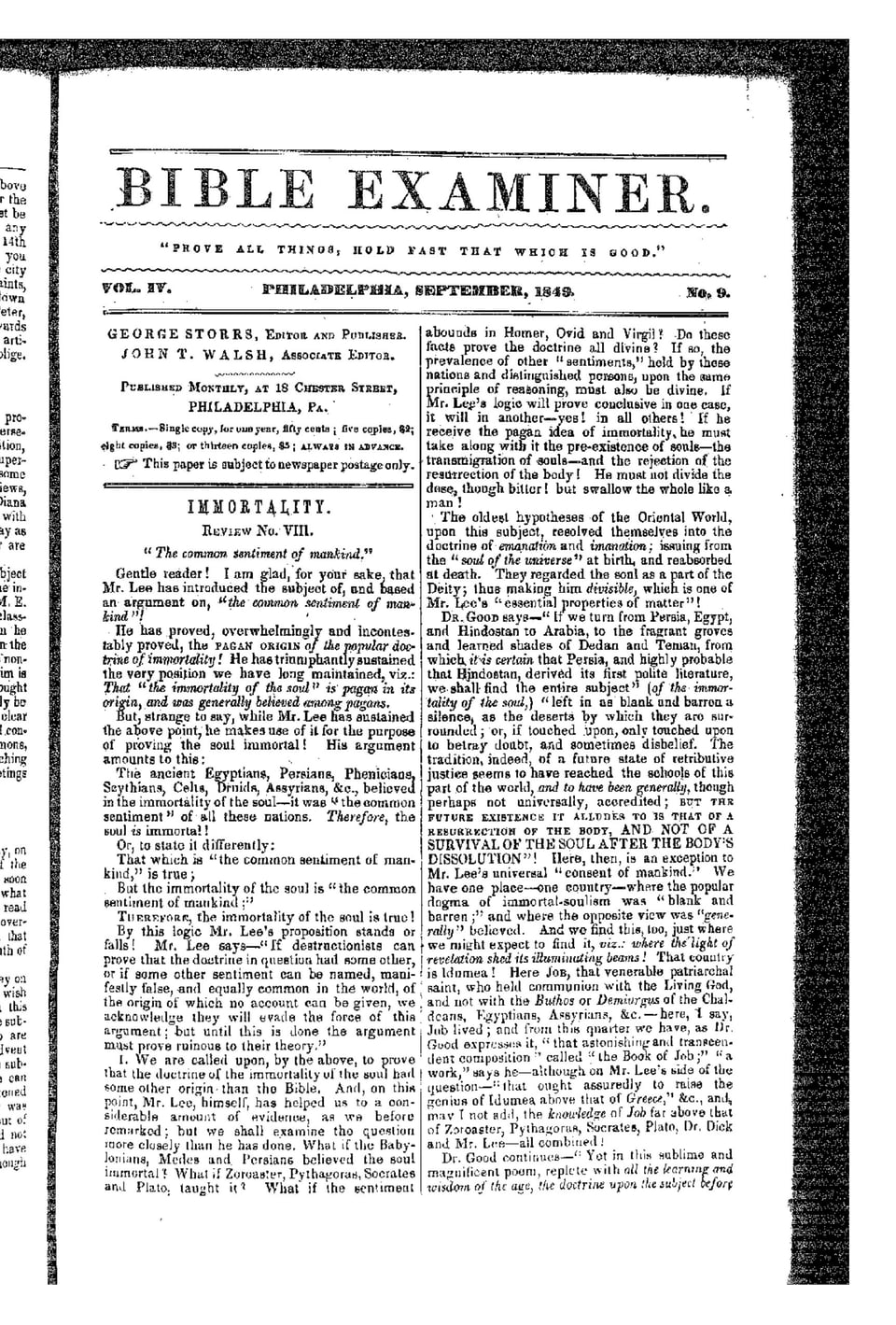
BIBLE EXAMINER.
"PROVE ALL THINGS, HOLD EAST THAT WHICH IS GOOD."
VOL. IV.
PHILADELPHIA, SEPTEMBER, 1849.
No. 9.
GEORGE STORRS, EDITOR AND PUBLISHER JOHN T. WALSH, ASSOCIATE EDITOR.
PUBLISHED MONTHLY, AT 18 CHESTER STREET, PHILADELPHIA, PA.
TENNIS. Single copy, for one year, fifty cents; five copies, 2; eight copies,3; or thirteen copies, $5; ALWAYS IN ADVANCE. This paper is subject to newspaper postage only.
IMMORTALITY.
REVIEW NO. VIII.
"The common sentiment of mankind."
Gentle reader! I am glad, for your sake, that Mr. Lee has introduced the subject of, and based an argument on, "the common sentiment of mankind"!
He has proved, overwhelmingly and incontestably proved, the PAGAN ORIGIN of the popular doctrine of immortality! He has triumphantly sustained the very position we have long maintained, viz.: That "the immortality of the soul" is pagan in its origin, and was generally believed among pagans.
But, strange to say, while Mr. Lee has sustained the above point, he makes use of it for the purpose of proving the soul immortal! His argument amounts to this:
The ancient Egyptians, Persians, Phenicians, Seythians, Celts, Druids, Assyrians, &c., believed in the immortality of the soul—it was "the common sentiment" of all these nations. Therefore, the soul is immortal!
O r_{1} to state it differently:
That which is "the common sentiment of mankind," is true;
But the immortality of the soul is "the common sentiment of mankind;"
THEREFORE, the immortality of the soul is true! By this logic Mr. Lee's proposition stands or falls! Mr. Lee says—"If destructionists can prove that the doctrine in question had some other, or if some other sentiment can be named, manifestly false, and equally common in the world, of the origin of which no account can be given, we acknowledge they will evade the force of this argument; but until this is done the argument must prove ruinous to their theory."
We are called upon, by the above, to prove that the doctrine of the immortality of the soul had some other origin than the Bible. And, on this point, Mr. Lee, himself, has helped us to a considerable amount of evidence, as we before remarked; but we shall examine the question more closely than he has done. What if the Babylonians, Medes and Persians believed the soul immortal? What if Zoroaster, Pythagoras, Socrates and Plato, taught it? What if the sentiment
abounds in Homer, Ovid and Virgil! Do these facts prove the doctrine all divine? If so, the prevalence of other "sentiments," hold by these nations and distinguished persons, upon the same principle of reasoning, must also be divine. If Mr. Leg's logic will prove conclusive in one case, it will in another—yes! in all others! If he receive the pagan idea of immortality, he must take along with it the pre-existence of souls—the transmigration of souls—and the rejection of the resurrection of the body! He must not divide the dose, though bitter! but swallow the whole like a man!
The oldest hypotheses of the Oriental World, upon this subject, resolved themselves into the doctrine of emanation and imanation; issuing from the "soul of the universe" at birth, and reabsorbed at death. They regarded the soul as a part of the Deity; thus making him divisible, which is one of Mr. Lee's "essential properties of matter"!
Dr. Good says—"If we turn from Persia, Egypt, and Hindostan to Arabia, to the fragrant groves and learned shades of Dedan and Teman, from which it is certain that Persia, and highly probable that Hindostan, derived its first polite literature, we shall find the entire subject" (of the immortality of the soul,) "left in as blank and barron a silence, as the deserts by which they are surrounded; or, if touched upon, only touched upon to betray doubt, and sometimes disbelief. The tradition, indeed, of a future state of retributive justice seems to have reached the schools of this part of the world, and to have been generally, though perhaps not universally, accredited; but the future existence it alludes to is that of a resurrection of the body, and not of a Survival of the Soul after the Body's Dissolution!" Here, then, is an exception to Mr. Lee's universal "consent of mankind." We have one place—one country—where the popular dogma of immortal-soulism was "blank and barren;" and where the opposite view was "generally" believed. And we find this, too, just where we might expect to find it, viz.: where the light of revelation shed its illuminating beams! That country is Idumea! Here Job, that venerable patriarchal saint, who held communion with the Living God, and not with the Buthos or Demiurgus of the Chaldeans, Egyptians, Assyrians, &c.—here, I say, Job lived; and from this quarter we have, as Dr. Good expresses it, "that astonishing and transcendent composition" called "the Book of Job;" "a work," says he—although on Mr. Lee's side of the question—"that ought assuredly to raise the genius of Idumea above that of Greece," &c., and, may I not add, the knowledge of Job far above that of Zoroaster, Pythagorus, Socrates, Plato, Dr. Dick and Mr. Lee—all combined!
Dr. Good continues—" Yet in this sublime and magnificent poem, replete with all the learning and wisdom of the age, the doctrine upon the subject before us is merely as I have stated it, a patriarchal or traditionary belief of a future state of retributive justice, NOT BY THE NATURAL IMMORTALITY OF THE SOUL, BUT BY A RESURRECTION OF THE BODY"!
Dr. Good makes this belief "patriarchal or traditionary;" but this is unnecessary, as Job was doubtless an inspired man. Dr. Good's testimony is the more valuable, because he believed in the popular doctrine of immortality.
Whether, therefore, the dogma of natural immortality originated with the old serpent, who said, "Ye shall not surely die;" or whether it originated in Egypt, Persia, Media, Babylonia, or elsewhere, it matters not. One thing is certain, it did not originate from God, else Job would have been in possession of it; and I will pnt Job's knowledge and wisdom against all the Babylonians, Persians, Medes, Assyrians, Zoroasters, and Platos on earth Again, this is doubtless the oldest book or document extant, and on that account demands the attention of the sincere inquirer after truth on this subject.
"The Hindoo philosophers," says Dr. Good, "totally and universally denying a resurrection of the body, and supporting the doctrine (of future existence) alone upon the NATURAL IMMORTALITY of the soul, and the Arabian philosophers (among whom was job) passing over the immortality of the soul, and resting it alone upon a RESURRECTION OF THE body."
The Hindoo view of this question, is the legitimate tendency of the modern dogma on the same subject—it leads to a denial of the resurrection.
Mr. Lee, then, is welcome to his Babylonian, Medo-Persian, Assyrian, and Hindoostan associates, and their authority! He is welcome to the company of Zoroaster, Pythagoras, Orpheus, Socrates, Plato, and a host of others! He is in learned!—but superstitious company! But, to be consistent, he should go all the way with them: he should believe in the pre-existence and pre-intelligence of the soul—that it is a part of God—that it may suffer in purgatory—and that it may be transmigrated!
The Grecian philosophy was imported by Pythagoras from India, whose philosophers reprobated the doctrine of a resurrection. So, when Paul preached through Jesus the resurrection of the dead, in the Argora of Athens, the Athenians declared he brought strange things to their ears, and inquired what the new doctrine was.
Here, then, we have the whole subject before us. On one hand we have Mr. Lee's long array of nations, composing "the heathen world, believing in the natural immortality of the soul, with its kindred appendages. On the other hand, we have the light of truth, concerning the resurrection of the body, pouring its steady rays from the days ofJob, through the dark ages, down to the present time.
And, now, I shall turn Mr. Lee's argument against him, by affirming that the "common sentiment of mankind" is wrong! Truth has always been in the minority, and it always will be, until the Lord comes and takes the kingdom, and the greatness of the kingdom under the whole heaven! Error, in some, or all its forms, is "the common sentiment of mankind." And if Mr. Lee were to carry out his rule, he would be compelled to ad out the eternity of matter, although he seems to
have such an abhorrence of it, for his "heathen" witnesses depose to its truth! Let us now state this argument in form:
That which is "the common sentiment of mankind" is true;
But error is "the common sentiment of mankind;"
Therefore, error is true!
But why should we take "mankind" as the standard of truth? Why not take a nation? A "heathen" nation, to follow Mr. Lee's example? Why not take Europe? or one of the nations of Europe? Why not take Italy? Why not take the Pope? Why not take the most enlightened nation on earth? Will Mr. Lee submit his faith to such a standard? If he were to submit his faith to the "common sentiment" of any nation on earth, he would be weighed in the balance and found wanting. Go to the "heathen world" to learn the doctrine of immortality! Go to Babylon—to India—to Egypt—to the Eastern Magicians, Soothsayers, Astrologers and Philosophers, to learn the doctrine of eternal life? Place these in the collegiate chair, and let the venerable Job, of the land of Uz, sit at their feet, and learn? Place the wisdom of Zoroaster and his associates, which is "foolishness with God," in opposition to the spirit of wisdom divine? A man must be hard pressed for evidence to sustain his faith, when he leaves the oldest and most venerable document on earth, and seeks to the Vedas of the Brahmins and the Zendavesta of the Parsees for light on the question of immortality!
Here, then, is a fact to which we call special attention, viz.: That the denial of the resurrection of the body was as much "the common sentiment of mankind," as the doctrine of the soul's immortality. Among all Mr. Lee's witnesses, only one—Zoronster—believed in, or taught, a resurrection. Now, I can find as many exceptions to Mr. Lee's "common consent of mankind," in relation to the immortality of the soul, as he can find on the subject of a non-resurrection. Will Mr. Lee give me the "origin" of this "sentiment?"
Mr. L. says—"If the doctrine of a future existence be an error, it is the most general one that ever entered the world," &c. Mr. Lee here makes a false issue; for it is not the "doctrine of a future existence" that is denied; but it is the predication "of a future existence" on the "natural immortality of the soul," instead of the resurrection of the body.
Mr. Lee says—the doctrine of the immortality of the soul "prevails most where the Scriptures are most known and read." But, alas! for Mr. Lee's cause, his evidence is all on the other side of the question! If he had said--that the doctrine in question "prevails most where the Scriptures are least known and read," he would have spoken the truth; and his statement would have harmonized with his "heathen" testimony! For surely he will not contend that the Scriptures were "most known and read" by the men and nations of whom he has spoken!
Again he says—"The doctrine must have had its origin." Of course, Mr. Lee, it had its origin; but was that origin divine? If it was, you have failed to prove it, for your witnesses are pagan. Taking the non-resurrection of the body as a sentiment running parallel with the doctrine of the soul's immortality—among the nations and tribes
referred to, I will adopt Mr. Lee's mode of reasoning, thus: As the NON-RESURRECTION OF THE BODY prevails in the heathen world, "and as no account can be given of its introduction, it follows that it must have sprung from some one of the following sources:—It must be instinct, the result of natural reason, from the light of nature, the impression of God's spirit on the mind, or the principle of revelation contained in the Bible. Now, if it be instinct, it must be from the Creator; if it be the result of natural reason, it cannot be unreasonable; if it be from the light of nature, it is a revelation from God; if it be the impression of God's spirit on the mind, it is no less a divine revelation; and if it be the sentiment of the Bible, none but infidels will deny it!" Thus Mr. Lee's logic will work both ways! It will alike apply to every prevalent sentiment, true or false! It will apply especially to many of the appendages of the immortality of the soul. But Mr. Lee makes a bad use of his own logic; for, will he tell me what sentiment has not sprung from one or the other of the sources he has mentioned? I apprehend he will find that every sentiment extant proceeded from one or the other of those sources. What, then, has Mr. Lee gained by this flourish? Absolutely nothing! What is "natural reason"? If Mr. Lee mean by this unenlightened reason, then I affirm that it has given birth, not only to his favorite doctrine, but a thousand other vagaries and absurdities which revelation repudiates, and enlightened reason scouts! 2. Now, let us look at this subject from another point
In perfect harmony with what we have said, concerning the origin and prevalence of the popular view, I will remark, that before the Babylonish captivity, and the Macedonian and Roman conquests, the Jews observed the most profound silence upon the state of the dead. They spoke of it as a place of silence, darkness, and inactivity. This fact speaks volumes as to the "heathen" or pagan origin of the doctrine we are calling in question. They knew nothing of natural immortality till they were carried captive to Babylon, and mingled with some of Mr. Lee's witnesses.
Again, "after the Hebrews mingled with the" Babylonians, "Greeks and Romans, they insensibly slided into their use of terms, and adopted some of their ideas on such subjects as those on which THEIR ORACLES WERE SILENT." Hence the peculiar views of the Pharisees, many of whom not only believed in the pre-existence of souls—but, also, their immortality and transmigration. This is the reason why the question was put to our Lord, concerning the man who was born blind. They supposed it possible for the man to have sinned in a previous state, which was the cause of his being born blind. They also thought that Jesus Christ was in possession of the soul of John Baptist, or one of the prophets. Let us now sum up the whole argument:
We have seen that the doctrine of the immortality of the soul, the pre-existence of the soul, and its transmigration, together with a reprobation of the doctrine of the resurrection of the body, was in its origin pagan or heathenish. Mr. Lee has given us ample proof of this. I have given additional proof.
That in Idumca or Arabia—the country of Job, who is the author of the oldest document extant, we find the opposite doctrine provailing;
and a future life predicated on the resurrection of the body.
That the prevalence of a sentiment is no proof of its truth, or correctness; but, if anything, affords presumptive evidence against it. Truth has always been in the minority.
That previous to the Babylonish captivity, the Jews were silent on the state of the dead, regarding it as a state of silence and darkness.
But that after the Hebrews mingled with the Babylonians, Greeks and Romans, they adopted their ideas on such subjects as those on which their oracles—the Old Testament—was silent. (See Appendix to New Version.)
And that reason unenlightened, has given birth to a thousand vagaries, and among them the dogma of "natural immortality."
But, we are not done with this subject yet; we wish to place it where the hand of mortal disinterment can never reach it! And I now affirm, that revelation has placed the seal of condemnation on the oriental science, of a part of which Mr. Lee is the special advocate.
First, then, in reference to the very nations whom Mr. Lee has convoked as witnesses, Paul says—"Professing to be wise men, they became fools; for they changed the glory of the immortal God into the likeness of an image of mortal man, of fowls, of four-footed beasts, and of reptiles." This will apply to Mr. Lee's Egyptian, Babylonian, Persian, Greek and Roman witnesses. Idolatry was as current among them as the idea of the soul's immortality; so that even in Athens, at that time the most enlightened city of the oriental world, they had thirty thousand gods, and held the natural immortality of the soul; but rejected the resurrection of the body. In the above quotation I have not followed the common version, though I have no objection to it; but have given a better rendering of the language, which is sanctioned by Campbell and McKnight. Here is another: "For this doctrine (the preaching of Christ) is, indeed, foolishness to the destroyed; but to us, who are saved, it is the power of God. Therefore, it is written, "I will destroy the wisdom of the wise, and will bring to naught the knowledge of the prudent. Where is the wise man? Where the Scribe? Where the disputers of this world? Has not God made foolish the wisdom of this world?" Again, Paul says—"The world by wisdom knew not God." The Greeks sought after wisdom—the wisdom of the Platonian school, and consequently, the preaching of life and immortality, through Jesus Christ, by a resurrection from the dead, was "foolishness" to them. Paul did not teach "the wisdom of this world"—he did not speak the theological dialect of Greece and Rome. And here we are reminded of an important fact, that, although the words and ideas, concerning natural immortality, are found scattered through the works of pagan philosophers, we have neither the one nor the other in all the revelations of God! Why this singular omission, if it be the doctrine of the Bible? "O!" says Mr. Lee, "it is taken for granted." Taken for granted, indeed! This is a mere evasion of the argument. There is not a particle of truth in it. The Bible does not take one doctrine "for granted," and then teach an opposite one!
"The theological dialect of the oriental and occidental schools is a compound of foolish words and phrases, which make a foolish language," the product of confusion, mythology and ignorance.
They taught "a vain philosophy;" the philosophy of Greece and Rome, which Paul justly avers is "falsoly so called." Hymeneus and Philetus appear to have been professors of this oriental science. What this science is, we have already seen; and I would here only remind you, that the dogma of a translation to heaven or hell at death, is one item of that profane science by which they overthrew the faith of some in the resurrection. It was upon this hypothesis that "some" among the Corinthians said there was "no resurrection;" and this, I repeat, is the legitimate tendency of the philosophy and theology of my friend Mr. Lee.
In concluding this long review of Mr. Lee's No. 10, I will, without arguing them, present the legitimate tendencies of the view we are opposing. It is furnished to my hand by an intelligent living author.
The dogma of "immortal souls" contravenes the Mosaic account of the Fall.
It reduces the Mosaic account to an absurdity.
It necessitates a change of the words of the Spirit from their proper to a figurative signification.
It is subversive of the resurrection and the judgment.
The pagan tradition of the soul's immortality, not only renders null and void the resurrection to life and judgment, BUT IS EQUALLY SUBVERSIVE OF THE PERSONAL APPEARANCE OF MESSIAH ON EARTH AGAIN.
THE HYMENEAN GNOSIS of immortal soul-ism, and ethereal translation at death, abrogates the reign of Messiah on David's throne for a season and a time.
I pledge myself to make good every item in the above indictment, when it is demanded by counterevidence. J.T.w.
THE ENGLISH DISCUSSION.
"ATHANASIA: OR, FOUR BOOKS ON IMMORTALITY. By John Howard Hinton, A. M."—Such is the title of a book that we have received from England, and of which Dr. Lees, of Leeds, speaks in his letter found in the Examiner for March last. We sent for this book immediately on the receipt of Dr. Lees' letter, but it has been delayed in coming to hand. For the contents of it we refer our readers to Dr. Lees' letter above referred to. We have had time only to glance over that part of the work which relates to his remarks "On the argument as conducted by Rev. George Storrs." If we must be converted back again into the old theory, we should like to be so by such a writer as Mr. Hinton. His manner is kind, christian-like, and well calculated to win our esteem and affection: we certainly feel that he has a brotherly heart, and that, to us, gives great weight to his argument. He is far removed from the narrow bigotry which characterizes most who defend the same side of the question. From the hasty examination we have been able to give his remarks on our "Six Sermons"—for that is evidently all he
has seen of our writings—we are much pleased, and may probably be led to modify some of our expressions, while at the same time we are greatly strengthened in the truth of our general position of the sinner's final doom. On a remark of ours in Six Sermons, page 75, that men in the days of our Lord "were not looking for eternal happiness merely, or an escape from eternal misery, but simply for eternal life," Mr. Hinton, quoting the words which we have italicised, says: "Now the author here affixes the idea of conscious being to the word life, as its literal or primary meaning, and so insists upon it. To this I reply, that this is not the primary meaning of the term. Life is a word having primary reference to organized substances in which its organic functions are maintained." p. 364. We let this definition pass for the present. And then it follows that Death is a word having primary reference to disorganized substances in which the organic functions are destroyed; and this, in fact, Mr. Hinton admits, for he says, p. 363: "The primary meaning of the word death is the cessation of the functions of an organized substance; and when we speak of the death of a man, we mean to denote the fact, and nothing more, that the functions of the organized substance which entered into his constitution have ceased."
This definition we will not now object to; and think in the issue it will help us greatly to fortify the general position of our Six Sermons. Our friend for we truly feel that he is such—has given us a firm foot-hold; but we have neither time nor space to notice him further this month.
The foregoing was written just as the Examiner for August was going to press, and intended to to have been inserted in that number, but we were compelled to leave it out. Since that, we have had time to examine the work generally, and commence giving our readers some notes upon it in this number of the Examiner, which are designed to be continued.
NOTE ON HINTON'S "ATHANASIA."—No. I.
The first thing we notice is Mr. Hinton's definition of immortality. He says—"The idea conveyed by this word in relation to man is that he is adapted to live for ever, or that he is not liable to the cessation of conscious being from any natural cause;" pp. 8 and 9. Again, p. 72, he says—"I take the proper immortality of a creature to be his nonliability to death (here understanding the term death of a cessation of its proper being) by natural causes, or by causes proper to itself." On the same page he says of the orthodox party—"Among the evangelical dissenters of the present day I know of no evidence that they, or any considerable number of them, conceive man to be immortal in the sense that he 'positively shall live for ever.'"
We are glad to hear Mr. Hinton affirm this, and hope he is not mistaken in it; because, if true, it shows that orthodoxy, at least in England, has undergone a radical change in "the present day."
for, we conclude, even Mr. H. will not and cannot deny but the popular orthodox sense of immortality has been, before "the present day," that all men "positively shall live for over;" and if that is not the sense in which all the orthodox party in America use the term in the present day, except so far as they have been compelled to modify it in the controversy now going on, then we acknowledge that we ourselves preached twenty years, and was in constant intercourse with ministers, without ever once hearing or suspecting but that they held the definition of immortality to be, in relation to man, that all "positively shall live for ever." But it seems a new era has dawned in England, and we hail it with joy, and hope it may spread its light on the pagan land this side the Atlantic. The point, in "the present day," in England, that they use immortality to signify that man. "positively shall live for ever," is given up.
This is a great advance towards the truth: and as immortality, according to Mr. H. and his coadjutors, in relation to man, is only an "adaptation to live for ever, or a non-liability to death by natural causes, or causes proper to" himself, we may fairly conclude that man may not live for ever if some cause foreign to himself shall intervene to bring about his death, or to cause the "cessation of" his "proper being." This Mr. Hinton's theory will not allow him to deny; hence we think he and his coadjutors in England, if they do not stop in their search after truth, will be brought to see, that though man has an adaptation to live for ever, yet he "positively shall" nor "live for ever" irrespective of moral character; and that is precisely the ground we occupy. Why is this shrinking, in England, from admitting that immortality has the sense of positive endless continuance in being? Is it not clearly because the truth, from some quarter, whether by the operations of their own minds or otherwise, has pressed upon them, that the orthodox, or popular theory, which till "the present day" has given the sense of positive, eternal, uninterrupted existence to the phrase immortality, is a ground untenable and without foundation in the revelation of God? We believe that is the fact; and the abandonment of such a position in "the present day" shows advance, which gives us much pleasure.
But we now proceed with Mr. Hinton's definition of immortality "in relation to man." We suppose, of course, that it is universal in its application to man. From this word, then, he cannot show that any man, whatever his moral character is, "positively shall live for ever:" all he can do from it is to show that when the righteous put on immortality by a resurrection from the dead, they put on an "adaptation to live for ever," or a "non-liability to death by natural causes;" that is all that can be gained from the word; they stand in the same position that Adam stood prior to his sin. That we are correct in this view of Mr. Hinton's theory, we infer from pages 89 and 90 of his work, where he says—"I speak of man antecedently to sin, and of the adaptation of his nature as a creature of God. I affirm that according to his nature man is immortal that, but for sin, man's existence would never have ceased."
That man by creation was "adapted" to live for ever—that is, the circumstances in which he was created were adapted to perpetuate his existence without end, we as fully believe as Mr. Hinton.
But what were those circumstances? Were they in his nature? They must be, if Mr. H.'s definition of immortality be correct. But we deny that such was the fact. The perpetuation of his existence depended upon the circumstances with which he was surrounded; and hence "lest he put forth his hand and take of the tree of life and eat and live for ever" he is removed from those circumstances upon which his continued existence depended. This certainly does not look as though man by creation was endowed with "non-liability to death by natural causes, or causes proper to" himself. So far from it, it seems as if the natural cause of death was in himself, which could only be stayed or averted by circumstantial causes, and when he was removed from them he naturally fell back again to the dust from whence he came.
If we are correct in these views, Mr. Hinton's definition of immortality; though it may convey his meaning, does not convey the scripture sense; or if it does, we can derive no comfort from Paul's declaration that "this mortal shall put on immortality;" as that, according to Mr. H., necessarily implies nothing more than Adam possessed before he sinned; and hence, for all that phrase teaches, saints may after the resurrection meet with a like disaster to that of Adam, and experience another death. From the phrase immortality, according to Mr. Hinton, we cannot show that man "shall positively live for ever" after the resurrection. Where then shall we look for this assurance? Can we find it in the phrase life?
MR. HINTON'S DEFINITION OF THE WORD LIFE.
He maintains that "Life is a word primarily used to express the active or living condition of organic substances; and it is not," he says, "in its strict or literal sense, applicable to any thing but organic substances, vegetable or animal. When applied to any other objects," he adds, "it is on the ground of some analogy or resemblance; that is, consequently, not literally, but figuratively." pp. 28, 29. Here is some truth and some error. It would be true with regard to created things if we were to amend his definition by saying—"Life is a word primarily used to express the active or living condition of the organic substances of sensitive creatures, whose general condition is one of consciousness; and it is not, in its strict or literal sense, applicable to anything else." The italic words are our corrections of Mr. Hinton's definition. His definition is an assumed one; but the law and the testimony shall settle ours. We have no need to travel far to sustain our position; the first chapters of Genesis will suffice to give us the primary use of the word life. In the account of creation life is not predicated merely of the "living condition of organic substances." It is not affirmed of the earth after its organism—it is not affirmed of the waters, nor of the grass, nor of the herb, nor of the fruit trees, nor of any of the trees which the Lord God made: no, nor of the sun, moon, stars, or any of the lights of heaven. This fact is fatal to Mr. Hinton's theory. But it is affirmed of all the sensitive creatures, whose general state is that of consciousness. Thus—"God said, Let the waters bring forth abundantly the moving creature that hath life, and fowl that may fly above the earth," &c. "And God created great whales, and every living creature that moveth," &c.: chap. 1: 20, 21. God said to man—"have dominion over the fish of the sea, and over the fowl of the air, and over every living thing that moveth upon the earth: v.
Again, to man, "God said, Behold, I have given you every herb bearing seed, which is upon the face of all the earth, and every tree, in which is the fruit of a tree yielding seed, to you it shall be for meat: and to every beast of the earth, and to every fowl of the air, and to every thing that creepeth upon the earth, WHEREIN THERE IS LIFE," &c. Here, we must think, is abundant evidence of the primary use of the word life: and though the trees, herbs, &c.; were an "active or living condition of organic substances," the "strict or literal sense" of the word is not applied to them at all; and hence we may safely conclude it was not "applicable to any" of them, except "on the ground of some analogy or resemblance, that is, consequently nor literally, but figuratively."
That the primary sense of the word life, in the Bible, is not applicable to organic substances without sensation, or without the capacity of consciousness, is further evident from the account of the flood, in which the phrase "every living substance" is employed, and is immediately explained to signify "both man, and cattle, and the creeping things, and the fowl of heaven," while nothing is said of "vegetable life," or of vegetables having life. The Lord said, "the end of all flesh is come before me—I will destroy man whom I have created from the face of the earth; both man and beast, and the creeping things, and the fowls of the air—I do bring a flood of waters upon the earth to destroy all flesh wherein is the breath of LIFE—every thing that is in the earth shall die." The Lord then gave Noah the following direction—"Of every living thing of all flesh, two of every sort shall thou bring into the ark, to keep them alive with thee: they shall be male and female—fowls—cattle—creeping thing—two of every sort—to keep them alive—and they went in unto Noah into the ark two and two of all flesh wherein is the breath of life"—that is, clearly, all sensitive or conscious creatures. Then it is added of those out of the ark—"All flesh often that moved upon the earth, both of fowl, and of cattle, and of beast, and of every creeping thing—and every man; all in whose nostrils was the breath of life, of all that was in the dry land died—Noah only remained alive, and they that were with him in the ark."
Thus we see, that "life is a word primarily used to express" the "active condition of" creatures, and of those only, who have sensation, or are endowed with senses, which distinguish them from the "active condition of" mere "organic substances," or "living vegetables." When the word is applied to vegetable organization it is used in a figurative or anological sense, not in its primary.
The creation of man is equally in point in proof of the position we take on this subject; but we think we do not need to press that point on Mr. Hinton's attention: he cannot fail to see that the word life in the Scriptures has its primary application, not merely to the "active or living condition of organic substances," but "is a word primarily used to express" created things whose peculiar characteristic is, in general, consciousness, or sensation. Whatever may be its definition in the schools of "philosophy," we think it clear we have the Scripture definition, as given by the Creator himself; and we cannot but think, from the general canon of Mr. Hinton in his work, that on reviewing this point he will be led to acknowledge his mistake. It is true, such an acknowledgment is fatal to his whole argument against us, which can only be maintained by saying that the term life primarily does not express a creature whose peculiar characteristic is, in general, conscious existence. If we are right in the definition we have presented, of the primary meaning of the word, Mr. Hinton cannot claim its uniform application in a figurative sense when spoken of the reward of the righteous. It is not, as he maintains, "a choice between two analogical significations" of the word life, but a choice between its literal, i. s. its primary sense and a figurative or analogical one. We maintain that the word life, in the Bible, has its primary and literal sense, generally; if there are exceptions, and we freely admit there are, it is to be shown that the text, context, or other Scriptures require the exception; and we think it not difficult to determine when that is the case. Mr. Hinton, therefore, nor any one else, is to assume that when life is promised and proclaimed, as it is throughout the Scriptures, that the word is used figuratively; that is, for "happiness." We do not admit it. We consider such a view, however undesigned in its advocates, as subversive of the very ground work of faith, and as launching us into the regions of fancy. Life is one thing, and distinct by itself; happiness is another and different matter. As, however, there could be no happiness without life, life is the first and great gospel promise and proclamation—life, ETERNAL LIFE. Such a life must inevitably draw after it happiness: all misery imports decay, and unless arrested must sooner or later result in the extinction of life. That point, however, we shall not argue now.
Page 95 Mr. H. says—"Since the only value of animated, or conscious existence, lies in the happiness derivable from it, life comes in some cases to denote happiness." Again he says—"Life is an expression for the benefits of Christ's death, that is for the whole of them:" p. 33. In a qualified sense we may admit, that it is thus used sometimes: that is, none of all the other benefits could be possessed without life, and therefore to give eternal life is to bestow all other benefits communicated by Christ—they all follow in the train as a necessary result. But if life is by nature, and not one of the benefits, yea, the primary one, upon which all the others depend, then the phrase life must signify, when applied to the benefits by Christ, happiness, as Mr. H. contends. If so, then by a substitution of the term happiness for life we shall have the sense of the word. Mr. H. thus substitutes it in 2 Tim. 1: 1, "The promise of life in Christ Jesus;" and reads it—"The promise of happiness in Christ Jesus;" and says—"I do not see why this should not afford satisfaction in all cases in which life is used to express the benefits of Christ's death, inasmuch as these are all of the general nature of happiness, and readily conceived of as included in the term:" p. 32.
If the term life is to be understood as another phrase for happiness, in relation to benefits received by Christ, it cannot be relied upon to prove future life at all, save by inference: that is, its proper meaning in this relation is happiness, and we infer that to be happy we must be alive. The term, then, according to Mr. Hinton, cannot be urged as direct proof of future life. Then the matter stands thus--To say that man is immortal
signifies only that he has an adaptation to live forever, though it does not prove that he "positively shall live for ever." To say that God has promised us life in Christ Jesus, does not prove that we positively shall consciously exist for ever, or that we shall live at all, only by implication; it only proves that we shall be happy; so that neither of these phrases assure us certainly that our conscious existence shall be perpetuated without end. And if the phrase eternal is brought in to help out of this difficulty, it gives no relief; for that phrase has an "andogical" meaning as well as life; and as life is used in its analogical sense in the case before us, according to Mr. H., it is but reasonable to conclude eternal is also, and therefore signifies only while the subject to which it is applied continues; while the saint continues to be conscious he shall continue to be happy: but, for all the phrase "eternal life" proves, God may at any time blot him out of life proper, provided it only be done without unhappiness; and all evidence from either the phrase immortality or eternal life, that we "positively shall live for ever," is given up and lost, if Mr. Hinton's view is the true one.
Having virtually given up all dependence upon the phrases immortality and eternal life in proof that any one "positively shall live for ever," or even live at all hereafter, Mr. H. must find some other mode of argument to establish those points. Indeed, he has not only virtually given up this point, but has plainly done it so far as it relates to endless conscious existence being a gift of Christ. His words are—"There are no texts that teach never-ending existence to be the gift of Christ to his followers." p. 123. Surely, that is true, if he defines the phrases immortality and eternal life correctly. He adds—"The phrase everlasting life is unquestionably used to express the entire felicity of the redeemed; and it cannot, therefore, when so used, be understood according to a different analogy, that is, of never-ending existence?" p. 123. On the previous page he says—"The phrase, eternal life, ought to be taken for one idea—happiness." Hence we repeat it—that all dependence on this phrase to prove that the righteous "positively shall live for ever" is abandoned. We must keep this position in view as we proceed in our examination of Mr. Hinton's theory; and at another stage of our notes, we shall see on what ground, if any, he can establish the eternal conscious existence of men.
"BEARING THE CROSS."
Much is said, among professed Christians, about "bearing the cross;" but we fear little is understood or really practiced in this matter. Some seem to think speaking in meeting is the cross they must bear; and when they have done that they think little more about the cross. We apprehend that is a very small item in bearing the cross. Men are all naturally in love with this present world. To this world we must become crucified. Crucifixion is a hard death; but few persons are willing to die such a death; there is, however, no other way of entering into the kingdom of God. We must be "crucified unto the world, and the world unto" us. Most professed Christians, it is to be feared, have made a covenant with the world, not to part with it; and the tempter satisfies them if they speak in meeting some times, and
give something to support the gospel, they may keep their covenant with the world: but, "If any man love the world, the love of the Father is not in him." 1 John 2: 15.
How then are we to be separated from the love of the world, and be crucified unto it? First—By a believing view of the Lord Jesus Christ, who became poor—was despised of men—a man of sorrow, acquainted with grief—endured reproach—resisted temptation, though he "suffered being tempted"—when he was reviled, reviled not again—murmured not, though wounded, bruised, put to grief, and his soul made an offering for sin, scourged, spit upon, his hands and feet pierced with nails, his soul in agony—all this he bore, and no lisp of impatience ever escaped him. Would you be crucified unto the world, go learn of him: contemplate his poverty—his life—his sufferings—his resignation—his patience—his loving and forgiving spirit, till the whole mind is humbled within you: and then realize this truth—"If so be we suffer with him, that we may be also glorified together." Rom. 8: 17: Do you ask what it is to suffer with him? We answer—To suffer with the same meek, patient, forgiving, resigned spirit that he had. This leads us to say—
Second—If you would bear your cross and be crucified unto the world, REMEMBER, every trial of your life—whether temporal or spiritual, personal or family, from friends or enemies, direct or indirect, great or small, of short continuance or long, or whatever be the nature or character of it, is by the appointment or permission of that God who willeth not the death of the sinner, but who is seeking by all these trials to crucify you unto the world, and sit you to be glorified with His Son Jesus Christ. How shall this design of our heavenly Father be accomplished? It cannot be, unless you "bear your cross." Do you ask again—What is it to bear my cross? We answer—It is to suffer all the trials of which we have spoken, patiently. You are not to quarrel with the instrumentality God may employ, nor indulge in fretfulness under it. If you do, you do not "bear the cross." And though you should speak like an angel in meeting, yet if you fret and complain under any of the trials of life, by which God is seeking to crucify you unto the world, it is hypocrisy for you to talk about your "bearing the cross"—you are but deceiving your own soul. God has assured us, "all things work together for good to them that love him." Rom. 8: 28; yet, you can murmur, fret, and complain at those things which God has permitted or appointed!! Alas, alas! Do not dream you are ripening for the kingdom of God while this is the case. No, you are ripening for death—for perdition. Saith our Saviour—"In your PATIENCE possess ye your souls." We shall learn soon, or when it is too late, that those words are words of solemn and awful import. If you indulge in murmuring, complaining, or impatience at any trials, insults, sufferings, or injuries, from whatever instrumentality they may come, and that spirit is increasing upon you, you are just as surely travelling in the road to perdition as God has said—"The soul that sinneth it shall die." We speak not now of one "overtaken in a fault," to which all are liable in the hour of temptation, but we speak of him upon whom this spirit is not abating but increasing—and it is increasing, except we bear our cross daily: for every day will bring some cross, in some form.
Happy the soul who is constantly looking to God for grace to bear every cross. We may pray to have the cross removed; but we may not pray for it only in submission to the will of God. "If it be possible let this cup pass from me; nevertheless not my will but thine be done." That is our example; and we cannot safely follow any other. "My grace is sufficient for thee," will often be the answer; and did we know now what we shall know better, we should
self,—where were you, some six year ago? How came you to embrace such a clear light of revelation? Did your salaried preachers teach it to you? Did your sectarian creeds guide to your present faith? Did you, of your ownselves, dare to think of the Bible truths as you now do? Do you not often exclaim, Oh! how great was my darkness; how traditionized I was? Did you not try your utmost
loaned me a few weeks ago "Dick on future punishment." I had said a few words to him on the subject of the destruction of the wicked which he received as though tending toward infidelity. I read Dick, and returned it to him with Dobney: he read Dobney and is reading it again, and says he can scarcely believe his own senses, that his eyes have been so long closed to that truth that there shall be
all we have invested in such a paper as the "Ex aminer."
Your brother in hope of Immortality.
FROM BR. A. A. JAYNE.
NEW YORK, Aug. 20th, 1849.
praise God for every trial and every cross we have to bear; yeah, a living faith will praise God even now, that he does not leave us to our own way, lest we should be like the children of Israel, whose impatient murmurings were answered by giving them "flesh," but "leanness" was "sent into their souls." "Be patient in all things." that is bearing thy cross; then, when Christ appears you shall have a CROWN.
BIBL E EXAMINER.
PHILADELPHIA, SEPTEMBER, 1849.
ENDLESS LIFE ONLY IN CHRIST.
"He that hath the Son hath life : he that hath not the Son of God hath not life."—1 John 5:12.
BIBLE EXAMINER. When our paper went to press for August, we had exhausted all our funds, and were about ten dollars in arrears. Through the goto prove your former theory to be the truth? Yea, did you not wish, that, Brother Storrs would keep such doctrines to himself? O! may the Lord forgive us.
Brethren, seeing what you now see, what would tempt you to wrap that old heathen fable about you again? What would induce you to have the "Examiner" stopped?
I will ask one question more. Are you willing that Brothers Storrs and Walsh, should willingly for OUR sakes, put their time, talents, reputation, living and all, upon the altar of our faith, and be sacrificed there, by suffering the opposition and prejudice of the popular religionists, and poverty and want? Their families need common comforts, as much as ours. Brethren, will you take this into candid consideration? While our brethren may feel it duty to preach the gospel, may it not be ours to sustain them? So reasons Paul.
been to long closed to that truth—that there shall be "no place" found for the wicked after their judgment; that they shall be "burned up root and branch;" nothing of them left—be as a thing that "was" and "is not;" we can love his God better, and see a glory in his justice and holiness which before he could not see. I enclose you a trifle [£2.00 Ed. Ex.] to support the Examiner and only regret that it is not in my power to do more.
FROM BR. WM. P. LEMMON.
BALTIMORE, August 15th, 1849. BROTHER STORRS: I note with regret your want of means to carry on the Examiner, as stated in the last number, and hope the friends of truth will sustain you as they ought. I don't agree with you in all you write, but I think the spirit of candor and kindness that characterises the Bible Examiner, is eminently fitted to correct your errors or mine, as
learned that, for want of funds, it would be difficult, if not impossible, to issue the paper for the balance of the year. I at once determined to cast my vote for its continuance; and for this purpose I enclose five dollars. If the following numbers of the paper are never issued, I shall not feel that you are indebted to me (or to any of your subscribers) one far
thing; for the light which you have been instrumental in shedding upon my mind, on many disputed doctrines of the Bible, is abundantly more precious than the small sacrifice I have made in obtaining it. I read the paper for August with great satisfaction. I think almost every unprejudiced mind would accord to Bro. Walsh the best of the argument, even if they hesitated to admit that he stands firmest upon the rock of truth. The article upon the "Signs of the Times" deeply interested me. I trust you will be enabled to send the following Nos. in due season.
genorosity of a few of our friends, that is cleared off and the present number nearly paid for also; though we are two weeks behind our regular time of issue. We have not asked donations, but they are none the less acceptable on that account. It would, however, be more agreeable to us to receive the amount necessary to complete this volume from new subscribers. We shall put the October number to press immediately on the receipt of funds sufficient to pay for its issue. However the Examiner may be delayed in appearing, our enemies need not exult, nor our friends despair, for it is not dead nor unconscious.
LETTERS OF ENCOURAGEMENT. FROM ELON EVERTS.
VERGENNES Vt., August 5, 1849.
DLAIR BHO. STORRS:-I wish that my anxiety for
I have repeatedly said, I would not, for $50,00 be deprived of the "Examiner." Not, that I can see everything as clear as our brethren that edit it: but, in it, we get a free discussion on both sides, of very important bible doctrines, and by the best talents, of Europe and America, so that the honest enquirer is readily assisted to judge.
Btethren, a word to the wise is sufficient. Are there not enough, of a willing mind, to contribute a small amount each to disembariass the "Examiner," that it may speak to our comfort, and to lead others to the truth? Oh! how great may our responsibility be.
Are there not fifty, who will give five dollars each, and as many more, who will give less, and then have more than the "poor widow?"
[Brother Everts letter contained five dollars, thus giving works as well as words.—Ed. Ex.]
the case may be; and, moreover, I think your paper is intrinsically worth double, at least, what you receive for it; I hope, therefore, that many, if not all your subscribers will agree, not only to double their subscriptions for the coming year but for the present, say one dollar in lieu of fifty cents per annum. Enclosed I hand you ten dollars with my best wishes for the truth's sake.
FROM BR. HENRY E. CARVER.
CINCINNATI, Aug. 23d, 1849. Bro. Storrs,—Some of your friends here were pained to observe by the August number of the "Examiner" that you had become embarrassed in your efforts to disseminate light by want of funds to pay the printer.
Now for one I have been conscious for some time past that the price of the paper, as it is, is too
Yours, looking for glory, hpnor, immortality, eternal life, only through Jesus Christ, our Lord.
BACK NUMBERS.—We can furnish the Bible Examiner to any who wish, from January, 1848, but no further back. We cannot break volumes, except to supply subscribers who have failed to receive their papers. Any such we will supply if they will give us notice of the number or numbers missing. As we shall make no charge for supplying missing numbers to subscribers, they will send us word free of postage.
DEFINITE TIME OF THE ADVENT.—If the author of an article on this topic, recently sent us, will read our editorial remarks on that subject, in the Examiner for June, he will see our reasons for not publishing his calculation. We cannot give currency to
your prosperity, in all the blessings of our heavenly Father commensurate with the stand you have taken on the side of truth, was transmissible. I would quickly diffuse it among the brethren, and incline them to do what is necessary to sustain you in publishing the "Examiner."
I deeply feel the necessity of such a paper, that fearlessly, independently of consequences, diffuses such a broad ray of light, while the popular mass are with all their sophistry trying to darken counsel, preaching fables and deceiving the innocent.
Dear brethren: I will ask you, as I often ask my-
FROM Bn. "W. F. F."
PITTSBURG, August 12th, 1849.
DEAR BRO. STORRS: I was very sorry to see by the last Examiner, a prospect of it not being continued regularly monthly, when it should be published every week, or at least once in two weeks. I trust the friends of "truth" have spoken out "substantially" before this time, and that we may be greeted by its bright beams on the 1st of next month and every month, until it shall come offener.
A friend of mine (an Old School presbyterian)
low, and am willing to pay the advanced price, even with no alteration in the issue. It would be a source of much regret to me to see the Examiner discontinued; for I regard it as the medium of communicating to the world one of the most important, grand and glorious truths ever presented to the mind of man.
The enclosed five dollars is hereby sent by Bro. Royce, Bro. Wibel, and myself. In return, you will please send three copies of "Dobney." The balance of the money you will consider a free-will offering to aid in finishing the present volume. We consider that we have received full benefit for
views on that subject which we are sure will result in no good, and can only add to the number of disappointments calculated to shake confidence in the reality of the advent itself; which we believe to be a glorious truth, and an event nigh at hand. Blessed is the man that watcheth and keepeth himself unspotted from the world, "for in such an hour as ye think not the Son of Man cometh."
FALLEN ASLEEP.—Sister Sarah Blynn, daughter of Br. James Blynn, of this city, fell asleep in Jesus, July 18, aged 25. For nine years, she endured the most intense suffering from a spine affection.
Her epasms were almost unremitted. In '44 and '45, she had a temporary relief, and was enabled to walk a little by the aid of crutches. We felt to praise God for this truly wonderful mercy; but it was of short continuance. Her sufferings since have been indescribable. For near three months before her death, she was unable to speak at all, or scarcely to be moved; and, though sensible, did not open her eyes. From the first year of her sickness to the last hour of life she was never known to murmur or complain; nor did she in any way manifest impatience. She was a firm believer in the second advent of Christ, of eternal life through him by a resurrection from the dead, and of the non-immortality of the wicked. A few moments before she fell asleep in death, she opened her eyes, and with a smile on her countenance, seemed to say farewell to her father and mother, who had watched by her bed side day and night. Unable to utter a word, she could only by signs say: "all is well." Then she fell asleep without a struggle or a sigh, and in glorious hope of a "resurrection at the last day." We might add more, but our limits forbid. We have said this much in praise of that grace which sustained her to the last, and for the information of the many christian friends and ministers who have seen and visited her during her long sickness. She rests from her sufferings, and will soon, we trust, enter into life eternal according to her faith.
EDITORIAL GENEROSITY.
The following communication, with the "Editorial Notes," we copy from the "True Wesleyan," of August 18th. We thank Br. Lee for his "editorial courtesy," and are glad to find that he "always calculates to be a little more generous than some of" his "neighbors." We will assure him, however, that he shall not outdo us in that respect; and we will be most happy to receive a like letter from him at any time, in answer to inquiries, and it shall find place in the Examiner, if we are so fortunate as to be able to continue our paper, which we feared we should not at the time we wrote the following letter to Br. Lee; this fact is our apology, if we need one, for sending our answer to him. That's not all; we will beat him in "generosity" if he will send us an answer to our inquiries to his article "No. II." on Immortality, in the Examiner for May last. We will exceed him in generosity by letting him finish his article without interrupting him by filling it with notes: we will say all we have to say after he has done speaking. We do not complain that Br. Lee placed his figures from "1" to "12" in our article, thereby interrupting us; if that is his taste he has a right to it; we practiced in that way once ourselves till we came to the conclusion
that it was bad taste, to say nothing more. Try the principle in a public oral debate and see who would tolerate it. We say again, we will exceed Br. Lee in generosity, at least in this respect, if he will try us with a reply to our queries in the Examiner for May. And we claim that we have already exceeded him in generosity, for we have copied two of his articles, entire, from the True Wesleyan, on Immortality, while he has copied none of the articles from the Examiner in reply to his, nor noticed that any replies were being made to him by our Associate Editor.
Br. Lee, it will be seen, finishes his notes on our letter "by repeating the questions which," he says, "we insist have not been answered." We are perfectly willing, the readers of the Wesleyan and Examiner should judge whether we have answered the questions or not; and there we shall leave that point after a few words at the close.
BRO. LEE:—Under the above head, in the Wesleyan of the 4th instant, you have noticed some remarks of mine, relating to my objection to the use of the term "annihilation" in the immortality discussion. You conclude with the following questions: "Will Brother Storrs tell us, what he understands by the word death, and by the word annihilation, and what, in his view, is the difference between them."
"ANNIHILATION—DEATH."
In your article, to which this is a reply, you said "we mean by annihilation, what is expressed by the words, 'cease to exist,' or 'a state of non-existence:' and you inquire—" Does Mr. Storrs mean the same thing by death?"
By this inquiry, I presume you wish me to give my answer through the Wesleyan, which I will cheerfully do. (1.)
My answer to this inquiry, turns on what definition you give to the term "exist." (2.) For it seems that you, as well as others, have your own definition of terms. (3.) Mr. Hinton, an English writer on the same side of the immortality question with yourself, in a late mighty effort against the view I advocate, says that "death involves no cessation of existence either body or soul;" p. 449. (4.) It is manifest, however, that the "body" becomes entirely unconscious: (5.) that is "death" when the term is used in relation to the cessation of the life of sensitive beings; but it is not "annihilation:" for, as Mr. Hinton affirms, it "involves no cessation of existence" of the "body." (6.) It is for you, Mr. Hinton, and others, on your side of the question to prove that a man only half dies. (7.) I agree with Mr. Hinton, that in man's death there is "no cessation of existence in either body or soul:" [using the term soul in your sense, of a distinct entity, without adopting that sense]; (8.) Hence, your question is answered, according to the language you employ in defining what you mean by annihilation, viz.—"ceasing to exist, or a state of non-existence:" neither body nor soul "cease to exist" either in the first or second death: (9.) and it is perfectly in "the power of God" to call them up to conscious existence after the first or second death, if he will: the only difference in this respect is. God wills to call all men back from the first
…