The Bible Examiner — Vol. 7, No. 4 (April, 1852)
Download: PDF — The Bible Examiner — Vol. 7, No. 4 (April, 1852)
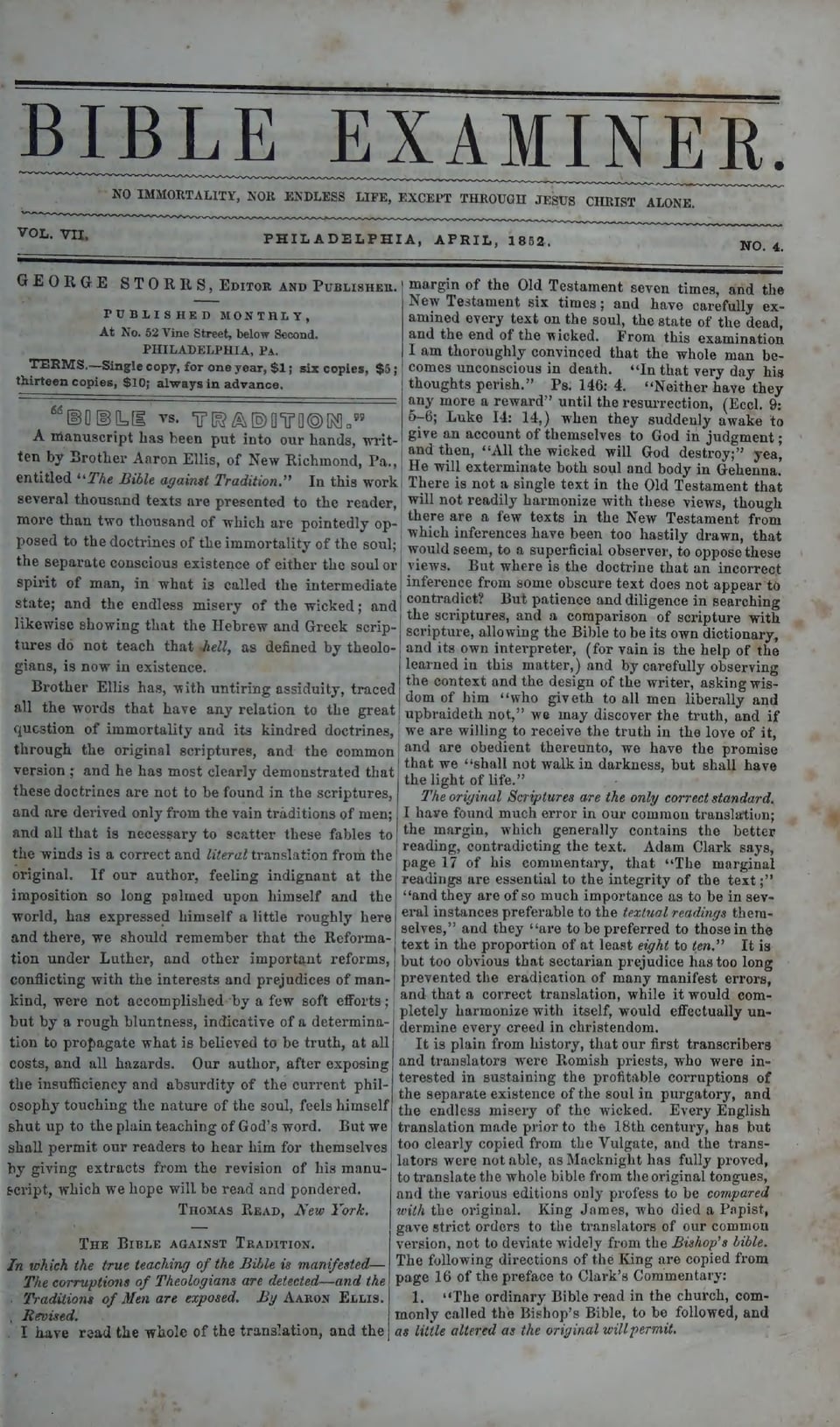
BIBLE EXAMINER
NO IMMORTALITY, NOR ENDLESS LIFE, EXCEPT THROUGH JESUS CHRIST ALONE.
VOL. VII.
PHILADELPHIA, APRIL, 1852.
GEORGE STORRS, EDITOR AND PUBLISHER.
NO. 4.
PUBLISHED MONTHLY,
PHILADELPHIA, PA.
At No. 52 Vine Street, below Second.
TERMS.—Single copy, for one year, 1; six copies, 5; thirteen copies, $10; always in advance.
"BIBLE vs. TRADITION."
A manuscript has been put into our hands, written by Brother Aaron Ellis, of New Richmond, Pa., entitled "The Bible against Tradition." In this work several thousand texts are presented to the reader, more than two thousand of which are pointedly opposed to the doctrines of the immortality of the soul; the separate conscious existence of either the soul or spirit of man, in what is called the intermediate state; and the endless misery of the wicked; and likewise showing that the Hebrew and Greek scriptures do not teach that hell, as defined by theologians, is now in existence.
Brother Ellis has, with untiring assiduity, traced all the words that have any relation to the great question of immortality and its kindred doctrines, through the original scriptures, and the common version; and he has most clearly demonstrated that these doctrines are not to be found in the scriptures, and are derived only from the vain traditions of men; and all that is necessary to scatter these fables to the winds is a correct and literal translation from the original. If our author, feeling indignant at the imposition so long palmed upon himself and the world, has expressed himself a little roughly here and there, we should remember that the Reformation under Luther, and other important reforms, conflicting with the interests and prejudices of mankind, were not accomplished by a few soft efforts; but by a rough bluntness, indicative of a determination to propagate what is believed to be truth, at all costs, and all hazards. Our author, after exposing the insufficiency and absurdity of the current philosophy touching the nature of the soul, feels himself shut up to the plain teaching of God's word. But we shall permit our readers to hear him for themselves by giving extracts from the revision of his manuscript, which we hope will be read and pondered.
THOMAS READ, New York.
THE BIBLE AGAINST TRADITION.
In which the true teaching of the Bible is manifested— The corruptions of Theologians are detected—and the Traditions of Men are exposed. By AARON ELLIS. Revised.
I have read the whole of the translation, and the
margin of the Old Testament seven times, and the New Testament six times; and have carefully examined every text on the soul, the state of the dead, and the end of the wicked. From this examination I am thoroughly convinced that the whole man becomes unconscious in death. "In that very day his thoughts perish." Ps. 146: 4. "Neither have they any more a reward" until the resurrection, (Eccl. 9: 5-6; Luke 14: 14,) when they suddenly awake to give an account of themselves to God in judgment; and then, "All the wicked will God destroy;" yea, He will exterminate both soul and body in Gehenna. There is not a single text in the Old Testament that will not readily harmonize with these views, though there are a few texts in the New Testament from which inferences have been too hastily drawn, that would seem, to a superficial observer, to oppose these views. But where is the doctrine that an incorrect inference from some obscure text does not appear to contradict? But patience and diligence in searching the scriptures, and a comparison of scripture with scripture, allowing the Bible to be its own dictionary, and its own interpreter, (for vain is the help of the learned in this matter,) and by carefully observing the context and the design of the writer, asking wisdom of him "who giveth to all men liberally and upbraideth not," we may discover the truth, and if we are willing to receive the truth in the love of it, and are obedient thereunto, we have the promise that we "shall not walk in darkness, but shall have the light of life."
The original Scriptures are the only correct standard. I have found much error in our common translation; the margin, which generally contains the better reading, contradicting the text. Adam Clark says, page 17 of his commentary, that "The marginal readings are essential to the integrity of the text;" "and they are of so much importance as to be in several instances preferable to the textual readings themselves," and they "are to be preferred to those in the text in the proportion of at least eight to ten." It is but too obvious that sectarian prejudice has too long prevented the eradication of many manifest errors, and that a correct translation, while it would completely harmonize with itself, would effectually undermine every creed in christendom.
It is plain from history, that our first transcribers and translators were Romish priests, who were interested in sustaining the profitable corruptions of the separate existence of the soul in purgatory, and the endless misery of the wicked. Every English translation made prior to the 18th century, has but too clearly copied from the Vulgate, and the translators were not able, as Macknight has fully proved, to translate the whole bible from the original tongues, and the various editions only profess to be compared with the original. King James, who died a Papist, gave strict orders to the translators of our common version, not to deviate widely from the Bishop's bible. The following directions of the King are copied from page 16 of the preface to Clark's Commentary:
"The ordinary Bible read in the church, commonly called the Bishop's Bible, to be followed, and as little altered as the original will permit.
"When any word hath divers significations, that to be kept which hath been most commonly used by the most eminent fathers, being agreeable to the propriety of the place, and the analogy of faith.
"These translations to be used when they agree better with the text than the Bishop's bible, viz: Tyndal's, Matthew's, Coverdale's, Whitchurch, Geneva."
Dr. Macknight says that "Tyndal and Coverdale's translation, of which the rest are copies, was not made from the originals, but from the Vulgate Latin." It is evident that our authorized version was not a new translation from the Hebrew and Greek; but only a revision of certain editions of the Papal Vulgate.
To the common version, it is objected, 1. That it often differs from the Hebrew to follow the Septuagint, and the German translation of the Septuagint. 2. That the translations following the Latin Vulgate, have adopted many of the original words, without translating them, such as hallelujah, hosanna, mammon, anathema, &c. 3. That by keeping too close to the Hebrew and Greek idioms, they have rendered the version obscure. 4. That they were a little too complaisant to the king, in favoring his notions of predestination, election, witchcraft, familiar spirits, &c. These, it is probable, were likewise their own opinions. 5. That their translation is partial, speaking the language of, and giving authority to, one sect, (meaning, probably, the Episcopalians.) 6. That where the original words and phrases admitted of different translations, the worse translations, by plurality of voices, were put into the text, and the better were often thrown out or put into the margin. 7. That notwithstanding all the pains taken in correcting this and the former editions of the English bible, there still remain many passages mistranslated either through negligence or want of knowledge; and to other passages, improper additions were made, which pervert the sense. See Preface to Macknight's translation of the Epistles, pages 21 to 25.
The high encomiums passed on the authorized-version may be due to the simplicity, elegance, pathos, and earnestness of its style; but certainly they do not belong to it for its fidelity to the original. On the immortality of the soul, the common version is not so faithful to the original as is the translation from the Latin Vulgate, sanctioned by Bishop Hughes. Drs. Clark and Scott, who speak most highly of our translation, convict it of more errors than any other Commentators. Be it always remembered that all the transcribers and translators, previous to King James, with perhaps the only exceptions of Tyndal and Luther, were believers in the Popish doctrine of the immortality and separate conscious existence of the human soul. There is only one manuscript, marked B., the Cod. Vaticanus, No. 1209, in the library of the Vatican at Rome, that dates back as early as the 4th, though probably transcribed in the 5th century. Consequently, all the ancient manuscripts were transcribed 200 years after the kindred doctrines of the immortality of the soul, invocation of dead saints, and purgatory, had become established in the Romish church, and the manuscripts, being scarce, were completely under the control of the Popish clergy. The various readings of manuscripts, and differing opinions of commentators, prove them to have been fallible, and their creeds and traditions would naturally bias them in their interpretations of the original text. If, therefore, we wish to obtain the truth, we are of necessity driven to the Hebrew and Greek originals as the purest accessible fountains. Assisted by an honest
and learned friend of the Independent Congregational Society, we have traced all the original terms translated soul, spirit, life, breath, hell, grave, and others, throughout the whole bible, so that any person may readily perceive their bible definitions.
Meaning of the original terms rendered soul and spirit.—The Hebrew word, nephish, of the Old Testament, occurs about seven hundred times, and is rendered soul four hundred and seventy-one times; life and living about one hundred and fifty times; and the same word is also rendered a man, a person, self, they, him, me, any one, breath, heart, mind, appetite, the body, (dead or alive,) lust, creature, and even a beast; and is twenty-eight times applied to beasts, and to every creeping thing.
The Greek word psuche, of the New Testament, corresponds with the word nephish of the Old. It occurs one hundred and five times, and is rendered soul fifty-nine times, and life forty times. The same word is also rendered mind, us, you, heart, heartily, and is twice applied to the beasts that perish. Psuchikos, an adjective derived from psuche, occurs six times, and is translated natural and sensual; it is properly translated animal in modern translations. 1 Cor. 15: 44, will bear this translation. It is sown soma psuchikon, a soul-body, or an animal body, it is raised a spiritual body. There is soma psuchikon, a soul-body, or animal body, and there is a spiritual body. 45v. And so it is written, (Gen. 2: 7.) The first man, Adam, was made into psuchen zosan, a living soul, the last Adam into a life-giving spirit. 46v. Howbeit the spiritual was not the first thing, but the psuchikon, animal, or soul-man, and afterwards the spiritual man. Thus we see that the adjective psuchikon always indicates mortality and corruption, and designates the animal nature, or soul nature of man, in contradistinction to the spiritual nature, or incorruptible nature, which the Christian will receive at the period of his resurrection from the dead.
The word ruah, in Hebrew, corresponds with pneuma in the Greek. These words are mostly rendered spirit; but are likewise rendered wind, air, breath, life, mind, disposition, &c., and are sometimes applied to the beasts. But it cannot be proved that either of the terms means a ghost, or abstract conscious spirit, in either man or beast.
If any theologian, fearing that the craft is in danger, by which he obtains his wealth, should venture to deny the truth manifested in these pages, he must likewise deny the truth of the bible. And to defeat this work by arguments drawn from the bible, he would be required to produce as many pointed texts opposed to our views, as we have produced; and likewise to show that the thousands of texts here produced are to be interpreted as contrary to their plain and obvious import, as the dead body of man is contrary to the immortal soul or ghost of a man; for the words meth nephish, dead soul, occurs eleven times and are four times translated dead body, although twice the word soul is put into the margin, (Numb. 19: 11; 6: 6,) but in the other places no intimation is given that the original words meth nephish, dead souls, is improperly rendered. We give a few examples, Numb. 19: 16. And whosoever toucheth one that is slain with the sword in the open field, or a meth nephish, dead soul, or a bone of a nephish, soul, or a grave, shall be unclean seven days. 2 Chron. 20: 24. Behold, they were meth nephish, dead souls, fallen to the earth. 25v. They found among them in abundance both riches, with the meth nephish, dead souls, and precious jewels. Ps. 79: 2. The meth nephish, dead souls, of thy servants have they given to be meat unto the fowls of the heavens. See also Ps. 110: 6; Lev.
21: 11; Num. 6: 6; 9: 10; 19: 16; Hag. 2: 13.
Thus, then, the fabled immortal souls have bones, and are slain with the sword. These plain texts must not be set aside by incorrect inferences drawn from a few texts which have been forced into the service of our opponents. Let us have scripture argument, for we shall treat human wisdom and invention as unworthy of notice. Although, in this discussion, we shall now and then be compelled to use plain and severe language to dishonest priests, who will neither acknowledge the truth, nor permit others to judge for themselves, yet we do not design to treat unkindly the honest and the liberal; and especially do we desire to avoid anything that has the slightest tendency to deter the sincere inquirers after truth.
In the forth-coming pages we shall unfold the truths of the bible relating to the nature and destiny of man, expose the pious frauds and forgeries of theologians, and manifest their numerous and glaring absurdities. And, First, we shall prove from the Bible the corporeal being and mortality of the soul, and the nature of the spirit of man; which spirit, not being a living entity, is neither mortal nor immortal. And, Second, we shall prove that the hell of the Bible imports the utter extermination of the wicked cast therein, the deprivation of their life and being.
ELDER JOHN TATE'S DEFENCE. [Continued from Vol. VI. page 183.]
Our readers will see by reference to Vol. VI. page 160, that Br. Tate is charged, before the New England Wesleyan Conference, with preaching "Unchristian Doctrine." The following is the continuation of his defence before that body.—Ed.
Mr. President:—I have endeavored to defend the doctrine that man is not immortal in his own nature, from the most positive declarations of the Old Testament. I have also shown that the principles laid down by several distinguished Immaterialists, lead to the same conclusion. I will now pass on to the New Testament. What did Jesus and his Apostles teach respecting the immortality of man? My answer is, they taught that immortality is a privilege and a blessing to be sought after. It is the gift of God, conditionally bestowed on man through Jesus Christ. In proof of this position, I refer to Rom. 2: 6-7. "Who will render to every man according to his deeds. To them who by patient continuance in well doing, seek for glory, honor, and immortality, eternal life.
I propose to carefully and logically analyse the the passages which I shall adduce in support of my doctrine. I intend to prove that the common notions of man's natural immortality are in direct opposition to the Son of God and his Apostles. To the vain uncertain inferences of modern theologians, I oppose the boldest and most positive declarations of Jesus. To you, brethren, I make my appeal. Judge ye what I say. With reference to the passage quoted I remark—
There are three things presented to view as objects to be desired—glory, honor, immortality.
These three things are to be sought for, if we would have them.
Such, and only such as seek for them, shall receive eternal life.
them who, in all the trials and difficulties of the present state, have persevered in well doing; seeking for and expecting glory, honor and immortality."
Dr. Clarke's note on the text is as follows: "In this manner will God in the great day dispense punishments and rewards. He will give eternal life to
Here the Commentator represents immortality not as inherent in or resulting from the nature of man, but as a contingency depending on the conduct of man and the will of God. Such as seek it, and they only, shall receive the precious boon. Nor can the threatening denounced against the wicked in the context invalidate this interpretation. Sinners will suffer tribulation and anguish, but the text does not say they will experience anguish forever. If the sinner shall suffer anguish during any given period of duration, the threatening denounced will be fully accomplished so far as the actual experience of pain is concerned. And the fact that in the text immortality is limited to the righteous, involves the idea of the final termination of the life of the wicked and of course of their anguish also.
Professor Stuart, on the passage before us, says: "We may translate the phrase thus: Immortal glory and honor; or we may render it glorious and honorable immortality, or honorable and immortal glory." The Professor does not say we must so translate the passage, but we may do so. This seems to imply that the passage may be rendered as in our version. When an alteration is proposed in the translation of a passage which affects an important doctrine like that of immortality, we ought to have something stronger than a mere may be or may do to warrant this change. Clarke is satisfied with our version, and so with Scott. It is to my mind a clear proof that immortality is not natural to man; on the contrary, we can secure life to eternity only by a patient continuance in well doing.
I will now turn to the testimony of Jesus Christ. And here I may remark that, if language affords any terms by which we can express the ideas of endless conscious being and total destruction of being, these are the very terms which the Saviour applies to the future states of men. Of the righteous, he says they shall have life; they shall never perish, but have everlasting life; they shall be raised to life, neither shall they die any more. John uses similar language. The righteous shall not be hurt of the second death. There shall be no more death. Of the wicked I read, they shall die, perish, be burned, burned up, they will lose life, be destroyed; their end is destruction, and they shall be punished with everlasting destruction. Now, these are solemn and positive declarations, and you will perceive they are applied, not to emotions or mere conditions of mind, but to the very being of the righteous and the wicked. Nothing is more plainly affirmed than the endless life of the one class, and the entire extermination of the other class from conscious being. And when men shall be emancipated from the dominion of human authority—when they will dare to subject their contradictory and sectarian creeds to a severe logical investigation, then will they reject the popular theology of the day as monstrously unreasonable and palpably unscriptural. So strong is this conviction in my mind, that I believe that, within thirty years, the dogma of eternal torment will be ranked with the blasphemous absurdities of unconditional reprobation and infant damnation.
But to the argument. I read, Matt. 10:39, "He that findeth his life shall lose it, and he that loseth his life for my sake, shall find it." On this I offer the following remarks:
The Saviour had just intimated that a profession of faith in him would subject the believer to desertion and persecution.
He that in this world findeth life, is plainly one who, on account of his profession of Christianity, was in danger of being martyred for his faith, but when the hour of trial came, loving life more than Christ, he denied his Lord to keep his life.
He who loseth life for Christ's sake, is plainly one who, rather than deny or curse his Saviour, suffered martyrdom.
Of these two characters, it is said that one shall find his life, the other shall lose his life.
Now, when we read that he who loses his life for Christ's sake shall find it, we all agree this has reference to the immortal life of the future state. Christ's martyrs shall revive and live again, and that forever. Thus far I say we agree. But in reference to the loss of life which apostates will experience, you seem to me flatly to deny the words of the Son of God. If the great Revealer of Truth is to be trusted, then in some sense the apostate will lose life. Will you tell me that in the case of such as find life and subsequently lose it, that Jesus merely meant they would lose their natural life? Did the Saviour, think you, mean nothing more than that if his disciples abandoned him, and joined with infuriate Jews and Gentiles to curse him, that they would sometime die a natural death? Such an idea appears to me an absurdity. Jesus did not trifle in this way. There is in the text a double antithesis. In this world, the apostate keepeth his life, but the faithful disciple loseth his life. We are then directed into the future world. There the faithful disciples find their lives, and there apostates lose their lives. Thus, according to Jesus, only some will be immortal in the future. We learn from other passages that the apostate will be revived again to life, but that life will be transient, not perpetual. The apostate's second life will be terminated by the second death, after which he will have no more being in the universe forever.
Matt. 16: 25-26, "For whosoever will save his life shall lose it: and whosoever will lose his life for my sake shall find it. For what is a man profited if he shall gain the whole world and lose his own soul, (life, so Clarke,) or what shall a man give in exchange for his soul?" (life.)
Here, again, to lose life for the sake of Christ, is to be martyred on account of adherence to him.
To save life, is to abandon Christ and so avoid martyrdom.
3 Such as lose life for Christ, shall find it again, and such as keep life by denying him shall finally lose life.
Hence, if a man could gain the whole world, it would not be any permanent advantage to him. He will soon lose his personality. His life will be utterly and forever extinguished. The possession of a personal existence is absolutely necessary to the possession of things external. Hence, when life is lost—when the man himself is lost, there can be no further possession of anything. To give away therefore the possibility of everlasting personal existence, with the glorious possessions always connected with immortal life, for a few years of life and comfort on the earth, is the greatest conceivable folly.
John 3:14-16, "And as Moses lifted up the serpent in the wilderness, even so must the Son of Man be lifted up. That whosoever believeth in him should not perish, but have everlasting life," &c., &c.
Here we find that men are in danger of perishing. But what is it to perish? According to the popular theology of the day, for the human soul to perish, it must live forever. Not only must it live forever,
but it must progress onward to higher and still higher degrees of intellectual vigor and power, to all eternity. What a contradiction! The prevailing idea is, that the more the lost soul advances into higher degrees of power and consciousness—in other words, the more it lives, the more it dies! It withers, it perishes in its everlasting accumulations of new knowledge and experience! Now I ask, what is the common and also the scriptural idea involved in the verb to perish? Walker defines it thus—to die, to be lost. Johnson defines it by the words, to be destroyed, to decay. The definitions in Butterworth's Concordance are, 1. To die. 2. To be rooted out. 3. To starve. 4. To be damned. 5. To be deprived of being. 1 Cor. 15: 18.
I will notice a few passages to ascertain what is the real meaning of "to perish," in the New Testament.
Matt. 8:25, "Lord save us, we perish." The disciples were afraid of being drowned. Had they been drowned, their human life would have been extinguished. They would have perished out of their then present mode of existence.
Matt. 9:17, "The bottles perish." When the bottles burst, they cease to be bottles. The materials remain, but they exist no longer in the form of bottles. The bottles are utterly destroyed.
John 11:50, "And that the whole nation perish not." To perish here is explained in verse 48. If we let him alone, all men will believe on him, and the Romans will come and take away our place and nation. The Romans will utterly destroy our nationality. As a nation we shall cease to exist.
John 6:27, "Labor not for the meat that perisheth." The food we eat is in its nature corruptible, and the strength it affords is only transient; both will soon cease to exist.
1 Cor. 15: 18, "Then they also which are fallen asleep in Christ are perished." It is indisputable that in this passage, the word perished denotes the utter extinction of life without any future restoration. As Butterworth has it, the word here means "to be deprived of being."
2 Pet. 2: 12, "But these as natural brute beasts made to be taken and destroyed, shall utterly perish in their own corruption." As the destruction of brute beasts is complete, so will ungodly men utterly perish. All who do not maintain the existence of brute souls separate from their bodies, must see that this passage teaches the entire destruction of the wicked, so that they will be as though they had not been.
In all these passages, the word perish plainly denotes the utter destruction of the subjects to which it refers. When used to express the final doom of the wicked, it means the entire extinction of their conscious being. Their names will be blotted out of the Book of Life. The materials which composed their natures will indeed remain, but they will be disorganized and dissolved, and may then be used in the production of new forms of animated beings.
I find, then, in the passages which I have quoted, two different destinies placed in contrast with each other. On the one hand, we have a conditional immortal life. On the other hand, we see men losing life—perishing even as natural brute beasts out of the creation of God. How, then, can you require me to believe in the immortality of the soul—in the endless conscious being of the wicked, when Jesus positively declares the contrary? Your doctrine of immortality is not in the New Testament, any more than the ground of immortality is in the nature of man. The ground of our endless life is to be found only in the will of God and the mercy of God through our Lord Jesus Christ.
John 5:24-29, "Verily, verily, I say unto you, he that heareth my word, and believeth on Him that sent me, hath everlasting life, and shall not come into condemnation, but is passed from death unto life. Verily, verily, I say unto you, the hour is coming, and now is, when the dead shall hear the voice of the Son of God, and they that hear shall live. For as the Father hath life in himself, so hath he given to the Son to have life in himself. And hath given him authority to execute judgment also, because he is the Son of Man. Marvel not at this, for the hour is coming, in the which all that are in the graves shall hear his voice, and shall come forth; they that have done good unto the resurrection of life, and they that have done evil unto the resurrection of damnation."
Here I find the term life used with reference to the Father, "as the Father hath life in himself." Every one must see that here the word life does not relate to the happiness of God, but to his conscious, necessary and infinite vitality. So with reference to the Son, the term life plainly means vital being. Jesus is the Life, the everliving Mediator, the divinely appointed medium through which eternal life is given to man. In verse 25, there is a plain reference to Jairus' daughter, the widow's son, and Lazarus. No sane man will pretend that the word life here means happiness. These persons were restored from the insensibility of death, to an animated conscious existence.
Well, then, in the next place, we have the term life used with reference to a great class of men who will come forth in the great resurrection. They shall come forth to life. Now, if within the limits of a few lines, we find the Saviour using the word life with reference to his Father, himself, and the three persons before named, and meaning in these three applications of the term, an active conscious existence, then I submit whether we are not bound to understand the word life in the same sense in verse 29? Those that have done good will come forth to life—to a conscious vital existence. But such a life is the privilege of those only who did good. The term life is placed in contrast with the word damnation, viz: condemnation. To what, then, is the sinner condemned? I answer, "The wages of sin is death." "If ye live after the flesh ye shall die." "He that soweth to his flesh shall reap corruption." Whose end is destruction." "The second death." Surely we could not be told in plainer language that only the righteous will live forever, and that the conscious life of the wicked will be finally and eternally lost.
I pass on to the 6th chapter of John. It is full of the doctrine of a conditional immortal life. I cannot dwell upon it at length, but will notice some of the main points.
Jesus is the great supporter of life. I am the bread of life. It is by him that the life of his people will be perpetuated to eternity.
In order that we may be the subjects of everlasting life, we must eat the flesh of Jesus and drink his blood, i. e., believe in him. Now I ask, what is the chief object of a man in eating? Is it to be happy or to sustain life? To sustain life, surely. So in the case before us. We must eat the flesh and drink the blood of Jesus as the indispensable condition of living forever.
That life is here to be understood of conscious existence, and not of happiness, is clear from verse 57. "As the living Father hath sent me, and I live by
The words living Father denote the unchangeable, infinite vitality of the Deity.
the Father, so he that eateth me, even he shall live by me."
"And I live by the Father." As mediator, he was dependant on the Father for the origination and conservation of his life.
As Jesus lives by the Father, even so shall all who believe in him live by him to eternity. If any man eat of this bread he shall live forever.
One positive declaration like this is worth more than a thousand mere inferences, such as are urged by the advocates of natural immortality in support of that great delusion.
John 11: 23-26, "Jesus saith unto her, thy brother shall rise again. Jesus said unto her, I am the resurrection and the life, he that believeth in me, though he were dead, yet shall he live, and whosoever liveth and believeth in me shall never die."
Here we have a case of real death. The resurrection and the life cannot then be figurative and spiritual, but real and literal.
Jesus declares himself to be the resurrection and the life, by which he plainly means that the resurrection of the dead, and their being made immortal, will be effected through his intervention and by his power.
Life in the resurrection state is promised and restricted to believers in Christ. He that believeth in me, though he were dead, yet shall he live.
The promise is given and restricted to believers, that they shall never die, or not die forever.
Let us carefully examine this passage.
Some take the words shall never die as they stand in our version and apply them exclusively to the soul, to prove it immortal. I answer, admitting this application, we have a fact stated and another implied. The fact stated is, that the souls of believers are immortal. The fact implied is, that the souls of unbelievers are not immortal. As the words in question are restricted to believers, it follows if they relate exclusively to the soul, that only the souls of believers will live forever.
But you will probably agree with me to adopt Clarke's rendering, "shall not die forever." Now, as these words indicate a privilege which the righteous only shall possess, it follows that in the sense of the text the wicked will die forever. I may here remark that the verb to die plainly denotes not so much the act of dying as the subsequent condition in a state of death. Whosoever believeth in me shall not be dead, or remain dead forever. Now the words shall not die forever must be understood in one of these ways:
They may relate exclusively to the soul. According to this the souls of believers will live forever, but the souls of the wicked will die and remain dead forever.
Suppose they relate exclusively to the body. According to this application, the bodies of the saints after a certain time will live forever, but the bodies of the wicked will be dead forever.
The words may be applied to the entire compound nature of man. According to this, after a certain time, the bodies and souls of the saints will be the subjects of everlasting life, but the bodies and souls of the wicked will be involved in everlasting death.
Thus a careful analysis of the passage leads me to the conclusion, that immortality is not natural to man. It is the gift of God through our Lord Jesus Christ.
They that sow unto the spirit, shall of the spirit reap life everlasting. But as many do not believe in Jesus—do not sow unto the spirit, they will not be entitled to the privilege and the gift of eternal life. Such, according to Jesus, will finally perish out of the universe and be no more forever.
John 14: 19, "Because I live, ye shall live also." I believe in every passage in which Jesus is said to live, or to be alive; the verb to live, or the noun life, denotes not the happiness of Christ, but his conscious active existence. Thus in Acts 1: 3, "To whom he showed himself alive after his passion." Rom. 6: 10, "For in that he died, he died unto sin once; but in that he liveth, he liveth unto God." Heb. 7: 25, "He ever liveth to make intercession for us." Rev. 1: 18, "I am he that liveth and was dead, and behold, I am alive forevermore."
So in the text under consideration. When Jesus said because I live, he meant life, not happiness. The words I live include his life among men on earth, and his glorious life in the heavens. In his life our life is involved and secured, if we are his disciples. Hence the notion that the ground of our immortality is in our nature, is directly opposed to the teaching of Jesus. Our Lord now lives, and when the proper time comes, he will fulfill the promise in the text. He will speak with a mighty voice and call forth his saints to life—a happy and glorious life it will be of course.
Rev. 2: 7, "To him that overcometh will I give to eat of the tree of life, which is in the midst of the paradise of God." Here seems to be a plain allusion to the tree of life in the terrestrial paradise. If Adam had remained obedient, he would have been permitted to eat of that tree, and by so doing, the tendencies of his physical nature to decay would have been counteracted. After he sinned, the reason assigned for his expulsion from paradise was, lest he put forth his hand and take also of the tree of life and eat and live forever. What was lost in the first Adam is recovered by the second Adam, the Lord from heaven. Jesus was lifted up in order that we might not perish, but have everlasting life. This everlasting life is here figuratively set forth by the Redeemer. To such as overcome the evil that is in the world, he will give the blessed privilege of eating of the tree of life. Now men do not live to eat; on the contrary they eat to live. The primary end of our eating is not to enjoy pleasure, but to maintain life. And so in the case before us. To eat of the tree of life which is in the midst of the paradise of God, figuratively represent the fact that God will maintain and perpetuate the life of his people forever. Here again, immortality is presented to view, not as inherent in man's nature, but as resulting from the divine will and goodness. I am compelled, then, to believe that when Jesus promises life, eternal life, to his people, he means just what he says. The common notion that the word life means happiness, when it is applied to the future state, is an unfounded assumption and an absurdity. I claim that the spirit of the revelation on this subject is manifest in the letter. And were my brethren to get rid of the unscriptural notion that man is immortal in his own nature, as Brother Lee contends, they would soon see how beautifully the doctrine of conditional immortality harmonizes with the divine character and dispensations. A milder glory would be seen surrounding the throne of the Everlasting Father. Far less perplexity would be experienced in contemplating the doom of the impenitent. In preaching, you could give a more confident utterance to God's positive declarations than of mere doubtful inferences; and your doctrine would recommend itself to thinking men as being reasonable as well as scriptural. God's testimony is true. This is the record that God hath given to us eternal life, and this life is in his Son.
There are many other passages in the New Testament which I would like to notice, but I will pass them for the present.
I proceed to inquire by what means will believers be made immortal? I answer, by a resurrection from death. In support of this answer, I urge the following considerations:
Because the dead with but few exceptions are unconscious, and will remain so until their embodiment at the resurrection.
It seems to me utterly improbable that those persons whom Jesus raised from the dead had been in a conscious state between their death and reanimation. Suppose they all went to heaven when they died. There, according to our modern theology, they were inconceivably happy. Now I ask, is it probable, if such was their condition, that Jesus would call them from the society of immortals and subject them again to the cares and troubles of this world? To me this seems very improbable. In every other case, Christ's miracles elevated men and improved their condition. But in the case of Lazarus and others, instead of elevation and progression, we have degradation. An immortal spirit is transferred from its celestial to a terrestial sphere, and subjected again to the bitter malice of the wicked, and the manifold evils of a mortal state. To say the least, such a retrograde movement of the human spirit, after its supposed glorification in the heavens, is not in harmony with the general method of the divine operations.
That the dead are unconscious, I argue from the fact that dead saints are represented as being asleep. See 1 Cor. 15: 18. 1. Thess 4: 13-14. I cannot see with what propriety the word sleep is confined entirely to the dead body. In the common language of life, the word sleep doubtless expresses our idea of a certain state of the body; but it also denotes a condition of mind. For the most part, sleep is a suspension of intellectual action, as well as of the voluntary physical motions. Suppose a man to lay on his bed with eyes closed and limbs motionless—and suppose, farther, that while apparently fast asleep, you knew he was studying out a solution of an intricate problem in mathematics—would you say he is asleep? I think all men regard a healthy, profound sleep as involving a temporary suspension of the mental powers. And this idea of sleep is most appropriate with reference to the passages referred to. On this point I shall quote from Archbishop Whately, who says, "The Apostle Paul, for instance, in comforting the Thessalonians concerning their deceased brethren, does not make any mention of their being at that time actually in a state of enjoyment; but alluding only to the joyful resurrection which awaited them. I would not have you ignorant, brethren, concerning them which are asleep, &c. Now this was, to be sure, a very consolatory prospect concerning their departed friends, but if he had known, and had been authorized to reveal, that these very persons were at that very time actually admitted to a state of happiness, one cannot but suppose he would have mentioned this as an additional consolation, and one more immediately striking; instead of which he makes no mention of an intermediate state of happiness, but merely speaks of a hope as of something future respecting the departed—the hope of a glorious resurrection to them that sleep."
See Bible Ex. for March, 1850.
What Whately here says, appears to me weighty and appropriate. If the Apostle believed the departed saints were then happy, why did he not refer to that fact when he was comforting their mourning friends? How do you conduct in similar cases? When you call to see a pious widow, whose husband lived and died a christian, how do you speak to her smitten heart? Why, you tell her the departed spirit is inconceivably happy. Instead of drawing your consoling utterances from the resurrection, ye talk of the present bliss and glory of the departed saints. And this is perfectly proper, provided your views of the separate state are correct. For you to omit all reference to the intermediate state of the dead in Christ, would be strange and unaccountable. And so with Paul. If Paul held as you do, that departed saints existed in a state of conscious enjoyment, he could not have overlooked a fact of such consequence, and so well adapted to afford comfort to his brethren. The idea that the departed were then happy, would have been first presented, while the subsequent fact of the resurrection would have been an ulterior consideration.
When, then, Paul speaks of the dead as being asleep, I understand him to mean they are mentally inactive. At death, the soul is deprived of those organs which are necessary to intellectual action. As Mr. Wesley says, "thinking is not, as many suppose, the act of a pure spirit, but the act of a spirit connected with a body, and playing upon a set of material keys." If thinking is not the act of a pure spirit, but the act of the spirit only as it is connected with a body, then it follows that in its state of naked unembodiment, it must remain "alike unknowing and unknown" until the resurrection. Then, furnished with better organs, it will act with greater vigor and harmony than it can do in this imperfect state of being.
Paul teaches that the resurrection is absolutely essential to future life. In the church at Corinth, there was one man who denied the doctrine of the resurrection. This is evident from what Paul says, 1 Cor. 15: 35, "But some men will say how are the dead raised up, and with what body do they come?" All Paul's reasoning in this chapter, is directed against this denial of the resurrection. He states the negative doctrine of the false teacher hypothetically, and then shows the conclusions which necessarily follows—If there be no resurrection of the dead, then is not Christ risen. And if Christ be not risen, your faith is vain, ye are yet in your sins. Then they also which are fallen asleep in Christ are perished. Paul's reasoning amounts to this—if there be no resurrection of the dead, then is Jesus Christ now dead, and will remain dead forever. Now, a dead man cannot quicken and raise the dead, and without such a quickening and resurrection, our departed brethren are lost, fully and forever perished. Our only hope of future life rests on the promise of Christ to raise up his people at the last day. But if there is to be no resurrection, then our dearest hope vanishes away, and of all men we are the most miserable.
Farther on, the Apostle teaches us in the most direct manner, that without a resurrection there can be no future conscious existence. "If after the manner of men I have fought with beasts at Ephesus, what advantageth it me if the dead rise not; let us eat and drink, for to-morrow we die." This passage is so positive and unambiguous, that it has forced from some of the advocates of natural immortality and endless torment an acknowledgment of the
doctrine which I maintain. Dr. Clarke's note on the text is as follows—"What the Apostle says here, is a regular and legitimate conclusion from the doctrine that there is no resurrection, for, if there be no resurrection, then there can be no judgment, no future state of rewards and punishments. Why, therefore, should we bear crosses and keep ourselves under continual discipline? Let us eat and drink, take all the pleasure we can, for to-morrow we die, and there is an end of us forever."
Here Clarke maintains that if there is to be no resurrection, then death is the full and final end of man, and there can be no future rewards or punishments.
I could refer to many other passages in proof that the popular doctrine of natural immortality was not the doctrine of Jesus and his Apostles. Those already quoted teach us that immortality is not to be expected until the resurrection. Accordingly the great facts of the second appearing of our Lord, and the resurrection, are constantly pressed on us as inducements to cherish and practice every christian virtue. But this is not the style of our modern preaching. We are perpetually referring to the shortness of life, and warning our people that as soon as they die they will immediately go to 'Canaan's fair and happy land,' or "Sink into a burning hell."
Such announcements are far too hasty. It would be better for us and for God's cause to give over manufacturing human thunder, and abandon the very common practice of painting fancy sketches of the state and place of the dead. Men's imagination have had far too much to do with this matter. I have heard some declaim about it, and speak with as much confidence about the minutiae of the future, as if they had been in every avenue and corner of the invisible world. My wish is, I think, to learn what Jesus taught, and be satisfied with that. And as I now understand his doctrine, I see a beauty, a holy harmony, in the ways of God which I could not see before. I now find no difficulty in believing that God is just, and his throne is established in righteousness.
Thus I have given you my reasons for publicly denying the natural immortality of man. That notion has no foundation in the scriptures. It is a vain assumption, a fiction, a delusion. Immortality is God's free gift in and through Jesus Christ. He who fails to secure it must perish and be no more. The natural tendency of the soul is to cease to exist; hence with Br. Lee I affirm, that it requires the constant exercise of that almighty power which created it to keep it in being. With Mr. Wesley I maintain, that the soul cannot form one thought independently of the bodily organization. With Dr. Clarke I hold, that if there be no resurrection, then death is the final end of man, and there can be no judgment—no future state of rewards and punishments. With Mr. Watson I agree, that immortality is a privilege which God has given to man; and that "the notion that the soul is naturally immortal, is contradicted by the scriptures, which make our immortality a gift dependant on the will of the Giver." We receive our title to immortality in our regeneration, and it will be actually bestowed in the resurrection. All whose names are written in the book of life will receive the gracious privilege to live forever. And those whose names are not so recorded, will be cast into the lake of fire, where they will reap the final consequence of their sins, which is the second death.
Note. In copying the foregoing article, I have abridged some parts of it; and here and there I have added a few remarks which were not in the original.
But the argument is essentially the same as the one urged in my defence before the Conference. Bro. Lee scarcely noticed a single point in the above argument. If he, or any other of my former companions in the ministry, should reply to it, now that it is published, I would be thankful to have forwarded to me a copy of the publication which may contain the reply. My address is "John Tate, Grandville, Kent Co., Mich."
THE SPIRIT MAY LIVE.
BY J. B. FRISBIE.
"If he (God) set his heart upon man, if he gather unto himself his spirit and his breath, all flesh shall perish together, and man shall turn again unto dust."—Job 34:14-15.
I have been studying whether the truth does not lie between two extremes, as Br. Storrs once wrote to me. That is, we argue if man has an immortal soul that enters immediately after death into rewards of happiness or misery, without the body, it destroys the scripture view of the resurrection. For if all receive their doom at death, it would be extreme folly to believe that they shall be brought back again from hell and heaven and put on their bodies and be judged back to the very places where they have already been. Such a view overthrows the resurrection of the dead and the atonement.
On the other hand, it is argued, as an objection, that if the whole man dies, soul, body and spirit, and all go back to their native elements; that the being, man, is then as if he never had been—so to resurrect would be to create anew just such a being, which cannot be the same being, even if every particle and element should be precisely restored as before, it would not be a resurrection. But a new creation of another being like the first would not be the first. And it would be very doubtful whether such a being could ever remember his former existence. And that a resurrection would be impossible under such circumstances.
Thus I have stated the two objections, that they may appear in contrast, which to many seem equally plausible, while some, for the daring absurdity of the first, have renounced it and come over to the latter view, when others have been kept from embracing the latter view, because of the seeming inconsistency in the above respect.
It can do no harm, as I can now see, if I should mark out a middle course that may possibly meet both classes of objectors. If so, it may result in much good, and redound to the glory of God in bringing others to a knowledge of the truth.
It cannot be disputed that many have and do become unconscious in life by different causes, such as fracture or pressure of the brain, by swoon, fits, fainting, sleep, &c., of which we have abundant proofs by every day's observation, by medical authors and moral philosophy, in which are accounts of those who have become unconscious for days, weeks, months, &c., who, when they have been awaked into consciousness, do immediately call to mind the last thing that transpired before going into this state, but not the faintest recollection, knowledge or consciousness of what had passed during the intermediate time. This proves conclusively that life does exist of the man, his spirit, or whatever it may be, and still not be conscious. If so in life, why not after death the spirit live and still be unconscious? It is so when it is wholly dependant on bodily organs for
thoughts, knowledge, sight, hearing, feeling, consciousness, &c. May not this be consistent? And at the same time meet the objections on both sides of this great question? This will show the necessity of the same bodily organs upon which the spirit may again be permitted to act, and by so doing it may act out its own former being. For it is certain that identity of body is not dependant on the same particles of matter, but especially upon organization. For it is an admitted fact that bodies change off every particle of matter every seven years, and yet we retain our identity from childhood to old age. Therefore, we can see at once that a resurrection does not depend on the same particles of matter. But let our reasoning be what it may upon this subject, it can amount to little without revelation. Then "to the law and to the testimony."
"And the Lord God formed man of the dust of the ground, and breathed into his nostrils the breath of" lives, (margin.) This favors the idea of Adam's having a double life breathed into him, one of the body, the other of the spirit. With this agrees the text at the head of this article, "If God gather unto himself his spirit and his breath." In this text there appears to be two, spirit and breath, and the one is not the other, that is gathered at death. The same idea is brought to view by Isaiah 42: 5, "God giveth breath unto the people—and spirit to them," &c. Here breath and spirit are so used that they do not appear to be the same. Once more the spirit is spoken of as a formation. Zech. 12: 1, "The Lord formeth the spirit of man within him." Job says, 32: 8, "But there is a spirit in man, and the inspiration of the Almighty giveth them understanding." "For what man knoweth the things of a man save the spirit of man which is in him." 1 Cor. 2: 11-12. Spirit—beareth witness with our spirit, &c. Rom. 8: 16. This shows that understanding and knowledge are ascribed to the spirit in man. Now, it appears that this spirit God gathers to himself at death, as Job 34: 14, and Eccl. 3: 21, "Who knoweth the spirit of man that goeth upward?" Eccl. 12: 7. "The spirit shall return unto God who gave it." Luke 8: 55, "Jesus said, Maid, arise, and her spirit came again, and she arose straightway." Acts 7: 59, "Stephen called upon God, and saying, Lord Jesus receive my spirit." The grain of wheat seems to favor the same idea, (1 Cor. 15: 36,) that there is a life or germ that survives the death of the old grain. Upon this evidence I will suppose that the spirit of man lives after the body is dead. Yet, understand, I do not argue that the spirit is either conscious or immortal separate from the body. Not conscious, because when connected with bodily organs, if these organs are fractured, there is no consciousness. Not immortal, from the fact that Isaiah 57: 16, says of God, he "will not contend forever, and be always wroth, for the spirit should fail before me and the souls which I have made." God might be eternally wroth, if the spirit or soul were immortal—it could never fail; that is, decay, perish, or die. God is said to be "the Father of the spirits of all flesh." Num. 16: 22; 27: 16; Heb. 12: 9. But to believe that there is a living principle something above animal life that is separated from the body at death, appears to be favored by the scriptures already quoted, and such as Matt. 10: 28, "Fear not them that kill the body," (the animal life,) but are not able to kill the soul, (the superior life, that survives the death of the body,) which God is able and will destroy or kill in hell with the body after the resurrection, unless he is feared and obeyed. This shows the soul is not immortal, because it can be destroyed or killed.
Again, "For ye are dead, and your life is hid with Christ in God," to be received when Christ comes. Col. 3:4. Here is life that is called the Christian's life, that will exist when the body is dead. Yet this does not argue its immortality or even its conscious existence; and it could never become conscious if never placed in connection with bodily organs in the resurrection. Both soul and body of the righteous are to be made immortal in the resurrection, but the wicked shall not be. These spirits will God bring with him. He died for us, whether we wake or sleep, we should live together with him. 1 Thess. 4:14, and 5:10. Yours in hope of immortality by a resurrection.
BIBLE EXAMINER.
PHILADELPHIA, APRIL, 1852.
New Works.—Several months since we sent to England for two works on Immortality, to which our attention was called by a friend. They have just been received. The first is entitled—
"Life and Death, or, the Theology of the Bible in relation to Human Immortality. Three Lectures, by J. PANTON HAM, Minister, formerly of Lodge Street Chapel, now of Cooper's Hall Congregational Church, Bristol," England.
The other work is by the same author, and entitled—
"The Generations Gathered and Gathering; or, the Scripture Doctrine concerning Man in Death."
This last work is wholly occupied with the subject its title imports; and, in our judgment, is the very best thing that has appeared for the present state of the controversy. It contains about one hundred and sixty pages 12mo. We are determined it shall be republished immediately in some form. For lack of means to do it otherwise, we think to issue it in a double number of the Bible Examiner. It will, we judge, fill two Examiners solid. If published in this manner, we shall have it stitched with covers and sent to all our subscribers. Others who wish to obtain the work, can have it sent by mail, free of postage, by remitting us twenty cents, post-paid. Any person who will remit us $5 immediately, shall have fifty copies; but they will be sent at their expense. For one dollar we will send six copies by mail, free of postage. But orders must be sent immediately to insure being supplied. If, however, orders are sent which we cannot supply, we will return the money at our own expense. Do not lay down this paper till you have made up your mind to send for the work; and do so without delay, or you may not get it at all. It cannot be published without cash, and few more than to supply our regular subscribers will be printed, unless ordered immediately. This work cost us 62½ cents, and is well worth double the money.
Whether we shall republish the other work on
"Life and Death," we will speak more fully shortly. That contains more matter, and we have not had time to examine it fully.
CORRESPONDENTS, ETC. Owing to a press of other matters, and absence from the city, we have not bee able to attend to articles sent us on Chronology, and various other inquiries. We will try not to forget them. The three articles on Chronology we republished because the Examiner for 1847, containing them was out of print. We originally published eight articles on the subject. The five remaining ones can be found in the Examiner for 1848, and will not be republished unless called for. We can still supply a few volumes of '48 & '49 bound in one. Price $1.50. Postage on it, 32 cents under 500 miles, and double that over 500 and under 1500.
"The Spirit May Live."—We offer the following remarks on Br. Frisbie's suggestions on the foregoing page, about a "middle view of the state of the dead." Whatever Br. F. may do, we never expect to satisfy those who, like the Sadducees, think a resurrection impossible because they cannot comprehend "how the dead" are "raised up." As to the state the spirit of man is in while man is dead, it is in vain to speculate; and we can know nothing about it further than God has been pleased to make known. That it is unconscious, Br. Frisbie maintains; that it may be alive he thinks possible. Suppose that is admitted, does it ease the minds of the second class he speaks of, or our opponents? We think not. They are satisfied with no such view, so far as we know. The offence with them is, that we maintain the dead are unconscious—that there is "no knowledge in sheol"—the state of the dead. This is what strikes the death blow to their natural immortal-soul theory.
But it strikes us that Br. Frisbie's suggestion that because consciousness may cease in this present state and yet the spirit be alive, therefore the spirit may be alive, though unconscious, after the man is dead, is not well founded. A fact is undeniable. While the man is alive the signs of life are evident; but when the man is dead, there is no sign of life, and therefore no evidence of the spirit being exempt from death; to pass beyond that point, looking for life still existing, is to launch into an unknown land. The identity of the man is maintained by the power of his Creator, we have never doubted, and have always contended. But that life is essential to maintain that identity is what lacks proof. And to assume, as the second class do, that Br. F. speaks of, that if the life of the entire man is suspended, God cannot restore the same man to life, is a palpable denial of the resurrection of the dead; it is an error that originates in "ignorance of the scriptures and the power of God." Br. F. has said that the identity of the body depends not upon the same particles of matter of which the body was composed, but "upon organization."
…