The Bible Examiner — Vol. 9, No. 16 (August 15, 1854)
Download: PDF — The Bible Examiner — Vol. 9, No. 16 (August 15, 1854)
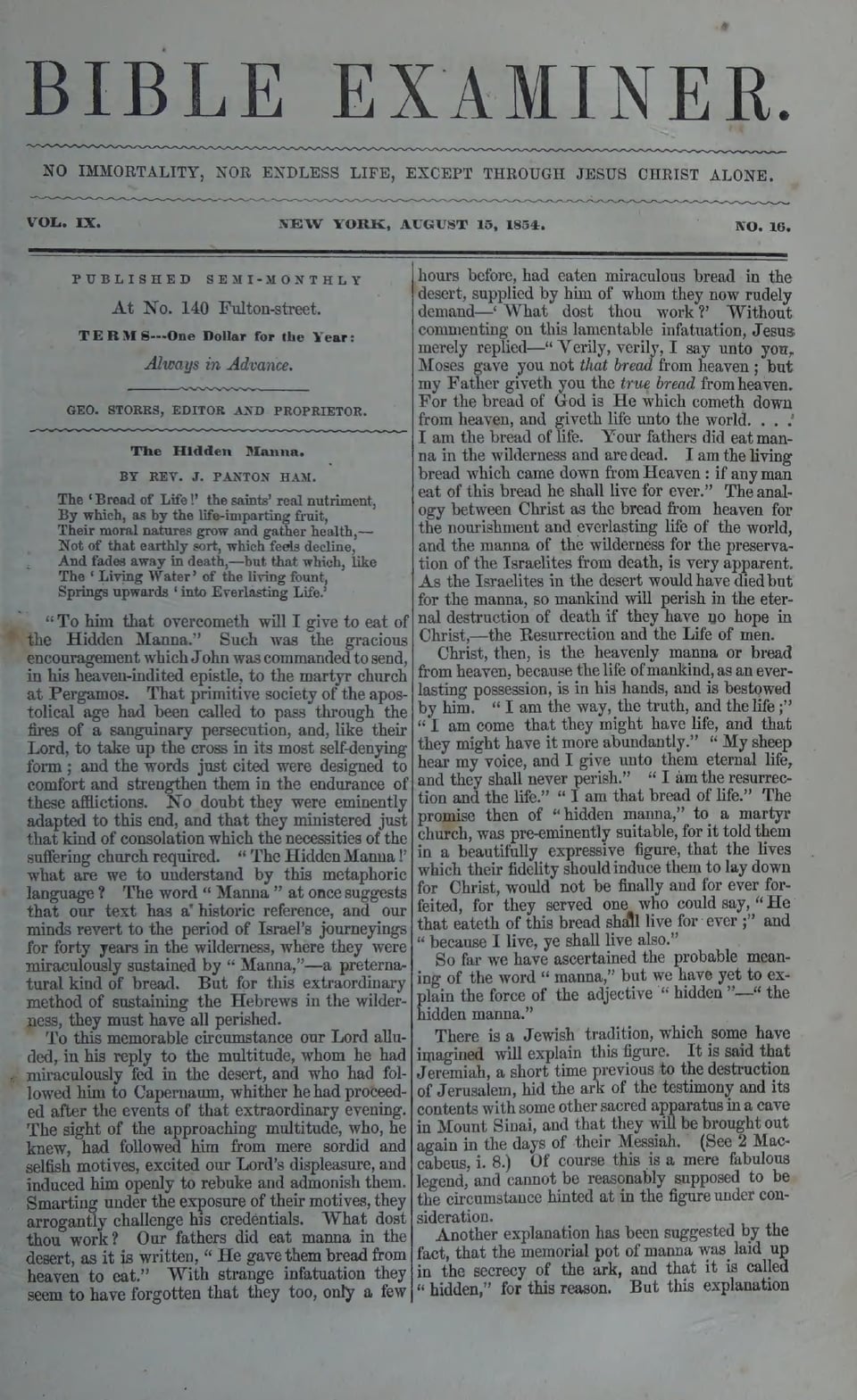
BIBLE EXAMINER.
NO IMMORTALITY, NOR ENDLESS LIFE, EXCEPT THROUGH JESUS CHRIST ALONE.
VOL. IX.
NEW YORK, AUGUST 15, 1854.
NO.16.
PUBLISHED SEMI-MONTHLY
At No.140 Fulton-street.
Always in Advance.
GEO. STORRS, EDITOR AND PROPRIETOR.
The Hidden Manna.
BY REV. J. PANTON HAM.
The 'Bread of Life!' the saints' real nutriment, By which, as by the life-imparting fruit, Their moral natures grow and gather health. Not of that earthly sort, which feels decline, And fades away in death,-but that which, like The 'Living Water' of the living fount, Springs upwards 'into Everlasting Life.'
"To him that overcometh will I give to eat of the Hidden Manna." Such was the gracious encouragement which John was commanded to send, in his heaven-indited epistle, to the martyr church at Pergamos. That primitive society of the apostolical age had been called to pass through the fires of a sanguinary persecution, and, like their Lord, to take up the cross in its most self-denying form; and the words just cited were designed to comfort and strengthen them in the endurance of these afflictions. No doubt they were eminently adapted to this end, and that they ministered just that kind of consolation which the necessities of the suffering church required. "The Hidden Manna!" what are we to understand by this metaphoric language? The word "Manna" at once suggests that our text has a historic reference, and our minds revert to the period of Israel's journeyings for forty years in the wilderness, where they were miraculously sustained by "Manna,"—a preternatural kind of bread. But for this extraordinary method of sustaining the Hebrews in the wilderness, they must have all perished.
To this memorable circumstance our Lord alluded, in his reply to the multitude, whom he had miraculously fed in the desert, and who had followed him to Capernaum, whither he had proceeded after the events of that extraordinary evening. The sight of the approaching multitude, who, he knew, had followed him from mere sordid and selfish motives, excited our Lord's displeasure, and induced him openly to rebuke and admonish them. Smarting under the exposure of their motives, they arrogantly challenge his credentials. What dost thou work? Our fathers did eat manna in the desert, as it is written, "He gave them bread from heaven to eat." With strange infatuation they seem to have forgotten that they too, only a few
hours before, had eaten miraculous bread in the desert, supplied by him of whom they now rudely demand—'What dost thou work?' Without commenting on this lamentable infatuation, Jesus merely replied—"Verily, verily, I say unto you, Moses gave you not that bread from heaven; but my Father giveth you the true bread from heaven. For the bread of God is He which cometh down from heaven, and giveth life unto the world. . . I am the bread of life. Your fathers did eat manna in the wilderness and are dead. I am the living bread which came down from Heaven: if any man eat of this bread he shall live for ever." The analogy between Christ as the bread from heaven for the nourishment and everlasting life of the world, and the manna of the wilderness for the preservation of the Israelites from death, is very apparent. As the Israelites in the desert would have died but for the manna, so mankind will perish in the eternal destruction of death if they have no hope in Christ,-the Resurrection and the Life of men.
Christ, then, is the heavenly manna or bread from heaven, because the life of mankind, as an everlasting possession, is in his hands, and is bestowed by him. "I am the way, the truth, and the life;" "I am come that they might have life, and that they might have it more abundantly." "My sheep hear my voice, and I give unto them eternal life, and they shall never perish." "I am the resurrection and the life." "I am that bread of life." The promise then of "hidden manna," to a martyr church, was pre-eminently suitable, for it told them in a beautifully expressive figure, that the lives which their fidelity should induce them to lay down for Christ, would not be finally and for ever forfeited, for they served one who could say, "He that eateth of this bread shall live for ever;" and "because I live, ye shall live also."
So far we have ascertained the probable meaning of the word "manna," but we have yet to explain the force of the adjective "hidden"—"the hidden manna."
There is a Jewish tradition, which some have imagined will explain this figure. It is said that Jeremiah, a short time previous to the destruction of Jerusalem, hid the ark of the testimony and its contents with some other sacred apparatus in a cave in Mount Sinai, and that they will be brought out again in the days of their Messiah. (See 2 Maccabeus, i. 8.) Of course this is a mere fabulous legend, and cannot be reasonably supposed to be the circumstance hinted at in the figure under consideration.
Another explanation has been suggested by the fact, that the memorial pot of manna was laid up in the secrecy of the ark, and that it is called "hidden," for this reason. But this explanation overlooks the important fact, that the manna was kept in the ark not for secrecy, but for frequent exposure before the people, as a memento of the memorable preservation in the wilderness.
Had the manna been "hidden" in the ark, it would have defeated the object contemplated, by putting aside some to be miraculously preserved as a memorial. See Exodus xvi. 32-34.
It has been further suggested that the word "hidden" is to be understood of those secret supplies of strength and grace which Christ ministers to his militant people, in their earthly probation. But this is evidently not the explanation, for the "hidden manna," here spoken of, is not given to believers during their earthly pilgrimage, but as a future reward at the close of that pilgrimage. "To him that overcome," which is obviously at the end, and not in the progress of their course.
A passage in Paul's writings seems to supply the true explanation. "For ye are dead, and your life is hid with Christ in God. When Christ, who is our life, shall appear, then shall ye also appear with him in glory."—Col. iii. 3, 4. Here the Christian's life is said to be hid with Christ; and Paul calls Christ "our life." Christ, too, says, "I am . . . the life;" and in a figure, "Except ye eat the flesh of the son of man, and drink his blood, ye have no life in you. Whoso eateth my flesh, and drinketh my blood, hath eternal life, and I will raise him up at the last day." The life of the christian is in the hands and power of Christ. Man has no life beyond the temporary life he now possesses. If he would live forever, he must be united to Christ. Union with Christ, by the bonds of genuine piety, establishes a title, by grace, to eternal life, which is bestowed as a gift or reward of grace through Christ.—Rom. vi. 23. And this gift of eternal life is bestowed by Christ, on the occasion of his second appearing, as "the resurrection and the life." Until his second advent, the lives of all his slumbering saints are in his hands, "hidden" in the mysterious secrecy of his great power. The exercise of that power, when he shall call upon his beloved dead to arise, will be the revelation of their, at present, "hidden" life. "Ye are dead, and your life is hid with Christ in God. When Christ, who is our life, shall appear, then shall ye also appear with him in glory." Well might the church at Pergamos be consoled, amidst its martyrdoms, with the promise, "To him that overcometh," or endureth to the end, "will I give to eat of the Hidden Manna." Who will not rejoice in this assurance as a promise made, not to one church only, but to the universal church of the faithful, and renouncing the presumptuous claim to an immortality, apart from Christ, exclaim, "Lord evermore give us this bread!" Believe it, christian, that you are dead, a mere mortal creature in yourself, destitute of any power of life beyond that ye now command in your momentary consciousness. Rob not Christ of this grand distinction as "the quickening spirit," but rejoicing in him as your "life," ascribe to him the glory of your redemption from mortality, as well as from sin, and with the divinely taught Peter, say, "Lord, to whom shall we go, thou hast the words of eternal life."
SPIRIT:
OR, THE HEBREW TERMS " RUACH " AND " NESHAMAH," AND THE GREEK TERM " PNEUMA." BY REV. WM. GLEN MONCRIEFF, SCOTLAND. [Continued from p. 227.]
PNEUMA.—Greek Term.
SEC. I. PNEUMA is a noun : the verb is pneo, to breathe, to blow.
SEC. II. PNEUMA is rendered wind and breath. 1. Wind. John 3:8, "The wind (pneuma) bloweth where it listeth."
Under this head, as we judge, ought to be introduced the passage—Heb. 1 : 7, "who maketh his angels spirits, and his ministers a flame of fire." This verse is rendered as follows by Moses Stewart, in his work on the Hebrews, "who maketh his angels winds, and his ministering servants flaming fire;" i.e., he adds, "who maketh his angels that serve him the ministers of his will, as the winds and the lightning are" . . . "The whole phrase is susceptible of another interpretation," observes the same commentator, "viz., who making his angels winds, i.e. swift as the winds, and his servants lightning, i. e. rapid, or terrible, or resistless as the lightning. But this does not suit the design for which the apostle quotes it, so well as the first interpretation. His object is to show that the angels are employed simply in a ministerial capacity; while the Son is Lord of all. Our English version, which has rendered ruchoth (Ps. 104: 4) by spirits, gives an erroneous view of the meaning of the original."
Breath. James 2:26, "The body without the spirit (pneuma, margin "breath") is dead. Rev. 13:15, "he had power to give life (pneuma, margin "breath") unto the image of the beast."
SEC. III. PNEUMA is rendered life.
Rev. 13:15, "He had power to give life (pneuma) unto the image of the beast.'
Life results from breathing, hence to give pneuma, or to cause a being to breathe, is to impart life to it. In this case our translators have put the effect, life, for its secondary cause, breath.
SEC. IV. PNEUMA is rendered ghost.
Matt. 27:50, "Jesus, when he had cried again with a loud voice, yielded up the ghost" (pneuma), or "expired." Rob. Lex. pneuma 2d. See also, Mark 15:37. John 18:30, "he said, it is finished: and he bowed his head and gave up the ghost" (pneuma).
These two passages are quoted, besides others, by Robinson in his Lexicon, under pneuma 2d, as examples of the use of the term pneuma, importing "the principle of life residing in the breath, breathed into man from God and again returning to God; compare Gen. 2:7, Eccles. 12:7, Ps. 104:29." After all "the principle of life residing in the breath" is not a very clear expression. Why not say, pneuma in these passages designates life? He yielded up the ghost—the spirit—the spirit of life—or simply, life; i.e. he died. Pneuma is translated "life" in Rev. 13:15; see the immediate preceding section.
Parallel to these verses is Luke 23 : 46, " Father into thy hands I commend my spirit (pneuma) ; and having said thus, he gave up the ghost," literally, breathed-out, expired, or died.
This, according to Robinson, is another verse illustrative of pneuma as designating "the principle of life residing in the breath;" or, as we would say, life itself, which is the result of breathing. Our blessed Lord gave up his life for men, and on the cross he said "Father into thy hands I commend my spirit," meaning the spirit of life he had, or simply life itself; having said so, we are told, he breathed out, or life ceased.
The following passages from the Old Testament are quite parallel to those just explained, and no one finds any difficulty in understanding them. "And when Jacob had made an end of commanding his sons, he gathered up his feet into his bed, and yielded up the ghost, and was gathered unto his people," Gen. 49 : 33. "Oh that I had given up the ghost, and no eye had seen me: I should have been as though I had not been," Job 10:18, 19, "Man dieth and wasteth away: yea man giveeth up the ghost (expireth) and where is he?" Jo 14:10. "She hath given up the ghost; her sun is gone down while it was yet day," Jer. 15:9.
SEC. V. PNEUMA, as already shown, is translated spirit. The English word spirit, we may observe, comes from the latin word spiro, to breathe; its radical force may be seen in the following compound English terms, inspiration, or in-breathing; expiration, or out-breathing. We will classify, so far as possible, the different modes in which this term is employed; and as far as these usages bear upon the object we have before us in this treatise, which is simply to determine what is meant by the spirit of man.
"Spirit" imports,
1st. The spirit, or breath of life; perhaps the idea will be more accurately presented thus--it imports the complex idea of breathing and so living; breath, and its result, life.
Of this usage a specimen was introduced at the close of last section, which may be here only referred to; it is Luke 23 : 46. In addition to it we may now note,
Luke 8:55, "and her spirit, (pneuma) came again, and she arose straightway:" she breathed anew and life was rekindled. This is another text exemplifying what Robinson calls "the principle of life residing in the breath."
Acts. 7:59, " Lord Jesus, receive my spirit " (pneuma).
This, according to Robinson, is another example of pneuma importing "the principle of life residing in the breath." Indeed the martyr just called upon his Lord to receive back the life-giving breath, or to receive his life which he cheerfully rendered up as a sacrifice on the altar of Christianity. Alas! but this "spirit" has actually been turned into the man Stephen himself; and yet surely the narrative is plain. He cried "Lord Jesus receive my spirit."—and did he go away to glory? as a spirit did he wing his flight to the Redeemer's presence? No; "He kneeled down and cried with a loud voice, Lord lay not this sin to their charge.
And when he had said this, HE FELL ASLEEP." The man, who was "but flesh," having the spirit of life in him, fell asleep. The spirit was not the man: Stephen and the pneuma he had were very different. He was stoned, it vanished; he returned to the dust, it returned to the charge of the universal Proprietor.
Dr. John Brown in his recent work, "The Dead in Christ," p. 21, says "Lord Jesus, receive my spirit," surely cannot mean—let me lose the capacity for many centuries of knowing, loving, and serving thee." On which we would respectfully observe, that if this "spirit" was not necessary to his knowing, loving, and serving Christ, he might part with it and remain as thoughtful and affectionate and loyal as ever; but if it was the spirit of life he had from God, and than this it was neither more nor less, its departure would inevitably number him with the dead, who "know not anything," whose thoughts have perished, till a resurrection takes place by Power Divine. He fell asleep, and could he be awake also? he was buried, was he also unburied? In the calm sleep of unconsciousness he rests in hope of a revival to immortality.
James 2 : 26, "For as the body without the spirit (pneuma, margin " breath ") is dead." Rev. 11:11, "After three days and a half the spirit (pneuma) of life from God entered into them, and they stood upon their feet. Compare Gen. 6:17, and 7:15,22,23.
2nd. "Spirit," is employed to express heavy physical ailment.
Luke 13:11, "A woman which had a spirit (pneuma) of infirmity, and was bowed together," &c.
3rd. "Spirit" is employed to express some mental quality or state, good or bad.
Matt. 5 : 3, " Blessed are the poor in spirit" (pneumati)—i.e. the lowly in mind. In the parallel verse "spirit" is omitted," blessed be ye poor." Luke 6:20. Matt. 26:41," the spirit (pneuma) indeed is willing, but the flesh is weak."
"The mind, the disposition is ready, and disposed to bear these trials; but the flesh, the natural feelings through, the fear of danger, is weak and will be likely to lead you astray when the trial comes."—Barnes.
Luke 1:17, "The spirit (pneumati) and power of Elias;" i.e. the courage and zeal of Elias. 1:80, "The child grew and waxed strong in spirit" (pneumati). "That is, in courage, understanding, and purposes of good, fitting him for his future work."—Barnes. 9:55, "Ye know not what manner of spirit (pneumatos) ye are of;"" Spirit" here designates temper, or disposition. They misunderstood themselves. 10:21, "In that hour Jesus rejoiced in spirit" (pneumati) or greatly rejoiced.
John 4:23, "the true worshippers shall worship the Father in spirit (pneumati) and in truth;" i.e. "with a sincere mind, with a true heart, not with mere external rites." Robinson's Lex. pneuma, 2 b. Acts. 6:10, "The spirit (pneumati) by which he spake;" "Spirit," here means "energy, power, or ardor."—Barnes. 18:25, "Being fervent in spirit," i.e. exceeding zealous. 20: 22, "Behold I go bound in the spirit (pneumati) unto Jerusalem;" i.
e. with a firm resolution.
Rom. 1: 9, "Whom I serve with my spirit" (pneumati); i. e. with the greatest zeal. 7: 6, "we should serve in newness of spirit" (pneumatos); i. e. "in a new and spiritual manner."—Stuart on Romans. Compare John 4: 23, above. 8: 15, "Ye have not received the spirit (pneuma) of bondage," i. e. the greatest degree of bondage—"again to fear, but ye have received the spirit of adoption," i. e. the greatest degree of filial affection—"whereby we cry abba, Father." See Macknight on the Epistles, Royal Octavo edition, London, 1835, p. 38, 2d col. 11: 8, "God hath given them the spirit (pneuma) of slumber;" i. e. the greatest degree of stupidity. See Macknight as referred to under the preceding text. 12: 11, "fervent in spirit" (pneumati); i. e. exceedingly zealous. Compare Acts 18: 25.
1 Cor. 2:12, "the spirit, (pneuma) of the world," i. e. the wisdom and knowledge which this world can give;—the learning and philosophy which were so much valued in Greece.—Barnes. 4:21, "Spirit (pneuma) of meekness," i. e. with a great wish and purpose to comfort and commend. 14:14, "For if I pray in an unknown tongue, my spirit (pneuma) prayeth, but my understanding is unfruitful"—"my own feelings thus find utterance in prayer, but what I mean is not understood by others." Rob. Lex. pneuma 2 b. 15, "I will pray with the spirit (pneuma), and I will pray with the understanding also; I will sing with the spirit (pneuma), and I will sing with the understanding also."
The sense appears to be something like this; I will pour out my desires in prayer, so as to be understood by others as well as by myself; or I will pour out my feelings, my joy, my love, my homage in praise, so as to be understood by others as well as by myself.
1 Cor. 14:16, "When thou shalt bless with the spirit (pneuma) " &c.; i.e. bless God with thy mind, but in a language not understood by your fellow-worshippers. 2 Cor. 4:13, "We having the same spirit (pneuma) of faith" &c. "The general sense here is—" We encounter these perils and afflictions through the very same principle of faith (namely, in the resurrection) which David had." Bloomfield's Greek Test. Perhaps "the spirit of faith" may require a sense somewhat stronger than that which Bloomfield assigns it, we should rather express it thus,—we having the same well-founded, and vigorous faith.
2 Cor. 7:1, " Filthiness of the flesh and spirit " (pneumatos). " By filthiness of the spirit (is meant) the pollutions of the passions, as shown in the inward workings of sin in the imagination and affections."—Bloomfield.
Gal. 5:16, "Walk in the spirit (pneumati), and ye shall not fulfil the lust of the flesh."
"By pneumati, most of the older commentators understand the Holy Spirit. But, as there is no article, that cannot be admitted. Besides, it is plain, from the words following, and from the opposition between flesh and spirit, at verses 17 and 18, that the sense is what some ancient and many
eminent modern expositors suppose, (as Beza, Rambach, Mor., Flatt, and Schott) the spiritual part of man, or the spiritual principle in man, THEIR REASON AND CONSCIENCE, enlightened by the Gospel, and sustained by the Holy Spirit."—Bloomfield. in lo.
Gal. 6:1, "In the spirit (pneumati) of meekness"—i.e. "with love, and gentleness, and humility, and patience, and with a readiness to forgive when wrong has been done."—Barnes. Phil. 1:27, "Stand fast in one spirit (pneumati), with one mind," i.e. "striving together strenuously for the furtherance of the Gospel."—Bloomfield. Eph. 4:23, "be renewed in the spirit (pneumati) of your mind," i.e. in your understanding, in your affections and dispositions. 1 Tim. 4:12, "Be thou an example of the believers—in spirit" (pneumati); i.e. "In the government of your passions, and in a mild, meek, forgiving disposition."—Barnes. 2 Tim. 1:7, "For God hath not given us the spirit (pneuma) of fear, but of power, and of love, and of a sound mind." The sense appears to be, God hath not made us timid, but bold and courageous; affectionate and prudent.
1 Pet. 3:4, "a meek and quiet spirit" (pneumatos), that is, meekness and quietness.
4th. "Spirit" is employed to express the idea of self, or personality.
Mark 2: 8, "Jesus perceived in his spirit" (pneumati) ; i. e. in himself; or simply, Jesus perceived. 8: 12, "He sighed deeply in his spirit" (pneumati), i. e., in himself; or he sighed deeply. Luke 1: 47, "My spirit (pneuma) hath rejoiced," or I have rejoiced—"in God my Saviour." This is parallel to the 46 v. "and Mary said, my soul doth magnify,"—or I do magnify,—"the Lord." Acts 17: 16, "While Paul waited for them at Athens, his spirit (pneuma) was stirred in him," i. e., he was greatly moved with distress and pity. Rom. 8: 16, "The spirit itself beareth witness with our spirit" (pneumati) ; with our mind, or simply with us.
1 Cor. 2:11, "For what man knoweth the things of a man, save the spirit (pneuma) of man which is in him;" or what man knoweth the things of a man save the man himself. Compare Pro. 14:10, "The heart knoweth his own bitterness;" the same idea might have been expressed in the language before us, from 1 Cor.—the spirit of man which is in him knoweth his own bitterness. Sometimes the formula is "the heart," sometimes "the spirit," but these and all similar modes of expression are invariably to be resolved into the fundamental idea of THE MAN HIMSELF.
1 Cor. 5: 5, "To deliver such an one unto Satan for the destruction of the flesh," i. e., for his amendment or sanctification; "that the spirit," (pneuma)—the life—the man's life,—or the man himself—"may be saved in the day of the Lord Jesus." The same idea may be expressed by another scriptural form;—that his soul—his life—the man himself, may be saved from the second death.
1 Cor. 16 : 18, "They have refreshed my spirit (pneuma) and yours;" i. e., refreshed me and you. 2 Cor. 2 : 13, "I had no rest in my spirit (pneum mati), or simply, I had no rest.
7:13, "Because his spirit," (pneuma) or he "was refreshed." Gal. 6:18, "The grace of our Lord Jesus Christ be with your spirit" (pneumatos), or simply, with you. 2 Tim. 4:22, "The Lord Jesus Christ be with thy spirit" (pneumatos), or with thee.
[To be Continued.]
Reasonableness of Christianity.
BY JOHN LOCKE, ESQ.—NO. I.
Redemption Implies the Fall—and by the Fall we Lost Immortality.
It is obvious to any one who reads the New Testament, that the doctrine of redemption (and consequently of the gospel) is founded upon the supposition of Adam's fall.
To understand, therefore, what we are restored to by Jesus Christ, we must consider what the scripture shows we lost by Adam. This I thought worthy of a diligent and unbiassed search, since I found the two extremes that men run into on this point, either on the one hand shook the foundation of all religion, or on the other made Christianity almost nothing. For whilst some men would have all Adam's posterity doomed to eternal infinite punishment for the transgression of Adam, whom millions had never heard of, and no one had authorized to act for him, or be his representative; this seemed to others so little consistent with the justice or goodness of the great and infinite God, that they thought there was no redemption necessary, and consequently that there was none, rather than admit of it upon a supposition so derogatory to the honor and attributes of that infinite being: and so made Jesus Christ nothing but the restorer and preacher of pure natural religion, thereby doing violence to the whole tenor of the New Testament.
And, indeed, both sides will be suspected to have trespassed this way against the written word of God, by any one who does but take it to be a collection of writings designed by God for the instruction of the illiterate bulk of mankind in the way of salvation; and therefore generally and in necessary points, to be understood in the plain direct meaning of the words and phrases, such as they may be supposed to have had in the mouths of the speakers, (who used them according to the language of that time and country wherein they lived,) without such learned, artificial, and forced senses of them, as are sought out and put upon them in most of the systems of divinity, according to the notions that each one has been bred up in.
To one that thus unbiassed reads the scriptures, what Adam fell from, it is visible, was the state of perfect obedience, which is called justice in the New Testament, (though the word which in the original signifies justice, be translated righteousness.) And by this fall he lost paradise, wherein was tranquility and the tree of life, (that is, he lost bliss and immortality.)
The penalty annexed to the breach of the law, with the sentence pronounced by God upon it, shews this.—The penalty stands thus: "In the day that thou eatest thereof, thou shalt surely die." How was this executed? He did eat; but in the day he did eat, he did not actually die, but was
turned out of paradise from the tree of life, and shut out forever from it, "lest he should take thereof and live forever." This shews that the state of paradise was a state of immortality, of life without end; which he lost that very day that he ate. His life began from thence to shorten and waste, and to have an end; and from thence to his actual death, was but like the time of a prisoner between the sentence and the execution which was in view and certain. Death then entered and shewed his face, which before was shut out and not known. So St. Paul: "By one man sin entered into the world, and death by sin;" (that is, a state of death and mortality.) And "In Adam all die;" that is, by reason of his transgression, all men are mortal and come to die. Rom. v. 12, and 1 Cor. xv. 22.
This is so clear in these cited places, and so much the current of the New Testament, that nobody can deny but that the doctrine of the gospel is that death came on all men by Adam's sin—only they differ about the signification of the word death.
Some will have it to be a state of guilt, wherein not only he, but all his posterity was so involved, that every one descended of him deserved endless torment in hell-fire. I shall say nothing more here how far (in the apprehensions of men) this consists with the justice and goodness of God, having mentioned it above. But it seems a strange way of understanding a law, (which requires the plainest and most direct words,) that by death should be meant eternal life in misery. Could any be supposed by a law that says, "For felony thou shalt die," not that he should lose his life; but be kept alive, in perpetual, exquisite torments? And would any one think himself fairly dealt with that was so used?
In addition to this, they would have it to be also a state of necessary sinning; and of provoking God in every action that men do—a yet harder sense of the word death than the other. God says, "that in the day that thou eatest of the forbidden fruit, thou shalt die"—that is, (according to this doctrine,) thou and thy posterity shall be ever after incapable of doing anything but what shall be sinful and provoking to me; and shall justly deserve my wrath and indignation! Could a worthy man be supposed to put such terms upon the obedience of his subjects, much less can the righteous God be supposed (as a punishment of one sin wherewith he is displeased) to put a man under a necessity of sinning continually, and so multiplying the provocation? The reason of this strange interpretation we shall perhaps find in some mistaken places of the New Testament.
I must confess by death here, I can understand nothing but a ceasing to be, (that is, the losing of all actions of life and sense.) Such a death came on Adam and all his posterity by his first disobedience in paradise; under which death they would have lain forever, had it not been for the redemption by Jesus Christ.
If by the death threatened to Adam, were meant the corruption of human nature in his posterity, it is strange that the New Testament should not any where take notice of it, and tell us that corruption seized on all, because of Adam's transgression, as well as it tells us so of death.
But (as I remember) every one's sin is charged upon himself only.
Another part of the sentence was, "Cursed is the ground for thy sake; in sorrow shalt thou eat of it all the days of thy life;" "in the sweat of thy face shalt thou eat bread till thou return unto the ground: For out of it wast thou taken. Dust thou art; and unto dust thou shalt return." This shews that Paradise was a place of bliss as well as immortality; without toil and without sorrow. But when man was turned out, he was exposed to the toil, anxieties and frailties of this mortal life, which should end in the dust, out of which he was made, and to which he should return; and then, have no more life or sense than the dust had, out of which he was made.
As Adam was turned out of Paradise, so all his posterity was born out of it; out of the reach of the tree of life. All, like their father Adam, in a state of mortality; void of the tranquillity and bliss of Paradise. "By one man sin entered into the world, and death by sin."
WE CANNOT BY RIGHT COMPLAIN OF THIS LOSS.
But here will occur the common objection, that so many stumble at: How doth it consist with the justice and goodness of God, that the posterity of Adam should suffer for his sin—the innocent be punished for the guilty?
Very well, if keeping one from what he has no right to, be called a punishment. The state of immortality in Paradise is not due to the posterity of Adam more than to any other creature. Nay, if God affords them a temporary, mortal life, it is his gift; they owe it to his bounty, they could not claim it as their right; nor does he injure them when he takes it from them. Had he taken from mankind anything that was their right, or did he put men in a state of misery worse than not being, without any fault or demerit of their own, this indeed would be hard to reconcile with the notion we have of justice, and much more with the goodness and other attributes of the Supreme Being, (which he has declared of himself, and which reason as well as revelation must acknowledge to be in him,) unless we will confound good and evil, God and Satan. That such a state of extreme irremediable torment is worse than no being at all, if every one's sense did not determine against the vain philosophy and foolish metaphysics of some men, yet our Saviour's peremptory decision has put it past doubt that one may be in such a state that it had been "good for him not to have been born." But that such a temporary life as we now have, with all its frailties and ordinary miseries, is better than no being, is evident by the high value we put upon such a life ourselves.
And therefore, though all die in Adam, yet none are truly punished but for their own deeds. "God will render to every one (how?) according to his deeds." "To those that obey unrighteousness, indignation, and wrath, tribulation and anguish upon every soul of man that doth evil." "We must appear before the judgment seat of Christ, that every one may receive the things done in his body, according to that he has done, whether it be
good or bad." And Christ himself, (who knew for what he should condemn men at the last day) assures us in the two places where he describes his proceeding at the great judgment that the sentence of condemnation passes only on the workers of iniquity; that is, such as neglected to fulfil the law in acts of charity. Matt. vii. 23 and 25: 41 and 42; Luke xiii. 27. And again, our Saviour tells the Jews "that all shall come forth out of their graves; they that have done good, to the resurrection of life; and they that have done evil, unto the resurrection of damnation." But here is no condemnation of any one, for what his forefather Adam had done, which it is not likely should have been omitted, if that should have been a cause why any one was adjudged to the fire, with the devil and his angels. And he tells his disciples, that when he comes again with his angels in the glory of his Father, "that then he will render to every one according to his works." Matt. xxvi. 27.
Debate on Human Immortality. AT THE BRISTOL ATHENEUM, ENGLAND.
We had the pleasure of attending recently an interesting debate by the members of the Discussion Society, a flourishing and highly important body connected with the Bristol Athenæum, on the following proposition: "Nature affords no evidence of Human Immortality." It is not our intention to furnish anything of the nature of a report of the debate, but merely to offer a few observations on one or two points, upon which the opponents of the above proposition laid considerable emphasis in support of their side of the question. It was affirmed by several, and too much conceded by all, that there was a common sentiment of all mankind in favor of the constitutional immortality of man. We pause not now to remark on the kind of immortality and soul-nature asserted by the ancient speculators on the subject, viz.,—their pre-existence and transmigration theories, which, we presume, the modern advocates of natural immortality will not be willing to accept, as they ought consistently, when they appeal to the opinions of the ancient philosophers, in evidence of their theory. This we pass by for the sake of challenging the assumption, that all mankind have ever accepted the doctrine of natural human immortality. Certain philosophers of Egypt, Assyria, Persia, Greece, and Rome,—who, by the way, ought not to be regarded as so many independent testimonies,—taught this opinion without doubt, but that it was the common opinion of all, even in these countries, is no by means true. The doctrines of Pythagoras, Plato, Socrates, and Zoroaster were the opinions of the philosophic few, not the expositions of the faith of the common people. Let Socrates himself, the intellectual champion of the soul, be our witness. "Can this soul of ours," he asks, "being such and of such a nature, when separated from the body be immediately dispersed and destroyed, as most men assert?" Phaedo 68. According to Socrates "most men" asserted the destruction of the soul in death. They who are familiar with the reasoning of the Phaedo, and subscribing to the basis of the argument, are prepared to affirm with Cato,
should be content with the strength of the Socratic superstructure, and never think in the face of their champion's testimony to the contrary, of superadding the common-place argument of the common consent of mankind. The Athenian philosopher knew that no such common consent existed, and hence the necessity of his elaborated argument to produce that consent. But why in the enumeration of the opinions of mankind should the Hebrews and Arabians be omitted? Both these peoples had their philosophic sects, as the Pharisees among the former, who subscribed to the oriental conceit of the soul's separate state and immortality; but the faith of the people generally was not identical with that of their speculative school-men. Omitting any reference to the sacred Scriptures, which the rules of the Ath. Soc. forbid to be cited in evidence, and where undoubtedly the popular doctrine is emphatically denied, we may yet turn to other Jewish literature, where the opinions of the Jews are recorded, for the sake of testing the assertion of a universal assent of mankind; and if we refer to the Apocryphal writings, the evidence is decisive against this common-place assumption. "Who shall praise the Most High in the grave," asks the author of Ecclesiasticus, ch. xvii. 27—32, "instead of them which live and give thanks? Thanksgiving perisheth from the dead, as from one that is not: the living and sound in heart shall praise the Lord. For all things cannot be in men, because the son of man is not immortal." Again, "O Elias, how wast thou honored in thy wondrous deeds! ... who didst raise up a dead man from death, and his soul from the place of the dead, by the word of the Most High,"—ch. xlviii. 4, 5. When Phariseeism flourished among the Hebrews, which was not even known till after the Babylonish captivity, then this ancient Hebrew faith in the non-immortality of man was pushed in some cases, as is natural, to an extreme—even to the denial of any kind of spiritual existence, and any future life at all; as in the case of the antagonistic sect of the Sadducees, from whose rash ultraism many sought their hope of a future life in the Babylonish fancies of the newly imported philosophy of Phariseeism. We have alluded also to Arabia as furnishing another exception to the assertion of a common consent among mankind. Dr. Good says, "If we turn from Persia, Egypt and Hindostan to Arabia, to the fragrant groves and learned shades of Dedan and Teman, from which it is certain that Persia, and highly probable, that Hindostan, derived its first polite literature, we shall find the entire subject (viz., the immortality of the soul) left in as blank and barren a silence, as the deserts by which they are surrounded; or if touched upon, only touched upon to betray doubt, and sometimes disbelief." Ecclesiastical historians have marked the fact that the philosophers of Arabia denied the natural immortality of man, and tell us that Origen was sent thither to teach them the Pythagorean philosophy of immortal-soulism. Here are then considerable exceptions to the alleged common
consent of mankind, and, consequently, the argument, such as it is, falls to the ground.
We were much surprised that the eloquent opponent of the introducer of this question at the Athenæum debate should have sought an argument in support of the immortal soul theory in the emphasized assertion, that as matter is indestructible, therefore, what is not matter, viz., the soul, is, a fortiori, indestructible. Did we hold the theory of the immortality of the soul on the ground of its being, as alleged, an immaterial principle, the very argument we should admit, of the non-destructibility of matter, would supply us with an argument for the destructibility of the mind or soul. For the word immaterial is the negation of what is material,—the opposite and contrast of materiality,—and, therefore, has none of the properties or attributes of that which is material. If, therefore matter is indestructible, that which is not matter or immaterial, for the reason assigned above, must be capable of destruction. This reasoning, if not altogether satisfactory, has as good claim to the Catonian commendation as any arguments in the Phaedo. But when it was asserted that matter is indestructible, is it meant absolutely indestructible? Granted that man cannot destroy a single particle of the material globe, but does it follow that the Maker of matter cannot destroy that which He created? If it be allowed that God created the matter of the universe, it must also be allowed that He can destroy it. So that the assertion is only relatively true that matter is indestructible.
What, however, has the destructibility or otherwise of matter to do with the question—"Nature affords no evidence of human immortality?" The affirmants of this proposition make no assertion about the nature and properties of matter: they assert that the being called Man is the mysterious product of organization,—that he depends upon his organization for conscious life, and the capability of developing the varied phenomena of his being; and that when he is disorganized, he, the being, man, ceases to be. The elements of his being may not be destroyed, but in their dispersion, have sought other affinities, and entered into other organic relations, but he, the being, man, who depended on their chemical union in the human organism, perishes in their dispersion. He shares the fate of all physical organisms,—as the brute, and the plant when disorganized and reduced to their elements cease to be respectively an animal and plant nature, so he also, in the same catastrophe, ceases to be a man,—like them he ceases entirely to be. The consolation to mortal man in the contemplation of death is, that, in his case, a merciful promise is given by the God and Father of our Lord Jesus Christ, that a life of fidelity to truth and righteousness shall be rewarded by a reorganization in his personal resurrection from the dead. So that, although he dies like brute beasts which perish, unlike them, he has the sublime possibility of living again in "the resurrection unto life."—Ham's Ch. Examiner.
BR.. C. F. Hudson's article came too late for this number, but will appear in the next.
BIBLE EXAMINER.
NEW YORK, AUGUST 15, 1854.
"MATERIALISM UNSCRIPTURAL : or, the Doctrines of George Storrs Refuted. By Rev. N. D. George."
Such is the title of a Tract recently issued by the Methodist Episcopal Tract Society, NewYork. It is substantially the same matter we noticed last winter, which appeared in nine articles, Zion's Herald, Boston, Mass.
What our name was attached to it for, unless to catch attention, we do not know, for our friend, George has given us but a small portion of his attention, in his tract of 48 pages. He has made another person, many of whose sentiments we never approved, the prominent object of his attack. It was well that in re-publishing the articles from the Herald, either himself or the Publishers of the Tract struck from the title the words, "Examined and." For it is apparent that it is not an "examination of the Doctrines of Geo. Storrs," as the author does not presume to look at the foundation stone of the theory we advocate. He gives us a passing fling and rushes on to meet one whom he can more easily refute; but, lest he should not have sufficient cause to triumph before men, he places our name at the head, or sets us up "on high," as Ahab did Naboth, that he might seem to have the greater victory; but we can forewarn him in this matter that his end will be as inglorious as that of Ahab.
Why did he not keep to his text, "and exami- and refute the doctrines of George Storrs"? Why did he leave his text to wander somewhere else? We think we understand the reason. Our foundation was too material for the weapons he had to attack with. He could not strike us at the root without pouring contempt on the Mosaic account of man's creation, thus showing that himself and associate laborers are the real "infidels." "The Lord God formed man of the dust of the ground," saith the inspired record; and all the wood, hay, and stubble of theological patch work, ever put forth by the advocates of immaterialism, falls to the ground before the Divine testimony of man's origin, as Dagon fell before the Ark of God.
A few things are introduced into the Tract, relative to our views, not embraced in the original articles; these we may notice after a while; but in the meantime, if our readers will turn to our article in the Examiner for Dec, 1853, and the continuation of the subject in a few numbers the first of this
year, they will find a sufficient "refutation" of N. D. George's effort, so far as "the Doctrines of Geo. Storrs" are concerned. If N. D. George would like to try his skill truly, on our views, our columns are open for him. Let the question be stated fairly—"Did the Lord God form man of matter?" Will Mr. George or any of the Methodist Tract publishers take the negative of this question? We affirm that God did so form man; and that hence the very heading of the Tract before us is bare-faced "Infidelity." Come then to rescue of your own characters, ye who are casting stones at us. The Examiner is open for any of you who stand approved of those on your side of the question.
A DILEMMA.—Dr. Adam Clarke, the learned English commentator, was a believer in the immortal-soul theory; hence sometimes found himself in a hard place, where guessing had to answer for facts. In his note on Acts 9:40, where Peter was instrumental in raising the deceased Dorcas to life, and it is said, Peter "turning to the body," says Dr. C., "soma; the lifeless body, for the spirit had already departed." Well, what did Peter say to this "lifeless body," whose "spirit had departed" to heaven, as the Doctor held? He "Said, Tabitha arise." Now it is very strange that Peter should think of calling on "the lifeless body to arise without first calling on the "departed spirit" to return! But strange to tell, not one word is said about that "spirit" in the whole transaction! But Peter calls "the body" Tabitha, and said, "arise." Now the body was Tabitha or it was not. If it was, then the "departed spirit" was not, and had no conscious existence except in fable or theological speculation. If the body was not Tabitha, then Peter made a great blunder in calling it so; but that he did not mistake in the matter is evident from the fact that when he thus spoke, "She opened her eyes; and when she saw Peter she sat up." Strange that such small things should be so particularly noticed and not one word be said about getting her soul back from heaven, and its coming into the cage again.
"As Dorcas was a woman so eminently holy, her happy soul had doubtless gone to the Paradise of God. Must she not therefore be filled with regret to find herself thus called back to earth again? And must not the remembrance of the glories she had now lost, fill her with dislike to all the goods of earth? No: for 1. as a saint of God, her Makers will must be her's; because she knew that will must be ever best.
It is VERY LIKELY that in the case of the revivescence of saint or sinner, God mercifully draws a veil over all they have seen or known, so that they have no recollection of what they have either seen or heard. Even St. Paul found it impossible to tell what he had heard in the third heavens, though he was probably not in the state of the dead. Of the economy of the invisible world, God will REVEAL NOTHING."
Here is a great man completeness swamped by his immortal-soul theory. The words "doubtless very likely—impossible—mercifully—probably not," and "reveal nothing," in the remarks of the Doctor, we have marked in small-caps to call attention to the vain conjectures and bold assumptions to which the advocates of the common theory are driven.
What is to be done with poor Dorcas' immortal soul that had gone to Paradise, i. e. to heaven? How is it to be reconciled to coming back again? Even her "Maker's will" could not quite satisfy Dr. Clark in the case; how much less then the "happy soul" of Dorcas herself? The Dr. is in a dilemma! What shall he do? Why, he invents the "very likely" notion that "God mercifully draws a veil over all" she had "seen or known!" He was afraid, "doubtless," that without this, Dorcas might rebel against His "will!" And to give plausibility to this assumption in support of a baseless theory, the Doctor perverts fact in Paul's case. He says, "Paul found it impossible to tell what he had heard in the third heaven," &c. On what ground was it impossible? Was it because God had drawn "a veil over" it? No such thing. For such a lively view had the apostle retained of those "abundant revelations" that he had to take a "thorn in the flesh, lest" he "should be exalted above measure." If he had only found Dr. Clarke's "veil" he could well have been spared the "thorn."
But, says the Doctor, Paul "was probably not in the state of the dead." Thank the Doctor for that admission; for, if he was not in that state whatever he saw or heard is no evidence that dead men can see or hear; and that they do not see nor hear, when actually dead, is abundantly testified in Scripture; and we have no occasion to resort to such vain conjectures and subterfuges as the Dr. is here driven into to hide the nakedness of his ghostly theory of "Dorcas' happy soul" going to "paradise" at death.
Finally, the Doctor, to solve the whole mystery of these "Know-nothing" resurrected ones, adds— "Of the economy of the invisible world God will reveal nothing." Hear that, all ye who unfold so
vividly the flight of souls to Heaven, and describe their state and condition there! Remember Dr. Clarke's words, and stop your speculations: "God will reveal nothing;" and if you pretend to know about it, either you or Dr. C. are mistaken. "But then the Doctor was in a dilemma or he would not have said so!" No doubt he was, and all other advocates of the theory of the distinct and separate conscious existence of an entity called the soul are in the same dilemma.
Intermediate State of the Dead.
Our friend Clark, of the Christian Advocate, passes very lightly over the Rich man and Lazarus, though he says "The parable is perfectly in point." He remarks :—
"The objection that this is a parable will not avail to break the force of the great moral truth it teaches. It is either history or a parable : if history, then it is a record of events that have actually taken place ; if a parable then it is a representation of events that may occur."
The oft-repeated assertion that a parable is, in all cases, a representation by something that has been or may be, is a mere assumption, and is contrary to truth. Let any one read the parable of Jotham, Judges 9th, or the parable of the two "great eagles," Ezekiel 17th, which is given by God himself, and he will be satisfied that parables are not always taken from things that have been or may be.
That a parable is "a representation of events that may occur," we readily admit; but what should we think of taking a house to represent a house; a lamb to represent a lamb; a prison to represent a prison? In other words, what should we think of taking the identical state or thing to represent that state or thing? It would, in fact, be no representation at all. As Dr. Clark admits this scripture to be a parable it cannot be a representation of a particular person, or persons, in the literal state of death; hence, we are compelled to look for some other event or events that are represented than that of literally dead men; and especially as we are not to assume, without undeniable evidence, that our Lord contradicted the testimony of the prophets, who declare that in the day of man's death "his thoughts perish," Psa. 146:4, that "the dead praise not the Lord," Psa. 115:17, that, there is "no remembrance of God in death," Psa. 6:5, that death is "a land of darkness as darkness itself," Job 10:22, that "the dead know not any thing," Eccl. 9:5, and that "thers is no knowledge in sheol," Eccl. 9:10.
This last text has the exact corresponding word to express the condition, or state, of the dead with that used in the parable by our Lord, and translated hell. Sheol is the Hebrew word in Eccl. 9:10, and Hades is the Greek word in the parable; though our translators have rendered that in Eccl. grave, and in the parable hell; words which are of precisely the same import, as any one can see by comparing Psa. 16:10, with Acts 2:31, in which places these corresponding words are both rendered hell; and in the latter place is a quotation of Peter, on the day of Pentecost, showing that Christ had a resurrection from the state of death—from sheol or hades—wherein inspiration declares there is no knowledge. Now we ask our friend Clark, in all candor, if he really believes that our Lord did intend, by a parable, to contradict the plain and expiciit testimony of the Old Testament scriptures? He had commanded us to search those scriptures as revealing to us eternal life: those scriptures reveal to us the state of death as being one without thought—without knowledge—as a state in which there is no "reward," Eccl. 9:5, where we cannot praise God, &c., and all this in plain, positive language. In the face of all this testimony, shall we—dare we—affirm that our Lord Jesus Christ covertly—in a parable—taught directly an opposite doctrine? And that too, when he never once directly affirmed that literally dead men are in a conscious state; but taught his followers he would raise them up from the dead "at the last day?" He must be credulous indeed, or strangely entangled by the "traditions of men," who can thus interpret the teaching of him who is "the way, the truth, and the life."
The parable is the "representation of events" which were about to take place, viz: a change in the dispensations from the Mosaic to the Christian, as the context shows, verse 16: which would remove the peculiarities of the Jewish economy, introducing a more spiritual one, adapted to all nations, or embracing those who were not under the law given by Moses, called goyim in Hebrew, and ethnos in Greek, or gentiles. This change in God's administration with men was in fact a falling back on the covenant He made with "Abraham" before the law was given, and which embraced "all the families of the earth;" tho' up to the advent of Christ, the Jews only had shared, evidently, in that peculiar favor, and hence it was especially their "life time." By their rejection of Christ—as their dispensation then passed away—they are represented in a state of death, which was a political and ecclesiastical death; in which, of course,
that people were not literally dead, and hence could be, in truth, represented in a most wretched condition-or in torments. Such has been their condition for near 1800 years, and their claim of relationship to Abraham has brought them no relief.
On the other hand the change in the dispensations, which revived the Abrahamic covenant and brought it out fully to the view of the ethnos—the Gentiles—placed the believing among them in that relation to Abraham which is aptly "represented" by being in "Abraham's bosom," whither they had been brought through the ministration of angels, or messengers,—for so the word signifies—who have proclaimed the love of God to "the world," and not exclusively to one nation.
In a parable we are to look only for the main scope and design of it; and not like some mere theorists and speculators attempt to find something to correspond with every minutiae that is introduced into it. This parable we regard in the light, then, of a simple and forcible "representation" of the different states of those under the law covenant, and those who were turned to the covenant of grace, or favor, made through Abraham in Jesus Christ, and fully opened at the advent of Jesus some 1800 years ago, and which is still in force, so that they who are Christ's are "Abraham's seed and heirs according to the promise," and "are blessed with faithful Abraham;" having promise of life eternal when Christ shall return "from heaven" to raise all his saints from the dead "at the last day."
Dr. Clark next speaks as follows in support of the theory he advocates—
"When St. John, upon the Isle of Patmos, had heard the wonderful revelations made to him, filled with wonder and astonishment, he fell down to worship the messenger of God; but that messenger said, 'See thou do it not: for I am thy fellow-servant, and of thy brethren the prophets, and of them which keep the sayings of this book.' Rev. xxii, 9. Do we not here obtain a glimpse of not only the conscious being, but the avocations also of those who have died in the faith?"
This text affords not the sligtest countenance to the theory that dead men are conscious. Enoch and Elijah were "translated that they should not see death," which was no great advantage if friend Clark's theory is the truth. Either of these men might have been the person who addressed John. Both of them were "prophets." Unless then it can be proved that John was addressed by one who had actually died, here is nothing to help the common theory: there is not even a "glimpse" to help our friend in his effort. Br. Clark proceeds— "St. John says: 'I saw under the altar the souls of them that were slain for the word of God: and they cried with a loud voice, saying, How long, O Lord, holy and true?
. . . And white robes were given unto every one of them, and it was said unto them that they should rest yet for a little season.' Rev. vi. 9-11. These souls not only possessed a conscious existence after they had been 'slain' for the cause of Christ, but they were also conscious of the wrong they had suffered, and were looking forward to the period of their vindication with anxious desire. Nor was this all; 'they cried with a loud voice,' and were afterward robbed in white, and told to rest yet a little season. Here, then, they have a conscious existence, power to express their desires, and capability of being comforted by gracious assurances. Though persecution had done its work, and the bodies of the martyrs had been consumed by the faggot, or devoured by wild beasts, or wasted in deep and dark dungeons or dens and caverns of the earth, yet, after it had destroyed the body, there was a conscious life remaining over which it had no power."
We give our friend the benefit of his entire remarks in this case; and we must say, that we should think any sober and reflecting mind must see how vain it is to appeal to this text in support of the common theory. In the first place, these souls had no existence at the time of John's vision of them, nor for several centuries after, probably; as it is most likely it is a representation of the feelings of persons suffering by the Papal persecutions; it being the fifth seal. The Doctor saith, "These souls had been slain!" Were immortal, undying souls "slain?" Did men "kill" them? So it would seem, according to the Dr. But unfortunately for his theory these souls had blood, which is material: "how long dost thou not avenge our blood," say they. They were not theological souls then, whatever else they might be. And then they seem not very happy, for they are "looking forward to the period of their vindication with anxious desire," saith the Dr.; and they are "conscious of the wrong they had suffered," he affirms. Now all this does not look much like being in Heaven, does it friend Clark? But it does look as though it might be a true "representation" of the feelings of suffering saints, while yet on earth, under a long and bloody persecution, which seemed to have no end; and the white robes seem to "represent" the "righteousness" which they would obtain in enduring the long night of persecution they were passing through, after which they were to "rest a little season"—not in heaven, but "under the altar"—that is, "in the dust of the earth," till the trial of others should be also ended. To talk of giving immaterial souls white robes, in heaven, to cover them; and of their "being comforted," there,
with the "assurances" of their "blood" being avenged after they are introduced into the glorious society of heaven, surely needs some plainer testimony than we have ever yet seen to make it even look like truth.
We pass what the Doctor saith on, "whether in the body or out of the body," with a brief remark, because we have so lately spoken of this text in another place. The Doctor says, If "the apostle" had not "believed that the soul may have a conscious existence out of the body—how could he have been in doubt whether his soul was really in the body or not?"
Paul saith not one word about "his soul," nor any other person's soul in the transaction. Paul was not in the habit of talking about "the soul" like modern theologians. He talks of man—"I knew a man," &c; that man had a "vision;" how, or in what manner it was made he could not tell, for he did not know, but God did, and there he leaves it. Here is no proof of the conscious existence of a man when dead, or of a distinct entity in man called the soul.
…