The Bible Examiner — Vol. 9, No. 7 (April 1, 1854)
Download: PDF — The Bible Examiner — Vol. 9, No. 7 (April 1, 1854)
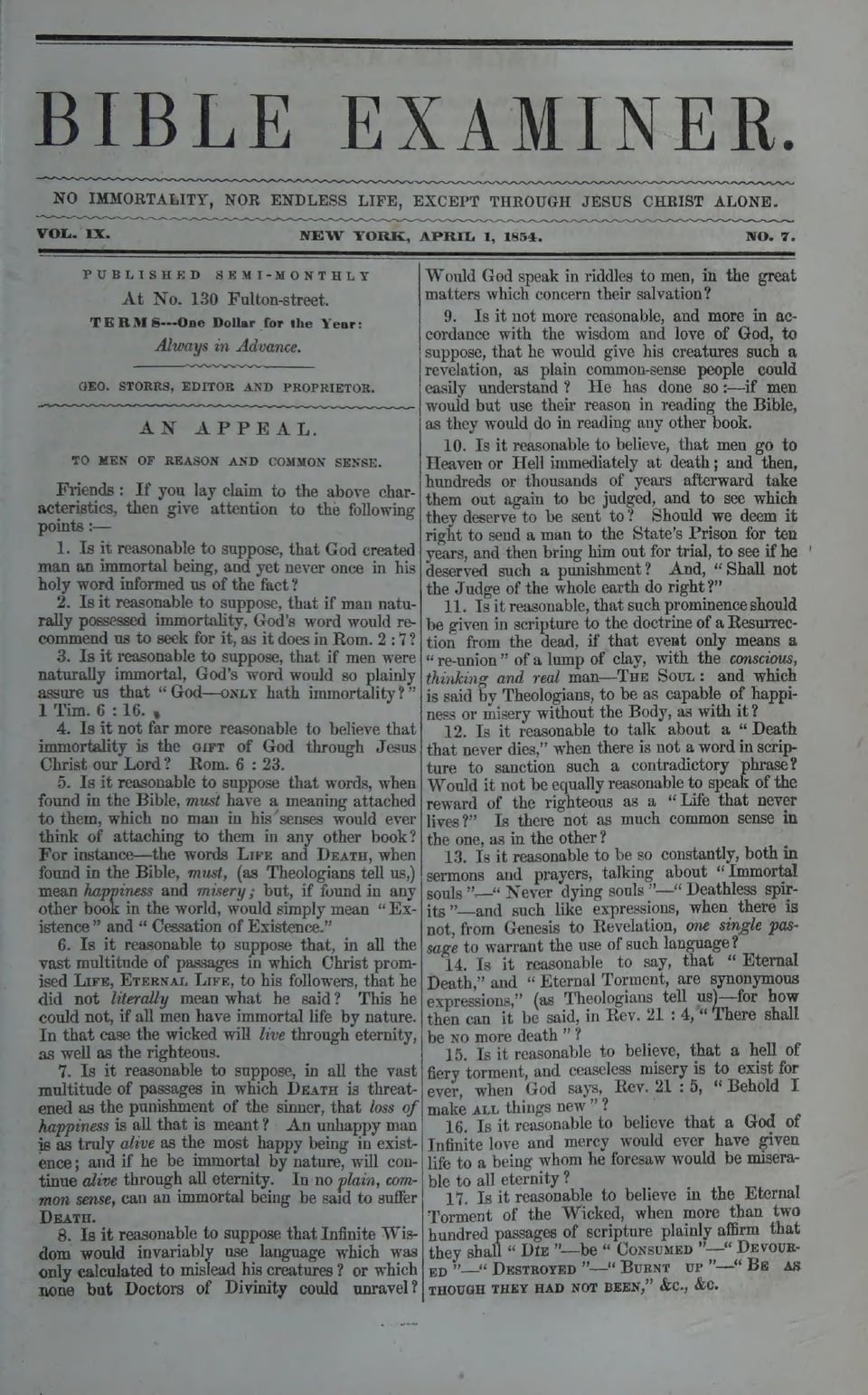
BIBLE EXAMINER.
NO IMMORTALITY, NOR ENDLESS LIFE, EXCEPT THROUGH JESUS CHRIST ALONE.
VOL. IX.
NEW YORK, APRIL 1, 1854.
NO. 7.
PUBLISHED SEMI-MONTHLY At No. 130 Fulton-street. TERMS----One Dollar for the Year: Always in Advance.
GEO. STORRS, EDITOR AND PROPRIETOR.
AN APPEAL.
TO MEN OF REASON AND COMMON SENSE.
Friends : If you lay claim to the above characteristics, then give attention to the following points :—
Is it reasonable to suppose, that God created man an immortal being, and yet never once in his holy word informed us of the fact?
Is it reasonable to suppose, that if man naturally possessed immortality, God's word would recommend us to seek for it, as it does in Rom. 2:7?
Is it reasonable to suppose, that if men were naturally immortal, God's word would so plainly assure us that "God—only hath immortality?" 1 Tim. 6 : 16.
Is it not far more reasonable to believe that immortality is the gift of God through Jesus Christ our Lord? Rom. 6 : 23.
Is it reasonable to suppose that words, when found in the Bible, must have a meaning attached to them, which no man in his senses would ever think of attaching to them in any other book? For instance—the words Life and Death, when found in the Bible, must, (as Theologians tell us,) mean happiness and misery; but, if found in any other book in the world, would simply mean "Existence" and "Cessation of Existence."
Is it reasonable to suppose that, in all the vast multitude of passages in which Christ promised LIFE, ETERNAL LIFE, to his followers, that he did not literally mean what he said? This he could not, if all men have immortal life by nature. In that case the wicked will live through eternity, as well as the righteous.
Is it reasonable to suppose, in all the vast multitude of passages in which DEATH is threatened as the punishment of the sinner, that loss of happiness is all that is meant? An unhappy man is as truly alive as the most happy being in existence; and if he be immortal by nature, will continue alive through all eternity. In no plain, common sense, can an immortal being be said to suffer DEATH.
Is it reasonable to suppose that Infinite Wisdom would invariably use language which was only calculated to mislead his creatures? or which none but Doctors of Divinity could unravel?
Would God speak in riddles to men, in the great matters which concern their salvation?
Is it not more reasonable, and more in accordance with the wisdom and love of God, to suppose, that he would give his creatures such a revelation, as plain common-sense people could easily understand? He has done so:—if men would but use their reason in reading the Bible, as they would do in reading any other book.
Is it reasonable to believe, that men go to Heaven or Hell immediately at death; and then, hundreds or thousands of years afterward take them out again to be judged, and to see which they deserve to be sent to? Should we deem it right to send a man to the State's Prison for ten years, and then bring him out for trial, to see if he deserved such a punishment? And, "Shall not the Judge of the whole earth do right?"
Is it reasonable, that such prominence should be given in scripture to the doctrine of a Resurrection from the dead, if that event only means a "re-union" of a lump of clay, with the conscious, thinking and real man—The Soul: and which is said by Theologians, to be as capable of happiness or misery without the Body, as with it?
Is it reasonable to talk about a "Death that never dies," when there is not a word in scripture to sanction such a contradictory phrase? Would it not be equally reasonable to speak of the reward of the righteous as a "Life that never lives?" Is there not as much common sense in the one, as in the other?
Is it reasonable to be so constantly, both in sermons and prayers, talking about "Immortal souls"—"Never dying souls"—"Deathless spirits"and such like expressions, when there is not, from Genesis to Revelation, one single passage to warrant the use of such language?
Is it reasonable to say, that " Eternal Death," and " Eternal Torment, are synonymous expressions," (as Theologians tell us)—for how then can it be said, in Rev. 21 : 4, " There shall be no more death "?
Is it reasonable to believe, that a hell of fiery torment, and ceaseless misery is to exist for ever, when God says, Rev. 21 : 5, "Behold I make ALL things new"?
Is it reasonable to believe that a God of Infinite love and mercy would ever have given life to a being whom he foresaw would be miserable to all eternity?
Is it reasonable to believe in the Eternal Torment of the Wicked, when more than two hundred passages of scripture plainly affirm that they shall "Die"—be "Consumed"—"Devoured"—"Destroyed"—"Burnt Up"—"Be as though they had not been," &c., &c.
Is it reasonable to believe that the righteous, in their glorified state, can be indifferent to, and unaffected by, the endless sufferings of countless millions of their fellow beings; among whom would probably be found parents, children, husbands, wives, &c.? Is it possible that they will be destitute or deprived of qualities which are considered most lovely and Godlike in this life viz.: pity, sympathy, compassion, commiseration for others' woes, &c.? Will insensibility to the woes of the wretched ever become a virtue? Will that which is a vice in this life become a grace in the glorious future life? Is the standard of virtue thus variable, that what is vicious here is to be gracious hereafter?
Is it reasonable to believe that a God of Infinite Rectitude will punish with Eternal Torment, the Heathen who have never heard of Christ, and who therefore could not reject him? Is it possible that God can cast into one indiscriminate mass of fiery torment, the least wicked among the heathen, together with the most guilty in this Christian land? for such must be the case if their souls are immortal, and if their torment is to be eternal. There can be no degrees in that which is infinite. Is it not far more reasonable to believe the Apostle's words literally, "For as many have sinned without law shall also PERISH without law."—Rom. 2 : 12.
Is it reasonable to believe that God is such a vindictive being, that his justice cannot be satisfied with the death of the offender? but that he must be constantly pouring floods of fiery wrath upon the wretched being through the ever rolling cycles of Eternity?
I might multiply questions of this kind, but I forbear.
Men of reason and common sense, give your serious attention to these points. Read your Bibles again. Read carefully—read prayerfully. See if these things be true or not. Dare to think for yourselves. If other men should attempt to dictate a political creed for you, would you not indignantly spurn their interference? Do the same in religious matters. Dare to be independent. Do not trust to commentaries. Do not build your faith on "Bodies of Divinity." Do not surrender your right of private judgment to any class of men. Go at once to the fountain head of truth. "The words of the Lord are tried words." "The law of the Lord is perfect." This cannot be said of the writings or opinions of any man, or number of men, however wise or holy they may be. To err is human. God and his truth, alone are infallible. Show yourselves true Protestants, and cast away the "Traditions of men." You have the Bible. The wisest and holiest of the "Fathers" had no more. Your ministers have nothing else to guide them—at least they ought not. "The Bible, and the Bible alone, is the book for Protestants." Go then to your Bibles, and see if the God-dishonoring doctrines to which I have directed your attention are found there or not. Excuse me if I tell you, that, however full of these doctrines human books and human sermons may be, God's Bible does not contain them.
Rather believe that man is MORTAL, and condemned to die, but Christ is "Come that men may have life, and that they may have it more abundantly."—John 10:10.
"The wages of sin is DEATH, but the gift of God is ETERNAL LIFE through Jesus Christ our Lord."—Rom. 6 : 23.
"He that believeth on the Son hath EVERLASTING LIFE; and he that believeth not the Son shall NOT SEE LIFE; but the wrath of God abideth on him."—John 3 : 36.
"And I give unto them ETERNAL LIFE; and they shall never PERISH, neither shall any pluck them out of my hand."—John 10 : 28.
"He that hath the Son hath LIFE ; and he that hath not the Son of God hath NOT LIFE."—1 John 5 : 12.
"Marvel not at this : for the hour is coming, in the which all that are in their graves shall hear his voice and come forth; they that have done good, unto the resurrection of LIFE; and they that have done evil unto the resurrection of DAMNATION."—John 5:28, 29.
"And have hope toward God, which they themselves also allow, that there shall be a resurrection of the dead, both of the just and unjust." Acts 24 : 15.
"The Lord knoweth how—to reserve the unjust unto the day of judgment to be punished." 1 Pet. 2 : 9.
"And they were judged every man according to their work. And death and hell were cast into the lake of fire—THIS IS THE SECOND DEATH." Rev. 20 : 13, 14.
"THE IMPERATIVE NATURE OF DUTY."—Such is the title of a sermon "By C. F. Hudson," which has kindly been sent us by the author. We have read it with much interest and satisfaction, and wish it a wide circulation. In its general character it is most excellent. We might dissent from a few expressions; which, however, may express the truth more clearly than any substitute of ours. Br. Hudson's sermon is an octavo pamphlet of about twenty pages. Whether he has them for sale we do not know. We give the following extract from the first part of it.
"All ungodliness, and all habitual immorality, is practical atheism. And however much the theories of atheists may differ, they are agreed in this—to practice the requirements of right and duty, only so far as it may suit their feelings or their convenience. Just this it is that makes them to be what they are. And accordingly Plato reckons as belonging to the one class of atheist, three different sorts of people: 1st, those who deny altogether the being of a God; 2dly, those who allow His being, but deny His providence, or that He takes note of the conduct of men; and, 3dly, those who confess that God does mark the actions and characters of men, but still think that He can be easily persuaded by their entreaties or their propitiatory sacrifices, to forego the claims of His law, and to forbear punishing their misdeeds. They are willing to disobey the divine requirement; they prefer to seek their own pleasure, even though they shall do wrong.
But fearing that the penalty of their disobedience is severer than they would like to incur, they seek to avert it by certain pains-taking, in the way of prayers, and sacrifices, and penances. And I would call your especial attention to the last sort of atheists, as the Greek philosopher esteems them, because their feeling is so allied to that of which I wish to speak. They dread to endure what they regard as their just punishment; and they endeavor to escape it, not by a change of heart and life, but by self-inflicted and voluntary pains and losses, which they offer to God as a substitute for the pains which He threatens. Thus, like the colonists whom the Assyrian king sent to the conquered land of Samaria, they 'fear the Lord,' and still 'serve their own gods.' Now this is precisely the nature of penance, as something distinct from repentance. It is not a sorrow for sin, but a fear of its consequences. Instead of producing a change of heart and a godly life, it is a sorrow of the world, that worketh death. Just here, too, lies the difference between religion and superstition. The one is a sense of obligation and duty to God, the other is a sheer dread of the penalty of duty neglected and disliked. Hence the austerities which the Hindoo devotee inflicts upon himself, are perfectly consistent with the vices of his life, because his object is, not to make his own heart and character better, but to better his case, or to make himself better off with his God. This it is that distinguishes all corrupt systems of worship—an abundance of rites and ceremonies and outward observances, which shall make one less afraid to indulge in sin. And even in the common life and intercourse of men, there are frequent exhibitions of the same feeling. Often when one has wronged his fellow, instead of humble and frank confession and reparation, he makes himself wretched with secret and cherished self-reproach, with which he hopes to punish himself, and tries to soothe the wounded and morbid pride of his heart. Just so, in their relation to God's law, persons under conviction of sin often cherish a purpose and continued sorrow, as though they might thus do something to atone for their transgressions, and avert the divine displeasure. All such self-imposed pains and sorrows are, in their essential nature, penances of superstition, as ungodly in fact as any other form of atheism, and ever sternly rebuked in God's Word. Thus when Balak, seeking an occasion against God's people, thought to gain His favor with burnt offerings, he was told that with thousands of rams, or with ten thousands of rivers of oil, he could not please a Being whom he would not obey. 'Shall I then,' he asks, 'give my first-born for my transgression, the fruit of my body for the sin of my soul?' 'He hath showed thee, O man, what is good,' replies the unwilling prophet, 'and what doth Jehovah require of thee, but to do justly, and to love mercy, and to walk humbly with thy God.'—Micah 6:6-8. And when Saul would avert the loss of his kingdom for his disobedience, by making choice sacrifices, Samuel would urge upon his conscience this plain truth: 'Hath the Lord as as great delight in burnt offerings and sacrifices, as in obeying the voice of the Lord? Behold, to obey is better than sacrifice, and to hearken, than the fat of rams.'—1 Sam. 15:22. Such is the nature of all superstition and penance; they are the instinctive resort of a guilty soul, that dreads the punishment it deserves, and is still unwilling to repent. And just the opposite of this was the feeling of the penitent Psalmist : 'Thou desirest not sacrifice, else would I give it; thou delightest not in burnt offerings. The sacrifices of God are a broken spirit; a broken and contrite heart, O God, thou will not despise.' —Ps. 51:16, 17.
"Thus have I endeavored to describe that superstitious form of atheism which dreads punishment, and imposes voluntary pains or penances as a substitute for it, though one is all the while unwilling to obey God, and seeks to do his own pleasure. For will-worship and superstition are only different phases of the same perverseness of soul. And such is human nature, that the unregenerate man man would gladly enjoy the pleasures of waywardness and sin, and then be free from the penalty of his guilt."
DEFENCE OF THE BIBLE.
In the EXAMINER for Jan. 15, we gave our first speech in defence of the Bible at [the Hartford Convention. March 15 we gave our last in that Convention. We now give our third. We spoke as follows :—
The Bible is on trial, charged with the blackest crimes. We have called for the rule by which the Bible is to be tried, and we are told that that rule is natural religion, or, in other words, the religion of nature. I do not know that there has been any receding. My friend Wright said very distinctly, that the rule by which the Bible was to be tried was the religion of nature. If they recede from that position, I have no objection certainly; but it is manifest that there must be some rule. Now to say that the rule is in the Bible itself, is to say that the criminal is to be judged by himself. (Cries of hear, hear.) It is taken for granted that he is a criminal. Now what law has he violated? Has he violated the religion of nature? I wish it to be distinctly understood with regard to myself, as I have before said, I do not stand here to contend that everything written in the Bible is inspired of God. That is not my position. I do not stand here to say that every sentiment that is uttered in the Bible is approved of by the God of the Bible. I do not stand here to affirm, when a certain character said, "Thou shalt not surely die," that that was inspired by God. No, it was a libel upon God. I said last evening, that I conceived that the true question should be, not is the Bible a revelation from God, but is the Bible a true history of revelations given to men in times past, and does it contain a true record of transactions connected with these revelations? As I have already said, the truth of that position depends upon the credibility of the witnesses; but I am not going to argue that point again tonight. What does the resolution charge upon the Bible?
Who has ever said that the Bible, "as a whole," emanated from God? I have just quoted one text that is recorded there that did not emanate from God, but from his enemy. The objection, however, that is urged against the Bible—the crime that is charged upon the Bible, is not a new one. It is substantially the same that has been urged by many eminent men prior to this day. We here give you a quotation from Lord Bolingbroke. He says:—
"The God of Moses is partial, unjust, cruel (hear, hear); delights in blood, commands assassination, massacres, and even exterminations of people, etc. (Hear, hear.) The God of Paul elects some of his creatures to salvation, and predestinates others to damnation, even in their mothers' wombs. If there was not a Being infinitely more perfect than these, there would be no God at all, nor any true religion in the world. But there is most assuredly such a Being, and he who proposes any system of religion wherein this all-perfect being is not to be found, may say he is not an Atheist, but can not say with truth that he is a Theist."—Works, vol. v., p. 600.
Here you perceive substantially the same argument. It is not a new one. How is the Bible tried by natural religion—the religion of nature? By contrasting it with the character of the God of nature? If I have misstated the question, I have not intended to. I have not come here with any feeling of quarreling in my heart. (Hear, hear.) I am almost prepared to say from my very heart, that I respect the Deists because they have rejected the Bible; they having been taught that that the Bible teaches certain doctrines, which I am satisfied are not to be found in it, but originated in the perverse understanding of men. Now, sir, we are going to test the God of the Bible by the God of nature, and see how the God of the Bible stands by this law in respect to the God of Nature. Now shut up the Bible and look at the God of nature. The God of nature is cruel. What, "the God of nature!" Yes, sir, outrageously cruel, barbarously cruel. "How do you prove that charge?" Go yonder, sir; see where that city stood. All were in the enjoyment of blessings and sympathy of friendship, rejoicing in each other's love, the love of society, and the God of nature marched through by his earthquake, shook the foundation of the city, and buried them in ruin! Is the God of the Bible worse than that? What has he done worse? (Applause.) Here is a populous country that spreads itself along the pleasant river, and the fields are whitening for the harvest. The inhabitants dwelling along the borders of that river are flourishing
and in prosperity. Their families are happy; but the God of nature pours down the waters, and the river rises and swells, and sweeps away their dwellings, and destroys the inhabitants. Ah! did the God of the Bible do anything worse than that? Come, God of nature, stand up and defend yourself. We charge you with being a cruel God. (Applause.) We see men spread abroad over the land, pursuing the business of life, and not interfering with the God of nature; but the God of nature travels along through the country with the cholera, and calls of thousands upon thousands. Does he not sanction "wholesale murder?" We are trying the Bible by the God of nature, and I will ask you, as a jury sitting on the trial, if, so far, the God of nature is not likely to be quite as bad as the God of the Bible? But, sir, we do not stop here—we go further. You complain, perhaps, that the God of the Bible authorized Moses to exterminate whole nations—wholesale murder you may call it, if you please. How has the God of nature acted in this respect? I beg leave again to refer to Bolingbroke. It is in his views on the subject of evil, in his Works, vol. v., pp. 403, 404. He says:—
"True it is that men are sometimes involved in general calamities, which they can neither foresee nor prevent, such as inundations, earthquakes, pestilences, and the entire devastations of kingdoms or provinces by savage and barbarous people, like the Huns of old, or the Spaniards, in later ages. But these calamities are rare. They may be considered as chastisements, for chastisements are reasonable when there are any to be amended by partaking of them, or by being at least spectators of them. They may be considered as mere effects, natnral, though contingent of matter and motion in a material system, put in motion under certain general laws. If they are seen in the first light (i.e. chastisements), they should teach mankind to adore and to fear that Providence which governs the world by particular as well as by general dispensations. If they are seen in the second (i.e. as mere effects, etc.), they should suggest some other reflections which are not without their utility neither." On page 438, Bolingbroke says:—"Cotta, who exercises greater injustice toward God than any of the tyrants he quotes did toward men, is much scandalized that those two eyes of the Mediterranean coast, Corinth and Carthage, were put out, etc. But how did he know that Mummius and Scipio (the Roman genenals by whom these cities were destroyed) were not instruments of the justice of Providence, as well as of Roman policy and passion? The worst men, and the Romans were none of the best, are employed to punish the worst. None so fitted to the task. They are the instruments, and in their turn the examples of divine justice. The wealth, the splendor, the magnificence of Corinth were great, but Corinth was a sink of iniquity.
Carthage was a great and powerful state, but the Carthaginians were a faithless, factious, and cruel people. Might not these be the remote and true causes (of the judgment of God upon them), whatever the immediate and apparent were of their destruction ?"
Now, sir, here is one who is talking of the God of nature. He admits it right, and undertakes to justify the God of nature in suffering those two eyes of the Mediterranean Sea to be put out. For what reason? "Why," says he, "they were abominably corrupt." Therefore the God of nature was justified in causing them to be destroyed, and destroyed, too, by the wickedest of men. Now I ask this intelligent congregation, whether the cases are not parallel with the God of the Bible; and whether the God of the Bible is to be condemned by the God of nature. What was the reason which the God of the Bible himself assigns, why Abraham was not yet to passess the land of Canaan? Why his posterity were to be kept out of that land for centuries to come? Turn to the Bible itself and hear what it says, Genesis 15:13-16. After speaking to Abraham of the bondage of his children in Egypt, He says, "But in the fourth generation they shall come hither again." Now mark, "For the iniquity of the Amorites is not yet full." What is that, sir? Why, the God of the Bible did not allow Abraham to possess that land, or injure its inhabitants, far the reason that their iniquity was not yet full; but when it was full—as Lord Bolingbroke says, the iniquity of Carthage and Corinth was full—then, sir, the God of the Bible did the same thing that the God of nature did.
Now, sir, how are you going to condemn the God of the Bible by the God of nature? Whoever will take the history of the world will find that the God of nature has suffered and countenanced the same crimes which it is affirmed the God of the Bible has; and without spending time to go into details, we will say that the God of nature has countenanced, sanctioned, and sustained exterminating war, Lord Bolingbroke himself being witness on the subject; so the God of nature is a "wholesale murderer." Sir, if the God of the Bible was, so is the God of nature; and once judged by that law, the Bible stands at least on an equality with the God of nature, or with natural religion, if you like the expression better.
But, sir, why is it that there must be a disposition or inclination on the part of some on this question to foist upon the God of the Bible certain doctrines which the Bible never taught, and
never does teach? I am of opinion, as at the outset, that the question first of all to be settled is, not whether the Bible is a revelation of God, but whether it is a faithful history of revelations made at different times to different persons under different circumstances, and a faithful history of transactions connected with those revelations? Now, sir, we take a transaction which was referred to last evening, and yesterday. My friend Pillsbury asked me last night why I would not take up the case of the slave whipped to death? Now, sir, we are going to turn to that text. Did my friend Barker intend to insinuate to this congregation that the God of the Bible sanctioned the whipping of a slave to death, and because he was the money of the master, the master was not to be punished for it?
Mr. BARKER—I said that the Bible lays down the print ciple, that if a man whip his man-servant or his maid-servant, so that the servant dies, if the servant does nodie the same day, then the master shall not be punished; and the reason assigned by this passage is, "because he is his money."
Mr. Storrs—Now, sir, we will read the passage, mark you—the question was, whether the God of the Bible sanctions the murder of a slave? "And if a man smite his servant or his maid with a rod, and he die under his hand, he shall surely be punished;" and what is the punishment? "He is his money, and must not be hurt!" Just let the Scriptures explain themselves and get their own testimony. The same chapter, twelfth verse, says, "He that smiteth a man so that he die, shall be surely put to death." That is the plain statement. "But, perhaps," says one, "that does not exactly prevent his smiting a slave so that he dies."
Mr. BARKER—Does Mr. Storrs mean to say that he has read the whole passage referring to the smiting to death a servant?
Mr. Storrs—No, not now; I am coming to it by and by. Turn to Deuteronomy, 19th chapter. Here are provisions made, that in case a man slew his neighbor, not intending his death, he might, by fleeing to a city of refuge, be preserved from death, if it was a manifest fact that he did not intend to kill him; but the person could not be saved from punishment where there was any intention of killing. Mark the law: "But if any man hate his neighbor, and rise up against and smite him that he die, and fleeth into one of these cities, then the elders of the city shall send and bring him thence, and deliver him into the hand of the avenger of blood, that he may die. Thine eye shall not pity him, but thou shalt put away the guilt of innocent blood from Israel, that it may go well with thee."
HOLBROOK LIBRARY
PACIFIC SCHOOL Now, sir, I ask, if the law does not clearly specify that in case a person intends to kill another, there should be no such thing as deliverance?
but he should die. That was the penalty. We come back again to the 21st chapter of Exodus. You have seen that this man who is supposed to have a pecuniary interest in his man-servant or maid-servant is found chastising or whipping them for some supposed, imaginary, or real offense. Why, says the law, "If he die under his hand he shall be surely punished;" and the punishment is, "he shall surely die for it." But says the following verse, "and notwithstanding if he continue a day or two, he shall not be punished, for he is his money." Did you ever hear of manslaughter? What is the punishment spoken of in the text? Death. Well, now, this person who has thus inflicted upon a man-servant or maid-servant chastisement, or punishment, or whipping, so that after a day or two he dies, it is supposed, from the nature of the case, that he did not intend to take the life of his servaut; therefore the punishment which had been specified beforehand was not to be inflicted upon him. I ask if this is not the case in modern days with our laws? Does not the law call it manslaughter, where a man lingers along a day or two after he is injured, and where it is proved that the one injuring him did not intend to take his life. The very fact that the master has an interest in the servant is prima facie evidence that he did not intend to take his life; and therefore is an evidence that he did not intend to commit murder. The impression has been made that the Bible sanctions such a servitude as American slavery; but we have in the chapter before us now—"and if a man smite the eye of his servant or the eye of his maid that it perish, he shall let him go out free for his eye's sake."
He was punished for striking out his eye by the loss of all pecuniary interest, whatever it was. "And if he smite his man-servant's tooth, or his maid-servant's tooth, he shall let him go free for his tooth's sake"—for loss of a tooth. Pretty good punishment, was it not? that he should be obliged to lose the property that he had in his servant? Therefore you see that the law guards against injury in inflicting punishment upon these servants. I say, then, sir, that the reason why he should not be punished with death is a good reason; and the principle is admitted in the administration of common law under our own government—the principle that circumstances may show that the man did not intend to kill. Here, then, sir, we conceive that the God of the Bible is not so bad as they have charged him to be in this particular.
"WHAT IS SPIRITUAL LIFE?" Also, "Doctrine according to Godliness :—The moral and spiritual tendencies of the doctrine, that Life and Immortality are, and can be, possessed only in Christ. A Sequel to What is Spiritual Life?"
The foregoing are the titles of two pamphlets, "by W. Morris," and printed in London in 1849. We have recently received them from the author, who now resides in the State of Ohio.
We shall give occasional extracts from these works, which will show their character. We give the following at this time.
In endeavoring to supply an answer, from the oracles of God, to the question, "What is spiritual life?" we observe :—
I. Spiritual life, considered in its radical principle, is the "incorruptible seed," the "seed" of God.—1 Peter 1 : 23 ; 1 John 3 : 9.
The apostle John distinguishes between the entire persons of the children of God, and that living and spiritual principle, or substance, by virtue of which they are sons of God. In so doing he speaks of "Whosoever is born of God," and also of "Whatsoever is born of God." And the ideas of these distinguishable but inseparable realities (i.e. the seminal principle of spiritual life, and the person to whom that principle has been communicated), are by him thus presented:—"Whosoever is born of God doth not commit sin; for His seed remaineth in him; and he cannot sin because he is born of God."
Man is a corruptible being, and the children of men are born "of corruptible seed." But God is the incorruptible God, and his children are born again "of incorruptible seed, by or through the word of God which liveth and abideth for ever." It is most certain that the truth of the gospel is the instrument through which they are begotton again; but that truth is inseparable from the person of the Incarnate Word who is "the Truth." The truth of the gospel is living truth, purely by virtue of its being identified with the living "Word of God,"—"the Word of life." Therefore, while the truth of the gospel is the medium of spiritual generation, and may be thus regarded as instrumentally conveying the seminal principle of spiritual life, it would be most unwise to confound in our minds the spiritual instrument of conveyance, with the incorruptible seed of God, who "is Spirit."
II. Spiritual life, in itself considered, is spirit; John 3:6, "That which is born of the flesh is flesh, and that which is born of the Spirit is spirit." Our Lord, before uttering this divine statement, said to Nicodemus, that, "Except a man be born again, he cannot see (perceive) the kingdom of God." He had thus spoken of the necessity of a new, a second and spiritual birth; and he had thus expressed his ideas of both analogy and contrast; analogy in respect to natural generation, as the origin and commencement of natural existence; and contrast in respect to spiritual generation, as the origin and commencement of spiritual being.
is flesh," he included in that saying the entireness of man's natural being, and also the evil moral qualities and mortal condition entailed by human generation. And when he thus spoke of the procreative energy, and of the offspring of the flesh, he used no metaphor nor figure of speech. Neither did he employ any figure of speech when he added, "and that which is born of the Spirit is spirit." A contrast, both physical and moral, is intended and expressed, between the offspring of "the Spirit" and the offspring of "the flesh."
When the Divine Teacher had said to Nicodemus, "Marvel not that I said unto thee, Ye must be born again," he added, "the wind bloweth where it listeth, and thou hearest the sound thereof, but canst not tell whence it cometh and whither it goeth; so is every one who is born of the Spirit." He had before spoken of a new and spiritual element of personal being—"that which is born of the Spirit;" and he here speaks of the persons who, by virtue of that new element, are declared to be themselves "born of the Spirit;" and of them he affirms, that they are incomprehensible by the intelligence and wisdom of the natural mind. It may possibly be thought that, in the above passage, our Lord is speaking of the mysteriousness of the Holy Spirit's operations, and that it is these he affirms to be incomprehensible; but his words are, "So is every one who is born of the Spirit." And as a manifest evidence of the truth of this statement, the unintelligent reply of Nicodemus was, "How can these things be?" His former question arose from his having supposed a second natural birth to have been spoken of; but this mistake was immediately corrected. Our Lord showed him that he did in truth speak of the necessity of a second birth, but of a birth which is both new and spiritual. This necessity he enforced, by saying, 'That which is born of the flesh is flesh, and that which is born of the Spirit is spirit.' He intimated that this doctrine ought not to have excited the wonder of one who was himself a teacher of Israel, and, as such, a leader of the popular mind in the paths of reputed orthodoxy. And he further affirmed, as before noticed, that "every one who is born of the Spirit," is a being who is incomprehensible by mere human intelligence. But the perplexity and amazement of Nicodemus were only, and greatly so, increased by this fuller statement of the doctrine of spiritual regeneration; and hence his unenlightened reply—his sceptical exclamation.
Nicodemus was a Pharisee and a teacher of Israel, and may be deemed to have been acquainted with the writings of the prophets. In those writings God had made promises to Israel of "a new heart," and "a new spirit." He had also, in some instances, used similitudes to describe the moral qualities, and the experimental and practical effects of that same "new spirit." But Nicodemus had not, in respect to those promises, distinguished between a spiritual substance and its moral qualities, nor between real and inward causes and their corresponding effects. He had taken all those passages in the writings of the prophets to be simply metaphorical, that is, if he had at all regarded them; and he held them to denote "a great moral change," supposed to consist in "a re-adjustment
of the faculties of the human soul." He had never learned that "the flesh profiteth nothing;" and that, however wrought up and modified, it is still flesh and not spirit. Therefore, when he fully knew that the Divine Teacher inculcated the doctrine of a second—a new and spiritual birth, he was filled with wonder. (Wonder has been described to be "the effect of novelty upon ignorance," and as "an effect produced on a senseless imagination excited by a strong cause.") But had Nicodemus understood our Lord to speak of a metaphorical second birth—a moral change in the state and activities of the human soul, rather than a new and spiritual element of personal being—this, doubtless, would have been no such novelty to his mind, as to have excited his wondering incredulity. His philosophy could undoubtedly have mastered the conception of such a "great change;" but the utmost exercise of his natural wisdom could not comprehend "one who is born of the Spirit."
His confusion of thought and of feeling was perfectly known to the Divine Teacher; but he did not seek to relieve his perplexed inquirer, and to reduce the mental chaos to order and harmony, by intimating that his words were to be taken figuratively, and not literally. He only added to the force and effects of his previous statements; and, at the same time, conveyed to the mind of Nicodemus a keen but merciful rebuke. As calling in question his ministerial competency, and reproving his ignorance and unbelief, He "answered and said unto him, Art thou a teacher of Israel, and knowest not these things? Verily, verily, I say unto thee, we speak that we do know, and testify that we have seen; and ye receive not our wit ness."
I LOOK TO THEE.
My wayward heart hath followed many a fancy, Hugged many a phantom in its secret cell, Wasted bright, sunny hours in idly musing, Yet pondered of the art of living well.
But of my little self now grown distrustful, From its deep scrutiny I turn away, To find my purest thoughts have still of evil My highest aspirations tinged with clay.
From the darkest chaos of intensest feeling,
Tired of sin's shackles, struggling to be free,
With all my faults and earth-hopes round me clinging.
Father, most merciful, I look to Thee.
I look to Thee, blest Saviour, all prevailing. Thy rainbow promise through the cloud I see. Nearer and still more near by faith approaching. Soon may I merge my feeble all in Thee.
Zion's Herald.
THE DEVIL'S AIM.—The Devil's Aim is to strike every man with Spiritual Blindness. The eagle, before he setteth himself upon the hart, rolleth himself in the sand, and then flyeth at the stag's head, and by fluttering his wings, so dusteth his eyes that he can see nothing, and so striketh him with his talons where he listeth.
Now the sand and the dust, with which the Devil filleth his wings, are earthly desires, and sensual pleasures, wherewith after he has put out the eyes of the carnal man, he dealeth with him at his pleasure.
BIBLE EXAMINER.
NEW YORK, APRIL 1, 1854.
"MATERIALISM."—Dialogue continued from the EXAMINER of Feb. 1st.
N. D. GEORGE.—"The Destructionists will have it that the expressions perish and destroy, when used in reference to the sinner, are to be understood in a strictly literal sense, that they mean annihilation. To show the falsity of this, let us apply this rule to a passage or two. Job says of God, (9 : 22,) 'He destroyeth the perfect and the wicked.' By the perfect, as contrasted with the wicked, the righteous are meant of course, and these two classes include the whole race of man. The whole race, then, are to be struck out of existence! Again Job says (24 : 15,) 'All flesh shall perish together.' The whole of Adam's race, then, are to be annihilated."
EXAMINER.—“To show the falsity” of your effort in these remarks, we observe, first—You have not truly represented our views. We say, when the terms perish and destroy, are used in relation to the “final doom” of the sinner, they are to be taken in a strictly literal sense, unless the immortality of the sinner is first established: such immortality never has been, and, we believe never can be, established by any argumentation either from Scripture or philosophy. On your side of the question, you maintain that perish and destroy, when used in reference to the wicked, mean “eternal misery.” Let us apply this rule to your texts from Job. “He destroyeth the perfect and the wicked.” That “includes the whole race of man,” you say. “The whole race, then, are to be” eternally miserable! “Again Job says, ‘All flesh shall perish together.’ The whole of Adam's race, then, are to be” eternally tormented! Thus, friend George, your illustrations recoil on your own system and prove universal damnation, and you come out a Universalist; but of the most horrible kind. We know, and have always maintained, that all words are sometimes used in a figurative and restricted sense; but it is not difficult to judge when that is the case. The circumstances and necessity of the case will determine that. No such necessity exists in the use of the terms under consideration, when applied to the final doom of wicked men, unless you can demonstrate that such persons are immortal: but not one text in the Bible saith “the
soul is immortal," or that man possesses an immortal nature : no, not one. Till you have settled that point you do nothing but assume; and you must not expect us to bow to your ipse-dixit.
Geo.—"In the Scriptures the terms destroy and perish, with their derivatives, are often used to denote, not the second, but the first death. Now, if these terms are to be understood literally, then such as die this first death go to nothing, which precludes the possibility of a resurrection, for to talk of the resurrection of nothing is to talk without meaning."
Exr.—The terms, then, "denote death." Thank you for that admission, for it demolishes your whole argument. It is death—deprivation of life according to yourself. The going "to nothing" is another matter. It is not difficult to see how a person can be deprived of life, sensibility, or consciousness, and yet not be "nothing." But do not your side of the question talk of God's creating "all things out of nothing"? Much more, we think, than to say, God can revive a dead man, who has remained in an unconscious state for any number of years. The fact is, We believe the Scriptures clearly teach that "there is no knowledge" in the state of death. Whether knowledge shall ever be possessed by those who are dead, depends on the fact whether God will ever raise them up from the dead. That fact is to be settled by revelation and not by conjecture. Your difficulty is very much like the Sadduces, who "err, not knowing the Scriptures, nor the power of God."
Geo.—"The truth is, the terms perish, destroy, and death, are used in a figurative sense when applied to the punishment of the wicked. Admit this, and let Scripture interpret Scripture, and all the consequences of the false rule we have just illustrated are avoided."
Exr.—We do not admit any such thing; and it is for you to prove it, if you can. We know such an admission would extricate you from your herculean task of proving man's natural immortality. You must not beg the question, but meet it with a "Thus saith the Lord, man is immortal—he cannot die; therefore when I say all the wicked will I destroy, I mean I will eternally preserve them in torment." Now, Br. George, your work is fairly before you. Will you do it? Give us one passage. Have you one? Where is it? No where!
Geo.—"We obtain light upon the intermediate state by what is said to Abraham, (Gen. 25 : 8,) "Then Abraham gave up the ghost, and was gathered to his people." This, by a superficial reader of the Bible, might be supposed to mean that Abraham's body was buried with his people. But it is not, for his fathers were buried hundreds of miles from him; some in Chaldea; and Terah in Haren, in Mesopotamia, while Abraham was buried in the cave of Macphelar, in Canaan.
The sense of the passage is this, that he was gathered to the assembly of the blest, that he went to those good men among his ancestors, who were united to that assembly."
Exr.—It is an easy matter to assume a point; so you assume that Abraham had a ghost—a soul, that he gave up to go to his "good fathers." The fact is, so far as Scripture gives us an account of his "fathers," they were all idolaters; and hence he was called to go out from his kindred and his father's house to another land; but it seems you place him back among them when dead: perhaps they had passed a purgatory and become "good men." Abraham was gathered unto his fathers, without distinction of moral character; and hence he must be in a state involving a common gathering: they were all in heaven or all in hell, if your theory is true; but if all were silent in death, then he could be gathered into the same state.
Let us look at this text and subject a little further. It was Abraham that gave up the ghost. Now if he gave up the ghost then, he—Abraham—had no ghost left. Abraham lost the possession of that which he gave up; so that, if the ghost was his soul, he lost his soul and was without one. The text saith nothing of Abraham's ghost or soul being gathered to his fathers: it was Abraham who was gathered: the same person who gave up the ghost, and not the ghost he gave up. Was the body Abraham, friend George? According to your theory it was the body that gave up the soul; and yet, strange to tell, it was the thing given up, and not he who gave it up, that was gathered to his fathers!
But, friend G., you have mangled the text, and put your words in the place of God's words. The text saith—"Abraham gave up the ghost, and died." Abraham was dead; not alive, as you asasume. Besides, the term "gova"—translated ghost—Prof. Pick, in his Bible Student's Concordance, says, is, literally, "wasted away." Abraham was "in a good old age," saith the text, and he "wasted away, and died." How very plain and simple is truth. The term osaph—translated gathered—Prof. Pick gives the literal sense, "to be brought in." Abraham died, and was brought into the state of his people, which was a state of death, where "there is no knowledge."
of Ishmael, and he did "mock" the child of promise, it is for you to show that he was a "good man." But whatever his character, he was gathered to the same "people" as Abraham, for all you can prove to the contrary. Whatever the state of "the people" was, it was a state of death, not life.
The same thing is said of Ishmael, verse 17 of the same chapter, as is said of Abraham, viz : that "he gave up the ghost and died, and was gathered to his people." As nothing very good is recorded
J. PANTON HAM.—It gives us much pleasure to lay the following letter from Br. Ham before our readers; both because of the excellent spirit it breathes and because it will serve to give fresh interest to the articles we have been republishing from his Christian Examiner on "The Cross of Christ." Those articles have appeared under a disadvantage by being in fragments, extending through so many months; yet we know they have been looked for by some of our readers with much interest, while others have been dissatisfied with our inserting them at all. Br. Grew felt that he could not wait till the articles were concluded before interposing some strictures on them; and we were of opinion that if Br. Ham was right, Br. Grew's remarks would serve to make our readers suitably cautious in adopting those views. Caution is important in any theological change. Some men seem ready to adopt any new view if it seems at all plausible; but we think great care is necessary in departing from those landmarks which have generally passed for truth; yet the mind should be open to investigate and weigh any scriptural argument, which may be urged in a candid manner, against any received opinions, whatever claims they may have to orthodoxy. Years ago we became satisfied that the common notion of substitutionary sufferings, or the idea that Christ died instead of us, or as a "vicarious" offering, in the sense of paying our debts, was without Scripture authority, robbing God of the privilege of forgiving our sins, and carried to its legitimate result compelled the belief of universal salvation to the honor of Christ, but to the dishonor of God. To talk of God's forgiving sins for which his justice demanded and received satisfaction, whether from the sinner or a subititute, is, to us, to talk a palpable contradiction. If the debt is paid the claim is liquidated, and it is mockery in the claimant, after that, to pretend to forgive the debt; he did not forgive it; he had his claim fully met. If Christ met the claim of divine justice against sinners, he met it for all, for he "tasted death for every man"—he "died for all," is the plain testimony of Scripture; and if as a substitute, then all are clear, and God's claim is satisfied; all sinners are free. Such a notion of the death of Christ the Scriptures do not justify; for God "forgiveth iniquity, transgressions and sins."
He is a sin forgiving God; and Jesus taught us to pray "forgive us our sins."
While we do not endorse every expression in the articles of Br. Ham, and perhaps may not agree with him in all his conclusions, we do dissent from the common notion of substitutionary sufferings, or Christ's suffering in "our room and stead," in the sense of "paying our debts." He "died for our sins," is a glorious truth, but not in the theological sense of a substitute. We are glad that Br. Grew is evidently modifying his views on the subject; for he now says, that Christ's death "was vicarious in some sense." That is true, but not in the sense usually maintained by scholastic theology. But we must not longer keep our readers from Br, Ham's letter. We intended only a single remark when we began, but have been led to protract them.
CLIFTON, BRISTOL, ENGLAND March 2,1854.
Dear Mr. Storrs:—Lest I shall appear discourseous in neglecting to notice the strictures of your excellent correspondent, Mr. Grew, on my papers on the "Doctrine of the Cross," which you have done me the honor to republish in your Examiner, will you allow me a very brief space rather for the purpose of acknowledging Mr. Grew's "Review" than of entering upon a formal rejoinder. The temper of mind in which my Reviewer addresses himself to the duty of canvassing my statements is so truly exemplary that I am moved by a sense of gratitude to pay him this public tribute of thanks for the admirable combination of literary independence and theological ingenuousness which his "Review" exhibits. So rarely do we meet with the union of manly candor and Christian courtesy in the arena of religious polemics, that its occasional exhibition takes us with grateful surprise. We are almost induced, under such pleasing circumstances, to forget the obligations of argumentation in the natural desire to open another sort of artillery—that of the heart's generosity, on our theological opponent. But I must forbear these amenities, though I think I should merit absolution were I even to attempt to occupy a whole number of your goodly Examiner in pourtraying the rich luxury of a generous religious controversy. Speaking the truth in love makes the truth itself sweeter, and even irradiates it with more than its native loveliness. Our mutual friend, Mr. Grew, has set us all an example worthy our study and imitation
If any controvertist has a claim upon our time
and labor it is such an one as Mr. Grew, and I am anxious to take the earliest opportunity of assuring him that if I decline, as I am compelled by my many engagements to decline, to carry on a controversy in the pages of the BIBLE EXAMINER, it is not because I disregard the arguments which he has advanced, for I have given them a careful consideration, and with all the impartiality that I am able to command. I must, however, take this opportunity of saying that I seemed to have failed to make plain to my friend, Mr. Grew, the drift of my meaning, which was not, by any means, as he supposes, to dispute the indisputable truth, "that the Ruler of the universe causes 'the wrath of man to praise him,'" for I conceive the death of our blessed Lord on the Cross to be an illustration of this truth, and when the whole series of papers shall have appeared in the EXAMINER, it will be seen that I so represent it. Let not my friend Mr. Grew suppose that I deny there was any "determinate counsel and foreknowledge of God" in the circumstance of Christ's death; nor imagine that I overlook the spontaneity of our Lord's sacrifice. The papers yet to appear will not only discover a proper recognition of these points in the inquiry, but also supply what appear to me to be the true expositions of those texts which he cites as apparently adverse to my theory of the Cross. I beg respectfully to remind him that throughout I am contending against that view of the Cross of Christ which makes it an awful judicial scene—which represents God in the attitude of the Penal Executioner of his violated laws, and Christ the vicarious victim of his judicial wrath. It is in the view of this representation that I say that the death of Christ was not designed "for any purpose connected with God's righteous government," &c. It is maintained that a penal satisfaction was demanded by God, and that without such a satisfaction the principles of his righteous government would have been treated with defiance, and his righteous authority set at naught. This view I am bound to deny, as being altogether contrary to the teaching of the Scripture, and it is against this theory that I contend. So far from saying that the death of Christ does not answer "any purpose connected with God's righteous government," I proceed to show in subsequent papers that it is just the grand moral agency of Christianity, and that which pre-eminently constitutes Christ both "the wisdom and the power of God." There are yet five more papers to appear on this subject. Will Mr. Grew oblige me by withholding his judgment until the whole series of papers is before him? He will see as he reads on that I have anticipated not a few of his objections.
I ask this favor partly because I do not think that he is in a fair position to judge of my theory until it is fairly and fully laid before him; and partly because I have already experienced in this country not a little demurring to my positions while in progress of publication, but which has been exchanged in the end for a decided approval. I may indeed fail after all to convince my friend that my theory is the true Scriptural theory, nevertheless I shall then have the satisfaction of knowing that he is acquainted with it, and shall have more cause to carefully weigh the considerations which he may do me the honor to advance against it. I feel persuaded that when he has perused all I have written, even though he should dissent from my conclusions, he will willingly withdraw the remark contained in your No. 4, of the current year, viz.: "How our respected author can maintain his views consistently with his avowed determination 'to appeal first and last to the law and the testimony for the rule of our faith,' I cannot possibly conceive,"—a remark which would only be justifiable on the proven fact that I had ignored the sacred testimony—which I humbly submit is exclusively appealed to, and, as my friend will see in the progress of the inquiry, in no partial and scanty measure.
I rejoice, my dear Mr. Storrs, that you have had the courage and energy to make the BIBLE EXAMINER a semi-monthly. I shall still more rejoice if the cordial co-operation of your friends will enable you before long to issue it weekly. Let your American friends know that their zeal is provoking very many on this side of the Atlantic, and bid them in the name of the British brethren "Go forward" in the great enterprize of scattering broad-cast the seed of the Kingdom. Wishing you personally every prosperity, and the blessing of our common Lord.
Believe me to be—
Your affectionate brother in Christ,
J. PANTON HAM.
"THE SPIRITUAL LIFE; A Sermon preached at the funeral of Frances Elizabeth Stowe, of Hampton, N. Y., a Student of the Troy Conference Academy, who died Oct. 12, 1853. By Rev. Jason F. Walker, A.M., Principal of the Academy."
We have received a copy of this Sermon, and have traveled through it in search of instruction. We are glad to find the author believes that spirits have "material forms." Yet he uses language that is liable to be construed into a denial of the resurrection. On page 8 he says :—
The properties of flesh and blood, corruption, dishonor and weakness, are expressly declared to be laid down in
the grave not to be resumed—while the body that is to be the spiritual body (and it is to be specially observed that it is a body) enters upon its eternal inheritance in incorruption, glory and power.
But, say you, I must then change my ideas of spirit entirely, if I must suppose it possibly associated with a material form. That may be—for that no one is more responsible than yourself, unless you can show good authority for ever evacuating the word spirit of all connection with matter. And almost any authority will seem questionable if Christ has gone to heaven with the body Thomas felt, if the descriptions of the revelator are truthful, and if " there is a spiritual body."
Here the author insists on materiality strongly ; but seems to deny the resurrection. Not a resurrection, absolutely, but the spirit does not evacuate all connection with matter when flesh ond blood is " laid down in the grave not to be resumed."
The author deals largely in poetry, but lacks in Scripture; though he says many excellent things. In the conclusion of his sermon, however, instead of following the apostolical injunction to "comfort one another with" the words of Christ's return from heaven and the resurrection of "the dead in Christ,"—see 1 Thess. 4 : 16-18—he breaks out in this language:—
If we could feel once and forever sure that "the loved and lost" we bear to the tomb, have already entered upon a conscious state of existence as real as ours, and sustaining that intimate relation to ours which I have endeavored to set forth in this discourse, should we not be comforted at this moment? Would not light shine in and upon our affliction, where now is a cloud of thick shadow?
He adds :—
True, the blow has fallen suddenly upon us. Oh how suddenly, and how heavy an one it is—Elizabeth Stowe is dead! I cannot realize it—I have written it down and looked at it, to make myself feel it. But in vain; my own hand writing gazed on me with the blank stare of an idiot. I have sounded it that I might make myself feel it. But my voice was in my ears like the hollow clatter of sounding brass. I cannot feel it—I must say it once more to my soul—Elizabeth is dead!
We do not wonder he could "not feel it:" because if his theory is true, Elizabeth Stowe was no more dead than he was; and his "own hand writing might well gaze on" him "with the blank stare of an idiot," when he had written that Elizabeth had entered on a "conscious state of existence as real as ours," and at the same time affirm she "is dead!" Surely such language may well be called "the hollow clattering of sounding brass."
To the "mourners," he next says:—
This havoc Death has wrought is not a great one. 'Tis little the icy hand can do. True he palsies the outward frame—shakes down the tenement of clay, but he has no power upon the glorious pillars of that "house not made with hands." In that, Elizabeth dwells—she is safe.
She has but passed through a necessary phenomenon—a legitimate operation of that law of the spiritual kingdom which forbids its inheritance to flesh and blood. Rejoice for her then that she has exchanged this corruptible for incorruptible—that she is clothed upon from on high.
…