The Bible Examiner — Vol. 7, No. 8-9 (August–September 1852)
Download: PDF — The Bible Examiner — Vol. 7, No. 8-9 (August–September 1852)
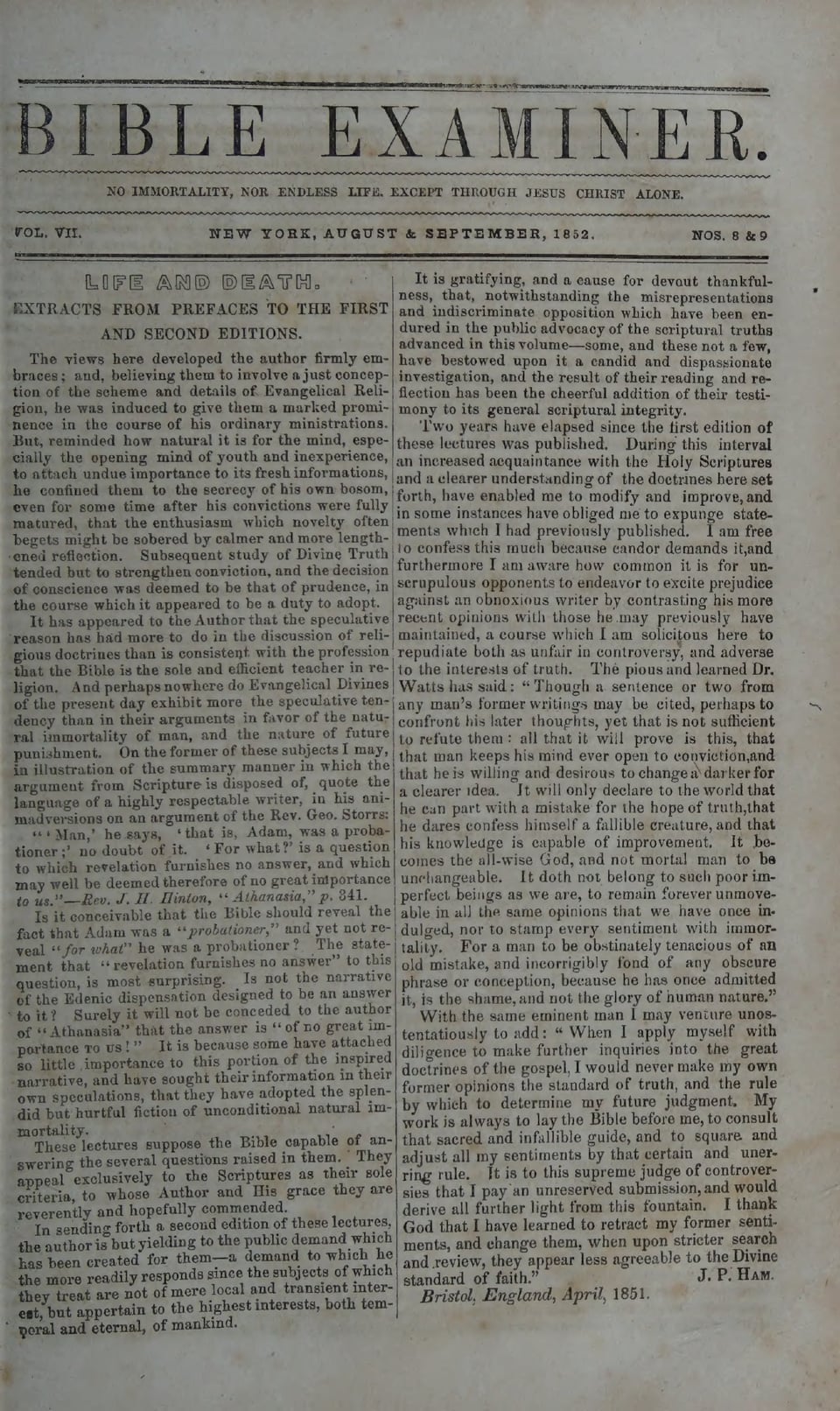
BIBLE EXAMINER.
NO IMMORTALITY, NOR ENDLESS LIFE. EXCEPT THROUGH JESUS CHRIST ALONE.
VOL. VII.
NEW YORK, AUGUST & SEPTEMBER, 1852.
NOS. 8 & 9
LIFE AND DEATH.
EXTRACTS FROM PREFACES TO THE FIRST AND SECOND EDITIONS.
The views here developed the author firmly embraces; and, believing them to involve a just conception of the scheme and details of Evangelical Religion, he was induced to give them a marked prominence in the course of his ordinary ministrations. But, reminded how natural it is for the mind, especially the opening mind of youth and inexperience, to attach undue importance to its fresh informations, he confined them to the secrecy of his own bosom, even for some time after his convictions were fully matured, that the enthusiasm which novelty often begets might be sobered by calmer and more lengthened reflection. Subsequent study of Divine Truth tended but to strengthen conviction, and the decision of conscience was deemed to be that of prudence, in the course which it appeared to be a duty to adopt.
It has appeared to the Author that the speculative reason has had more to do in the discussion of religious doctrines than is consistent with the profession that the Bible is the sole and efficient teacher in religion. And perhaps nowhere do Evangelical Divines of the present day exhibit more the speculative tendency than in their arguments in favor of the natural immortality of man, and the nature of future punishment. On the former of these subjects I may, in illustration of the summary manner in which the argument from Scripture is disposed of, quote the language of a highly respectable writer, in his animadversions on an argument of the Rev. Geo. Storrs: "Man,' he says, 'that is, Adam, was a probationer;' no doubt of it. 'For what?' is a question to which revelation furnishes no answer, and which may well be deemed therefore of no great importance to us."—Rev. J. H. Pinton, "Athanasia," p. 341.
Is it conceivable that the Bible should reveal the fact that Adam was a "probationer," and yet not reveal "for what" he was a probationer? The statement that "revelation furnishes no answer" to this question, is most surprising. Is not the narrative of the Edenic dispensation designed to be an answer to it? Surely it will not be conceded to the author of "Athanasia" that the answer is "of no great importance to us!" It is because some have attached so little importance to this portion of the inspired narrative, and have sought their information in their own speculations, that they have adopted the splendid but hurtful fiction of unconditional natural immortality.
These lectures suppose the Bible capable of answering the several questions raised in them. They appeal exclusively to the Scriptures as their sole criteria, to whose Author and His grace they are reverently and hopefully commended.
In sending forth a second edition of these lectures, the author is but yielding to the public demand which has been created for them—a demand to which he the more readily responds since the subjects of which they treat are not of mere local and transient interest, but appertain to the highest interests, both temporal and eternal, of mankind.
It is gratifying, and a cause for devout thankfulness, that, notwithstanding the misrepresentations and indiscriminate opposition which have been endured in the public advocacy of the scriptural truths advanced in this volume—some, and these not a few, have bestowed upon it a candid and dispassionate investigation, and the result of their reading and reflection has been the cheerful addition of their testimony to its general scriptural integrity.
Two years have elapsed since the first edition of these lectures was published. During this interval an increased acquaintance with the Holy Scriptures and a clearer understanding of the doctrines here set forth, have enabled me to modify and improve, and in some instances have obliged me to expunge statements which I had previously published. I am free to confess this much because candor demands it, and furthermore I am aware how common it is for unscrupulous opponents to endeavor to excite prejudice against an obnoxious writer by contrasting his more recent opinions with those he may previously have maintained, a course which I am solicitous here to repudiate both as unfair in controversy, and adverse to the interests of truth. The pious and learned Dr. Watts has said: "Though a sentence or two from any man's former writings may be cited, perhaps to confront his later thoughts, yet that is not sufficient to refute them: all that it will prove is this, that that man keeps his mind ever open to conviction, and that he is willing and desirous to change a darker for a clearer idea. It will only declare to the world that he can part with a mistake for the hope of truth, that he dares confess himself a fallible creature, and that his knowledge is capable of improvement. It becomes the all-wise God, and not mortal man to be unchangeable. It doth not belong to such poor imperfect beings as we are, to remain forever unmoveable in all the same opinions that we have once indulged, nor to stamp every sentiment with immortality. For a man to be obstinately tenacious of an old mistake, and incorrigibly fond of any obscure phrase or conception, because he has once admitted it, is the shame, and not the glory of human nature."
With the same eminent man I may venture unostentatiously to add: "When I apply myself with diligence to make further inquiries into the great doctrines of the gospel, I would never make my own former opinions the standard of truth, and the rule by which to determine my future judgment. My work is always to lay the Bible before me, to consult that sacred and infallible guide, and to square and adjust all my sentiments by that certain and unerring rule. It is to this supreme judge of controversies that I pay an unreserved submission, and would derive all further light from this fountain. I thank God that I have learned to retract my former sentiments, and change them, when upon stricter search and review, they appear less agreeable to the Divine standard of faith." J. P. HAM.
Bristol, England, April, 1851.
LECTURE I.—THE EDENIC DISPENSATION.
And the Lord God formed man of the dust of the ground, and breathed into his nostrils the breath of life, and man became a living soul."—GEN. 2:7.
It may reasonably be presumed, apart from any overweening sense of one's own personal claims upon public attention, that, in announcing a series of discourses on the "Theology of the Bible," some inquisitiveness may have been excited in the minds of those who feel any interest in the truth; and, perhaps, a state of mind has been antecedently produced, which is rather curious and disquiet than devoutly reflective and calm, and which may, in consequence, disturb that consciousness of interested fellowship in which I desire we should come, at the present time, to the oracle of truth.
It is a great attainment, and evinces a noble independence, when a mind will, in the spirit of earnest devotion and inquiry, look the truth humbly but steadily in the face; and, without anticipations and pre-judgments, go whithersoever it is directed. It often happens that the calm and independent current of our thoughts, in the investigation of truth, is interrupted by a foresight of the conclusion which we are about to reach—a conclusion which, because opposed to our previous belief, is, on this account, anxiously avoided. The inquirer, thus taken by surprise, is injuriously checked by his prejudices; and, unless accustomed to independent thought and urged on by the irrepressible thirst after truth, forecloses abruptly the prosecution of the inquiry.
It were too much to presume that, in a mixed assembly like the present, none should be mentally circumstanced as I have supposed: I hope, however, notwithstanding this forestalling tendency, that I may be permitted to lead the way in these interesting inquiries, in which I shall endeavor from the Bible to show, that the popular religious teaching gives an incorrect representation of the fall of man, and as a consequence, does not accurately represent his redemption by Christ. The scriptures, I have been led to believe, exhibit the fall of man as a more intelligible and complete ruin, and the redemption by Christ as a more rational and blessed recovery, than is commonly taught. My endeavor will be to indicate the teaching of the Bible on the important subject of human immortality, with the view of proving that this doctrine, as professed by the modern Christian church, is a tradition of the old speculative philosophy of the heathen sages, which is nowhere recognized in, but is most repugnant to the word of God.
But this is an undertaking which will probably be considered by many as unnecessary as it is presumptuous. Is it possible, some may ask, that the Christian church can have nurtured in her bosom such mischievous and distracting errors, and that through a long series of ages they should not have been discovered, and that it remains for us in the nineteenth century to go back to first principles, and revise the basis of our holy faith? Even so. If all impartial history assures us, that very early in the Christian era the seeds of serious errors were sown in the bosom of the church—and if the progress of that history exhibits, in its many controversies, the germination and too successful growth of these errors, is it not rather probable that the lateness of the period in which we live, instead of putting us beyond their reach, has afforded a longer time for their destructive maturity, and that now may be the harvest-time of many early errors, and we may in reality be feeding upon their fruit? If the living and "true vine" be closely pressed upon by the forest trees of old errors, is it improbable that the "branches" of "the true vine" shall put forth their tendrils to these desitful props, and by seeking other supports, be unconsciously dishonoring the parent stock? Let not then the supposition of a necessary doctrinal perfection prejudice the mind in the prosecution of this inquiry. No less authority than Douglas thus wrote on the rise of error in the primitive church:—"The early Christians were by no means aware of the extent of their danger when they enumerated only the heresies and the heretics, that were without the church. The same errors were also spreading within. Those who were vehement and determined in their errors, naturally separated themselves from others, and distinguished themselves by a peculiar name, while the many, through whose minds the same erroneous notions of philosophy or superstition were vaguely floating, remained included in the bosom of the church. As the multitude of believers increased, the number of crude and mistaken opinions they brought with them were multiplied also; and the study of the scriptures, the only cure for these evils, was either neglected, or pursued upon visionary principles. While the doctors of the church were refuting heretics, they were often cherishing in their own writing the seeds of future heresies; and the tone of feeling and the mode of thinking among Christians was rapidly receding from the standard of scripture and the oracles of truth."
In this and the following discourses, I desire to adhere closely to the word of God—to take this word as the infallible instructor in all the matters of our religious faith and practice. It is not with human opinions, whether right or wrong, that I desire to have to do—although these must, of necessity, be occasionally referred to—but with the plain and authoritative teachings of God. To this I have endeavored to bring my own mind, from the conscious insufficiency and unsatisfactory character of much which I had been taught to believe was the revelation of God, but which I am constrained to regard as but the doctrines and commandments of men.
Mr. Noel, in his work on "The Union of the Church with the State," well observes, that since the doctrine of Christ "has been preached, men can no longer receive the creed of their fathers or of their country without investigation; but each one is bound to search after truth, to receive it, to maintain it, and to promulgate it in the world, in opposition to all error, however venerable or popular. Our Lord predicted that this novel exercise of conscience in matters of religion, this independent inquiry and resolute profession, would disturb society everywhere to its very foundations. 'Think not that I am come to send peace on earth; I came not to send peace, but a sword;' to which may be added another declaration of our Lord, 'I am come to send fire on the earth.'" And while this is the predicted effect of making conscience of our creed, the obligation to do so is no less obvious: "Let every man be fully persuaded in his own mind;" "Whatsoever is not of faith is sin;" "Prove all things, hold fast that which is good."
All who are accustomed to investigate the grounds of their own religious faith, and who are in the habit of contemplating the development of the religious opinions of others, will readily concur with me, that considerable vagueness, and even actual ignorance, with respect to religious doctrines, exist in the minds of the majority of religious persons; and that a very considerable proportion of religious belief is rather to be regarded as traditionary and educational, than the result of enlightened conviction. May not this be chiefly traced to the fact, that religion is propagated rather independently of the bible, than by its supreme authority, as the source of all religious teaching? There is an understood creed, conventionally stereotyped in the minds of all so-called orthodox believers, according to which the correctness of any belief is examined, and by which it is approved or condemned.
We have an authoritative tribunal, a ghostly council, as virtual a spiritual council as either that of Carthage or event, with canons and formularies as fixed; the effect of which is to awe and intimidate any independent mind that shall be bold enough, in the consciousness of a sacred duty, to sit at the feet of Jesus and learn of him. One has only to entertain a different opinion, even on some minor point of religious belief, from the orthodox multitude, and immediately suspicion, hard names, and sometimes something worse, become the recompense of such temerity. Roman Pontiffs, alas! are not the only Popes who have troubled the churches of Jesus Christ. Protestantism, with all its protestations, has had its Popes; and even now, while Romanism has one Pope, Protestantism has many. In this respect Protestantism has become deprotestantized, and needs to revise and revive its noble position—the bible, the bible alone, is the religion of Protestants. "To the law and to the testimony, if they speak not according to this word it is because there is no light in them."
The character of these discourses will be rather expository than controversial. An attempt will be made to reply to the question, "What saith the scripture?" on the successively connected subjects which I have proposed to bring before you. The subject for our present consideration is, the scriptural representation of man—his constitution, probation and fall.
Turning to the book Genesis, where the inspired account of the creation and primitive condition of man is recorded, we learn that "the Lord God formed man of the dust of the ground." It must be confessed that the first creation of man is fitted to awaken humiliating reflections on our constitutional original, and to check the complacency with which we are wont to dwell upon our distinctive nature. There is a disposition in man to exalt himself too highly, and to talk extravagantly of his native excellence. His language often indicates the belief that he is by natural constitution allied, in some very important respects, to God; and that he possesses, although in a vastly inferior degree, attributes and capabilities similar to those of the Supreme Being. In some sense this is indeed true; but, in opposition to the conceit of the native constitution of man which is commonly entertained, I cannot but regard the sacred history as designedly teaching us that our origin is extremely humble, and that our constitutional alliance is less with the immortal Deity than with the mortal and perishable earth. "The Lord God formed man of the dust of the ground." Considerable emphasis is placed upon the fact that man was originally formed "of the dust of the ground," an emphasis which appears to me to be inexplicable, except on the supposition that the scriptures teach the native mortality, and not the immortality of mankind.
We are accustomed to assume a phraseology when speaking of the human constitution, singularly different from that which the bible uniformly employs. We speak of the soul, as suggesting the essence and destiny of human nature, and not unfrequently as being properly and eminently the man; but the bible gives a marked prominence to the material form which was constructed out "of the dust of the ground," and points rather to that as suggesting the essence and destiny of man. Observe the phraseology, "God formed man"—not the body of man, but man—"of the dust of the ground." And after the unsuccessful probation of our first parent, and he was cast forth from Eden, the curse is expressed in terms as definite as
language can possibly furnish: "In the sweat of thy face shalt thou eat bread, till thou return unto the ground; for out of it wast thou taken; for dust thou art, and unto dust shalt thou return." Gen. 3:19.
Now, let it be remarked that this very distinct and emphatic language is employed after it had been said, at the time of the creation of Adam, that God "breathed into his nostrils the breath of life, and man became a living soul"—or as the word soul here means, a living person. We should have expected, if these words were intended to teach that the breathing "into man the breath of life" signified the impartation to him of an immortal or undying spirit, and that the possession of such a spirit suggests the essence and destiny of man's nature, that the curse would have been expressed in very different language from that which is actually employed; instead of which it is most explicitly and significantly suggested, even after the operation of breathing "into man the breath of life," that the essence and destiny of the nature is not an immortal, but a mortal and perishable existence—"dust thou art, and unto dust shalt thou return." The terms point out the personality of the first Adam as involved in his perishable and mortal nature. "Dust thou"—thyself, thy personality—dust thou art, and unto dust shalt thou return.
In further corroboration that the phrase, "the breath of life" which God "breathed" into Adam, does not imply the constitutional immortality of the human soul, permit me to call your attention to the very significant language in which this creative act of God is recorded. "God breathed into his nostrils the breath of life." That spark of life which the vivifying breath of God kindled in Adam, and so lit up his personal consciousness, did not descend into the depth of his human constitution to enthrone itself in an imperishable seat; it trembled, as it were, on the surface of his being, as if tarrying for a season only. The tenure of that life, so far from being eternal, is suggested as both temporal and precarious. The "breath of life" was but "breathed into his nostrils." And in laying an emphasis on these words, I do not unduly exaggerate their importance, as the following scriptural examples of their usage will testify. The prophet, when he would express the helplessness and mortality of man, thus writes, "Cease ye from man, whose breath is in his nostrils, for wherein is he to be accounted of?" Isa. 2: 22. And yet more definite and significant is the language of the patriarch, "All the while my breath is in me, and the Spirit of God is in my nostrils." Job 27: 3. The breathing into Adam's nostrils the breath of life imparted not immortality, but life and consciousness to him; the duration of that life was altogether an independent consideration. Before this divine act, Adam was a man, after it he became not an immortal man, but simply a living man. "Man became a living soul," that is, a living person.
Now, it is commonly said, that the "breath of life" which God breathed into Adam was an immortal soul. The opponent who avails himself of this argument, should be reminded that it proves much more than he will be disposed to concede, unless he believes in the immortality of the whole animal creation. If the phrase breath of life proves that Adam had an immortal soul, then it also proves that every animal, beast, bird, fish, and reptile, has an immortal soul. Of the animals saved from the deluge we read, "They went in unto Noah into the ark, two and two of all flesh, wherein is the breath of life. And all flesh died that moved upon the earth, both of fowl and of cattle, and of beast, and of every creeping thing that creepeth upon the earth, and every man; all in whose nostrils was the breath of life, of all that was in the dry land died.
And every living substance was destroyed which was upon the face of the ground, both man and cattle and the creeping things, and the fowl of the heaven; and they were destroyed from the earth, and Noah only remained alive, and they that were with him in the dark." Gen. 7: 15, 21-23.
In this passage it is obvious that the whole animal creation, including man, is comprehended in the phrases all flesh and every living substance; and in reference to them all, without any distinction, it is written, "in whose nostrils was the breath of life." Of them all—man, beast, fowl, reptile, animated by the breath of life, we are told that they died and were destroyed. The breath of life cannot therefore mean an immortal, or deathless spirit, otherwise the whole animal creation are immortal; and it would, moreover, have been impossible that either by the deluge or any other catastrophe they should have died and been destroyed. What is immortal is necessarily indestructible and deathless. If man's soul is his personal self, and is possessed of immortality, man-cannot die, nor be destroyed.
The last clause of the text under consideration informs us of the product of this creative act of God; and, therefore, could there have been brought no evidence whatever to show the value of the phrase, the breath of life, since it is recorded what the product was—what, that is, "man became;" it would be sufficient, if it be possible, to demonstrate, by scriptural evidence what is the nature of this production—in other words, what is the meaning of the phrase living soul. God "breathed into his nostrils the breath of life, and man became a living soul."
Every candid disputant will allow, that to fix the true meaning of the phrase, "living soul," is to preclude any argument founded upon the process of breathing into man the breath of life. What is the meaning, then, of this phrase? Does it or does it not mean that Adam became an immortal soul? Relying solely upon scriptural evidence, I hesitate not to reply, that it does not teach that Adam became immortal in any sense. For, in the first place, it is a phrase that is not restricted in its application to Adam, but is applied equally to all the inferior creatures. In Gen. 1: 20, we read, "God said, let the waters bring forth abundantly the moving creature that hath life," or, as it is in the marginal reading, and which is the literal translation, "living soul." In the original Hebrew, in all the following places—Gen. 1: 20, 21, 24, 30; 2: 19; 9: 12, 16—it is the same language that is employed of the lower animals as of man—they are invariably called "living souls." This fact, then, destroys the possibility of building up the doctrine of the soul's immortality upon such a basis. We have, moreover, a more direct and emphatic testimony to the value of this phrase, in the authoritative commentary upon it of the Apostle Paul. In his first epistle to the Corinthians, the apostle quotes this text for a purpose so manifest and unmistakeable, that if his reasoning be impartially attended to and accepted, not only would all discussion about the meaning of this text in particular be for ever set at rest, but the doctrine of the soul's immortality would be driven from the arena of controversy, as a philosophical figment, inconsistent with and detrimental to scriptural Christianity. In the fifteenth chapter of this epistle, where he discourses with considerable particularity on death and resurrection, he thus observes, "It is sown a natural body, it is raised a spiritual body." The term natural in our translation is in the Greek an adjective formed from the substantive soul, and, therefore, its most literal English equivalent is not natural, but soulical. It is sown a soulical body, that is, a body animated by a soul, or
in other words, a living body, all of which "is sown" in death, and "raised" in resurrection. Paul does not use the word "body" either here or elsewhere in the modern conventional sense, of the mere tabernacle or fleshly garment of the soul. As employed by him and the sacred writers generally, we are compelled to understand it, as comprising the human nature as a complete whole, the essential basis of which is a material body, mortal and corruptible and which is animated by a temporary life. For the sake of illustrating and confirming the foregoing statement, I would instance the following passages, "I beseech you that ye present your bodies a living sacrifice, holy, acceptable unto God, which is your reasonable service." Rom. 12:1. Surely Paul did not enjoin upon the Roman believers that they should present their bodies merely, but their entire selves. Again, when he says, "We are willing rather to be absent from the body, and to be present with the Lord," he does not mean that the soul is the human personality distinct from the body, and that at death the soul leaves the body, and is present with the Lord. Paul's idea of absence from the body, if we are to judge by the analogy of his doctrinal teaching, is an absence from the present condition of the entire human nature as mortal, and under the dominion of death; to be absent from which is to be entirely liberated from liability to death, and to be invested with immortality; which is, at the time of resurrection, when 'this mortal shall put on immortality,' and when, not before, believers will be absent from the body and present with the Lord.
In the same comprehensive sense is the word soul used by the sacred writers, not to signify the essence of man distinct from his body, but the complete man, whose characteristic nature is a rational living organization—the essential basis of which lies not in an indestructible soul or spirit, but in a material and perishable body.
Attaching then the Apostle's idea to the words which he employs, we see clearly what he means us to understand by the phrase "living soul," and what is the real constitution of the human nature. "There is a natural body (a soul body) and there is a spiritual body (a spirit body.) And so it is written, the first man Adam was made a living soul, (a living person,) the last Adam was made a quickening spirit," (a life giving power.) Here the Apostle proves the mortality of man by the very phrase which the advocates of the popular doctrine bring to prove the soul's immortality! He contrasts the first Adam with the last Adam, or Christ—the first is only a 'living soul,' a mere temporal existence, the last, or Christ "hath life in himself," and is the "quickening or life-giving spirit." And with greater particularity Paul proceeds to state the mortality of man. "Howbeit that was not first which is spiritual (life-possessing or immortal,) but that which is natural (soulical, animal or mortal,) and afterward that which is spiritual. The first man is of the earth, earthy, the second man is the Lord from heaven. As is the earthy such are they also that are earthy, (that is, mortal and perishable,) and as is the heavenly, such are they also that are heavenly, (that is, immortal, and heirs of the everlasting life.) Now this I say, brethren, that flesh and blood (the mortal creature man) cannot inherit the kingdom of God, (because that kingdom is an everlasting kingdom, and "flesh and blood" is not immortal and everlasting) neither doth corruption (and man is corrupt and must decay) inherit incorruption. For this corruptible (which is the character of our present human nature) must put on incorruption, and this mortal (for such we are by natural generation) must put on immortality." It demands very special attention that Paul does not say that the incorruptible soul, the immortal soul, is to "put on incorruption and immortality," but 'this corruptible' and 'this mortal.'
The whole human nature of man is corruptible and mortal, and before it can enter into life, must be endowed with an everlasting or immortal quality. "So when this corruptible shall have put on incorruption, and this mortal shall have put on immortality, then shall be brought to pass the saying that is written, death is swallowed up in victory;" "mortality is swallowed up of life," And so being 'absent from the body"—the mortal and corruptible nature of man, by means of resurrection from the dead in a spiritual body, or life-endowed nature, we, if we are Christ's, shall "be present with the Lord," by whom, as by 'the quickening spirit,' we are raised. Thanks to God who giveth us the victory' over the mortal nature or body 'through our Lord Jesus Christ.'
The passage just referred to is, according to some, a scriptural proof of the doctrine of man's native immortality. Besides what has just been advanced in opposition to this interpretation of the passage, and which, in my judgment, is most conclusive, I would ask, if the language in question would convey such an idea as that of the native immortality of man to any one, who, ignorant of the sense generally put upon it, should for the first time be required to express its meaning? I cannot but think that, to one unbiassed in his judgment by a conventionally understood meaning, and uninfluenced by attachment to a creed, the natural signification of the passage would appear to be this—that after the creation of man from the dust of the ground, God breathed into him, and he became an animated existence. There surely is nothing in the term 'living' that suggests the idea of unlimited duration of existence, but only a different condition of existence from what was presented before. Until breath was put within him, and thus the first impulse was imparted to the human mechanism, man was only a lifeless form; but after this Divine act man became 'a living soul,' that is, an animated existence.
In Gen. 1: 27, we read, "So God created man in his own image, in the image of God created he him: male and female created he them." Upon this language more emphasis is laid by the advocates of the native immortality of man. Man having been created "in the image of God," it is affirmed that he must have been created immortal, because that "image" would have been imperfect without this element in his constitution. In reply to this statement I would observe that it is a perfectly gratuitous assertion, destitute of all evidence, and resting only upon an assumed probability. It will surely not be maintained that man, because he is said to have been created in the Divine image, is like the Divine Being in every attribute of his nature. That nature can, in this extensive sense, have no "image" or "likeness." Immortality is one of the peculiar attributes of the divine nature, and why then should one only of these peculiar attributes be selected, and not all of them, as properly involved in the "image" and "likeness" of God? If immortality be selected, why not select every other attribute involved in the complete similitude of the Deity? Now, we have a direct scripture prohibition against the assumption of the attribute of immortality by man; for the Apostle Paul, in his epistle to Timothy, distinctly asserts that "God * only hath immortality." 1 Tim. 6: 16. To this it is replied that God hath immortality in a peculiar sense, that his immortality is essential and underived, and looks back into the infinite past, as well as forward into the infinite future; while man's immortality is dependant upon the Divine will, and has no retrospective but only a prospective relation. This admission satisfactorily proves that there cannot therefore be any "image" or "likeness" of God in this respect, if man's immortality is quite another attribute, and so materially different from the immortality of God. Let it be distinctly borne in mind, that the argument for man's natural immortality is established upon the statement in Genesis, that he is made in the Divine image or likeness. Now, there is a very material respect in which this image or likeness fails as we have seen, and this is, that God's immortality embraces eternity—the eternity past and the eternity future, while the assumed immortality of man embraces only the eternity to come. Man's immortality, then, is quite a distinct idea, a widely different attribute; it is not the image or likeness of God's immortality.
The attributes in which man resembles God, are the intellectual and moral attributes of his nature. Here, it is true, there is a wide difference in the respective perfection of these attributes. As possessed by God, they are absolutely perfect; possessed by men, they are but imperfect. The reason and moral nature of man are infinitely inferior in their capacity and excellence to those of God, but yet they are images, likenesses of the Divine reason and moral nature, the difference being, that they are not possessed by man in the same degree and perfection as they exist in God. The immortality of God is incapable of an image or likeness, since it admits of no degrees and no imperfection: it is the exclusive prerogative of the Divine self-existence.
To claim for the original constitution of the human nature the attribute of immortality, because it is an attribute of the Divine nature, is therefore a most palpable mistake, since of all other attributes demonstrative of the Divine personality and supremacy, this is most frequently selected by Jehovah himself. Thus the memorable reply to Moses, "I am that I am;" the solemn and frequent form of the Divine protestation, "As I live, saith the Lord;" and the no less frequent form of asseveration, "As the Lord liveth;" to which may be added the emphatic and commonly occurring phrase, "The living God." These formulae indicate a peculiarity of the Divine nature which is incommunicable, "God only hath immortality."
The interpretation, then, of the disputed passage in Genesis, I would submit, may be fairly seen in the following paraphrase: "As yet"—as if the self-communing Creator had said—"we have formed but irrational creatures in this lower creation, without a moral nature, and therefore unaccountable—let us make a creature that shall sustain a moral relation to us, that shall resemble and represent us in this new creation—a creature possessing intelligence, self-consciousness, a moral sense, and capable of a higher enjoyment than other sentient existences—a rational enjoyment—and who shall exercise dominion over the earth, and all that is therein." "So God created man in his own image, in the image of God created he him; male and female created he them."
The assertion that man is not by original constitution an immortal being, obtains, very possibly, an unwilling reception from many whom I have now the pleasure to address. It has been so long a settled point of our belief, and so flattering to human pride, that it may appear to occupy an impregnable position among the credenda of religious doctrines. I cannot also but be aware, that the denial of the natural immortality of man affects other articles of religious teaching, in which the faith of the church has, for many years, unsuspectingly reposed. Nevertheless, with those who seek truth, and who desire not to be the conservators of opinions on the mere ground of their antiquity, the question is—"wha saith the scripture?" It does not follow, because during even several centuries a popular belief has not, except in some few instances, been called in question, that that popular belief is founded in truth.
The papacy is a venerable institution, yet Luther was right in his crusade against that system of iniquity, notwithstanding its antiquity, and the confidence and reverence with which it was almost universally regarded. The aged man of three-score years and ten, about to be gathered to his fathers, is right in going to Christ at the eleventh hour of his mortality, and in believing that during the whole of his past long life he has been religiously wrong. Errors, alas! seem more indigenous to our world, and obtain a more tenacious longevity than truth. The progressive development of religious doctrines abundantly proves that the grossest heresies have survived centuries, and been embraced by hundreds of thousands in every succeeding generation; and, notwithstanding, have at last been shown to be but human speculations, or the interpretations of a false criticism. It will not be pretended that we have even now arrived at the Ultima Thule of all religious truth, and that to call in question any popular article of faith, or to expect to elicit any new voice from the Word of God, is to exhibit either puerile weakness or daring presumption.
The dogma of the natural immortality of man, it may not generally be known, was not the uniform belief of the primitive Church. The history of the Church abundantly proves that the primitive Fathers, so early as the second century, were greatly divided upon this subject. It would appear that up to this time this dogma was not a received article of religious faith, and that its introduction is to be referred to just this period, when Christianity began to number philosophers of the Platonic and Aristotelian schools among her converts; for those who maintained the natural immortality of man did so, not so much on Scriptural, as on philosophical grounds. The question was discussed as properly belonging to the region of metaphysics, and the form in which it was held by the polemics of this age, depended upon their respective philosophical creeds. Thus, even those who maintained this dogma differed in very material respects; a reasonable consequence of suffering "science falsely so called" to decide what are, and what are not, articles of religious faith. The question was at last settled by the dictum of authoriv. The Council of the Latean, in the beginning of the sixteenth century, decreed, that the proper immortality of the soul be a recognized doctrine of religious faith; and from these sources, and not from the teaching of the Bible, we have the doctrine of the natural immortality of man transmitted to the Church. The Platonism of the second century was the father, and a Lateran Council, under Pope Leo X., in the sixteenth century, was the foster-father, of this so-called Bible doctrine.
That the natural immortality of man should be a most universally held at the present time, will not be a matter of surprise to any one who know how comparatively few they are who really derive their religious faith from the fountain of truth itself. How few obtain the religious doctrines they hold from the Bible, is evidenced by the fact that the great multitude of professing Christians are ill qualified to prove from the Bible the doctrines which they believe it to contain. The great mass form their religious creed from the discourses of their appointed teacher, from catechisms and conversations. Orthodoxy is soon learnt, and its symbols soon adopted; it being like a well-paved highway along which all travel, and the greater proportion not with an intelligent step, as the pathway of their deliberate and reasonable choice, but with a mere mechanical precision. Judaism, the
Papacy, and even the Reformed Churches, have taught us lessons about orthodoxy—its history and influence—by which, if we are wise, we shall, by this time, have profited—the chief lesson of which is, that the bible has had less to do in the teaching of the Church than many have suspected. Creeds conventionally stereotyped, in which human conceit and a speculative philosophy have lent their mischievous aid, have supplanted the Book of God, and even now, as in our Lord's time, men make void the law of God through their traditions
If we may then judge from the present state of religion, the extremely unsatisfactory aspect of certain great religious questions, and the impotency of the Gospel compared with what, from Scripture promises, we might be led to expect, we shall, I think, conclude that the Gospel of Christ is capable of a presentation to the popular mind far more striking and influential; and that at present it is encumbered with many human admixtures which distract and destroy its moral efficiency. We are not, therefore, to be deterred by the cry of novelty, from an honest and independent inquiry into the meaning of that infallible record, which contains the sayings of "holy men of God, who spake as they were moved by the Holy Ghost;" nor are we afraid, while cautiously and prayerfully threading our way, of being led into the labyrinth of dangerous error. We know him who has said, "Search the scriptures, for in them ye think ye have eternal life, and they are they which testify of me;" and who has further taught us, that the Palladium of our faith is not in blindly following the echoes of popular beliefs, and in the prejudiced adherence to systems and creeds, but in studiously and devoutly examining the written Word for ourselves, "Ye do err, not knowing the Scriptures."
I repeat, then, that the teaching of the Bible upon the primitive constitution of man—if that, and not human speculations and assumptions is to decide what is, and what is not truth—will be found to be this: that man was created a being who, while capable by the power of God, of an unending existence, yet had it not by original constitution; that after his creation he was removed to a particular locality, where the pure pleasures of which, in his first formation, he was alone conscious, might receive their highest gratification—and where, as a moral being, he should be submitted to a state of probation, the success of which should be rewarded by an unending existence, subject to no suffering nor constitutional decay. Whether this probation would have been limited, or extend throughout the whole course of Adam's existence—and what the actual condition of mankind would have been in the event of the successful progress of Adam's probation—it is impossible to say, and it is of little moment to be informed. That the probation would have been confined to our first parent, and that it would have been limited to a definite period, seems highly probable, from the fact that the Divine arrangement constituted him the representative of the human race.
The scene of the trial of our first parent's obedience was a garden, separated from the rest of the earth by a greater luxuriance and attraction, and adapted to minister to his most refined satisfactions and enjoyment. Adam was not created in this garden, but was brought thither subsequent to his creation: "And the Lord God planted a garden eastward in Eden; and there he put the man whom he had formed, (ch. 2:8;) and which is again repeated in the 15th verse, "And the Lord God took the man, and put him into the garden of Eden, to dress it and to keep it." In this favored and peculiar place Adam was to enter upon his momentous trial, and to attain to, or forfeit forever, immortality for himself and for generations then unborn.
The terms of the trial are thus stated: "And the Lord God commanded the man, saying, of every tree of the garden thou mayest freely eat; but of the tree of the knowledge of good and evil, thou shalt not eat of it, for in the day that thou eatest thereof thou shalt surely die." The test was at once simple and easy: it involved, we may presume, no self-denial; it was not likely, amidst so many and such exalted attractions to act as a temptation. Were this even the case, there were counteracting motives far stronger and more influential. Upon the success of the trial depended the highest issues. The reward of his faithfulness was, for himself and his descendants an unending life—the only desideratum of his being—the character of which, from his original moral excellence, and the superadded gifts of God, would be a life of blessedness. The punishment of his disobedience was for himself and his descendants—an existence of toil and suffering, exposed to all the contingencies of a native mortality, and then a return forever to the parent dust and original non-existence: "Dust thou art, and unto dust shalt thou return."
But it may be asked, does not this penalty imply that Adam was constitutionally immortal, for how otherwise could death be a punishment to a being who was created to die? I may reply on the other hand, and with equal reason, by another question; if Adam was created an immortal or deathless being, how could he die? It should be borne in mind that Adam was not created to die, neither was he created to live for ever. The duration of his existence was left to be determined by himself under a gracious system of moral probation. The penalty was proclaimed to Adam after he was placed in Eden. Outside of Eden, that is, before he was placed there, he was a mortal creature. From the moment he entered the garden of Eden he was a candidate for immortality, and was therefore raised above the condition of necessary mortality. He had begun to live a life after he was placed in Eden, which, on a certain condition being fuled, should never end. He had in fact entered conationally upon his immortality. To Adam therefore, who was a probationer for immortality or a deathless existence, and to whom both life and death were possible, these words, "in the day that thou eatest thereof, thou shalt surely die," only implied that his immortality was conditional. Death, to him who might have been forever exempt from its dominion, was, therefore, manifestly a punishment.
That the above is the fair exposition of the account given in the sacred history of the probation of Adam, I cannot but think every candid person who is happily unfettered by the dogmas of the common belief, will at once admit. That this exposition greatly detracts from the supposed native dignity of man's constitution, I readily allow; but what is gained by cherisning beliefs, if they are rather fond and flattering conceits, than the instructions of the unerring word of God? If the doctrine of natural immortality be true, it must be proved from the bible; for there, or nowhere, can this doctrine be authoritatively taught.
And if this be not the true explanation of this interesting fact, what, I ask, is the true explanation? If Adam was placed as our representative in Eden, not that he might obtain a higher good than he already possessed; if he was merely placed in Eden that he might run a terrible risk—the risk of losing something which he already had; and not that he might have the advantage and opportunity of gaining something more than he already had—then the placing of him in Eden was less an act of grace than the Bible represents it to have been. Indeed, such a representation of the design in placing Adam in the garden of Eden, is incompatible with the evidences of love which the sacred narrative discloses in connexion with this event. "And the Lord God planted a garden eastward in Eden, and there he put the man whom he had formed. And out of the ground made the Lord God to grow every tree that is pleasant to the sight, and good for food; the tree of life also in the midst of the garden, and the tree of the knowledge of good and evil." Here, surely, is the enumeration of what was to contribute to our progenitor's highest felicity. Among all the delights which greeted his senses, and which reminded him of the grace of his divine benefactor, was "the tree of life also in the midst of the garden, and the tree of the knowledge of good and evil." But the popular representation of the probation of Adam, makes this tree-test a terrible calamity. "The tree of the knowledge of good and evil" stands in the garden-centre, not as the crowning gift of all, as its locality would seem to suggest—giving, while untouched, a right to the tree of life; but as a visible worm at the heart of Adam's many enjoyments. It stands there but to mar, and to be in unsightly contrast with all around. It is in the popular view but a Upas tree, which had already discharged its poison into the fruits which were "good for food," and folded its dark pall over such as were "pleasant to the sight;" instead of a Jacob's ladder, by which the creature of earth might rise to the perfection of an immortal existence.
The two trees, singled out by name, and situated side by side in the centre of the garden, require a more extended consideration. I venture to think, that there was nothing mysterious about these trees; that the names which they bear originated in the arbitrary relation which they sustained in the peculiar Edenic dispensation, and do not characterize their inherent or communicated virtues and capabilities. Their design is sufficiently apparent to guard against any possibility of mistake. The prohibition, it is to be particularly observed, extended to one of these trees only, "the tree of the knowledge of good and evil:" "Of every tree of the garden thou mayest freely eat; but of the tree of the knowledge of good and evil, thou shalt not eat of it." This tree was the sole test of Adam's obedience: while he abstained from this, he might eat of every tree in the garden, including of course of the tree of life. Now what, we ask, is meant by this "tree of life?" If Adam had already by original creation, life in himself, of what use could this tree of life have been to him? It is replied that it had an antiseptic quality imparted to it, and that its design was to preserve the mortal part of Adam's nature from decay. But this answer, however plausible, is a petitio principii—it assumes what we contend is contrary to the record, that man is, in any sense, by creation, an immortal being; and proceeds, moreover, upon the assumption of a compound and conflicting nature of the human constitution, that man is in part mortal and in part immortal—a strange and unnatural union! Where is it taught in the scriptures that man, in reference to his soul, is immortal, but, with respect to his body, mortal? Where is this anomalous breaking up, so to speak, of the unity of man's nature to be found in the Bible? It is not a religious doctrine; but a philosophical refinement, which started into existence when Platonism meddled with the simplicity of the scriptures. Neither the body nor the soul separately is the man, but the union of both. To borrow the illustration of a living writer, "as the union of oxygen and hydrogen produces water, so the union of body and soul constitutes a man."* Man is always in the bible spoken of as one, and as having one destination.
It is true, by the figure synechdoche, the scriptures often employ the word soul to signify the person; as we do, when we say, that such a number of souls perished in shipwreck, or by any other catastrophe; but it is never used in antithesis to the word body, as appropriating the idea of the human personality. An apparent exception to this may be suggested to some in the language of the preacher, where he says, "Then shall the dust return to the earth as it was, and the spirit shall return unto God who gave it;" but this language is rather confirmatory of the opposite view, that in the disjunction of the constituents of man's conscious being, he ceases to be such a being. The body, or the dust returns "to the earth as it was," and the spirit, in like manner returns to God as it was before he gave it: not as a man, a human personality; for if so, man must have had a conscious existence before he was born, but as a constituent of the man—the man himself is dissolved.*
And it is in harmony with these remarks that we learn from the bible that the resurrection of the body must precede the judgment of men; and that until the resurrection of the body, the righteous can neither enter upon their reward, nor the wicked pass away into final condemnation. And permit me again to repeat, and to request your particular attention, that Adam after the fall, when in possession of the living, animating principle, is not addressed as the possessor of an immortal spirit; it is not his spiritual nature which we might have expected, according to the popular belief, that is alluded to, as suggesting the essence of his being; but, on the contrary, his corporeal nature, and to this corporeal nature the personality and essence of his nature are attached, "Dust thou art, and unto dust shalt thou return."
The reply that "the tree of life" was placed in the garden of Eden to counteract the native tendency of one part of the constitution of Adam to decay, does not, we think, furnish a satisfactory explanation. It represents man as a very incongruous compound, as a defective work, to say that one part is inwardly self-sustaining, while the other component part is dependant upon a constant miraculous external agency. In opposition to this view, I would remark, that "the tree of life" in the garden was in the character of a pledge. Side by side with the prohibited tree, it was a perpetual check upon the temptation to violate the command by memorializing Adam of the tremendous penalty he would endure for his disobedience. So long as he persevered in his fidelity, he was assured of an immortal existence, and regarded as exempt from suffering and death; there stood the divinely-given pledge of his immortality. While in the garden of Eden, and having access to that tree, immortality was guaranteed to him and to his posterity; death had no dominion over him or them. The immortality of Adam, therefore, was contingent, not native; it depended upon a particular dispensation and
locality—his position in the garden of Eden, and upon the circumstance of his free permission to eat of the 'tree of life' as its guarantee and sign. It was a conditional gift, not a personal possession—the reward of his obedience, and not his original constitution.
With this view of the condition of Adam in Eden, all the circumstances of his expulsion from Eden obviously agree. The test having failed, and the melancholy consequences of his disobedience being experienced in the knowledge or consciousness of evil,* purchased at the tremendous cost of a forfeited immortality, Adam is expelled the home of privilege and pleasure. He must now quit the garden of Eden, with its scenes and associations of conscious innocence and joy, and with a guilty conscience and a lost immortality, toil for the subsistence of a brief and sorrowful life, and then, having resigned the breath of his consciousness and animation, dissolve again into his parent dust.
The terms of the original curse most explicitly teach this doctrine, "In the day that thou eatest thereof thou shalt surely die." That the meaning of this curse is not that Adam should cease to exist in the very day that he ate of the forbidden tree, is manifest from the fact that he did not then die. Had this been its signification, we should have been at a loss to account for the delay of the punishment, and be unable to explain upon what principle he continued to live so many years afterwards. Now, I would submit that the terms of this curse are quite incompatible with the doctrine of man's constitutional immortality. How could an immortal being die? It is worse than trifling to say that his body should die, but that his soul should live; for, in the first place, the body of Adam did not die in the day of his transgression; and secondly, if the soul of man is his personality, and the body only a mere instrument for connecting him with and fitting him for this condition of existence—the body, the unconscious tabernacle of the human personality; then, to say that the curse contemplated only the body of Adam, that his body only should die, is to leave the terrible curse unexecuted; for the curse is, 'in the day that thou eatest thereof thou shalt surely die,' not thine unconscious body, but "thou," thy conscious personality—thyself.
It has been affirmed that the words of the curse, "in the day that thou eatest thereof thou shalt surely die," imply the constitutional immortality of man, because the threat of death pre-supposes the possession of life, which otherwise would not end. But this is rather specious than sound, for all that the words signify is simply that immortality would be a conditional privilege. Of course up to the time that Adam violated the command, he continued to live, and would, had he not eaten of the fruit, have lived forever; but even then, his immortality would have been conditional, and by no means a possession independent of the Edenic dispensation.
This threat must mean something else, and demands a more satisfactory exposition; and what more consistent exposition can be given than that which accords with the view I am now presenting, of the possible, and since the fall, of the real mortality of human nature?
"In the day that thou eatest thereof thou shalt surely die;" or, accepting its more literal interpretation, "dying, thou shalt die." In that very day in which Adam ate of the tree he lost the privilege of immortality; in that moment he fell from the sublime possibility of an attainable immortality, and realized the condition possible to his nature—the condition of a mortal, perishable being. Thus and thus only in that very day Adam died; from that time forth immortality to him was an impossible inheritance—from that day the seeds of decay possible to his constitution commenced their desolating growth, and spread in him, and in us all, through him, the desolation of death.* The death threatened was thus a progressive, not an immediate death. From the day of his transgression his mortality became a fixed and irreversible fact. Adam was henceforth a dying man travelling onward, not to the realms of the light of life, but to the region of darkness and death.
Now the popular exposition of this curse represents God as declaring that he will punish the guilty offender, and yet not doing so. If the curse of death here means, as it is said to mean, a threefold death, that is, in the popular phraseology—death temporal, death spiritual, and death eternal, then this threefold death must have been executed upon Adam, and by consequence upon his posterity, and redemption is necessarily impossible! God had said thou shalt die, not "thou," or a substitute for thee, but thou, thyself. If this threefold death, therefore, is involved in the word "die," then Adam must have been the subject of it, and to this death, as "the wages of sin," the whole race is exposed. The animal life is destroyed, the spiritual life is alienated, and both forever. How then, on the popular theory, is redemption possible? From an eternal death, of course there can be no redemption whatever. But accepting the word "die" in the conventional and evidently scriptural sense of ceasing to exist, then Adam did and does endure this curse, and so do his posterity, and it is from this curse that Christ, as "the resurrection and the life," recovers us. He has "abolished death, and brought life and immortality to light."
The sequel throws additional light upon the nature and consequences of the fall of Adam. Our first parents were immediately expelled Eden; and the reason assigned for their expulsion is as follows: "And the Lord God said, Behold the man is become as one of us, to know good and evil; and now lest he put forth his hand and take also of the tree of life, and eat, and live forever; therefore the Lord God sent him forth from the garden of Eden, to till the ground, from whence he was taken." Gen. 3:22-23.
…