The Bible Examiner — Vol. 7, No. 12 (December, 1852)
Download: PDF — The Bible Examiner — Vol. 7, No. 12 (December, 1852)
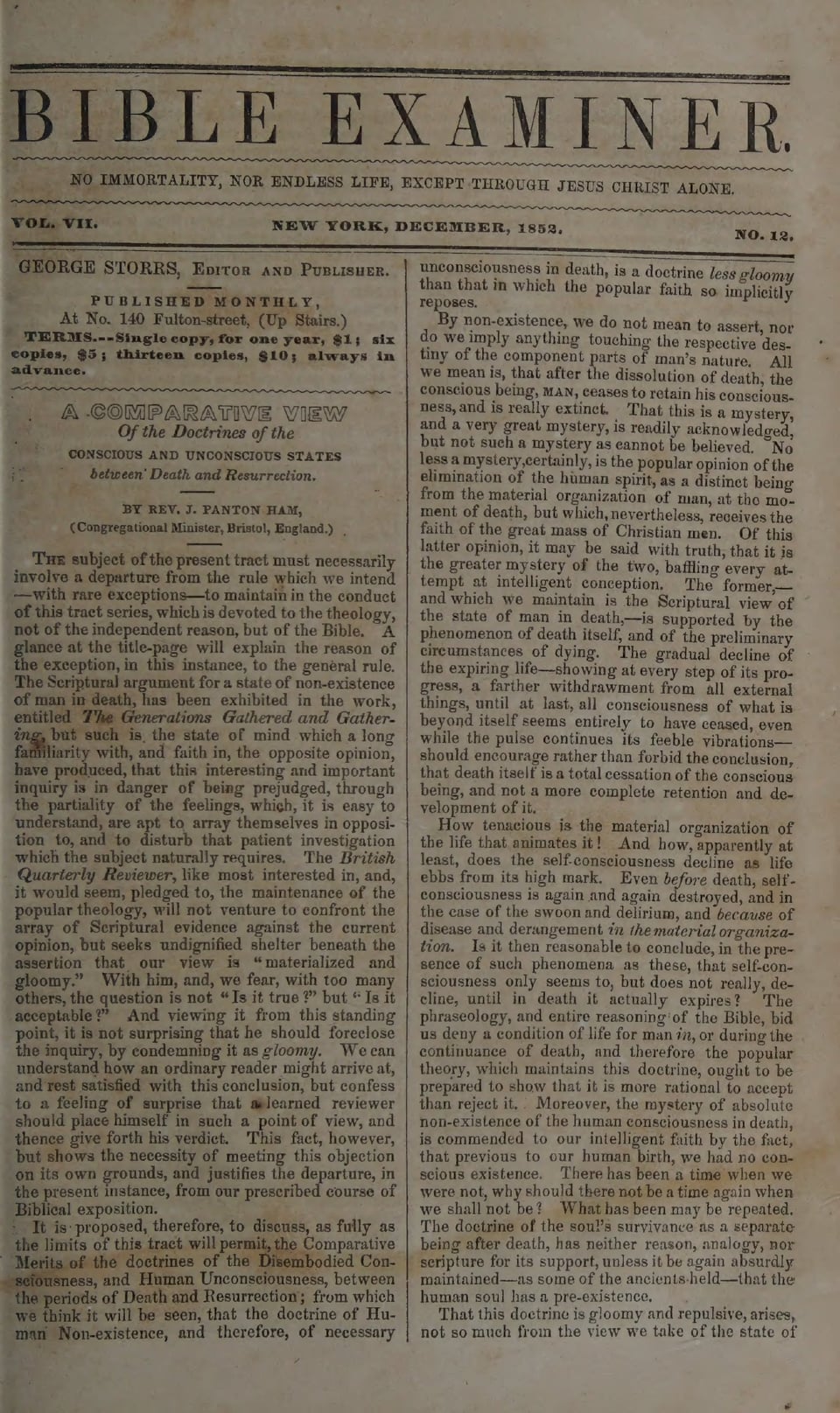
BIBLE EXAMINER.
NO IMMORTALITY, NOR ENDLESS LIFE, EXCEPT THROUGH JESUS CHRIST ALONE.
VOL. VII.
NEW YORK, DECEMBER, 1852.
NO.12.
GEORGE STORRS, EDITOR AND PUBLISHER.
PUBLISHED MONTHLY, At No. 140 Fulton-street, (Up Stairs.)
TERMS.--Single copy, for one year, 1; six copies, 5; thirteen copies, $10; always in advance.
A COMPARATIVE VIEW Of the Doctrines of the
CONSCIOUS AND UNCONSCIOUS STATES between' Death and Resurrection.
BY REV. J. PANTON HAM, (Congregational Minister, Bristol, England.)
The subject of the present tract must necessarily involve a departure from the rule which we intend—with rare exceptions—to maintain in the conduct of this tract series, which is devoted to the theology, not of the independent reason, but of the Bible. A glance at the title-page will explain the reason of the exception, in this instance, to the general rule. The Scriptural argument for a state of non-existence of man in death, has been exhibited in the work, entitled The Generations Gathered and Gathering, but such is the state of mind which a long familiarity with, and faith in, the opposite opinion, have produced, that this interesting and important inquiry is in danger of being prejudged, through the partiality of the feelings, which, it is easy to understand, are apt to array themselves in opposition to, and to disturb that patient investigation which the subject naturally requires. The British Quarterly Reviewer, like most interested in, and, it would seem, pledged to, the maintenance of the popular theology, will not venture to confront the array of Scriptural evidence against the current opinion, but seeks undignified shelter beneath the assertion that our view is "materialized and gloomy." With him, and, we fear, with too many others, the question is not "Is it true?" but "Is it acceptable?" And viewing it from this standing point, it is not surprising that he should foreclose the inquiry, by condemning it as gloomy. We can understand how an ordinary reader might arrive at, and rest satisfied with this conclusion, but confess to a feeling of surprise that a learned reviewer should place himself in such a point of view, and thence give forth his verdict. This fact, however, but shows the necessity of meeting this objection on its own grounds, and justifies the departure, in the present instance, from our prescribed course of Biblical exposition.
It is proposed, therefore, to discuss, as fully as the limits of this tract will permit, the Comparative Merits of the doctrines of the Disembodied Consciousness, and Human Unconsciousness, between the periods of Death and Resurrection; from which we think it will be seen, that the doctrine of Human Non-existence, and therefore, of necessary
unconsciousness in death, is a doctrine less gloomy than that in which the popular faith so implicitly reposes.
By non-existence, we do not mean to assert, nor do we imply anything touching the respective destiny of the component parts of man's nature. All we mean is, that after the dissolution of death, the conscious being, MAN, ceases to retain his consciousness, and is really extinct. That this is a mystery, and a very great mystery, is readily acknowledged, but not such a mystery as cannot be believed. No less a mystery, certainly, is the popular opinion of the elimination of the human spirit, as a distinct being from the material organization of man, at the moment of death, but which, nevertheless, receives the faith of the great mass of Christian men. Of this latter opinion, it may be said with truth, that it is the greater mystery of the two, baffling every attempt at intelligent conception. The former,—and which we maintain is the Scriptural view of the state of man in death,—is supported by the phenomenon of death itself, and of the preliminary circumstances of dying. The gradual decline of the expiring life—showing at every step of its progress, a farther withdrawment from all external things, until at last, all consciousness of what is beyond itself seems entirely to have ceased, even while the pulse continues its feeble vibrations—should encourage rather than forbid the conclusion, that death itself is a total cessation of the conscious being, and not a more complete retention and development of it.
How tenacious is the material organization of the life that animates it! And how, apparently at least, does the self-consciousness decline as life ebbs from its high mark. Even before death, self-consciousness is again and again destroyed, and in the case of the swoon and delirium, and because of disease and derangement in the material organization. Is it then reasonable to conclude, in the presence of such phenomena as these, that self-consciousness only seems to, but does not really, decline, until in death it actually expires? The phraseology, and entire reasoning of the Bible, bid us deny a condition of life for man in, or during the continuance of death, and therefore the popular theory, which maintains this doctrine, ought to be prepared to show that it is more rational to accept than reject it. Moreover, the mystery of absolute non-existence of the human consciousness in death, is commended to our intelligent faith by the fact, that previous to our human birth, we had no conscious existence. There has been a time when we were not, why should there not be a time again when we shall not be? What has been may be repeated. The doctrine of the soul's survivance as a separate being after death, has neither reason, analogy, nor scripture for its support, unless it be again absurdly maintained—as some of the ancients held—that the human soul has a pre-existence.
That this doctrine is gloomy and repulsive, arises not so much from the view we take of the state of man in death, as the fact that the doctrine concerns death itself.
The subject is necessarily a gloomy one in itself, and whichever view we take, we cannot divest it of its essential gloominess. To our life-loving natures, death must ever appear as the king of terrors; and it argues no little against the popular faith, that they, who believe that death is but a new and higher development of life, have as strong an instinctive dread of it, as those who deny this doctrine. They who regard death as the door of life, and who believe that death introduces immediately to the bliss of the heavenly world, ought to welcome, rather than strive to shun it; and the fact that they do not so welcome its approach is a strong presumptive evidence against
tality, as the disciple of the other. Nor is the disadvantage greater in the one case than in the other, for both theories recognize the necessity of dying of passing through the pains of dissolution—and of quitting this scene of things forever. Each theory has its coffin and its grave. In both, corruption and the worm have their work to do. In these respects, neither has the advantage of the other; both alike are gloomy; and from one as much as from the other, our natures instinctively recoil. But beyond this point, there is a difference in the respective theories. According to one, the man has ceased to be; he is from this time, the subject neither of hope nor fear; of pleasure nor
proach, is a strong presumptive evidence against the truth of their opinion. The natural instincts give the lie to the artificial faith. We do not forget indeed, that some have died in triumphant anticipation of a glory immediately following their decease, but this is no proof that their faith was right; all this fact proves, is, that death did not, and could not destroy their hope in a future realization of a blessed immortality. It is true they were expecting it at the moment of death, but the time of possessing their reward was less the occasion of their dying joy than the certainty of possessing it. These happy deaths are however, comparatively rare, which ought not to be the case; they should be the rule, not the exception, where the popular faith is professed.
It should, therefore, be distinctly pointed out, that those who believe in a state of life for the soul after death, and before the resurrection, view the fact of death with as much dread as those who regard the intermediate state as one of uncon-
"shadow of death" has cast its sable mantle over him; and the "gates of death" have opened to welcome him. He has gone down "into silence:" [Psa. 115:17.] his dwelling is "in the dark," in "the land of forgetfulness." [Psa. 88:12.] He is registered among "the congregation of the dead:" [Prov. 21:16.] he is where there is "no work, nor device, nor knowledge, nor wisdom," [Eccl. 9:10.] for "the dead know not anything." [Eccl. 9:5.] We are disposed, and naturally so, to turn away from this vision of death: we say, it is cold and gloomy. It is so; but call it not the writer's theory, nor a human theory at all, for its description is given in the language—not of speculative man, but of the infallible Word. The language and imagery are from the Bible. Turn away, we may, after learning the solemn lesson of our guilt, to seek deliverance through Him who is "the Resurrection and the Life;" but turn away to another theory, we cannot without discrediting the
sciousness and non-existence. Like Hezekiah, they think it a greater blessing to live than to die, although they profess to believe that death removes them from a scene of suffering and sin, to the presence of God and His Son, and the companionship of the holy and blessed. They rejoice also in the recovery of their dying friends, and, like Paul of Epaphroditus' recovery, speak of it as an act of God's "mercy." Here are ample evidences that a deep instinctive dread of death exists in the human nature, and which, despite a false though fondly cherished faith, expresses itself on all suitable occasions. The instincts of humanity are against the dogmas of false religion. Facts therefore prove, that even the popular doctrine of death is regarded as a gloomy and repulsive doctrine; so that there is no advantage enjoyed by the believer in the soul's separate life after death, over the believer in a state of entire cessation of the human being. No accommodating theology can convert
revelation of God, and reposing in a mere fond conceit. This, however, is not the place for entering upon the proof of our theory of death—we will keep to our professed purpose, which is not to discuss here the truth of the doctrine, but the comparative advantages of the two theories.
We have admited then, that our view of the state of man in death, is most repellant to human feelings. But be it acknowledged, that both theories stand on an equal footing up to a given point—the point of actual decease. Beyond this point, whatever repulsiveness may attach to our theory of death, does not, let it be observed, affect him who is the subject of death, but only those who are living, and who may be contemplating it. To the deceased, who is deprived of consciousness, there can, of course, be no painful experience, whatever. All the repulsiveness that is peculiar to this theory, is in the aversion with which we contemplate the extinction of our being. The thought of not being
the curse of God into a confection! Death is the curse, "the wages of sin," which we can never treat as a guest, but must ever dread as an enemy. The Christian consolation which the Bible administers is the assurance to all who are in Christ Jesus, that though they die, they shall live again, when Christ, who is "the Resurrection and the Life," shall come to raise the dead saints, and invest them with their "building of God,"—their "house not made with hands, eternal in the heavens;"—their "spiritual body:" or perfect resurrection and incorruptible nature.
So far then, the practical advantages of both theories are equal. The disciple of the one theory can be as hopeful and joyful in the hour of his moris the painful thought, and the whole sum of the gloominess of this theory of death.
We turn now to the popular theory of a state of consciousness for man in death, as a separate spiritual existence, or soul. Of this condition of the human being, we can form only a vague idea. It is beyond possibility for us to conceive of a condition of being apart from a material organization of some sort. To have an idea of personal existence, we must have both material and form. It may be of a texture as pure and impalpable as light, but a material there must be, however subtile, and of necessity our conception invests it with form, and gives it locality. Of a pure immaterial essence, we know nothing. They who believe therefore in the soul's separate state after death, as the human personality, conceive of it, we apprehend, in a human form—the express image of that possessed before death, but of a substance altogether different—ethereal.
The common notion of an apparition is probably that which generally prevails with respect to disembodied souls. In this condition of existence, then, it is presumed, that man passes after death. The human being becomes an apparition, a "shade," as the poets represent. Will it be maintained, that so far as this change of the mode of human existence is concerned, the popular theory of the state of man in death, has an advantage on its side? The perpetuation of life is an advantage, unquestionably, (supposing it to be a fact) but is such a perpetuation of the living being an advantage? Without offering any opinion on the reality of apparitions or ghosts, we merely ask, does the expectation of becoming one of these mysterious beings after death, invest the state of death with attractiveness? The popular theory holds out the prospect of an intermediate state in the society of shades or ghosts, into one of which we ourselves are to be transformed. This is a feature in the popular theory which does not belong to what we believe to be the Scriptural theory; is this feature, then, such as commends the popular theory of the state of man in death? Our's is condemned as gloomy—is this more inviting to human nature? If we may judge by our present views and feelings, we should be disposed to decide that such a prospective condition and companionship as the popular theory holds out, is rather against, than in favor of, its doctrine of death. It is natural to us to have a fear of supernatural existences. The disciples, when they saw their Lord walking on the sea, felt as we should have felt under such circumstances: "They were troubled, saying, 'It is a spirit,' (some have erroneously concluded that the word "spirit" here means the disembodied human spirit. If the disciples had meant the spirit of Christ, they would not have said "a spirit," but "his spirit." The meaning is, they supposed they saw a being of a different nature, a spirit,) and they cried out for fear." With respect, therefore, to the personal nature, and society of the intermediate state of conscious existence, the popular doctrine rather loses than gains by the comparison. Our human sympathies pronouncing the judgment of this view of the comparison, decide in favor of the non-existence, rather than such an existence of man between death and resurrection.
And if we examine the other characteristics of the popular representation of the intermediate state, we shall be prepared to admit that the advantages are decidedly on the side of the unconscious state of man in this solemn interval in his history. The period between death and resurrection is of necessity—even according to the popular belief—a unique condition of existence, constituting a second estate, perfectly distinct from the first and last estate of the human existence. In religious phraseology, it is termed "the intermediate, or disembodied state." During the continuance of this state, which must be long or short, according to the distance of the decease of any individual of the human family from the final consummation of all things there is a complete separation, in the experience of the blessed dead, from all painful experiences of the former life in the body; but no less separate
and distinct is this intermediate condition from that which is to distinguish the life to come. While therefore, this second condition of human existence is represented as a higher condition than the first, being exempt from all its painful contingencies, it is yet but an imperfect state, and awaits some unknown, distant period, when its condition shall be perfected. It is sometimes in general discourse, called heaven, and a state of glory,—but when its teachers enter upon an explanation of their theory, they always, as they are compelled to do, admit that it is but an imperfect condition—not that perfect state of glorified existence which shall be introduced after the resurrection of the dead. As man carries with him into this new state of existence his characteristic nature as an intelligent and emotional being—which his organic change leaves unaffected—he must be still the subject of hope, desire, and of all other emotions proper to him, as possessed of a mental and moral nature. By the aid of memory, he can recal the past, and by the faculty of foresight, he can anticipate the future. Let us imagine the spirit of the Apostle Paul in this interesting state. Would such a state be a heaven to him, or to any of a kindred spirit with him? The state, mark, is not that of perfect bliss, which is yet to be revealed, but of quiescence—conscious repose. He that was willing to abide in the flesh for the service of Christ, and the Church, would, we should think, be impatient of the restraints and inactivities of this intermediate state. In itself, too, it could have no positive attractions, for he says to the Church at Corinth—according to the popular exposition of the language—that he had no desire for the disembodied state: "Not that we would be unclothed, but clothed upon." [2 Cor. 5:4.] Paul was only willing to leave this world on condition of being with Christ. "To depart," he says, "and to be with Christ is far better." [Phil. 1:23.] He did not mean to "depart" in the modern sense of his soul leaving his body, for he says, "Not that we would be uncloth ed;" but to "depart" from his present mortal and corruptible nature, and the power of death, which departure would take place at the time of resurrection from the dead, when "absent from the body," (the mortal nature) he would be "clothed upon," with an immortal nature, and so "be present with the Lord."
When Paul was on earth, he "groaned,"—to use his own strong language—for "the redemption of the body;" [Rom. 8:23,] and he thus expresses his anxiety: "If by any means I might attain unto the resurrection of the dead." [Phil. 3:11.] Imagine the spirit of Paul in this intermediate state, groaning for the redemption of the body, and longing for the resurrection of the dead: could Paul be happy there? Could the intermediate state be a heaven to him? And imagine the souls of the blessed generally, looking forward to the pregnant future, as the season of their manifestation and glory: is such a state consistent with enjoyment and heavenly repose? Could it be otherwise than a state of dissatisfaction and discontentment? Think of the patriarchs immured in this state—cherishing ardent hopes of the future bliss through thousands of long years. Paul tells us that these ancient worthies "having obtained a good report, through faith, received not the promise: God having provided some better thing for us, (in these last days) that they without us should not be made perfect."
[Heb. 11: 40.] Is such a state of hope deferred consistent with a state of blessedness? Since there must be a lapse of time for the accomplishment of the beneficent purposes of God concerning the human race, the consciousness of this long lapse of time, (which is the vaunted quality of the popular doctrine of the intermediate state,) is rather to be deprecated than desired. To the Divine Being "a thousand years are as one day," but not to the human being;—to the latter it is the long slow moving series of ages, especially if a prospective good is at its farther end. This doctrine of a conscious state for a fractional part of man between death and resurrection is like all attempts at patching God's revelation,—a most miserable mistake! Blessed it cannot be, to live in a state of almost perpetual hope deferred; rather, "blessed are the dead which die in the Lord, for they rest"—in unconscious repose—"from their labors," awaiting "the crown of righteousness, which the Lord, the righteous judge shall give" them "at THAT DAY,"—the day of HIS APPEARING.
The popular doctrine of a state of consciousness for man between death and resurrection, when examined on its own professions, is evidently rather an evil than a good. To the doctrine of a cessation of consciousness in this interval, which the Scriptures most decidedly teach, must be given the ready choice of every rational mind. On this latter, and unpopular, yet Scriptural theory, the holy man who died five thousand years ago is at no greater advantage or disadvantage with respect to the future reward, than the last man who shall die in this life. To borrow the words of Archbishop Whately, "the moment of our sinking into this state of unconsciousness will appear to us to be succeeded by that of our awaking from it, even though twenty centuries may have intervened; of which any one may convince himself by a few moments's reflection." (Revelation of a Future State.—Note C.) On the theory we advocate, the moment of death is virtually the moment of resurrection, and the instantaneous realization of the great reward. Not so, on the popular theory. The moment of death is to dismiss the conscious being to an intermediate state of imperfection and discontentment, possessed of a nature, and destined to be the companion of natures, from which our human sympathies instinctively withdraw, as both unnatural and undesirable. The state of glory, according to the popular doctrine, is far distant in the unknown future—waited for by the disembodied soul, but still disappointing its hopes, and prolonging its patience. We leave it, therefore, with the candid and intelligent reader to decide which, on its own independent merits, commends itself most to our approval as human beings—the popular theory of a state of consciousness, or the unpopular theory of a state of unconsciousness for man, between the periods of death and resurrection. They who judge theory by the evidence of its truthfulness, we refer to the volume entitled, "The Generations Gathered and Gathering; or the Scripture Doctrine Concerning Man in Death."
"The Father hath life in Himself."
Sublime and yet simple as are the teachings of our Saviour, there are few sentences among them all which seem more like loopholes piercing the darkness of nature, and letting in the light of heaven, than this simple announcement.
The wisdom and the might of men have their boundaries, and one of these boundaries is the line of life. As in ascending the Alpine summits you at length reach a spot beyond which vegetation cannot exist, so in proving the powers of man, you here reach a boundary that he cannot transcend. Man can plunge deep into philosophical investigation, and acting upon principles thus ascertained he can invest and arrange, he can bring into his service the existing powers of nature, he can thus command a force that is almost incredible—he can imitate nature—he can mould material in the image of animate creatures, but when he attempts to give Life even to the weakest insect, or the meanest worm, he transcends his powers, and is powerless. In the ordinary course of nature he can propagate his species, as can the veriest worm beneath him, but beyond this his power and wisdom may expend itself, in vain and futile attempts to convey animation to the smallest particle of inanimate matter.
And does not this fact harmonize with the declaration that "the Father hath life in Himself?" Up to this great central Fount we trace each of the ten thousand streams of vegetable, animal, and spiritual animation. In him we live, and move, and have our being. In this sense we are his offspring. Here in the great, the eternal, the self-existent one, do we find our source. His skilful hand moulded the parent of our race, and his vivifying "breath of life," with which he inspired the lifeless form, connects him with and renders him dependent for his very existence upon the Deity himself. Let but that spirit be withdrawn, let it be resorbed in Deity, and man must sink into the non-existence which preceded his creation. "If he set his heart upon man; if he gather to himself his spirit and his breath, all flesh shall perish together, and man shall turn again unto dust." Job xxxiv. 14, 15.
If this then be a Scriptural presentation of the facts in the case (and who can deny it?) if our present and momentary life is from God—if we depend upon him for it—if we could not live one moment were his sustaining hand withdrawn—if when we lay down and sleep we awake for the Lord hath sustained us: (Ps. iii. 5.) if in a word, we live and have our being in him even in this life—how much more must we be dependent upon him for an eternal existence?
For the communication of life to his rational creatures on earth the Almighty has seen fit to employ mediums. In the beginning it may perhaps be said, without impropriety, Adam was employed by God as a channel or reservoir through which the principle of natural life could be communicated to the human family. This channel of communication having been polluted at the outset, can only communicate a transient and mortal principle of life to mankind. Such as it is we receive it as a precious gift, and though marred by the channel through which it is conveyed to us, we still refer its origin to the Self-existent, the eternal One.
For the conveyance of immortal life to his people, God has in wisdom selected another medium not liable to the accidents to which the former medium was subject, but able to preserve and convey to mankind, unpolluted and unimpaired, the treasure committed to him. Such a medium we recognize in the Second Adam—the Lord from heaven.
That He might effectually restore and redeem the human race, that he might fully remove the evils resulting from the transgression of our common father, and that he might communicate to his followers a deathless and eternal existence, it pleased God that in him all fullness should dwell, and "as the Father hath Life in Himself; so hath he given to the Son to have life in himself." And as the Father is able to raise the dead from their graves, even so the Son quickeneth whom he will. In him was life, and amid the darkness that engirded and enshrouded a death-doomed race, this only could afford them relief. "The Life was the light of men." He boldly declares himself to be the way, the truth, and the Life; and informs us that while the object of thieves was to kill and steal, his object was the communication of a more abundant, yea, a boundless Life. Standing by the sepulchre of a departed friend, he, for the consolation of the mourners, declared himself the Resurrection and the Life. And the apostle in accordance with this, while exhorting his brethren to heavenly mindedness informs them that (as they have, by putting off the old man with his works, renounced their relationship to Adam,) they are dead, and their life is hid with Christ in God; and consequently he points them onward to the period when He who is their life, shall appear as the time when they also shall appear with him in glory.
The conditions upon which the human family receive the Life, which is deposited for them in Christ, are so clearly revealed in the Word of God, as to preclude the necessity for mistake. If we would partake of the life and nature of the vine, a living bond of union must exist between us. God hath sent his only begotten Son into the world, that we might live through him. And "this is the record, that God hath given to us eternal life, and this life is in His Son. He that hath the Son hath life; and he that hath not the Son of God hath not life."
If we would partake of this life we must grasp firmly the Life Giver, by an unwavering faith. If we would enter into life we must keep his commandments. And if we thus patiently continue in well-doing, if we seek for glory, and honor, and immortality, God will grant to us, at the resurrection of the just, his priceless "gift"—Eternal Life.
From these thoughts we may learn, First: Our entire subjection to the power of the Almighty. He made us and we are his. We subsist at his pleasure. He can preserve us, or he is able to destroy both soul and body in hell. We are entirely, soul, body, and spirit, at his disposal.
Second : We may learn our entire dependence upon God. His will determines our existence. To produce our ruin, to consign us to non-entity, needs not that power that was requisite to call us into existence. No, let but the sustaining arm of God be withdrawn, and we fall at once. This thought
should make us fear to sin. How dare we offend the God that holds our life in his hands! How can we sin against him who sustains us every moment!
Third: We may hence infer the certainty of the future life of the redeemed. Everything depending upon man, is, according to the voice of all Scripture, and all experience, subject to accident and uncertainty. God hath no variableness nor shadow of turning. Christ is the same yesterday, to-day, and forever. Every power and ability that man possesses he has abused, and in many instances utterly ruined. Facts demonstrate this. And if the future destiny of man depended upon anything inherent in him, it would be as mutable as the shifting wind, and the ever-changing clouds.
Thanks be to God, our future destiny is not thus uncertain. Two immutable things have furnished a firm anchorage for our hope, and strong consolation to our afflicted hearts. We trust in God. Our hope of Life rests in the Living Father. Like the tree planted by the rivers of water, we in this life draw the rich supplies of the grace of God; and like that same tree in the world to come, we hope to throw our roots still deeper into the Godhead itself, and being made partakers of the divine nature, receive from the unfailing fountain that life which shall be endless as the years of God.
This is the great discovery of the Gospel. Christ hath abolished death and brought Life and immortality to light in it; and in this blessed revelation we rejoice. In the language of Saurin we may say: "Death, then, has nothing, hence forward, that is formidable to the Christian. In the tomb of Jesus Christ are dissipated all the terrors which the tomb of nature presents. In the tomb of nature I perceive a gloomy night, which the eye is unable to penetrate; in the tomb of Jesus Christ I behold light and life. In the tomb of nature the punishment of sin stares me in the face; in the tomb of Jesus Christ I find the expiation of it. In the tomb of nature I read the fearful doom pronounced upon Adam and upon all his miserable posterity: Dust thou art, and unto dust shalt thou return; but in the tomb of Jesus Christ my tongue is loosed into this triumphant song of praise, 'O death, where is thy sting? O grave, where is thy victory?... Thanks be to God who giveth us the victory, through our Lord Jesus Christ.' Through death he has destroyed him that had the power of death, that is, the devil; that he might deliver them who through fear of death were all their life-time subject to bondage."
DOES THE CHRISTIAN DIE?
BY LEWIS BUTLER.—MICHIGAN.
"Whosoever liveth and believeth in me shall never die:" John xi. 16. On this text you have given your views, and say, that to die in the absolute sense of the word is to be dead past a resurrection. On what authority you make the assertion I know not; but sure I am that the penalty annexed to Adam's transgression was not death in that sense of the word, or the penalty was never inflicted upon Adam or his posterity; and hence Satan is exonerated from the charge of falsehood, if your assertion is correct. But, I think that your views on the text are not correct, for God assured man that he should die if he ate of the forbidden fruit; and God must have known that man would be raised from the dead, for Christ was a lamb slain from the foundation of the world.
Hence his resurrection was as certain in the mind of Deity as his death; therefore death in an unqualified sense [for he used no qualifying term] admits of a resurrection.
In this position I am sustained by human authority as well as divine.
Brother Walsh, on the penalty of sin, or the nature of death says, "I define it to be extinction or suspension of life:" Bible Examiner, vol. 5, p. 12. In reply you say—"We do not, in the place he refers to, and we never did assume any other position than the one he contends for, viz: that death is the extinction or suspension of life; yet in its primary sense it is extinction," p. 14. In your last position I think you are incorrect, as I have shown above. Again, Thomas Read, on the penalty of Adam's transgression says that, "he (Adam) must have understood it as death, the suspension of life:" Bible Examiner, vol. 6, p. 1. Again, page 2, he says, "Thus the sentence, dying thou shalt die, was fully carried out." Then, of course, the penalty does not preclude the idea of a resurrection, and is only suspension of life. If the views above taken are correct, then our Saviour's declaration amounts to this, that whosoever liveth and believeth in me shall never have life suspended.
Again, that the Saviour did not intend to say, he that believeth in him should never die, so as never to be raised again, appears from the fact that he taught the resurrection in the context, 25 v., "I am the Resurrection and the life, he that believeth in me though he were dead, yet shall he live." Here all is expressed in the context that you think is taught in the text. Therefore, I think that my position stands unaffected by your remarks. Then he that believeth in Christ shall never have life suspended, but hath eternal life. This agrees with the quotations given in my other article, also with the following texts, John iii. 15, "Whosoever believeth in him should not perish, but have eternal life." Walker defines "Perish, to die, to come to nothing." Now, it seems to me, man comes to nothing at death, according to your theory: and hence the theory must be wrong. "Whoso eateth my flesh and drinketh my blood hath eternal life, and I will raise him up (recognise him) at the last day." Notice—he hath eternal life; not, he shall have it, but obtain it when he eats and drinks the flesh and blood of Christ. This appears more plainly, if possible, by looking at the context, 57, 58 verses. "As the living Father hath sent me and I live by the Father, so he that eateth me shall live by me. This is that bread which came down from heaven, not as your fathers did eat manna and are dead," (not beyond a resurrection, of course,) "he that eateth of this bread shall live forever." See also 47-51 v. John x. 28: "I give unto them eternal life, and they shall never perish," (die and come to nothing.) 12: 25, "He that loveth his life shall lose it, and he that hateth his life in this world shall keep it unto life eternal." What can be more plainly expressed? and how can we understand this declaration of our Lord in any other light than that the present life shall be preserved in some form or other until we shall gain access to the tree of life, and through that medium have life perpetuated eternally?
Hence the expressions of our Lord that they shall never die—live forever—hath eternal life, &c. This life if perpetuated forever is eternal life: hence it is said, they who eat and drink Christ's flesh and blood have eternal life: and in contrast, it is said that no murderer hath eternal life abiding in him : 1 John, iii. 15.
I have explained the text under consideration to mean that life shall never be suspended; but I admit that death is some times used in an accommodated sense to mean less than the suspension of life; as in the case of Lazarus. Jesus told his disciples that he sleepeth; a figurative expression, doubtless; but one ill calculated to represent unconsciousness, much more suspension of life. But when they could not understand his meaning he told them plainly that Lazarus was dead; that is, according to the common acceptance of the term, accommodating his expression to their weakness of understanding.
Again: that this state is not death in an absolute sense of the word, and hence not suspension of life, appears from Luke viii. 53. Hence we have a narration of the death and resurrection of the daughter of Jarius, and a positive declaration of our Saviour that she was not dead but sleepeth; an expression generally used in relation to the change (called death) of the righteous, but never once used, as I recollect, in relation to the death of the wicked, in the New Testament; which fact, I think, argues much in favor of my position.
Let me here remark that the distinction you and some others make between extinction and suspension of life is unscriptural as it regards the human race; for there can be no doubt but what suspension of life was all that was threatened to Adam; for certainly God would not threaten that which he never designed to inflict; and he certainly intended that man should have a resurrection when he enacted the law to which the penalty was attached. See Acts xv. 18. "Known unto God are all his works from the beginning of the world;" and in relation to the second death that is expressed by the word everlasting and eternal; there being no difference in the nature but in the duration of the death, one being as entire as the other.
Let me now illustrate my position. If a man's arm were cut off, if vitality existed it would not be said that he was dead; and if his legs were also amputated, and life was still extant, it could not be said that he was dead; and so if his head was extricated, and the signs of life were visible, he would be pronounced alive. So if the entire corporeal organization were dismembered or dissolved, if we could see the signs of life, we should not hesitate to say the person was alive, or was not dead.
And wherefore should we doubt, when he who spake as never man spake, has told us that his followers shall never die, even though we cannot see the signs of life? The apostle has explained that which otherwise might remain a mystery. Col. iii. 3: "For ye are dead and your life is hid with Christ in God." With this agrees the anticipations of St. Paul. See 2 Cor. v. 1: "For we know that if our earthly house of this tabernacle were dissolved, we have a building of God a house not made with hands eternal in the heavens * we are willing rather to be absent from the body and to be present with the Lord." Verse 9. See Phil i. 21-
I know how you and others of my brethren, believing as I do on the destruction of the wicked, explain these texts and argue these points in debate. To me there always seems to be a weak spot in your argument when you come to these texts; and were it not that you regain your arguments and repulse opposition by a reference to the Old Testament Scriptures, I think you would have been entirely vanquished on the sleep of the dead, as you define it. Now, this shows that there is an element of truth lacking; for if you had the whole truth on your side, you certainly could defend your ground as well or better on the New Testament evidence as Old Testament, which I think can be done on the theory I advocate. It beautifully harmonizes with all the New Testament evidences of man's life in the intermediate state, and at the same time corroborates with the testimony found in the Old Testament, that man is a unit, and that in the very day that his breath departs his thoughts perish.
I wish now to call your attention to a few texts that I do not recollect of seeing urged in favor of man's life in the intermediate state.
Matthew xvi. 18: "On this rock will I build my Church, and the gates of hades shall not prevail against it." Now, I have been told that hides, or hell as it is translated, means a place of silence, or state of the dead. Then of course this state or place shall never prevail over those who by one spirit have been baptised into the one body or Church of Christ. This agrees with Gal. iv. 26: "But Jerusalem which is above is free, which is the Mother of us all." Thus we see that instead of the Church of Christ being in hides, or state of the dead, she is above and free. Eph. iii. 15: "Of whom the whole family in heaven and earth is named." Here we see that part of the family is in heaven; and if you say that part are the resurrected ones, yet it would seem that if part were in hades that mention of them would have been made. Romans viii. 10: "And if Chrst be in you, the body is dead because of sin, but the spirit is life because of righteousness." The sentiment here taught is that though the body is dead, or disorganized in consequence of the sin of Adam, yet the spirit shall live in consequence of righteousness, or obedience to the gospel.
Having thus given you the most important texts favoring the theory I advocate, I will look at a few texts that you quote in support of your theory. And first, we shall examine 1 Cor. xv. 18: "Then they also which are fallen asleep in Christ are perished;" that is, if there is no resurrection. This text clearly proves in connection with the context, that there is no future life but through Christ; and hence is good evidence against the natural immortality of the soul; but certainly does not prove that if there is a resurrection of the dead, and hence that Christ is risen, and consequently that the faith of Christians is not vain, that Christians shall perish—die—or come to nothing: see 14-17. The 19th v. is of the same import. I cannot recollect any other.
Thus I have passed through an examination of the subject, giving some of the most prominent evidences and illustrations of the perpetuity of the Christian's life,and answering objections as briefly as I could,hoping in all candor that good may result
to the cause of truth thereby; if I have erred, may God forgive my error; but if I have defended the truth, may he bless that defence. Amen.
LEWIS BUTLER.
Lock, Mich. April 4th,1852.
THE ADAMIC PENALTY.
BY DR. TAYLOR, ENGLAND.
God having created man after his own image, a living soul, endowed with the powers of reason, in order to form in him all the habits of virtue, besides the obligations resulting from the natures and relations of things, was pleased, in a command of pure authority, to exercise his obedience to Himself, his Maker, by forbidding the use of one tree in the garden, called the tree of the knowledge of good and evil. The threatening, in case of transgression, was that he should surely die. Death was to be the consequence of disobedience. Death is the losing of life. Death is opposed to life: and must be understood according to the nature of that life to which it is opposed. Now the death here threatened can, with any certainty, be opposed only to the life God gave Adam when he created him, verse 7. Any thing besides this must be pure conjecture, without a solid foundation. For no other life is spoken of before, to which death can be opposed; nor can we conceive, from any thing in the history, how Adam could understand it of the loss of any other life than that he had newly received. In this light, the sense of the threatening will stand thus: Thou shalt surely die; as if he had said, 'I have formed thee of the dust of the ground, and breathed into thy nostrils the breath of life; and thus thou art become a living soul. But if thou eatest of the forbidden tree, thou shalt cease to be a living soul; for I will take from thee the breath of life, and thou shalt return unto the dust of which I formed thee.' Less than this, I think, the threatening cannot signify; and I do not see how any thing more can be made of it."
"THE BIBLE AGAINST TRADITION."—We again call the attention of our friends to this work. Shall it be issued? It is for you to say. Without your help it cannot be done. Some forty dollars have been pledged; but we must have 200 to begin with; and that will only about half meet the cost of the first edition. Will the friends who desire the work issued send us immediately the amount they are willing to invest in publishing it. If it is not issued we will return your money at our own expense. One brother says, he "will be one of ten to advance the 200 immediately." Let us have it and the work shall be issued forthwith.
Let those who cannot advance their 10 or 20 tell us how many copies they will take and pay for, when it is ready for delivery. A few have already done this; and some have sent a dollar, saying— "Send me the work-pay the postage on it, and keep the remainder for your trouble." Who will do likewise? The work will probably contain between 200 and 300 pages, 12 mo. The price, bound, will not vary much from fifty cents; possibly it may be sixty-two-and-a-half. That is as near as we can judge at present.—Ed. Exr.
BIBLE EXAMINER.
NEW YORK, DECEMBER, 1852.
Our Subscribers have now received the last number of the present volume. We hope few will subject us to the regret of discontinuing the paper and striking their names from our book.
Our terms are "cash in advance in all cases." By the course we pursue, of discontinuing all papers not paid for in advance, we have kept our subscription list down low; but we have had the pleasure of knowing that those who receive the paper prize it, or they would not pay as they do; and we know such subscribers read it with more comfort, and are not afraid we shall dun them. We shall pursue the same course still, believing it best for all concerned; hence none need expect the January Examiner unless they have sent the subscription price.
We receive no subscriptions for a less time than one volume. One reason for this is, we print a definite and equal number each month; not to send the whole volume is to break it, and the remainder is of no use to us. We may as well give you the whole volume for twenty-five cents as three numbers of it, for the reason just assigned.
We wish to know early how many will be likely to take the Examiner, so as to judge what number to print. To induce an early payment, we offered in our last to give each subscriber for 1853 [or volume eight] the two double numbers of this year, containing J. Panton Ham's works, without charge, except they must pay the postage on them. That offer we limited to payments made before the first of December. We have concluded to extend it to all who pay prior to the 25th inst. Those who wish to avail themselves of the offer must see that they attend to it immediately.
The Examiner would have been issued weekly the ensuing year if we had believed it could be sustained. With only one thousand paying subscribers, at $2 per year, we would have gone forward; although that sum would barely have met the printer's bill, office rent, and expense of mailing. Not believing it could be raised, without crippling other papers, we did not make the proposition, though some desired it, assuring us that money could be raised. Our past experience, however, has made us cautious about pecuniary risks.
Let all who write us, by mail, address us simply, "Geo. Storrs, New York." By adding the No. of the street where our office is, we are subjected to two cents extra. Some have continued thus to tax us, though we especially asked them, some months since, to "be particular" not to do it.
FROM ENGLAND.
We are glad to lay before our readers the following from J. Panton Ham. We know they will be gratified with it.—Ed. Ex.
ST. MICHAEL'S HILL, BRISTOL, ENGLAND August 2nd, 1852.
To GEO. STORRS, New York.
My Dear Sir:—I feel that I cannot, and that I ought not to refrain from expressing to you my sense of obligation for the privilege which you have granted me of speaking to a large number of my brethren on your side of the Atlantic. Your kind notice of my two little books, followed up by the still more emphatic commendation of reprinting them for cheap circulation in the United States, I duly appreciate, and beg to present my best thanks for your kindness and trouble. If they shall help forward the great cause in which I feel it a privilege to be permitted to labor, in concert with yourself and other dear brethren, both in England and America—they will not have been written in vain. The warm-hearted response which the first reprint called forth from Brother Bacheler, contained in your July number, came home to me, as no doubt it did to you, like a hearty grasp of the hand. The enthusiastic approval of but one earnest man of God is an object worth laboring for.
From your Bible Examiner I learn that you are actively disseminating the great Bible truths that Immortality is a gift of God dispensed through Christ, and that the wicked will be punished not with endless torment, but "everlasting destruction." For the past three years and a half I have been permitted to testify for the same, as well as for some other truths, in this city: and it will rejoice you to know with considerable success. Although expelled from my former chapel for this testimony, for more than three years I have been listened to in another place by large and attentive audiences. Our church numbers nearly two hundred, with a congregation in the usual proportion. We have printed and published during the above period about one hundred thousand different tracts—a specimen of which I have sent you. You will see by the accompanying "Letters" that my course has not been very smooth—and that strenuous efforts have been made by ministerial brethren to extinguish the light that has been kindled. Still, however, the good work advances,—inquiry is rife,—and hearers abound. We have much to encourage us here. Let us pray for each other—that the Lord would give us patience and endurance to prosecute our labors diligently to the end.
For some months past we have had in contemplation the publication of a British Bible Examiner, and probably before three months are past, it will make its debut.
As the Editorship will devolve on myself, and the risk be mainly incurred by myself and friends, I think of issuing it at first as a bimonthly. Such a periodical we could probably undertake without risk of failure. Possibly it may, after some little time has elapsed, create a demand for a monthly.
I should like to possess the "Bible Examiner" from its commencement. Will you tell me through the medium of your next number what a complete set of them would cost, including carriage from New York to England?
May you, my dear sir, be long spared to labor in the Lord's vineyard, and be permitted to taste largely of the fruits of your labor.
Yours most fraternally,
J. PANTON HAM.
REMARKS BY EDITOR OF EXAMINER.—The "Letters" and "Tracts" were received, but did not arrive till after the last Examiner went to press. We are much obliged to Br. Ham for the package sent us. We have sent the Examiner in sheets from its commencement in its octavo form, for which we shall make no other charge than that he furnish us an article occasionally, and send us the British Bible Examiner when started. The package we sent by private hands to Manchester; from there to be sent by Express. When too late we discovered we had directed it to "St. Michaels," Bristol, omitting "Hill.'
The Tracts Br. Ham has sent us are nineteen in number, done up with covers in four packages. Besides these are four pamphlets of from 12 to 18 pages octavo, with the following titles, viz:
"The Anathema of the Nine Dissenting Bishops contained in the Letter of the Rev. George Henry Davis; A Reply by J. Panton Ham."
"The Popery of Popular Protestanism; A Letter on the Protestant Doctrines of Supererogation and Indulgence, addressed to the Rev. J. B. Clifford, M. A., by J. Panton Ham."
"The Weakness of Popular Protestantism: A Letter on the Roman Catholic Doctrine of the Intercession of Saints, addressed to the Rev. J. B. Clifford, M. A., by J. Panton Ham."
The Translation of Ephesians iv. 32, Defended; with an Appendix, &c., by J. Panton Ham."
The Tracts are entitled "THEOLOGICAL TRACTS," varying from four to sixteen pages, 12 mo. We give one of them in this month's Examiner, which we shall issue immediately in a tract. It is "A Tract for the Churches." Price $1 per 100.
SINCE OUR LAST EXAMINER was issued we have visited Springfield, Mass.; Philadelphia; Paterson, N. J. twice; preached several Sabbaths in New York city; and spent eight days in Victor, N. Y.; at which last place we preached twelve times; we trust not in vain. At that place we became more familiarly acquainted with Brs. Levi and Caleb Boughton, at whose houses we made our home while there—and truly felt much at home in both their families; as also at Br. Cephus Boughton's. There are a goodly company of strong men at Victor, though their number is small. We shall not soon forget their kindness. They gave us substantial aid to help us on our way. May the Lord abundantly reward them. We shall not enter more into particulars in relation to any of the places visited, at present.
We would record the mercy of the Lord in our preservation in all these travels; especially in the deliverance he gave us on our return from Springfield. Between New Haven and Bridgeport, Conn., as we approached the Housatonic Bridge, it was discovered that the switch, near the entrance of the bridge, was misplaced. The engineer had only time to blow his whistle, and the brakemen to turn their breaks in quick time, and jump from the train, before the locomotive struck the right hand pillar of the arched bridge with a thundering crash, and in a moment the whole of the first arch, of 160 feet, fell into a mass of ruins; and the locomotive, its tender car, and all the baggage cars, had gone over the abutment of the bridge among the ruins. By the good providence of God, the hind wheels of the last baggage car had become separated from that car, as it went over the abutment, and were so embedded in the sand that when they struck the abutment they could not go over, and all the passenger cars were brought to a sudden and dead stand, with such force, however, as to do considerable damage to the platforms and their fixtures. We were sitting in the first car occupied by passengers—heard the alarm whistle; followed, almost instantly, by the crash in front, without knowing the nature of the disaster, till brought to the sudden stand mentioned. We then got out of the car and walked down the steep bank to see the ruins, and the awful perilous situation we occupied a few moments previously. We turned away from the sight, and standing alone, our heart poured out devout thanks to God for his delivering and preserving mercy. May our spared life be devoted wholly to Him; that when the great trumpet shall sound, as the signal that the cars of this age are to come to a stand, we may not be wrecked, but saved in the Lord to Life Eternal.
"HURT HIMSELF.'—Who has? "Br. Storrs." How? "By saying what he did in the last Examiner about the thousand years past theory."
Well, it is not the first time "Br. Storrs has hurt himself," and probably it is not the last; and if he had chosen not to "hurt himself," he could have remained in the Methodist E. Church, where he had gained a standing at least equal to his fellow ministers. When he commenced preaching in 1824 he held a military commission, with fair prospects of soon having rank with officers of the highest grade. He resigned all that worldly honor to preach the gospel of Christ. "What a pity"! said some of his friends—"he might have been somebody." After attaining to some standing in the Methodist E. Church he withdrew from it, for causes not necessary now to repeat. "What a pity"—said some—"how he has hurt himself—he might have been one of our Bishops." Next he openly espoused the unpopular doctrine of the destruction of the wicked, instead of their eternal torture. Then came the cry—"Geo. Storrs has used himself up." However, having obtained help of God he continues unto this day, witnessing to both small and great, saying none other things than what he believes he is sustained of God's word in saying; and strong to confess when he is satisfied he has been in error.
We have noticed this matter only to let all know that while we publish the Examiner it will not be our inquiry, what will "hurt" us? but, what is truth? and when satisfied we have it, we shall fearlessly proclaim it. Some theories we shall only name to show our disapproval, while the merits or demerits of others will be discussed at length; and our own judgment will guide us in our course, while we are willing to be reproved by friends or enemies, but we shall act our own discretion whether to open our lips in reply or keep silence Our Lord Jesus thus acted. Some men it is useless to answer; nor do they wish an answer only to have occasion for more words. A discerning mind can usually tell what the motive is in seeking a reply; and where it is manifestly for strife and debate, the most severe rebuke is to refuse to answer them. Silence annoys and chafes them more than labored arguments.
We wish all to understand, while we conduct the Examiner, we shall express our opinions untrammeled, and in our own way; though we intend to be respectful in our language. If any do not like this course they will not sustain the paper: and they may further understand that we shall not alter in this matter to gain or keep subscribers. Whether we hurt ourself, in the case which is the occasion of these remarks, or not, remains to be
seen. A time-serving policy we abhor. If we cannot be sustained in a free expression of thought our paper may go down, and we will dig the earth for bread, so far as food is concerned. We have no fears, however—the Lord will provide, and lovers of free thought and expression will sustain us.
"The REVIEWER REVIEWED; A DIALOGUE; Being a Reply to Eld. J. G. Stearns, on the Immortality of the Soul, by GEO. STORRS."—Such is the title of a work of some 30 or 40 pages, 18 mo., to be issued in a few days. Price six cents, without covers: $4 per hundred. Our friends in Western N. Y., where Mr. Stearns' work has been so extensively circulated, we trust will circulate the Reply. Let us have your orders immediately.
NEW TRACTS.—We have added to our list of Tracts two new ones, viz: "The Gospel Faith," and "The Gospel Hope"; each 12 pages, 18 mo. Price 75 cents per 100. The first named should be circulated with the "Reply to J. G. Stearns," as it serves to show how prominent the doctrine of Life is in the Bible; and Mr. Stearns, like others on his side of the question, has made this grand theme a mere figure before the goddess Immortal-soulism. We need not say more of these tracts at present, as our readers have seen the matter of them in the Examiner for Oct. and Nov. Shall they be sent abroad? What are we doing to scatter truths which we profess to believe so valuable and important? Br. Ham's congregation alone, in Bristol, England, seem to be doing more in scattering tracts than the whole body of believers in this country are at present doing. Ought these things so to be? It must not be. Where are the funds and men to do this work? Something must be done. If the friends do not individually come up to this work, necessity will compel to seek associate action. The work must go forward.
Ham's Works.—Shall those double Examiners containing the works of J. Panton Ham be scattered over the land? We have put them now at the extreme low price of twelve and a half cents per copy; or eight dollars per hundred. There are no works more valuable for general circulation. But our readers need no other commendation than what the reading has impressed on their minds. Let the work of scattering them be increased a hundred fold.
BR. MONCRIEFF will accept our thanks for his kind intention of sending us a "revised and corrected copy of his work on the 'Soul.'" But he will regret, as well as we, to learn, that through the blunder of his binder, the copy sent us contains only the first six and the last six pages, so that it is lacking twelve pages of the middle of the work; that is from page 6 to 19; though the pages sent are duplicate; the binder thus spoiling two copies.
…