The Bible Examiner — Vol. 8, No. 12 (December, 1853)
Download: PDF — The Bible Examiner — Vol. 8, No. 12 (December, 1853)
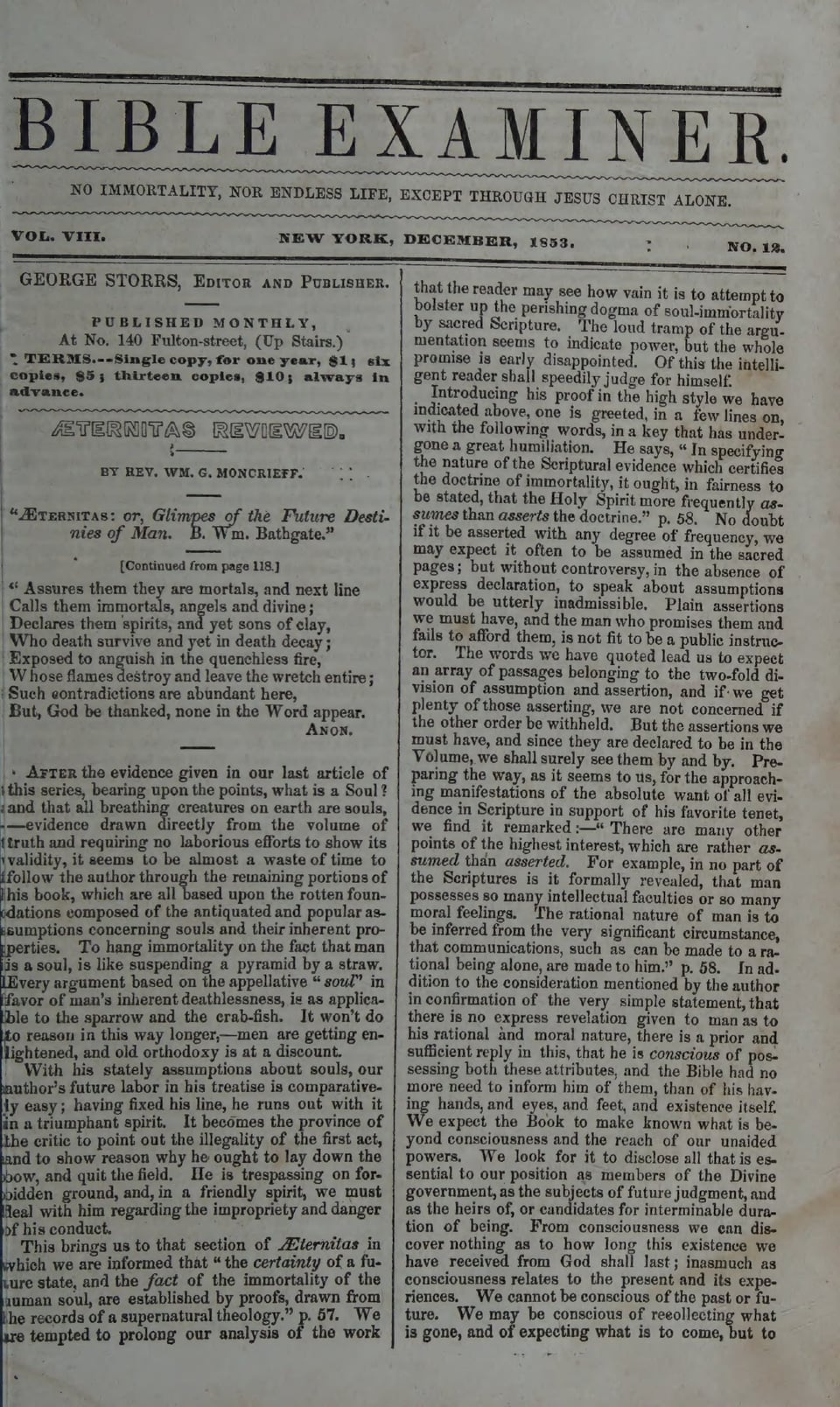
BIBLE EXAMINER.
NO IMMORTALITY, NOR ENDLESS LIFE, EXCEPT THROUGH JESUS CHRIST ALONE.
VOL. VIII.
NEW YORK, DECEMBER, 1853.
NO.12.
GEORGE STORRS, EDITOR AND PUBLISHER.
PUBLISHED MONTHLY, At No.140 Fulton-street, (Up Stairs.)
TERMS.--Single copy, for one year, 1; six copies, 5; thirteen copies, $10; always in advance.
AETERNITAS REVIEWED.
BY REV. WM. G. MONCRIEFF.
"ETERNITAS: or, Glimpes of the Future Destinies of Man. B. Wm. Bathgate."
[Continued from page 118.]
"Assures them they are mortals, and next line Calls them immortals, angels and divine; Declares them spirits, and yet sons of clay, Who death survive and yet in death decay; Exposed to anguish in the quenchless fire, Whose flames destroy and leave the wretch entire; Such contradictions are abundant here, But, God be thanked, none in the Word appear. ANON.
After the evidence given in our last article of this series, bearing upon the points, what is a Soul? and that all breathing creatures on earth are souls,—evidence drawn directly from the volume of truth and requiring no laborious efforts to show its validity, it seems to be almost a waste of time to follow the author through the remaining portions of this book, which are all based upon the rotten foundations composed of the antiquated and popular assumptions concerning souls and their inherent properties. To hang immortality on the fact that man is a soul, is like suspending a pyramid by a straw. Every argument based on the appellative "soul" in favor of man's inherent deathlessness, is as applicable to the sparrow and the crab-fish. It won't do to reason in this way longer;—men are getting enlightened, and old orthodoxy is at a discount.
With his stately assumptions about souls, our author's future labor in his treatise is comparatively easy; having fixed his line, he runs out with it in a triumphant spirit. It becomes the province of the critic to point out the illegality of the first act, and to show reason why he ought to lay down the bow, and quit the field. He is trespassing on forbidden ground, and, in a friendly spirit, we must fleal with him regarding the impropriety and danger of his conduct.
This brings us to that section of Eternitas in which we are informed that "the certainty of a future state, and the fact of the immortality of the human soul, are established by proofs, drawn from the records of a supernatural theology." p. 57. We are tempted to prolong our analysis of the work
that the reader may see how vain it is to attempt to bolster up the perishing dogma of soul-immortality by sacred Scripture. The loud tramp of the argumentation seems to indicate power, but the whole promise is early disappointed. Of this the intelligent reader shall speedily judge for himself.
Introducing his proof in the high style we have indicated above, one is greeted, in a few lines on, with the following words, in a key that has undergone a great humiliation. He says, "In specifying the nature of the Scriptural evidence which certifies the doctrine of immortality, it ought, in fairness to be stated, that the Holy Spirit more frequently assumes than asserts the doctrine." p. 58. No doubt if it be asserted with any degree of frequency, we may expect it often to be assumed in the sacred pages; but without controversy, in the absence of express declaration, to speak about assumptions would be utterly inadmissible. Plain assertions we must have, and the man who promises them and fails to afford them, is not fit to be a public instructor. The words we have quoted lead us to expect an array of passages belonging to the two-fold division of assumption and assertion, and if we get plenty of those asserting, we are not concerned if the other order be withheld. But the assertions we must have, and since they are declared to be in the Volume, we shall surely see them by and by. Preparing the way, as it seems to us, for the approaching manifestations of the absolute want of all evidence in Scripture in support of his favorite tenet, we find it remarked:—"There are many other points of the highest interest, which are rather assumed than asserted. For example, in no part of the Scriptures is it formally revealed, that man possesses so many intellectual faculties or so many moral feelings. The rational nature of man is to be inferred from the very significant circumstance, that communications, such as can be made to a rational being alone, are made to him." p. 58. In addition to the consideration mentioned by the author in confirmation of the very simple statement, that there is no express revelation given to man as to his rational and moral nature, there is a prior and sufficient reply in this, that he is conscious of possessing both these attributes, and the Bible had no more need to inform him of them, than of his having hands, and eyes, and feet, and existence itself. We expect the Book to make known what is beyond consciousness and the reach of our unaided powers. We look for it to disclose all that is essential to our position as members of the Divine government, as the subjects of future judgment, and as the heirs of, or candidates for interminable duration of being. From consciousness we can discover nothing as to how long this existence we have received from God shall last; inasmuch as consciousness relates to the present and its experiences. We cannot be conscious of the past or future. We may be conscious of recollecting what is gone, and of expecting what is to come, but to speak of having a consciousness, as some do, that we will live for ever, is to use words that are palpably incorrect.
Again, to suppose that we can learn from reason that we are immortal is equally fallacious, and the impossibility of reaching such a conclusion by our own faculties, evinces the need of explicit affirmations that no believer in Scripture would question for a moment. Appearances are all against the conclusion that we do not expire in death, and that we shall resume conscious existence posterior to that mournful crisis. Shall we infer that we are immortal because we are now in being? Shall we conceive that that event introduces us to a new life, destined to have no end, which assuredly seems to terminate being for ever? Shall we argue that the powers we have indicate undoubtedly that this is but the dawn of our God-like duration? Thus we may reason, and thus many have tried to build up the hope of immortality, but with nothing better to construct the fabric, it is one airy as the dreams of a drugged imagination. Something plain, unambiguous, full and authoritative is needed to hold up the doctrine that man is an heir of immortality. On other momentous points the Word gives us ample satisfaction, and on this one we expect most reasonably no less confirming and consoling information.
Drawing nearer to the point, when the evidence that is to solve all questionings, and ratify the teachings of the creed, the author presents what a dim eye can discover to be thoroughly fallacious.—He writes,—"The Bible does not communicate the attributes of rationality or immortality, but is framed for rational and immortal beings, informing them of their duties, privileges, and destinies,—all the while taking it for granted, that we no more need to be formally or minutely told of our intellectual, moral, or immortal nature, ere we can turn the contents of the Scriptures to a practical account, than we require to be distinctly told we have feet, ere we employ them in walking, or that we have tongues ere we employ them in speaking." p. 59. Alas, there is but small hope of Bible evidence for man's immortality after lines like these; they are a gentle, we doubt not, an unconscious effort to prepare his friendly readers for the great gulph they will by and by see. He promised ample and convincing evidence lately, now he tells us in so many words we are foolish to expect it. Expect plain assertions that you are immortal!—as well look for explicit intimations that you have eyes to see with, and hands to hold by! This may pass with some, it won't do with us, and thousands more.—That the Bible is formed for rational beings, is implied in its very existence, for surely no volume was needed by the birds and trees and fishes. But that it was prepared for immortal beings, is a point that is not necessarily implied in its existence, since surely a message might come to intelligent creatures who were not immortal, but who were summoned in its pages to seek for glory, honor and immortality. Is it irrational to suppose that God might address men as candidates for immortality? The Bible might be useful to immortals, is it useful to address mortals who may, by following a divinely appointed course, ascend to the heights of endless being? Immortal creatures would have "their duties, privileges, and destinies;" but mortal beings, in the circumstances we have supposed, would have their duties, privileges, and destinies,
concerning which they would need to be enlightened also. That there could be or would be no Bible unless men were immortal, is the grossest misunderstanding of the plainest point that could engage the humblest capacities. As we have already declared, we require no supernatural communications to assure us we could reason and had moral faculties, since these are matter of indisputable consciousness; but what relation have we to the future? must we, or may we live for ever? Is the event we call death the end of all, as far as we are concerned? These are the points we need to have cleared up, since unless by the Spirit of God they are illuminated, there is no other mode of reaching the knowledge that is so momentous. It is affirmed by the author that the Bible is framed for "rational and immortal beings;" and of course we will get ample evidence that such is the case, as he develops his argument. As we observed on a former occasion, we would naturally expect to find the doctrine laid down expressly on almost every page of the Word, for there is scarcely a religious volume sent from the press like the one before us, but teems with "immortal souls" and "immortal man." We are near the spot now, when the promised Scriptural assertions must be given, and truth and error are thus near a conflict. They have often met before, and we wait the issue of the contest in peace and hope.
In the course of the existing controversy, it has again and again been demanded on this side the Atlantic and on yon one, that if there is one plain assertion in all the Bible on the point of man's immortality, that it should be produced for our enlightenment and confutation. Thousands have heard the request, and surely it is a reasonable one. What less can we solicit? what less could our opponents grant us? They are bold in affirming men are immortal beings, we ask the warrant for the statement? Our author says, it ought to be stated in fairness that "the Holy Spirit more frequently assumes than asserts the doctrine." If it is more frequently assumed, it must be frequently asserted; this is a legitimate conclusion. Has it been asked for years that one explicit statement to the effect should be presented, and after all are texts of this nature frequently to be found in the Book? Were men so foolish as to call for one, when any individual with eyes in his head, could see them by dozens? Have we been unconsciously playing the part not merely of fools, but of something worse? That can scarcely be believed by us, for the question has been uttered by those who are conscious of reverence for God, who have studied His Word and are anxious to understand its contents. Explain the matter as we please we have never got one plain passage, and the author of this volume says there are many! Was he destined to discover what innumerable eyes could not find within the sacred enclosure? It is far from probable, but we will learn ere long.
He continues :—
"A portion of Sacred truth explicitly asserting the immortality of the soul is frequently demanded by those who call in question our immortality, and that demand is made in tones which indicate the spirit of the challenger, who is confident that there is not one passage which can be produced as worthy of a hearing. Now, although it were true, (which is not the case,) that this high doctrine is based only on the assumptions of the Omniscient spirit, our faith in the doctrine would be as unwavering as if human immortality were fifty times most unequivocally asserted in the Word of God.
But there is at least one remarkable passage in which the doctrine is taught, not by indubitable inference, but by undubious assertion. We refer to Luke 20:27-38:—'Then came to him certain of the Sadducees, which deny that there is any resurrection; and they asked him, saying, Master, Moses wrote unto us, If any man's brother die, having a wife, and he die without children, that his brother should take his wife, and raise up seed unto his brother. There were therefore seven brethren, and the first took a wife and died without children.—And the second took her to wife and he died childless. And the third took her; and in like manner the seven also: and they left no children and died. Last of all the woman died also. Therefore, in the resurrection, whose wife of them is she? for seven had her to wife. And Jesus answering, said unto them, the children of this world marry and are given in marriage; but they which shall be accounted worthy to obtain that world, and the resurrection from the dead, neither marry, nor are given in marriage: neither can they die any more; for they are equal unto the angels: and are the children of God, being the children of the resurrection. Now, that the dead are raised, even Moses showed at the bush, when he called the Lord, the God of Abraham, and the God of Isaac, and the God of Jacob. For he is not a God of the dead but of the living: for all live unto him.' Of course the assertion of immortality is contained in these words, 'NEITHER CAN THEY DIE ANY MORE.' A dispute is raised as to the parties of whom the Savior says that they cannot die again. On the one side it is said that Christ attributes to all mankind the destiny of immortality; on the other side, it is argued that he limits the possession of immortality to the saved. Let us candidly look at the context preceding and succeeding." pp. 59, 60.
It is not our intention to enter on an examination of this passage at present; our space is too far gone to allow us to do justice to it. We shall make it, along with the author's connected reasoning, the subject of our next article, when his deliverances will be subjected to a full and searching scrutiny. In the meantime we commend the quotation we have given to the reader's diligent study; and we are inclined to think he will be confounded, as we have been, to see the words of the Saviour made to teach what manifestly they were never designed to inculcate. The passage was given by Mr. Bathgate to demonstrate the immortality of the human soul, and the word soul is not in it;—the passage was announced to us as being an "undubious assertion," a plain, unequivocal affirmation of "our immortality," and after all it turns out to be one needing to be defended at great length, one out of which no such sense comes freely and naturally, but which must be crushed and twisted ere it even has the appearance of yielding the dogma! But we must not enlarge at present.
"There is at least one remarkable passage in which the doctrine (of human immortality) is taught by undubious assertion,"—one passage, one solitary passage in the great volume of truth! One passage! the words are beggarly and deplorable. That man is immortal, only once affirmed by the
Holy Spirit! Never was there a more humiliating confession. After all the promise in the extracts formerly quoted, is it to end in this? Our author's volume has been applauded to the skies as a defence of orthodoxy, and it has but one place to point where the foot can stand, and that one of questionable solidity indeed! Where are the frequent assertions? We expected them anxiously, they are undiscoverable, and instead of many, we have ONE! On this one hangs the immortality of our race—the ceaseless torments of the damned—and the horrors of relentless retribution. Archimedes was wont to say that if he had a spot whereon to fix his engines, he would lift the globe: this writer has found one spot to operate upon, and whether he shall move the so-called portentious heresy of conditional immortality, and no eternal misery, remains to be discovered.
(To be Continued.)
THE DOCTRINE OF THE CROSS.
THE FACTS AND PHENOMENA OF THE DEATH OF CHRIST.
(Continued from page 165.)
With the view of marking the historic facts and phenomena connected with the final sufferings and death of the Lord Jesus Christ, we followed his hallowed footsteps from the place, where, with his disciples, he partook of the last social meal, and gave that meal its memorable spiritual significance, to his lonely and much beloved retirement in Geth-semane, the scene of his almost mortal agony. With the same pious inquisitiveness we joined the weeping multitude on the road, since celebrated as the Via Dolorosa, and pondered the tender-hearted but significant words addressed to those weepers. Now we gather with the group at Golgotha,—gloomy Golgotha—"the place of a skull." The Son of the Highest is about to be hanged on a Roman gibbet, at the guilty bidding of a proud and powerful priesthood. We mark the wonderful meekness of the great Sufferer's deportment,—"He is led as a lamb to the slaughter, and as a sheep dumb before her shearers, so he opened not his mouth." The hands of the hangman have made him fast. The feet that went about on errands of mercy; and were so often wearied,—the hands that were wont to help, and to heal, and hold bread to the hungry, are now transfixed, and torn with nails. Exquisite torment racks his already enfeebled frame, as the feverish blood drains from the cruel wounds. The insult of scoffs and mocking is added to this dreadful outrage against the Christ of God, but no revengeful response comes from the lips of the great sufferer,—they are opened on the cross, not to curse, but to call to heaven for compassion,—compassion not for himself, but for his murderers!
"Father, forgive them, for they know not what they do."
We pause at this new phenomenon, not, indeed, as we profitably might, to dwell on its moral grandeur, but to study its doctrinal indications, and examine it in the view of a theological theory. The prayer on the cross, like other phenomenal incidents already noticed, cannot be reconciled with the theory against which we contend. Contrasts the most conflicting present themselves in the effort to estimate this benignant prayer co-existently with the current ideas on the nature and design of the crucifixion.
Possibly, some of our readers have not been accustomed to ponder these moral and historic phenomena from the particular stand-point which we invite them to occupy; but, no doubt, they will at once see its propriety, and give this aspect of the inquiry all the consideration which its obvious importance demands. By pursuing this mode of investigation, we are selecting a more special and convincing mode of argumentation than that commonly adopted by the defenders of the popular theory, who seem instinctively to shrink from particulars, to bewilder themselves and their readers in the mazes of abstract and general disquisitions about law and moral government. The argument deduced from plain matters of fact and incidental phenomena is worth all abstract theories together. Requesting, then, our readers to bear in mind what has already been advanced, we proceed to add to this class of evidence, the testimony derived from our Lord's prayer for his murderers,—"Father, forgive them, for they know not what they do."
This prayer implies that our Lord's crucifiers were guilty of a great crime against God. Now it is an essential principle of the popular theory of expiation, that all sin needs a moral satisfaction, and that such satisfaction can only be had by allowing retributive justice to take its course, either in punishing the sinner himself, or a substitute. But is it not clear that the prayer of Christ takes no account of any such principle? Does he not actually set it aside by asking for forgiveness, which is a gratuitous act of mercy? "Father, forgive them," is the prayer he offers,—as if he had said, "Take not vengeance on their sins,—pass by their great transgression,—let not retributive justice take its course,—spare them for thy mercy's sake." Such is evidently the force of this prayer. That it should have been offered by Jesus at such a time adds considerably to its significance and argumentative value. At that time, Christ, it is said, was expiating the world's sins, and experiencing the bitter anguish which an inexorable justice made imperative should be endured. To ask for forgiveness then, exhibits an unaccountable disregard of this stern law of retribution; and coming from the lips of the great Expiator in the very hour of his expiation, could only conceal from the spectators of the crucifixion the real moral significance of those sufferings, and confound all future readers of the record. Here are discrepancies which we are persuaded no theological ingenuity can reconcile. To say, as is commonly said, that Christ offered his prayer in reference to the expiation he was then making, is a mere quibble,—an invention to escape a difficulty. It is sufficient to reply, that Christ asked for forgiveness, which excludes such an antagonistic idea as that of expiation. If justice has taken its retributive course, and received a full satisfaction, then there is no room for the gratuity of forgiveness.
But, it may be observed, further, in opposition to the doctrine of expiation, that this prayer on the cross, in the view of the popular theory, exhibits a singular contrast of disposition and principle between Christ and his Father. No truth is more emphatically asserted in Scripture than the oneness of Christ and his Father,—"I and my Father are one." Whatever else may be involved in this idea
of oneness, it is undoubted that it involves a unity of principle and purpose,—a unity of character and acts. It is such a moral unity as was expressed by our Lord when he said, "He that hath seen me hath seen the Father." But on the cross, the theory of the popular churches represents Christ as the voluntary and compassionate victim of an equally voluntary and inexorable vengeance. Christ is placed by this theory in direct and advantageous contrast with God, and under such lamentable tuition mankind have not been slow to mark the difference. The compassion is felt to be all on Christ's side, and hence many draw near to Christ as the shield and safeguard against the vindictiveness of God, whom their imaginations clothe in the attributes of an Avenger. They can trust Christ, but before God they tremble. Alas! how greatly does this doctrine of expiation dishonor God, and damage his benignant influence over his creatures! Give the world to understand that Christ's sufferings on the cross were the appointment of God, and involved an infinite agony of punishment which he would not remit because inconsistent with his perfections, and the world will see a contrast of personal perfections in the suffering One when he sought to avert vengeance from his murderers by asking for gratuitous pardon. The prayer, "Father, forgive them, for they know not what they do," will develop to their apprehensions a character of higher perfections than that which the Father is represented as developing—a character which, it is their nature, much more to love and admire. The perfections of God, instead of being glorified by this so-called orthodox theory, are miserably and mischievously distorted; his benign influence over his creatures is hereby nullified through the operation of an unconquerable dread; he is represented in disadvantageous contrast with the Lord Jesus Christ; and the unity between the Father and the Son is manifestly destroyed. Such are some of the mischiefs of popular "orthodoxy." How painful is the contrast between Christ and his Father which this false theology obliges us to recognize, as we listen to the prayer on the cross! Wrath to the uttermost is represented as streaming forth from the ireful bosom of God on the meek sufferer, while in the sufferer himself, the tenderest compassion is expressing itself in intercessory prayer. The scene on which we are bidden by the popular churches to gaze, shocks severely our moral sensibilities. It is that of an incensed God, and an interceding Christ,—an exacting God, and a forgiving Christ,—an inexorable God, and a lenient and merciful Christ? Who can see a unity between a God punishing sin to the uttermost, and a Christ praying for a full and gratuitous pardon? The theology which represents God as an Avenger of Sin in the agonies of Christ's crucifixion, sadly distorts and damages the Divine character. We cannot subscribe to it without offering a high insult to the majesty and mercifulness of God, and placing in painful contrast to Him the spirit and principle of his Son concerning whom it is declared that he is "the express image of his person," and to have seen whom is to have "seen the Father."
The inconsistency of the alleged circumstances of the case with our Lord's prayer on the cross is yet further apparent, when we reflect on the position which the crucifiers of Christ occupied. The popular theory requires us to regard our Lord's crucifiers as the Ministers of Divine Justice appointed to execute on him the terrible sentence of the violated law.
The Roman soldiers then, and all who had anything to do with the crucifixion, were fulfilling a highly important and necessary work. Had not they, or some others, nailed Christ to the cross, no expiation of the world's sins would have been made, and according the commonly received opinions, the world would have been unredeemed, and its salvation impossible. The crucifiers then were discharging an official and imperative duty. They were doing an act which would result in the highest glory to God, and the greatest good to mankind. By their act, Justice would withdraw its uncompromising opposition, and Mercy would issue forth with unhindered march to pardon and save men. The law of God, we are assured, received a lustre from the crucifixion of Christ far beyond what it could have received, had mankind never sinned, and the satisfaction had never been offered. Then, why, we ask, did Christ pray to his Father to forgive his crucifiers? In view of the Lord Jesus himself, these men must have been great criminals needing even his intercession, to shelter them from the merited displeasure of God. The proof of their criminality is furnished in the fact, that they needed forgiveness. There is some significance in the circumstance that Christ added to his prayer in their behalf, the words, "they know not what they do," and that he assigned this ignorance of theirs as the reason why they should be forgiven. "Father, forgive them, for they know not what they do." Now, if these men were doing what we are told they were, namely, executing on Christ the judgments of God's retributive law, the fact that they were ignorant of what they were about, could not alter the value and importance of their service, and be a reason for asking forgiveness for them. Will any of our brethren affirm, that if they had known what they were doing, they would not have needed any forgiveness? It is very evident that if they had known what they were doing, they would have been vastly more guilty in our Lord's opinion, and that their ignorance of whom they were putting to death, was the only plausible extenuation of their crime. The logical, though anti-scriptural, conclusion of the popular theory of the crucifixion, is, that the crucifiers, because of their official position as the executioners of Divine Justice, were guilty of no crime, and needed no forgiveness. Such a logical conclusion, Mr. D'Israeli, as we have before shown, unhesitatingly comes to. He, although a disciple of the orthodox theology, asks, "Could that be a crime which secured for all mankind eternal joy? Which vanquished Satan, and opened the gates of Paradise? Such a tenet," he says, "would sully and impugn the doctrine that is the corner-stone of our faith and hope." It was "a crime," we reply, and abundant proof may be brought from Scripture to demonstrate its criminality. This one fact, that Christ prayed for the forgiveness of his crucifiers, is amply sufficient proof, and if "such a tenet" really does "sully and impugn the doctrine" which, Mr. D'Israeli, speaking for himself and his co-religionists, says, "is the corner-stone of our faith and hope," then let it "sully and impugn" the unscriptural "doctrine," for it is the "corner-stone" of a false "faith," and a most vain and delusive "hope."—That it does "impugn" the so-called orthodox theology is clear enough, and it rests with the advocates of the popular theology to decide whether they will adhere to a speculative system, which is manifestly at variance with the facts on which that system is professedly founded.
The solemnity and world-wide importance of such a judicial execution as the crucifixion of Christ is declared to be, would, we should reasonably expect, secure for it a distinctness and prominence which should make its misapprehension absolutely impossible. Christ, we should expect, to appear in the unmistakable attitude of the substitute for a guilty world; God, to give most significant evidence that he was present there as the Avenger of the sins of men; and the crucifiers to be distinctly identified as the appointed Executioners of the Divine retributive law. All the details of this most eventful occasion would need to stand out in the boldest relief, that every beholder of the awful scene might apprehend, and unhesitatingly acknowledge its significance. But, who can discover any such distinctness? Who, but the thoroughly trained theologue, can find in the historic facts such an alleged significance? The facts are patent enough, but the farthest stretch of fancy cannot put them into that forensic form which the popular theology claims for them. Had the theology of our Lord's death been formed from the due consideration of the history of that fact, and all its accompanying phenomena, no such tortuous task had ever been set the world. The evangelic history has been wholly disregarded in the formation of this false theology, and now it is boldly defied by it. Prejudice has purblinded the mind to the most palpable facts; hence these historic facts need to be put into the foreground of utmost prominence, and we have no fear, if this be done, of arresting the popular eye, and convincing the popular judgment. So far as we have proceeded in this direction of our inquiry, we have failed to discover the faintest traces of a judicial character in the crucifixion of Christ; but, on the contrary, the clearest evidences that no such character can belong to it. All the historic phenomena of that awful event protest against any such construction. Even the prayer on the cross has a virtual and emphatic protest to utter against a scheme of doctrine, which, notwithstanding the prestige of a considerable antiquity, is as antagonistic to our intelligence as it is to the clearly revealed principles, and historic phenomena of Scripture.
(To be Continued.)
SECTARIANISM.
We were just on the point of writing an article on this anti-christian spirit-feeling deeply that it is needed—when Br. Moncrieff's Expositor came to hand with the following excellent article on "The True Test of Christian Discipleship." We commend it to the careful attention of all; especially to such as seem to be fast growing out of the spirit of that Christian liberty for which they contended when they left those organizations where they felt the bondage of sectarianism. It is painful to see how fast that unchristian spirit has grown in the past few months among those from whom we expected better things.
May God forgive them, and lead them to see that "one is our Master, even Christ, and all we are brethren." "By this shall all men know that ye are my disciples if ye have love one to another," said Jesus. And to one, who found a person "casting out devils in Christ's name, and forbade him because he followeth not us," Jesus said, "forbid him not." Let the following remarks be pondered in view of Jesus' words; and let the imported sectarianism which has so recently shown itself be compelled to hide its deformed head; and may it "die the death."
"Were the question, what constitutes a person a disciple of the Lord Jesus Christ? by what marks is his Christianity to be determined? put to the various societies distinguished by the appellation of christians, what a host of conflicting answers might we expect to receive! Very probably we should find their replies not less varied and contradictory in character, than multitudinous in number: each sect would return a verdict different from, if not directly opposed to, every other sect. Yet, notwithstanding this distressingly conflicting variety in their decision, it would, at the same time, present a oneness or similarity. The testimony of each contending sect would amount to this,—"That man is to be regarded as a Christian who believes what we believe." And it is this similarity in their verdict that renders it so bewildering, for, the confusion is, none of them believe alike.
"Turn we, then, to the 'Law and to the Testimony,' we shall find that the marks of true discipleship consist not in opinion but in practice; in other words, the Bible teaches us to discern our brethren in Christ, not by their creed but by their character. 'By their fruits ye shall know them;' 'ye are my friends if ye do whatsoever I command you;' 'by this shall all men know that ye are my disciples, if ye have love one to another.' The justified by faith 'have peace with God through our Lord Jesus Christ.' Those who are in Christ Jesus 'walk not after the flesh but after the spirit;' i.e., their deportment is characterized by such sentiments as love, joy, peace, long-suffering, gentleness, faith, meekness, and temperance (see Gal. 5:22, 23). To sum up all, they have the spirit of Christ. The inspired record assures us, that if any man have not the spirit of Christ, he is none of his; consequently, all who have the disposition of Jesus belong to him. The feelings of our Divine brother toward God and man have been beautifully manifested during his pilgrimage on earth; and may be described in such terms as the following: Unflinching obedience to his Father's will; unwearied effort for the weal of man. Unsullied piety towards God; unbroken love to the human race. A perfect abhorrence of sin; and the tenderest pity for the sinner. Blessing all men, and with latest breath; amid the most shameful, painful, and unmerited sufferings, pleading pardon for his merciless murderers. To sum up all, he had PERFECT LOVE TO GOD AND PERFECT LOVE TO MAN.
Jesus, but they have these qualities of mind to such an extent, as to be distinguished by them. The germ of true godliness has taken root in their minds, and their highest ambition is to arrive at the 'measure of the stature of the fulness of Christ.'
"Such is the spirit of Christ, and by the manifestation of the same feelings are his disciples to be distinguished. Not that every follower of the Lamb possesses these dispositions in the same degree as
"It is a notorious fact, that a man may believe any of the creeds of the sects, and still remain destitute of the spirit of Christ; it is also true that a man may believe or disbelieve any of these creeds, and yet possess like dispositions with the Saviour. It therefore follows, that we should regard, as our brethren in Christ, all who have peace with God through our Lord Jesus Christ; whose main desire is to glorify God, to learn and obey his will, so far as they understand it. We should test them, not by the resemblance of their opinions, but by the likeness of their conduct to Christ's.
"The folly of testing men's piety by their peculiar beliefs must appear evident, when we reflect that God alone is the proper judge of men's thoughts and opinions,—He alone is infallible. The best of men have had imperfect views of divine truth, and are daily changing their opinions; and, until we arrive at infallibility, we have no right to exclude a man from our fellowship, simply because he sees some Bible doctrine in a different light than we do.
"Yet this presumptive intolerant system of trying men's Christianity by their creed, reigns rampant throughout the whole Christian world. Wherever we turn our eyes, we see it manifesting itself in the form of petty bickerings and fierce disputes, excommunicatings, splits, and an increase of sects; and the worst feature of it is, that no sooner is a new sect formed, than, notwithstanding all their complaints against the tyranny and uncharitableness manifested in their expulsion, no sooner are they constituted a church, than they begin to exercise authority over the minds of any of their number who have learned a little faster, or, it may be, a little slower than themselves; and then we have another excommunicating, or another split, and so the separations go on till total ruin sets the splitters at rest.
"Difference of opinion among Christians, regarding spiritual truth, during the present state of things, appears to us inevitable. Where freedom of thought is exercised, and a variety of mind exists, the more active and vigorous intellect must make greater progress in the discernment of truth, than one of an opposite character; while both alike may be anxious to learn and obey the will of God. Love, guided by reason, will lead us to judge that, while many pious individuals do not think on many points as we do, this is not because they love God less, or are less willing to do His will, but simply because their convictions are different from ours. In the spirit of love and fidelity, we should try to persuade them to the adoption of what we think right. Should we fail in this, being convinced of their attachment to Christ, still let us esteem them as brethren, cheerfully walking together so far as we are agreed.
"Acting under this idea, Paul enjoined the brethren at Corinth to 'receive him who was weak in the faith; and not subject him to doubtful disputations,' but to 'follow after peace, and things by which they might edify one another.' 'Twas with the same feelings that the Great Teacher bore with the ignorance and stupidity of those disciples more immediately under his care and instruction; and to whom he primarily addressed his new commandments,—a command equally binding on us, and his followers in all ages,—'Love one another, as I have loved you.'—w.
L."
FROM T. PENDLETON.
Westerly, R.I., Nov. 16, 1853.
Br. Storrs:—It is now forty years since I embraced the Christian religion; and from that time until I was 33 years old, which was about 20 years, I thought much on the prevailing doctrine of the end of the wicked. That doctrine and some other things almost drove me to infidelity. To express my views of the doctrine I was brought up to believe, and its horribleness, I will illustrate by a figure in part. Suppose a girl at the age of 16 years dies in an unprepared state. She might not be guilty of any outbreaking sins; yet she goes to an eternal place of conscious torment. When as many millions of years have passed away as would take a bird to carry off a bulk of sand as large as our earth, and be ten thousand years in carrying one grain at a time; when all that vast length of time should have passed away, her sufferings would be just begun, according to the popular theory!—O, my dear brother, may the God of the universe bless you and dear Br. Grew, in trying to persuade men that such is not the doctrine of the precious Bible. It is a doctrine that drives men to infidelity out of the church, and influences men in the church to act infidelity.
In regard to my embracing the Bible views on this subject, I was living in the city of Middletown, Ct., at that time, about 20 years since. I did not know of but one or two in the universe who believed as I now do; and with them I never had more than 15 minutes conversation upon any subject whatever. I was in that city all alone. By chance I heard some of the popular preachers preach from the words in Phil. 3:18,19. These verses state that the end of the wicked is destruction; and he tried to make out that the wicked had no end.—His sermon led me to much reflection upon the subject, earnest searching the Scriptures, and prayer to Almighty God for light and direction. After six months had elapsed I came out and committed myself on that subject; and now that twenty years have passed I feel that the arguments for endless existence in torment do not move me any more than a faning breeze would the Rock of Gibralter.
Yours, TAYLOR PENDLETON.
FROM JAS. L. MATHEWSON.
Montreal, (Canada,) Oct. 27, 1853.
GEO. STORRS:—Sir:—I have been for a long time a disbeliever of the doctrine of natural immortality, but it was only lately that I became aware of the great extent to which a similar disbelief prevailed in the United States, and of the important part you have taken in the question. The notice to preach, which appeared in some of the religious papers, last week, gave me great pleasure as indicating your purpose to bring the subject more prominently before the public. I had serious thoughts myself, before I was aware that you had done so of publishing Ham's two volumes, and inserting an advertisement similar to the one now enclosed, in every religious paper in the country. The list of contents is most inviting, and could not fail to excite great attention. The proper means have not yet been tried either here or in England of bringing the question prominently before the religious public, and there are none more effectual than by advertising in all these papers. Would the "Observer" admit one? Yours, respectfully,
JAS. L. MATHEWSON.
BIBLICAL versus SCHOLASTIC THEOLOGY.
Just published, a Second Edition, with Additions. Cloth, price 2s.
LIFE AND DEATH; or, The Theology of the Bible in Relation of Human Immortality. By the Rev. J. PANTON HAM, Cooper's-hall, Congregational Church, Bristol.
CONTENTS.
Lecture 1.—The Edenic Dispensation. Lecture 2.—The Christian Redemption. Lecture 3.—The Future Retribution. Appendix.
Also, by the same Author, price 2s., cloth.
THE GENERATIONS GATHERED AND GATHERING; or, the Scripture Doctrine Concerning Man in Death.
CONTENTS.
Sect. 1.—Introduction.
Sect. 2.—Terms denoting the Locality of the Dead. Sect. 3.—Scripture Descriptions of the State of the Dead.
Sect. 4.—Christ's Miracles on the Dead.
Sect. 6.—Apostolic Doctrine do do do
Sect. 7.—Implied and Doubtful Allusions to the Dead.
Sect. 8.—Practical Importance of the Doctrine of the Dead.
OPINIONS OF THE PRESS.
"A learned and ingenious argument to prove that the immortality of the soul is not only unwarranted by Scripture, but is altogether unscriptural. The arguments of Mr. Ham are drawn from Scripture, arranged under the appropriate heads. The 'Generations Gathered' is a curious book on a curious subject."—Spectator.
"I seems to us a reverent and sincere spirited book, and as such entitled to attention and respect, even from such as may withhold assent."—Nonconformist.
"The work is written in a philosophical and Christian spirit."—Bristol Examiner.
London: Houlston and Stoneman, and Longmans; Bristol: Evans and Abbott.
The foregoing is the English advertisement referred to in the preceding letter from Montreal.
These works we have often spoken of, and republished in two double Examiners, and put them at the low price of ten cents single copy, or $7 per 100, sent at our expense.
We now offer to mail the two copies without charge to any Clergyman in the United States, who shall inform us that he will read them. Who will work now to see how many theologians will accept our offer, which is worth more than many whole libraries of theological guess-work. Here they have the Bible and not Traditions. Again we say, Let them be scattered through the land. Address
"Geo. Storrs, New York."
BIBLE EXAMINER.
NEW YORK, DECEMBER, 1853.
BIBLE EXAMINER.—This number completes the volume for 1853. We thank our friends for the aid they have afforded us, enabling us to go on thus far without pecuniary embarrassment. Our subscribers have not been dunned for dues, because most of them owe us nothing. They are thankful for this we know. Our terms of "payment in advance" have been pretty uniformly complied with, and all may be assured that if we send the Examiner without pre-payment we have no intention of upbraiding you with not having paid for it. Our uniform rule is to discontinue all papers at the end of the volume when the following volume is not paid for, unless in special cases. If any one does not receive the Examiner for 1854, he may understand that we have not received pay according to terms. If any, however, should not receive it who suppose themselves entitled to it, let us know immediately, stating the facts, and we will make it right. Money enclosed in a sealed letter, for the Examiner, and sent us by mail, is at our risk, if directed plainly, "Geo. Storrs, New York;" but do not think you must write "money letter," or anything indicating that there is money in it; that only increases the danger of a miscarriage, in these days.
If we receive one thousand dollars by Dec. 25th, from subscribers or otherwise, we will publish the Examiner twice each month at $1 per year.
The proposition for next year is as follows:
Or, if fifteen hundred paying subscribers are secured by January first, at $2 per year, then we will publish it weekly.
If neither of the previous propositions are met, then we shall go on monthly as heretofore; but any person who pays $1, prior to Dec. 25th, shall be entitled to a copy of Br. Blain's new work— "Death not Life,"—without charge; they paying
the postage. This offer applies only in case of the Examiner being published monthly.
The prospect of a semi-monthly issue is at present favorable; and if all would act as promptly as some have done, the matter would soon be settled. But a delay in acting may defeat the object. Let all who intend helping, do it at once. Remember, this month must decide the matter; and it is our friends who must decide it. So far, we have received double the amount for the Examiner we had last year at the same time. This is encouraging. One simultaneous action would settle it in three weeks. It can be done. Shall it be?
The Examiner will continue to be devoted to the Life Theme, or, to "Life and Immortality only through Jesus Christ." We intend to give a reasonable space to other topics; but the one mentioned is that for which the paper was first started, and to which we have been enabled to keep, through all the stormy winds that have howled around us. That we should please all we never expected; but we are conscious that we have labored to treat all kindly; tho' in this we may have sometimes failed: may the Lord forgive us.
The year past has been one of much labor, travel and preaching; so that we have not been able to write as much as in some previous years. How it may be the coming one we cannot say, except that we intend no effort shall be lacking on our part to make the Examiner both interesting and profitable. We have passed through our share of trials since the year commenced, but have also had many comforts and blessings. The cause of "Life through Christ" has certainly advanced greatly, or else we much misjudge. There is a greater interest on the subject now than ever heretofore. The work of Dr. McCulloh, of Baltimore, has had a mighty influence in some high places. "The Bible vs. Tradition" is mowing a wide swarth through the traditions of men. "Death not Life," comes on in the train, regardless of the many attempts to turn "switches" to run us off the track. Various other smaller works have appeared to help on. The laborers in proclaiming these truths are increasing. The Lord has blessed all these efforts: to Him be all the praise and glory.
Shall we hear from all who intend to continue the Examiner immediately? We hope so. Do not wait for somebody to call on you, but enclose your money in a letter and send it to us at once. Then we shall know how to begin the new year. No subscription is received for less than one volume.
The Examiner for '52 and '53, bound in one volume will be ready for delivery in a few days. Price $1,50. Those who wish for it should send immediately, as only a limited number can be supplied.
The numbers, bound, for '50 and '51, in one volume, can also be had at the same price.
VISIT to Boston.—We spent the first and second Sundays in November, and the week intervening in Boston, and preached nine times in Chapman Hall—the same place where we held meetings in that city, last March. We found there had been a growing interest in that vicinity since that time, so that our meeting now opened with a much larger assembly than at our previous visit; and numbers came from far to be present. The intervening week was rainy, and the last Sunday was stormy throughout. Notwithstanding, more were out to hear than we anticipated. The works on the Life theme were much called for; and all the "Bible vs. Tradition," and "Death not Life," that we had there, were disposed of, and more wanted before the meeting closed. The great theme of "Life only through Christ" is clearly advancing mightily. To God be all the glory. We were entertained by Br. Geo. T. Adams and his beloved wife, where we found a home last Spring. We returned home in safety, tho' the roads had been badly washed by the heavy rains. The Lord be praised for all his mercy to us and ours. The friends in Boston will accept our thanks for their remembrance of us in pecuniary matters.
Books.—We made an arrangement with Geo. T. ADAMS, 167 Hanover-st., Boston, so that all persons in that region, and in the State of Maine, can be supplied with "Bible vs. Tradition," and "Death not Life," at the same wholesale prices as at our office in New York. Br. Adams will keep a constant supply on hand. The demand for them is increasing; at which we rejoice as evidence that the Life Theme is waking up attention in community. May there be no slumbering on the subject. Br. Adams has been prompt in calling for Bible vs. Tradition, and in paying for them. He has bought and sold more than any other person. His heart is full of love to the doctrine of "Life only through Christ."
"PAULINE THEOLOGY; or, The Christian Doctrine of Future Punishment as Taught in the Epistles of Paul. By H. L. Hastings, Plymouth, Mass." A neat pamphlet of 48 pages, 12 mo.
This is a most valuable and convincing work. There can be nothing better to put into hands of persons who are unacquainted with our views. It ought to be scattered into every corner of the land; and put into every house in city and country. Arrangements have been made with the author for
issuing it hereafter at the Office of the Bible Examiner; and it is to be put at the low price of $4 per hundred, for cash. Retail,eight cents.
We wish to publish a large edition. Thirty or forty thousand ought to be issued and scattered at once. Will the friends let us know how many they will take, and send the cash that we may be able to pay the cost, and "owe no man anything." Let those who have funds see that this work is sent on its mission of truth and mercy without delay. Br. Hastings will be a regular contributor to the Bible Examiner the year to come, we expect.
BIBLE VS. TRADITION.—This work continues to go rapidly. The "Third Edition" was more than half sold the past month. Let it be sent into every city, town, and neighborhood: it is a thorough cure for the natural immortality theory; and shows beyond a reasonable doubt that Life and Immortality are the gift of God through Jesus Christ alone, and by the resurrection at the last day.
Price, 75 cents. For 5, ten copies. Sent in all cases at the expense of the purchaser, except where 1 is sent for one copy, and the two double Examiners containing Ham's Works, then we pay the postage.
PERVERSION OF LANGUAGE. At the funeral of Dr. Geo. Cox, of Williamsburg, the past month, "Rev. E. S. Porter, of the Dutch Reform Church," concluded his address with a quotation from "Sir Thomas Browne, M.D.," as follows:—
"There is but one who died savingly for us and is able to, say unto Death, hitherto shalt thou go and no further. Only one enlivening Death which makes gardens of graves and that which was sowed in corruption to arise and flourish in glory; when Death itself shall die and living shall have no period; when the damned shall mourn at the funeral of death; when life in despair shall be the wages of sin: when the second death shall be a miserable life and destruction shall be courted."
The part italicised is that to which we call attention. We confess it is a mystery how an intelligent congregation can sit and hear such a shocking perversion of the truth of God. Paul saith, "The wages of sin is death:" "No,"—saith modern theology—"The wages of sin is life in despair!" Thus Paul stands corrected!! "The soul that sinneth it shall die," saith God. "No,"—saith modern theology—"The second death shall be a miserable life!" Thus God is charged with folly, by failing to express what he means; and Dr. Browne, and "Rev. E. S. Porter," are the dis- "honored instruments" in correcting Jehovah!—God saith, Ps. 145:20, he will preserve all them them that love him; "but all the wicked will he destroy:" "That is not true," cries the "orthodoxy," under consideration, for "destruction shall be courted !"
We do not wonder that infidelity and atheism is so rapidly spreading through christendom when such a mixture of folly and blasphemy is taught by those who profess to know what the Bible teaches. But we know the power of traditionary teaching, and these "orthodox" men, we trust, will yet see that they "teach for doctrines the commandments [traditions] of men;" and have turned aside from the truth of God. We do not feel disposed to revile them for their present want of more perfectly understanding the testimony of God, but we do deeply lament the destroying influence of such antiscriptural teaching. "Father, forgive them, they know not what they do."
ZION'S HERALD.
From Sept. 14th onward for nine weeks, "Rev. N. D. George," a Methodist Minister, in the M. E. Church, published articles under the following caption—"Materialism Anti-Scriptural; or, The Doctrines of George Storrs Examined and Refuted." This head, it seems, was used to catch attention to a running fire on a pamphlet by "Z. Campbell;" for he has scarcely noticed our writings, but has spent most of his nine shots on the last named person. We shall, however, give him a passing notice in the form of a dialogue. Geo. stands for N. D. George, and Exr. for Examiner.
Exr. My friend, if it had pleased you to have kept to your announcement, and "examined" the "doctrines" Mr. Storrs advocates, we could have given you more credit for consistency. Instead of this, however, you give Mr. Storrs a passing fling and rush on to meet one whom you seem to think you can more easily attack with the small arms you have to use. Happy for you, that you did not deem it prudent to attack the Mosaic account of creation, and of man's formation, as that would have shown that your weapons were "rotten wood" which could not endure the "material" of creation. Till you establish it as a fact that "man" was not "formed of the dust of the ground," all you build is but "wood, hay, and stubble," or a "house built upon the sand." Had you intended to have "reviewed" Mr. Storrs' doctrinal views, why had you not commenced with Moses' account, where he did, and follow him step by step through, what you are pleased to call his "erratic driftings," till you could have shown wherein he misunderstood Moses, or misinterpreted his writings? Why leave the entire foundation of his argument and pass almost entirely by his superstructure to light on
another, whose peculiar views Mr. Storrs is not responsible for, whether true or false? Did Mr. Storrs' independent exposition of the Bible so throw you off your track that you thought best to light on some other road?
Geo. "Mr. Storrs says: 'I shall call no man master or father that now lives or ever did live. It will not weigh a straw in my mind what any of the so-called fathers' have said or written: but what saith the testimony of God?' And yet in the same pamphlet in which this extract is found, we find the names of Theophylact, Luther, Whately, Blackburn, Tillotson, Wakefield, Campbell, Clarke, Dwight, and others, used to strengthen some of his points!"
Exr. "Mr. Storrs" had not one of the names you have enumerated in his "Six Sermons," from which you select his expression. These name were, several years after, placed in the same covers with other matter, but not as a part of the Sermons: he adhered to his determination strictly through the Six Sermons. The names spoken of were given several years afterwards for the information of some people who regard the authority of men more than that of God; just as crutches are given to lame people who cannot walk without. Those names were not given "to strengthen" any "point" in his Sermons; they were given simply as facts.
Geo. "Materialism upturns the whole foundation of the Christian system, and when adopted brings in its train the most destructive errors. Its tendency, as might be expected, is not to improve the moral and religious condition of the people, but to induce skeptical views respecting the fundamental doctrines of the Christian religion."
Exr. "Materialism" lays at the foundation of creation, and lays a solid basis for the "Christian system;" and without it you yourself would be but a phantasma—a phantom, nothing. It is immaterialism that prostrates the Christian system by denying, in fact, the whole Mosaic account of creation, and upturning the Christian doctrine of the resurrection of man, by making that resurrection as useless as two bodies would be to one individual. As to the improving "the moral and religious condition of the people," we are quite willing to leave that to the judgment of God. But can you tell what the advocates of the theory you oppose do teach?
Geo. " They teach that subsequent to death men have no conscious existence until their resurrection, that when Christ shall come the dead shall be raised, and brought to judgment, when the wicked will be punished with the second death, or annihilation, and the righteous will be rewarded with immortality. They will have it that when the words perish, and destroy, and death are used to designate the punishment of the wicked they are to be understood literally, and not in an accommodated or figurative sense. The advocates of these sentiments can have no patience whatever with the current idea that the righteous enter bliss immediately when the body dies, and of course deny the endless punishment of the wicked.
These being the prominent points in their theory, all must see that there is a wide difference between them and christendom generally, and that if they are right the churches are composed of a host of either ignorant or wilful heretics."
Exr. A pretty fair statement if we except the expression—“and of course they deny the endless punishment of the wicked”—which is a total misrepresentation. They do not deny any such thing; but they do affirm that the wicked are to “be punished with everlasting destruction,” and not with everlasting preservation in misery. “The Lord preserveth all them that love him, but all the wicked will he destroy:” Psa. 145:20. There is this “wide difference between them and christendom generally:” They believe God means what he says; and their opposers seem to have no faith of that kind, but suppose God speaks in a “figurative sense.” If you are disposed to call yourselves “either ignorant or wilful heretics,” if we “are right,” we cannot help that: it may be true, though we would prefer to use milder terms, and simply say, that you are mistaken, as we once were ourselves. We would be glad if you could see the truth, as we regard it, on these points: and we think you may yet be led to see traditions are not always the truth. Doubtless the Jews thought the first Christians differed widely from their theology; and the Papal church thought Luther and the Reformers differed so widely from them that that church must have been “ignorant or wilful heretics,” if Luther was right. But did that prove that either the first Christians or the Reformers were wrong? By no means, except in the minds of bigots.
…