The Bible Examiner — Vol. 9, No. 20 (December 1, 1854)
Download: PDF — The Bible Examiner — Vol. 9, No. 20 (December 1, 1854)
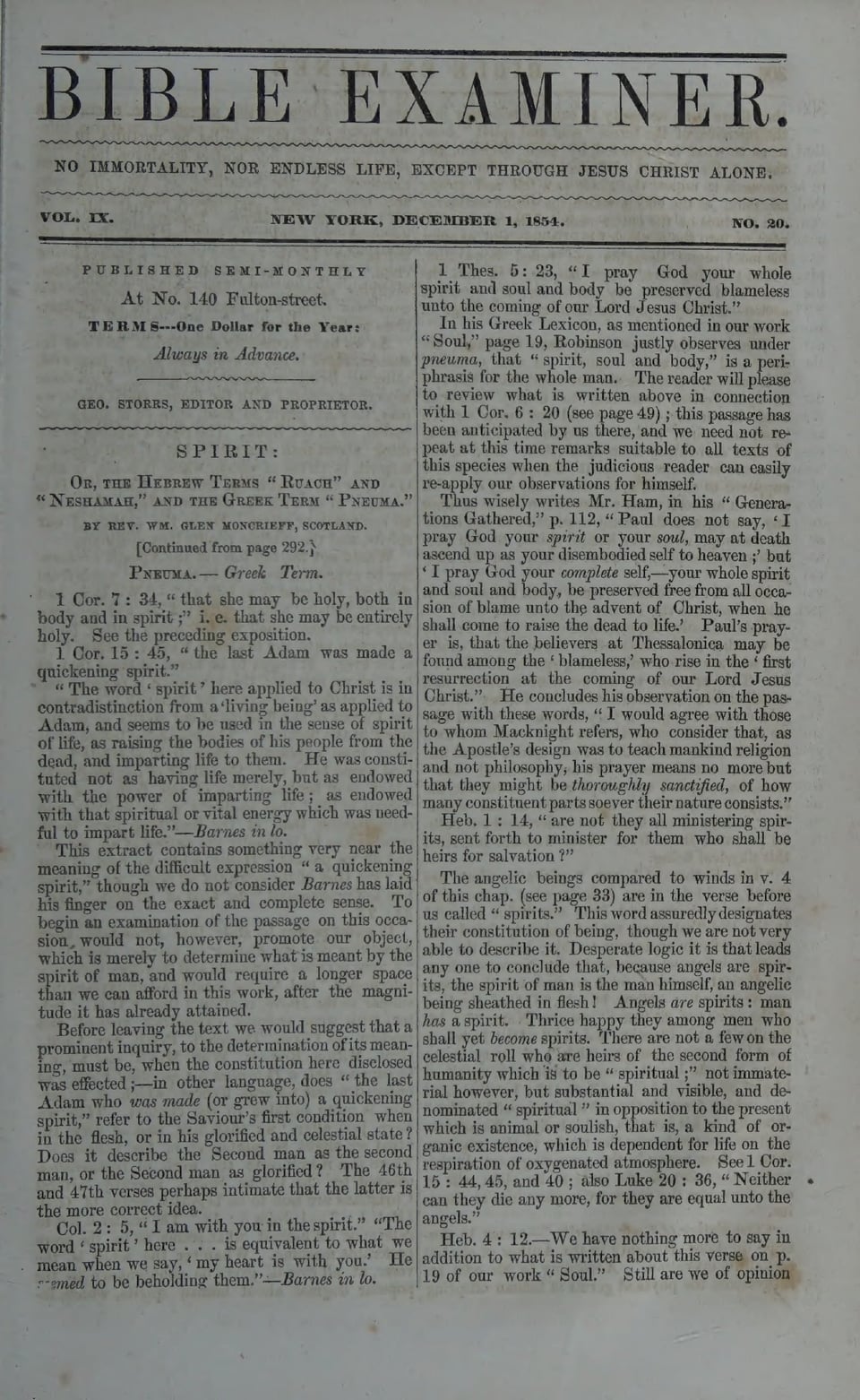
BIBLE EXAMINER.
NO IMMORTALITY, NOR ENDLESS LIFE, EXCEPT THROUGH JESUS CHRIST ALONE.
NEW YORK, DECEMBER 1, 1854.
VOL. IX.
NO. 20.
PUBLISHED SEMI-MONTHLY
TERMS---One Dollar for the Year:
GEO. STORRS, EDITOR AND PROPRIETOR.
SPIRIT:
OR, THE HEBREW TERMS "RUACH" AND "NESHAMAH," AND THE GREEK TERM "PNEUMA."
BY REV. WM. GLEN MONCRIEFF, SCOTLAND.
[Continued from page 292.]
PNEUMA. Greek Term.
1 Cor. 7 : 34, " that she may be holy, both in body and in spirit;" i.e. that she may be entirely holy. See the preceding exposition.
1 Cor. 15 : 45, "the last Adam was made a quickening spirit."
"The word 'spirit' here applied to Christ is in contradistinction from a 'living being' as applied to Adam, and seems to be used in the sense of spirit of life, as raising the bodies of his people from the dead, and imparting life to them. He was constituted not as having life merely, but as endowed with the power of imparting life; as endowed with that spiritual or vital energy which was needful to impart life."—Barnes in lo.
This extract contains something very near the meaning of the difficult expression "a quickening spirit," though we do not consider Barnes has laid his finger on the exact and complete sense. To begin an examination of the passage on this occasion would not, however, promote our object, which is merely to determine what is meant by the spirit of man, and would require a longer space than we can afford in this work, after the magnitude it has already attained.
Before leaving the text we would suggest that a prominent inquiry, to the determination of its meaning, must be, when the constitution here disclosed was effected; in other language, does "the last Adam who was made (or grew into) a quickening spirit," refer to the Saviour's first condition when in the flesh, or in his glorified and celestial state? Does it describe the Second man as the second man, or the Second man as glorified? The 46th and 47th verses perhaps intimate that the latter is the more correct idea.
Col. 2:5, "I am with you in the spirit." "The word 'spirit' here . . . is equivalent to what we mean when we say,' my heart is with you.' He seemed to be beholding them."—Barnes in lo.
1 Thes. 5:23, "I pray God your whole spirit and soul and body be preserved blameless unto the coming of our Lord Jesus Christ."
In his Greek Lexicon, as mentioned in our work "Soul," page 19, Robinson justly observes under pneuma, that "spirit, soul and body," is a periphrasis for the whole man. The reader will please to review what is written above in connection with 1 Cor. 6 : 20 (see page 49); this passage has been anticipated by us there, and we need not repeat at this time remarks suitable to all texts of this species when the judicious reader can easily re-apply our observations for himself.
Thus wisely writes Mr. Ham, in his "Generations Gathered," p. 112, "Paul does not say, 'I pray God your spirit or your soul, may at death ascend up as your disembodied self to heaven;' but 'I pray God your complete self,—your whole spirit and soul and body, be preserved free from all occasion of blame unto the advent of Christ, when he shall come to raise the dead to life.' Paul's prayer is, that the believers at Thessalonica may be found among the 'blameless,' who rise in the 'first resurrection at the coming of our Lord Jesus Christ." He concludes his observation on the passage with these words, "I would agree with those to whom Macknight refers, who consider that, as the Apostle's design was to teach mankind religion and not philosophy, his prayer means no more but that they might be thoroughly sanctified, of how many constituent parts soever their nature consists."
Heb. 1 : 14, "are not they all ministering spirits, sent forth to minister for them who shall be heirs for salvation?"
The angelic beings compared to winds in v. 4 of this chap. (see page 33) are in the verse before us called "spirits." This word assuredly designates their constitution of being, though we are not very able to describe it. Desperate logic it is that leads any one to conclude that, because angels are spirits, the spirit of man is the man himself, an angelic being sheathed in flesh! Angels are spirits: man has a spirit. Thrice happy they among men who shall yet become spirits. There are not a few on the celestial roll who are heirs of the second form of humanity which is to be "spiritual;" not immaterial however, but substantial and visible, and denominated "spiritual" in opposition to the present which is animal or soulish, that is, a kind of organic existence, which is dependent for life on the respiration of oxygenated atmosphere. See 1 Cor. 15: 44, 45, and 40; also Luke 20: 36, "Neither can they die any more, for they are equal unto the angels."
Heb. 4 : 12. We have nothing more to say in addition to what is written about this verse on p. 19 of our work "Soul." Still are we of opinion that there is no necessity to enquire minutely into the reference of the terms "soul and spirit" here, or as to what is imported by their division, and that of the "joints and marrow."
Our wisest course is to regard the whole as a full and strong assertion of the effects which the divine testimony can produce on the entire man. Like a sword it plunges into the depths of his being; and exposes his most secret thoughts and veiled depravities. "The meaning here," says Barnes, "is, that the word of God reaches the heart—the very centre of action—and lays open the motives and feelings of the man."
Whatever the Apostle may have embraced under "soul" and under "spirit," on this occasion, it is most apparent he did not understand the two as synonymous, according to nearly universal usage in our day, else he would not have written "soul and spirit," and we would have heard nothing of their divisibility from each other. And again, to assert he means by "spirit" here, what he is now supposed to express, is to utter what any one with as much authority can contradict, without making any reference to the direct opposition of the Biblical teaching about the human spirit, to the prevailing philosophy, or rather fancies, on the subject.
Heb. 12:9, "Shall we not much rather be in subjection unto the Father of spirits and live?"
Some conceive the reference of "spirits" here to be to other orders in creation, the angels for example, who are called "ministering spirits" in Heb. 1 : 14. This appears to us, we confess, forced and uncalled for. Because God is the Father of angels, does not appear a very conclusive reason why we should be in subjection to him; a reason drawn from his being the Father of our spirits would furnish more satisfaction. We are convinced "our" must be supplied to complete the antithesis, the first part of which is "the fathers of our flesh." By "fathers of our flesh," we understand our natural parents; those from whom we have inherited this physical being.
"The Father of" our "spirits"—what are these? or, to be more definite, what is the spirit we have each received from our divine Parent? In the Old Testament we have already found language perfectly analagous to this; indeed the expression before us is undoubtedly borrowed from the ancient records. Such as these are the passages we refer to:—Num. 16 : 22," O God, the God of the spirits of all flesh;" see also Num. 27 : 16. Similar to this, likewise, is Job 12 : 10, "In whose hand is the soul (margin, "life") of every living thing, and the breath (ruach, spirit, i. e. spirit of life) of all mankind;" and Zech. 12 : 1, "The Lord . . . which formeth the spirit of man within him" (literally, in his inwards, in his belly). To save repetition, we must refer the reader to the explanations of these verses in the preceding part of this work: the index of the texts at its close will at once show him the pages we request him to examine.
"The Father of" our "spirits"—seems to describe the Lord Almighty as the Author of our life and all its operations. According to his own arrangements the physical germs of human offspring
are derived from earthly parents; he nurtures in the womb these germs into perfect creatures, infuses life into each wondrous frame, and in the course of time preserves. each in independent animated existence by the breathing of the vital air, and other kindly appliances and resources of his bounteous providence. Parents thus afford the material; he moulds the clay and sends forth into independent life the finished vessel—a perfect living child. They are instruments; he is the operating, vivifying agency. To him we are indebted for conscious being, and capacity for its varied functions and experiences.
As we have frequently observed in previous instances, there is not a word here about immortal, thinking, living, or immaterial spirits. Find these adjectives coupled with the human spirit where we may, they are never so used, even on a single occasion, in all the Book. The record teaches us nothing about man as a spirit, but of man's having a spirit, in virtue of which, while it is his, is also God's, or the spirit of life from the Creator. It is common to us with the inferior tribes. We have all one ruach or spirit. He is the author of our spirits, and the sublime results they originate.
Would not the full force of the Apostle's reasoning be expressed were we to omit some words from the text, and read it as follows?—"We have had earthly fathers which corrected us, and we gave them reverence; shall we not much rather be in subjection unto our heavenly Father and live?" i.e. for ever. It ought to be borne in mind that at best, as we consider, this reasoning is popular and not scientific, or absolute, for Jehovah is as much the Parent of our flesh as of our spirits, or of any spirit in the universe. The reasoning before us is more from appearance than from absolute fact; God seems to be more the author of our life-breath which is in his hand, than of our flesh;—of the "spirit of life" that supports us in activity and consciousness, than of the breathing form itself, nevertheless he is equally the author of all we are and all we possess. Hence, while we read of him as "the God of the spirits of all flesh," we also find him self-pronounced "the God of all flesh." Jer. 32:27.
It seems proper to state that Bloomfield, after remarking on "the Father of spirits," that it is "a very peculiar expression and therefore variously interpreted," and, having mentioned an explanation similar to the above, continues thus, "It is . . better, with some eminent expositors, ancient and modern, (as Chrys., Theophyl., Pesch, Syr., Crell., Grot., Milton, Rosenm., Wolf, Middl., and Kuin,) to suppose this a Hebraism for spiritual Father, as opposed to our natural fathers; which, it is certain, is quite suitable to the context. Thus we have just after 'we shall live,' and at verse 10, 'that we might be partakers of his holiness.' There is a reference to the work of regeneration effected by the Divine Spirit, whereby faithful Christians are said to be begotten again of God. 1Pet. 1 : 3,—1 John 5 : 18." The reader is left to determine for himself what seems to be the more preferable meaning. Whatever the sense is, the verse, at all events, gives no countenance to the popular dogmas about human spirits, which, instead of being the spirits of men, are actually converted substantially into men themselves!
Heb. 12:22,23,"ye are come .to the spirits of just men made perfect."
"The words 'the spirits of just men made perfect,' it is alleged, refer to disembodied spirits. The whole passage, it is evident, is highly oratorical; and, on this account, its expressions are to be treated with less critical severity than would be appropriate if the composition were more dispassionate. Whatever may be the meaning of this passage which is disputed, it is sufficiently clear that it is no declaration that the 'spirits of just men are their conscious personalities,' and that they are existing at this moment in their perfected state. An attentive consideration of the passage will show that all the particulars referred to are future and not present. Believers 'are come' to these privileges anticipatively now; they will not 'come' to them actually and hereafter. 'The church of the first-born' are at present only 'written' or enrolled in heaven; their names are there now, their presence will be there when, from the generations of the slumbering dead, 'the children of the resurrection' shall be summoned to life. The phrase 'the spirits of just men made perfect,' is obviously an example of the figure synecdoche, in which the entire nature of the human being is expressed by a term which signifies only a part. Thus we use the word roof, meaning the whole house; and speak of evil-disposed men as wicked spirits."
"It is important also to note that the subject of the participle translated 'made perfect' is not the term 'spirits,' but 'just men,' and that the Greek would be more literally rendered thus—ye are come . . . to the spirits of the perfected just ones,' (pneumasi dikaion teteleiomenon.) In the preceding chapter, the concluding verse, we are informed that the long catalogue of the Old Testament worthies will not be perfected until the entire Church of Christ is gathered in from the generations. 'God having provided some better thing for us, that they without us should not be made perfect.' The perfecting of the departed just ones, is at the period of resurrection, when 'this mortal shall put on immortality.'"—Mr. Ham's Generations Gathered, pp. 116, 117.
Sec. VI.—Sometimes "spirit" and "soul" are used as parallel expressions of the idea of personality. For example,
Job 7:11, "I will speak in the anguish of my spirit (i.e. in my anguish); I will complain in the bitterness of my soul," i.e. in my bitterness.
Job 12 : 10, " In whose hand is the soul of every living thing,and the breath (ruach) of all mankind ;" i. e. In whose hand is every living thing and all mankind :—He preserves all alive.
Isa. 26 : 9, "With my soul have I desired thee in the night; yea, with my spirit within me will I seek thee early;" i.e. I have desired thee in the night; yea, I will seek thee early.
Luke 1 : 46, 47, " And Mary said, my soul doth magnify the Lord (or, I magnify the Lord) ; and my spirit hath rejoiced (or, I have rejoiced) in God my Saviour."
"Heart and "spirit," it may be added, are similarly employed, as in Ps. 77 : 6, "I commune
with mine own heart (with myself), and my spirit (or I) made diligent search."
REMARKS.—1. The preceding investigation and accumulation of evidence distinctly shows, that the spirit of man is not the man, the thinking being himself, but the breath, or spirit of life, given to him by the Creator. Though not alive, though no more alive than the water and food we use, it is essential to our continuance in life.
All such language as "the living," "deathless," "thinking spirit" of man, and a "disembodied human spirit," are just immense absurdities. In using these expressions countless multitudes utter what they do not understand; and we fondly trust the time is coming when more accurate information will be spread abroad. We once were equally in darkness and have no ground for boasting.
It has also been discovered that the breath, or spirit, of life, is common to man with the inferior tribes.
After acquiring a correct idea of the spirit of man, how strange it sounds to hear Goethe for instance, thus express himself.—"If I work on till my death, nature is bound to give me another form of existence when the present one can no longer sustain my spirit." What a pity, moreover, if that was all his hope for futurity : its basis is as poor as the erection is presumptuous.
This spirit-language runs through all works, and hymns in a lamentable abundance, as every person can quickly prove to his own satisfaction. *
The preceding pages, along with the work "Soul," furnish demonstration that man must be unconscious between death and the resurrection. His "soul" is then alive say many, but his soul just happens to be himself—the dust-made man, Gen. 2:7. His "spirit" is alive, others affirm, and his "spirit" is the breath, or spirit of life, when he receives from God Almighty for the animation of his being. In this manner all such passages as the parable about Lazarus and Dives, the verse about the Thief; Paul's being absent from the body, &c., can be proven in the clearest manner to mean something very different from the common interpretations of them. Let the reader take the case of the Thief, and apply the test he has been furnished with. The reclaimed malefactor expired on the cross, but his "soul," it is affirmed, was to go to Paradise on that day; the "soul" of the Thief, however, was just the man himself who went to the grave. He died,—his body died,—but his "spirit," it is said, went to Paradise; his spirit! why, that was the breath of life in his nostrils, and on the departing of which his thoughts would instantly perish. Ps. 146:3,4. Whatever the passage signifies, it cannot import that the man was that day to be in Paradise in a state of consciousness. Unless he was something different from a body, or a soul, or a spirit, and could be both dead and alive at the same time, he could no more be where he is ordinarily supposed to have gone on that day, than he could be there on the year before he was first in existence.
The preceding chapters, along with "Soul," furnish also irrefragible proof that Purgatory is an abominable, monstrous and mercenary device; and that the worship of saints, and addressing petitions to them, is the merest folly, since it is applauding the unconscious, it is praying to those who are, in the interim, as if they had never been.
The blindness, as well as the sinfulness, of such conduct may be easily manifested. Purgatory is old heathenism brought into the Christian church : the Protestant dogma of immortal-soulism, and conscious death, lead on naturally to the Purgatory of Romanism, and the wild dreams of Swedenborg about heaven and hell.
Thus we see more and more the importance of the RESURRECTION. There can be no consciousness till then. Man has a spirit now, but the hope of becoming "spiritual" in the constitution of his being, at the resurrection, is now mercifully brought within his reach. "It is sown a natural body," or saints lie down soulical or animal beings; "it is raised a spiritual body," or they rise spiritual, perfectly born of the Spirit, equal to the angels of God in heaven, fit for the kingdom which "flesh and blood" cannot inherit. See Luke 20 : 35, 36, John 3: 5, 6, and 1 Cor. 15: 44, 50. The concluding two pages of "Soul" may be here examined as they bear on the point immediately in hand. Again we remark, happy they who shall cease to be souls, and become spirits, like the angels who are "ministering spirits," prepared for glory, honor, and eternal, or immortal life. Romans 2: 7.
The preceding Remark suggests another, and one which is worthy of profound consideration. It is this:—the misapprehension of the Book which has led to the belief that man is already substantially a spirit, for nothing is more common than the expression "the spirit is the man," leads every person to regard himself as already what the Bible declares to be ALONE THE INHERITANCE OF THE FAITHFUL. They only shall ascend to this the higher and enduring form of human existence; in fact, it is to a great extent the very salvation, when rightly understood, made known through the Son of God. The first stage or form of human being is the animal, or soulish, one; the second, which will be conferred on those who seek after it, is denominated the "spiritual" as described in the passages referred to in the foregoing observation. "That which is born of the flesh is flesh, that which is born of the Spirit is spirit." No doubt there is a limited spirit-birth even now received by believers, when they are reconciled unto God, and replenished with the emotions and desires of gospel-love; this, however, is simply partial, or a character birth, and is to be esteemed as an earnest of what is coming at the resurrection of the just, when the whole being shall undergo renewal, or be spiritualized, through the energy of him who was constituted "a quickening spirit." Hence that era is styled "the regeneration:" the immense privilege of being regenerated will then blossom out in its loveliness and fragrance. The worm Jacob will then be like one of the celestial messengers; he who in this stage was as the grass,—frail and fleeting,—will, in that age, resemble the perpetual mountains. In consequence of the dim, and often most incorrect, ideas of God's wonderful and merciful plans, proceeding from the belief that man is already spirit, the glory of the Redeemer is veiled
and lost. This is the grand point we would call attention to as with a rod of fire. Men are led to feel independent of him, to calculate from the most fanciful data on permanent duration in the universe. So far from being led to discover that all their future, if they shall have any eternity, hangs on him, they see the very opposite; that a future they shall possess, some even go the length of asserting they must possess, as certainly as if he had never appeared on earth. Thus the world is encouraged to be Christless, even—alas! that it should be so—by some of the Saviour's true, but misguided friends. Instead of being "shut up to the faith," they are shut out from it; in place of it being the light to the path of eternity, the lamp is extinguished and virtually pronounced unnecessary. In the spirit of love to man we testify against this delusion being any longer cast into his thoughts; in the spirit of loyalty to the Saviour we entreat that he may be exhibited by the church, not as he is imagined to be, but as he is revealed in the Word. Till man is understood in his nature and necessities, how can the work of man's Redeemer, and elevator, and immortalizer, be rightly apprehended?
There is, we conceive, the amplest evidence, furnished in "Spirit" and "Soul," warranting us to reject the dogma of resurrection at death, an opinion entertained by not a few professing Christians. It proceeds on the assumption that man is not "dust," but a "soul," or a "spirit," in the popular acceptance, or something nearly akin to it. What, we would demand, is to go out of the body, is to remove from this material dwelling? Is it answered "the soul," that is the very dust-made being himself: is it again replied "the spirit?" that is, the life-giving breath in man's nostrils. What, we insist, is to spread its wings and depart to some mansion in the sky? "Man dieth and wasteth away, yea, man giveth up the ghost (expireth) and WHERE IS HE?" Job 14:10.
The doctrine of the Resurrection is nearly excluded from all popular religious teaching now, and no wonder, for even where it is believed it occupies a very inferior position on the scale of truth. The ideas about " souls" and " spirits" going to heaven at death finished, to all intents, the doctrine of the Resurrection; this glorious truth, however, will again ascend to its sublime and all-absorbing elevation, when man and redemption are better understood. All hail to Him who is " THE RESURRECTION AND THE LIFE."
"The doctrine of the Scriptures," says a writer in Kitto's Journal for this April, p. 167, "which moved the ridicule of the sneering philosopher, was not any vague and comfortless, but scholastic, immortality; but the bright, and real, and grand, though despised anastasis, or resurrection; not the continuous life of that which never died, but the RE-LIVING OF WHAT HAD PERISHED."
SINCE the foregoing article was in type BR. MONCRIEFF has arrived in this country from Scotland. He landed in New York the 7th ult., in seventeen days from Glasgow, with his wife and only son. We were pleased to have their company beneath our roof, after they had passed the perils and fatigues of the sea.
After spending one week with us he proceeded to Canada West, where he designs, with his family, to fix his location for the present. We were sorry that he should think it best to go there, especially at this late season of the year. After he has had time to rest awhile, and fix on his future course, we hope to have communications from him for the EXAMINER.
We deeply sympathise with him and his beloved partner in the trials to which they have been subjected for the truth's sake. Though bigotry and prejudice are rampant on this side the Atlantic, as well as on the other, yet we trust Br. Moncrieff may not be made to feel its withering influence in his new and adopted home.
The respect felt for him by a portion of his countrymen will be seen by the following article which we clipt from " The Edinburgh News" of Oct. 21.
"SOIREE AND PRESENTATION.—On the evening of Monday last, the Rev. W. G. Moncrieff was honored in the Carlton Convening Rooms with a soiree from his friends, previous to his departure to America. The gathering was both numerous and respectable, every available place being occupied by some admirer of the intending emigrant. Alexander M. Bell, Esq., occupied the chair. After tea the chairman remarked that they had come to bid farewell to a gentleman who to many present was a private friend, and for whom they reserved a later and quieter leave-taking. To many more he was known only as a public friend, whose voice had breathed into them accents of love and counsels of kindness divine and human. He leaves his mission here, said the chairman, to enter on a new sphere of labor in another country, and wherever that may be, he has our heartiest wishes that his success in it may be as ample as his merits. A purse containing eighty guineas was presented by Mr. George Goodsir as a substantial token of esteem and affection to the guest of the evening from his numerous friends, including not only those who regularly attended on his ministrations, but also members of nearly every denomination in the city of Edinburgh. Mr. Moncrieff made a feeling and manly reply, expressing the pleasure he felt at seeing so many present who, although not agreeing with his theological views, were advocates for the right of every man thinking for himself, and the liberty to propagate those opinions which he conscientiously believed to be true. Speeches were afterwards delivered by Messrs. Jackson, Davey, Laing, Dowie, Sommerville, Wilson, and others. Some excellent singing enlivened the meeting, which altogether was a delightful one, and will long be remembered by those who were present."
From Samuel Brown, Milwaukie, Wis.
Br. Storrs.—As I believe you are laboring in the cause of truth, and for the glory of God; as one of his stewards that would desire to be found
faithful, I wish to contribute my mite towards aiding you in your labors; and as I feel that the plan adopted by the Brethren and Sisters of Philadelphia must commend itself to all of like precious faith, and I trust will have its desired effect, and that each brother and sister will ask, each for themselves, what can I do? and what does the Lord require of me? and when each one shall have answered the questions on his knees before God, the result will be that brother Storrs will be placed in a situation above embarrassment, so that he can devote his whole time in the good cause in which he is engaged. To this end I enclose ten dollars, feeling that that is the least amount that God will accept at my hand; and I hope that I may be ever ready to respond to the call of duty when the cause of God requires it.
I wish you to apply one dollar on account of Bible Examiner for the year 1855, and the balance for your own private use.
Yours in the bonds of Christian love and affection.
From B. L. Buckley.
NEWTON HAMILTON, Pa., Nov. 7, 1854.
Br. Storrs.—Having a great sympathy for you and the cause of truth to see it spread abroad I enclose $5. Take one for the EXAMINER next year, and accept the balance as a free-will offering, which I intend to give yearly. I like the spirit of the brethren of Philadelphia, Paterson, and elsewhere, in striving to support the greatest of all causes. That the good Lord may bless you and them, and prosper the great cause of truth, is the sincere prayer of your unworthy brother.
I intend to try and obtain a subscriber or two before the 25th of December.
From Nathaniel Jones, Royalton, Vt.
Br. Storrs.—You will please find enclosed, one dollar for the Examiner another year. I don't know very well how to do without it. The leading doctrine—"No immortality, nor endless life, except through Jesus Christ alone,"—which it supports, I have been fully established in since first reading your Six Sermons—obtained of yourself at the camp-meeting in Chelsea, Vt., in 1843—and have done what I could with my feeble means, to help spread that very consistent doctrine, making the scriptures more harmonious with itself, with common sense; and the character of God in harmony with the declaration, "The Lord is good to all, and his tender mercies are over all his works."
Yet, doctrine alone, however correct it may be, will never save one individual. It must be connected with a practical carrying out, in a sober and godly life, as the grace of God teaches; i.e. "denying ungodliness, and worldly lusts, we should live soberly, righteously and godly, in this present world, looking for that blessed hope, and the glorious appearing of the great God, and our Saviour Jesus Christ."
"Whosoever transgresseth, and abideth not in the doctrine of Christ, hath not God. He that abideth in the doctrine of Christ, [or doeth it] he hath both the Father and the Son."
I can bid you, I think, a hearty God-speed in your persevering and untiring labors to spread this glorious truth in the midst of so much popular tradition, and precepts of men, Jewish fables and commandments, " which turn from the truth."
But this one thing may we all do—"grow in grace and in the knowledge of our Lord Jesus Christ, to whom be glory both now and forever."
Nov. 7,1854.
The following extracts from letters we intended to insert sooner, but they have been left till now by the length of the "discussion," which has occupied so much of our space.
From Isaac Dimmick, Vermillionville, Ind.
Br. Storrs.-I send you the names of two new subscribers to the Bible Examiner, to wit: Eld. Alfred Lathrop, and William Arnold.
Elder Lathrop is a regularly sustained Baptist Minister, in this vicinity—and has lately abandoned the traditions of men for the more sure word. He now preaches, Christ a whole Saviour—not one in part, who giveth only happiness to his Saints, while they possess immortality independent of him—but a Saviour who giveth life and immortality itself, and all things richly to enjoy; for they are dead, and their life is hid with him—and not that they receive this inheritance at death, but at the glorious resurrection, when Christ shall appear, then will they appear also with him in glory. These are among the truths that our brother publicly proclaims, and which he says, he must preach, if he preaches at all.
Brother Arnold is a substantial old pillar in the same church—and he says, he never did believe this dogma of innate immortality—but did not, till now, think it his duty to come out against it.
This I consider quite an accession to our cause in this place—and from this I am encouraged to look for more additions to the faith—because, the gospel is now faithfully preached—the public attention is awake to the subject, and many of the people seem to hear the truth gladly. But above all, why I am constrained to look for such a result is because the Lord evidently is with us.
August 15,1854.
From Wm. B. Wade, Oswego, Ind. Sept. 14, 1854.
Br. Storrs.-I see by the last EXAMINER that you are in want of funds to publish semi-monthly; and that your present number of paying subscribers is not sufficient to sustain the paper and remunerate you for your labor in publishing the same. Now this should not be so. The paper must not fail for want of funds to sustain you and your family, while you are engaged in the great and good work of publishing the truth of God's word, in opposition to the fables that are taught through the length and breadth of the land in this nineteenth century. The paper must not be crippled for want of funds. Although my means are very limited I send you one dollar to help sustain the cause of truth, and I will endeavor to do the same annually, while the EXAMINER is published, in addition to my yearly subscription for it. I have also obtained two new subscribers for it, with one dollar each for the same. I am glad to learn that there are brethren in various parts of the country that are willing to help sustain the EXAMINER and its EDITOR so long as it is needed to scatter the light on the great theme of life only through Christ, and a resurrection from the dead. Go on, my brother, in the good cause; and I trust that you, and the cause you advocate, will be sustained until the Lord comes.
Your brother, hoping for Immortality at his coming.
From a Brother in Wisconsin.
Sept. 12, 1854.
Br. Storrs.—I am grieved to learn of your embarrassments, and that the cause of God should suffer for the apparent want of dollars and cents in this land of plenty and wealth. I value the EXAMINER enough to pay five dollars once, twice, nay, three times per year, as long as I can get the money by earning it any way, and not "deny the faith." So, you can tell your Philadelphia friends, I will be one of the twenty to get the one hundred, and more, if needed, unless Gods forbid it, and that will be a sufficient reason to you and them.
From Geo. Hill, Meredith, N.Y.
Sept. 9,1854.
Br. Storrs. I consider your decision respecting the monthly issue of the EXAMINER a just one; but I am unwilling to receive it less than twice each month, or that its EDITOR should be in want of the necessary means for its publication.
How many among your readers, who welcome its message with joy, will share to furnish the needed sum for its semi-monthly issue?
The EXAMINER is a faithful advocate of the life theory, and is published for the benefit of its readers; and, as a lover of truth, I rejoice in the benefit derived from its pages. And shall our worthy friend, Br. Storrs, labor for nought? Enclosed I send one dollar for his personal benefit, and may others do likewise according to their ability.
I would like to have you write and publish a piece entitled—What can I do? For example; I am a man about 30 years old, and poor in this world's goods, but desirous to labor for the extension of Christianity among our modern idol worshippers.
From C. Sears, East Dennis, Mass.
Br. Storrs.—Enclosed I send you three dollars to assist you in extending your efforts to eradicate error, and to enlighten the inquirer after truth respecting the all important doctrine contained in the Bible.
The great question, "what is truth?" in relation to the future is, and has been, an all important inquiry with me for some time. Your Six Sermons on the question—are the wicked immortal? taught me that some of the prevailing doctrines, preached in our churches, may with great propriety be questionable in regard to their being taught in the Bible. I find some sentiments in the EXAMINER (especially the editorial) that appear to me to be the true Bible doctrine; and I hope it will be sustained.
I take a deep interest in the discussion with Bro. Mattison on the Soul, and hope it will be continued until the whole subject may be brought out to the view of an inquiring public, that those who can may read and learn for themselves. I hope this discussion will be printed together when it terminates. In conclusion, I wish to say—Let us so live that we may inherit Eternal Life.
From Wm. H. Fernald, Lawrence, Mass. Sept. 9.1854.
Sept. 9,1854.
Br. Storrs.-Since reading the suggestions of your Philadelphia, and also others of your correspondents in the last EXAMINER, I have thought considerable of you and the cause you are laboring to sustain.
With yourself I have never had the opportunity of forming other acquaintance than that which is to be gained by reading your works; these I admit are eminently calculated to inspire and win the confidence of those who read them.
Since learning your embarrassment and of the loss which the cause is likely to suffer by the destruction of your property by fire, I consider that it is my duty to devote all the means that I can command to the support of the EXAMINER. In this, I cannot state definitely how much of the stock, which is thrown into market by your Philadelphia correspondent, I shall be able to take. I will do all that I can. His suggestion is a good one, and I hope it will be responded to in a manner so as to relieve the readers of your paper from the disappointment which now threatens them, and yourself of the embarrassment which you have already experienced. It would have given me pleasure to have forwarded you timely aid, but it was not in my power to do so. I might have written you a letter of sympathy long ago, and I doubt not but what such expressions would be appreciated by you, but feeling convinced that it was not so much your own gratification that you looked to the readers of the EXAMINER for, as it was that of the means by which the cause of truth might be sustained, I concluded that, how well-soever disposed one might feel in communicating such thoughts, such letters alone are not the safest means upon which to rely for support to the cause.
Hence I deferred writing you until now, for the purpose of arranging matters so as to be able to give you assurance of more support than formerly.
From Freeman Dillingham, West Brewster, Mass.
I shall write you again so soon as I can determine how much I shall be able to do. Jn this I forward two dollars for the EXAMINER another year.
Br. Storrs—Enclosed I send you three dollars. I wish you to send the EXAMINER to ___, and the other two dollars apply to your own benefit.
My wife and myself feel very much interested in the good cause you advocate, although very unpopular with most professors of religion. Let us bear in mind, that the doctrines of Christ, our great life-giver, never were nor never will be received so long as men love the praise of their fellow creatures more than the praise of God. The rejoicing of the ancient followers of Christ was, the testimony of a good conscience; and that their children walked in the ways of truth; not because they belong with us, and subscribe to our creed, but their love and good will extended to all mankind, using all proper means to bring them to the knowledge of the truth.
Yours in hope of Eternal Life.
From Simeon Thos. Corby, Carbondale, Pa. August 14, 1854.
Br. Storrs—The cause of truth is advancing in this place, notwithstanding the opposition it meets with from the different "orthodox" denominations.
The preachers manifest a zeal in opposing this doctrine which is not common with them in opposing error. Some of them may think they are doing God service; others say, they would not preach this doctrine if they knew it was truth! But while they cease not to speak evil of this way, there are some more noble that receive the word gladly, and search the Scriptures to see if these things are so. As we have been unable to obtain a speaker, we have to apply for the means within our reach to get light on this great truth. I accordingly send you four new subscribers for the Examiner.
"MATERIALISM SCRIPTURAL : or, The Doctrine of Rev. N. D. George Exploded ; by ELD. Z. CAMPBELL."
This is a thorough exposure of Mr. George's attempt to prove man is not a material being. Mr. G.'s professional effort was to "Examine and Refute the Doctrines of Geo. Storrs;" but in reality it was an attack on Eld. Z. Campbell, in which an attempt was made, by misrepresentation and ridicule, to throw contempt on the doctrine of immortality and eternal life through Jesus Christ alone. Br. Campbell has completely laid in the dust the Dagon of natural immortality, the favorite dogma of Mr. G. and his school.
Mr. Campbell's response should be scattered wherever Mr. G.'s work has gone.
Price $3 per hundred; five cents single. Address, "Geo. Storrs, Bible Examiner Office, New York."
DEFERRED ARTICLES.—Necessity compels us to lay over Prof. Mattison's article till next month; Br. Hudson's coming first to hand. Also, Br. Hudson's account of Br. LANGARL's trial, by the Methodist Episcopal Conference, in Ohio; with the " Prospectus " of a new paper by these brethren; and various other matters; all of which we will endeavor to give place in the January issue.
BIBLE EXAMINER.
NEW YORK, DECEMBER 1, 1854.
BIBLE EXAMINER.—We come to our subscribers with our last issue for 1854. For the faults and errors of the past year we hope our readers will make all the allowance they can, honestly. We do not claim infallibility, or that we have been free from errors in judgment, either in matter or manner; but we do claim the intention of doing nothing with design to injure one of the least of Christ's followers; how far we have succeeded the Judge of all the earth will soon decide.
We shall be sorry to part with any of our present subscribers, for any cause; but if we must, we commend them to God and His grace; and may His blessing attend them.
Those who intend to renew their subscription, for 1855, will confer a favor to remit the amount immediately on the receipt of this number. They may do it, by mail, at our risk; but they are desired to be careful to send us none but current money.
Our terms are $1 per volume always in advance. All papers not paid for 1855 will be discontinued with the end of this year. It will not be sent to any one for January unless payment is previously received. Let none be offended that we adhere strictly to this rule. We will not adopt the dunning system, after the paper has been sent. "ADVANCE PAY OR NO BIBLE EXAMINER," is our business motto.
We wish we could now say, the Examiner will be issued semi-monthly next year; but we dare not promise anything more than monthly, at this time; yet if $900 is received by the 25th inst., in subscriptions or donations, we shall go on twice each month next year. Shall it be done? If so, it must be done quickly. Write all names of persons and Post Offices plain. Address, in all cases, "Geo. Storrs, Bible Examiner Office, New York." Please do not put the number of the street on the letter, when sent by mail.
THE BIBLE EXAMINER bound for this year will be ready in a few days. Price $1, if sent us free of expense, in current money. If you wish us to pay the postage, you must add 27 cents in Post Office Stamps. We have put this work exceeding low, in hopes that it may be sold soon; and assured that any purchaser will be satisfied that he has the worth of his money.
iner for 1850 and 1851, in one volume; also,1852 and 1853 in one volume. Price reduced to $1,25 per volume. Postage on these volumes 31 cents each, if prepaid.
We have still a few copies, bound, of the Exam-
"SIX SERMONS on the inquiry—Is there Immortality in Sin and Suffering? By Geo. Storrs, New York: 1855." To which is prefixed "A brief Biographical Sketch of the Author," with a Portrait, from a steel plate engraving. Also, there is added a Sermon on "Christ our Life-Giver, or the Faith of the Gospel;" being a view of the Life theme drawn from the Syriac New Testament, as translated by Prof. Murdock; the whole making a 12mo. volume—on good paper—and well bound—of 168 pages. Price 63 cents. Full bound in gilt $1. We thought some might wish it in this manner as a Christmas or New Year's Present for a child or friend.
This edition of the Six Sermons is on the basis of the original ones, entitled, "An Inquiry: Are the Wicked Immortal?" but revised and enlarged, and with a much larger type.
DISCORDANT OPINIONS.—We are all too apt to think others must see as we do or there can be no fellowship with them. Now we are as likely to err in this matter as others, but we abhor it in ourself and all others. The positive spirit on prophecy, relating to events future, or now passing, till more plainly developed—which is manifested by some—we deeply regret; because we think it tends to anything rather than the promotion of brotherly love. There are, at this time, several different opinions among those who believe the coming of Christ "the second time" is near.
One class have believed, and taught, that the event would certainly occur this year. Though we were perfectly satisfied, from the commencement, they were mistaken in their calculation of time, yet many of them were men we much loved and esteemed, and we did not feel called upon to take a public stand against them, believing that we could better serve them, and the cause of truth, by a kind course toward them, while at the same time they all understood we did not agree in their theory. We knew a short time would realize their expectation or satisfy them of their mistake.
Another class maintain that before Christ can come "the second time," Russia must overrun Turkey, and the Jews be restored to Palestine. With this view we do not agree, at all; but we do not feel disposed to enter into a controversy about it, which must be exceedingly profitless, and call off attention from what we regard as far more important matters to this dying world.
We do not affirm that this view is not correct; but we have no faith in it; and especially in the positive assumption that these things"must"be done"before"the Lord can come.
A third class agree with the foregoing so far as relates to Russia overruning Turkey; affirming that Russia is "the king of the north," spoken of Daniel 11th, and must overflow Turkey before Christ can come "the second time;" and that, hence, until Turkey is overwhelmed by Russia, we can have no scriptural hope of our Lord's return from Heaven. With this view we have no more sympathy than with the previous one. But, as we said of that, so say we of this; we do not say that such events will not take place before Christ's return, but to affirm that they must, positively, we think is overstepping our province as fallible mortals. We do not believe that Russia is "the king of the north." It is our opinion that any power that reigns over Syria is—for the time being—"the king of the north," spoken of Daniel 11th; hence that the Turkish Dynasty is now that power. If Russia, Austria, England, or France should become possessed of supreme power over Syria, then it—which ever it might be—would become "the king of the north." Till then none but the Turkish Dynasty occupies that position, in our opinion. Our views of Russia, Turkey, and France are known to our readers. No arguments, nor ridicule, that has yet appeared, has in the least shaken our mind; yet we do not affirm that we are right; events may convince us we are wrong in the matter. We have no theory at stake, and shall feel, we think, no mortification to find we are just what we believe all others to be—fallible.
We entertain no views of prophecy that makes it necessary to put off the coming again of our Lord from heaven a single day. We are of opinion, that event may occur at any hour, for all there is in prophecy to hinder it; still, we do not affirm that there may not be events yet to go before it. We greatly desire that while entertaining different views on subjects relating to the great event of our Lord's coming, and freely express them, we all may do it in a manner which shall manifest that we remember our fallibility, and thus cultivate a mutual spirit of toleration. A contrary spirit can only divide but never harmonize us. The Lord alone must be exalted in this day, or we have good reason to fear He will not exalt us "in that day" of His Son's return from heaven; for, "every one
that exalteth himself shall be abased; and he that humbleth himself shall be exalted;" so saith Jesus, the Judge of the living and the dead.
Is the Soul a Distinct Entity? AFFIRMATIVE BY C. F. HUDSON.
Bro. Storrs.—In order to close this discussion on my part with the December number of the Examiner, it will be necessary for me to throw one or two points into a separate article, to be published at your convenience. The "three assertions," which Bro. G. challenges from my remarks upon Ps. 30: 3, I think are amply proven in the paper I send you herewith. It includes a part of the argument of "the learned George Campbell," whose concession, Bro. G. thinks, helps to annihilate my assertions. That argument will be found in full in his VIth dissertation on the Gospel, and the perusal of it will amply repay the reader. The "one testimony of the Eternal Spirit" in Eccl. 9: 10, would be very decisive if there were no question about the identity of the witness. But if the "Eternal Spirit" is here testifying, pray what was it thinking about in the 9th verse, when it gave such Epicurean advice as to "live joyfully with the wife whom thou lovest all the days of the life of thy vanity, which he hath given thee under the sun, all the days of thy vanity; for that is thy portion in this life, and in thy labor which thou takest under the sun." And what kind of an "Eternal Spirit" is it that tells us "there is nothing better for a man than that he should eat and drink, and that he should make his soul enjoy the good of his labor." (Ch. 2: 24.) Bro. G. may affect, or may feel, great "surprise at the unwarrantable manner" in which I appeal from Solomon foolish to Solomon wise. And he may be alarmed for the safety of a "great portion of the Bible." I think, however, the considerate reader will not tremble at my audacity, especially if the refutation of a materialist interpretation of the Bible is the only danger that threatens. My appeal from Solomon foolish to Solomon wise might be defended from a single passage, (Ch. 1: 17,) if it were not justified by the whole tenor of the peculiar book of Ecclesiastes. Bro. Grew must know that the inspiration of the book is one thing; to believe that each proposition it contains is a divine revelation, is quite another thing. The study of the principles of interpretation would do no harm in a case like the present. That I am not mistaken in my view of the book of Ecclesiastes, may appear by a consultation of candid writers upon it.
If the scope of the book, as also of the book of Job, be an indirect argument for a future retribution from the apparent inequalities of Providence in this life, then the two last verses will shed light on the whole. And upon the last verse "God shall bring every work into judgment, &c," I may prosecute my appeal in the present discussion.
For, as all agree, there can be no proper "judgment" of man after death, unless a valid identity of the being judged, is preserved. And the importance of this whole discussion turns on the fact that a theory is broached, and is claimed to be the only theory consistent with the Bible, which to multitudes of Christian minds seems to destroy all possible identity between the present and the future man. Wherein does this entity consist?
Will the same bodies which we now have, appear in the judgment, and be immortalized, if we are found worthy of eternal life? Neither of us holds this; and we well know this gross style of faith has been the stumbling block which has occasioned serious error among good Christians, from the time of Synesius to Emanuel Swedenborg, to say nothing of the ribald infidelity which has made merry at the large faith of those who have so understood the resurrection.
Is it, then, an identity of organization that makes the present and future man to be the same? Certainly not; for as I have already remarked future bodies could not then be spiritual bodies.
Such are two theories, then, which cannot be accepted as justifying to human reason, or even to human faith, the doctrine of the resurrection and final retribution. Each of these theories seqsms to involve not only difficulties, but absurdities. If we shall have neither the same bodily particles, nor the same bodily organization, in the resurrection, then our future identity by such means, must be given up. You may resort to mystery, or to the power of God, to preserve our identity by other means which we do not know of; but if every other possible method is denied in detail, then the resort to mystery, or to divine power is simply ridiculous. Bro. Grew may say "the resurrection of men who have temporarily perished in death is no absurdity." (p. 235). That is his opinion. To my mind, the re-origination of a thing which has properly ceased to exist, is an absurdity. "One thing cannot have two beginnings of existence," says John Locke, who ought to be respected by my good friends, and whom I shall quote again before I close. True, a thing that has perished may by divine power be replaced by a new-created thing exactly like it. But that new thing will no more be the same thing than are two things, exactly similar, existing at the same time. To make two such things to be the same thing, is not an object of omnipotent power, for the same reason that God cannot make two and two equal five. I know it is very common, and often highly proper, to entrust to divine power what is impossible with man. But that is no reason why men should reduce the Divine Being to the limits of an absurd theory, and then call upon us to trust his omnipotence!
Two theories are now, I think, disposed of. Another theory is proposed by John Locke, to wit, that "consciousness makes personal identity," and how cautiously he handles it in his Essay, Bk. II, ch. xxvii, 13. Locke should have said, "consciousness proves personal identity," just as the blossom proves the life of the plant, but does not constitute or create it. Locke's mistake here is that very common one which the logicians call that of the cum hoc for the propter hoc.
Two theories yet remain. One is, that a few particles, or possibly a single particle or atom of our dying bodies, is preserved as a nucleus, and will be the basis of our future identity. Of this theory there are various modifications. Whately states it without adopting it, on this wise, viz., that "For aught we know, the soul may remain combined with a portion of matter less than the ten thousandth part of the minutest particle that was ever perceived by our senses; since 'great' and 'small' are only relative." (Essays on the Peculiarities, &c., I, cited by M'Culloch, vol. ii, p. 484.) Here it will be perceived the Abp. speaks of the soul as a distinct substance or entity, and names this theory not to prove the identity of the being, but of the body, as possible in the resurrection. A very foolish version of the theory is given by Carmichael, in his "Theology and Metaphysics of Scripture," vol. ii, p. 314, 321. It is a significant circumstance that in reasoning on this subject men will flee from the impossible, even though they run into the ridiculous.
Upon this theory of an atomic or malcular nucleus, I have only to say, the thing is possible. It is also necessary, if the body and its attributes constitute the whole man. But it is not required by a fair interpretation of Scripture, and it is not needed, if we allow that the soul is a distinct entity.
This view of the soul accords, as I think I have shown, with the general tenor of Scripture language. That it accords with the language of mankind generally, is undeniable. That it accords with the general opinion of enlightened nations, and especially of Christian communities, is also undeniable. It is now denied by a school of Bible Materialists, and on this denial is rested, and so far hazarded, a most important argument respecting the final destiny of man. The effect is, the doctrine of Life in Christ is associated with the doctrine of Hobbes and Spinoza, of Epicurus and Thomas Paine, whose characteristic philosophy was a consistent and relentless materialism. This is also, if I mistake not, the "positive Philosophy" of Comte, and the practical philosophy of the lower grades of the phrenological school.
Now I have no horror whatever of speculative materialism, especially in this age when matter itself is getting somewhat spiritualized. The postulates of materialism can by possibility be made to consist with the truths of Christianity, and by a free use of the argumentum hominem, one may stagger the infidel materialist in his denial of the principles of "righteousness, temperance, and judgment to come." And in a separate article I shall try to state what may be allowed, on this subject. But you well know, Bro. Storrs, that even if materialism were the true scriptural philosophy, the Bible Examiner cannot make it popular or acceptable with good Christians generally. And no eminent thinker among Christian men has ever held it. And I have engaged in this discussion for this reason, that the cause of a most important truth is being committed by a frail bark which Christians have rarely sailed in, and which in my opinion, and by the common opinion must sink by its own weight.
Is the soul a distinct entity? If it is, then the identity between the present and future man, instead of being a mystery, or a special work of omnipotence, is one of the most natural things in the world. And that the soul is a distinct immaterial substance, was the sentiment even of John Locke, the most unspiritual of all the respectable metaphysicians, and also held to life in Christ as firmly as does Bro. Grew. He speaks as distinctly as need be of "three sorts of substances,-1. God, 2. Finite intelligences, 3. Bodies;" (Essay, Bk. 2, ch. xxii., § 2.) And though Bro. Grew may laugh at the idea of an immaterial substance, still he may respect the opinion of Locke, that it is "as rational to affirm that there is no body, because we have no clear and distinct idea of the substance of matter, as to say there is no spirit because we have no clear and distinct idea of the substance of a spirit," Bk. 2, ch. xxiii. § 5. And he expresses the common sentiment that soul or spirit is no abstraction, or quality of matter, thus:—"If we consider the active power of moving, or, as I may call it, motivity, it is much clearer in spirit than body; since two bodies, placed by one another at rest, will never afford us the idea of a power in the one to move the other, but by a borrowed motion; whereas the mind every day affords us ideas of an active power of moving bodies."
(§ 28.)
And on the main question which Bro. G. and myself have discussed, Locke, who like myself, does not deny the abstract possibility of matter being made to think,—says thus,—"Possibly we shall never be able to know whether any material being thinks, or no; I see no contradiction in it, that the first eternal being should, if he pleased, give to certain systems of created matter put together as he thinks fit, some degrees of sense, perception and thought; though, as I think, I have proved it no less than a contradiction to suppose matter (which is evidently in its own nature void of sense and thought) should be that eternal first thinking Being. * I say this, not that I would any way lessen the belief of the soul's immateriality. I am not here speaking of probability, but knowledge." Bk. 3, ch. iii., § 6. And again, "For my soul being a REAL BEING, as well as my body, is certainly as capable of changing distance with any other body, or being, as body itself; and so is capable of motion." Bk. II., ch. xxiii, § 19.
And this brings us to the point which I named in closing my last letter. What is the soul? We must have definitions. What does Bro. G. mean, what idea has he in mind, when he talks about a soul; and what do I mean when I talk about a soul? Bro. G. has defined it to be a "mysterious principle." I think the subject admits of something more definite. But before giving my definition of soul I will ask,—if the soul is a quality, or a property, or an attribute, which God has pleased to superadd to matter,—has the soul itself any attributes? And if it has attributes, are they attributes of a substance, or attributes of an attribute? The question is certainly a proper one, and will impress the need of intelligent precision in this discussion.
…