The Bible Examiner — Vol. 8, No. 2 (February, 1853)
Download: PDF — The Bible Examiner — Vol. 8, No. 2 (February, 1853)
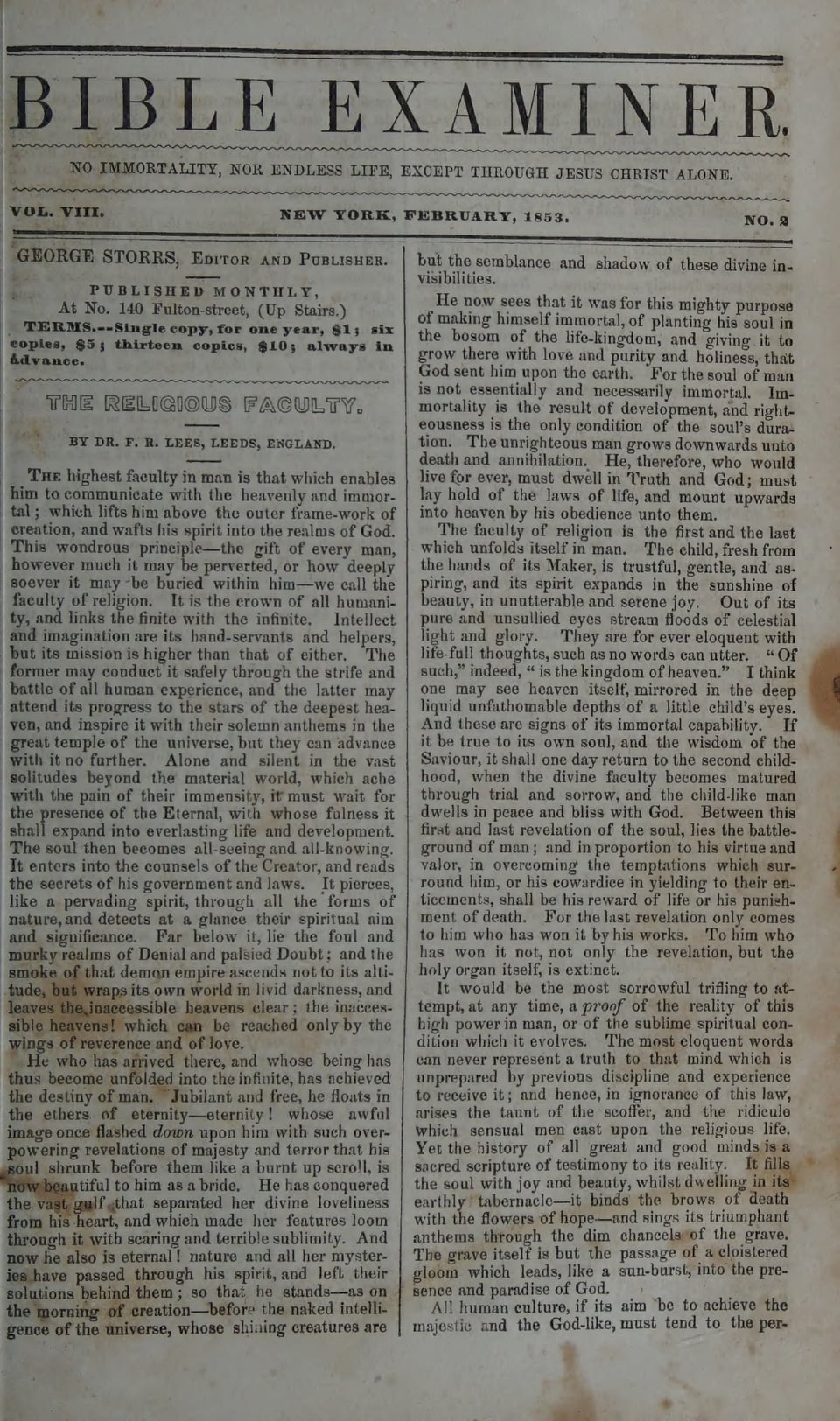
BIBLE EXAMINER.
NO IMMORTALITY, NOR ENDLESS LIFE, EXCEPT THROUGH JESUS CHRIST ALONE.
VOL. VIII.
NEW YORK, FEBRUARY, 1853.
NO.2
GEORGE STORRS, EDITOR AND PUBLISHER.
PUBLISHED MONTHLY,
At No. 140 Fulton-street, (Up Stairs.)
TERMS.--Single copy, for one year, 1; six copies, 5; thirteen copies, $10; always in advance.
THE RELIGIOUS FACULTY.
BY DR. F. R. LEES, LEEDS, ENGLAND.
The highest faculty in man is that which enables him to communicate with the heavenly and immortal; which lifts him above the outer frame-work of creation, and wafts his spirit into the realms of God. This wondrous principle—the gift of every man, however much it may be perverted, or how deeply soever it may be buried within him—we call the faculty of religion. It is the crown of all humanity, and links the finite with the infinite. Intellect and imagination are its hand-servants and helpers, but its mission is higher than that of either. The former may conduct it safely through the strife and battle of all human experience, and the latter may attend its progress to the stars of the deepest heaven, and inspire it with their solemn anthems in the great temple of the universe, but they can advance with it no further. Alone and silent in the vast solitudes beyond the material world, which ache with the pain of their immensity, it must wait for the presence of the Eternal, with whose fulness it shall expand into everlasting life and development. The soul then becomes all-seeing and all-knowing. It enters into the counsels of the Creator, and reads the secrets of his government and laws. It pierces, like a pervading spirit, through all the forms of nature, and detects at a glance their spiritual aim and significance. Far below it, lie the foul and murky realms of Denial and palsied Doubt; and the smoke of that demon empire ascends not to its altitude, but wraps its own world in livid darkness, and leaves the inaccessible heavens clear; the inaccessible heavens! which can be reached only by the wings of reverence and of love.
He who has arrived there, and whose being has thus become unfolded into the infinite, has achieved the destiny of man. Jubilant and free, he floats in the ethers of eternity—eternity! whose awful image once flashed down upon him with such overpowering revelations of majesty and terror that his soul shrunk before them like a burnt up scroll, is now beautiful to him as a bride. He has conquered the vast gulf that separated her divine loveliness from his heart, and which made her features loom through it with scaring and terrible sublimity. And now he also is eternal! nature and all her mysteries have passed through his spirit, and left their solutions behind them; so that he stands—as on the morning of creation—before the naked intelligence of the universe, whose shining creatures are
but the semblance and shadow of these divine invisibilities.
He now sees that it was for this mighty purpose of making himself immortal, of planting his soul in the bosom of the life-kingdom, and giving it to grow there with love and purity and holiness, that God sent him upon the earth. For the soul of man is not essentially and necessarily immortal. Immortality is the result of development, and righteousness is the only condition of the soul's duration. The unrighteous man grows downwards unto death and annihilation. He, therefore, who would live for ever, must dwell in Truth and God; must lay hold of the laws of life, and mount upwards into heaven by his obedience unto them.
The faculty of religion is the first and the last which unfolds itself in man. The child, fresh from the hands of its Maker, is trustful, gentle, and aspiring, and its spirit expands in the sunshine of beauty, in unutterable and serene joy. Out of its pure and unsullied eyes stream floods of celestial light and glory. They are for ever eloquent with life-full thoughts, such as no words can utter. "Of such," indeed, "is the kingdom of heaven." I think one may see heaven itself, mirrored in the deep liquid unfathomable depths of a little child's eyes. And these are signs of its immortal capability. If it be true to its own soul, and the wisdom of the Saviour, it shall one day return to the second childhood, when the divine faculty becomes matured through trial and sorrow, and the child-like man dwells in peace and bliss with God. Between this first and last revelation of the soul, lies the battleground of man; and in proportion to his virtue and valor, in overcoming the temptations which surround him, or his cowardice in yielding to their enticements, shall be his reward of life or his punishment of death. For the last revelation only comes to him who has won it by his works. To him who has won it not, not only the revelation, but the holy organ itself, is extinct.
It would be the most sorrowful trifling to attempt, at any time, a proof of the reality of this high power in man, or of the sublime spiritual condition which it evolves. The most eloquent words can never represent a truth to that mind which is unprepared by previous discipline and experience to receive it; and hence, in ignorance of this law, arises the taunt of the scoffer, and the ridicule which sensual men cast upon the religious life. Yet the history of all great and good minds is a sacred scripture of testimony to its reality. It fills the soul with joy and beauty, whilst dwelling in its earthly tabernacle—it binds the brows of death with the flowers of hope—and sings its triumphant anthems through the dim chancels of the grave. The grave itself is but the passage of a cloistered gloom which leads, like a sun-burst, into the presence and paradise of God.
All human culture, if its aim be to achieve the majestic and the God-like, must tend to the perfection of man as a religious being.
For the soul never arrives at its full stature—its spiritually plastic beauty—until the spirit of religion has been infused throughout its members. An uninspired artist may produce physical loveliness from his block of marble, but a holier hand is requisite to kindle it with the celestial fire, and make it felt as a living influence.
We are perpetually reminded of the want of this culture in our intercourse with the world, and even in our more friendly associations. Never, perhaps, was the intellect more intensely active, nor the accomplishments of learning more generally diffused. The mathematician and the scholar are present in almost every assembly; but the divine man—he whose thoughts and aspirations are directed evermore to the good and beautiful—is seldom seen. It is rare to meet with a serious and solemn man in the mart and fair of society. Instead of him, we have idle and scandalous gossips, who sink us deeper and deeper into the mires of pollution. Looking at life through the common medium of intercourse with our fellow creatures, it is so pretty and ignoble, that death were infinitely preferable. We continually need men to speak to us words of life, and hope, and love. We are all too apt to descend—to forget our high vocation; to gather weeds, when we should be plucking flowers.
And yet no one comes to perform the office of the god-like for us—none to inspire us with grand thoughts, and fill us with the enthusiasm of spiritual chivalry. Clearly, therefore, we must be our own oracles—and become that ourselves, of which we lament the want, in others.
For men have now lost their faith both in God and themselves; and this dread calamity is the heaviest which can fall upon the human race. It is the source of every evil and corruption, and pollutes the world with perpetual decay and death. We seem, indeed, to be fast descending from all nobility and glory of manhood, into the apish forms of satyrs, and the impure monsters of the fabulous ages. Having neglected our one talent, even that is taken away from us, and we are abandoned to the negations. Our love of Gold has crushed our love of God, until we are become worse than the wildest theoretical Atheist, in our practical denial of the existence of God, and our contempt for his most righteous laws. It is this sad reduction of the spirit of man—this utter faithlessness in the holy object of his mission upon earth, which prevents all high and beautiful human aspect, and gives us haggard portraits of Midas for the glorious impersonations of Apollo and of Jove.
Who can look, for instance, into the face of John Milton, such as we know it, without feeling that he stands in the presence of a man whose spirit was as pure and holy as it was musical and severe? And who can gaze upon the features of any true man of genius, or of pious life, without blushing in agonies of sorrow, for the sensual and bloated appearance of the mass of mankind?
There can be no doubt that the inward being moulds the proportions of the physical; and the character of a man, in plainer words, writes itself ineffaceably upon his outer image, and stamps it either with loveliness or deformity. Think not, O unhappy Voluptuary! O Miser, Drunkard, or Brutal-hearted! to hide your baseness and wickedness from us, however secretly or silently ye may do your deeds; for, in spite of you, the infernal, like a ghastly phantom, grins over your heads, and proclaims whose children ye are! But, in mercy to yourselves and the race, cast the devils out of you, and purge yourselves for the indwelling of the angels!
And here let us announce the law of the highest, as it relates to human development, and say: that in the exact ratio of a man's spiritual or religious attainment, is he felt to be a living presence and a power. Before the full soul, every lower soul must bow, and though he were silent as the Thebean statuary, there is such an enchantment of heaven's own magic in his person, that he is accredited of all men for the lordly majesty of his gifts and influence.
To arrive, therefore, at such celestial heights and beatitudes should be the object of every one. It is clearly in the power of all to gain these glorious summits, where the true infinitude of man's life becomes sensibly revealed to him.
There is, however, no "royal road" to these last altitudes. They can be reached only through the furnace of trial, and the grandeur glooms of a speechless unutterable sorrow; a sorrow which conquers life by its solemnity, and the mightiness of its enduring love. The religious faculty, in short, can have no real unfolding until the human soul has become purified through the blood of the passions. It must, first of all, set itself in battle array against the allurements of the world, and the seduction of the senses; and in this heroic attitude, with the stern resolves of valor and virtue within it, it shall gradually arrive at new insights and holier conditions. Every triumph which it obtains over temptation adds fresh accession to its existence. Every defeat it endures strikes whole cycles from its eternity; for death and hell are the consummations of vice, and life everlasting is the crown of virtue—inasmuch as virtue is allied to that higher existence of which reverence, and faith, and love, are the spiritual conditions. We call this existence religious, and remark: That it is the legitimate and inevitable result of a true human culture.
No one who understands what we here mean by the word "true," will charge us with building too entirely upon individual effort for the attainment of the religious state. He will know that all unaided effort is barren and unprofitable, and that no man can arrive at insights into God's will and laws, who does not repose with confidence and humility upon God himself. The gospel of self-reliance which we so unceasingly proclaim, is but one side of our truth; and would be worthless if it were not based upon the love and reliance of God. No man, indeed, can think much without coming, like Sir Isaac Newton, to the conclusion of his sand-like nothingness. He only is strong who, rejecting a priestly arm of flesh, leans upon the bosom of the Almighty; he only is wise who nobly dares to do His work, and to leave the rest. Since, however, the religious existence is the natural result of a true human unfolding, and the highest form of all existence, it is, therefore, the supreme life-mission of every man to struggle after and attain it. For what is our business upon this earth? To eat and drink, and die? Ah, no! For there is that within us which, at times at least, gives the lie to all sensual pleasures, and compels us to listen to more elevating thoughts and inspirations.
This is that light which enlightens every man coming into the world. It says to us: "You, O man! born out of eternity into time; an apparition of life—who wert not, and now art; with infinite capacities! which can grasp the stars and suns of the vast universe—and prison them in thy own soul—making thee also an universe! out of whom goeth forth the deep unfathomable idea of God! master of all things—sovereign lord of all things—bethink thee—what a mute unspeakable privilege is this, thy life! Be-think thee, that thou also, art brother of the august band of worthies who have planted this magic dream-land of existence with undying thoughts—with hopes that reach beyond life, and stretch into the life of lives, where the dreams of this become the realities of that. Thou, the brother of Christ, who first saw the kingdom of heaven, and died that thou mightest attain unto it. Bethink thee, what meanings lie in the mysterious creation, for thy spirit to gather to itself. If thou art sad and desponding, and seest no aim in thy existence, think how wonderful it is to be. Think also of those who have gone before thee, back again into the night of darkness, who bore themselves bravely upwards through the same difficulties which beset thee, and have left their words and deeds for thy consolation. Look thou, also, upwards!—forego the slavery of sense, and press continually forwards until thou stand before the face of God, immortal by thy Christian conquests."
The only business, indeed, which man can have upon this earth, is to unfold his entire nature. Yet it would appear necessary, at the very outset, to convince men, in this day, that they really have a nature to unfold; for if we look around us in the busy commercial world, we shall see no evidences that any such truth is credited to the human family in the ledger of God. Few men understand what their entire nature is, and have scarcely felt any higher faculties within them than those which illustrate the relations of pounds, shillings, and pence to the staple commodities of trade. We do not mean to under-value these faculties; but admit their worth to the full extent of their claims. But, absolutely, there is a God! and there are other and higher relations which we bear to him than any trading accounts can satisfy. And it is to this fact that our thoughts should be incessantly directed. Why should not trade and commerce—the great evangelists of civilization—be conducted by holy men upon holy principles? and thus become a means of human development, instead of a barrier to its progress. As much religion may be present in the sale of rags or ribbons, as the most ecstatic prayer and praise: all that is necessary is, that a true religious man should be at the bottom of the transaction. No craft and no employment are mean, when they are practised for culture. The soul can as easily and truly grow, under the soot-bag of the sweep, as under the gown of the divinity doctor. But wo! to that man who enslaves his soul to his trade, and sets up his gold in the stead of God for worship. It need not be so. The acquisition of wealth is honorable, when it is lawfully followed, and made subservient to the acquisition of being. But when once the love of wealth has
quenched the divine perception of a people, when they can no longer bear the words of genius, and make a scoff at the revelations of the poet and the prophet, it is a fatal sign—a sign of ignominious life-in-death! Our object, therefore, is to draw men out of this awful state, by proclaiming the existence of that high faculty which we have called religious; by shewing that the way to get it unfolded within them, is to be truthful to themselves, to their fellow creatures, and to God. They must first of all have an infinite trust in the revealed destiny of the soul: They must believe that all good and holy thoughts and deeds are progressive expansions of their life to the accomplishment of that destiny: That all obscenities, whether in idea or action, are a sort of satanic devices to kill the soul, and rob it of its god-like attributes; and with these emblazonries over their life-temple, they are to go forth, day by day, until they realize the perfection and the consummation of their existence in the lifeworship of their Maker.
THE NEW YEAR'S EVE OF AN ERRING ONE.
A FREE VERSION FROM "JEAN PAUL:" BY F. R. LEES.
It is New Year's Midnight. An Old Man, with despondent and despairing look, appears standing at a window. He gazes upward upon the still, starflowered heavens; downward upon the pure, quiet, snow-white earth—earth where not any are now so joyless and so sleepless as he.
His grave was close by, hidden only by the snow of age, not by the verdure of youth; and, alas! out of a long life, he has brought no fair and fragrant flowers to adorn it—nothing save sins, and sickness, and an emaciated frame—a barren soul—a bosom full of poison, and an age full of ruth.
And now his Young Days, like Spirits, move before him, leading him again to the bright clear morn, when his Father had placed him at the Parting of the Ways of Life—that to the right conducting, up the sun-lit Steep of Virtue, into a far-off but peaceful land of light and harvest, full of angels—that to the left, downwards through the mole-track of Vice, into a black Hell, full of dripping poisons, full of darting serpents, and dark sweltering vapors!
Ah! those serpents twine about his breast, those poison drops hang upon his tongue: he knows not where he is!
In an anguish inexpressible, he lifts up his voice to heaven: he cries: "Give me back my youth once more! Oh, Father! place me once again at the Parting of the Ways, that I may choose the right!"
Alas! his youth and his father have long disappeared in the far Past.
He beholds only misleading lights dancing by the water-courses, and disappearing on a funeral ground—and he sighs, "They are my Foolish Days!"
He sees a star shoot out of the heavens, shimmer in its fall, and disperse on the earth. "Such am I!"—exclaims his bleeding heart, while the serpant fang of Remorse fastens deeper into his wounds.
Fearful is the Pantasmagoria which his inflamed fancy now brings before him : Night-walkers gliding upon the roofs—windmills, with vast uplifted arms, threatening to strike—and a skull, left in an empty dead-house, momently assuming the lineaments of life.
Suddenly and soothingly, in the midst of this nightmare of the soul, the New Year's Music floats downward from a tower, like the far-off melody of psalms. The old man grows less agitated. He surveys the wide horizon,-he scans the white earth, and as he gazes upon the scene, recalls the friends of his youth-friends who now, happier and worthier than he, are teachers of the land- fathers of children and blessed men.
"O!" he cries, "I too, like you, could have slept this first night of the new-born year, tearless and terrorless—had I but willed it! I also might have been happy, ye dear parents, had I fulfilled your New Year's wishes, your wise instructions!"
In such feverish reminiscences of his youthful time, it seemed to him as if the skull in the deadhouse rose up: then—for on New Year's Eve, it is said, men behold spirits and the future—it shapes itself into a living youth, in the attitude of the Boy of the Capitol drawing out a thorn—and his own form, as it appeared in the bloom and beauty of youth, is conjured up in mockery before him!
There stands the vision—his Past confronting his Present self! He can endure the agony no longer—he covers his eyes—a flood of hot but blessed tears flow fast from their fountains, sinking in the snow as they fall; he only sighs—sadly and sense-benumbed—"Come back again, my youth come back!"
And it did come back; for this miserable one had only so frightfully dreamt on this New Year's Midnight. He was yet a youth—but his follies and frailties had been no dream! Heartily then, did he thank God, that he could still, while young, turn back out of the filthy track of Vice, and betake himself to the sun-lit paths which lead to the pure land of harvests.
Turn with him, young reader, if thou standest upon his erring path! Remember! this fearful dream will in future become thy Judge, if thou shouldest ever cry out in thine anguish—"Return, days of my childhood, return!" THEY WILL NOT RETURN.
GOD NOT A GOD OF THE DEAD, BUT OF THE LIVING.
BY REV. J. PANTON HAM, ENGLAND.
"Now that the dead are raised, even Moses showed at the bush, when he called the Lord the God of Abraham, and the God of Isaac, and the God of Jacob. For he is not a God of the dead, but of the living, for all live unto him."—Luke 20, 37, 38.
It is commonly supposed that this text teaches that Abraham, Isaac, and Jacob are now living as disembodied souls, but a careful and candid examination will convince that it teaches nothing of the kind. The Sadducees believed that when mankind died, they passed as completely out of personal existence, as before they had any personal existence at all,—an opinion which neither our Lord nor his apostles ever rebuked. But they further maintain that the dead would never more be restored to
conscious life by means of resurrection, which, they presumed, was an impossibility. It never seems to have been suggested to them that the Divine energy is as miraculously displayed in creating the personal existence of men, who before their birth, had no existence, as in reviving their existence by resurrection, after it has been extinguished by death. Now it was in reference to this part of the Sadducees' creed, that the text above exclusively refers. Let it be specially noted, that these words of Christ contain his memorable refutation of the Sadducean error that there will be no resurrection of the dead. It was of persons of this belief, that Paul in one of his public apologies, inquired, "Why should it be thought a thing incredible with you, that God should raise the dead?"
The sense generally imputed to this text, is as follows: Because God is the God of Abraham, Isaac, and Jacob, and, because God is not the God of the dead, but of the living, therefore Abraham, Isaac, and Jacob are now living.
Now it is not for any one to say what these words can be made to mean, but to humbly inquire what they really do mean. If the common opinion of this text, which has just been stated, is the meaning which our Lord intended to convey, then, WHERE IS THE PROOF TO THE SADDUCEES THAT THE DEAD WILL RISE AGAIN? for it was with the special object of proving the doctrine of the resurrection of the dead, that Christ uttered these words.
The point to be proved, is by our Lord, thus formally announced: "Now that the dead are raised" or as it is in Mark, "And as touching the dead that they rise, have ye not read in the book of Moses," &c. The popular interpretation destroys the proof that the dead will rise, which is the point in question, and forces the words to teach a doctrine which is contrary to all Scripture, viz: that when men are dead and buried, they are living without bodies, and before the resurrection. This popular exposition cannot be the right one, since it could not have convinced the Sadducees that the dead will live again by resurrection. But expounded in accordance with our Lord's avowed purpose, which was, to prove by the writings of Moses, the doctrine of the resurrection of the dead, we see in his text, a most convincing proof of that all-important doctrine. Addressing his sceptical interrogators, our Lord thus virtually spoke,—"You have read in the writings of Moses, in whom you believe, that God is called the God of Abraham, of Isaac, and of Jacob, long after they were among the buried dead. Now if Abraham, Isaac, and Jacob were dead in that absolute sense, which you Sadducees maintain, that they will never live again, then how could Moses address God as their God? for he is not a God of the dead but of the living. But you perceive that God is called the God of Abraham, Isaac, and Jacob, although they were then dead, and had been from any years. Then it is certain that, if God is not the God of the dead but of the living, these holy patriarchs are not dead forever; God must, evidently, intend to raise them up again at the resurrection of the just. There is a very intelligible sense in which it may be said that 'all' who have lived, and are yet to live, 'live' as if present, "unto Him." Although these patriarches are not living now in their actual personality before God, yet they live in God's memory, affections and purposes.
This relatively brief extinction of their existence does not cut them off from God, 'who quickeneth the dead, and called things which be not, as though they were.'—Rom. 4:17. Therefore, because Abraham, Isaac, and Jacob will live again at the resurrection, when I 'the resurrection and the life' shall come to bring salvation to the dead,—God, the 'God of the living,' is appropriately called their God."
This exposition exhibits what our Lord undertook to prove, viz., THE RESURRECTION OF THE DEAD. The argument is simple and convincing. The point in dispute, "Now that the dead are raised," is triumphantly established. "Then certain of the scribes answering, said, 'Master, thou hast well said.'"
If the above be a correct interpretation of the text under consideration, and it should be borne in mind that it does what the popular interpretation does not do, that is, it exhibits a consummate proof of the doctrine of the resurrection of the dead, which was the special doctrine our Lord untook to establish in opposition to the error of the Sadducees,—if this interpretation, we say, be correct, then is it a new independent argument.
We are aware that our interpretation of this much-misunderstood text will meet with much opposition, because it represents the condition of the dead, previous to the resurrection, as one of insensibility and unconsciousness. This presentation of an important article of divine revelation has not merely to appeal to the calm and independent decision of the judgment, but also to contend against the hereditary traditions of a human theology, and stem the impatient tide of adverse human sympathies. The exhibition of divine truth concerning the state of man in death, is confessedly one from which our life-loving nature recoils. It is the curse which an accommodating theology has sought to transform into a confection. Curse it is, and curse it may remain, until mortality shall be swallowed up of life! "The wages of sin is death." As is the work, so are the wages; both alike are bitter! But shall we on this account, hide our eyes from what most surely awaits all who shall "sleep in the dust of death," and seek imaginary peace in an antiquated delusion! The recognition of this gloomy fact ought to enhance the preciousness of Christ, as "the Resurrection and the Life," and kindle a grateful enthusiasm in the assurance that "the last enemy which shall be destroyed, is death." Let us rather rejoice in the gospel of Everlasting Life, and find sure solace in the fact that "the Lord is risen indeed, and become the first fruits of them that slept;" and that he has said—"Because I live, ye shall (hereafter) live also." "There is a natural body," says Paul, "and there is a spiritual body;" and if the former, which we now own, must become a wreck, the latter shall, at the time of resurrection, prove a living temple enduring unto eternal life. The Bible tells us nothing about bodiless existence; on the contrary, it assures us that IF THE DEAD RISE NOT, then they which have fallen ASLEEP IN CHRIST ARE PERISHED.—1 Cor. 15. Until the resurrection, all the deceased are in the state of those concerning whom it is said, "The dead PRAISE NOT the Lord, neither any that go down into silence."—Psa. 115, 17. "Man lieth down and riseth not till the
heavens be no more, they shall not awake nor be raised out of their sleep."—Job 14:12. Hence the Scriptures give so much prominence to Christ as "the Resurrection and the Life," and represent his second coming as the season of joyous redemption to his Church. "Surely I come quickly. Amen. Even so. Come Lord Jesus!" Rev. 22: 20.
IMMATERIALITY.
THE RESURRECTION OF THE DEAD INCOMPATIBLE WITH IMMATERIALITY.
BY THOMAS READ. New York.
There is no proof that the soul and spirit of man differ in their nature from the souls and spirits of the cattle of the field; the difference in man consists in the superiority and number of the organs of the body. The spirits and souls of cattle would develop high reasoning and moral powers, if they had suitable organs for such development. All the faculties belong to the bodily organization, and none to the soul or to the spirit; but these faculties can only be excited to action through the soul and spirit. Happiness results from the activity and harmonious gratification of all the faculties. Of the three essential elements of his being, man's bodily organization is entitled to the pre-eminence. Hence the transcendant importance of the resurrection of the dead, a doctrine completely obscured by the prevailing notion of immateriality. If the soul were immaterial and immortal, and could possibly be conscious, independently of the body, there could be no such thing as a resurrection of the dead; it would be an absurdity. And so we find that the advocates of immateriality deny the resurrection of the dead, and affirm that there will be "a resurrection of the body" only, to which the soul or spirit, or both, (for error is seldom explicit,) will be "reunited!"
Paul preached "that the dead are raised," and taught the nature of the change. "It is sown an [animal] body—it is raised a spiritual body. Howbeit, that was not first which is spiritual, but that which is [animal] and afterwards," (at the resurrection,) "that which is spiritual." The risen Jesus is a pattern of the substantial and tangible nature of the spiritual body, who will reign with his saints upon the earth. So, "if the dead rise not," they cannot inherit the land of promise, and "they which have fallen asleep in Christ have perished." "For David has not ascended into the heavens." Can an immortal soul perish? "If the dead rise not, let us eat and drink, for to-morrow we die;" for we have no future life. Can words more plainly condemn the notion of an independent self-conscious soul, than does Paul? The unconsciousness of the dead is plainly taught in many other passages in the Bible. "By faith Abraham, when he was called to go out into a place, which he should afterward receive for his inheritance, obeyed." "By faith he sojourned in the land of promise as in a strange country, dwelling," (not in lasting habitations) "but in tents with Isaac and Jacob, the heirs with him of the same promise." "These all died in faith, not having received the promises." For God had said, "I will give unto thee, and to thy seed after thee, the land wherein thou art a stranger, all the land of Canaan, for an everlasting possession; and I will be their God."
And that the dead are raised, Moses taught at the bush, calling God, the God of Abraham, the God of Isaac, and the God of Jacob; wherefore God is not ashamed to be called their God; (though they are dead,) for he hath prepared for them a city, (the New Jerusalem,) therefore the dead must rise, for God is not the God of the dead, (who will never be raised,) but of the living; of those whom God will raise to inherit the kingdom. "I will ransom them from the power of the grave."
Christians, to be consistent, should at once repudiate the Popish notion of the self-consciousness, and natural immortality of the soul; or openly discard the Bible as the only rule of faith, and return to the other vain traditions of the fathers, to Latin masses, and to wafer gods. Most truly does Bishop Hughes expatiate on the decline of Protestantism, and on the increasing tendency of the sectarian churches towards Romanism. The churches, with their conflicting creeds, which are made by too many the "only rule of faith," establish the Popish principal that "the church must interpret the Bible;" and thus, in the name of religion and Protestantism, they are undermining the very bulwark of Christianity—THE WORD OF THE LIVING God. We most fervently implore all professing Christians to be decided for the cause of truth, of the Bible, and of God; and after due investigation, to openly acknowledge their convictions, that man is mortal, and that without a resurrection, there is no future life.
NON-RESURRECTION.
There has been considerable said and written on the non-resurrection of the wicked, which, to my mind, is uncalled for; and is productive of no practical good. I think its tendency is evil; and only evil. It has been charged home upon those whom I consider to be true Bibleites; "that Storrism is baptised infidelity; that they make the sayings of infidel France true, &c.; so that death is an eternal sleep." Now I wish to say just a word or two on this subject. What has been written and published in the Examiner, and Harbinger, on the non-resurrection of the wicked, I do not consider to be the doctrine of Bro. Storrs, neither do I believe it to be the true Bible doctrine; for to my mind, it sets one part of the Scriptures against the other; thereby making the Bible say yes, and no, on the same important subject. I object to it then, because it destroys the idea of a general Judgment—which is so clearly expressed in the Scriptures. "For we must all appear before the Judgment seat of Christ; that every one may receive the things done in his body; according to that he hath done; whether it be good or bad."—2 Cor. 5:10. How, I ask, can those to whom the Apostle then spake, come before the Judgment Seat of Christ without a resurrection? For the good and bad are to be there. If only the good, why did not the Apostle say so? If friend Macknight, and others are correct in their conclusions, then, in fact, there will be no judgment seat at all; for, if the wicked die out of the world, and that is the end of them, of course they will not appear.
they will not need to appear. Hence, there is no necessity for a Judgment Seat. What saith Scripture on this subject? "I said in mine heart, God shall judge the righteous and the wicked; for there is a time there for every purpose and for every work."—Eccl. 3:17. "Rejoice, O young man; but know thou that God will bring every work into judgment; whether it be good or whether it be evil."—12:14. "Because he hath appointed a day in the which he will judge the world (the whole world; not merely one-fourth part of it,) in righteousness," &c.—Acts 17:31. Again, "For the Son of Man shall come in the glory of his Father, with his angels; and then he shall reward every man according to his works."—Matt. 17:27. It is said, at that day when Jesus shall come, that before him shall be gathered all nations, and he shall separate them one from another, as a shepherd divideth his sheep from the goats."—Matt. 25:32. This brings our minds down to the end of the world; the second coming of Christ; and the general Judgment. Can any one suppose that from the above account, none but the righteous will be raised, and come to judgment, and that the righteous will then and there be divided? the one part be sheep, and the other goats? There will be no goats unless the wicked are raised. Else the judgment was designed only for the generation that should live on the earth at the Saviour's Second Advent. I apprehend none will take that ground. God is to "judge the secrets of men, according to my gospel;" saith Paul.—Rom. 2:16. The plan of the judgment is revealed in the gospel.
"And I saw the dead, small and great, stand before God, and the books were opened; and the dead were judged out of those things which were written in the books, according to their works. And the sea gave up the dead which were in it; and death and (the grave) hell, delivered up the dead which were in them; and they were judged, every man according to their works, and whosoever was not found written in the book of life was cast into the lake of fire."—Rev. 20:12, 13-15.
The above is so plain that it needs no comment. The small and great—the sea giving up her dead—death and the grave giving up their dead—and those whose names not being written in the book of life, cast into the lake of fire, which is the second death, is proof enough, to my mind, of the resurrection of all; righteous and unrighteous, the just and the unjust; and of a general judgment. Again, I object to the non-resurrection of the wicked, because the teaching of Christ and the apostles, in regard to men's being brought into judgment, could have no bearing upon, or reference to them, to whom they gave instructions; for whenever and wherever they preached, they published a judgment to come, for saints and sinners. Hence, if the wicked rise not, then I say, the Saviour's instructions, on that point, could have no reference to the wicked of his time. The same may be said of the apostles. Again, if the wicked rise not, of all past ages, how shall every eye see him? and they also which pierced him, when He cometh with clouds? I must now dismiss this subject for want of room; hoping some one may be benefited by these reflections. My only desire is, to know the truth, and to defend it at all hazards; for it is through the truth that I expect to be sanctified, and made meet for the coming and kingdom of God. c. w. l.
"THE PENALTY OF THE LAW."
BRO. STORRS: I notice the remarks of "Inquirer," in your last interesting Examiner, on my belief, that eternal death is the just and revealed penalty of the law.
He writes, "I should like to know how there can be any deliverance to man at all if the penalty is eternal death?" I reply, on the same principle that there may be deliverance to the murderer, by the pardon of the executive. If the faith, that God, "the Father of mercies," can answer our prayer, "forgive us our trespasses," for his name's sake, and "for Christ's sake," is a "Babylonish garment," I have no desire to be "divested of" it. I desire to enter the everlasting kingdom in it, "shouting, Grace, grace unto it."
Inquirer remarks that, "the wages of sin is death;" and "the wages of the sin of rejecting the gospel scheme of deliverance from death is 'everlasting destruction,' or 'eternal death.'" I find no warrant in the Scriptures for this distinction. On the contrary, the very passage referred to, assigns the same punishment of everlasting destruction, or eternal death, to those "who know not God," (i.e., to the heathen, who do not improve the light they have) as to those who "obey not the Gospel"; though the sufferings, antecedent to the second and eternal death, will be "sorer" in the latter case than in the former.
The term eternal, or everlasting death, never occurs in the Scriptures. Yet it is obvious that the term must be so understood in the several passages. It must be so understood in at least two passages quoted by "Inquirer." "There is a sin unto death." "There is a sin not unto death." The contrast requires the same construction, for the term death in both passages. That the first imports eternal death will not be denied. Such must be the import of the second, for it is not true that there is any sin which is "not unto death" temporal, i. e., which does not deserve it.
If the wages of sin is not eternal death—if this is not the desert of sin, then those heathen, who have committed things "worthy of death," (Rom. 1:32,) deserve death only for a period, and, consequently, have a claim to future life. "He that converteth the sinner from the error of his way shall save a soul from death." James 5:20. This must mean eternal death, for such conversion does not save from the first death. "Why will ye die?" must be of the same import, for turning from transgression does not save from the first death. Ezek. 18:31. "Sin when it is finished bringeth forth death." James 1:15. So the words destroy and destruction, must be understood in the eternal sense in passages where the adjective is not appended. See 1 Cor. 3:17, Math. 10:28, Phil 3:19, Ps. 73:18. Inquirer remarks: "The sin, the penalty of which is eternal death, I do think, hath never forgiveness." He also affirms that "the wages of the sin of rejecting the gospel—is eternal death" If so, it follows, that speaking against the Son of Man hath no more forgiveness than speaking against the Holy Ghost. Many rejectors of the gospel have subsequently believed it and been forgiven.
It is also observed that "God's words cannot be set aside." It is important to observe that both the
divine threatenings and promises, are to be understood in harmony with the principles of the divine government. The word of the Lord, by Jonah, to Nineveh was, "Yet forty days, and Nineveh shall be overthrown." But "when they turned from their evil way;—God repented of the evil that he had said that he would do unto them and he did it not." God hath said, "The soul that sinneth it shall die," i.e., forever. "The wages (desert) of sin is (eternal) death." Yet when men repent, God repents of the evil that he has threatened and does it not. According to Inquirer's views, God's word has been set aside, if we understand the words, "The wages of sin is death," to import only a temporary death. Enoch and Elijah were sinners, for "all have sinned," yet they never died at all. Elijah's sin of impatience is recorded 1 Kings 19:4.
The truth is, that rebellion against the holy government of God, both of law and gospel, justly exposes an intelligent being to the forfeiture of life, without any claim for its restoration.
VERITAS.
BURNT, CORN., ALA.,
Dec. 20, 1852.
I rejoice to hear that you "yet live" to proclaim the Bible doctrine of "No Immortality, nor Endless Life, except through Jesus Christ alone."
This doctrine I have believed and proclaimed for some time—and "day unto day uttereth speech, and night unto night sheweth the knowledge," that it is true. In other words, all my experience convinces me that man is mortal—born to die—without any life in himself, or any prospect of Immortality except in and through belief in Christ, and the resurrection of the dead.
My belief always has been, that all who are dead and buried were in an unconscious state—know not anything, neither can know until raised up and clothed upon with that spiritual body which is the gift of God, and Eternal Life. An intermediate state savors of the Roman Catholic Purgatory: and could I believe that man never dies—never ceases to exist—I should be ready to adopt modern spiritualism, alias Universalism, or any ism that would vindicate God from this charge of injustice in holding myriads of human beings forever in a life of horrid misery, among the weepings, wailings and gnashing of teeth, where hope and mercy are unknown.
I venture the assertion, that in less than ten years the present popular opinion—that the wicked are to dwell in Endless Torment—will be numbered among the things that were—and repudiated by all sensible men.
It is now more a matter of question than belief among the sectarians; and the great battle now to be fought is between spiritualism and Materialism; or, whether all the wicked are to be saved or destroyed. The great question will soon be,—which and what is Truth—Universalism or Destructionism? God speed the right, and lead us all into the truth as it is in Christ Jesus.
"THE [BRITISH] CHRISTIAN EXAMINER and Bible Advocate," was received just as we were going to press; too late to notice this month.
BIBLE EXAMINER.
NEW YORK, FEBRUARY, 1853.
BIBLE EXAMINER. Our friends have our thanks for the prompt manner in which they have responded to our request for early remittances. If any have not received the promised premium, of Ham's works, who think they are entitled to it, let us know, and they shall be sent. We intended to send those works to all whose letters are dated prior to Dec. 25th, with the remittance for this year. It is possible some may have been overlooked; if so we shall be happy to send them.
WE OFFER the following Premiums for those who send money for the present volume of the Examiner, whether for old subscribers or new ones; and it shall apply to any person who has sent money since Dec. 25th, who was not in time for the premium offered to those who paid prior to that, provided they so inform us.
For two dollars, for two copies of the Bible Examiner for 1853, one set of the double Examiners, containing Ham's works, sent to any one they choose.
For $3, for three copies of the Examiner for 1853, one set of the Examiner for 1852, entire. Or if preferred, the entire volumes for '50 and '51 in sheets.
For $5, for five subscribers for '53, we will give one set of the Examiner for each of the years '49,'50,'51,and '52, in sheets.
In all cases the postage on the papers sent as a premium must be paid by the person ordering them. The postage, however, is only half a cent on each number if prepaid; which can be done by sending us Post-office stamps. Two "three cent" stamps for each volume, is all that is required.
These premiums will be continued till the offers are revoked. Any who intend to avail themselves of them must say so distinctly, and which offer they accept. This is necessary to avoid confusion and disappointment.
CORRECTIONS. In the last Examiner the name of MILES GRANT was omitted, and the omission overlooked till too late. The article headed "Good News," from Winsted, Conn., was from Bro. Grant.
On page 13, left hand column, twelfth line from bottom, for "poising" read poisoning. On page 16, last column, thirteenth line from bottom, for "woe" read woo.
Br. Dobney, we are glad to learn, did not go to Australia, as we announced in our last, but remains in England; having given up the project. We
hope he will soon favor us with communications for the Examiner. We should be truly glad, also, to hear from Bro. White, Hereford, Eng., again, and any others on that side of the Atlantic, whether now known to us or not, who are interested in the general object of the Examiner.
VISIT TO BUFFALO, N. Y.—Since our last issue of the Examiner, we have spent two Sabbaths and the week intervening with Bro. Blain, in the city of Buffalo. We have seldom spent eight days more satisfactorily; and, we believe, profitably. Bro. Blain, and a few others, had prepared the way by publishing the notice in six daily papers, and posting up hand-bills, stating enough of the doctrine to be preached to awaken attention, so that there was a good assembly to begin with, and the interest increased up to the last. For the second Sabbath we had to procure a larger hall; and though that day was extremely cold—the coldest of this winter—there was a larger congregation during the day than at any previous time; and in the evening very much larger yet. All the meetings were marked by the attendance of an intelligent class of people—many of whom had never before heard of the great subject of "Immortality only through Christ." The attention was all that could be desired in the assemblies; and though we sometimes taxed their patience by long discourses they seemed not at all restless.
The consolation we felt, in our own mind, while giving those twelve Lectures is known only to Him who comforteth all who put their trust in him. Never did we feel more the value of the truths we proclaimed—"Life only through Christ; and that by a Resurrection from the Dead." Little do those understand of the value of Christ and the resurrection who do not understand this subject.
There were several interesting occurrences during our visit at Buffalo, which we leave Bro. Blain to communicate if he thinks best. One evidence of interest is, that we received over twenty subscribers for the Examiner at that meeting.
We preached to large and interesting audiences at Canandaigua and Rochester, on our way to Buffalo; and at Auburn on our way back, on the "French Empire."
We were absent two weeks, traveled a thousand miles, and preached fifteen times, from one hour to one and three-quarters each time. The Lord wonderfully sustained our strength and preserved our health; to His name be all the praise and glory, through Jesus Christ our Life-Giver.
One word about getting up meetings. It is of little use for our friends to invite us to visit them unless they are willing to go to some expense in giving notice of the meeting, and see that it is given out thoroughly; and also a central and comfortable place secured for the meeting.
If this is not attended to they may expect to discourage our heart, and they themselves be disappointed as to the good that shall result. Do not ask us to visit you if these things cannot be done.
"BIBLE VS. TRADITION," ONCE MORE.--Br. Rufus Wendell, Canajoharie, N. Y., writes—
"I am extremely anxious that the work upon which Bros. Read and Ellis have bestowed so much labor should be published, and that at an early day. I deem it my duty to contribute ten dollars towards the enterprise, upon the terms named by you in the Examiner. You have certainly offered to assume your share of the risk, and I hope others will not be wanting to bring up the remainder. It is my firm conviction that the work in question cannot fail of being a very useful one. If the dominant theology concerning 'man in death,' and the doom of the finally impenitent, is an error, it is a serious one; and the friends of truth cannot witness its tendencies without concern. 'Orthodoxy' will have enough to do, if it has not already, when the 'BIBLE vs. TRADITION' appears in the field. That it may enter soon is my earnest wish."
We can say little more on the subject than we said in the last number. About 85 have now been pledged to help publish the work; but the 200 is not yet forthcoming. Shall it be made up? Just think—Bros. Ellis and Read have spent time enough in preparing the work to earn twice the money necessary to publish it; and, if published, we must spend weeks in superintending it, added to all our other cares of books, paper, traveling, preaching, answering correspondents, &c. We are afraid that some will "perish with" their money who profess to love these truths and yet manifestly love money more.
We published at our own expense thousands of copies of our Six Sermons, when we had funds, and scattered them without fee or reward, over the United States. Those were not scattered in vain. But the time has come to push this battle still harder; and we need works more critical, and as a kind of Manual to which those who have little time for thorough investigation can turn at once for assistance in carrying forward the great work to which God has called us. Shall such a work be issued? Shall Bros. Read and Ellis go unrewarded for all their labor? to say nothing of our own in bringing out such a work. We do really think those brethren ought to receive compensation for their labor. They are poor, and yet have done a work worth more than the riches of earth. Now ye who have the funds act as you think God will approve in the day of our Lord Jesus' coming. We intend to say no more about this matter.
"FUTURE RETRIBUTION."
The following extract from the remarks of PROFESSOR STUART, in the Biblical Repository, July 1840, shows how a powerful mind may be exercised in endeavoring to reconcile the endless misery theory with the perfections of God or the felicity of the saints in glory. He says:—
"That the subject is one of fearful interest, none will deny who believe in future retribution. That there are difficulties pressed by it on the mind, when one thinks of his own condition, that of his beloved friends, or of his brethren of the human race, it would be mere pretence to deny. But it is a consolation to believe, that, behind any clouds, however dark, that interpose between us and the light of the sun, his beams still shine clearly. All will be clear in the light of heaven. If parents, husbands, wives, brothers, sisters, must see those dear as their own life perish at last, while they themselves are saved, heaven in mercy will either EXTINGUISH THEIR SOCIAL SUSCEPTIBILITIES, or else give them such a SWEET AND OVERPOWERING SENSE OF THE JUSTICE AND GOODNESS OF GOD as shall not permit the joys of the blessed to be marred, nor the songs of the redeemed to be interrupted, with sighs of sympathic sorrow."
Thus does the Christian mind labor in view of the God-dishonoring doctrine of endless sin and suffering. It is irreconcilable with any ideas we now have of the perfections of God or the "susceptibilities" of our natures; and so we must be transformed into stoics,—made callous to all the agonies endured by "parents, husbands, wives, brothers, sisters," and friends, in order to reconcile us to their endless torture! But it is worthy of remark, that Prof. Stuart uses the term "perish." Why this? Because, his mind could but revolt at the horrid idea of "endless misery," for such relatives as he had named; and he quietly slides into the Scripture language. Thus he shows the power of truth on his own understanding. "The wicked shall perish: and the enemies of the Lord shall be as the fat of lambs; they shall consume: into smoke shall they consume away."—Psa. 37:20. Such is "law and the testimony;" and "if they speak not according to this word it is because there is no light in them."—Isa. 8:20.
We may safely say—That no transactions will take place in the "future retributions" that saints will need to have "their social susceptibilities extinguished" to witness them. God has said, "Come now, and let us reason together."—Isa. 1:18. Men may affect to despise "reason," but God does not: and he has made no threat of punishment but what he is willing should now be tested by that faculty which he has implanted in man. He calls upon us now to exercise it, and condescends, himself, to become a party in the matter. Does any man think it can ever be made apparent to reason "now"—in this present life—that the endless and unmitigated sufferings of "parents, husbands, wives, brothers, and sisters," is reasonable or just?
Prof. Stuart has given up that point; and in giving it up, has stampt the entire fable of immortality in sin and suffering as opposed to God and truth.
The late pious John Foster, minister in the Baptist Church, England, makes the following remarks on this endless torture doctrine :—
"How every hostile feeling becomes mitigated into something like kindness, when its object, perhaps lately proud, assuming, unjust, is now seen oppressed into dejection by calamity. The most cruel wild beast, or more cruel man, if seen languishing in death, and raising towards us a feeble and supplicating look, would certainly move our pity. How is this? perhaps the character is not even supposed to be really changed amid the suffering that modifies its expression. Do we unconsciously take any thing like a tender feeling, even for self, as a proof of some little goodness, or possibility of goodness? Is it for those beings alone that we feel nothing, who discover a hard and stupid indifference to self and every thing besides? Perhaps any sentient being, the worst existent or possible, might be in a situation to move and to justify our sympathy. What, then, shall we think of that theology which represents the men whom God has made most like himself, as exulting for ever and ever in the most dreadful sufferings of the larger part of those who have been their fellow-inhabitants of this world?"—Mr. Foster's Journal, No. 494.
Thus the "reason" of the most pious revolts against the popular doctrine of endless torment. Torment is not the threatened punishment of the Bible to the finally impenitent. That idea has originated in barbarism, and was fostered and nourished by Papal blindness, superstition, and blasphemy, as a justification of her abominable cruelties. Shall Protestants still consent to wear the Harlot's attire; and charge the blessed God of truth and love with calling us to "come now" to "reason" with him, while he presents a doctrine for reason's approval, which reason cannot but reject? Is that the way to turn men from sin to God? Reason and Revelation both answer—No. The Bible penalty for sin is loss—loss of life—of being. It is to come short of Eternal Life:—"Seeing ye judge yourselves unworthy of everlasting life."—Acts 13:46. "The wages of sin is death." Rom. 6:23. "If ye live after the flesh ye shall die."—Rom. 8:13. "Ye will not come to me that ye might have life."—John 5:40. "They which shall be accounted worthy to obtain that world, and the resurrection from the dead *** neither can they die any more."—Luke 20:35, 36. The wicked will not obtain that world: they come short of it—lose life—die—perish—are "destroyed forever."
Such is the testimony of the Bible; and with this view reason harmonizes.
Prof. Stuart, in an article on "Future Punishment, as exhibited in the Book of Enoch," in the Biblical Repository, July, 1840, makes use of the following language:—
"In respect to the other class [of Universalists,] or Restorationists, justice would require some change of tone and representation. There are indeed among them men of like temperament and demeanor with those already characterized. But there are not a few of a different character, and whose doubts and difficulties are entitled to kind and respectful consideration. Not a few persons in our community secretly belong to this class. They perceive the extravagant and obtrusive assumptions of those who deny any future punishment; and fearing to encourage them in their error, they withhold the expression of their own doubts and difficulties, guarding themselves at the same time from expressing and inculcating any positive belief in the doctrine of endless punishment. Thus they live, and perhaps die, without ever making any explicit avowal of their secret belief, or at least, of their secret doubts. And among these are not a few of the professed preachers of the Gospel.
"It were easy to prefer accusations, in this case, of insincerity and the want of open and honest dealing; and this is sometimes done. To such accusations, indeed, there are some who would be justly subjected. But I am not persuaded that all doubters of this class are to be taxed with hypocrisy and double dealing. There are minds of a very serious cast, and prone to reasoning and inquiry, that have in some way come into such a state, that doubt on the subject of ENDLESS punishment cannot without the greatest difficulty, be removed from them.
"They commence their doubts, it is probable, with some a priori reasoning on this subject. God is good. His tender mercy is over all the work of his hands. He has no pleasure in the death of the sinner. He has power to prevent it. He knew, before he created man, and made him a free agent, that he would sin. In certain prospect of his endless misery, therefore, his benevolence would have prevented the bringing of him into existence. No father can bear to see his own children miserable without end, not even when they have been ungrateful and rebellious; and God, our Heavenly Father, loves us better than any earthly parent does or can love his children.
"Besides, our sins are temporary and finite; for they are committed by temporary and finite beings, and in a world filled with enticements both from without and from within. It is perfectly easy for Omnipotence to limit, yea, to prevent, any mischief which sin can do; so that the endless punishment of the wicked is unnecessary, in order to maintain the Divine government and keep it upon a solid basis. Above all, a punishment without end, for the sins of a few days or hours, is a proportion of misery incompatible with justice as well as mercy. And how can this be any longer necessary, when Christ has made atonement for sin, and brought in everlasting redemption from its penalty?"
…