The Bible Examiner — Vol. 7, No. 1 (January, 1852)
Download: PDF — The Bible Examiner — Vol. 7, No. 1 (January, 1852)
HOLBROOK LIBRARY
PACIFIC SCHOOL
OF RELIGION
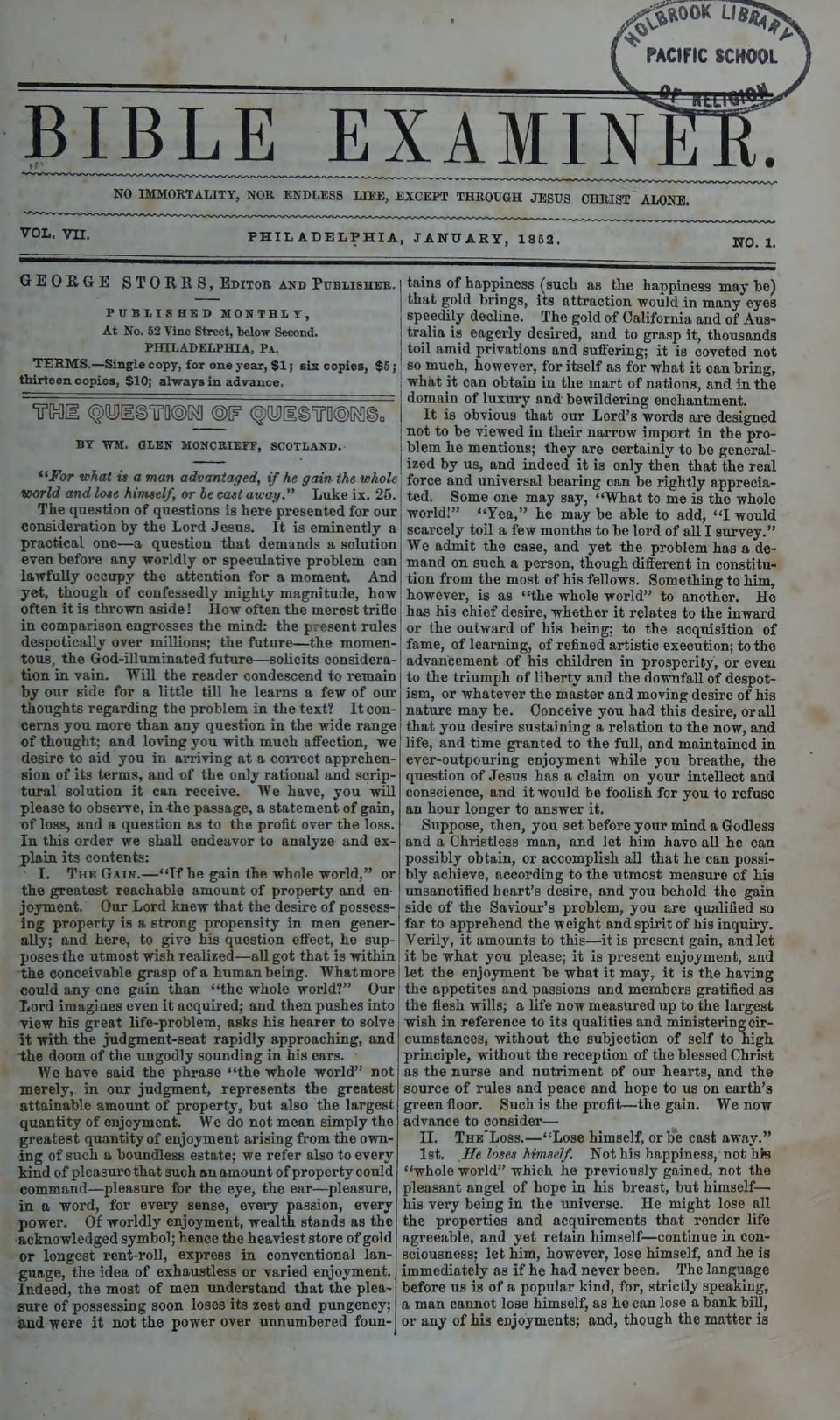
BIBLE EXAMINER.
NO IMMORTALITY, NOR ENDLESS LIFE, EXCEPT THROUGH JESUS CHRIST ALONE.
VOL. VII.
PHILADELPHIA, JANUARY, 1852.
GEORGE STORRS, EDITOR AND PUBLISHER.
NO.1.
PUBLISHED MONTHLY, At No. 52 Vine Street, below Second. PHILADELPHIA, PA.
TERMS.—Single copy, for one year, 1; six copies, 5; thirteen copies, $10; always in advance.
THE QUESTION OF QUESTIONS.
BY WM. GLEN MONCRIEFF, SCOTLAND.
"For what is a man advantaged, if he gain the whole world and lose himself, or be cast away." Luke ix. 25.
The question of questions is here presented for our consideration by the Lord Jesus. It is eminently a practical one—a question that demands a solution even before any worldly or speculative problem can lawfully occupy the attention for a moment. And yet, though of confessedly mighty magnitude, how often it is thrown aside! How often the merest trifle in comparison engrosses the mind: the present rules despotically over millions; the future—the momentous, the God-illuminated future—solicits consideration in vain. Will the reader condescend to remain by our side for a little till he learns a few of our thoughts regarding the problem in the text? It concerns you more than any question in the wide range of thought; and loving you with much affection, we desire to aid you in arriving at a correct apprehension of its terms, and of the only rational and scriptural solution it can receive. We have, you will please to observe, in the passage, a statement of gain, of loss, and a question as to the profit over the loss. In this order we shall endeavor to analyze and explain its contents:
I. THE GAIN.—"If he gain the whole world," or the greatest reachable amount of property and enjoyment. Our Lord knew that the desire of possessing property is a strong propensity in men generally; and here, to give his question effect, he supposes the utmost wish realized—all got that is within the conceivable grasp of a human being. What more could any one gain than "the whole world?" Our Lord imagines even it acquired; and then pushes into view his great life-problem, asks his hearer to solve it with the judgment-seat rapidly approaching, and the doom of the ungodly sounding in his ears.
We have said the phrase "the whole world" not merely, in our judgment, represents the greatest attainable amount of property, but also the largest quantity of enjoyment. We do not mean simply the greatest quantity of enjoyment arising from the owning of such a boundless estate; we refer also to every kind of pleasure that such an amount of property could command—pleasure for the eye, the ear—pleasure, in a word, for every sense, every passion, every power. Of worldly enjoyment, wealth stands as the acknowledged symbol; hence the heaviest store of gold or longest rent-roll, express in conventional language, the idea of exhaustless or varied enjoyment. Indeed, the most of men understand that the pleasure of possessing soon loses its zest and pungency; and were it not the power over unnumbered fountains of happiness (such as the happiness may be) that gold brings, its attraction would in many eyes speedily decline. The gold of California and of Australia is eagerly desired, and to grasp it, thousands toil amid privations and suffering; it is coveted not so much, however, for itself as for what it can bring, what it can obtain in the mart of nations, and in the domain of luxury and bewildering enchantment.
It is obvious that our Lord's words are designed not to be viewed in their narrow import in the problem he mentions; they are certainly to be generalized by us, and indeed it is only then that the real force and universal bearing can be rightly appreciated. Some one may say, "What to me is the whole world!" "Yea," he may be able to add, "I would scarcely toil a few months to be lord of all I survey." We admit the case, and yet the problem has a demand on such a person, though different in constitution from the most of his fellows. Something to him, however, is as "the whole world" to another. He has his chief desire, whether it relates to the inward or the outward of his being; to the acquisition of fame, of learning, of refined artistic execution; to the advancement of his children in prosperity, or even to the triumph of liberty and the downfall of despotism, or whatever the master and moving desire of his nature may be. Conceive you had this desire, or all that you desire sustaining a relation to the now, and life, and time granted to the full, and maintained in ever-outpouring enjoyment while you breathe, the question of Jesus has a claim on your intellect and conscience, and it would be foolish for you to refuse an hour longer to answer it.
Suppose, then, you set before your mind a Godless and a Christless man, and let him have all he can possibly obtain, or accomplish all that he can possibly achieve, according to the utmost measure of his unsanctified heart's desire, and you behold the gain side of the Saviour's problem, you are qualified so far to apprehend the weight and spirit of his inquiry. Verily, it amounts to this—it is present gain, and let it be what you please; it is present enjoyment, and let the enjoyment be what it may, it is the having the appetites and passions and members gratified as the flesh wills; a life now measured up to the largest wish in reference to its qualities and ministering circumstances, without the subjection of self to high principle, without the reception of the blessed Christ as the nurse and nutriment of our hearts, and the source of rules and peace and hope to us on earth's green floor. Such is the profit—the gain. We now advance to consider—
II. THE LOSS.—"Lose himself, or be cast away."
1st. He loses himself. Not his happiness, not his "whole world" which he previously gained, not the pleasant angel of hope in his breast, but himself—his very being in the universe. He might lose all the properties and acquirements that render life agreeable, and yet retain himself—continue in consciousness; let him, however, lose himself, and he is immediately as if he had never been. The language before us is of a popular kind, for, strictly speaking, a man cannot lose himself, as he can lose a bank bill, or any of his enjoyments; and, though the matter is very plain, this whole subject has been so mystified and misrepresented, that we do well to look into every corner and chase away the last atom of darkness.
The loss, be it observed, is the man himself, which, without controversy, the man cannot feel, cannot be conscious of; because, if he could have feeling in any degree, that would be demonstration that himself—the man—was not flung into non-being, or was not lost. The dominant theology would have us to believe the man penally lost, and to feel the loss; that is, to be lost and not lost at the same time—to have parted with every attribute of being and yet to retain them, which is gloriously absurd; for which let us be thankful. Losing himself then just means ceasing to be; returning to non-existence, whence he originally came.
The same idea is expressed in Mark 8: 36, "What shall it profit a man, if he shall gain the whole world and lose his own soul?" Viewed side by side with our text, this language "lose his own soul" becomes very plain; even alone, it most emphatically conveys the idea that the unholy shall ultimately cease to exist. "Lose his own soul"—what does that mean? The man is represented as losing his soul—not his happiness, nor hope, nor the Divine smiles, but his own soul. Now, what is a man without a soul? Nothing, for the idea of a man and a soul are substantially one. To make a man, you must produce a soul, for there cannot be a man without a soul, and to make a human soul is to make a human being, capable of all responsible functions as a moral agent, and susceptible also of suffering and pleasure. For a man, then, to lose his soul, is, in other words, a soul losing itself, or, as it is in the text, a man losing himself, his being, departing from conscious existence. A man might lose happiness, and yet keep his soul; a man might lose heaven and the mercy and favor of God, and yet retain his soul; but he cannot lose his soul, and yet continue a soul, for that would be losing a soul and keeping a soul at the same moment! Losing consciousness, an essential attribute of a living soul, or of a living self, and yet preserving it! Losing self and yet preserving self, which is utterly impossible.
In the passage from Mark, the Greek word rendered "soul" is the same that in the context of that verse, and in the parallel passage in Matthew, as well as in many other parts of the New Testament, is translated "life;" and the verse from Mark may most properly be rendered "what shall it profit a man, if he shall gain the whole world and lose his own life? So rendered it conveys the idea which is given in the text. The man is to lose his life, and when a man loses his life, is he not as if he had never been? Can he lose life, and yet in any sense be alive? Can he be conscious of having lost that which is essential to consciousness itself? To lose the life, then, is to cease to be, not here, but anywhere in space, and losing life—losing his soul—and losing himself, are only different modes of expressing the same awfully solemn thought, that the doom of the godless is that they shall be finally swept from conscious existence, as unfit for being.
The prevailing theology teaches that the unholy are to be visited with ceaseless torments in hell, as the reward of their evil ways. Now, just imagine a poor sinner in that agony; an agony waxing, at a fixed ratio, more and more intense. Tossing there on the boiling flood, has he lost himself? What think ye he would say, were one to exclaim in his hearing, "O! mad sinner! you have, being Christless, lost yourself at last." Mocked—would he not feel in the midst of his burning woe? Lost himself! Lost himself! and every moment producing a more intense consciousness of himself; for pain augments the sensitiveness of consciousness, and makes a being terribly alive to the fact that he is, and also to what it is to be. Lost his life! and yet living in agony! Lost his soul, and he—the man—the soul, tormented! O! mockery of truth! O! insult to language! O daring perversion of his threatenings, who is ordained to be the judge of quick and dead. Popular theology affirms the wicked man shall not lose himself, but shall last perpetually condemning himself, and enduring the vengeance of sulphurous fires; God says, the unholy shall lose themselves, they shall cease to be capable of pain or pleasure; in a word, they shall die. "The wicked shall perish, and the enemies of the Lord shall be as the fat of lambs; they shall consume, into smoke shall they consume away." Ps. 37: 20. How great the contrast! How mournful to think that millions are believing a lie, and that myriads are preaching it from day to day.
2d. We have now to consider the remaining words "or be cast away." This is the same idea under a slightly different aspect; for you notice the man is to "lose himself," "or" (not and) "be cast away." To lose himself is to be cast away, and he loses himself by being cast away. Now we do not think the idea is that he loses himself by casting himself away, or by rushing on to death in Gehenna; but that he will lose himself, his being, when he is cast away by the Omnipotent Judge—not cast away from hope, but from being itself. In one sense, he casts himself away; in a higher acceptance, he does not, since life is to be withdrawn from the impenitent by the divinely appointed agents of destruction; God will burn them up root and branch.
To our view the verse perfectly harmonizes with the alarming passage in 2 Thess. 1: 9, "Who shall be punished with everlasting destruction from the presence of the Lord," that is, a destruction to issue from the Lord, or a destruction of which he is the Author.
3d. This loss of self is to be irrevocable—hope less. A man may lose himself for a while, or forever; in other words, a man may pass into the unconsciousness of death for a day, for a thousand years, or for an eternity. Now the self-loss here spoken of is eternal; they are to be punished with an everlasting destruction, not an everlasting preservation in torment, but destruction, and one that is never in the lapse of ages to be repaired. No resurrection follows the second death; the end is destruction; they shall never see life. Some have lost themselves voluntarily, or resigned their present life for Jesus and his gospel, and now they rest in the silence of the grave. But they will find themselves again—they shall ere long awake to a new and glorious state of being—to the crown of martyrdom likewise, and the songs of salvation before the enthroned Redeemer. Alas! for the apostates who preserved themselves here, or preferred life to the honor of Jesus and the purity of their consciences; they and all the godless shall be reduced to ashes, and no eye shall ever see them more. They shall be blotted from the roll of being—from the page of life. They had their portion in this life, and of this life, they preferred the now to the after—present enjoyment to immortal being and felicity. Streams may be dried up, and again murmur along their ancient channels; trees that have been long reckoned dead, may send forth green shorts to wave in the sunshine; the land that has apparently been cursed with sterility, may anew bloom like Paradise; stars that ceased to shine in the high places of the firmament, may afresh be kindled, but no forth-putting of Divine reviving energy shall restore the condemned and consumed to being; the long moonless and morningless night of forgetfulness is their unalterable portion.
"Appalling end, most melancholy—sad,
To be expelled existence hopelessly;
To be unconscious when the saved are glad
Before the throne, throughout eternity;
Numbered with things that were for age to be
Unworthy of a name, a place, a rank,
In this fair universe by Heaven's decree;
O direful doom! but better far a blank
Than wretches ever scorched on Tophet's brimstone bank.
O direful doom indeed! but why forget
It is their choice? for men may live or die;—
On wings of faith escape the penal threat,
Or with the last in condemnation lie.
And when at length the hours of mercy fly,
And God apportions each his chosen lot,
Whom can the sinner blame? when on his eye
Oblivion's night descends, to vanish not—
Whom can the sinner blame?—what he decreed he got."
III. THE QUESTION—"what is a man advantaged, if he gain the whole world and lose himself, or be cast away?"
The humblest capacity can discover that the proper answer is, it will advantage him nothing. The price of his present enjoyment and impiety is the loss of being itself. In the recent exhibition in London, there was one diamond, 'the mountain of light,' as it was called, of immense value. Now, suppose it cast into the deep, and that a man dives for the treasure, and finds it, but expires with it in his grasp, just as he reaches the surface of the wave—what would it profit him to have gained the diamond and to lose his life? So here, the present enjoyments of a godless life consume in the end being itself; the reward of sin is the darkness of non-existence. An infinitesimal gain, and an infinite loss; a straw, gathered from the flood of time, prized beyond the glory and gladness of interminable duration; a drop preferred to an exhaustless ocean; a grain to a kingdom, and a city which hath foundations, whose builder and maker is God; a worm-like being to one kindred with a seraph's, yea, approximating his on whom all existence hangs as his robe and his shadow.
What, then, beloved reader, will it avail you to gain all you can desire now, and be thus impoverished, thus cancelled from being at last? You may understand the calculation before us, the loss and the gain; you may admit the accuracy of our development of the two sides of the balance sheet, and yet you may refuse to act on the discovery that the loss will inexpressibly transcend the gain, that in fact all comparison between the two is imperiously debarred. You may shun the momentous theme, we cannot exclude this possibility from our thoughts; will you, in mercy to yourself, disappoint our fears? Will you yield to our most ardent wish, and henceforth renounce the profitless service of sin and Satan. In the end it is unqualified loss; sometimes in this scene, we admit, it has the semblance of gain. You may have a godless life in time, but there shall not be for any a godless eternity; it is enough for God to be mocked for a period; he will not be slighted and blasphemed by creature tongue forever. Now, the great Redeemer implores you to calculate the problem of being; a godless present and no eternity; a holy, grateful, self-denying life here, and everlasting duration in the company of the
Lamb and his angels. Think, that a life of sin—a life out of Jesus—is nothing else than a toiling for death; a hurrying from night to night; a long prayer, if I may so express myself, that the gates of existence may at length be shut upon you by an omnipotent arm; and that prayer will be answered when the penal-destroying elements come forth to burn up the moral chaff and vile corruption that shall be found in the Universe at the end of time. Man must be renewed by love, or removed by power; conquered by grace or consumed by fire. At present the angel of love waits and beckons the guilty to the Saviour's side. The compassion of the Eternal has appeared in a thousand forms to your view; its fairest and richest manifestation was in the person of his Son, who was sent into the world that we might not perish, but have everlasting life. He is the brightness of his Father's glory. Have you seen him? You have seen the Father. Jesus was love—love was Jesus—the friend of man, the revealer of heaven, the conquerer of hades, the bringer of immortality. With him you have the pledge of being; because he lives, his disciples shall live also; without him, without his grace, his transforming power, his lovely image, his indwelling spirit, you are an heir of ruin, and angels will yet weep over your end, as they are now deploring your progress in sin. He desires your love, and that you may yield him your heartiest homage and affection, he unfolds to you the greatness of his compassion for you as you are; assures you of his desire for your recovery to righteousness, your reconciliation to his Father, your enrolment among the heirs of immortality. Lose a world, rather than lose Jesus; gain a whole world, and what will it avail when the horrors of destruction are thickening around your being, when Gehenna demands you as fuel for its quenchless flames? My brother, think; the text appeals to you as a reflecting being. One is filled with horror and unspeakable disgust in contemplating the popular hell: the bible revelation as to the doom of the wicked imparts an awfully solemn feeling to the heart. The one unhinges or excludes consideration; the other awakens reflection, and it does not outrage reason, nor remorselessly harrow the sympathies of humanity. The nearer you come to the one you are the more disqualified for the exercise of your intellectual capacities; the other—the further you penetrate its enclosures and chambers, makes you the more intensely thoughtful, and the more alive to the hopelessness of men disconnected with Jesus. To him, therefore, when serious thought is, as we fondly trust, excited in your mind; to him we would affectionately conduct you, and the while tell you of his tears, and groans, and agonies, and triumphs in the sublime effort he made to redeem you from sin and its fruits. Behold thy Saviour! He died for you; will you not begin to live for him? Will you not taste his love that flows like a soft stream from his heart; its taste is sweeter than nectar; its healing and reviving virtues pass an angel's description. Be wise, and count all things but loss for the excellency of the knowledge of Christ Jesus your Lord, and strive to attain unto the resurrection from among the dead, and the kingdom whose splendor and blessedness shall not pass away.
Deal gently with those who stray. Draw them back by love and persuasion. A kiss is worth a thousand kicks. A kind word is more valuable to the lost than a mine of gold. Think of this, and be on your guard, ye who would chase to the grave an
PACIFIC SCHOOL
OF RELIGION [Communicated.] UNIVERSALISM.
BY MRS. C. C. WILLIAMS.
To the Editor of the Ambassador, J. M. Austin:
Sir:—I am not a subscriber to the Ambassador, but I am an interested reader of it, for which privilege I am indebted to one of your subscribers, George French, an inmate of our family—not that I am a Universalist for various reasons, which will appear hereinafter. I was taught to believe the doctrine of eternal misery by my father, who was a Baptist Minister, and I sincerely believed it to be true and taught of God in the Bible till about four years ago, being a member of that order. Were eternal misery or the views entertained by Universalists the only alternatives, reasoning as both do, from common ground, as to man's nature, I should not hesitate to decide in favor of the God-honoring system of the latter in comparison with the former. But by being led to doubt the truth of eternal misery, by presuming to read some of the writings of George Storrs, I commenced studying the scriptures as one entirely ignorant of what was taught therein, with an intense desire, which time does not abate, to find out what was true—to see what relation we sustained to God—what end he had in view in creating man, and allowing him the freedom of choice, together with the design of government—and as fast, and far, as I have succeeded in fathoming the meaning of the sacred writers in relation to these points, and others connected therewith, so fast, and so far, I have renounced my former absurd and contradictory imaginings for a comprehensible can-be-told system—and am now prepared to follow the injunction, to be always ready to give a reason of the hope I entertain with meekness and fear—emphatically so. In the Ambassador for Oct. 11th, I saw a notice calling the attention of all who would read, to a sermon on the first page. Time was when my prejudices would have so blinded me, that if I had read anything that I knew was from a Universalist, it would have been of little use, for I should not have been able or competent to have appreciated any argument, however well founded. But a better and happier state of feeling has obtained, and Truth, wherever found, is now lovely to me, though there is so much that is called truth affloat, it is rather staggering to a looker-on; yet, in the full confidence that Truth is one, and that all truth is capable of being clearly demonstrated, I will not despair. It argues well for the adherents of any system, when they covet investigation, as truth can lose nothing thereby, and if it should chance to be error that is entertained, and truth is the object sought after, certainly a good exchange would be made if error could be bartered for truth. I have lived, formerly, where I could have almost daily friendly converse with Universalists, and I have tried to become acquainted with their views, so that I could see and appreciate the ground of their belief, and I think with the additional light of the sermon spoken of above, which is alleged to be an expose of Universalism, I have a tolerably correct view of the doctrine. Now, you have solicited the attention and criticism of religious editors and writers of all denominations to this sermon, and if you included females amongst the writers, then I may write. You ask to have objections candidly pointed out, and that is due and meet. Jesus was candid. And you have said, "there shall be no offence on our part"—urging a thorough investigation. This assurance leads me to think I shall be heard while I attempt to show
some of the errors of your system. I have long had it in my mind to do so, but have been waiting to get a better understanding of the case, and also to see an open door, or chance to be heard. This seems to be the proper occasion. I well know it is a nice business to get round this sermon, or in other words, to make the nice distinctions that are necessary in the case, and make those distinctions clear to the understanding. I must confess, however, I do not see how you can well avoid such conclusions respecting the final destiny of all, with such views of the nature of man—the paternal character of God—the end or design of punishment—as I see are entertained by you as a body, from this sermon, and other articles of the Ambassador, with the general tenor of the policy. I should think both must stand or fall together. So that my objections will not be so much objections to this sermon as they will be objections to that which leads to such a view as is indicated herein in giving we such a latitude. There is one part of the sermon, that has my cordial sympathy, and that is from where he commences to tell what is necessary to be efficient laborers in the moral vineyard onwards to its close. But as to the former part, I must confess I fail to see any very good reasons why we should be very much engaged to labor for others here, this side of the grave, just for what more would be enjoyed by them in the interim; seeing it is so difficult to be heard, amidst the din of conflicting passions, as it is also difficult to stem the tide of selfishness, and if the wicked are so much better circumstanced hereafter and the means necessary to reform them, so much more available there, it does seem to me that the best and easiest way is, so far as others are concerned, to let the matter rest till then—for as the wicked shall not live out half of their days, they will pass through what you call the resurrection state the sooner into this favorable situation, and in that case it seems as though we should be ungenerous to attempt to stay them. I cannot see how such conclusions can be avoided, if you are right, and I should like to know how you can keep from thinking so and acting accordingly. I think, however, the key to all this is given in the sermon of Rev. J. B. Sap, at the funeral of Br. L. A. Wright, when he says that "if Jeremiah, David and Christ knew nothing about an endless hell, the dogma is false which teaches that there is one; and if that is not true, the doctrine of the final holiness and happiness of all mankind is true." That they knew nothing of such a place, and taught nothing of it, is, I think, sure, and if I can understand them, they taught as little respecting the other extreme, which extreme was and is adopted, as it seems, by the above declaration, as a matter of course, on finding out the falsity of eternal misery, without once thinking there can be any other alternative. Much is due your body for being instrumental in exposing this dire dogma in all its depravity. Your system seems far more honoring to God in many respects. But there is a superlative degree, and I find the scripture writers advocating neither of the above views, if I can understand them; but this system, superior to either, inasmuch as, viewed in whatever light it may be, it seems liable to no objections save what may arise from unenlightened and uninformed sympathy, so I call it the superlative degree. In and of myself, I shrink at the thought of meeting such strong confidence as is expressed in regard to the truth of your position. Nothing but the desire that Jesus and his followers' views should be understood, relative to these all-important topics, nerves me up to take my pen in their vindication. Otherwise the task had been left to abler minds and hands which have less to do than mine.
As it is, however, (God by his spirit, without which none can do anything, being my helper,) I will do the best I can in redeeming my pledge, hoping that my humble efforts to justify the ways of God to man, will be accepted and blessed. As Jesus said, so say I, "my doctrine is not mine," so I assume no responsibility, but leave that to its Author—my only care being to speak on good authority.
1st. I will notice your view of the nature of man. I gather from this sermon, and the general tenor of the articles of your paper, that the spirit, or soul, (as I see they are used synonymously,) is regarded as the man proper, or that which is saved—that the body or house which holds the man, dies, and thus the hitherto fettered and clogged soul wings its way to the skies, or enters on a higher life, or a second and better disciplinary state, to fit it for its ultimate destiny. The Bible says that the Lord God formed man of the dust of the ground. Gen. 2: 7. The spirit is not formed thus, so that the spirit is not the man to begin with. But of what use is such a grand piece of mechanism without some power to set and keep it in motion? None at all. So He that made him, "breathed into his nostrils the breath of life, and man became a living soul;" and it should be borne in mind constantly that beings made of dust become living souls just in that way now. Men and women, beasts, birds, and fishes, are living souls alike. Gen. 1: 30, and 7: 22, (margin.) The spirit is not a living soul, it is the spirit of God in our nostrils that makes living souls of us, and all. Job. 22: 3; and the difference is in the variety of structures, and not in the spirit or power, (Gen. 7: 22,) by means of which all act; and if he (God) sets his heart on man and gathers to himself his spirit and his breath, all flesh shall perish together, and man shall turn again to his dust. Job 34: 14-15. That is, where he came from, and what God defines death to be. Gen. 3: 19. And he says, too, his spirit shall not always strive with man, because he is flesh, yet his days shall be 120 years, and during that time, it would strive with them—thereby justifying Paul's assertion to the Corinthians, that they were temples of the living God, and if any man defiles the temple of God, him will God destroy. 1 Cor. 3: 17. For those to whom this was spoken gave little heed to the spirit of Christ in Noah, 1 Peter 8: 19, warning them to forsake their pollutions, and by means of this spirit to mortify the deeds of the body, through and live; so they were destroyed that they might no longer curse the earth. David says his (man's) breath goeth forth, he returneth to his earth, in that very day his thoughts perish.
I have quoted these texts above to show what man is—and by these we see that man is one thing, and the spirit is quite another. Man, it is true, as well as every other creature, is dependant on this spirit for all he knows, wills, and does. What though a man should gain the whole world and lose his life or soul? (Matthew, Mark, and Luke, to say nothing of the others, use the terms life and soul synonymously.) What good would possessions do a dead man? When the spirit goes, the life or soul (which the Bible says is the blood, though used ambiguously,) must die; for James says "the body without the spirit or breath (margin) is dead." But man has no control over the spirit when it is demanded of him. Eccl. 8: 8. Nor after it has left him. His only care should be to make a good use of it while permitted to retain it, seeing the manifestation of the spirit is given to every man to profit withal, dividing to every one severally as he wills. 1 Cor. 12:
7-11. The inspiration of the Almighty gives man understanding. Job 32: 8. He would know nothing without it, and can know nothing without it, for the dead know not anything. Eccl. 2: 5. Hezekiah of old was very glad to have his soul kept back from the pit or grave fifteen years longer, for he wanted to praise the Lord; and he knew the dead could not do that. But he says, the living, the living, they shall praise thee as I do this day. Isaiah 38: 17-19. David, too, said he should be satisfied when he awaked with his likeness. It seems that the same or similar opinions prevailed in the Apostles' time about the state of the dead as are now prevalent, for Peter found it necessary to assure those who were witnesses of the wonderful manifestation of the outpouring of the Holy Ghost on the day of Pentecost, that David had nothing to do with it, because he was dead and buried, and his sepulchre was then with them—and more convincing still, he told them David had not ascended into the heavens. Acts 2: 29-34. Job said, the dead would not be raised nor waked out of their sleep till the heavens be no more; and he wanted to be hid in the grave, and have a time appointed, to be remembered, and to be called and he would answer. Job 14: 10-14. Jesus died and was buried, but his soul was not left in hell or the grave. Acts 2: 31. He committed his spirit to his Father, and God restored it to him again, and thus raised him up from the dead. It was impossible for death to hold him, being sinless. Acts 2: 24. Paul says if the spirit of him that raised up Christ from the dead dwell in you, (and it will dwell in those who do not defile the temple so as to be destroyed,) he that raised Jesus from the dead shall also quicken your mortal bodies by his spirit that dwelleth in you. Rom. 8: 11. Not to particularize further, Paul says, all the ancients, from Abel down to his time, who had faith in the promise of eternal life and its accompanying blessings, thereby becoming heirs of the righteousness which is by faith, died, not having received the promises. These promises, viz: the possession of the land where he lived, or rather the world, (Rom. 4: 13,) and in thee shall all nations be blessed, every one that has the faith he had being blessed with him, (Gal. 3: 8-9,) and that he should be the father of many nations, were made known to him (Abraham) before he died, and he with all the others, saw them afar off, and being persuaded of them, (Heb. 11: 13,) they were not afraid to trust God, but fell asleep in full confidence that what God had promised, he was able also to perform in due time; and even Moses showed that the dead are raised, when he called God, or the Lord, the God of Abraham, &c. Luke 20: 37. Some of these ancients were tortured to death, and would not accept deliverance, that they might obtain a better resurrection; (Heb. 11: 35,) for they well knew that if they loved their lives so well, that, for the sake of staying here a few years longer at most, they should betray their trust, they would forfeit their claim to eternal life. Paul thought thus too. He counted everything but dung that he might win Christ and be found in him, &c.; he was content to share his sufferings, and felt it cheaply won, if by any means he might attain unto the resurrection of the dead. Phil. 3: 9-11. In keeping with these sentiments he told the Thessalonians they must not sorrow about those that were asleep (in Jesus) as those did who had no hope, (of a resurrection,) for God would bring them again from the dead as he did Jesus, and that they would eventually meet the Lord together; and that they must comfort one another with these words.
1 Thess. 4: 13-18. We look in vain in scripture for
HOLBROOK LIBRARY
PACIFIC SCHOOL
OF RELIGION survivors comforting bereaved ones with the assurance that the departed were happy in heaven.
There are three points I want to prove by the above:—
1st. That man dies, and his work ceases, and unless made alive again, he is as though he had never been, because, if there be no resurrection, or if Christ be not raised, then they which are fallen asleep in him are perished, too, to say nothing of those out of him, who die in Adam. 1 Cor. 15: 15-18.
2d. That none enter into eternal life at death for, notwithstanding the spirit we had from God, returns then to the Giver, yet man is not benefitted thereby, unless restored to him again; and further, let it be what it may, it needs to go but a little way to go to God, for Paul says, he is not far from every one of us. Acts 17:27. Which is not as your poets sing, as well as myself in former days.
3d. That the prevalent notions and anticipations about the spirit are baseless. And let me say to mothers, that it is our children we should try to train, that they may be fit habitations for this pure spirit. The spirit we have nothing to do with, any further than to make it subservient to the purposes designed, while permitted to retain it. We neither gave it to them, nor are we to take it. And can parents cast off the fear of God themselves, and forbear to teach it to their children, which fear is the beginning of knowledge, (Prov. 1: 7,) and neglect to train them in the way they should go, and then empty them into the world, to cast a blight wherever they may go, (unless they chance to learn from other sources to love righteousness and the benefits and blessings of obedience,) and then complain that it should go ill with them, or that their end should be destruction? Here, before proceeding further, allow me to ask two questions. What is the purgatory of the Roman Catholics but a state or place of discipline for the purification of souls? Does not the prevalent opinion of the nature of the soul lead to all these various and conflicting theories about its welfare and whereabouts at death, since imagination is the only guide in the case?
To resume. 2d. The paternal relation and the ground of God's impartiality is misapprehended.
That God is the Father of the spirits of all flesh is readily allowed, and the former of all in one sense, (though I should hardly be willing to charge him with making all the miserable, degraded specimens of humanity that breathe his air and live on his beneficence—their being here, and thus degraded, being better accounted for on Paul's theory, Rom. 1:21-31,) but he is not the Father of all flesh, because he has made all, nor of man, because he has made him, more than of any other creature; but man is the only creature which of his good pleasure he has endowed with a capacity "to will and to do"—consequently man alone can be tempted with evil, and voluntarily yield to it, or manfully resist and overcome temptation. So that he alone of all the creatures God has made, can obtain a knowledge of Him that hath called us to glory and virtue, by means of which he can escape the corruptions that are in the world through lust, and thereby become a partaker of the divine nature. 2 Pet. 1:3-4. Those that believe on his name, John says, have the power to become the sons of God. John 1:12. To man alone is held out the unspeakable honor of attaining the rank of becoming sons and daughters of the Lord Almighty, by coming out from the world, &c. 2 Cor. 6:18. Jesus taught his disciples to say, Our Father, &c., and they had a right to, on the ground of their discipleship, for as many as are led by the Spirit of God, they are the sons of
God by anticipation only, because, by submitting to be led by the Spirit of God, they had received the spirit of adoption, whereby they could cry Abba, Father, and every believer may do the same. Rom. 8:14-15. But the adoption itself is an object of hope, and what must be waited for till the redemption of the body, when the sons of God will be manifested. Rom. 8:19-23. The unbelieving Jews claimed God as their Father, and unbelieving Gentiles have the same right, for Paul says he is God of one as well as the other. Rom. 3:29. The heathen poets claimed the same, and Paul asserts to have assumed their position for the purpose of showing them the absurdity of worshipping senseless idols. Acts 17:28. Jesus told those unbelievers that if God was their Father, they would do the works of God, or would love him. John 8:42. And in the 44th verse he told them that they were of their father the devil, and his lusts ye will do. In the 21st, 23d and 24th verses, he tells them, if ye believe not that I am he, ye shall die in your sins, and where I am ye cannot come, and because ye are of this world, or beneath, and I am not. This shall suffice to establish the ground of the parental relation.
PROPHETIC PERIODS.
BY THE EDITOR.
That great confusion exists with regard to the commencement and termination of the prophetic periods must be manifest to every reflecting and impartial mind. Historians and chronologists are anything but united on the exact time of many important events which are necessary to define with accuracy the time of the beginning or ending of most of those periods. The chronology of some of the events noted in the scriptures is based upon these conflicting and discordant materials; and too much reliance upon profane chronology and popular mistakes as to the reigning king of the times in which the scripture event happened, has led into great errors in the interpretation of the prophecies. This, we conceive, is especially the case with the ninth chapter of Daniel.
Let us take a view of the generally received chronology in the Bible in a few particulars. The chronology put against Ezra 1: 1, or the Decree of Cyrus, is B. C. 536. Haggai 1st commences with the second year of Darius, and the chronology is put down at 520 B. C., when the house of God or temple was put forward to its completion by Haggai and Zerubbabel at God's command; that is, just sixteen years after the decree of Cyrus; and Ezra 6: 15, tells us "this house was finished in the sixth year of the reign of Darius the king:" that is, according to the common received chronology, within twenty-one years after Cyrus' decree; and yet, strange to tell, commentators and chronologists have fixed upon the decree of Artaxerxes II., B. C. 457, or fifty-eight years after the temple is finished, according to their chronology, as "the commandment" that went "forth to restore and build Jerusalem!" Also, according to their chronology of Dan. 9th, B. C. 538, the "seventy years desolation of Jerusalem" (ending at that time, Dan. 9: 2,) ended eighty-one years before the commandment went forth to restore and build Jerusalem, i. e., if 457 B. C. is the true point from which to reckon that commandment; and Daniel must have been dead at least seventy-five years before Ezra went up to restore and build Jerusalem!
It has seemed to be taken for granted that the Darius of Dan. 9th is the same as the Darius who took Babylon.
From a careful examination of the subject, we are fully satisfied this is a great mistake. In consequence of this mistake, that chapter has been thrust in between the 8th and 10th chapters, and thus led into inextricable confusion all who have based their calculations upon that theory.
Daniel himself, if carefully examined, shows that these Dariuses were two different and distinct persons. Chapter 5: 31, tells us, "Darius the Median took the kingdom;" the 9th chapter says, "In the first year of Darius the son of Ahasuerus of the seed of the Medes." The Scriptures give us Ahasuerus as the husband of Esther, Esther 2: 16, and the chronology in the margin of our Bible gives this event B. C. 462. Artaxerxes I. reigned between Cyrus and Darius king of Persia, "son of Ahasuerus." Any one must be satisfied of this, we think, who, with an unprejudiced mind, carefully reads the 4th chapter of Ezra. Artaxerxes I. died B. C. 424. See Taylor's Manual of History, p. 66. Says Taylor—"On the death of Artaxerxes, his only legitimate son, Xerxes, ascended the throne; but within forty-five days was murdered by his natural brother, Sogdianus; and he again was deposed by another illegitimate prince, Ochus, who, on his accession, took the name of Darius II." This king was surnamed Nothus, that is, "illegitimate." He was called illegitimate because not the son of Artaxerxes, but of Ahasuerus, and was most most likely born of Esther, a Jewess, and therefore would be accounted as not legitimately heir to the throne of Persia. It seems to us clear that Darius Nothus is the Darius of Daniel 9th, and he came to that throne about 424 B. C., instead of B. C. 538, as would seem by the chronology now found in the margin of the Bible. If this be so, then all the other chronological dates in the margin of the Book of Daniel are equally erroneous.
Darins Nothus reigned at a later period than Cyrus (whose Persian name is Coresch,) king of Persia. The communication, therefore, made to Daniel, chap. 9, was at a later period than that of the 10th, 11th, and 12th chapt's; and its chronological position in the Book of Daniel is after the 12th chapter. Darius Nothus, or "Darius the son of Ahasuerus," is the same, we judge, as Ezra's "Darius king of Persia." Ez. 4: 5; and cannot therefore be identical with "Darius the Median," but corresponds with the Darius of Haggai 1: 1, and Zech. 1: 1; and what further confirms this idea is, that in the "second year" of this Darius, the seventy years' indignation of the Lord against Jerusalem ceased. See Zech. 1: 1, 12. The seventy years' indignation which the angel here declared was completed, in the second year of Darius, is identical with the seventy years' desolations which were terminating in "the first year of Darius, son of Ahasuerus;" for the desolations ceased when the work of rebuilding the temple had such a putting forward as resulted in its completion; that was from the "second year of Darius king of Persia." See Ezra 4: 24, and 5: 1-2; therefore, it follows conclusively that Darius the son of Ahasuerus, (Dan. 9: 1,) is the same as the Darius of Ezra, Haggai, and Zechriah; and hence reigned at a later period than the Scripture Cyrus (Coresch,) king of Persia, and king of Babylon, and therefore was not "Darius the Median," who reigned before Cyrus. If these things are so, it follows that the chronology relied upon in fixing the dates of the prophetic periods is erroneous, and will forever delude those who follow it.
Again, as Cyrus reigned before Darius Nothus, or "Darius son of Ahasuerus," and as Daniel's seventy weeks, seven weeks, and sixty-two weeks, were given him under this latter king, it follows that the decree
of Cyrus, to restore and build Jerusalem, was previous to the 9th chapter of Daniel; and it is abundantly evident that the decree of Cyrus, and not that of Artaxerxes, is the decree spoken of by Gabriel to Daniel. This we know will be startling to some who have labored to make the generally received chronology harmonize with the facts in history and prophecy; and yet it is demonstration, to our mind, that the decree of Cyrus is the decree of which Gabriel speaks, Dan. 9th.
Let us turn to Isa. 44: 28, and we shall see what the Lord saith concerning Cyrus. "Cyrus is my shepherd, and shall perform all my pleasure; even saying to Jerusalem, thou shalt be built, and to the Temple, thy foundation shalt be laid." This language exactly tallies with Gabriel's annunciation—"Know, also, from the going forth of the commandment to restore and to build Jerusalem," &c. Here is a distinct reference to some prophecy on the subject; no other prophecy can be found that so exactly corresponds as that which relates to the acts of Cyrus; and if we are correct as to the chronology of Dan. 9th, that decree of Cyrus had been issued prior to Gabriel's announcement of the time at which to commence the seven weeks and sixty-two weeks, so that Daniel had a definite point at which to begin his reckoning, viz: at the decree of Cyrus. As Cyrus is the only person prophesied of as issuing such a decree for the specified object, we have a right to conclude that is "the commandment" intended by Gabriel. The question arises, did Cyrus issue a decree exactly corresponding with the prophecy in Isaiah and the declaration of Gabriel?
In examining this point, we have nothing to do with profane chronology, or the chronology of historians. The Bible must settle the question, and if profane chronology does not tally with it, we have a right to conclude that such chronology is false, and not to be trusted.
Let us now examine the foregoing question. Cyrus did issue just such a commandment as agrees with Isaiah and Gabriel. See Ezra 1: 2, "Thus saith Cyrus king of Persia, The Lord God of heaven HATH CHARGED ME TO BUILD HIM A HOUSE AT JERUSALEM. Who is there among you of all his people? his God be with him, and let him go up to Jerusalem, which is in Judah, and build the house of the Lord God of Israel (he is the God) which is in Jerusalem. And whosoever remaineth in any place where he sojourneth, let the men of his place help him with silver, and with gold, and with goods, and with beasts, besides the free-will offering for the house of God that is in Jerusalem. Then rose up the chief of the fathers of Judah, and Benjamin, and the priests, and the Levites, with all them whose spirit God had raised to go up to build the house of the Lord which is in Jerusalem."
Let us next see how this "commandment" was attended to. In the 3d chapter, after noticing the offerings made by the people when they arrived at Jerusalem, it is said, verse 7, "They gave money also unto the masons, and to the carpenters; and meat, and drink, and oil, unto them of Zidon, and to them of Tyre, to bring cedar-trees from Lebanon to the sea of Joppa, according to the grant that they had of Cyrus king of Persia." Then verses 10 and 11 say, "And when the builders laid the foundation of the temple of the Lord, they set the priests in their apparel with trumpets, and the Levites the sons of Asaph with cymbals, to praise the Lord, after the ordinance of David king of Israel. And they sang together by course in praising and giving thanks unto the Lord; because he is good, for his mercy
HOLBROOK LIBRARY
PACIFIC SCHOOL endureth forever toward Israel.
And the people shouted with a great shout when they praised the Lord, because the foundation of the house of the Lord was laid. But many of the priests and Levites and chief of the fathers, who were ancient men, that had seen the first house, when the foundation of this house was laid before their eyes, wept with a loud voice, and many shouted."
Thus we have an exact fulfilment of Isaiah's prophecy; and that the building the city was included in Cyrus' commandment is clear from the letter which the enemies of the Jews afterwards wrote to Artaxerxes I., Ezra 4: 12; "Be it known unto the king, that the Jews which came up from thee to us are come unto Jerusalem, building the rebellious and the bad city, and have set up the walls thereof, and joined the foundations." Here, then, we have also a clear sight of the point of time to which Gabriel pointed as "the going forth of the commandment to restore and build Jerusalem." The decrees of Artaxerxes and Darius were only an approval of the decree of Cyrus, and not "the going forth of the commandment" to have the work done. See Ezra 6: 14, "And the elders of the Jews builted, and they prospered through the prophesying of Haggai the prophet, and Zechariah the son of Iddo. And they builted and finished it, according to the commandment of the God of Israel, and according to the commandment of Cyrus, and Darius, and Artaxerxes king of Persia." "According to the commandment (singular) of Cyrus, Darius, and Artaxerxes," &c. The commandment was one, originating with Cyrus, but confirmed by Artaxerxes, who finally revoked his approval, Ezra 4: 17-24; the decree itself was unalterable, according to the laws of the Medes and Persians, but it was renewed by Darius king of Persia, in the second year of his reign, which was the next year after Daniel's prayer, chap. 9, who having examined the ancient records at Babylon, (see Ezra 4: 24,) found the roll containing the decree of Cyrus, Ezra 6: 1-5; and confirmed that decree in strong language, as may be seen, Ezra 6: 6-12; which concludes with saying, "Let it be done with speed." From that time, the Jews under the prophesying of Haggai and Zechariah, [see Ezra 6: 14; and Haggai 1st and 2d chs.,] carried forward the work so rapidly that "this house was finished in the sixth year of Darius," Ezra 6: 15; or, within five years from the time Daniel so earnestly entreated God to "cause" his "face to shine upon the sanctuary that is desolate." Thus was the prayer of this man of God speedily answered, though he, possibly, did not live to see it, as he must have been about ninety-five years old "in the first year of Darius, son of Ahasuerus."
BIBLE EXAMINER.
PHILADELPHIA, JANUARY, 1852.
"A RAP."—Our readers will remember the inquiry we made in our last, after "The Spirit World." We said it had disappeared—that we had "continued to send the Examiner directed to" it, &c. The Examiner containing our remarks we again directed to the Spirit World, and asked, "Shall we hear a rap?" Sure enough, we had a rap; for back came the Examiner with a note "in its mouth." May it prove "an olive leaf"—an omen that the flood is over, and terra firma is once more in sight. The note was in
pencil mark on the margin of the returned Examiner as follows:—
"Have sent you each No. and the whole of the volume. 'Examine' and see. Notice, some of the numbers were double. You must take that back."
We had to take it back, anyhow, for the returned Examiner brought it. That is one way to take a thing "back." That is a new idea, for which we acknowledge ourself indebted to the invisibles. We say "invisibles," because we cannot say the Spirit World sent it back, or that friend Sunderland did, as the note has no initials to guide us. The last tidings we had from the Spirit World was last June. It was a "double number;" and the close of volume two. We continued to send the Examiner regularly, directed to it, and hoped to have a friendly response; we heard no more from it till the returned Examiner brought the foregoing note Now, if the Spirit World is not dead, let us know by its appearance once more. Our office is open for its entrance. The June number, the last we have seen, had the following announcement:
"We ask for no remittances of money for the third volume, until the first number is issued. And that number will not appear till we receive what is equivalent to three hundred pledges of five dollars each."
From this announcement, and not seeing it any more, we knew not but the Spirit World had become defunct. We intended, by our notice last month, to see if it was yet numbered with the things that are. The result is before our readers.
We sympathised with our old friend Sunderland, when he said in the last number of volume 2:—
"I solemnly declare that my connection with this cause has cost me over one thousand dollars, to say nothing of my time and labors for the past year, which have been given gratuitously, as my friends in this city [Boston] know, and will testify, if need be." And when he added—"Shall the good I would do, be prevented by the slanderous representations of thoughtless people, who know nothing of these facts, and wha feel no sympathy for the cause to which I have devoted my time, my talents, and my all of this world?" we responded, "That's too bad."
We repeat it now—it is too bad, when a man gives evidence by worldly sacrifices of the sincerity of his devotion to what he believes is truth, even though he may be mistaken, to accuse him of money-making, if it is not so. And we believe Mr. Sunderland's declaration in his case till it is proved untrue. While we thus sympathise with him in any wrong inflicted upon him, and in his sacrifice of his "all of this world," we cannot but regret that he has been drawn as we conceive, to the verge of a more fearful loss, viz: his all in "the world to come." For we regard the system of spirit manifestations, in itself, as developed in the "rappings" in this land, as a Satanic development and delusion that will prepare thousands for perdition and destruction. The developments are calculated to deceive unwary souls, and to draw men from dependance upon God to trust in imaginary deities, called "their loved ones," who "have departed into the spirit world."
These imaginary deities are consulted, prayed to, appealed to, and more earnestly sought after than the Almighty and His Son Jesus Christ our Lord and Redeemer. This we have abundantly shown in the Examiner the year past. It is "another gospel;" concerning which an apostle has said, if "an angel from heaven preach" it, "let him be accursed."
The system is evidently "devil worship." A person in order to a full manifestation to him, must consent to yield himself, "soul, body, and spirit," entirely up to the control of the spirits. In other words, he must be submissive to them; "fall down and worship me" is the spirit of their demands. This point it is easy to prove, though some may deny it. Their mandates must be obeyed, or the penalty is a refusal to hold intercourse with you. But we drop the subject here for the present, or till some further development is made.
"The True Wesleyan."—It is months since our old friend Luther Lee, the editor of the Wesleyan, has noticed us. We expected, however, that Bro. "Tate's Defence" would wake him up, and we have not been disappointed, though he has not mentioned that defence. In the Wesleyan, Dec. 13th, he comes out with a column and a half under the caption of "To Save that which was Lost," and "The Immortality of the Soul proved from the Atonement." It might have been our remarks on Prof. Finney's sermon that aroused him; but it matters not what did the work; his slumber is broken. He opens his battery upon us in the True Wesleyan, Dec. 13th, as follows:
"The position has been taken by Rev. Geo. Storrs that as man forfeited his existence by sin, involving the death of the soul, in the sense of the loss of conscious existence, immortality can be obtained only through faith in Christ, the great restorer, and of course, that impenitent sinners who do not believe and receive the benefits of atonement, cannot have immortality, continued being, but must cease to exist. Mr. Storrs opened his first great effort on this subject some years since, as follows:
'To commence, I call attention to what man lost by the fall. In order to understand this, let us look at man prior to the fall. He was a probationer. For what? Not for happiness—for he had that in possession. Nor for life, merely, as he was in the enjoyment of that also. I conclude, it was for eternal life, figured and set forth before his eyes, by the "tree of life"—as death, the opposite, was set forth by the "tree of knowledge of good and evil.'
In noticing the remarks of Br. Lee that follow this quotation from our Six Sermons, we will take the form of a dialogue. The Wesleyan shall take the lead and the Examiner respond:
Wes.—"The position that man could not have been a probationer for happiness because he was already happy, is unsound."
Ex.—The argument does not say "man could not;" but that man was not a probationer for happiness. We'
admit, however, that the reason assigned is not strictly correct; for man, though happy, might, if his Creator pleased, have been on probation for continued happiness; but as a matter of fact that was not the case; at least, so far as the Mosaic account states.
Wes.—"But Adam may have been a probationer * for a higher sphere, and a greater degree of happiness. He was doubtless a probationer for the happiness of heaven, in contradistinction from the happiness of the Garden of Eden."
Ex.—The question is not what he may or might have been, but what was it he was on probation for? Mr. Storrs said, it was not life merely, and yet it was for life; and this is evident from the fact that disobedience was threatened with the loss of life, or with death. Hence it was argued that it was eternal life, or a confirmation in life, that he was actually on trial for. Do you not admit that to be a fact?
Ex.—So you are compelled to admit the principle. When Mr. S. said man was not on probation for life merely, we think he spoke intelligibly. Life merely and eternal life are two distinct things. All animal creation has life, but have all animals eternal, unending life? Clearly not.
Wes.—"He could be in possession of life, while he was a probationer for its confirmation."
Wes.—"Life merely, means life only, or life and nothing else or besides life. To say that man was not a probationer for life merely, is to say that he was a probationer for life, and for something more than life."
…