The Bible Examiner — Vol. 7, No. 7 (July, 1852)
Download: PDF — The Bible Examiner — Vol. 7, No. 7 (July, 1852)
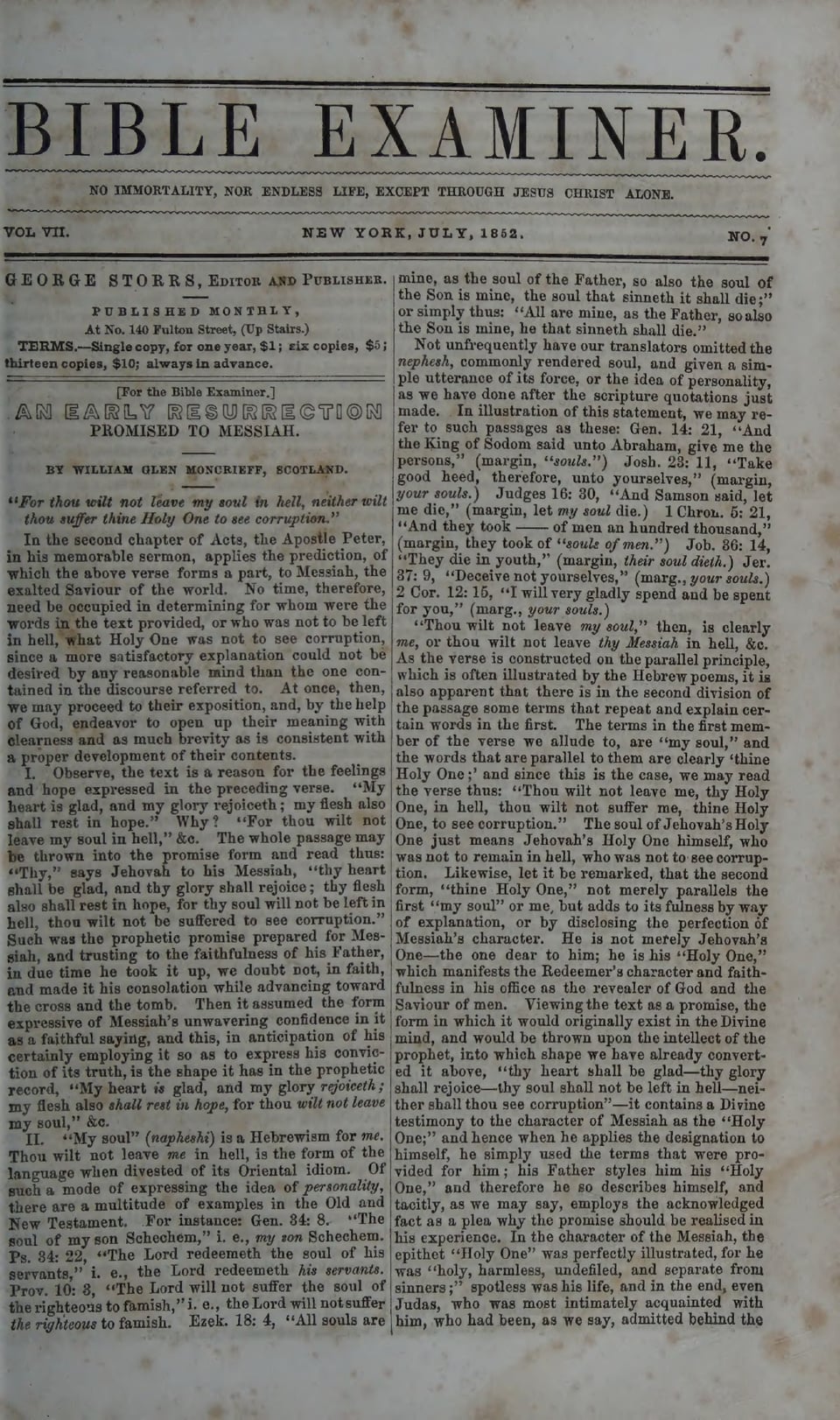
BIBLE EXAMINER.
NO IMMORTALITY, NOR ENDLESS LIFE, EXCEPT THROUGH JESUS CHRIST ALONE.
VOL VII.
NEW YORK, JULY, 1852.
GEORGE STORRS, EDITOR AND PUBLISHER.
NO.7
PUBLISHED MONTHLY,
At No.140 Fulton Street, (Up Stairs.)
TERMS.—Single copy, for one year, 1; six copies,5; thirteen copies, $10; always in advance.
[For the Bible Examiner.]
AN EARLY RESURRECTION PROMISED TO MESSIAH.
BY WILLIAM GLEN MONCRIEFF, SCOTLAND.
"For thou wilt not leave my soul in hell, neither wilt thou suffer thine Holy One to see corruption."
In the second chapter of Acts, the Apostle Peter, in his memorable sermon, applies the prediction, of which the above verse forms a part, to Messiah, the exalted Saviour of the world. No time, therefore, need be occupied in determining for whom were the words in the text provided, or who was not to be left in hell, what Holy One was not to see corruption, since a more satisfactory explanation could not be desired by any reasonable mind than the one contained in the discourse referred to. At once, then, we may proceed to their exposition, and, by the help of God, endeavor to open up their meaning with clearness and as much brevity as is consistent with a proper development of their contents.
I. Observe, the text is a reason for the feelings and hope expressed in the preceding verse. "My heart is glad, and my glory rejoiceth; my flesh also shall rest in hope." Why? "For thou wilt not leave my soul in hell," &c. The whole passage may be thrown into the promise form and read thus: "Thy," says Jehovah to his Messiah, "thy heart shall be glad, and thy glory shall rejoice; thy flesh also shall rest in hope, for thy soul will not be left in hell, thou wilt not be suffered to see corruption." Such was the prophetic promise prepared for Messiah, and trusting to the faithfulness of his Father, in due time he took it up, we doubt not, in faith, and made it his consolation while advancing toward the cross and the tomb. Then it assumed the form expressive of Messiah's unwavering confidence in it as a faithful saying, and this, in anticipation of his certainly employing it so as to express his conviction of its truth, is the shape it has in the prophetic record, "My heart is glad, and my glory rejoiceth; my flesh also shall rest in hope, for thou wilt not leave my soul," &c.
II. "My soul" (napheshi) is a Hebrewism for me. Thou wilt not leave me in hell, is the form of the language when divested of its Oriental idiom. Of such a mode of expressing the idea of personality, there are a multitude of examples in the Old and New Testament. For instance: Gen. 34: 8. "The soul of my son Schechem," i. e., my son Schechem. Ps. 34: 22, "The Lord redeemeth the soul of his servants," i. e., the Lord redeemeth his servants. Prov. 10: 3, "The Lord will not suffer the soul of the righteous to famish," i. e., the Lord will not suffer the righteous to famish. Ezek. 18: 4, "All souls are
mine, as the soul of the Father, so also the soul of the Son is mine, the soul that sinneth it shall die;" or simply thus: "All are mine, as the Father, so also the Son is mine, he that sinneth shall die."
Not unfrequently have our translators omitted the nephesh, commonly rendered soul, and given a simple utterance of its force, or the idea of personality, as we have done after the scripture quotations just made. In illustration of this statement, we may refer to such passages as these: Gen. 14: 21, "And the King of Sodom said unto Abraham, give me the persons," (margin, "souls.") Josh. 23: 11, "Take good heed, therefore, unto yourselves," (margin, your souls.) Judges 16: 30, "And Samson said, let me die," (margin, let my soul die.) 1 Chron. 5: 21, "And they took —— of men an hundred thousand," (margin, they took of "souls of men.") Job. 36: 14, "They die in youth," (margin, their soul dieth.) Jer. 37: 9, "Deceive not yourselves," (marg., your souls.) 2 Cor. 12: 15, "I will very gladly spend and be spent for you," (marg., your souls.)
"Thou wilt not leave my soul," then, is clearly me, or thou wilt not leave thy Messiah in hell, &c. As the verse is constructed on the parallel principle, which is often illustrated by the Hebrew poems, it is also apparent that there is in the second division of the passage some terms that repeat and explain certain words in the first. The terms in the first member of the verse we allude to, are "my soul," and the words that are parallel to them are clearly 'thine Holy One;' and since this is the case, we may read the verse thus: "Thou wilt not leave me, thy Holy One, in hell, thou wilt not suffer me, thine Holy One, to see corruption." The soul of Jehovah's Holy One just means Jehovah's Holy One himself, who was not to remain in hell, who was not to see corruption. Likewise, let it be remarked, that the second form, "thine Holy One," not merely parallels the first "my soul" or me, but adds to its fulness by way of explanation, or by disclosing the perfection of Messiah's character. He is not merely Jehovah's One—the one dear to him; he is his "Holy One," which manifests the Redeemer's character and faithfulness in his office as the revealer of God and the Saviour of men. Viewing the text as a promise, the form in which it would originally exist in the Divine mind, and would be thrown upon the intellect of the prophet, into which shape we have already converted it above, "thy heart shall be glad—thy glory shall rejoice—thy soul shall not be left in hell—neither shall thou see corruption"—it contains a Divine testimony to the character of Messiah as the "Holy One;" and hence when he applies the designation to himself, he simply used the terms that were provided for him; his Father styles him his "Holy One," and therefore he so describes himself, and tacitly, as we may say, employs the acknowledged fact as a plea why the promise should be realised in his experience. In the character of the Messiah, the epithet "Holy One" was perfectly illustrated, for he was "holy, harmless, undefiled, and separate from sinners;" spotless was his life, and in the end, even Judas, who was most intimately acquainted with him, who had been, as we say, admitted behind the cenes, had no other declaration than this concerning his Master whom he betrayed, "I have sinned in that I have betrayed the innocent blood."
It would appear then that the phrase "Holy One" is not to be understood of comparative perfection in character; on the contrary, it unquestionably denotes absolute completeness, holiness, or wholeness in him who appeared as the example and redeemer of our race. He towered above all human beings as the cloud-touching mountain rises above the plain and its hills and palms. He was that beloved Son in whom his Father was well pleased, as was intimated by voices from the eternal throne, by the intense and incomprehensibly intimate fellowship he
Saxon verb helan, 'to hele,' or hell, heel, hill, shell, hulk, shovel, whole, wold, welt, heal, sheal, shield, shawl, i. e., 'cover up.' * Hell, then, is a place covered up, and when men are in sheol, they are hidden from view; they are, as the Greeks said, in hades, the unseen, from a, not, and idein, to see. The import of hell is very perceptible in the word healing. When a wound is closing, we say it is healing; when fully repaired, we say it has healed, it is now covered out of view. Thus it is quite correct to call each grave a hell, for there a corpse is hid, so that hell may stand generically for all graves and for the state of all in them, or specifically for a grave, and the state of the dead being by whom it is
enjoyed with his Father, by the astonishing prodigies at this crucifixion, by his resurrection from the grave, and his exaltation to the right hand of the Majesty on high, far above all principalities and powers, and might and dominion, and every name that is named. In virtue of his sinlessness could he die for the unjust; in virtue of needing no salvation himself, could he become the Redeemer of a lost world.
III. His soul, he, the "Holy One" of God, was not to be left in hell, neither was he to see corruption.
The term rendered "hell" is sheol in the Hebrew, and in applying this prediction to Jesus Christ, and demonstrating its accomplishment in him, the Apostle Peter uses hadou, a part of the Greek work hades, which is proven by this very fact to be the Greek synonym for the Hebrew sheol. Sheol signifies the state of the dead, or a dead state, the grave, a deep pit. Frequently is it rendered grave in the Old Testament, as Ps. 6:5, "In the grave (sheol) who shall give thee thanks?" Ps.30:3. "O Lord, then hast
tenanted. Do we not speak of a grave, and of the grave? So we may discourse of hell and of a hell, (hole is twin to hell;) of sheol, and of a sheol, though the Hebrews never seem to have used the term except in a generic or comprehensive manner, (as we use the word grave in the expression the grave,) though the principles of language might fully have authorised them taking such a course.
When Messiah entered sheol, he was hid, silent, praiseless and at rest; he was in the state and of course in the place where corruption is seen or undergone. Now this brings us to note the second parallelism that seems to be in the verse. The first was between the "my soul" or the me, and the "Holy One;" the example remaining to be considered is found in the words "in hell" and "see corruption." Let them be placed thus—
Thou wilt not leave me IN HELL;
Neither wilt thou suffer thine Holy One to see CORRUPTION.
To be in sheol, or in the state of the dead, is not
brought up my soul (or me) from the grave," (sheol.) Ps. 31: 17, "Let them (the wicked) be silent as the grave," (sheol.) Ps. 89: 48, "Shall he deliver his soul (himself) from the hand of the grave," (sheol.) Prov. 1: 12, "Let us swallow them up alive in the grave," (sheol.) Prov. 30: 16, "The grave," (sheol.) Eccl. 9: 10, "There is no work, nor device, &c., in the grave, (sheol,) whither thou goest." See also Song of Sol. 8: 6, Isa. 38: 10, and Rev. 20: 13, "Death and hell (hades, margin, grave,) delivered up the dead which were in them." When a dead man is in sheol, he is of course in his grave, but the term sheol is more comprehensive or generic than the word grave as usually employed. All the dead are in sheol, or in a dead state; hades has the dead, not the living, in it, as is demonstrated by Rev. 20: 13, "Death and hades delivered up the dead which were in them." Each dead man is in his grave, or keber, in the Hebrew tongue. Sheol, or hades, clasps all graves—it, like a large realm, receives the congregation of the dead, and in its silent, dark and noi-
necessarily to see corruption; it is, however, certainly to be where in all ordinary cases it is seen or undergone, and where no one is long without suffering decomposition. Lazarus, for instance, was in sheol, and he had been so long in a condition of death in the tomb, that his sister thought corruption must at the date of her conversation with our Lord, have had a commencement; she said, "Lord, by this time he stinketh, for he hath been dead (buried?) four days." John 11: 89. The soul of Messiah, or Messiah himself, could die then; for he did expire on the cross; could see corruption since he needed to be preserved from it, and the words before us are the promise that he would. Had the verse ran, Thou wilt not suffer me to see sheol, the meaning would have been, thou wilt not permit me to die; had it been only, thou wilt not leave me in sheol, the sense would have been, thou wilt give me a resurrection, without at all intimating when it would be effected; and as it stands, we learn that Messiah was to die, for he was to enter sheol, and also that he would be soon resurrected, since he was not in
some enclosure they slumber on and moulder into dust. When one goes into sheol, the poetic Hebrew mind pictures him as going into this obscure domain, which is just a state, presented under the imagery of a place, for sheol is no more a real place than death is a real being. They personified death as we do ourselves when for instance we speak of the monster death, of his coming, of his relentlessness, meaning only thereby that men expire under an unavoidable appointment; the dead go into sheol—they are with the dead—they are like them—they are asleep and corrupting in the dust. Inasmuch as dead men are buried or covered over from the sight, it is quite correct to say of all the dead that they are in hell even, only let the true force of the English term be carefully understood. Hell is a part "of the Anglosheol even to see corruption. The whole verse, then, is equivalent to a declaration that Messiah should have a very early resurrection; one before corruption had commenced, which in the climate of Judea was commenced much sooner than with us, in consequence of its warmer temperature, which is universally known to accelerate the process of decay and resolution. From the gospels we discover that Messiah expected such a restoration to life, as we read in Matt. 20:18-19, "The chief priests and scribes shall condemn him to death, and shall deliver him to the Gentiles to mock and to scourge and to crucify him, and the third day he shall rise again." Matt. 12:40, "For as Jonah was three days and three nights in the whale's belly, so shall the Son of man be three days and three nights in the heart of the earth."
On the morning of the third day, in spite of every effort by his foes, he awoke from the sleep of death, and came forth the spoiler of the grave.
"And did he rise?
Hear, O ye nations, hear it, O ye dead!
He rose, he rose! and burst the bars of death."
From the sepulchre he issued forth to die no more; death has no more dominion over him—he ever liveth to make intercession for us. "With long life"—length of days—"will I satisfy him, and show him my salvation."
IV. We would now suggest a few remarks of a more practical nature, arising out of the preceding statements.
Observe how the faithfulness of Jehovah was manifested toward Messiah.
It was more than a thousand years after the promise in the text was first delivered, ere it had its fulfilment, and how exactly and truthfully was it accomplished! The blessed Redeemer trusted, and was not put to shame; his hopes were realized, his predicted triumph was gained. "He was not left in sheol, neither did he see corruption." As the Prince of believers, he sets us an example by his confidence in his Father's testimony—he staggered not at the promises—he was strong in the faith, giving glory to him who had sent him into the world. Thus he was the "Holy One"—pre-eminently the Holy One—who, in virtue of his faith, the fountain of peace and of power, finished the work which had been given him to do. And why should we ever be unbelievers? Why should we ever for a moment dishonor, by our suspicions, the God who cannot lie? We have no less reason to trust the God and Father of our Lord Jesus Christ than the Saviour himself; he trusted, took his Father at his simple word—and is that word less real, less true to us than it was to him? Has not the Father of All one character—the changeless in love and faithfulness? Let us then learn to be loyal subjects and bold believers; act on the conviction in our journey through life, amid its cares and wants, and sorrows and toils, and fears and foes, that "heaven and earth may pass away," but one promise towards us who are his sons, by a gracious birth, shall not pass away, or come short of the millionth part of a line of its perfect and literal accomplishment. With thine eye, O my brother, scan the future, studied with star-promises each of them vocal, telling thee of transcendent glories, of unfading joys, and listen with an expanded ear, for the voice that speaks is the voice of God!
Observe, the blessed Jesus can sympathize with us in life and in death. Had he only lived for a while below, in toil and sorrow, and then departed say from Gethsemane to heaven, he would have had no experience of death, and of course less ability to sympathize with his friends when entering the valley of shadows, and in their aversion from the silence and corruption toward which it conducts. But he so lived and also died; he can therefore feel for the living, and for the dying. In what situation can we be placed of which he had not experience in the days of his flesh, while he was a pilgrim through the vale of tears? Once he was young, and with the 'lambs' he has a fellow-feeling; so with the tried, so with the bereaved, so with the poor, so with the persecuted, so with the betrayed and calumniated, and so with the dying in their mortal pangs. We are nearly ignorant of his celestial joys, yet he knows well our
terrestrial experiences. We cannot apprehend his glory, but he knows right well our gloom. Truly, he is touched with a feeling of our infirmities, and is not merely impressed and moved by them, but can yield us from his vast stores those measures of consolation and fortitude which we require. Having passed through the stages of our common humanity, and had trials beyond all we will ever be called upon to endure—having climbed the mountains and trod the valleys—having seen night starry and starless having groaned in death and entered the thick darkness of sheol, he is competent in every sense to be a present help in the hour of need.
Observe, that through the fulfillment of this promise to Messiah, he has become the first fruits of them that slept. Had he not descended to the grave, and triumphed over death, there would have been for us no joy, no hope of a return from the land of sheol, to the activity of conscious being. "If Christ be not raised, your faith is vain—and they that have fallen asleep in Christ are perished," it is all over with them for ever—the eye-lids of the grave are eternally closed. But he who died for us, has risen again, and life and immortality have been brought sensibly to light by his reanimated and glorified existence. His holy ones, who have been washed in his blood and made meet for a sublimer destiny, will yet awake from the repose of death. Yet see on yonder side the tomb, the king in his beauty, and the kingdom over which he is to reign. Unless he speedily returns to earth, the reader and writer will enter into Sheol, and return to dust, like the companies who have already been gathered to their fathers; the dominion of death over us, however, shall not be perpetual, and if we have in this life sought for "glory, and honor, and immortality," this mortal shall be exchanged for immortality and this corruptible for incorruption. Rather would we like Paul, have "mortality swallowed up of life." and thereby be saved the necessity of entering the dark portals and the halls of oblivion; we can only be there, however, for a time, and, thanks be unto God who giveth us the hope of emancipation from the bondage of the sepulchre. The sleep, however long it may last, will appear but a momentary dream; the blaze of immortality will seem instantly to have followed the blow of death. We shall not be left in Sheol, for the mouth of the Lord hath spoken it, and the glorified Immanuel, our Divine Brother, is the pledge and model and power of our own resurrection.
Finally. Never let us forget that in the resurrecting of Jesus, there was shown the divine immense compassion for our race. God so loved the world that he devoted to death for us his only begotten Son, that through his dying, death might be destroyed, and that we might escape the destruction which sin entails. For ages the hymn of love divine has been composing, and the drama of infinite compassion enacting before this world and the universe. What a scene was developed in Eden, what thrilling promises had fallen on the ears of ancient prophets and saints; what a forthcoming was shown in the manger, and on the accursed tree; what an enrollment when the tomb of Joseph was emptied, and what a transcendent and enduring vision will be unveiled when we shall be like him, seeing him as he is! Call it all the song, the poem, the labor of divine compassion for man, designed to attract the eye of the thoughtless, to move the affections of the torpid, to quicken and elevate the morally degraded. We can only by viewing it in different lights and from various positions, see its vastness, discover it as the shoreless incomprehensible.
God with man, for man, in view of man, and in man! Love producing being, and consuming sin; love saving being and confronting death, and Sheal with threatening that will soon be summarily executed. This love, O reader! is thy God, for God, the author of thy being, is love. Over thee he watches from hour to hour with a parent's solicitude, and on account of thy sins, if still thou are rebellious, he is moved in sorrow; even for thy return he longs with ardour, and will rejoice to clasp thee instantly to his bosom. He is now in Christ wishing, not that thou mayest endeavor to reconcile him, but that thou wouldest be reconciled to thy God. "Be ye reconciled unto God." Be ye—ye—O sinner, be ye reconciled unto Him. Amen.
UNIVERSALISM.
In the January and February numbers of the Examiner, we gave an article from Mrs. C.C.Williams, of Elmira, N.Y., on Universalism. That article was sent first to the Editor of the Ambassader, a Universalist paper, and returned with the following note declining its publication :
MRS. CATHARINE C. WILLIAMS—
Dear Madam: It is seldom I am compelled to decline the publication of a communication with so much regret, as in returning the accompanying article from your pen. Its spirit of candor, and kindness, I can highly commend, and treats the denomination to which I belong, with a friendliness greatly in contrast with the spirit manifested by many other sects. It shows an investigating mind greatly to your credit, and that you have given yourself much to the study of the Scriptures. Alas! that with all your reading, you should yet fail to see the most momentous and beautiful truths, which that Book of Books declares in relation to man's final destiny. There are several reasons which bear against an insertion of your article in the Ambassador.
1st. It is very lengthy—much more so than articles should be, which are intended for a weekly paper. The very length would frighten many away from its perusal. See the present crowded state of our columns; it would be many weeks, if not months, before I could find an opportunity to insert it, with any justice to matters already on hand and pressing for publication.
2d. Although your article is grammatically constructed and properly punctual, yet before it could be placed in the hands of the printer (there are many little corrections known only to those who are familiar to the mechanical process of type-setting) which would have to be made, to have it appear as it should in print. I could explain these technicalities better orally than I can describe them with the pen. Pressed as I am, to an extreme degree, with the labors required of me, this would be a task I could find little time to fulfil.
3d. Although your communication professed to be an answer to Mr. Ballou's Convention Sermon, yet you make very little reference to it, and do not attempt directly to invalidate any of its positions, by showing their inconsistency, except by endeavoring to build up a conflicting theory. The article, in fact, is a labored and studied essay in support of the doctrine of annihilation rather than a review of Mr. Ballou's sermon.
4th. If the communication were admitted, an answer would be required at my hands. This would
lead to a long, and I apprehend, profitless discussion between us. You have quoted, I should judge, over one hundred passages of Scripture. Two-thirds of them at least, I deem entirely misapplied. Yet to go through them, one by one, and show their irrelevancy, would be an amount of manual labor, which would require many days to accomplish. For instance, you construe the phrase "death unto death," in 2 Cor. 216, as signifying natural death resolved into eternal death! a phrase of which the Scripture writers never once made use.
I rejoice that you have turned away from the cruel dogma of an endless life in endless agonies. It shows your native goodness of heart. But I regret that you halted by the way to adopt the chilling and unsatisfactory theory of annihilation. The idea that God, after having created man "subject to vanity," should in consequence of his blindness and frailty in this existence, strike him into non-entity in another world, rather than train him up to perfection and glory—is to me exceedingly unscriptural, unreasonable and repulsive. Your heart certainly desires a better view of human destiny—it desires in fact, precisely what we preach, the hope that all at last shall be brought to obedience and love. If you will pursue your investigations with a sincere desire to know the whole truth, and with your mind unprejudiced by preconceived opinions, I have no doubt the convictions of your reason will, in due time, fully accord with the better promptings of your heart.
Imploring the divine blessing to rest upon you, and aid you in your researches for truth, I subscribe myself
Your friend and brother,
J. M. AUSTIN.
MRS. WILLIAMS' REPLY TO THE FOREGOING.
Mr. J. M. Austin—Sir: I received my article accompanied by your respectful and fraternal letter, some time since, and I desire again to crave your indulgence to a few things I wish to say in reply in the order of your letter. I was neither disappointed nor offended at the non-insertion of my article, as a desire to be noticed, I trust, formed no part of my motive for writing, consequently vanity had no chance to be mortified. However, I should like to see the points on which I wrote treated on. I am thankful you received it in the spirit it was written. But alas, if, in studying the Scriptures, no such reward is to crown our toil, which we may dare trust, as cheers the inquirer on in any and every other department of knowledge, viz: the sun-light of truth—the animating conviction that we understand the Author. Everything else has an A. B. C. process that needs to be gone through with, so that any one under a good teacher to lead, and thoroughly explain first principles, can, after a time arrive at pleasing certainty, and all understand alike. Is it not as important that the Biblical student should have the key? If in one case, much process would be impossible without a knowledge of first principles, why not in the other? Some ancients, Acts 13, 26-7 read the Scriptures every Sabbath, but understood not. Pursuing that course now, would undoubtedly lead to the same result. Must there not be some serious defect somewhere to occasion such a diversity of sentiment? You speak with regret that I should yet fail to see what you say is declared in the Bible, in relation to man's final destiny. If you are right, I am wrong, that is certain, and in case you are right, I would like to speak world-wide, that some one might answer, and point out a way to HOLBROOK LIBRARY
PACIFIC SCHOOL
OF RELIGION
surmount the obstacles that beset me, in attempting to scale the eminence on which you stand, which commands such a view as you take of God, his government and designs, respecting those who live and die slaves to vice and every species of degrading sensuality by making them co-sharers and participants in those pure delights which many, or some, in all ages of the world have thought could only be obtained by "denying ungodliness and worldly lust, and living soberly, righteously, and godly in this present evil-world." When I believed in eternal misery, I was constantly harrassed by conflicting emotions, I could explain nothing—solve nothing—mystery all. When I turned to Universalism for relief, I was equally puzzled, though quite differently. Jesus' mission as explained by John, would force itself before me. There it was, and is, and I have never yet seen the difficulty removed. As Moses lifted up the serpent in the wilderness, so must the son of man be lifted up, that whosoever believeth on him, should not perish, but have eternal life. For God so loved the world, he gave his only begotten son, that who-soever believeth on him should not perish, but have everlasting life. John 3, 14, 15. Perishing in opposition to eternal life. I try to place myself in your case, and look at it and ask myself, has Jesus' death effected anything? and I am forced to say I can't see as it has, for what death is now, it must ever have been, and if it is now "another life," introducing all into a "better and lovelier state," it must all who have left the stage heretofore, and this would have been the case if Jesus had not died, for neither man's nature nor death are changed thereby. But in searching the Scriptures for a confirmation of such a view, I find what appears quite different. The Bible seems to speak of man's perishing as it does of beasts, and I see nothing whereby I can discriminate between the death of the wicked and the beasts—for example, "all in whose nostrils was the breath of the spirit of lives, (Gen. 7: 22, margin) died, while those only who were in the ark, were left alive. The cities of the plain, or the people became so steeped in sensuality, as to be unfit to stand longer, and Peter speaks of these instances as something awful, and says they are ensamples to those who should after live ungodly. 2 Pet. 2, 5-6. Again the inhabitants of Canaan were spued out as too vile for the earth to longer bear them, (Lev. 18: 27-9,) and they were destroyed, that they might not be a snare to the Israelites, on the principle "that one sinner destroys much good." We too, pull up weeds that good may grow. The Israelites were threatened with a like fate if they did thus. Now, however much is threatened them, or any one else, it all seems nullified, and what the Bible calls great calamities, seems the height of blessing, if death is what your paper claims, and any means that brings about so desirable a result as an introduction into a state of perfect good, should be hailed with gladness rather than with "fear and dread."
There is one fact worthy of observation which I do not remember to have seen much noticed by your writers, viz: the Apostles based all their hopes on promises made to the fathers, and I cannot remember ever to have seen any promise of eternal life to the wicked on which to build; on the contrary, the Old Testament abounds with threatenings of destruction to the wicked on the one hand, and promises of life to the righteous on the other. See the 37th and 49th Psalms in particular. I go on to the New, and hear the Great Teacher say, "good were it for that man by whom offences come, if he had never been born;" (Mat. 18: 7.) and hear him propose this question for solution, "what is a man, any man advantaged if he gain the whole world, and lose himself, or be cast away?" Luke 9: 25. With all this array, and much more which I might bring (so plain if we understand it, as we understand each other in talking thus about any thing else,) how can I explain? How do you explain it, so as to venture to draw inferences from other passages directly contrary to express declarations, respecting those who do not "confess their sins and forsake them?" However much those passages seem to favor something else, that might be so if other things correspond. Can the end of the wicked be destruction, death, perishing, &c., and eternal life? We know that the major part of those belonging to the species called man, die with little more regrets for the past, and I might add, hopes for the future, that the "beasts that perish," and the descriptions given of the future state, forbids the idea of penitents there. Mat. 22: 30. Mark 12: 15. Luke 20: 36. If they do not sin because of the absence of temptation, I shall not envy them their happiness. But the language of the Bible seems to be, if ye live after the flesh, ye shall die; but if ye, through the spirit mortify the deeds of the body, ye shall live, (Rom. 8: 3,) and I cannot see why man should be entitled to so much more regard than the rest of his creatures, unless he is distinguished from them in some other way than form. If God thinks they are not fit to live here, I cannot see how they can be fit to live with angels in Heaven, or be made so just by dying. The above are a few of the things that puzzle me, and I am not alone. Among the thinking who oppose your views—hostility arises more from these things, than the humiliating tendency of your doctrines. Reconciling these things would be doing away great obstacles if it can be done. Too many put raillery and declamation in the room of argument, but truth needs no such supports, and I will say, I mistake you if you are of that class.
Your first and second objections to publishing my article were valid. Your third seems not so well based. I plead guilty to your charge in part. I I considered it enough if the Scripture writers were on my side, for if I proved my side right, it must inevitably invalidate Mr. Ballou's sermon, for both cannot be true. If the remanding back to the nonentity from whence all sprung, those whom God shall deem "cumberers of the ground," no more to see life, (John 3: 36,) is annihilation, then that is what I understand the united testimony of the Scripture writers prove. That no knowledge is gained without mental toil, I readily grant, but it is not so hard to tell what I think, I understand.
4th. Though I am anxious to see the subject of life and death discussed, but not anxious to become a public disputant, yet it is not strange that you should deem such a discussion fruitless, while with me life is at stake, with you the most any one can lose or fail of, is a good conscience—the pleasing sense of doing right. Though the enjoyment of these is so desirable, yet the current of selfishness, which needs stemming in order to enjoy them, seems too formidable to be attempted, on reflecting that by drifting with the current, we may reach the desired heaven sooner—when death will at once strip our low-lived propensities from us, leaving nothing to do even for the vilest, but to regret the past, perhaps, or else become at once a pure angel, and begin at once to enjoy that which never cost one act of self-denial to win. So that however much I admire your percepts, (for they are beautiful) your strongest arguments and most powerful appeals to become and live like the adored Nazarene, seem motiveless and nullified in view of the result, which theoretically and virtually promises most to the most undeserving.
You deem two-thirds of the passages I quoted, misapplied. If it is so, it is because I misapprehended. I believe in understanding the Scriptures as we understand anything else we take interest enough in to study, till assured by the light and a mutual feeling, or the witness of the spirit of truth that we understand the author, even as we know when we understand, and are understood in conversation or correspondence. Though we know in these, we sometimes misunderstand for a time—and the same is undoubtedly true in the other case. But I try to study, compare, and carefully weigh everything I undertake to fathom—to understand the reasons the writers themselves give for their assertion, nor feel at liberty to assign different ones, as it seems to me you do in several instances. Thus in the passage, and I, if I be lifted up, &c., I see nothing in the reason John gives, for Jesus saying so to warrant such an application of it, as your writers make. And Paul too, gives his reason why "God wills all should be saved and come to the knowledge of the truth," and in the reason he assigns, I see nothing more than that Jesus, in his office as mediator, (inasmueh as "he gave himself a ransom for all,") is ready to undertake, in behalf of any one who sues to him, irrespectively and impartially, thereby recognizing man as capable of acting a rational part in the transaction. Once more—where the Apostles speak of the restitution of all things that the prophets have foretold should be restored, I see it used as though it meant all would finally be holy and happy. But does not restore mean, to give back something before possessed. They had formerly enjoyed independence, a king, and kingdom of their own, and the question anxiously asked Jesus prior to his ascension, shows the nature of their hopes as to what they expected to be restored again. Lord wilt thou at this time restore again the kingdom to Israel? Acts 1: 6. Now I do not take your frankness unkindly, and may mine not offend you. It will lead me to greater caution, I trust. You say "eternal death is a phrase never used in Scripture. Admitting it, though we have a translation of the New Testament, by Harwood, which (in Mat. 25: 46) reads, "the wicked will then be sentenced to eternal death;" still aside from this, if you should introduce a contrast about anything, and use a qualifying term in one case, and for brevities sake omit it in its opposite, especially if your meaning was apparent and unmistakeable, would you not consider it unfair to make a handle of it to destroy the contrast? Please examine John 6, Rom. 2, and 1 John 5, in particular, and judge if it is perversion, to qualify both antetheses alike.
Lastly, though you regret that I have halted by the way, yet am I not justified? Is it, or can it be satisfactory to believe what we cannot reconcile? It is a sad thing to die and live no more, and my heart beats in unison with the divine sympathy speaking through the prophet when he says, "I rather they would turn and live;" but my sympathy is not of that kind that would spare the viper to spread death around. I will do what I can to win to virtue, and let God be judge, as to who are, and who are not fit to live, leaving vengeance to him to whom it belongs." But to me it seems like bidding a bounty on sin, to plead man's "ignorance and frailty" as an excuse for his sensuality, unless we first satisfy ourselves that he has not endowed man sufficiently to fulfil his part, and then exacts of him that he cannot perform. That there are those but little removed from the brutes, is undeniable, and if God is alone chargeable for their being thus, it would not seem altogether unreasonable that he should take them to himself, and train them, instead of leaving so hopeless a task to his blinded creatures. Our own consciousness however tells us we do as we please, nor do we act without motive, and what greater motive can be brought to bear on us than a chance to "lay hold on eternal life." What an incentive is this to continue patiently in well doing and self-denial! And does not frail man need such an inducement to fortify him sufficiently against the strong tide of passions which engulfs so many? Would it not have a more elevating tendency on mankind to appeal to the noble powers they possess to control themselves, rather than to tell them God is too good to attach any lasting consequences to the life-indulgence of their lower natures. Let us rather say, with David—"if thou seek him, he will be found of thee, but if thou forsake him, he will cast thee off forever." I can anticipate little pleasure in spending eternity with those who have no sympathy for nought but sensual delights here, without some guarantee for their future good conduct, and on the Saviour's principle I see none, for he says if we are not faithful in a little, we shall not be in much, and it seems too much to me to think of such mighty interests being entrusted to those who hitherto betrayed every trust, and with whom virtue, purity, and everything good, were ever in jeopardy. What though a ray of goodness now and then beams, as there does from the worst, are we willing to trust such far? "Blessed are the pure in heart, for they shall see God." Such society I pant after and long for, and I can see neither partiality nor injustice in awarding life to those who prove themselves worthy of it, and death to those who, like the lower animals prefer a life of self-indulgence. 2 Pet. 2: 12. And because some avail themselves of the blessings which the Son of God died to secure, I cannot see as it makes the case of those who do not any worse, than it would have been if no such plan had been devised and executed, and thereby all after passing a short life here had returned again to their dust to live no more. I have written more than I meant to, but not half I want to, but I forbear. This is the way things appear to me, and I cannot reconcile them with your belief. If your views on these things were as rational and consistent as your talk about the unity of God, I should have no trouble to see. But waiving every other objection, if you can prove that all are naturally immortal, or that any will ever become so but those "who by a patient continuance in well doing seek for it, (Rom. 2: 7.) then I shall not be slow to believe that eternal life awaits entire humanity, and then hope will be resolved into certainty, and anxiety will cease, for I have long been convinced from the Bible, that an immortal being can neither sin, suffer, nor die. With the best wishes, a grateful acknowledgment of your generous expressions of interest in a stranger, and a reciprocation of your title of brother, I close by subscribing myself,
Yours, with much respect,
C. C. WILLIAMS.
$
\text {A N O R G A N I Z A T I O N}
$
LEWISTON FALLS, ME., 31st March, 1852.
Bro. Storrs: It devolves on me to address you on the part of a small band of Brethren in the Faith, inhabitants of this village, who have recently united together for mutual benefit, by means of conference and prayer.
For some time back we had had desultory conversations, meeting only as it happened, and never all together. On the evening of Tuesday, the ninth of March instant—a day agreed on after frequent contemplation of such a course—we met for the first time formally, to deliberate on the subject of such mutual aid, and to take measures for holding regular weekly conferences.
On this interesting occasion, the brethren consulted together respecting the Rule of Faith to be established among us. One brother referred us to the practice of the oldest of the Baptist Churches in New England—the Church of Roger Williams—which has never established or used any other test, in admitting members, but the Bible; and has never had any other book of doctrine or articles of faith. Many others of the Baptist Churches, (it was observed,) are said to have pursued the same course.
Another brother argued, that we are now setting out—a small band—and it is important that we should set out right, and strike a right line for our course. Other ecclesiastical bodies at their outset, have struck a line which they intended should be straight and parallel with the straight line of the course of the Apostles of the lamb. They have gone on well awhile: but, after a long while, have found themselves at some distance from the true line. Some take in the Fathers of the Church as part of the Rule of Faith. These fathers were but men, and liable to err. By-and-bye, those who follow them are found to have diverged, more or less, from the true line with which they had supposed their course to be parallel. But if we strike the true line at the outset, we shall be enabled to keep the right course. It is absolutely necessary, in order to avoid the danger of diverging, that instead of creeds, we should adopt the unerring rule of the revealed First Principles of Truth; and it was
"Unanimously Resolved, That we adopt, as the sole Guide and Rule of our Faith and practice, the Bible, the whole Bible, and nothing but the Bible."
On Wednesday evening, the seventeenth instant, at our second conference, we took into consideration the propriety of adopting a name for our society; and also the expediency of corresponding with brethren in other places, on the doctrines of the Bible, and on all matters in general, connected with the pure faith of the Gospel, and especially, (on the present occasion,) in respect to the question of a suitable designation, for all societies of believers who hold with us on essential points, and on such as distinguish us: which latter may be described as the belief:
Firstly. That man was created mortal; and was placed on probation for immortality.
Secondly. That to fallen man, immortality is now offered in and through Jesus Christ alone.
And thirdly. That he that hath not the Son of God, hath not Life; that he that believeth not the Son, shall not see life, but those who obey not the Gospel, will be punished with everlasting destruction.
The general sentiment (as entered on our record,) was—that while some distinctive appellation is not only desirable, but necessary—(it being indeed inevitable that some sort of name would be given to us if we should not in the first place assume one,)—it is, at the same time important to avoid everything like a sectarian designation. Upon deliberation, the conclusion was arrived at, that it is essential to the propriety of a name to be chosen on such an occasion, that it shall indicate and express that the Association is based on the broad and sure foundation of evangelical general principles; and it was
"Unanimously Resolved, That we adopt for our Association, thus instituted for the purpose of meetings for conference and prayer, the name of 'The Reformed Protestant Society of Lewiston Falls, Maine.' "
It was then ordered, "that the secretary correspond with Bro. George Storrs and others, introducing us as a society, to their notice; and requesting interchange of brotherly communications, particularly on the subject of the name which we have adopted."
It is part of my duty to add, that it has been a frequent topic of remark among us, that it is desirable to obtain information respecting the degree to which our views of evangelical doctrines are now diffused among the churches in Britain as well as in America. So soon as we can ascertain the names and residences of leading men engaged in this revived reformation, we shall consult our interests, as well as our feelings, in putting ourselves in direct communication with them. The advantages, we believe, will not be small to us; and if we can contribute even a little to the encouragement of others to go on zealously fighting the Lord's battles, "without fear and without reproach," it will be a most delightful reflection in all coming time.
We find our Conferences profitable. There are, however, as all know, passages of scripture, in the study of which the friendly aid of a brother who is more thoroughly versed in such learning becomes a great desideratum. We read the Bible Examiner with profit and pleasure. And we hope still to continue to find much advantage in its perusal.
Whatever information and advice you can afford us in these matters will be thankfully received.
HENRY BALDWIN, Jr.,
R. Sec. Ref. Prot. Society,
Lewiston Falls, Maine.
Geo. Storrs, Editor Bible Examiner.
NOTE BY THE EDITOR.—We have inserted the foregoing, though it does not come altogether within the special object of the Examiner. We are glad these brethren have adopted the "Bible as the sole rule of faith and practice:" that is right; but where in that book do our beloved brethren find a rule for calling themselves by any other name than the "Church of God," in Lewiston Falls? We fully approve the object these brethren have in view, but not the name they have assumed. We think they, on reflection, will see that the Bible does not sanction the followers of Christ in taking any other name than that of God or his Christ. "The Church of God," or "The Church of Christ," as we judge, is the only name Christians should take upon them. All the addition allowable to this is simply to designate the location of such particular church; as for example, the "Church of God at Corinth"—"at Ephesus"—"at Philadelphia"—"at Lewiston Falls:" or, if there is more than one assembly in a town, or city, then it may be called the "Church of God in—or assembling at" its place (naming that place.) Beyond that, it seems to us, we should not go in giving or receiving a name. "The Reformed Protestant Society," &c., identifies brethren with Protestants, and thus approaches sectarianism.
We are for taking no name but the bible one: we are then at an equal remove from corrupt Protestantism and Romanism; and yet are wide open to receive all who wish to leave the corruptions of those organizations which are of human invention. If Christ has made us free, let us keep free. If others call us "Beelzebub," that is no reason why we should take their name or adopt another not known in the Scripture as the appellation of the followers of Christ. We have not, and are determined we will not adopt any of the unscriptural names which men have assumed, not even that of "Advent Church," which is equally sectarian and unscriptural as any other. Pursue your object, brethren, but keep to your first resolution—"the Bible, the whole Bible, nothing but the Bible." That is as it should be: carry it out, and the name "Reformed Protestant Society" will not be found necessary.
We are pleased with the struggle these brethren are making, and hope God may guide them aright, bless them abundantly, and keep them safe from every snare.
BIBLE EXAMINER.
NEW YORK, JULY, 1852.
REMOVAL TO NEW YORK.—On the first of May we took up our residence in New York. It was painful to leave the beloved ones in Philadelphia with whom we had been so happily associated for the last eight years; and if personal gratification could have overpowered our judgment, of what was duty to God and his truth, we should have continued our residence in that city. We have left the loved ones there, however, with the less regret from a full conviction that they are not novices in the great truths of the Gospel of Christ, but are able to instruct others; and now especially that they are like the young eagles when their "nest is stirred up," they will "spread abroad their wings" to bear up others in the truth and ways of God.
Our conviction has been, for months past, that a removal to a more central position was demanded of us as an advocate of the unpopular truth of "Life and Immortality only through Jesus, our 'Life-Giver.'" We have been delayed from several causes in carrying our purpose into execution of removing to New York. We thought we ought to be located where we could with less expense of time and money visit various places in the State of New York and in New England. Nearly all our calls for labor and books were from the north, north-west, or east from this city. The fare on the Railroad between Philadelphia and this city is the most extravagant of any in the Northern States, so far as we know. This was one reason of our removal.
On this subject Br. Blain wrote us from New York in March, as follows:
I have been thinking, and feel more deeply than ever the importance of your being located somewhere in York state. It appears to me you can do comparatively little in Pennsylvania and New Jersey to what you could in this and the Eastern and Western States. In Philadelphia you of course do good; but when you go out you must be at the expense of time and money to come here. Pennsylvania and New Jersey will be the last of Northern States to understand and adopt our views. I conclude you are much better known this way than anywhere south of here, except in Philadelphia. We need your counsel and preaching as well as your paper. Having been the pioneer in the doctrine of Destruction, I find wherever I travel, you are known, and strong desires are felt to see and hear you. It seems to me your preaching ought not to be so much confined to one church; and besides that, many more of your papers and books would be scattered, if printed here, at Albany, Troy, or Rochester. For instance, from Albany or Troy, 1 to 1.50 would carry you to the large and intelligent villages I have just visited. You could visit Vermont and the north part of this State, and send books with less expense than you can to this city. I hope to make a market for $200 worth of your works the coming year.
You see the Western States are waking up to our views; and the travel by water, &c., to Albany and here would supply them with books cheaper and more conveniently, than from Philadelphia, and so more be sold.
I was kept awake last night by reflecting on your removal, &c., and feel as if the friends of truth have a kind of claim on your services in our midst. I pledge myself to efforts to sustain you, and hundreds would feel more pledged if you were nearer to them.
There is a great field from here to Albany; fare is cheap, and nothing has been done; but they read much more than in your State, out of Philadelphia.
Your dear Church would regret your removal but while one might be grieved, a hundred would be cheered.
On the subject of the feelings of the Church with which we have been associated in Philadelphia, we received a communication, unasked, unlooked for, and wholly unexpected: represented to us as having been adopted unanimously. It is as follows:
TO ELDER GEORGE STORRS;
Dearly beloved in the Lord.—We, the undersigned, by the grace of God, your brethren in Jesus Christ, and in the patient waiting for his coming, desire to assure you that it is with sorrow of heart that we contemplate your removal from us.
Truly edifying has been your ministry among us. Very precious has been our fellowship in the faith and love of Jesus Christ, and in the blessed hope of his coming and kingdom.
Imperfect indeed have we been in the performance of our duties; yet we hope that, in some degree, we have appreciated your holy and disinterested labors of love for our spiritual and eternal welfare.
Truly, it has been your object to instruct us in the truth as it is in Jesus, that our faith may stand, not in the wisdom of men but in the power of God.
Sincerely and earnestly have you labored and prayed for us that we may not hold the truth in unrighteousness, but that, by a life influenced by love to God and love to man, we may prove that we have not received the grace of God in vain.
We doubt not, beloved brother, that your decision in this important matter, has been influenced by pure motives, and we unite our prayers with yours, that our loss may be gain to Jesus Christ, in your increased usefulness in winning souls to him, and in leading his disciples back to that 'simplicity' from which they have been corrupted by the pride and covetousness of selfish men, and to the practice of those commandments and ordinances which they have made void by their traditions.
Oh, that it may so appear to our mutual joy and the divine glory in the day of the Lord.
Accompanying this imperfect expression of our christian respect and affection for one who will ever be dear to our hearts, is a small amount to aid you in cancelling the expenses of your expected removal. It is justly due to you. We hope that it may be acceptable as a small token of our grateful appreciation of your faithful services.
Commending you and yours to the love of God, and to the grace of our Lord Jesus Christ, we remain your affectionate brethren, in the blessed hope of re-union and of eternal life, at the glorious appearing of our dear Redeemer.
The Church from which this document was received is deeply on our heart; and our prayer is still, daily, to God for the members thereof, that they may be holy in heart and life, contending earnestly for the faith once delivered to the saints; which faith is, that of "Life through Jesus Christ." May they grow up more and more into our life-giving Lord.
It is now our intention, as health and circumstances permit, to visit the various places to which we have been, or may be invited, and proclaim "Christ our Life." We do not expect to take the oversight of any one church, but hold ourselves at liberty to act as the providence of God shall seem to demand of us. Sometimes it will be in traveling and preaching; at others it may be wholly with our pen. The Examiner will continue its course in search of Bible Truth; especially that for which it was originally commenced; yet holding ourself at full liberty to investigate other topics as we may have time and space.
BE PARTICULAR.—Let all please address us simply "Geo. Storrs, New York." By adding anything to this, or directing to the care of anybody, you subject us to extra expense, and often to delay in getting your letters. We call at the Post Office daily when at home, and employ some one to do so for us in our absence. Let this direction be remembered. Write our name plain. and you need have no fears but that we shall get the letter if it arrives in New York.
DOUBLE NUMBERS OF THE EXAMINER.—Some may possibly not feel pleased that we should fill two monthly numbers with one subject; yet we think the majority of our readers will be glad that we have done so. The works we thus republish are not within the reach of many of our patrons, besides costing more than a year's subscription to the Examiner. In the May and June Examiner we gave you "The
Generations Gathered and Gathering; or the Scripture Doctrine concerning Man in Death, by J. Panton Ham," a Congregational Minister, England. We gave our own opinion of its value, and we here add that of Elder M. Batcheler, of Pownal, Vt. He ordered a dozen copies after having received his regular number, and says:
"I think this is the master-piece of all. God bless Br. Ham for writing, and you for publishing it. It was a real feast to my mind. I thought of the policy of keeping back the state of the dead and the advent of Christ, for fear it would prevent people from looking at the destruction of the wicked. This sweeps away, at one stroke, all such human policy."
Many others, we doubt not, feel as does Br. Battecher; and we hope they will act as promptly in putting the work into circulation. Price, single copy, 20 cents; six copies for 1. For 5 fifty copies. Cash always with the order.
The other work, by Br. Ham, "Life and Death; or the Theology of the Bible in Relation to Human Immortality," will fill a double number of the Examiner; and be issued as the August and September numbers. To subscribers, by the year, nothing extra is charged, though we have been at extra expense in issuing these works. The price of this last work is the same as the other. It will be sent to our subscribers immediately. We shall not then issue another number of the Examiner till the regular month for it, viz: October, unless something special should demand an earlier issue.
"BIBLE AGAINST TRADITION," by Aaron Ellis. We did intend to have given another portion of that work immediately; but the cares and weariness of removal, both of ourself and Br. Read, have prevented our getting it ready for the press. We shall resume the work soon; and probably publish it all at once. Of this, however, we can speak definitely in a short time.
IMMORTAL-SOULISM.—The following specimen of Pagan fables was handed us by some person—we have forgotten who—taken from a tomb-stone. One would think it was sufficient to read such traditions to convince a thinking mind, either that the sentiment is purely mongrel-pagan, or that the Bible is a dim light, as it nowhere reveals such sentiments as here exhibited:
"The vessel's wreck'd, the voyage is o'er,
But th' immortal cargo's sav'd;
'Tis gone aloft, where spirits oft
Have gone, who earth's storms have braved.
The shattered hulk is resting here,
2Neath Christ the captain's eye;
'Twill rise again, its freight obtain,
And anchor in the sky."
FROM WM. GLEN MONCRIEFF.
Edinburg, Scotland, March 16, 1852.
Dear Brother.—At the close of last year I made up my mind to leave Musselburgh, and resolved to seek a better and larger field for developing the life, views, &c., which are so much needed in this dark era.
I fixed on Edinburgh, and having engaged a hall, I began to preach here about 8 weeks ago. Our meetings are very encouraging, and I doubt not much good will result from this effort, made in dependence on the God of mercy and faithfulness. The small tract sent will give you an idea of the principles on which we are proceeding. Hitherto, the Lord has opened and guided our way, and I feel very sure our confidence in Him will not be put to shame. As a family, we came here at the commencement of February, and the Lord is good to us. His promises are sure—"yea and amen in Christ Jesus." My little works are selling slowly, and the truth is gaining ground here and in Scotland. I know now many real friends of our movement,—I mean our common movement—who are waiting for the Lord's coming with much desire, and are not ashamed of their hope of seeing him and of being like him when he comes. God has blessed my testimony; and a light is kindled now, which no power will be able to extinguish. Witnesses, though not exactly in a public way, are rising up in Scotland, and I doubt not, the Lord will ere long send forth some public testifiers to his truth and name. Lord send them soon, the fields are white.
…