The Bible Examiner — Vol. 8, No. 1 (January, 1853)
Download: PDF — The Bible Examiner — Vol. 8, No. 1 (January, 1853)
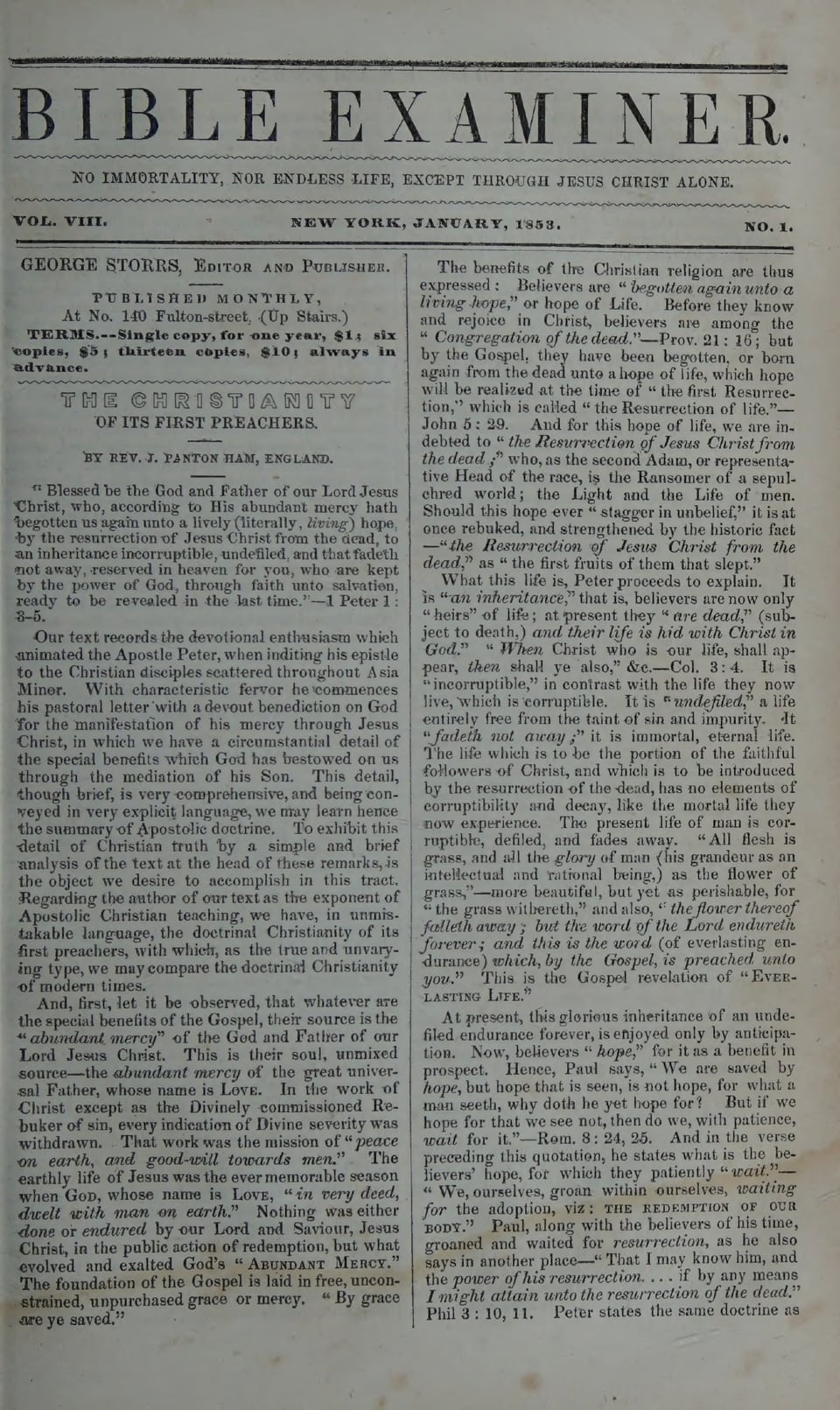
BIBLE EXAMINER.
NO IMMORTALITY, NOR ENDLESS LIFE, EXCEPT THROUGH JESUS CHRIST ALONE.
VOL. VIII.
NEW YORK, JANUARY, 1853.
GEORGE STORRS, EDITOR AND PUBLISHER.
NO.1.
PUBLISHED MONTHLY. At No. 140 Fulton-street, (Up Stairs.)
TERMS.--Single copy, for one year, 1; six copies, 5; thirteen copies, $10; always in advance.
THE CHRISTIANITY OF ITS FIRST PREACHERS.
BY REV. J. PANTON HAM, ENGLAND.
"Blessed be the God and Father of our Lord Jesus Christ, who, according to His abundant mercy hath begotten us again unto a lively (literally, living) hope, by the resurrection of Jesus Christ from the dead, to an inheritance incorruptible, undefiled, and that fadeth not away, reserved in heaven for you, who are kept by the power of God, through faith unto salvation, ready to be revealed in the last time."—1 Peter 1: 3-5.
Our text records the devotional enthusiasm which animated the Apostle Peter, when inditing his epistle to the Christian disciples scattered throughout Asia Minor. With characteristic fervor he commences his pastoral letter with a devout benediction on God for the manifestation of his mercy through Jesus Christ, in which we have a circumstantial detail of the special benefits which God has bestowed on us through the mediation of his Son. This detail, though brief, is very comprehensive, and being conveyed in very explicit language, we may learn hence the summary of Apostolic doctrine. To exhibit this detail of Christian truth by a simple and brief analysis of the text at the head of these remarks, is the object we desire to accomplish in this tract. Regarding the author of our text as the exponent of Apostolic Christian teaching, we have, in unmistakable language, the doctrinal Christianity of its first preachers, with which, as the true and unvarying type, we may compare the doctrinal Christianity of modern times.
And, first, let it be observed, that whatever are the special benefits of the Gospel, their source is the "abundant mercy" of the God and Father of our Lord Jesus Christ. This is their soul, unmixed source—the abundant mercy of the great universal Father, whose name is Love. In the work of Christ except as the Divinely commissioned Rebuker of sin, every indication of Divine severity was withdrawn. That work was the mission of "peace on earth, and good-will towards men." The earthly life of Jesus was the ever memorable season when God, whose name is Love, "in very deed, dwelt with man on earth." Nothing was either done or endured by our Lord and Saviour, Jesus Christ, in the public action of redemption, but what evolved and exalted God's "ABUNDANT MERCY." The foundation of the Gospel is laid in free, unconstrained, unpurchased grace or mercy. "By grace are ye saved."
The benefits of the Christian religion are thus expressed: Believers are "begotten again unto a living hope," or hope of Life. Before they know and rejoice in Christ, believers are among the "Congregation of the dead."—Prov. 21:16; but by the Gospel, they have been begotten, or born again from the dead unto a hope of life, which hope will be realized at the time of "the first Resurrection," which is called "the Resurrection of life."—John 5:29. And for this hope of life, we are indebted to "the Resurrection of Jesus Christ from the dead;" who, as the second Adam, or representative Head of the race, is the Ransomer of a sepulchred world; the Light and the Life of men. Should this hope ever "stagger in unbelief," it is at once rebuked, and strengthened by the historic fact —"the Resurrection of Jesus Christ from the dead," as "the first fruits of them that slept."
What this life is, Peter proceeds to explain. It is "an inheritance," that is, believers are now only "heirs" of life; at present they "are dead," (subject to death,) and their life is hid with Christ in God." "When Christ who is our life, shall appear, then shall ye also," &c.—Col. 3:4. It is "incorruptible," in contrast with the life they now live, which is corruptible. It is "undefiled," a life entirely free from the taint of sin and impurity. It "fadeth not away;" it is immortal, eternal life. The life which is to be the portion of the faithful followers of Christ, and which is to be introduced by the resurrection of the dead, has no elements of corruptibility and decay, like the mortal life they now experience. The present life of man is corruptible, defiled, and fades away. "All flesh is grass, and all the glory of man (his grandeur as an intellectual and rational being,) as the flower of grass,"—more beautiful, but yet as perishable, for "the grass withereth," and also, "the flower thereof falleth away; but the word of the Lord endureth forever; and this is the word (of everlasting endurance) which, by the Gospel, is preached unto you." This is the Gospel revelation of "EVERLASTING LIFE."
At present, this glorious inheritance of an undefiled endurance forever, is enjoyed only by anticipation. Now, believers "hope," for it as a benefit in prospect. Hence, Paul says, "We are saved by hope, but hope that is seen, is not hope, for what a man seeth, why doth he yet hope for? But if we hope for that we see not, then do we, with patience, wait for it."—Rom. 8:24, 25. And in the verse preceding this quotation, he states what is the believers' hope, for which they patiently "wait."—"We, ourselves, groan within ourselves, waiting for the adoption, viz: THE REDEMPTION OF OUR BODY." Paul, along with the believers of his time, groaned and waited for resurrection, as he also says in another place—"That I may know him, and the power of his resurrection...if by any means I might attain unto the resurrection of the dead." Phil 3:10, 11. Peter states the same doctrine as Paul; neither of these Apostles tells us of any hope or reward for believers, until the time of resurrection.
Thus in our text we are told that the inheritance is "RESERVED in heaven," and ready TO BE REVEALED IN THE LAST TIME;" and that believers, whether among the living or the dead, are now "kept by the power of God" until the time of their future "salvation." The faith of all who have "died in faith" has no acknowledgment, until "the appearing of Jesus Christ." In the state of death "they rest from their labors, and their works (the fruit of their faith) do follow them." There they slumber in undisturbed repose, until "all that are in the graves shall hear Christ's voice, and shall come forth;" when their works shall be "made manifest that they were wrought in God," and their faith shall receive the great reward. "Wherefore," says Peter, in the 13th verse of this chapter, "Gird up the loins of your mind, be sober, and hope to the end, for the grace that is to be brought unto you AT THE REVELATION OF JESUS CHRIST."
Now, this text is virtually Peter's Confession of Faith—the formally announced articles of his Christian Creed. We will arrange the separate doctrinal items of our text in contrast with the doctrinal articles of the so-called orthodox faith of our own times.
APOSTOLIC CREED Of the 1st Century.
—God saves us by His abundant mercy, through Jesus Christ.
Believers are begotten again unto a hope of life by the resurrection of Jesus Christ from the dead.
—The inheritance of believers is reserved in heaven, and ready to be revealed in the last time, at the revelation, or second appearance of Jesus Christ.
--The future life of believers is obtained by rising from the dead, at the time of Christ's second appearing, as "the resurrection and the life."
The expectation of believers is the second coming of Christ, to raise the dead, for "if the dead rise not, then they which have fallen asleep in Christ have perished." 1 Cor. 15:16-18.
ORTHODOX CREED Of the 19th Century.
God saves us by satisfy ing the inflexible demands of His justice, through Jesus Christ.
—Believers never needed a hope of life, since, in common with all men, they are immortal beings, and could never lose their life. Their hope in Christ is a hope of happiness.
The inheritance of believers awaits them in heaven, and is ready to be revealed as soon as they die.
4--The future life of believers is first enjoyed as bodiless souls, immediately after they die; and after this they have a kind of second future life, when their souls enter into their spiritual bodies at the time of resurrection.
The expectation of believers is, to go to glory when they die, as disembodied souls, and they do not believe they would "perish," even though there should be no resurrection!
Reader! "Beware, lest any man spoil you through philosophy and vain deceit, after the tradition of men, after the rudiments of the world, and not after Christ."—Col. 2:8.
THE PENALTY OF THE LAW.
BRO. STORRS :—In the last Examiner, "Veritas" says, "The mediation of the Son of God is necessary for the deliverance of Adam's seed from the penalty of the law, which is eternal death."
Now, as I am an "Inquirer," I should like to know how there can be any deliverance to man at all if "the penalty is eternal death." I apprehend our minds are not entirely divested of Babylonish garments, but that we are all more or less entangled in the old swaddling clothes. It does really seem
to me there is not, and in the nature of the case there cannot be any deliverance from the penalty of eternal death: "The wages of sin is death;"—and the wages of the sin of rejecting the gospel scheme of deliverance from death is "everlasting destruction," or "eternal death." But from this there is no deliverance, and can be none; for God's word cannot be set aside. If then "the penalty of the law" on "Adam's seed," for Adam's sin, was "eternal death," there could have been no hope for them, as God's law cannot be revoked; and a substitute could not deliver from such a death without perishing himself, so far as I can see. It seems to me "Adam's seed" were "subjected to vanity [or death] not willing [or from voluntary sin, like Adam] but by reason [or the choice] of him who hath subjected in hope,"—viz: of a resurrection. That is—whatever may be said of Adam himself, his seed were not under "the penalty of eternal death;"—hence there was hope for them, which would not have been the case otherwise. The sin, the penalty of which is eternal death, I do think, hath never forgiveness. John saith—"There is a sin unto death;" and adds—"I do not say that he shall pray for it." He also tells us—"There is a sin not unto death:" 1 John v. 16, 17.
I have expressed my objections to the foregoing statement of Veritas freely, for the sake of getting all the light I can on the law and the testimony, that blessed lamp God has given us. May we better understand it, and then I am sure we shall love its Author more. INQUIRER.
SUPPOSED STRONGHOLD Of the Doctrine of the Soul's Separate State.
BY REV. J. PANTON HAM, ENGLAND.
" Therefore we are always confident, knowing that while we are at home in the body, we are absent from the Lord; (for we walk by faith, not by sight:) we are confident, I say, and willing, rather to be absent from the body, and be present with the Lord."—2 Cor. 5:6-8.
The author of our text, in an epistle to another church, enjoins the following admirable practice, as becoming the Christian intelligence and piety of all believers:—"Despise not prophesyings: prove all things: hold fast that which is good." But alas! the history of Christianity—the religion of liberty, the friend of free thought and free utterance—has presented the painful spectacle of a systematic prohibition of prophesyings, and a forcible stereotyping of "all things," both bad and "good." Through long ages of spiritual darkness and despotism, the liberty of prophesying was, in the name of Christ and Christianity, denied to any but such as had received due authority from Pope or Parliament-made Bishops, which sacerdotal veto, indeed, like a mediaeval curiosity, is still exercised, both by Romish and Reformed Papists. And while the Christian liberty of prophesying has been denied by an unchristian priesthood, so also has the duty of welcoming the pious teacher, and giving respectful heed to his "prophesyings," been supplanted by a suspicious distrust of all "prophesyings" which have not the accredited seal of conventional orthodoxy. The chief proportion of professing Christians in our times, in manifest violation of the apostle's command, despise "prophesyings," as necessarily dangerous to the faith; "prove" nothing, instead of "all things;" and "hold fast" not only that which is good, but much that is false and mischievous.
Now the Apostle Paul evidently believed that theology is not a fixed, but a progressive science,—and that faithful and spiritually minded teachers and students of God's word, as "scribes well instructed unto the kingdom, bring forth" occasionally from this "treasure, things new and old." He bids Christian disciples, therefore, not despise prophesying, for by so doing, they may be closing their eyes to the light of new truth: but "prove all things; and hold fast that which is good." But the modern church believes that its opinions about the teaching of the Bible cannot in any respect be wrong—although but two or three centures ago its forefathers were slumbering, amid the superstitions, and bound by the spiritual slavery of Rome; and since the new light of the Reformation dawned, has scarcely made any progress in divine truth,—but is constantly going back to that twilight era, to learn its doctrines, and fix its faith.
Was then the Reformation so complete, that progress beyond that point was impossible? Can any be so infatuated as to suppose that the deep-rooted and wide-spread errors of Popery were so eradicated then as not to leave some corrupt germs in their full vitality and vigor? That the Reformation should have been thus complete is not probable, for it would have been a remarkable exception to the universal experience of human progress.
Why, then, should our faith in the orthodoxy of the living church be so implicit as to foreclose every devoutly independent inquiry into the teaching of the living word? The voice of God's word calls loudly for another and more advanced reformation. Let us heed its voice, as the supreme dictator in matters of faith and obedience. It bids us come yet farther away from the deadly superstitions of Papal and Pagan Rome. It tells the Protestant church that it is even yet occupying, to some considerable extent, a common platform with the great Papal apostacy. The Protestant doctrine of the soul's human personality and capability of a separate state as an immortal being, is not of Scripture, but tradition—claiming its parentage in the heathen philosophy, and affording a broad foundation for many Popish errors. On this belief the church of Rome builds its worship of the Virgin Mary, its invocation of saints, its purgatory and indulgences. The Bible bids us give up this mere human conceit, and profess a more thorough Protestantism.
But this will be disputed: and the text at the head of this tract is the supposed grand authority for disputing this assertion. I ask, then, the inquirer's candid attention to the exposition of this stronghold of the popular doctrine.
"Therefore, we are always confident, knowing that whilst we are at home in the body we are absent from the Lord. We are confident, I say, and willing, rather to be absent from the body, and to be present with the Lord."
It is readily allowed that this passage seems to teach the doctrine of the soul's separate state, and immediate felicity in that state. But this apparent instruction is to be attributed to the fact that such doctrines are so generally taught and accredited. Holding the traditional belief that the soul of man
is his personality, and is capable of existing independently of the body, it is natural to put such a construction upon this text as that which it commonly obtains. But I cannot think that the believers in Corinth, who had read and understood the Apostle's first epistle, could have so interpreted his meaning. Such an interpretation would have been in direct contradiction to the very clear and cogent reasoning contained in the 15th chapter of their first epistle. Let the text under consideration be taken, not, as is generally the practice, apart from, but in connection with, its context. The intelligent inquirer will ask, 'Of what is the Apostle discoursing in this part of his epistle? Is it his object to prove the separate state and immortality of the soul? Because, if this be not the subject of which he is treating, then, although his language may be made to express such a doctrine, such a construction cannot be fairly placed on his words.' In the chapter preceding that whence our text is taken, the apostle alludes to the perilous nature of his mission as a Christian preacher—"We are troubled," he says, "on every side, yet not distressed; we are perplexed but not in despair; persecuted, but not forsaken; cast down, but not destroyed; always bearing about in the body the dying of the Lord Jesus [that is, always resigned, like Jesus, to dying, in the fulfillment of duty], that the [obedient] life also of Jesus might be made manifest [imitated by us] in our body [or mortal life of probation]. For we which live are alway delivered unto death for Jesus' sake, that the life also of Jesus might be made manifest in our mortal flesh. . . . Knowing that He which raised up the Lord Jesus, shall raise up us also by Jesus, and shall present us with you. . . . For which cause we faint not." It must be apparent that the Apostle is here speaking of the encouragement which the well-grounded hope of a resurrection from the dead by Jesus Christ, gave him in the daily anticipation of losing his life in the preaching of the gospel. He knew that if his life were taken from him he should have another and more perfect life by means of resurrection. If it were not for this hope of rising from the dead, he would have no hope at all to sustain him in the prosecution of his perilous ministry. "Why stand we in jeopardy every hour," he asks this same church, in his first epistle, "if the dead rise not at all?" But he had this "living hope," and hence he commences the fifth chapter with a profession of strong faith in the survivance of mortality—not by living in a disembodied state, but by a resurrection from the dead in a new spiritual and immortal nature. "For we know that if our earthly house of this tabernacle were dissolved, we have a building of God, a house not made with hands, eternal in the heavens. For in this we groan, earnestly desiring to be clothed upon with our house which is from heaven: if so be that being clothed we shall not be found naked. For we that are in this tabernacle do groan, being burdened: not for that we would be unclothed, but clothed upon, that mortality might be swallowed up of life. Now he that hath wrought us for the self-same thing is God, who also hath given unto us the earnest of the spirit. Therefore we are always confident, knowing that whilst we are at home in the body, we are absent from the Lord: (for we walk by faith, not by sight:) we are confident, I say, and willing rather to be absent from the body, and to be present with the Lord.” The imagery—for the language is obviously figurative—is that of “an earthly house of this tabernacle,” which is condemned to be “dissolved,” and which was the Apostle’s appropriate image to describe the mortality of the creature man.
Man, the one complex being, is compared to an “earthly house,” or “tabernacle,” which will be “dissolved.” Nothing is here said nor implied about an immortal and essentially permanent part of man, which in its own nature is independent of this general and complete dissolution, which is most unaccountable, as on the popular supposition this immortal part is the human personality. The believer is here taught that he himself, in his one totality, not a part of himself, must be “dissolved.” But he knows that if like an “earthly house,” he must crumble in dissolution, he will be restored again in the beauty and durability of a “building of God, a house not made with hands,” but one that is “eternal in the heavens.” Here the two states of the believer’s existence are described by an “earthly house,” or “tabernacle,” which must dissolve, and “a building of God, a house eternal in the heavens.”—According to the popular interpretation of this text, Paul should have said, “We know that if our earthly house of this tabernacle were dissolved,—if, that is, our body were to be put off in death,—we have yet within us an imperishable soul or spirit which cannot be dissolved.” But he does not say this,—he does not say that we retain in ourselves anything which survives the dissolution of the “earthly house of this tabernacle.” What he says is, “If this present nature dissolves in death, we know that God has provided another nature, even an incorruptible and imperishable one—“a house eternal in the heavens”—which he will bestow upon us when he re-creates us by Christ Jesus at the resurrection.” “We know,” says Paul, that “we have [not an immortal soul, but] a building of God; [not an eternal soul within but] a house eternal in the heavens.” Paul is undoubtedly speaking of the two bodies, or conditions of human existence, to which he alludes in the 15th chapter of the first epistle,—“There is a natural body, and there is a spiritual body;” and hence he says in the second verse, “For in this we groan, earnestly desiring to be clothed upon with our house which is from heaven.” As if he had said, “While our bodily nature is under the power of dissolution we have no nature or being,—we in fact cease to be, and therefore, in the view of this dissolution, we groan for our new immortal nature—our house from heaven.” The Apostle evidently desired to be “clothed upon” with an eternal house, when this tabernacle or temporary house was destroyed. He makes not the faintest allusion to any survivance of mortality as a disembodied soul. He groans to be clothed upon, as he also says in another epistle, [Rom. 8:23,] “Even we ourselves groan within ourselves, waiting for the adoption, to wit, the redemption of our body.” “For we that are in this tabernacle [dwelling as mortal creatures] do groan, being burdened, not for that we would be unclothed [we desire not to die,] but clothed upon [with our eternal house from heaven, which is our resurrection nature], that mortality might be swallowed up of life.” “Therefore, we are always confident;” for we know that if on the one hand, as mortal beings, we must dissolve in death,—on the
other hand, as beings upon whom God has conferred, through Christ, the gift of immortality, we shall, when we are raised from the dead and receive our spiritual natures, live again as immortal beings "eternal in the heavens." "We are always confident" of this, and know "that whilst we are at home in the body,"—whilst, that is, we are existing as earthly tabernacles, mortal and perishable, "we are absent from the Lord," with whom we cannot be until we have put off our mortality—because "flesh and blood cannot inherit the kingdom of God,"—and have assumed our immortality; which will be when we are raised from the dead in our "spiritual body,"—our "building of God,"—our "house" which is "eternal in the heavens." "We are confident," I say, of so glorious a re-creation in Christ Jesus awaiting us; and are, therefore, "willing rather to be absent from the body," that is, from our "natural body,"—our present mortal and corruptible nature, which separates us from the Lord, and to be possessed of our "spiritual body," our new incorruptible nature,—in order "that we may be present with the Lord," which cannot be until the resurrection, when "mortality shall be swallowed up of life."
The Apostle desired to "be" present with the Lord, not as a disembodied soul, for he says, "not for that we would be unclothed;" and hence, in harmony with this desire, he says, "in this we groan earnestly, desiring to be clothed upon with our house which is from heaven;" and, therefore, since this "clothing upon," or re-creation of the human nature cannot take place until the resurrection, "when this corruptible shall have put on incorruption, and this mortal shall have put on immortality,"—his desire to "be absent from the body and to be present with the Lord," cannot be gratified, and he evidently did not expect it, from his reasoning, until the dead in Christ shall rise in "the first resurrection."
So far, then, from inculcating the doctrine that at death the soul of the believer is present with the Lord, this text forms part of an important passage in the Apostle's writings, in which he exhibits an utter disregard of such a doctrine, and declares that his own earnest longing was for the day of resurrection; when being "absent from the body"—having, that is, parted forever with his mortality—he should possess his new immortal nature, in which he should behold, and be forever "present with the Lord."
I leave, then, the teacher of the popular doctrine to explain this remarkable fact, that here (as in the two places which we have previously considered,) the Apostle says nothing of the blissful interval between death and resurrection—expresses no desire in reference to this interval; but as if impatient of it, he groans and earnestly desires to be "clothed upon" with his "house not made with hands, eternal in the heavens." The conclusion is unavoidable, that the Apostle Paul knew of no such a state of intermediate blessedness for the soul; the consummation of his wishes is thus expressed—"if by any means I might attain unto the resurrection of the dead."—(Phil. 3:11.)
Some, in their determination not to yield this, the citadel of their favorite dogma, endeavor to make something plausible of it by what is termed riding a metaphor to death. The figurative expression, "clothed upon," and "at home in," and "absent from the body," it is alleged, must signify something distinct from the clothing and the body.
That which is "clothed upon," and which is "at home in or absent from the body," is the immortal soul. Now this looks very specious; but admit it for the sake of argument, and it is obvious what a strange and unmeaning confusion of language the whole of this part of the chapter exhibits. Paul sets out with expressing the strong confidence which he and believers generally had in their triumph over mortality when they should receive their "building of God"—their "spiritual body"—their new condition of future life—which he had shown in the first epistle, will be bestowed at the resurrection. Groaning under the burden of a present mortality, he earnestly desires that the time may soon arrive when, possessed of his "spiritual body," "mortality shall be swallowed up of life." Until this clothing upon,—that is, until the resurrection,—it is obvious that mortality reigns,—it is not "swallowed up of life." But how does this instruction of Paul's agree with the popular belief that the immortal soul at death escapes from its prison-house of clay, and that at this moment
"There is a land of pure delight Where saints immortal reign"?
The Apostle is evidently at variance with the modern theology on this point, when he teaches that not until we are "created in Christ Jesus,"—invested with our "spiritual body,"—"clothed upon" by our "building of God,"—the grand result is accomplished, mortality is swallowed up of life.
Besides, on the supposition that the being "absent from the body" and "present with the Lord," refers to the immortal soul leaving its corporeal abode and ascending to God, how, I ask, does this statement follow as an inference from what the Apostle had been previously discoursing upon? Why does he preface it by a term which shows that it stands connected with the foregoing observations as a consequence, and say, "Therefore, we are always confident," &c? The substance of Paul's statement is that he earnestly desired the arrival of resurrection, that he might be possessed of his spiritual and immortal nature. What logical connection is there between this empathic desire, and the statement, that, when he died, his disembodied soul ascended to the presence of God? According to the exposition given above, the connection is obvious and natural; but such an exposition of the passage, the only possible one as it appears to me, gives a most decided contradiction to the doctrine which is so fondly andfurtively reared upon it.
But further, if we are to understand that apparent something which is clothed upon to be the spiritual nature or soul, then the Apostle plainly avows that he had no desire for this intermediate state; for he says, "Not for that we would be unclothed." Even with this gloss, his longing is for the "redemption of the body" at resurrection. Let it be noted, that according to this exposition, Paul does not pass over in silence the popular notion of an intermediate state of bliss, as in the true exposition of the passage as given above; he is made to affirm that he would rather not participate in it; he does not desire disembodied bliss,—"Not that we would be unclothed, but clothed upon, that mortality might be swallowed up of life."
Once more, if it be affirmed that the imagery of being "clothed upon" represents the popular notion of the soul as something within which is "clothed upon" with its "earthly house" or "building of God," then consistency demands that the doctrine of the soul's incorruptibility and immortality be forthwith discarded from the orthodox belief; for it is written "This corruptible must put on incorruption, and this mortal must put on immortality." This something within,—the soul, must put on incorruption and immortality, and is itself called "this corruptible, and this mortal." "So when this corruptible shall have put on incorruption, and this mortal shall have put on immortality, then shall be brought to pass the saying that is written—Death is swallowed up in victory."
The attempt to evade the proper meaning of the Apostle's language, does but involve the disconcerted polemic in greater perplexities, and in the end lead to his being entangled and taken in his own net. Candor must compel the acknowledgment that the very prevalent custom of quoting this text of Paul's for the purpose of teaching that he expected to be with Christ immediately at death, is most unwarrantable; a very gross and mischievous perversion of his meaning.
The hope which the Bible bids the believer in Christ cherish is the Hope of Future Life by means of Resurrection from the dead. The great importance of the doctrine of the resurrection in the Christian religion is shown by St. Paul, when he says that "if the dead rise not, then they which are fallen asleep in Christ are perished." And in one of his epistles he speaks of certain persons in his own age who denied the future resurrection, which denial, he says, "overthrew the faith of some." If there be no resurrection, then there is no intermediate consciousness for the dead in Christ; they "are perished;" and the denial of this doctrine was to altogether overthrow the Christian faith—because, if there be no future resurrection, then there is no life after death; no future life at all. Here, is at once apparent, how pernicious is the influence which the expectation of a state of bliss for the separate soul after death, has upon the doctrinal system of Christianity. The resurrection is comparatively forgotten, or at all events, is but little heeded by the Church of modern times. This great event is, by the general concurrence of Christian professors, regarded as very remote, as far hence in the history of the human race. In consequence, it has little practical influence upon the spiritual life of Christians, and is very rarely referred to in the modern so-called orthodox preaching. The reason is obvious, the church is anticipating a preparatory glory for the separate soul; and believing the soul to be essentially the human personality, it entertains but little thought about its companion in the grave.
Besides this, there is yet another and most serious evil resulting from, or at least fostered by, the unscriptural notion of the soul's separate state of happiness in death. The evil referred to is the general infidelity of the church on the subject of Christ's Personal Advent as an event to be daily looked for and desired by the faithful. Our Lord frequently urged his disciples to watch and wait for his coming, lest, coming suddenly, he should find them sleeping, and not actively engaged in his service, and anticipating his arrival.
The Apostolical epistles also exhibit the expectation of Christ's speedy coming as a grand motive to Christian faithfulness. When Christ comes again, it is to raise the dead Church to life, who will slumber in their graves, until they "shall hear his voice and come forth." The resurrection depends upon the second advent of Christ, who is "the resurrection and the life;" hence every Scriptural believer longs with Paul for the "redemption of the body," and that he may "attain unto the resurrection of the dead,"—and with John, utters the fervent prayer that his Lord may come quickly. "He which testifieth these things saith, "Surely I come quickly. Amen.
ing that ye have put off the old man with his deeds, and have put on the new man."—Col. 3:9,10. "Put on, therefore, . . . . bowels of mercies," &c. —Col. 3:12. "Put on Charity."—Col. 3:14. "He put on righteousness as a breast-plate, and a helmet of salvation upon his head; and he put on the garments of vengeance for clothing, and was clad with zeal as a cloak."—Isa. 59:17.
NOTE 2.—PROFESSOR HAGENBACH, summing up his historical sketch of the opinions of the Primitive Fathers on the soul and its immortality, thus writes, "The whole question, however, had more of a philosophical than Christian bearing, as the idea of immortality itself is abstract-negative. On
NOTE 1.—Very much, indeed all, of the obscurity of the passage under consideration, arises from understanding what are evidently but figurative expressions in a strictly literal sense. The popular interpretation of this ill-used text owes all its value to this great mistake. Expositors insist upon the phrases "clothed upon," "absent from," "at home in," being understood as strictly literal expressions, and hence they speak of that which is "clothed upon;" that which is "absent from;" that which is "at home in." And this something they maintain is the separate soul. Now the language of our text adopts the imagery of clothing, as most common and familiar to the ancient Hebrews, and it is manifestly to do violence to a law of writing and speech, to take figurative expressions in a rigidly philosophical and literal sense. Being "clothed upon with our house which is from heaven," simply
the other hand, the believer by faith lays hold of eternal life in Christ as something really existing. The Christian doctrine of immortality cannot, therefore, be considered apart from the person, work, and kingdom of Christ, and must rest upon Christian perceptions and promises." —History of Doctrines, vol. 1., p. 153.
"BIBLE VS. TRADITION."
We give the following extract from this work, on which Bros. Ellis and Read have expended so much labor. It is taken from the "Introduction," and will give some idea of what may be expected in the work, and shows that "the Baptists," in this country, are doing well in trying to bring about a new translation of the Scriptures. Let them do it, and do it with all the helps in their reach. The
signifies becoming possessed of the spiritual or immortal nature, without any reference to the manner of the possession. And so also "to be absent from," and to be "at home in" the body, does not indicate the manner, but simply the fact of mortality, or superiority over it by being immortalized. In Peter's second epistle, ch. 1:18, the Apostle thus writes—"I think it meet, as long as I am in this tabernacle, to stir you up, by putting you in remembrance; knowing that shortly I must put off this my tabernacle." On this passage the pious and learned Dr. Watts thus comments—"The soul or thinking principle of the Apostle Peter, which is here supposed to be himself, is so plainly distinguished from the tabernacle of the body, in which he dwelt for a season, and which he must 'put off' shortly, and most evidently implies an existence of this thinking soul, very distinct from the body, and which will exist when the body is laid aside. Surely the conscious being and its tabernacle or dwelling place are two very distinct things; and
views we hold will be strengthened by it, unavoidably.
REVISION OR NEW TRANSLATION OF THE SCRIPTURES.
The following clearly ascertained facts will show the necessity for a more thorough revision, or for an entirely new translation of the Scriptures, to supplant King James' version. The common version at present in use, was printed A. D. 1611. The only printed editions of the Greek Testament, which were in existence at that time were, Cardinal Ximens, printed in A. D. 1514, Erasmus, 1516, Stephens, 1546, and Beza, 1563, and editions that were printed from these. Nearly the same may be said of the O. T. The authorized version was not made from any edition whatever, uniformly. It is a somewhat startling assertion, yet an unquestionable fact, that although we have by public authority, a Standard English Version of the Bible,
dwelling place, are two very distinct things; and the conscious being exists when he puts off his present dwelling."—Essay towards the Proof of a Separate State. Here is an example of forcing a meaning out of the figurative terms by which a truth is illustrated; a method of interpretation which, if cast in a canonical form, the eminent Doctor would not for one moment have allowed. In proof of the incorrectness of the Doctor's exposition of the above passage, let the reader endeavor to interpret on his principle the following kindred texts, "Put ye on the Lord Jesus Christ."—Rom. 13:14. "As many of you as have been baptised into Christ, have put on Christ."—Gal. 3:27. "See-
TEXT, for the original of that version. What is called "The Received Text," is the text of Erasmus, who revised the Latin Vulgate, and compared it with the Greek Text. This edition was corrected by Stephens, Beza, and Elzivir, and was published by Elzivir, at Leydon, in Holland, A. D., 1624; that is, NOT till thirteen years AFTER the publication of the Authorized Version. In the compilation of his Text, Erasmus was only able to consult eight recent manuscripts, which manuscripts are now considered as of comparatively slight authority. These manuscripts were those marked 1, 2, 3, 61, and 69, and the MSS. 4, and 7, were used in part of his text, and only one in Revelations, all of which were written later than the 10th century.
The only manuscript from which he made up his text for Revelations, had several chasms, and because the last leaf was wanting, he translated the Latin of the Vulgate into Greek to supply these deficiencies. See March's Introduction, vol. 2, p. 846, and Penn's Annotations. Such is the origin of the Received Text. In these times the Reformation had not made sufficient progress to allow of the compilation of a correct Text.
The Received Greek Text, though compiled from eight comparatively modern manuscripts, is unsupported by any one manuscript, ancient or modern, and from recent developments, is now ac-
scribers, to embellish. Such are,—The woman taken in adultery; The descent of the angel to trouble the waters of Bethesda; The bloody sweat of our Saviour, and the angel strengthening him; and, The conversion of the dying thief upon the cross; all of which are supposed to be spurious. But, perhaps the worst of all these corruptions, is the transposition and omission of clauses of the verses in Mat. chap. 27, to conceal the essential fact, that Christ was truly slain by his enemies. The reading of the best manuscripts is, 50 v. "They offered him vinegar: but another going to him, pierced his side with a spear; and Jesus crying with a loud voice, expired." This passage of the piercing of Christ prior to his death, was condemn-
knowledged to be the very worst Greek Text extant, in a printed form. Since its publication, between 600 and 700 manuscripts have been discovered, some of which are very ancient, and very valuable. The best is marked B, the Cod. Vaticanes, of the 4th and 5th centuries. The second, marked A, the Cod. Alexandrinus, of the 5th century. The third, marked C, Cod. Ephrem, about the 5th century, and the fourth, marked D, Cod. Cantabujiensis, of the 7th century. The Received Text has not received the benefits of these, nor of the editions and collations of Mill, Wetstein, Matthei, London Polyglott, Bengal, Griesback, Bently, Birch, Knapp, Lachman, Scholz, and Hahn, for the N. T., nor of many of the most celebrated collaters of the O. T.
The first translation of the Bible into English, was made by Wiekliffe, wholly from the Latin Vulgate, in A. D., 1380. This forms the basis of all the English editions. Tundale published his
ed as late as the 14th century, by Popes Clement 5th and his successor John, because it conflicted with some of their notions respecting the Trinity. This shameful perversion is sufficient alone to condemn every edition in which it is contained.
Seemingly the best course now to be pursued, would be to adopt the principle of criticism recommended by Dr. Johnson, "For restoring the correct text of all ancient writings, whether profane or sacred." "Take the most ancient copy for the standard; to correct by authority, wherever it can be found; and to resort to conjecture, only where authority is absolutely and altogether wanting; observing always to hold a most rigid medium between presumption and timidity; by the former of which, we induce error upon truth, and by the latter, we consent to remain forever under the dominion of error, and in the power of chance, ignorance, or artifice."
This is the principle that has been adopted by
first edition in 1525. Between this and the Version of King James, in 1611, a period of only 86 years, four successive revisions were published by authority, as new stores of manuscripts were discovered; that is, one version was made on an average, every 22 years. Although in the 241 years since King James' Revision was made, a greater multitude of manuscripts, of greater value and authority than any before existing, have been discovered and collated, yet no subsequent revision has been made by authority. Still many will fondly cling to the common version, with all its errors and corruptions, and thereby help to conceal the precious truths which the providence of God has brought to light, and placed within the reach of the learned; but which are shamefully withheld from the community.
We are aware that sectarianism would suffer considerably from a correct translation. But what of that? The gain to the cause of truth and right-
Penn in his revision of " The New Covenant." He has chosen the entire text of the most ancient surviving manuscript, and which is likewise the most free from those interlineations and alterations, that disfigure and render suspicious, other manuscripts : This one is The Codex Vaticanus, or celebrated Vatican MS. noted 1209 in the Vatican catalogue at Rome, and marked B. by Wetstein, making it the basis and substance of his revision.
"THE FULFILMENT OF PROPHECY : or a Prophetic History of the World ; including a few suggestions on the probable termini of the Chronological Periods. By F. H. Berick and J. Couch."
Such is the title of a pamphlet of some 140 pages, sent us, we presume, by the authors. We have only had time to glance at its pages. We commend the spirit in which they have written. So far as we discover, it is free from that denunciatory spirit
eousnes would gloriously compensate. Indeed it may be set down as an axiom, that when the Scriptures are purposely corrupted to sustain any doctrine, that doctrine is presumptively false. No lover of truth tries to conceal her from himself. The "Bible Union" have convicted our translation of 20,000 errors, some indeed of small consequence. But the Scriptures have been purposely corrupted to sustain the doctrines of the "immortality of the soul," "the separate conscious existence of the spirit of man," "the eternal misery of the wicked," &c., as we shall make abundantly manifest in the forthcoming pages. Sometimes whole stories have been introduced, probably the opinion of the tranthat condemns all who do not see with them. We are glad to find they see, what we were condemned for maintaining seven years ago, that the Mahomedan power is clearly brought to view in the Prophecy of Daniel. We do not know that we should apply to that power all they do; but that it is clearly revealed there we have had no doubt for seven years. That Michael is Jesus Christ we do not believe; but we have no room to argue that point now, and our views of it may be found in the Examiner for '48, page 60. That the Austrian power is the head "healed"—having been "wounded to death"—we doubt; though that may be true, possibly.
That the Austrian Imperial is the "short space" dynasty, we do not eredit. That it is the beast that ascendeth from the bottomless pit, or abyss, we have no faith in; or that that power is the beast on which the woman—the harlot—sitteth when she goes to judgment, we cannot eredit with facts so clearly developed in another direction. The present Napoleon Dynasty looks much more like the healed head—though we do not say it is—and we are quite sure that Catholies in France and in Europe, generally, regard Louis Napoleon as the grand defender and supporter of the Catholic church, as such they extol, honor, and worship him.
In the view of definite time, for the advent, they advocate, we do not agree; though we are happy to say, they have expressed themselves upon it in a commendable spirit. We would be glad to see all writers on that subject manifest a like spirit: then should we have less bigotry and denunciation. Some who take the definite time theory denounce all who do not see as they do, and manifest anything but the spirit of the lowly Jesus. On a subject where so many mistakes have occurred surely modesty is becoming.
BIBLE EXAMINER.
NEW YORK, JANUARY, 1853.
BIBLE EXAMINER.—We now enter upon the Eighth Volume of our paper. The first two volumes were published at irregular intervals, from 1842 to 1847, and in the quarto form. January, 1848, we commenced it in its present octavo form, at fifty cents per year. The receipts, at that price, fell short of paying the printer's bill, and there was but one alternative, either to discontinue the paper or increase the price to one dollar. By the advice of friends we did the latter. This course has kept the paper alive, and for the last two years has paid the cost of the printing and given its editor about $200 per year for his labor in editing and mailing; all of which he has performed with his own hands for lack of funds to employ others. The number of paying subscribers has not exceeded about six hundred; though we have sent off, regularly, between seven and eight hundred copies. Our friends can easily see that we have to economize to get along at this rate; and we have no "Association" to sustain, or beg for us, if unable to go on ourselves. Our terms are payment in advance in all cases. We have, however, never refused sending to any one who has informed us that he was poor—wished the
paper—but could not pay for it at present. We have sent to numbers of such. Some of them have afterwards paid for it—others have not. We never send bills, nor duns. If we send you the paper without its having been paid for in advance, you need have no fear that we shall dun you for it. All papers are discontinued at the end of the year unless the advance pay has been sent; or with very rare exceptions.
If our number of paying subscribers could be increased to fifteen hundred, we would publish the Examiner twice each month, without increasing the price; as it is, we cannot.
We can still furnish complete sets of the Examiner, in sheets, from 1849. The volume for '48 is exhausted. For '49, the price is fifty cents. For '50 and '51 the same, per volume; or $1,50 bound in one volume. On the bound volume, 25 cents will be discounted to paying subscribers for 1853. Paying subscribers for '53 may have the volume for '52, in sheets, for 75 cents. None of '52 have been bound, and probably none will be unless specially called for.
The Examiner will be conducted as heretofore, with special reference to its motto—"No Immortality, nor Eternal Life, except through Christ alone." We shall occasionally speak on other topics, but this is the leading theme to which our paper is devoted. The passing events in Europe have led us to throw out a few hints in this number, the value of which our readers will judge for themselves.
PATRONS AND FREENDS.—We feel greatly obliged for the prompt manner in which many have responded to our call for early remittances for the present volume; and that their letters come with so many expressions of satisfaction and profit. We presume those expressions were intended for our private use, and we so appropriate them; even though it might be pleasant to others to share in them. We seek no public commendation; and where it has appeared, in other papers, it has been unsought by us, and a cause of humiliation, from a consciousness of unworthiness. We intend, through grace, to do that which we believe God and Truth demand of us. When that is done, it is often with so much imperfection that it gives us cause to mourn instead of exultation. "Brethren pray for us." May the Lord bless and comfort you all.
VISITING ABROAD.—It may be thought strange by some, why we should go a long distance-say to Buffalo, or other places as distant-and return home so soon. Why not, to save expense, visit several other places at the same time? Our answer is a plain one—We have no one at home who can attend to our monthly issue of the Examiner, or answer our letters and orders for Books, Tracts, &c.
We have not the means of employing any one to do this. Bro. Young, in whose Book Store we keep our office, very kindly waits upon those who call personally for works in our absence; but the pressure of his own business forbids his undertaking any more. Consequently, all letters sent have to remain unanswered till we return from abroad; hence to remain away more than over two Sabbaths at once, we cannot; unless we conclude to let our office and paper go to ruin. As it is, when we return, we sometimes feel almost at our wit's end to know what to do first.
If there was an income from the paper and office that would enable us to employ an interested person to take charge in our absence, it would be otherwise. My son, who is competent and willing, would have done this work for me; and on him might have been laid much of the burden which is now borne alone; but the lack of means has prevented this, and he has been compelled to seek employment in another city. Separated thus from him, all falls upon his father's shoulders, relating to the office and paper. We trust this reply will satisfy all.
"BIBLE VS. TRADITION."—The cost of the first edition of this work, if published, cannot vary much from 400. The pledges to aid, hitherto, have amounted to only about 60. We offered to risk one-half the whole amount necessary to publish it; and promised to return the funds furnished by others, if they desired it, so soon as the sales should amount to the cost of the first edition of one thousand. The help we ask amounts to a loan, with the risk of losing it, provided the work does not sell. But even then we will give you the books in payment at the actual cost of the edition. More than this we cannot promise. We believe the work will sell for enough to pay the cost: others may think differently. It is for those who have the funds to say whether it shall be published. We still wait to hear from them, believing that we have now discharged our duty in the matter.
"REVIEWER REVIEWED: A Dialogue; Being a Reply to Eld. J. G. Stearns, on the 'Immortality of the Soul,' by Geo. Storrs."
This work is now ready for delivery. It is a pamphlet of 36 pages,18 mo. Price, six cents single copy; $4 per 100. The matter of it will not be published in the Examiner. It has been gotten up by special request in a pamphlet. The expense
has been considerable in preparing and publishing it. We hope our friends will see that we are not pecuniary losers thereby. We trust they may think it worth scattering.
POSTAGE. The Examiner is subject to only half cent postage within the State of New York. Neither is it any more to a subscriber out of this State, provided the postage is paid quarterly in advance; and it is not necessary to do this, as was at first supposed, at the office where mailed, but may be done at your own Post Office.
Those who order Tracts sent by mail, should take at least eight ounces; otherwise each tract is subject to the same postage as if it weighed three ounces. If eight ounces are taken, and the postage pre-paid, they are chargeable half a cent only, per ounce. Do not forget this.
All pamphlets under three ounces go for one cent each, if pre-paid. This includes the "Six Sermons," 18 mo., and the "Unity of Man, by Anthropos;" which weigh only three ounces each. Another cent is added when not pre-paid.
Bound books are one cent per ounce, when prepaid ; or one cent and a half if not. We hope our friends will scatter much seed this year in the fields which wait for cultivation.
THE FRENCH EMPIRE.
The re-establishment of the Napoleon Dynasty in France, has opened a new chapter in prophecy, as clearly marking the time in which we live, as any event in modern history. The prophecy relating to this scene is found chiefly in Revelation 17th chapter.
In the prophecies of Scripture a beast is the symbol of a Dynasty, or Body of Rulers. It does not include the ruled, or subjects. To suppose this is to destroy the harmony of prophecy. The same dynasty may be, and sometimes is, symbolized by different beasts. The seventh and eighth chapters of Daniel are presented in proof of this. It is not our object now to enter further into that argument, but to show that the Napoleon Dynasty is symbolized in Rev. 17, and then briefly suggest its mission in this present development.
At the opening of that chapter one of the angels having the seven last plagues, called John to view the position the great harlot occupied when she was going to judgment; and he beheld her seated on a scarlet-colored beast, having seven heads and ten horns. That this harlot represents the Papal Dynasty, we shall not now stop to argue, as we consider that point long since settled. The corrupt body of rulers of that corrupt church appear supporting their power by taking refuge on the civil dynasty that is described by a scarlet-colored beast.
The description of that beast shows it to be a dynasty differing from any previous one. The Dragon, Rev. 12, has seven heads and ten horns, but has crowns on his heads. The first beast, Rev. 13, has the same number of heads and horns, but has the crowns on his horns. The beast in the 17th chapter appears with the same number of heads and horns, but no mention is made of any crowns; and yet it is shown to have a family relation by the seven heads.
The peculiarities of this beast are, that it is "the eighth, and is of the seven"—that "it was, is not, and VET IS;" and that it is, by ascending out of the abussou—the abyss. It had been in power—that power for a time is not; then, suddenly, it ascends from its non-existence and appears to the wonder of all except those whose names were in the book of life; that is, of all except the followers of Christ, for whose special benefit the prophecy was given; and who by a careful attention to the words of Christ are enabled to see the approaching consummation in the accuracy of the events fulfilling the prophecy.
In the information the angel gave John, he says, v. 10—"There are seven kings"—forms of government, or dynasties—"five are fallen, one is, the other is not yet come; and when he cometh he must continue a short space."
That these seven dynasties are all Roman, we believe, is nearly the universal belief of Protestant Christendom. The sixth, that was in power at the time John had the vision, was the Roman Imperial. Five forms of Roman government had fallen prior to that time. The Imperial was the one then reigning, and was to continue till "the short space" dynasty should arise.
We find the Imperial did continue down to 1806. After it was darkened in the western Roman Empire, just previous to the rise of Papacy, it still continued in the eastern, at Constantinople, till 1453. Before it fell in the east, it had been revived in the west, in the person of Charlemagne, A. D., 800; and continued unbroken in the Emperors of Germany or Austria till overthrown by Napoleon Bonaparte in 1806.
At this point we look for the "short space," or "seventh" dynasty. Accordingly we find Napoleon proclaimed Emperor of France and King of Italy; and assuming to be the successor of the Cæsars. Thus the seventh is developed. "It was"—but soon, "it is not;" and the world supposed it had disappeared forever. But, before forty years pass away, an "eighth" appears from the abyss, to the
wonder of the world; but this eighth is not another dynasty—it "is of the seven;" it is the same that "was"—then "is not"—and "yet is."
Nothing could be more accurate in its fulfillment than the prophecy in the Napoleon Dynasty; and when Louis Napoleon entered Paris on his return from his tour through France, to prepare the way for the proclamation of the Empire, some of the sentiments inscribed on the banners that graced his entry into the city, were such as this—"The uncle that was—the nephew that is." Thus employing the very words of the prophecy, though unknowingly to themselves.
For a time this dynasty "is not." When Napoleon I. abdicated, he did so in favor of his own son, Napoleon II. But that son never came to power—he "is not" a reigning portion of the dynasty: and the dynasty, itself, for near forty years, "is not." It then "ascended from the abyss," and now "it is!" Thus far all seems plain.
We next remark—That in ascending from the abyss, one of the first acts of the beast is to receive the great harlot to sit upon him. She takes her seat there just as the "judgment" is about to be executed upon her. Here again history and prophecy harmonize. The Papal power was driven from Rome, and was not likely to recover its seat. But the ascending beast sent his republican [!] armies to Italy, and the harlot takes her seat on, or by means of, that scarlet-colored beast, where she now sits; because, as yet, Louis Napoleon knows it is for his interest to let her sit upon—not guide—his dynasty. So long as he can use her for his own aggrandizement so long will he consent to let her sit as she does.
Thus far the fulfillment seems perfect; but we now approach the future. Here all we can do is to trace the outlines. There seems clearly to be "ten kings"—or small dynasties—who are to be united to the beast by a voluntary giving "their power and strength to the beast," v. 13. These are most likely to be the ten States or Principalities of Italy; who, from some motive of policy, will unite their interest with the Napoleon Dynasty; after which, by some means, or from some cause not yet developed, "the beast with the horns," [so the Syriac reads,] will come in collision with the harlot, and "eat her flesh, and burn her with fire." Let the Papal or Harlot power attempt to put bits in the mouth of this beast, or to restrain his ambition, and she will soon find she has been riding to judgment, and her destruction is certain and final.
Another event in the history of this dynasty and its horns is, they will "make war on the Lamb": consequently this "short space" dynasty will continue in power till the Lamb shall return to claim the kingdoms of this world.
…