The Bible Examiner — Vol. 8, No. 7 (July, 1853)
Download: PDF — The Bible Examiner — Vol. 8, No. 7 (July, 1853)
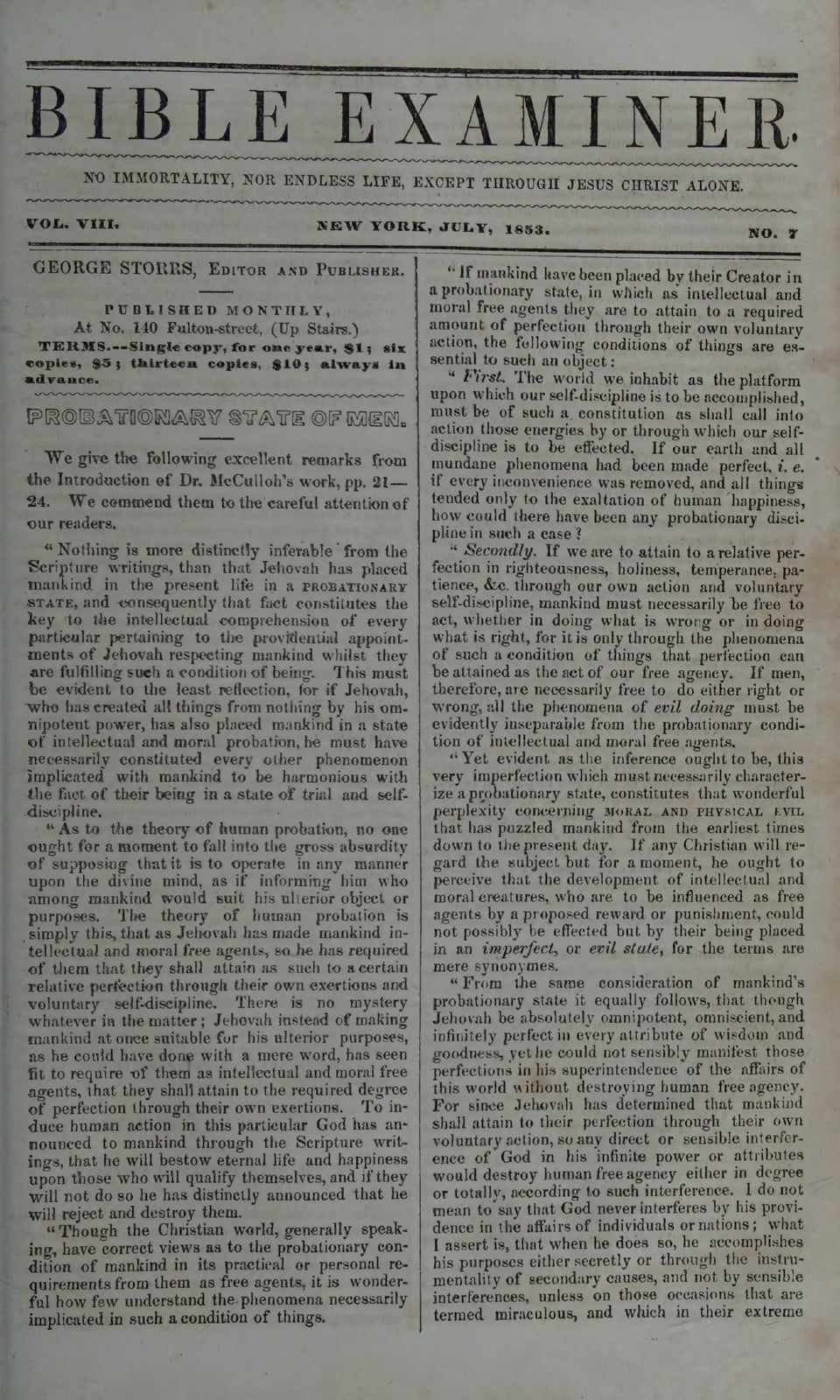
BIBLE EXAMINER.
NO IMMORTALITY, NOR ENDLESS LIFE, EXCEPT THROUGH JESUS CHRIST ALONE.
VOL. VIII.
NEW YORK, JULY, 1853.
NO. 7
GEORGE STORRS, EDITOR AND PUBLISHER.
PUBLISHED MONTHLY, At No. 140 Fulton-street, (Up Stairs.)
TERMS.--Single copy, for one year, 1; six copies, 5; thirteen copies, $10; always in advance.
PROBATIONARY STATE OF MEN.
We give the following excellent remarks from the Introduction of Dr. McCulloh's work, pp. 21- 24. We commend them to the careful attention of our readers.
"Nothing is more distinctly inferable from the Scripture writings, than that Jehovah has placed mankind in the present life in a PROBATIONARY STATE, and consequently that fact constitutes the key to the intellectual comprehension of every particular pertaining to the providential appointments of Jehovah respecting mankind whilst they are fulfilling such a condition of being. This must be evident to the least reflection, for if Jehovah, who has created all things from nothing by his omnipotent power, has also placed mankind in a state of intellectual and moral probation, he must have necessarily constituted every other phenomenon implicated with mankind to be harmonious with the fact of their being in a state of trial and self-discipline.
"As to the theory of human probation, no one ought for a moment to fall into the gross absurdity of supposing that it is to operate in any manner upon the divine mind, as if informing him who among mankind would suit his ulterior object or purposes. The theory of human probation is simply this, that as Jehovah has made mankind intellectual and moral free agents, so he has required of them that they shall attain as such to a certain relative perfection through their own exertions and voluntary self-discipline. There is no mystery whatever in the matter; Jehovah instead of making mankind at once suitable for his ulterior purposes, as he could have done with a mere word, has seen fit to require of them as intellectual and moral free agents, that they shall attain to the required degree of perfection through their own exertions. To induce human action in this particular God has announced to mankind through the Scripture writings, that he will bestow eternal life and happiness upon those who will qualify themselves, and if they will not do so he has distinctly announced that he will reject and destroy them.
Though the Christian world, generally speaking, have correct views as to the probationary condition of mankind in its practical or personal requirements from them as free agents, it is wonderful how few understand the phenomena necessarily implicated in such a condition of things.
"If mankind have been placed by their Creator in a probationary state, in which as intellectual and moral free agents they are to attain to a required amount of perfection through their own voluntary action, the following conditions of things are essential to such an object:
"First. The world we inhabit as the platform upon which our self-discipline is to be accomplished, must be of such a constitution as shall call into action those energies by or through which our self-discipline is to be effected. If our earth and all mundane phenomena had been made perfect, i.e. if every inconvenience was removed, and all things tended only to the exaltation of human happiness, how could there have been any probationary discipline in such a case?
"Secondly. If we are to attain to a relative perfection in righteousness, holiness, temperance, patience, &c. through our own action and voluntary self-discipline, mankind must necessarily be free to act, whether in doing what is wrong or in doing what is right, for it is only through the phenomena of such a condition of things that perfection can be attained as the act of our free agency. If men, therefore, are necessarily free to do either right or wrong, all the phenomena of evil doing must be evidently inseparable from the probationary condition of intellectual and moral free agents.
"Yet evident as the inference ought to be, this very imperfection which must necessarily characterize a probationary state, constitutes that wonderful perplexity concerning MORAL AND PHYSICAL EVIL that has puzzled mankind from the earliest times down to the present day. If any Christian will regard the subject but for a moment, he ought to perceive that the development of intellectual and moral creatures, who are to be influenced as free agents by a proposed reward or punishment, could not possibly be effected but by their being placed in an imperfect, or evil state, for the terms are mere synonyms.
"From the same consideration of mankind's probationary state it equally follows, that though Jehovah be absolutely omnipotent, omniscient, and infinitely perfect in every attribute of wisdom and goodness, yet he could not sensibly manifest those perfections in his superintendence of the affairs of this world without destroying human free agency. For since Jehovah has determined that mankind shall attain to their perfection through their own voluntary action, so any direct or sensible interference of God in his infinite power or attributes would destroy human free agency either in degree or totally, according to such interference. I do not mean to say that God never interferes by his providence in the affairs of individuals or nations; what I assert is, that when he does so, he accomplishes his purposes either secretly or through the instrumentality of secondary causes, and not by sensible interferences, unless on those occasions that are termed miraculous, and which in their extreme rarity distinctly shews that Jehovah does not sensibly interfere in the regulation of human affairs.
"The clear discernment of this necessary peculiarity as to Jehovah's non-intervention towards mankind during their probationary condition, is of all other principles the most important to be understood in estimating the true character of the Scripture writings, for without we comprehend his peculiar attitude towards mankind as creatures in a probationary condition, we shall be plunged into inextricable perplexities in consequence of our belief in his absolute omnipotence and omniscience. A single statement may be sufficient to convince the reader of the correctness of what we have just remarked. Among the many enactments of the Law of Moses are a number of minute regulations under the immediate sanction of Jehovah, that were calculated to preserve the Jewish people from being infected by the leprosy. All these regulations in themselves are apparently inconsistent with the infinite power or goodness of Jehovah; for it is immediately suggested to our minds, why, as being omnipotent, did he not exempt the Jews from the disease, or else inform them how it might be readily cured. It must be evident, however, from such a query, that if Jehovah was to manifest his omnipotence according to this requirement, he ought also to remove every other inconvenience, however trivial it may be, that pertains to our present condition. In other words, we would get rid of the very phenomena essential to a state of probationary self-discipline, for if all the inconveniences of human life were removed, in what would our probation consist?
"Again, in utter oversight of the circumstance that Jehovah, according to the Scriptures, requires mankind to attain to their perfection through their own voluntary action, the deists have objected, and many Christians have been perplexed to understand why mankind should be required to pray to God for things which he knows better than ourselves what is most suitable for us. The reason of the requirement is as plain as day light. Jehovah does not propose to make us to suit his ultimate purposes by the exercise of his omnipotence, he has left it to ourselves to become what we please, under the inducements of obtaining either an everlasting life, or of incurring an absolute rejection and condemnation.
"But though this great work is to be accomplished by ourselves, Jehovah has at the same time promised to help those who will pray to him, i.e. ask his assistance. Jehovah, therefore, will help men to attain to perfection, but he will not do their work for them; he assists them as far as they ask his assistance, and no further.* If God intended
to make men perfect by his omnipotence, he would not have placed them in a state of trial.
"The solution of all similar queries is to be found in the fact of our probationary condition. Jehovah in his wisdom and omnipotence has established a certain condition of mundane phenomena that are essential to, or harmonious with the probationary condition of mankind, and which are to continue permanently until his purposes shall be accomplished. We are therefore not to estimate his attributes or providence in the superintendence of earthly things by the standard of his absolute nature and infinite perfections, however much we believe in them abstractedly, but according to the peculiarities of the scheme through which he has determined mankind shall as free agents accomplish the development that he anticipates from their action as moral and intellectual creatures.*
count for this, as they suppose that Jehovah, in bestowing wisdom and skill upon Solomon, also prevented him by his grace, and therefore they are greatly puzzled to find that history essentially represents him as a worldly-minded, voluptuous man, who had little, and sometimes no regard towards Jehovah.
The simple truth of the matter is, that Solomon, notwithstanding the great intellectual discernment he received from Jehovah, was unaffected in his probationary condition by that circumstance, and was required to attain to moral perfection, like all other men, by personal self discipline. Now there is no evidence from the Scriptures to infer that Solomon ever sought grace or assistance from God to enable him to attain to righteousness and personal holiness. Jehovah, therefore, never operated on his heart, because Solomon never asked such help, and consequently he continued a merely intellectually wise or philosophical king, who availed himself of whatever was in his power for gratification; presumably on the ground that he only did what pertained to his royal prerogative. Solomon's history, therefore, I apprehend, shews conclusively, that although Jehovah may bestow all other gifts or endowments upon individuals, yet he never bestows the grace that leads to perfection in righteousness and holiness, but to those who seek that assistance from him by personal application in earnest prayer.
It was undoubtedly to this principle that Moses alludes, when he told the Jews, (Deut. vi. 16.) "thou shalt not tempt Jehovah thy God." In other words, that they must not anticipate any intervention of Jehovah whenever they might see fit to appeal to his omnipotence. They were to fulfil their duties under the appointments of existing phenomena, and must not expect that the circumstances under which they were placed should be dispensed with or modified, because Jehovah had the power to do so if he pleased. Our Saviour applies this text expressly to such a doctrine in his answer (Math. iv. 6, 7.) to the temptation proposed by Satan:
HUMAN MATERIALISM.
BY WM. GLEN MONCRIEFF, SCOTLAND.
The fact that human Personality in Scripture is associated with materialism, is one that ought not to be overlooked; moreover, it is one that an attentive reader of the Book may without difficulty confirm to his perfect satisfaction. No doubt this has been plainly manifested already, still, we think, an arrangement of a few passages, noting in them by italic types the words with which personality is conveyed, may furnish additional confirmation to those who have been impressed from the foregoing chapters with the corporeal or organic basis of personality in the Word, and be, as it were, a key to the understanding of all similar texts.
I. Personality is conjoined directly or indirectly with "dust."
Gen. 2:7, The Lord God formed man of the dust of the ground," &c. Compare with this, v. 22, "And the rib, which the Lord God had taken from man made he a woman,"&c.3:19, "Dust thou art,"&c.18:27, "Behold now, I (Abraham) have taken upon me to speak unto the Lord, which
selves." 8:23, "waiting for the adoption, to wit, the redemption of our body" (i.e. our redemption). 12:1, "present your bodies;" (i.e.yourselves). 1 Cor.9:27,"I keep under my body (myself) . . lest that by any means, when I have preached to others, I myself should be a cast-away." 15:44, "It is sown a natural body;" i.e. the men spoken of lie down in the grave soulical—"it is raised a spiritual body;" i.e. the men spoken of rise spiritual beings.
The Apostle is not speaking of the resurrection of bodies in the popular acceptance, as distinguished from souls or spirits; he discourses concerning the resurrection of men as may be seen
am but dust and ashes." Job 10:9, "Remember, I beseech thee, that thou hast made me as the clay; and wilt thou bring me into dust again"? 34:15, "Man shall turn again unto dust." Psalms 103: 14, "He remembereth that we are dust," &c. 146: 4, "His breath (of life) goeth forth; he returneth to his earth," &c. Ecc. 3:20, "All are of the dust," &c. 12:7, "Then shall the dust return to the earth as it was; and the spirit (of life) shall return unto God who gave it."
II. Personality is conjoined with "clay," and "blood."
Job 33:6, "I also am formed out of the clay." Isaiah 64:8, "We are the clay," &c. Acts 17:26, Hath made of one blood all nations of men."
III. Personality is conjoined, very frequently, with "flesh."
Gen. 6 : 3, "Man...is flesh." 6:12, "All flesh had corrupted his way." 6:13, "The end of all flesh." 9:11, "Neither shall all flesh be cut off
from the preceding part of the chapter, for instance, verse 18, "then (if Christ be not raised) they also (the MEN, and not parts of them) which are fallen asleep in Christ are perished;" and verse 22, "as in Adam all die (all the MEN he is speaking of), even so in Christ shall all (the same persons) be made alive." Hence he goes on in the next verse thus, "but every MAN in his own order," &c.
Gal. 6:17, "I bear in my body (i.e. person) the marks of (or for) the Lord Jesus." Eph. 5:28, "So ought men to love their wives as their own bodies;" (i.e. as themselves). Phil. 1:20, "Christ shall be magnified in my body (i.e. in me) whether by life or by death." 3:21, "who shall change our vile body (or self) that it may be fashioned like unto his glorious body." (or self). Heb. 10: 5, "a body (entire humanity) hast thou prepared me." 10:10, "we are sanctified through the offering of the body of Jesus" (i.e. through the offering of Jesus). James 2:26. "For as the body (the
any more." Numbers 16:22, "The God of the spirits of all flesh." Psalms 65:2, "Unto thee shall all flesh come." 56:4, "I will not fear what flesh can do unto me." 78:39, "they were but" (or only) "flesh." 145:21, "Let all flesh bless his holy name." Isaiah 40:5, "All flesh shall see it together." Jeremiah 17:5, "Cursed be the man that . . . maketh flesh his arm." 25:31, "He will plead with all flesh." Matthew 24:22, "There should no flesh be saved." Romans 3:20, "by the deeds of law there shall no flesh be justified." 1 Cor. 1:29, "that no flesh should glory in his presence." Galatians 2:16, "by the works of the law shall no flesh be justified."
IV. Personality is conjoined with "flesh and blood."
Matthew 16:17, "flesh and blood (man) hath not revealed it unto thee." 1 Cor. 15:50, "flesh and blood (man unspiritualized, see v. 44,) cannot inherit the Kingdom of God." Gal. 1:16, "I con-
man) without the spirit (margin, "breath") is dead." 3:6, "the tongue . . . defileth the whole body," (or person.)
POPULAR ASSUMPTIONS WITH BRIEF REPLIES.
I. It is asserted that thought is not a property of matter. If this means a table, a stone and an apple cannot think, we find no fault with the statement; but if it means that animalized living matter, for instance brain, cannot evolve mental phenomena, we ask the proof. Has the Creator said so? Is it a self-evident proposition that Omnipotence cannot cause animalized and organized living matter to judge, reason, love, and hate? When it is demonstrated that this is impossible, and, that it is impossible, nothing less than the testimony of God himself can be accepted as final proof, it will be time to pass on in quest of a second cause to explain the existing results, both, we may say, in relation to man and the lower animals. The phil-
ferred not with flesh and blood;" (i. e. with no man). Eph. 6:12, "we wrestle not against flesh and blood." Heb. 2:14, "For as much then as the children are partakers of flesh and blood (were men) he also himself likewise took part of the same" (appeared as a man).
V. Personality is conjoined with "body."
Psalms 139:15, "My substance (margin, body'—i.e.I) was not hid from thee when I was made in secret" (in the womb). Matt. 5:29, "not that thy whole body (i.e.person) should be cast into hell." 6:22, "the light of the body (person) is the eye . . . thy whole body (person) shall be full of light." 6:25, "nor yet for your body (person) what ye shall put on." Rom. 1:24, "to dishonor their own bodies (themselves) between themosophic rule of Sir Isaac Newton, in obeying which he made his grand physical discoveries, is most applicable here, "When one cause is sufficient to account for an effect, no more are to be admitted."
To all appearance, judging from the development of brain, and the corresponding mental functions or results,—from the facts of madness, either complete or partial,—from idiotey, and from the suspension of consciousness by pressure on the brain, and many other circumstances,—we say, judging from all these, there appears to be ground broad and firm, for the conclusion to rise upon, that thought, passion, desire, and the like, as naturally proceed from matter when it assames the form of brain, as perfume arises from it when it exists in the form of a rose, or galvanism when it coheres in the form and subject to the arrangements of the battery.
To all appearance this is the case, and, since it is the product of Heaven's power, it must be an infinitely wise ordination, and on our part it is the office of piety to acknowledge the device of his wonder-working hands.
In asserting that brain thinks, &c., in man and the lower tribes, we do not wish to be misunderstood, for, strictly speaking, it is not the brain of a man, but rather the living being man himself, that thinks and wills by his brain. A brain by itself, that is, disjoined from the human system of which it is only a part, cannot act in this way, any more than feet can walk, or lungs breathe, or ears hear,
self? When he uses the words "my soul" the phraseology is equal to I, as is detectable in the verse, "my soul," or I, "shall have no pleasure in him."
Men, it is again affirmed, will live for ever because they are spirits. Who has not heard the language, "a spirit cannot die?" Now we beg to answer, that the Bible no where declares man to be a spirit, and the same book never asserts that a spirit must live for ever. Angels are spirits, and who would suspend their duration on the order, or kind of being conferred on them, and not on the will, and power, and promise of the Supreme.
Men are in the image of God, and therefore
or a stomach digest; but if we rightly consider we will discover, as already suggested, that the proper view of the matter is this, that it is the creature man who walks by his feet, breathes by his lungs, &c.; and the being man is a compound of these organs, with many more, capable of executing the various mechanical, physiological, mental or cerebral functions, peculiar to his order of animated existence.
We are told man's spirit thinks. We answer, it is quite an assumption that he has a spirit such as he is supposed to possess; it is another that a spirit must be a living substance, and that, if even alive, thought must be among its attributes. Who, with an authority that we may not wisely and virtuously question declares that man's spirit thinks, and wills, and desires? When will the distinction be drawn between a man and the spirit of a man?—between the life-giving breath and the Breather?
It is asserted that the man and his outward
they must be spirits. Where is this laid down in the Book, from which, of course, it is professedly derived? So far from God making man a spirit, when he produced him in his image, the Record instructs us, he was formed of the "dust of the ground." Gen. 2:7, 3:19. As all Bible students know, we are never expressly informed in what this image consisted, and to assume that it was in the point of "spirit," or, what is no less common in that of immortality, is to do what the whole volume palpably condemns. Man is of "dust," and was at the very first merely a candidate for an eternity of being, as may be easily discovered by an unprejudiced examination of the arrangements in Eden, and the trial to which our first parents were subjected there. The language "image of God," in which man as man is still found (James 3:9, 1 Cor. 11:7), seems to have a primary special reference to the dominion which was to be exercised by him over the inferior tribes, like that
material parts are entirely different, as may be detected in the phraseology, my hands, my feet, my head, my eyes, &c.; the "my," it is affirmed, is the "spirit" on its throne within owning these as its organs or members, and this spirit is alone worthy of being called the man. Well, if this reasoning is solid, what originates the my, or what is it that says my, in the expressions "my soul, my spirit?" If the "my hands," for instance, prove these members do not essentially belong to the human being, but are, as it were, accidentally conjoined with him in the meantime, then the my soul and my spirit prove the same as to the popular "soul" and "spirit;" and if a man is not a corporeal agent, nor a soul, nor a spirit, what is he? Every orthodox believer in the common doctrine about the human spirit, uses parallel phraseology to that on which such stress is fallaciously placed, when he speaks, as every one must do, of his reason, his will, his imagination, his desire. How very absurd to demand is there a being different
which the Everlasting maintains in the boundless universe, for so soon as it is said, "let us make man in our image," it is added "and let them have dominion over the fish of the sea, and over the fowl of the air," &c. Gen. 1:26.
But whatever it may consist in, or however numerous may be its elements, it is demonstrable that it describes man not as a spirit, for he only has a spirit, being himself of the dust entirely; moreover it cannot lawfully be understood to intimate that he is immortal, since he has never been any thing else, in all the dispensations under which he has been placed, than a candidate for eternal life. One simple statement of what man is, and the position he occupies in the universe, is worth a thousand inferences drawn from the words "image of God," or a thousand conjectures as to what their meaning may be. Such direct intimations are abundant in the Volume, and they are to teach us in interpreting "image of God," what its import
from this reason, will, imagination, and desire, who yet owns them all, and employs them to gain his ends? If the evidence is good in the first case, it is equally powerful in the second. A little reflection, we respectfully submit, would convince most persons of the language we have presented being just that of a human agent announcing property in his own members, parts, faculties, and in himself. If we say my hands, we also say my-self. and the being who underlies the my is the same being who underlies and originates the self. It is in fact a "self" claiming property in a "self"—a man declaring himself to belong to himself. The divine being is an absolute unity, yet he says "my soul," and is not the soul of God, just, the Eternal himto acquire a satisfactory apprehension of its signification.
Matter is base, and gross—man must be more than that. Man, we beg leave to answer, is just what his Maker composed him of, and that is, "the dust of the ground," "He knows our frame, he remembers we are dust." This mode of characterizing our divine Parent's material production, seems to be neither wise nor reverential. Our vanity may lead us to entertain foolish ideas about forms and substances, to establish vast differences between material beings and spiritual beings,-the latter more correctly to be described as matterless nonentities,-but we ought rather to act in a sensible manner, and consult for his glory in our conceptions and language.
Gross matter! where find we such expressions in the Bible? "The earth is the Lord's, and the fulness thereof." Men speak of matter as if it was execrated by the Supreme,—as if it was a Satanic production, thrust, against his consent, into the empty kingdom of immensity,—as if it was charged with all sinful and loathsome attributes and influences. Through some most contorted philosophising, notions like these have been common in oriental countries, especially in India, from time immemorial; and many a heart-sick child of man, is at this moment toiling there in penance, enduring terrific self-maceration, and located, in dreary contemplations, under some verdant shade, perhaps beneath the scorching sun itself, endeavoring to modify the material conditions in which they find themselves, and vainly hoping in virtue of their deeds and sufferings, to pass eventually into the tomb of unconsciousness, the infinite depths of Brama's nature, by whom it is the quintessence of all privileges to be totally and eternally absorbed, as a bottle of water, when broken, mixes with and is lost in the ocean whence it had originally been drawn. The Indian devotees and fanatics are the genuine haters of matter, because they have been taught it is the fountain of all uncleanness; and man—whom they most orthodoxically hold to be pure spirit—is regarded by them as defiled in consequence of his wretched marriage with it in the form of fleshly organization. From these wonderful climes the dogmas about souls and spirits, and the detestation of innocent tangible substance, have flowed over the western regions of the globe, both in ancient and modern periods. We trace the eastern conceit, concerning the sinfulness of matter, denying the "flesh of our Lord;" hence the anxiety of John to demonstrate that he "came by water and by blood"—that he was no shadowy being, as the Docetae asserted, but an actual brother in the common organized humanity; we see it pervading the Romish Church, originating the institution of priestly celibacy, and leading deluded multitudes to ignoble self-torturings and deprivations; amongst ourselves we also find it, in a reduced form no doubt, yet really pervading the whole of society, for the mention of materialism excites horror in the most of minds. Let us cease to misrepresent and malign our Father's works; let us begin to acknowledge that, as far as man is concerned, the Scripture is the grand patron of materialism, for each member of our race is of "dust," and his "spirit," which has been so inordinately magnified, almost into divine qualities and proportions, is but a very humble, yet unspeakably useful, element—the ordinary electrified air of heaven.
We are what the Almighty has made us. To persist in cavilling at what lies at the foundation of our being is folly and impiety. Matter it is; but matter mysteriously, and often sublimely, endowed. The Quarterly Review lately asserted that "Chemically speaking a man is forty-five pounds of carbon and nitrogen diffused through five and a half pailsful of water;" common-place elements no doubt, yet how combined, vivified, enriched with diverse and inexplicable forces with which we are well acquainted;—forces of voluntary and spontaneous movements, forces of thought and will, passion and desire. Chemically, man may be so much carbon, nitrogen, and water; but so much carbon, nitrogen, and water, is not a man, and there
is the immense difference. The Venus de Medicis, the statue that "enchants the world," is only a quantity of common white marble; yet it is marble touched and shaped by the chisel of genius, and he would be esteemed an imbecile who, while gazing on that creation, should exclaim, "is this the marvel of art, just so many pounds of ordinary marble?" The "Last Judgment" of Michael Angelo is, in one view, so much canvas, and so much paint, the value of which, in themselves, is very trifling; but then, O reader, observe, so much cloth, and so much color, would never form that awful painting; and he would pass in society as bordering on idiotey who would, when ushered into the presence of that great work, utter in derision, "what a noise to make about so many square feet of canvas, and so many ounces of oil and coloring substances?" It is not the materials, friend, one might whisper to him; it is what the mighty genius of Angelo, the Milton of painters, has accomplished with them; they are cheap and vulgar in themselves; they have been dignified beyond expression, however, by his magic pencil. Look out on a gorgeous sunset, and, as you contemplate the spectacle, think that it is merely so much vapor, penetrated by the rays of the declining orb; and what reduction from the magnificence and the pleasure does that lowly fact create in a sensitive mind? What cares he,—what, we may aver cares any one, about the elements at the foundation of the excelling vision? It is all, chemically speaking, easily understood and expressed; the effect, nevertheless, of the union, and position, and changes of the elements is divine indeed, and each eye, not utterly imbruted, kindles as it views the drapery, and the isles, and the halls, and the climes of beauty, delineated on the evening sky. There we see the Infinite Artist producing his visions of thrilling grandeur, and he may employ what elements he pleases. And now let us ascend to a higher field in creation, where we encounter the phenomena of life and mind. A man looks through a microscope, and sees the millions of animals sporting in a drop of water; he beholds in that singular world thought, and will, and desire, and love, and anger, on a reduced scale, and what though each creature itself is substantially nothing more than an atom of carbon, and an atom of water? True; it really may be no more; still it is this minute portion of matter endowed with such wonderful properties, that a resemblance is discoverable between the animalculi and the grandest mentalization in the universe. Orthodoxy sees in the case of these diminutive beings, no immaterial and perpetual spirit urging on the vile organization; at bottom these denizens of the drop of water are of vulgar elements, yet the elements are ennobled by life and undeniable mental functions. Again, consider the dog, the bee, the horse, and the beaver, for the same remarks are applicable to them. What though the creature in each case is of common materials,—carbon, nitrogen, and water,—look at its attributes, such wisdom, skill, discernment and kindness; and yet few imagine all this demands, as its explanation, the presence of a mysterious, immaterial, and deathless spirit. Matter in their case is wisely deemed, by enlightened physiologists, enough; and to a thinking individual it affords little concern what these beings are constructed from; it is with the various phenomena displayed by them, that his thoughts are attracted and his curiosity
HOLBROOK LIBRARY
PACIFIC SCHOOL
OF RELIGION stimulated.
Only ignorance, to our view, as pitiful as it is profound, would, on considering the powers and excellences of these inferior tribes, give expression to the complaint or the derisive exclamation, "a few ounces, a few pounds of matter, and is that the whole!" No; it is not all, if he would more narrowly examine the point, for it is matter, by the wonderful energy of Omnipotence, gifted with astonishing capacities, evolving mental manifestations, in many instances of a high and interesting character. Once more, to make a last supposition, let us imagine an archangel subjected to chemical analysis, and that he is found to consist of but very common elements, similar to those detected in the composition of a human being. Shall we despise all he has ever said, and thought, and done, on that account? The lofty conceptions, the profound discoveries, the songs of transcendent excellence he may have composed and uttered, the emotions of love and piety that rose for ages, like a tide from the depths of his heart, shall we despise all these? Shall we underrate the worth of his being, especially the exalted dignity of his character, which stood forth, like a mountain clad in celestial beauties,—because the materials of his constitution are discovered to be cheap and abundant? The sunset is ravishing though but light and water: he is glorious in virtue of what had been evolved from a combination of material elements endowed with forces so overwhelmingly sublime. If matter could do the whole, what more could spirit, even with its fancied virtues and adaptations, be made to produce? we say made to produce, for even it would be a material, a something, in the hands of the Creator, who would require to furnish it with the capacities it was destined to evolve. These remarks proceed on the supposition that there is such a thing as "spirit," after the popular belief, and an attenuated affair it is; whereas the Scriptures most clearly understand by created spirit, nothing more at best than refined matter; the one element, or the material atoms, pervading immensity, moulded into the various objects, inanimate and living, appearing on its plains. Man is matter, we are of the dust, and that such unpromising elements, as they appear to our eye, can be so combined, and quickened, and strung, and endowed, as to generate all we feel, and see, and know, from consciousness and observation, betokens His might, and skill, and love, who is "wonderful in counsel and excellent in working."
(To be Continued.)
THE JUDGMENT.
BY THE EDITOR.
Much has been said and written on this subject; but we fear a large portion has been "words without knowledge," and that no really definite and practical ideas have been the result. The general notion of the judgment is that of a great assize or court, at which the entire race of Adam are to be assembled in one vast concourse, and that each individual case is then and there to be examined, and all the thoughts of his heart, actions of his life, words of his lips, as well as the motives which have governed him, are to pass in review, and his case be decided upon the evidence then appearing, after which the sentence is to be pronounced, and the execution to follow.
Against this view there are great and (with present light) insuperable objections. In presenting them, however, we are aware, we shall have to encounter an almost impassable barrier in the minds of many sincere souls who have had the common notion interwoven in all their religious thoughts and instructions.
Far be it from us to approach such time-honored sentiments with rude hands, and far from us be the wish to unsettle any mind in such a cherished idea, unless we can offer them a more scriptural one, and one that shall be more practical in its influence upon their hearts and lives. Believing, however, that it is possible the popular view may be erroneous, if not pernicious, in its influence, we shall proceed to state some objections to it, and then see if the Scriptures do not warrant and require a different view of the subject.
To the correctness of the view generally entertained, we suggest, first, an objection as to the time necessary to such a procedure. We are not to rush upon a conclusion blindly: and it is doubtless true that not one in a thousand, ministers or people, ever have exercised their thoughts on the time that must be occupied to conclude the judgment, if the popular theory be the true one.
The position we are to occupy on this subject, is not that of a dogmatist—or positiveness—but of investigation, to find, if possible, the truth on a subject of such absorbing interest to every serious and reflecting mind.
THE TIME necessary to an examination of each individual case, in the formal manner expressed or implied in the common theory, is an insuperable objection to it.
As to the number of the human family, it is impossible to arrive at any thing like certainty; yet we are not of those who suppose the number has been so great that they could not all stand upon the globe at one time, as some have affirmed. For a basis of calculation, we will suppose that one generation of the world lasts thirty years. This would give 200 generations in 6000 years. We will now take the present number of the inhabitants of the globe (eight or nine hundred millions) as the number to represent each generation; though it will be seen that this most likely gives us too many. Eight hundred millions multiplied by 200, (the number of generations from Adam to the end of 6000 years), will give us one hundred and sixty thousand millions (160,000,000,000!) as the sum total of the human family to be judged, provided the judgment is to occur at the close of the 6000 years. Now, let us allot some specific time to the examination and decision of each individual case, on the supposition they are to be judged in succession—that is, one after another.
Allow one second to each individual, and six thousand years must be taken up in the process.
Allow one minute to each case, and three hundred and sixty thousand years are necessary.
Give one hour to each, and twenty-one millions six hundred thousand years are required. (21,600,000 years!)
Let one day be the time for each case, and near eight thousand millions of years will be necessary to complete the judgment. (8,000,000, 000 of years!)
We do not affirm such a period will not be occupied in the judgment, but it certainly looks doubtful when the Scriptures seem every where to speak of the speedy execution of the sentence of the judgment on the return of Christ.
There seems only one way to avoid this protraction of the judgment, and that is to suppose that the examination of all, or of large numbers, is proceeding at one and the same time. This indeed is possible, but then it breaks in upon the notion that each individual case is to be examined before all and exposed to all the race of men.
If we reduce the number to be examined and judged to one-half our estimate, as likely we may in truth, and then allow only one hour to each case, at least ten millions of years would be necessary to complete the judgment, and before sentence could be executed; or a period about sixteen hundred times as long as it has been since Adam was created.
Notwithstanding this seemingly insurmountable difficulty to the common theory, if the Scripture positively affirmed such to be the process of judgment, we would bow to its testimony; but we may find it does not, and we are therefore at liberty to search to see if some other view of the judgment is not the true one.
In addition to the foregoing objection, we urge another on the attention of those who believe the righteous will have a priority, in time, in the resurrection, whether that time be one hour, one day, one year, or a thousand years.
How is it to be known who are to have part in this favored class, if all in their graves have not been judged before the resurrection begins? Are the righteous to be raised, and then the process of judgment to be instituted, to see whether the Searcher of hearts has made a mistake? Or, are they to be tried, undergo an examination after their resurrection, as if suspected characters? Can we adopt either of these positions? If not, must it not be manifest that they had been judged before being raised? And why are they raised, and not the wicked at the same instant, except the wicked also have been judged, and found not worthy to have part in this prior, or "first resurrection?" If these things are so, then we are brought to the inevitable conclusion that the judgment, in which character and doom is decided, is at some period prior to the resurrection. This, let it be remembered, is not saying there is not a judgment—yea, "a great day of judgment,"—at, or immediately upon, the resurrection; but the nature of that judgment will be a subject of inquiry as we proceed.
Before going farther, we will endeavor to find out the meaning of the terms judge and judgment. They are variously applied in the Scriptures.
Judgment, in its most simple form, signifies the act of judging, or, the process of examining facts and arguments, to ascertain truth, propriety and justice. It also signifies the determination of the mind, or the conclusion the mind has arrived at from an examination of things presented to its consideration. It is sometimes put for the spirit of wisdom with which a person is endowed. Sometimes it signifies the statutes, or laws and testimony of God. This is often the case, as in Psa. 119. It is applied to remarkable calamities inflicted upon communities and nations. Also, to judicial decisions, and to the execution of the sentence following trial and conviction, or acquittal.
These are the general ideas contained in the terms judge and judgment. There are judicial judgments on individuals, communities and nations. The Lord told Abraham He would "judge that nation," who were to "afflict" his seed "four hundred years." The process of judgment is definitely recorded in Exodus. Not a personal appearance of Jehovah to the persons judged; but he tested them,—that is, the rulers of Egypt, by his servant Moses, and gave them sufficient evidence to have led them to regard his demand, to "let Israel go," if they had not persisted, through their covetousness, to hold those whom they had enslaved. The demands of Moses, and the evidence he exhibited, in the name of the God of the Hebrews, was the judgment process that was to decide the doom of Egypt, or her Princes. Then follows the executive judgment, or the judgment carried into execution; and the Lord said, as the deciding judgment was drawing to a close, "I will pass through the land of Egypt this night, and smite all the first-born in the land of Egypt...and against all the gods [princes] of Egypt I will execute judgment." The executive judgment commenced that night, and terminated, or was completed, at the Red Sea, when Pharoah and all his princes were destroyed. This was judging a nation, or rather her body of rulers. The principle, we apprehend, is here brought out, that the judgment is constituted or made up of two parts, viz.: the investigating judgment, and the executive judgment. The one precedes the other. The first goes on while in a state of trial, and when the trial closes, and the evidence or testimony is all elicited, the sentence is passed; the executive judgment follows after at some fixed period. We might illustrate this view with several other examples from Scripture, but we judge this is sufficient for the present.
The christian belief in the second century, concerning the state of the dead, is thus set forth by Dr. Gieseler:—"Till then (viz., the "first resurrection") the souls of the departed were to be kept in the under-world (hades), and the opinion that they should be taken up into heaven, immediately after death, was considered a Gnostic heresy."—Eccles. Hist., vol. I, p. 167.
A BEAUTIFUL SENTIMENT.—The late eminent Judge, Sir Allan Parke, once said at a public meeting in London:
"We live in the midst of blessings, till we are utterly insensible of their greatness, and of the source from whence they flow. We speak of our civilization, our freedom, our laws, and forget, entirely, how large a share is due to Christianity. Blot Christianity out of man's history, and what would his laws have been? what his civilization? Christianity is mixed up with our very being, and our very life; there is not a familiar object around us which does not wear a different aspect, because the light of Christian love is upon it—not a law which does not owe its truth and gentleness to Christianity—not a custom which cannot be traced in all its holy, beautiful parts, to the gospel."
"The Cross of Christ."—The second number by Br. Ham on this interesting subject we have been obliged to lay over till next month.
BIBLE EXAMINER.
NEW YORK, JULY, 1853.
"BIBLE CONVENTION."—Such was the name of a Convention called at Hartford, Conn., June 2d, by Andrew Jackson Davis—the great clairvoyant, and leader in spirit manifestations—and others. The call was of some weeks standing in the New York Tribune, and also in other papers. It professed the determination to examine the authenticity of the Bible, &c., and to give the believers in it a full share of time to defend it, if they could. It was manifest that the call was gotten up with the deepest hostility to the Bible; and we cannot help the suspicion that the design was to overthrow its divine authority, and then to establish "spirit rappings," or "spirit manifestations" on its ruins.
We had no idea of attending that Convention, but through the earnest solicitation of Br. Miles Grant, of Winsted, Conn., we at last consented to go, two days before the time appointed for the meeting. We did not arrive till after the morning session of the first day. Most of the first day was occupied by the opposers of the Bible; though Br. Joseph Turner, of Hartford, and myself occupied a part of the time. Near the close of the first day a resolution was adopted giving the stand alternately, for forty minutes, to the speakers on the different sides of the question. This seemed fair, but as the sequel will show was not adhered to by the AntiBible party. Still we were not disposed to complain, only we wished the fact to be known.
A long string of charges was brought against the Bible, by the Chairman, Joseph Barker, of Ohio, recently from England, and formerly a Methodist preacher—in which he attempted to make out that the Bible sanctioned all manner of crimes, &c. He was followed by Henry C. Wright, formerly a Congregational minister; once a Non-Resistant and Peace man, but now an opposer of the Bible. He opened with the following resolution :
"Resolved, That the Bible, in some parts of the Old and New Testaments, sanctions injustice, concubinage, prostitution, oppression, war, plunder, and wholesale murder; and, therefore, the doctrine of the Bible, as a whole, is false, and injurious to the social and spiritual growth and perfection of man."
This resolution opened the battle in earnest. We took the stand and remarked, that when any person was accused of crime the law by which he was to be tried should be distinctly stated and known; else how is it to be known whether he is guilty or not. We demanded, therefore, the law by which the Bible was to be tried. This inquiry was approved by Mr. Wright, and he undertook to define the law, which seemed to be very indefinite, as it
was the sense of right every man had in himself. As the definition was unsatisfactory, he was pressed for something more definite. After much time had been spent in this inquiry, we asked Mr. Wright, if we were to understand him that the law under which the Bible was to be tried, on his charges, was "Natural Religion, the Theology of Nature, or the God of Nature?" To this he answered distinctly—"Yes." We thanked him that he had at last given a definite law, and here we joined issue with him, and those on his side of the question. We showed that, tried by this law he could not condemn the Bible, even if it sanctioned all he had charged upon it: for the God of Nature swept away, by "wholesale murder," whole cities by earthquakes, laying them desolate in a moment: by floods he overwhelmed various parts of the land, "robbing" the laborers of their hard toil: by pestilence, cholera, &c., he inflicts the most terrible sufferings and distress: that the God of Nature, for aught can be made to appear without the Bible, "sanctions injustice, concubinage, and prostitution," inasmuch as these practices prevail where the influence of the Bible is not known. We affirmed, therefore, that the Bible, or the God of the Bible, tried by the law as defined by the opposers of it must be acquitted. Mr. Wright made a faint effort to clear his God of Nature from the charge of "wholesale murder;" and said, he "denied that the God of Nature ever did send an earthquake to kill anybody—earthquakes were natural omens; and if men had not got in the way of it they would not have been killed," &c.
We replied to him, that his "natural omens" were the natural actions of his God of Nature! and when this God of Nature knew that his "natural omen" would pass along that way he gave the innocent inhabitants of the city, who had never sinned against him, no notice of his intention, but came upon them suddenly and overwhelmed them in ruin. Whereas, the God of the Bible, when about to destroy the wicked inhabitants of Canaan, who had planted themselves on a land which the Most High had given to the children of Israel when he divided the earth among the inhabitants, gave them "forty years" notice of his determination to put Israel into the land he had given them; and confirmed the truth of his purpose in the matter by the astonishing works he performed for Israel in Egypt and in the wilderness: so that the God of the Bible was better than his God of Nature, and could not be condemned by the law specified.
Mr. Wright said, "the God of the Bible commanded Abraham to butcher his son;" and added— "I have been asked if I would do such a deed if God commanded it?
No! I would cut the throat of such a God." Mr. Wright uttered this with terrible emphasis.
We replied, that when our friend Wright was a follower of Jesus he was a peace man, but now he seems changed into a war man: that then he was a non-resistance man—would not use violence if a man was to injure his family in any way; but now he is for blood: yes, if only commanded—not compelled—to kill his child he would "cut the throat of such a God!" We denied that God commanded Abraham to "butcher his son;" and when Abraham put forth his hand to take the knife God commanded him not to do it. We affirmed that Mr. Wright's God of Nature had not only commanded, but compelled tender mothers to kill and eat their children, as in cases of siege and famine in cities. We called upon friend Wright to cut the throat of his God, for he was a far worse God than the God of the Bible, even if the former were as bad as he had charged. Besides, his God of Nature gives no revelation of reasons for his murderous conduct; while the God of the Bible does inform us of another life and the reasons of the evils of this.
Mr. Wright maintained that the God of Nature took men to a better state or condition when they die. He had however only one proof to offer on this point, viz: "The caterpillar turns to a butterfly:" ergo, a man at death is transformed in like manner.
This wonderful illustration we have heard urged so many times, in seeming triumph, that we thought best to show its fallacy, and remarked that in the case of the caterpillar life never was extinct: penetrate his habitation and extingush life and see if a butterfly ever appears: never. And the butterfly—where is its transformation at death? there it lies upon the earth, and returns to dust. This marvellous illustration of what the God of Nature does with man at death is evaporated, and proves nothing of his hereafter. No, the God of Nature gives not one ray of light on that period beyond this life.
Mr. Wright had spoken in the most unmerciful manner of the Levitical priesthood and its institutions, calling them "a contemptible foolery;" and then proceeded to make some criticisms on the teaching of Jesus. To show how faulty Jesus was, he quoted Mat. 5:27,28—"Ye have heard that it was said by them of old time, thou shalt not commit adultery: but I say unto you, that whosoever looketh on a woman to lust after her hath committed adultery with her already in his heart." That is, said Mr. Wright, "If a man desires a woman for a wife he has committed adultery according to Jesus!"
We must say we were shocked at such a glaring perversion of words; and at such an attempt to pour contempt on Jesus the Life Giver. In reply we first read an extract from Lord Bolingbroke, which Dr. McCulloh has quoted in his "Proofs of Credibility of Scripture Writers," vol. 1, page 240. Dr. McCulloh says:—
"Lord Bolingbroke, however inimical to the theory of the divine constitution of Christianity, has not hesitated to render the clearest testimony to its excellent morality, as the following extracts from his writings abundantly show. And his observation on the subject of theological teaching, not only is creditable to his discernment, but does justice to the actual merits of Christianity, which most other deists have endeavored to confound with false teachings of men."
The following are the extracts Dr. McCulloh gives from Bolingbroke, and which we read in our reply to Mr. Wright.
"The gospel teaches universal benevolence, recommends the precepts of it, and commands the observation of them in particular instances occasionally, always supposes them, always enforces them, and makes the law of right reason a law in every possible definition of the word beyond all cavil. I say beyond all cavil, because a great deal of silly cavil has been employed to perplex the plainest thing in nature, and the best determined signification of words according to the different occasions on which they are used."—Bolingbroke, Essay 4, section 5.
"The gospel of Christ is one continued lesson of the strictest morality, of justice, of benevolence, and of universal charity."—Bolingbroke, Fragments of Essays, 20.
We then proceeded to remark, that Mr. Wright had called the "Jewish Priesthood a contemptible foolery," but we would not call his criticism on our Lord's words a "contemptible" criticism, yet we would in the language of Lord Bolingbroke, call it a "silly cavil." It was an unwarrantable construction of the words; an attempt to make it appear that Jesus was opposed to honorable marriage. We called attention to Math. 19: 4—6, "The Pharisees" asked him, "Is it lawful for a man to put away his wife for every cause? And Jesus answering, said unto them, Have ye not read that He which made them at the beginning made them male and female, and said for this cause shall a man leave father and mother, and shall cleave unto his wife: and they twain shall be one flesh? Wherefore, they are no more one twain but one flesh. What therefore God hath joined together let not man put asunder." How does my friend Wright's caril look in the light of this announcement? Truly it is a "silly cavil."
Other speakers against the Bible were answered by Br. Turner; and answered well. We must say that he did nobly for the truth.
If the speeches are reported and published, as the leaders in the Convention said they should be, we shall publish more fully on the subject at another time.
After the second day there was a strong desire manifested to prevent "two men"—as they called Br. Turner and ourself—occupying half the time of the Convention, and a move was made to alter the rule, which however failed, the more intelligent of their own party opposing it. Nevertheless in several instances injustice was done us by putting down as on our side of the question some spirit rappers, and even one insane man, because they professed to believe some things in the Bible inspired, while they manifestly had no confidence in it now. By this means the leaders managed to occupy just about two-thirds of the time. At this point we take pleasure in saying, that Andrew Jackson Davis did not approve of that course; and however mistaken we regard him in his theory, he acted a gentlemanly part throughout; and it is gratifying to our feelings to give him this credit.
The spirit rapping manifestations were not reached before the Convention closed, at the end of the fourth day. So much of the design of that meeting was defeated, if we are right in our view of its design.
Mr. Barker would be best replied to by republishing in this country his work, published in England 1841, entitled "Christianity Triumphant;" a masterly work, which we deeply regretted we did not have with us at the Convention. Had we anticipated meeting him there, we would have had it with us. We will at a future time furnish our readers with some extracts from it, by which they will see that Joseph Barker the Christian is more than a match for Joseph Barker the Deist.
Mr. Barker said, in the Convention, that our remarks on the God of Nature would lead to Atheism. We were well aware that we crowded him and his fellow-laborers up to Atheism; that is the ultimate and legitimate end of their position—they must go there or return to the God of the Bible, there is no avoiding it. No man can prove whether there be one God or many by natural theology; nor whether the attributes of goodness, truth, or justice exist in such God or Gods. Hence when these men are shown that their God or Gods of Nature manifest evil of the worst kind and give them no clear knowledge of any better state hereafter, no wonder they talk about going into Atheism! that is their true position.
We are truly sorry for our friend Barker's position. We cannot imagine what outrage some professed Christians have inflicted upon him which has so embittered him against Christianity. We
respect him even in his apostacy from Christianity, but we have no sympathy for his "silly cavils" on the Scriptures. His "cavils" on our Lord's sermon on the mount, in the late Convention, we should suppose would have satisfied any sane mind that his delight is to find fault with Jesus. O, that he may yet return to him who alone can give him rest.
We are glad we attended that Convention. We loved the Bible before, but our love and attachment to it has been increased a hundred fold. Never did it appear so precious to us as now. Never did we see the weakness of Deism as now: yet the time has come that men having departed from the faith will give heed to seducing spirits and doctrines of demons, speaking lies in hypocrisy, and having their consciences seared as with a hot iron; and are given up to believe a lie that they may be condemned to death, because they have rejected the truth. We desire, however, to save as many from such a doom as possible; therefore we are glad that God enabled us to withstand publicly this flood of deism and atheism that is now flowing like a deluge over the earth to prepare men for the terrible harvest which is just at hand.
With whatever ability Br. Turner and ourself were enabled to manage our defence of the Bible, to the God of that blessed book be all the glory and praise. It is indeed a comfort to know that the effort to defend the truth of God and his Bible was not in vain. We are satisfied that whatever may be the boasts of those who were against the Bible, they were sadly disappointed in their effort at Hartford. Not one of their "Resolutions" were passed, nor did they care to hazard a vote on them. We would have been glad to have had one. There is no doubt they would have been voted down by an overwhelming majority.
P. S.—Since the foregoing was written an article appeared in the New York Tribune, of June 14, from Joseph Barker, on reading which we addressed the following note to Horace Greeley, editor of that paper:—
DISCUSSION ON THE BIBLE—THE OTHER SIDE.
To the Editor of the N. Y. Tribune :
NEW YORK, Tuesday, June 14, 1853.
SIR: I see in your paper of to-day, " Joseph Barker," Chairman of the late Hartford Convention says, that " Convention exceeded the expectations of its authors, except in one particular, namely, the weakness of the opposition they met with. They certainly expected to hear from believers in the divine authority of the Bible an abler defense of their views."
…