The Bible Examiner — Vol. 9, No. 12 (June 15, 1854)
Download: PDF — The Bible Examiner — Vol. 9, No. 12 (June 15, 1854)
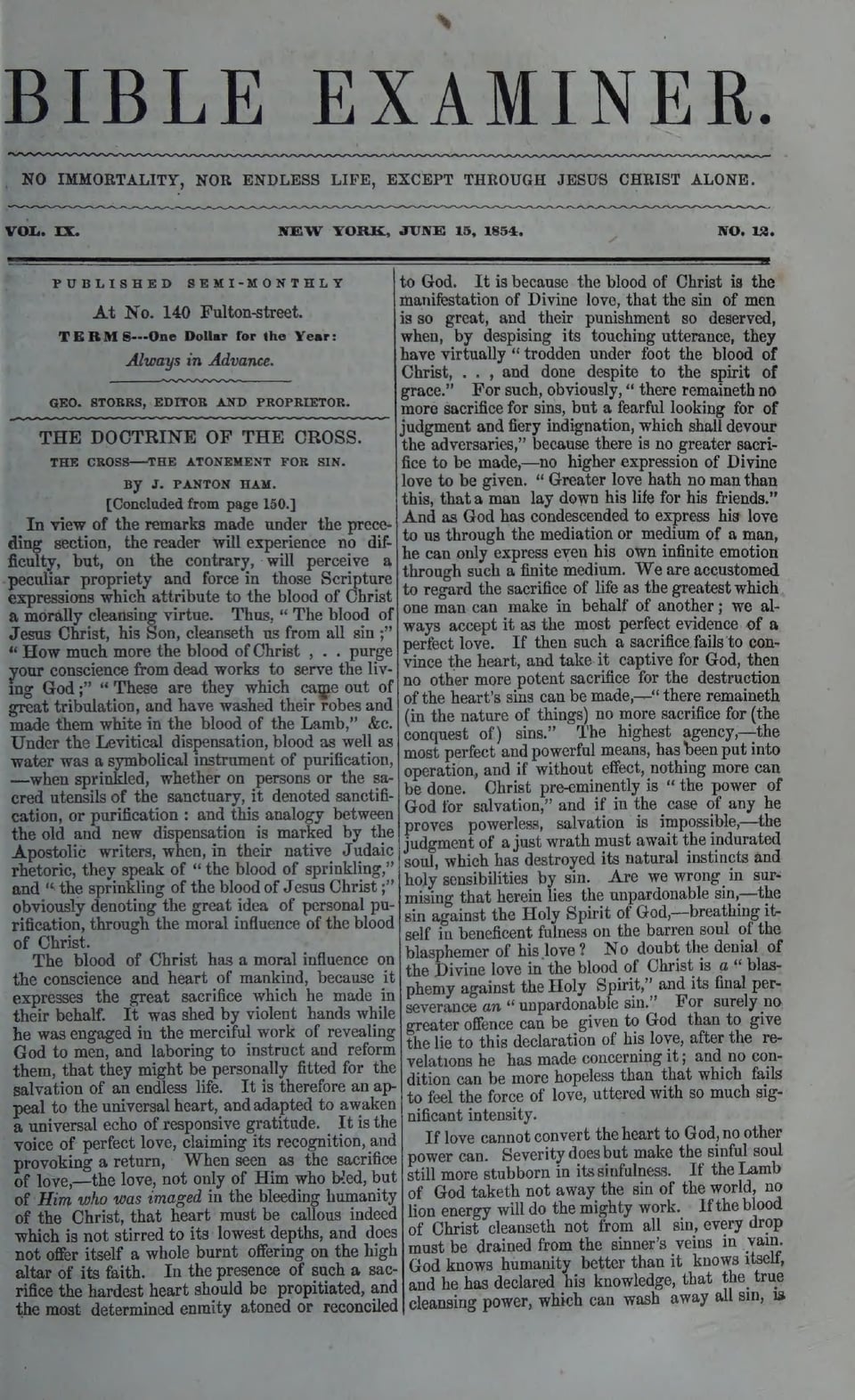
BIBLE EXAMINER.
NO IMMORTALITY, NOR ENDLESS LIFE, EXCEPT THROUGH JESUS CHRIST ALONE.
VOL. IX.
NEW YORK, JUNE 15, 1854.
NO.12.
PUBLISHED SEMI-MONTHLY
At No.140 Fulton-street.
TERMS----One Dollar for the Year:
Always in Advance.
GEO. STORRS, EDITOR AND PROPRIETOR.
THE DOCTRINE OF THE CROSS.
THE CROSS—THE ATONEMENT FOR SIN.
BY J. PANTON HAM.
[Concluded from page 150.]
In view of the remarks made under the preceding section, the reader will experience no difficulty, but, on the contrary, will perceive a peculiar propriety and force in those Scripture expressions which attribute to the blood of Christ a morally cleansing virtue. Thus, "The blood of Jesus Christ, his Son, cleanseth us from all sin;" "How much more the blood of Christ , . . purge your conscience from dead works to serve the living God;" "These are they which came out of great tribulation, and have washed their robes and made them white in the blood of the Lamb," &c. Under the Levitical dispensation, blood as well as water was a symbolical instrument of purification,—when sprinkled, whether on persons or the sacred utensils of the sanctuary, it denoted sanctification, or purification : and this analogy between the old and new dispensation is marked by the Apostolic writers, when, in their native Judaic rhetoric, they speak of "the blood of sprinkling," and "the sprinkling of the blood of Jesus Christ;" obviously denoting the great idea of personal purification, through the moral influence of the blood of Christ.
The blood of Christ has a moral influence on the conscience and heart of mankind, because it expresses the great sacrifice which he made in their behalf. It was shed by violent hands while he was engaged in the merciful work of revealing God to men, and laboring to instruct and reform them, that they might be personally fitted for the salvation of an endless life. It is therefore an appeal to the universal heart, and adapted to awaken a universal echo of responsive gratitude. It is the voice of perfect love, claiming its recognition, and provoking a return. When seen as the sacrifice of love,-the love, not only of Him who bled, but of Him who was imaged in the bleeding humanity of the Christ, that heart must be callous indeed which is not stirred to its lowest depths, and does not offer itself a whole burnt offering on the high altar of its faith. In the presence of such a sacrifice the hardest heart should be propitiated, and the most determined enmity atoned or reconciled
to God. It is because the blood of Christ is the manifestation of Divine love, that the sin of men is so great, and their punishment so deserved, when, by despising its touching utterance, they have virtually "trodden under foot the blood of Christ, . . , and done despite to the spirit of grace." For such, obviously, "there remaineth no more sacrifice for sins, but a fearful looking for of judgment and fiery indignation, which shall devour the adversaries," because there is no greater sacrifice to be made,—no higher expression of Divine love to be given. "Greater love hath no man than this, that a man lay down his life for his friends."
And as God has condescended to express his love to us through the mediation or medium of a man, he can only express even his own infinite emotion through such a finite medium. We are accustomed to regard the sacrifice of life as the greatest which one man can make in behalf of another; we always accept it as the most perfect evidence of a perfect love. If then such a sacrifice fails to convince the heart, and take it captive for God, then no other more potent sacrifice for the destruction of the heart's sins can be made,—"there remaineth (in the nature of things) no more sacrifice for (the conquest of) sins." The highest agency,—the most perfect and powerful means, has been put into operation, and if without effect, nothing more can be done. Christ pre-eminently is "the power of God for salvation," and if in the case of any he proves powerless, salvation is impossible,—the judgment of a just wrath must await the indurated soul, which has destroyed its natural instincts and holy sensibilities by sin. Are we wrong in surmising that herein lies the unpardonable sin,—the sin against the Holy Spirit of God,—breathing itself in beneficent fulness on the barren soul of the blasphemer of his love? No doubt the denial of the Divine love in the blood of Christ is a "blasphemy against the Holy Spirit," and its final perseverance an "unpardonable sin." For surely no greater offence can be given to God than to give the lie to this declaration of his love, after the revelations he has made concerning it; and no condition can be more hopeless than that which fails to feel the force of love, uttered with so much significant intensity.
If love cannot convert the heart to God, no other power can. Severity does but make the sinful soul still more stubborn in its sinfulness. If the Lamb of God taketh not away the sin of the world, no lion energy will do the mighty work. If the blood of Christ cleanseth not from all sin, every drop must be drained from the sinner's veins in vain. God knows humanity better than it knows itself, and he has declared his knowledge, that the true cleansing power, which can wash away all sin, is Love.
Hence he put this mighty moral force in operation when he "so loved the world as to give his only begotten Son" for it, and when it pleased him that his Son should be bruised for the purification of our iniquities, for "by his stripes we are healed," if healed at all of our spiritual disease; we have "washed our robes, and made them white in the blood of the Lamb," if the "robes" of our righteousness are really "washed" and "made white." Christ on the cross, because the full expression of the love of God is the true "Fountain opened for sin and uncleanness." Have we known by blessed experience the purifying and healing virtue of this "Fountain?" Have its sanctifying waters flowed in their purging course upon our consciences and lives,—destroying within us the sense and service of sin? Then indeed may we unite with the ransomed Church, in ascribing all the praise and glory "unto him that loved us and washed us from our sins in his own blood."
Such being the moral significance and power of the Cross, or, which is the same thing, the blood, or death of Christ, it is apparent how it has become pre-eminently the Atonement for Sin. The word atonement,—it ought to be carefully remembered by all who would have clear and just views of this great subject,—is a word which, when employed by our translators of the English Bible, was used as the equivalent of the word reconciliation, as its etymology, as well as its usage in the New Testament, clearly establishes. It has now another, and widely different signification,—that of making amends for any thing, or any person,—a sense which it has derived through the much lamented prevalence of a most false and vicious scheme of theology in the Christian Churches. The literature of the word atonement will abundantly testify to the truth of our statement, when we affirm that it ought to be understood, in its New Testament use, as equivalent to Reconciliation. In the Old Testament it is the translation of a word which means to cover:—hence the phrase "to make atonement," is literally to cover. The idea is that of covering over sins by a gratuitous forgiveness, on certain conditions, which God represented by means of those sacred symbols of sacrifice which he instituted for the instruction of his ancient church. In Leviticus, chap. 17:11, we read, "It is the blood that maketh an atonement for the soul,—literally, it is the blood that maketh a covering for the soul or person of the sinner. In New Testament phraseology we should read it thus: "It is the blood that maketh reconciliation for the soul or person." Understanding, then, the blood to be that of Christ, we have already seen how it operates as a moral drawing power on the heart of man, binding him in grateful allegiance to Christ, and through Christ, to God, so establishing a reconciliation, or at-one-ment, between man and God. Herein is the true reconciliation, or atonement, effected by the cross:—a reconciliation, be it carefully observed, not of God to man, but of man to God.
It is often overlooked that a very marked precision distinguishes the language of the sacred writers on the subject. They uniformly exhibit the reconciliation as looking towards man, and no
towards God. It is man who needs to be reconciled or atoned, not God. "If when we were enemies," writes an Apostle, "we were reconciled to God by the death of his Son." "And having made peace through the blood of his cross, by him to reconcile all things unto himself. And you, who were sometimes alienated, and enemies in your mind, by wicked works, yet now hath he reconciled," (i.e. "you.") "That he might reconcile both unto God in one body by the cross, having slain the enmity thereby," (i.e. man's enmity to God.) "All things are of God, who hath reconciled us unto himself by Jesus Christ." "God was in Christ reconciling the world unto himself." "For if the casting away of the Jews be the reconciling of the world." "We pray you in Christ's stead, (for this was Christ's mission,) be ye reconciled to God."
In all these texts which we have quoted, to make apparent our statement, it will be observed that it is uniformly said that it is man who is at enmity with God, and who needs to be reconciled; and therefore it is in keeping with this representation that the Apostle Paul, in the only verse where the word atonement occurs in the New Testament, says that it is man, and not God, who has received the atonement. "And not only so, but we also joy in God, through our Lord Jesus Christ, by whom we have now received the atonement," or reconciliation. The atonement of the Bible, then, is not the doing something to God as a compensation or satisfaction, but a doing something for man as a means of propitiating or reconciling him to his Maker. As represented in Scripture, it is the practical energy of a powerful persuasion,—an eloquent and heart-stirring appeal made by Christ, in the name of God, to mankind. It is atonement, not as a judicial satisfaction to God, but as a moral propitiation of man. It is the assault of a powerful love on the hearts of aliens and "enemies to God by wicked works." The heart that yields is reconciled, or atoned to God, and for that reason is the receiver of the atonement, or reconciliation. Thus Christ is "the propitiation for (or on account of) our sins." He propitiates not God, but us, because of our sins, which cause us to be at enmity with God. In order to accomplish our reconciliation, the Apostle Paul tells us that "God hath set Christ forth to be a propitiation, through faith in his blood." He who has faith in Christ's blood,—who believes it to be the expression of his own and his Father's love for man, feels the power of that blood,—is conscious of its moral influence on his heart as a propitiating agency,—and by the eloquence of its condescending utterance, returns propitiated and penitent to his Father's house, saying, "Father I have sinned against heaven and in thy sight, and am no more worthy to be called thy son." Shall we not say with the beloved Apostle, in the contemplation of this wonderful scheme of atonement, or reconciliation, by the propitiatory blood of Christ, "Herein is love, not that we loved God, but that he loved us, and sent his Son to be the propitiation for our sins."
The reader, who may have accompanied us with some degree of distrust and anxiety in the outset of our inquiry into the proper scriptural significance of the cross of Christ, will, we presume, by this time, see that we had no design to lower the appreciation of this great fact of Christian doctrine, but, on the contrary, to extricate it, so far as our abilities enable us, from that irrational and irreligious confusion by which it is enveloped in the popular faith.
We cannot understand Christianity without the cross:—deprive it of this, and you dislocate the whole system of revealed truth, and render Christianity an imperfect and powerless thing. "Christ must needs have suffered and risen from the dead." He must "needs have suffered" for the perfection of his own example, and for the power of that persuasive eloquence which the cross pre-eminently possesses. Hence, we add to, rather than diminish, the force of our Lord's emphasis, when, after his resurrection, he said to his disciples, "Thus it is written, and thus it behoved Christ to suffer, and to rise from the dead the third day."
In our view of the nature of the cross, and its value in the Christian system, it is an indispensable fact, inasmuch as it gathers to itself the highest practical influence of Christianity. The cross, as we apprehend it, is a mighty moral power, indeed, the power which takes the heart captive, and trains it for the enjoyment and service of God. It is not a thing to tremble before in the paralysis of a sinstricken fear, but a fact to feel grateful for, and whence to derive the inspiration of a generous faithfulness. On this account we need a cross in our notions of Christianity: we need, not only a Christ, but a "Christ crucified." A Christ without a cross might possibly be a human creation, but it could not possibly be the creation of God. It "must needs" be that Christ should have a cross,—in the very nature of things it could not be otherwise. It may be a "stumbling block" to the religious Jew, and "foolishness" to the philosophical Greek, because they know not the nature of highest virtue, and how it ever fares in our world; they know neither the perfection nor the omnipotence of love. But to God, and also "to them which are called, both Jews and Greeks, Christ is the power of God, and the wisdom of God."
But we must not dismiss this grand subject without saying a word or two on the relation of the cross to the Forgiveness of Sins. In the popular scheme of theology, the cross of Christ was a judicial arrangement to make the forgiveness of sins possible, by transferring the punitive deserts of sin to a substitute. We pause not to expose what must be apparent on the least reflection,—the contradiction involved in the statement that sin is both punished and pardoned at the same time. We shall merely declare what, in our judgment, is the true relative position of the cross to the forgiveness of sins, and this may be set forth in very few words. As we apprehend the cross of the New Testament, it is the agency by which God effects the repentance and reformation of sinful men. It is a moral energy for subduing the heart's enmity, not an artificial equivalent to satisfy certain imaginary demands of inflexible law. The cross, if we understand its moral significance, does not purchase the sinner's pardon, but prepares him personally for it, by transforming his character, and making him the subject of holy dispositions
and desires, Forgiveness is a gratuity on the simple conditions of faith and repentance,—faith in the message and mission of Christ as the necessary preliminary to repentance. It is a strange doctrine which represents forgiveness as impossible to God, and asserts his obligation to take vengeance on all sin, as well repented of, as not repented of. It is strange both to our moral sentiments and practice, and we think also strange to the Christianity of the Bible. God is not satisfied by taking vengeance on our sins, so much as by turning us away from the paths of vice. The cross was a satisfaction to him,—in it he was well pleased, because it possesses that power of persuasion which effectually redeems the sinner from the love and service of sin, and fits him to appreciate and profit by the grace of a free forgiveness. And thus the Apostle tells us that "according to the good pleasure of his will he hath made us accepted in the beloved; in whom we have redemption through his blood, the forgiveness of sins, according to the riches of his grace."
Our view of the cross of Christ unites it indissolubly with the grace of forgiveness, for it makes faith in Christ, and, of course, in his cross, a prerequisite to being morally influenced thereby, so as to discover our own sinfulness, and need of salvation. Until we believe in Christ we do not place ourselves in that sympathetic relation to him which enables him to act upon us as "The fountain opened for sin and uncleanness." But as soon as we believe the heart-stirring facts of his mission, and the sacrifice he made in fulfilling it, those healing waters flow in upon our moral consciousness,—"His stripes," endured in our behalf, heal us of our sinful diseases,—his "blood" shed for us, "cleanses us from all sin." Thus the forgiveness of our sins, as well as every other Gospel blessing, is through the medial agency of the Lord Jesus Christ, who is both the bearer of this heavenly grace, and the begetter within us of that repentance which is the indispensable condition of its enjoyment. In the view of this two-fold relation of Christ, to the forgiveness of sins, a very considerable emphasis is imparted to the memorable words of the Forerunner of our Lord, "Behold the Lamb of God that taketh away the sin of the world."
Finally, the doctrine of the Atonement, as we have represented it, is no longer a dry speculative dogma of scholasticism, and a professional theology, but a practical matter of immense personal concernment. Instead of being a subject for occasional discourse, as among the abstruser mysteries of the Christian doctrine, it is brought forward into fore-ground prominence, as the grand burden of the Christian ministry, to all who are unreconciled to God. So at least Paul viewed it. He calls the Christian ministry the "ministry of atonement." The term "reconciliation," which, as we have before observed, is the same in meaning as atonement, may be used interchangeably with that word. It occurs in its verbal and nominal forms in 2 Cor. 5:18-20, and the same Greek word is used there as in Romans 5:11, where it is translated "atonement." By substituting the word "atonement" in the passage first mentioned, the force of our remark about the practical prominence of the doctrine of atonement in the Christian ministry will be apparent.
Paul there says "All things are of God, who hath atoned us to himself by Jesus Christ, and hath given unto us the ministry of atonement, namely, that God was in Christ atoning the world unto himself, not imputing their trespasses unto them, and hath committed unto us the word [doctrine] of atonement. Now then we are ambassadors for Christ, as though God did beseech you by us; we pray you in Christ's stead, be ye atoned to God." "For," to paraphrase his words which are so extensively misunderstood, "God hath given him, who committed no sin, to be set forth a propitiatory offering for us, that we, being propitiated by him, might, through his moral agency, become workers of the righteousness of God." The true Christian preacher persuades men to be reconciled to God, by representing to them the greatness of the Divine love to sinners, of which the cross of Christ is the highest expression. He shows how
God's beseeching voice is here,
Breathing forth its tenderest strains,
And when sinners so interpret the high significance of the cross,—when it is to them "as though God did beseech them" by the soul-stirring eloquence of blood, shed to serve and save them,—and when yielding to this eloquent appeal, their sinful hostility is subdued, and they become humble suppliants at the footstool of mercy,—then is the atonement, or reconciliation accomplished,—then is it actually made for the individual sinner. Its historic occurrence is then, when the sinner yields to the moral power of the cross, and, repenting of his sins, becomes reconciled or atoned to God. To us there is no mystery in the atonement, other than its own intrinsic mystery of love. And other than this we know of no Christian atonement. The Gordian knot of the "extent of the atonement," as it is theologically phrased, is easily untied by the simple theory which we advocate. It extends just so far as it is effectual in reconciling sinners to God through Christ. Every addition to the true church of repenting sinners is a new extension of the atonement, and when sinners cease to be recovered and reconciled to God, the atonement halts in its Divine work of conciliation, and awaits a further extension among men.
Would that the preachers of Christianity knew that the "ministry of atonement" was committed to them, and, instead of disputing about the extent of a fancied satisfaction, sought to extend the atoning agency of Christ, by proclaiming that "God was in Christ atoning the world to himself, not imputing their trespasses unto them!" Would that, throwing aside the false and mischievous speculations which they mistakenly designate the atonement, they would startle the slumbering sinner, by assuring him that as yet no atonement has been made between him and his Maker!—that the cross of Christ is ever seeking to effect that atonement,
and that unless atoned now, while the day of grace surrounds him with its golden sun-light, he
must die un-atoned, and share the destruction of those who perish everlastingly!
Men know not that the bleeding Christ is the image of a beseeching God,—that the cross is the loud cry of Almighty compassion. The atonement in its sublimest and most powerful ministry, is not yet administered but on a very limited scale. Now that the world has almost lived its Christian history, and the signs of the times indicate that the Son of Man is nigh at hand, even at the doors,—theological men are beginning to discover this long lost ministry of love, and beginning to apply it! But it is as yet a mooted point: the popular churches have not yet recognized it, and the few that have are cast out as reprobates and heretics! Before we can hope to see "the ministry of atonement" in active operation in the churches of our land, it must pass into favor with the spiritual sanhedrim, and receive the broad seal of authority of the high priests and scribes of Christendom. More than eighteen hundred years ago, Christ sealed it with his own blood, and nearly as long ago the Apostles published to the world that God had committed unto them "the word or doctrine of atonement," to preach as the grand burden of their Christian ministry to all who were still unreconciled to God. And now the churches deny this trust, and instead of preaching an atonement that has power to woo the heart, and work the reformation of the life, they teach mankind a theological tradition, which shocks the moral sentiments, and has no influence, save a detrimental one, on the masses of society. Christ, when he expired on the cross, kindled a fire in the world to burn up its enmities, and bend the iron stubbornness of the soul into a grateful and willing service; but religious men have cooled it down by their crude conceits till now it is at the very zero of spiritual efficiency. The cross, which is the most wonderful illustration, among the wonderful works of God, of his skill in bringing good out of evil, and making the wrath of man to minister to his praise, has been distorted by the theology of the popular churches, into the most awful tragedy which the world has ever been called to gaze on,—a tragedy in which the benignant Father himself is represented in the most revolting character,—a character which we cannot love,—which neither our instincts nor the principles of the religion of Christ will permit us to love. The cross, which, in the theology of the New Testament, is so unequivocally proclaimed to be "the power of God" for the conversion of men, is, through the theology of the churches, their greatest perplexity. That which was designed to reconcile us to God has been perverted into an instrument to repel men from one another,—to foment prejudice, party-feeling, and even violent persecution! Of what wrongs and wickedness has not the cross been made the symbol and servant! When it was erected into a power, it was made the power of violence, and bloodshed, and murderous wars; and now that the traditions of men have made it almost "of none effect" for evoking the heart's repentance and reverence towards God, it stands as the dry-rot of the church, nourishing nothing but the decay of the church's vitality, and Christian brotherhood.
God grant that the cross of our corrupt Christendom may perish, that the cross of Christ may yet again be lifted up before men, and the voices of thousands of grateful hearts ascribe "grace, grace unto it!"
ETERNITAS REVIEWED.
BY REV. WM. G. MONCRIEF.
"ETERNITAS : or. Glimpses of the Future Destinies of Man : By Wm. BATHGATE."
[Continued from page 164.]
And while thus obliged to restrict the bearings of the words, "neither can they die any more," to the regenerated,—to them they are replete with immense consolation. In our judgment, and we are not ignorant of this great question in its divers bearings, it is the strongest assertion of their future deathlessness, delivered in that word on which we rest our highest expectations. This is our fortress of immovable stability; it is ground to stand upon that no earthquake can disturb. They can die no more. It is not even said they will die no more; the "can" gives a power to the affirmation that ought to excite our boundless gratitude to Him who brought light and immortality to light through the Gospel. One can scarcely leave the expression, for it refreshes like the smitten rock in the wilderness. It irradiates the distant future as with rosy beams, and flings towards us its illuminations as we journey towards the sepulchre, among the ruins of mortality. As we contemplate the time-future, its blackness of oblivion seems every hour about to descend on us, and at any moment it may; but imagine yourself, O faithful disciple, on yonder side the grave; look down the valley of futurity then, and it is all cloudless; while ever and anon you may hear from the spangled firmament over your head, as if an archangel tuned his harp, the words of triumphant jubilee, of which in the incorruptibility of your resurrected frame, you have at once the meaning and the proof, "neither can they die any more."
Thus we have endeavored to meet and overthrow those lines of reasoning brought forth by Mr. Bathgate in defence of his position that the passage from Luke affirms a universal human immortality. We have made great concessions to our author for the sake of doing justice to his teaching, and after all we are compelled to declare that his argumentation is as destitute of vigor as the whole system he upholds is of satisfactory proof. And we must now bring back to memory the fact that the verses we have found him commenting upon, and whence he would evolve evidence of the deathlessness of all human souls, has not one word about souls from its commencement to its close. To prove his point he might have quoted with equal propriety, "Thus the heavens and the earth were finished, and all the host of them."
"Eternitas," on behalf of the common dogma of human immortality, derived from the conversation of our Lord with the Sadducees. One, yes one, though only one passage was promised us about man's immortality, as our author delivers it; and lo, the one is an empty vessel,—a hollow delusion. He builds up a plea, and an infant's hand might pull it down, for it is only an erection of cards. And in such a fabric poor old orthodoxy was to find shelter from the storms of indignation at his position. The writer ought to have been more considerate, unless, which is not to be imagined, he had had some evil design of exposing the hoary deceiver to a tempest in which it was foreseen he would totter and expire. Many long for that hour, for he has practiced his cunning arts before the church and the nations so long and so well, as nearly to eclipse the glory of Him who is the revealer of immortality, and at the same time the resurrection and the life. It is time he were dead,—we don't mean disembodied,—but literally defunct, and consigned to the grave.
The more that the reader understands the true doctrine of soul, as already partially developed in one of this series of papers, he will the more readily endorse our assertions concerning the imbecility and absolute worthlessness of the argument in
Though not logically necessitated to examine the 37th and 38th verses of the chapter before us, whence the "one" passage for immortality was promised us, it may be useful to glance at them for a little, as they are misunderstood by the author, and by very many along with him. Perhaps the simplest plan is to present a brief exposition of them, taking up any difficulties as we go along, either suggested by Mr. B., or others, with whose writings we happen to be acquainted. And first let us again quote the verses, that they may lie before the reader's view.
Ver. 37. Now that the dead are raised even Moses showed at the bush, when he calleth the Lord the God of Abraham, and the God of Isaac, and the God of Jacob.
Ver. 38. For he is not the God of the dead, but of the living; for all live unto Him.
We begin by remarking upon the 37th verse. It will be observed, then, in the 36th verse our Lord had asserted that resurrection was not merely possible, but something yet actually to happen, at any rate to parties therein described by their moral qualities. Its reality depends, up to that stage in his reply to the Sadducees, on his authority alone, and, of course, with all who admit him to be the Messiah, that is a sufficient basis for it to be placed upon. But as he was not conversing with those who allowed his claims, it was important to meet their objections in a way more fitted to gain their consent. Personal authority with them could go for little when they were not believers in Jesus; but they might see the force of an argument drawn from Moses, in whose testimony they had confidence. From Jesus, therefore, the question is carried to the Hebrew legislator,—the question is fair, and the tribunal is acknowledged. "Now that the dead are raised, even Moses showed at the bush," or the words which Moses affirms he heard from the bush, proved the dead are raised, or that there is to be a resurrection of the dead. The Sadducees, we are informed, denied "any resurrection;" they also rejected the existence of angels and spirits. They were not atheists, but while they had faith in God they were believers in the unity and materiality of man, they also held that at death it is over with each human agent forever.
That the Lord God formed man of the dust of the ground,—that in death there is no remembrance of God, or any one else—that the dead know not anything, was their creed in reference to humanity, and it would be difficult to prove they were anti-scriptural on these points. They erred in this, however: they not merely affirmed that in death remembrance was gone, but that it was gone forever: in short, that a man, when once prostrated by the king of terrors, could never live again. They rejected the future life altogether, seeing, as far as their eye reached, no evidence of resurrection, and perhaps deeming it speculatively an impossibility that life could ever be restored to the children of corruption. They had no faith in intermediate states, purgatories, limbos, or any such localities, with their attenuated denizens. With them death was a palpable and terrible reality,—a going out of the lamp,—a snapping of the thread of life; the lamp never to be re-kindled, the thread never again to be re-joined. Our Lord purposes to prove to these men that existence could be restored, and that even in the Scriptures which they revered,—the writings of Moses,—it was prophetically intimated in language which was not too dark for an ordinary apprehension. As soon as he pointed out the argument, the effect of it was acknowledged by those who were auditors of the dispute. "When the multitude heard this, they were astonished at his doctrine."—Matt. 22:33. "The scribes answering said, "Master thou hast well said."—Luke 20:39; and the very Sadducees themselves were put to silence.—Matt. 22:34.
It has been said, though the Sadducees believed in the entire destruction of man in death, there is no need to suppose that our Lord had the same idea in his mind concerning the deceased, when he uttered the words, "Now that the dead are raised." In other words, it is affirmed, that our Lord held it was only of "bodies" that a resurrection could be predicated,—souls not needing it, being in themselves incapable of extinction. But our Lord says nothing, either here or anywhere else, about souls being exempt from mortality. Moreover, the universal teaching of Scripture is, that the soul of a man is just the man himself, whom the Lord God originally formed of the dust of the ground. Further, he says, "Now that the dead,"—not dead bodies, but the dead, i, e., dead men, are raised. They are dead, and they are dead as men. He is to prove not that men never die, but that dead, extinct men shall live anew by the power of God; he has already answered who are to be incapable of death a second time, beyond the resurrection hour; he now simply grapples with the Sadducean error that resurrection would not,—could not possibly take place. It even matters little whether many or few are to rise; let resurrection be proven as a thing destined by God to happen, and the removal of objections to the resurrection of one carries away difficulties from the mind of a Sadducee as to the resurrection of any number who may be appointed to resume consciousness activity.
Once more, the present tense is in this clause employed for the future,—a figure of speech with which we are familiar in the sacred writings. "The dead are raised," i. e., are to be raised, or will rise. Our Lord is not to prove that the resurrection of the dead has taken place, but that they will rise at a future time. Some are of opinion, like the Swedenborgians, that the resurrection occurs at death, or that the going away of the "soul" or "spirit" from its fleshly abode is the resurrection of Scripture; and, of course, they hold that when this disembodiment and translation happens men are done with materiality and its experiences forever afterwards. This, we can only afford time to observe, is just the popular idea very slightly modified, and perhaps exhibited in a more consistent form than we are accustomed to find in the volumes of the self-styled orthodox: and it is a doctrine which can be no more received by the man who understands the Bible doctrine that the "soul" is just the human being himself,—that his "spirit" is the life-breath which animates his form, than the common theory, or any conceivable modification of it.
The proof of resurrection is,—"Moses showed at the bush that the dead are raised," when he calleth the Lord the God of Abraham, &c. The Sadducees had already appealed to Moses (v. 28.) and the Savior leads them again to their own favorite authority, as we have already observed. The common opinion, approved by our author, is that these renowned patriarchs were not dead, but at that hour, when the dispute took place, as truly in consciousness as when they were pilgrims on the face of the globe. But the Savior classes Abraham, Isaac, and Jacob among the "dead;" and, indeed, if they were not dead, what need had they of a resurrection? The Sadducees affirmed that men, once lifeless, would never be revived by Divine power; and our Lord's intention was to show that the very doctrine rejected by them was indirectly announced by the voice that Moses heard at the bush. They could not be dead and alive at the same time,—needing a resurrection, and yet not requiring it; in heaven and in the grave at the same moment! Save the Bible from such absurdities, and fill creeds and commentaries with them to the brim, if you please. The patriarchs must be held to be dead in the plain sense of the term. Their spirit—their life-breath had gone forth. They had returned to their dust, and in that very day their thoughts had perished: they had joined the great company of the silent and the unconscious in the land of darkness:—they were as if they had never been. What do we read of their decease? Does it countenance the delusion that death had been to them a "blissful friend," or a relentless foe? How sound the records? "Then Abraham gave up the ghost,"—expired, "and died in a good old age, and full of years; and was gathered to his people. And his sons Isaac and Ishmael buried him in the cave of Macpelah, in the field of Ephron, the son of Zohar, the Hittite."—Gen. 25:7, 8. "These all [Abraham, &c.] died in faith, NOT HAVING RECEIVED THE PROMISES, but having seen them afar off, and were persuaded of them, and embraced them, and confessed that they were strangers and pilgrims on the earth."
"These all, having obtained a good report through faith, RECEIVED NOT THE PROMISE, God having provided some better thing for us, THAT THEY WITHOUT US SHOULD NOT BE MADE PERFECT."—Heb. 11 : 13, 39, 40. It seems then most proper to use the words of Peter about David with application to Abraham, Isaac, and Jacob. "They are not ascended into the heavens," "They are both dead and buried, and their sepulchres are with us unto this day." Here, then, are men in the exact position whence the Sadducees affirmed they never would, or need be taken. Shall these dead men live anew? Yes, for God is still their God. "I am the God of Abraham, and the God of Isaac," &c. What is it to be a God to them? How does the intimation he is yet their God evolve the Savior's position, that they would yet be resurrected from the arms of the grave?
TRUTH ADVANCING.—The following Response by the Editor of the Christian Advocate—organ of the Methodist E. Church, in this city—to a correspondent in that paper May 4th, we hail as a return to the Bible, which is cheering, and indicates an abandonment of pagan philosophy for the only source of information in relation to a future life. The Bible is where we have ever desired to meet the opposers of the doctrine of immortality and eternal life only through Jesus Christ as a gift of God to the holy alone, and conferred at the resurrection of the just, in the last day.
The Editor of the Christian Advocate—Dr. BOND—speaks thus:—
We have deeply felt the importance of the subjects to which our correspondent refers: "The relations of the spiritual to the material world, and the disposition made of the soul on its separation from the body." We have consulted philosophy and philosophers in regard to these subjects with no success. Philosophy, applied to spiritual things, constitutes what is called natural theology, and from natural theology is derived what is called natural religion. Now natural theology must be derived from natural phenomena; that is, from the works of creation, as they are exhibited to our senses, and from the providential government and superintendence manifested in these works. Both in antiquity and modern times men of the greatest ability, and most patient industry, have inquired of the phenomena of nature and providence, and have ended in nothing but vain speculations in respect to spiritual things. Their theories are vain imaginations, unsupported by proof which carries conviction to the judgment, or satisfaction to the longings of human nature after sure and certain hope in respect to the future.
At the very threshold of the temple of knowledge, the philosophers of both ancient and modern times have met with an insurmountable obstacle to their progress. They could not proceed a single step without answering the inquiry, Has man an immaterial spirit in him-something distinct from, and capable of existing independently of
matter? They found the opinion everywhere prevalent that he had; but how did it originate? Tradition had handed down the belief from the earliest ages, but mixed up with the most puerile conceits, and absurd superstitions. Could it stand the test of philosophical inquiry? One thing was perceived at the outset. The question as to the existence of spirit could not be subjected to ordinary philosophical tests. Philosophy examined matter, its qualities and laws, as it was presented to the senses; but spirit was neither tangible nor visible—was not cognizant of any sense. How, then, could its existence be demonstrated? If any attempted to demonstrate the existence of spirit by the operations of mind, the argument was met by the objection that no one was so well and accurately acquainted with the powers of which material organization was capable, as to be assured that no peculiarity of organization was competent to perform functions attributed to the mind. It was not more inscrutable than the thinking of subordinate animals, and the functions which are performed by what is called life in vegetables. It excelled these in degree, but so might human organization excel in degree all other forms of life.
But if philosophy could not demonstrate the existence of an immaterial spirit in man, it could not assure us of a future state of existence, and consequently could not reconcile the existence of moral and physical evil in the world with the omnipotence and Goodness of God; for it was evident that a good man, possessed of omnipotence, would not have made a world like this, where no degree of excellence could exempt a man from the evils of life—from pestilence, famine, oppression, pain, bereavments, and death. It was true, then, as Paul declared in his day, that "the world by wisdom (i. e., philosophy) knew not God," and it is true still. They could not assure themselves of his unity, much less of his omnipotence and moral attributes comprehended in the word goodness. On the contrary, when they contemplated the moral and physical evil existing in the world, and viewed the apparently unjust administration of providence, they could come to no other conclusion than that there existed both good and evil deities, mutually counteracting each other in the government of the world. True, they could not contemplate the phenomena of creation without perceiving evidence of intelligence and power in the works and in the government of creation. These attributes were evident—everywhere seen. They were apparent in the movements of the heavenly bodies by fixed and invariable laws, and the structure of the smallest insect testified to the same intelligence and power by the adaptation of its organization to the purposes of its economy. But whether this intelligence and power resided in one God, or in many gods, philosophy could not decide. And, indeed, had it decided on unity as a divine attribute, the other attributes of intelligence and power would have afforded no basis for religion, as they would have taught nothing which could direct man how to worship and serve the Creator so as to procure his favor.
With these views we renounce, wholly, all reliance upon metaphysical theology, and consequently upon natural religion, and betake ourself solely and exclusively to revealed theology and religion, as found in the Holy Scriptures.
We have settled the only question which remained to be answered after philosophy failed us; namely, Are the Scriptures true? Do they contain a revelation from God to man? We find their truth attested by evidence which our judgment cannot resist;—demonstration as satisfactory as the Q. E. D. of Euclid; "They have God for their author, salvation for their end, and truth, without any mixture of error, for their matter. Here, then, we rest our faith and our hope, in all spiritual concerns. Our only business now is to inquire, What has God said? what does he require? what does he promise? what does he threaten? With John Wesley, we are homo unius libri,"—"a man of one book"—in regard to the interests of the soul for time and eternity; and, "looking into the perfect law of liberty, and continuing therein, not being a forgetful hearer, but a doer of the work, we are happy in our deed."
BIBLE EXAMINER.
NEW YORK, JUNE 15, 1854.
THE DEATH OF CHRIST.—As Br. Ham's articles on "The Cross of Christ" have now all appeared in the BIBLE EXAMINER, and as considerable controversy has arisen and more may arise, we deem it our duty to say a few words more on the subject.
We do not endorse all the positions of either side in this controversy. We believe the death of Christ was necessary to deliver dying men from sin and death: that without it the world would not have had a Deliverer, and all would have perished without hope. But we do not believe that his death by crucifixion was either planned by God, approved by Him, or necessary to redeem man. Nor do we believe the Son of God died one moment sooner for being nailed to the cross. By causing him to be crucified the Jews displayed their malice and wickedness, and were justly chargable with being his betrayers and murderers, as the design and intention constitutes the crime. But the Jews did not actually take away his life, nor was it in their power to do so, any more than they could hold him in the tomb when buried.
In support of our position we have first the testimony of Jesus himself—"No man taketh my life from me, but I lay it down of myself. I have power to lay it down, and I have power to take it again." When hung upon the cross, it is evident that his death was not caused by the crucifixion. Pilate marvelled that he was so soon dead. He dismissed himself from life. The hour of his death was to be the hour of offering the Possover lamb; that was the hour for the glorious anti-type to offer
himself up in death for our redemption. Till then his "hour" had "not come;" then it had come; and then he would have died even if no "wicked hands" had been there. But God suffered wicked men to manifest their wickedness on the occasion, and thereby his death was notorious to all, and his resurrection made the more certain by the pains his enemies took to prevent his disciples from "stealing him away."
Jesus' death, then, was a necessary event, and he would most certainly have died without any human intervention; as no such intervention did or could take away his life. He laid it down of himself. The crucifixion was not necessary: it was not planned of God, nor required as an act to constitute Jesus such a Deliverer as perishing men needed. The crucifixion was a wicked act, and all concerned in it were wicked men who committed the foulest crime. The act was never approved of God, and of course never made necessary for the redemption of men. The fact that prophecy foretold the death of Christ by acts of wicked men, no more proves that God planned His Son's death by crucifixion than that He planned and designed the abomination, called Papacy, because prophecy foretold it.
Jesus died ; that is a glorious truth. Jesus rose from the dead is another glorious truth. But wicked men no more actually killed Christ, than good men actually raised him from the dead. Wicked men disclosed their murderous hearts in nailing him to the cross—but they had no power to take away his life. Jesus himself has forever set that fact at rest—"No man taketh my life from me, but I lay it down of myself." He reached our lost estate by descending under death where we all lay, and by his resurrection brought life and immortality to light: thanks, eternal thanks to God and the Lamb.
"THE WORLD OF WOE."
The American Messenger, published by the Am. Tract Soc., for May, makes the following remarks :—
"The Justice of Endless Punishment, for the sins of time, is often denied by men, because they reject the testimony of the Bible as to the evil of sin against an infinitely holy and just God, and because they think only of the sins of time. But man will go on sinning through eternity, and will deserve to be punished through eternity. In the world of woe, man will be freed from all the restraints that here keep him back from sin, and will be forever given up to all evil passions and influences, and therefore will never cease to sin, It is evident that as long as a sinner continues to add to his sins, God's justice will require his continued, his endless punishment.
Shall we presume to say that God's standard and sentence are not just? How much wiser to acknowledge the justice of our condemnation, and looks to Christ for pardon."
The Scriptures teach us that men are to "receive," when "the Son of Man shall come in his glory, according to their works, . . . in the body." Compare Matt. 16:27, with 2 Corth. 5:10. To talk about men being punished for sins under a system of government where they cannot avoid sinning—shut up to the necessity of wickedness—is to represent the inflictor of the punishment as the most outrageous tyrant and monster conceivable: and, besides, there is not a single "Thus saith the Lord," to support such a monstrous sentiment, found in the Bible: it is a pure assumption and "fable."
The same paper, in another article, says, "No mere apprehension of danger ever effectually leads to holiness. Men cannot be frightened out of their sins."
That is truth : and not only so, but threatening a punishment, manifestly opposed to reason—as endless misery is—is the most effectual way to harden men in sin, and engender hatred instead of love. The natural result of the doctrine contained in the foregoing defence of "endless woe" is to make thinking men abhor the being who is supposed to design such a punishment for sin.
The same number of the Messenger has in it a story of a "cruel boy," that began his career by tormenting and killing flies and little animals: and asks, "Was he not very cruel?" At length he arrived at such a pitch of love for cruelty, that "He enjoyed cruel sports of all kinds; and the groans and sufferings of his fellow creatures afforded him rich entertainment."
What better is the Demon—for we will not say God—of the "endless woe" of the American Messenger? We fearlessly reply that "Nero" was a saint to him. For Nero killed his victims in the end; but the Demon of "endless woe" is supposed to have the power and the disposition to protract the life of his victim to unending ages, and to be constantly increasing the anguish of the sufferer: and no sorrow or pain of the miserable being is ever to move the demon-god to relax, or show pity.
No wonder " Nero's subjects grew weary of him, and condemned him to be thrown from the Tarpeian rock and dashed to pieces." Such was a deserved fate.
But we rejoice to know that the view taken of endless punishment, in the Messenger, is totally unsustained by the Bible, and the God of the Bible
is not to be charged with such blasphemous teaching.
Again the Messenger says—speaking of "Repentance unto Life,"—"He who will not be won by love, cannot be saved." That is truth. Why then attempt to win men by the blasphemous teaching of "endless woe?" It never did and never can win a soul of man to repentance, or draw them to God.
In the article about the "cruel boy," the Messenger inquires, "Does any child think that the great God, whose tender mercies are over all his works, and who watches the dying sparrows, will not be very angry with all those who in any way abuse his creatures?"
Truly! But how irreconcilable is the last view of God with the previous one, which represents the same God as inflicting "endless woe," on the "creatures" He has made; and under circumstances, too, where it is impossible for them to reform; or, if they should, He would in no case liberate them from their pains?
Must not that "God, whose tender mercies are over all his works . . . be angry with those who in any way" represent Him as giving life to innumerable beings whom He determines to make immeasurably and eternally wretched and miserable?
QUESTIONS.
Br. Storrs:—I wish to ask you a few questions, and should be glad to have you answer them.
What was it that was closed up and sealed till the time of the end? 2. What was it the wise shall understand? 3. What are the periods of time in the Bible for, if we are to know nothing about the time of Christ's coming? There is so many different opinions that I want to know yours. Some think the church is now in the wilderness, and the signs have none of them appeared. Yours, in love, looking for immortality in Jesus Christ,
Lisbon, N. H.
IRA QUIMBY.
REPLY OF THE EDITOR.—1. That which "was closed up and sealed till the time of the end "was the "words" which related to "the end of these things" which had been the subject of the previous prophecy.
"The wise shall understand" the "words" spoken of, when the "time of the end" shall arrive.
"The periods of time in the Bible" relate to events of which we can "know" something; but it remains yet to be proved that any symbolic period relates to the precise time of Christ's "coming." We are not convinced by anything that we have ever yet seen that there is any evidence of a symbolic period—"day for a year"—being given us for the second coming of Christ.
We believe, from the best light we have, at present, that the 1290 and 1335 days of Daniel 12th are literal days, and yet in the future. Our reasons for that belief we stated in the Examiner several years since. They are briefly these : Daniel 10th, 11th and 12th is one chain of historic prophecy, not symbolic. Hence there is no reason for regarding the "days" in the 12th chapter as symbols of years. Besides, the original term for days in that chapter is the same as that used in the 10th, where the personage that appeared to Daniel—after he had fasted "three full weeks"—said, "The Prince of the kingdom of Persia withstood me one and twenty days." Here no one doubts that literal days are meant. Why, then, in the same discourse, shall we suppose the same term is employed to signify years? and that too when no other part of that discourse is symbolical? and especially as the word translated days is not the same that is used Dan. 8th, "2300 days."
We are at present decidedly of the opinion, that the time in Dan. 12th relates to the period of a personal Anti-Christ, yet to be developed, who will constitute "the abomination that astonisheth," and continue in his glory for the number of literal days spoken of in that chapter. Then may "the wise understand" even the time of their deliverance, and will more earnestly long for it than has ever yet been realized by any previous saints. Dr. Kitto, under the head of "Anti-Christ," says :—
"Justin Martyr, in his Dialogues with Trypho, describes him as exercising his wrath against christians with special fury in the period immediately preceding the Second Advent. Cyril of Jerusalem repsesents him as reigning three years and six months preparatory to the entire destruction of his dominion at the second coming of Christ; and says, he will deceive both Jews and Gentiles; the former, by representing himself as the Messiah; the latter by his magical arts and incantations. St. Chrysostom observes, on 2 Thes. 2: that Anti-Christ will not lead men to idolatory, but will rather abolish the worship of false gods, as well as that of the true God, commanding the world to worship himself alone as the only Deity."
We are inclined to the view that the development of the real Anti-Christ will be Atheism enthroned, perhaps in all the governments of earth, and possibly the Papal head will take that form. The Prince of the power of the air has tried all forms of religion to cheat and destroy men—paganism, with all its forms of idolatry till they were exhausted in their popularity—then he transformed paganism into Papacy, and has used that till it has become an abhorrence to all reasoning men; and his last dying efforts will be to enthrone Atheism;
or a rejection of "all that is called God, or that is worshipped." Papacy hitherto has not answered this description, though it has shadowed it forth and prepared the way for it. "The Anti-Christ" is clearly described by John in his First Epistle, chap. 2, verse 22; "He is [the] anti-christ that denieth the Father and the Son." The emphatic "the" is in the original. There are and have been, "many anti-christs;" but there is to be revealed one who is emphatically "the anti-christ;" and John clearly designates him as a denier of "the Father and the Son." Such has not been, hitherto, the character of Papacy: it may possibly yet assume it, to adapt itself to the spirit of Atheism that is now spreading in Europe with awful power.
THE DISCUSSION.
"DOES THE BIBLE TEACH THAT THE CREATURE MAN—WHICH THE LORD GOD FORMED OF THE DUST OF THE GROUND—HAS A SUPERADDED ENTITY CALLED THE SOUL?"
The Affirmative by Prof. Mattison.
Mr. Editor:—Granting you every thing you desire in the statement of the question, I proceed at once with the argument.
To prove that man has a spirit, distinct from his body, I have proposed to show first that such entities as spirits exist; and to show that there are spirits in the universe, unconnected with material forms or organs, I allege, upon the authority of the Bible, that God is such a spirit. Of the relevancy of this argument our readers must judge. I am talking of God the ETERNAL SPIRIT, as you must have known; and if you choose to run off upon the term "composed" to write about a created spirit, while I am writing about Jehovah, our readers will doubtless infer the true reason.
But let me call you back to my argument. I affirm that "God is a pure spirit, immaterial, uncompounded, and indivisible; and unconnected with bodily form or organs." My scripture proof is John 4 : 24, "GOD IS A SPIRIT." I affirm that this point is vital to my argument, and invite you to either admit it, or deny and controvert it. And you respond that it is "irrelevant." Strange that the question whether spirit ever exists separate from matter has no bearing upon the question of man's spiritual nature. If God is a spirit immaterial and uncompounded, then there is at least one purely spiritual being in the universe; and the question of the possibility of the existence of a spirit, conscious, intelligent, and active, without connection with matter, is settled beyond all cavil. Besides, the determination of this point will settle the question as to the nature of spirit. Please, then, to meet my argument frankly and fairly or leave it to its legitimate office in the discussion.
But you seem, after all, to feel the force of this "irrelevant" fact. And to escape it you virtually deny it. This you do when you affirm that the doctrine of the immateriality of God "is a pure assumption, without a particle of Scripture authority;" and also where you speak of "the Pof.'s notion of a spiritual nature" as something that you do not believe.
For you well know what my "notion" of the spiritual nature of God is, viz : that he is a pure spirit, unconnected with a material form or organs. And by controverting this "notion," so distinctly and fully avowed, you take the position that God is a material being.
This is what I expected. For whoever denies that consciousness, thought and intelligence can exist separate from a material organization, must either deny that God is a conscious and intelligent being, or deny his pure spirituality, and invest him with material organs. You adopt the latter alternative; and in the face of one of the most direct, explicit, and unequivocal statements in all the Bible, going to show that God is a spirit, you controvert this "notion," and avow your belief that he is matter! And you even assert that the Bible does not teach the contrary!! Pray, then, tell me what is the meaning of the declaration, "God is a SPIRIT." Are spirit and matter the same? And will you assert that God is a material being, in the face of the declaration of Christ that he is a "SPIRIT?"
Leaving you to meet my first argument as you best can, I affirm—
That the "holy angels," so often spoken of in the Bible, are spirits, and not material beings. Who maketh his angels spirits," Psa. 104:4. Are they not all ministering spirits," Heb.1:14. These passages as plainly assert that the holy angels are spirits as human language could do. As God is a spirit, and is so revealed to us, so the angels are revealed to us as spirits also. In this respect God and angels are alike, as purely spiritual entities, unconnected with bodily forms or organs.
…